Here, “electric” means the car runs on electricity from a battery, not gasoline. The hosts are using it to talk about an EV model and how it compares to other EVs.
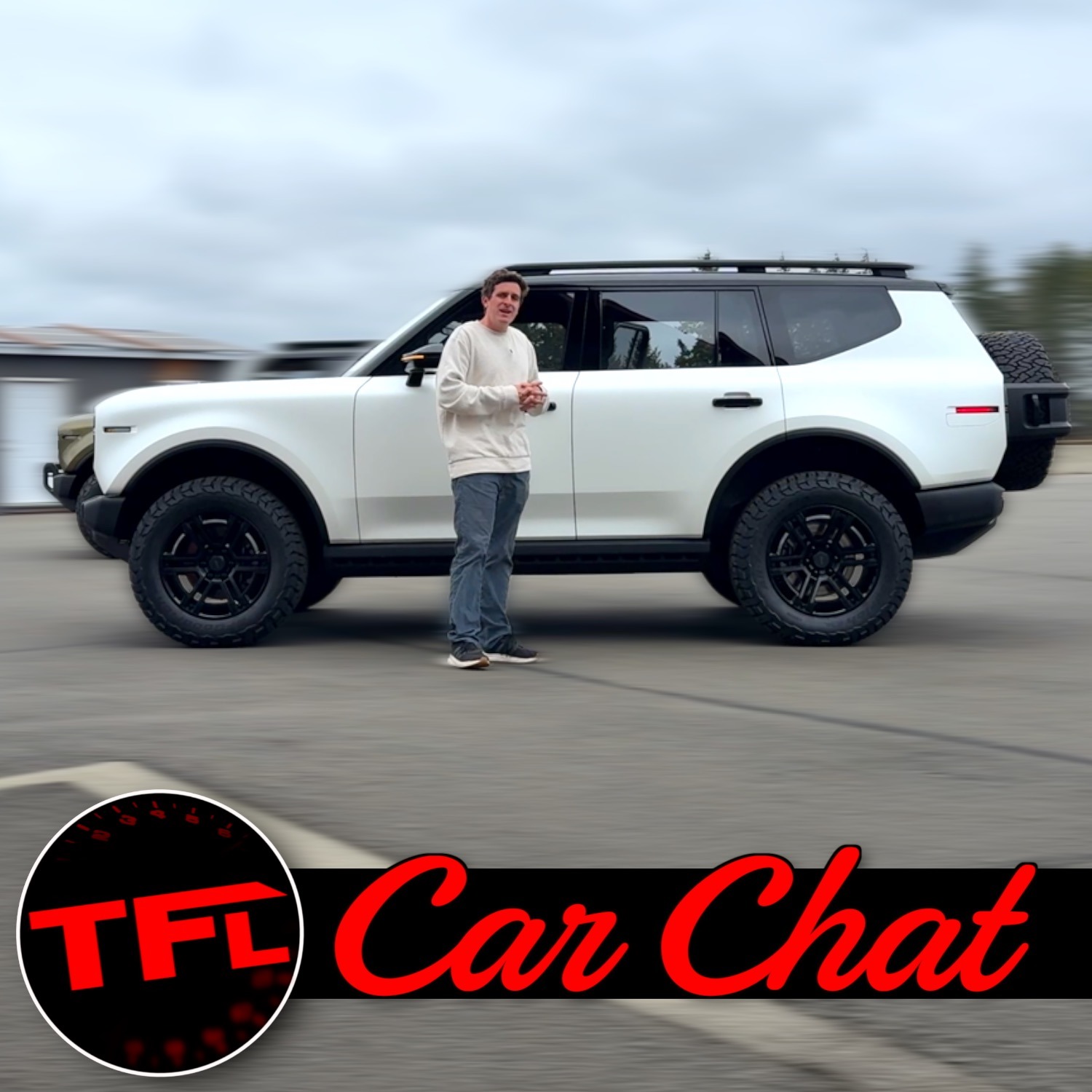
In the podcast, “Traveler” refers to a company that makes a new SUV and a truck. The host says they had a chance to sit down with the vehicles to learn more. It’s being discussed because it’s new and worth checking out.
The Scout Traveler is an upcoming Scout SUV. The hosts say it will come with different battery/energy setups, including an all-electric version and a longer-range option.
The Scout Terra is Scout’s second upcoming model, positioned as a truck alongside the Traveler SUV. The episode frames it as part of Scout’s broader lineup strategy, including different powertrains and range targets.
A range-extended option is a way to go farther than a standard all-electric car. Instead of relying only on the battery, it adds another way to keep energy available for longer trips.
A range extender is like a backup generator for an electric vehicle. It helps recharge the battery so you can keep going longer without plugging in every time.
That means the backup engine has four cylinders and burns regular gasoline. In this design, it’s mainly there to help recharge the battery, not to directly push the vehicle.
It means the gasoline engine isn’t mechanically linked to the wheels. The wheels still get power electrically, and the engine just helps keep the battery charged.
A bench seat is a single, continuous seat for multiple passengers (often two or three) rather than separate individual seats. In pickup/SUV packaging, offering a bench can improve seating flexibility and usability for families or work crews.
Captain’s chairs are separate seats, usually with armrests, instead of one long bench. They’re often more comfortable, but they can take away seating flexibility compared with a bench.
Test units are early versions of a car that automakers build to make sure the design and factory process work. They’re like practice runs before the real customer cars start rolling out.
This segment discusses the factory build-out stages—paint shop, body shop, and assembly areas—and how close each is to completion. It’s presented as evidence that production timing is still on track.
Prototypes are pre-production vehicles used to prove the engineering and confirm the design before mass production. They may still change as issues are found, so prototype timelines often precede final deliveries by a year or more.
Early production units are the first run of vehicles produced as the factory ramps up, bridging prototypes and full-scale production. They help the automaker iron out manufacturing issues and confirm quality before broader customer deliveries.
A “test bed” is a vehicle platform used primarily for development testing rather than normal driving. When the hosts say the cars are “still fundamentally designed test beds,” they mean the vehicles shown aren’t fully representative of customer-ready models.
It’s a way to build a car (often an electric one) using a flat platform underneath. Because the base is shared, the company can make different body styles without redesigning everything from scratch.
Car makers sometimes build test cars using the important parts they’re developing, but with different or temporary body panels. It helps them test the car’s fundamentals before the final look is ready.
Winter testing means driving and checking the vehicle in cold weather. It helps confirm the car still works well when it’s freezing outside, not just in mild conditions.
The Rivian R2 is an electric vehicle made by Rivian. The podcast brings it up while talking about what’s going on in the electric vehicle market. It’s mentioned as the next model people are watching for changes and trends.
The Rivian R1T is an electric pickup truck, meaning it uses electricity instead of gasoline. The podcast mentions it because it was one of the early electric trucks that got a lot of attention. It’s used as a reference point for how the EV truck space has developed.
A reservation is basically a way to say “I want one of these when it’s available.” Companies look at what people reserve to figure out which versions are most popular.
An EREV is mostly an electric car, but it also has a small engine that can generate electricity to help the battery last longer. It’s meant to reduce range anxiety compared with a pure EV.
A “towing number” is the maximum trailer weight the manufacturer says the vehicle can safely pull. It depends on things like power, cooling, and how the drivetrain is designed to handle the extra load.
This is about where the car puts the big “range-extender” hardware. Putting it behind the rear axle can make the layout easier so they don’t have to redesign the whole vehicle to add that system.
A generator is the part that turns the engine’s motion into electricity. In an EREV, that electricity helps run the car and recharge the battery so you can go farther.
Cooling refers to the systems that manage heat for components like the engine, generator, and power electronics. In range-extender vehicles, adequate cooling is especially important because sustained towing or high-load driving can generate more heat than normal commuting.
This is the maximum amount of weight the car’s front or rear axle is allowed to support. If more weight shifts to the back, the rear axle may reach its limit sooner.
They’re talking about how cheap the company says the SUV will be at launch. The question is whether the real-world price will actually land near that goal.
They mention the Ford Lightning as a past example of an electric vehicle where the initial price expectations didn’t always match what buyers saw. It’s used to argue that Scout’s $60k goal may be tough.
They mention the Tesla Cybertruck because it’s another electric vehicle where the initial expectations didn’t fully match what happened in the real world. It’s part of their argument that $60k may be hard to deliver.
Switch gear means the physical buttons and knobs inside the car. They’re saying the interior should feel high-end, with controls that look and feel premium.
A dealer network is the established set of retail dealerships that sell and service vehicles in a region. The hosts are saying VW dealers want to sell Scout through the existing Volkswagen dealer network, which is a business and distribution strategy issue rather than a technical one.
“Vertically integrated” means a company does more steps of the process itself instead of outsourcing everything to other companies. The point here is that some brands (like Tesla) build more in-house, while others rely heavily on suppliers.
This means the “new tech” is often created by companies that make parts for carmakers. So instead of the car brand inventing everything, the suppliers may be where a lot of the innovation happens.
Bosch is a big company that makes parts for lots of car brands. The hosts are using it to explain that many “new tech” ideas come from companies that supply parts, not just from the car brand itself.
A wiper motor is the motor that moves your windshield wipers. The hosts mention it as an example of the kind of part suppliers can design and improve for car brands.
Volkswagen is a car company. In this discussion, it’s brought up as an example of a big automaker that already has supplier connections and could request new designs for another brand.
Carvana is a company that sells cars online and either delivers them or lets you pick them up. The host is using it as a comparison for how Scout might handle delivery or pickup.
Topic
dealer model vs online/digital buying
They’re talking about how buying a car can work either through dealerships or mostly online. The tradeoff they’re weighing is convenience versus how information is handled.
Stellantis is a big car company that owns multiple brands. The point here is that when you deal with a dealer, your information can be linked to the company behind the brand.
The Dodge Charger is a car that’s designed to feel fast and sporty. It’s a gasoline-powered sedan, not an electric vehicle. The podcast mentions it because someone had the chance to consider buying one for their situation.
Fast charging is when an EV can recharge quicker than normal. It’s especially important for apartment dwellers who may not have easy access to home charging.
A kilowatt-hour (kWh) is how they measure the amount of electricity you use. If the price is, say, 33 cents per kWh, that’s what determines your charging bill.
An off-road course is a special track with obstacles meant to test SUVs outside normal roads. It can include hills, slippery ground, and water so you can see how well each vehicle handles it.
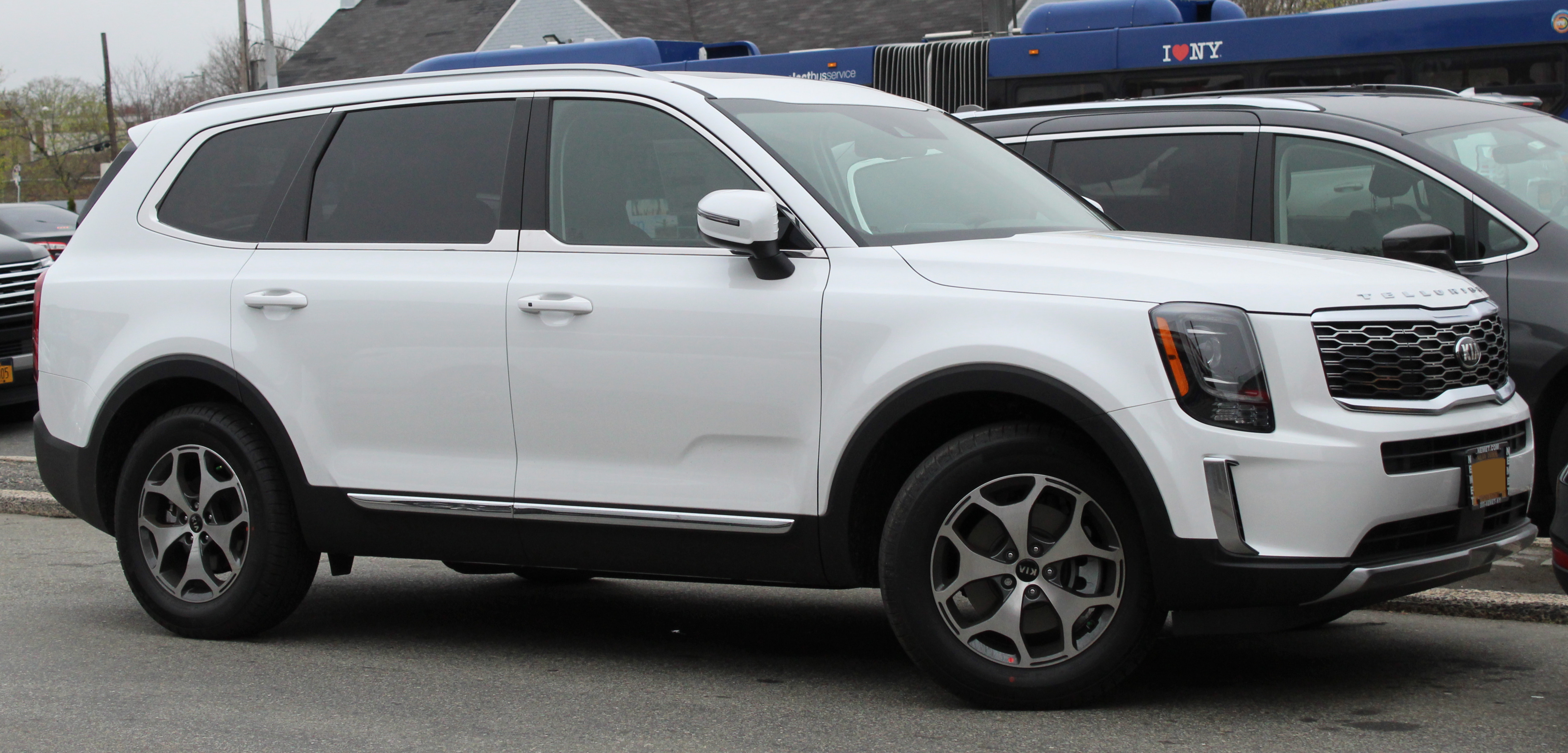
The Kia Telluride is a popular SUV with a nice, upscale interior. They’re comparing engine types and saying many reviewers like the normally aspirated version better than the turbo four.
A “normally aspirated” engine doesn’t use a turbo. It usually feels more straightforward and predictable when you press the gas, compared with a turbo engine that has to build boost.
A “four cylinder turbo” is a smaller engine with a turbocharger. The turbo helps it make more power, but it can feel different than a non-turbo engine when you accelerate.
Car
Kia Palisade
The Kia Palisade is a family SUV. In this segment, they’re talking about how much power it feels like it has, and how that changes depending on altitude where you live.
A V6 is an engine with six cylinders. They’re saying it can feel smooth, but where you live (especially at high altitude) can change how much usable power you feel.
A turbocharged engine uses a device that packs more air into the engine. At high altitude there’s less air available, so the engine may not feel as strong as it does at sea level.
A naturally aspirated engine doesn’t use a turbo. When you drive at higher altitude, the air is thinner, so it can make less power than it would at sea level.
“Torque delivery” is how the car’s pulling power shows up when you press the gas. At higher altitude, that pulling power can feel weaker or less immediate.
They’re talking about an AWD system that uses electric motors to drive the wheels. In this test, the electric drive didn’t have enough pulling force (torque) to get the car moving up the slope.
Trail mode is a setting meant for rough surfaces. It adjusts how the car applies power so it can grip better, but here it still couldn’t get the car up the slope.
Brand
Dunlop Grand Track
Dunlop makes the tires they’re talking about, and “Grand Track” is the tire model. Better off-road tires can help grip, but in this case the drivetrain still couldn’t get the car up the hill.
It means the car can “separate” power going to the front and rear wheels. That can help save energy, but on rough climbs you may want both ends working together for grip.
A transfer case is a device that routes power to both the front and rear wheels. If it’s sending power to both, the car usually has better grip off-road.
Torque availability is basically how much “pulling power” the car can deliver right when you need it. If it’s too low, the car can’t climb well and the wheels may spin.
A rear motor is the electric motor that powers the rear wheels. If it’s small or can’t make enough torque, the rear wheels may not help much when climbing.
Concept
cresting up this hill
When you crest a hill, the car is working hard to keep moving over a changing surface. If the power isn’t going to the wheels that can grip, the car can lose traction.
The Toyota Prius is a hybrid that’s usually focused on efficiency. The host is saying the older Prius setup only supported that mode up to around 25 mph, so it wasn’t ideal for the kind of slow off-road work they were doing.
The Mitsubishi Outlander is a popular SUV. Here they’re talking about how well it can send power to the rear wheels and climb obstacles, and how the newer setup helps compared to the older one.
All-terrain tires are made to work on both pavement and rougher surfaces. They’re saying the Outlander’s trail version was fitted with Cooper all-terrain tires for better traction off the road.
This means the car is directing engine power to the back wheels. They’re describing how the tires behaved while climbing the obstacle—showing the car was actively trying to use traction at both ends.
Term
OEL drive system programming
This is basically the car’s computer logic for how it controls power and traction. They’re saying the Mitsubishi’s settings/software helped it behave well in the situation they tested.
CVT is a type of automatic transmission that changes ratios smoothly. The host is saying it didn’t give the car the strong “grunt” at low speed needed to get through the obstacle.
This means the Outlander uses a small turbo engine plus a mild hybrid system that helps the engine, especially when you need extra effort. They’re saying it makes the car better at getting up the hill and through the obstacle.
The Jeep Wrangler 392 is a special, higher-power version of the Wrangler. The big deal is the V8 engine, and the hosts are saying it sounds really impressive compared to the others they drove.
“Slip a tire” is when a tire loses traction and starts spinning instead of gripping the ground. Saying it didn’t slip suggests the vehicle had good grip on the surface they were testing.
The Kia Sportage is a compact SUV. In this clip, they’re testing how well it climbs a hill, and you can see the tires lose grip and spin when traction isn’t there.
When a tire lifts off the ground (wheel lift) during a climb, that wheel can lose traction and spin freely (wheelspin). This often happens when the vehicle can’t maintain grip due to slope, weight transfer, and limited traction at the contact patch.
Momentum is the vehicle’s stored motion energy, which helps it keep moving up a slope when traction is marginal. The host implies the successful car used momentum to avoid stalling or wheelspin long enough to crest the hill.
The Volkswagen Tiguan SEL R-Line Turbo is a compact SUV with a turbo engine. Here, they’re talking about how it can still push forward strongly when you’re trying to get through something difficult, even without certain off-road options.
An eight-speed automatic is the car’s automatic gearbox with eight different gear settings. More gears can help it stay in the right power range, and in this case the lowest gear helps it move through the obstacle more easily.
A lower first gear means the transmission multiplies engine torque more aggressively at the start of motion. That gives stronger “crawl” ability and better control when you need to move slowly and keep traction while climbing or pushing through a difficult section.
“Low-end grunt” means the car feels strong even when you’re not revving it high. It’s the kind of pull you notice when you start moving or drive slowly up a hill.
The Volkswagen Gol is a compact car made by Volkswagen. The podcast mentions it as a positive example of a model that did well. It’s being referenced because it’s a notable, practical car in Volkswagen’s lineup.
“German driving dynamic” is basically a way of saying the car feels more precise and fun to drive—like the steering and handling are tuned to feel sharper.
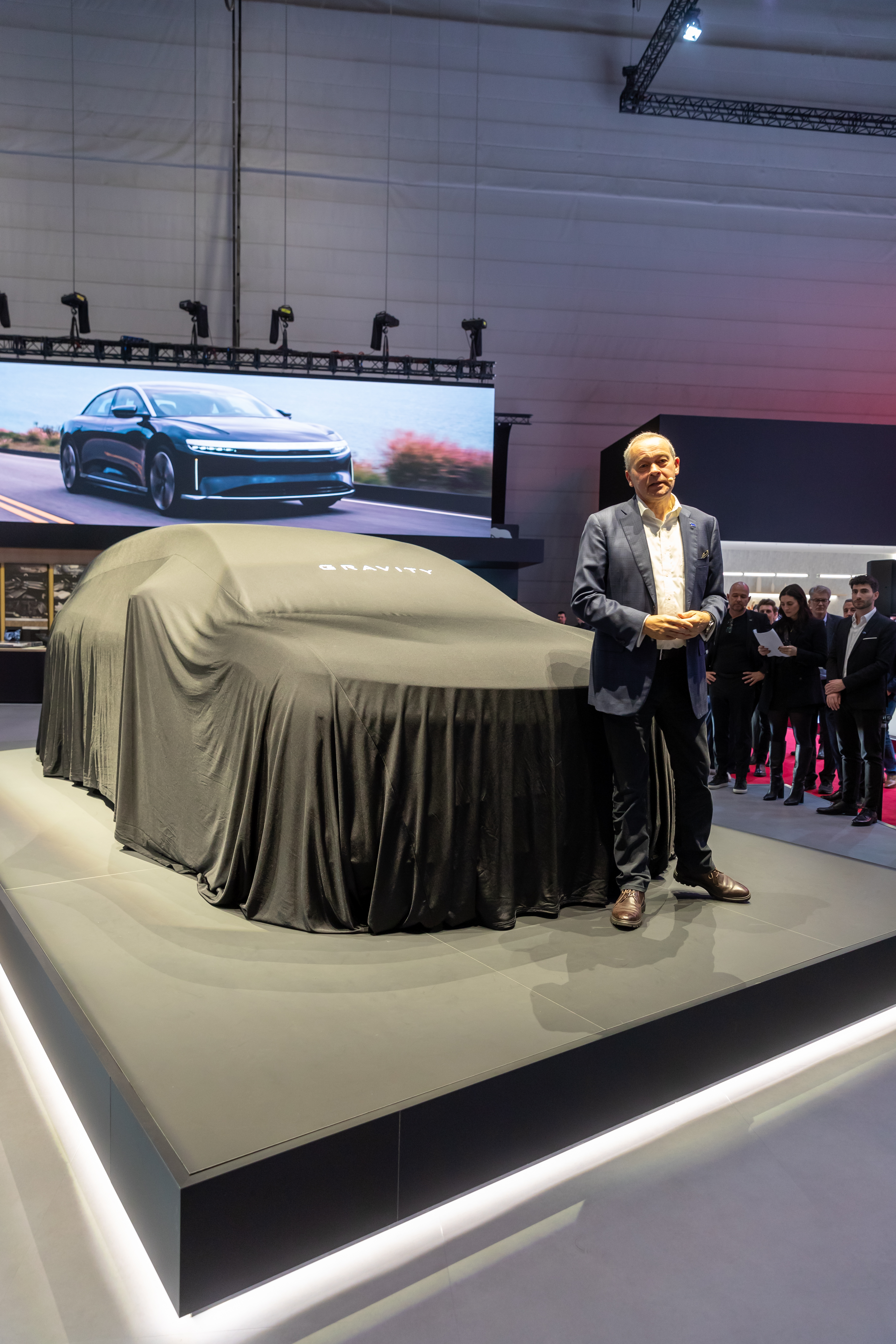
Lucid Gravity is Lucid’s electric family-sized vehicle. The hosts are talking about how it steers—especially that it uses four-wheel steering—which can make it feel quicker and easier to maneuver.
Four-wheel steering means the back wheels can help steer too. That can make the car easier to turn in tight spaces and feel more stable when you’re driving faster.
A “quick rack” means the steering is geared so the wheel turns faster for a given amount of steering input. The car can feel more responsive when you turn the wheel.
A “three-row crossover” is a bigger family SUV with three rows of seats. It’s meant to carry more people, so it has to balance space with how it drives.
LIVE
Time, we got a lot going on in this podcast because you just came back from Portland where
you got the latest and greatest, it's Portland or Seattle, Seattle, oh Seattle, I figured
I get 50% chance of getting that right, where you got the latest and greatest on the latest
news from Scout and then I just came back from Spain, Barcelona, Barcelona where I
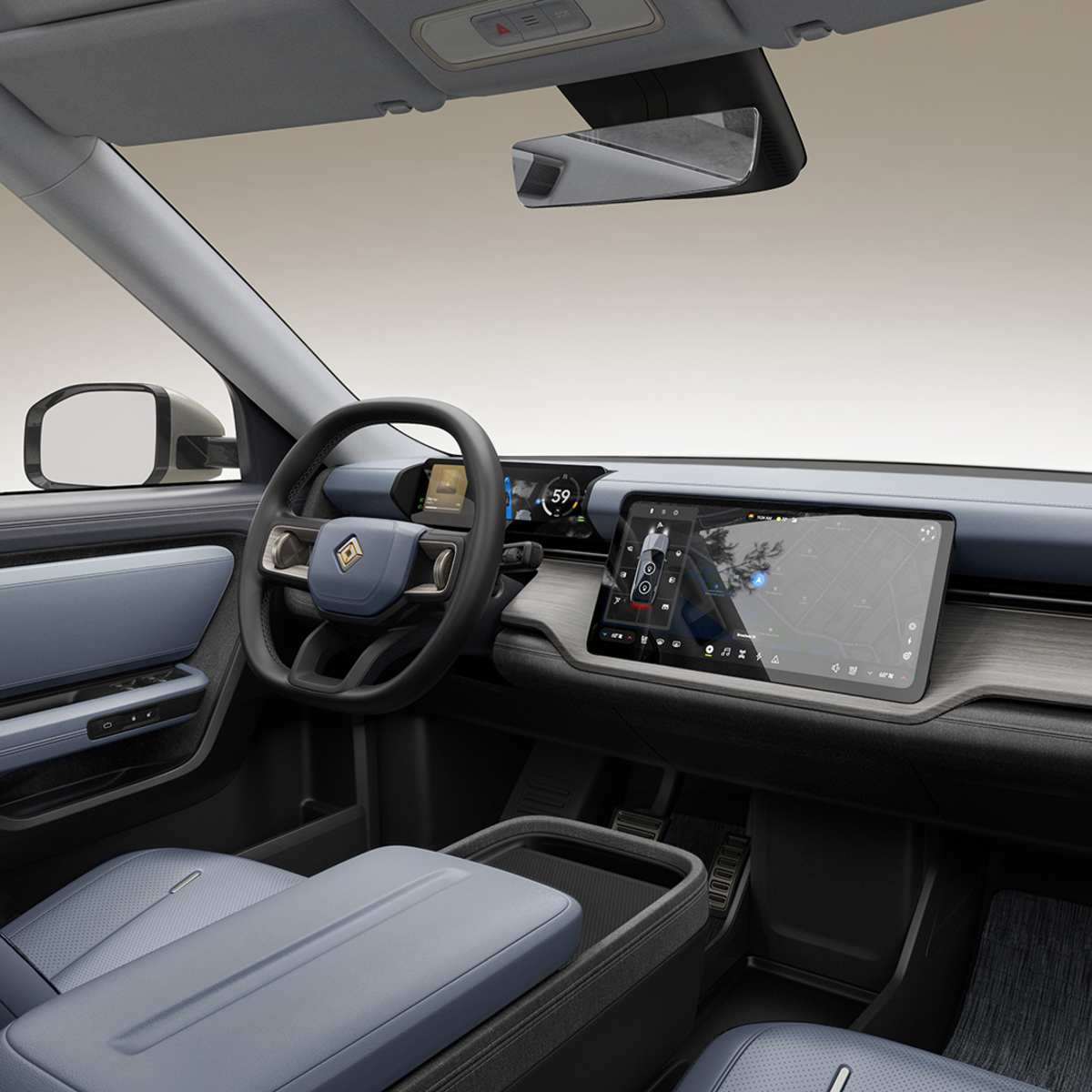
did the new EX60, the electric, let's call it kind of Model Y sort of kind of competitor,
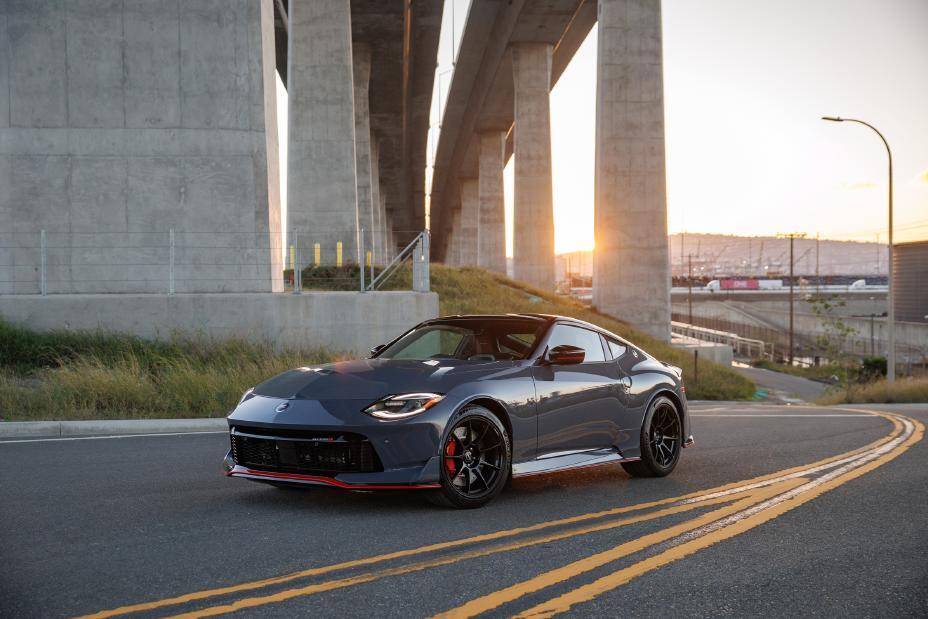
plus you got to drive the Nismo Z, plus you got to drive a whole boatload of other cars,
so let's get right into it with the Scout.
Yeah, so I was at an event called Mudfest, which is put on by the Northwest Automotive
Press Association, and it's a really cool event, basically a bunch of manufacturers
bring out a whole ton of SUVs for us to drive, and we get to drive them on and off road to
evaluate them, put them up against each other, and they set up a really cool off road course
outside of Seattle, Washington, and it was a really nice event, and we'll talk about
some of the other stuff I drove in this podcast as well, but Scout brought over two products
for us to check out, so their new Traveler SUV and Terra truck, and I had a chance to
sit down with them and actually talk through some of the rumors going on at Scout, figure
out what's true, what's not, and some interesting things that I think we can debunk in this
video.
Now do you want to start with some of the changes they've made since last time I've
seen this?
Yeah, let's get the latest and greatest on the Scout.
Now let's start with just the basics, there are two models right there, the Traveler and
the Terra.
Yes, that's right, and there's two powertrains, so there's going to be a full electric with
350 miles of range, and then there's going to be a range extended option with 500 miles
of range, and I've got some news on that, and I'm going to clear up some confusion on
that as well.
So they did confirm to me that the range extenders going to be a four-cylinder gasoline engine
mounted in the rear of the vehicle for packaging reasons, so it doesn't take up space underneath
the front trunk.
And it's going to have a smaller battery than the full electric version, so they're targeting
a total range of 500 miles, but that breaks down into two different things.
150 miles of all electric range, and then when that battery is depleted, the gas engine
will kick on to start charging it back up so you can get another 350 miles of extended
range with the gas engine running.
Now this is going to be a true range extender, there's no connection between the gas engine
and the wheels at all, its sole purpose is to charge the battery to keep you cruising
down the road, but what do you think of that, 150 miles of full electric range, is that
going to be enough for most people's daily driving?
You know most people are happy with like 40 to 50 miles in the latest crop of plug-in
hybrids, so 150 miles is triple that, which I think is plenty.
Like the interior, they keep kind of tweaking it.
I noticed that you did a short where you highlighted that there's going to be a bench
seat.
Yeah, so it's going to be an option in both the SUV and the truck.
In the little showcase it had for us, the SUV had the captain's chairs, the truck had
the bench seat, but it's a really interesting idea, like they keep bringing this back to
kind of the roots of back when it was international, the farming roots, and they want to make this
vehicle durable and useful first and foremost, and then also modernize it with modern tech
and features and creature comforts, but they really do say that things like that bench seat
are there to be a purposeful addition to this truck to make it a more usable vehicle compared
to some of its competition.
Yeah, of course, the controversy has been that there was a story that was put up by
German publications saying that it's going to be delayed for about a year, and then the
CEO said, no, they're on schedule with the first, not the first sellable production units,
but the first kind of test units coming out of the factory sometime next year or is it
this year?
So I asked them about that.
Yeah, you got the, let's hear about it, because I think there's a lot of people who are super
excited.
I do love the bench seat, by the way.
I've got the rumors debunked here, so.
There it is.
Look at that.
They're building a factory in the U.S. in the Carolinas, that's exactly right.
And apparently, you know, the factory's built and now they're outfitting the inside of it,
so the paint shop is very close to being done, the body shop is close to being done, the assembly
areas coming along as well, and they are still on target with what they originally said.
So production to begin 2027 with deliveries to start 2028.
So what that means is they'll start building prototypes and early production units in 2027
and then it'll hit customers' hands in 2028.
Did they say one in 2028?
I didn't get any clarification, but it is supposed to be 2028.
Now where are they at right now?
So the two cars that we just saw, those are still fundamentally designed test beds.
So they're not really running and driving vehicles.
They do move, but they're not full-fledged, you know, cars you could take through the
desert just to get on and off a truck.
Now, they do have mules running around, apparently, with different bodies on them.
So this is very common in the auto industry.
You develop your chassis, your skateboard architecture, and then you just graft on another
body so you can test it, right?
But the test prototypes are well underway.
They've done substantial winter testing already.
So it sounds like things are really coming along, but it's still going to be a little
bit of a wait until we get to get our hands on one.
All right, let me ask you a very basic question.
So what's coming first, the truck or the SUV?
Well, reservations are open and they've been open for a long time.
We have both reserved, by the way.
So 75% of reservations are the SUV.
So the SUV is coming first.
SUV is coming first and 85% are the range extender.
So range extender, SUV is coming first.
Yeah, exactly.
That makes sense.
So rain?
That's good.
That's the one I want.
I am shocked that in a world so dominated by trucks in the US that the SUV is launching first.
I mean, and that the interest is so much higher for the SUV than the truck.
I thought for sure we would see a higher split toward the pickups.
Why do you think that is?
I think that, I mean, look at the Rivian R2, you look at what's happening in general in
the industry.
And I think the truck, electric truck had its moment when Rivian first came out with
the R1T and then ever since then there's been kind of a slide down in interest in
trucks.
I think that the Slade is the last kind of big one that people are going to be
super excited about as a small truck.
But in general, let's face it, trucks, you know, are very popular.
I also think they're like the last American, pure American vehicle, but they still
don't work for, let's say at least 50% of the population or more.
Right.
This is a thing that is big in Texas.
It's the thing that's big in the West.
But if you live in New York, sure, but it's still so big where they sell 400,000
F series every year, 500 or whatever it is, it's still the biggest category of
vehicle.
All right, but let's say, let's say on a typically annual year, we sell 60 million
units, that means vehicles in America.
Let's forward, we know it sells about 600,000 F series, right?
So that's less than a million.
Then add another 600,000 for GM year, 1.2 million.
And then you add Ram into it and you're maybe what, 2 million trucks sold out of
that 16 million annually.
And the reason for that is most people live in cities and trucks don't work in
cities.
But you're also forgetting, that's just F series.
Think about the several 100000 Rangers, several 100000 Tacomas
they sell, Colorado, I guess you could Google it, how much of Google, how many
trucks are sold annually in America?
Yeah, I bet it's, I bet it's quite a lot.
Let's go 3 million out of 16 million.
That's still not, Cole's doing it.
Thank you, Cole.
Thank you, Cole.
But you see the problem, right?
Most people still live in cities and that's the one place trucks don't work
that well.
How many?
12 to 13 million.
Trucks?
Yeah.
Oh, that includes SUVs.
Yeah.
Okay.
So pickup truck sales were roughly 2.3 million according to automotive sales figures.
So out of 16 million, that what, what percentage?
Yeah, yeah, it's pretty small.
Yeah, that's interesting.
But I still think I'm still a little bit surprised by that because it seemed like a
lot of initial excitement around it was the pickup, but clearly the reservation
holders are leaning substantially toward the SUVs.
What I'm surprised about, and I was talking to the PR manager about this, is
that they're still going through with the full electric one.
You know, 85% of the reservations are great.
I actually think that's smart.
Look, well, that's what she said to you.
I know the prevailing winds are right now.
Everybody wants V8s and take the V8 out of my cold, dead hands, but electric cars
are coming, electricity, whether you believe it or not, is a smarter way to
power your car just because your house is your gas station.
That's such an easier way to live.
You just plug the thing overnight and then you drive it around and you plug it
in overnight again, less parts, less maintenance, less of everything, including
money if you're BYD.
And when you combine all that, there's no doubt that electric vehicles are going
to take over this country.
It may happen later than sooner, but that's the way the world is going.
And at some point, this moment in time will pass and people will be like,
you know what, when gas gets, and gas is a finite resource, at some point
we're going to run out.
And so, you know, even all those cross currents, it's kind of pretty logical
that electric vehicles, especially electric vehicles, renewables are the
way that the thing's going to go.
Does that mean, you know, I'm excited about, no, I love V8s.
I love, you know, internal combustion engines, but at the same time, I love
new technology.
So, you know, pick your poison and pick your vitamin.
So I also have some other news from our buddy Sam.
Yeah, what Sam's have to say.
So Sam is from another friend, friend of the show podcast, Wheel Bearings.
Yep.
And he just had a chance to talk with some of the scout folks.
Yep.
So he's got some, he's got some inside information for us.
Scout has only talked about 10,000 pounds towing for the BEV.
They've never given a towing number for the EREV.
But when we asked Scott Kehoe about it, he said they were, they were actively
working on making the towing number as good as possible.
The lack of commitment to matching the BEV to rating is still a strong
indicator that the rating will be substantially less with speculation
at 5,000, although my guess is they will do everything possible to have 7,500.
The people I talked to at this event said something similar, that it will likely
be less, but the engineering team apparently has a pretty cool solution
as to how to keep that number pretty high.
Sam also said, putting the EREV into a module behind the rear axle is great
for packaging the whole module, including engine, generator, fuel tank, cooling
and exhaust will be easy to add without reengineering the rest of the vehicle.
They don't have to route the exhaust and fuel lines around the battery
and they preserve the look of the front, but it will shift the weight
balance toward the rear and reduce max axle weight load rating.
It's true.
And this is the interesting one.
And the scout team confirmed this to me as well.
The starting price for the SUV is targeted at under, $60,000
with top price, hopefully under a hundred K.
So I heard something similar.
You know, I don't, I personally don't think this is just my speculation.
It's going to be very hard for them to hit that 60 K entry price.
Yeah, no one's done it.
Given what I've seen in that vehicle with the size of the vehicle, the feature
set in there, I think it's going to be a real challenge, but it will be amazing
if it does because I think it's a hell of a lot of SUV for 60 K.
Yeah, inflation is just through the roof right now.
I just don't see, I haven't, like you look, you look all the way back to
Ford and the Lightning, you look back to Rivian, you look at the Cybertruck.
Nobody's managed to hit the number they promised initially.
And I think people have become a little bit jaded and stop believing
that these numbers are possible.
And so yeah, I'm not sure we're going to get a $60,000 scout.
I hope we do, but the scout, to me, looks like a very premium product.
We were just looking at the video.
The interior is beautiful.
That's if they can bring in those, that switch gear and that kind of premium
metal look or real metal, it's going to be, be a premium product.
And I could see, you know, people paying premium money for that.
I don't think Scott has ever said, like Ford did, you know, we're going
to come in at $39,000 for an electric truck.
No, they said 60 and they're sticking with 60.
That's still the story.
So they could be contented.
The screen, by the way, I had my first opportunity to interact with.
The scout uses the Rivian software suite.
They partnered with Rivian for the Volkswagen invested $5 billion.
For the UI and then Scott is owned by Volkswagen.
What's interesting now is like that the way they phrase it is interesting.
They don't say owned by Volkswagen.
They say Volkswagen is currently our only investor, but they make it sound
like they're leaving the door open for others to enter.
Yeah, sure.
Right.
So it's not, it's not like part of the Volkswagen group.
What they're saying is this is a little bit more of a separate company.
So we had a long conversation about this as well.
So the other big kind of news surrounding Scout is that VW dealers
in the U S are very upset.
Yeah, they're suing Scout, right?
Because they think that they, they should be the ones to sell scouts
through the Volkswagen dealer network, which, you know, you, you can sort
of see that argument because Scout as a company is like you're saying
underneath the Volkswagen AG umbrella, right?
Which is essentially the German global company.
But the team made it very clear that just because they're under Volkswagen
AG doesn't mean they have any association whatsoever with Volkswagen of America.
So they don't have any partnership or they don't have any commitment
to Volkswagen of USA.
And that makes sense from a legal standpoint, right?
If you're being sued, you want to say, we're a completely different entity.
There's also another precedent there that you could look at.
So, you know, once upon a time, Ferrari was part of Stellantis, right?
Actually, FC at the time, and then it was spun off as its own separate entity.
And as a publicly traded company, and it made Ferrari one of the more
successful brands in the world, because the brand equity is so high.
And so, you know, most of the Volkswagen group companies are part
of the Volkswagen family, but it almost sounds like they could be thinking
about going down that road where they could spin it off as its own
separate company, and then, you know, Volkswagen would get the cash
that they put into it out of it, plus some profit, I'm guessing.
Anyway, and keep a portion of it.
You know, Porsche just sold their steak in Bugatti.
There's just a lot of when there's when there's, you know, upheaval, when there's
change, there's just a lot of different changing of the guard.
And I think we're seeing that or the door being open to that with Scout.
That's my guess.
But there's a lot of like the way they explain it to me, there's a lot of
advantages to being associated with VW AG, right?
So, for example, if you force leaders going to be a V, you know, yeah,
it's probably going to be a VAG product.
But ultimately, if you or I tried to start a company, this is something
people don't think about, right?
Car companies, car companies assemble the vehicles and they do have, of course,
the majority of the engineering ability to engineer a vehicle, but they work
very closely with these huge tier one suppliers for the actual supply line
of the products, right?
So Bosch, for example, you know, Magna, right?
These are all companies that design and engineer products for pretty much
every car company within the industry.
So like car companies are really good at taking credit for innovation, but the
vast majority of innovation within modern cars actually comes from the suppliers.
I'll give you an example.
Do you know that little camera mirror, right?
That that every car has now?
Remember, I think that's been around for like 12 years.
The first time I saw that was with, was in a GM product.
It was in the vault.
The first yes.
And they made a big deal and they're like, look, we have this new thing we came
up with. It wasn't, it was done, but I was talking to another, another company.
They're like, no, we were at a vendor show five years before GM incorporated that.
And they were trying to sell us that technology to put it in our cars, right?
So like the innovation really is happening at the supplier level, unless you're
Tesla, in which case you're very vertically integrated or BYD.
But the point is like, if you and I tried to start a car company and we call
up Bosch and we're like, we really love to work with you guys on a wiper motor.
They would just laugh and hang up the phone.
If Volkswagen calls them up and say, Hey, we've got this connection already.
Can you design us one for our scout brand?
The ball would get with the Micabee, Tommy.
What would it be?
Yeah, but what car would the Micabee?
It would probably be three different colors because none of us can decide what
color it is.
We'd have a different front end and we're in designer.
Very combative.
A lot of, yes, exactly.
It'd be a tank.
Exactly.
That's what the Micabee would be in the tank business.
Let's get back to cars, but let's, let's talk about how they're going to sell
this thing, because that's where I was going with this whole thing.
How are they going to sell it?
Not going to be through Volkswagen dealers.
That very clear.
It's not going to happen.
Well, we already have a reservation.
I mean, they're obviously doing it online.
Yeah.
So they're planning on scout locations, individual stores throughout the U.S.
Obviously kind of very difficult to scale that.
But the word that they said, locations within two hours of 80% of the U.S.
population, and they said the goal is to be able to buy one online digitally
through a 10 step process, just like Tesla.
So you never have to step foot in a scout store.
You can, if you want, that's why they exist.
So you can kick the tires and poke the buttons, but the idea is you can do it
all online within 10 steps digitally.
Yeah.
I mean, that, that makes sense.
And then like Carvana, you pick it up or do they deliver it to your door?
And this is an interesting thing too, that they kept pushing.
One of the challenges and disadvantages of going with the dealer model too is
like when I go to the Fiat dealer, right?
Which you do a lot because of your E.
And I give them my, my, my personal information, right?
That of course goes to Stellantis, but it also stays at the dealership.
And then sometimes that data gets sold.
They say they make you sign a thing saying it won't, but, you know, I think
it is reasonable assumption it could happen, right?
You take it to a separate service station or even the service station within
the dealer, you're giving your data again, where a scout is able to, to keep all
your data secure in one location.
I don't know if that realistically makes you guys feel better, but it is
something that they said is a concern for a lot of consumers.
They kept it, they kept it all together until they sold it.
Well, yeah, I mean, that is always the issue on start.
They kept it all together when they sold it.
Is that, is that how, is that how that works?
Sorry if I'm being a little cynical, but, uh, you know, it is, it is a realistic
possibility and, and, you know, people are, it's funny because, um, you know,
the craziest, craziest new legislation, which is so unbelievably crazy.
There are a bunch of democratic legislatures who want to prohibit
Chinese cars from even crossing the border, even like coming.
Like if you, you know, if you have a Chinese car in Mexico and you want to
come up to El Paso, you shouldn't go across the border.
First of all, how do you, how do you work that?
Like, like you have to then look at the VIN to verify that it was made in China.
And the reason for that is a national security interest, uh, because Chinese
cars have cameras, uh, and they could, I suppose, you know, film everything, but
every car has cameras and could film everything.
Wouldn't that be just easier for, if you, if you wanted to do Chinese
espionage, just to come in here and buy a car and have it film everything, as opposed
to like actually sending Chinese cars in here.
Like buy a car company?
Like just buy a car, just buy any car, by any Tesla, because any Tesla records
all the camera information to a, to a hard drive, right?
Well, that's the rationale that these lawmakers are making, that these cars
could be like recording all the secret stuff that's going on on the streets of
America. You could do that with a Tesla.
You don't have to have a BYD or a Z-turn.
I mean, I really, in my mind, a lot of the, the underlying reason for not
allowing Chinese cars, and even for people driving over, is there, there's
so protectionist over the American auto industry, which they make it seem like
we're a bunch of idiots.
We know, we well, because they're coming out these BS excuses
to not allow Chinese cars.
And the, and the fact is, if you really want to protect the American car
industry, hey, bring in some competition.
I think the biggest problem is that we're lacking competition.
We have no lack of competition.
No, we do.
We, we, we, we have every Korean cars here, every Japanese cars here in
German.
The Chinese have completely changed the way the cars are built.
We're building cars today in America, the way they were built when Henry Ford
came up and used the assembly line.
That's the, it's called the silo method.
That's what we're doing.
The Chinese have completely shattered that model.
And that's why Ford is doing that.
They're trying with that new.
Yeah, the new model.
Anyway, I don't want to talk about an industry.
It's boring.
Let's go back to cars.
Okay.
So, um, we have a question from Don actually a comment.
Yeah.
Roman, yes, electric, maybe the future, but millions still can't charge at
home because they live in apartments or condos or rental homes.
When it comes to fast charging, not at your house, the cost savings
compared to fuel is not much.
That is true.
Fast charging is very expensive.
Yes, this will change, but the issue needs to be resolved.
Uh, you know, that's partially true, but, um, a lot of the new apartment complexes
now, uh, like that we just bought a place, uh, in Moab, which is about as rural as it
gets, right?
This is, this is, this is like the backwater of the backwater.
Well, and we bought the bureau that we have one of that rural.
It's rural.
Tommy, try getting there.
It's rural at six hours from the lake, from the nearest big town.
Uh, but when we bought this place, we, we were, we were given the option of
actually buying a charger as well in our, you know, little condo complex.
So it is changing.
Uh, there are laws being passed, uh, just for that reason where you have to
start having chargers.
So I think, I think that common is fair 10 years ago, but I think today, uh, it's,
it's more difficult than places like, you know, urban centers where there isn't as
much real estate or where it's not new builds.
But I think apartments and condo complexes or townhome complexes are now
getting on board and starting to put chargers in place.
I agree with Don and I also agree with you.
Don, by the way, asks us a comment on our live Patreon page, patreon feed,
patreon.com.
If you want to watch this show live and ask us questions.
Um, but what, what Don's point is interesting is like, yes, it's currently a
big challenge, but if you look at other nations, like much of Europe, like much
of China that, that have rapid adoption of EVs, these are also countries that are
largely driven by, um, condo dwellers and apartment dwellers, right?
If you go to Shanghai and Beijing, where EVs are really taking over, it's all
condos and it's all apartment.
So there are ways that that's changing very quickly.
And let me also push back on what he said about fast charging.
We just, you know, we have a Tesla Model Y and I've been driving it and I super
charged it the other day.
It was 33 cents, uh, 33 cents a kilowatt hour.
It's got an 80 kilowatt hour battery, three times, three times 80 ish is $24.
So it's basically cost 26 dollars to fill up.
Try doing that at the local gas station.
Yeah, it depends on that's fast charging.
But to Don's point, like I've seen a lot of stations at 60 or 70 cents a kilowatt
hour.
It depends.
It varies.
It's like gas.
You really have to, and actually I think it's more, um, it's more subject to price
gouging than gasoline.
Like in an area, you'll find a lot of gas stations and they'll be within a few
cents of each other, but kilowatt hours prices can be 50 or 60 percent different,
even in the same city.
So you really got to be careful with that.
Anyway, let's keep going back to cars.
All right.
Yeah.
So what else did you drive?
So mudfish was a really cool opportunity and a lot of interesting products there that
you should define what mudfest is.
So like I said, the North American, the Northwest, um, uh, the Northwest.
New Wappa.
Geez.
I'm so sorry.
Tom invited me Northwestern Automotive Press Association.
There we go.
Puts on this event.
I think there were a total of 19 cars there and they created a really cool little off-road
course for us to experience.
So we had some good hills.
We had some water crossings.
We had some interesting loose climbs and it was a great opportunity to be able to drive
a bunch of vehicles back to that we might not be able to experience
on a normal precipitation.
So for example, if you're watching on YouTube right now, you see we're cresting this cool
little hill into the water in a Mitsubishi Outlander trail edition and then I was able
to get right into a Toyota RAF for Woodland.
So it was really interesting to be able to just hop into various vehicles one after another
and experience them side to side.
So some of the highlights I'd like to point out and some interesting trends I've noticed.
Hyundai, Palisade and Kia, Taleride really are some of the greatest new SUVs on the market.
I mean, what they've been able to accomplish in those vehicles is truly incredible.
I think that the level of luxury and refinement that you get in, for example, this is the new
Taleride, same thing in the new Palisade, is a step above what it was in the previous generation
and that was already a budget BMW.
So they've done such a good job in evolving the design, pushing the bounds and technology
and comfort.
And our learning meaning, you said something interesting.
You said that the Palisade and the Taleride are sister, cousin, whatever, brother cars.
But you said every journalist likes the normally aspirated Kia better than the four cylinder turbo
in the Taleride.
Yeah, very interesting.
Except we have the Palisade and that's kind of an anemic engine to some extent.
It doesn't have a lot of power.
So I've driven both substantially at this point now.
And I think that a lot of the perspective might be driven based on where you live.
So of course, most of the journalists at this Northwest event
live at sea level.
We're at sea level, right?
And I could see the potential of the smoothness that comes with the V6 being a big factor.
But when you when you live or we live at six or 7000 feet above sea level,
there just isn't that torque delivery that you want out of the turbocharged or out of
the naturally aspirated V6.
And the Taleride is such a better option for where we're at.
So I think it's interesting because everybody on the team agrees that the two,
I think it's 2.5 turbo in the Kia is a much better choice in the V6 and the Hyundai.
But if you live at sea level, maybe there's an advantage for that Palisade.
So big hits on that.
The most interesting thing I experienced is,
Cole, I'm going to airdrop you a couple other clips here.
So I had a chance to drive a bunch of these compact crossovers back to back to back,
which directly compete with each other, which is a unique experience.
It's something that I don't typically get to do.
And there was this really cool little hill climb.
It was a two track about 20 degrees in steepness.
And what I was able to do, and I figured out if I stopped kind of sort of halfway up,
there's a nice trench that was created and I could really test the all wheel drive system.
So I tried it first in the RAV4, went up in the RAV4,
it's kind of crawled off halfway up, started applying more power.
The front end of that car started going crazy, right?
The front end started spinning, flinging dirt everywhere.
But the rear end, because it's got that E all wheel drive system with these separate electric
motor just didn't have the torque required to push me up the hill.
Like I got pretty much immediately stuck.
I tried a bunch of different things.
Was that the hill before the water?
Was it a different hill?
Different hill.
Okay.
Yeah, you'll see this hill.
I was in a trail mode and it just would not go up the hill.
Okay.
So that's surprising because that is the Woodland version,
which has those Dunlop Grand Track all three tires.
So then I tried it in the Kia Sportage.
Similar result, even an X-Pro with off tires.
I gotta say, I'm not sure.
We've done some testing on this and so you've done more than this,
but I'm not sure that Toyota's method of having, you know,
an electric motor that spins the rear wheels
and no connection between the front wheels and the rear wheels is
the best solution for off-roading.
I think it's really good for fuel economy
because you can decouple the rear wheels from the front wheels
so you don't have to necessarily roll off form at the same time.
But I think from an off-road point of view,
it's not as good as some other systems where you actually have,
you know, a traditional transfer case that sends power to both.
What do you think?
Yeah, I do agree with that completely.
And like, I think it's fine for the normal F4,
but for the Woodland, they should have up the torque availability on that rear motor
because you'll see here I'm cresting up this hill
and this is when it was still pretty easy.
And like, you know, I start applying throttle,
look, you can see the front wheels just start going crazy,
trying to grip and it just, it had nothing.
So ultimately I came back when it got even harder in the day
and it just was not having it.
There we go, there's my second attempt.
You can see the front end is super active at trying to get me up the hill.
But look, the rear tires just look like they're doing almost nothing at all.
So that was a really disappointing result.
So I tried a couple other vehicles.
Because that motor is pretty small.
It is pretty small relative to the vehicle.
Let's go to the Outlander.
I mean, in the previous generation Prius,
it would only work up to about 25 miles an hour.
So I think the solution that Toyota came up with was something that's good for fuel economy,
something that's good for like getting going in snow.
Sure.
But it's not meant for like this kind of off-roading.
Yep. So the Outlander, Outlander has a new trail addition,
which actually looks really cool.
And this one even had a set of Cooper all-terrain on it that they added for this event.
And by the way, there's a video coming.
There is a full video coming.
So you're getting a preview of what we haven't edited yet.
So this one was able to send power to the rear.
You can see the rear tire spinning, same with the front tire.
So the OEL drive system programming in the Mitsubishi is quite good.
The problem with the Mitsubishi is it's got a CVT.
So with the CVT, it was unable to give me that low-end torque delivery to get me
through that obstacle.
Now it's got a new engine.
Outlander's got a new 1.5-turbo mild hybrid.
So I think that that's actually an improvement in some ways,
but I had to take quite a good run at it to actually get up the hill.
And you can see it's really working foot to the floor at the top.
Yeah. And to be fair, this is not something that most people who are buying these cars are
going to do.
So I'm not trying to knock the manufacturers for this because this is an extreme test.
Now here we have a Wrangler.
Show the Wrangler.
Sure. This is someone else did this.
There was a Wrangler 392 on this event.
You said that was the most fun.
It was the most fun.
It sounded the best by a country mile.
And it was just, I mean, it's just the engine is so special in that Jeep.
I can't believe how.
Why don't you buy one?
Well, there's 70 grand.
There's a new Willie's coming.
That's going to be 60 grand.
Look at that.
Didn't even slip a tire.
Yeah, of course.
Yeah.
But no, the Willie's is 70.
I thought it was 60.
69.
Oh, I thought it was 60.
The normal one's like 80.
The Moab.
The Moab is like 80.
So 10K less, but you're not getting the hard top.
You're getting the soft top.
That's right.
Yeah.
So most, you'll see in these clips a lot of other journalists went
and a lot of other journalists used speed.
All right, here's another one.
So this is the Kia Sportage.
This is the naturally aspirated 2.5 X Pro version.
I think it looks quite nice.
Actually, I really do like the style of the Sportage
and the tires are excellent.
But even with a more conventional transmission,
you can see we lifted up that right rear tire.
There it goes.
Spinning.
Can't accomplish it.
Anyways, I just want to show the one that did actually make it through.
And this is the funniest part.
The only one of these cars to make it through on the first try.
So you could make it if you used a little bit of momentum.
In other words, what you did is you stopped in the middle of the hill
and you made it harder for the car to get up.
It's this one.
Okay, so this is the one that made it.
This is the only one that made it using my hard method.
Okay.
And it was the one that didn't have the off-road package.
This is the Volkswagen Tiguan SEL R-Line Turbo.
That was someone else doing it.
But you can see kind of halfway through the middle,
it actually has the torque to really push you up.
And I've got 11 of these clips,
Cole has me stopping perfectly in the middle
and it was still able to get through that,
which kind of blew my mind a little bit.
I also had the Mazda CX-5, same problem.
So that's kind of the Tiguan.
Here we go, Cole.
The Tiguan has been.
Okay, the first version of it was not good.
Was okay.
But the Tiguan has been refreshed.
So it is all new.
Yeah.
And the reason it was able to do it
is because it has an eight-speed automatic
with a substantially lower first gear
than a lot of the competition.
But it also just has a 268 horsepower turbo engine
and all this low-end grunt
where it can push through the brakes
and actually get you up where you need to go.
It also looks like it's getting harder
as more cars go up.
It got a little harder,
but the Tiguan was pretty late in the day.
So the Toyota was actually in my first attempt of the day.
Yeah, that was,
now it's become kind of rutted out
and it's a little bit more like.
So here I go.
So once again, lose momentum right there.
You stop and then it just goes.
And then even on these really bad street tires for off-road,
I was able to just crawl up that hill.
Pretty cool, huh?
There you go, Volkswagen.
So another win for Volkswagen.
So on-road, I think that as a whole,
the RAV4 is probably the best option for most people.
I actually like the new Tiguan.
Yeah, it's really good.
I shouldn't say it though.
I like the new Tiguan.
It's a really good package.
I think for a long time it was a little me too.
You know what I mean?
It was just kind of a, it was a little meh.
And now with the latest version,
they've actually kind of infused that German driving dynamic
and German engineering into it.
So I hope it does so well.
Yeah, so.
But that's a very competitive segment.
It is a competitive segment,
but I think as an all-around vehicle,
and I also did some on-road reviews,
it is really hard to beat the RAV4
because of the fuel economy, right?
The Tiguan is an impressive performer,
but it's also very thirsty.
When you're looking at 40 MPG in that RAV4,
especially when gas is 450 gallon on average,
that's a hard one to beat.
It really is.
So out of all the cars you drove,
what was the most fun?
392.
Off-road was definitely the 392.
The Lucid gravity was very interesting on the road.
Yeah, so.
You would like driving it.
You know why?
Why?
It steers like a Cybertruck.
Does it have four-wheel steering?
It's got four-wheel steering and a really quick rack.
That's a real head scratcher.
In my case, a head scratcher,
that's my short way of saying I don't understand
where the head's at.
Because when it was obvious that the whole world
was going SUV slash crossover,
they decided to do a sedan.
And now, when they had the chance
to do a crossover slash SUV,
they did a minivan.
Because at least the shape of it,
it's like they put practicality and utility
over the stuff that makes people buy cars,
which is their heart versus their head.
And they always lead with their head,
except a lot of people,
especially enthusiasts,
when they buy vehicles,
they lead with their heart.
And so, to me, I got a chance to see it at Pebble Beach.
Thank you, Dave, for letting me do a walk around.
But it just felt like the car was, you know,
just another kind of roly-poly.
I just, the styling would never catch fire with it.
At least with that one.
I agree with you that the styling
is a huge miss in that car.
But same thing with the air,
in that the driving dynamics are unbelievable
for what that vehicle is.
And, you know, I think that it's probably
the best driving three-row crossover maybe ever.
I mean, you're talking gas.
I mean, the responsiveness of it, the steering.
But you said the brake is...
The brakes, it was very underbraked for the performance.
I gave the only...
You don't even have regen.
I mean, wouldn't it?
Yeah, it does.
Can you zip up?
Can you, you know, kind of tap up the regen?
No, I'm talking like emergency braking.
Okay.
Like, I was full into that pedal
coming off of our acceleration test today.
But most brakes with electric cars
are certainly blended, you know,
so that some of it is the brake.
For sure.
And some of it is regen,
and you don't know which is which.
I'm talking, I'm talking,
I think on a normal everyday standpoint,
I thought it had plenty of brake.
Yeah.
I did a full emergency stop
from about 80 miles an hour.
Okay.
And the pedal was very soft
and the stopping distance was very long.
Interesting.
I felt that it was not up to the level
that that car should have been.
But the other thing about the Lucid's
is they handle very well,
they accelerate like stink.
And shockingly, it was one of on-street tires,
one of the most impressive of the vehicles off-road.
Because the four,
the all-wheel drive programming
and what they're able to do
with the sensitivity of their torque sensors
was unreal getting it up those hills.
So I guess I'm not an engineer, Sam.
You can answer this if you're listening.
I guess the question is,
okay, when you're normally braking, right,
you're probably got blended braking,
where some of it is actually the brake calipers
and some of it is regen.
Right.
When you do an emergency stop,
does that mean you're just going right to brakes
as opposed to not having any regen?
There still is regen,
but I think you're relying a lot more
on the friction brakes to slow you down.
Yeah.
Right.
Because the car should give you everything
it has to slow you down.
Right.
And I don't know,
maybe there's like an emergency ramp up too
on regen where it gives you a ton more regen
than it would in normal situations.
But for example,
like on most EVs I've driven,
you can actually see on the graph,
you get max regen off one pedal,
and then anything beyond that,
you go to the friction brakes.
So I feel like from an emergency stop,
it probably gives you all the regen it has safely
and all the friction brakes it's got.
You know, this is another trend
that I'm a little confused about.
When electric car companies like Rivian
and in this case Lucid do an off-roader,
they never like go hard off-road.
It's always very like,
you know, they'll do a topographical map
or they'll make it,
they'll make a very elegant off-road.
Well, it's $125,000, right?
But to me-
People want that luxury.
You could have a $250,000 hardcore off-roaders
like the Porsche Dakar,
and they don't, you know, they-
That's not hardcore off-road though.
No, no, they do.
They strap on, they put a roof rack on,
they put on oil cans.
So you want more visual stuff on it.
Yeah, yeah, they make, you know,
they put the big number on the thing.
Yeah, but that-
You know, they put big vents in,
they put huge knobby tires,
but when electric car companies,
somehow they feel like they have
to be like genteel overall.
What about the Hummer?
What about the Hummer?
It's massively in your face.
It's got 35s.
Yeah, that's cool.
Yeah, but I don't, I actually-
Except for the traditional company,
I'm talking about the,
I should have defined this,
I'm talking about when new startups go off-road,
it's like, it's like the kind of off-roading
that I imagine happens in the Hamptons.
Sure.
Where it's like, honey,
let's kind of have a picnic on the beach,
and it's not the kind of off-roading
that we do here in Colorado.
But they're looking at their data,
and they realize that no one's
taking these things in a dirt.
Yeah, because they don't make-
Why put a shovel on it?
Because they don't do dirt-worthy cars.
I mean, the Rivian's very dirt-worthy.
It is very dirt-worthy, but it doesn't look dirt-worthy.
But that's the Range Rover problem.
It's like, Range Rover told you 10 years ago
that the average Land Rover product
doesn't see dirt until seven years or $700,000.
Yeah, but they still have the Akta,
which is a hard-
Yeah, I understand your point,
but I think that it's a hard argument
to make to the bean counters.
And I gotta say,
that Porsche thing really grinds my gears,
actually, to the car.
Because it's BS.
Sure, they put a shovel on it,
but it has four-
How about it's Toronto?
Even more.
It's got six inches of ground clearance.
It's got lights.
Yeah.
But you're never gonna...
It's not capable of doing what it's average...
I don't know, I took...
They drove a 911 to the highest mountain.
Oh, okay.
Have you...
It's got portals on it.
Yeah, if you put portals on at the car,
sure, call me.
But they did it.
It just shows...
There's no 911 left in it.
Hold on, before we get to argument...
They took a Mini through Dakar.
It doesn't mean that the Mini is a Dakar.
But it proves their engineering prowess.
It proves that they can do it.
So it's based on reality.
It's the exact opposite of what everybody else is doing more.
It's like, let's just throw some recovery hooks out of them,
paint them red, and call it an off-roader.
Porsche said, you know what?
We are serious off-road.
We're gonna build a 911 with portals.
With six inches of ground clearance.
And we're gonna drive it up to like 20...
Whatever it is, 24,000 feet above sea level
where everybody's oxygen start.
I don't care.
I mean, it's hard core and it's based on real.
Whereas a lot of these new startup electric car companies,
they're not startups anymore, are doing like...
Like I said, off-road.
They did...
Off-road, Hampton.
Trans America?
Hampton off-road.
Trans America and the Rivian.
And listen, the problem is with these stunts,
is you can't buy that car.
So what's the point if I can't buy the car?
You know what I'm saying?
They should build that car.
But they won't.
They should, but they won't.
Build that and stop with the topographical maps
and the cute little, you know, like North Star stuff.
Build a real off-roader.
That's the debt.
Give me something with some lead in the pencil.
That's the Dakar problem, right?
There's no Dakar problem.
They sold every single one of them.
And they're still selling.
Yes.
Dakar sold for 250.
Try to buy one.
Google how much the car is called.
I know, the 400.
The 400.
No, the 600.
Okay.
That's fine.
But fundamentally, it's a poser car to some extent.
But I know it's not a rock crawler.
You see what I'm saying?
I don't see what you're saying.
That's success.
When you sell a car for 250 in the secondary market,
it's like, I think they're down.
There's one for 379.
Right.
So there you go.
So they've come down, but they were up to 600,000,
which shows you the demand.
But okay, so I don't want to dump on the Dakar
because I do think it is very fundamentally cool.
And it's not supposed to be a rock crawler.
It's supposed to be more of like a rally-esque thing,
which I have no doubt it does quite well.
And Mercedes.
But you don't need to put a shovel on the roof
to go on a rally stage.
And Mercedes with the G-Wagon squared
and Porsche with the Dakar can't really help who the customer is.
What you're saying is the customer is defining the car.
And I'm flipping it around saying the company is defining the car.
Sure, I get it.
But then the customer may be a YouTuber or an influencer
or somebody who's never going to go off-road.
But the fact is, even with the G-Wagon squared,
Mercedes is building a hardcore off-road on portals.
And that goes to their engineering prowess.
And yes, maybe it's being bought by the Kardashians,
but that shouldn't define the car and engineering.
So you think that Lucid should go do a stunt,
and that would make it?
I thought these aren't stunt.
That's not a stunt.
Driving up a mountain, it's like climbing Everest.
You may consider it a stunt.
Try it and then call it a stunt.
It's hard.
It's really hard.
It's very hard.
But they used a car you can't buy.
But they still built it and they still showed.
So should Lucid do that?
Should they go drive up a mountain with one of the portals
that you can't buy?
Yes, exactly.
Absolutely.
And so should Rivian.
This is exactly...
Should Mini?
Because Mini did it.
Mini won Dakar like three times.
But they never used it in there.
That's another headscratcher to me.
So Mini enters Dakar.
A lot of companies actually do this.
And then they never actually use that to promote the products that they're...
They would say Volkswagen certainly did.
Mini does not build an off-roader, Tommy.
Yeah, but that's...
As long as you get to the country.
Porsche doesn't build an off-roader either is what I'm saying.
Dakar!
It's not a real off-roader.
It's got two inches of additional ground clearance on the 911.
I think you'd be...
Did you see the B-roll that they had from the Dakar
where they went up that?
Yes, they went up.
They drove it through a desert on the sand, which is very cool.
No, and then they went up like a mountain somewhere.
Doesn't have a low range.
But still, the car is very capable.
I think that Dakar is more capable than you think.
I would love to test one.
A little bigger again.
Yeah, Porsche sent us one.
Yeah, send us one.
That'd be awesome.
Which one are they gonna...
They sold them all.
I'm very...
Yeah, I know.
They're never gonna do that.
Look, I tried to get a Strato and a Dakar to drive up to Dead Horse.
And both companies turned us down.
Yeah.
So they didn't want us doing it.
So there you go.
I would love to see its actual capability in person
because I am very skeptical.
And if I'm wrong, it will fully admit I'm wrong.
I guess what I'm saying is if both Rivian and Lucid want to sell serious off-roaders,
you have to somehow ground that in experience and in engineering.
Yeah, I see that.
Yeah, yeah.
Well, that's what the Rubicon is, right?
They show it.
They create a vehicle that can go down the Rubicon Trail.
Yeah, don't pick the Rubicon.
Jeep owns that, right?
Why not?
They don't own that.
Yeah, they do.
One of the Jeeps is called the Rubicon.
Yeah, but GM did it, right?
No, there's plenty of trails.
Pick something else.
I actually think, I was talking to Ineos about this,
I think it'd be really smart for them to do the Rubicon as a press drive
because it is the benchmark trail, right?
And I understand it's on the side of a Wrangler,
but at the same time,
Jeep has done a great job of building it up as one of the staples in the off-road space.
You know what?
So they should do it.
Call it the Poison Spider.
Yeah, but it doesn't have the same.
Call it the Metal Master.
It doesn't have the same Panache.
The Rubicon didn't have the same Panache until Jeep made it, which came first.
The Jeep came first and the Rubicon came first.
And actually, I don't love the Rubicon.
I just think it's a very difficult trail, but not a very fun trail, right?
All you're doing is crawling over giant rocks and you're just...
That's the challenge of it, right?
It's not supposed to be fun.
It's supposed to be hard.
No, it's supposed to be fun.
No, you can have fun and hard.
It doesn't just have to be hard.
I do love the Rubicon.
I think it's the greatest in the world.
Hold on, before we go there.
So this conversation, I'm talking to you PR people.
Name names, but you know who I'm talking to.
You know who I'm talking to.
Let us do something with the Scout.
Let us do something like drive it up to Dead Horse, which you've done before,
or something harder and build some off-road cred,
either for the Terra or probably the Terra, right?
Because that's coming first than the Traveler.
No, no, the Traveler's coming first.
Okay, let us do something with the Traveler
and let us inject some lead into that pencil.
You have to find a new phrase, Dad.
I know, I keep stealing it from Nathan.
Let us show that that vehicle does have the prowess and the engineering
to be a serious off-roader.
We live in the right place in Colorado.
You know, we could do, we could come up with a really fun program.
We'll put it on portals.
No, we won't put it, we don't have engineering prowess.
You do the engineering, but we could do something like, you know,
we'll take it up five of the most iconic trails in Colorado.
Right, I guess.
Like you could name it after one of the trails here in Colorado.
My fundamental, the last thing I'll say on this topic.
Imaging would be a great name, by the way.
It's a great name.
But nobody knows how to say it.
It has to people say, Imogen.
Yeah, but once you get into writing, you kind of see its imaging.
No, that's the problem in writing.
I have a black bear there.
Black bear is good.
Can people say black bear?
Yeah, black bear is good.
That's supposed to brown bear or grizzly bear.
So my fundamental, the last thing I'll say on this topic
is what really grinds my gears is when people like Porsche
do these amazing feats, if you want to call them instead of stunts,
and then you can't buy that product.
That's why I have a lot of respect for Jeep, because they say,
look, this vehicle will do the Rubicon,
and then you can buy one at the dealership and do it.
I can't buy a Dakar and drive it up a mountain.
Yeah, you can.
You can.
Not that mountain.
It'll go up, not that mountain, but nothing will go up that mountain.
First of all, if me and you went up there, we'd pass out at 20,000 feet.
It's not something that most people can replicate.
I think it's also cool, like Ford has their Dakar class
where they take a Raptor and they run it in a sort of stockish class,
and then you can buy that truck.
That's much cooler to me.
I'm not buying the Dakar truck.
The Raptor is not.
They have a stock class, and that truck is remarkably close
to the actual one you can buy.
Yeah, but it's not the race truck.
The race truck is a world away from the actual.
I think you'd be surprised.
The stock class truck is sort of close.
It's fairly close.
I bet you it's got much more suspension.
Doesn't have portals on it, though.
But it's probably got long form suspension.
So let's talk about something else that we did.
Let's talk about the Z.
Yeah, so I was on the Z trip.
We actually got another comment about that over at Patreon.
You want to boot that puppy up here, Cole?
Now that we're done bickering again.
The guy said he likes to hear us bicker.
You got, there you go.
Just got 10 minutes of bickering.
Tommy G says, hey, Roman and Tommy.
Happy Friday, longtime Patreon supporter.
Thank you for your support.
Aside from the fun factor of the Nismo Z manual,
what do you feel makes that a better sell over the automatic?
The automatic may have a better resale value,
not that a 2026Z will be collectible.
So interesting comment here.
Basically, the synthesis of it is like,
you know, will it be more valuable
and what makes the manual better?
So I'm still under embargo for driving impressions,
but I will say you're on the right track
about the fun factor, right?
This is a car designed not for lap times
because you can achieve that with the automatic
to a much larger extent.
This is a car designed to be a vehicle
that enhances the experience of the internal combustion engine.
I do actually think long term,
this will hold its value better.
And if you look at like Supras,
it does appear the manual Supras
are doing much better long term than the automatics
because even though there's potentially a smaller buyer for that,
there's also less of them made
and it fits the character of the car more.
So I think that long term,
it will probably have a better resale value.
And the only reason to buy it over the automatic
is for the experience, right?
The automatic is going to be faster.
It's going to be better on a track,
but being able to interact with that transmission
is the way to go.
Now some quick things about that manual,
which I learned.
It's not actually the same manual as a normal car.
It's got a shorter throw on it.
It's got a beefed up pressure plate.
It's designed to be feel a little bit notchier
and it's got a stronger transmission housing.
So let me ask you a question, okay?
One of the great things we get to do here at TFL,
and I get to do specifically,
is buy the cars that I've always dreamed of wanting to buy.
Sure.
Whether those are new or used
and then we feature them in videos
and then hopefully the business model is such
that we end up making money and you guys watch them.
You know, your grandfather was a Z guy.
I'm a Z guy.
I would love to buy the new Z.
Sure.
I would love to go out and buy it,
except it just doesn't get a lot of views.
You just put out a video from the program.
Top five myths, I think.
Was that the title of it, if I recall?
And it did not do well in terms of viewership.
Why is it that the Z just gets no love?
I mean, it's got the heritage.
It's got the design, the newest design,
I think is really good.
That's a really good-looking car.
It's got the manual.
There are, you know, you can count on probably two hands,
the number of manual sports cars you can buy,
if not one hand.
It's affordable, especially if you don't get the Nismo.
And even the Nismo, it was 60-something.
Currently, 65.
Yeah, even the Nismo is, I think, relatively affordable.
And yet, it's just not, it just has no Riz right now.
Wow, I've never heard you use that one.
That's a new one.
Yeah, I mean, I think.
Sorry, it has no charisma.
Are you saying I should act my age?
Well, I'll let you make that call.
Cole, what do you think?
Riz or charisma?
Thank you.
Yeah, because I pimp.
Yeah, yeah, exactly right.
So the big problem with the Z, unfortunately,
the reason I think that the hype-
It has no Riz?
No, the reason it's perhaps struggling a little.
One day you'll get to embarrass yourself.
That's right.
And you'll feel my pain.
Well, I can't even say Riz.
I'm too old to say that.
That's like, you got to be 12 if you're saying that stuff.
Is it fire, Tommy?
Yeah, I could probably say fire.
Okay.
The reason is, I think, fundamentally,
because the dealers killed this car.
Really?
And that's the number one comment I see.
But they're not killing your video.
That doesn't help.
But I think it's the dealers have killed a lot of the excitement around the Z.
Because they had one shot, as you always say.
You have one shot to make a first impression.
And when the first impression is that dealers
are asking $30,000, $40,000, $50,000 over sticker.
That was stupid.
And then compound that with the production challenges,
this became a car that people just didn't want to deal with.
I think the car is an amazing piece of design
with a compelling powertrain.
And at the MSRP, 420,
at the MSRP, not in an unreasonable price,
especially with the starting price now of $42,970 for 400 horsepower.
But folks went to the dealers in 2023.
They were asking $80,000 for them.
And then they were like, no, absolutely not.
So I think that's one issue.
There's also the perception that it's fundamentally based on the old car.
Which it is.
Yes, but it's so different.
I mean, it's so different.
The old car had a VQ NA engine.
This is a twin turbo V6.
That's a good point.
I think sometimes the problem is they use some of the switch gear from the old car.
Yeah, but even-
And that really reminds you of the old car.
But people, this is another one that's just a head scratcher.
Everyone's complaining and complaining about everything screens
and everything screens are too big.
Well, they use the switches out of the old car and there's switches, right?
There's buttons and knobs and controls.
And then people complain that it feels old.
It's like there's no winning here, right?
So I think that, yeah, there are some switch gear,
but like it doesn't feel like the old car.
You know what this could be like?
This could be like the fourth gen Supra.
Where when it came out, it didn't knock the roll down fire
and then a movie came out and just made it into something.
It depends on the reputation of the engine
and if people start modifying them.
Yeah, for sure.
And 10 years from now, when it's gone and there is no replacement,
this could be the one that blows up and is the one that people want.
Because it does have that recipe for being collectible.
And that is, you know, it doesn't resonate when it's built,
but eventually people figure out what it is.
And by the time they figure out what it is, it's too late.
Yeah, that's potential.
Yeah, I think you're right.
I mean, look, I asked him about the similar to the old one.
I can't pay the rent with that.
No, well, the engineer told me he's like, look, fundamentally,
and you see this across the board, right?
Like there's just, if it's a billion dollars to develop a new car
and the car is going to sell small volumes,
which the vast majority of sports cars do,
there's not a business case to be made of doing an old,
completely ground up new car.
And look, no sports car for sale today, for the most part, is a new car.
But it's kind of like a self-fulfilling prophecy.
You say there's no business case, so you don't do it,
so you kind of do a half refresh on it,
and then it doesn't sell because people aren't excited about it.
Everybody does this.
Everybody does this.
The new Mustang is not an old new Mustang.
Yeah, but the Mustang is different.
But it isn't different.
It is.
It competes directly.
Everybody, Ford will tell you it's brand new.
The Mustang is the last of the muscle cars.
Let me make my argument here.
The F650, F650 is a new generation of Mustang.
It's got a five-liter Coyote V8.
It's got the same wheelbase as the old car.
It's got the same silhouette as the old car.
Ford will tell you it's all new,
but they're not really fooling anybody, right?
Clearly, you start with the old car and you make the changes.
And even in an all-new generation, that's what you do.
You start with the old car and you make the changes.
I'm just saying, I think from a design point of view,
to me, it looks different.
It looks fresh.
Yes, absolutely.
We still haven't answered the question,
why is it not resident?
Maybe somebody can comment, why is this a car
that is not on your top 10 shopping list?
So five factors.
That's what I went through in the video.
Number one, people think that it's the old car.
Okay, cool.
We just talked about that.
Going for value.
People think it's not a good value.
At 42, damn, it's a good value.
But people are seeing them transact at 65 and saying,
for $65,000, I can go buy a 515 horsepower V8 in a Mustang
or I could go get an M2 or I could get a 420 horsepower Nissan.
I think M2's are more than that now.
They start, M240 is 53 and M2 is 69 is starting on those cars.
So value is another one.
What was some of the other ones I did?
I watched the video.
They didn't like that the top trim was an automatic only.
They've addressed that, right?
They made it manual.
Yeah, they waited too long to bring out the manual.
I think that was, I think that's certainly one of the problems
because when it first came out, you could only get the automatic.
But I really do think the big issue was,
was there a manual right away?
There was a manual right away, but not in the Nismo.
The Nismo was the only automatic.
Yeah, that was the problem.
But I think fundamentally people thought it was not a new car.
It was too expensive and dealers were making it even more expensive
than what it could be.
But you've got to give Nissan a lot of credit
because the other solution.
I'm giving them tons of credit.
The other solution to building a sports car in 2026
is you don't do it yourself.
And hang on, that's what Toyota did with the Supra, right?
Toyota built the Supra with BMW.
What about the AE86?
Well, that's another good example because I think people,
when it first came out, I went on the launch of that.
I took it on the track and everybody,
you could not have a conversation about it
without people complaining about the fact
that it was badge engineering.
In other words, that it was a BMW underneath
that had BMW logos all over the engine.
Which is still the case, I think.
Yeah, BMW, switch here.
People still say that.
But now, people have realized that the Supra
is a really good car.
And then dynamically, it's one of the best handling sports cars
out there.
And that that engine, the BMW, it into it.
The straight six is one of the most robust,
one of the most tunable engines.
And they're finally figuring it out.
And unlike the Z, which is still around, that one's gone.
And maybe what Nissan has to do is,
and I'm doing air quotes if you're listening to this,
like kill it.
Yeah, bring it back.
And then bring it back a year later.
Or just kill it and have it die over three years,
as opposed to over one year.
I don't know what it's take.
But it's a great car.
I'd love to buy one.
Wish we could have it at the channel.
But it just doesn't seem to get a lot of love.
And I'm still a little bummed by that.
Yeah, now I agree.
But it was, we'll have like a driving a patients video
coming soon.
You know what happened to me, which is interesting.
I've always, this was really fun.
We got offered the signature edition of the Tesla model
S, which is crazy.
And I don't know why we got, they're only building,
first of all.
A lot.
Apparently a lot of people got offered that thing.
But they're only building 250.
Yeah.
I think it takes a lot of people to buy that car at that price.
So the signature edition, of course,
came out when the car was brand new.
There was a signature edition.
It was a special ruby red color.
And those are transacting for like 1,000 more than a used Tesla
of that same generation.
Yeah, they go for 12 instead of 11.
And the new signature edition is basically an appearance
package.
So it goes from 120 for applied to 160.
And for that, you get a whole bunch of things.
Most of it is, like I said, an appearance package.
So you get special paint, wheels,
you get special interior, you get lifetime free charging,
lifetime free full self driving supervised,
you get lifetime premium connectivity.
But the most interesting thing you get,
which is probably worth the most money,
is you get carbon ceramic brakes, which are expensive.
Sure.
But why do we get it offered?
I just, you sing because they cancel.
I think a lot of people got, yeah.
But you don't think it's going to be collectible?
No, no.
Because look at the original one, right?
The original one, it transacts about $1,000 more
than the standard cars, right?
But that's $1,000 on top of a $12,000 car.
So like a signature might be worth 13.
And the normal ones worth 12.
I was tempted, but I just, first of all,
it's a lot of money to put into one car.
If they had done substantial changes to make it
significantly better than the normal car,
then yeah, I think there's a potential collectability there.
But $40,000 for some trim and color.
Jason spent the whole show talking about it.
Well, he spent a whole show talking about the Model S,
not the signature.
Yeah, he's barely talked about the signature,
because it's just no.
He had one in the studio and they gave him
like three of them pre-production ones.
It was pretty serious.
He talked about the car, but the signatures,
there's no changes.
Well, I just said what they were.
Yeah, it's body changing in color.
And the ceramic carbon breaks.
Yeah, but you could get that on the normal plaid.
That was an option.
Anyway, so I just don't see the collectability there.
Well, I mean, it's the last, you know,
well, he spent the whole show talking about why the Model S
is a very important change.
Change the auto industry, which I agree 100%.
And you're saying that the one anniversary edition,
the ultimate one is not collected.
I would argue that kind of argues both ways.
The first of it would be the one you'd want.
You'd want the first signature.
I think the problem really isn't the car.
It's the problem with all electric cars,
and that is eventually you end up with a brick.
So over time, you know, the computers get upgraded,
the battery goes bad, and all you're left with is a car
that you can't drive because the technology has moved down
so fast and so quickly that you can't even charge the damn thing.
Like, you know, like trying to charge a roadster these days
is almost impossible.
Yeah, the original one.
The original one.
And that's not even that old.
That's what 15 years old.
So for a car to be truly collectible,
it has to be drivable, I think.
And I think a lot of people are worried that 20, 30,
40 years from now, you're going to have, you know,
a piece of art and not a vehicle.
I mean, roadsters are somewhat collectible,
but that's because...
They're like 100k.
Yeah, but they're, which is, by the way,
still less than they were new.
150 new.
Yeah, especially when you consider inflation.
But fundamentally, the roadster was not only limited,
it was a vehicle that was nothing else like it.
Anyway, I was happy to get,
thank you Tesla for offering that to me.
You know, I wish we could have bought it.
I was tempted.
I love Ruby Red.
That's another reason I was tempted.
I mean, to be honest with you,
I think that email went out to pretty much every previous Tesla owner,
because I think it's hard to sell those cars.
You just liked it.
Like, take a dump on me.
Like, I feel special.
No, I'm sorry.
You know, right away it went out to, you know,
Jan walked into the Tesla's showroom,
and they sent her an email the next day offering her a special edition.
I think if you've owned multiple Tesla's...
He's laughing over there.
Let's see.
I feel special and unique.
I'm sorry, I'm not trying to...
I'm just trying to bring you down here.
It was an accident.
They sent it to everybody.
I just don't want you to, like, get caught up in thinking
I was one of 250 to get that email.
I think it went out to thousands of people.
I'm not thinking I was one of 250,
but still, I don't think it went out to hundreds of thousands of people
the way you make us out.
This is on the Cybertruck Owners Club.
I'm curious, did everybody receive signature models in the email?
I got an invite.
We had about 10 Tesla's in total.
It's supposed to be invite only.
There you go.
It was invite only.
I got the emails.
I've had four Tesla vehicles.
I got the invite today.
I've had five Tesla's.
So it looks like it's for people that have, like, multiple Tesla's.
Yeah.
Interesting.
Okay.
Yeah, so I don't think it went out, you know, to the guy who walked by the Tesla store
and signed up for a newsletter.
This guy did say it's a suckers list.
Anyway, I was wondering why we got invited and I was happy about it.
Well, I'm wrong.
I apologize.
They didn't mean to bring you down there.
It made me feel special.
Unfortunately, we're not buying it because it's too much money.
But thank you.
Do you really think those are going to be collectible?
No, that's the reason we didn't buy because I couldn't think of one.
Can you think of one electric collectible car?
I can't.
Electrified?
No, one electric.
Can you think of one electric car that has gone up in value beyond its full electric?
Even the Roadster has not gone up in value above its MSRP.
Yeah, no, that's a really good question.
I couldn't think of one.
I don't.
I don't think I can think of one either.
That's a problem.
I mean, like 918s and La Ferraris, those are hybrids.
Yeah, electrified, but I'm talking pure electric.
No, that's a big problem.
Yeah, that's true.
I mean, we lost on all of our EVs.
We typically lose a lot of money.
Yep.
And speaking of electric vehicles, I just came back from Barcelona where I drove the new Volvo EX60.
It's basically the, I said it was in my videos.
I said it was the Tesla competitor.
People are saying it's not because obviously Volvo is more of a luxury brand than Tesla is.
But they do have three versions of it.
There's a 6, a 10, I think it's B6, B10, and B12.
And there's a cross-country coming.
Oh, cool.
And the battery sizes, there it is.
The battery, it's got an interval architecture.
Let's start with that.
Nice.
And the 12 will have up to 400 miles of EPA range, not European range, but EPA range.
That's really good.
117 kilowatt hour battery.
Huge.
It's got 370 kilowatts of charging power.
Nice, good.
Which is fast, yeah.
And it's a Volvo in that they've really worked on safety.
So it's got these weight-sensing seat belts that I think have 11 or 12 settings
if there's an accident that they can pull you at.
So obviously you don't want somebody who's tiny getting the same amount of pressure on the seat belt
as somebody who's my size.
And so what the car does, which is kind of cool, is when you sit down and you turn it on,
the seat belt tugs at you, kind of tightens itself up to let you know that it's awake
and it knows that you're in the seat.
And then they've also changed the infotainment.
It's all Google-based.
They're incorporating Google's Gemini AI into it.
So now you could be like in the car in Barcelona and say, hey,
Gemini, what's the population of Barcelona?
It'll tell you.
And they've done something which Tesla hasn't done, and that is they have two screens.
You can see them.
There's one there.
Yeah, I like that.
And then there's a second one that's hiding in front of the driver.
That seems to be the new trend now.
Ford first did that on the Mach-E, but I was just in the new Hyundai Ioniq 3,
and that's the same setup.
Another cool feature they've done, which I like, and somebody said that Tesla's done this as well.
I haven't seen it because I haven't been in that many Teslas.
But what they do is most cars have those electronic door handles.
It's like a button.
And then there's a secondary latch in case the power goes out.
So what they've done is they've used both the 12 volt and the DC battery for the door latch.
And then if you click it up, it's electric.
But let's say the batteries both are dead.
If you keep going, it becomes mechanical.
That's what Rivian does too.
Yeah, so it's on the same handle, so you're not having to find a...
Very smart.
Which is kind of interesting.
Although I still don't, at that point, just make it a mechanical door handle.
Why even bother with that?
Yeah, I don't know.
I mean, I understand for child locks, it's easier because you don't have to get out and like,
click a switch on the door.
But it's still, it's like, it's just a lot of complexity.
They've got that giant roof and it's also an option.
You can have an electrochromatic roof.
Nice. That's cool.
Yeah.
So, you know, in our Tesla, I had to go buy a $45 sunshade.
Yeah, that's nice that it does that.
Yeah.
Which is nice.
And then you can see the little volume knobs.
It's got a real volume knob.
And then they move the glove box into the center there, as opposed to in front of the passenger.
The X30 does that too.
Yeah.
And they say that because then both the driver and the passenger can get at it.
And then, you know, it's got the steering wheel controls,
which I don't love for them, for the mayors on the side,
kind of like Rivian and like Tesla does,
but they also have the ADAS on the one side.
Right.
And then because I was in Europe, they have a little star button
that you can program to turn off like that annoying beeping.
Yeah, that's good.
But you got to turn it off every time.
Well, that's European legislation.
Yeah.
And then the coolest thing, I go back,
Cole can kind of zip through when I show the back of the thing.
I think you have to go forward.
Yeah, right there.
So there's there's two kind of cool Easter eggs underneath that little flap right there
is a bucket.
And in that bucket, you'll see a little crab.
Okay.
It's not a real crab.
It's like a little plastic, you know, imprint of a crab.
I don't know if this guy shows it.
And I guess they do this thing called crab fishing in Sweden.
Wow.
And so it's a little Easter egg showing you how to go crab fishing.
I like that.
And because they're Swedish, they don't ever, oh,
and then you could put the little cargo cover.
Yeah, that's really smart.
Because he was saying, well, most cargo covers end up in your garage,
which is true.
But yeah, there's a little place to put them.
So I thought that was cool.
And then underneath the outside mirror, there's a little moose.
That's cool.
Yeah, so some cool Easter eggs.
I think this car looks fantastic.
And I think the pricing is pretty good, too.
I haven't announced it yet.
I thought they did.
No, don't talk about it.
It's embargo.
I know what it is, but I can't tell you May 18th.
We can talk about pricing.
Are you sure?
Yeah, I'm a hunter.
Please don't don't go there.
I know that embargo back.
So the embargo for my first drive video.
And I actually got to take it off road.
So I'm doing an off-roadish review.
You're right.
They're just projected pricing.
It's nothing official.
Yeah.
So I know I can't talk about it.
I hate doing that on a podcast.
But it's, you know, it's close.
Hey, in the last five minutes before we got to go.
Yep.
Want to give them your experience that you had this morning
with trying to get your Jeep CJ2 title?
Sure, yeah.
So I've got these two CJ's that Project Jeep have been working on
and basically turning two into one.
But I wanted to get titles for both so I can sell
like the old body and frame from the old Jeep.
Anyways, it's one of the 46 and one of the 47.
And one of the issues apparently that the Colorado has
is you're not allowed to title and register military vehicles.
But these are both very clearly CJ's, which is a civilian Jeep.
Yeah, CJ stands for civilian Jeep.
Obviously it's a civilian Jeep.
They're also post-war, one's 46, one's 47.
But the guy was saying that like sometimes in the system,
just stupid bureaucracy where it's all automated now.
So the computer said no.
The computer says no.
It's like, nope, that's a military Jeep.
And there's like, you can't have a conversation with the
computer and be like, wow, the war ended in 45.
And you know what CJ stands for.
It's CJ.
Luckily, both of the guys I was working with, they were really,
they've done this before and they were pretty savvy.
And they both knew CJ stood for civilian Jeep.
And basically one of the issues is if you register a Willys,
I guess in Colorado, because Willys did the military Jeep,
the computer is like, oh, that's a military Jeep.
But that's the stupidest thing I've ever heard.
Because Willys also sold cars and SUVs and pick up trucks post-war.
So if it was a Ford, let's say 44, which would have been a military Jeep.
And why the, yeah, that's funny.
A Ford probably would have been okay, but Willys.
Let's take a huge step back.
Why can't you register a Jeep?
Well, I mean, so.
Yeah, it's a military, but you're not mounting a, you know,
34 caliber gun in the back.
I don't think they want you driving tanks on the road in Colorado.
It's a freaking Jeep.
Right. And the funny part is like, for all intents and purposes.
Colorado, get your crap together.
As far as the DMV cares, the military Jeeps and the civilian Jeeps are basically identical.
Yeah, of course.
Like originally neither of them had turn signals,
but they all, they both have headlights and they both have brake lights.
Right. They have the same engine, the same tires, the same brakes.
So like, why does it matter?
Basically the difference between like the military CJ, not the CJ, the military, what's it?
The MB and the CJ is nothing.
Well, okay.
Now the G people are going to, and they're going to say while a steering system,
I mean, they're a tiny differences.
That's how I get it.
But, but if you looked at them,
one has a nine slot grill, one of a seven, right?
So there's like some visual differences.
But a lot of people take CJ's and paint them green.
Yes. And then try to play them off and drive them down the street on the fourth of July.
So they were very helpful and they said,
there might be a backdoor away.
We can tell the computer like this is very much.
But then the other issue was like this white Jeep I bought was in a barn.
It says 93.
And the title was like this little postage stamp thing from the early nineties
with the, and the, the Vin on it's like four numbers or something.
This is what cars used to have in the 40s.
Yeah. Five numbers.
I think the Vin is the five number Vin.
So it automatically got flagged because the, the, the, it looks like it was from prehistoric era.
So hopefully I get the title of that one, the green one I got a title for.
So, and the reason you're getting it, because it's easier to sell with the title.
Yeah. I mean, obviously I need the title to the white one so I could drive it.
And you need the title of the green one so I can sell the body and frame.
Yeah. Cause you, you bought three of them to cannibalize into 12 and a half.
I already sold the half of one.
Well guys, there you have it. Thanks for spending another hour with us.
And as always, if you want to see some Tommy's videos on the Z or coming up,
the five crossovers going up that hill or my Volvo videos, hide on over to where, Tommy?
All TFL.com. I've got a driving impression video on the Z coming soon.
I don't want to thank all our patrons. Thank you for your comments.
Yes. Thank you. Yeah. Yeah. For sure. Some good comments this, this day.
Really appreciate it.
We'll see you in the next one. Ciao.
About this episode
Scout’s range-extender plan takes center stage: two models (Traveler and Terra) with a full-electric target of 350 miles and a range-extended option of 500 miles. The hosts explain the “true range extender” setup—an engine that isn’t connected to the wheels and exists to charge the battery—plus the expected 150-mile all-electric portion. They also cover timing (production in 2027, deliveries in 2028), prototype test beds, and how reservations skew toward the SUV and range extender.
( https://www.alltfl.com/ ) Check out our new spot to find ALL our content, from news to videos and our podcasts! In this episode, the team is back from opposite ends of the world with a massive update on the future of Scout Motors and a grueling head-to-head comparison of today's most popular crossovers. Tommy just returned from Seattle, where he got the inside scoop on the new Scout Traveler SUV and Terra pickup, including the truth about production timelines and the controversial "Harvester" range-extended powertrain. Meanwhile, Roman shares his first impressions of the all-new, all-electric Volvo EX60 and the high-performance Nissan Z Nismo.
We also put the industry's most popular compact crossovers through a brutal, mid-hill stop test to see whose AWD system actually works. The results were shocking: while the Toyota RAV4 Woodland and its E-AWD system left Tommy stranded, the Volkswagen Tiguan—on standard street tires—managed to crawl up the incline with ease. We also discuss the unique driving dynamics of the Lucid Gravity, the rowdy farewell of the Jeep Wrangler 392, and the national security concerns surrounding connected car cameras.
( http://www.patreon.com/tflcar ) Visit our Patreon page to support the TFL team!