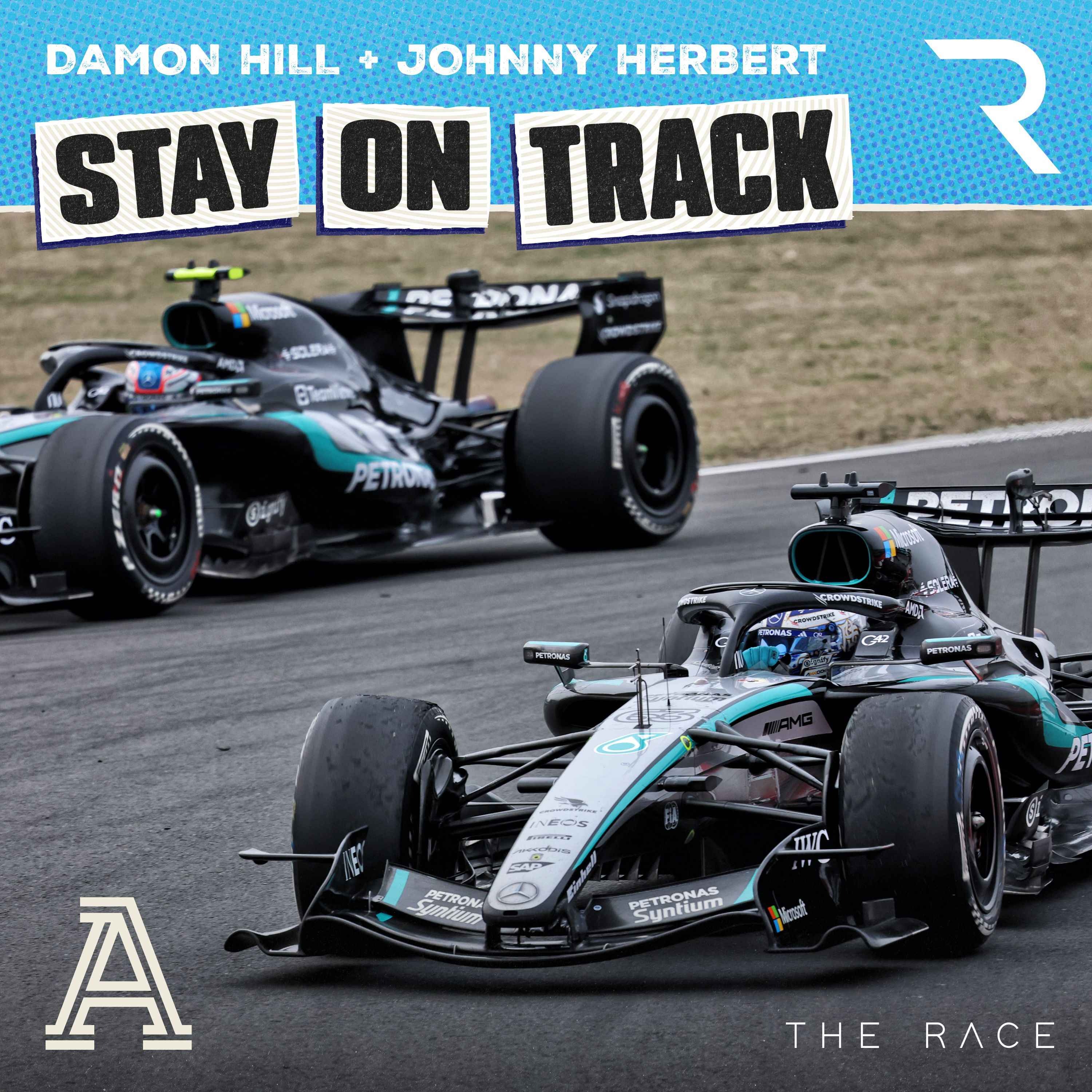
How should Antonelli handle Russell? Damon and Johnny answer your questions
About this episode
Damon Hill and Johnny Herbert field a rapid-fire batch of listener questions, mixing career wisdom with F1 technical talk and plenty of banter. They advise Lando Norris to enjoy success while staying mentally pressured, tell 19-year-old Kimi Antonelli to be professionally ruthless with George Russell, and urge Lewis Hamilton to be honest about when motivation fades. The discussion also covers era differences in driver-engineer communication, why car performance swings track-to-track, race-weekend preparation in the 1990s, and the human side of team management. Crashes, rivalries, and even the “Scotch egg in the cockpit” story round it out.
What pieces of advice are Lando Norris, Kimi Antonelli and Lewis Hamilton - three F1 drivers at very different stages of their careers - most in need of?
In this special edition of Stay On Track, Damon Hill and Johnny Herbert have their say as they answer YOUR questions about contemporary F1, their grand prix racing careers and much more.
Find out whether either of them would like to drive the 2026 generation of cars (and the answer's a short one), whether they regret not making more of their respective talks with McLaren and Ron Dennis, what happens when friends collide on-track... and, of course, whether Damon really did drive to victory in the 1994 British GP with a Scotch egg in his pocket gifted to him by comedian Bob Mortimer.
Get bonus F1 podcasts, extra content and ad-free listening, sign-up to The Race Members' Club on Patreon today. For a limited time you can get 90% off your first month!
Hosted on Acast. See acast.com/privacy for more information.
driver manager
"[298.7s] If you were a driver manager today, what one piece of advice [303.2s] would you offer?"
A driver manager is basically someone who helps a racing driver plan their career. They help with decisions like contracts and which teams the driver should aim for.
A driver manager is the person (or team) that helps a Formula 1 driver with career strategy—things like contract decisions, team relationships, and long-term planning. In F1, that role can strongly influence which seats a driver gets and how they’re positioned for championships.
World championship
"Well, OK. [347.1s] It's good to start with Lando, aren't we? [348.8s] World championship. [349.7s] Of course, you know better than me about that one."
A “world championship” is the big yearly title in racing. It’s decided over many races, not just one event, and winning it usually means you’re at the top of the sport.
In Formula 1, the “world championship” refers to the season-long battle for the Drivers’ Championship (and separately the Constructors’ Championship). Winning it is a major career milestone and usually changes how teams and rivals view a driver.
McLaren
"because obviously it's been a little bit of a difficult start [356.1s] for McLaren themselves. [357.9s] For me, just enjoy it."
McLaren is one of the famous racing teams in Formula 1. If they’re having a “difficult start,” it means they haven’t been as fast or consistent as they hoped early in the season.
McLaren is a top-tier Formula 1 team with a long history of racing success. When the hosts mention a “difficult start for McLaren,” they’re likely talking about early-season performance and competitiveness.
Formula One
"I think it is important to enjoy it. I don't think if you're not enjoying it, it's very hard to deliver the performance you want. But at the same time, in order to win in Formula One, you have to put yourself under quite a lot of pressure."
Formula One is the highest level of car racing with teams and drivers competing all season. To win, drivers can’t really “switch off”—they have to stay focused and handle pressure every race.
Formula One (F1) is the top tier of open-wheel racing, where teams and drivers compete in a season-long championship. Winning requires managing performance under constant pressure—both mentally and strategically—rather than simply “relaxing” and driving casually.
Williams
"[464.7s] I'm having a chat with Jack. [466.4s] We're doing some stuff with Williams and we're talking about our time together. [470.4s] He's an ambassador for Williams."
Williams is a Formula 1 racing team. Even if someone has an ambassador role, they still have to work like a professional and compete hard on the track.
Williams is the historic Formula 1 team Damon Hill and Johnny Herbert are discussing. In F1, a driver’s role with the team can include ambassador duties, but on-track performance still comes first.
Formula 1 (F1)
"You can't do F1 half-hearted. No. You have to be fully committed."
They’re talking about Formula 1, the top level of open-wheel racing. The point is that you can’t treat it casually—if you’re not fully focused, it’s very easy to make a dangerous mistake.
The speaker is referring to Formula 1, where drivers are expected to be fully committed because the margin for error is tiny. In F1, small lapses in focus or preparation can quickly turn into mistakes at high speed.
Christian Horner
"But I wonder if Christian Horner, I think I would have got on well with Christian. I think you have to be able to stand up to people."
Christian Horner is the boss of a Formula 1 team. He helps run the team and works closely with the drivers, so how he handles people can affect performance.
Christian Horner is a prominent Formula 1 team principal, best known for his leadership of Red Bull Racing. In F1, the team principal plays a major role in managing driver relationships, strategy, and day-to-day team direction.
support of both drivers
"[976.4s] The support of both drivers, I think, they try and make it balanced. [981.4s] It's a very different world than what it was when I started."
In F1 you have two drivers, and the team has to help both of them. If one driver gets treated badly or ignored, the whole team can suffer because that driver may not perform at their best.
Supporting both drivers means ensuring each has the resources and guidance needed to extract performance from the car. If one driver is emotionally or strategically undermined, the team can lose potential points from that side of the garage.
young driver
"[1026.9s] I think it's very difficult for a young driver. [1030.2s] I mean, you see it with Flavio because he's obviously a lot older than the people. [1032.8s] I mean, poor drivers are kind of like, you know, they get such a roasting."
They’re talking about how newer drivers can get overwhelmed more easily. If the environment is harsh, it can make it harder for a young driver to do their best.
The segment highlights how young drivers can be more vulnerable to pressure and criticism. In F1, that can affect confidence, communication with engineers, and the ability to consistently extract performance.
crashed into each other
"[1046.0s] I mean, Toto saw recently said, do you know where Nico and Louis crashed into each other in the year that Nico won? [1051.8s] Barcelona."
They’re talking about two cars hitting each other on track. In F1, that kind of incident can cost a lot of points and cause serious fallout inside the team.
“Crashed into each other” refers to a collision between two drivers, which can dramatically affect race outcomes and team strategy. The discussion implies that the incident had enough significance to trigger major internal consequences.
race simulator
"So preparation for a race would be a simulator, I guess, today, wouldn't it be mostly? Yes. And going through with the engineer approach."
A race simulator is like a high-tech video game for racing, but it’s used seriously by teams. Drivers can practice the track and try different approaches without driving the real car.
A race simulator is a computer-based setup that lets drivers rehearse tracks, braking points, and race scenarios without using the car. In modern motorsport, teams often use simulators to refine strategy and driver technique between on-track sessions.
Silverstone
"And then two days later, I was at Silverstone doing a three-day test. And then it basically went through the whole of the winter off season before you got to the first race."
Silverstone is a well-known racing track in the UK. The speaker is saying they went there for a longer test session.
Silverstone is a famous UK racing circuit used for Formula 1 and other major motorsport events. Mentioning it alongside a “three-day test” highlights the role of established tracks for extended car evaluation.
jet lag
"Everything else was in Europe. And the testing was in Europe. So there was no jet lag. There was no jet lag. So it was much easier."
Jet lag is what happens when you fly across time zones and your body clock doesn’t match the local time. In F1, lots of travel can make it harder for teams to stay sharp.
Jet lag is a major factor in the modern F1 travel schedule, especially when races and testing are spread across different time zones. The speakers contrast today’s travel demands with their era, when more events and testing were concentrated in Europe.
curfew
"Now, they have so much downtime. They have a curfew. Yeah, the curfew. So the downtime is much, much easier."
A curfew is a rule that says teams can’t work past a certain time. That gives people more predictable rest during race weekends.
A “curfew” in modern F1 refers to time limits that restrict when teams can work during a race weekend. This rule creates structured downtime, which the speakers say makes the schedule easier on staff compared with earlier eras.
FP1 and 2
"[1545.4s] I don't want, I don't want to watch FP1 and 2. I mean, it's meaningless. It's just like. [1549.8s] It's an engineers. It's an engineers. It's not entertaining. So I'd rather see them do one [1554.0s] session and then go straight into qualifying."
FP1 and FP2 are practice sessions early in the weekend. Teams use them to try different settings and learn about the car and track.
FP1 and FP2 refer to Formula 1 practice sessions 1 and 2. These sessions are primarily for teams to test setups and gather data, which is why some viewers find them less entertaining than qualifying or the race.
qualifying
"...where you'd have a problem in qualifying, for example, and then you'd run back or I'd hobble back, get back to the, to the spare car..."
Qualifying is the session where drivers set their fastest lap to determine starting position for the race. In F1, issues during qualifying can force a driver to switch to a spare car, which often changes performance immediately.
oversteering
"We're always going to say it's either understeering or oversteering, or the cars a bit loose here there..."
Oversteer is when the back end feels like it’s sliding or stepping out more than you want. It usually means the rear tires have less grip than the front.
Oversteer is when the rear of the car loses grip first, causing the car to rotate more than expected. It’s a key handling complaint in motorsport and is influenced by setup balance, tire pressures, and temperature.
understeering
"We're always going to say it's either understeering or oversteering... or the cars a bit loose here there..."
Understeer is when you turn the wheel and the car doesn’t rotate enough—it feels like it wants to go straight. It usually means the front tires aren’t gripping as well as they should.
Understeer (often called “push” in racing) is when the car turns less than the driver expects, typically because the front tires lose grip first. Teams and drivers discuss it because it’s strongly affected by setup, tire behavior, and track conditions.
tire compound
"...the compounds are very different. And we hear very, very often that one driver or one team works on a... medium tire and one team works on a harder tire... the tire compound makes a huge difference to how that particular car works..."
A tire compound is basically the type of tire rubber. Softer tires usually grip more but wear faster, while harder tires last longer but may not feel as grippy.
A tire compound is the rubber formulation (e.g., softer vs harder) that determines grip level and durability. Softer compounds typically offer more immediate traction, while harder compounds tend to last longer—so teams choose based on track and race strategy.
Pirelli
"...where the tires were produced, what day they were produced on. You know, because Pirelli obviously tried to produce a standard, which is consistent as possible"
Pirelli is the company that makes the Formula 1 tires. The idea is that they try to keep the tires consistent, but small differences can still show up on track.
Pirelli is the tire manufacturer used in Formula 1, and the speaker notes the company’s effort to make tires as consistent as possible. In practice, tire production timing and batch-to-batch variation can still matter for performance.
Paddock
"but everything and the look of what you had when you're in the Paddock. So he was very special from that point of view."
In racing, the paddock is like the teams’ backstage area. Cars get worked on there, and you can see how professional and organized the team looks.
The paddock is the team area at a racing circuit where cars are prepared and team personnel work between sessions. It’s also where you’ll see team branding, hospitality, and the “look” of the operation up close.
double diffuser
"Well, you go to a track and you're quicker than everyone without doing anything to the car. But when did you feel it was like famously with Jensen and the double diffuser? He knew immediately."
In Formula 1, the floor and the area under the car can be shaped to make the car stick to the track better. A “double diffuser” is a specific shape that helps that airflow, and teams noticed it could make the car feel fast right away.
A double diffuser is an aerodynamic feature used on some Formula 1 cars to improve efficiency by managing airflow under the car. It was famously associated with the era when teams gained a big performance step through floor and diffuser design. In the segment, it’s referenced as a case where the car’s pace was evident very quickly.
1998 Argentinian Grand Prix
"In the 1998 Argentinian Grand Prix, you and Johnny crashed into each other."
They’re referencing the 1998 Formula 1 race in Argentina. That’s the event where the two drivers collided, and they’re now debating who was at fault.
The 1998 Argentinian Grand Prix is the specific Formula 1 race where the crash discussion takes place. In F1, incidents like this are often analyzed in terms of race context (positions, points, and strategy) and whether the driver’s actions were justified.
F1
"Richard Ryle. I'm going to do this one for you. So Damon, do you feel your early world champion teammates, Mansell Prost Center, where I've benefited to you coming into F1?"
F1 is Formula 1, the highest level of open-wheel auto racing. Drivers race for teams on tracks around the world.
F1 refers to Formula 1, the top tier of open-wheel racing run by the FIA. It’s a team-based championship where drivers compete on circuits using highly regulated, high-performance cars.
setup compromise
"there was a compromise on a setup, for example, when tracks were quite bumpy... you'd have to probably change the spring... But then it would actually be worse on faster corners..."
They mean race car tuning is always a trade-off. If you set the car up to handle bumps well, it might feel worse in fast corners, and vice versa.
A “setup compromise” is the balancing act in race car tuning—choosing settings that work well in one condition but may be less ideal in another. The speakers use bumpy track sections as an example of how suspension choices trade off ride compliance versus cornering performance.
spring
"But if there was a bump going into cops corner, just for example, you'd have to probably change the spring to absorb that bump..."
A spring controls how soft or stiff the suspension feels. Softer springs can smooth out bumps, but they can also make the car less responsive in fast turns.
In F1 suspension, the spring rate affects how the car absorbs bumps and how it maintains tire contact under load. Changing springs alters ride stiffness, which can improve compliance over rough sections but may hurt stability or grip in faster corners.
art of driving
"[3164.2s] I think the word here that we're looking for is art. In other words, there was a thing called the art of driving."
They’re talking about racing like an art, where you use feel and instinct, not just rules. The idea is that great drivers “create” on track, instead of only following instructions.
The “art of driving” frames racing as more than following instructions—it’s about creativity, feel, and instinct. In this context, it contrasts with modern coaching and data-driven guidance that can make drivers feel micromanaged.
Adelaide 1994 collision
"In an alternative world where the Adelaide 1994 collision sends Michael Schumacher out, but your car is able to be fixed with you rejoining in sixth..."
They’re talking about a famous crash in Formula 1 in 1994 at Adelaide. The hosts use it to imagine how the championship might have turned out differently if the incident had gone another way.
The Adelaide 1994 collision refers to a pivotal Formula 1 incident at the Adelaide circuit that affected the championship outcome. In the segment, it’s used as a “what if” scenario to explore how different race results could have changed who won the title.
driving in the wet
"probably the crashes I didn't have, which was driving in the wet places like Spa, where you are scared, but you didn't crash."
When the track is wet, tires don’t grip as well. That means the car can slide more easily, and you have to brake and turn more carefully.
Wet-weather driving reduces tire grip and increases the chance of aquaplaning, so braking points and cornering speeds must be adjusted. Drivers often describe wet sessions as “scary” because the car can suddenly lose traction even with normal inputs.
whiplash
"Yes. Thank goodness. I did have a crash once where in testing, while we're on the subject, where I'd had, you know, you get neck problems and stuff from whiplash and everything."
Whiplash is an injury to your neck that happens when your head gets jerked forward and then snaps back quickly. In racing, crashes can cause that motion even if you don’t feel the impact right away.
Whiplash is neck injury caused by a sudden forward-and-back motion, commonly during crashes. In motorsport, it’s a key safety concern because head and neck movement can be severe even when the car’s impact isn’t catastrophic.
barrier
"So I went left and straight into the barrier. And now as I was heading into the barrier, I remember seeing this is going to be a big..."
A barrier is the wall or guard on the side of the track meant to protect you and slow the car down safely. Where and how you hit it can make the crash much more or less serious.
A barrier is the track’s impact protection structure designed to absorb and redirect crash energy. In high-speed incidents, how the car hits the barrier (angle, speed, and restraint effectiveness) strongly affects injury risk and car damage.
Alan Prost
"...I go to what Alan Prost said after his last race, I was still learning something up till the last lap of my last race."
Alan Prost is a legendary Formula 1 driver. Here, he’s being used as an example of someone who kept learning and improving right to the end.
Alan Prost is referenced as an example of a driver who maintained a learning mindset even after his final race. His approach is often discussed in motorsport as a blend of competitiveness and continuous improvement.
karting
"The only time I remember was actually it was karting. I was British championship Felton and was leading the race and a driver behind knocked me out."
Karting is usually the first step into racing for kids and teens. It’s where drivers learn how to race closely, and sometimes that leads to arguments or contact.
Karting is the entry-level form of motorsport for many future professional drivers, focusing on car control, braking points, and race etiquette. Because karts are small and close-packed, contact and aggressive moves can happen frequently, especially in youth championships.
jack handle
"But he had the jack handle, the big jack handle that he went in there and basically sort of attacked him."
They mention a jack handle, which is basically a tool used to lift a car with a jack. In this case, it’s part of what made the situation turn into a fight.
A “jack handle” is a tool used to operate a garage jack. In the story, it’s referenced as the object involved in the confrontation, highlighting how quickly a racing dispute can turn dangerous.
Request an Explanation
Heard something you'd like explained? We'll add it to this episode.
Sign in to request explanations for terms you heard.
Want to learn more?
Browse our glossary for plain-English explanations of automotive terms, jargon, and concepts.
Help improve this episode
See something that's not quite right? Our annotations are AI-generated and can sometimes miss the mark. Click the flag icon on any annotation to suggest a correction.