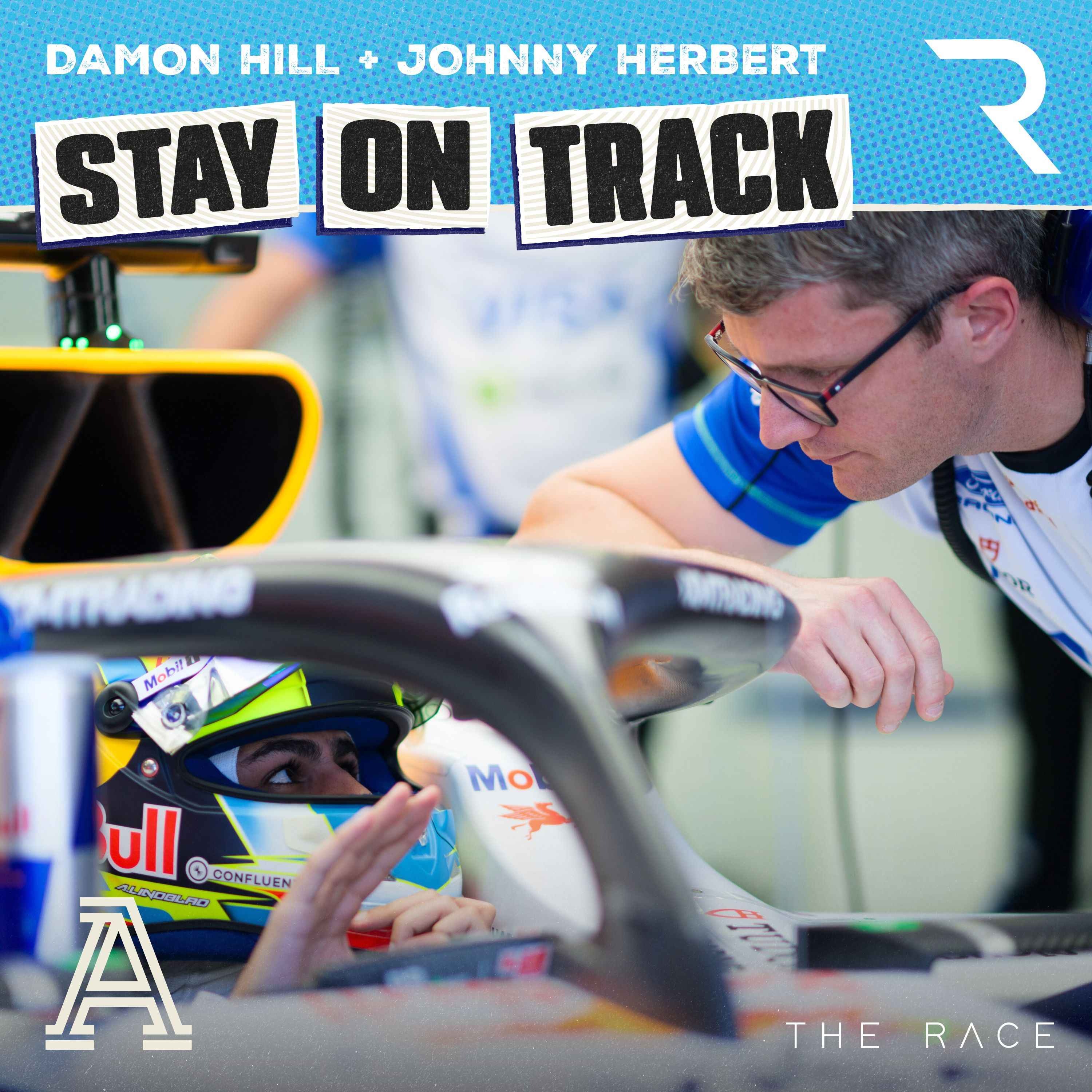
The art of communicating with F1 drivers - A race engineer shares his secrets
About this episode
Grief, history, and race-weekend stories set the tone as the hosts welcome Pierre Hamlin and talk through Miami and beyond. The race engineer then gets to the heart of communicating with F1 drivers: when to speak, what to say, and how to build trust. From lap-time and gap updates to filtering technical detail, the discussion links calm radio tone, driver feedback, and structured debriefs to better performance—especially on tricky tracks like Monaco.
On the latest episode of Stay On Track, Damon Hill and Johnny Herbert go deep on the most important relationship in F1 - the one between a driver and his race engineer.
They're joined by special guest Pierre Hamelin, who listeners might recognise as Arvid Lindblad's race engineer at Racing Bulls. Pierre has developed a reputation as a man who nurtures rookie drivers, having previously engineered Alex Albon, Pierre Gasly, Carlos Sainz, Daniel Riccardo, Liam Lawson, Isack Hadjar and others. But how does he go about helping a young driver get the best out of himself and the car?
Pierre shares his secret tips and tricks, plus Johnny and Damon discuss the evolving F1 title race and why Canada is such an important grand prix for George Russell...
Get bonus F1 podcasts, extra content and ad-free listening, sign-up to The Race Members' Club on Patreon today.
Hosted on Acast. See acast.com/privacy for more information.

BMW M2
"...ust outside downtown Miami. And they had a little M2 BMW series that they do and they invited myself. ..."
The BMW M2 is a small two-door sports car made by BMW’s performance team. It’s built to be fun to drive, with stronger power and sportier handling than a regular BMW. People mention it when talking about BMW’s performance cars and what makes them different.
The BMW M2 is a compact, performance-focused sports coupe from BMW’s M division. It’s often discussed because it’s designed to deliver a more driver-oriented feel in a smaller, lighter package than many larger performance models. In a podcast context, it may come up as an example of BMW’s “M” lineup and what that badge means in real-world driving events.
correlation
"But anyway, they're back. They put on upgrades. They seem to work every time they put upgrades on the car, it seems to work, which is a sign that they've got all their correlation going."
Correlation is basically “does the team’s prediction match reality?” If their tests and computer models line up with what the car does on track, the upgrades are more likely to work the way they expect.
In F1, correlation is how closely the team’s simulations and wind-tunnel/track data match what the car actually does on track. If correlation is good, it’s a sign the upgrades are behaving as predicted and the team can trust its development direction.
feedback
"They put on upgrades. They seem to work every time they put upgrades on the car, it seems to work, which is a sign that they've got all their correlation going. So they're making progress. But when we go to Canada, there's more upgrades going on everyone's cars, I think."
Feedback is what the driver feels from the car—especially through the steering—so they know how much grip they have and how the car is behaving. If the feedback is off, it’s harder for the driver to push confidently.
Driver feedback is the information the driver feels through the steering wheel and chassis—like grip changes, balance, and how the car responds. When the team says Max “wasn’t getting the feedback from the car that he wanted,” they mean the car’s behavior wasn’t communicating the right sensations for him to drive at the limit.
chassis
"They found something that they'd missed with his steering, the feel he was getting back. And it sounds like it sounds to me like that maybe some sort of flexing was going on in the chassis and the way they mounted it, because he was steering itself."
The chassis is the car’s main structure that connects suspension, steering, and the body. In this context, the speaker suggests the mounting and flexing of the chassis affected the steering feel—meaning the structure wasn’t behaving the way the driver expected.
flexing
"They found something that they'd missed with his steering, the feel he was getting back. And it sounds like it sounds to me like that maybe some sort of flexing was going on in the chassis and the way they mounted it, because he was steering itself."
Flexing means the car’s structure bends or moves a little under forces. If it flexes more than expected, the steering can feel inconsistent.
Flexing refers to unwanted movement or deformation of the car’s structure under load. In F1, even small changes in stiffness or mounting can alter steering response and how the driver perceives balance and grip.
Red Bull
"Now if Max has got the feel back, his they were competitive, much more competitive. So you'd have to say our Red Bull in long term, the title hunt, because we've seen him come from a long way back before."
Red Bull is the F1 team Max Verstappen drives for. The point being made is that when Red Bull fixes the car’s feel for him, it can swing the championship fight.
Red Bull is the F1 team associated with Max Verstappen, and it’s known for rapid development and strong performance when upgrades land correctly. Here, the discussion frames Red Bull’s long-term title chances as tied to getting the steering feel and driver feedback back.
gap (eight tenths)
"But Isaac, the gap was eight tenths, I would say, nearly all the time. Yeah. And it's a typical situation, a frightening gap as a racing driver."
A “gap” is how far one car is behind another in time. “Eight tenths” means the driver behind is about 0.8 seconds back, which is a big difference in racing.
In F1, a “gap” is the time difference between two cars, usually measured in seconds (or tenths of a second) over a lap or at a specific timing point. An “eight tenths” gap means the trailing driver is about 0.8 seconds behind, which is large enough to feel like a different pace and can make following and overtaking much harder.
signal of the car suddenly sprung up to the next level
"Yes. But it's a typical situation of where the the signal of the car suddenly sprung up to the next level or two. And that's where Max is just able to follow wherever that car goes."
Engineers talk about the car’s “signal” as how clearly it tells the driver what it’s doing—like whether it has grip and how it reacts. If that signal suddenly improves, the driver can control the car more confidently and go faster.
“Signal of the car” is race-engineer shorthand for how clearly the car communicates grip and balance to the driver—through steering feel, traction, and how the car responds to throttle and braking. When it “springs up to the next level,” it usually means the car has found more usable performance (often from setup, tire condition, or track evolution), making it easier for a driver to stay consistent.
teammate like Max
"But, you know, so it's tough times now for Isaac up against a teammate like Max, but we'll we'll see how that's always going to be tough."
In F1, fighting a teammate is often more difficult than it sounds because both drivers usually have access to the same car platform, but they can still differ in driving style, confidence, and how they extract performance. That’s why the conversation frames Isaac’s challenge as “up against a teammate like Max”—the teammate can be a benchmark for pace and consistency.
tires
"And then his the guy around the team comes out and says, we've got these tires. We've been saving them back because they're the magic tires. Anyway, so just put them on you and be fine."
Racing tires are what actually grip the road. If a team says they have “magic tires,” it usually means those tires help the car feel easier to drive and faster.
In racing, tires are the car’s only contact patch with the track, so they strongly affect grip and lap time. When teams talk about “magic tires,” they’re usually referring to a tire compound or setup window that gives a driver more confidence and consistency.
driver-engineer relationship
"You're vulnerable, aren't you, as a driver? ... The engineer is going to go. The relationship has to change and they have to be with someone that they trust. Yeah. And trust is really everything."
Race engineers and drivers have to work like a team. If they don’t trust each other or communicate well, the driver won’t follow the advice, and the car won’t perform as well.
In F1-style racing, the engineer and driver form a feedback loop: the driver reports what the car is doing, and the engineer translates that into strategy and setup changes. If the relationship isn’t right, the driver may not act on the engineer’s guidance, and performance suffers.
driver-engineer communication
"But I think that relationship is very important. I had a good relationship in Formula One. ... it was the first time I really had it where he was telling me you're doing a good job, just coming over the radio very softly and calmly."
Driver–engineer communication is the ongoing exchange of information between the driver and the race engineer, often via radio. The tone and clarity of feedback can affect driver confidence and decision-making under pressure.
radios
"Because when everything I'd done before, the radios were really bad back then. They got crackled and you could never, you could only speak more or less when you went past the pits."
In F1, “radios” are the in-car communication system that lets the team talk to the driver during the race. If the signal is crackly or hard to hear, it’s harder for the driver to get instructions in time.
In Formula One, “radios” are the driver–team communication links used to send instructions and feedback during a race. When the radio signal is noisy or unclear, it can limit what the driver can understand and how quickly they can act.
crackled
"They got crackled and you could never, you could only speak more or less when you went past the pits."
“Crackled” means the radio audio sounds distorted and noisy. In a race, that can make it harder to hear what the team is telling the driver.
“Crackled” describes a degraded radio audio signal—typically interference or poor reception—making communication harder to understand. In racing, that can increase the chance of missed or misunderstood instructions.
Lotus
"And Jock Clear, I remember when I was at Lotus when Jock stood off. Yeah, Jock was interesting."
Lotus is a Formula One team brand with a long racing history. In this segment, it’s referenced as the team context where Jock Clear was engineering.
McLaren
"I was thinking Mick Hackenon in McLaren when he was racing. He'd drive around every problem and they'd be saying, can we do anything?"
McLaren is one of the famous Formula 1 teams. Here it’s mentioned because the example driver was racing for them and had a different attitude toward engineering feedback.
McLaren is a Formula 1 team/brand known for long-running engineering programs and competitive race cars. In this segment, the speaker references Mick Hackenon racing for McLaren to illustrate a driver’s approach to feedback and problem-solving.
poor unit
"Actually, even more so this year, it's hard not to happen because of the poor unit. As you know, the poor unit this year is making a very big impact on the overall car performance,"
They’re talking about an important part of the car that isn’t performing well. Because of that, it affects how fast the car can be, more than it did in earlier years.
In F1, a “unit” usually refers to a major powertrain component or control unit that can strongly affect how the car behaves. When the engineer says the “poor unit” is impacting performance, they mean a specific system that’s underperforming or not working as intended, changing the car’s overall pace more than in prior seasons.
filter out what we think is important
"But it does happen and it's important for us to filter out what we think is important, to try to bring them the right information at the right time and not to overload them effectively."
It’s about how engineers choose what to tell the driver. They try to give only the most useful info at the right moment so the driver doesn’t get overwhelmed.
This describes an F1 race-engineering communication workflow: the team gathers data, decides what matters most for the driver right now, and then relays only the actionable points. The goal is to prevent “information overload” so the driver can focus on driving decisions rather than getting buried in technical detail.
overload them effectively
"to try to bring them the right information at the right time and not to overload them effectively. Because there are other drivers who are not interested."
They mean the driver can only handle so much information while racing. If the team gives too much at once, it can make it harder for the driver to act on it quickly.
“Overload” here is about cognitive load: too many technical inputs, options, or data points can make it harder for a driver to process what to do next. In racing, timing and prioritization of feedback are critical because the driver must translate information into immediate on-track actions.
gaining or losing time
"…looking at whether the driver is gaining or losing time, is he breaking harder or less hard on his teammates?"
It means whether the driver is getting faster or slower compared to someone else or a planned target. Engineers look at which parts of the track are helping or hurting.
In F1 engineering, “gaining or losing time” refers to whether a driver is improving or falling behind relative to a reference—often a teammate, rival, or a target lap. Engineers break this down into where time is made or lost (braking, corner entry/exit, and traction zones).
breaking harder
"…is he breaking harder or less hard on his teammates? Are we, like I just mentioned about the lines in Miami…"
It’s about how strongly and when the driver brakes. Braking changes how fast the car turns into the corner, which affects speed and grip.
“Breaking harder” is driver input related to braking force and braking point. In F1, small changes in braking intensity and timing can significantly affect corner entry speed, tire load, and ultimately lap time.
lines
"Are we, like I just mentioned about the lines in Miami, are we using different lines compared to competitors?"
A “line” is the route the car takes through a corner. Choosing a better line can help the car carry more speed and grip.
“Lines” are the chosen path through a corner—where the car turns in, how it tracks across the apex, and where it exits. Different lines can change braking distance, cornering load, and traction, which is why engineers compare lines between drivers and competitors.
RVD
"So he's really giving me a picture of what RVD is doing on track. And then it's for me to have that picture in mind."
“RVD” is a team shorthand for a specific thing the engineer is tracking about how the driver is driving. The idea is that the driver gets a clear picture of it so they can focus on what helps them go faster.
“RVD” is an F1 engineering shorthand for a driver-relevant on-track behavior the engineer is monitoring and communicating. In this context, it’s used as the “picture” of what the driver is doing on track, which the driver then uses to prioritize what will make them faster.
prioritize what I feel is beneficial for him to go faster
"And then to filter, or rather than filter, it's more prioritize what I feel is beneficial for him to go faster."
Engineers don’t just dump information on the driver—they pick the most important things that will make the car faster. It’s about focusing on the few changes that matter most during the race.
This describes how race engineers filter a large amount of telemetry and driver feedback into only the most actionable items. Because drivers can’t process everything at once during a race, engineers prioritize the changes most likely to improve lap time right now.
free practice vs race information flow
"Yeah. With the performance engineer, is that more in the free practice… or is it still in the race that you're going to be getting that information… It's still in the race."
They’re talking about when the team gives the driver useful guidance: during practice sessions or while the race is happening. In this case, the engineer says it’s still done during the race.
The segment contrasts when engineers provide certain guidance—during free practice versus during the race itself. It highlights that, in this workflow, the driver can still receive actionable coaching and corrections while racing.
track evolution
"we talk about track evolution and we talk about tire degradation, especially in qualifying."
Track evolution means the race track gets better as more cars drive on it. More rubber gets onto the racing line, so the track usually becomes grippier and faster over time.
In Formula 1, track evolution is how the circuit changes over a weekend as rubber is laid down and grip levels rise. That means the same line can become faster later, so teams constantly adjust strategy and car setup.
tire degradation
"we talk about track evolution and we talk about tire degradation, especially in qualifying."
Tire degradation means the tires don’t stay perfect for long. As you drive, they wear and heat up, and grip drops—so your lap times can fall if you push too long.
Tire degradation is the gradual loss of tire grip and performance as the tire heats up and the tread wears down. In qualifying, small changes in grip over a few laps can decide lap times, so drivers and engineers manage when to push.
qualifying
"we talk about track evolution and we talk about tire degradation, especially in qualifying."
Qualifying is the session where F1 cars set their starting positions for the race. It’s often where tire grip and timing matter a lot because you’re trying to get your best lap.
Qualifying in F1 is the session that sets the starting grid for the race. Because track grip and tire condition can change quickly, teams try to time tire use and driver effort to get the best possible single-lap performance.
driver evolution
"but also the driver is getting faster. So we have a driver evolution, effectively."
Driver evolution means the driver gets better during the session. As conditions change and the driver learns the track, they can squeeze out more speed lap after lap.
“Driver evolution” here means the driver improving lap-by-lap as they learn the circuit, refine braking/turn-in points, and adapt their driving style to changing grip. It’s treated like a parallel variable to track evolution and tire wear.
Monaco
"And we always, every year, have that discussion in Monaco where we say, but a new tire is much better than just keeping the same tire and keep running around."
They’re talking about Monaco because it’s a circuit where conditions and grip change in a way that makes timing really important. The best strategy depends on both the track improving and the driver getting more confident.
Monaco is highlighted as a circuit where timing and tire choice can be especially tricky. The conversation frames it as a place where track evolution and driver learning interact strongly, creating a “moving target” for performance.
moving target
"And it's this moving target you're working with, this subjective thing out on the track."
A “moving target” means the situation keeps changing while you’re trying to make decisions. In Monaco, grip and tire behavior shift, so what’s fast right now might not be fast a few minutes later.
A “moving target” describes how lap-time performance in Monaco (and similar circuits) is constantly shifting due to changing grip, tire condition, and driver confidence. Engineers have to communicate in real time because the “best” decision depends on what the track and tires are doing at that moment.
window
"Yeah, there's always I hear about the window, the performance of the tyre, trying to get that right, especially for qualifying."
The “window” is the short period when the tires work best. The engineer’s job is to get the driver to push during that best moment.
In qualifying, the “window” refers to the limited time range where a tire is at its best operating temperature and grip level. Race engineers try to time the driver’s laps so the car is pushed when the tires are in that peak range.
tyre
"Yeah, there's always I hear about the window, the performance of the tyre, trying to get that right, especially for qualifying."
They’re talking about the tires and how their grip changes. The goal in qualifying is to use the tires when they’re giving the best traction.
“Tyre” here means the tires’ grip behavior during qualifying, which changes as they heat up and cool down. Engineers monitor tire performance so the driver can exploit peak traction for fast laps.
free practice sessions
"So to answer from my perspective, we use obviously the free practice sessions to find out."
F1 has practice sessions before the race weekend’s main events. Teams use them to try different settings and learn how the track affects the car, so they’re better prepared for qualifying and the race.
In Formula 1, free practice sessions are the on-track practice periods where teams test setups, learn the circuit, and gather data before qualifying and the race. Engineers use them to build and refine a plan for how the car should behave across different conditions.
adjust
"We try to follow that plan, and we adjust."
They start with an initial plan, then keep changing it as they learn more during the session. If the car isn’t behaving as expected, the team updates what they’re trying next.
The engineer describes an iterative workflow: teams start with a plan based on previous tracks and years, then adjust as new information arrives. In practice, this means changing strategy and setup direction when data and driver feedback don’t match expectations.
purple
"and then you have a couple of teams, first time lap, they managed to do a purple on good laps."
In F1 timing, “purple” is a color that usually means a driver has the fastest time in a sector so far. It’s a quick visual cue that they’re doing something better than earlier laps.
“Purple” is F1 timing-color shorthand used on timing screens to indicate a sector (or lap segment) that is the fastest for that driver in the session. When a driver manages a “purple” on a good lap, it signals they found a quicker part of the track than before.
GPS
"First thing you're going to do is take the GPS, take the onboard."
In F1 engineering, GPS is used to measure where the car is on track and how it moves through key sections. That lets engineers compare laps and identify differences in braking points, corner entry speed, and line choices between drivers or teams.
onboard
"First thing you're going to do is take the GPS, take the onboard."
“Onboard” means the car’s own recorded data from the session. The team uses it to see what happened while the driver was driving, and compare it to other laps.
“Onboard” refers to data captured from the car during a session—typically from sensors and the driver’s onboard systems. Engineers review it alongside GPS to understand what the driver did differently and how the car responded.
plan Z
"well, we had a plan, but that now has to be plan Z or whatever it is, because so much has changed."
“Plan Z” basically means the backup plan. If things change and the original plan stops working, the team has to switch to something else quickly.
“Plan Z” is a colloquial way to describe a last-resort or fallback strategy when conditions change faster than the original plan. In F1, engineers may need to pivot quickly if track evolution, tire behavior, or competitor actions make the initial approach obsolete.
sprint weekend
"And I've got good proof for that, a sprint weekend. We had a sprint weekend in Miami, we have a sprint weekend again in Canada... when you have the sprint race, of course, it's a very different thing."
A sprint weekend is an F1 race format where there’s a shorter race (the sprint) earlier than usual. That changes how teams practice and qualify, because the sprint is important and you can’t just experiment as much.
In Formula 1, a sprint weekend is a format where a shorter “sprint race” happens earlier in the event, typically affecting how teams approach practice and qualifying. Because the sprint race is competitive and results matter, teams often run different setups and take less experimental risk than on a standard Grand Prix weekend.
Grand Prix weekend
"I've got a question then for you have a normal Grand Prix weekend, the free practice is qualifying race. Then when you have the sprint race, of course, it's a very different thing."
A Grand Prix weekend is the whole event across multiple days—practice, qualifying, and then the main race. The schedule can change in sprint weekends, which makes things feel more pressured.
A Grand Prix weekend is the full multi-day F1 event, usually including practice sessions, qualifying, and the main race. The transcript contrasts this with sprint weekends, highlighting how the schedule changes the pressure and decision-making for drivers and engineers.
simulator work
"Because as much as I'd love to say our prevent simulation work on simulator work and preparation is absolutely amazing... it's never quite as good as being on track on trying it out."
Simulator work is practicing and testing in a computer-based racing setup. It helps teams prepare, but it’s not the same as driving the real car on track, where you learn things you can’t fully replicate in software.
Simulator work refers to using an F1 driving simulator to predict car behavior, evaluate setups, and rehearse scenarios. The engineer stresses that simulators are helpful for preparation, but they can’t fully replace real on-track testing because you learn different things when the car is actually being driven at speed.
FP1
"And having only a single FP1 without the rest of the practice, it makes it very difficult, very challenging."
FP1 means the first practice session on an F1 weekend. In sprint weekends, teams may not get as many practice sessions, so there’s less time to learn what the car needs.
FP1 is the first free practice session of an F1 weekend (the “FP” stands for free practice). In the transcript, the engineer notes that having only one FP1 session—common in sprint formats—limits how much teams can test and reduces the time available to validate changes.
risk reward approach
"And I think also it's changing a little bit your mindset in terms of what you do with the car on the risk, risk reward approach... in the sprint weekend, you can't really take this too far."
The risk-reward approach is basically deciding how much you’re willing to gamble for a possible gain. In sprint weekends, teams have to be more cautious because there’s less time to correct mistakes.
The risk-reward approach is how teams decide whether a change is worth the potential downside. The engineer explains that sprint weekends alter this mindset: with fewer practice opportunities, you can’t “take a risk” as far because there’s less chance to fix problems before qualifying and the sprint/race.
setup
"So you would, a standard weekend, you probably will go with a setup where you may be say, okay, in FP1, I can take a bit of a risk... in the sprint weekend, you can't really take this too far."
A setup is how the race car is adjusted for the track and the driver. The transcript explains that on sprint weekends teams have to be more careful with changes because there’s less time to recover if something doesn’t work.
In F1, a setup is the car’s configuration—how it’s adjusted to suit track conditions and the driver’s preferences (for example, balance and handling characteristics). The engineer describes how teams may allow more risk in FP1 on a standard weekend, but in sprint weekends they must be more conservative with setup changes.
Renault engines
"I've got an example of something like that when I was racing with Alan Prost, who came to race with Williams, but of course we had Renault engines, so he would speak to the Renault engineers in French"
Renault engines means the Renault-powered cars. The story is about how the engine team communicated, and why they wanted the driver to use English so everyone could follow.
Renault engines refers to the engine supplier/brand used in that era of F1. The engineer’s anecdote highlights that engine teams and their engineers may communicate in their native language, which can create friction if the driver isn’t using the expected team language.
Williams
"I've got an example of something like that when I was racing with Alan Prost, who came to race with Williams, but of course we had Renault engines,"
Williams is one of the F1 teams. Here it’s mentioned because it’s the team where Alan Prost raced while using Renault engines.
Williams is a historic Formula 1 constructor/team. In the segment, it’s used to set context for Alan Prost’s move to a team that used Renault engines, which then affects how communication worked between drivers and engine personnel.
Q3
"It's been a bit of a tough fight in the top 10 in Q3 with Alpine, which is competitive this year, with Ferrari, which is a bit of an in-between as well,"
Q3 is the last, most important part of qualifying. It’s where the fastest drivers go to set the best starting spots for the race.
Q3 is the final segment of F1 qualifying (the last group of cars). Drivers in Q3 are fighting for the best grid positions, so “a tough fight in the top 10 in Q3” means Isaac was competing for the very front of the grid.
Alpine
"It's been a bit of a tough fight in the top 10 in Q3 with Alpine, which is competitive this year, with Ferrari,"
Alpine is an F1 constructor/team competing directly in qualifying battles. The engineer mentions Alpine as one of the teams Isaac is fighting against in Q3/top-10 contention, indicating how tight the field is.
Ferrari
"with Alpine, which is competitive this year, with Ferrari, which is a bit of an in-between as well, with obviously Mercedes on the McLaren,"
Ferrari is a major F1 team. Here it’s mentioned to describe where they seem to be in the pecking order this season.
Ferrari is one of F1’s most prominent teams. In this segment it’s used as a benchmark for competitiveness—Ferrari is described as “in-between,” suggesting they’re neither the clear front-runner nor the back of the pack in qualifying.
new regulations
"I hope it stays dry, because we still haven't had a wet race with these new regulations. Yeah, what do you think about that? I mean, we were looking at maybe one in Miami,"
F1 changes its rules from time to time. These “new regulations” can change how the cars act, including how they handle in rain.
“New regulations” refers to the rule changes F1 introduces for car design and race operations. The engineer notes they haven’t had a wet race under these rules yet, implying the new cars may behave differently in rain compared with prior seasons.
electric motor
"and I had the impression that with this talk they have with the electric motor, it's going to be [3312.8s] really tricky, isn't it? It will be difficult, so we have a lot of power and we have less grip."
An electric motor is the part that helps the engine by adding power using electricity. In racing, it can deliver power very quickly, which can make the car harder—or easier—to control depending on grip.
In modern F1, the electric motor is part of the hybrid power unit and adds torque instantly when commanded. That instant response can change how the car accelerates and how traction is managed compared with a purely combustion-based setup.
grip
"It will be difficult, so we have a lot of power and we have less grip. [3319.2s] We still haven't really driven the weight on the intertires a lot."
Grip is how much traction the tires have. If grip is low, the tires can’t “hold on” as well, so the car may slip when you accelerate or change gears.
Grip is how well the tires can hold the road surface without slipping. In low-grip conditions, the same power can cause wheelspin and make acceleration and gear changes much more difficult to manage.
Pirelli tests
"Obviously, there's been [3326.8s] some pyrilli tests in a Fiorano with Ferrari. We have done one in Suzuka, so there is a few [3334.1s] things which Pyrilli has looked at to help the teams as well."
Pirelli is the company that makes the F1 tires. Their tests help teams learn how the tires will behave on different tracks so they can set up the car better.
Pirelli is the tire supplier in F1, and its tests are used to evaluate tire behavior and gather data for teams. Track-specific testing helps teams understand how the tires will respond to braking, cornering loads, and temperature changes.
turbo lag
"no, we've got all these discussions about turbo lag. As you know, in the weights, [3354.0s] with very low grip, if you don't have the power you're asking for at the right time, [3359.4s] that makes it very difficult on all the upshifts, downshifts, all these visual topics."
Turbo lag is a short delay where you ask for more power but the engine doesn’t respond instantly. In a race car, that delay can make acceleration less predictable, especially when the tires don’t have much grip.
Turbo lag is the delay between pressing the throttle and the turbocharger producing full boost pressure. In low-grip situations, that delay can make it harder to deliver power smoothly during gear changes, increasing the chance of traction loss.
upshifts, downshifts
"if you don't have the power you're asking for at the right time, [3359.4s] that makes it very difficult on all the upshifts, downshifts, all these visual topics. [3364.0s] I think especially in Canada as well, it's quite a tricky old track."
Upshifts and downshifts are when the car changes gears. In racing, doing it at the wrong moment can make the car lose traction or feel unstable.
Upshifts and downshifts are the gear changes that happen when accelerating or slowing for corners. In F1, the timing of these shifts matters because power delivery and traction must be coordinated to avoid upsetting the car.
Canada as well, it's quite a tricky old track
"I think especially in Canada as well, it's quite a tricky old track. [3368.5s] So it's dated earlier, so I was just speaking to someone from Montreal and saying that [3374.1s] the good chance it could be wet, but it could be wet in June as well."
They’re talking about how the Canadian race track can be difficult. Weather and track conditions can change grip, so drivers and engineers have to be extra careful.
The hosts discuss how a specific F1 venue (Canada) can be challenging due to its characteristics and how weather can affect grip. This frames why communication and setup decisions are especially important there.
Request an Explanation
Heard something you'd like explained? We'll add it to this episode.
Sign in to request explanations for terms you heard.
Want to learn more?
Browse our glossary for plain-English explanations of automotive terms, jargon, and concepts.
Help improve this episode
See something that's not quite right? Our annotations are AI-generated and can sometimes miss the mark. Click the flag icon on any annotation to suggest a correction.