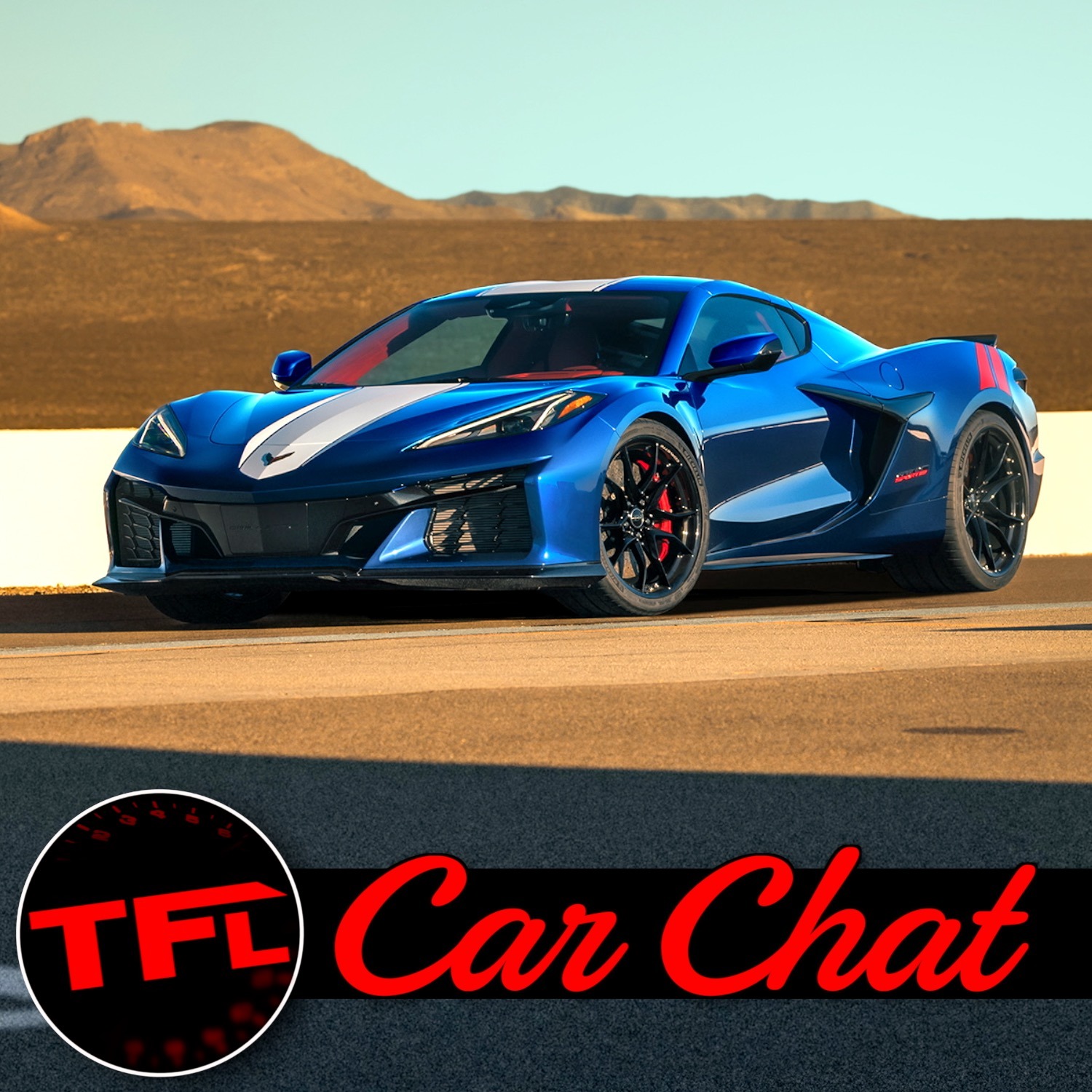
The hosts kick off with a roundup of upcoming enthusiast cars, then dive into three myth-busting debates: there’s no blanket 10-year parts law, Hitler didn’t ban Tetras, and why manuals keep disappearing despite demand. Nissan’s 2027 Z Nismo finally adds a six-speed manual, while Corvette’s new Grand Sport lineup returns to a 6.7L naturally aspirated LS and adds electric front motors on the higher-power variant. They also discuss a Eurovan Weekender purchase, Easter Jeep Safari concepts, and a Denver 100 cost comparison of EV vs hybrid vs gas amid high fuel prices.
( https://www.alltfl.com/ ) Check out our new spot to find ALL our content, from news to videos and our podcasts! In this episode of Car Chat, Roman and Tommy dive into the massive sports car news of the week, headlined by the reveal of the 2027 Chevrolet Corvette Grand Sport. With the return of the legendary LS6 nameplate in the form of a 6.7L naturally aspirated V8, the guys debate whether this 535-hp beast is the "sweet spot" of the C8 lineup or if the high-tech, 721-hp hybrid Grand Sport X is the one enthusiasts actually want. They also tackle the bittersweet news surrounding the Nissan Z Nismo finally getting a manual transmission just as the market for internal combustion sports cars begins to shrink, leading to a heated discussion on why enthusiasts clamor for manuals but rarely buy them new.
Beyond the track, Roman takes on the role of "Myth Buster," dismantling common automotive lies—from the "10-year parts law" to historical tall tales the Tatra 603. The duo also catches up on the latest additions to the TFL stable, including two new Jeeps for the upcoming Easter Jeep Safari and a surprisingly cool vintage Volkswagen van. Whether you're curious about the death of the Corvette E-Ray, the future of the Toyota Supra, or just why Roman hates modern electronic vents, this episode covers the full spectrum of car culture.
( http://www.patreon.com/tflcar ) Visit our Patreon page to support the TFL team!
"First and foremost, we got two new sports cars, the new 2027 Nissan Z. It's the most significant changes in years."
The Nissan Z is a sports car from Nissan that’s been around for decades. The “2027” part means they’re talking about the newest version, which usually brings big changes you’ll feel while driving.
The Nissan Z is Nissan’s modern take on its long-running Z-car sports coupe. In this episode, the host calls out the 2027 Nissan Z as a major update, which matters because Z-car changes typically affect performance, tech, and driving feel.
"... Jeeps in the stable. We're going to Easter Jeep Safari, and I've got some myths I want to bust. And we ..."
The GMC Safari is a station wagon, meaning it’s a car with a lot of space behind the seats. The podcast mentions it in the context of an event where people bring interesting vehicles. It’s brought up as part of that vehicle lineup.
The GMC Safari is a station wagon that’s often associated with family hauling and practical, long-distance use. In the podcast context, it’s mentioned around “Easter Jeep Safari,” which suggests the speaker is talking about vehicles they bring or consider for that kind of event. That makes it relevant as part of a lineup of vehicles used for off-road-adjacent adventures or themed builds.
"I was just talking to an OEM about this and they said there's actually no such law that exists... I actually talked to not one, but two purchasing managers at OEMs."
OEM means the company that makes the car in the first place. When they talk to OEM purchasing managers, they’re getting the “inside” view of how parts and warranty support are handled.
OEM stands for Original Equipment Manufacturer, meaning the company that builds the vehicle (or its major systems) and supplies parts through its supply chain. The hosts reference OEM purchasing managers to discuss how parts support and warranty obligations work in practice.
"So there's this like dance that happens between the purchasing manager
and the supplier to the OEM, let's say it's Bosch or whoever makes these parts."
Bosch is a major global automotive supplier that makes a wide range of components used by many OEMs. Here it’s used as an example of the supplier the purchasing manager coordinates with when planning production and long-term parts supply.
"[419.9s] So they didn't exactly do a complete, you know, ground up refresh,
[424.2s] but they did change the styling of the vehicle."
A “ground up refresh” would mean the car was basically redesigned completely. The speaker is saying this one wasn’t that—it was more of a partial update.
A “ground up refresh” means redesigning the vehicle from the architecture and major systems outward, rather than making smaller updates. The speaker contrasts this with what actually happened—styling changes plus carryover components.
"[468.7s] But in terms of performance, in terms of handling,
[472.2s] the new Z and the new super are better than they've ever been out of the box, at least."
“Out of the box” means you don’t have to modify the car to get good performance. The speaker is saying the newest versions are already better right when you buy them.
“Out of the box” means the car performs well without needing aftermarket upgrades or special tuning. The speaker is claiming the new Z and the “super” are better than previous versions in performance and handling straight from the factory.
"...everybody was whining about the fact or complaining about the fact that this wasn't a real Supra because it was jointly built with BMW. ...you could see all the BMW power train. You could see all the BMW parts."
BMW is referenced as the company that jointly built the newer Toyota Supra and supplied major components. The hosts highlight that BMW’s powertrain/engine technology is a major reason the partnership worked. This is central to the episode’s theme: whether shared engineering dilutes or improves a car.
"...you went under the hood and you could see all the BMW power train. You could see all the BMW parts. ...the engine that's in the Supra is one of BMW's best."
“Powertrain” is the car’s main mechanical system for moving the vehicle—typically the engine, transmission, and related drivetrain components. The hosts emphasize that the Supra’s powertrain is strong because it uses BMW’s best engine technology, which helps win over skeptics. It’s a useful term because it focuses attention on what actually drives performance and feel.
"Or sorry. So you're saying the youngsters want the manuals? But yeah, like people like my age want manuals,"
“Manuals” means cars with a stick shift. The driver has to change gears manually, and the speaker is saying younger people like them, but newer ones can be too expensive.
“Manuals” refers to cars equipped with a manual transmission, which typically requires the driver to use a clutch pedal and shift gears. The segment frames manuals as desirable to enthusiasts, but also notes affordability barriers for newer manual-equipped cars.
"That's the price not before the that's the price before the markup of a GT three R.S. nine eleven. I mean, the problem is we're living in this this K shaped economy, right?"
A markup is basically a price increase added on top of the normal price. When a car is hard to get, some dealers charge extra, so you end up paying more than you expected.
A “markup” is the extra amount added to the car’s advertised price, usually by a dealer when demand is high. In limited-supply, high-demand models, markups can push the real purchase price far above MSRP.
"And then what ended up happening, I think, was you had the onset of cars and coffee where you wanted to show off your car. And now even if you didn't track your car, you could get that GT product or the GT three product or the RS and take it and show it off somewhere."
“Cars and coffee” is a popular informal car meet format where enthusiasts gather in public to show their cars. It shifted car ownership culture toward visible “car show” appeal, which helped drive demand for special trims and performance models even for owners who didn’t track.
"Yeah, it is a limited cabin space for a headroom is just not there for"
Some cars just don’t have much room inside. If you’re tall, you can run out of headroom or feel cramped even if the car looks like it should fit.
“Limited cabin space” refers to how much room the car provides for occupants—especially headroom, legroom, and overall seating comfort. For taller drivers, even small differences in roof height or seat position can make a car feel cramped quickly.
"Yeah, it is a limited cabin space for a headroom is just not there for somebody over like six feet tall for sure."
Headroom is how much space you have above your head while sitting. If it’s not enough, you’ll feel cramped or have to sit in an uncomfortable position.
Headroom is the vertical space between a person’s head and the roof liner when seated. It’s a key fitment metric for taller drivers, and it can be affected by seat height, steering wheel position, and roof shape.
"Um, grand sport came out actually technically in the 1960s.
You know, there was a race version of the Corvette called the grand sport,"
Grand Sport isn’t a brand-new name—it goes back to the 1960s. Today’s Grand Sport models are meant to carry on that racing/performance spirit.
The “Grand Sport” name has roots in the 1960s, including a Corvette race version. In modern usage, it’s a performance trim/variant that evokes that heritage while using contemporary engineering.
"...in a role race, zero one was faster than a 9 11 turbo."
A “roll race” is a drag-style race where both cars are already moving when the timing starts, usually from a set speed. It tends to favor cars with strong mid-range power and traction rather than just off-the-line launch.
"...running Maserati or Ferrari or McLaren in the UK or in Germany, running Porsche..."
Ferrari is a famous Italian brand that makes high-performance supercars. They’re using it as an example of the kind of company Corvette should be measured against.
Ferrari is an Italian supercar brand associated with high-end performance and prestige. The speaker uses it as a benchmark for how Corvette’s interior and image should stack up against elite European sports cars.
"...running Maserati or Ferrari or McLaren in the UK or in Germany, running Porsche..."
McLaren is a performance car brand from the UK. The speaker is basically saying Corvette should be judged alongside brands like this, not just other American cars.
McLaren is a British performance car manufacturer known for track-focused engineering and supercars. In this context, it’s part of the speaker’s list of European brands Corvette is being compared to for interior quality and desirability.
"...running Porsche, I would really start to be worried because I don't even think it's on the radar... I mean, if you're a Porsche, right?"
Porsche is a German brand famous for sports cars. The speaker is saying Porsche fans (especially younger ones chasing track-oriented models) may not be interested in the Corvette alternative.
Porsche is a German sports car brand known for engineering-focused performance and a strong enthusiast customer base. The speaker argues that if you’re already a Porsche buyer—especially someone shopping for a GT3 RS—you may not consider a Corvette Grand Sport.
"didn't happen with Corvette's. You just pull up and it wasn't like it's always, no, you were like, Hey, it's a Corvette and most people thought old man in an old core in a new Corvette."
They’re talking about the Chevrolet Corvette. It’s a performance sports car, and the speaker says it’s become more serious and exciting—especially with track-focused options.
The Corvette is Chevrolet’s long-running performance sports car, and the discussion is about how its reputation has evolved. The speaker argues that modern Corvettes now offer serious track capability and multiple variants, making them more of an enthusiast choice than a “stereotypical” older-driver car.
"Uh, I mean, and, and the problem is like in the real world, we're never going to the track, right? You know, no, we go to the track, but not, not because of, we want, we just don't do track days as part of our life... We do a lot of track days."
Track days are organized events where drivers take their own cars to a circuit for practice and fun, rather than racing competitively. They’re a common way to evaluate a car’s real-world track capability—tires, brakes, cooling, and driver comfort all matter.
"which happened to us, by the way, in our Tetra getting on the Autobahn."
The Autobahn is Germany’s high-speed highway network, often associated with long stretches of fast driving. It’s a fitting setting for discussing how a car’s stability and traction behave at speed when you change throttle or cornering inputs.
"ever
since then it's been repeated.
It was recently repeated in Hagerty where they actually rolled the Tetra and
they used that myth as a reason to actually, this was in the Lane Museum"
Hagerty is an automotive media and insurance company known for classic-car coverage. In this segment, it’s mentioned as the outlet that repeated the myth and even performed a test involving rolling the referenced car.
"Tremac, right? Showed a manual Corvette at SEMA. But then did you hear the engineering boss of Corvette said he wished it hadn't happened..."
SEMA is a big car show in the U.S. where companies bring out performance ideas and prototypes. It’s where you might see a special manual version of a car.
SEMA (Specialty Equipment Market Association) is a major U.S. trade show where automakers and aftermarket companies showcase performance parts, prototypes, and concept vehicles. It’s a common venue for demonstrating enthusiast-focused ideas like manual-transmission builds.
"...only available with an automatic, specifically a dual clutch automatic or a single clutch."
A dual-clutch automatic is an automatic transmission that shifts gears very fast. It uses two clutches so the next gear is ready before you need it.
A dual-clutch automatic is an automatic transmission that uses two clutches to shift quickly and smoothly. It’s often marketed as faster and more consistent than traditional torque-converter automatics, which is why it comes up in the manual-vs-auto discussion.
"[2024.7s] But what would have made it really unique is if the Grand Sport did get a
[2031.1s] stick, that would have encouraged people to really go out and buy it, right?
[2034.5s] That would have been a big differentiator over the rest of the lineup."
“Stick” means a manual transmission (a car where you shift gears yourself). They’re saying that would make the Grand Sport more appealing.
“Stick” is slang for a manual transmission. In this context, it’s being used as a selling point—adding a stick shift to the Grand Sport would make it stand out within the Corvette lineup.
"I think if you want sports cars, of course, you've got like the Miata, right? It's a really good option..."
The Miata is a small, fun sports car that’s known for being easy to drive and enjoyable. The host is saying it’s so popular as a recommendation that it doesn’t feel fresh anymore.
The Mazda MX-5 Miata is a lightweight, enthusiast-focused roadster that’s often praised for its steering feel and driver engagement. The speaker calls it a common “answer” for people who want a fun manual sports car, then says they’re bored of the cliché.
"And if it's rev hanging all the time at that point, I'm like, just get the automatic, right? ... And that's an issue specific to the SI, the rev hang."
Rev hang means the engine speed doesn’t drop immediately when you lift off the gas or change gears. Some cars do it to meet emissions rules, but it can make shifting feel weird.
Rev hang is when engine RPM stays elevated for a moment after you lift off the throttle or press the clutch. It’s often used to help emissions and drivability calibration, but it can feel awkward because it delays the engine settling down.
"I'll be curious to see what the IIHS crash implications of the ducks are. Like, do you think they've tested with the airbag? Like, like when they have those crash tests, you think like 50 ducks will fly out of the Jeep."
An airbag is a safety cushion that pops out during a crash. It’s designed to help protect your head and chest when the car hits something.
An airbag is a supplemental restraint system designed to deploy rapidly in a crash to help reduce injury. In crash testing, airbag timing and deployment behavior are critical to how well occupants are protected.
"So if you fill it up overnight at your house, it could be as cheap as 15 cents per kilowatt hour. But if you go to the supercharger, it could be, which we pay 33 cents a kilowatt hour or a lot more..."
A kilowatt-hour (kWh) is how utilities measure “electric energy.” EV charging stations often charge you per kWh, so the price you pay depends on the rate.
A kilowatt-hour (kWh) is the unit of energy used to measure electricity consumption. EV charging prices are often quoted per kWh, so the same amount of driving can cost more or less depending on the local electricity rate and charging time.
"Ford is going toward a hybrid lineup. Honda is pushing hybrids and I'm ultimately plugging hybrids, right?"
Ford is planning more hybrid cars. That’s important because it shows big companies are betting that hybrids will be the way forward.
Ford is moving toward more hybrid models, according to the discussion. For listeners, this matters because it signals how major automakers are responding to fuel-cost pressure and emissions regulations.
Select text to request an explanation
There's something about spring that just feels like a reset.
Longer days, fresh energy, and the motivation to try something new.
This spring, that something new could be learning a new language.
That's where Rosetta Stone comes in.
They've been a leader in language learning for over 30 years, with an immersive method
that helps you learn naturally, connecting words, visuals, and meaning and context instead
of memorizing or translating.
With over 25 languages to choose from, like Spanish, French, German, even Japanese, Rosetta
Stone is a go-to tool for real language learning.
It's designed to help you think in your new language, so what you learn actually sticks.
Plus, True Accent gives real-time feedback on your pronunciation, so you sound more
natural, like having a personal coach.
And you can learn anytime, anywhere, whether you've got five minutes or a full hour.
Ready to start learning a new language this spring?
Visit rosettastone.com today to explore Rosetta Stone and choose the language that's right
for you.
Go to rosettastone.com today now and begin your language learning journey.
If you're a podcast host, listen up this one's for you.
My name is Ali Jackson.
I'm the host of Finding Mr. Height, a dating and relationship podcast that I've been doing
for four years now, sharing my positive and practical approach to dating that's built
on my own life experience.
I wanted to share another experience that I've had, my secret behind monetizing my show.
It's called Red Circle, and I was just telling my colleague about how much I love their platform.
With Red Circle, not only am I getting a seamless hosting experience, but I also love the support
I receive in ad sales.
It's not just typical ad sales either.
It's targeted opportunities based on my show and my life.
And the platform is super simple.
You just set your preferences, and Red Circle matches you with sponsors that align with
your show.
You can vet every opportunity, and their platform gives you great analytics.
More recently, too, my Red Circle team has brought me opportunities outside of my podcast,
on social media.
To really augment the podcast partnerships, bring them full circle, I just can't recommend
them enough.
If you want to give it a try, go to RedCircle.com to get your free trial.
That's RedCircle.com for a free trial.
Hey, Tommy, we got a lot to talk about this week because there's a lot going on.
First and foremost, we got two new sports cars, the new 2027 Nissan Z.
It's the most significant changes in years.
There's a new Corvette in town.
We did a really interesting video where we went and compared a hybrid to an EV.
We've got two new Jeeps in the stable.
We're going to Easter Jeep Safari, and I've got some myths I want to bust.
And we bought a Volkswagen van.
Yeah, we'll talk about that, which is cooler than you think it is.
And what's this thing got in your hand there?
This is related to the Volkswagen van.
It is the most complicated light switch on the planet that does one thing.
So we'll talk about that later in our Volkswagen segment.
Yeah, for those of you who are listening, Tommy's holding up a Volkswagen light switch
from, I don't know what car that is, but he's got...
Ford Golf, but that's not the most interesting thing.
As much as you want to hear about a light switch from an O2 Volkswagen.
So let me bust three myths, OK?
Yes.
These have been bugging me.
I've been listening to a lot of podcasts and I keep hearing these myths.
Mists get recirculated and regurgitated.
I'm really tired of them, so I'm going to do my best to bust the myth
because they are misinformative and they are wrong.
The first one and the one that just gets, I just heard it repeated again.
And that is when a car manufacturer comes out with a new car,
the myth is, the false myth is that there's a law that states that they have
to have parts for it for 10 years.
I was just talking to an OEM about this and they said there's actually no such
law that exists.
But if, for example, they offer a 10 year battery warranty
or an eight or a 10 year emissions warranty, they are legally required
to supply parts to support that warranty up for the warranty period.
Yeah, but there's no rule that says for the next 10 years,
every part in the car has to be available for you to purchase.
I actually talked to not one, but two purchasing managers at OEMs.
And I asked them about this and they said the way it works is when they come up
with a new car, pick a new car, give me a new car. Corvette.
All right. When the new Corvette comes out, they get together with their suppliers
and because they want to get the best deal possible for the parts they need
to build it and eventually for the parts that they will need to replace it.
They try to order as many parts as possible without necessarily
getting stuck holding onto a lot of parts.
So the more parts they order, the better deal they get per part.
So there's this like dance that happens between the purchasing manager
and the supplier to the OEM, let's say it's Bosch or whoever makes these parts.
And so they have a formula for that, but there is no rule that states
that 10 years from now that part has to be available.
And in fact, it's better than that because what is up happening is
they usually don't have parts for 10 years, but cars get crashed,
then they get recycled and a lot of those parts five years from now
or seven years from now come from the cars that have been taken out of service
or have been crashed or are no longer around.
But please stop repeating this BS lie that seems to make people happy
because what ends up happening is the way that this gets spread around
is a new car gets introduced and people are really worried about it
because obviously we're all going to keep our cars for the next 50 years.
And so they get really worried about the fact that 10 years from now,
they won't be able to get parts.
And the fact is you may not be able to get parts five years from now.
And so that is one of the myths that I am happily to bust.
There you go. You're good with that. Sure. What's next?
Well, let's let's let's spread these throughout the podcast.
OK, I don't want to like I don't want to do them all once.
And I'll tell you the next one after we talk about the the sports car news.
So let's talk about the new 2027 Nissan Z Nismo.
Yeah, so the big news for the Nissan Z Nismo
is it finally gets some manual transmission.
So when this car launched a little while back alongside the standard Z,
it was automatic only, which was definitely a little bit of a miss
because this is the most enthusiast minded version of the Z, the performance version.
But now it's finally getting the six speed manual from the standard car.
So this is great. It's got a short shift,
race lever and upgraded clutch versus the other Z models.
Other mechanical differences, revised steering rack,
brakes from the GTR, which is pretty cool.
So it's a two piece rotor, 19 pounds lighter at the front
and then retuned suspension, still more horsepower than the standard Z.
So 420 horsepower versus a normal Z sitting at right at 400
and also more torque, 34 pound feet more torque.
But we also have different styling.
Yeah, I think they freshen up the styling on the Nismo, made it a little nicer looking.
So I drove the newest version of the Z when it first came out a few years ago.
And it was really a story of the best of times and the worst of times.
I'll start with the worst.
The problem was that because Nissan didn't put a hundred percent of their effort into it,
it's the three fifties. He shares a lot of the chassis, shares a lot of the switch gears.
Three 70, three 70, sorry, shares and actually from the three 50.
Yeah, that's true.
So I misspoke, but actually I misspoke correctly.
Yeah.
So they didn't exactly do a complete, you know, ground up refresh,
but they did change the styling of the vehicle.
But a lot of the switch gear came from the old car
and they actually had all the generations of the Z at the launch.
And so I was able to do a video showing all the different generations.
And so you could pretty easily tell that the interior bits were the same
from three 50 to three 70 to the current one.
And for some reason, it didn't sell.
Well, I think it's not necessarily the fault of the car.
I just think I like the car a lot.
I love the design, but it didn't sell.
It's a reality of the market.
People just sports cars do not sell in big volumes in 2026.
It's the same reason that the super ultimately died.
Right. I think both the Z and the super were arguably the best of their generations,
although I know some people would disagree with that.
But in terms of performance, in terms of handling,
the new Z and the new super are better than they've ever been out of the box, at least.
And just the market, people say they want these cars
and then when it comes to actually buying them, they very few of them
actually end up being sold.
So I think the problem is two different stories, same problem and same outcome.
So with the Supra, which you bring up, which is very relevant,
the issue when it first came out and went on launch of that as well
was everybody was whining about the fact or complaining about the fact
that this wasn't a real Supra because it was jointly built with BMW.
So, you know, one of the videos we did was you went under the hood
and you could see all the BMW power train.
You could see all the BMW parts.
But as it turned out over time,
people realized that the partnership was actually very smart
because the engine that's in the Supra is one of BMW's best.
And so now you have a situation where when people finally came around
and everybody has, I get it.
Some people still in the comments will be like, no, it's a, you know,
it's a hybrid monstrosity, not hybrid in terms of power train,
but hybrid in terms of half BMW, half Toyota.
But people are coming to the realization that it's actually a good partnership
and you've got a really good power train combined with really interesting
styling in the part of, you know, Toyota.
And now that it's leaving, people are starting to kind of regret
the fact that it's leaving.
Yeah. And I think the same thing is going to happen with the Z.
The problem is, though, the hard core Toyota purists have never fully accepted
the Supra, like your friend James, right?
James, who's all about Toyota's got an LC.
He drives pretty much only Toyota's.
He never came in a bolt.
Yeah. And a bolt for some reason, but he never came around to the Supra.
Right. He said it's all, it's a BMW underneath.
It'll always be a BMW underneath.
Yeah. But he bought the, Jen, he bought the fourth Mark four Supra.
Yep. And he also sold that.
Yeah. He didn't like it very much.
But I think that the reality is like it's a great car, the current Supra.
And I think that the non-hard core Toyota fans are all about it, right?
Especially people that are just in the cars in general, not necessarily brand specific.
I think a lot of folks see the value in having that BMW partnership.
But the real core of the Toyota enthusiasts never fully accepted it as a Supra.
And I think that that's not necessarily the case with the Z,
because everything in the Z is Z, right? It's all Nissan.
So it doesn't really have that excuse.
I actually don't think the pricing is all that bad either.
It starts at the 2027.
We don't know, but the 26 starts at about 44.
And that's a lot of, that's a lot of car.
I mean, four and a horsepower, 350 pound feet of torque for $44,000 is pretty good.
Yeah, the current is most 67.
So that's less good.
But the normal Z I'm saying.
But a Supra is going to be 72 if you get the.
Sure. Yeah.
Yeah, it's going to.
So look, there are a couple of cars that I regret not buying.
The final edition of the last Mitsubishi Evo 10.
Sure. I wish I'd bought that.
Or I wish if I had been smart, we would have bought it because it's worth more.
Same thing with the heritage edition of the Land Cruiser 200 series.
And I think these are two cars that if you are thinking about
having a car that may not necessarily depreciate, but will appreciate.
Now, don't hold me to this because we don't give financial advice.
But if I were at my dithers and we didn't have to create content all the time
and I just wanted that car to hold on, it would either be this manual
Nismo or the manual Supra.
And it's funny because everybody is complaining and we'll get to
people complaining about the Corvette that it's not available in a manual.
And then you have these two sports cars that aren't in manuals.
And yet they're both dying a slow death because people aren't buying.
True. I think so.
What's why is there that discrepancy?
What is everybody's like?
Everybody's like, oh, Porsche only makes two manuals now in the 911.
And yet here you have two very good manuals and people are like, oh, no, no,
no, I can't. Well, I think part of it, frankly,
is that a lot of car enthusiasts probably can't afford
sixty seven thousand dollars in these most super super, right?
Or sorry. So you're saying the youngsters want the manuals?
But yeah, like people like my age want manuals,
but we also can't afford the new manuals.
So then we go out and buy the old manuals.
I get that. But I was at Pebble Beach last year.
Yeah. And there were a lot of people your age running around in GT three R.S.s.
Well, what's a lot? A hundred?
I don't know.
Like it's relative, right?
But but apparently you can't afford a sixty seven thousand ismo,
but you can't afford a three hundred and fifty thousand.
That's that's the price not before the that's the price before the markup
of a GT three R.S. nine eleven.
I mean, the problem is we're living in this this K shaped economy, right?
Where you've got the haves to have nots.
But the problem is now we have to have lots.
So there's a lot of people that can't afford a ten thousand dollar car.
And then there's really not a lot of people in the middle
that can't afford a sixty seven thousand dollar car.
And then there's a shocking number of people that can afford a three hundred
thousand dollar car. So we're in this weird situation.
We've got a ton of people way at the top of the market
and then a ton of people who can't afford anything.
And then these cars are appealing to a shrinking demographic of folks
that can't afford a sixty seven thousand dollar toy.
So it's a very, very weird time right now to be anybody,
but even especially car enthusiast, I think I would say that because of this
K shaped economy, what we have and what we didn't have in the past.
So GT products in the past out of like out of the nine eleven range, right?
Did not sell for the most part because these were race cars for the road.
And most enthusiasts in America, I'm not saying in Europe,
a lot of people take their sports cars to the track, but in America,
most enthusiasts did not track their cars.
And then what ended up happening, I think, was you had the onset of cars
and coffee where you wanted to show off your car.
And now even if you didn't track your car, you could get that GT product
or the GT three product or the RS and take it and show it off somewhere.
So that's the first thing that happened.
Yeah. And then the second thing that happened was those cars
started to become popular and they started to appreciate and they started to appreciate.
There was no longer that depreciation curve or you bought it.
It just fell off a cliff and then over the next 30 years, it came back up.
It just went straight up.
And so a lot of a lot of, let's say, non car enthusiasts,
people got involved as a way to basically hedge against inflation or make money.
And so all of a sudden, all those cars became not for us,
but they became for people who just wanted a lot of a lot of ways
to diversify their revenue stream and make money on them.
And then the thing just took off like crazy.
Well, the problem with that is that at 67,000, let's say 70,000,
the Dizmo is never going to have that straight up curve.
I mean, I think it depends.
Part of it, part of it, too, is limited supply, right?
And a lot of demand.
So the reason I think that the Z, the Z manual, especially in the final
addition is going to be a fairly good investment or at least a lack of depreciation
is because it's a limited number of vehicles and production is coming to an end.
Right.
So I think that you could park your money in a final edition
super manual and probably not keep up with inflation or the stock market,
but you wouldn't lose a ton of money.
If it were your money, which would you get the fine?
I mean, the Z is not done yet, but you can see the writing on the wall.
But the problem is that because this is not a limited addition and because it's
not officially done yet, I think this is a depreciating asset in the C.
And if you look at maybe you need some, should have made a limited addition.
Yeah.
That's what I'm saying.
If you look at current Z prices, I mean, they're on their way down.
All right.
So you're saying you'd buy the Supra given dollar for dollar, then being about
the same, I mean, if I wanted to not lose money, but I actually think I like
the way the super drives more, I think that it's a better investment.
But for me, I actually love the way the Z looks so much.
I'll probably get the Z.
I really do like that car a lot.
Not that I don't like the Supra.
I just don't fit in it.
Well, that's also a big problem.
Yeah, it is a limited cabin space for a headroom is just not there for
somebody over like six feet tall for sure.
That's a huge problem.
There's something about spring that just feels like a reset longer days,
fresh energy and the motivation to try something new.
This spring, that's something new could be learning a new language.
That's where Rosetta Stone comes in.
They've been a leader in language learning for over 30 years with an
immersive method that helps you learn naturally, connecting words,
visuals and meaning and context instead of memorizing or translating.
With over 25 languages to choose from, like Spanish, French, German,
even Japanese, Rosetta Stone is a go to tool for real language learning.
It's designed to help you think in your new language.
So what you learn actually sticks.
Plus true accent gives real time feedback on your pronunciation.
So you sound more natural, like having a personal coach.
And you can learn anytime, anywhere, whether you've got five minutes or a
full hour, ready to start learning a new language this spring.
Visit Rosetta Stone.com slash today to explore Rosetta Stone and choose
the language that's right for you.
Go to Rosetta Stone.com slash today now and begin your language learning journey.
Let's jump to the next new sports car that was unveiled this week.
And that is of course, uh, the color, the Chevy, uh, Z LS powered 6.7
liter grand sport.
Yep.
So this is the C eight grand sport, right?
Um, grand sport came out actually technically in the 1960s.
You know, there was a race version of the Corvette called the grand sport,
but really the grand sport, as we know it in the modern era, debuted in the
C four generation, won a cases, dream cars, by the way, you know, I found
love with the grand sport when we had it at the office in the C six.
Yep.
Uh, I just always loved that car.
I love the four exhausts.
I love the wider body, which is all, you know, very iconic in the grand sport.
And so they introduced two new models, a 550 horsepower, 6.7 liter powered
grand sport naturally aspirated.
And then there is another one that's 721 horsepower, which is basically
the replacement for the era.
Yeah.
So they're putting the electric motor on the front axle and then the new LS six
in the rear.
So this is a big deal for Corvette fans, right?
Because this is a, a different engine than we've been accustomed to, right?
So we're returned to the LS nomenclature, 6.7 liter naturally aspirated V eight.
Now, typically historically what the grand sport has been is a wide
body zero six car with a smaller slash D tune engine out of the, the, the normal
stingray, right?
This is a little bit different.
Yeah.
Cause it, uh, zero six, which we now own, we actually own three Corvettes.
We own, uh, the first of the C threes, we own a 68.
We own a zero one C four, first of the zero ones.
Uh, and we own a zero six, uh, which only has 670 horsepower.
So actually the, uh, the, the grand sport's going to have more horsepower in the
X specifically, not the standard, right?
I wonder where they'll price it.
Well, I mean, so first of all, they killed the era.
So as I read that the era, we liked the era.
Well, I mean, it was, I just didn't sell very well.
It was kind of a confusing car, but, uh, I think that this new plan to, to
just add X, meaning it's got the front electric motors, probably a good plan.
The same thing with the zero one, right?
There's a zero one and the zero one X, but, uh, yeah, I don't know where they're
going to price this.
I mean, I think it's going to be squat in between the stingray and the zero six.
It kind of feels like they're taking a page out of Porsche.
I think there's 25 different variants on the nine, 11 for sure.
And now there's going to be, what is that four or five?
I do my math, right?
Variance of the Corvette.
Yep.
Um, obviously they just introduced the zero one and the zero one X, which are
a thousand and 1200 horsepower respectively.
Um, and the question that, that I would ask you, Tommy, is out of all those, if
you had your dithers, which one would you buy?
Would you go for the crazy horsepower, zero one or zero one X, or would you get
the more traditional six point seven LS powered or would you go for a base
Corvette, which still starts at just under, I think 70.
Yeah.
I mean, I think my problem with it is that the performance envelope has gotten
so high that to enjoy these cars at all means losing your license.
If you're on a public road, if I were McLaren or Porsche, I'd be worried.
Yeah.
But this has always been the case with Corvettes, right?
No, I mean, Corvette has always had the reputation for being like old guy.
Right.
But like, if you look at white, white, white shoes, white belt, but they've
always outperformed their European rivals, out horsepower until the C seven.
They really didn't outperform that's not true.
I was just reading an article about the first zero one, 1990.
Okay.
Car and driver did a comparison with a 1990 zero one and a 9 11 turbo.
Yeah.
And in a role race, zero one was faster than a 9 11 turbo.
All right.
But they've always had until the C seven really budget interiors.
Sure.
And so if you put one up against the other, the, you know, the discerning
connoisseur sports car, Galer guy would look at the interior of the thing and
say, this is something out of the, out of a, you know, pick your generation of
Corvette and they still do.
So this is the crazy thing is I was just reading a review, a European
review of, of a Corvette and they still, so even though it's, it's the nicest
interior, it's the nicest interior that Corvette's ever had.
It's easily on par with a lot of the German brands or Italian brands.
Um, I just don't think it can shake that reputation.
I really don't, I'm serious.
If I were, if I were like sitting it, yeah, but they should have been
in Italy, running Maserati or Ferrari or McLaren in the UK or in Germany,
running Porsche, I would really start to be worried because I don't even think
it's on the radar and I don't think it should be.
I mean, if you're a Porsche, right?
Yeah.
If you're that 21 year old kid who wants a GT three RS, that kid's not going
to want a grand sport, right?
Because changing, it's like it takes, it's like a super tanker changing
your cars, reputation takes a long time.
But by putting the engine, making it mid, mid, you know, making a mid
engine by changing the styling to make it less old manny.
I mean, that's what we're talking about, right?
It's been always an old man car.
And by now introducing different variants so that people have this argument.
So now you could sit down and over, you know, but it's always been the argument.
Like you, you pull up to the country club.
Your friend's got a 9 11 turbo.
You've got a C six zero one.
My car is faster than your car.
It's got more horsepower than your car out corners.
Your car, I don't, I don't, I think like in the past, that argument
didn't happen with Corvette's.
You just pull up and it wasn't like it's always, no, you were like, Hey,
it's a Corvette and most people thought old man in an old core in a new Corvette.
Now I think because the car has become so well endowed with track capability
and you've made it into a Ferrari competitor with the zero six with the flat
plane crank, right?
Where it now sounds just like a Ferrari or you can go the traditional route,
you know, classic American, you know, now 6.7 LS or you can go, you know,
classic American horsepower through the roof or you could take it to the drag
strip and go drag racing.
It's actually made it an enthusiast car because all of a sudden you've got all
these different variants that you can talk about, listen, which in the past
people, I guess Corvette guys did, but most people, I think just had this.
I mean, that made the magazine cover, right?
Zero one fastest nine 11 turbo.
Yeah, but the last generation, zero one had oodles of power, but didn't
have the chance to control it in 1990.
Yeah, but that's too far back.
Same thing with Z six, C six, that zero one was faster than the Ferrari's at
the time. I just think the problem that is, if you're a buyer for a
prancing horse, you're not buying a Chevy.
I think it's changing.
I hope you're right.
But I just don't see people are snooty like that, especially the people that
can't afford these cars are snooty like that.
And I think that this is the best Corvette that's ever been with the most
interesting gender.
I mean, it's such an amazing car, but you still are fighting up against
the societal norms of saying, if I've got $200,000 or $400,000, I want the
Porsche badge.
You don't want a Chevy badge.
Yeah, you can have that conversation until, you know, the tire hits the
pavement and you're at the track.
But it's always been like, you know, it hasn't always been like that since
1990 has been like, you've only been around half as long as I have been around.
Yeah, but I read the, I lived it, you read it, which do you think is more
important that I read the magazine articles, right?
I don't want to bicker anymore.
And the zero ones have always been faster.
Let's move on.
Okay.
Anyways, would you buy a, uh, uh, whatever it's called the, um, what's the
new car called?
Grantsport.
Would you buy the Grantsport?
Uh, no, I love the zero six.
I don't think I, the zero six to me is still the, uh, most track worthy, the
most pure, the most zero six has always been that, but the most kind of pure
racy Corvette of them all, because at some point more than 600 or 700 horsepower
is unusable on the street.
And so it's cool to have that power, but you know, it's like, it's like owning,
um, uh, I don't know, pick your favorite fast electric car, like a plaid.
You can only accelerate two or three times zero to 60 in two seconds before it
makes you sick.
So I, I mean, you have that ability, but it doesn't actually go anywhere.
Maybe if you track your car and I'm talking about the drag strip, not the
regular track that it might be worth doing, but I haven't driven one.
So I don't know.
Maybe if I get anyone, I'll be like, holy crap, I want a thousand horsepower or
1200 horsepower.
But for me, uh, you know, there is a, a, a, a kind of a good and perfect middle
point for that.
And I think the zero six is at the only cost wise, it's, it's, it's affordable.
Give it, it's affordable compared to 240,000 when we're talking about
affordability in sports cars.
Yeah.
I mean, I love the zero six a lot, but it's a little too hardcore.
Um, that's why I would probably still just get the normal base car.
I mean, the normal base car, Chevy says zero to 60 in 2.9 seconds.
How much faster do you need the 2.9 seconds zero to 60?
Right?
I mean, that's so much performance.
The base car is incredible.
We had one.
Yeah.
Um, and it's, it's a much, it's like more of a touring car, whereas the zero six
is more of, and I haven't tested the other one.
So I don't know, whereas the zero six is more of a track car, it really
depends on what experience you want.
Do you want a daily driver, a zero six is a pretty rough daily driver.
I mean, you're going to scare everybody the second you started up in any garage.
Uh, I mean, and, and the problem is like in the real world, we're never going to
the track, right?
You know, no, we go to the track, but not, not because of, we want, we just
don't do track days as part of our life.
Yeah.
Right.
I know our part, our part of our leisure life.
We do a lot of track days.
Sure.
But I'm saying for fun, right?
Yeah.
We don't do track days like off-roading better.
Yeah.
So at that point, I'm like, well, if I'm not going to the track, why do I need the
track car?
All right.
I'm going to give you a really obscure myth that we busted actually.
Okay.
This is super obscure, but I think if you're, if you're a true car guy or car
girl, you appreciate this.
So as you know, I'm, I'm Czech.
And so once upon a time we bought a Tetra, a 603 and there's a rumor out there
and actually did a lot of research into this about the fact that during the
Second World War, Mr. Hitler didn't allow his generals to drive Tetras.
Now back then Tetras were the equivalent of like Bentley's today.
They were very expensive.
They were very fast.
They were rear engines, just like a Porsche.
And the styling was out of this world, right?
These were very aerodynamic cars.
They had a giant kind of fin on the back.
And if you were, you know, a young German general and you had just invaded the
Sudetenland and you wanted a Tetra, then you would get it because it was a
cool car to drive.
And the myth is that at some point, because of snap oversteer, because it was
rear engine, just like a 911, what would happen is, and this is actually true.
You'd be going around a corner and you'd take it too quickly and you'd let off
the gas and then the back end would just come spinning around, which happened to
us, by the way, in our Tetra getting on the Autobahn.
And if you weren't lucky, you'd be dead.
And so the myth was that Adolf Hitler forbade his generals to drive Tetras
because so many of them were dying because these things were so powerful and
so hard to handle.
Yep.
So we decided when we bought our Tetra to go to the home of Tetra.
What's the name of that town?
I forgot.
Kopchenica.
Very good.
Let me say that the Czech way.
And we went into the Tetra Museum and I had a long interview with the director
of the Tetra Museum.
Remember that?
Yeah, I do remember.
We shot it.
And one of the questions I asked him was about this.
And I was 100% sure that this sounded right because of course Hitler didn't
want his generals to die.
And he kind of looked at me when I said this and he said, wait, are we talking
about the same Hitler?
You think that Hitler gave a rat's ass about his generals?
I mean, this is a guy who did a lot of worse things.
And I started to think about it.
I'm like, yeah, I don't think Hitler really would have cared.
And so then he said, no, absolutely not.
This is complete horseshit.
Hitler didn't care.
You know, if you died, you died.
That was just the way Hitler was.
And so then I started doing some research and it turns out that that myth first
was printed in some British car magazine back in the like the sixties and ever
since then it's been repeated.
It was recently repeated in Hagerty where they actually rolled the Tetra and
they used that myth as a reason to actually, this was in the Lane Museum
in Tennessee.
They had a newer Tetra, but they wanted to see if they could actually roll it.
And the reason for that entire story was because of this myth that Hitler
forbade his generals driving Tetras, which is absolutely not true.
There you go.
So I was thinking about this Grand Sport.
Yeah, you know what would have made this interesting?
Yeah, this car should have had a manual.
Yeah.
So what is it about car companies?
We had a whole podcast about this.
What is it about car companies not listening to their customers?
Because what we just talked about where no one buys manuals.
I mean, everyone says they want it, but no one buys them.
But I do think that as an enthusiast, if I had this money, which I don't
Tremac, right?
Showed a manual Corvette at SEMA.
But then did you hear the engineering boss of Corvette said he wished it hadn't
happened because it was never on the table and it's not possible.
I always think listening to your customers is a good idea.
But he was saying that the dual clutch that this car has is the superior option.
I could give me like three examples of when companies thought that they knew
what was best for their customers.
Sure.
And in the long run, it ended up either really hurting their reputation.
I mean, look at Dodge, right?
With the latest Daytona.
I mean, I think a better example with manuals is companies like Volkswagen and
BMW. So if you look at like the Volkswagen Type R or even the older BMW M5s,
interesting thing about those cars is in many Europe's, including the home market
of Germany, those cars were only available with an automatic, specifically a
dual clutch automatic or a single clutch.
Yeah. So look, so like GM looks at the take rate on the C7 manual.
Sure. And they're like, hey, nobody was buying these things.
So when the C8 came around, they were like, let's just take that off the table.
But times change.
Well, times have changed quickly.
People really want manuals because we're so sick of all the electronic crap that
now are stuffed into modern cars that people are longing for just a simplicity
of actually controlling the car themselves.
And that that longing is really being expressed, I think, especially more
powerfully in the fact that people want manuals.
And you're ignoring these people and you keep giving them vents that are
electronically operated door handles that slide into the door crap that nobody
wants, because designers for some reason have decided that this is cool.
And the public is clamoring for basic, simple, easy to operate cars.
And yet they're all going in the exact opposite direction.
So that's kind of the big picture.
Well, where I was going with my argument earlier was Volkswagen W, both offered
manuals here in the US.
And now if you look at them historically, the E60M5s at the manuals are worth 50
or 100 percent more than the automatics.
The Golf Rs are worth a lot more than manual transmissions.
And I think that as an engineer, you have to look at it from a technological
standpoint, like the Germans do.
And the Germans would say the dual clutch is a superior technology.
It offers faster response.
The cars are quicker to the 60.
But as a car enthusiast who may be buying that car, you want that engagement
that the manual gives you.
So I think it's a case two of you have to look at the mismatch between what
the engineering brain says versus maybe what the enthusiast wants, even though
the manual is a far inferior product, it offers an experience that may be more
in line with what you're selling.
I think you're right.
I think engineers have this way of looking at the world very logically, but
people aren't logical.
I'll give you a good example of that.
When the Leaf first came out, you know, the thing the engineers and then
the marketing people said was the average American drives only 30 miles a day.
So if we give them a car with 60 miles of range, that's plenty.
But in real life, that's not how people think, right?
They worry about like getting stuck.
Some days they may want to stop and pick up their laundry or do something else.
And all of a sudden that 30 miles becomes 40 miles.
And then the car starts saying, I've only got 20 percent battery left.
And it just it just killed the Leaf because it had nowhere near enough range.
And I would argue that even most new electric cars, which have, what,
300 miles of range are still, you know, in a lot of people's minds, not enough
because it takes a long time to refill.
They don't know where they're going to refill it.
You know, they're worried about being stranded by the side of the road.
So what's logical in the engineer's brain does not work in the real world.
But even more basic than that, if you've got people clamoring, if you've
got customers saying, you know, we love a cool range Doritos.
And then, you know, the company says, yeah, but, you know, the cool range Doritos
doesn't sell or hasn't sold.
So we're not going to give it to them.
I think that's always a bad business idea.
I think just listen to your customers.
Yeah, for sure.
Give them what they want.
BMW is down to one manual, right?
The M two.
Yeah, that would be a good place to put money, too, I think in the, in the
BMW manual, speaking of good investments potentially.
But, um, yeah, I think that you're exactly on the money.
I mean, the Corvette, the problem I have with the Corvette is that it's kind
of like the Porsche problem where the, the, the product is becoming so, so
stratified now.
And there's so many slight variations on things where like the, the Grand Sport,
there's really not much of a reason to buy a Grand Sport over a standard car or a
zero six, because the standard car's performance is so high, the zero six
performance is so high.
And pricing wise, where is that really going to fit in?
But what would have made it really unique is if the Grand Sport did get a
stick, that would have encouraged people to really go out and buy it, right?
That would have been a big differentiator over the rest of the lineup.
And I really would have loved to see that.
So let's do a little bit of consumer, uh, advocacy here.
Uh, so if you guys love manuals and you're upset that you can't get a manual,
think outside of the box.
There are still vehicles that if you love shifting your own gears, that you
can get new with actually pretty good manuals.
Let's start with off-roaders.
You can get a Bronco and you can get a Wrangler with an off-roader.
So if you really love the sense of shifting your own gears, and if, if you
can't get a sports car because it's too expensive or because they don't
longer make them, think about a Wrangler or Bronco.
Both of those are really cool cars, really engaging cars, really fun to drive.
Uh, they'll scratch that itch for you for the manual.
And best of all, they're great in inclement weather.
They're great, you know, uh, off-road, uh, and as a daily, they're fun to drive
and probably, you know, very entertaining in a lot of other ways.
I think if you want sports cars, of course, you've got like the Miata, right?
It's a really good option.
Yeah, the Miata's, it's just let you, uh, yeah, if you, I mean, the problem
with the Miata is it's, you know, people say Miata's the answer, but everybody's
had one, it's just become a cliche of itself at this point.
I, I, I'm kind of bored of the Miata.
It's not that interesting anymore.
It needs like something new.
CT5V Blackwing, right?
That's a really interesting, I mean, if you're in Corvette money, they're not
that expensive for a Corvette buyer.
That's a crazy manual with the Supercharged V8.
Um, M2, M3, I think you can still get with a manual.
Only M2.
Ah, M3 base car, not the competition.
Only M2 is the only BMW left.
Are you sure?
I promise you.
Cole, you want to Google?
Yeah.
What's going on?
I'm asking, I'm asking the AI.
I'm on it.
All right.
Or, or I'll give you some others.
Come, come to the dark side.
Come to Truck World.
You got one truck.
You can get a Tacoma with a manual.
That's it.
There's no other manual?
Well, then get yourself a Tacoma with a manual because it's, it's a lot
of fun to drive.
Can still get an M3 with the manual, the base car, 473 horsepower, rear wheel drive.
Really?
Yeah.
The competition that you can't get the manual in.
So if you want all wheel drive, you got to get the eight speed automatic.
Um, yeah, not a lot of trucks anymore with manuals either.
That's specifically one truck.
No, but it's not very good.
I mean, you got that.
No, I don't like that 2.4 liter.
I don't think I'd really want it.
But the manual is very good.
I don't know.
I've never driven it.
The problem fundamentally too is the, the other issue with manuals, they have
to interact with the, with the engine correctly.
Right.
And like, so I think an automatic has to interact with the manual.
You can kind of control yourself.
Yeah, but not really.
Cause like I was driving a Civic SI with the manual.
That's another one, by the way.
Yeah.
And it wasn't very good because the rev hang was so bad.
You shift gears.
That's better.
But I'm saying like, how about a WRX?
Can I finish my thought?
What I'm saying is like, when you're interacting with the engine, you want
to make sure the engineer interacting with behaves in a way that's fun to drive.
And if it's rev hanging all the time at that point, I'm like, just get the
automatic, right?
If it's frustrating to drive, I think that's a very small issue.
And that's an issue specific to the SI, the rev hang.
I think most manuals don't do that.
I think like a lot of the new ones do cause of emissions.
I saw a piece about it.
So I've seen that happen more with like, like the old, uh, the problem with
the old forerunner was that the manual, uh, and actually the problem with the
old Tacoma was that the automatic, uh, and that V six didn't get along.
Exactly.
That was a really bad and that can also be a problem.
But I'm saying it also could happen with, uh, so like, if I'm getting at the
coma, the other thing you have to keep in mind is so, so you get a manual Tacoma,
which is cool.
But then you're dealing with this engine, which is kind of a 2.4 liter turbo.
You had a manual, um, a Wrangler.
Yeah.
I hated it.
So I sold it.
Why did you hate it?
Because the manual wasn't good.
Like it was smudgy.
I thought that the shifts didn't feel very good.
And ultimately it was geared wrong.
So I could never use sixth gear.
So that's a case where like you kind of should just get the automatic.
Like I bought that manual thinking I'm going to really have a better experience
with it, but that penis are with that gearing just meant that it was never,
it was never really that responsive.
So I'm going to say something that's controversial, but I think manuals suck
off road.
I think you really burn the clutch on.
For sure.
That's another thing to consider.
Automatics are much better off road.
So I probably wouldn't get maybe a Rubicon because you get the four 10s, but
I wouldn't get another base Wrangler with the manual.
Yeah.
The Bronco with that little granny gear manual is really cool.
But like you said, there's other manuals with the Integra, right?
There's the, um, the, the type bass, right?
I just think a lot of it is people want what they can't have.
Sure.
Oh, for sure.
This, this is always the issue.
And so now you can get this Nismo with the manual, uh, and people are going
to be like, nah, and then five years from now, these things are going to be very valuable.
Yeah, potentially.
Yeah.
Yeah.
All right.
Let's keep going.
Uh, let's move on to our next topic, which is, uh, the thing you're holding in your
hand.
So we just bought yesterday, a new vehicle to the TFL fleet because we're doing a
new series called flip it where we're actually going to do a competition to see
who can, uh, make more money flipping cars.
We don't like flipping cars because I don't want to be in that world.
We're not dealers, but for this series, we're going to, uh, you know, put that,
put that on hold and we are going to try to flip two cars.
Uh, and the car that we bought, Tommy, you want to tell them what we bought?
Yeah.
It's a 2003 Volkswagen Euro van, which is very cool.
It's the, it's a weekend trim.
So it's kind of got the camper thing going, just cool.
It's got the pop-top and the rear seat that converts to a bed and the little
fridge, but very interesting cars.
I didn't realize how valuable these cards are.
Like they can sell 15, 20, even $25,000 for a really, really nice one, which is a
lot of money for a 25 year old Volkswagen.
It was the last camper that Volkswagen imported.
Period.
Yes.
Yeah.
And I think they kept developing in Europe.
Andre and Nathan drove the California.
Do you think that there will be a ID buzz?
No.
Weekender.
Because for some reason, Volkswagen doesn't bring in the cool stuff anymore.
I think there might be.
I've got my fingers crossed.
I wish Volkswagen, this is Wolfsburg, if you're listening, because this is where
the decisions are made with Volkswagen.
Um, you gotta, you gotta like bring in the cool stuff.
Uh, and if you had brought in that California when COVID was happening, you
would have, and I know they thought it was too expensive because, so the
California, let me take a step back.
Is an all wheel drive car?
It's not even on their press site, the Euro van.
You can find it, find the, find it in our, uh, video.
Yeah, it was on car.
Yeah.
The California.
So the California is a camper version of the latest van or was, I was, it was an
all wheel drive, so we had a four wheel drive or all wheel drive.
There it is.
Uh, and it had basically a lot of brilliant, cool features that made it the
ultimate camping in America would be the Winnebago, but, but look at this thing.
It's so cool.
So obviously it, uh, they incorporated the latest stuff that, that like ours
doesn't have so like that side, uh, curtain.
Well, well, the weird thing about the California, we didn't even get this van at
all.
No, we didn't.
I'm saying they never bought it, but like even the non camper version.
Right.
So, you know, now in theory, we have a van.
Cole, can you fast forward and show them showing the features?
Cause the features are so cool.
It had like, we can't.
Okay.
Well, no, we can't throw it.
Yeah.
Why can't we play it?
Copyright.
Oh, because this is one of our old videos and the old videos.
Get the copyright all confused.
Oh, okay.
But there's Andre.
There's really, really young Andre.
This is like a 10 year old video.
Well, thank you for letting us know.
This is some weird copyright thing that, that YouTube's doing to us, which is
hard to understand.
But anyway, um, this is the ultimate version of the van that we bought.
Uh, it has like built in Shays lounges.
Yeah, it's really cool.
It had the pop top.
Uh, it had the sunshade on the side.
Uh, Nathan and Andre, young Nathan and young Andre there had a really good time.
And then I went to Europe and I, I looked at these things as I was so impressed.
And in Europe, they were like 60 to 70,000 euros.
And I actually talked to Volkswagen and I think the thinking was that it was too
expensive to bring into America that nobody would pay for it.
And yet, you know, we had a storyteller, uh, Mercedes that was 200,000.
So when we did the story, it was long pre COVID.
I think this was like 2018.
Yeah.
Um, but with the explosion of the fans in 2020 at 2021, this would have been
such a massive seller that they really, even at $80,000, $90,000, people
would have paid for this van.
Um, because the problem was like the conversions is so you buy like a Eurovan.
Uh, it's a small, easily drivable car that you can park in your driveway,
park in your garage, use as a car.
The problem with the sprinters, you're driving a large, essentially
commercial van that works great as a camper, but doesn't work in any other
situation.
So it's essentially a one, one use one trick pony with a great thing
about the European Eurovans and then this later T five and whatever is that
you can use them as a normal car.
And that was a huge thing that, that you can't really buy anymore.
And when you add on to the fact that they were manufactured by Volkswagen or
Westphalia, right?
These are really reputable companies that specialize in really high
quality parts and conversions.
You ended up with a product that was warrantyable, very well made, very
usable, and just an all round great product for daily life and camping.
And that doesn't really exist anymore.
Oh, there you go.
Cole's now showing all the different.
That's the UK one, the current one.
So it sells for 64,000 pounds.
So about $70,000.
Yeah, they're not cheap, but they're a lot cheaper than a Sprinter conversion.
And they're a lot better made and they're a lot more usable.
Yeah.
So anyway, we, we bought the last T four, which is the 2003 last year that they
were made.
And that's the one that they, that's one that people want because it has a VR six.
They are problematic.
The one we bought has 181,000 miles.
They all blow through the transmissions.
Yep.
Also, the VR six is hard to get at because it's kind of hidden underneath the
thing and it has issues.
So while we got it, and you'll see it in the series that we're producing right
now, while we got it relatively cheap and while they're valuable, we may end
up putting a lot of money into it.
And that's going to make, I think the series fun to see if we can actually
fix it up and then still flip it and make money.
Yeah.
So be sure to stay two for that because I think that the van is, I'm really
into it now.
I wasn't that excited about it, but I think it's a really cool little van.
I wish it was all wheel drive, like ours was front wheel drive.
But they never imported the T4 or all wheel drive.
They didn't do the Syncro, right?
But as a, as a concept, I, I really think that there's still, even though I
know the overlanding craze is kind of dying down and people are back to work.
But the idea of just being able to take this for a weekend and then drive it
to work on Monday and not have any penalty for doing either.
That's pretty ace.
You know, we've got that Starlink, the little mobile one.
We'll have to put it on the van.
Yeah, that'd be cool.
Yeah.
So that you have like a wifi.
Exactly.
And as a little kid, I would have loved like sleeping in that pop-top.
Oh, for sure.
Yeah.
Yeah.
I mean, you can see why people love them because they're so utilitarian and yet
they're so fun.
I could see young families camping in these things.
So you can, easy to drive.
It's just got everything going forward.
And ours is overall, it's held up quite well.
So like the paint's okay and the interior is really nice.
It didn't come out of most of its life, so it's not rusty.
It's a little rusty, but not as rusty as most of them because most of them
rust ferociously.
So check out our series coming up.
I'm really excited about a Euro van, um, Weekender, I think is what they
called them, right?
Yeah.
And then we have two new cars, uh, that, uh, we got because we're going
to the Easter Jeep Safari tomorrow, actually, which, which you're, if you're
listening to this, it'll be last week.
And if you go to tfocar.com, uh, Cole, I want to show off what we're going
to check out at Easter Jeep Safari this year.
This is my favorite week of the year by far.
Scroll down.
I think Zach's got the ride up.
Boom.
So every year Jeep creates a series of concepts that they let us journalists
drive around and kind of experience.
These are the six that they've done this year.
Uh, do you want to see if there's any pictures that we can scroll through Cole?
So this is really cool.
I think this was called the anvil.
It's, it's a Wrangler that's got that very vintage-y, uh, reverse facing grill
on it, right?
That they took off the Kaiser M715.
That's a really cool looking concept.
It's got big tires.
It's a V8 powered Jeep.
It's got the platform on the roof.
Keep going, Cole.
There you go.
There's the front end.
So I really like the front end on this thing.
It's got a really unique look, which I'm a G wagon look to it.
I hope you're right.
That's true.
Very G wagon.
I hope this actually makes it into production.
I don't think it will, but angry G wagon.
It is such a cool look.
Yeah.
Angry G wagon.
I like it.
All right, Cole.
Keep going.
Let's see what else we got this year.
This is called the buzz cut.
It's a two door Wrangler that's got some really interesting top and light
options on it.
Keep scrolling, Cole.
There's the rear view of it.
By the way, by the time you're listening to this or watching it, we have
been, we would have have driven them.
So over a TFL off road or all TFL.com.
If you want to see videos about all these, is this not going up Monday?
Yeah.
Monday, Tuesday, it goes up.
Yeah.
So we might not have the videos up yet.
Yeah, we will, because we're driving on Monday.
That's right.
So over TFL off road, yeah, we'll, we'll get them up very quickly.
So there's Laredo, which is kind of a vintage seventies vibe in a Wrangler.
I love the mag wheels.
We need more mag wheels and brown on the cars.
That's really cool.
And then the coolest one, Cole, is the XJ.
I want to kind of, there you go.
So Jeep is bringing an XJ Resto mod because it's a new Cherokee.
Yeah, but it sure is nothing in common with this XJ.
So I'm not sure they're helping their case much, but fundamentally, this was
a cool build, two door 87 XJ lift kit, wagon wheels, custom flares.
Really interesting.
Yeah.
And so we're going to be doing wall to wall coverage, Tommy, of the Easter
Jeeps, as far as we usually do.
Okay.
And then next week, if you're going to come back for this podcast, actually
Andre and probably a special guest are going to be kind of taking over because
Andre is at the New York auto show.
Yeah.
And so he's going to be doing a walk around of the New York auto show.
So if you want to see those, those have become very popular.
We'll have it on this channel.
And we'll probably do the walk around from Easter Jeeps ferry as well.
So we might have two videos next week on our TFL talk channel.
And then Cole, if you go on over to TFL Offroad, we should talk about the
vehicles that we're driving out to Easter Jeep.
Two really cool Jeeps, one's a gladiator and one is a Wrangler, but they're
not the stock Wrangler or gladiator.
Yeah.
They're not the normal ones because these are a special edition called the
Willys 41.
And what this is, is a throwback to the original Willys Jeep that we sent
overseas in World War two.
So it's got this 41 green paint, which is very similar to the olive drab that
you'd see on the Willys MB and the Ford GPW.
It's got these really interesting wheels, which are also olive drab, but it
looks like a steel wheel, a throwback to the military Jeep.
It's actually all aluminum.
It's got a bunch of different looks and changes on the inside, different
data plate, different shifter.
And you can get this in both the Wrangler and the gladiator.
So there's our old Jeep, right?
That's a 1945, but you can really see the influence that they brought into the
new one.
Yeah.
And we're going to be driving the Wrangler out.
And then we are going to be, look, how are we going to publicize?
We're doing a giveaway.
So our friends at Onyx have given us a golden duck, Tommy, a golden duck.
So as you know, the ducks are a big thing in the Jeep community, but this
golden duck comes with an Onyx subscription.
So we're going to have to find it.
It's not just a year.
I think it's five years.
Is it?
That's why it's golden.
That's great silver.
Maybe I'll keep the golden.
Am I allowed to keep the golden?
No, we have to give it to a fan.
We could duck ourselves.
We can't duck ourselves.
So we're going to give it to somebody in Moab this coming week.
And so we may post where we're going to have a click, you know, maybe a
meetup over on our community page on TFL off-road.
No, I don't think we're going to have time.
No, we're very busy.
We're really, really slammed.
But what we will do is we will find the coolest Jeep and we'll give away a duck.
All right.
The only issue with the golden duck thing is that some of these Jeep guys are
crunchy about the ducks.
Yeah.
So we've got to find someone who will be enthusiastic.
The Jeep people are not in the ducks.
I thought it was all about the Jeep.
No, no, no.
Here's the thing.
The fun Jeep people who just like Jeeps are into the ducks.
The hardcore off-roaders that are going to Easter Jeep, not in the ducks.
Actually, they actively hate the ducks.
It's a real thing.
Wait, wait.
So if you're a grumpy old guy and you've got a YJ.
You're going to hate the ducks.
Yeah.
But if you're like, you know, let's say somebody, a millennial.
Yep.
We just bought their first Jeep.
They're excited about it.
They'll be in the ducks.
Okay.
Look at who has ducks on their dash.
It's normal people who are still have whimsy.
All of us hardcore old Jeep people.
So no LJs.
You can't keep right from the LJ, YJ.
How about TJs?
No.
Are those right out too?
How about JKs?
Is that on the?
No, JK people usually like ducks.
Okay.
So JK or JL, but nothing older than that.
Yep.
That's right.
Cause then they're too grizzled and they don't like ducks.
So we got to find it.
There's a lot of strategy to this duck placement thing.
Okay.
So we got to look for a modern Jeep with maybe a gal driving it.
No, it could be a guy.
But you have to look for the presence of other ducks on the dash.
If there's other ducks on the dash, they like ducks.
I could see why people got sick of ducks because some people have taken it very far.
Have you seen like the Jeeps with like 50 ducks on the dash?
I've seen those.
Yeah, I think that's fine.
That's a lot of ducks.
Well, it doesn't impede your visibility.
It's just a lot of ducks.
Yeah, but who cares?
They're fun.
They're just ducks.
Well, I mean, like one duck is cool.
Two ducks is cool, but 50 ducks.
That means that you're a well liked Jeep.
I'll be curious to see what the IIHS crash implications of the ducks are.
Like, do you think they've tested with the airbag?
Like, like when they have those crash tests, you think like 50 ducks will fly out of the Jeep.
I do.
I kind of want to know what happens in an accident.
And other just ducks everywhere in an accident.
So someone, someone look into that, please.
That'd be really interesting.
Is this golden duck a bigger duck than a Jeep?
I don't know.
I haven't seen this duck yet.
Okay.
All right.
Let's keep going.
Maybe this duck will go missing in the night and then I'll have a five year
on X subscription.
It's a great thing to have.
So let's talk about gas prices.
So as of today, uh, gas is almost a hundred or oil is almost a hundred
dollars a barrel, average price of fuel.
And this has changed by the time you listen to this unless you listen to it live.
Is it going to be, by the way, are there any comments, Cole?
No, no, no, no, this thing right now, Friday morning, morning and nobody's around.
Oil prices and then go to oil prices are like a hundred dollars a barrel and
gas prices right now.
Our gas prices are like on average, like four bucks a gallon, give or take.
Yeah.
So we thought it'd be fun to do a video where we do the Denver 100 and
compare it and EV to hybrid.
Uh, and the results were actually pretty eye opening.
Now this is a interesting video to do because when you, um, depends on where and
how you fill up your vehicle with the electric.
So if you fill it up overnight at your house, it could be as cheap as 15 cents
per kilowatt hour.
But if you go to the supercharger, it could be, which we pay 33 cents a
kilowatt hour or a lot more, depending on the time of day, if there are surcharges
for like a super busy, but we filled up, uh, the new Cherokee.
So we're back to Jeep.
So that's a transition here.
Uh, hybrid, which is actually really good.
It's almost 40 MPG.
So we filled that up with gasoline.
Uh, we didn't fill up the Tesla Model Y that we have and we ran it for over a
hundred miles and then we went and saw not how much, how many kilowatts had used
or how many gallons, but how much it cost to refill.
So you want to tell them what the difference was.
Well, yeah.
So I think we're paying like four bucks, 20 cents for the gas.
Um, and over a hundred mile loop, we spent $8 and 80 cents.
Nope.
We spent $12 on gas and then the supercharger we went to, it delivered
like, I think it was 26 kilowatt hours or something.
And that was $8 and 80 something cents.
So it was about $4 less expensive on electricity.
Using public charging and public gas stations.
But if I had charged at home, that would have halved on the EV.
And then I would have been looking at about $4 charging that same exact
distance from my home charger.
So if you're going to public stations, if you're spending 33 cents a kilowatt
hour, like we were, it's pretty expensive.
And actually they can get a lot more expensive.
Like I've seen EAs at 50, 60, 70 cents per kilowatt hour.
And then it probably would have been more to charge the even than it would have
been to fill with gas.
But if you charge at home and you have cheap rates, especially that can happen
at night, that's where you're going to see your money savings.
Yeah.
And we did this because with gas being so expensive, we thought, you know,
people are starting to think about when their next car comes around, whether
they want an EV or a hybrid or a regular car.
And we were kind of curious because obviously hybrids are red hot right now.
People like that transition from not full electric, but partial electrification
where they can still get the benefits of being able to fill up in two minutes at
the local gas station.
And then of course, the better fuel economy of a hybrid.
And so we thought, is it really better to have an EV in terms of how much
money you pay now?
Obviously, as I say, your results may vary, but with apparently, and I don't
know where this number comes from, so take it with a grain of salt.
But the number out there is that 300,000 EVs are going to come off
least this year and everybody was expecting an EV apocalypse, right?
That these things are going to go, uh, right into the trash because nobody's
going to want them in the ocean.
Exactly.
This is this apocalypse, but now with fuel prices being so high, uh, it's,
it's interesting to find out.
I'm interested to see if actually this might be a good time to pick
yourself up like a good daily run around.
Obviously this may not be your main car that you take to
grandma's in Michigan, but it might be the car that you drive to work every day,
especially if oil prices stay high.
And the question, of course, is how long will oil prices stay high?
And Cole actually brought up a good point.
Last time we had an oil crisis, we were a net importer petroleum.
Yeah, we're a net exporter.
So why if we actually export petroleum, are we paying $5 at the pump?
If you're in California or $6 at the pump?
And the problem is that oil goes into a world market and you pay basically the
amount that is the international rate.
And just because the oil's coming from Texas or Alaska doesn't mean that,
you know, we're going to get a break on that cost.
It's still going to be $98 a barrel as of today, which is probably good for a
lot of oil companies and a lot of oil executives, because now they're making a
boat ton of money selling oil.
True.
Yeah.
Yep.
True.
Or maybe we'll just go out and buy geometros like we did in 2008, remember that?
Where everybody was like, the Prius was still pretty new and expensive.
And then everyone started like veggie converting old diesels and buying.
And so we've had this argument at the office.
Geometros.
Because we leased a leaf for $9 a month, if you recall.
Yes.
In July, two years ago, and we only got 20,000 miles.
And I think we've got like 17,000 miles on that thing.
So we have another 3,000 miles to go, but we're paying insurance on it.
And of course, $9 a month for the lease.
So I want to dump it, but you're like, well, fuel prices keep going up.
Maybe that'll be a good EV to have just as a runaround.
Yeah, for sure.
And I don't know what we should do with that thing.
Let me know in the comments.
What would you do if you had a leaf at $9 a month?
Keep in mind, we have a lot of other cars to drive.
And we buy these cars and use them for content.
We don't necessarily use them to commute in.
And so this was a car that we bought because we wanted to create content around it.
So we're kind of in a different situation than most people are.
Like we don't need a car to drive to work.
That's cheap.
But like if you saw it, if I was in this position, if it was my car, if it was your car.
So my Land Rover gets 14 miles to the gallon, right?
You're a LR three.
And at $4 per gallon, excluding maintenance and insurance, which is the same, by the
way, for my stupid LR four, as it is for the leaf.
Um, a leaf's like 120 bucks a month.
Yeah.
Mine's 130 for a $4,000 car insurance.
Yeah.
I'm getting scammed.
Um, but if you're young, yeah.
So I pay 28 cents per mile thereabouts to drive my Land Rover.
The leaf is like a quarter of that, right?
It's so cheap.
And the crazy thing too is, so we're about to run out of miles on that car.
20,000 miles is that we got, we got 3,000 left in four months.
But the crazy thing is like with this deal, we have Nissan has the option to
extend the mileage and it's 10 cents per mile.
Pat, once you go past that 20,000 miles, you can actually buy miles ahead of time,
which is also an insane deal.
So like if it was your only car, that would be, but you're stuck driving a leaf.
Well, it's a good car.
I, you don't like the leaf, but it genuinely is a really good, good car.
Um, it, I mean, it's not exciting and it's not fast and it doesn't go that far in
the interior is a little cheap, but it's, it's a very comfortable, quiet, safe
machine, right?
So we got this email, do you want to talk about your email you got about what it
would cost to upgrade to the new leaf?
Yeah, we got any, so what they do is when the leaf, when any lease runs out, they
try to basically upsell you on the next one.
Yep.
And they try to get me into a new leaf.
I think it was $399 a month.
Yep.
Yeah.
From $9 a month.
And the problem with having a $9 a month lease is it's a big jump to go $390 more a month.
So yeah, that upsell is not going to work.
Uh, but, uh, you know, with fuel prices continue to go up and the question of
course is at what point do people start making decisions based on the price of
petroleum?
I think it's, is it when they buy a car or is it like now because all of a sudden
it's starting to really bite?
I mean, I think Americans are pretty, um, short term minded in some ways.
So I think that there's a higher probability of people looking to sell their
cars now that gas is expensive, but it also hasn't been expensive for that long.
I mean, I think it's going to take six months or eight months or a full year of
high gas prices before people really start changing and looking at what they drive.
The other thing that, that of course is a headscratcher is, you know, Ford, uh, and
now Honda have all basically written down all kind of canceled all the TV just
when fuel prices are going through the roof.
You could have foreseen this.
I'm going to be a little bit boastful here, Tommy, but you know, as long as I've
been doing this, I've always said just wait a week and fuel prices are going to
go back up.
Apparently, um, the car companies didn't take that serious.
Well, yeah, because you said that six months ago and it took six months.
Yeah.
It was still happening though.
Like, I mean, I can predict it's going to, you know, I can predict that in two
weeks it's going to go back down, but gas prices always go up.
I mean, I could have predicted that and they always spike.
Yeah.
But they like historically they go, they do get more expensive.
I just think that I think, I think they got cheap and I think people were like,
uh, yeah, uh, why don't, why, why do I want an electric car?
Because, you know, I can fill up my Ford F 150 or my TRX, uh, and it's not going to
cost me anything.
And now all of a sudden it's starting to hurt.
I think that ultimately long term, the, the hybrids are the move that they're
going for, right?
Ford is going toward a hybrid lineup.
Honda is pushing hybrids and I'm ultimately plugging hybrids, right?
So that's going to be the near term solution to, uh, to the gas prices.
Yeah, I think we got some comments.
Yeah.
People want to see Karsh back.
We're looking at ways to bring it back.
Well, we have no gals.
We want a gal in that podcast and Jen is still in maternity leave.
So, uh, as soon as gal, as soon as we have another girl, we'll, we'll bring it back.
We'll try to bring it back.
The problem is, like I said, it would just be me and Tommy in case.
And we already do podcasts.
So yeah, it's got to be different.
It's got to be different.
So we're trying to figure out how to make that happen.
But yeah, stay tuned for that.
Um, anything else that you want to talk about?
Uh, I want to talk about, um, the Range Rover that we have.
I haven't driven it enough to really know, but we have the new range over sport.
And we just got it dropped off.
Yep.
Which is a hundred and three thousand dollars.
It's an inline six car.
Yeah.
Um, it, uh, there's parts I like a lot about it from the quick drive I took.
I think that the seating position and the, the, the ride quality are still some of
the best in the industry.
You do get that command seating position.
It feels very comfy.
Um, the interior is very, very screen dependent, all screen dependent.
And a lot of piano black in ours.
And I think that does cheapen the experience a little bit.
The reason I want to talk about it is, um, we're living in a time where companies
that don't have off-roaders in general or serious off-roaders like Honda or Hyundai
or Kia are now building versions of their current cars that are off-roading,
which I get because there's been this, um, there's been this, I'm not saying a
lot of people are going off-road, but there's been this push to build lifestyle
cars that express what you want to be or what you are.
And so whether you own a passport or a ridgeline and you ever actually take it
off-road doesn't really matter.
It's the fact that you drive these off-roading ones where you think that, uh,
it expresses who you want to be or who you are.
And I understand that completely.
So companies basically that have off-roaders, don't have off-roaders or don't
have serious off-roaders are now making off-roaders because that's where the market
is. And yet, and yet Tommy, companies that have a heritage of off-roaders are
like not making off-roaders.
And I'll give you an example of that.
One of, one of these is this Range Rover Sport, which basically on 23s and no
low range, even though it has all the off-road stuff, we'll never go off-road
because those tires are like rubber bands and God help you if you actually punch
your sidewall on the 23, which you will do very easily.
And while it has all the off-road cred, it's been so street tuned that you
would never seriously think about taking it off-road or the recent video that
we did with the new Cherokee, which is, you know, a brand steeped in as
much off-roadiness as you can ever have that does not go off-road.
And I don't understand that.
Why are some manufacturers like tripling on off-roaders and the ones that
actually have that heritage are walking away from it.
It's, it's a complete head scratcher to me.
And I don't understand it.
I agree.
That's a good point.
So that's why I want to talk about the Range Rover because it doesn't
necessarily go off-road, and yet it has the technology that it should be able.
It's got air suspension.
And yet if I were buying a Range Rover, one of the reasons I would buy it is
because I'm not going to take it around the track.
I'm going to take it, you know, to work in the school and I want it to be
able to go off-road if I have my cabin in the woods or if I want to go
fishing or something.
And yet with this thing, I'd be terrified.
Yeah.
Why is that?
Well, I mean, I think that they're looking at the data and they're realizing
that the once again, they're not listening to their customers.
The Range Rover buyer does never take their vehicle off-road.
So why engineer a low range that weighs three or 400 pounds more, sacrifices fuel
economy, and then it takes the third owner for that person to use that
transfer case?
Because they buy it because they think they will.
Whether they do or not is irrelevant.
But what Land Rover and Range Rover betting on is that they have this lineage
and that whether or not they have the actual gear, people will assume it will.
And then they'll never test out to find out whether or not it will.
Right.
That's what they're banking on.
So if you're, for example, Hyundai, you don't have that pedigree.
So you have to work extra hard to catch up.
Land Rover does have that pedigree and they can work less hard.
Right.
Okay.
So that makes sense for the Cherokee, but why not have a Cherokee now that can
go off-road because the one that we tested because once again, they're looking
at their data and they realize I think it's because Stellantis is partially owned
by Pujo and the Europeans in general don't have a lot of off-roading.
Like it's cultural.
And so they don't understand why people in America buy, but Jeep understands it and
Jeep should be pushed back and the guys that Jeep should be like, Hey guys, I
think we need one that can actually go off-road.
Well, what they're doing though, and maybe rightfully, maybe wrongfully, is they
have that assumption that people buy Jeeps thinking they go off-road.
They never take them off-road and they would rather have 38 MPG combined.
Right.
So that's what they're betting on is that we think that if we looked at the
data, people may buy this with that in mind, but it'll never hit the dirt and
they'd rather get 37 MPG.
Like there's just this constant theme that keeps coming back and back.
I have never lived through a time in the auto industry, whether I was doing
this as a full-time job or whether I was, you know, on the sidelines where car
companies are listening less and less to what people want.
Yeah, I agree.
It just keeps, everything just keeps repeating itself.
And the reason I know this is because, and I think all YouTubers, you could, you
know, you know, people that we work with, or you could look at the people that
also do YouTube videos, we can tell how popular car will be by how popular
that video, as much as I, I would love to think that people tune in because of you
and me, they tune in because of the car.
And I can tell just by how popular the car will be by how popular the video is.
And if you read the comments, you can immediately tell what kind of the
conversation is around the car.
Yeah, I agree.
Yeah, yeah.
And it wouldn't be that hard for a manufacturer to watch our videos and
then read the conversation in the comments and realize that what people
want is what people make buying decisions on.
And yet they keep stuffing all this stuff into the cars that nobody asked for.
Nobody wants.
Definitely.
And eventually what ends up happening is you end up with, you know, Honda getting
rid of all their electric cars, just as people are going to start buying electric cars.
Well, that one may be less so, but I think that I think that's what's going to
happen to me.
The Cherokee is a good example of, you know, we're living in a time where, you
know, we're searching back against all this technology.
I think that this would have been a good time to re-release essentially the XJ.
Yeah, a basic back to base.
Look, you can't do a back to basics car because everybody wants that.
I agree.
But the problem is you also want car play and you also want safety and all that
stuff is very complicated and expensive to engineer, but you can release kind of
a pseudo basic car where you still have that technology that's kind of baked into
it, makes it safe, makes it crashable, makes it usable in a modern way, but
doesn't make it confounding from an end user point of view.
I mean, I also kind of think that we're living in a time now, especially under
the current administration where like mission requirements have kind of gone
away and it seems like there's less focus on regulation in the auto industry.
So there's less to stop a company like Jeep to release a vehicle that maybe
pollutes more and is less safe, but is a lot cheaper, right?
I see this coming a lot.
Why doesn't Jeep just re-pop the original XJ?
Well, people probably would buy it.
It would be unsafe and it would get eight miles a gallon, but it would be
an interesting topic to talk about.
The other thing you can see come in a mile away.
And if I can see it, they actually have future rest of these companies.
Sure, they know it better than I do.
You can see that this pendulum is going to go swing and swing hard the other way
because right now this administration has done away with, you know, clean air,
basically legislation, clean water, and at some point there's a lot of people
in this country who, you know, want to breathe clean air, who, you know,
don't want to drive behind diesels that are rolling coal, and they're going
to vote with that in mind, and it's going to go swinging the other way.
So now you've got companies like Stellantis, you know, who have doubled
down on Hemi's and who are bringing all this stuff back, who are listening to
them, but because of the lag time, where I was going to talk about it.
Yeah, it's like a long time to build a car.
By the time they actually do this, Tim Kaniscus, right, we're going to be
living in a different era, and all of a sudden, you know, it's like Hondo.
They pull the plug on electric just when people start buying them.
And I fear that Stellantis is going to start pumping out Hemi's just when
people are going to be like, no, I want, you know, I want a car that's
fuel efficient and I want a car that's clean.
And that's going to happen.
You can see that coming because that pendulum is going to swing back the other way.
Well, guys, let us know what you think in the comments below.
We'd love to hear input.
Yeah, thanks for joining us.
Come back because we are going to have a lot of off-road content
Yep, next week or this week.
If you're listening to this, like I say, it's my favorite week of the year.
I am so excited, Tommy, to go to Moab.
It's just, it's just heaven on earth.
Yep. All right, guys, we'll see you next week.
Ciao.
If you're a podcast host, listen up this once for you.
My name is Ali Jackson.
I'm the host of Finding Mr. Height, a dating and relationship podcast
that I've been doing for four years now, sharing my positive
and practical approach to dating that's built on my own life experience.
And I wanted to share another experience that I've had,
my secret behind monetizing my show.
It's called Red Circle.
And I was just telling my colleague about how much I love their platform
with Red Circle, not only am I getting a seamless hosting experience,
but I also love the support I receive in ad sales.
It's not just typical ad sales, either.
It's targeted opportunities based on my show and my life.
And the platform is super simple.
You just set your preferences and Red Circle matches you with sponsors
that align with your show.
You can vet every opportunity and their platform gives you great analytics.
More recently, too, my Red Circle team has brought me opportunities
outside of my podcast on social media to really augment the podcast partnerships.
Bring them full circle.
I just can't recommend them enough.
If you want to give it a try, go to RedCircle.com to get your free trial.
That's RedCircle.com for a free trial.
If you're a podcast host, listen up this once for you.
My name is Ali Jackson.
I'm the host of Finding Mr. Height, a dating and relationship podcast
that I've been doing for four years now, sharing my positive and practical
approach to dating that's built on my own life experience.
And I wanted to share another experience that I've had,
my secret behind monetizing my show.
It's called Red Circle, and I was just telling my colleague
about how much I love their platform with Red Circle,
not only am I getting a seamless hosting experience,
but I also love the support I receive in ad sales.
It's not just typical ad sales, either.
It's targeted opportunities based on my show and my life.
And the platform is super simple.
You just set your preferences and Red Circle matches you
with sponsors that align with your show.
You can vet every opportunity and their platform gives you great analytics.
More recently, too, my Red Circle team has brought me opportunities
outside of my podcast on social media.
To really augment the podcast partnerships, bring them full circle.
I just can't recommend them enough.
If you want to give it a try, go to RedCircle.com to get your free trial.
That's RedCircle.com for a free trial.
Request an explanation for:
4 cars
4 cars featured
Request an Explanation
Heard something you'd like explained? We'll add it to this episode.
Sign in to request explanations for terms you heard.
Want to learn more?
Browse our glossary for plain-English explanations of automotive terms, jargon, and concepts.
See something that's not quite right? Our annotations are AI-generated and can sometimes miss the mark.
Click the flag icon on any annotation to suggest a correction.