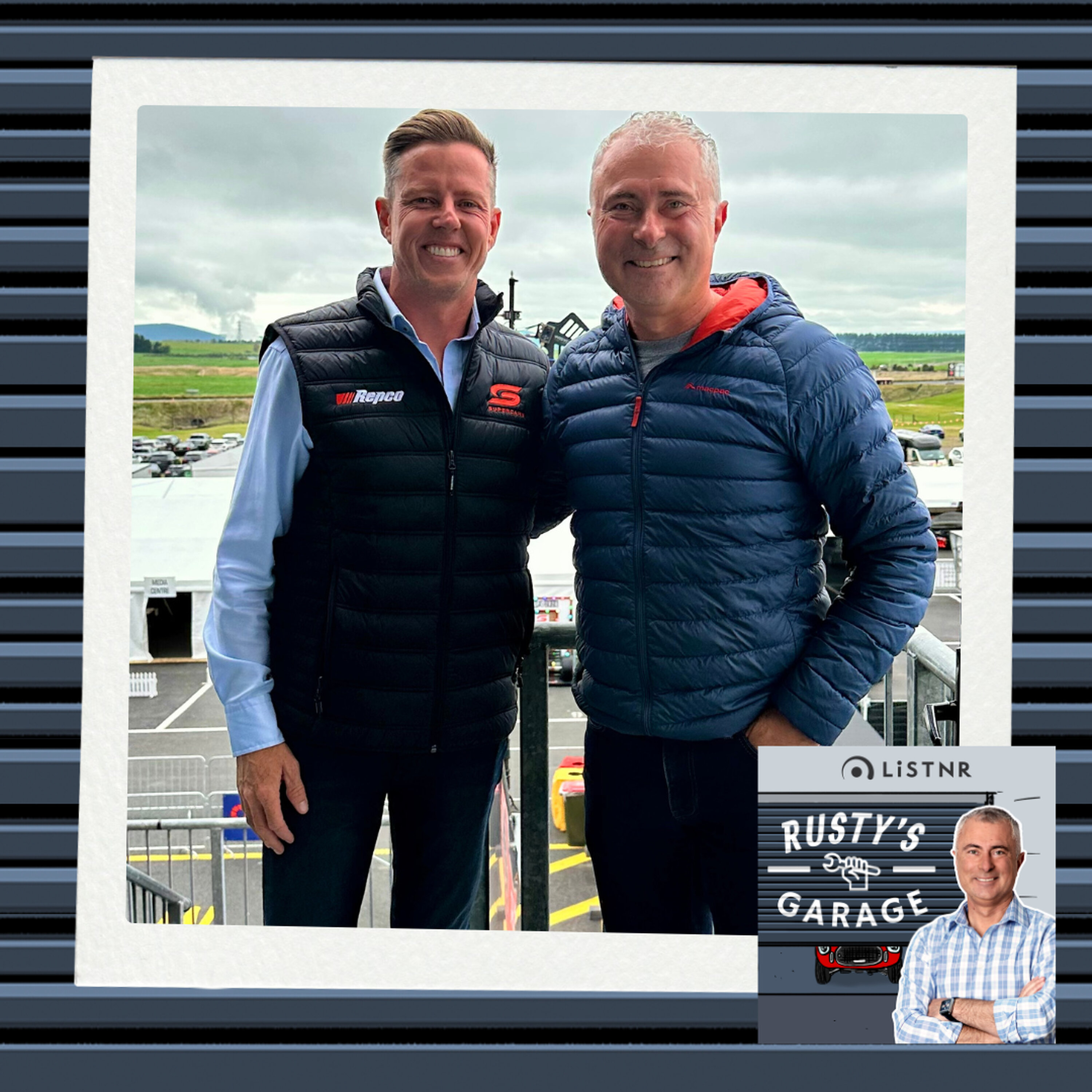
James Courtney’s karting-to-F1 origin story mixes ruthless competition, family sacrifice, and hard lessons. He explains how a “flash name” became Giovanni Cortini, why severe ADHD and dyslexia made school brutal (yet fueled high-pressure focus), and how karting started with dad’s tinkering and a Lithgow come-and-try day. Key turning points include Jim Morton’s Castrol support, early world-kart success, and a Formula Ford/UK path backed by Alan Gow’s funding. The episode also covers the emotional aftermath of a teammate’s death at Alton Park and a wild Honda Type R road-jump prank that nearly ended in disaster.
How sampling a kart at Lithgow started the journey and it clicked straight away. Borrowing chain oil from the late Jim Morton and how his generosity put JC on course for Europe. Living alone in Italy in his mid teens and the future F1 stars who tried to scare him at the Karting World Championships. Thinking he was at the end of the road until a chance catch-up with Neil Crompton opened the door to car racing. Alan Gow stumping up serious cash for a move into Formula Ford. Realizing the dangers of the game when a friend was killed in a crash at Oulton Park. The ‘Dukes of Hazzard’ moment with Marino Franchitti and why they didn’t tell his legendary brother Dario about it for years! Plus a candid conversation around ADHD and how James has learned to live with it. There are some fabulous takeaways for young racers in this 2-parter and we’re indebted to James for sharing Head to Rusty's Facebook, Twitter or Instagram and give us your feedback and let us know who you want to hear from on Rusty's Garage
"...m recording these intros in the home studio as a cyclone approaches. That's a true story, so although it'..."
The GMC Cyclone is a pickup truck that was made to be fast, not just useful. It’s known for having a powerful setup compared with typical trucks.
The GMC Cyclone is a high-performance pickup truck built for quick acceleration and strong power. It’s a notable “sleeper” type of vehicle because it combines truck practicality with serious performance, which is why it can stand out in a garage-style discussion.
"The interview itself I did in the lead-up to the shortened tow-pore supercars round last weekend."
Supercars is Australia’s premier touring-car racing series, featuring production-based cars prepared for racing. Rounds typically include qualifying and multiple races, with points awarded across the weekend.
"Little note of thanks to my long-term friend and colleague at Listener, Mark Howard, from the famous Howie Games pod."
“Howie Games” is a podcast brand, and the transcript frames it as a long-running show where James Courtney previously spoke at length. This matters because it provides context for the guest’s backstory and the interviewer’s prior conversations.
"Two karting world titles. He was British Formula Four champion, and that is a very respected, famous championship or class, and he did that at the turn of the century, breaking a record at the time for most wins in a season."
F4 is a junior race series for drivers moving up from karting. Winning the British F4 championship means you were the top driver in that important “next step” before bigger racing.
British Formula Four (often shortened to F4) is a junior single-seater racing category designed to bridge the gap between karting and higher formula series. Being a champion in F4 is a major credibility marker because it’s a highly competitive stepping stone.
"Tell me the backstory to this. Was it someone saying that you needed a more Euro-sounding name for the karting days, or when you were heading overseas?"
Karting is usually the first step into racing. It’s like training wheels for race driving—learning how to steer, brake, and race around other drivers.
Karting is the common entry point for many racing careers, using small, lightweight go-karts to build racecraft. It’s where drivers learn fundamentals like lines, braking points, and how to manage traffic.
"And it had adjustable pedals and whacked the pedals all the way back."
Adjustable pedals mean the pedal positions can be moved to fit the driver. That helps a smaller driver reach the controls properly and drive more confidently.
Adjustable pedals let the driver move the pedal positions to fit their body size and driving style. In karting, this is especially important for young drivers so they can reach the pedals comfortably and operate the throttle and brake consistently.
"I had this little yellow open face helmet on with goggles."
An open-face helmet protects your head but doesn’t cover your face like a full-face helmet. It’s still meant to keep you safe, just with more of your face exposed.
An open-face helmet (a helmet without a full-face chin bar) is common in some motorsport and karting environments, depending on local rules. It provides head protection while leaving the face more exposed than a full-face helmet.
"I had this little yellow open face helmet on with goggles. And it was freezing because it was Lithgow."
Goggles protect your eyes from wind and dirt kicked up on the track. They help you see clearly so you can focus on driving.
Goggles are eye protection used in karting to shield against wind, dust, and debris kicked up by other tires. They’re especially useful in colder or windy conditions where eyes can water and visibility drops.
"From a very young age, you were sort of transfixed on the notion of Formula One, you loved it,"
Formula One is the highest level of race car driving in the world. Teams build very advanced cars to compete for championships.
Formula One (F1) is the top tier of open-wheel racing, run by teams that compete for the World Drivers’ and Constructors’ Championships. It’s known for highly engineered cars, strict regulations, and a global race calendar.
"But after seeing some of the shunts, I thought, maybe not. But yeah, Bathurst was one."
A “shunt” is a collision or sudden impact during racing, often involving contact with another car or a barrier. Mentioning “seeing some of the shunts” signals the speaker was concerned about safety and risk after watching incidents.
"The 24 hours of Le Mans, I had a lovely deal ready to go on that."
Le Mans is a famous long-distance race that lasts 24 hours. Teams swap drivers and manage the car carefully so it can keep running for the whole race.
The “24 hours of Le Mans” is one of the world’s most prestigious endurance races, run at the Circuit de la Sarthe in France. It’s a multi-hour team event where strategy, reliability, and driver stints matter as much as outright speed.
"Enter Jim Morton, great person in Australian motorsport in karting circles. And there's a yarn about you."
Jim Morton is a person the speaker credits as important in Australian racing. The story suggests he helped make connections and start conversations that supported the driver’s path.
Jim Morton is mentioned as a key figure in Australian motorsport, particularly connected to karting. In driver development stories, influential people like this often provide mentorship, opportunities, or introductions that help careers move forward.
"...can you ask if you can borrow some chain oil? So I roll up there... can we borrow some chain oil?"
Chain oil is lubricant for the chain that transfers power. Keeping it properly oiled helps the chain move smoothly and last longer.
Chain oil (or chain lubrication) is used to reduce friction and wear on a chain drive system. In karting, proper lubrication helps maintain consistent power delivery and reduces the chance of chain wear or failure during races.
"Like like Tony Oliotsy, like Fernando Alonso. These are the guys in the driver's briefing for these two little guys."
Fernando Alonso is a famous race car driver from Formula 1. The fact he’s mentioned here shows that top drivers often begin their careers in karting.
Fernando Alonso is a two-time Formula 1 World Champion and one of the most famous modern race drivers. Mentioning him in a karting context highlights how many elite F1 drivers start in junior categories like karting.
"Listen to your mechanic and the mechanic who was Yarno Trulli's manager. And he's a mechanic because he was still in the car team."
Jarno Trulli is a former Formula 1 driver who later worked in team and driver development roles. The speaker’s point is that the mechanic had high-level racing pedigree because he was connected to Trulli’s team environment.
"And if memory serves, something goes wrong with the throttle and you nearly got a podium, but you had to drive it using the throttle by hand or something... Yeah, the throttle cable broke."
The throttle is what you use to tell the engine how much power you want. If something goes wrong with it, the car may not accelerate normally.
The throttle controls how much air/fuel the engine gets, which directly affects engine power. In racing, throttle problems can drastically change acceleration and drivability.
"There was Anthony Davidson, who now does this guy stuff.
Yeah, I do."
Anthony Davidson is a pro racing driver who later became a TV/analysis type of figure. The guest is saying he’s one of the toughest drivers he’s ever raced against.
Anthony Davidson is a well-known British racing driver and commentator/analyst. The speaker highlights him as the best opponent they’ve raced against, which is meaningful because Davidson has a reputation for strong technical feedback and racecraft.
"Who's one of the toughest you've come up against in that period?
Alonso, Hamilton?"
Hamilton is one of the most successful modern Formula 1 drivers. Mentioning him means the speaker is talking about top-level competition.
Lewis Hamilton is a dominant Formula 1 driver celebrated for speed, consistency, and tire management. In this context, his name is used to describe the caliber of opponents the speaker faced.
"And it was a period there where there wasn't any real change in F1.
They sort of let Reichenan and Button through."
F1 is the highest level of open-wheel race car racing. When “not much changes,” it means the cars and rules are similar, so racing skill and strategy become even more important.
F1 (Formula 1) is the top tier of open-wheel racing, where rule changes, car development, and driver performance all matter. The segment suggests a period where the cars and competitive landscape weren’t changing much, so outcomes depended heavily on execution and timing.
"Because I'd just done a funny, so we did a lap around the mountain and in the go-kart. Wow."
A go-kart is a small race car you drive on a track. Lots of racing drivers start in karts because it teaches you how to race.
A go-kart is a small, lightweight racing vehicle used for driver development and grassroots racing. In motorsport pathways, karting is often where drivers learn racecraft like braking points, corner entry/exit, and battling for position.
"I mean, owner of the British touring car championship had worked significantly with Brock over time, all those guys, Brad Jones, Crompo, they all know Gau very closely and how well connected he is."
The British Touring Car Championship is a big racing series in the UK. It’s a sign the people involved are well connected in professional motorsport.
The British Touring Car Championship (BTCC) is a major UK touring-car series featuring production-based cars. Mentioning it here signals the speaker’s connection to high-level motorsport networks and team personnel.
"And typically that's a two year campaign, mate, isn't it? You get in and then hopefully you can have a shot at it the next year with the factory team or whatever it might be."
A two-year campaign means you race for two seasons as part of a bigger plan. The idea is to learn, improve, and then try to move up after year one.
A two-year campaign is a multi-season racing commitment where the driver’s development and results are evaluated over time. In junior formulas, the goal is often to secure better seats or advancement after the first season.
"You get in and then hopefully you can have a shot at it the next year with the factory team or whatever it might be."
A factory team is the manufacturer’s own racing team. If you get a shot with them, you usually get more support and better chances to move up.
A factory team is an official works team supported directly by a car manufacturer. In a driver development path, getting into a factory team typically means better resources, engineering support, and a clearer route to higher-level racing.
"He's also high up in the FIA. I think he was, I don't know, but back then, John Todd or Max Moseley."
FIA is the organization that helps run and regulate big international racing. If someone works high up there, they can influence the rules and how races are organized.
The FIA (Fédération Internationale de l’Automobile) is the main governing body for many forms of international motorsport. When someone is “high up in the FIA,” they’re involved in rules, approvals, and oversight that affect how series operate.
"...prior to this, I was at the IndyCar race on the Gold Coast and I met Dario Franckitti and Paul Tracy."
IndyCar is a top racing series in the US with open-wheel cars. Racing there means you’re competing at a very high level.
IndyCar is the premier American open-wheel racing series, featuring purpose-built cars and top-level drivers. It’s a different ladder from European junior formulas, so experience in IndyCar can translate into strong car-control skills.
"[2239.7s] And he was doing a few little video projects.
[2241.8s] And I reckon I would have the VHS.
[2243.9s] I've still got it.
[2244.5s] Did you?"
VHS is an old-school way of recording and watching video on tape. People used it to keep copies of videos like race highlights or interviews.
“VHS” is a magnetic tape video format that was widely used before DVDs and streaming. In racing contexts, VHS tapes were often used to archive interviews, race footage, and promotional videos.
"maybe you and Merino had put like, what was it? All these wheel weights in his rental car, his road car on the way on the track that day, and he had to stop and jack it up."
A rental car is a car you borrow temporarily. When you’re heading to a track, any problem—like shaking or wheel issues—can turn into a stressful stop.
A rental car is a vehicle borrowed for a short period, typically with strict rules about damage and modifications. Using one on the way to a track highlights how even small issues (like wheel balance) can become a big hassle quickly.
"All these wheel weights in his rental car, his road car on the way on the track that day, and he had to stop and jack it up. But what was going on?"
“Jack it up” means lifting the car off the ground with a tool so you can work on the wheel. It’s usually needed when something on the tire or wheel needs fixing.
“Jack it up” means lifting the car with a jack so you can access the wheel or underbody. In this context, it sounds like they had to physically raise the car to deal with the wheel/weight issue.
"...we got, I went to Dunlop on, this is like the Thursday you get to the track, and I went to the Dunlop guy and I'm like, give me all the wheel weights you can."
Dunlop makes tires, and in racing they often have people at tracks helping with tire-related stuff. Here it sounds like they were getting wheel weights from that tire support.
Dunlop is a major tire manufacturer and motorsport tire brand. In racing contexts, “the Dunlop guy” would likely be someone associated with tire supply or track support.
Select text to request an explanation
MUSIC
A Listener production.
I'm automotive commentator and journalist Greg Rust,
and this is Rusty's Garage.
I'm recording these intros in the home studio
as a cyclone approaches.
That's a true story, so although it's pretty well soundproofed
and thankfully the cyclone has been downgraded a little,
you may hear the wind outside.
The interview itself I did in the lead-up
to the shortened tow-pore supercars round last weekend.
Martin Collins, who's a friend and former team boss at Team Kiwi,
among other management roles in the sport,
has very kindly let me use his office in Rusty's Garage.
One piece of memorabilia in here
quickly caught my guest's attention,
and we'll talk about that later.
Little note of thanks to my long-term friend and colleague
at Listener, Mark Howard, from the famous Howie Games pod.
James Courtney spoke with him at length back in 2017,
and he opened up on living with hyperactivity,
something that I didn't know about.
He expands on that a bit in this latest chat with me here,
because he's learnt a lot in the almost decades
in speaking with Howie.
At times, JC might laugh about things that he went through
while learning to cope with it.
Don't take that the wrong way.
It's an almost self-deprecating way that he accepts it,
owns it, and powers on.
That is a theme of both parts of this feature app.
It is a great takeaway for young racers who are listening.
Don't let things like that stop you.
Just look at the success that James has had.
Two karting world titles.
He was British Formula Four champion,
and that is a very respected, famous championship or class,
and he did that at the turn of the century,
breaking a record at the time for most wins in a season.
He drove for Jaguar's Junior F3 team and won on debut.
He was test driver for the Jag F1 team,
and he talks in the pod here in incredible detail
about a testing crash at Monza at a time
when he was very much on the radar of teams in the F1 paddock.
We also talk a little about his success in Japan,
some other motorsport career or driving options
that aren't widely known, the highs and lows of supercars,
selling one of the best houses on the Gold Coast
that belonged to the former Zara of the sport, Tony Cochran.
And thanks to the head of broadcast
for the next Gen-NZ championship that I work on,
a deal that nearly saw him move into TV much earlier
before his stint with the Blanchard racing team.
Thank you to David Tonaklet for that little bit of intel there.
Thanks also to the supercars TV crew,
Nathan, Briney and more,
for helping us find a couple of hours in the schedule
in the lead-up to Topor so that we could record this chat.
For regulars to the pod, after you've listened,
I reckon you'll agree this is up there
with some of the best eps that we've ever done.
Thank you to JC for that. Hope you enjoy it.
Bonjour, Anor.
That's exactly what my school teacher used to call me.
Tell me the backstory to this.
Was it someone saying that you needed a more Euro-sounding name
for the karting days, or when you were heading overseas?
Where did this... And if I got that right,
is it Giovanni Cortini or something like that?
That's exactly what they said.
They said that to be a racing driver, you need a flash name,
and he thought James Courtney was pretty boring.
Because at the time, I was going to live in Europe or in Italy.
So he said, oh, you got to call yourself Giovanni Cortini.
Did it stick a bit?
No, only with him. He was the only person.
And you remembered it.
I love that. I love that.
We've jumped forward in the timeline.
Let's come back a little step.
Your dad was a chippy-by-trade,
but the family had a carpet-laying business, didn't they?
And he sort of, I think, enjoyed the notion of tinkering,
whatever it was, bikes, carts or whatever.
And at about age seven or eight, maybe you go to Lithgow,
where I've commentated over time.
And was it like a come-and-try day or something?
What was it?
Yeah, so my dad actually raced first.
Did he?
Yeah, so he actually won two national championships.
So he was good.
I shouldn't remember that. Sorry, yes.
No, no, no, I don't tell it
because I don't want anyone to know that he was good.
Sorry, dad.
But no, he won two national championships
in the top class, which was pretty cool.
But yeah, I was that little kid, annoying the crap out of him
and friends and everything to have a go.
And we eventually went up to Lithgow and had this,
there was an old clapped-out thing.
I think Winnebottom drove the thing at the same time,
and Caruso.
And it was like, it was called a track-up.
And it had adjustable pedals and whacked the pedals
all the way back.
And I remember the first time, like it was yesterday.
Your age seven or eight, he said, aren't you?
Yeah, and my dad, I remember looking at,
I had this little yellow open face
helmet on with goggles.
And it was freezing because it was Lithgow.
And I remember my dad running around the track beside me.
Me telling me what to do.
So he's obviously a bit of it.
But yeah, I remember him gradually, like that first time,
like yelling at me, not yelling,
but running, telling me instructions, what to do.
So that's how it started.
By the end of the day, it obviously got a little bit faster.
And we're off, and I fell in love.
And I annoyed dad that much that, and then,
I think he won a race and won a cut.
Then I got, there was an arrow, an old little arrow.
Maybe it was a Demon X-8, I can't remember what,
I think, I don't know if that was a brand or whatever,
but I remember it having Demon X-8 on it.
And that was too big.
And then they got me a little, a card, a Dino Mini,
and then I was off, I was gone.
So, and then dad realized, I think that he,
we both couldn't do it.
And as dads do, as I'll do now for mine,
you sort of sacrifice your own fun to enjoy it for your kids.
So then dad and I went on this journey together.
I love that.
There is a little backstory here.
You enjoyed soccer to begin with,
but you got a little too much.
You got in a bit of trouble, didn't you,
seeking the limelight?
Is this true?
I may have liked to have played every role of the team,
so I did get asked not to play anymore,
but yeah, I was, who would have thought, a glory hunter.
So I'm not much of a, I mean, like racing's a team sport,
but it's very much individual as well once you're out there,
but yeah, the soccer story was short lived.
I think the story goes something along the lines
of tackling your own team in order to score the goal
or something along those lines.
Yeah, it was probably a home goal.
I didn't care, I just wanted to run around.
Come forward a step.
It clicks straight away in a motor racing sense for you,
and I think there's a drive in order to kind of get
a sign off on your license,
and you may have either in that race
or the first official race kept the trophy.
You finished on the podium that day
and kept the trophy, is that right?
Yeah, I still got it at home.
It was like a little green sort of bit of perspex
with a little emblem on it and combined districts.
So yeah, that was my, I think it was at the end
of that come to try day.
You had like a little run and I ended up getting a trophy,
so yeah, it was pretty good from the start.
I love that.
You have a saying too, mate.
Mark Howard and I both work for the same podnet work
in Listener, and I know you spoke with him back prior
to the pandemic, beautiful chat that.
And you used a line with him,
and it was something along the lines of,
I don't want to be, I'm gonna be.
And I love that.
From a very young age, you were sort of transfixed
on the notion of Formula One, you loved it,
and Center, things like this, mate.
And it wasn't necessarily just like a dream.
It was more like, I forget school, whatever,
I want to pursue that.
Mate, it was happening.
I was, I told myself, like even down in school
when I was driving, I should have been doing schoolwork,
but I was designing my helmet.
And I left, if you know my helmets,
that's sort of a band on the top,
which I left in the front.
That was because I was gonna have,
it's not allowed to now, Marlboro,
because everyone had Marlboro sponsorship,
as you can see behind me.
So I had, I left space on it,
because I was gonna be a McLaren driver,
I was gonna win World Championships,
and I was gonna be sponsored by Marlboro.
So I didn't just want to get to F1,
I wanted to get there and be someone,
and that was my sole focus,
and I was so determined the whole way through.
You shared with Howie,
I don't know if you are comfortable
talking about it again here now.
School was a bit tougher, you made, wasn't it?
You know, I think you talk,
as though you have a level of ADHD,
and that there are nerves around things like,
you know, reading books in front of fellow class members,
or classmates at school back then.
That aspect kind of haunted you a bit, mate, didn't it?
Yeah, massively.
I've got severe ADHD.
That much that when I was going through my divorce,
I ended up having to get tested
and do all this sort of stuff for other reasons.
But when they tested it,
they asked me to come back in after the test,
and there was all the other doctors in the room,
and they questioned me for a long period of time,
because they couldn't understand how I had a job,
and for a long period of time,
and sustained it, and I wasn't in jail.
Because the normal medication for someone
is between 30 and 40 milligrams,
of the medication I was on was five ants.
But I didn't get diagnosed last 38, so prior to that.
But anyway, so then, as you can see,
I'm jumping around a bit.
You're right, so good, so good.
But my, so then I sat down with these people,
and they're going through it all,
the doctors, and they're going through it all,
and my dose was 115 milligrams.
But so then they tracked my diet,
and everything I did for a month to try and work out
how I was sort of managing such,
that said, it was the most severe case of ADHD
that I've ever seen.
And they worked out that with my diet,
what I was eating, and my coffee intake,
and all that sort of stuff,
I was self-menocating to balance myself out.
So that was, and at school, that was horrific.
I couldn't sit still.
I couldn't, as you know,
I only wanted to be a racing driver,
or anything else that wasn't gonna benefit that
I was not interested in, or soul-focused on that thing.
You know, at school, it was really hard for me.
I was okay at math with numbers,
but anything, reading, or writing,
or anything like that was horrific.
So even now, like I'll sit, you know, on the telecast,
I can sit and talk for hours about racing,
and if you give me a paragraph to read on TV,
I'll just fall apart.
Like, anything to do with, you know,
there's a form of dyslexia with that as well,
because whenever you have ADHD,
you either have something,
like there's a, they come in pairs, thankfully,
which is lovely.
So you either have ADHD and dyspraxia,
which is trouble to speak,
and you know, you sort of stutter and things like that,
or dyslexia, where it's the words get jumbled up.
So when I read, I don't read...
In a linear sense, in a, you know, you're right.
No, I just look at blocks,
and my brain sort of makes up...
Jumps it, jumps it, yeah, right.
...guess is what the words are,
as opposed to, you know, reading it properly.
So that was always hard.
At school, I was really skinny as well,
like I'm not massive now,
but I was always the little guy.
I went to, you know,
it grew up, Western Sydney, where it was big, tough,
um, footy players.
So at school, I went to a football school,
so I was always the geek that wasn't involved in football,
and I'd go away and race a car on the weekend,
and I'd always get teased at school.
So, um, I was pretty,
I'm really introverted away from racing,
and I just had to teach myself
that I had to be an extrovert
to be able to do what I wanted to do,
which was racing, and, you know,
part of the racing side of things
I made of ours, Neil Crompton,
was bang on to me from when I was 15.
You have to be able to talk to the media.
You have to be able to present yourself.
You know, you have to be able to hold conversations,
all this sort of stuff, so I had to teach myself
on how to be an extrovert.
So a lot of people that see me away from racing
are blown away with how quiet I am,
because the moment I'm on show or doing,
you know, this is a show for us.
This is our show business.
So the moment I'm in character,
I'm bang on life now,
but then, of a night, I'll go and sit in the hotel room
by myself, have a pizza and watch the football,
not talk to anyone.
So it's, a lot of people can't understand
that's the way that all works with me,
but I think it all comes back to, you know,
the way it was through school, the ADHD stuff,
and just being so determined to do racing
and block everything else out.
The thing for me here is the beauty in that.
I mean, that's a very difficult thing to deal with,
and you've obviously gone extensively to try
and manage it the best way you can.
But the great example to other young carters
that might be going to Lithgow for a come and try day
is it hasn't stopped you, mate.
It hasn't stopped you making it all the way to Formula One.
It hasn't stopped you winning a Supercast championship
and so on.
No, not at all.
And the more I sort of think about it,
and you sort of get into it, and you read,
and you talk to people about it, there's so many of us.
It's not like a disease or anything, but.
And talking with the doctors,
they then realize that it's my ability to process
like high stressful situations with so much information.
I'm used to it because my brain's working
like that the whole time.
So you can process so much stuff and make decisions
and get through those crazy times without too much stress.
It's like you've trained yourself
to deal with that stress kind of thing oddly.
Yeah, but a lot of high functioning people with ADHD
in high positions like big CEOs and things like that
because they can deal with that stress.
They can have six million things on their plate at once
and not be overwhelmed with it all.
And it's just because in my head the whole time
there was that much information.
Like when I had to get medicated
through my divorce for a period of time,
which I didn't like because all of a sudden
everything was so quiet and it was, for me, it was unnerving.
Like not having my brain going 24 seven.
Like with my, as soon as I wake up, it's like,
bang, it's on and I'm thinking about what I can do
or what I can't do and what's happening over there.
And like I'm talking to you now
and there's a car on the track.
I wonder what times they're doing.
There's all that sort of like seriously
there's all that stuff going on.
But with you, you're a normal person.
So you're sitting here listening to what I'm saying
and you can block all that out.
So with the ADHD, you have the inability
to prioritize information.
You just get flooded with everything
and then your brain is then trying to process
and place it all and give everything
the same amount of importance with yours.
It's like, hey, I've got to concentrate
because James is talking to me.
Whereas mine is still now trying to work out
what's going on, but explain this and to the podcast.
So it's, it is craziness in there, but it's,
that's my crazy.
Yeah, but you've got a beautiful smile
and you clearly have found a way, mate.
You are a twin too, which not many people realize.
Your sister was born, I think four or five minutes difference
to four minutes.
Four minutes, there you go.
She doesn't have this.
She doesn't, it's not a hereditary.
No, I think she does.
Sorry, sorry, Bec, sorry.
Bec's with twins are very rarely the same sort of character.
Bec's fuse is about a millimeter long
and like I'm pretty crazy and to a point
where I'll get upset, but Bec,
if you look at Bec the wrong way, she's into you.
So, but she's beautiful.
She's, it's amazing for me,
which was really tough through my childhood
is because I left so, it was my choice.
I left when I was 15 and went to Europe.
So then I was by myself.
So I went from mom and dad being so focused
and so such a tight family unit with myself,
Bec, and we have an older sister as well, Melinda.
We'd all travel together, do the racing
and all that sort of stuff.
And then I was off by myself for whatever it was, 11 years.
So you sort of miss so much of your family time with her
and with my older sister and with my mom and dad
through those very influential years
where I was by myself in Europe.
You had to grow up fast, mate, didn't you?
Yeah, it was pretty wild, it was pretty wild.
So mom doted on me as a kid.
And it's Diana, isn't it, your mom?
Yeah, yeah, yeah.
Yeah, so, and then dad, Jim, was,
you know, he was hard into me about the racing.
So we're always so close.
And then all of a sudden you're just by yourself in Europe.
So it was a big adjustment for me.
It was like so many times I was like, this is just so sad.
Like I'd sit in hotel, like I'd lived in an apartment
and it was fine through the week when the team was there.
You're talking Italy now when you're living in Italy
and stuff, and sometimes you were there
in winter when it's snow and can't go out.
Yeah, so I pretty much come home at Christmas
for two weeks a year.
And apart from that, I was pretty much there the whole time.
So I would, through the week, you're sort of in the factory
where Tony Cart was the team and you'd sort of be there
See something that's not quite right? Our annotations are AI-generated and can sometimes miss the mark.
Click the flag icon on any annotation to suggest a correction.