This part is about Jay’s experience at an IMSA race at Laguna Seca. He talks about what it was like watching the action and how the rules affected the cars.
Balance of performance is how race organizers try to make different cars feel more evenly matched. They do this by adding limits or restrictions, so one car doesn’t automatically dominate everywhere.
Term
restrictions
In racing, “restrictions” are rule-imposed limits that can include things like air intake limits, power limits, or aerodynamic constraints. When applied after a dominant result, they’re meant to bring a car’s pace closer to the field under BoP.
Downforce is the “squishing” effect from aerodynamics that helps the tires stick to the track. More downforce usually means better grip, but it can also make the car slower through the air.
Concept
on the break of bankruptcy
This phrase means the company was almost out of money—so close to going under that it could have failed. The hosts are using it to explain how costly the racing effort was.
Term
plastic portions
“Plastic portions” here likely refers to bodywork or aerodynamic components made from plastic/composites rather than traditional metal. In race cars, using lighter or more shapeable materials can help with packaging and aerodynamic development, but it can also raise durability or cost concerns depending on the design.
Company
VW
VW is Volkswagen. They’re mentioned because a contract from VW helped provide money or business when banks were refusing loans.
The Porsche 356 is an early sports car made by Porsche, first released in 1948. It’s important because it was one of the first cars that helped define what Porsche would become. People bring it up when discussing Porsche’s early history and major turning points.
The Volkswagen Beetle is a small car made by Volkswagen that became very popular and was built in huge numbers. The podcast mentions money and taxes related to how the design was licensed and sold. That kind of business setup can create extra paperwork and costs when lots of cars are produced.
Back then, race-car aerodynamics weren’t as well understood as they are today. Teams had to experiment more because it was harder to predict how changes would affect grip and stability.
Drag is the air’s resistance to the car moving forward. Less drag generally helps top speed, but you still need the car to stay planted for handling and stability.
Lift is the opposite of downforce—it can make the car feel like it’s getting light at speed. If a race car creates lift instead of pressing down, it can lose traction and become unstable.
A ramp tail is a shape change at the back of a race car that helps the airflow work better. The goal is usually more grip and stability, which can make the car faster around the track.
The hosts are talking about the bigger goal: winning the whole Le Mans race. They’re linking that goal to why engineers cared about things like air resistance and speed.
Aerodynamics in racing is how the car’s shape interacts with air to affect speed and grip. The idea is to design the car so it goes fast without becoming unstable or hard to drive.
A wind tunnel is a lab setup where engineers test how air moves around a car. It helps them measure things like how much the car is slowed by air and how much grip it gets from aerodynamic forces.
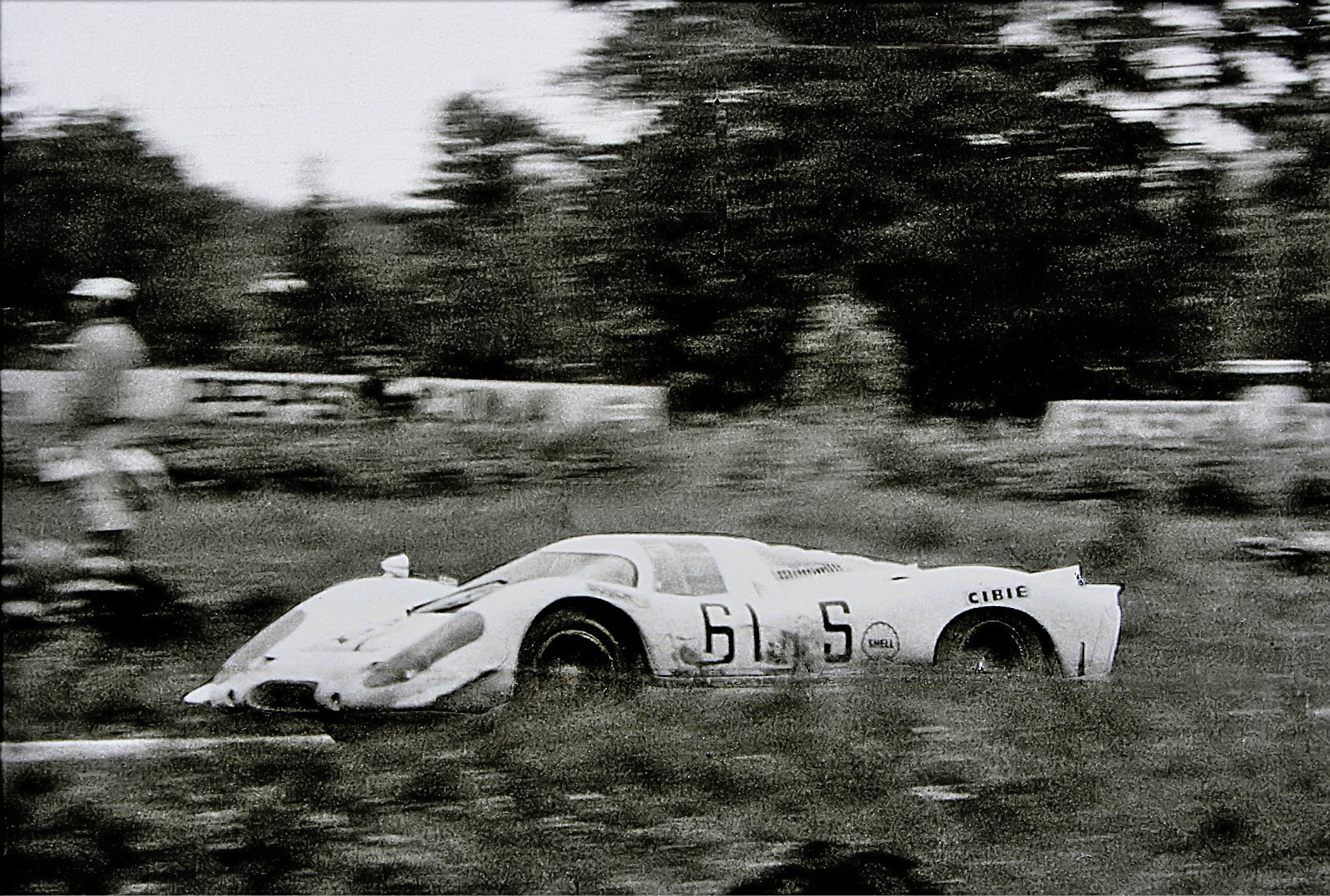
The Porsche 917 was a famous race car Porsche built to win big endurance races like Le Mans. Here, the hosts are talking about the people who engineered it and how they worked on making it faster.
“Air cooled” means the engine is cooled using air moving over it, not coolant flowing through a radiator. The host is saying Porsche wanted to keep that cooling approach even while racing.
Le Mans is a famous long-distance race where cars have to keep going for 24 hours. Winning it is a big deal because it shows the car can handle tough conditions for a long time.
A “halo effect” is when one great thing makes people assume other things are also great. In this case, winning a big race makes people look more favorably at the brand’s regular cars.
Gulf is mentioned as a partner Porsche used for racing. The idea is that Porsche didn’t want its own engineers spending all their time at races, so they handed more of the factory team work to Gulf.
Company
John Weier
John Weier is a racing figure Porsche trusted to help run the factory team. The host is saying Porsche used him so their engineers could spend more time back at work on road cars.
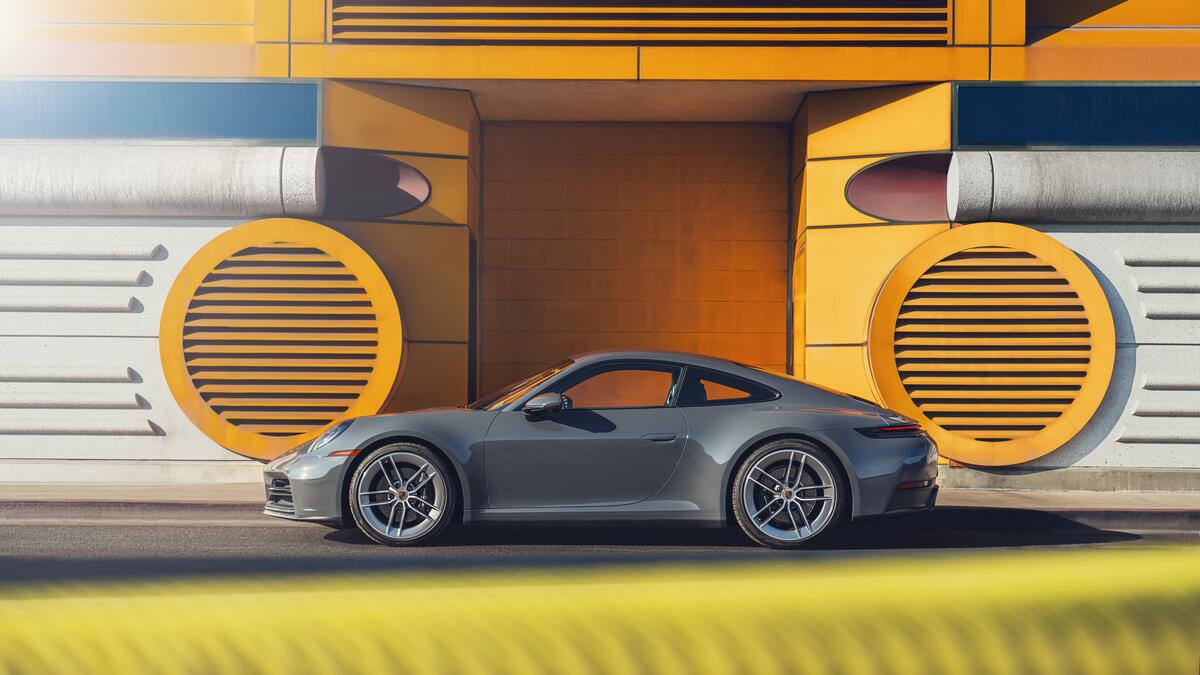
The Porsche 911 is Porsche’s flagship sports car, known for its rear-engine layout and long-running evolution across generations. The host mentions it as the street-car line that “pays our bills,” contrasting it with time spent on racing.
The Porsche 914 is an older Porsche model with a mid-engine design. The host is using it to emphasize that Porsche wanted engineers focused on improving their regular cars, not only racing.
The Porsche 904 is an earlier Porsche race car mentioned as a problem case. The host says its design and build quality weren’t consistent enough and it was too heavy.
Car
Porsche 906
The Porsche 906 is a Porsche race car from the 1960s. It used a light metal frame and a very thin fiberglass body to help it compete better.
A tube frame is basically a strong skeleton made from metal tubes. It helps a race car be lighter and stiffer, which can improve handling and durability.
Homologation is a racing rule that forces teams to build a certain minimum number of cars to be allowed to race. The episode says Porsche’s plans changed when that required number dropped.
The Ford GT40 is a race-focused car made to compete in endurance racing. The podcast mentions homologation, which means racing rules required a certain number of cars to be built so the race version could qualify. That’s why you’ll hear about specific production counts when people talk about the GT40.
The FIA is the organization that writes and updates the rules for major international racing. In this story, they changed the rule that affected how many cars Porsche would need to build.
They talk about how, in the past, getting a Formula One seat could be extremely dangerous. The story shows how even when someone turned down a job, the next drivers could end up killed.
They’re saying that racing used to be far more dangerous than it is today. Safety equipment and rules back then weren’t as effective as what we expect now.
Vents are openings that let air flow through the car to help cool hot parts. If you block them, the car runs hotter, so you need another way to keep the driver or components cool.
A cooling suit was a way to keep the driver cool during a race. The idea was to use something cold to cool the driver, but early versions didn’t cool effectively for long.
Adding extra stuff to a race car makes it heavier, and that usually slows the car down. Teams often try to avoid unnecessary weight to keep performance up.
This is the basic idea of using ice to cool something. The problem is that ice melts quickly, so it can’t keep cooling for long enough to be useful in a race.
This is a safety system that can put out a fire fast. In racing, teams may choose to add it even if it adds weight, because it can protect the driver in a crash.
LIVE
Welcome to Porsche Patter with Bracken Helms, the show where we hear Bracken and his distinguished
guests from the Porsche community patter on about Porsches and all things automotive.
Porsche Patter is sponsored by Circuits Explore. Circuits Explore creates authentic automotive
apparel made for life-minded automotive enthusiasts. The links for Circuits Explore are in the
show notes. Okay, let's get to it.
Jay Gelotti, part two. Alright, last week I was down at Laguna Seca for the IMSA race. At the end,
I just went and was by the stance. I mean, I move around throughout the race, but I ended at the
main grandstands by the start finish. And I'm sure the people in the bleachers behind me were
thinking I was crazy because that last couple laps with Heinrich, I was unsure whether he was
going to get around. So I grabbed in the bleachers ahead of me and they probably thought I was a
little crazy, but I could hear them cheering too. I mean, there was definitely some people
back there, especially considering how crazy people are about Rexing and Roxy. So I think
there's a lot of fans that wanted Heinrich to win because I heard a lot of people like, you know,
but that was pretty crazy. I mean, the cars a year old because they don't have the newest
and greatest 2026. So it's a 2025 963. This balance of performance is killing me. Well,
it makes it even harder with longbeats in the middle, because longbeats, they can't really
gauge whether the balance of performance was too much. I mean, they put up huge restrictions on
the Porsche after they won Sebring and Daytona. But in the city, you can't really tell if that was
too big of a restriction. So that's kind of wasted. And then you don't know until Laguna Saken.
But I was pretty excited about the Apple cars because I mean, I could give two shits less
about Apple. But my thing is with Bob Garrett, son, who's a friend of mine, you know, he told the whole
story. If you haven't listened to that podcast, maybe go back and listen to Bob Garrett's and he
explains how the whole Apple thing happened. I mean, Porsche wouldn't have been able to do Apple
this week as a throwback if it wouldn't have been for that one. I don't even know how many times they
race that Apple. I might have just been for one race or something. I mean, it was good seeing the
Apple car knowing that it was specifically because of Bob Garrett's and they had that original 935
there. I took video of it and sent it to Dick Barber. All right. And this one, we talk about
Luis Piak and then a little bit about Fernand Piak and his against the downforce on the 917.
Then we also talk about Fernand Piak and how much he stressed the company with the 917, which
this was a good take because I just barely read in a magazine, a pretty prominent magazine.
And the article was like, oh, Fernand Piak put the company damn near bankruptcy for the 917.
Because you always hear like, oh, the company was on the break of bankruptcy.
Things were not looking good. They spent way too much on that 917. So who knows?
And then another thing we talk about is where would the 917 be without Fernand Piak? You always
just think about, like we were just talking about how much they had to stress financially,
how much they had to stress everything, how they went all in with the 917. So
you kind of just get stuck on the 917, but he was kind of responsible for all the plastic
portions. And then we end kind of with how dangerous it was for drivers back in the day.
But here's Jay Gelotti, part two. Okay. So this is kind of something that I read a while ago that
didn't really make a whole lot of sense to me. So I'm just going to read it and maybe you can
clear my head. So Ernst Piak told the story of Austria. After the war, all companies that were
German owned were transferred to the government. Louise was an Austrian. So she had part ownership
in the company. So she bought more ownership so they couldn't take it from her. They were building
watermills and stuff at Gummond. And the bank wouldn't finance them anymore. And they were
going to go bankrupt. So they got an Algeria company came and wanted a diesel design.
And other banks went low on money because Steyr, Steyr, whatever that company is,
Steyr, didn't want them giving other people loans or Porsche. Then they got a contract with VW
too. And finally they did get a bank loaned. And then they closed everything in Gummond
and moved to Salzburg. And so was Salzburg like the consulting company? Was this that we're
talking about? Is it the same thing? Was it the consulting company? Because this all happened in
1948, which is also the same year the 356 came out. So I don't understand like the Salzburg
aspect of it. And I thought, you know, I know that they were in Gummond and then they moved to Stuttgart.
But where the Salzburg and that comes in, I don't know.
So again, this is an hour long, at least an hour long discussion normally. And again,
very twisting, lots of twists and turns in this story. But so Louise Pieck is Ferdinand Porsche's
daughter. She's five years older than her brother, Ferry Porsche, which is an interesting dynamic.
And Louise Pieck, by all accounts, had more of the personality of the father. Ferry was much more
mild-mannered and much more easygoing and quieter in some ways than the father. But in the late 1940s,
obviously, the two siblings are there. Everything's been destroyed. They moved to Gummond to get away
from when Stuttgart was being bombed during World War II. They sort of decamped to Gummond
to try to preserve some nucleus of the company and its records and its engineering capacity and so
on. But yes, it's true that in order to not lose all or part of the company being confiscated
as a German company, Louise was very clever in saying, no, it's an Austrian company. And I'm
way oversimplifying this. But basically, that's what Louise did. And keep in mind, there was a
point where her father, her husband, and her brother were all in prison. And she's there in
Gummond left to hold everything together. She was quite an amazing lady, not very well known. I try
to feature her a little bit in my book because so many people don't know about her. But she managed
to hold it all together until her brother was released from prison, you know, reasonably quickly.
But her husband and her father, it was I think 18 months or more that they were held by the French
for suspicion of war crimes, basically, way oversimplifying that part of the story. But yeah,
eventually, she forms her own company. After Ferdinand Porsche passed away in 1950,
he split his estate evenly between the brother and the sister. And so the company that for
shorthand reasons, we call it Porsche Salzburg, that's the company that Louise ran. And she became
the distributor in Austria for Volkswagen and Porsche at first. But she built that over many
decades, she built that into a huge business, distributing Volkswagen, Porsche and other cars,
not only in Austria, but many other countries in Europe. So she built that into a very big,
very successful company. But what happened in 1950 is they did decide to move back to Stuttgart
for manufacturing of the 356. They thought that Stuttgart was a much better location because a lot
of their suppliers were there. They also had a tax problem because under the Volkswagen contract,
they started getting a royalty on every beetle that was sold. That created a tax problem. And again,
I'm way over simplifying it, but by becoming a manufacturing company in Germany, that allowed
them some offset to the income they were getting from Volkswagen, you know, the royalty income.
And also to some extent, the consulting income, which also became a part of their business as
time went along. And I don't know if I answered your question, but Porsche Salzburg is the Austrian
arm under Louis Pieck. Porsche AG in Stuttgart is run by Ferry Porsche. But I think Ferry Porsche said
that he never made a really important decision about the company without consulting first with
his sister. And then the Porsche family dynamic continues on for years and actually continues
on to this day. We still have the Porsche family dynamic going on and how Porsche and Volkswagen
are owned and managed. Yeah. Yeah, I mean, I've heard enough about Louise to know she's a bigger
player than sometimes like maybe gets a little bit pushed to the side because females aren't always.
Well, that and I don't think she sought the spotlight. I think she preferred in some ways
to stay in the background. Of course, Ferry Porsche himself didn't like the spotlight. He preferred
to kind of stay in the background. You know, he didn't do a lot of press. He preferred to have
people like Huschke von Hanstein, who became Porsche's racing and PR manager. He liked to have
somebody like that to go out and sort of be the forward facing person representing the company.
But you'll read or you'll see or you'll hear the little anecdotes about, you know, when Porsche
would say where they were designing a new car or styling a new car, Ferry and Louise often would
look at whatever the styling proposal was. And sometimes they would say, well, thanks,
we like how that looks, but sorry, it's not a Porsche. Yeah.
Do you know why Ferdinand Pieck, his nickname was Burley Burley?
You know, his cousin on the other side is Ferdinand Alexander Porsche known as Bootsy. So we had Bootsy
and Burley, including Ferry Porsche himself when he was very young child. You know, he got the nickname
Ferry, which just helped to differentiate him from his father. And I forget how they got their
nicknames, but I mean, it's like happens in a lot of families. Too many Ferdinands, right?
Everybody's named Ferdinands. Like you don't know who you're talking to. So I think that's in part
how they got their nicknames. And as super competitive and great an engineer is Ferdinand
Pieck was, why was he so against the downforce on the 1917? My, my basic explanation is at that time,
racing car aerodynamics was still a bit of a black art. We hadn't quite gotten to the science
yet. And so I think Ferdinand Pieck had it in his mind. And again, he was somewhat in personality
like his grandfather. You couldn't basically tell him anything. Again, it's a hierarchical system.
I strongly suspect that the engineers working under him, particularly Helmut Flegel and Peter
Faulk, I think they knew exactly what the problem was. No downforce. But they had no way to go to
their boss and say, you know, because he was adamant, we're going to go for the lowest drag
solution we possibly can. We're going to be the fastest car down the straight and we'll win.
Well, but of course, what happened is the faster they went down the straight, the more unstable the
917 became because it was trying to take off like an airplane. It was creating lift, not downforce.
So the only way it got solved was by foreshad outsourcing to John Weier and the golf team.
And my friend, John Horseman, who's since passed away, but helped me a lot with my first book,
he experimented with the car, created this ramp tail that has become so famous,
created it on the spot in the middle of a test session, basically. And even Ferdinand Pieck
himself could not deny that the car was five seconds a lap faster. You know how it is in racing,
we get a tenth of a second or two tenths of a second, all of a sudden your car's five seconds
a lap faster. That's like a massive leap. And so Ferdinand Pieck had to admit that they had found
a better solution. But then he, as we talked about earlier with the long tails, he continued
trying to find a solution, you know, a low drag solution with reasonable downforce
that would still be the fastest car down the malls on straight at Le Mans. Because remember,
this, that was the goal. He wanted to win Le Mans overall because Porsche hadn't done that yet.
And he really felt like low drag was a really important part of the equation.
It's not until later in the 1970s and certainly in the 1980s when the racing car designers,
I think, got much more sophisticated and scientific about how aerodynamics in racing cars actually
work, you know, where it became more common for racing cars to be analyzed in the wind tunnel,
so that the engineers could balance, because that's what you're trying to do, right? You're
trying to balance downforce with low drag, so that the car is as fast as it can be, but also
drivable. Right. And I was going to ask a question they knew, or a lot of them knew,
they were just scared of Ferdinand. Right. And I've heard it from a number of different sources
have said that they strongly suspect that the engineers, particularly Helmut Flegel, who was
the chassis engineer for the 917, and Peter Falk, who was another of the racing engineers at the time,
and they were at the test session in Austria when John Horseman took one of the cars aside
and started building this ramp on the tail. And the thought is, is that Flegel and Falk were probably
secretly very happy, because they could get to the solution that they knew, they probably knew
that was the solution, but they could blame it on the Englanders. You know, they could blame it on
these outsiders, right? So they could say to their boss, it was not our fault, they did it, but
car five seconds a lap faster. Okay, so how far did Piac stress the company like financially and
everything to get that 917 win? Again, we could do a whole hour on this, because this is very
controversial. And again, we don't have perfect information on this. I personally don't believe
the company was stressed financially all that much, because when Ferdinand Piac eventually wrote a
book in German, so those of us in English speakers can't really read it, but Mr. Ludwigson, our great
Porsche author is fluent in German. So the very final edition of excellence was expected. Mr.
Ludwigson's, you know, Bible on Porsche as a manufacturer, Ferdinand Piac's book had come out
and Piac had admitted that they had sponsorship from Volkswagen, that Volkswagen provided two thirds
of Porsche's racing budget in that era of the 917 on condition that the cars remain air cooled,
right? Because, you know, there's PR benefit in a way to Volkswagen when an air cooled car
wins the 24 hours of Le Mans, that has a halo effect in a way on the humble Volkswagen Beetle.
I also have done kind of back of the envelope calculation on what Porsche's revenue probably
was at the time, and it's hard to get this information because Porsche was still a private
company at that time. But you can kind of estimate what Porsche's revenue was at the time.
You can kind of estimate what the program probably cost roughly. Hans Metzger in one of his papers,
I think, or in his book, I forget, he said that Porsche tried not to spend more than two to three
percent of their revenue on the racing program. And don't forget they sold some of the cars to
customers, so they got some money back selling some of the cars and parts. Put it all together,
I don't think the financial stress on the company was all that great. I think it's a myth
that Porsche risked the company. It's a little bit like Boeing, which was happening almost exactly
roughly the same time, right? Boeing was doing the 747. And I think Boeing truly was risking,
that was a, you know, existential risk to Boeing financially speaking. I don't think that's the
same thing for Porsche with the 917. And I think if we put all the information together, we can
kind of dispel that myth. Now, what I also think though, I think Ferry Porsche did have a concern
about his engineering resources being too involved in the racing program and not enough
concentrating on developing the street cars. So I think Ferry Porsche may have had a concern there
not having the right balance and how his engineers were spending their time. So that's not a
directly financial consideration, but it is a business consideration. And I firmly believe
that's part of why they outsourced the factory team to Gulf and to John Weier, because that reduced
the amount of time that his engineers, instead of having his engineers fly out to every race
and actually conduct the racing operation, give that to John Weier. Maybe you send one engineer
to the race, but the rest of your engineers can stay home in Stuttgart and work on, can we improve
our 911s? Can we improve our 914, you know? Yeah. Which are the cars that pay our bills.
So anyway, I think that's also part of the dynamic that was going on.
Okay, so this next question is going to be even probably more broad. I was going to say,
what would happen to Porsche without Piak? Like the 911 was close in 69. Sorry, the 908 was close
in 69, but are you thinking just broad? So if Ferdinand Piak had never worked for Porsche,
we probably would have the 917. Probably not. Who knows if we'd had any of those cars,
any of those plastic tube frame. Would we have the 906? Because again, this is where the story
starts is in 65 when Ferdinand Piak becomes head of R&D, which includes racing. And in 65, he says,
he kind of rejects the 904 as far as the way it's constructed. He doesn't like it. He thinks it's
too heavy. There's too much inconsistency from one car to the next. So he says, no, we're going to
go back to tube frame, which at the time steel tube frame, but with very lightweight, ultra thin
plastic fiberglass bodywork. And that's so the 906 is the first of the line. And then from there,
they just keep going, you know, 910, 907, 908, 917, 936. 936 is the end of the line for that
basic method of construction. So without Ferdinand Piak, would we have any of those cars? It's almost
impossible to say or imagine what would they have done with their racing program without Ferdinand
Piak and his drive and his determination to again, eventually build a car that could win
overall at the most famous race in the world, at least in some people's eyes.
Yeah. I mean, I guess I was just still stuck on the question before. Well, when I wrote the questions,
because the first one was the stress on the 1917. So I was focused on the 1917, but yeah,
I guess he's the one that kind of was from the plastics. Well, again, then the 917 comes about
because of that change in the rules. You know, in 68, at the beginning of 68, the rule was you could
run a five liter sports car, but you had to have 50 cars built for homologation. So the GT40 qualified,
they got the Lola T70 qualified, you know, as having 50 cars having been built.
But there's no way that Porsche was considering building 50 cars. But then when that rule suddenly
changed, and it's a little bit mysterious why the rule changed, but the FIA and their wisdom
brought that down from 50 to 25. Now, Ferdinand Piak could say, well, wait a minute, how many
9.08s are we building? You know, how many 9.10s did we build? I mean, they were building a lot
of cars, and they would race them once or twice, and then they would sell them to their customers,
right? And so they had a little business going there. And so Ferdinand Piak, I'm sure, you know,
when it came down to 25, he said, well, wait a minute, that's 25 is not that far out of our
reach. We can probably do that. And of course, now that we know that Volkswagen was in the
background supporting them, it all kind of makes sense that, yeah, we could probably build 25 cars.
And that's how the 9.17 basically gets the green light. Yeah.
When I was at Canepa a couple of years ago, we were doing the tour. And I remember there was
like a 9.35 and there was the roll cage. And they told the story about, you know, one driver was like,
this metal piece is right here. If I get in any sort of accident, my head's just going to like,
like, this is dangerous. Like, what are you guys thinking? And one of the mechanics,
supposedly, of course, he was just like, oh, we've got plenty of drivers.
Well, you know, I've never heard that story, although it does point to a fact that,
in a sense, the drivers in that era were disposable. I mean, it sounds awful to say that.
And I've talked a lot with my friend, Brian Redmond about this, because he's one of the
survivors of that era, although he had three huge crashes, any one of which could have taken his
life. And just recently, I was emailing with Brian and talking about, he turned down driving for
Shadow in Formula One twice. He turned it down twice. Both of the drivers who took the job when
he turned it down got killed. Now, just think about that for a second. You know, you turn the
job down twice, and both of the guys who took the seat in your place end up getting killed.
I mean, this is how racing was in those days. It was very dangerous. You know, what they were
trying to do in terms of safety by our modern standards is laughable, almost. But of course,
thanks to people like Jackie Stewart, who was very focused on safety, they started putting
one brick on top of another. And eventually, you started to get things at least like, well,
at least you had Armco guardrails at a place like Spa. So if you go off the track, you don't hit a
tree, or you don't hit a house, you hit a guardrail, which is probably better than hitting a tree or
hitting a house, right? And eventually, over all these years, it has become much safer. But in the
60s and 70s, and even in the 80s, it was still extraordinarily dangerous.
Yeah. So I read that kind of relates to this. Peacock was trying to make the cars quicker,
so he put tape over all like the vents. If this is true. So then the drivers, not only did they
keep have to keep cool, they made these like cooling suits, which didn't work. And there was
just a puddle of water. And the only reason he wanted to get rid of it is because that was adding
weight, not for any other reason. And then he was even trying to like come up with oxygen tanks.
So he didn't have to cover these vents. Yeah, I haven't heard about oxygen tents.
But Brian Redman was in the race at Zeltveg in August of 69 when they tried the first cool suit.
And Brian said it didn't work at all because it was based on ice, you know, like a tub of ice,
basically. And then the water kind of circulated through this tub of ice. And he said, after a
few minutes, the ice melted and you know, the whole, but I mean, the concept was there, right?
Yeah. It's just they didn't have the technology to keep the fluid cool. But yeah, the driver had to
sacrifice a lot for the performance of the car. But again, there was differences between Porsche's
approach, for instance, and say John Weier's approach in the golf team. You know, in the golf
team, they insisted on a good working fire suppression system. So that added weight to the
golf cars. But you know, John Weier insisted that was an absolute requirement for him and for his
drivers was to have at least a state of the art fire suppression system in the car. So it was,
very much the early days of safety in racing. But you can see where, you know, you got to start
somewhere. Thanks for joining us for today's episode. If you enjoyed the show, please subscribe,
comment, like and share with your friends. Feel free to send questions or suggestions
to the email in the description of the show. Special thanks to our sponsor, Circuit64. Goodbye
for now. We hope we can get together again for our next episode. Now get out there and enjoy the cars and the people.
About this episode
Jay Gillotti and the hosts move between modern IMSA frustration and deep Porsche history, from the 963’s balance-of-performance headaches to the 917’s aero battles and homologation politics. They trace how Ferdinand Piëch’s engineering choices, Louise Pieck’s postwar business moves, and Volkswagen contracts shaped the company’s survival and racing ambitions. The conversation also lingers on how dangerous old racing really was, with stories about roll cages, cooling experiments, fire suppression, and the constant tradeoff between speed and safety.
Jay Gillotti has written very well know books such as Gulf 917 and Porsche Decades. This year a new book he is writing is coming out about the Porsche 936. He has also written articles for 000, Panorama, Forza, Vintage Motorsports, International Motor Racing Research Center, Collier AutoMedia and Wayne Carini's The Chase. He was also contributed to other automotive books like A French Kiss with Death, 1982 and Daring Drivers, Deadly Tracks. He has helped out at events like Pebble Beach Concours D'Elegance and moderated many Porsche Events people like Brian Redman, John Horsman, Vic Elford, Derek Bell, Hurley Haywood among others.
In this episode we talk about: -Louise Piech. -Ferdinand Piech and downforce on 917. -How financially stressed did the 917 make Porsche. -Ferdinand Porsche and the plastic Porsches. -Dangers of motorsports back in the day.