
About this episode
Jay Gillotti and the hosts move between modern IMSA frustration and deep Porsche history, from the 963’s balance-of-performance headaches to the 917’s aero battles and homologation politics. They trace how Ferdinand Piëch’s engineering choices, Louise Pieck’s postwar business moves, and Volkswagen contracts shaped the company’s survival and racing ambitions. The conversation also lingers on how dangerous old racing really was, with stories about roll cages, cooling experiments, fire suppression, and the constant tradeoff between speed and safety.
Jay Gillotti has written very well know books such as Gulf 917 and Porsche Decades. This year a new book he is writing is coming out about the Porsche 936. He has also written articles for 000, Panorama, Forza, Vintage Motorsports, International Motor Racing Research Center, Collier AutoMedia and Wayne Carini's The Chase. He was also contributed to other automotive books like A French Kiss with Death, 1982 and Daring Drivers, Deadly Tracks. He has helped out at events like Pebble Beach Concours D'Elegance and moderated many Porsche Events people like Brian Redman, John Horsman, Vic Elford, Derek Bell, Hurley Haywood among others.
In this episode we talk about:
-Louise Piech.
-Ferdinand Piech and downforce on 917.
-How financially stressed did the 917 make Porsche.
-Ferdinand Porsche and the plastic Porsches.
-Dangers of motorsports back in the day.
Send questions and suggestions to [email protected]
https://www.circuitsixfour.com/
https://www.instagram.com/circuit6four/https://mail.google.com/mail/u/0/#inbox
IMSA race at Laguna Seca
"Alright, last week I was down at Laguna Seca for the IMSA race. At the end, I just went and was by the stance... And I'm sure the people in the bleachers behind me were thinking I was crazy..."
This part is about Jay’s experience at an IMSA race at Laguna Seca. He talks about what it was like watching the action and how the rules affected the cars.
This segment centers on Jay Gillotti’s experience watching an IMSA race at WeatherTech Raceway Laguna Seca. He discusses how race rules and car performance played out over the final laps from the grandstands.
balance of performance
"So it's a 2025 963. This balance of performance is killing me. Well, it makes it even harder with longbeats in the middle, because longbeats, they can't really gauge whether the balance of performance was too much."
Balance of performance is how race organizers try to make different cars feel more evenly matched. They do this by adding limits or restrictions, so one car doesn’t automatically dominate everywhere.
Balance of performance (BoP) is a racing rule set that uses adjustments—like weight, engine limits, or aerodynamic restrictions—to make different cars compete more evenly. The goal is to reduce performance gaps, but it can also make it harder for teams to predict how a car will behave at a specific track.
restrictions
"Well, it makes it even harder with longbeats in the middle, because longbeats, they can't really gauge whether the balance of performance was too much. I mean, they put up huge restrictions on the Porsche after they won Sebring and Daytona."
In racing, “restrictions” are rule-imposed limits that can include things like air intake limits, power limits, or aerodynamic constraints. When applied after a dominant result, they’re meant to bring a car’s pace closer to the field under BoP.
downforce
"Then a little bit about Fernand Piak and his against the downforce on the 917."
Downforce is the “squishing” effect from aerodynamics that helps the tires stick to the track. More downforce usually means better grip, but it can also make the car slower through the air.
Downforce is the aerodynamic force that pushes a car’s tires harder onto the road or track. More downforce generally improves grip and stability at speed, but it can also increase drag and affect top speed—so teams balance it against overall performance.
on the break of bankruptcy
"Because you always hear like, oh, the company was on the break of bankruptcy. [191.5s] Things were not looking good."
This phrase means the company was almost out of money—so close to going under that it could have failed. The hosts are using it to explain how costly the racing effort was.
“On the break of bankruptcy” describes a company being extremely close to insolvency—meaning finances were so tight that the business could fail without major changes. In the context of racing programs like the 917, it highlights how expensive development and racing budgets could threaten the broader organization.
plastic portions
"So you kind of just get stuck on the 917, but he was kind of responsible for all the plastic portions. And then we end kind of with how dangerous it was for drivers back in the day."
“Plastic portions” here likely refers to bodywork or aerodynamic components made from plastic/composites rather than traditional metal. In race cars, using lighter or more shapeable materials can help with packaging and aerodynamic development, but it can also raise durability or cost concerns depending on the design.
VW
"Then they got a contract with VW [279.6s] too. And finally they did get a bank loaned."
VW is Volkswagen. They’re mentioned because a contract from VW helped provide money or business when banks were refusing loans.
VW (Volkswagen) is referenced as a contracting partner in the historical financing and survival story. The mention is about how outside contracts helped keep the business afloat when other banks wouldn’t lend.

Porsche 356
"...happened in 1948, which is also the same year the 356 came out. So I don't understand like the Salzburg..."
The Porsche 356 is an early sports car made by Porsche, first released in 1948. It’s important because it was one of the first cars that helped define what Porsche would become. People bring it up when discussing Porsche’s early history and major turning points.
The Porsche 356 is an early Porsche sports car that debuted in 1948 and helped establish the brand’s reputation for lightweight, efficient performance. It’s often discussed in historical contexts because it represents Porsche’s post-war start and the foundation of its engineering approach. In a podcast, it commonly comes up when talking about key dates and milestones in Porsche’s early development.

Volkswagen Beetle
"...contract, they started getting a royalty on every beetle that was sold. That created a tax problem. And ag..."
The Volkswagen Beetle is a small car made by Volkswagen that became very popular and was built in huge numbers. The podcast mentions money and taxes related to how the design was licensed and sold. That kind of business setup can create extra paperwork and costs when lots of cars are produced.
The Volkswagen Beetle is a compact, mass-market car that became one of the most influential designs in automotive history. The podcast context about royalties and a “tax problem” points to how the Beetle’s production and licensing arrangements affected the business side of building and selling it. It’s frequently discussed because its widespread sales made it a major economic and cultural phenomenon.
racing car aerodynamics was still a bit of a black art
"racing car aerodynamics was still a bit of a black art. We hadn't quite gotten to the science yet."
Back then, race-car aerodynamics weren’t as well understood as they are today. Teams had to experiment more because it was harder to predict how changes would affect grip and stability.
The host is describing how, in the early era of prototype racing, aerodynamic behavior wasn’t fully understood or reliably predicted. That uncertainty made it harder to design for downforce and stability, so teams often relied on experimentation and iterative changes rather than precise “science” upfront.
drag
"because he was adamant, we're going to go for the lowest drag solution we possibly can. We're going to be the fastest car down the straight and we'll win."
Drag is the air’s resistance to the car moving forward. Less drag generally helps top speed, but you still need the car to stay planted for handling and stability.
Drag is aerodynamic resistance that slows a car down, largely driven by how air flows around it. The host describes the team’s goal of the “lowest drag solution” to be fastest on the straight, even though it conflicted with the need for downforce for stability.
lift
"the more unstable the 917 became because it was trying to take off like an airplane. It was creating lift, not downforce."
Lift is the opposite of downforce—it can make the car feel like it’s getting light at speed. If a race car creates lift instead of pressing down, it can lose traction and become unstable.
Lift is the aerodynamic force that acts opposite of downforce, tending to raise the car and reduce grip. The host uses the analogy that the 917 was “trying to take off like an airplane,” meaning the airflow was creating lift at speed rather than pressing the car down.
ramp tail
"he experimented with the car, created this ramp tail that has become so famous, created it on the spot in the middle of a test session"
A ramp tail is a shape change at the back of a race car that helps the airflow work better. The goal is usually more grip and stability, which can make the car faster around the track.
A “ramp tail” is an aerodynamic tail configuration used on race cars to manage airflow and increase effective downforce without simply adding drag. In this segment, the host says John Horseman created a ramp tail during a test session and that it made the car dramatically faster per lap.
Le Mans overall win goal
"that would still be the fastest car down the malls on straight at Le Mans. Because remember, this, that was the goal. He wanted to win Le Mans overall because Porsche hadn't done that yet."
The hosts are talking about the bigger goal: winning the whole Le Mans race. They’re linking that goal to why engineers cared about things like air resistance and speed.
This segment frames the development objective as winning Le Mans overall, not just being fast in isolated conditions. It connects the engineering choices—like prioritizing low drag—to the specific demands of endurance racing and the overall race result.
aerodynamics in racing cars
"when the racing car designers, I think, got much more sophisticated and scientific about how aerodynamics in racing cars actually work,"
Aerodynamics in racing is how the car’s shape interacts with air to affect speed and grip. The idea is to design the car so it goes fast without becoming unstable or hard to drive.
Aerodynamics in racing cars is the use of airflow and body/wing shapes to control forces that affect speed and handling. This segment emphasizes the shift toward more “scientific” development—using tools like wind tunnels—to optimize the trade between downforce and drag for both lap time and drivability.
wind tunnel
"where it became more common for racing cars to be analyzed in the wind tunnel, so that the engineers could balance, because that's what you're trying to do, right?"
A wind tunnel is a lab setup where engineers test how air moves around a car. It helps them measure things like how much the car is slowed by air and how much grip it gets from aerodynamic forces.
A wind tunnel is a test facility where engineers study how air flows around a car by running it through controlled airflow. For racing cars, it helps quantify aerodynamic forces like drag and downforce so teams can refine bodywork and wing designs with more scientific confidence.
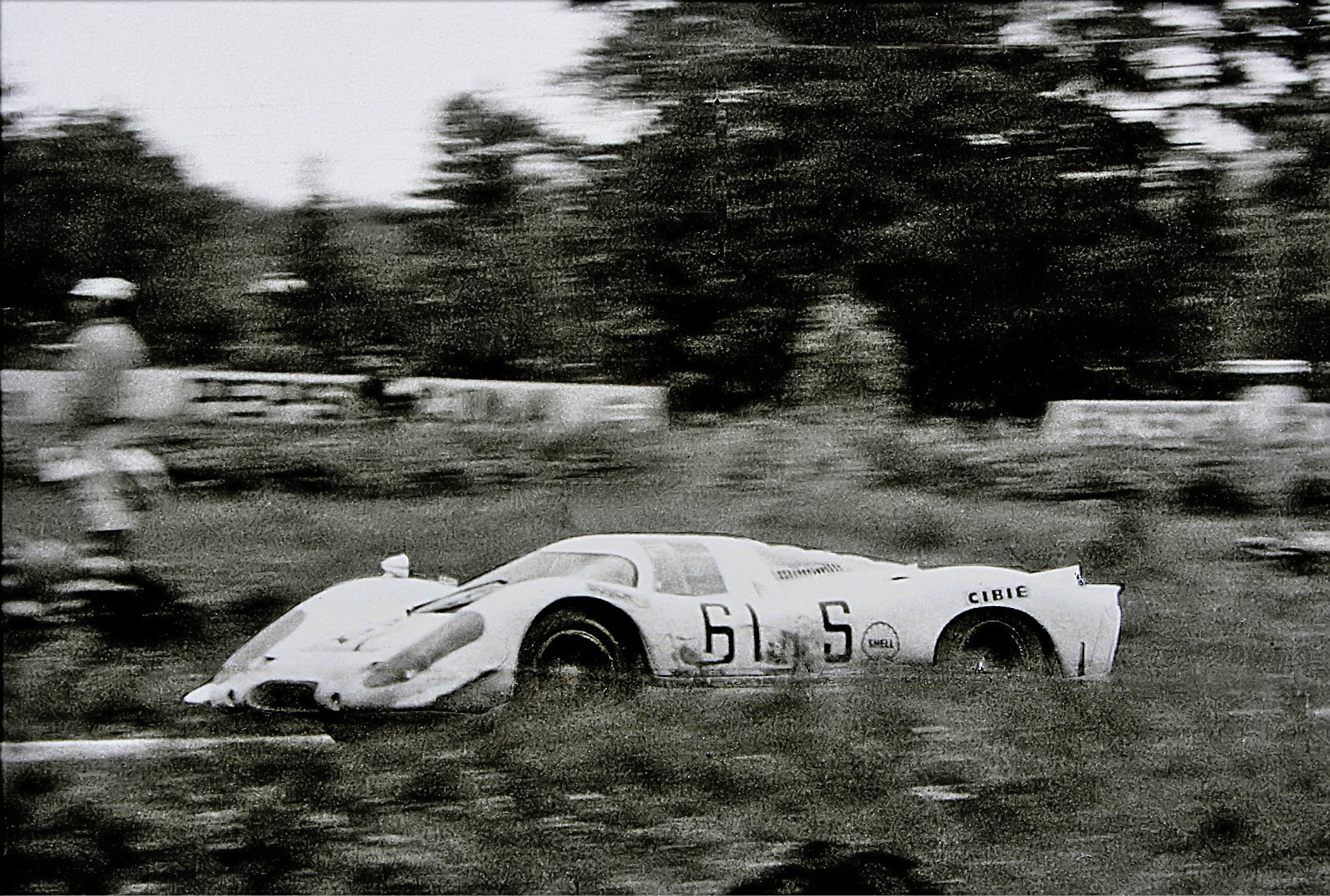
Porsche 917
"have said that they strongly suspect that the engineers, particularly Helmut Flegel, who was the chassis engineer for the 917, and Peter Falk, who was another of the racing engineers at the time,"
The Porsche 917 was a famous race car Porsche built to win big endurance races like Le Mans. Here, the hosts are talking about the people who engineered it and how they worked on making it faster.
The Porsche 917 is a legendary Le Mans prototype race car known for its ability to win at the highest level of endurance racing. In this segment, it’s specifically tied to the chassis engineering work of Helmut Flegel, highlighting how the car’s development focused on making it fast enough to dominate overall.
air cooled
"of Porsche's racing budget in that era of the 917 on condition that the cars remain air cooled, right?"
“Air cooled” means the engine is cooled using air moving over it, not coolant flowing through a radiator. The host is saying Porsche wanted to keep that cooling approach even while racing.
“Air cooled” means the engine is cooled primarily by airflow over the engine rather than by a liquid coolant system. Porsche’s classic flat engines are known for this approach, and the host notes it as a condition tied to the racing program.
24 hours of Le Mans
"Because, you know, there's PR benefit in a way to Volkswagen when an air cooled car wins the 24 hours of Le Mans, that has a halo effect in a way on the humble Volkswagen Beetle."
Le Mans is a famous long-distance race where cars have to keep going for 24 hours. Winning it is a big deal because it shows the car can handle tough conditions for a long time.
The 24 Hours of Le Mans is one of the most famous endurance races in the world, where cars run continuously for a full day. Winning it is treated as major brand proof because it demonstrates durability and engineering under extreme conditions.
halo effect
"Because, you know, there's PR benefit in a way to Volkswagen when an air cooled car wins the 24 hours of Le Mans, that has a halo effect in a way on the humble Volkswagen Beetle."
A “halo effect” is when one great thing makes people assume other things are also great. In this case, winning a big race makes people look more favorably at the brand’s regular cars.
The “halo effect” is when one impressive achievement (like winning a major race) creates a positive reputation that spills over to other products. Here, the host argues that motorsport success can improve how people view a brand’s more ordinary cars.
Gulf
"And I firmly believe that's part of why they outsourced the factory team to Gulf and to John Weier, because that reduced the amount of time that his engineers..."
Gulf is mentioned as a partner Porsche used for racing. The idea is that Porsche didn’t want its own engineers spending all their time at races, so they handed more of the factory team work to Gulf.
Gulf is referenced here as a racing team/partner Porsche outsourced the factory racing effort to. The host’s point is that outsourcing reduced how much Porsche’s own engineers had to travel and run the racing operation.
John Weier
"And I firmly believe that's part of why they outsourced the factory team to Gulf and to John Weier, because that reduced the amount of time that his engineers..."
John Weier is a racing figure Porsche trusted to help run the factory team. The host is saying Porsche used him so their engineers could spend more time back at work on road cars.
John Weier is mentioned as the person Porsche worked with when outsourcing the factory racing team. In this context, he represents the operational leadership that allowed Porsche to keep more engineering resources focused on street cars.

Porsche 911
"Maybe you send one engineer to the race, but the rest of your engineers can stay home in Stuttgart and work on, can we improve our 911s? Can we improve our 914, you know?"
The Porsche 911 is Porsche’s flagship sports car, known for its rear-engine layout and long-running evolution across generations. The host mentions it as the street-car line that “pays our bills,” contrasting it with time spent on racing.

Porsche 914
"Maybe you send one engineer to the race, but the rest of your engineers can stay home in Stuttgart and work on, can we improve our 911s? Can we improve our 914, you know?"
The Porsche 914 is an older Porsche model with a mid-engine design. The host is using it to emphasize that Porsche wanted engineers focused on improving their regular cars, not only racing.
The Porsche 914 is a mid-engine Porsche built in the 1960s/70s era, notable for bringing a more affordable entry point to the Porsche lineup. In this segment, it’s referenced alongside the 911 as part of the street-car development that Porsche needed to prioritize.

Porsche 908
"Okay, so this next question is going to be even probably more broad. I was going to say, what would happen to Porsche without Piak? Like the 911 was close in 69. Sorry, the 908 was close in 69..."
The Porsche 908 is a Porsche race car mentioned as being close in 1969. It’s brought up as part of the sequence of cars tied to Piëch’s influence.
The Porsche 908 is referenced as a late-1960s Porsche racing prototype that was competitive around 1969. In this segment it’s part of the broader “line” of cars that the hosts attribute to Ferdinand Piëch’s R&D direction.

Porsche 904
"And in 65, he says, he kind of rejects the 904 as far as the way it's constructed. He doesn't like it. He thinks it's too heavy. There's too much inconsistency from one car to the next."
The Porsche 904 is an earlier Porsche race car mentioned as a problem case. The host says its design and build quality weren’t consistent enough and it was too heavy.
The Porsche 904 is discussed here as an earlier racing car that Ferdinand Piëch rejected for its construction. The critique is that it was too heavy and inconsistent from one car to the next, which drove the move back toward a tube-frame approach.

Porsche 906
"So he says, no, we're going to go back to tube frame, which at the time steel tube frame, but with very lightweight, ultra thin plastic fiberglass bodywork. And that's so the 906 is the first of the line."
The Porsche 906 is a Porsche race car from the 1960s. It used a light metal frame and a very thin fiberglass body to help it compete better.
The Porsche 906 is a mid-1960s race car built around a lightweight tube-frame chassis with an ultra-thin fiberglass body. In this episode, it’s presented as the first step in Ferdinand Piëch’s push away from the earlier 904’s construction approach.
tube frame
"So he says, no, we're going to go back to tube frame, which at the time steel tube frame, but with very lightweight, ultra thin plastic fiberglass bodywork."
A tube frame is basically a strong skeleton made from metal tubes. It helps a race car be lighter and stiffer, which can improve handling and durability.
A tube frame is a chassis made from welded metal tubes that form the vehicle’s structural skeleton. In racing, it’s often chosen for stiffness and weight savings, and here it’s contrasted with the earlier 904’s construction that Piëch disliked.
fiberglass bodywork
"...but with very lightweight, ultra thin plastic fiberglass bodywork. And that's so the 906 is the first of the line."
Fiberglass bodywork means the outside panels are made from fiberglass-reinforced plastic. It can make the car lighter than using metal body panels.
Fiberglass bodywork uses fiberglass-reinforced plastic panels for the car’s outer shape. Compared with heavier metal panels, it can reduce weight, which matters a lot for endurance racing and prototype performance.
homologation
"in 68, at the beginning of 68, the rule was you could run a five liter sports car, but you had to have 50 cars built for homologation... But then when that rule suddenly changed... brought that down from 50 to 25."
Homologation is a racing rule that forces teams to build a certain minimum number of cars to be allowed to race. The episode says Porsche’s plans changed when that required number dropped.
Homologation is the rule requiring a manufacturer to build a minimum number of cars (or a specified version) so the race car is “approved” for competition. The segment explains that Porsche couldn’t realistically build 50 cars, but when the FIA reduced the requirement to 25, it became feasible to pursue cars like the 917.

Ford GT40
"...ad to have 50 cars built for homologation. So the GT40 qualified, they got the Lola T70 qualified, you k..."
The Ford GT40 is a race-focused car made to compete in endurance racing. The podcast mentions homologation, which means racing rules required a certain number of cars to be built so the race version could qualify. That’s why you’ll hear about specific production counts when people talk about the GT40.
The Ford GT40 is a purpose-built race car known for competing at the highest levels of endurance racing. The podcast context about building a specific number of cars for “homologation” refers to the rules that required a minimum production run so the race car could be eligible to race. It’s a key historical example of how racing regulations shaped the design and production of performance cars.
FIA
"But then when that rule suddenly changed... it's a little bit mysterious why the rule changed, but the FIA and their wisdom brought that down from 50 to 25."
The FIA is the organization that writes and updates the rules for major international racing. In this story, they changed the rule that affected how many cars Porsche would need to build.
The FIA (Fédération Internationale de l’Automobile) is the governing body that sets many of the rules for international motorsport. Here, the host attributes the homologation requirement change—from 50 to 25—to the FIA’s decision-making.
roll cage
"And I remember there was like a 9.35 and there was the roll cage. And they told the story about, you know, one driver was like, this metal piece is right here."
A roll cage is a strong metal frame inside the car. It helps protect the driver if the car flips or crashes hard.
A roll cage is a reinforced metal frame inside a race car designed to protect the driver during rollovers and severe impacts. In older racing eras, it was one of the key safety upgrades, but it still didn’t make crashes “safe” by modern standards.
Formula One driver seat decisions and fatalities
"he turned down driving for Shadow in Formula One twice. He turned it down twice. Both of the drivers who took the job when he turned it down got killed."
They talk about how, in the past, getting a Formula One seat could be extremely dangerous. The story shows how even when someone turned down a job, the next drivers could end up killed.
This segment discusses how driver opportunities in Formula One could be life-or-death, using Brian Redmond’s story as an example. It highlights the grim reality that when one driver declined a seat, the replacements who took over could still die.
racing safety by modern standards
"It was very dangerous. You know, what they were trying to do in terms of safety by our modern standards is laughable, almost."
They’re saying that racing used to be far more dangerous than it is today. Safety equipment and rules back then weren’t as effective as what we expect now.
The hosts contrast historical racing safety with today’s standards, emphasizing how much more survivable modern crashes are. The episode frames the era as extremely dangerous, with safety measures that were “laughable” compared to what’s expected now.
Armco guardrails
"And eventually, you started to get things at least like, well, at least you had Armco guardrails at a place like Spa."
Armco guardrails are metal barriers along the track. They’re meant to reduce how badly a car hits something if it goes off the road.
Armco guardrails are steel barrier systems designed to absorb and redirect impact energy when a car leaves the track. The episode mentions them at Spa as an early step toward improving trackside safety.
vents
"Peacock was trying to make the cars quicker, so he put tape over all like the vents. If this is true. So then the drivers, not only did they keep have to keep cool..."
Vents are openings that let air flow through the car to help cool hot parts. If you block them, the car runs hotter, so you need another way to keep the driver or components cool.
In race cars, vents are openings used to manage airflow for cooling—often around brakes, engine bay components, or other hot areas. The transcript describes taping over vents to make cars quicker, which then forced drivers to rely on additional cooling methods.
cooling suits
"Peacock was trying to make the cars quicker, so he put tape over all like the vents. If this is true. So then the drivers, not only did they keep have to keep cool, they made these like cooling suits, which didn't work."
A cooling suit was a way to keep the driver cool during a race. The idea was to use something cold to cool the driver, but early versions didn’t cool effectively for long.
Cooling suits were an early attempt to keep race drivers from overheating by circulating cooled fluid or using ice-based cooling. In the transcript, the suit concept exists, but it didn’t work well because the cooling medium couldn’t stay cold long enough.
weight penalty
"And there was just a puddle of water. And the only reason he wanted to get rid of it is because that was adding weight, not for any other reason."
Adding extra stuff to a race car makes it heavier, and that usually slows the car down. Teams often try to avoid unnecessary weight to keep performance up.
A weight penalty is the performance cost of adding mass to a race car—typically affecting acceleration, braking, and tire wear. The transcript frames the decision to remove vent coverings or cooling gear as partly driven by the fact that these solutions added weight.
ice-based cooling
"Brian said it didn't work at all because it was based on ice, you know, like a tub of ice, basically. And then the water kind of circulated through this tub of ice. And he said, after a few minutes, the ice melted."
This is the basic idea of using ice to cool something. The problem is that ice melts quickly, so it can’t keep cooling for long enough to be useful in a race.
Ice-based cooling is the idea of using ice as a heat sink to keep a cooling fluid cold for a period of time. In the transcript, Brian Redman describes how the ice melted after minutes, so the cooling system couldn’t maintain the temperature needed to help.
fire suppression system
"But again, there was differences between Porsche's approach, for instance, and say John Weier's approach in the golf team. You know, in the golf team, they insisted on a good working fire suppression system. So that added weight to the golf cars."
This is a safety system that can put out a fire fast. In racing, teams may choose to add it even if it adds weight, because it can protect the driver in a crash.
A fire suppression system is a safety setup that detects a fire and releases extinguishing agent(s) quickly to protect the driver and car. The hosts contrast approaches: some teams prioritized speed and weight savings, while others treated fire suppression as a non-negotiable requirement.
Request an Explanation
Heard something you'd like explained? We'll add it to this episode.
Sign in to request explanations for terms you heard.
Want to learn more?
Browse our glossary for plain-English explanations of automotive terms, jargon, and concepts.
Help improve this episode
See something that's not quite right? Our annotations are AI-generated and can sometimes miss the mark. Click the flag icon on any annotation to suggest a correction.