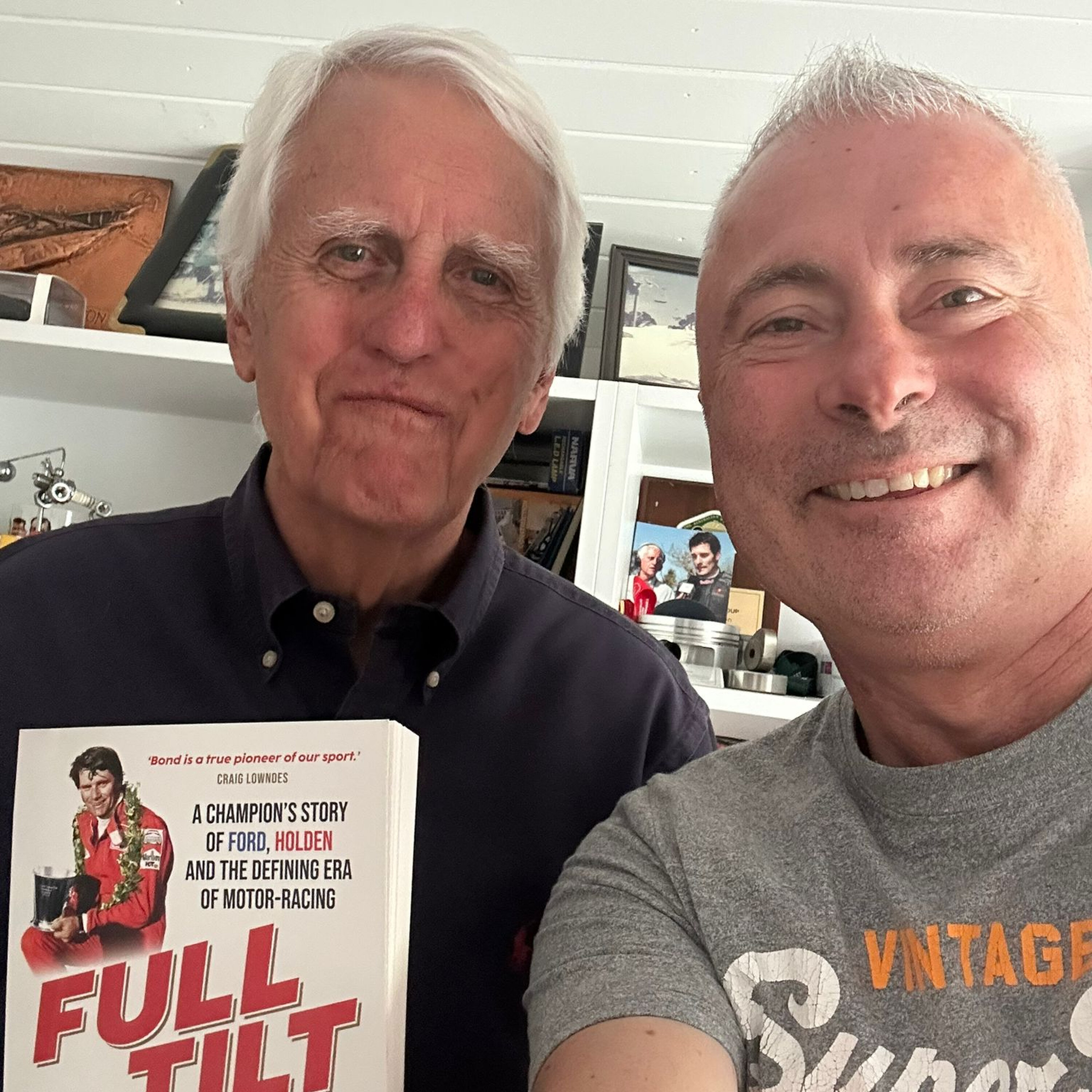
John Smailes shares captivating stories from his extensive career in motorsport journalism and PR, including memorable encounters with legends like Colin McRae and Peter Brock. He discusses the evolution of his PR company, Projects Automotive, and its impact on the Australian automotive landscape. The episode also highlights Smailes' new book on Colin Bond, exploring Bond's remarkable achievements in racing. With anecdotes about famous personalities, the challenges of broadcasting, and the importance of reinvention in one's career, this conversation is rich with insights and nostalgia.
"...a search for a star where we'd looked for under 25-year-old aspirants from each of the categories of motorsport, like NASCAR and Speedway and, you know, motorcycling and rally."
Motorsport is a term that covers all kinds of racing with cars, motorcycles, and other vehicles. It includes many different types of races, like car racing on tracks or off-road racing.
Motorsport encompasses all forms of competitive racing involving motorized vehicles. This includes various disciplines such as Formula 1, NASCAR, rally racing, and more, each with its own set of rules and formats.
"...the ability to drive the Corolla in the Bathurst 1000, for goodness sake, the first time, never been there before."
The Bathurst 1000 is a famous car race in Australia that takes place on a difficult track. It's a big event for car racing fans and features many skilled drivers.
The Bathurst 1000 is a prestigious touring car race held annually in Australia, known for its challenging mountain circuit. It attracts top drivers and teams from around the world.
"...the Yamaha 700s turned up for the first time. Crazy."
Yamaha is a company that makes motorcycles and other vehicles. The Yamaha 700 is a type of motorcycle that was used in a famous race.
Yamaha is a well-known Japanese company that manufactures motorcycles, marine products, and other motorized vehicles. The Yamaha 700 refers to a model of motorcycle that was notable for its performance in racing.
"...I call them super bikes, but they were Grand Prix bikes."
Grand Prix bikes are special racing motorcycles that are very fast and built for professional races. They are different from regular motorcycles because they are made to compete at the highest level.
Grand Prix bikes are high-performance motorcycles designed for racing at the highest levels, particularly in events like the MotoGP World Championship. They are built for speed, agility, and advanced technology.
"In the race, the Australian Grand Prix that year, willing and hands would pass each other 20 times. And they weren't mucking about."
The Australian Grand Prix is a famous car race that happens in Australia, usually as part of the Formula One series. It's known for exciting races and a lot of fans cheering for their favorite drivers.
The Australian Grand Prix is a prestigious motor racing event that is part of the Formula One World Championship. It takes place on a street circuit in Melbourne and is known for its competitive racing and enthusiastic crowds.
"...on the Le Mans 24-hour race sponsored by BMW and Toyota. This is the year the webber flipped it?"
The Le Mans 24-hour race is a famous car race that lasts for 24 hours straight. Teams of drivers take turns racing their cars, trying to go as far as possible in that time.
The Le Mans 24-hour race is one of the most prestigious endurance races in the world, held annually in Le Mans, France. It tests the durability and performance of both cars and drivers over a full day of racing, with teams competing to cover the most distance in 24 hours.
"Yeah, I took on the Australian Rally Championship. And I took it on not only as a commentator and as a producer..."
The Australian Rally Championship is a racing series in Australia where cars compete on different types of roads and terrains. It's a test of driving skill and car performance, with popular brands like Subaru and Toyota often involved.
The Australian Rally Championship is a national motorsport series in Australia that features rally racing, where drivers navigate through various terrains and conditions. It showcases both the skill of the drivers and the capabilities of their vehicles, often involving manufacturers like Subaru and Toyota.
"...convincing Subaru and Toyota to fund the broadcast. So, you know, to that end, I'm quite proud..."
Subaru is a car brand from Japan that makes vehicles known for their all-wheel drive and performance. They are famous for their involvement in rally racing, which is a type of motorsport.
Subaru is a Japanese automotive manufacturer known for its all-wheel-drive vehicles and performance-oriented models, particularly in rally racing. The brand has a strong motorsport heritage, especially in the World Rally Championship.
"...which led us to, of course, in Channel 10, being able to cover the World Rally Championship as well, which Gary Connelly was running out of birth."
The World Rally Championship is a series of car races that happen on different types of roads, like dirt and snow. It's known for being very challenging and exciting, with drivers racing against the clock in various locations around the world.
The World Rally Championship (WRC) is a prestigious international motorsport series that features rally racing events held on various terrains, including gravel, tarmac, and snow. It showcases the skills of drivers and teams as they compete in timed stages across different countries.
"And there is a moment where you have a conversation with Colin McRae. Just share that with people because it's a little bit surreal, isn't it?"
Colin McRae was a famous rally driver from Scotland. He won a big championship in 1995 and is remembered for his exciting driving style and contributions to the sport.
Colin McRae was a Scottish rally driver who became a household name in the world of motorsport. He was known for his aggressive driving style and was the first Briton to win the World Rally Championship in 1995, earning him a legendary status among rally fans.
"...moment when Peter Brock retired for the first time"
Peter Brock was a famous race car driver in Australia, known for winning many races and being a big part of the Bathurst 1000. He is remembered as one of the best in Australian motorsport history.
Peter Brock was a legendary Australian racing driver known for his success in the Bathurst 1000 and his contributions to motorsport. He is celebrated for his achievements and is a significant figure in Australian automotive history.
"...in a dreadful old black Subaru, several Leon's old. And it was Cody Crocker."
The Subaru Leone is an older model of car made by Subaru. It was known for being reliable and was used in some racing events.
The Subaru Leone is a compact car that was produced by Subaru from the late 1970s to the early 1990s. It was known for its all-wheel drive capabilities and was popular in various markets, especially in rallying.
"...thinking back to the 1986 Belgian Grand Prix on lap 36 and Jacques Villeneuve overtook Martin Brundle, was that the trigger that enabled Damon Hill to win by two seconds from Michael Schumacher?"
The Belgian Grand Prix is an important car race in Formula 1 that takes place in Belgium. It's famous for its difficult track and exciting races, making it a popular event for fans.
The Belgian Grand Prix is a prestigious Formula 1 race held at the Circuit de Spa-Francorchamps, known for its challenging layout and unpredictable weather. It has a rich history in the sport and is a favorite among drivers and fans alike.
Damon Hill is a famous race car driver who won a big championship in 1996. He drove for a team called Williams and is known for being a very good driver.
Damon Hill was a British racing driver who won the Formula 1 World Championship in 1996 driving the Williams FW18. He is known for his consistency and skill on the track, contributing to his success during that season.
"...and I've got a Toyota Camry, what do you think?"
The Toyota Camry is a popular car that is known for being reliable and comfortable. Many people use it for everyday driving and it has a good reputation.
The Toyota Camry is a mid-size sedan known for its reliability, comfort, and practicality. It has been a popular choice for families and commuters for many years.
"...een up to a car club meeting where it was at the Cortina Owners Club, what was it, was it a Bathurst, wher..."
The Ford Cortina is a small car that was made in the UK for about 20 years. It was loved by many people because it was affordable and easy to drive, and now there are clubs where fans gather to celebrate and share their passion for this classic car.
The Ford Cortina is a compact car that was produced by Ford of Britain from 1962 to 1982. It is significant for its role in the British automotive market, being popular for its affordability and practicality, and it has a strong following among classic car enthusiasts today. The mention of the Cortina Owners Club highlights its enduring legacy and the community built around this classic model.
"...he was the winner of the Bathurst 500 which is an amazing triple that no one else has ever achieved. We want people to read the book so we won't take from all of it..."
The Bathurst 500 is a famous car race in Australia that takes place on a difficult track. It's a big event for car racing fans and features many skilled drivers.
The Bathurst 500 is a prestigious endurance race held annually at the Mount Panorama Circuit in Bathurst, Australia. It is part of the Supercars Championship and is known for its challenging track and competitive field.
Car
McLaren M10C
"series so he trialled in a McLaren M10C which was a Frank Mattage development of the M10B"
The McLaren M10C is a race car built by McLaren, known for competing in the Formula 5000 series. It was designed to be fast and powerful for racing events.
The McLaren M10C is a Formula 5000 racing car developed by McLaren in the early 1970s. It was designed for high-performance racing and featured a powerful V8 engine.
"Colin put it on pole. He said I thought I was driving like a rally car..."
Pole position means starting at the front of the race. It's given to the driver who is fastest during qualifying, which helps them have a better chance to win.
Pole position refers to the starting position at the front of the grid in a race, awarded to the driver who qualifies with the fastest time. It is a significant advantage in racing.
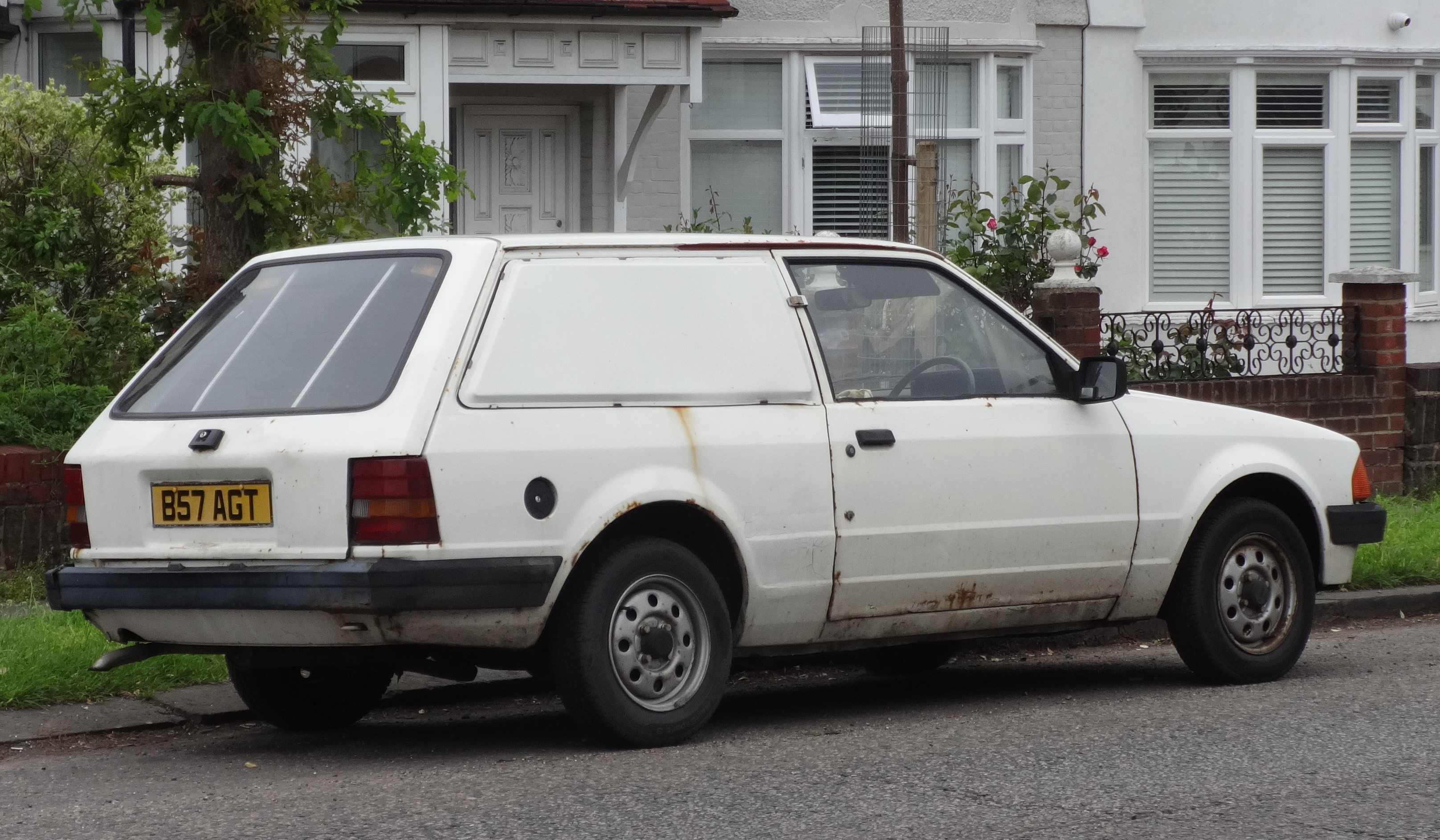
"they made world-class BDA escorts basically didn't they?"
The Ford Escort is a small car that has been popular for many years. It's well-known for its success in racing, especially in rally competitions.
The Ford Escort is a compact car that has been produced in various forms since the 1960s. It gained fame in motorsport, particularly in rallying, where it was known for its performance and handling.
"they made world-class BDA escorts basically didn't they?"
BDA is a type of engine used in some racing cars, especially the Ford Escort. It's known for being powerful and helping cars go fast in competitions.
BDA refers to the Ford BDA engine, a 2.0-liter four-cylinder engine used in rally cars. It was known for its performance and was a key component in the success of the Ford Escort in motorsport.
"Ari said Colin I will only drive this car out of his left hand drive so Colin beautifully made it a left hand drive car..."
Left-hand drive means the steering wheel is on the left side of the car, which is how most cars are made for countries where people drive on the right side of the road.
Left-hand drive refers to vehicles designed for driving on the right side of the road, where the steering wheel is located on the left side of the vehicle. This is common in many countries, including the United States.
"but I was tasked with the with the with the task of doing door stops on these guys because it's good for the audience yeah yeah Michael Schumacher for example..."
Michael Schumacher is a famous race car driver known for winning many championships in Formula One. He's considered one of the best drivers ever.
Michael Schumacher is a retired German racing driver, widely regarded as one of the greatest Formula One drivers of all time. He won seven World Championships and holds numerous records in the sport.
Select text to request an explanation
MUSIC
A Listener production.
..
G'day, it's Rusty here, all set for part two of my podcast
with legendary commentator, journalist and PR wizard John Smales.
If you've arrived here, as I always say,
and not given the first half a listen,
jump back to the library and check it out.
You are missing some gold.
From writing to ferry Porsche in his teens
and getting a reply to working with his hero,
Australian touring car champion David Mackay.
His early years in mainstream media,
covering bank robberies and working for the Packers,
vivid memories of meeting the great Jack Brabham,
recollections of interviews with a straight-talking Frank Gardner
and how highly the Kiwi Chris Amon was rated by Enzo Ferrari.
You will be gripped by those stories, I know I was,
and there are still some rippers to come
as we get into this second half.
One thing I may have missed in joining the dots here,
would you have had to have had a conversation
with either Sir Frank or someone like that to exit 9
and go and do some of this stuff? What did you do?
No, I...
I was above grade, journalist of grade,
and I was above grade and about to sign a contract with Channel 9,
which was very good.
But a guy called Evan Green,
who was the doiant of motoring journalists in Australia,
and also the doiant of motoring promotion,
he was, for example, the guy who was manager of Donald Campbell's
Bluebird attempt on Lake Air in 1964,
and one of the promoters of the early ampoules around Australia trials.
And Evan approached me and said he was leaving British Leyland,
where he was a director,
and was going to start a PR company
and wondered whether I would join him in it.
I was pretty chuffed with that idea,
because, you know, I didn't realise what I had, Rusty.
I didn't realise where I was in the lexicon of Channel 9
and where my career could go. I was just having fun.
And so Evan offered me this opportunity.
So I went to see Clyde Packer,
carrying his brother, who was running Channel 9 at the time.
And I said, Clyde, because he could...
I mean, it was amazing. In those days, it was really a family affair.
You could say you called him by his first name.
I called him by his first name. Try doing that now.
And I said, Clyde, I've made this opportunity.
I know I'm talking to you about a contract,
but I've been given this opportunity.
He said, look, you've got to follow your dream.
Give it a go, and if it doesn't work out,
you can always come back.
I said, wow, golden parachute. This is sensational.
So I told Evan, you know, I'll join him for a year and see how it goes.
I had to work out a long period of resignation
because of my grading.
And at the end of it, the last week,
Kerry Clyde's brother is walking down the corridor towards me
and he looks at me and he says, I hear you're leaving.
And I said, yeah, I am at the end of this week.
He said, you can never come back here, no.
There went the safety net.
And so I started with Evan, a company called Projects Automotive,
which was working in communications in the automotive field.
And that led me to be available to do things like the ABC.
I guess so. A couple of things out of that.
Firstly, Evan Green, beautiful voice, much missed part of the commentary and so on.
And Project Automotive, which later became the project group for you,
was it's chartered to begin with to be this sort of company
that provided all sort of media and PR related services for automotive?
Or what was its charter?
Yeah, we all loved automotive.
And when I say we all, Projects Automotive was originally started
by Paul Higgins in Melbourne and by Ian Fraser,
who went on to become the owner of Car Magazine in Great Britain,
recently deceased, actually, only earlier this year.
And when Ian went to Great Britain, he bequeathed Projects Automotive to Evan.
And so I became a junior partner in Projects Automotive.
But it was because we were all mad keen motorsport enthusiasts
and motoring enthusiasts that Projects Automotive existed.
And at the time, there were companies that needed our services,
not just wanted, but needed our services because it was very much an evolving time.
So we would do all sorts of communications work for the major car companies,
but also in the retail area and in the first and second tier supplier area.
Wow. Yeah.
So it would later become the project group.
And I had been in there in senior offices in North Sydney and so on.
At its peak, J.S., how many people would you have had there?
What sort of things did you cover?
Toyota were a big client and so on, weren't they?
Toyota were the biggest client and we were very fortunate to be there
when Toyota became number one in Australia.
You know, success has a thousand fathers.
We were one of the thousand in terms of helping them get where they got.
But we were very fortunate that we managed to achieve the Toyota account
and held it forever, which was sensational.
You got to do some great things in conjunction with them.
I mean, you fill in more if I'm not covering all of them.
But I mean, one of them that stands out was a search for a champion-based thing
that unearthed like Neil Bates, for example, and so on, didn't it?
Toyota was formed, yeah.
Toyota Australia was formed from the amalgamation of Tease Toyota,
which was the commercial vehicle division, and AMI,
which was the passenger vehicle division.
And they came to...
And AMI was running Corollas with an employee called Tony Niavani running the team.
And when the new management took over as the conglomerate Toyota Australia,
Tony had probably achieved everything he could with the Corollas.
He was in the Guinness Book of Records as having won 27 successive
two-liter class Australian touring car championships.
And the new management decided there was nothing more to be achieved,
so that they were going to shutter the race team.
And a few of us, again, a success of the Thousand Fathers,
a few of us determined that there was a better way.
And what about if we had a search for a star where we'd looked for
under 25-year-old aspirants from each of the categories of motorsport,
like NASCAR and Speedway and, you know, motorcycling and rally,
and brought them all together and gave them an opportunity to drive
a Toyota Corolla in a round of the Australian touring car championship.
And I went to Cams and Bruce Keys, who was their motorsport manager at the time,
actually agreed.
I mean, could you imagine today saying to supercars,
listen, I've got this bloke who's never driven a supercar.
I'm going to stick him on the grid.
I'd like to stick him on the grid.
But we did it.
We actually ran one at each of the race meetings in the Australian
touring car championship that year, 1989 or something.
And at the end of it, we voted on who should get the prize,
which was the ability to drive the Corolla in the Bathurst 1000,
for goodness sake, the first time, never been there before.
To my somewhat embarrassment, I voted against Neil Bates.
Did you really?
Do you talk about that now?
We still talk about it.
We laugh.
Well, sort of laugh.
He would pair with Michael Dowson though.
He would pair with Michael Dowson.
And they at the Bathurst 1000 that year were sensational.
And they actually beat the works team of John Faulkner,
who whoever was with Faulkner at the time, maybe John Smith.
That sounds right, yes.
And so Bates and Dowson created themselves as guys of the future.
And Toyota still didn't want to go motor racing,
but Bates was smart enough to turn that success into his rally team
and to become the ongoing, now for three decades,
rally partner of Toyota, which has led to the 86 series as well.
I cut you off there before, just around the,
I guess it's peak, what the project group represented
in terms of the amount of staff and things like that.
I pulled out the other day a telephone directory of project group staff.
And at our peak, we had 45 people, which was just amazing.
You failed your responsibility immensely.
A sole operator, basically.
That's what I'm mental thinking.
And suddenly I find myself responsible for 45 people and their families.
And that was about the level of my ability.
I mean, I know guys who've built businesses
which have hundreds of employees, goodness gracious, thousands of employees.
And I'm amazed at how they managed to do it.
I mean, what sort of mindset have you got to have
that you can do that sort of thing?
Yeah, but you did it and it was gold standard.
And am I right in saying, I think there were even photographers,
perhaps on the books at that point,
would you have done even maybe speech writing for executive at Toyota and things?
Well, what sort of sort of stuff did you do?
We set out to be an all encompassing umbrella communications company.
We were the first in Australia in pretty much any field to do it.
At the outset, I was simply selling my time and my talent.
I had a lot of time and some talent.
But then I realized that I was relying on other people
to provide other services.
Like, for example, I needed a photograph taken,
so I had to book a photographer.
And then I was paying for his profit,
but I was also relying on his professional ability
or her professional ability to enhance my business.
So I hired a photographer so I could control time, quality and cost.
Archive and library too.
And cost and had archive and library as well.
And from that, we started a production company
and had in-house bid going on.
Excellent.
And then we had event organization and so it grew.
And so suddenly we were a one stop shop for all of this activity
and a lot of people, it sounds a bit egotistic,
but a lot of people copied us.
And so today that's kind of the format
if you want to have a communications company
that you need all those services in-house.
But we were the first.
I want to come back to what you alluded to there before
about being responsible for effectively 45 mortgages and so on.
So does that mean that broadcasting takes maybe a little bit
of a backseat just because you had that responsibility,
but also it became a fix for you where you could fit it in?
Is that about right or?
It's about right, but it also was the broadcasting
was a sensational means of showcasing my business.
Yes, of course.
People really enjoyed the fact that they were working with somebody
who they saw on television on the weekend.
Got you.
Yeah, and it gave me a reputation which perhaps I didn't deserve.
Rubbish.
No, seriously.
Seriously.
You're just another operator when it comes right down to it,
but television uplifts you.
And even today I would respectfully suggest
that the people regard folks who are on television
as something a bit special.
Are they?
I don't know.
Well, but people have an attachment to that.
You're in a place talking about something that is in your heart,
pure that you love, and they want,
invariably when you see them, people at a bar,
people at a car club meeting,
whatever they want to tap into the things you've seen
and done over the time in your career.
One of them was a young Neil Crompton in the ABC days.
Tell me about, did you pick him up from the airport or something?
How did that all come about?
David Wood was the producer of the ABC television sport at that stage,
and he was a star maker.
He really could understand.
He really understood the medium,
and he understood the way the medium was evolving.
And he realized that the uptight,
terribly plum in the voice,
do-it-the-ABC-wow chat was possibly becoming a thing of the past,
and it needed a bit more free form about it.
And he received a notification
that there was a young bloke out of rural Victoria
who owned a bicycle shop in Ballarat
who was doing a bit of motocross calling down there,
and wouldn't it be a good idea if we gave him a trial?
And Willie Hagen and I sort of looked at each other and went,
hang on, is this a competitor?
And anyway, it turned out to be Neil Crompton,
and I picked him up at the airport and drove him out to Warren Park,
and we gave him a geek, and he was sensational.
And I drove him back, and he started our place that night,
my place that night before.
This was in practice on Saturday,
and he started our place that night and called it on Sunday,
and he just knew from that point onwards
that there was a new kid on the block.
He was fantastic.
This is all pre-Aaron Noonan and statistics
and all this sort of stuff.
So are you and Will,
and I think the pair of you complemented each other beautifully.
People can remember your voices attached to the coverage then.
Are you walking in with a briefcase with notes?
What is the preparation to do this?
Well, we varied.
Will liked his notes.
Yes.
Will would have many airline on-board bags
with which he would carry notes.
He would have notes on things that occurred 20 years ago.
But when he got to the broadcast point,
they would all stay in his bag.
All from the top, all from his head.
But yeah, because they were all there as kind of...
Safety net, like a safety net.
But he never used them.
Well, he seldom used them.
I would, on the other hand,
walk in with one reporter's notebook in my hip pocket.
Which you still have to this day.
Which I still have to this day,
where I've taken a few notes,
and I tend to rely.
Because Rusty, I never really enjoyed commentary.
I much preferred being the interviewer on Pip Lane.
Chasing the story.
To me, chasing the yarns was what I was about.
I was never totally confident in my own ability
calling an event as much as I was interviewing for the event.
Whereas Willie was in his element up there.
In the commentary box.
And so he would always try to grab the microphone from me.
David would a bit like Murray Walker and James Hunt.
The way that the BBC sorted those two out
was by giving them only one microphone.
David would do the same to Willie and myself.
So you're in an arm wrestle, the peer review.
Yeah, well, there was this one castrol six hour.
Where they were doing a live edit as we went.
And cutting six hours down to two hours
to go to air that afternoon.
Quick turnaround.
Quick turnaround.
So they were actually editing on the run.
And we'd take the last hour live.
But the first hour would be an edit of the five hours
that highlights of the five hours that occurred.
Mistakes had to occur.
Willie's way of telling me that was his turn to talk,
which was very, very often,
would be to clutch me by the knee and squeeze hard.
And at one stage of this broadcast,
I turned to him and I said,
Will, will you get your hands off my knee?
Which of course went to air.
Well, I did.
Oh, fantastic.
So in the course of this,
I'm so pleased you brought up two wheels.
We can't do this conversation
without talking about a bit of two wheels.
You lit up before about six hour and others.
There is a funny story around Wayne Gardner.
Tell us, tell us what happened there.
We're at the Castrol six hour at Amaroo Park.
And there's this amazing guy called Miles Stefano,
who is the PR man, sales manager for BMW motorcycles
in New South Wales, larger than life.
Wayne Gardner is the young bloke on the way up.
Peter Malloy is looking after him.
He's driving for Billy Hill of Mentor Motorcycle,
riding for Billy Hill of Mentor Motorcycles.
And before the race starts, Miles said,
if Wayne Gardner wins this race,
I will run naked around the circuit,
or worse to that effect.
And six hours later,
I'm interviewing the winner of the Castrol six hour Wayne Gardner.
And over Wayne Gardner's shoulder,
I see the big white bear ass
of Miles Stefano heading for the pond over at the stop corner.
Oh, it's a ripping.
And plunging in.
And I'm trying to keep a straight face while interviewing Wayne Gardner.
And moving off camera.
Oh, that's awesome.
In talking with you, because you've traveled the world
and covered lots of different forms of motorsport
and some big, big events,
it's probably very difficult to say what's your favourite.
But I know you fondly recall a race
between the late Greg Hansford, Warren Willing.
There's a real standout race for you
with those two battling away, isn't there?
Yeah, if you ask me what's my favourite motor race ever in the world,
it was 1974, it was Bathurst.
And the Yamaha 700s turned up for the first time.
Crazy.
Amazing.
I call them super bikes, but they were Grand Prix bikes.
No, no, no, no chase then.
There was no chase, it was straight over the second hump.
And I walked up to the humps and took a group of journos with me
on the first time these bikes went out.
And they were doing warp speed.
They were monowing over the second hump at 180 miles an hour.
And there was a crosswind blowing.
And I was on a 400mm lens looking at them coming down the straight.
And suddenly this crosswind blew
and one of them turned sideways directly towards me.
And apart from a certain bowel movement
which was threatening to occur,
I took one step sideways to move out of the one.
By the time I'd taken that one step,
they were 200 metres down the road.
That way it passed me.
It was just amazing.
In the race, the Australian Grand Prix that year,
willing and hands would pass each other 20 times.
And they weren't mucking about.
This was not a setup for the crowd.
This was full on motor racing.
And it was just the most sensational race you'd ever see.
Love that.
Yeah.
Love that a lot.
And the fact that it is still now very vivid for you.
Let's move a little along here in the broadcasting sense.
A couple of things.
It went to seven from the ABC and the Mike Raymond chapter.
And so was that difficult, that sort of move?
I didn't go to seven.
No, I know that.
But the championship did, didn't it?
The championship, yeah.
It made a move because the ABC had set it up.
The ABC had done all the hard yards and created the foundation.
Then along came an ambitious Mike Raymond and said,
OK, I'll have it now.
And he took it over.
And of course, when he took it over,
he took it over with only one of the three commentators.
He left Willie and I behind as yesterday's men
and took Neil Crompton as tomorrow's young starter,
which was only fair and ideal.
OK, with that, how are you about that?
Look, I've always worked on the principle that, you know,
one door closes, another one opens.
And I turned it into an opportunity.
I had a friend, Mike Ortson, who'd worked on the ABC
and was now working at Channel 10.
He's now called, very sadly, Bright Man.
Yeah, and Audie and I started playing with Motorsport at Channel 10.
And I was brought in to do late-night commentary
on IndyCar races that were coming in from the States.
And I was doing Motorsport stuff for the news
and a bit for the sporting programs as well.
Cool.
Ultimately, working with guys like Billy Woods.
And I was there for the start of RPM, which was all kind of cool.
And so, for me, you should never look to the past
in what you've lost.
You should always look to the future and what you can gain.
Great advice.
Great advice.
You may play this down a little bit,
but I think he talks about it even in his podcast episode with me
as it being a significant moment.
You go to Le Mans in the late 90s with one young Lee Diffie.
It is an eye-opening moment for him in relation to the potential.
If you will, he at this stage has done super touring very successfully,
very, very well, a bright, fresh face and voice.
He'd gone into the early Supercars coverage at 10
and they'd given it a real change-up, if you will.
And he was front and center of that.
But all of a sudden, his eyes are open to potential global opportunities.
And you had a big chat with him there, didn't you?
It was his first international gig, first time he'd been offshore.
And Tim Jardine was putting together a one-hour doco
on the Le Mans 24-hour race sponsored by BMW and Toyota.
This is the year the webber flipped it?
Or have I got the year not?
Yeah, yeah.
Anyway, it's about, yeah.
Yeah, yeah, it was, it was.
And we were over there doing a one-hour doco,
but Tim wanted to do the intro as live.
Excellent.
So, Diffie was the lead commentator, I was the boy reporter again.
And the sequence was, we're standing on the grid at the Le Mans 24-hour race,
surrounded by a quarter of a million people, you know.
And the drivers are coming over the ramp, you know, in open cars.
And my job was to walk up to Martin Brundle,
who was driving for Toyota and was on, I think, pole position,
and ask him one question.
But the sequence was, Diffie opens the program, throws to me,
timing has to be pin shot.
One shot at it, one shot at it.
I go, walk in on Martin, say, what's your aspect for the race?
Martin gives me a response, he doesn't know it's coming.
And then I throw it back to Diffie, who rounds out.
All of this has got, whereas Martin drives by,
all of this has got to happen perfectly.
Thanks to Diffie and to Brundle, it does.
And at the end of it, there's a whole heap of fist pumping going on.
And I say to Diffie, mate, why are you coming back to Australia
to speak to 20 million people when you could be over here speaking to 200 million?
And it was just a throwaway line.
But it sparked, I mean, it absolutely made him begin that process.
I mean, he became synonymous for a period there with the Le Mans 24-hour race.
He'd called a number of those.
He had conversations with Baz that led to the World Superbike Championship
and a move to the UK.
And he's now doing from IndyCar to NASCAR this year.
He's done some amazing things in the United States.
And it's clearly stemmed from that moment, J.S.
Look, can I tell you, I'm amazed that he says that.
Because to me, it was just a throwaway line.
But it obviously tweaked something in his brain.
And actually, he came back and thought about it for a while.
And then he went to David White, who was, as you know, the sports supremo at Channel 10.
And he said to Whitey, mate, I'm going to the UK.
I've got nothing to go to, but I'm going to the UK to have a big go.
And Whitey was filthy with me.
Because he knew that I'd, yeah, if he told him that it was all to do with what I'd said.
And so Whitey never quite forgave me.
But those two have ended up very, very close.
And David's been a great friend and mentor of Lee's.
And I think, ultimately, where it's ended up for him, David has great respect for, yeah.
At Lee's beautiful home at Ridgefield in Connecticut,
there is a room, which is the David White suite,
where you and I have both stayed at one stage or another, yeah.
Tremendous.
A young Greg Rust comes along and probably a little life lesson for me around
respecting people.
I'm hungry.
I'm probably ill-prepared.
I'm not savvy with aspects of the business.
And you had been in the pit lane for them for supercars.
And in time, I would replace you.
And that was a bit awkward, JS.
So I apologize for that.
Don't.
You were also highly talented.
And I was doing other things.
But Channel 10 had just taken over supercars.
I'd done the pit reporting with Barry Sheen for the very first Channel 10 coverage of supercars,
the 1,000-kilometer race in 1997.
And Channel 10 needed to, once it realized that it was going to go forward with this thing,
because that was an experiment, they needed to put together a team
which was young, vibrant, and really knew what it was doing.
None of which described me.
But seriously, they needed new fresh faces.
They needed a new look.
And I will never forget the phone call you made to me to apologize for taking my place
in that coverage team.
I don't think I was necessarily particularly nice to you in that phone call, because it hurt.
But at the same stage, go back to what I said earlier, when one door closes, another one opens.
And so I reinvented myself again.
You went on to have a great career.
And I went on to take my career in other directions.
But the reinvention thing that you're talking about is a thing that really,
even to this day, resonated with me.
And I'm a huge believer in doing that.
And we would get to, which I'm so pleased about, we've become friends in the wake of all of that.
We get to do some good things around Hall of Fame and more.
And I was so pleased that we got to work on things like the Australian Rally Championship.
For a time there, you basically took it over and built the coverage, didn't you?
You made the coverage.
Well, from the time of you boning me.
Well, Blay, we can laugh about this now.
No, right.
Yeah, I took on the Australian Rally Championship.
And I took it on not only as a commentator and as a producer,
and my company, The Project Group, in fact, did the production of the championship for a couple
of years before Channel 10 decided to, quote, internalize it because it was successful.
And I still side on as a commentator.
But at that time, Rally was in its formative stages.
And I actually formed a company called Rally Corp.
And we became the commercial arm of the Australian Rally Championship as well,
convincing Subaru and Toyota to fund the broadcast.
So, you know, to that end, I'm quite proud, please, pleased at least,
of the fact that we managed to give Rallying a bit of a foundation in this country,
which led us to, of course, in Channel 10, being able to cover the World Rally Championship
as well, which Gary Connelly was running out of birth.
I want to come to a good story around that.
We got to work on it on several occasions.
Barry Sheen was a part of it before he left us as well.
And there is a moment where you have a conversation with Colin McRae.
Just share that with people because it's a little bit surreal, isn't it?
You and I are in the service park at the Bunning Stage,
the infamous Bunning Stage, south of Perth.
And Colin McRae is World Champion.
I've just done this wonderful interview with Colin Backadie's Hotel earlier that day.
And as you know, Colin was the on-form terrib of Rallying.
The things he got up to at night time in the midnight hour were things that you don't want
to talk about or write about, isn't it?
And so Colin is brash and full of himself and an ego beyond belief.
And yet he walks up to me in the service park and says,
is that guy who's working with you as a commentator, is that really Barry Sheen?
And I said, yeah, it's Barry's.
And he said, look, and this is Colin who's brash and what have you.
And he's turned into fanboy and he said, look, could you introduce me to him?
And so I call one World Champion over and introduce him to the other World Champion
and they become the best of mates.
And if you recall that evening, we're driving back to Perth from Bunnings.
Colin's in his million-dollar rally car left-hand drive.
Barry is in our $30,000 rent-a-rec and he is driving because he won't let us drive
because he trusts Tony himself.
And so he's in the right-hand seat, Colin's in the left-hand seat,
and they're travelling millimeters apart down the road at 110 kilometers an hour,
hooning on the way back into Perth and they became best of mates ever since.
Some great days there.
I don't know if you're with me.
One morning we jumped in the car to go out to the Bunnings stage
and Barry was always pretty chirpy.
You know, he's always happy and up to some sort of mischief.
And he was a bit flat this morning and I said,
I said, what?
What's wrong with you?
And he goes, oh, I missed my window to go to the bathroom before and I just threw him
all out of kilty.
That's absolutely.
You have a memory around Peter Brock's swan song and Bares and Bathurst, don't you?
It was the year before you boned me again.
Oh, sorry.
If I could go back to that.
I'm sorry, it's just you put the idea in my mind.
And so I'm doing the commentary, the Pitlane commentary and so is Bares.
But Bares knew, as you said just a moment ago,
Bares needed to be in his comfort zone.
He would only interview those people that he knew well.
He was a Dick Johnson fanboy, so he wanted to look after the Dick Johnson pit.
He wasn't too keen on looking after the Brocky pit because he didn't understand
Peter.
He didn't know him well, but he knew Dick and he knew he could do things with Dick
that he couldn't do with anyone else.
You know, in a personality sense, in a fun sense.
Yeah, yeah, yeah.
But so we're sharing the pits and I've got Brock and this was Brock's last last race.
This was his retirement race, his first retirement.
But the one he announced was being a retirement.
Marks gave his co-driver and Mark pulls to the to a halt at the top of the mountain
and Brocky is now left in the pits.
Cuppertree in hand.
Cuppertree in hand, staring into space.
And I've got the producers in my ear saying, interviewing, interviewing.
And I'm thinking, no, this is too good a moment.
Just take the vision.
Just leave Brocky sitting there by himself, you know.
And it was a minute before I walked in on Brocky with people yelling at me to interview him.
I'm not going to do it because I just reckon the moment was too good.
But to come back to what was happening outside, on the other side of Pit Straight,
most of the crowd had gathered outside Brocky's pit because this was Brocky's last day.
But while he was getting cheers,
Baz, whenever he damed to walk down that end of the pit lane, was getting double the cheers.
Baz was the hero of that weekend as the first time that he'd commentated on...
The Bathurst 1000.
The Bathurst 1000, yeah, yeah.
So it was Baz who was the hero of the day.
Brock was almost the secondary hero.
But I will never forget that moment when Peter Brock retired for the first time
and the silence was just extraordinary.
The moment was amazing and it didn't need commentary.
All it needed was silent vision of Brocky and his Cuppertree.
That's how kind of broken he was, I don't think, or not the way to go out.
You obviously cross paths with him many times in your career.
Have you got another memory of Brock?
I mean, the way you described the heartbreak, the silence from the audience there says so much
about how loved he was by the Australian public.
And I can't even remember the Brock movie and things,
and then adjusting a few little aspects of his story to suit the biopic.
But the fans didn't like that.
They didn't like, you know, you don't muck around with the Brock story, do you?
No, not at all.
I mean, Brocky was a weird dude, you know, sorry to say it.
I mean, there are a lot of people out there who love him or love the image,
but he was a strange cat.
I mean, a couple of personal stories.
Number one, he was very competitive with me.
Any time we'd see, you asked earlier how many people I employed,
he'd say, how many people have you got on board now?
Because he had, you know, Brock's special vehicles.
And, you know, he and I were employing about the same number of people.
And so he would always check in with me to see whether I had more than he had in that respect.
He and Bev were lovely people.
When he and Bev were together, that was the epitome of the Brock era, when he was fairly.
And my dad had just died.
And Peter and Bev took me aside in the pits of Genet Bathurst
and sincerely offered to put me in touch with my father.
Oh, wow.
Because they believed strongly in the afterlife.
Is it in the Eric Downer stuff?
And they believed strongly in the ability to communicate with those that had passed.
And their offer, while bizarre, was totally sincere.
I'll always remember that.
The fact that they did it out of the goodness of their heart.
You spoke earlier of Evan Green.
They were good friends of Evan Green.
When Evan was lying, dying in hospital in Sydney, they visited him.
And the Brock's weren't wealthy at the time, in fact, far from it.
But they left a check for $5,000 inside his bed.
Recognising that Evan was in impecunious circumstances.
Wow.
Amazing stuff.
You know, the Brock's were a lot deeper than you'd ever imagined.
There were many people that helped ex-Pat Ozzie
lead if he take those first steps that lead to his successful international broadcast career.
But it was a conversation with John Smales at Le Mans that was the initial spark.
We were standing in the pit lane and he said to me,
what do you think about all this diff?
And I said, oh, it's crazy.
Like, look how big this place is and the cars and the drivers.
And he said, no, no, no, no, no, I'm not talking about the event.
I said, he said, I'm talking about motor sport and sport and living in the northern hemisphere.
He said, you should be here.
You can do this.
Diff's incredible drive and determination then saw him land roles in the world,
super bikes in Europe and later Indy car and NASCAR in the United States,
as well as track and field for NBC, the biggest broadcaster at the Olympic Games.
Check out Diff's episode in the garage if you haven't already.
Now back to Smalesy.
In your career to J.S.
We've lost some big names along the way.
You're on the Toyota side, but covering the Australian rally championship as a whole.
What about the departure of possum born, the loss of possum born?
And I can vividly remember being in Canberra and how somber the mood was and so on.
Yeah, possum was larger than life.
He was brilliant.
He was the man who could achieve anything.
He was the bloke who should have gone on to be world champion.
Yeah, instead he was Asia Pacific champion many times.
And he was Neil Bates nemesis.
And he was just brilliant to be around.
I'll never forget at the rally of Victoria, a rally of Melbourne, when possum walked up to me.
He said, see that bloke over there?
Possum spoke a bit strangely.
He was in New Zealander.
He said, see that bloke over there?
What do you think of him?
And he's pointing to this young bloke in a dreadful old black Subaru, several Leon's old.
And it was Cody Crocker.
He said, what do you think of him?
And I said, I think he's got some possibility possum.
Like possum's asking me.
And next thing you know, Cody is in the fold and there's possum's number two.
The day possum died was just the worst day of all.
Taken out quite ridiculously in a situation that was, you could say it was avoidable,
but it just happened.
No one to blame, even though a bloke did the other guy and the accident did suffer for it.
But it was just a horror.
The horrible thing I have to say, Rusty, is that they built a statue, a larger than life statue.
Well, it's a book of Cody now, but it used to be at the top of the hill climb where possum died.
It was actually mounted up there.
Can you tell me, does it look even remotely like possum?
You have to look at it closely, but I know where you're coming from in terms of...
There's this guy on the hill and you say, who in goodness name is that?
You know, is it the spirit of possum born perhaps because it certainly doesn't represent him.
You can find it for those listening.
You can find it in one of the main streets of Pococoe now.
Murray Walker is another who is sadly gone, but we got to both work with him in different
capacities along the way.
You got to do a fun...
Was it a book tour or a book launch with him?
You take questions from the audience and all sorts, wouldn't you?
Murray was promoting his book in 2003, I think it was.
And Murray was promoting his book and I was hired to be his warm-up man.
So I would warm up the audience and the audiences were huge.
400 people were paying for the privilege of listening to Murray speak.
He was a superstar and so I would be the warm-up man and then Murray would come up and he would
wow the audience and then at the end of it I would come up and I would take questions from the
audience for Murray and they would always try to stitch him up.
I don't know why, but there was something in the Australian psyche that said you had to win
one over Murray and so people would stand up and they say ridiculous things.
Look, Murray, thinking back to the 1986 Belgian Grand Prix on lap 36 and Jacques Villeneuve overtook
Martin Brundle, was that the trigger that enabled Damon Hill to win by two seconds from Michael Schumacher?
And Murray wouldn't even hesitate.
He'd look him straight in the eye and in his Murray voice he'd say,
well you're partially right, but in fact it was an incident on lap 72 where in fact
XYZ, overtook XYZ and there was a small crash which in fact and oil on the track
and that was the real reason why Damon Hill won that day.
And everyone would go wow and then Murray would sit down and I would say Murray,
how did you do that? He said I have no idea what happened in that race, I don't even remember that
race, but they kind of argue against me and it was just brilliant, it was fantastic and then that
led to Murray saying to me, you know the one event I'd like to do, Murray is 79 years of age at this
stage, he said I would love to do a rally, I would love to drive in a rally and I said what
about target Tasmania? He said I would love to drive in target Tasmania, co-drive and so I happened
to be in a position where I was doing some work with Toyota and Mike Breen was the PR manager
for Toyota so I've rung Mike and said listen I've got Murray Walker hot to trot for target Tasmania
and Mike said I've got Colin Bond capable of driving him and I've got a Toyota Camry,
what do you think? And I said to Murray what do you think? I would love to, I would love to,
so we brought Murray and Elizabeth, his wife, out and he co-drove for Colin Bond. At nearly 80.
At age 80 and Colin says it was the thrill of his life hearing Murray
commentate, not call the notes, commentate, go go go go and they were passing Porsches and Porsches
would stop at the side of the road and let them through rather than have the ignominy of being
passed by a Toyota Camry and they finished second in class and 44th outright. Amazing.
For goodness and Murray I've got a photograph of Murray with the with the the metal around his
neck and he was so proud of that he kept it for the rest of his life. Bondy is the the natural link
here, there is a beautiful new book that you have out it's called Full Tilt. Tell us about that,
you've literally just before we've recorded it you've been up to a car club meeting where it was
at the Cortina Owners Club, what was it, was it a Bathurst, where did you go? 200 Cortinas got
together at Bathurst there at their annual convention, it was brilliant, it was fabulous,
it was a really good thing and Colin was invited up and I was invited to MC the night with CB and
Ian Tate who was Harry Firth's man and and Frank Lownes who these days says that he's these days
only known as Craig's father and he's not resentful. So I mean the book itself tells an
incredible story of a man who has driven for both the key marks in the day, he's the only man who
have been the teammate of Peter Brock and the teammate of Alan Moffat for Holden and for Ford.
It's an amazing record but keep in mind also he was three times Australian rally champion and he
was the Australian touring car champion and he was the winner of the Bathurst 500 which is an
amazing triple that no one else has ever achieved. We want people to read the book so we won't take
from all of it, there's actually a little tip of the hat to his ability in an open wheeler too,
isn't there? Frank Mattage asked him to drive for Frank's Rothman's Mattage team in the American
series so he trialled in a McLaren M10C which was a Frank Mattage development of the M10B
and they turned up at the Australian Grand Prix in 1971 at Warwick Farm
and it's raining. Frank had only bought one set of rain tires naturally so Frank went out and
qualified on his one set of rain tires then gave the rain tires to Colin to put on the M10C.
This is Colin's first drive in anger at Warwick Farm in an Australian Grand Prix against people
like John Surty's. Unbelievable. Colin put it on pole. He said I thought I was driving like a rally
car and I thought I was going really badly when he came back he was the quickest of everyone
but then as you did in the day
Frank Radisic, father of Paul, made a bid for the motor car and bought it from underneath Colin
so Colin never got to do the L&M series in the States after all because Frank had sold his car.
Harry Firth made an approach to Colin and convinced him to stay to drive for the Holden
dealer team instead. Amazing. You alluded to the diversity there before or the variety in
his skill. He's a real kind of family man. I mean he was quite good from a car build or a
mechanic perspective wasn't he and they made world-class BDA escorts basically didn't they?
Oh yeah. I mean Colin working with blokes like Bob Ryder were genius and Henry Nerebecki were
absolutely genius at building and constructing as well. Colin had the Ford rally team gig which
Edsel Ford had signed him up for which was running in parallel to his racing with Alan Moffat
in the Moffat dealer team but was not related in other words one didn't depend on the other.
So Colin was building rally cars in Sydney while he was racing for Moffat in Melbourne
and they were winning championships with a young grid car. They won the Australian
rally championship and they were winning Castrol rallies in Canberra and Colin determined
that he wanted to build the world's best rally car which was based on the the Ford BDA escort
using a lot of Ford BDA parts but they built a better BDA in Sydney using local contacts
for componentry and that car was just genius and Colin to this day is so proud that he brought
our two world champions to drive for his team. What are we talking about Bjorn Valdegard and
Ari Bartonan? Yeah Ari Bartonan who was driving with Dave Richards. Dave Richards was co-driver
to Ari Bartonan. David Richards we all know and and Ari said Colin I will only drive this car
out of his left hand drive so Colin beautifully made it a left hand drive car then he said I'll
only drive it if the seat is elevated so I can see over the bonnet so Colin duly elevated the seat
and then Dave Richards said I want my seat low and inboard and Colin thought this is amazing
they've got it down to a situation where they use the co-driver as ballast to put weight down low
over the rear wheels and David said no no I just want to be as far away from the accident as possible.
He in the Moffat aspect if you will he he bordered or lived with the captain with Peter
Janssen did he not for a bit there? Well Peter Janssen was integral in the development of the
Holden Dealer team ignore Peter Janssen at your own peril this guy may have been a bon vivant he
may have been the greatest playboy Melbourne had ever known by his own by his own admission but
but the reality is he was so well connected and he did amazing things and he he very much ran the
the the commercial aspect of the Holden of the Holden Dealer team right and and was amazing at
it except of course John Baxill who worked for Holden had a minder on Janssen so that none
so that all of the money would flow to the team and not be siphoned along the way but but Janssen
had the towers in Melbourne Janssen's towers were a place that you wanted to visit simply so that
you could see what went on but you didn't ever want to be caught being there for fear for fear that
for fear that you'd be tainted by the brush you know some wild parties but Harry used to board
Colin at the towers because it was free and free was very important in Harry's world Colin had
just fallen in love with Robin yes and she was part of motorsport and she was up on the Gold Coast
with Murray Louise Gagan at the time and Colin Reigningen said well come down and spend a few
days with me in Melbourne so Robin came down to spend a few days with Colin in Melbourne this was
the very early days of their romance and on the way in from the airport Colin gave her a newspaper
clipping which had just appeared in the Herald Sun that day which had covered a Janssen party
or a Janssen atrocity the previous weekend just just for her interest sake to give her a bit of
context of where she was going they've got to the door of the towers Janssen has opened the
door dressed in his red velvet suit and with a glass of champagne in his hand saying have a
flute of champagne my dear and Robin has turned and fled Colin's brought her back and everything
was fine it's an amazing time I said Moff I should have said hold and deal with him before sorry
thank you for correcting me um on um on that the that you talk a little bit too about the
wives club if you will that's not the right words for it perhaps but but they they did some very
important things in the paddock that helped around safety and all sorts didn't they motor racing
was dangerous it always says it on the back of the entries even now motor racing is dangerous
back then it was lethal and the promoters were doing nothing to make it less lethal
you know you turn up at a motor racing circuit and there there wasn't a lot of safety precaution
going on the wives and girlfriends the wags got together and determined that they had to do something
to protect the lives of their loved ones because they wouldn't do it themselves all they wanted
to do is go motor racing with the cards for what they will but the girls figured that something
needed to be done so Betty Hill wife of Graham in Great Britain had started a thing called
the doghouse club and they were a fundraising activity because it was equally dangerous over
there no fundraising activity where they were buying safety equipment for motor racing circuits
because no one else was and so in Australia girls like Robin Bond started the Down Under
doghouse club it became the social heart of motor racing in the 1970s so after any race
meeting there'd always be a party fundraising but a party where everyone forgot what suit they were
wearing and what had happened during the day and they were all friends together which just
doesn't happen in motorsport these days as much anymore well I think there's a resurgence
but they raised funds for things like what we call crash trucks at the time which are now of
course first intervention vehicles and and they raised money for for fire extinguishers and
jaws of life and all of that sort of thing and they effectively brought safety to motor racing
in Australia so this is the forefront of our thinking which is yeah yeah so I mean the the
hold and deal a team chapter the rally chapter the moffat chapter people can read about that in
full tilt it is it is beautifully done as is always the case with you thank you can I just
touch mate on the forward because there's some commentary in there from Alan Jones who I got
to work with in years gone by and he gives a beautiful summary of Collins talent and perhaps
where it could have gone doesn't he yeah he Alan claims and I think quite rightly that there are
certain drivers whose egos won't let them understand how good they really are Alan said there are two
people who he exemplifies as that one was the late Ronnie Peterson who never ever knew according to
Alan how good he was and the other is Colin Bond wow he says Colin could have been one of the best
in Europe but he didn't understand in his own mind how good he was and how good he should be
and that's not I mean a negative either he's a beautiful family man who who made choices to you
know to to stay and build a life here basically didn't he yeah he didn't really have aspirations
like the Vern Schupens and the Tim Schenkins of the world who were his contemporaries at the time
you know keep in mind Tim Beading by by half a second in the Australian hill climb championship in
1965 which Colin will never forget in which Tim will never let him forget and those guys put
their lives on hold to go overseas motor racing Colin couldn't see that he couldn't see past you
know living in Hunters Hill and buying their first home together and raising a family and
and to him motor racing was a professional sport he always wanted to be a professional sportsman
and he could make money out of motor racing but he didn't see that picture overseas which I think
in one respect is a pity because it would have been lovely to see what he could have achieved
had he gone overseas on the other hand as Alan Jones said there are some people who went over there
who had to be tough I mean Alan said he his dad Stan would rather have a fight than a feat
and Alan's view on life was skewed by that Colin grew up in a very respectful middle-class family
in Hunters Hill and his view was skewed by that yeah to him you know doing it his way
was what he knew and he built a career out of it I want to talk in wrapping this up about family
firstly your son is doing some great things at SPS I mean so he's ended up in the TV landscape
Andrew hasn't he? Well a family of media junkies yeah and Andrew is supervising director at SPS
and he's doing some sensational things unbelievably proud of him. Offer the chance to work with him
over time too he's terrific so yeah yeah nicest director you'll ever meet he actually says please
and thank you how many directors you know do that and Katie is absolutely I mean the kids
like crushing it which means that you know she's doing something in agency land very cool things
when my company when my company folded into a much larger PR company in Australia communications
company in Australia Kate went with it and she's now managing partner of that organization
and is still running the Toyota account which is fabulous after all these years yeah so very proud
of her. So Jen's looked after us today she's she's gone to the gym now she's had enough of you and
I jibbering away here and reliving life and time let's let's wrap up with a couple of things here
firstly a yarn that you won't know about I go to the race of champions after party it's about
3 a.m the late Tim Miles is there causing havoc and and so on and Petters Holberg walks up to me
and he eyeballs me in that beautiful way with his smile and he he shakes my hand and he goes
you used to do the WRC in Perth didn't you and I said yes and he goes you were with that gray head
commentator what was his name and I said I said firstly Petter I've gone great like him I said
he's a great fellow he's a mate of mine John's John smiles that's it and he lit up he lit up he
thought that was he thought that was tremendous I was reminded in the the preparation for this
conversation today about a little yarn you'd shared with our good friend Aaron Noonan for his
podcast and that is a little running with Kimmy Reichenan at the Australian Grand Prix what what
happened there did you two was it Kimmy that you oh yes oh yes oh yeah yeah what happened here
for four years I was set the task of door stopping Formula One drivers up and down Pip Lane as you
know it's a structured environment they'll do media when it's scheduled but they won't they don't
do weeks in advance they don't want to do box pops they don't want to do door stops you know
but I was tasked with the with the with the task of doing door stops on these guys because it's
good for the audience yeah yeah Michael Schumacher for example yeah I'd walk up to Michael and I'd
say Michael just one quick question and he'd say look please not now if you don't mind but
perhaps we could make a time when we could possibly do it I'd say but Michael your fans are waiting
for you to talk now but look really I'd love to do it with you by the time he'd given me the excuses
he couldn't do it he could have done it you know and that that that referral to catch up with
him later was never going to happen but I don't know I figured he was so polite he probably would
have okay but but either way that was almost the thing with us every every Australian Grand Prix
for several years and at Singapore that he would always give me an excuse why he couldn't do it
all of which was going to air because I was live to air at the time hey anyway uh Kimmy Reichenan
I've I've walked up to Kimmy and as you know Kimmy absolutely hated and detested doing doing
anything to do with media you know and he was a one-stop wonder anyway one word wonder anyway
and I walked up to him and said Kimmy and I've asked him a ridiculous question and instead of
instead of uh just uh walking on he's given me the big elbow in the side
bang and I've gone no you're not getting away with this you're miserable and I've given him one
back and we we're walking down Pitt Lane at Albert Park on camera live to air pretty much
we weren't having fisticuffs but we're giving each other the big elbows it's it's like it's
like the first turn of the Grand Prix you know and and it all went to air and you know nothing ever
came of it but it was just just an extraordinary extraordinary moment in time in time but but
you uh you you didn't back down you never you never could you know I mean the moment you let
him get away with it yeah two to go hall of fame so I have the joy of playing a very little role
in that with you you do an amazing job leading it it's um in the manner that you are doing with
these books this is in your mind a a passion project of preservation of the the people that
have made their mark in motorsport in this country isn't it it's an absolute privilege to work with
the guys who have made their mark and I think it's essential that their achievements be captured
and and commemorated but also it's not enough that they should simply be put in the library and put
away yes it's really important to see Hall of Fame especially as a living entity the past has
got to inform the future it's got to motivate the future and you and I both know that what we're
working towards at the moment is making Hall of Fame dynamic yes so that the people who are in it
can motivate the young people coming up through through through the ranks yeah to me that's really
important but for me it's the world's greatest privilege to be able to sit with my heroes and
write books about them or induct them into the Hall of Fame when we we have that opportunity I love
that we're we're celebrating their their story and we're keeping it front of mind in some respects
in the in the motorsport community which is which is excellent and you bring I mean it brings
together you know all these different federations and we've talked circuit racing for cars and bikes
I mean there's there's drag racing in there and motorcycling and all sorts which is which is um
and we'll do that at the Grand Prix next year where the the um each year we've been um announcing the
inductees haven't we at the at the Grand Prix on the Thursday it's excellent and the joy of it Rusty
is that the Australian Grand Prix Corporation has now embraced heritage yeah you know for a while
there I think they thought they were just running that sounds bad I think they thought they were
running a contemporary event but they now recognize that they're that they're representing
the heritage of motorsport in Australia and the world and this year when I walked in to discuss
how we'd go about next year's presentation I was so warmly greeted and uh so obviously
they want to embrace history which is I think magnificent and a real credit to the Australian
and Grand Prix Corporation that they've got they've caught caught the caught the flame yeah yeah
people can find in the app description the website link for the Australian Motorsport
Hall of Fame you can you can go on there and it'll explain when the next round of voting
happens next year for the the inductees and so on and you can you can be a part of that it's open to
the public have you got another book in you you don't have to tell me what that is you don't
have to give me any of the the scoop the but but I mean you're up to 10 is there another one
sure absolutely yeah I always have one yeah and and it'll never stop you did want to cover it over
the phone I think didn't you yeah yeah look I've just had a ball uh writing these books everything
from the London City Marathon the revisiting that uh through the Heroes of Formula One I wrote a
book on every every member every Australian or Australasian who's ever driven a Formula One car
which was sensational to be able to talk to those guys about you know about their experience
Ditto Australians who've Australasians who've driven Indy cars yeah fantastic and then the
latest one with Colin Bond I mean it all started because Alan Moffat approached me and asked me
to write his autobiography I mean goodness gracious you picked me up off the floor you know
that Alan Moffat would request me request of me to to write his book and and just in time and
that's a beautiful book too how what a perfect way to finish this conversation from him telling you
to f off on the grid in the live broadcast to engaging you to do a book that that encapsulated
his career yeah absolutely I couldn't believe it no I was so privileged to do it congratulations J.S.
The new book is out now full tilt you can find it in certain bookstores I think Aaron Noonan
stocks it as well doesn't he on his his V8 Sleuth store so go on go and find it there thank you so
much for spending a couple of hours and and recapping your incredible career and the big takeaway
from me J.S. is the the friendship that we that we have the things that we get to do together now
and that you have taught me the importance of of kind of reinvention and always being
eyes forward that is one of your many great traits mate thank you Rusty thank you very much
indeed for saying that in return I just simply like to say that it's an absolute it's an unexpected
privilege to be on Rusty's garage it's not something I ever thought would occur to me
because I'm a background bloke it's it's overdue it's overdue and in truth I just so much enjoy
watching your career and the things that you've been achieving over over the recent past especially
and I'm so pleased that amongst your very busy engagements on air that you've agreed to to join
the Australian Motorsport Hall of Fame and bring your depth of knowledge across the board of all
sports to to that august body you're doing a great job thank you and we're looking forward
to getting Bondi on for a chat about the new book too thanks J.S.
Rusty's garage is written and presented by me Greg Rust series editor and producer is Joel Harrison
audio production by link Kelly if you've got a guest suggestion get in touch with me on social
media the garage it's where a journey begins with a tank full of passion-fueled stories
Request an explanation for:
5 cars
5 cars featured
Request an Explanation
Heard something you'd like explained? We'll add it to this episode.
Sign in to request explanations for terms you heard.
Want to learn more?
Browse our glossary for plain-English explanations of automotive terms, jargon, and concepts.
See something that's not quite right? Our annotations are AI-generated and can sometimes miss the mark.
Click the flag icon on any annotation to suggest a correction.