Lisa shares her heartfelt automotive journey, starting with her family's connection to GM and her first car, a Camaro. She reflects on the emotional ties to her vehicles, including a Pontiac Sunfire that served her through significant life milestones. The conversation dives into her recent purchase of a 2009 Pontiac G6 hardtop convertible, made on the last day of Pontiac's existence, and her experiences at a charity auction for a DeLorean. Lisa's passion for cars and community service shines through, making for an engaging discussion about the stories behind our vehicles.
Lisa bought her first car at 16 with Pizza Hut paychecks—a '95 Camaro in Patriot red with T-tops and custom violet pearl flake. Growing up in East Baltimore with family working at GM plants, brand loyalty ran deep. Her mom drove a red Camaro when Lisa was born (classic family car, right?), and Lisa kept the tradition alive.
After nearly eight years, she traded up to a 2004 electric blue Pontiac Sunfire for $10,767—the best money she ever spent. That car carried her through law school, the bar exam, being sworn in as an attorney, and buying her first house. Fourteen years and 180,000 miles on the original clutch before it was totaled.
Then came December 31, 2009—Pontiac's last day of existence. Lisa rushed to a Hunt Valley dealership where anything unsold by midnight became rental fleet cars. She bought a navy blue G6 hardtop convertible, calling it her "quarter-life crisis car" (because red convertibles are for midlife crises).
Bonus: Lisa once bid $20,000 on a DeLorean at a charity auction before remembering she needed a roof. Solid priorities. The DeLorean sold for $27,000—her shingles appreciated the restraint.
Listeners will be moved by Lisa’s transparency and might find themselves reminiscing about their own “first set of wheels” experiences – the triumphs, the trials, and the road trips that shaped who we become.
*** Your Favorite Automotive Podcast - Now Arriving Weekly!!! ***
Listen on your favorite platform and visit https://carsloved.com for full episodes, our automotive blog, Guest Road Trip Playlist and our new CAR-ousel of Memories photo archive.
Don't Forget to Rate & Review to keep the engines of automotive storytelling—and personal restoration—running strong.
"...because of DeLorean's, right? Lisa has a big birthday coming up and she is a big 80s fan, just like me. And she booked my DeLorean for her 80s birthday party..."
The DeLorean is a famous car from the 1980s, known for its distinctive gull-wing doors and stainless steel body. It became popular because of its appearance in movies, especially 'Back to the Future.'
The DeLorean DMC-12 is a sports car that became iconic for its unique design and stainless steel body. It is famously known for its role in the 'Back to the Future' movie franchise, where it was modified to travel through time.
"...I’m super excited to have the DeLorean at my birthday party that is, I think, going to be the most fun, interesting element of it..."
The DeLorean is a unique car known for its shiny metal body and doors that open upwards. It became famous because it was featured in a popular movie about time travel.
The DeLorean is a sports car manufactured by the DeLorean Motor Company, famously known for its distinctive stainless steel body and gull-wing doors. It gained iconic status due to its appearance in the 'Back to the Future' film series.
"...I think Lisa's life began very early on with a Camaro that her mom bought not long after she was born..."
The Chevrolet Camaro is a type of sports car that is known for being fast and stylish. It has been around for many years and is often associated with American car culture.
The Chevrolet Camaro is a popular American muscle car known for its performance and distinctive styling. It has been a staple in the automotive market since its introduction in 1966, appealing to enthusiasts and casual drivers alike.
"And for newer listeners, Camaro had this Camaro and all these old rear-wheel drive cars had this great thing in the middle, had this center hump for the transmission tunnel."
The transmission tunnel is the part of the car's floor that goes over the transmission. It can make the middle seat a bit uncomfortable because it's higher than the other seats.
The transmission tunnel is a raised section of the vehicle's floor that houses the transmission and provides structural support. It often affects seating arrangements in cars, especially in rear-wheel drive models.
"...but with teatops in that Patriot red. And then after a couple of little fender benders, I had a custom paint job on it..."
Teatops are special parts of a car's roof that you can take off. They let you enjoy the sunshine and fresh air while driving, making the ride more fun.
Teatops are removable panels in the roof of a car, allowing for an open-air driving experience. They are commonly found in sports cars and add to the vehicle's versatility and enjoyment.
"...after a couple of little fender benders, I had a custom paint job on it. We kept the same base color, added a big flake violet pearl..."
A custom paint job is when someone changes the color of their car to make it look special or different. It can include cool designs or shiny finishes that make the car stand out.
A custom paint job refers to a unique, personalized paint application on a vehicle, often involving special colors, designs, or finishes. This can enhance the car's aesthetic appeal and reflect the owner's personality.
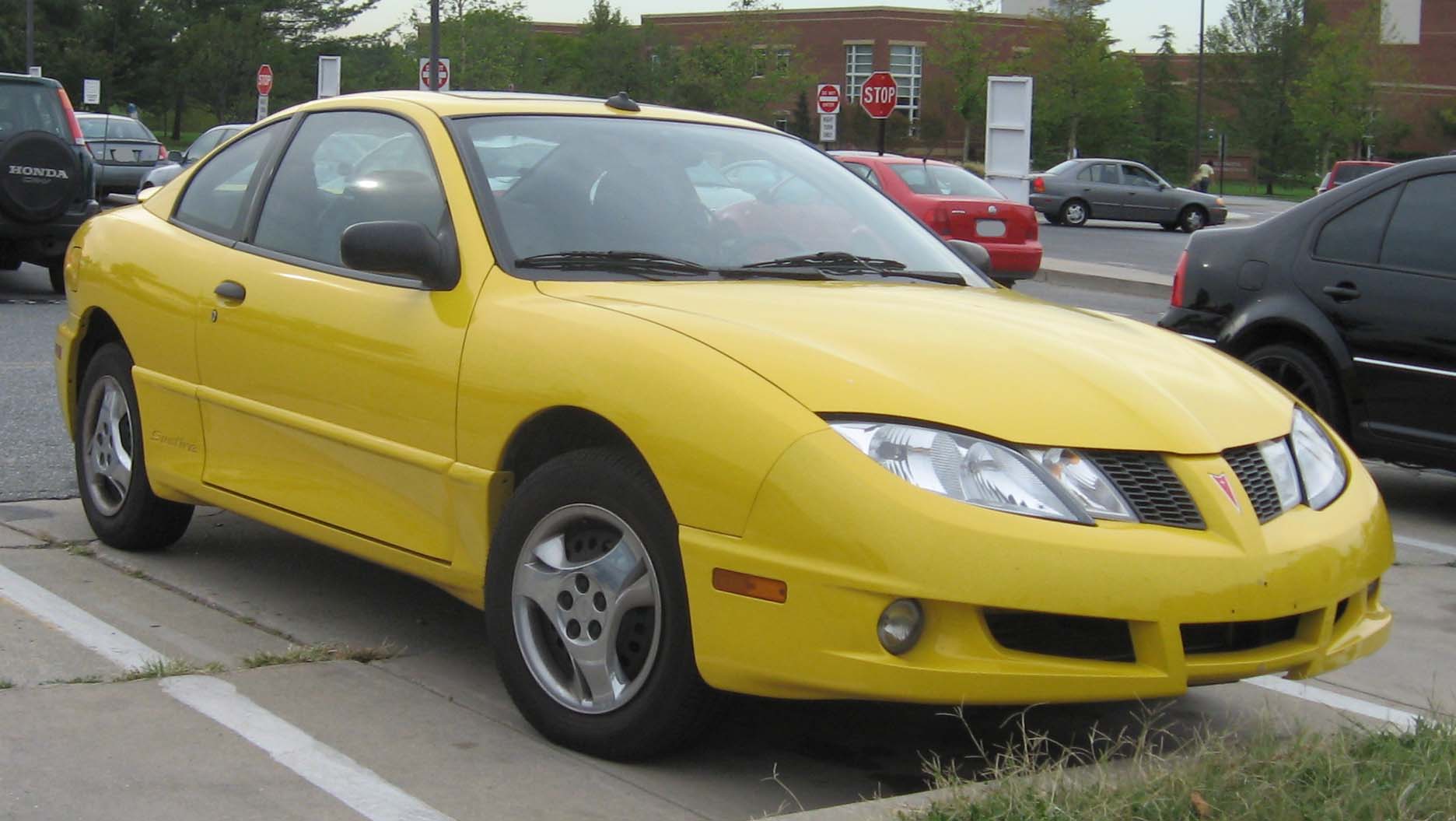
"...that was a 2004 Pontiac Sunfire Pontiac. It was the stripped down base model, the one S V."
The Pontiac Sunfire is a small car that was made by the Pontiac brand. It was known for being affordable and had a sporty look, which made it a good option for people looking for a budget-friendly vehicle.
The Pontiac Sunfire was a compact car produced by Pontiac from 1995 to 2005. It was known for its sporty design and affordability, making it a popular choice among budget-conscious buyers.
"...the stripped down base model, the one S V. And that's why it was so affordable..."
The base model is the simplest version of a car. It usually doesn't have extra features that more expensive versions might have, making it cheaper to buy.
A base model refers to the most basic version of a car without any additional features or upgrades. It typically comes at a lower price point compared to higher trims that offer more options and amenities.
"...it was electric blue. And yeah, it sparkly, really easy to find in a parking lot was great."
Electric blue is a very bright and shiny color that some cars can be painted. It's a fun color that makes the car easy to see and stand out.
Electric blue is a bright, vibrant shade of blue often used in automotive paint. This color is popular for its eye-catching appearance and can make a vehicle stand out in a crowd.
"And then I went on to buy a couple of Pontiacs and, you know, not to mention the other Chevys and Saturns and Pontiacs within my immediate family."
Pontiac was a car brand that made sporty and performance cars. They are no longer in production, but many people still remember them fondly.
Pontiac was a brand of automobiles produced by General Motors, known for its performance-oriented vehicles like the Firebird and GTO. The brand was discontinued in 2010.
"But also a little bit of shame if you considered buying anything that wasn't a GM product in those days."
General Motors, often called GM, is a big company that makes many different car brands. They are known for producing a lot of cars in the United States.
General Motors (GM) is one of the largest automobile manufacturers in the world, producing various brands including Chevrolet, Pontiac, and Saturn. GM has a significant influence on the automotive industry.
"...particularly, he got the HHR when that came out, which was not super popular."
The Chevrolet HHR is a small car that looks a bit like an old-fashioned station wagon. It was made from 2005 to 2011 and was known for being practical but didn't become very popular.
The Chevrolet HHR is a retro-styled compact car that was produced from 2005 to 2011. It was designed to resemble the classic Chevrolet Suburban and was known for its unique design and practicality.
"...ar. That was, you know, Chevy's answer to the the PT Cruiser. Correct. He had that he had special ordered"
The Chrysler PT Cruiser is a small car that looks a bit like a classic vehicle from the past, but it was made in the 2000s. It has a roomy inside, which makes it great for carrying stuff or passengers. People talk about it because of its unusual style and how it stands out from other cars.
The Chrysler PT Cruiser is a compact car that was produced from 2000 to 2010, known for its retro styling and versatile interior space. It gained popularity for its unique design and practicality, appealing to a wide range of drivers. The PT Cruiser often comes up in discussions about distinctive cars from the early 2000s and their impact on automotive trends.
"Yeah. So I had had my eye on the G6 hard top convertible. For a while and just really interested in the hard top concept"
The Pontiac G6 is a car made by Pontiac that was sold in the mid-2000s. It came in different styles, including a version with a roof that could fold down like a convertible.
The Pontiac G6 is a mid-size car that was produced by Pontiac from 2005 to 2010. It was available in various body styles, including a hardtop convertible, which is notable for its retractable roof design.
"Not far from here, north of Baltimore in Hunt Valley, had two hard top convertibles in stock."
A hard top convertible is a car that has a roof that can be taken off or folded down, letting you drive with the top down like a convertible, but it also has a solid roof when it's closed.
A hard top convertible is a type of car that has a solid roof that can be retracted or removed to allow for open-air driving. This design combines the benefits of a coupe and a convertible.
"And I'm going to put the top down to drive, you know, 25 minutes away for dinner. And it beeped at me and the radio displayed top not allowed. It's too cold."
When you put the top down, you're folding the roof of a convertible car back so you can drive without it. It's a fun way to enjoy the outdoors while driving.
Putting the top down refers to retracting the convertible roof of a car, allowing for open-air driving. This feature is common in convertible cars and enhances the driving experience, especially in nice weather.
"because it wants to protect those delicate mechanisms in the back. Absolutely. And lubricants get gummy in the cold."
Delicate mechanisms are the small parts inside the car that help the roof open and close. They can be easily damaged if the car is too cold or if they're not used properly.
Delicate mechanisms in a convertible roof system include components like motors, cables, and hinges that are responsible for the operation of the roof. These parts can be sensitive to extreme temperatures, which may affect their functionality.
"Absolutely. And lubricants get gummy in the cold."
Lubricants are oils or greases that help parts of the car move smoothly. When it's cold, these lubricants can get thick and make it harder for things to work properly.
Lubricants are substances used to reduce friction between moving parts in a vehicle. In cold temperatures, lubricants can thicken or become gummy, which can hinder the operation of mechanical systems like a convertible roof.
"...It's got a decent size V6 in it, although it's an automatic and I don't love driving automatics."
A V6 engine has six cylinders arranged in a V shape, which helps the engine be smaller and lighter while still producing a lot of power. It's common in many cars for a good balance of performance and fuel economy.
A V6 engine is a six-cylinder engine with the cylinders arranged in a V configuration. This design allows for a more compact engine while still providing good power and efficiency.
"...Just just like the last one and a half mustangs. That's it. Same thing."
The Mustang is a famous sports car made by Ford. The speakers are talking about a special version that was produced in a limited way, making it rare.
The Ford Mustang is an iconic American muscle car known for its performance and style. The reference to 'last one and a half Mustangs' suggests a unique production situation similar to the Pontiac mentioned earlier.
"...you need to go trade that car in on a roof, I think."
A trade-in is when you give your old car to a dealership to help pay for a new car. It can lower the price you need to pay for the new car.
A trade-in is when a customer offers their current vehicle as part of the payment for a new or used vehicle at a dealership. This can reduce the overall cost of the new vehicle.
Select text to request an explanation
Welcome back to all the cars I've loved.
Before CarsLove.com, this is your podcast, America World, Planet, Galaxy Universe, where we talk
about the cars that have made you influenced you, cars that you've owned, everything in
and around them.
I am continuing to get over illness and sickness here in sunny Florida.
Yes, we have pathogens down here.
So I started out with strep throat, kicked that, then had a cold, various pathogens moving
through my life.
I had chicken for lunch.
I'm sure I'll have bird flu in the coming days here, but hey, that's not going to
stop me.
It's not going to stop the show.
Good afternoon, Doug, my partner, my co-host.
How are you doing, Doug?
I'm doing great.
Great to be back here with you.
Absolutely.
He is Doug at CarsLove.com.
I am Christian at CarsLove.com, sniffling all the way.
And let's see, what can we, any housekeeping to get into?
As Doug mentioned, at the end of the prior episode, depending upon how he feels like
slicing and dicing this season and putting together the episodes like a magician does
a deck of cards, there's a pull that he has put together and is that in beta?
Is that out on the site yet on CarsLove.com?
It is.
I believe it's CarsLove.com slash vote, but there is also a link at the very top of
the page.
Wonderful.
And so we want people to vote for your favorite episode.
When this one comes out, this one will be on there too.
You may want to hold your vote till you hear this entire episode because it may be
your favorite.
Yeah.
Yeah.
And I'm very excited about today's guests and typically I babble on way too long at
this point, but our guest has an episode that she wants to talk about.
But before I introduce her, I am going to gently hand the introduction to the
outstretched hand of my co-host here.
Who knows her and is going to introduce her into the discussion.
Doug.
Yeah.
Yeah.
So our guest today is a Maryland native, I believe.
I consider myself a Maryland native even though I moved here when I was four.
And so we're both Maryland natives.
She's got a really great car background, including family, and we're going to get
into that.
One might say oil and or gasoline is in her veins as well, just like
another wonderful guest we had.
And Lisa and I came into knowing each other because, and I sound like a broken
record here, because of DeLorean's, right?
Lisa has a big birthday coming up and she is a big 80s fan, just like me.
And she booked my DeLorean for her 80s birthday party where I think I'm going
to be bringing her, unbeknownst to her friends, and we're going to surprise
them at the event where a local 80s cover band that's really good is going
to be playing.
So I'm really looking forward to it.
I mean, here's somebody who's after my own heart and she's got a DeLorean story too.
But with that, Lisa, I hope I didn't tell your whole story, but introduce yourself.
Welcome aboard.
Thanks for having me, Doug and Christian.
Yeah.
So I am a Maryland native.
I have lived on the east side of Baltimore pretty much my entire life.
And yeah, I'm super excited to have the DeLorean at my birthday party that is, I think, going
to be the most fun, interesting element of it.
And after we connected about renting your DeLorean and your DeLorean driving services
for that evening, and you turned me on to the podcast, I've had a lot of fun listening.
And I really particularly loved the pilot and I know it sounds kind of cheesy to
say that, but it was so much fun to hear the two of you sort of discovering the potential
of this topic and your natural curiosity with everybody and their storytelling.
And I feel like I myself get really emotionally attached to my cars.
I've owned four in my lifetime, two I've parted ways with, and I cried like a baby
when I parted ways with each of them.
And I expect to do the same with at least one more in the near future.
So definitely a topic that hits home for me.
Full of passion.
You are full of passion, passionate person you care, dig it.
Thank you for sharing.
Yeah.
And I think just as a quick teaser not to take it away, I think Lisa's life began
very early on with a Camaro that her mom bought not long after she was born or
right before, because that's a very, very good family car, right?
Yeah.
Perhaps not surprising in East Baltimore that my mother bought a Camaro shortly after
I was born.
Vanity plates and everything, a red one.
And she drove that for many years and then handed it down to my brother who abused
it.
And it didn't last much longer in his hands.
Camaro's great family cars.
You just put the baby in the hatch.
It's fantastic.
Yeah.
Lots of song back there.
And for newer listeners, Camaro had this Camaro and all these old rear-wheel drive
cars had this great thing in the middle, had this center hump for the transmission
tunnel.
And Lisa, I'm guessing, I think you said you're one of three.
So that with a four-seater car, somebody had to sit in the middle on the hump, right?
Absolutely.
And we would fight over who got to sit in the middle because there was no seatbelt
there.
And you're always a little higher.
You're a few inches higher.
It's the commanding height, isn't it?
You just see a little better and see through the middle out of your window, over brother
and sister in the back.
And in the 80s, yeah, seatbelts were an afterthought.
Yeah.
Exactly.
Some of backseat.
We'll just think captive thoughts.
We don't need a seatbelt.
Now, is this the one that was Patriot red, Lisa, or is that a different one?
My Camaro was Patriot red.
My mother and brothers was a more traditional tomato red.
I'm not sure what the official GM paint color was.
Mine was a darker, almost maroon color.
I was going to ask.
I was going to ask.
So Patriot red sort of bordered on them.
And I love just the clever official paint names they have, right?
Midnight Electric Eel Blue, Envious Green, and on it.
I'm crazy.
Chrysler color.
That's it.
That's another blue.
That's a Chrysler color from back in the day, yeah.
And yes, so, Lisa, as you hinted to your Camaro, the first of many in the family was your first
car.
Yes.
So my very first car that I bought when I was 16 didn't even have my license yet.
Fun fact, it had been inspected by the used car lot where I bought it on my 16th birthday.
That was the day on the inspection certificate.
So I thought it was meant to be.
It was a 95 pretty base model, but with teatops in that Patriot red.
And then after a couple of little fender benders, I had a custom paint job on it.
We kept the same base color, added a big flake violet pearl, and it was just really beautiful.
Sounds so pretty.
Yeah.
I love that car.
It was a part of my identity as a teen without a doubt.
And I still run into people 20 plus years later in the neighborhood because I still live
in the same neighborhood where I went to high school that will ask me, hey, you still got
your Camaro?
No, not anymore.
Yeah.
Wish I kept it, but just they take up a lot of space, take up a lot of space.
And you had that one for how long then?
I had that car for about seven and a half, almost eight years.
Yeah.
Okay.
Yeah.
And I think you have a great story.
How did you earn the money for that car on your 16th birthday?
Making pizza.
Worked two years at Pizza Hut, then my store closed, and I went to work at Papa John's,
which coincidentally is right next door to where I live now since I'm still in
that neighborhood.
And making minimum wage or close to it for all of those years made thousands of pizzas
and socked that money away as fast as I could and bought that car.
Okay.
So we're not going to ask age, but what was minimum wage at your first job?
Four and a quarter an hour.
Okay.
So mine was, I want to say $3.33, I don't know if there's a way.
I don't think I kept anything that could confirm that.
Doug, what was your first?
It was probably in the $3 to $4.
Yeah, we got to go look that up.
Yeah, I'm sure it's in the wayback machine.
I love when we talk about food on this show.
And I know it's about cars, but all I can think of right now is pizza.
So did you eat a lot of pizza when you were there?
Or as soon as the shift was over, you ran screaming from the, and you couldn't
look at dough again when to talk about pizza at work.
I took a lot of pizza home when you're a teenager and you're making minimum
wage and trying to save up as much as you can for a big purchase.
You're going to eat whatever's free.
And I got creative to take some other ingredients to work with you
and mash it together with what they have there.
Like what?
So at Pizza Hut, I'd cook pasta at home and take that in and put it
in a pan with sauce and veggies and cheese and throw that through the oven
and bake it.
Oh.
Papa John, we figured out you could bake cookies on the conveyor oven
to get that slice and baked dough and they baked up perfectly in that oven.
Oh my gosh.
To all the pizzas I've eaten before.
That's going to be our Splinter podcast.
Sorry, sorry, we need to move on, but I love this.
Sorry, Doug, you were saying.
No, that's OK.
There's a new pizza place in Annapolis, so I'm probably going to
be going there tonight.
What's it called? Timber Pizza.
It's a small chain.
Maybe they could sponsor us.
Maybe. Maybe we'll work for toppings.
OK. Yeah, Timber Pizza.
My mate. Wood oven.
We'll do a review.
Dig it. It's always great to have a new place.
And yeah, next time you're in town, Christian, we'll we'll try it out with you.
So it's a pizza guy, but back to the cars, right?
So the Camaro you had for I think he said seven years.
Yes, seven, almost eight years.
It wasn't my daily driver that whole time.
It overlapped with my next purchase,
which I frequently say was the best 10,767 dollars I ever spent.
And that was a 2004 Pontiac Sunfire Pontiac.
It was the stripped down base model, the one S V.
And that's why it was so affordable and it was electric blue.
And yeah, it sparkly, really easy to find in a parking lot was great.
You know, today, everything's black, white, gray and silver.
It's like everything looks the same, but a nice neon blue car.
Really. Now, did you did you pay extra for that color?
You said it was baseball.
Is that an option you added on?
Was there a little extra paint you remember?
There was not.
That stripped down model only came in black, white, silver and blue.
The other colors were reserved for the higher trims.
So I had my choice between those four colors and I picked the blue.
Good choice.
There was one as we were talking before the show.
There's one I saw I've seen that exact car.
I'm telling you within the past few months around here and it's traded
in the deep blue metallic flake for the oxidized rust flake over most of the car.
But it's still a good looking car.
Nice curves and lines and it's still running.
It is still running.
And I don't dare say a sharp looking little car.
And so and so you said it ran well and you had that for a time, didn't you?
I drove that car 14 years, 180,000 miles on the original clutch.
I only retired it because it was totaled.
And although it wasn't going to cost much to fix it, I had my eye
on the new laws coming that required the backup cameras and all the other features.
And I knew that entry level cars were going to get really expensive.
And so I decided it was better to go ahead and replace it, then try to kick
a couple more years out of it.
And it was it was sad for me to give that car up.
And people thought I was crazy that I was that upset and even considering fixing it.
But when I think back, that car took me to so many important events
in my young adult life.
I graduated, went to my first law school classes driving that car.
Yeah, we did took the bar exam and got sworn in, bought my first house
first day as lawyer and and lots of other things in between.
And so it was it was tied to all of those events and memories of my life.
And it was such a reliable piece of my life.
In that 14 years, I replaced one light bulb over the license plate in the back.
And I made one repair other than basic preventative maintenance.
It was just a really efficient, practical, but like you said,
still really cute car for a young person to drive.
Well stated, well stated.
Yeah, more than just machines.
That's why we say we say that, you know, every car tells a story.
And when we're out and we talk to people about this podcast,
even people that wouldn't mean you're obviously a car nut.
Just listen to your to your faces lighting up, talking about these things,
these memories, but we go meet people at car shows or friends of friends.
I got that show and people just come alive.
It's reminiscing and Doug and I like to talk about this a lot.
It's it's it's a lot of your story, the person that you are.
Because for just being a hunk of metal, it's a big investment.
And you got every penny out of what you put in that car.
Ten thousand seven or six or seven dollars, you know,
you had it for a long time, took you from A to B.
Took care of you.
A lot of you in that car are the way around.
Yeah, definitely a great investment.
And I don't think I realized it at the time.
I kind of felt like it was a consolation prize.
I'd been driving a Camaro and a little subcompact.
And I was a little salty about it at the beginning,
but I knew I needed something better to commute to school.
And then after after a couple of years went by and I was
I was out of school and I went to get a mortgage to buy my house.
And the mortgage broker said to me, he goes,
what kind of car are you going to buy?
Because he's trying to figure out what I can afford.
And I'm like, what do you mean, what kind of car am I going to buy?
It's like you're going to get like a BMW or you're a lawyer now.
And I'm like, oh, my car's fine.
Like I I'm in a broke.
I'm not going to fix it.
And I did continue to drive that car for many more years after that.
And I got a little flack from some people who thought it was maybe not so
professional or it didn't match the level of success.
I wanted to project.
But at the end of the day, I think anybody whose opinion mattered appreciated
the efficiency and that I was going to drive that car until it died
and that I got my money's worth out of it.
We we get that a lot from people who end up bonding
with these machines when when they sort of least expect it.
And it's it's kind of a lovely thing.
A lot of it is the memories in there.
Hey, came from my dad.
It came from my brother.
This car went through all of my siblings and I was last stop.
You know, there are ties that bind.
That's lovely. Well stated. Thank you.
Well, and speak if I may, Christian,
yeah, speaking of which, since you mentioned Ma,
we mentioned her mom earlier, you just mentioned her dad or a dad.
You know, I'm I'm seeing a theme of GM cars.
And before we get on to your replacement Pontiac,
there's there's a family history with GM in your family.
And, you know, how unique.
I think we have two parents at minimum
and maybe some relatives that actually worked for GM
while you were growing up.
Yeah, that's that's the case.
My mother worked there actually before my time in the 70s
and and her husband worked there for decades, retired from there.
They both were uprooting Highway and he wound up
moving to Shreveport when that plant opened down there in the early 80s.
And so the fact that
my mother and then my brother drove the one Camaro,
I had one, my sister had one.
And then I went on to buy a couple of Pontiacs
and, you know, not to mention the other
Chevys and Saturns and Pontiacs within my immediate family.
We did, you know, enjoy the family discount that comes with that.
But also a little bit of shame
if you considered buying anything that wasn't a GM product in those days.
I think I think your car
had a chance of getting beaten up at the GM plant.
If if you came in something else is my understanding.
Definitely are those stories.
Yeah, my my sister worked for Saturn briefly.
She also got the family discount on a Saturn.
Sedan number two, whatever whatever that model was.
Yes. Yep.
Yep, correct, correct.
And she drove that car forever.
Yeah, so did you just curious,
because I think back to my my dad was in the computer industry.
And so he always knew the latest, greatest
thing that was coming or could bring it home.
Was there a bit of that in the family like, hey, this new car is coming out
or this engine is changing over?
Yeah, I definitely remember some talk about new models and things
and particularly, he got the HHR when that came out,
which was not super popular.
That was, you know, Chevy's answer to the the PT Cruiser.
Correct. He had that he had special ordered
a really high end Camaro at one point
and then had second thoughts about it and didn't take delivery ultimately.
And I actually considered taking it and my.
Good judgment got the better of my desire for a fun car
and I didn't do it, but I thought long and hard about it.
Yeah. Yeah.
Yeah. So funny, funny tidbit about that, because I had to I knew there was some connection.
The gentleman, Brian Nesbitt, who designed the HHR was the former designer,
formerly at Chrysler, and he was the guy who designed the PT Cruiser.
Kind of seems like a little bit of a rip off, but.
You know, he had the timing right on both those cars.
He did. Did he ever? Yeah. Yeah. Absolutely.
So. Oh, so since we're on Pontiac.
Sorry, this is a very car centric episode.
So we all know Pontiac went went down due to the financial crisis.
And, but that didn't stop you from finding a Pontiac before they went out of business.
And hoping you could tell us about that.
There's a neat story involved in it as well timing wise.
So I'll let I'll let you tell us, Lisa.
Yeah. So I had had my eye on the G6 hard top convertible.
For a while and just really interested in the hard top concept
because I had had the T top Camaro and I still had the T top Camaro at this point.
And I didn't really want a soft top.
And so I'd just been looking at this car and thinking about it
and looking at reviews and things.
And then the news came out during the recession that GM was going to shed
a couple of lines, including Pontiac at the end of 2009.
And that news hit pretty hard right about 1230.
And so I checked local inventory and I found a dealership.
Not far from here, north of Baltimore in Hunt Valley,
had two hard top convertibles in stock.
And I went and looked at them and they said, well,
anything that doesn't get sold by tomorrow is going to be the rental lots.
GM did a package deal.
Everything left just goes to rental because we can't sell anything
after 1231. We're done. We're out of business. It's over.
So a bit of a rash decision for me.
I usually spend like years deciding to buy something and I have spreadsheets
and lots of information and I overanalyze it.
And by the time I select a car, it's no longer on the market, usually.
And so I went and bought this 2009 G6 GT hard top convertible.
They had two on the lot.
One was red with tan leather interior and I hated everything about that.
I bought the navy blue one with gray cloth interior.
I was in my mid twenties at the time and I thought that a midlife crisis
would warrant a red convertible, but a quarter life crisis would warrant
a blue way ahead of schedule. Yeah. Good work.
And so I bought that in the middle of winter on 1231, literally the last day I could.
And I remember taking it for a test drive.
Just a couple of weeks later, a friend's birthday came up
and I bundled myself all up in a coat and hat and scarf.
And I'm going to put the top down to drive, you know, 25 minutes away for dinner.
And it beeped at me and the radio displayed
top not allowed. It's too cold.
Oh, no, really?
And yeah, yeah.
So the car has some limitations.
It won't let you put the top up and down too quickly.
It won't let you operate it when it's too cold
because it wants to protect those delicate mechanisms in the back.
Absolutely. And lubricants get gummy in the cold.
Yeah. So that was my first.
It's a little deflating, but that was my first time really driving
the car after I brought it home.
And so I've still got that 15 years later
and I don't drive it every day.
It's my tune from the beach car.
It's my road trip car.
It's very comfortable. It's a very smooth ride.
It's got a decent size B six in it, although it's an automatic
and I don't love driving automatics.
It is just a very comfortable ride.
Now, it's not a 2009
and it's not a 2010, is it?
No, so they had to make 2009 and a half
because the next model year was rolling out,
but then they decided not to exist in the next year. Exactly.
Exactly. So, yeah, there's a small pocket
of of Pontiacs that are two thousand nine point five.
Just just like the last one and a half mustangs.
That's it. Same thing.
Yeah, that's unique.
Not something I knew.
Rest in peace, Pontiac.
But now like Lisa and Christian are keeping it going.
We do. We do our best.
We do our best.
Well, and I can't so much to get to with Lisa.
But where is the the auction story?
Is that are we about ready for that in the chronology of your life?
Or is that a little bit later?
So that was actually right around the time I bought the G6.
I don't know if it was shortly or shortly after,
but it was in that time frame.
I attended a charity auction
specifically was Community College of Baltimore County.
Did their big annual Gala event and they heavily theme their events.
That year was like a spy theme
and they have some relationship with a car collector
and convinced him to donate one of his cars to the event to auction off.
And they specifically said, we want the DeLorean and he ponied up the DeLorean.
And so ever the 80s fan,
I am sitting there at this charity event
where they're encouraging you to bid and spend money
and I'm having a great time in the open bars flowing
and I have great affinity because I'm an alum of the institution.
And I think back at that time, I was also teaching there.
I did teach there for a few years and I think that was the same timeframe.
And so when the DeLorean goes up for auction,
I just start bidding and keep bidding and keep bidding.
What did it start at?
Do you remember what the bidding started at?
I think they started it at like eight or nine grand.
OK.
And I remember going at least up to 14.
I think I probably went up to like 20
before my sense caught up with me.
That was my next question.
The only reason I had 20 grand sitting in my bank account
is because I was saving up to buy a new roof
that I desperately needed because my shingles were blowing off.
And the roof was probably a better investment
than the DeLorean at the end of the day.
Although I couldn't help but think
that I would win every costume contest I ever went to.
A hundred percent.
Yeah, you just do it back to the future theme.
You show up in the DeLorean and you take your price.
What did it go for?
What was the winning bid?
Do you remember?
Are you sober?
I was awake.
I had a few.
I was probably hitting up the dessert buffet at that point.
And I want to say it sold for about 27 grand.
OK, so not not not close.
All right, good deal.
Yeah, I think the roof was a good choice.
I think being a DeLorean owner, I can imagine the upkeep
on that car is difficult.
I can imagine that the owner collector was probably like,
yeah, I will get rid of that car.
I'm tired of fixing it.
Yeah, I get I get excited over in the eBay auction,
you know, for a couple of baseball cards,
I can't imagine a car, you know, be flesh and blood, sit there.
That would be dangerous.
That's high anxiety.
Good stuff.
Yeah. And once you start bidding, the people at your table,
even if you don't know them, they start aching you on.
Yes. It gets very heated.
And it's it's fine.
And then you want to win just because you don't want someone else
to get the thing you want.
Hard to disengage.
I would think that it would be hard to disengage
when you're that deep in it,
especially if you're an excitable person
and it's something that you've you've wanted for some time.
Well, good on you.
Good on you.
Yes. So I'm glad that I've met Doug now
and he can fulfill my occasional DeLorean need
without having to actually own one myself.
Think of all the money he saved you.
Oh, my gosh.
You have no idea.
Yeah, Doug, you need to go trade that car in on a roof, I think.
But yeah, I got a new roof a couple of years ago,
so I'm good to go back.
It was right around the time I bought the car, too.
That doesn't make sense.
So yeah, with that, as we're coming towards the end,
you know, Lisa, it sounds like you've done a lot
for your community.
You mentioned teaching at the community college
and helping with that auction,
fortunately not getting stuck with anything.
But what is what is a cause that's important to you
that you'd like to share with our listenership?
So I am very active in my local Elks Lodge
and many people are familiar with the Elks.
Maybe their dad or their grandfather was a member,
but not everybody is.
It's that BPOE sign you see on an old building
in your neighborhood,
the Benevolent Protective Order of the Elks.
We've been around for a very, very long time.
My particular lodge has been around since 1899,
so it is our 125th year in the same building
right in the heart of Towson, right off the circle.
And we have a couple national focuses
in terms of philanthropy and volunteerism.
The top one is by far veterans,
and that is what my lodge focuses on.
We also hand out some scholarships
and do some other community things,
but we raise money for different veterans' causes,
volunteer at the VA hospitals.
We bring a group of vets out for a big dinner
around Thanksgiving every year and serve them a meal
and throw money at them through a bingo game.
Is the fun way to do it.
And then we send them home with a police escort,
which they just love.
They get on their little buses back to their old age homes
and the police take them with lights and sirens on.
It's great.
But it's just a great civic, paternal organization
that engages in a lot of different ways in the community.
And I find that it's a convenient way to be a volunteer.
Lots of events, sign up for what works for you,
sign up for what you enjoy,
and then also make friends and experience some camaraderie.
We've got parties and events throughout the year as well.
And it's an interesting mix of people.
Well, thank you for sharing.
Now I know a little more about the ELCS,
because I've seen that BPOE around where I live in Maryland,
but didn't know too much about it minus a veteran component.
And thank you for helping the veterans
and the senior citizens as well.
Yeah, they're an important part of our local communities.
And I think that sometimes they get a little overlooked.
And a lot of their organizations,
like the American Legions and BFWs
are kind of fading away over time.
So it helps when other organizations step up to some of them.
Excellent.
Yeah, for sure.
Well, thank you for that, Lisa.
Well, Lisa, I gotta tell you,
I have heard of you for some time.
I've been really looking forward to meeting you.
And this was just a real treat to me for me.
So I want to thank you for taking the time
and being a friend of the show, being a fantastic guest.
And we promised that we would get you out of here on time.
And there is so much more to talk about, talk about,
but hey, there's always another podcast.
What do you think, Doug?
Yeah, I think we should thank Lisa for her time,
her energy, her interest.
Her service, her community service.
And it's her service.
And when she was asking me about the DeLorean,
it just popped in my head,
hey, here's a car person I should mention the podcast.
The podcast was very new then.
And, you know, it really was a great experience.
Not to sound...
Serendipitous fortuitous and some other us.
Thank you, exactly.
You got it.
Yeah, it really helped see the connection there.
And, you know, the cars and people,
and you could be talking to anybody.
And yeah, I have a podcast.
Such a good point.
Such a good point.
Good stuff, Doug.
Thank you again, Lisa.
Thank you to our audience.
You know how to get ahold of this CarsLove.com.
Doug at Cars.com.
Doug at CarsLove.com.
Christian at CarsLove.com.
Lisa, thank you again.
It was a pleasure.
It was great meeting you guys.
Thanks for having me today.
Thank you, Lisa.
Excellent.
See you soon.
Can't wait till October.
Yeah, look forward to seeing you in the DeLorean.
Yeah.
All right.
Have a great night.
We'll talk soon.
See you next time.
Right.
CarsLove.com.
To all the cars I've loved before,
for every car, tells a story.
They lose a...
Request an explanation for:
7 cars
Scroll for more
7 cars featured
Request an Explanation
Heard something you'd like explained? We'll add it to this episode.
Sign in to request explanations for terms you heard.
Want to learn more?
Browse our glossary for plain-English explanations of automotive terms, jargon, and concepts.
See something that's not quite right? Our annotations are AI-generated and can sometimes miss the mark.
Click the flag icon on any annotation to suggest a correction.
Report incorrect info
Suggest better explanations
Flag missing cars
More from To All The Cars I've Loved Before: Classic Car Restoration, JDM, and Automotive History