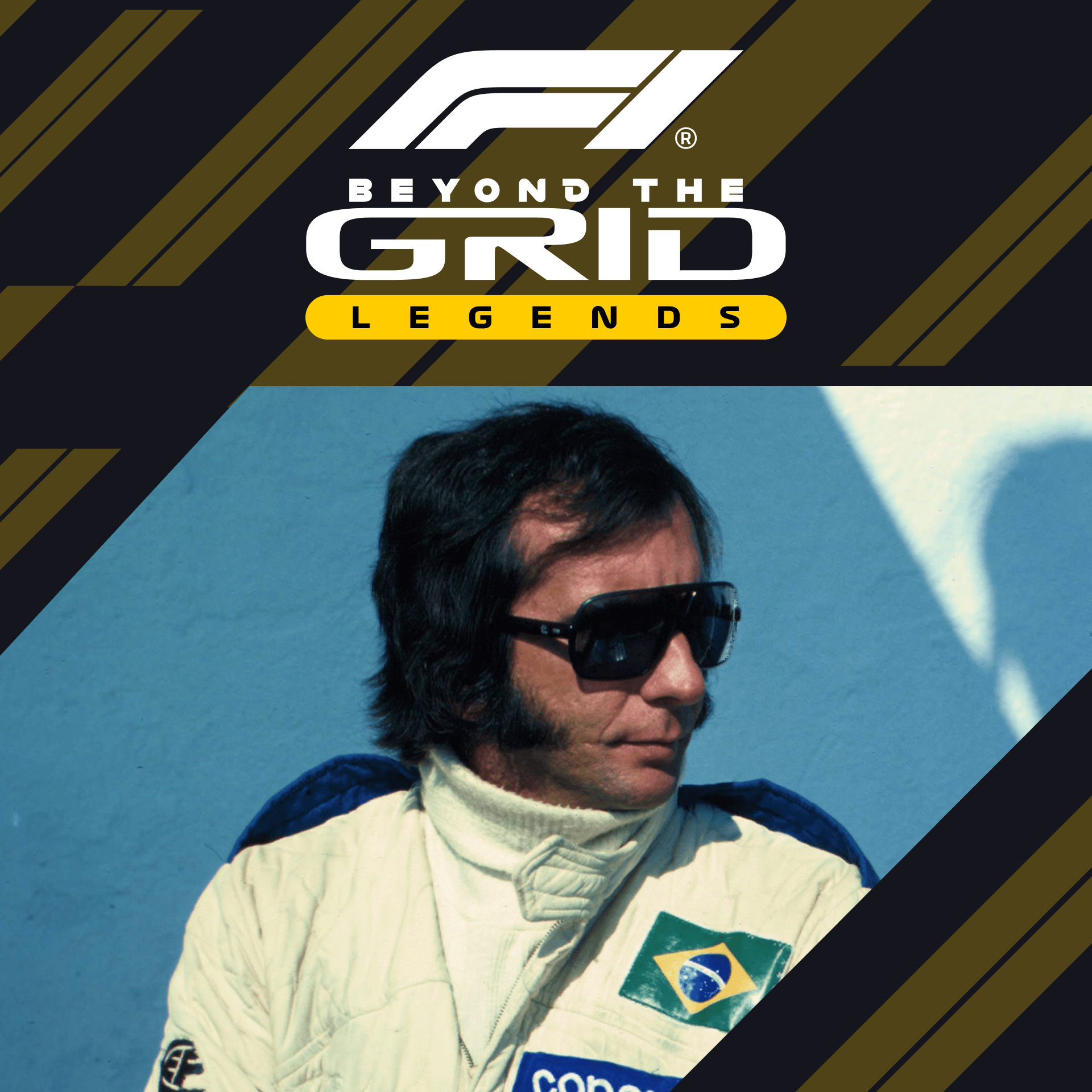
LEGENDS: When Emerson Fittipaldi shocked Formula 1
About this episode
Emerson Fittipaldi looks back on the career moves that defined him: leaving Lotus after a near-miss, finding McLaren’s tiny but highly organized operation, and then taking the bold step of building his own Formula 1 team with his brother. He also reflects on the pressure of title fights, the challenge of ground-effect cars, and the support systems that shaped his rise, from team backing to even bringing his own doctor to races.
50 years later, Emerson tells Tom Clarkson why he and his brother Wilson launched Copersucar, a team based in their home country of Brazil. He also remembers the dramatic events that led him to start his own team – winning the World Championship with Lotus and considering retirement before winning a second title with McLaren, and the conversations with Ferrari which could have changed the course of his career.
Emerson’s passion for F1 still burns bright. He drove his championship-winning M23 in Miami at a McLaren showrun. He also keeps a close eye on every Grand Prix, and gives his views on Kimi Antonelli’s impressive start to the 2026 season.
This episode is sponsored by:
Vanta: get started at vanta.com/GRID.
Shopify: sign up for your $1 per month trial today at shopify.com/beyondthegrid
McLaren
"50 years ago, Emerson Fittipaldi shocked the Formula One world by leaving McLaren just a year after becoming a two-time world champion."
McLaren is a famous Formula 1 racing team. The story here is about Emerson Fittipaldi leaving that team and doing something very different next.
McLaren is a Formula One racing team and constructor. In this segment, Emerson Fittipaldi leaving McLaren is the key career move that sets up his later decision to start his own team.
Formula One team
"He created his own Formula One team. I knew that would be a struggle because when you start a new Formula One team, normally you need four to five years to be competitive normally."
A Formula One team is the organization that competes in F1 with its own car and staff. New teams usually need time—often several years—to get fast enough to fight at the front.
A Formula One team is the full racing organization that builds or runs the car, hires drivers and engineers, and competes in the F1 championship. Starting a new team is difficult because it typically takes multiple seasons to develop a competitive car package.
World Championship
"When I won my first World Championship, I had lunch with my father, myself and my brother... I want the World Championship. What else I want?"
In Formula One, the World Championship is the season-long competition that crowns the best driver (and, separately, the best team). Winning a World Championship is a major milestone that changes a driver’s options and leverage.
Grand Prix driver
"I left Brazil. I had the dream to be a Grand Prix driver. I want the World Championship."
A Grand Prix driver is someone who races at the highest level of Grand Prix events. In this context, it means the top-tier open-wheel racing that Formula One represents.
A Grand Prix driver is a driver who competes in Grand Prix-style racing events—specifically, the top-level races that make up the Formula One calendar. The term emphasizes the prestige and highest level of open-wheel competition.

Buick Century
"...ion for Formula One still burns brightly. Half a century after he and his brother Wilson created the Copa ..."
The Buick Century is a regular passenger car (a sedan) made for comfortable daily driving. It’s not primarily a race car; it’s more about smooth transportation. The podcast mentions it to connect to the larger history of car makers and their work.
The Buick Century is a full-size sedan line from Buick, known for comfortable, everyday driving rather than racing. In the podcast context, it’s referenced as part of a broader story about automotive history and the people behind it. It may come up because it represents the mainstream side of car building alongside more performance-focused machines.
Miami Grand Prix
"I live here since 1984 to have this Miami Grand Prix."
The Miami Grand Prix is a Formula 1 race in Miami. The episode uses it to set where and when Emerson is talking to the hosts.
The Miami Grand Prix is a Formula 1 race held in Miami, and it’s used here as the context for the conversation. The hosts are framing the interview around Emerson being in Miami for the event.

McLaren M23
"because you were reunited with your McLaren M23 as part of the team's 1000 race celebrations."
The McLaren M23 is an old Formula 1 race car from McLaren. In this episode, it’s mentioned because Emerson Fittipaldi got to see his old McLaren again during a team celebration.
The McLaren M23 is a classic Formula 1 car from the 1970s, strongly associated with Emerson Fittipaldi’s championship-winning era. It’s notable for being part of McLaren’s successful late-1970s/early-1970s development and for its role in the team’s racing history that the episode is celebrating.
power-to-weight ratio
"It feels extremely good, another impressive thing, Ton, because it was only 550 kilos and we had over 400 horsepower. That means it was nearly one kilo per horsepower."
Power-to-weight ratio is a simple way to describe how “strong” a car feels for its size. If a car is light and has a lot of power, it tends to accelerate quickly.
Power-to-weight ratio is how much engine power you have for each unit of vehicle mass. In this segment, the speaker uses the M23’s 550 kg weight and 400+ horsepower to explain why it accelerates so strongly—nearly one kilo per horsepower.
spinning wheels
"I was spinning wheels and it accelerated so much that, you know, it was the relationship similar to Formula 1 car now, the weight, power, it's very similar, very impressive acceleration, but there was no grip"
Spinning wheels means the tires are slipping instead of gripping the road. The car can still accelerate hard, but you’re not getting the traction you need to put power down efficiently.
Spinning wheels happens when the tires lose traction and rotate faster than the car can move forward, usually under hard acceleration. The speaker says they were spinning wheels, then notes the car accelerated a lot but “there was no grip,” linking traction limits to the M23’s behavior.
grip
"...very impressive acceleration, but there was no grip and a lot of spectators, the public was an incredible event in McLaren organized, Zac Brown, typical from Zac Brown."
Grip is how well the tires “hold on” to the ground. If grip is low, the car can slip—like spinning wheels—even if the engine is making plenty of power.
In racing, grip is how well the tires can stick to the road surface and transmit acceleration, braking, and cornering forces. The speaker contrasts impressive acceleration with a lack of grip, explaining why the car could be fast yet still slip under power.
Zac Brown
"...but there was no grip and a lot of spectators, the public was an incredible event in McLaren organized, Zac Brown, typical from Zac Brown."
Zac Brown is referenced as a key figure associated with McLaren’s organization and public-facing events. The speaker’s “typical from Zac Brown” comment frames him as someone who makes these celebrations happen.
Lotus
"Why did you leave Lotus and go to McLaren? Because you've been so successful at Lotus. I had already five years with Colin."
Lotus is a Formula 1 team and constructor with a long history of winning races and championships. The speaker references his success with Lotus and his relationship with Colin (his mentor), which sets up the context for why he later moved to McLaren.
Monza
"...in 1973, I was teammate to Ronny and in Monza, I still had a mathematical chance to win the World Championship. And before the race, I had a meeting myself, Ronny and Colin..."
Monza is a well-known Formula 1 race track in Italy. The speaker is referencing the Monza race as the moment when his title hopes were still alive.
Monza is the famous Formula 1 circuit in Italy, known for high-speed racing and heavy braking zones. Here it’s the specific race where the speaker says he still had a mathematical chance at the World Championship.
team orders (signboard)
"...we say, if we are leading the race and the third guy is well behind, if I finish first, I still can go for the championship... Colin said, OK, 15 laps to go, I give a signboard and you guys change your position. And the signboard never come."
Team orders are instructions from the team telling drivers how to race, usually to help the team or championship. A signboard is a signal the team uses, and in this story the drivers didn’t follow it because they didn’t see it.
In Formula 1, team orders are instructions from the team to drivers about how to race for the best overall result—often involving position changes to maximize championship points. The “signboard” described here is a signal used to coordinate those instructions, and the failure to see it led to the wrong outcome on track.
Canada and the States
"...if I finish first, I still can go for the championship in Canada and the States. And Colin said, OK, 15 laps to go, I give a signboard..."
He’s talking about the next races in North America. Those races still had enough points to change who could win the championship.
This refers to upcoming Formula 1 races in North America—Canada and the United States—where remaining points could still affect the championship outcome. The speaker is using the schedule to explain why the team’s strategy mattered.
Teddy Mayer
"[465.1s] You have a meeting with Teddy Mayer, [466.9s] the guy running McLaren at the time."
Teddy Mayer was an important person in Formula 1 management. Here, the speaker says he was in charge of McLaren at that time.
Teddy Mayer was a key Formula 1 team manager/executive figure. In this segment, he’s referenced as the person running McLaren at the time, indicating his role in team operations and decision-making.
team BRM
"[476.8s] I said, listen, we have to change team BRM. [479.8s] He's not doing well. [482.2s] Louis Stanley is a great guy, but the team was not doing well."
BRM is the name of a Formula 1 team. The speaker is saying they needed to switch away from BRM because results weren’t going well.
BRM refers to the Formula 1 team the speaker is talking about, and “team BRM” is used as shorthand for that racing organization. The context is Fittipaldi discussing changing teams because the team wasn’t performing well.
Indie program
"And amazing, because they have the Indie program. They won 74 John Rutherford."
They mention an “Indie” program, meaning a racing effort connected to IndyCar-style racing. The point is that even a small shop was working on more than one type of race.
The “Indie program” refers to a racing development effort tied to IndyCar/Indy-style competition. In the context of McLaren’s small factory, it highlights that the organization supported more than just Formula 1.
Interlagos
"I mean, you win your home race at Interlogos [726.4s] for the second year in a row actually."
Interlagos is a well-known Formula 1 race track in Brazil. Winning a race there is considered a major accomplishment.
Interlagos (Autódromo José Carlos Pace) is a major Formula 1 circuit in São Paulo, Brazil. Winning there is a big deal because it’s one of the sport’s most iconic tracks and often features challenging race conditions.
setup
"[766.3s] And McLaren was very good in Terlagos, too. [769.7s] We got a good setup. [771.3s] We test during the winter with good year"
A “setup” is how the team adjusts the race car to fit the track. Small changes can make the car handle better and feel faster in corners.
In racing, a car’s “setup” is the chosen configuration of adjustable settings (like suspension, aerodynamics, and tire pressures) to match a specific track and conditions. Here, the speaker says they had a good setup at Interlagos, which helps explain why the car felt strong.
test during the winter
"[769.7s] We got a good setup. [771.3s] We test during the winter with good year [774.8s] and we develop the car for Interlogos, very bump track."
Winter testing is when Formula 1 teams practice and fine-tune the car before the season starts. It helps them learn what works so they can be ready for races like Interlagos.
Winter testing refers to preseason track sessions where teams evaluate changes and refine the car before the next race season. The speaker links winter testing to developing the car for Interlagos, implying it’s part of how they arrive ready for race pace.
bump track
"[774.8s] and we develop the car for Interlogos, very bump track. [779.7s] And McLaren always very fast on fast corners. [783.4s] And if you remember the old Interlogos,"
A “bump track” means the road surface has bumps and uneven spots. Those bumps can make the car bounce, so the team has to set up the suspension and tires to stay stable and grip the road.
A “bump track” is a circuit with noticeable surface irregularities that cause the car to bounce or upset its balance. That matters because suspension and tire behavior have to be tuned to keep traction and stability over uneven sections.
fast corners
"[779.7s] And McLaren always very fast on fast corners. [783.4s] And if you remember the old Interlogos, [785.3s] there was turn one, two similar to Indianapolis."
“Fast corners” are turns you take at higher speed. The car has to stay planted and keep good tire grip, so it feels smooth and controlled rather than sliding or bouncing.
“Fast corners” are high-speed turns where the car must maintain aerodynamic grip and tire traction without losing stability. The speaker credits McLaren’s ability to stay effective through these sections, which is often a sign of good balance and downforce.
turn one, two
"[783.4s] And if you remember the old Interlogos, [785.3s] there was turn one, two similar to Indianapolis. [788.2s] And then you had up here in the lake."
“Turn one, two” just means the first and second corners on the track. The exact layout matters because it changes how the driver brakes and turns, and how the car grips.
When drivers describe “turn one, two,” they’re referencing specific corner sequences on a circuit. Corner-to-corner layout affects braking points, steering inputs, and how the car transitions between traction phases.
suspension
"we developed the car changing suspension, geometry, [834.1s] downforce, wings, but always incredible car to drive."
Suspension is the part of the car that helps the wheels follow the road. Changing it can make the car grip better and feel more stable when you’re turning hard at speed. That’s why it matters a lot in racing.
Suspension is the system that connects the car to the wheels and controls how the tires stay in contact with the track. When Fittipaldi says they “developed the car changing suspension,” he’s describing setup changes that affect grip, ride behavior, and how the car responds in fast corners. In F1, suspension tuning is tightly linked to driver confidence and cornering performance.
geometry
"we developed the car changing suspension, geometry, [834.1s] downforce, wings, but always incredible car to drive."
“Geometry” here means how the wheels are set up relative to the car—basically the alignment and angles that affect tire contact. Small changes can make the car turn in better and hold grip through corners. It’s a key part of race-car setup.
In racing, “geometry” usually means alignment and suspension geometry settings like camber and toe, which determine how the tires contact the track. Adjusting geometry changes tire grip and steering response, especially under cornering loads. Here it’s grouped with suspension and aerodynamics as part of the Lotus 72’s performance development.
downforce
"we developed the car changing suspension, geometry, [829.5s] downforce, wings, but always incredible car to drive."
Downforce is the “suction” effect from the car’s shape and wings that presses the tires onto the track. More downforce usually means better grip in corners, so the car can go faster while staying stable. That’s why wings matter in race cars.
Downforce is the aerodynamic force that pushes the car’s tires toward the track, increasing grip. In this segment, Fittipaldi credits development of downforce and wings as part of why the Lotus 72 was so effective. More downforce generally improves cornering traction, allowing higher speeds through turns.
wings
"downforce, wings, but always incredible car to drive. [839.6s] I would come to the paddock, look to him"
“Wings” are the aerodynamic parts on a race car that help it stick to the road. By changing them, teams can increase grip in corners. They’re a big reason race cars can go so fast through turns.
In F1, “wings” are aerodynamic surfaces (front and rear) designed to generate downforce. Fittipaldi mentions developing wings alongside downforce, indicating they were actively tuning the car’s aero balance for faster cornering. Wing design and angle directly affect how much grip the car has at speed.
telemetry
"It was amazing because there's no telemetry. [865.3s] There was was just what I was feeling telling Colin"
Telemetry is computer-based data logging from the race car. Fittipaldi is saying that back then there wasn’t that kind of data, so the team had to improve the car mainly by listening to the driver’s feel and making changes based on that. It was more “hands-on” than today.
Telemetry is the real-time or recorded collection of car data (like speeds, temperatures, and suspension/engine parameters) used to analyze performance. Fittipaldi emphasizes that there was “no telemetry,” meaning the team relied heavily on driver feedback and engineering intuition rather than instrumented data. That highlights how setup and development were done in that era of F1.
driver feel
"There was was just what I was feeling telling Colin [869.5s] and then Colin going to the point and improving the car."
“Driver feel” means what the driver notices about the car while driving—like whether it turns in smoothly or feels stable. In this story, because there wasn’t telemetry, the team used that feedback to decide what to change. It’s basically the driver acting like the sensor.
“Driver feel” refers to the subjective feedback a driver gives about how the car behaves—such as balance, grip, and steering response. Here, Fittipaldi says that without telemetry, the development process depended on what he was feeling and then Colin’s adjustments. It’s a key concept in how older F1 cars were tuned.
torsion bars
"Lotus had like the torsion bars that was difficult to work with the proper angle."
Torsion bars are suspension springs that twist to provide springing and ride control. In this context, the speaker says Lotus’s torsion-bar setup was difficult to work with because getting the correct “proper angle” (installation/geometry) matters for how the suspension behaves.
wheelbase
"But we had three wheelbases, a long wheelbase. We had the mid wheelbase and the short wheelbase for Monaco for the short circuits."
Wheelbase is the distance between the front and rear wheels. Changing it can make the car feel more stable or more nimble, which is why they used different lengths for tracks like Monaco.
Wheelbase is the distance between the front and rear axles, and it strongly affects stability, steering response, and how a car behaves through different corners. The speaker describes McLaren running multiple wheelbase lengths—long for fast corners, short for Monaco and short circuits—so the car could match each track’s demands.
weight distribution
"we changed the weight distribution, more percentage weight on the front for the short circuits."
Weight distribution is how the car’s weight is split between the front and back. Shifting more weight to the front can change how the car turns and grips, especially on tighter tracks.
Weight distribution describes how much of the car’s mass is on the front versus the rear. Here, McLaren changes the balance toward the front for short circuits, which can influence turn-in, traction, and overall handling characteristics on different track layouts.
equal points
"We go to Watkins Glen, last race, equal points to Clay Regazzoni with the Ferrari. And by coincidence was one of the first races that year that we could make the car work properly."
“Equal points” means two drivers ended the season with the same total score. The champion is then decided using extra rules based on how they finished races.
In Formula 1, “equal points” means both drivers finished the season with the same total championship points. When that happens, the title outcome depends on the sport’s tie-break rules for that era (typically race results/countbacks).
rear wing
"Emerson, if we run less real wing in the beginning of the race with full load of fuel, the car can take less real wing at that time... So you ran less rear wing and it was fine when you were full of fuel at the start of the race."
The rear wing is an F1 part that helps the car stick to the track. More wing usually means more corner grip, but it also adds drag that can slow you down on straight sections.
In Formula 1, the rear wing is an aerodynamic device that creates downforce to keep the car planted in corners. Changing how much rear wing (and thus downforce) you run affects grip and drag, which is why it can make the car faster on straights but slower in turns.
fuel load
"if we run less real wing in the beginning of the race with full load of fuel... when you were full of fuel at the start of the race... after half of the race, a half fuel was going to be more"
Fuel load is how much fuel is in the car. Early in the race the car is heavier, and that can change how much aerodynamic help (like wing settings) you need.
Fuel load refers to how much fuel the car carries at a given point in the race. Because a heavier car changes balance and aerodynamic needs, teams may run different wing settings early (full fuel) versus later (lighter fuel) to optimize performance across the stint.
drag
"we surprised Ferrari with the speed on the straight... I was very fast in straight line and say, that's perfect configuration."
Drag is air resistance that makes the car slower, especially when you’re going fast. Less wing can reduce drag and help you go quicker on straight sections.
Drag is the aerodynamic resistance that slows the car down, especially at high speed on straights. In F1, reducing wing area or angle lowers drag, which can improve straight-line speed even if it slightly reduces corner grip.
aerodynamic configuration
"I was very fast in straight line and say, that's perfect configuration... when you were full of fuel at the start of the race. What was the car like later on?"
An aerodynamic configuration is the exact wing/aero setup the car is running. It’s chosen to balance grip in corners versus speed on straights, and it can change as the race conditions change.
An aerodynamic configuration is the specific setup of aerodynamic elements (like wing angles/levels) that determines the car’s downforce and drag balance. F1 drivers and engineers choose configurations to match track demands and race conditions such as fuel level.
straight line
"[1215.9s] He took the Ferrari because if you're not going to crash in straight line. [1219.7s] But I keep flat out."
A “straight line” is the part of the track where you’re basically going straight and can carry speed. Passing there is hard because both cars are moving fast and there’s less room to maneuver.
In racing, “straight line” refers to the section where the car is traveling with minimal steering input, maximizing speed and stability. Drivers often talk about whether an overtake is possible without forcing a risky move that could lead to a crash.
flat out
"[1219.7s] But I keep flat out. [1221.4s] I didn't back off."
“Flat out” means you’re going as fast as the car will go, with the throttle fully open. The driver is basically not easing up.
“Flat out” means the driver is using full throttle (or near-full throttle) for maximum speed. In the context of overtaking, it implies the speaker didn’t lift or back off when pressure was high.
momentum on the Ferrari
"[1222.4s] And then I had the momentum on the Ferrari. [1225.0s] And by the end of the street, I was ahead of him."
This means the speaker’s car had the speed advantage over the Ferrari. That extra speed helped them get in front by the next section.
“Momentum on the Ferrari” indicates the speaker had the advantage in speed/energy relative to the other car, helping them pull ahead by the end of the straight. It’s a common way drivers describe why one car can complete a pass after a tense exchange.
lap one
"And by the end of lap one, I was already more than 100 meters ahead. I say, now focus, focus and gone."
“Lap one” just means the first round of the track. Early in a race, cars are close together, so it’s usually the most intense and risky time.
“Lap one” is the first circuit of the race, when the field is still bunched up and positions are being established. In Formula 1, the opening lap is often the most chaotic because cars are accelerating away from the start and drivers are probing for gaps.
Formula One world
"And you shock the Formula One world by joining the family business effectively, wasn't it, the the Fittipale, the Copa Suica team."
This phrase just means the whole Formula 1 scene—everyone watching and competing in F1.
“Formula One world” is a reference to the broader F1 community—fans, media, and competitors—reacting to major career moves or race results. It’s not a technical term, but it frames the significance of the moment being discussed.
Copa Suica team
"And you shock the Formula One world by joining the family business effectively, wasn't it, the the Fittipale, the Copa Suica team. Talk us through that decision for nineteen seventy six, fifty years ago."
A “team” in racing is the group that prepares the car and enters it in races. The “Copa Suica team” is the specific racing outfit being mentioned here.
The “Copa Suica team” appears to be the team Emerson Fittipaldi joined as part of his early career path. In motorsport, a team is the organization that runs the car(s), manages engineering, and enters races.

Volkswagen Beetle
"...re was Dyson for GT 40, the Alfa Romeo P33 with a beetle. And we always loved to build cars."
The Volkswagen Beetle is a small, classic car that became famous for its unusual shape. It’s often talked about because it was built for many years and is easy to recognize. In the podcast, it’s used as an example of a car people love to build and work on.
The Volkswagen Beetle is a classic compact car known for its distinctive shape and long production history. In the podcast context, it’s mentioned alongside other iconic race cars to highlight the idea of building and engineering vehicles across very different categories. It’s a recognizable reference point when discussing automotive passion and design.

Ford GT40
"who was extremely fast. There was Dyson for GT 40, the Alfa Romeo P33 with a beetle. And we always loved to build cars."
The Ford GT40 is a race-focused sports car designed to go very fast for long periods. It’s famous because it was built to win endurance races. The podcast brings it up as an example of serious performance engineering.
The Ford GT40 is a legendary mid-engine sports car built for endurance racing, best known for its dominance in the 1960s. The podcast’s mention ties it to a theme of extreme performance and the drive to build fast cars. It’s discussed because it represents a major chapter in motorsport engineering and success.

Alfa Romeo P33
"...s extremely fast. There was Dyson for GT 40, the Alfa Romeo P33 with a beetle. And we always loved to build cars..."
The Alfa Romeo 33 is a race car made for high-speed competition. It’s designed to perform well over demanding events, not just for everyday driving. The podcast mentions it as an example of a famous, fast car built for racing.
The Alfa Romeo 33 is a high-performance sports racing car associated with Alfa Romeo’s endurance and prototype era. In the podcast, it’s grouped with other iconic race machinery to emphasize how builders pursued speed and engineering excellence. It’s discussed because it represents a distinct approach to racing design and performance from its time.
Hewland gearbox
"...the racing package, the coser engine, Hewland gearbox that anybody could buy [1382.4s] and make a nice chassis, a nice car and build a Formula One car."
Hewland is a company that makes race car transmissions. The idea is that it’s built for racing—able to handle hard driving and frequent gear changes.
A “Hewland gearbox” refers to racing transmissions made by Hewland, a well-known motorsport supplier. Hewland gearboxes are common in formula-style racing because they’re designed for quick gear changes and durability under high loads.
Formula One car
"...Hewland gearbox that anybody could buy [1382.4s] and make a nice chassis, a nice car and build a Formula One car."
A “Formula One car” refers to the purpose-built single-seater race cars used in F1, with strict technical rules around aerodynamics, engines, and safety. The speaker’s point is that, at the time, a combination of available racing components made it possible for private builders to assemble an F1-style car.
chassis
"...Hewland gearbox that anybody could buy [1382.4s] and make a nice chassis, a nice car and build a Formula One car."
The chassis is the main frame of the car. It’s important because it affects how the car handles and how well it can take racing forces.
A “chassis” is the car’s structural foundation that everything else mounts to—engine, suspension, and bodywork. In racing, chassis design affects handling because it determines stiffness, geometry, and how forces travel through the car.
Embraer
"[1416.4s] And then after one year, Embraer, the airplane company,"
Embraer is mentioned as “the airplane company,” indicating the speaker is connecting the Brazilian motorsport effort to a real Brazilian corporate actor. In this context, it’s a business/industry reference rather than a technical automotive detail.
wind tunnel
"helped us to develop on the wind tunnel in the factory for Embraer. We developed a new car that was laying down too much."
A wind tunnel is a place where you can test how air flows around a car. Teams use it to figure out how much “push down” the car gets and how much air resistance it creates.
A wind tunnel is a controlled airflow testing facility used to measure aerodynamic behavior. In racing, it helps teams quantify downforce, drag, and airflow patterns so they can tune bodywork and wings for faster lap times.
aero balance
"We developed a new car that was laying down too much. My brother couldn't drive, tried to make it very dynamic. And we start the team."
Aero balance means how the car’s aerodynamic grip is spread across the front and rear. If it’s not right, the car can turn in weirdly or feel unstable, even if it has a lot of downforce.
Aero balance is how a car’s aerodynamic forces are distributed front-to-rear and side-to-side. If the car is “laying down too much,” it can indicate an imbalance that changes handling characteristics, making the car harder to drive.
Philip Morris
"Did you catch McLaren by surprise? Did you catch Philip Morris by surprise? Was because I was about to sign the contract"
Philip Morris is a company that, historically, sponsored motorsport teams. The speaker is talking about whether they surprised the sponsor when making contract decisions.
Philip Morris is referenced as a sponsor/partner in the racing world. In F1 history, tobacco companies were common sponsors, and contract timing could affect team resources and driver moves.
Joe Ramirez
"My brother's running and they had very good team manager, Joe Ramirez. The great Joe Ramirez. Yeah, who worked with Senna and Prost at McLaren."
Joe Ramirez is mentioned as a key team manager. The speaker says he worked with some of the biggest names in McLaren’s history.
Joe Ramirez is referenced as a team manager who helped run the operation. The host ties him to top-era McLaren work by noting he worked with Ayrton Senna and Alain Prost.
Senna
"Joe Ramirez. The great Joe Ramirez. Yeah, who worked with Senna and Prost at McLaren."
Senna refers to Ayrton Senna, one of the most influential Formula One drivers. Mentioning him in connection with McLaren highlights the caliber of people Ramirez worked with.
Prost
"Joe Ramirez. The great Joe Ramirez. Yeah, who worked with Senna and Prost at McLaren."
Prost refers to Alain Prost, another all-time great Formula One driver. Alongside Senna, his name here signals the high-profile McLaren environment Ramirez was part of.
logistic problem
"We had a very difficult logistic problem because every time, for example, an engine come from England, we had to clear customs in Brazil. It was so complicated."
“Logistics” here means the real-world hassle of shipping race parts and equipment across countries. If customs or shipping takes too long, the team can’t get the car ready in time.
In motorsport, logistics is the practical challenge of moving people, tools, and race parts between countries on tight schedules. For F1 teams, delays at borders can directly affect how quickly cars can be repaired, maintained, and prepared for the next race.
clear customs
"every time, for example, an engine come from England, we had to clear customs in Brazil. It was so complicated."
“Clear customs” means getting permission from the government to bring imported goods into the country. For race teams, that step can take time and can delay parts.
“Clearing customs” is the border process where imported goods are inspected and released by government authorities. In an F1 context, it can be a major schedule risk because engines, gearboxes, and other parts are time-critical.
engine
"every time, for example, an engine come from England, we had to clear customs in Brazil. It was so complicated."
The engine is the main power source of the car. In racing, it’s a very important component that teams can’t afford to have delayed or damaged.
In F1, the engine is the core power unit that converts fuel into mechanical power for the drivetrain. Because engines are expensive, tightly regulated, and high-performance, teams treat them as critical parts that must be transported and managed carefully.
brakes
"Yes, all the, you know, the brakes come from England. Always very difficult logistic to import."
Brakes are what help the car slow down and stop. In racing, they have to work extremely well and consistently, so teams keep them in top condition.
Brakes are the components that slow the car by converting the car’s kinetic energy into heat. In F1, brake systems are performance-critical and often require specialized parts and careful maintenance between races.
Grand Prix to Grand Prix
"No, we had a maintenance place, not factory, just to keep the cars running from Grand Prix to Grand Prix. But the building, everything was in Brazil at that time."
This means the team has to get the car ready for the next race right after the previous one. There’s very little downtime, so everything has to be organized and maintained quickly.
“From Grand Prix to Grand Prix” describes the tight turnaround cycle between races. F1 teams must keep cars running reliably and ready to race, even while parts and equipment are being moved and maintained across continents.
Brazilian Grand Prix
"You know, going first Grand Prix, the Brazilian Grand Prix,"
The Brazilian Grand Prix is a Formula 1 race in Brazil. Different tracks can change how teams race, so it’s a big deal in the F1 calendar.
The Brazilian Grand Prix is a Formula 1 race held in Brazil. It’s one of the sport’s long-running events and often features unique track characteristics that can strongly affect race strategy.
valve spring
"After four or five laps went to seven cylinder danger. I think I broke a spring valve."
A valve spring is a small part inside the engine that helps control how the engine valves move. If it breaks, the engine can misbehave or stop working properly.
A valve spring helps keep an engine’s valves opening and closing correctly by applying force to return them when the camshaft releases. In an F1 engine, a broken or weak valve spring can cause valve timing problems and serious performance loss or engine failure.
ground effect car
"It was really a modified car that we had, the ground effect car... because the full ground effect car, to me, is difficult to explain... if you arrive at the end of the straight in Silverstone and you have five kilometers more going to the corner"
A ground effect car is designed so the underside of the car helps push it down onto the track. It makes the tires grip better, especially at speed. But if the airflow under the car changes, the handling can get weird or harder to drive.
A ground effect car uses bodywork and underbody shaping to create low pressure under the car, effectively “sucking” it toward the track. That increases downforce without relying purely on a large rear wing, improving grip—especially in high-speed corners. In F1, the “full ground effect” era is known for cars that could feel very fast but also tricky when the airflow under the car was disturbed.
Silverstone
"because the full ground effect car, to me, is difficult to explain, but if you arrive at the end of the straight in Silverstone and you have five kilometers more going to the corner,"
Silverstone is a well-known Formula 1 race track in the UK. The speaker uses it to describe what it felt like driving the ground-effect car—how fast you could carry speed before a corner. It’s an example of the driving experience on a real circuit.
Silverstone is a famous Formula 1 circuit in the UK, and the speaker uses it to explain how the ground effect car behaved. By referencing the end of a straight and the approach to a corner, they’re describing the speed and grip window where ground effect matters most. It’s a track-specific driving feel example rather than a technical spec.
feeling the limit of the car
"then it was difficult to feel the limit of the car. [1979.3s] And then was taking away the art of driving to me."
“Feeling the limit” means knowing when the car is about to lose grip. If the car is very stable and grippy, it can be harder for the driver to tell the exact moment it’s near the edge.
“Feeling the limit” refers to how clearly a driver can sense when the car is approaching its maximum grip and performance. When aerodynamics like downforce make the car more stable, the driver may find it harder to judge exactly when traction is about to run out.
Skoll, Brazil
"And then, July, the marketing people from Skoll, Brazil, [2052.1s] who was a group owned by a Canadian-Brazilian group, called me and said,"
The guest talks about people from a Brazilian group who were involved in marketing and communications. They contacted him because they believed the team was being harmed in the public narrative.
The speaker mentions marketing people from Skoll in Brazil, describing them as a group that contacted him about the team’s situation. This is relevant because it highlights the business/PR pressure that can affect an F1 team alongside on-track performance.
Formula One sponsorship and team funding
"It doesn't justify for us to continue sponsorship... by the end of the year, I release KK, Pitowar, everybody, we cannot continue... It takes four, five, six years to get the Formula One team going well."
They’re talking about money in Formula 1—how sponsors decide whether to support a team, and how bad publicity can make it harder to find new backers. They also mention that building a strong team takes time, not just one race.
The segment discusses how sponsorship decisions and media pressure can affect whether a Formula One team can keep operating. It also highlights the time it takes to build a competitive team and how sponsor interest can be influenced by public narratives.
qualify fourth
"And then we went to the first race in Hockenheim. I think, first, out of the box, you qualify fourth. And it was fifth or sixth."
“Qualify fourth” means the driver finished 4th in the qualifying session, which sets where they start the race. Starting near the front usually makes the race easier to manage.
“Qualify fourth” refers to the qualifying session result, where the driver earns a starting position for the race. In F1, qualifying position strongly affects race strategy because track position can determine how easily you can overtake.
Ross Braun
"Of course, Ross Braun bought the team, and Jensen Button wins the World Championship,"
Ross Braun is said to have bought the team after Honda left. When that happens, the team’s funding and leadership can change, which can influence how well it does.
Ross Braun is mentioned as buying the team after Honda withdrew, illustrating how team ownership and investment can shift when a manufacturer exits. Ownership changes can affect budgets, staffing, and the direction of car development.
Nürburgring
"[2206.2s] And what happened when Niki had the crash, 7.6 in Nurburgring? [2211.6s] I had my own doctor going to all the races, [2213.9s] because the rescue team at that time was very not well-organized."
The Nürburgring is a well-known race track in Germany. The speaker mentions it because something serious happened there and it affected how rescue and medical help worked.
The Nürburgring is a famous German racing circuit known for its challenging layout and high-speed corners. The segment references a crash “at Nürburgring,” tying the driver’s medical and rescue response to the track’s real-world safety and logistics.
monopostos
"Because people don't realize, in 1948, first Ferrari win, he built like a monopostos, like a Formula 2 car."
“Monopostos” means single-seat race cars. The idea is that the car was built for one driver, like early racing machines rather than a more general-purpose vehicle.
“Monopostos” refers to early single-seat race cars—essentially the move toward purpose-built, one-driver Grand Prix machines. The speaker is comparing Ferrari’s early design direction to Formula 2-style single-seater concepts.
Formula 2 car
"Because people don't realize, in 1948, first Ferrari win, he built like a monopostos, like a Formula 2 car. They had the Grand Prix cars,"
Formula 2 is a racing series that sits just below Formula 1. It’s often where drivers and teams learn and develop skills before moving up.
Formula 2 (F2) is a feeder series to Formula 1, using single-seat cars designed for developing drivers and engineering talent. Saying Ferrari built “like a Formula 2 car” suggests the early race car concept was closer to that single-seater style than later F1-specific designs.
Grand Prix cars
"Because people don't realize, in 1948, first Ferrari win, he built like a monopostos, like a Formula 2 car. They had the Grand Prix cars,"
“Grand Prix cars” are the race cars used for major top-level Grand Prix events. The speaker is basically saying Ferrari’s early cars were part of that top racing world.
“Grand Prix cars” refers to the race cars built for Grand Prix events—top-level single-seater racing in the early history of F1. In this context, the speaker is contrasting Ferrari’s early single-seater approach with the broader Grand Prix car category.
sports car championship
"The sports car championship was very important for Ferrari... I didn't want to drive Le Mans or the sports car race, I said,"
A sports car championship is a racing competition for sports cars, not the open-wheel cars used in Formula One. Ferrari wanted Emerson to drive in that kind of series because it mattered to them.
A sports car championship is a racing series where teams compete with sports-prototype or grand-touring style cars, distinct from open-wheel Formula One. Here, the speaker emphasizes that Ferrari treated the sports-car championship as strategically important enough to try to recruit him away from F1.
Le Mans
"I didn't want to drive Le Mans or the sports car race, I said,"
Le Mans is a famous long-distance endurance race (the 24 Hours of Le Mans) where cars race for a full day. Emerson says he didn’t want to do that kind of sports-car event then.
Le Mans refers to the 24 Hours of Le Mans endurance race in France, one of the most prestigious events in sports-car racing. The segment notes that Fittipaldi didn’t want to drive Le Mans at that time, reinforcing his preference for Formula One.
number one driver
"he said, you'll be number one driver... in that you have to be the number one and get all the best equipment, or is it actually taking pressure off you"
A “number one driver” is the teammate the team focuses on most. That usually means more priority for things like strategy and car support, which can help a driver feel more confident.
In F1 team dynamics, a “number one driver” is the team’s primary priority for strategy, car setup direction, and support during the season. The speaker connects this to getting the best equipment and guidance, which can be crucial for a young driver under pressure.
Mercedes
"full support for Mercedes from Toto Wolf, he can succeed, he has to feel these people behind him, supporting on the World Championship."
Mercedes is one of the major Formula 1 teams. The speaker is saying that if Mercedes fully supports a young driver, it can make it easier for them to succeed.
Mercedes is a Formula 1 team brand competing in the World Championship. Here, the speaker emphasizes that a young driver’s success depends on the team’s full backing—resources, guidance, and priority within the team.
Toto Wolf
"full support for Mercedes from Toto Wolf, he can succeed, he has to feel these people behind him, supporting on the World Championship."
Toto Wolf is a top leader at Mercedes in Formula 1. The point here is that strong leadership and backing from the team can help a young driver.
Toto Wolf is a team principal/executive figure associated with Mercedes-AMG in Formula 1. In this context, the speaker credits Wolf’s backing as part of the support system for a young driver.
extreme situations
"I think to have more confidence on driving in extreme situations, like, for example, when Watkins Glen was my first race as number one driver, I qualified well, but then it was raining on race day."
They mean really challenging moments on track where mistakes are easy. In this story, it’s mainly about driving in tough conditions like rain.
“Extreme situations” here refers to high-stress driving scenarios where a driver’s experience and confidence strongly affect performance—especially in changing weather. The speaker specifically ties it to wet conditions and the need to take calculated risks while maintaining control.
Watkins Glen
"like, for example, when Watkins Glen was my first race as number one driver, I qualified well, but then it was raining on race day."
Watkins Glen is a famous race track. They’re pointing out that his first “number one” race happened there, and it rained on race day, making driving harder.
Watkins Glen is the track where the speaker describes his first race as number one driver. The key detail is that it was raining on race day, which is a major factor in F1 because it changes grip and braking behavior.
race strategy
"The car preparation, the setup, the strategy for the race, [2803.4s] now they have all the tire changes, all the strategic, [2807.9s] it must be a tremendous pressure going on through the year."
Race strategy is the team’s plan for how to drive and when to make decisions during the race. It often includes when to pit and how to manage tire grip.
Race strategy is the plan for how to manage speed, tires, and pit stops across the whole Grand Prix. In modern F1, it’s tightly linked to tire behavior, fuel/energy management, and track position.
tire changes
"The car preparation, the setup, the strategy for the race, [2803.4s] now they have all the tire changes, all the strategic, [2807.9s] it must be a tremendous pressure going on through the year."
In F1, teams can change tires during the race. Since tires wear out and lose grip, when you pit for new ones can decide the race.
“Tire changes” refers to the pit-stop process where an F1 team swaps tires during a race. Because tire grip and wear change quickly, the timing of these swaps is a major part of race strategy.
Max Verstappen
"The modern-day equivalent would be someone like Max Verstappen, starting his own team. A huge story."
Max Verstappen is a current Formula 1 superstar. The hosts mention him as an example of someone who could do the same kind of “start your own team” thing today.
Max Verstappen is a modern Formula 1 driver used here as a comparison point. The hosts use him to illustrate what it would mean for a current star to start a team, echoing Fittipaldi’s earlier shock move.
Request an Explanation
Heard something you'd like explained? We'll add it to this episode.
Sign in to request explanations for terms you heard.
Want to learn more?
Browse our glossary for plain-English explanations of automotive terms, jargon, and concepts.
Help improve this episode
See something that's not quite right? Our annotations are AI-generated and can sometimes miss the mark. Click the flag icon on any annotation to suggest a correction.