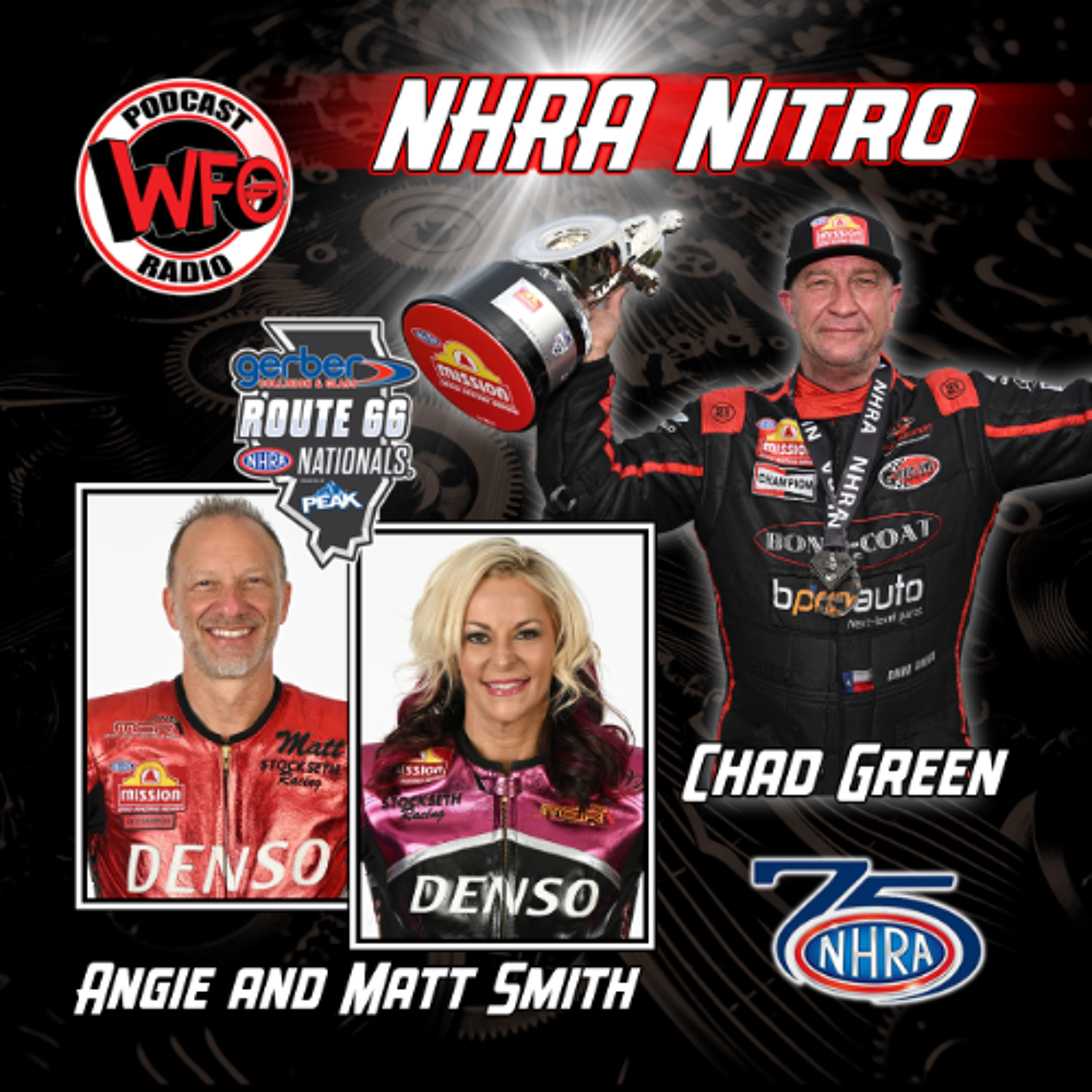
Matt and Angie Smith and Chad Green join WFO Radio after Route 66 NHRA Nationals
About this episode
After the Gerber Collision and Glass Route 66 NHRA Nationals presented by Peak, the WFO Radio crew talks with Matt and Angie Smith and Chad Green about what it takes to stay competitive—plus the real-world troubleshooting that comes with it. They break down crosswind setup choices, a transmission failure that stopped a bike at the start, and how even a brand-new gearbox can still fail. The conversation also covers engine storage protection, women-in-motorsports plans, and upcoming NHRA schedule and fan-culture notes.
diesel particulate filter
"Looking to replace your OEM diesel particulate filter or diesel oxidation catalyst? Look no further than DPFXfit, a complete line of aftermarket diesel particulate filters"
A diesel particulate filter is a part that catches the smoky soot from a diesel engine. Over time it can get clogged, so it needs cleaning or replacement.
A diesel particulate filter (DPF) traps soot (fine particle pollution) produced by a diesel engine. It periodically cleans itself by burning the soot off, usually using heat from the exhaust and engine conditions.
diesel oxidation catalyst
"Looking to replace your OEM diesel particulate filter or diesel oxidation catalyst? Look no further than DPFXfit, a complete line of aftermarket diesel particulate filters"
A diesel oxidation catalyst is a part in the exhaust that helps clean up the gases coming out of a diesel engine. It works with other emissions parts to reduce pollution.
A diesel oxidation catalyst (DOC) is an exhaust aftertreatment device that helps convert harmful exhaust gases. It supports emissions control by oxidizing certain pollutants, and it often works alongside a DPF in modern diesel systems.
DPFXfit
"Look no further than DPFXfit, a complete line of aftermarket diesel particulate filters and diesel oxidation catalyst designed as an exact fit OEM replacement"
DPFXfit is the company selling replacement emissions parts for diesel trucks. They’re advertising DPF and exhaust catalyst replacements that are supposed to fit like the originals.
DPFXfit is the brand/company being promoted for aftermarket diesel particulate filters and diesel oxidation catalysts. The pitch emphasizes fitment and quick shipping for replacement emissions components.
OEM replacement
"and diesel oxidation catalyst designed as an exact fit OEM replacement with all makes coverage for light, medium and heavy duty trucks."
An OEM replacement means it’s made to match the original factory part. That helps it fit correctly and work as intended in the emissions system.
An OEM replacement is a part intended to match the original manufacturer’s specifications and fitment. In emissions components, “exact fit” matters because incorrect fit or calibration can affect exhaust flow and emissions performance.
FTI
"For more than a decade, FTI has strived to become the leader in the aftermarket, performance, transmission and converter industry."
FTI is a company that sells performance parts for transmissions and related drivetrain components. They’re talking about growing their reach and resources.
FTI is presented as a company in the aftermarket performance transmission and converter industry. In this segment, they’re also describing a partnership and expanded distribution network.
McLeod driveline components
"We've joined forces with McLeod driveline components under the leadership of top fuel funny car pilot Paul Lee"
McLeod driveline components is another company involved in drivetrain parts. The hosts say FTI teamed up with them to expand distribution and resources.
McLeod driveline components is named as a partner company that FTI has “joined forces” with. This implies collaboration in the aftermarket drivetrain parts space, likely around transmission-related components.
top fuel funny car
"We've joined forces with McLeod driveline components under the leadership of top fuel funny car pilot Paul Lee"
Top Fuel Funny Car is a drag racing category where cars are built for maximum acceleration. They run in short bursts and are among the fastest vehicles in NHRA.
Top Fuel Funny Car is a NHRA drag racing class featuring highly modified, purpose-built cars with extremely powerful engines and short, intense acceleration runs. The “funny car” body style is a distinctive aerodynamic shell over a specialized chassis.
Route 66 NHRA Nationals
"today's show following the Gerber Collision and Glass Route 66 NHRA Nationals presented by Peak out there at Route 66 Raceway."
This is the specific NHRA drag racing event they’re talking about. They’re recapping what happened during the weekend.
This is the specific NHRA event being discussed in the episode segment. The hosts reference the race location and recap the weekend’s storylines.

Nissan Serena
"...ny car win. We're going to watch the video of Joe Serena saying, bring us another champion to defeat. That..."
The Nissan Serena is a minivan, which means it’s built to carry people—usually families—with more space than a typical car. It’s designed for practical daily driving and passenger comfort. In the podcast, the “Serena” mention likely points to the vehicle name even if the context is about a person.
The Nissan Serena is a family-oriented minivan designed to carry multiple passengers comfortably. The podcast context referencing “Joe Serena” appears to be a wordplay or name reference, but the Serena name is strongly associated with this minivan model. It may be discussed because minivans are common in everyday life and can come up in broader automotive talk.
Pro Stock Motorcycle
"But if you love Matt and Angie, if you love NHRA Drag Racing, if you love Pro Stock Motorcycle, you got to share this show."
Pro Stock Motorcycle is an NHRA motorcycle racing class with production-based engines tuned for drag racing. It’s referenced here as part of the audience the show wants to reach.
Ring Seal Technology
"Hopefully in the case of Larisse Motorsports Insurance.com, Total Seal Piston Rings, the leader in Ring Seal Technology."
Piston rings are the metal bands on the piston that help keep combustion pressure where it belongs. “Ring Seal Technology” means the rings are designed to seal better, so less pressure escapes and the engine runs more consistently.
Ring Seal Technology refers to how piston rings are designed to maintain a tight seal between the piston and cylinder wall. In drag racing engines, better sealing helps reduce blow-by (combustion gases leaking past the rings), which can improve power consistency and efficiency.
Total Seal Piston Rings
"Hopefully in the case of Larisse Motorsports Insurance.com, Total Seal Piston Rings, the leader in Ring Seal Technology."
Piston rings are parts inside the engine that help seal the piston to the cylinder. Total Seal makes performance versions intended to work better when the engine is pushed hard.
Total Seal Piston Rings are aftermarket piston rings made to improve sealing and durability in high-stress engines. In performance builds, ring choice can affect compression, oil control, and how well the engine holds power under repeated hard runs.
Hidden Horsepower
"We've got a big interview on Total Seals Hidden Horsepower later on today."
“Hidden Horsepower” usually means the engine has extra power potential that you can unlock with the right parts or setup. It’s not always obvious until you test it or feel the difference.
“Hidden Horsepower” is a performance marketing term used to describe power gains that aren’t obvious at first glance. In this context, it likely refers to improvements from engine components or tuning that reduce losses (like friction or leakage) and free up measurable output.
Redline Synthetic Motor Oil
"Redline Synthetic Motor Oil. We'll tell you more about those guys later. But thank you, Redline, for being involved with WFO."
Redline Synthetic Motor Oil is a specific brand of engine oil used for performance and protection. Oil choice can matter in racing because it affects lubrication under heat and load, and it’s part of how teams manage wear and engine longevity.
cylinder finish
"Fog It. The engine spray that is designed to protect your cylinder finish is vital. After you put it away, you don't want it to get corroded or eroded."
The cylinder wall has a specific surface texture. That texture helps the piston rings work correctly and hold oil, so it’s important for engine health and power.
Cylinder finish is the surface texture of the cylinder wall, created by machining and honing. That finish matters because it affects oil retention and ring seating; if it gets damaged, you can see more wear, worse sealing, and reduced performance.
corroded or eroded
"Fog It. The engine spray that is designed to protect your cylinder finish is vital. After you put it away, you don't want it to get corroded or eroded."
When an engine sits, the inside surfaces can get damaged. “Corroded” is rust-like chemical damage, and “eroded” is surface wear—either can hurt how well the engine seals later.
Corrosion and erosion are two different ways surfaces can degrade over time. Corrosion is chemical attack (often from moisture), while erosion is physical wear from particles or fluid flow; both can ruin cylinder surfaces and hurt sealing after storage.
HPX Summit
"So, we're having a meeting, women in motorsports. I'm actually speaking at the HPX Summit in Charlotte on June 2."
HPX Summit is a motorsports event. The guest is going there to speak and meet with others to plan for what’s next.
The HPX Summit is an event where people in motorsports gather, and the guest mentions speaking there. It’s relevant to the episode because it ties into the “women in motorsports” planning and networking segment.
two bikes in the final
"It doesn't get much better than two bikes in the final, Matt and Angie. No, it doesn't."
They’re talking about how their bikes did well enough to make it to the final round. Then they explain what happened and why it was both exciting and disappointing.
This segment is focused on the race outcome—specifically having two bikes reach the final round. It sets up the discussion of how the team’s setup and execution led to domination, even with some disappointment in the final result.
staggered the rear axle
"I think the biggest thing is so to compensate for the wind, we staggered the rear axle a little bit. So we put some rooster in it."
They changed the rear axle position so the bike would “track” straighter. The goal is to keep the bike centered in the lane even when wind tries to blow it off line.
Staggering the rear axle means offsetting how the rear axle is positioned relative to the bike’s centerline. In drag racing, small setup changes like this can help the bike track straighter when crosswinds push it sideways.
rooster
"So we put some rooster in it. And everybody was putting too much rooster as heavy as the crosswind was."
“Rooster” is a racing setup adjustment that helps the bike steer back toward the center. They used it to fight the wind pushing the bike sideways.
“Rooster” is drag-racing slang for adding rear-end steer or a directional bias via the bike’s setup (often tied to rear steer geometry). The idea is to counteract crosswind so the bike returns to the middle of the track after being pushed.
crosswind
"And everybody was putting too much rooster as heavy as the crosswind was. And basically it would drive you right because that's what we were doing."
A crosswind is wind blowing sideways across the track. It can push the bike off center, so the team changes the setup to compensate.
A crosswind is wind blowing across the track rather than straight down it. Crosswinds can push a bike sideways, so racers adjust setup (like axle position and rear steer) to keep the bike aligned.
rear steer
"And basically it would drive you right because that's what we were doing. We'd make the bike go right with rear steer. So when the wind hits you, it would, it would put you back right in the middle of the track."
Rear steer means the bike can be set up so the back end helps correct its direction. That helps it stay in the lane when wind blows it sideways.
Rear steer is a drag-racing technique where the rear of the bike is made to steer (or change direction) to help the bike stay centered. In crosswinds, rear steer can be used so the wind pushes the bike one way, but the setup steers it back to the middle.
eighth mile
"really to the eighth mile. So everybody was overcompensating and the bike was going right hard."
Drag racing is measured in distances. The “eighth mile” means the race is 1/8 of a mile long, so it’s a shorter sprint than the full quarter-mile.
In drag racing, the “eighth mile” is a shorter race distance (1/8 mile) used at many tracks. It’s a common benchmark for how quickly a car or bike accelerates over a brief sprint.
transmission failure
"it just, it just happened to be her bike didn't leave the start line and it was just a transmission failure. Okay, so let's, let's dive into that, Angie."
A “transmission failure” means the bike’s shifting/gear system broke or malfunctioned. If it happens, the bike can’t put power to the wheels the way it needs to, so the run ends.
A “transmission failure” means the gearbox or its internal components stopped working correctly, preventing the bike from completing the run. In drag racing, that can happen after launch or during a shift, and it often ends the race immediately.
second gear
"we stopped the bike, I put it back in second gear, put it back in first, put it back in neutral,"
“Second gear” is one of the gears in the bike’s gearbox. Switching gears changes how the engine’s power is delivered to the wheels.
“Second gear” is one of the bike’s selectable transmission ratios used to control acceleration and engine RPM. Drag racers may cycle gears during troubleshooting to confirm the transmission is engaging correctly.
shutdown area
"Nothing happened on the run, nothing happened in the shutdown area, but the transmission was making noise."
The shutdown area is where the bike slows down after the run. They’re saying the problem didn’t show up during the slowing-down part, which helps narrow down what went wrong.
The shutdown area is the part of the track after the finish line where the vehicle slows down and comes to a stop safely. If nothing happened there, the speaker is emphasizing that the issue wasn’t obvious during deceleration—only the transmission noise was noticed.
fourth gear
"Matt and Michael both went through the transmission, through the gears with it on the bike and fourth gear was not there."
Fourth gear is one of the gear settings in the bike’s gearbox. If it’s “not there,” it usually means that gear won’t work properly—either it won’t engage or power doesn’t go through it.
“Fourth gear” is a specific gear ratio in the transmission. Saying fourth gear was “not there” implies that gear either wouldn’t engage or wasn’t transmitting power correctly, which is a classic symptom of internal transmission damage or a shift/mechanical failure.
burnout
"And, you know, we put the other transmission in. And even when I went up to the burnout, I put it in third gear, everything was normal."
A burnout is when you spin the rear tire(s) on purpose before the run to get better grip. They’re using it as a checkpoint that the bike seemed fine right before going to the water.
A burnout is when the rider spins the rear tire(s) under power to heat them and improve traction for the launch. The speaker mentions it to show the bike behaved normally under that pre-run load condition (e.g., “everything was normal” in third gear).
clutch
"And when I rolled back to what roll in the water, I had the clutch in, the bike stopped."
The clutch is what lets you separate the engine from the gearbox. If the clutch is pulled in but the bike still behaves like it’s connected (or stops unexpectedly), that suggests a problem with how the clutch is disengaging.
The clutch disconnects engine power from the transmission so the rider can control engagement. The speaker’s point is diagnostic: with the clutch in while rolling back, the bike should not keep moving under drive, so stopping indicates the clutch may not be fully disengaging or something else is binding.
neutral
"So then Michael Ray was like, I'll put it in neutral. So we put it in neutral."
Neutral is when the bike isn’t in any gear, so the engine shouldn’t be driving the back wheel. They put it in neutral to see if that fixes the weird behavior during the roll-back.
Neutral is the transmission state where no gear is engaged, so power shouldn’t be transmitted to the rear wheel. Moving the bike to neutral is a troubleshooting step to confirm whether the unexpected stop was caused by a gear engagement or drivetrain connection.
dog off
"and left the line or attempted to leave the line, it broke the dog off. We didn't find that out till probably about an hour ago. It broke the dog off the transmission."
A drag bike’s transmission uses parts that “grab” to lock a gear. If the speaker says the “dog” broke off, it means that locking/grabbing part failed, so the bike couldn’t put the power down correctly.
In drag racing transmissions, the “dog” refers to the shift dog/clutch engagement parts that lock a gear in place. “Broke the dog off the transmission” means a mechanical failure prevented the transmission from properly engaging or staying engaged when the rider/driver tried to leave the line.
left the line
"and left the line or attempted to leave the line, it broke the dog off. We didn't find that out till probably about an hour ago."
“Leaving the line” is drag-racing shorthand for the launch moment when the racer starts the run from the starting area. The segment ties the transmission failure to that launch attempt, implying the bike didn’t transition cleanly into the intended gear.
Winter Circle interview in the Media Center
"Matt, how do you feel about this win? The Winter Circle interview in the Media Center, it was weird. It was like, you know, like you want to win you."
After the race, there’s usually a place where racers talk to reporters. This is that interview moment, and they’re discussing the emotions around the result.
This refers to the post-race interview area where winners (and sometimes other top performers) do media interviews. It’s a structural marker for the segment’s discussion of how the racer felt after the outcome.
Pomona
"It's like, it feels Pomona and I have to win that round to win the championship. That's a different story. But it's way early in the season"
Pomona is a drag-racing stop on the NHRA schedule. The speaker is saying this race is early in the season, but Pomona later matters more for the championship.
Pomona is a common reference point in NHRA drag racing because the series races at the Auto Club Raceway in Pomona, California. Here it’s used to contrast the current early-season round with a later, more championship-critical event.
Q3
"She just lost it on speed that round to Ryan in Q3. But best bike she's probably ever had best bike all weekend."
In drag racing, qualifying is split into numbered rounds. “Q3” means the third qualifying round, and they’re saying she lost on speed in that round.
“Q3” typically means the third qualifying session/round in drag racing qualifying. The segment uses it to describe when the other rider (Ryan) beat her on speed during that qualifying context.
fork
"And we had a parts failure. And it just for some reason in the burnout, when she came out of the burnout, it broke the dog right off the fork."
The fork is the front suspension on a motorcycle—the part that connects the front wheel to the bike’s frame. Saying something broke “off the fork” means it came loose from the front suspension area.
On a motorcycle, the fork is the front suspension assembly that holds the front wheel and allows it to move up and down. The speaker says the “dog” broke “right off the fork,” indicating the failure affected the front-end hardware during/after the burnout.
third gear
"We don't know why it happened, because that's why we do burn us in third gear is not supposed to do that. You do that in any other gear."
A transmission has different “gears,” which change how the engine’s power is delivered. “Third gear” is one of those settings, and they’re saying something went wrong when it was supposed to work there.
“Third gear” is a specific ratio in a transmission that determines how fast the engine spins versus the vehicle’s speed. In this story, the team noticed the transmission misbehaving specifically in third gear.
drum
"That rides in a drum that rotates around as we shift gears and it makes the thing go back and forth into gears."
A drum is a rotating part inside the transmission that helps move the shifting parts. As it turns, it helps the bike’s gearbox select the next gear.
The “drum” is the rotating housing in a transmission’s shift mechanism that moves shift parts as gears are selected. In this setup, the dog rides in the drum and helps drive the engagement into different gears.
fuel check
"we're the last class to run in semifinals. And by the time we get to scales, fuel check and [966.9s] scales and get back to the pit, typically in HRA, the guys are sitting there going,"
A “fuel check” is when officials verify the fuel being used follows the race rules. They do it to prevent unfair advantages.
A “fuel check” is a compliance procedure where officials verify the fuel used matches the rules for that class. In drag racing, fuel type and composition can be tightly regulated because it affects power and performance.
scales
"we're the last class to run in semifinals. And by the time we get to scales, fuel check and [966.9s] scales and get back to the pit, typically in HRA, the guys are sitting there going,"
“Scales” means they weigh the vehicle to make sure it meets the rules for its class. It’s a quick check to keep the competition fair.
In NHRA drag racing, “scales” refers to weighing the car or motorcycle to confirm it meets the class’s minimum weight rules. It’s part of the pre-run and/or post-run compliance checks so competitors can’t gain an advantage by being underweight.
Potomac Nationals
"So maybe the Potomac Nationals will be your day. Let's look ahead at that racetrack. [1029.2s] And what do you think? What's your take?"
The “Potomac Nationals” is an upcoming drag racing event. They’re talking about it as the next race where the team hopes things go better.
The “Potomac Nationals” is a specific NHRA event the hosts are looking ahead to. They’re using it as the next target race when discussing how the competitor’s class might perform.
no data on board
"You know, we went to South Georgia, [1075.3s] we're doing Maryland. I mean, we're going to Rockingham this year. I love going to new venues [1079.7s] because team MSR typically does really, really well at new venues with no data on board. And"
It means they don’t have previous track experience or measurements to guide their setup. So they have to make educated guesses and hope the car/motorcycle works well there.
“No data on board” means the team doesn’t have prior performance data from that specific track, so they’re starting with less information about tuning and setup. In drag racing, teams often rely on past runs to dial in things like gearing, tire prep, and shift behavior.
100 grams of water
"That's a very fast track. If it's not 100 degrees and there's 100 grams of water in there, it should be really fast."
Drag strips sometimes get watered to change how grippy the surface is. The goal is to help the tires hook up so the car can accelerate better and more consistently.
In drag racing, adding water to the track is used to manage traction and reduce excessive tire spin. The amount of water can influence how “sticky” the surface is, which directly affects acceleration and how consistent the car is across runs.
100 degrees
"That's a very fast track. If it's not 100 degrees and there's 100 grams of water in there, it should be really fast."
In drag racing, the weather and track temperature can change how well the tires grip. That can make the car faster or slower, so racers pay attention to it.
Track temperature matters in drag racing because it affects tire grip and how efficiently the car can put power to the ground. Hotter conditions can change traction and engine cooling needs, which is why teams talk about weather and track heat when predicting performance.
Outlaw Pro Street
"I'm excited. I've raced a lot of races there in my Outlaw Pro Street days. So I'm excited to go back to Maryland International Raceway."
Outlaw Pro Street is a drag-racing style where cars look like they could be street cars, but they’re built to go fast. The rules are usually looser than more official classes, so teams can build them more aggressively.
Outlaw Pro Street is a drag-racing class/style where cars are built for strong street-appearance looks but run in a more aggressive, performance-focused setup than typical street classes. It’s “outlaw” because the rules are less restrictive than sanctioned categories, so teams often emphasize power and traction over strict spec compliance.
double O on the tree
"No, because I was going to do exactly, I was going to run the race exactly like I ran it with Richard and with Chase. I wasn't going to be double O on the tree."
The “tree” is the starting light system. “Double O” is a way racers describe a bad start timing situation, and it can make you lose even if your car is quick.
“Double O on the tree” refers to a reaction-time/starting-light situation where the driver is too slow or mistimes the launch relative to the Christmas-tree signals. In heads-up drag racing, getting the timing wrong can cost the race even if the car is fast.
conservative
"I was going to be a conservative and I was going to go straight down the track. And then if he could take it from me, then he can take it from me."
“Conservative” here means she planned to be careful with the launch and not push too hard. When conditions are tricky, being smooth can help you avoid losing traction.
In drag racing, “conservative” driving usually means managing risk at the start and early in the run—avoiding overly aggressive launches or shifting/traction strategies that could cause wheelspin or instability. It’s a common approach when conditions (like wind) make grip less predictable.
testing
"And I kept telling myself all day, it's testing, it's testing. I kept telling Michael Ray. Every time I told Michael Ray at the beginning of the day on Sunday, I said, just remind me, we're not racing, we're testing"
“Testing” means practice passes to work out what the car is doing and how to tune it. It’s not as much about winning that moment as it is about learning for the next runs.
In drag racing, “testing” refers to practice runs where teams dial in launch technique, tune settings, and confirm performance before the competitive rounds. The hosts emphasize that they were focused on testing rather than racing, which changes how aggressively drivers push.
50 on the tree
"And she was going, you know, conservative, consistent 50 on the tree, getting down very nice and straight."
“50 on the tree” means she reacted about half a second after the start lights. A quicker, consistent reaction can help you win the race.
“50 on the tree” is shorthand for a 0.50-second reaction time to the starting lights. In drag racing, reaction time matters because it can swing who gets the advantage even if both cars run similar elapsed times.
won by a thou
"So the math, the math said that Angie was winning that unless you were like perfect and won by a thou. I mean, that's possible too."
“Won by a thou” means the win was by an extremely tiny amount—like one-thousandth of a second. In drag racing, that’s basically a photo-finish.
“Won by a thou” refers to winning by one-thousandth of a second, a very small margin used in drag racing timing. Because the numbers are so close, reaction time and consistency can decide the outcome.
starting line
"And to compose yourself and do an interview with us on the starting line and like tell everybody how bad it sucks."
The “starting line” is where the drag cars stage and launch under the rules controlled by the starting tree. It’s also where drivers must manage nerves and timing because the launch is the first critical moment of the run.
CNC billet
"This guy wants to know real quick, Matt, is that dog, is it a pin or is it part of the CNC billet? [1414.1s] I think it's a pin is what it is."
“CNC billet” means the part is cut out of a solid chunk of metal using a computer-controlled machine. People use this for race parts because it can make them very strong and precise.
“CNC billet” refers to a part machined from a solid block of metal (“billet”) using CNC equipment, which cuts to tight tolerances. In racing contexts, billet parts are often used for strength and consistency, especially for components that see high stress.
pressed in
"I think it's a pin is what it is. You know, that is something that is [1419.3s] a lot like I think it's pressed in. And it doesn't normally break because it goes in really deep."
“Pressed in” means the part is pushed into place with force so it fits tightly. That tight fit helps it stay put when the car or bike is under stress.
“Pressed in” describes a fitment method where a component is installed by applying force so it seats tightly in a mating part. The goal is to create a secure mechanical connection that resists movement under load.
backlash
"But for some reason, it was just a failure. It had a crack or something. And like I said, [1430.8s] the backlash just just made it break right off after the burnout."
“Backlash” is a tiny bit of looseness between connected parts. When torque changes quickly, that looseness can cause extra shock loads that can help something break.
“Backlash” is the small amount of free play or looseness between connected mechanical parts (commonly gears or splined interfaces). In driveline systems, backlash can increase impact loads during torque changes, which may contribute to failures.
new transmission
"You had a great weekend, great win, big win, Diamond Wally, all that. [1445.6s] And you'll get one. And you got a hot start going here. Big picture, hot start going fast bike, [1450.4s] bike in one piece, new transmission going in, new race coming up after Memorial Day."
A “new transmission” means they replaced the gearbox. Race launches put huge stress on it, so if it breaks or wears out, they swap it before the next event.
A “new transmission” means the drivetrain gearbox was replaced, typically because the previous one was damaged or not surviving the demands of racing. In drag racing, transmissions see extreme torque and shock loads during launches and shifts.
Joe Serena
"And Joe, I mean, Joe has been there from the day I got back in 2018 when I was getting my license and Tim's car. He was there working on the car and he's basically been there on my car every cent."
Joe Serena is the person the host says has been helping with their car for years. In racing, the crew is a big deal because they keep the car working well between runs.
Joe Serena is mentioned as a long-time crew member who has been working on the car since the host got their license in 2018. In drag racing, the crew’s hands-on work and consistency can strongly affect how reliably the car performs run after run.
shortage of good crew teams
"More people need to do it because, you know, there's a shortage of good crew teams out there and good crews. And yeah, it's a very tough aspect of it and something that definitely needs to be, you know, pointed out."
The speaker is talking about a shortage of experienced crew teams and good crews. In drag racing, the crew handles setup, tuning support, and rapid repairs between runs, so crew quality directly affects consistency and how often the car can make successful passes.
Alan Johnson
"Like in that, like, oh, you know, there's a lot of guys that can learn and and I'm over my head when I talk about this to anybody out there that's melted and Alan Johnson blocked to the ground."
Alan Johnson is referenced in the context of learning and racing operations, with the speaker saying they couldn’t do what others can. In NHRA-style drag racing, team leadership and experienced crew members often help reduce mistakes that can lead to broken parts or failed runs.
destroying equipment to learn
"But destroying equipment to learn is different than learning without destroying equipment. And that's the thing."
They’re saying there’s a difference between learning by breaking stuff versus learning while keeping the car intact. Breaking equipment can cost money and time because you can’t run the car as often.
The speaker contrasts “destroying equipment to learn” with learning without breaking things. In motorsports, especially drag racing, repeated failures can damage expensive components and also slow progress by reducing how many clean runs you can make.
blow it up all the time
"I look back at, you know, I see all these other teams, even big teams, you know, blow it up all the time and have all these problems."
“Blow it up” means the car breaks in a big way. The host is saying some teams have problems so often that it hurts their ability to keep running and improving.
“Blow it up” is racing slang for catastrophic mechanical failure—something breaks severely enough that the car can’t continue. The speaker uses it to criticize how some teams frequently suffer major failures, which can derail testing and race results.
power management
"And, you know, Dean's the same way. You know, Dean is a master of power management on the track."
Power management is how a race team controls the car’s power during a run. Instead of just making the engine as strong as possible all the time, they manage it so the car hooks up and doesn’t stress out too much.
On a drag-racing track, power management is how the team controls how much engine power is delivered and when, so the car stays in its best operating window. It’s about balancing acceleration, traction, and component stress rather than just maximizing output every pass.
load her for bear
"And yeah, we had to go up there and load her for bear that one. You know, first round is I get more nervous first round than any other round."
“Load her for bear” is a saying that means “go all out.” Here, it means they expected a hard race and prepared to give it everything in the first round.
“Load her for bear” is a racing idiom meaning to bring maximum effort and readiness for a difficult opponent or situation. In this context, it implies they prepared aggressively for a tough first-round matchup.
first round
"You know, first round is I get more nervous first round than any other round."
“First round” refers to the opening elimination matchup in a drag-racing bracket. It’s often high-pressure because you’re immediately competing head-to-head, and a mistake can end the run early.
Goodyear tires
"And you could watch the Goodyear tires like settle down. And then you started to get back into it and you won the race."
Goodyear makes the tires. In drag racing, the tires decide whether the car grips the track or spins and smokes at the start.
Goodyear is a tire brand, and in drag racing the tire is a key part of how much traction the car has at launch. When the tires “settle down,” it usually means the initial spin/smoke calms and the car can hook up and accelerate effectively.
smokes the tires
"If you hit the gas and your car smokes the tires right there on the starting line, you're done."
“Smokes the tires” describes tire spin at launch, where the rubber slips faster than the car is moving. In drag racing, that usually kills acceleration because the engine’s power isn’t being converted into forward traction.
throttle
"You can't just, you know, when these things smoke the tires, you can't just whack back on that throttle or it's just going to do it again and again."
The throttle is how much you press the gas pedal. If you add too much gas right after the tires start spinning, they’ll spin again instead of grabbing the track.
In racing, the throttle is the driver’s control of engine power delivered to the drivetrain. The speaker’s point is that after a tire-spin event, abruptly adding throttle can cause repeated wheelspin instead of letting the tires regain traction.
nitro racing
"So, yeah, you know, I haven't had to do that too much in my nitro racing career."
“Nitro racing” means the car runs on nitromethane fuel. It makes a lot of power, but it can be tricky at the start because the car can spin the tires if you don’t manage it carefully.
“Nitro racing” refers to drag racing using nitromethane fuel, commonly called “nitro.” Nitro engines produce very strong power and can be harder to manage at launch, so traction and throttle control are critical.
pan pressure switch
"And actually my car cut off before the finish line and, you know, pan pressure switch cut it off."
That switch watches the engine’s oil pressure. If the oil pressure isn’t right, it can shut the engine off so the engine doesn’t get damaged.
A pan pressure switch is a sensor that monitors oil pressure in the engine’s oil pan. If oil pressure drops (for example, due to starvation or a fault), the switch can trigger an engine cut-off to protect the motor from damage.
Sunday drag racing is better than going on Saturday
"And that's why you can't quit. And that's why Sunday drag racing is better than going on Saturday."
They’re talking about which day to go to a drag race. The point is that Sunday tends to be a better experience than Saturday for how the event runs.
This is a discussion about race-day strategy—why attending on Sunday can be preferable. The speaker ties it to getting there and to the flow of competition rounds.
hooked up
"And I tell fans all the time... 12,000 horsepower hooked up and you beat him."
In drag racing, “hooked up” means the car got good traction. Instead of the tires just spinning, the car actually grabs and accelerates.
In drag racing, “hooked up” describes the moment the car gains traction and the drivetrain effectively transfers power to the track. When a car “hooks up,” it can accelerate hard without spinning the tires.

Chevrolet C5
"Let's see. And C5 Pete piling on with got to run to the dentist. Th..."
The Chevrolet Corvette is a sports car made by Chevrolet. It’s designed to be fast and fun to drive, with a focus on performance. The “C5” reference usually means a particular generation of Corvettes from that era.
The Chevrolet Corvette is a performance sports car built by Chevrolet, known for its strong acceleration and driver-focused design. In the podcast context, it’s being referenced alongside other enthusiast talk, which often comes up because Corvettes have a long history in motorsports and car culture. The C5 mention suggests the discussion may be about the fifth-generation Corvette era specifically.
fogging oil
"Fog It is a high performance fogging oil designed, especially for internal combustion engines."
Fogging oil is a special oil you put into an engine to help protect it while it’s sitting. It leaves a protective coating so parts don’t rust as easily.
Fogging oil is a protective lubricant used to coat engine internals, typically for storage or off-season protection. It helps reduce corrosion by leaving a protective film on surfaces that can otherwise rust when an engine isn’t running.
internal combustion engines
"Fog It is a high performance fogging oil designed, especially for internal combustion engines."
An internal combustion engine is the kind of engine where fuel burns inside the engine to make power. The product they’re talking about is meant to protect the inside parts when the vehicle sits.
An internal combustion engine is an engine where fuel burns inside the engine to create power. The “fogging” oil mentioned in the segment is intended to protect internal surfaces during storage by coating parts that would otherwise corrode.
Fog It
"Fog It is a high performance fogging oil designed, especially for internal combustion engines... And at some level, you have a product that works better. You might as well just use it."
Fog It is a product made to protect engines when they’re not being used. The hosts say it’s meant to coat the inside of the engine to help prevent corrosion.
Fog It is a branded fogging oil product marketed for protecting internal engine surfaces. In the segment, the hosts describe it as a high-precision oil spray intended for racing engines and also usable for other engines with cylinder walls.
Summit Racing Equipment
"It's available at Summit Racing Equipment."
Summit Racing Equipment is a store that sells car and racing parts. They’re mentioned here as a place you can buy the Fog It product.
Summit Racing Equipment is a retailer known for selling performance and racing parts, tools, and related automotive supplies. The segment mentions it as a place where Fog It can be purchased.
Brian Heusen
"And Brian Heusen is like living in his own lane. We did a great interview with him a few weeks ago. But they got it done. Won the Mission Foods Too Fast to Tasty Challenge."
Brian Heusen is part of the racing team that helps the car perform. The transcript also mentions he and the team won an event, which points to him having a big impact on how the car runs.
Brian Heusen is discussed as a key part of the Top Fuel team’s success, including winning a specific event. In NHRA drag racing, crew chiefs and team leaders like Heusen are central to tuning the car and coordinating the run.
chemistry, the all for one, the one for all
"And you can see it. The chemistry, the all for one, the one for all. We don't care what's going on except what's happening inside our team."
They’re talking about teamwork. In racing, everyone has to be on the same page because the car’s performance depends on how well the driver and crew coordinate.
This is a team-dynamics concept applied to racing: “chemistry” and shared focus are framed as what keeps performance consistent. In drag racing, the driver, crew, and strategy have to work in sync because small changes can affect traction, timing, and stability.
Mission Foods Too Fast to Tasty Challenge
"But they got it done. Won the Mission Foods Too Fast to Tasty Challenge."
The Mission Foods Too Fast to Tasty Challenge is a branded competition referenced as something Heusen’s team won. In NHRA coverage, these kinds of challenges are often special event formats or sponsor-linked race segments.
qualifying session
"I got to spend an entire qualifying session with Chris Karamazini's amongst other times."
Qualifying is when racers run to earn their spot in the bracket. Your qualifying results can affect who you race in the next round.
A qualifying session is the timed run (or set of runs) used to set the starting order or bracket positions for the elimination races. In drag racing, qualifying performance strongly affects who you face next.

Chevrolet Nova
"...is back to back races. I've done a session with a Nova Tenarian, someone in their 90s. I had to look tha..."
The Chevrolet Nova is an older Chevrolet model that was made as a regular car, and later many people turned them into faster, race-style cars. In the podcast, it sounds like the Nova is being talked about in connection with racing. That usually means the car may have been modified for performance.
The Chevrolet Nova is a classic American compact car that became especially well known in performance and racing circles. The podcast context about “back to back races” and a “Nova” suggests it’s being discussed as a track or drag-racing platform. Because Novas were popular for modifications, they often come up when people talk about build quality and how these cars are used.
NHRA drag racing
"The respect runs deep within those of us who love NHRA drag racing."
NHRA drag racing is a type of racing run by the NHRA. It’s the kind of racing where people really respect the older, experienced racers.
NHRA drag racing is the National Hot Rod Association’s style of drag racing, where cars compete over a short straight-line distance. The episode segment emphasizes how the community treats its longtime racers and legends.
situational racing
"Brian Houston says what he wants to do this year and he's [3777.8s] doing it learning about situational racing."
“Situational racing” means adjusting your plan based on what’s going on in that exact race. It’s about reacting to conditions and the other car so you can make the best choices at the right time.
“Situational racing” refers to adapting driving and race strategy to what’s happening in a specific round—like how the other car is reacting, track conditions, and timing. In drag racing, small changes in launch and throttle timing can be the difference between winning and losing.
top fuel car
"And he's like, nah, I got to get fitted for a top fuel car. [3806.1s] Oh, big timing us, huh?"
A “Top Fuel” car is the NHRA’s fastest drag-racing category, using a specialized nitro-burning engine and a purpose-built chassis. Drivers typically get “fitted” because the cockpit setup (seat position, harness, controls) matters for safety and for consistent performance during extremely violent acceleration.
snap judgments
"I'm not willing to make any snap judgments after one race, [3880.1s] but we'll tell you, Erica Anders was the number one qualifier."
They’re saying not to decide something based on just one race. Racing results can swing from day to day, so it’s smarter to look at more than one event.
“Snap judgments” here is about not over-interpreting results from a single race. In motorsports, one event can be influenced by setup, conditions, or luck, so teams often wait for multiple rounds/events before concluding a trend.
qualifier
"but we'll tell you, Erica Anders was the number one qualifier. [3882.8s] Erica storms onto the semis where she loses to Greg Anderson"
Qualifying in drag racing is like a tryout round. Your best run decides where you start in the bracket, and the “number one qualifier” is the top performer in those rounds.
In drag racing, a qualifier is a driver’s performance in the qualifying rounds that determines their starting position in the elimination bracket. The “number one qualifier” is the fastest/most successful qualifier and typically earns the best lane and matchup path early on.
semis
"Erica storms onto the semis where she loses to Greg Anderson [3885.8s] in a very tough race talking about thousands."
In drag racing, “semis” means the semifinal round. It’s one of the last steps before the final, so the competition is usually at its toughest.
“Semis” is short for semifinals in the elimination bracket. After qualifying, drag racers advance through rounds (like quarterfinals) until the semifinals, where only a few teams remain before the final race.
thousands
"in a very tough race talking about thousands. [3888.3s] Other side of the ladder."
Drag races are timed very precisely. “Thousands” means the difference was in thousandths of a second, so it was basically a photo-finish.
In drag racing, “thousands” refers to time differences measured in thousandths of a second (0.001s). When racers are separated by “thousands,” it means the finish was extremely close—often decided by reaction time, traction, and tiny changes in acceleration.
round one
"Aaron Stanfield had to run Matt Hartford round one. [3893.2s] Hartford is 23 and runs 59 one and gets busted because Aaron"
“Round one” is the first bracket matchup after qualifying. Win that race and you move on to the next round.
“Round one” is the first elimination round after qualifying. Drivers who qualify face off in head-to-head matchups, and winners advance to later rounds like quarterfinals and semifinals.
reaction time
"And so now you've got the worst reaction time on the day is [3930.4s] 11."
Reaction time is how fast the driver reacts when the starting lights turn on. Faster reaction time usually means the car gets off the line sooner, which can decide a drag race.
In drag racing, reaction time is how quickly the driver responds after the starting lights. It’s measured from the moment the light indicates “go” to when the car leaves the line, and it strongly affects who wins the race.
goes red
"And he gets to the final round and gets Greg Anderson and [3939.8s] Greg goes red."
“Goes red” means the driver got a bad start at the lights. In drag racing, that usually counts as a loss even if the car is fast.
“Goes red” refers to a red-light start, meaning the driver’s reaction time was too slow or the car moved before the green light. In drag racing, a red light typically results in an automatic loss regardless of how fast the car runs afterward.
Pro-modified
"Those reaction time. Pro-modified, you know, is it better than it's ever been? Take a second to dwell on that."
Pro Modified is a specific drag racing class where cars are heavily modified. The hosts are talking about whether the class is getting better and more competitive.
Pro Modified (Pro-mod) is a drag racing class for highly modified cars with rules that allow big power and advanced setups. The discussion here is about how the class is evolving—car counts, competitiveness, and how evenly matched the field is.
parity
"Do you want more cars with less parity and quality? Or do you want slightly fewer cars where anybody can win? And there's great racing all day long."
Parity means the competition is more even. If parity is high, more different cars/drivers have a real chance to win.
Parity in racing means the cars are close enough in performance that outcomes aren’t dominated by just one or two setups. Higher parity usually leads to more unpredictable races and more winners.
Top alcohol dragster
"And, you know, every race, every race, I think it's getting better and better. Top alcohol dragster Jamie Noonan, the Raging Roo. I hear a listening to Jason Galvin call it that, man."
Top Alcohol Dragster is a type of drag racing class. The cars are dragsters that run alcohol fuel and compete in their own category.
Top Alcohol Dragster is a drag racing category for purpose-built dragsters running alcohol fuel. It’s known for very high power and a distinctive class identity compared with other alcohol and nitro categories.
FrankHolly.com
"Frank Holly's Drag Racing School. FrankHolly.com."
FrankHolly.com is the website tied to Frank Holly’s Drag Racing School. The school is meant to help people experience drag racing in a structured way, even if they’re new to it.
FrankHolly.com is associated with Frank Holly’s Drag Racing School, which offers an organized way to learn and experience drag racing. It’s positioned as an “easy” entry point for people who want the sport without already having a car or racing background.
Dragster Adventure
"It's called the Dragster Adventure. Then go all around the country."
“Dragster Adventure” sounds like a packaged experience for trying drag racing. Instead of only watching, you get to participate so you understand what drag racing is like.
“Dragster Adventure” is presented as a guided experience that lets people experience drag racing firsthand. In this context, it’s framed as a structured way to learn the sport by participating rather than just watching.
HustyPerformance.net
"Frank Atlanta Holly. Appreciate them. HustyPerformance.net."
HustyPerformance.net is mentioned as a performance parts supplier. In this segment, they’re associated with selling gaskets that racers may need for their engines.
HustyPerformance.net is referenced as a source for racing-related gaskets. The speaker frames it as a place racers use for sealing parts, and notes they offer more than just one gasket type.
head gaskets
"I'm not telling you to buy head gaskets when you don't need them. But they don't just do copper gaskets anymore."
A head gasket is a seal inside an engine that helps keep important fluids and compression where they belong. If it fails, the engine can start leaking or lose power.
Head gaskets are the sealing layer between an engine’s cylinder head and the engine block. They’re critical in high-stress applications like drag racing because failures can cause coolant or oil leaks and loss of compression.
copper gaskets
"But they don't just do copper gaskets anymore. They've got composite gaskets, oil pan gaskets, valve covered gaskets."
Copper gaskets are made from copper and are used to seal engine parts. The segment suggests there are other gasket materials available now, not just copper.
Copper gaskets are a gasket material option known for good heat transfer and sealing characteristics, often used in performance and racing contexts. The speaker contrasts them with newer gasket materials, implying copper isn’t the only choice anymore.
composite gaskets
"But they don't just do copper gaskets anymore. They've got composite gaskets, oil pan gaskets, valve covered gaskets."
Composite gaskets are made from engineered layers/materials designed to seal reliably across temperature and pressure changes. In performance parts catalogs, they’re often offered as an alternative to metal gaskets like copper depending on the engine and application.
oil pan gaskets
"They've got composite gaskets, oil pan gaskets, valve covered gaskets. They've got a contingency program."
An oil pan gasket seals the bottom of the engine so oil doesn’t leak out. If it fails, the engine can lose oil and that can be dangerous.
Oil pan gaskets seal the oil pan to the engine block to prevent oil leaks. They matter for racing because oil loss can quickly lead to lubrication problems and engine damage.
Request an Explanation
Heard something you'd like explained? We'll add it to this episode.
Sign in to request explanations for terms you heard.
Want to learn more?
Browse our glossary for plain-English explanations of automotive terms, jargon, and concepts.
Help improve this episode
See something that's not quite right? Our annotations are AI-generated and can sometimes miss the mark. Click the flag icon on any annotation to suggest a correction.