
May 11th, 2026 | Nissan cuts tariff costs $2.3B; Geely lands first in Canada
About this episode
Geely makes a splash in Canada, becoming “the first Chinese brand to enter the Canadian market,” starting with “18 Lotus Elutra crossovers that shipped late last week.” The show then pivots to software-defined vehicles and cybersecurity, noting “Modern vehicles have about 100 million lines of code” and “100 million potential entry points for hackers.” Nissan’s strategy follows: “slashed its tariff bill… by $2.3 billion,” cutting costs by ramping up US production and using software and zonal architectures to keep improving vehicles.
Nissan slashed its tariff bill by $2.3 billion with an America-first production strategy. Geely becomes the first Chinese automaker to enter Canada, shipping Lotus EVs under a new trade deal. Plus, Volvo’s Anders Bell discusses how organizational changes have accelerated the company’s software-defined vehicle development.
Geely
"Geely becomes the first Chinese brand to enter the Canadian market. For Monday, May 11th, 2026, I'm Kellan Walker in Las Vegas today on the show."
Geely is a car company from China. In this episode, they’re described as being the first Chinese brand to sell electric cars in Canada, starting with a specific EV model.
Geely is a Chinese automaker that’s expanding into new markets, and this segment highlights its move into Canada. The hosts say Geely is exporting electric vehicles to Canada under a new Trans-Pacific trade deal, starting with a specific model.
software-defined vehicles
"Software-defined vehicles create a $20 billion cybersecurity problem and Nissan slashes its tariff bill by more than $2 billion."
A software-defined vehicle is a car where lots of important features are controlled by software. The concern is that more software means more ways hackers could potentially break in, and a single flaw could impact many cars at once.
Software-defined vehicles rely heavily on software for functions that used to be handled by dedicated hardware. The episode frames this as a cybersecurity issue: with so much code onboard, there are many possible entry points for hackers, and one vulnerability could affect large numbers of cars.
cybersecurity problem
"Software-defined vehicles create a $20 billion cybersecurity problem and Nissan slashes its tariff bill by more than $2 billion."
In this context, cybersecurity problem refers to the risk that hackers could access a vehicle’s connected systems or software. The segment emphasizes the scale of the threat by citing the large amount of onboard code and the idea of many potential “entry points.”
Lotus Elutra
"Geely is now exporting electric vehicles to Canada under a new Trans-Pacific trade deal, starting with 18 Lotus Elutra crossovers that shipped late last week."
The Lotus Elutra is an electric SUV/crossover. The show says it’s the first electric model being shipped from Geely’s group into Canada under the new trade arrangement.
Lotus Elutra is an electric crossover that Geely is exporting to Canada as the first shipment. The segment ties it to Canada’s EV import rules and mentions the initial batch size and shipping timing.
Cherry
"And Geely's not alone. Cherry and BYD are gearing up to enter Canada this year too."
Cherry is a Chinese automaker mentioned as planning to come to Canada. The hosts are basically saying multiple Chinese EV brands are preparing to compete there.
Cherry (Chery) is referenced as another Chinese brand planning to enter Canada. In this segment, it’s mentioned as part of the competitive landscape alongside Geely and BYD.
BYD
"And Geely's not alone. Cherry and BYD are gearing up to enter Canada this year too."
BYD is a Chinese car company. The episode says it’s getting ready to sell EVs in Canada along with other Chinese brands.
BYD is a Chinese automaker mentioned as preparing to enter the Canadian market. The segment groups it with other Chinese brands as part of a broader wave of EV imports influenced by tariff and trade policy.
lines of code
"Modern vehicles have about 100 million lines of code that's 100 million potential entry points for hackers."
“Lines of code” is a way to describe how much computer programming is inside the car. The more code a system has, the more chances there are for mistakes or weaknesses that hackers could exploit.
“Lines of code” is a measure of how much software is running in a vehicle’s systems. The episode uses the figure of about 100 million lines of code to illustrate why modern cars can present many potential vulnerabilities and attack surfaces.
entry points
"Modern vehicles have about 100 million lines of code that's 100 million potential entry points for hackers."
“Entry points” are the openings a hacker might use to get into a car’s computer systems. The episode’s point is that modern cars have many possible openings, so one weakness could be widespread.
“Entry points” are the places where an attacker could try to access a system—such as network connections or software interfaces. The segment argues that modern vehicles have many entry points, so a single vulnerability could potentially impact millions of cars.
cyberattacks
"According to a new analysis from Reuters Events, cyberattacks cost the global auto sector more than $20 billion in 2025. That's 20 times higher than 2022."
Cyberattacks are digital break-ins or disruptions that can hurt a company’s operations. The segment says the auto industry is losing a lot of money to these attacks, and they’re happening more often than a few years ago.
Cyberattacks are malicious attempts to disrupt or compromise computer systems, which can affect vehicle production, logistics, and connected systems. This segment cites Reuters Events analysis showing cyberattacks cost the global auto sector more than $20 billion in 2025 and that the frequency has risen sharply versus 2022.
Tier 2 and Tier 3 suppliers
"And most attacks don't start with automakers. They start with Tier 2 and Tier 3 suppliers, where automakers have limited visibility."
In car-making, there are different levels of suppliers. Tier 2 and Tier 3 are deeper in the chain, and the point here is that hackers often target these smaller or less-visible companies first.
Tier 2 and Tier 3 suppliers are companies further down the automotive supply chain that provide parts and subcomponents to other suppliers, not directly to the automaker. The segment highlights that cyberattacks often begin at these tiers because automakers may have less visibility and control over their security.
tariff strategy
"Joining me now to talk about Nissan's tariff strategy is our own Ervash Karkaria who wrote about it on AutoNews.com. Ervash, welcome back to Daily Drive."
A tariff strategy is a plan for dealing with taxes on imported goods. Here, Nissan is trying to pay fewer tariffs by building more cars in the US.
A tariff strategy is how an automaker manages import taxes by changing where it builds vehicles and components. In this segment, Nissan reduces tariffs by ramping up US production and increasing the share of vehicles sold that are built domestically.
Nissan
"And Nissan slashed its tariff bill last fiscal year by $2.3 billion. It cut those costs 61% by ramping up US production and pushing sales of vehicles built in Tennessee and Mississippi."
Nissan is a car company, and here they’re talking about how Nissan lowered the extra taxes (tariffs) they pay. They did it by building more cars in the US instead of importing them.
Nissan is the automaker using a tariff-cost strategy by shifting more of its vehicle production into the United States. In this segment, the focus is on how Nissan reduced its tariff bill by increasing US-built volume at its Tennessee and Mississippi plants.
Made in America strategy
"Yeah, so in the past year, Nissan has focused on its Made in America strategy. They have tried to maximize as many of the vehicles they sell in the US."
A “Made in America” strategy is an approach where an automaker increases the share of vehicles built in the US to reduce trade barriers and improve supply-chain control. Here, Nissan increases domestic production at its Smyrna, Tennessee and Canton, Mississippi plants to grow the portion of US sales built in-country.

redesigned Rogue
"So in 2028, they will have a redesigned Rogue, which is their volume seller. But they're also going to bring a hybrid, an e-power hybrid Rogue to market, which is expected to over time sort of be the majority of Rogue sales."
The Nissan Rogue is one of Nissan’s biggest-selling cars. When they say it’s getting a redesign, it usually means Nissan will update it with changes to keep it modern and competitive.
The Nissan Rogue is Nissan’s key compact crossover “volume seller,” meaning it’s one of the company’s highest-selling models. A “redesign” typically means a new generation or major refresh with updated styling, interior tech, and powertrain changes to stay competitive.
e-power hybrid
"But they're also going to bring a hybrid, an e-power hybrid Rogue to market, which is expected to over time sort of be the majority of Rogue sales."
Nissan’s e-Power is a hybrid system where the gas engine mainly acts like a generator. The car still drives using an electric motor, so it can feel smoother than some traditional hybrids.
“e-Power” is Nissan’s hybrid system concept where an internal-combustion engine primarily generates electricity for electric drive. Instead of the wheels being driven directly by the engine through a traditional hybrid layout, the electric motor does the driving, which can change how the car feels and how it manages efficiency.
body on frame platform
"And then further out, they've launched a new body on frame platform, which will support five vehicles. So local production will significantly ramp up in Canton, Mississippi."
Body-on-frame means the car has a strong “skeleton” frame underneath, and the body is attached on top. It’s common on trucks and some SUVs because it can handle heavy-duty use well.
A “body-on-frame” platform uses a separate ladder-like frame that the body mounts to, rather than using a unibody structure. This architecture is often chosen for trucks and SUVs because it can support higher towing loads and easier durability engineering, and it can be shared across multiple vehicle models.

Nissan Frontier
"In addition to increasing production, Nissan has also increased sales of its US made vehicles, primarily the Rogue, the Frontier, the Pathfinder and the Murano."
The Nissan Frontier is Nissan’s midsize pickup, and it’s one of the company’s key US-made vehicles mentioned in the segment. In pricing and financing strategy, pickups like the Frontier are often treated as “utility vehicles” that respond strongly to incentives.
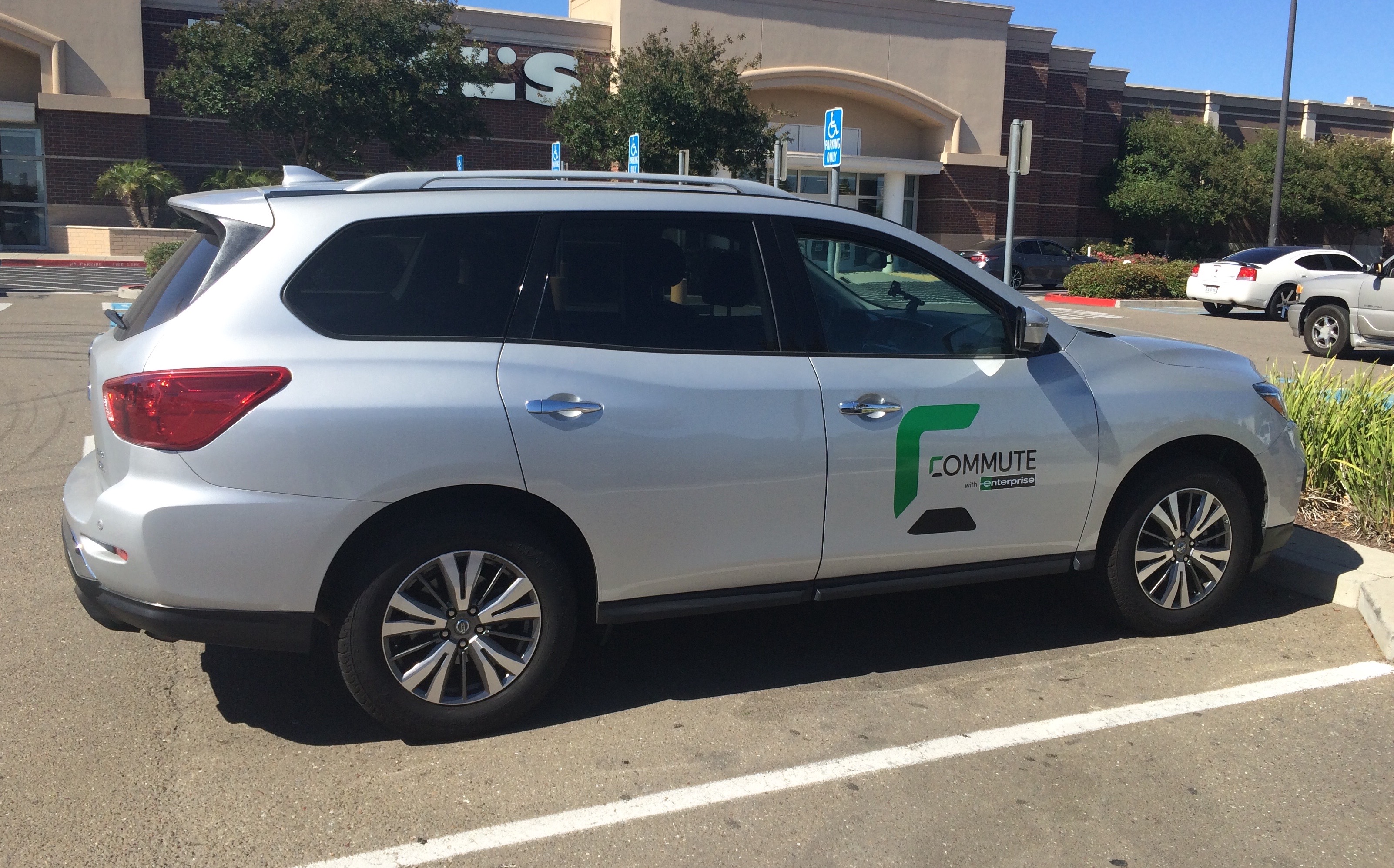
Nissan Pathfinder
"In addition to increasing production, Nissan has also increased sales of its US made vehicles, primarily the Rogue, the Frontier, the Pathfinder and the Murano."
The Nissan Pathfinder is Nissan’s midsize three-row SUV, and it’s listed alongside the Rogue as a US-made sales focus. The segment ties its sales push to pricing cuts and financing incentives, which are common levers for large family SUVs.
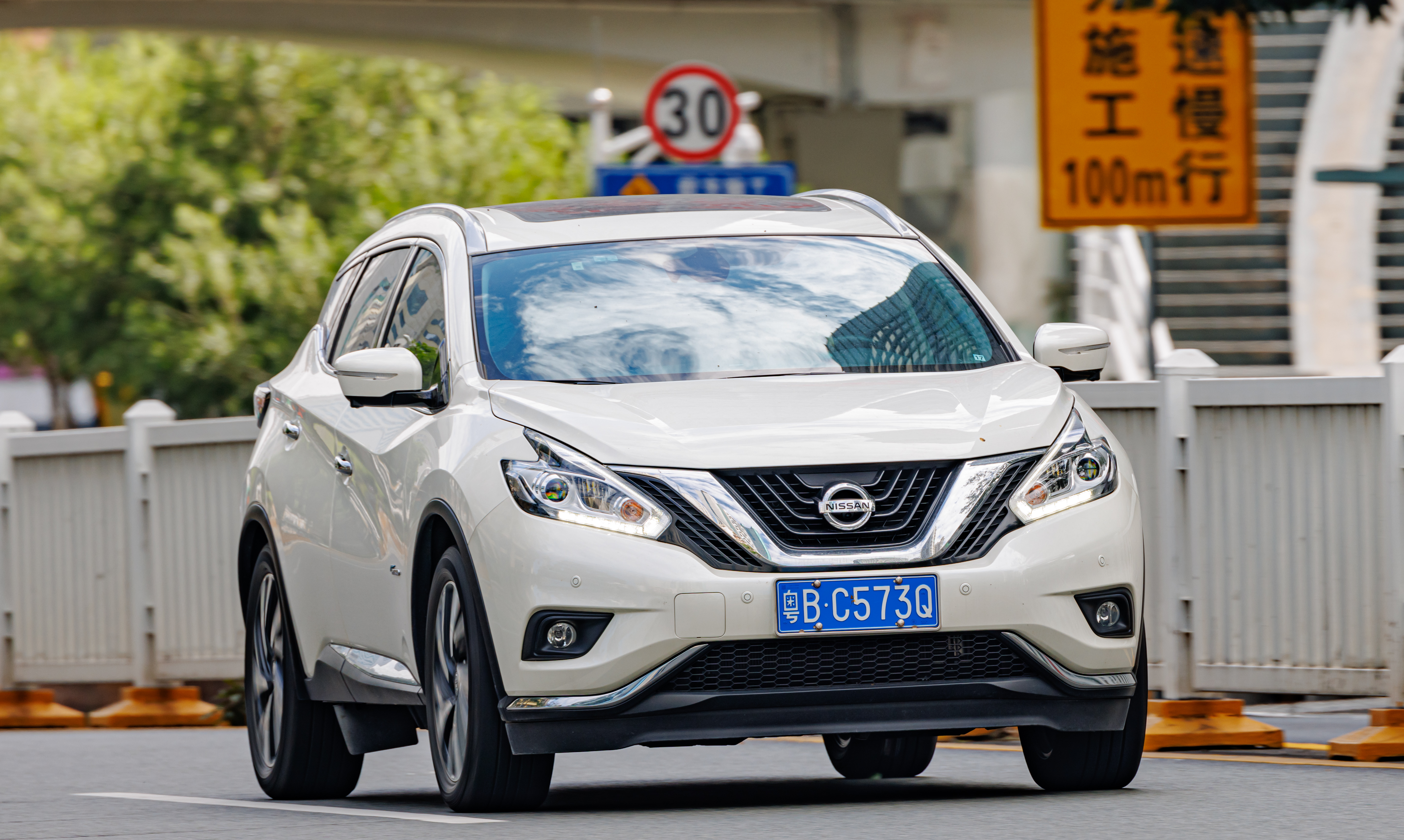
Nissan Murano
"In addition to increasing production, Nissan has also increased sales of its US made vehicles, primarily the Rogue, the Frontier, the Pathfinder and the Murano."
The Nissan Murano is Nissan’s midsize crossover SUV, included here as part of Nissan’s US-made lineup. The segment frames it as one of the vehicles benefiting from broader sales and production efforts.
0% financing for 60 months
"And they've done that by cutting prices, especially on the Rogue and the Pathfinder, but also having aggressive 0% financing for 60 months on those four utility vehicles."
“0% financing for 60 months” is an incentive where the buyer pays no interest over a five-year loan term. Automakers use these offers to lower the monthly payment burden and stimulate demand, especially for higher-volume “utility” models.

Kicks
"So they make the Centra and they make the Kicks in Mexico, which are high volume vehicles for the US market."
The Nissan Kicks is a compact crossover that the segment says Nissan produces in Mexico for the US market. It’s included in the tariff-cost discussion because increasing US-sourced components can reduce the effective tariff burden on imported vehicles.
tariff bill
"But by increasing the US-sourced components, they're able to lower the cariff bill that they pay on those vehicles."
A “tariff bill” is the total cost a company pays in import duties due to tariffs. The segment explains that by using more US-sourced components, Nissan can reduce the tariff impact on vehicles built in Mexico.
25% tariff
"Until the 25% tariff comes down in Mexico, they are essentially absorbing the cost on these imports. They haven't increased the sales price significantly."
A “25% tariff” means imported vehicles or parts face an additional 25% duty cost. The segment argues Nissan is effectively absorbing that cost for the Mexico-built models until the tariff changes, which helps explain why prices aren’t rising as much as they otherwise might.
Volvo Cars
"Anders Bell, Chief Engineering and Technology Officer at Volvo Cars, thanks so much for joining us."
Volvo Cars is the automaker being discussed through its engineering leadership in this segment. The host references Volvo’s high SDV readiness score and asks its technology executive what “SDV ready” actually means.
SDV readiness scores
"So a month ago or so, S&P Global Mobility published its SDV readiness scores for 2026, and Volvo and the Chinese manufacturer NEO got the top scores."
SDV readiness scores are a way to judge how “ready” a carmaker is to make cars that rely heavily on software. It’s basically a checklist-style score for the systems and processes needed for that approach.
SDV readiness scores are an assessment of how prepared an automaker is to build and operate software-defined vehicles. They typically reflect things like software architecture, update capability, and how much of the car’s functionality can be managed through software.
S&P Global Mobility
"So a month ago or so, S&P Global Mobility published its SDV readiness scores for 2026,"
S&P Global Mobility is a company that does automotive research and publishes industry data. Here, they’re mentioned because they released scores about which automakers are ready for more software-driven cars.
S&P Global Mobility is a data and analytics provider that publishes automotive industry research and scoring. In this segment, it’s referenced for publishing “SDV readiness scores,” which are meant to evaluate how prepared automakers are for software-defined vehicle capabilities.
level 3, 4, 5
"So having something we can all look at and say, hey, level 3, 4, 5, what is what, right? [532.1s] And of course, that definition didn't exist when we started the development of what is now"
These “levels” describe how automated a car is. Higher numbers generally mean the car can drive more of the job by itself, with less help needed from the driver.
Levels 3, 4, and 5 refer to the SAE automation scale for self-driving capability. Higher levels generally mean the car can handle more driving tasks without the human needing to supervise as much (with Level 5 being full automation in defined conditions).

EX60
"And of course, that definition didn't exist when we started the development of what is now [536.6s] the EX60 and the entire platform. So happy to have kind of be recognized from the outside on"
The Volvo EX60 is a Volvo model that’s being built around advanced software. The idea is that the car can gain features over time, not just at the factory.
The Volvo EX60 is being discussed here as a software-forward vehicle built on a new platform. The key point is that Volvo is tying its development to advanced vehicle software capabilities, not just traditional mechanical design.
open network
"And for us, that's kind of the primary now with the software defined vehicle, full kind [618.5s] of open network where we have read and write possibility to the car. [624.8s] We can basically understand what happens in the real world in real time"
In this context, an open network refers to the vehicle’s internal communications being designed to allow data exchange and software access across systems. The speaker emphasizes that the car can be both read from and written to, enabling updates and new functionality.
read and write possibility
"And for us, that's kind of the primary now with the software defined vehicle, full kind [618.5s] of open network where we have read and write possibility to the car. [624.8s] We can basically understand what happens in the real world in real time"
It means the car can share information out (read) and also accept changes back in (write). That’s how software updates can add features or adjust behavior.
“Read and write possibility” describes the ability for software systems to both collect data from the vehicle (read) and send commands or updates back to it (write). This is a core enabler of SDV-style improvements, where the car can learn from real-world use and then receive new functionality.
domains
"And this goes for all different [646.5s] domains to the customer of improved functionality. How do we maximize the usage of the hardware [651.9s] that we have on the roads by unlocking functionality through software"
In car software, “domains” means different big areas controlled by computers. The speaker is saying updates can improve more than just the entertainment screen.
“Domains” in modern vehicles refers to major software-controlled subsystems (for example, infotainment, vehicle control, and other electronic functions) that can be updated and improved. The speaker’s point is that software unlocking can apply across multiple vehicle systems, not just one feature area.
infotainment domain
"It's [651.9s] far beyond just being able to update infotainment domain, for instance. I think the second kind [663.8s] of entry into this, if I may, is the more industrial view"
“Infotainment domain” is the car’s computer system for things like the screen, music, and navigation. The speaker is saying SDV is bigger than just updating that part.
An infotainment domain is the vehicle’s software area responsible for the user-facing experience—typically the touchscreen, audio, navigation, and related controls. The speaker contrasts this with broader SDV capabilities, implying that software updates should do more than just improve the entertainment interface.
domain based systems
"So we've been building cars on domain based systems for the last 20 or so years, which has served us extremely well. It's where you have basically your sensors and actuators behind a NECU."
Domain based systems split the car’s electronics into separate groups, like one group for the engine-related stuff and another for the cabin and entertainment. Each group has its own computer that controls its functions. As you add more features, coordinating all those groups can get complicated.
Domain based systems organize vehicle electronics by “domains” (like powertrain, body, infotainment), with each domain typically having its own set of electronic control units (ECUs). In this approach, sensors and actuators connect to ECUs, and the vehicle’s overall behavior depends on how well those domain ECUs communicate. It can work well, but as features grow, the number of hardware systems and interfaces can become complex.
sensors and actuators
"It's where you have basically your sensors and actuators behind a NECU. And then those typically come from the entire system comes from a tier one."
Sensors are what the car uses to “sense” what’s going on. Actuators are what make things happen, like moving parts or adjusting systems. Together they connect the car’s physical world to the computers that control it.
In vehicle systems, sensors measure conditions (like wheel speed, temperature, or position) and actuators perform physical actions (like moving a valve, adjusting a motor, or controlling a mechanism). The transcript uses this pairing to describe the hardware layer that connects to ECUs. In SDV discussions, the key point is how these devices are integrated and how much control logic lives in software versus dedicated hardware.
ECUs
"And the job of the car maker and the OEM in that in that world is basically to put a bit simplicity is to make all those ECUs talk to each other with limited in-house software."
ECUs are the car’s computers. They take information from sensors and then control parts of the car that do something physical. Many cars have several ECUs working together.
ECUs (electronic control units) are the car’s embedded computers that read sensor inputs and control actuators (like valves, motors, and other hardware). In modern cars, there can be many ECUs, each responsible for different subsystems. SDV discussions often focus on how ECUs communicate and how many separate hardware “islands” the car needs.
tier one
"And the job of the car maker and the OEM in that in that world is basically to put a bit simplicity is to make all those ECUs talk to each other with limited in-house software. And it's to a large extent a specification and coordination work. And the code is mostly written by by tier ones."
A “tier one” supplier is a major automotive electronics or systems vendor that supplies complete subsystems (often including software) to automakers. In the transcript’s context, tier ones commonly write much of the vehicle code, while the automaker focuses on system integration and coordination. This supply-chain structure strongly influences how vehicle software is developed and maintained.
zonal architecture
"So do you feel like you mentioned domain architecture and the movement towards zonal architecture and listeners of the podcast will remember from an explainer a few months back"
Zonal architecture means the car is organized into sections (zones) like different areas of the body. Instead of grouping electronics only by function (engine vs cabin), the system is grouped by where things are in the car. That can make it easier for the car’s computers to coordinate actions.
Zonal architecture is an approach to vehicle software and electronics where the car is divided into physical zones (like front, rear, or left/right areas) and the control systems are organized around those zones. The goal is to reduce the complexity of coordinating many domain-specific systems by aligning computing and communication with the car’s physical layout. The transcript contrasts this with domain-based organization by emphasizing “physical zone of the car.”
domain architecture
"So do you feel like you mentioned domain architecture and the movement towards zonal architecture and listeners of the podcast will remember from an explainer a few months back"
Domain architecture is how a car’s electronics are grouped. Instead of organizing by where components are located, it groups them by what they do (like engine-related systems vs cabin systems). How you group these systems affects how complicated it is to add new features.
Domain architecture is the organizational strategy behind domain based vehicle electronics, where functions are grouped by subsystem categories (for example, powertrain vs body vs infotainment). The transcript frames it as “organized by domain,” meaning functions are categorized rather than tied to the car’s physical layout. This matters because SDV efforts often involve changing how those groups communicate and how much hardware is duplicated across domains.
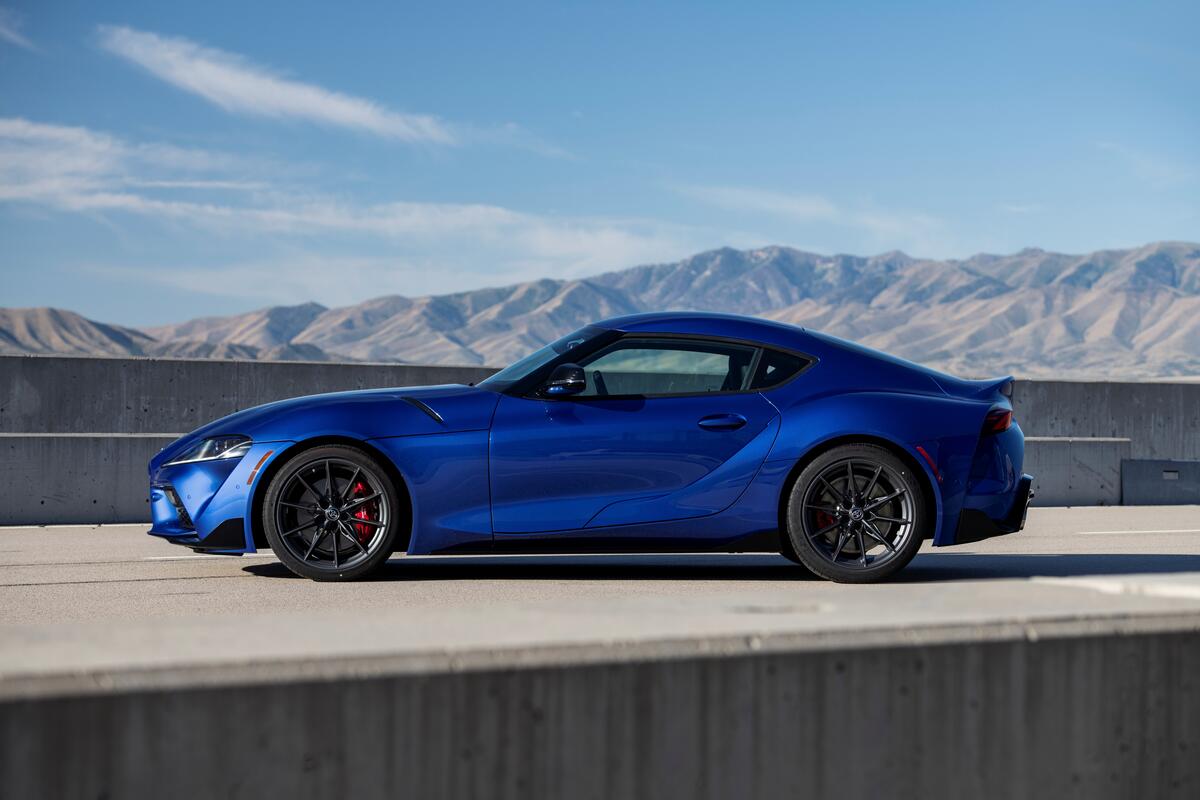
Toyota A90
"taking that a step forward. It's kind of, as a carmaker, like I said, carmaker coming from a domain based world, you're kind of slicing the car in a 90 degree, if you did it horizontally before, now you need to think vertically or the other way around, doesn't matter, right?"
The Toyota Supra is a sports car made for driving fast and feeling connected to the road. It’s often discussed when people talk about how a company improves its performance cars over time. The “step forward” idea usually means updates to how the car is built or how it drives.
The Toyota Supra is a performance sports coupe known for its driver-focused design and strong engine options. In a discussion like the one you quoted, it’s the kind of car that represents how a manufacturer “steps forward” in engineering and product direction. It may come up when talking about brand strategy, platform development, or how performance models evolve.
Request an Explanation
Heard something you'd like explained? We'll add it to this episode.
Sign in to request explanations for terms you heard.
Want to learn more?
Browse our glossary for plain-English explanations of automotive terms, jargon, and concepts.
Help improve this episode
See something that's not quite right? Our annotations are AI-generated and can sometimes miss the mark. Click the flag icon on any annotation to suggest a correction.