
May 8, 2026 | Why a Pennsylvania dealer sold his collision center; court blocks Trump tariffs
About this episode
A court blocks Trump’s 10% global tariffs as unlawful, and Toyota explains a $1.2 billion North American loss tied to an $8.6 billion tariff bill plus EV and truck upgrades. GM tries to capitalize on constrained F-150 supply, while also managing low inventory around factory downtime and upcoming pickup redesigns. Then the show shifts to collision repair: a Pennsylvania dealer sells his collision center, citing rising complexity, manufacturer certification requirements, and insurers increasingly totaling vehicles instead of fixing them.
John Masano of Masano Auto Group in Pennsylvania explains why he sold his collision center to focus on his core business. A federal trade court strikes down Trump’s 10 percent global tariffs as unlawful. Plus, General Motors pushes for more pickup inventory as Ford production problems linger.
pickup inventory
"And General Motors is working to boost pickup inventory on U.S. dealership lots, aiming to meet [148.3s] demand and capitalize on Ford's production problems."
Pickup inventory refers to how many pickup trucks dealers have on their lots (and in the pipeline) to sell. When inventory is low, sales can be constrained even if demand exists; when inventory is higher, a brand can capture market share from competitors who are supply-limited.
General Motors
"And General Motors is working to boost pickup inventory on U.S. dealership lots, aiming to meet [148.3s] demand and capitalize on Ford's production problems."
General Motors is a major car company. The discussion here is about GM trying to get more pickup trucks onto dealer lots so they can sell more.
General Motors (GM) is the automaker behind brands like Chevrolet, GMC, and others. In this segment, GM is trying to increase pickup inventory at U.S. dealerships to capture sales while competitors are constrained.

Ford's F-150s
"Ford has been dealing with an undersupply of [154.9s] F-150s since a September fire at an aluminum supplier plant."
The Ford F-150 is a very popular pickup truck. Here, the hosts are saying Ford hasn’t been able to make enough of them, so dealers don’t have as many trucks to sell.
The Ford F-150 is Ford’s best-known full-size pickup, and it’s often the volume driver for the brand. In this segment, the key point is that Ford has been short on F-150 production, which can ripple through dealership inventory and sales.
aluminum supplier plant
"Ford has been dealing with an undersupply of [154.9s] F-150s since a September fire at an aluminum supplier plant."
This is a factory that makes aluminum parts used to build vehicles. If it has a major problem like a fire, carmakers can’t get the materials they need, so they can’t build as many trucks.
This refers to a supplier facility that produces aluminum components used in vehicle manufacturing. A fire at such a plant can reduce the availability of critical materials, which then limits vehicle production and dealership inventory.
market share
"Dave Weston of Morningstar says [162.1s] GM should pick up a lot of share in the second quarter... If it's significant at all, whether it lasts is"
Market share means how much of the total truck sales a company gets compared to competitors. If one brand can’t supply trucks, another brand can temporarily take a bigger slice of sales.
Market share is the percentage of total sales in a category that a company captures. Here, the hosts are discussing how GM could gain share in the second quarter if Ford is supply-constrained, and whether that advantage persists after production normalizes.
ramp back up
"As soon as this month, [194.9s] obviously it'll take time to ramp back up and to get supplies back up to where Ford would like."
“Ramp back up” means restarting production and gradually making more again after a shutdown. It usually takes time before the factory is back to full output.
“Ramp back up” describes the process of increasing production after a disruption until output returns to normal levels. In manufacturing, ramping takes time because equipment, staffing, and supply chains all need to recover.

redesigned Silverado and Sierra pickups
"You mentioned GM is also preparing to launch redesigned Silverado and Sierra pickups later this year. Does that complicate their push to build inventory right now?"
Silverado and Sierra are GM’s main big trucks. When they’re redesigned, it can be harder to keep enough trucks on dealer lots while production shifts to the new versions.
The Chevrolet Silverado and GMC Sierra are GM’s main full-size pickup trucks, and both are being discussed as “redesigned” for later this year. Redesigns can force factories to balance new-model ramp-up with current demand, which affects inventory levels.
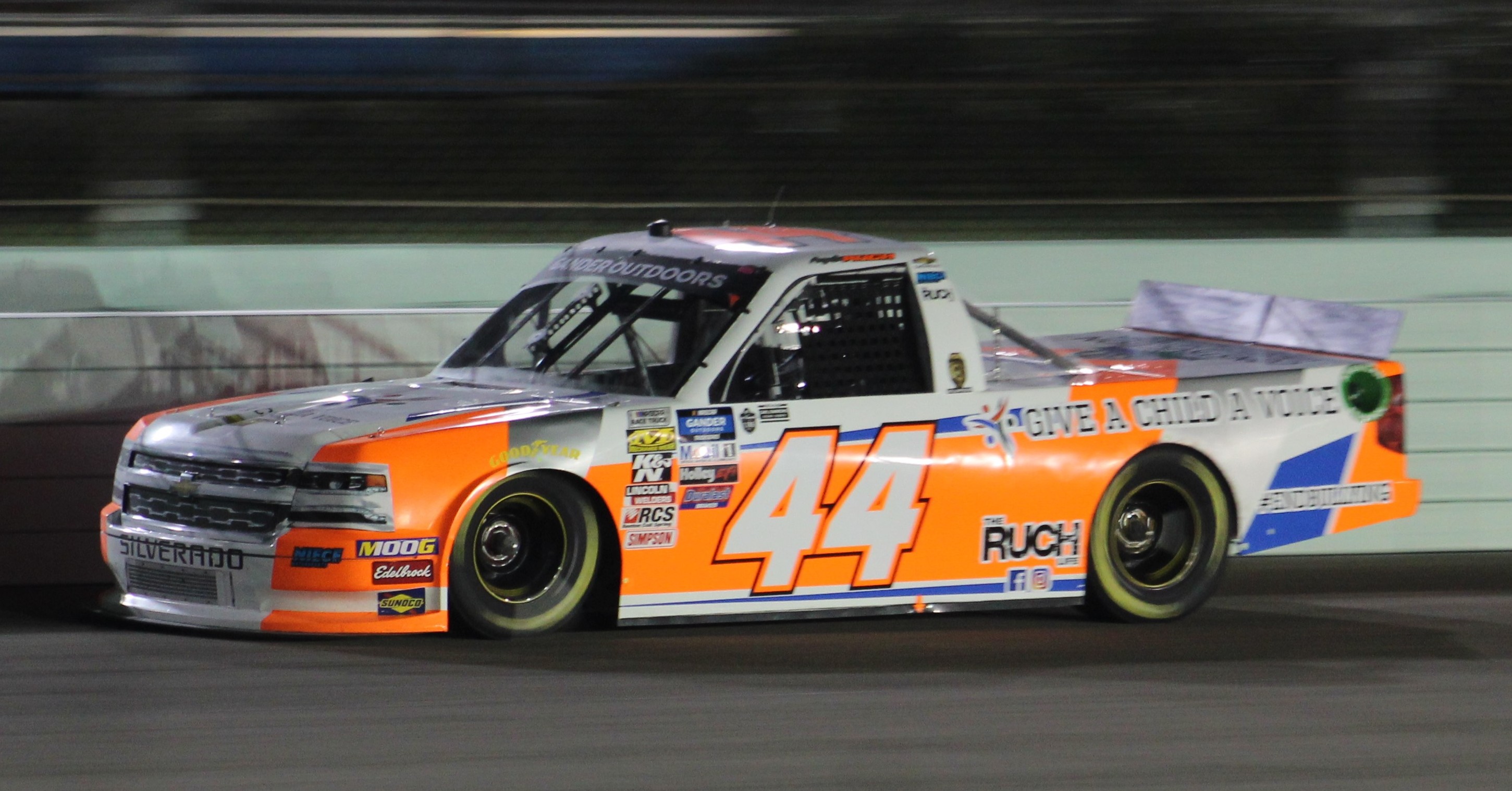
Chevrolet Silverado
"You mentioned GM is also preparing to launch redesigned Silverado and Sierra pickups later this year. Does that complicate their push to build inventory right now?"
Silverado and Sierra are GM’s big full-size pickup trucks. If they’re getting redesigned, it can change when factories make them and how many trucks are available for dealers.
The Chevrolet Silverado and GMC Sierra are the two flagship full-size pickup trucks from GM. When GM talks about “redesigned” versions, it usually means major updates that can affect production timing, parts supply, and how much inventory dealers can stock.
build inventory
"Does that complicate their push to build inventory right now? Yeah, we've already seen that this year, part of the reason that their inventory is low is because they're the first quarter, there was some factory downtime..."
“Build inventory” means making enough vehicles so dealers have cars and trucks to sell. If factories are switching to new designs, it can be harder to keep those lots stocked.
“Build inventory” is the production-and-stocking strategy of making enough vehicles to keep dealer lots supplied. When redesigns and factory downtime are coming, automakers may struggle to time production so inventory stays healthy.
factory downtime
"Yeah, we've already seen that this year, part of the reason that their inventory is low is because they're the first quarter, there was some factory downtime to help for heavy duty production for the next generation trucks."
Factory downtime is when the factory stops making cars or trucks for a while. It often happens when the plant is switching over to build a newer version.
Factory downtime is scheduled or planned time when a manufacturing plant pauses production. Automakers use it for retooling and transitions—like shifting capacity to “next generation” trucks—so output can temporarily drop even if demand is steady.
heavy duty production
"Yeah, we've already seen that this year, part of the reason that their inventory is low is because they're the first quarter, there was some factory downtime to help for heavy duty production for the next generation trucks."
Heavy duty trucks are the tougher, work-oriented versions of pickups. They’re built for things like towing and heavy use, so factories may prioritize them at certain times.
“Heavy duty” refers to the more work-focused, higher-capacity versions of pickup trucks—typically aimed at towing and commercial use. Producing heavy-duty models can require different scheduling and tooling, which can reduce availability of other truck variants during transitions.
light duty
"And yeah, later this year, they'll certainly at some point be downtime for factories before the next generation light duty vehicles as well."
Light duty trucks are the more normal, everyday-use versions of pickups. When factories are preparing new models, light-duty production can be delayed while they focus on other variants.
“Light duty” means the more everyday, less-commercially focused versions of trucks. In production planning, automakers often switch between heavy-duty and light-duty schedules, so redesign timing can affect which trucks are available first.
collision center
"That's part of why John Massano, dealer principal of Massano Auto Group in Pennsylvania, decided to sell his collision center last year. Massano spoke with automotive news senior retail editor, Dan Shine, about the decision whether he has any second thoughts"
A collision center is a repair shop for cars that were in accidents. It focuses on fixing the body and damage so the car is safe and looks right again.
A collision center is a shop that repairs vehicles after crashes—typically handling bodywork, structural repairs, and refinishing. In the dealership world, it’s often run as a separate operation that can be profitable but requires specialized processes and staffing.
Massano Auto Group
"That's part of why John Massano, dealer principal of Massano Auto Group in Pennsylvania, decided to sell his collision center last year."
Massano Auto Group is the dealership business in Pennsylvania that John Massano runs. They sold their accident-repair operation, and that’s what the discussion is about.
Massano Auto Group is the Pennsylvania dealership group owned/led by John Massano in this segment. The episode uses the company’s decision to sell a collision center as the real-world example for why dealers might change how they run collision operations.
body shop
"Can you run this body shop? Can you scale it? That was another decision that we had to make. Are we going to scale this?"
A body shop is where accident damage to a car’s body is repaired. It’s the part of the repair process that fixes dents, panels, and the car’s exterior.
A body shop is the portion of collision repair focused on restoring the vehicle’s exterior panels and surfaces. When the host asks “Can you run this body shop?” they’re talking about the operational challenge of managing collision repair as a dedicated business unit.
scale it
"Can you run this body shop? Can you scale it? That was another decision that we had to make. Are we going to scale this?"
“Scale it” means growing the business so it can handle more work. In this context, it’s about whether the collision shop should expand.
“Scale it” here means expanding the collision operation—adding capacity, staff, and workflow—so it can handle more repairs and grow revenue. The discussion frames scaling as a strategic decision, not just a day-to-day operational one.
core competency
"I think the more that dealers look at this, they'll look at maybe concentrating on their core competency, which is sales and service."
“Core competency” means the main thing a business does best. The point here is that dealers might focus on selling cars and regular service instead of collision repair.
Core competency is a business term for the main area a company is best at and should focus on. The host suggests dealers may concentrate on their “core competency,” meaning selling vehicles and providing service, rather than running collision operations.
collision business
"Yeah, yeah. I know I've talked to people in the collision business, you know, maybe this maybe for the stories last year. And one of them, I always would think of this quote he said to me,"
The “collision business” means repairing cars after crashes. The quote is saying you can’t do it casually—you have to commit to doing it properly.
The “collision business” refers to the specialized aftermarket repair industry focused on crash damage. The quote emphasizes that it requires full commitment—process discipline, parts/bodywork coordination, and consistent quality—rather than treating it as a side activity.
rental business
"but it's not the tradition that we know, automotive service. It's a different type of business also reminds me a little bit of the rental business that we were in a while back."
They’re comparing collision repair to the car rental business to explain how it’s a different kind of operation. Rentals have their own rules and logistics, just like collision shops do.
The “rental business” is referenced as an analogy for a non-traditional automotive-adjacent operation. The comparison highlights that collision operations can feel like a different kind of business with its own logistics and customer flow, similar to how rentals operate differently from normal car service.
sensors
"And I think also cars are getting more complex. Putting them back together is more complex. It takes, you know, more sophisticated equipment, a little more patience. I mean, everything has to be just right for all those sensors and everything else to work again."
Modern cars use lots of small devices to “see” and measure what’s happening around you. After a crash, those devices may need careful setup so the safety features work right again.
In collision repair, “sensors” refers to the radar, cameras, and other detection devices used for driver-assistance and safety systems. After repairs, they often require precise alignment and calibration so the systems read the road correctly again.
manufacturer certification
"And that's also why we move forward to manufacturer certification versus insurance preferred shop. Because we were going to take a shot at that because we realized that was going to be the tip, the very top of automotive collision repair to carve out that niche in our world."
It means the repair shop is approved by the car brand. That approval usually comes with strict rules for how repairs are done and what parts are used, especially for safety systems.
Manufacturer certification is when a collision shop meets a carmaker’s training and process requirements so it can repair specific brands to the manufacturer’s standards. In practice, it often ties to using approved repair procedures and parts so the car’s safety systems and electronics are put back correctly.
insurance preferred shop
"And that's also why we move forward to manufacturer certification versus insurance preferred shop. Because we were going to take a shot at that because we realized that was going to be the tip, the very top of automotive collision repair to carve out that niche in our world."
This is a repair shop that an insurance company has a deal with. It can make the claim process easier, but it may not require the same brand-specific repair steps as a manufacturer-approved shop.
An insurance preferred shop is a collision repair facility that an insurer has a relationship with, often to streamline approvals and control repair costs. The tradeoff is that preferred status doesn’t necessarily mean the shop follows the same manufacturer-specific repair standards as a certified facility.
totaled out
"But the problem that it happens, which I'm sure you're seeing from maybe being so close to the industry, they total out these cars. So if we have a BMW or Mercedes, hey, it's great. We're certified for it."
A “totaled” car is one where the cost to fix it is judged to be too high. With newer cars, repairs can get expensive because there are many electronics and safety systems that must be restored correctly.
“Totaled out” means the insurer (or the owner’s decision process) determines the repair cost is too high compared with the vehicle’s value, so the car is declared a total loss. In modern cars, advanced electronics and sensor-related calibration can push repair bills high enough to trigger that decision.
Mercedes
"they total out these cars. So if we have a BMW or Mercedes, hey, it's great. We're certified for it. And it was a $40,000 repair."
Mercedes is another car brand mentioned as an example. The speaker’s point is that their certification covers brands like Mercedes, but newer cars can be expensive to repair because of the safety and sensor systems.
Mercedes is referenced as another brand the shop is manufacturer-certified to repair. The discussion emphasizes that modern Mercedes vehicles rely heavily on sensors and electronics, which can raise repair complexity and cost when cars are damaged.
manufacturer certified parts
"And it was a $40,000 repair. But obviously you have to use manufacturer certified parts, which is great. And you've got to absolutely get these cars back perfect because of all the sensors."
These are parts approved by the car brand for repairs. Using them helps ensure the car’s safety and electronics work the way they’re supposed to after a crash.
Manufacturer certified parts are components approved by the vehicle maker for repairs, typically to match fit, function, and safety performance. In modern cars, that matters because sensors and electronic systems can be sensitive to mismatched or non-approved parts.
airbags
"And sometimes if all the airbags go off, they may say, well, hell, it's not worth putting all those back in. You have an opportunity still for those customers who are told, sorry, your car is totaled, to walk across the street..."
Airbags are the safety cushions that deploy during a crash. If they go off, the car’s safety system often needs more work to make sure everything is safe again.
Airbags are crash-inflating safety restraints controlled by the vehicle’s airbag system. If airbags deploy in a crash, repairs can become more expensive and complex because the system must be restored correctly for safe operation.
joint venture
"And that's why we considered our sale, not just a buy sale, but a joint venture with Driving Force Collision. And we worked hand in hand with them as far as we said, providing them parts, providing the upper level service repair when it's needed."
A joint venture is when two companies team up to run something together instead of doing it all alone. Here, the dealer and a collision shop worked together so repairs and related support were handled as one coordinated setup.
A joint venture is a business partnership where two parties combine resources to run a specific project or operation. In this case, the dealer and Driving Force Collision teamed up so the collision center could handle repairs while the dealer provided parts and service support.
Driving Force Collision
"And that's why we considered our sale, not just a buy sale, but a joint venture with Driving Force Collision. ... And they obviously fixed the vehicles."
Driving Force Collision is the body shop/repair shop the dealer worked with. They handled the collision repairs, and they were part of the coordinated plan between the two businesses.
Driving Force Collision is the collision-repair business the dealer partnered with in a joint venture. The hosts describe it as handling the actual collision repairs and routing totaled vehicles to the dealer’s process.
stay bonus
"And then we also gave our co-workers, based on longevity and skill, stay bonuses. So if we closed in May, we gave them, I think it was a 90 day stay bonus."
A stay bonus is extra pay to get employees to keep working for a set period. In this case, it was used to help retain staff during the transition so operations wouldn’t stall.
A stay bonus is a retention payment offered to employees to encourage them to remain through a transition period. Here, the speaker mentions a 90-day stay bonus tied to keeping the repair process moving after closing.
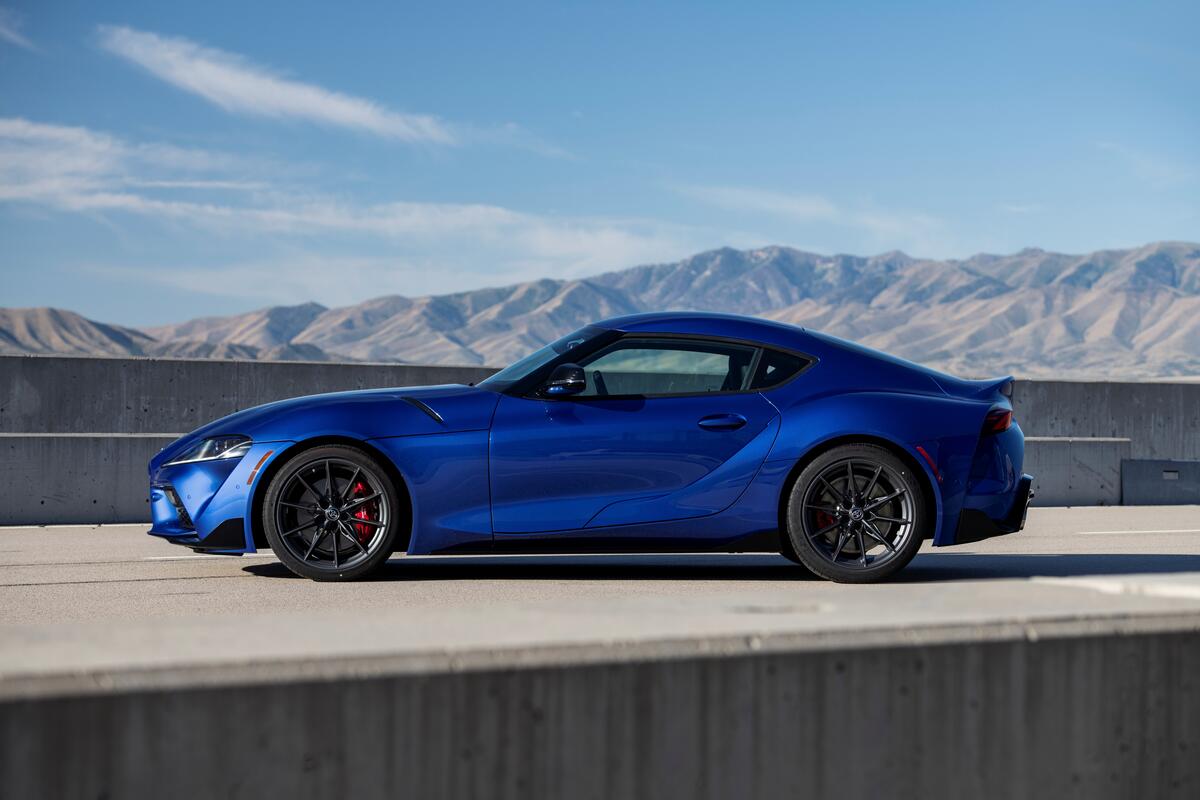
Toyota A90
"our co-workers, based on longevity and skill, stay bonuses. So if we closed in May, we gave them, I think it was a 90 day stay bonus. You stay to 90 days and we'll give you a nice bonus to share in that sale to keep the process moving. Nice. And you probably couldn't have done it."
The Toyota Supra is a sports car designed to be fun to drive and go fast. It’s the kind of car people pay attention to when there are updates about production or sales. In this episode, it’s mentioned as part of the broader automotive news being discussed.
The Toyota Supra is a performance sports car built for driving feel and acceleration, and it’s frequently a headline-worthy model when automotive news touches on production, sales, or enthusiast interest. In this podcast context, it’s not the main topic, but it’s still a car that can be referenced when discussing broader industry updates. Its mention likely ties to how automakers and dealers manage demand and operations.
collision repair center
"some of our service and parts people focusing on it. So we took all of that off our plate and then worked within our departments. And yes, definitely more productive because some of the problems that happened or situations, I'm going to say a problem, situations at the body at the collision repair center were almost unsolvable."
A collision repair center is where cars are fixed after accidents. It’s not just “getting it to run”—it’s also fixing the body and making sure everything lines up and is safe.
A collision repair center is a specialized shop for restoring vehicles after crashes. Unlike general mechanical work, it involves bodywork, structural repairs, and paint/refinish processes that must be done correctly to restore safety and fitment.
BMW
"So if we lost our BMW tech, we would lose our certification. So we tried to do some redundancy there,"
BMW is referenced as an example of a manufacturer whose certification can be lost if the required BMW-trained technician leaves. That highlights how brand-specific approval can tie a collision center’s staffing to each automaker’s rules.
technician shortage
"Right. You hear a lot about the technician shortage and people think in the service department, but that's in the collision industry as well. Yes, yes, very much so."
A technician shortage means there aren’t enough trained people to do the work. In crash repair, it can be especially hard to find the right skilled workers.
The “technician shortage” refers to a lack of qualified people to staff service and repair roles. In collision repair specifically, it can be hard to find highly skilled technicians who can meet manufacturer certification requirements.
Request an Explanation
Heard something you'd like explained? We'll add it to this episode.
Sign in to request explanations for terms you heard.
Want to learn more?
Browse our glossary for plain-English explanations of automotive terms, jargon, and concepts.
Help improve this episode
See something that's not quite right? Our annotations are AI-generated and can sometimes miss the mark. Click the flag icon on any annotation to suggest a correction.