“GT” usually means a more performance-focused, track-friendly version of a car. In this episode, they’re saying that even if GT cars are meant to be more extreme, a lot of buyers choose them for image and what they think is the “top” trim.
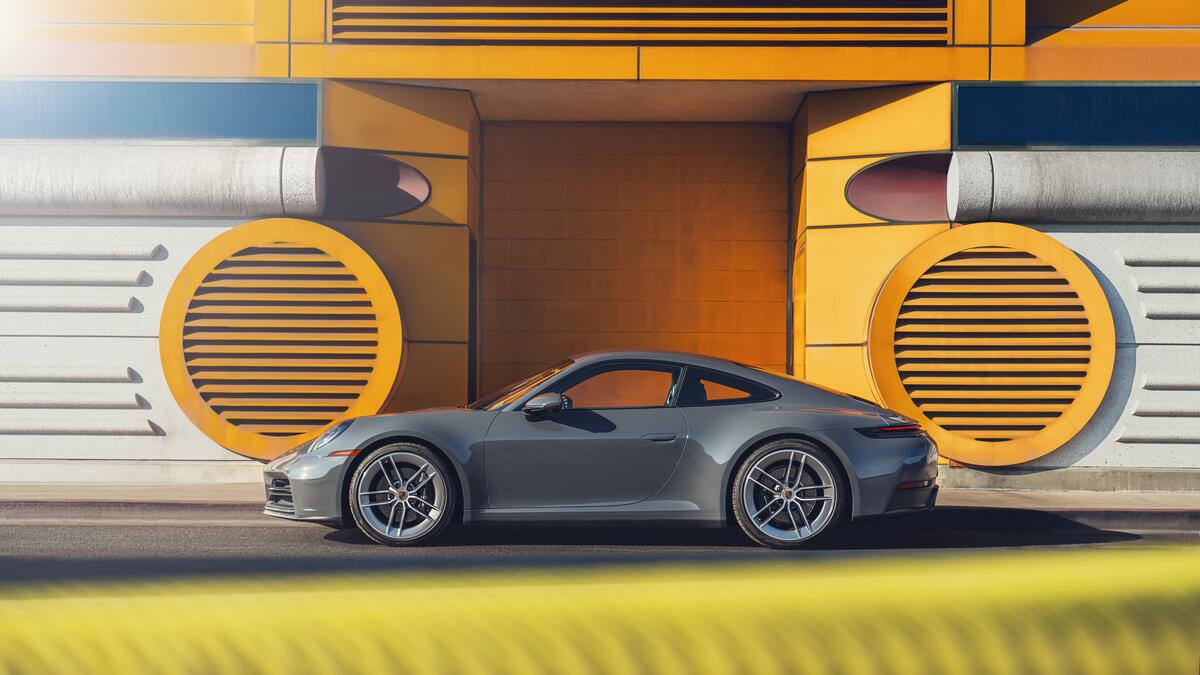
The Porsche 911 Turbo is Porsche’s top, turbocharged 911. The hosts are debating which one feels like the “real top-of-the-line” car—GT3 versus Turbo—and they mention that the Turbo can feel more comfortable even though it’s very fast.
Suspension is what connects the wheels to the car and helps control how smooth or firm the ride feels. Here they’re comparing how stiff the suspension can feel when you move from a Turbo to a GT3.
The Porsche 911 GT3 RS is the 911 made for track driving first. It can still be driven on the street, but the point is that it’s optimized for performance driving, not everyday comfort.
“Liveries” are the car’s paint and sticker design—its overall look with colors and graphics. The point here is that GT cars often look more dramatic, while many Turbo cars are more subtle.
This is a Porsche GT3 turned into a convertible. In this segment, they’re saying Porsche could build it faster by reusing existing GT3 parts instead of designing everything from scratch.
Car
Porsche Speedster
A Speedster is a Porsche open-top style that’s usually more stripped-down and special than a regular convertible. They’re comparing it to the Cabriolet in terms of how long Porsche would be able to sell it.
Homologation is the legal approval a car has to get before it can be sold. The point here is that Porsche had approval for only a certain length of time, so that limited the sales window for the model.
This phrase means using existing parts instead of designing new ones. The host’s point is that you still need engineering work to make the assembled car actually work well.
R&D is the engineering work behind making a new car (or new version) actually work. Even if you reuse parts, you still have to test and refine how everything comes together.
Term
718 capacity
They’re talking about factory production capacity—basically, how much the plant can build. The idea is that Porsche has more room to build 911-based cars, and that helps them reuse existing parts instead of starting over.
The Porsche 718 is one of Porsche’s sports cars. In this segment, it’s used as a reference point for factory production and shared parts that make it easier to build other Porsche models.
This means Porsche can reuse existing parts they already have. But the host is saying that having parts on hand doesn’t automatically make a good car—you still have to engineer how everything fits and works together.
Tiptronic is an automatic transmission that still lets you choose gears yourself if you want. It’s usually more convenient than a manual, but you can still drive more “hands-on” when you feel like it.
“Homage” means the car is being styled to pay respect to an older classic look. It’s like copying the vibe of a famous design, even if the result isn’t practical.
“Petina” is a car-enthusiast term for the natural, lived-in look a vehicle develops over time. The host is complaining about “fake petina,” where someone tries to manufacture that worn look instead of letting it happen naturally.
The BMW 3 Series is a popular BMW model line. The podcast talks about a specific version called the E36 and mentions the M42 engine, which is just a particular engine option. Different engines can mean different driving feel and upkeep needs.
Term
M44
M44 is the name BMW used for a particular 4-cylinder engine. The discussion is about which engine it is and how that affects how the car drives day to day.
Term
M42
M42 is another BMW engine name. The host is clarifying which BMW 4-cylinder engine is actually in the car they drove.
Dual overhead cams means the engine has two camshafts up in the head that control the valves. It’s a design detail that can change how the engine runs and responds.
“16 valves” is how many valve openings the engine has to let air in and exhaust out. More valves per cylinder can help the engine breathe better, but you usually feel it more as smoother power than as a specific “valve” sensation.
Term
throttle pedal is really just an on-off switch
That phrase means the car doesn’t respond smoothly to tiny pedal movements—it feels abrupt. It’s about how the computer turns your gas pedal input into engine power.
This is about how the transmission is geared in fifth gear. If fifth gear is “low,” the engine spins faster on the highway, so it feels like it’s begging for a higher gear.
The clutch is what you press to change gears in a manual transmission. The host is saying that with the automatic (tip-tronic), you don’t have to deal with that kind of effort in traffic.
The Porsche 911 is the classic Porsche sports car. In this segment, they’re talking about how expensive it is to get into a 911, and what you can (or can’t) buy with a limited budget.
“Air-cooled” means the engine is cooled mainly by air flowing around it, not by coolant running through a radiator. In Porsche talk, it usually means the older, classic 911 style.
“Water-cooled” means the engine uses coolant (liquid) to carry heat away, usually to a radiator. Here, it’s used to explain why later 911s can cost less than the older air-cooled ones.
Brand
D-Mores hardtop
D-Mores is a company name tied to an aftermarket hardtop. They’re saying you can spend extra to add a hardtop to a convertible-style car.
A “cage” here means a roll cage, which is a metal safety frame inside the car. It can make the car stronger and safer, but it’s also complicated to install.
A soft top is the fabric roof on a convertible. The host is saying that if you add a hardtop, you usually have to take the fabric roof off first.
Brand
D-Morris top
A “D-Morris top” is an aftermarket hard roof option for a convertible. The key point here is that installing it usually means taking off the fabric roof.
The Lancia Delta is a compact car. The podcast mentions it to make a point about size compared with other cars being discussed. The main idea is that it feels bigger in comparison.
Chassis rigidity is how “stiff” the car’s body feels when you drive. Less rigidity can mean more flex, which can change steering feel and how the car behaves.
A tonneau cover is the cover that goes over the area where the convertible roof is stored when the top is down. It helps keep things covered and can make the car look cleaner.
Tiptronic is Porsche’s automatic transmission that still lets you choose gears yourself. So it’s easier than a manual, but you can still drive more “hands-on” when you want.
“Five speed” means the transmission has five forward gears. More gears can help the engine stay in its best range, but it depends on the specific setup.
The Porsche Cayenne is Porsche’s SUV. Here they’re talking about the manual-transmission version and saying it doesn’t feel as good or as satisfying as you might expect.
Fuel saving mode is the car’s efficiency strategy. It tries to use less fuel, which can affect when the transmission shifts and how quickly the car responds.
The Porsche Cayman is a sports car with the engine mounted near the middle. That layout helps it handle well, and here it’s being used to compare two different Porsche transmissions.
A torque converter is the part in an automatic transmission that uses fluid to transfer power from the engine to the gearbox. It can affect how quickly the car responds when you accelerate hard.
Heel-toe is a manual-driving trick where you brake and “blip” the gas at the same time to make downshifts smoother. It helps the engine speed up to the right level before the lower gear engages.
The power curve is how strong the engine is at different engine speeds. If a shift drops you out of the good RPM range, the car can feel like it pauses before pulling again.
The differential is the part that sends power to the wheels and lets them turn at different speeds when you corner. Hard driving can make it run hot and wear faster.
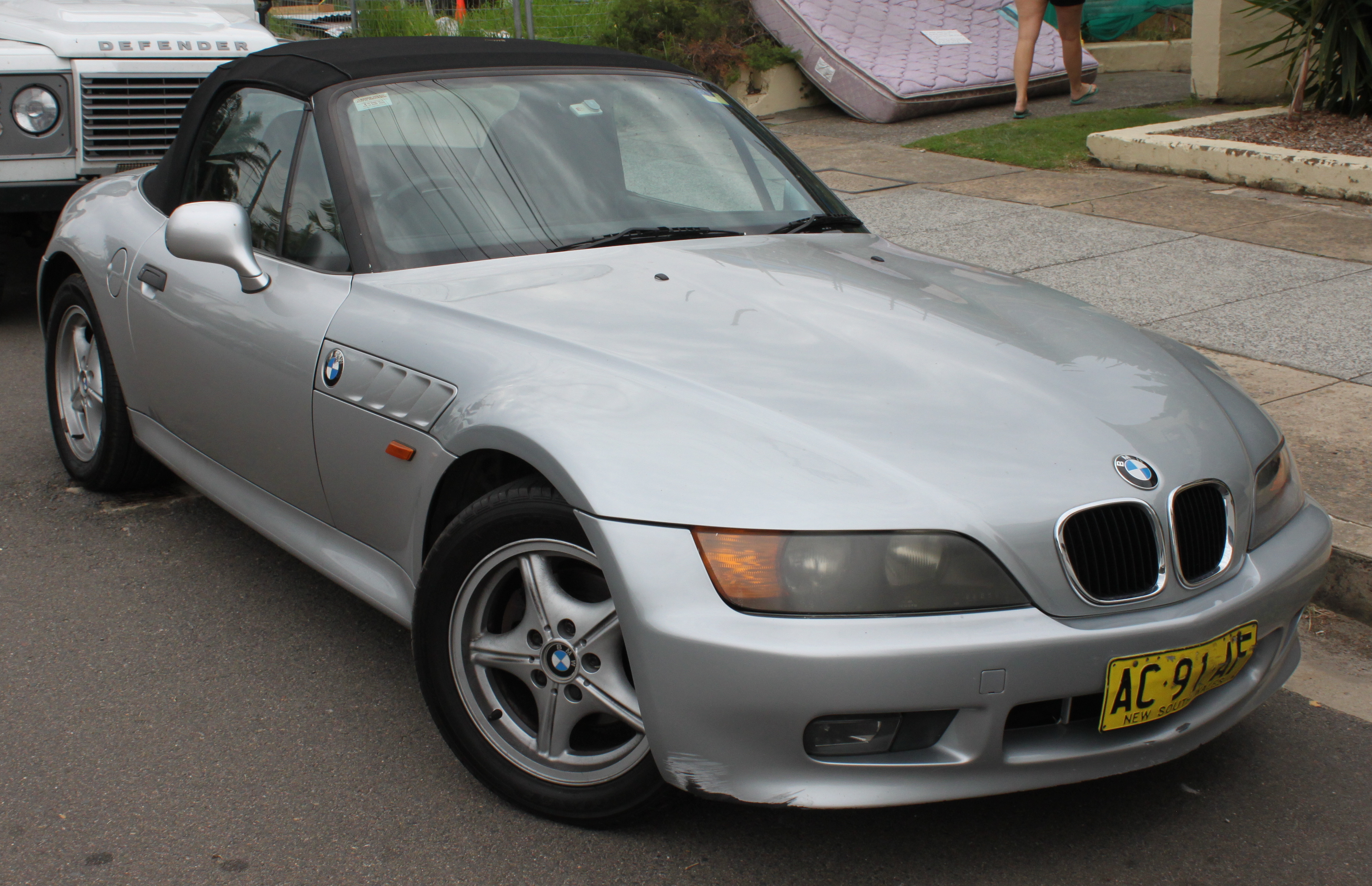
The BMW Z3 1.9 is a budget-friendly BMW roadster. The hosts bring it up as a cheaper way to get into the kind of driving feel people want before stepping up to a Porsche.
“GT car” is a label for a type of sports car meant for fast, comfortable driving over longer distances. The host is debating whether calling a 911 a “GT” is fair or insulting.
In this context, “manual” means a traditional manual gearbox (driver-operated clutch and gear selection) rather than an automatic like PDK. The hosts emphasize that finding a 991.1 or 997.2 with a manual is difficult, and that buyers need to act quickly when one appears.
Term
clear crystal tail lights
This is a description of how the rear lights look—more clear/transparent instead of darker. The host is using it to say the older 997.2 has a different, more “old-school” look.
“Dot 2” is a nickname fans use for a particular tail-light design on certain Porsche 911s. In the discussion, they’re basically debating which tail-light look they prefer.
“Dot 1” is a fan nickname for an earlier look on the Porsche 911. They’re saying they prefer the earlier front-end styling even if they like different tail-light versions.
A prototype is a pre-production version of something that’s still being tested. In this story, it’s a car with new tail-light tech that hadn’t been shown publicly yet.
LED tail lights use small electronic lights (LEDs) instead of older bulb technology. They can look different and often have a distinct “signature” shape.
Vents are the openings where air comes out inside the car. If foam is coming out of the vents, something is stuck in the heating/AC airflow system and needs to be cleaned out.
Car
Porsche 987
Porsche 987 is the name enthusiasts use for a specific Boxster/Cayman generation. They’re saying the common DIY videos don’t correctly cover how the 987 differs from the earlier version, so the job may not be as straightforward.
A “litmus test” is a quick way to figure out what’s wrong by looking at the symptoms. Here, it’s about whether the car can reach full heat (and full cold) to point to the likely HVAC problem area.
The blend door is a flap that mixes warm and cool air. If it’s not sealing or moving correctly, you can get stuck with only partial heat or partial cooling.
Coolant is the fluid that keeps the engine from overheating. If you open up parts of the cooling system, you can lose some coolant and need to top it back up afterward.
“Building inventory” just means stores are stocking up on cars. If they have a lot of cars sitting around, it can change what deals you find when you shop.
“Gas-powered vehicles” are cars that use gasoline as fuel. They’re talking about Porsche making more of those cars before a shift to other types of power.
An allocation is basically how many cars a dealer is allowed to get from the manufacturer. If a dealer doesn’t get enough allocations, it can’t sell as many of the most desirable models.
Term
cell volume
Cell volume here means how many cars the dealer sells. The host is saying Porsche uses that kind of sales volume to decide which dealers get more of the top cars.
A tariff is a government tax on imported products. If it’s big enough, it can make cars and car parts cost more, which then affects what dealers and buyers deal with.
The window sticker is the paper (or label) on a new car that shows the official price and what options it has. The host is using it to show the real cost of the car he drove.
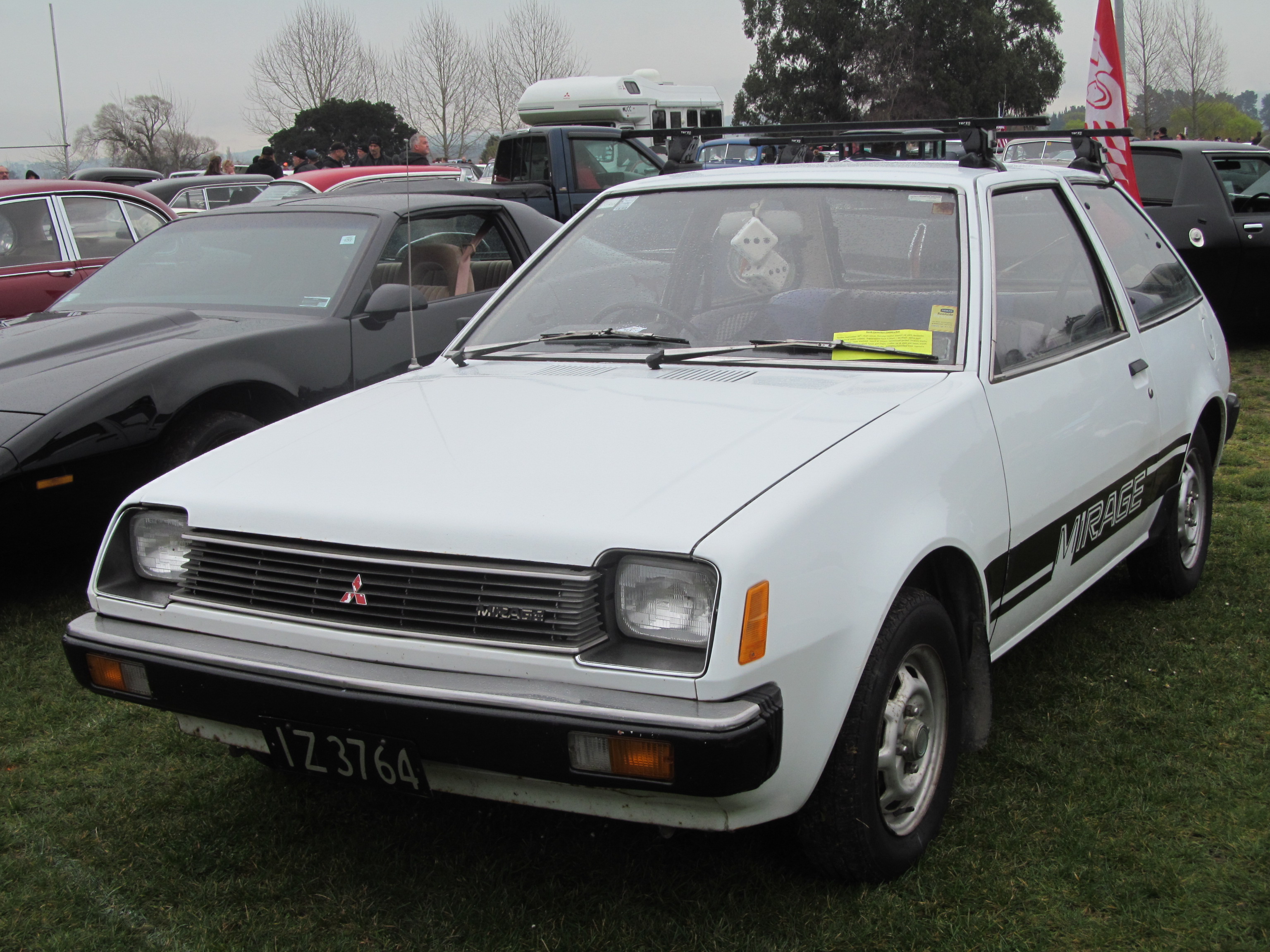
The Mitsubishi Mirage is a low-cost, basic new car model. The hosts are using it as an example of something that might be the cheapest new car you can buy.
The Toyota Corolla is a small, everyday car. In the podcast, it’s mentioned as the cheapest new car option in the comparison. It’s used to show what “low price” looks like in the market.
The Mazda Miata (MX-5) is a small sports car with a convertible top. The podcast talks about a specific Miata generation (the NC) that someone bought. It’s generally chosen because it’s meant to be fun and easy to drive.
“Hold its value” means the car doesn’t lose money as fast when you go to sell it. If a car holds its value well, you usually get more of your purchase price back.
The Porsche 911 GT3 is a more track-oriented 911. The point here is that GT3 updates may make the car faster through things like aero and setup, not necessarily by dramatically increasing peak horsepower every year.
Concept
electric motor turbo
This is an idea where an electric motor helps the turbo respond quicker. The goal is to make the car feel more immediate—less waiting for boost—so it can seem similar to a naturally aspirated engine in how it delivers power.
A normally aspirated engine doesn’t use a turbo or supercharger. The host is saying the electric assist can make a turbo/hybrid car respond in a way that feels closer to that simpler style of power delivery.
The Porsche 911 GT3 Touring is a GT3 meant to be a bit more livable for the street. Here, it’s mentioned as one of the cars the host has driven to compare how the power feels.
The Porsche 911 GT2 RS is a very extreme, performance-first version of the 911. People usually buy it for maximum speed and track-style driving, not for relaxed cruising.
The Porsche 718 Spyder is a lighter, mid-engine Porsche that’s meant to feel fun and lively on real roads. It’s the kind of car people enjoy even when they’re not driving at race-track speeds.
Horsepower is a number that describes how much power the engine makes. People use it to guess how fast a car will be, but it doesn’t always tell you whether the car is actually fun to drive.
The BMW Z3 M is the more performance-oriented version of the Z3. The idea is that if you’re buying a Z3 and want it to feel more special, the M version is the one to consider.
The Porsche 986 Boxster is an early Boxster model. Here, they’re saying it’s a simpler, more “honest” driving experience compared with cars that use more electronic safety help.
Car
Porsche RS Spyder
The Porsche RS Spyder is a race-focused Porsche. In this discussion, it’s used to illustrate that a very fast car can feel more controllable when the car’s electronics step in.
PSM is Porsche’s electronic system that helps prevent skids. If the car senses you’re losing control, it can automatically reduce power and use the brakes to help you stay on track.
The Porsche Carrera RS is a special, performance version of the 911. The podcast mentions it while talking about rare Porsche models. The “RS” idea generally means it’s built to be more performance-focused than a regular car.
Titanium is a very strong but lightweight metal. Using it in a car helps make the car lighter, which can improve how it feels and handles.
LIVE
Welcome to the Porsche Club Insider, your one stop for all things Porsche and PCA.
Here's your host, Vu Gwin, and the Insider crew.
Welcome everyone, we're at PCA National Office and it feels good to be back at home and I
have Manny to the right of me, Damon's at the controls, and my brother from another mother,
also known as PCA's Tech Committee valuation, expert and owner of Columbia Valley luxury cars,
Mr. Nathan Mers. Welcome, sir. Good morning. Thank you to our presenting sponsor, Pirelli.
Pirelli tires have to achieve the highest levels of performance, safety, noiselessness,
and grip on the road surface. Innovative tires that can satisfy even the most specific mobility
needs of the end consumer. Thank you all for listening. If you aren't currently a PCA member
and own a Porsche, what are you waiting for? Grab that VIN, make yourself a member at PCA.org,
and for those of you that don't currently own a Porsche, check out our Test Drive program,
where we unlock resources to help you find that Porsche for your driveway and or garage.
Again, be sure to head over to PCA.org. So gentlemen, how are we doing today?
Well, I'm excellent. Flew in from Seattle late last night, got in at Reagan around 1030,
and drove right to this nice hotel in the parking lot, at which time they told me
they did not have a room for me. Oh, no. Yes, I was very pleased. Did you reserve at the other
Hampton Inn in Columbia? Oh, no. They had a room for me reserved. However, they sold out somehow.
You can take a reservation. Yeah. And so they said, well, we have a room for you at the Hilton
Garden Inn four miles down the road. So I was a little bit cranky. I would be honest,
because I was a little tired and I was like, got to be up early to look good on camera.
And we told you you could literally walk from that hotel to PCA. Yeah. So I am down the road.
So are they going to move you back or are you just going to stay there?
They offered to let me stay and then or come back. So I'm coming back. So tomorrow I could just,
you know, walk across. And this is as of the recording, it's early here and it's three hours
early for you. Yeah. So it's 5.41 a.m. my time, but the good news is I'm a morning person.
You've already run 20 miles by now, right? I get up usually at 3.45 or 4 a.m. in those days.
Careful with the table. Oh, yeah. All right. What do we got today, Manny?
Just random topics that we would love to hear Nathan's opinions on.
All right. Well, let's start with the car that's sort of been hot on the interwebs and stuff.
And I wouldn't say it's controversial, but a lot of people have opinions.
And I've listened to none about you, but I listened to a lot of interviews with
Andy, Andy Preninger. Since they came out, of course, PCA had yours, but the other ones too.
And some were pretty technical. So I like to hear Nathan's opinion on this GT3S slash C.
Yeah. I'm not surprised at all to see it. I mean, I think, you know, obviously our audience is made
up of pretty hardcore portion enthusiasts for the most part. And so we tend to think, okay,
a GT product is more track focused. It should be as pure as possible to be rigid. It should be a
coop. But at the end of the day, we have to remember about half of all new 911 sold are open.
And so that's a huge market and a huge percentage of the buyers that buy GT product.
I hate to say it, but it's ego driven. They say, well, it's the top level trim. And so that's
what I want. And so to me, if I'm charged a portion of marketing and increasing sell through,
I'm going to look at that and say, that's a no brainer. I mean, that's an easy home run.
You know, it's a layup. What you say is interesting because the turbo is actually
your top level trim. And I've had members call up or just see me cars and coffee and they went
from a turbo or turbo turbo S to a GT three and will come up and say, are they all that rough
running or not rough running, but the suspension? So, uh, so stiff and whatnot. I'm like, well,
sure, it's a like anything articulated a track focused car. No, like, yeah, but my turbo was
more power and it's, and it seemed just more comfortable. And so the, it's amazing how the
shift went for GT threes where GT three wasn't even a brand in 1999. And now it is. And now
people perceive it as the top of the line when I think Porsche still considers the turbo as their
top line. Yeah. And I think, you know, as you mentioned, Nathan, people kind of get caught up in
you know, the nomenclature and, you know, I have a GT three or I have a GT three RS,
which are fantastic track tools, right? And, and they are drivable on the street for sure,
but a turbo S, a car that I didn't really understand back in the day until we drove it
in Europe. And man, the ultimate street car, like, if you're talking about ultimate street car,
that turbo S is it because it is comfortable. It has gobs of power. It has all will drive. It's
sure footed. Anybody can get in that car and pilot it and feel like Superman or superwoman.
Or GT three is a very specific tool. But I guess some people feel like they need to own that too.
Well, I, I, but I think, I think you're 100% correct. Porsche have used the turbo product as
their top trim level, but I don't know that that's the common perception in the marketplace. And I
think maybe they need to do some thinking around that because most people, they say, well, I got
to get the best one. And almost never do they say turbo. They almost always say GT three. I think
that's because that's what everyone's talking about in social media and all the forums and stuff.
And if you go to an event, the GT cars draw all the attention and to your point, a turbo oftentimes
cost as much or more similarly equipped than the GT does, but the GT cars get all the attention.
And also the turbos and turbo S's are fairly muted in terms of, like you said, you roll up to cars
and coffee, the big wings of the GT three, the liveries, the colors, but most turbos are understated.
They're kind of like a touring. Yeah, exactly. I mean, they're to your point, they are the
ultimate street car. In fact, about the only, I don't know that I would do a 992, but I've,
I've sort of thought about like a 991.2 turbo West, even maybe a cab for Susie and I is like
Trefins. Oh my gosh, that would be the perfect Trefin car. Yeah. Like miles and miles of highway,
big power gets, yeah, that's comfortable, ventilated seats. That's going to be important.
You know, all the important stuff. Easy to get in and out of.
Totally. Yeah. No buckets, no, whatever. So I think from the interviews I've listened to
about this car from Andy, I feel like calling him. I never call still
call him Mr. Rödinger because I don't, I don't know him like that. Vu was raised right. Yeah.
He, you know, just like in the interview of Vu, it was a partspin car and mainly because
they were very crunched by time. And I'm sure the board went to him and said, what can we do
right now that's going to be a home run and the GT3 Cabriolet. Obviously Porsche doesn't just think
about this in a vacuum. They've done their research. They've talked to their customers. I'm sure they've
already been hammering that they, we should think about the GT3 Cabriolet or Speedster.
So it wasn't, I don't think that radical. But it was definitely something that he was put under
time crunch where, which I didn't realize that, you know, these cars are homogalated for two years
left. So he said, if we did like a Speedster, that would cut it down to one year of sales.
So if we stuck with the Cabriolet, that was all that safety stuff was done already.
We could sell the car for two years. And as he said, we wouldn't have that many piss off customers
who said, you come up with this great car and now you can only make it for a year and I'm not
going to get mine. So two years, it sounds like they're going to make as many as people want.
So yeah, it's a parts spin car. But as he articulated to you, it's a car that simply pulling
parts from the shelf doesn't make a car. They did a lot of research and development.
And it's an idea that's not new, right? Like I think I've shared with you all like when we
went to visit Visock a couple of years ago and under a cover, we certainly saw the shape
of front end of a GT3, but there was no roof and we were told, don't look too closely, look away,
blah, blah, blah, blah. So they've thought of this idea because they said there's potential.
They haven't had an opportunity to act upon it until now. I would assume it's because with the
718 capacity that is now made available for the 911 line, as Manny said, you have the parts
already that are proven. And oh, by the way, when you put it all together, it worked. Like it,
there's no tons of development or redevelopment of new parts to make that car work. And you can
produce it with no limitations. And the profitability on that car is probably significant.
That makes sense. I want access to these parts. Bins and the SD parts, GT3 parts. That's not
anything to sneeze at. Well, I think when they say the parts bin availability isn't
a physical bin of things that not being used, which I know you know. know that,
but I envision a home depot. Oh, there's the SD section. Let's go look at that, Nathan.
But the idea is they already are under contract with suppliers to make these things. And so they
can continue to run it. Whereas going back to their number one seller, the Macon,
those contracts are expiring or have expired. Those contracts can't be renewed to continue
to make ICE Macons. They don't have that availability. So that's why you're not getting
anymore. I think their production stops this summer, right? The Macons. So yeah, with the
cards that they're currently being dealt with, I say this a lot, I think they're playing their
best hand. Yeah. Well, it's going to be interesting. I think later in the show, we're going to be
talking about a car, which is actually a parts bin car, a physical parts bin car. So we're going
to get to that, I think a little bit later in the show. So that'll be kind of fun. Yeah. Since
we're talking about convertibles, Manny's been window shopping and trying to look and share with
folks because you get the call a lot. Like what, you know, I want to get into a poor show, but man,
it seems like everything is six figures. So Manny's on the computer kind of figuring out what he can
offer to members when they call or potential members when they call. And the convertibles,
as well as tiptronics comes up quite a bit. Yeah, I wrote an article, I think two weeks ago,
for eBreak, that said, if you're willing to compromise on these five things,
you can get yourself into a 911 very easily, even air-cooled 911. And this week's
Mark Fresh, there was a 95-993 Cabriolet with tiptronic with 70,000 miles. The
front of pictures looked pretty decent. $45,000. Man, again, that's like Toyota Camry prices.
You know, the average price of a new car today is just over $50,000. There you go. So the question is,
once again, you got your heart set on a coupe. Will you be able to compromise and live with
the Cabriolet? And these tops on these 911 Cabriolets are not these like my Z3, a piece of
fabric with a rubber sheet in between it. And that's it. It's a fairly well-padded top. So once
you have it on, it's almost like having a hard top on it. It insulates the sound from the outside.
And Porsche convertible top fabric is pretty hard-wearing. As long as you condition it and
take care of it, like my Boxster, it's still original top on it. I wouldn't say your Cabriolet
is that impressive because my Cabriolet top is original. It's not impressive because it's well
worn. It's got holes and I have dreams of putting a new one on every year. But then once I start
driving it, I put the top down. I don't see it. I put the cover on it and I get to the winter and
then I put it up and go, oh, maybe I should do it. And then next thing you know, it's spring.
Well, don't let Manny shame you. Hopefully Damien can put an image of this up on the screen for
people to see us. But if you haven't seen Manny Z3, his top, it's an homage to the original 55
Speedster top. It's about 42% of the original remaining fabric is on and the whole rear window
blown out and taped up. You can't even see out of it. So I don't know if that's a good comparison.
What was that movie, A Grand Prix, where he said everyone behind me is losing? I don't
need to know who's behind me. That's true the way you drive. And I'll have to mention that's just
the top there. And there's more. That car is held together. Well, we know the car is held together
by tape. I love it actually though. You know what, I love when occasionally you'll see a Porsche
being driven that kind of looks like that. I went to an event and Boise this past weekend and
we got to give out an award for Petina. And there were a couple cars there that were...
Well, there were a couple cars that were like fake Petina. That's a pet peeve of mine. But
there were a couple cars there that... Fake Petina. Wow. Someone like polishes through the
paint. No kidding. No. You're not talking about like Petina rap. You're saying they created the
Petina? No, like it's fake Petina. No, it's embarrassing. I'm like, get out of here. Wow.
But there were a couple cars that... That sounds like he's triggered by that. You've never seen a
fake Petina car. I mean, I've seen raps that look like rusted and whatnot, but not... Like someone
took a good car and... No, I mean, I think it was already kind of rough, but then... I've seen
where they clear coat over top rust and whatnot. Not rust, but surface rust and stuff. This one was
too precise in terms of... You could just tell someone kind of created it. But there were a
couple cars there that I just love that were just honest and just... I mean, you could tell someone...
Just used, you know, like chips and dings and faded paint and mismatched panels.
Cool about that. And it's kind of... Mine's clean on the inside. I can always clean it.
This is... I refuse to put any money into anything other than keeping it running.
And he definitely has not put any money. I drove it for a few miles. I'm like, what the heck?
My antenna broke and I'm like, well, I guess I'm listening to podcast from here on out.
Is yours a 1.9? 1.9. That's actually a great car.
We're a podcast, but that's a really fun car to drive. Have you ever driven?
Just for fun, I looked up what a junkyard engine and there's one for sale for 75,000 miles for
$1,500. We're talking the entire engine. Everything, all you got to do, it has all...
Everything ready to go. Here's the crazy thing about his car. The 20 miles that I drove it,
it looks like it's been through heck. But on the highway, it drives really well.
It's a really great car. I can commute two and a half hours in it every day.
And I will say, I'll drop a little bit of knowledge because at some point,
I was looking for, I wanted to buy an E36 or something with that engine, but it's the M42.
M44. It's the M44. It's not the M42. So the M42 is what?
I don't know that much about BMW, but I know it's an M44.
But I believe then it's... What is it? Do all overhead cams, 16 valves,
if it shares anything with the M42, I'm pretty sure it does.
If it does have dual overhead and four valves, you don't really notice it.
It's got 138 horsepower. His throttle pedal is really just an on-off switch.
He does not do use anything in the middle. That car lives at over $4,000,
because the gearing is so low in fifth gear. You're like dying for sixth gear,
but it just refuses to die. I actually love that car. I truly, truly love that car.
I mean, I think this is crazy, but... Why are you giving this more fuel now?
I used to be a BMW fanboy. They ticked me off with modern BMW, but that's a good car.
It is a good car. But what's funny is, so he drove this on the way, we went to
the Carlisle Swatmeat this past weekend. The Boxster.
The Boxster. So the Boxster sitting there at home is Roxanne's car. That's why it's
electronic. But now she has a Macan, so she rarely drives it. And out of my drive,
I usually take the cars and coffee when I'm too lazy to move all the cars around and bring
something else. But that will more likely become my daily driver when the BMW finally dies.
When the engine dies, there will be no other engine. It'll be the RIP and we'll move on.
So I'm waiting for that to die so I can move on to the Boxster. But the Boxster is tip-tronic.
And maybe I wanted a few people. I'm obviously coming in here with miserable traffic,
but I guess because the clutch is so easy and the shifting is so easy that it doesn't even bother
me. I don't, you know, people always say, I would hate to drive a stick in traffic going in.
But so having tip-tronic isn't something like, I'm like, oh, I can't wait because I don't have to
shift gears. But I, that was the first time I spent, well, it was a two hour drive. Well,
I drove two hours worth. I think that's probably the longest I've driven a tip-tronic for. And
that car? Procruising. Procruising, comfortable. I did notice like it would like,
sometimes kind of hunt and kind of shift early and stuff like that. But that's maybe just because
it's learning my drive pattern. And on the street, I drive pretty tame and the shifting gears are
super early. But the car was still very solid, super fun to drive around twisty corners for the
amount of or lack thereof money that you pay for a tip-tronic Boxster. What a great daily driver.
I would agree with that. The only thing I would push back on a tip-tronic Boxster is that Boxers
in general are fairly low price point. So the difference in terms of absolute dollars between
you see a tip-tronic Boxster and a manual Boxster is not that large. So in that instance, I think
you buy what you want. And there's nothing wrong with tip-tronic. So if someone's use case and
desires a tip-tronic, 100%, I'm all about it. But if they want a manual, to me, the difference
makes sense. Now, when you jump to the 911 product, now the pricing differential gets
astronomical. And to your point, like if members are calling and saying, hey, I want to have
911 experience and I've got a very limited budget, let's say someone has a budget of
$40,000 and they want to buy a 911. Well, right now in the 911 world, what will that buy you?
That will buy you pretty much a terrible air-cooled manual. Terrible. I mean, horrible car. Project car.
Okay. So that's pretty much off the table. Well, what would it buy in the water-cool world? It's
only going to be 996. And that would buy you a pretty decent regular 996 coupe. But you're
going to probably pay in the mid-30s. So you're going to be a little bit tight on budget. Whereas
you can buy a manual 996 coupe in the low 20s. And you can still buy a cab in the high teens.
So less than $100,000 all about it. I mean, that's a pretty compelling use case.
Or if you said, I absolutely have to have an air-cooled car. If I'm willing to do both two
compromises, go to a cab and a tip. Like Manny pointed out, there was a 93 cab at 45. And so,
again, that gets you into that air-cooled experience at a budget price point.
Spend another $12,000 on that D-Mores hardtop. You've seen that?
Oh, I have seen that. Yeah.
It's pretty impressive because I saw one at SEMA. And it wasn't D-Mores advertising it. The guy
had set up a car. And what got my attention was he had this really complicated cage in it. And
I'm looking at him going, how in the world did he get this cage in his coupe? He had to be very
flexible to get some of these pipes. And I just kept on looking and going, I have no idea how this
guy put this cage in it. And at the last, I would look at it for 10 minutes, and then I saw the
line. Yeah. I was a dark-colored car, so it was hard to see the line. And I was like, oh my god,
this is a hardtop. This is a cabriolet. That's made sense that, you know, he took the top off and
then put the cage in. But at first glance, that hardtop is pretty impressive. It doesn't look
most hardtops where you can tell, yeah, this is not a
coupe to begin with. The 996 hardtop, to me, is terrible. It's just...
Oh, man. Do you like it? I love it. They don't look bad. And I just saw a 996
driving in Dundalk today, randomly enough, where I live on my way to work. And it doesn't look bad,
it's just you know that it's a cabriolet with a hardtop. It's not trying to hide it.
You know what I love about it? The engineering of that is solid. Okay, so if you look, little
known fact, Porsche actually made a hardtop for their cool cars. Very, very, very rarely ever ordered,
but it was available. Staggeringly expensive. But if you look at either the 986 or 996 hardtop
that Porsche developed, the engineering is super elegant, it's super easy to put on,
it's aluminum, they're very lightweight. And they look good. The boxes look great
with the hardtops. They do. And you know what they were similar to? When Grant Larson was telling
us about how they were developing a coupe version of the Boxster, wasn't called a Cayman or anything
yet. And he showed me like a drawing of it. And I thought, that's the Boxster hardtop.
Because it looked nothing like the Cayman as a hatch. It was just a coupe version. And so,
you know, they didn't stray far from, I guess, Grant's drawings to make this hardtop work.
That's probably why it looks so good. I mean, I have a hardtop on both my 986
and on my 987, so I like them quite a bit. But you know, back to the, you know,
putting a D-Morris top on, I think the notion sounds good. But the other day,
you still have this ultimate compromise, because in order to put that top on,
you have to remove the soft top. So you're all in, you've kind of permanently made it a coupe,
but it's not really still a coupe. To me, this is for someone who wants a coupe,
but can't afford coupe money. This is a way to, Bob Sasson,
I had a long conversation about this, because to your point, the Delta is so large with the 911s
versus the Boxsters that suddenly it's because, especially the air-cooled, you're looking at,
hey, 12,000, I can make this car look like a hardtop and still be way under what a coupe would
be. It's a car for somebody like me who would gladly buy something cheap and then just chip away
to add it in my garage, maybe get the top painted. Yeah, but for you, I don't think it would work,
because you are not about looks. You're about, you want a hardtop car for its chassis rigidity,
and putting a top like that on a cabriolet wouldn't help you in that matter. So yeah, well,
that's why a cage goes in with it. Yeah, I mean, I guess if you decided to do it.
It would be a fun project if you really, I mean, I don't see myself ever wanting to spend
the money on a 911 air-cooled coupe, but maybe a cab. Being a cabriolet owner, and maybe that's
why I'm a bit sensitive to this, I truly enjoy, I would say my enjoyment of driving with the top
down is higher than my worries of losing chassis. Let's put the car in park.
Lose chassis rigidity. What's that pretty hair you want to, oh wait, I'm going to make it very
stiff, that hair. As he articulated earlier, the reason he doesn't ride the top up is because he
can't. It holds in it. I guarantee you, if you would put the top on, you would wonder at 50 miles
an hour, is that top still going to be there when I get home? No, I've driven my 87 with the top.
When's the last time you drove it? When's the last time? Not often. Not often. What did you
weigh the last time you drove it? Man, he is giving both barrels today. What did you eat this morning?
But no, but back to just last night, I drove the 87, of course, top was down.
But actually, I think from, I think that's a power top. Is it still a power top?
It is still a power top, but I'm pretty sure from April to October, my top just stays down
on the 87 and I have the tonneau cover and I just park it in the garage. It just stays down.
But what I'm getting at is driving last night, I went to pickleball and I was out by like 815.
It was like kind of dusk, not completely dark, not completely light. And just driving the
back roads with the top down, hearing the motor, like it is an incredible experience and you don't
even have to do crazy speeds. You could do just run through the gears and enjoy the world, like
enjoy that. Like I'm not so worried about is my chassis flexing or whatever.
I feel like we could make a meme about the person who plays pickleball and drives in their
tiptonic cabriolet. Like I just sort of really don't hate what I'm saying is don't hate.
Right now, all the tennis players are going to get in my coupe and drive finish playing real ball.
The other thing is my uncle and auntie in like the late 90s, they bought a red
tiptonic coupe 993. My uncle did PSS-9s on it, had the turbo choice wheels,
perfect guards, red tan interior. That car was smoking hot. I don't think I ever realized
that it was a tiptonic until one day I got in for a ride and I'm like, oh, it's a tiptonic.
He's like, yeah, my, you know, your auntie prefers driving a tip and like they, it wasn't an issue.
And the car looked nice. Like today, if you saw that car at Cars and Coffee,
you literally would walk up to it. It is a shame that the enthusiasts would walk up
and look inside and go, eh, it's a tiptonic. But why do we do that?
You know what's so funny? To me, this is the most petty thing, but
you know, particularly in the 964 and 993 era, I swear to God, they just, the, whoever the
designer at Porsche was angry that they were going to offer a tiptonic. And so he says,
we're going to make the surround, the plastic surround look so cheap and so ugly. It's like a
$10 part. It just looks awful. In fact, I chuckle, there's a guy in our area who has a beautiful
993 and he oftentimes takes it to gatherings. And I know he tries to pretend this is just
random, but he always sets his hat over the tiptonic lever. So if you look in the window,
you can't see it's a tiptonic. You don't have to do that, man.
That's a good tip. I'll do it. I think someone might think the Boxster.
Be proud. Don't do that. Be proud. Wear it probably.
Yeah. I mean, you know, I have that my new tiptonic 993 Turbo.
And I would actually, there's a couple of things I would say. Maybe I'm just trying to
defend my own honor here, but I'm just going to rock it. Two things. I think the tiptonic,
as it evolved over time, got better. And so, you know, that's the final iteration of the tiptonic.
And it's really, it's a Mercedes. How many speed is it on?
Five speed. Who's on the Cayenne? Is there 10?
Oh, no, no, no. Which Cayenne are we talking? The first gen?
No, the latest one. Oh, the latest ones are eight speeds.
Eight speeds. Yeah. And that's almost, to me, like a PDK. It shifts so fast.
Well, that's a great box. And at the end of the day, I'll go on record. I will say not every car
is better than manual. And no matter what everybody says, the Cayenne manual is not a great car.
I would agree. I've said that before. People always tell me Cayenne GTS.
The manual is the unicorn you need to get. I'm like, no, it's not. I've driven one.
Yeah. I've had one. I've owned one. And it was a frustrating car to own. And it was the first
time I had to tell myself, you know what, Nathan, not every car is better than manual.
And an SUV, it's use case. It's just a better car.
How often do you shift on your turbo tiptonic with the paddles?
Never. Never. So you just let the car do the shift?
No, because I mean, the problem with the, one of the issues I will say with the tiptonic is that
when you use the paddle shifter, it's about a 32% chance it will respond to you. And you press it
and sometimes it responds. Other times it's like, hmm, I've sent an email to Stuttgart.
I'm waiting to hear back whether I actually should shift or not. And then all of a sudden,
it'll shift. So it actually, the logic on it's pretty good. The other thing about that car,
compared to like a normalized pretty car is it makes so much power and it's so effortless.
It really doesn't matter what gear it's in. So if I have any feedback, they,
I think you pointed this out. It tends to want to grab a higher gear than you naturally.
Automatically. Yeah. Right. And so like in a regular say 997,
if the car is loafing along at, you know, 2,200 RPM, there's not a lot of grunt there.
In the turbo, if it's loafing on like 2,200 RPM and you put your foot in it, spools up and it goes.
So it's. If I'm doing a tour or something of the region, then I'll,
more to your point, I'll be just down shifting. Yeah. Up shifting is fine, but I'll,
because the thing wants to go into fuel saving mode immediately. And I feel like I'm doing 25
miles an hour and it's already in fifth gear. So regular cruising, it doesn't bother me, but
if I know I'm going to be running with other guys that are now revving it out, then I'll
drop a couple of years and try to keep it on the higher RPM.
Hey, Damon, question for you. What if you were autocrossing your car as a tip?
Tiptronic versus PDK for a Cayman, there's probably, there's a difference.
Yeah, definitely. But I'm saying tip, but for a tiptronic, because you're,
I don't think it would matter all that much because I'm, and I'm guessing with the tiptronic
would be the same year in second gear after you shift from first to second year in second
gear the whole time. And so really it's the weight penalty of an automatic torque converter
automatic is going to be heavier. But would you be more comfortable going like on tight
corners, going back down to first more often than you currently do?
No, that I would be more comfortable with PDK, but like with the tiptronic, I probably wouldn't
go back into first and autocross or whatever. With manual, I've been practicing heel toe since
I was 16. So, you know, I, if I need to go into first gear and I do often like for
driveways and all that in the Cayman, I'll heel toe into first. So, I want to make an argument.
I think you, is use case, I think a tiptronic version of your car would be faster. And here's
why. That's what I thought. Because you could left foot brake for the start, bring the revs up on
the torque converter in a way you're not going to dump the clutch on a manual transmission car.
And then you're going to focus on everything else. And in that car, because it's a fairly low
torque car, having a torque converter gets it into the power band quicker. So, I think that's
going to come into play. And it's also your car is a five-speed car being a base. So, you're not
giving up any ratios. I mean, one of the problems with, for example, a 96493 is that those cars,
like a 93 six-speed manual, the tip is four. So, it's kind of splitting the difference. So,
like if you notice if you drive one of those cars, like an autocross, by the time it shifts into
second gear or third gear, the gap is so big and you're so out of the power curve on the car.
And the other thing I like about the tip, the one thing I will say, gosh, there's like a tip
show, but they're dead nuts reliable. Like they simply don't break. You can beat the
living snot out of them. I would be terrified to have a first-generation PDK car if I was on a
budget in the autocross. Because you're going to eat lunch on that thing and you're going to basically
throw the car away. Especially one that you don't know the maintenance of. What you ought to use,
and the people before you stick to the changing all the fluids, because unlike a Tiptronic, it's
not just the one fluid you're changing. It was supposed to be, you know, like you wouldn't have
to worry about the fluid for a long time, I believe, or whatever it was. But now, you know,
what, 10, 15 years later, they're like, yeah, you should probably do it every 20.
They say that with the intent that the car is going to be resold in five years. Yeah,
you never have to worry about it. But myself, I tend to keep things. So, 10 years, 15 years,
20 years, 30 years, 40 years of owning the same car is possible and no fluid is going to last forever.
What's interesting, our good friend Tony Callis actually made a post about this just
in the last week or two. So, shout out to Tony on this. I think I know the post you're talking about.
He was basically saying, hey, we're now recommending 20,000 mile services on PDKs. And he says,
if a customer brings us a car that's got north of 50,000 miles on the PDK, has not been serviced,
we will not service it. Because they don't want the risk of failure. Because he thinks all the
damage is already done at that point. And so, I think that's a fair. Yeah, there's a video that
Mike Levitas, who was in a new title video, we just released, where Mike, it's TPC Racing,
I think their YouTube channel. Anyways, he's showing out, they're taking apart or servicing
a PDK transmission that was a track car and I think it had been serviced in 60,000 miles.
So, it's amazing how much glitter it looks like. So, the fluid from the Nissan, this is all clutch
material and they're going to be replacing the clutch packs, not really thorough service, but
and he said the smell, he goes, he was basically saying, I'm afraid to open up the differential
because I'm afraid what that's going to be like, that's going to go, that gets more heat
than this clutch back and transmission. So, it's a pretty interesting video to see the PDK,
not split apart, but the servicing part and what it looks like when you have a 60,000 mile
to your point or Tony Callis's point of what happens when it's not properly serviced. So,
yeah, I love PDK, but that would worry me, has it been serviced or not and how was it driven,
especially if it was track driven versus tiptronics, like you said. Yeah, pretty reliable. Yeah. So,
for those of you that are on a limited budget, perhaps we've unlocked a couple of cheat codes
here. Consider Cabriolet, consider a tiptronic if it meets your use case. And if you're autocrossing,
perhaps a tiptronic might be an advantage to you. Or if you're really low budget, a Z3 1.9.
There you go. With tape. With tape, exactly. I want to remind folks to be sure to head over to
PCA.org to sign up for PCA's newsletters, performance news, e-brake news, mark fresh,
all free. I also want to share with you what we're doing this week and why Nathan's here,
of course, for the podcast. But we're also a couple of projects and a couple of videos.
You want to talk about that? Yeah. So, this is going to be kind of fun. We're going to do
one that's going to be in the shop. And I think we're going to do some driving and talking about
a couple of comparisons. So, the comparison I'm probably most excited about is the 997.2 versus
the 991.1. Because this is such a common question I get asked. And people,
please, please, please do me a favor. Don't email me and say, Nathan,
I know you can help me find. I'm looking for a 997.2 manual coupe. Now, it has to have sport seats
and sport chrono and full leather and be original owner under 20,000 miles. And I've got a budget
of $80,000. But no, PTS doesn't matter. Oh, my gosh. But I'm open. I'll take one of these three colors.
And I literally just hit delete. I don't. I kindly respond. But I joke because everyone,
there's so much attention on the 997.2. And I would actually argue the 991 is a better car
developmentally. It's a whole new generation of car. And of course, when I mentioned that,
the people say, oh, no, no, no. It's too big. It's too heavy. It's a GT car. And I always joke that
the definition of a GT car for a 911, which we view as an insult, right?
Is one generation newer than whatever that owner has.
Yes, exactly.
And so I said, well, actually, the 991.1, light car for light car, way less than the
outgoing 997.2, through a greater use of, you know, space age materials and more aluminum
and things like that. And so I think we're going to test that out, I believe. I think we're going
to go weigh a 991.1 versus a 997.2. And we're going to measure them out and talk about that.
Because of course, the economic climate was much better with the 991. They produced a lot more
cars. And so still a hard car to find in a manual. However, I would just argue that's a better car.
Now in a PDK version, unequivocally, I would buy a 991.1 due to some of the reliability concerns I
have about that those earlier PDK transmissions.
This is very timely. My nephew, Willis, he's actually coming to the Chesapeake region,
social talk dinner thing on Friday, which you'll be speaking at, because he has this very question.
He has roughly that amount of money, 997.2 versus 991.1. So you're going to have someone
that will be listening to every single word that comes out of your mouth.
Oh, that's scary.
Yes, because he doesn't splurge very often and he wants to make the right choice.
And yeah, it's tough. And to find one, he does want a manual and I've already kind of given
him a heads up like that is you're going to have to be patient. And then when you find the one,
like you got to be ready to strike because 10 other people are going to want that car as well.
Absolutely.
I'm on team 991. I always tell people I go, they're not going to be this inexpensive
for very long. People are going to discover them if you want the best bang for your buck.
And I think the 991.1 is just more refined. I mean, the interior is nicer.
I mean, I think some of the 997.2 people don't hate me, but like it has some
kind of period things on it that like the clear crystal tail lights and stuff like that are just,
they just didn't age well.
My favorite is the PCCM with the phone.
The keypad.
Oh, that's 997.1 though.
I was just one, then he did it too.
What are you trying to say about the Dot 2 tail lights? Those are some of my favorite tail lights.
They look like Lexus Altezza tail lights.
Way better than the Dot 1 tail lights, but the Dot 1 front end looks better.
That's my thing.
I didn't want to make a big deal out of it.
No, no, no. The 997, I'm going to go on record. I don't care what anybody says.
The 997.1 you can hate me all you want is a better looking car than the Dot 2.
I would agree.
The big bulbous mirrors and the little teardrop shaped tail lights again look like they bought
them up eBay.
Yes, I know the difference in the motors and all that stuff.
Man, we're going to get a lot of flak for this one.
Do you remember back in, what had been, what had been 07 maybe, 08?
We went to Atlanta to meet the new CEO that lived in Platten.
He took us to dinner and then he said,
I want you to come back to the garage and I want to show you something that's a prototype
that I've been driving around and no one's seen it.
It's a, so I'm expecting a whole car.
Really, what could this be?
And it was the LED tail lights and I am not good at hiding facial expression.
The wrinkles on his forehead are very apparent.
I was not impressed, I remember.
That's too funny because I think the tail lights on the 997.2,
it's one of my favorite parts of the car.
Bless your heart.
So there's a reason he's on the control, not on the podcast.
I'm just saying.
Again, not meaning to hate.
I'm just saying there are some very period attributes to a 997.2 that you need to consider.
Absolutely.
I mean, speaking of considering, and actually we're going to do this a little bit on budget.
So we're going to do the 15, 30, 45 and can you buy a Porsche in those price ranges?
We're going to talk about that.
A lot of people don't think it's possible.
It is absolutely possible.
But that's what we're going to share with them.
And the tech that we're doing here is we're going to be using Booze Boxer 986.
Loann's Boxer.
She makes it very clear that it's her car and not mine because
the reason why I say that is because I'm not allowed to do anything to that car
because it's her car.
You mean put stickers on it?
She's like, I can put, well actually I can't even put stickers on it.
Like she says, don't change the suspension, don't put the exhaust on it.
I did sneak in a 997 shifter, but that was a maintenance issue.
Is it a Feria stock?
But that's also maintenance.
That's not a...
It's cool if you make the HVAC better.
Yes, but it's totally cool if I can make it.
So she does complain that the foam when she hits the HVAC and it comes blowing out of the vents.
I'll probably, I'll need to do this in my 996 as well.
So we're going to be attacking how to clean out all the foam.
From the front.
From, well from the interior of the car as opposed to taking the whole dashboard.
Either you go through the cowling or from the, I say the front,
meaning the interior of the car is better said.
We were hoping to do my 987, but then I guess Nathan did some research and found out that
it's a little bit more complicated and all those videos that say 986 slash 97 are wrong.
They are not the same thing.
I quickly, when Nathan said, I'm not familiar with this because it's not the same thing.
I quickly did some research myself and I was like, oh, he's right.
It's not the same thing for all the DIYs that people wrote.
Yeah.
It's not the same thing as the 986.
So we're still committed to do the 97 because I need that from my wife's car.
But it won't be on this one because we got to figure out.
I wonder if any of our listeners with 987s have actually tried this already.
I didn't know of a good video because I couldn't find anything on YouTube.
We can talk about it.
So the 987 is going to be better to go through the heater core method,
but it's going to be a little bit more involved.
So we can talk about that.
But the one thing I tell people when I was asking Voodie's questions,
the best litmus test is look at your symptoms of what's happening.
So if your only symptom is that you're getting the occasional bits of foam
blowing at you, which is super irritating, but let's say put your car on full heat on a cold day.
Does the car get hot enough?
You feel like you're absolutely getting cooked out of the car.
If you feel like you're getting absolutely cooked out of the car,
then likely your foam on your vent door that actually is the blend door on the heater core
is still intact because if that goes away,
then what happens is you're hot and cold are always blending together
and you never get full heat and you never get full cold.
But whereas the ones after you get from the inside are the ones that direct where the air goes.
The ones on the heater core side seem to hold up better.
I think it's because they don't have the actuation of the blower motor all the time working against
that foam. So he was indicating he's got good heat in the car, so we'll go test that.
But if he's got good heat, then we'll just do the interior one.
If it's symptomatic on both, then what we can do is interior to start,
and then maybe at a later date, we can do through the heater core.
But through the heater core, is that a full replacement and dash?
No, so that one actually...
But you recommended if you're at the heater core and is original,
you might as well.
Yeah, heater cores on these cars are super cheap. They're like a hundred bucks.
So, you know, and that one's actually not too bad. I mean, essentially,
pull the battery out, pull the trays wiper motor out,
and then you can pull the heater core out.
And I will say, if you've ever done a heater core in a car, it's usually a nightmare.
Because underneath and you got to take the whole deck out.
God bless Porsche. So rarely do you do a DIY where you're like, well, hot damn,
they actually did a good job. This one they did.
Literally, the heater core is physically the highest point in the car.
So literally, once you pull it off, you lose maybe a tablespoon of coolant,
and you can pull the heater core right out.
So all the work is just the disassembly, the count to get to the heater core,
but it's not hard. And the heater core comes out. I mean, we're talking 30 minutes.
And if you're going to do that repair, there's no sense in putting a 25-year-old heater core
back in when it costs a hundred bucks. Just put a new one in.
So maybe we'll have time to do that. It'll be interesting to see.
Okay. Yeah, we don't really drive it in super cold weather. Maybe if it's 34 degrees out,
we'll drive it. I haven't never noticed that it wasn't hot.
So I do have one question about that. You said Luan said you can't do anything to the car, right?
I can't modify that.
So what would happen? I'm just like, you know, just a
fictitious situation. Let's just say, for whatever reason, she might have
drives it to a train station and she parks it in a garage and the boxer came out.
And there was no wheels on it. I mean, would she request that you put new wheels on it?
Too soon, too soon.
That would be a perfect opportunity to upgrade the wheels.
Yeah. I mean, you could go like on faith. I mean,
just thinking out of the box, you just feel the wheels.
The boxer wheels on her car are not perfect. And I have to look away.
So let's take it to the train station and get them removed.
Get some Pepsi crates.
But the car is for what she uses it for and how much she enjoys it. Like really,
I don't know.
I'm sorry I got to laugh because I've never seen her drive this car.
She drives it on the weekend occasionally.
Yeah, I've never even heard about it either.
All right. Let's move on.
Wow.
Are you listening, Luan? We love you.
All right. So we're going to do these videos. You'll see them drop within a few weeks.
It should be really good.
Porsche News.
Porsche's building inventory gas-powered vehicles.
Yeah. As we articulated earlier, they're finishing up production of the Macan.
I'm trying to find the article here.
And dealers are also building up their inventory of used Macans as well because they are the bread
and butter.
And so you have like 10,000, I think, that they're making that aren't sold, if you will.
I'd love to know where they're going to park these cars.
I guess Leipzig must have a lot of space to park their cars.
But we were at a new member party at Porsche Hunt Valley.
And I think they sold like four gas Macans while we were there.
So yeah, people still obviously want to gas Macan.
And I think Porsche realizes they're not going to be competitive with their own sibling Audi.
So now's the time to say the last hurrah.
Yeah. Well, the interesting thing that we don't talk about, but the person I feel bad for is
your smaller market Porsche dealers.
And so little known fact, but your allocation of the flagship models is driven based on
cell volume and your ratings and all these things.
And so a lot of these smaller market Porsche dealers,
essentially all they're selling is Macan product.
And so if they don't have that product and they don't get allocations for
much in the way of Porsche sports cars, that's going to be a really tough thing.
They're already low volume and you take away what was likely 80 or 90% of their cell volume.
I don't really know what they're going to do.
That's why we bought our Macan when we were waiting for a dealer process all the paperwork.
I watched four other people.
One was electric and three were gas Macans that people came in to buy.
And just in that hour and a half that we were at the dealer.
And to add to this, not to be political, but more of a financial punch,
they're talking about the 25% tariff.
Yeah, it's, man, another blow.
That's crazy.
Well, it's interesting.
I was in Ottawa at Mark Motors Porsche two weeks ago.
Great people, by the way, shout out to them.
I really enjoyed working with them.
Oldest Porsche, continuously operating family on Porsche dealership, I think in North America
since 1959.
Nice people.
They gave me a Macan electric to drive for the weekend.
That interesting thing about that one too is like, it was a fairly basic spec.
It was a Macan four, but I pulled the window sticker out of the glove box.
And granted, this was in Canadian dollars, but it was $120,000.
Six figures.
And I'm thinking, well, so many of the Macans that I see in my market that people are buying
that are maybe not enthusiasts are your typical Macan base that were $70,000 or $68,000.
That's a big gap from that to 110 or 120.
And they know they're going to lose those customers.
I mean, they say it's an unknown right now, but I mean, it doesn't take it rocket scientists
to realize just to your point that price gap, no one's going to jump in even to a base Macan.
It's still six figure.
Yeah, but that also goes in line with what you mentioned earlier.
Like a average car now is $55,000.
Yeah, it's nuts.
Although I did little known fact.
Do you know this?
Do you know what the lowest MSRP new car you can buy in North America is today?
It's got to be a Mitsubishi something.
No, is it still the Mirage?
No, this is so shocking.
It's got to be domestic, right?
So long, very long story as short as possible.
I wanted to get my 23 year old daughter a new car.
I was like, you know what, I'm tired of maintaining on my kids cars.
Let's just find her a new car.
So I was just curious.
So I Googled it and I was shocked and I almost bought one because I was like,
this is a great car, the cheapest new car, at least MSRP.
Now, it's not going to be discounted like some of the other cars.
So real world, it's probably not the cheapest one you can buy,
but is a new Toyota Corolla.
Oh, that fantastic car.
229.
22, oh man.
And they're probably made in the U.S.
Yes, they are.
And so they don't have the tariff.
That might be part of it.
Yeah, sure, absolutely.
So the cheapest I could find when advertised was like 21.3.
That's a heck of a deal.
And I really thought about it.
I told her, I said, sweet, here's the great news.
You can try this car for 10 years and in 10 years, it'll still be worth 15.
And not break down.
And not break.
But I punted and I got the new version of Manny's car.
I bought a Miata NC, which is kind of like a, you know.
Oh, that's also a very, very cool car.
My favorite gen.
Yeah.
That's a more fun car.
I mean, and it doesn't break.
And I paid nine grand for it.
So I was like, nine is still better than 23.
They came on a trip to Boyfriend because they can only take one piece of luggage.
That is true.
And funny enough, that's a funny thing you said.
I just did it from IPMW.
It's like one piece of luggage that's it.
Her boyfriend actually lives in Scotland.
And so when he travels over, I said, well, you better like,
measure out the size of luggage that he can bring.
They'll have to Uber that those days.
Yeah.
And that's another car that's going to last forever.
And like you said, hold its value.
And it's so fun to drive.
Fun to drive.
I was driving, I was like, man, this thing is great.
And then the engine does go.
There are a bunch of two and a half liters you can put right in
with no modification.
He's so excited.
Damon's waiting for it.
I think I should just go put something in his engine
because he wants to do an engine swap so bad.
Yeah.
But the reality is that motor that he has in there will last forever.
You know what?
Why don't we use his car?
We can do like a tech tactics like all those like we can do
like all those as seen on TV, like put the magnet on the gas tank.
We can pour the mystery stuff, sealant in the car, fix all oil leaks.
So this will for sure kill the engine, right?
It won't.
It won't.
It won't.
All right.
Let's see.
We want to.
Oh, what was the one you said something about rolling out GT3 thing?
I didn't I didn't catch that article.
I believe that's the one where Mr. Perninger admits that the turbo engine
will eventually be part of it, which I guess maybe because we're in the inside
that we know that that's just inevitable for a host of reasons,
which isn't the end of the world, especially if they use the new technology
where there's no lag, you know, it's more power, more power.
That's the main thing.
If you look at GT3, they don't go up in power.
The performance goes up because of the arrow and whatnot,
but the horsepower is very minimal increases every year.
So with the turbo, suddenly you're looking at a much higher horsepower.
And if they use the electric motor turbo, then I hate to call it a T hybrid
because you hear hybrid and people are freaking out.
But it will make the car seem like a normally aspirated.
So I got some time in a GT3 touring and a GT3.
What, 505 horsepower?
Yeah, it's around there.
It's enough.
Yeah.
Why are we continuing?
Oh, you're going to get some hate mail there.
It's enough.
That's like saying 80 miles an hour on the highway is enough.
It's like it was crazy to have that power on the street.
And the capabilities of that car, I can't imagine having.
Like I've driven, you know, Peter's GT2 RS with what?
That's seven and some change.
That's too much.
It literally is too much.
I have more fun driving his Spyder than his GT2 RS on the street again.
And also, let me be honest, I'm very fearful of being pulled over by the police
just because one ticket and the number of cars I have could financially impact me.
So for fun on streets, I think 500.
And we saw with the Tudhill car, that's only 350.
Man, there's so much fun to be had at that power level.
Why are we constantly trying to add more?
Because it's what sells.
I mean, at the end of the day, I mean, I'm a strong believer.
Horsepower is not an indicator how much you're going to enjoy driving a car.
But it's the number one thing people think about.
But it can't hurt.
I don't know.
I actually, I would argue, like getting back to your lovely Z3.
I think the Z3 1.9 is a better car than that car with the 2.3, the 2.5 or the 2.8.
So to me, if you're going to buy a Z3, you buy a 1.9 or you buy an M.
He hasn't driven a 1.9.
I have.
Oh, let's do a video and put him in your car.
I absolutely have driven that car along.
I cannot do any road racing.
Because I can't run away from anyone.
But it's an enjoyable car for its use case.
So no, I think that's true in the Porsche world.
I would argue oftentimes the car, you know, like a basic early 986 Boxster,
you know, back to our $15,000 car with its whopping 201 horsepower is a lovely car to drive.
There's nothing about that car.
When I drive that car, it feels deficient to me.
And anyway, I don't drive it and think, oh, this would be a better car.
The 986 doesn't have what the RS Spyder does have is a lot of these safety features that,
yes, will make you seem like a better driver than you really are.
And they can take that 500 horsepower, 600 horsepower and make it seem like it's very
manageable because suddenly you're doing stuff in the rain.
That's not you have to pay no consequences, if you will, because the car is smart enough to say,
you know what, you may be accelerating, but we're not going to accelerate.
We're going to start hitting the brakes.
So the 96 is more of a driver's car because you have nothing to save.
You PSM wasn't around until 2000.
So the early 96s were just pure ABS and as Nathan says, a prayer book.
Yeah.
That was it.
The last news item you have here is a little bit on the sad side,
because we're talking about profitability forecast.
And we also just talked about the upcoming tariff.
Times are kind of rough.
But the good news is, especially the new CEO, yes, the new profits are going to fall,
but they didn't fall as badly as they thought and they stay within the range that they predicted.
So obviously the new CEO is trying to get a hold of
of stopping the bleeding, if you will.
And this is why a few weeks ago, they sold Bugatti and their interest in Bramac.
I think they're doing any smart business owner is going to do.
And that's to maximize cash flow, minimize expenses,
and cut out the things that don't make sense.
And they're looking at everything.
We feel for our friends that are at PAG and PCNA, they're looking at under every corner,
under every piece to be able to trim the quote unquote fat.
And those that remain will be the strong ones that will have to carry a heavier load than normal.
But they're extremely wonder what projects that they have shelved that we may see in the future.
And which ones we won't, because obviously they can't afford to do all the stuff.
It's almost, I was thinking about this when I knew Nathan was coming in.
It reminds me kind of like the 90s.
When Porsche was digging out, they'd reached, if you will, their low point.
Now they're starting to dig out at all the cool special models they made because they were so
desperate to sell anything.
And you look at that 964 versus the 993 is how many special models they made.
Because if they thought five people would buy it, they were making it.
America Roadster, RS America, the 964 Speedster.
The 964 Speedster.
There was the N64 Lightweight, the Carrera RS.
The flat valve car, X this and we're actually going to talk about some of those in the auction.
But I mean, I would actually, in some ways, this is kind of the thing I like.
And it's always hard whether, you know, we've all had these times personally or if we own
businesses where things get tough.
The one thing that's good out of a tough situation is you have to regather and regroup.
And those are the times that even though it's painful, good things generally come out of that.
Because you realize what's important and you prioritize what's important and you
de-prioritize or move along things that are just kind of distraction.
So let's be honest, Porsche has been running pretty fat for what, 20 years now, right?
Pretty, yeah.
And so.
And they weren't keeping a secret about it either, they were very proud of it.
And so you get kind of lazy and sloppy.
And so them having to say, oh gosh, maybe we don't need to be doing this and maybe we don't
need to know Bugatti and maybe we, and so if you look at like the 90s and you say, well,
what came out of that period?
Well, we got the Blockster, which turned around Porsche.
We got the Cayenne, which turned around Porsche.
They had been to bring in the GT cars here in the U.S.
And all these things that we look forward to enjoy now, those came out of sort of a dark period.
Yeah.
So if we have a little bit of a pick up in a dark period, I think that means in
five to 10 years out, we're going to have some really, really cool stuff come out of the pipe.
I am so glad that they, I didn't want them to get into F1, but now I look at it and I go,
thank God, we don't commit to F1, because that would have made a huge great cash drain.
All right.
I want to run through a couple of things and then get into the Meekum auction at Indy.
Let's remind folks that we have Porsche Parade, June 14th through 20th.
Crazy number of people are coming, over 2,600 people.
If you're not already registered and have your plan set, it's going to be kind of tough for you.
Not impossible, but we're looking forward to seeing you there.
If you're coming, then you remember Wednesday, you get to see Nathan in person at Tech Tactics.
And ask him all the questions about 997.2 versus 991.1.
Thursday, when we do, what's my Porsche worth?
Yeah. Well, the cool thing is because the parade, I mean, there were so many people coming and it
was really hard to get housing and stuff. I ordered a rooftop tent, so I'm just going to
be sleeping in the parking lot. So if anyone's looking for me, that's who I'll be.
Somebody might wake up and see you in your driveway.
Yeah. I do sleep in my underwear, so just be prepared if you like to get out in the morning
and stretch. So it might be a little awkward.
Spending time in the wilderness with Nathan. I'm not sure I'm signed up for that.
I did not sign up for that in my registration.
Works for Union Monterrey, August 14th. Make sure you register.
Registration opens May 13th. Treffen at Sea, September 9th to 25th.
That's the 2026 Pacific Wine Country cruise with Princess. Registration is open there and
rooms are still available. And looking forward to Nathan will be there as well as I.
And we've got some cool speakers that are going to be joining us.
We have Dicast Concord at Sea and much, much more. And the pricing for it is, man,
it's quite a value pack. So check it out. Videos we recently dropped.
We talked a little bit about my opportunity to represent PCA and meet Andreas Perninger.
We weren't exactly sure how this was all going to happen, but we planned for anything.
And thankfully we had, I think, which was kind of a cool, more casual opportunity
with Andreas. And we drove up. That's when I drove the GT3s up Angeles Crest and met at the
Good Vibes Breakfast Club, which happens every Friday up there. It's a lot of people that,
I guess, aren't working on Friday and bringing their cool cars up there just to hang out for a
restaurant or whatever it used to be is not open there. People are bringing their own jugs of coffee
and we literally sat on a log. And I thought that would look cool because behind us is what
people are doing. Just hanging out, checking out each other's cars. And I think he seemed to have
a good time. I wanted to ask some of the questions, not only on the GT3s slash C,
but the person that is behind all the GT cars getting this opportunity was pretty cool. So
another video that we recently dropped, this car, I feel enthusiasts really know about, but
there's a lot of people in the club that may not know the Tuthill 911. And I got to say,
Manny, hopefully you agree with me. Probably one of the most impressive builds I've ever seen, period.
It's definitely a driver's car. It is amazing how much titanium.
Wherever the thing is. Amazing how much titanium was used on this car because of the light
weightness. Does it really weigh 1,900 pounds? It actually weighs 1,870. Which is less than
the original 911 R, which is insane. Because they didn't use that much titanium. 350 horsepower.
Did you have a chance to drive it? I rode in it. I didn't drive want to take
on the liability. It was a customer car. And it's a customer's car. And the customer wasn't there.
And a Daytona winning driver is better than me driving it, right? Of course I trust your driving.
I would love to drive, but of course. Well, we drove at Daytona just not on the track.
We did. We are Daytona driving. By the way, to Krispy Kreme, we've driven Daytona.
But that car is incredible. Thank you, Damon, for taking the time to put that together and
getting that edit out so quickly. Yeah, the underneath is something I had not seen in any videos.
As soon as they lifted, the first thing that shocked me was no coilovers,
torsion bars. Not to Cindy's torsion bars, but torsion bars.
And Mike explained why, you know, because the car is so light that you don't need coilovers,
that torsion bars are a perfect setup. And so, yeah, it's, it was great having Mike,
if you will, hold your hand as you walked around the car. 15-inch wheels, big tubby sidewalls.
Not only that, but 18570, Nathan, you're thinking like really wide rubber to keep it on the road.
And carbon brakes, not even PCCB or carbon ceramic. They're carbon.
You would love this car, Nathan. Everything about it. And everything that is there is there
with purpose. And if it was extra, it's out of it. So why did I not get a call to come see this
car? That's what I want to know. I see how I rate with this today. You know what? It might still be
there. It better be there. Or I'm leaving. I'm getting out of this. Actually, we should call Mike
to see if it's still there and we'll run over. It's almost like anti-tinger, anti-gunter works in
a sense that it is so basic. Yeah. There's no deviated stitching. There's nothing fancy. It is
just clean, lean wheel seats. Yeah, very clean. It is like a perfectly tailored tux.
At 10,500 RPM, it was still pulling. Okay, make sure it stays there. You could feel the front
end lift when it was going from like 6,500 to 9,000 RPM. I mean, it's nuts. I remember I've never
never scared as an instructor for drivers in all the 15 years or something that I did it.
And once the Mike was giving me a ride in it, I told him, I said, I wasn't scared because it was you.
But if someone else had been driving it, I probably would have been making sure everything
was tight and I was holding on. I could see how an untrained driver could get themselves into it.
There's no nannies. There's nothing to save you. Not even ABS. Even with him, it's like 9,000 RPM
on the street. It's probably the most you want to do in this car, even though it's capable of 11.
And at 1,900 pounds, my imagination is from a safety standpoint, there's not a lot of additive
items in that car. No, it's everything is carbon. The other one, like carbon 70 safety standards.
So yeah, and nothing to save you. No anti lock brakes, no traction control. And even if you did,
it's so small car. So somebody's coming the other way. And things happen so fast in that car, so
fast. Yeah, I will say one of the coolest parts about the car is the transmission. It's a six speed
915. But the funkiest reverse you've ever seen. Nice. Yeah, so if you want to learn about that,
which you know, it's up there with the 11,000 RPM engine, but that whole transmission set up and
how you get to reverse, it is really cool, very analog. And you show you a blue shows you when
they lift the car out, how the linkage everything works for reverse.
We want, of course, everyone was like, why didn't you rent a track and look, people have already
done that. And I'm no Chris Harris. And, you know, of course, we could have had Mike drop, but we
that's not what this video is about. This video is about showing you the details of the car that
no other outlet has done. And we get super geeky with it. So it seems to be doing well,
hopefully by time you guys listen to this and drop the video has already dropped. And yeah,
you can enjoy it. Let's get into the Porsches that we want to feature that will be at the upcoming
auction. Meekum auction. This comes out on the 11th and this auction is from the 16th. So
all right, so what we're talking about today, you could win and you could possibly own.
Let's go first one, a 1986 roof. And man, that is that. So funny enough, that car in a cabriolet
is I have a photo is actually the car that was on my bedroom wall during high school.
A roof version. Yep. I have it. You know what's so funny to me, like, I'll be I'll
mention this, but I'm generally not a flat bell fan. Even though in the 80s, I didn't have this
poster on my wall. To me, I get rid of that friendly face that defines the 911 with the flat
bow. Yeah. But what I like about this car is it's kind of funny. It's just roofed. It's such a good
job between the roof front valence, the roof mirrors and the roof wheels. The way that brings the
shape of the front of the car works much better than, for example, a factory flat bow with the
kind of the recessed front valence and the and the Fuchs wheels. It just this car works better.
And I like it as a flat bow in a way I don't like a factory like if this were a 88 9 30 s
factory flat bow car, really speak to me, but the roof, which I think we have coming up. Yeah.
But yeah, it's um, and I believe I could have swore that the front bumper is polyurethane
or purple and whatever. But there was a picture when a roof came out that bumper of them twisting
it. So it's not fiberglass that has no give. That's it. No, no, all cars have this type of
material on the bumper that have the give. But back then that was pretty high tech.
On the way to Carlisle this past weekend, we were we grabbed breakfast and we the
iconic roof wheels came up in discussion. Probably the most beautiful wheels ever to have been
produced for that body style car. And I've I've often thought about taking my custom
boots off and putting that wheel on. But that wheel is incredible. And I don't know that many
people know this, but those roof wheels by design are incredibly heavy, especially compared to a
Fuchs. Yeah. Yeah. Yeah, I've got a set of roof wheels on my 993 and they are heavy. Yeah. I like
the look because I hate turbo twists. Not my thing. So I put the roof wheels on there. But
yeah, I was shocked. Super definitely not a performance adder in terms of I heard I heard
they I heard they wanted a heavy like back in the day, they could have designed a lightweight
wheel for the yellowbird and at that speed, but maybe at that speed, they wanted the stability
of a heavier wheel. I don't know. I don't know beyond my pay grade. But yeah, they're magnesium
probably because that's a portion of the RS. So on a sort of a side note, there is a YouTube
channel called called Tire Reviews spelled with the Y T Y R E. They actually have a video where he
tests three different wheels, one at like 20 pounds, one at 40 pounds and one at like 70 pounds. It's
a custom wheel. Very interesting. Go check it out. You can actually learn a little bit about why
they might have chosen the heavier one. Can you give us a cliff note version of it? Basically,
it handled bumps fairly well, actually, and it didn't decrease the time around the test track
almost at all. It was like the heaviest wheel. It was fractions of a second. And the way it handled
was a little bit different, numb in the way that it's not so snappy, but still
could create and still go. And yeah, I think that I remember. It's interesting. You take a
time on the test track. We're all that different, but the feeling. What car were they running them
on? It was a BMW. I forget which one, but I think it was one of the four. I think about
people that do lightweight flywheels and stuff like I know why you do and it revs up faster,
but then the stock heavier flywheel is more consistent, no noise, easier to drive. My
told me that my lightweight flywheel on my Cayman probably makes it slower, actually.
I love like he's just crushing Damon. That's the worst thing you can put in your car.
Oh, did you do that to your car? I would still do it. I love my lightweight flywheels. Maybe what
you should do is think about running E85. I mean, that might be a good idea. Maybe I should. No,
you did not just do that to us. You know how we've been shot down so much because naturally
aspirated. You don't have to make power. Just pop the top to this can that we put the lid on
finally. And I hadn't mentioned it on the podcast or anything yet. That's okay. Anyways, and he's
running in his Camry just fine. So this 86 roof is one of six or something? Pretty few.
One is one of five. So how much do you think that car is going to run for? I don't play in this
world. Meekum doesn't give estimates. I don't know because I'll be honest. I didn't prepare for
this show up. I'm pounding on the table very well. So I didn't look at the particulars of this car.
I will say roof right now is on a tear. I mean, it's sort of the highest quantity in place right
now. This is an early roof too. This is an early car. I think that at least from what I've seen
in the pictures, it presents with the right aesthetic. One of the things I like about this car in
particular too is that if there's anything I don't like about some of the roofs later is sometimes
they get a little too out of their lane, I think on the interior. This one I really like how this
interior is done. It's clean. It's very like they took the traditional like SC steering wheel and
just put a roof center pad on it. I love how they did just like these Recaro LXCs. It looks like a
pretty clean build. They didn't go crazy. Like I don't like the later big heavy seats that look
like almost like the Koenig seats they put in the later cars. I love the manual boost control
in the center. I love how they do the reverse sweep tack, but they do like a red line.
I just think it's an elegantly turned out car and it looks factory with just the right period
roof goodies. So is this a half a million dollar car? Is this a million dollar car? You know,
I'm not even going to record because I didn't do my research on this car. So it's a little bit hard
to say. Well, this is AI, which is never wrong. Oh, same between two to 400000
Yeah, I think that's wrong. That can't be right. I'm not voting on AI. I value roof PTR.
What did you name AI again? When we talked about AI, you named it a certain name.
When he says something, look at our titles for AI and he goes,
did you figure that out? I said, no, Arthur Ignacio.
All right, let's go to the next one. The next one is an 88 930 turbo block bow. This is the one
that factory one factory one. Okay, so now like this is a good comparison. Look at that image of
that car and then look at that factory front valence. It just like it almost looks like now
the car has an overbite. So that has a US where the European actually had the center oil cooler.
Yeah. Which is like it's tucked in as opposed to like being. Yeah, like the face of the red car
looks better with the roof valence and then the wheels. Oh, very cool. Damon, thanks for doing
that. That's really good. I think that's a better looking car. Like to me, I'm sorry,
I'm going to offend people, but that's not a good looking car. Give me a regular 930
with those nice smiling bright eyes. Richard Bauer is counseling his
attending Fridays. No longer did it with Nathan. Well, thankfully, he won't hear this until after.
I mean, we surely will bring it up when we're together again.
No, but I think it's an iconic car. Like this is literally the car that was on my.
That's very 80s. Very 80s. Okay, so if you have a M490 one cabriolet. Yeah. So if someone came
along and said to you, you know, just for a tech thing, we'll put a flat bow nose on your car at
no cost. Would you take them up on that off? Not even being through the top.
Mitty. And why wouldn't you? Mitty is relentless today. So you could get a free flat
bow. Try to help me out here. No, I wouldn't. love the look of my car. I mean,
as much as I love a flock bow, I love the look of my car. But he's a flock bow,
really. He hates them where you love them. I mean, it's very polarizing. Yeah, I don't think
the people who love them are just passionate about them. I loved the traditional look of a 911 to
me. That's that. So if this car was not a flock bow, it would be probably 150 ish, right? Maybe
a little bit. What was mileage on it? Do we know what the mileage was? Milage.
57,000 miles. Yeah, it'd be mid hundreds, probably 160. 160. Yeah, I mean, the 88s are kind of tough
because of course, all the attention goes to the 89s and 89 cabs are not particularly rare with
about 640 some odd units or something. So this is a buck 75. I think it's a 160 car without the
flat bow. Yeah, the flat bow is an interesting one. What's what's it going to do? The interior in
this car presents more wear on it than I'd like to see with quote, 57,000 miles. But oh, yeah.
Okay. All right. Well, good luck to those that are bidding on that.
Let's talk about this 964, which is also a flock bow. This is a 94 964 Turbo S.
This same year, they had the x 88, which had the
968 headlights. Yes. I like this car. This car looks nice. The front
nose of it, especially. I like this look. It's a little bit ostentatious with the chrome
polish, I think. Yeah, I don't say chrome, you know, but they look like they're chrome.
Yeah, they do. They're polished. They're high polished. Yeah, they're super polished. So polished,
they look like chrome. Okay, no. Okay, so here's an example of when we many times have a partspin.
This was back when Porsche actually had partspins. They didn't have just in time delivery.
And the Japanese were telling him, you got to get rid of these partspins.
And basically, yeah, they were sitting there going, Oh my gosh, we have no money. We can't
afford to buy new parts. So let's go do an inventory. They probably tallyed it up on a sheet
of paper and said, Okay, we can build 10 cars this way, we can build five cars this way.
And so that's for example, why we got 17 of the package cars here in the US. They got 10 of these
cars in the Japanese market. I 100% guaranteed this was someone tallyed what's in the bin.
Oh, yeah. And they said we got this many wide body shells. And this is why they see for lightweight
they were able to build because someone counted how many 959 transmission parts
yeah, they had and they're like, Hey, we can build some cars with this.
Yeah, I mean, very, very cool car. That's pretty. But for me, like for example,
I'd rather have a US delivery package car, which the package cars
equipped very similar to this car, except for it did have the traditional upright fenders.
I like that it has a Euro markers or I guess it's Japanese, but yeah,
like the markers on the fender, the stance on Japanese cars are well taken care of.
Yeah, right there. Maybe.
Really? Yeah.
Because I always heard that they are desirable because as opposed to some European cars where
people just didn't take them care of them to the level that Americans are expecting.
I think that notion comes from a lot of people that are selling these cars and the Japanese
markets are cars are the most commonly found rest of world cars here in the US. Of course,
they they position it that way. My argument is that people are people no matter where they're at.
And so are there Japanese cars that are exceptionally great? Yeah, absolutely.
Are there German cars that are exceptionally great? Yes.
Are there bad German cars? Yes. Are there bad Japanese cars? Yes.
So there's always a percentage of the population that takes good care of their stuff.
So I care less about where it comes from and more so about what the history is.
With that said, I do have my preferences like I'm kind of a snob. If I have a rest of world car,
I want a C00 German market car. But that's just my own.
Well, you can tell like this car, you know, what, 30 some thousand miles? Is it?
Yeah, and look at the bucket. 30 some thousand kilometers. Yeah.
And you know, almost nowhere on the Schiffnab. It's a beautiful car.
Yeah. I mean, I do love the fact it came with the 964 RS buckets. 39,000 kilometers.
This car should do very, very well. This will be quarter of a million?
Oh, God, no, no, no. This car should, this car should crack over a million dollars.
I mean, if you think. Oh, really?
Yeah, or very close to it. Because look, I mean, look what a turbo 3.6 is doing right now.
Yeah, well over a million. Yeah. So it's got.
Those are probably like 40,000 bucks or something, right?
Yeah. I mean, if you want date stamped real speed lines, because you can still buy new
speed lines. In fact, this is what's funny. Sometimes you'll see speed lines sell and
bring a trailer for like $15,000 or whatever. And you can still buy a brand new set from Porsche
for around 10 grand if you're lucky. What's funny though, is that if you want date matched ones,
because the ones you buy from now are fairly new. So, you know, a correct date match set may cost
you 20. But yeah, parts wise, I mean, the real 964 RS buckets are going to be another 20 plus
thousand dollars plus the wheels plus. Yeah. Pretty cool car.
All right. So there you have it. Those are the three picks that we have.
Watch it on Beacon on May 16th.
Many likes to watch it earlier days. I do.
Cars are a bit more affordable as you get to Saturday.
Actually, they're going to be today when we're recording.
That's next week. Yeah. Wednesday is the fourth car that Manny could afford.
Yeah.
And I can dream. And then after that, they are like, yeah.
Well, the one thing that was actually, I don't know if you saw this in the press release,
but there are featuring a collector who's got kind of a really eclectic collection.
So the two cars that he was actually primary collecting three cars.
He was collecting older Camrys from Baltimore, BMW Z3s and Dotson B210s.
A very weird collection. Oh my gosh.
But it would be interesting to watch.
That would be a dream for me. It would, wouldn't it?
Yeah. Yeah.
Maybe we should come up with a meek amoxion of the oddball cars that we want.
Oh.
That would be so much fun.
I think they should have when the divorce happens, the wife is selling the cars.
Oh gosh.
Oh, you know, the, the angry divorce wife.
Just let that go.
Of collector Nathan Merz.
You forget I'm not married.
Oh, you're talking about Nathan.
Or any, any collector that, you know, because they always say the collection of such and such.
And I'm like, I want to see the one where the wife is really pissed off and now is going to sell off.
I'm going to have to call my wife and make sure she hasn't already made a press release about the space.
Manny, Susie, Susie, just call me.
All right, folks, if you're looking to race others online, check out PCACemRacing.com.
If you're looking for some insider swag, we've got bottles and mugs and t-shirts available for sale.
If you're just looking for some decals to show your support of the podcast,
send your address, add information to podcast.pca.org and we'll send you some insider decals.
And with that, it's time to get to work on the Boxster and anything else before we close it out.
Well, I'll be having another podcast with Nathan and it'll come out like a few weeks after
where we talk about what we learned from doing these videos.
That should be interesting. Folks, thank you for listening.
Be sure to like, comment and subscribe.
Consider sharing our show with fellow portion enthusiasts.
Until next time, stay safe and we'll catch you down the road.
Bye.
About this episode
The conversation starts with PCA logistics and quickly pivots to what makes a great first Porsche—especially an open-top 911. Hosts weigh GT3 vs Turbo perceptions, then get practical about cabriolet ownership: insulation, top durability, and even why hardtops can feel like a “permanently made” coupe. Budget strategy shows how $40,000 steers buyers toward water-cooled 996s, while transmission talk ranges from Tiptronic stigma to PDK service risk. The episode also dives into HVAC fixes and other real-world ownership details.
Nathan Merz hits the studio to talk about the GT3 S/C and debate if a 911 Cabriolet is your best bet for an affordable entry into the brand. We also preview the projects Nathan is filming at PCA National Office, dive into the latest Porsche news, and highlight the must-watch Porsches heading to the Mecum Indy auction. The fun we had recording the podcast will be contagious.