Lockers are traction helpers for off-roading. They make sure both wheels on an axle spin together, so if one wheel slips, the other can still keep moving the truck.
“35 off-roaders” refers to 35-inch off-road tires, a common size target for serious trail rigs. Larger tires can improve obstacle clearance and traction, but they also affect gearing, ride quality, and steering effort.
A product cycle is how long a car generation usually stays on the market before it gets replaced. They’re using Wrangler’s history to guess when the next one might show up.
The “Boulder” is a new vehicle name mentioned for Hyundai. The podcast talks about it as part of a group of cars being compared or counted. It’s included because it’s a new model that could matter to buyers.
A facelift is when a car gets updated during its model run—usually styling changes and maybe some new features. The hosts are wondering if the Bronco will get that kind of update or a whole new generation.
The front fascia is basically the car’s front “face”—the main styling pieces you see up close, like the grille and headlight area. The hosts are pointing out what the new Xterra’s front might look like.
Term
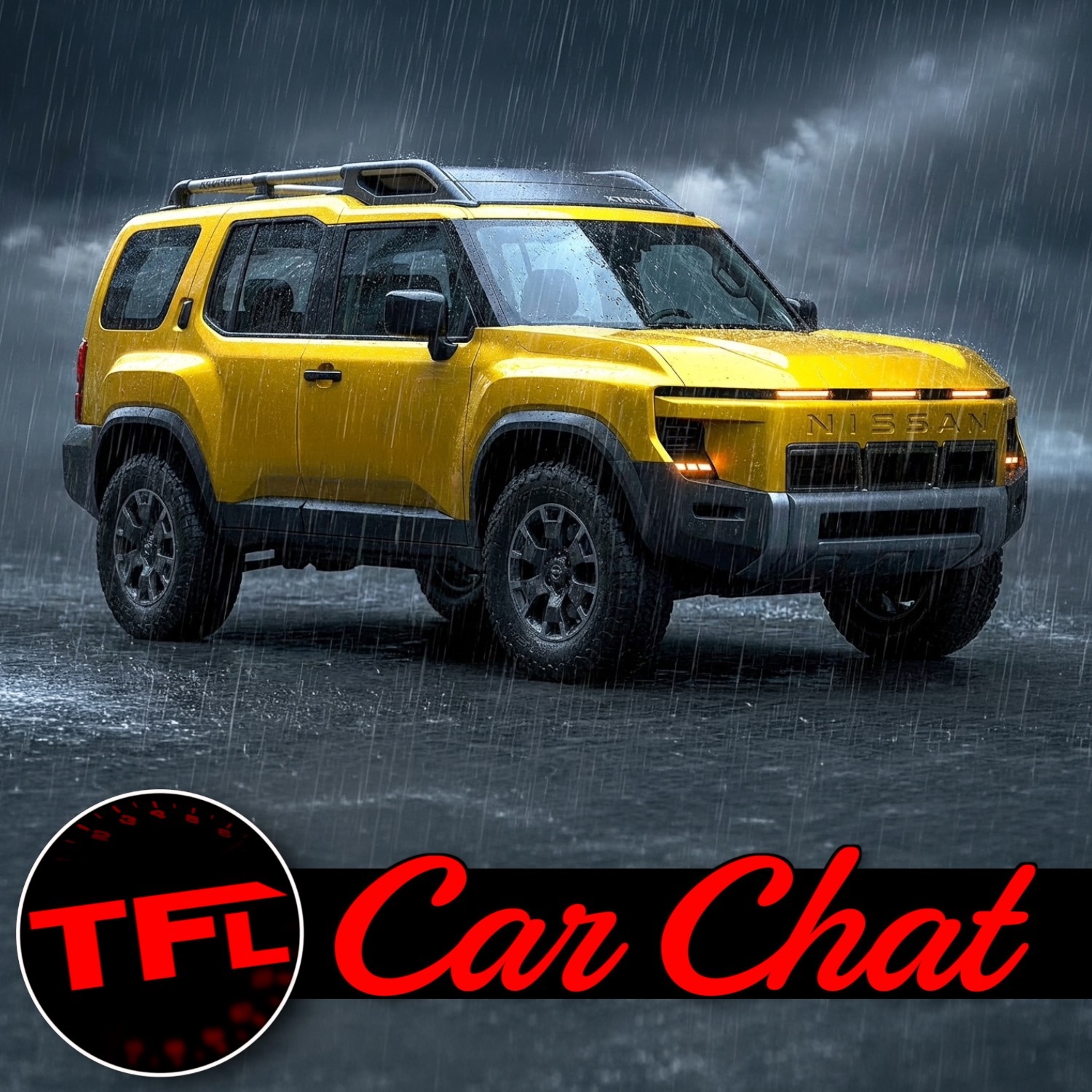
front end of the upcoming XTERRA
They’re focusing on the front of the next Xterra and describing the styling details. It’s a way to talk about how the new model might look before it’s officially revealed.
The Nissan Pathfinder is another Nissan SUV. The hosts mention it because the new Xterra’s front lighting and shape remind them of an older Pathfinder look.
The Toyota 4Runner is a rugged SUV that many people use for off-roading and long trips. The hosts say it became more popular when Nissan wasn’t selling the Xterra anymore.
Overlanding means taking long trips, often to remote places, and being prepared to drive off-road and handle basic needs without much help. The hosts say this lifestyle trend made off-road SUVs more popular.
CAFE rules are government standards that push car companies to make their overall lineup get better gas mileage. If the rules change, it can make it easier (or harder) for companies to sell less-efficient trucks and SUVs.
Body-on-frame is a construction method where the vehicle’s body mounts to a separate ladder frame. It’s common on traditional off-roaders and trucks because it can handle rough use well, but it often comes with higher weight and lower fuel economy than unibody designs.
The Nissan Xterra is an off-road SUV that the podcast says got discontinued. The reason wasn’t just sales—it was also because fuel-economy rules made it hard for Nissan to keep it profitable.
CAFE rules don’t treat every vehicle the same. Smaller or differently sized vehicles can fall into a category with tougher fuel-economy expectations, which can affect whether a model stays on sale.
The Toyota Prius is a well-known fuel-sipper. The podcast brings it up to explain that some very efficient cars can help a company meet fuel-economy rules when other cars don’t.
The Nissan Leaf is Nissan’s electric car. The podcast uses it as an example of how having very efficient vehicles can help a company meet fuel-economy rules when other models are less efficient.
The aftermarket is the community of companies that make replacement parts and upgrades for a specific car. The hosts say people were starting to build support for the Xterra, so killing it hurt that momentum.
They’re basically saying the Xterra is like Nissan’s Frontier pickup, but turned into an SUV instead of a truck with a bed. The idea is that it keeps the rugged, off-road-friendly basics.
They’re saying the Xterra and the Frontier use very similar core mechanical parts. That can make the SUV feel and behave a lot like the pickup, especially for rough roads.
This is basically Nissan saying they’re going to sell fewer different models worldwide. The goal is to focus money and effort on the vehicles that matter most.
They’re saying Nissan wants to build new cars faster—about 30% quicker than before. That can help them react to what buyers want and get new models to market sooner.
The Jeep Wrangler is a popular off-road SUV. In the conversation, it’s used as an example of a vehicle that many people already know well, so the hosts think buyers may want a new option.
Mitsubishi is another car company. In this discussion, they’re being talked about as a partner that helps Nissan build a new truck platform, which can affect timelines for other vehicles too.
A “product cycle” is how long it takes a company to go from planning a new vehicle to actually selling it. The hosts say recent supply-chain problems and trade issues have stretched those timelines, so new cars arrive later than planned.
Modern cars need computer chips to run many systems. If chip supplies are limited, carmakers can’t produce vehicles on schedule, so new models and updates get delayed.
Tariffs are extra taxes on imported products. If car parts cost more because of tariffs, it can slow down production and make new vehicles arrive later.
Concept
right offs
A “write-off” is when a company has to admit some planned spending or inventory isn’t going to pay off as expected. The hosts are saying these financial hits are part of why automakers are slowing down.
Packages and trim lines are ways automakers differentiate a vehicle without redesigning the whole platform. Packages bundle features (like off-road equipment or tech), while trim lines define equipment levels and sometimes different powertrain or interior options.
Rivian’s R2 is an upcoming/introduced electric SUV that’s meant to be a more attainable option. The point being made is that building a new car—especially an off-road one—is really hard, even for fast-moving brands.
Making a brand-new car is hard because it’s not just one thing—you need tons of parts to work together. And those parts come from many different companies, so everything has to be timed correctly.
Some car companies build several models on the same basic “skeleton.” That means they don’t have to design everything from scratch for every model, which can lower cost and speed up development.
Engine size is measured in liters, and 1.5 liters is a fairly common size for everyday cars. If many cars use the same engine size, it can be easier and cheaper for the company to build and maintain them.
Bosch is a company that makes car parts for many different brands. The idea here is that some automakers can use common supplier parts instead of designing unique ones.
Making a car costs money, and a big part of that is paying workers. If labor is cheaper in one country, it can make it easier for companies to build cars for less money there.
These are crash-safety testing programs. They put cars through standardized crash tests and score how well they protect people, so automakers have to design and prove safety to meet those rules.
When a vehicle isn’t sold in the US yet, it often means it hasn’t been certified to US regulations and safety standards. That can limit direct comparisons because the car may be a different spec or may not have gone through the same compliance process.
The Detroit Auto Show (historically a major US venue for automakers) is referenced here as the place where the hosts saw a Chinese automaker’s presence. It highlights how global brands try to build awareness in the US market.
This is a major auto event in China where car companies display their newest models. The hosts bring it up to set the timeline for how those cars later appeared in the US.
Chrysler is a US car company. The discussion uses it as an example of how a company might respond to pressure by selling fewer models or partnering with another market.
Profit margin is how much money a company keeps from each sale after costs. The point here is that a high-priced car can be easier to profit from, which is why some companies focus on expensive EVs.
An assembly line is a factory process where workers and machines build a car step-by-step in a set order. It helps companies build cars faster and cheaper, which is why it mattered for making the Model T affordable.
Part sharing is when different car models use the same parts. That can lower costs because the company doesn’t have to design and build everything from scratch for every model.
Cutting production time means building cars faster in the factory. The goal is usually to reduce waste and cost so the company can sell cars more competitively.
They’re talking about keeping the vehicle’s starting price below $40,000. That matters because many people have a hard budget limit, and crossing it can dramatically reduce sales.
Bigger tires help an off-road SUV get over rough ground and can provide better grip. They’re saying that buyers now expect larger tire sizes as part of the “real off-road” package.
Shocks help control how the wheels move when you hit bumps. For off-roading, you usually want shocks that are built and tuned for rough roads, not just for smooth pavement.
Roush is a company that works on performance and special vehicle packages. They’re saying Nissan’s Roush-linked off-road version looks promising, but it may not add the power people want.
A naturally aspirated V6 is an engine that makes power without a turbo. The idea is that it can be simpler and easier to live with, which some buyers prefer.
Four wheel drive means power can go to all four wheels, which helps on dirt, snow, or rough trails. They’re saying Nissan needs to make the truck feel genuinely capable, not just look the part.
Low range is a gear mode that makes the vehicle move slower but with more pulling power. It helps when you’re going up steep hills, crawling over rocks, or driving on slippery ground. It’s the kind of feature off-roaders rely on for control.
Buttons and toggles are the physical knobs and switches you can use without hunting through menus. Off-road, that matters because you might be wearing gloves or your hands are busy. Screens can be harder to use when you’re focused on driving.
Real door handles means normal, physical handles you grab to open the door. Some newer cars use touch or electronic systems instead, which can feel less direct. The hosts prefer the traditional approach for reliability and ease of use.
CVT is a type of automatic transmission that can smoothly change ratios instead of shifting gears like a traditional automatic. Some people like how it feels, but it can also be a concern if a brand’s CVTs have had reliability problems. The hosts are saying Nissan’s CVT reputation affected how trustworthy the brand felt.
The Toyota Crown is a car name used by Toyota for more upscale models. The podcast mentions it while talking about which brands are leading in a certain category. It’s included because it represents that “top” position in the discussion.
King of the Hammers is a famous off-road race in the desert that’s known for extreme rock crawling and high-speed desert sections. When the hosts reference it, they’re saying Nissan needs to prove serious off-road credibility, not just look the part. It’s a benchmark event for hardcore capability.
Easter Jeep Safari is a big off-road gathering in Moab, Utah, around Easter. Jeep uses it to show off special off-road vehicles and attract attention. The hosts are using it as an example of how one brand can dominate the spotlight in a specific place.
Moab is a famous off-road area in Utah with lots of trails and desert terrain. Many off-road brands and events happen there, so it becomes a “center of gravity” for off-road credibility. The hosts are saying you don’t have to always chase Moab to have real adventures.
The Wrangler is the Jeep SUV that’s built for off-road trails. The podcast talks about picking different trails to drive on, which is part of how people use Wranglers. It’s mentioned because it’s strongly tied to that kind of driving.
The Rubicon Trail is a well-known off-road route in California associated with Jeep’s off-road reputation, especially the Wrangler Rubicon. When the hosts say “how Jeep has a Rubicon trail, pick a different trail,” they’re emphasizing that off-road credibility comes from specific, recognized routes—not just marketing. It’s a discussion of brand storytelling through trail choice.
Topic
Grenadier Gathering
The “Grenadier Gathering” is referenced as another Moab event, used here to show that multiple off-road communities converge on the same destination. It highlights the broader trend of brand/owner events driving engagement.
Term
Extero
“Extero” sounds like it’s referring to the Nissan Xterra. They’re talking about how the Xterra looks and how it’s usually priced to be more affordable than some competitors.
“Stadium seating” describes an upright seating position and higher hip point that gives drivers and passengers a commanding view over the road. On off-road SUVs, it’s often used to improve visibility and make the cabin feel more spacious.
The Nissan Frontier is Nissan’s midsize pickup, and the hosts specifically say you can’t get it with a manual transmission. That’s used to support the broader point that manuals are becoming rare in this segment.
A manual transmission means you shift gears yourself with a clutch pedal. The hosts are saying that while manuals are fun, they can be tiring or less ideal for off-roading compared with automatics.
The Toyota Tacoma is a popular midsize truck. They’re saying manuals are loved by some people, but the data suggests very few buyers actually choose them.
The Jeep Gladiator is a Jeep pickup that offers a manual transmission option (as mentioned here), which the hosts call out as a notable exception. It’s used to illustrate that manuals still exist in the off-road world, but are limited to certain models.
A dual-clutch gearbox is an automatic that shifts gears very fast. It uses two clutches so it can be ready for the next gear ahead of time, which can feel great on a track but may not feel as “hands-on” as a manual.
Flappy paddles are the little shift buttons on the steering wheel. They let you tell the car when to change gears, even if the car is technically an automatic.
The Hyundai Boulder is a concept SUV Hyundai showed off, and it sounds like it could become a real vehicle. People are debating its looks because it resembles other rugged, boxy off-road SUVs.
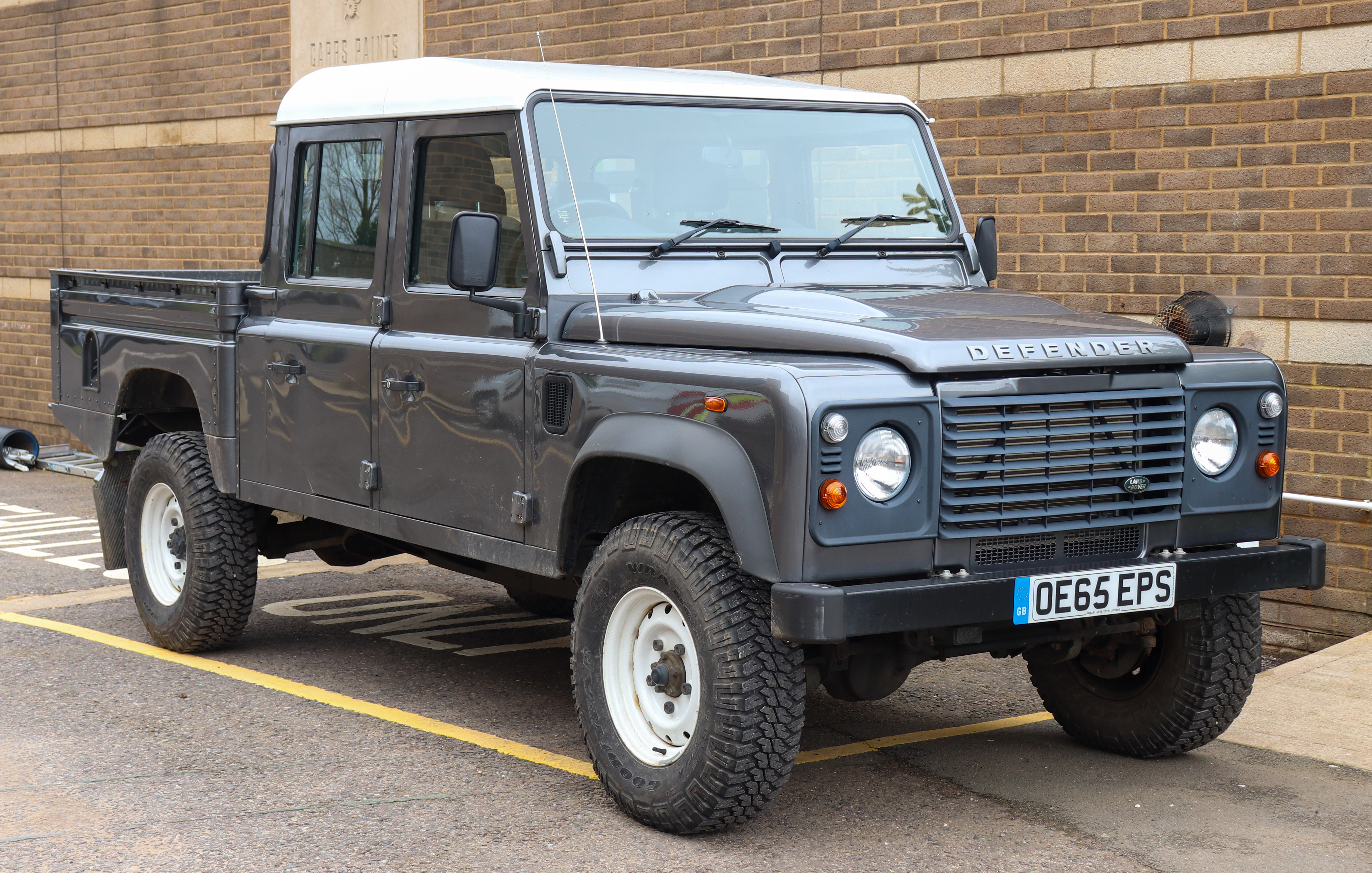
The Land Rover Defender is an SUV built to handle rough terrain. The podcast mentions it when talking about how some newer off-road SUVs look similar. It’s known for having a strong off-road look and purpose.
The Hyundai Santa Cruz is a small pickup truck. The hosts say Hyundai is ending it, and they’re using that as an example of what Hyundai learned (or should learn) about making trucks.
The Ford Maverick is a compact pickup that Ford made and it’s being held up as the better example. The hosts are basically saying that if you make a pickup, it needs to be the kind of pickup people actually want.
“37s” means very large off-road tires (about 37 inches tall). Bigger tires can help the truck clear obstacles, but they’re also heavier and can be harder/expensive to run.
Solid axle means the wheels are connected by a rigid bar, so one wheel can move while the other stays supported. That can help the vehicle keep traction on uneven rocks or ruts.
Approach angle is how well the front of the vehicle can “get up to” a hill or obstacle without scraping. Bigger approach angle usually means fewer front-end hits off-road.
Departure angle is how well the back of the vehicle can come down off a bump or ledge without scraping. Better departure angle means fewer rear-end hits off-road.
Recovery hooks are strong tie-down points on the vehicle for pulling it out when you get stuck. If they’re included from the factory, it usually means the vehicle is meant for serious off-roading.
A concept car is a “preview” vehicle that automakers show to hint at what they might build next. The final production version can look similar, but it usually changes to meet rules and cost targets.
The Kia EV9 is an electric SUV with three rows of seats. The podcast says the production version is very similar to the concept car that was shown earlier. It’s brought up because it’s designed to be practical for real family use.
Car
EV9 concept
The Hyundai EV9 is Hyundai’s electric family SUV. In this discussion, the “EV9 concept” is the earlier preview version, and the host is saying Hyundai often makes the real car look very similar.
The Hummer EV is the electric version of the Hummer, built to be a big off-road truck. The point here is that it’s expensive, and that price can make it harder to sell.
“G wagon” is what people call the Mercedes-Benz G-Class. It’s a luxury off-road SUV, and the host is saying it’s one of the few that still sells well because it has a loyal audience.
Range Rover is Land Rover’s luxury SUV. The host is saying that, unlike some other expensive off-roaders, Range Rovers are still selling well.
Concept
UV
“UV” here doesn’t sound like a normal car part or feature. The point the speaker is making is that regulations and rules can make it much harder and more expensive to design and build a vehicle.
They’re talking about rules that carmakers have to follow in Europe. Even if a car is built in another country, if it’s sold in Europe it still has to meet European requirements.
A range extender is an auxiliary power source (often a small engine or generator) used to recharge the battery and extend driving range in an electric vehicle. It can be packaged in different locations, and where it sits affects weight distribution and available space for towing hardware and payload.
A frunk is a trunk in the front of the car. Here, they’re saying the designers wanted that front storage, so they placed the range-extender somewhere that makes towing harder.
Towing capacity is the maximum weight a vehicle can tow safely, determined by factors like payload limits, hitch/tongue weight limits, cooling, and suspension capability. In this segment, the hosts argue that relocating the range extender under the bed constrains payload/tongue weight, which directly reduces towing capacity.
Tongue weight is the weight that presses down on the hitch from the trailer. If tongue weight is too high, the vehicle can feel unstable and may exceed its safe towing limits.
LIVE
Hey Tommy, imagine it's 2028 and you're in the market for a new, serious off-roader.
Imagine the possibilities because with all of our recent travels and all of our access
to the manufacturers, I think we're pretty safe in saying that they're going to be not
one, not two, but five. Get that five. Brand new. Serious, but serious. I mean like lockers,
plenty of ground clearance, rolling on 35 off-roaders. And so in this podcast, let's talk
about them. Let's talk about what we know, what we don't know. Yeah, you want to introduce the
five? Yeah, I'll introduce the five. So I actually got to see the new XTERRA. I know, I've heard.
Yeah, so there is a new XTERRA coming. It's been confirmed by the CEO and I actually got to see
it. Now, I can't talk about it, but I could kind of, you know, talk about the things that have been
out there. We can show pictures of it. So that's number one. Number two. And this is a little
bit on the sad side. You've seen this. You've sat in it. The new Scout. Yes. Which keeps getting
kicked down the road and we can talk about what's happening with that because we know why it was
supposed to be out in 2027 and now it's 2028 and maybe even further down the road. But we'll talk
about the issues that they're having with bringing that to the market. And then I got to figure,
Tommy, not a lot of smoke yet, but you figure that the JL Wrangler is getting old. Yes. So there
could be a new or there probably will be a new Wrangler. So what do you think it'll be? JL,
LM, NLM, JM? Yeah, that's right. Yeah, for sure. Yeah, I mean that vehicle is going to be 10 years
old in 2028 and they have 10 year product cycles on Wrangler, 2008 to 2018 and then 2018 to
2028. So it's going to be a huge year. There's more. That's only three. Okay. We're not done.
You can have a lot of choices in 2028. We also know through the grapevine, through keeping our
ear to the ground that there's a new GM, Jimmy coming out. That's right. Maybe even a ZR2 Jimmy.
Yeah, exactly right. So that's four. And then I forgot the fifth one. Hyundai Boulder. Yeah,
that's right. The new Hyundai Boulder. Thank you. That was just unveiled at the New York
Auto Show and that should be hitting the ground now. Hyundai has said that they're going to bring
out a truck first, but we can certainly talk about the Boulder and timing wise, it could be
around 2028. So there's going to be a lot of great choices when it comes to going off road. Oh,
and a refreshed Bronco. Make that six. Well, they're not refreshing it and probably be all new.
Well, there's a facelift coming because the last news I read was they're not facelifting it.
I heard that there was a facelift. No, the big news was that they were they were going to keep
it going. They were going to refresh it. It was selling so well. They didn't see a need to refresh
it. So they're just going to be a brand new one. Yeah. So it'd be likely that they would just go
to the next generation, but I don't think that would be 28. I think to be a little further down
the road. Could be. Yeah, that's where the newest of them. So which one of those do you want to
start with? Well, I mean, I think the big one, the one that we've got the most concrete information
on is the XTERRA. That's the one that everyone's excited about talking about. Now, we do have some
images both from Nissan and also rendering those to what it could look like. So this was
from Nissan. Am I correct in saying that? Yeah. And this is the front end of the upcoming XTERRA.
Now, if you're not watching this live, what we're looking at here is a bright yellow concept shot
in the rain. It's just the front fascia and you got this kind of line of lights across the leading
edge of the hood with the three marker lights. Very similar to, for example, the original Nissan
Pathfinder, then a very slab sided front end, very angular scoops leading to marker lights
down near the headlights and then a very sculpted out hood with a bit of a power dome in the middle.
Yeah. And you've got these like three air intakes in the front. And then you've got these three
matching lights that are there to kind of mirror the air intakes. And, you know, I think we have
to take a step back before we deep dive into the new XTERRA. First and foremost, Nissan,
you pulled the rug at the wrong time. And I think people at this point know that. They
basically got out of the market, left the market to the Toyota 4Runner just when
overlanding and offroading was becoming red hot. And I think what was happening back then,
when you think about the last gen XTERRA, it was very thirsty. It had been kind of long in the
tooth. And instead of Nissan, like doubling down on it, they decided to pull it from the market,
which was, I think at this point, everybody would agree, the wrong decision. And I actually had a,
I asked a question of the new CEO of Nissan, I said, why are you ringing back now? And his answer
was because of the new legislation that basically de-teeths, de-fangs the new CAFE rules, which
allows Nissan to start building body on frame trucks, off-roaders without having to have
more leaves and more arias, electric cars to offset the CAFE number that they would
lower by having these big, bold off-roaders. Do you know why it died in the first place?
I don't know why. It is because of CAFE. So I was talking to someone on that project who
since left Nissan and he gave me the lowdown as to why they killed the XTERRA, but they actually
kept the frontier going. So that generation of truck had two different form factors. It had
the pickup and it had the SUV and they killed quite famously the XTERRA and kept that frontier
generation for like another five years beyond it. And what happened was, I learned is the CAFE
numbers that a manufacturer has to meet is de-incentivize the smaller vehicles and those with
shorter wheelbases. And the problem with the XTERRA is it had a much shorter wheelbase and a much
shorter overall length than the truck. Therefore, it fell in a different CAFE, Corporate Average
Fuel Economy category or bucket. And therefore, it was expected to meet a much higher requirement
than it could meet. So they ended up killing that and keeping the truck. And they didn't have,
at the time, of course, like a Prius that could offset those numbers. Well, they, they didn't.
They had a leaf, but that was about it. And it wasn't selling very well. Yes. This is like
twenty-six, twenty-fourteen, twenty-fourteen, twenty-fourteen, twenty-fifteen. Yeah. I mean,
they did have some hybrids. They certainly in that period did. They had, of course, an Nissan
Leaf, which came out in 10, 11. So they did, they did have some efficient vehicles, but the XTERRA
and the frontier were so woefully inefficient and they were relatively small that they were
really hurting the overall economy number. So that was why the decision was made to pull the
plug on the XTERRA. And it was especially unfortunate because there was like an aftermarket
that was starting to build around the XTERRA. Our local Nissan dealership here was big into that.
You could actually start to build it out. And it left the field wide open for basically two vehicles,
the four-runner and the Wrangler. Yes. And each of those started selling, you know,
two hundred and three hundred thousand units a year. It was mind-blowing how much people wanted
off-roaders or at least capable cars capable of going off-road. And there were two vehicles
that were competing in that space. I mean, you have to put yourself back in that era, though.
Same era. We were there. I know we were there. Same era as the FJ Cruiser.
You got to understand that at that point, the XTERRA was a pretty aging platform. I want to
say that this generation debuted in 05, right? And if they killed it in 1314, which I think was
right around when they killed it, at that point it was going on eight, nine years old. And there
was a community around them. Certainly when it debuted, there was a huge community around the
first gen, but it never really picked up steam. I think largely due to lack of marketing that
the Wrangler did, that the four-runner had. All right. So I'm going to simplify this because
I'm sure it's a lot more complicated than this, but in essence, an XTERRA is a frontier without a
bed. Sure, but in the same way. Same powertrain, same suspension, you know, same chassis.
But that's like the same thing. It's like saying a four-runner is a Tacoma without a bed.
Yeah, it is. But so it wouldn't have been difficult when the new frontier came out,
instead of putting all that money into the Titan for them to also introduce a new XTERRA,
which unfortunately they did not. And this brings me to the second point. Now, I was just in
Japan at Yokohama, which is Nissan headquarters. Thank you very much, Nissan, for flying me out
there. I had a chance, like I say, to ask the CEO questions. A new CEO. Obviously, they've gone
through some CEOs. They've had some challenges, but we don't want to get into that. That's a whole
different podcast. But one of the things that they have said is that they are trimming their
worldwide product line by a lot. So they're they're focusing on their core vehicles.
The other thing they're doing is they're speeding up the amount of time it takes them to develop a
vehicle by about 30%. This is what they said. So instead of taking five years, it's going to take
three years. And my question with that is if that is indeed the case, why is the XTERRA not
coming until 2028? At this point, they would have they would be the the new bell of the ball.
People are kind of getting bored of Wranglers and forerunners and Broncos. And they'd be,
you know, right at the sweet spot of when the market is looking for something fresh and interesting
and different. But in 2028, they're going to be there with four or five, six other vehicles
that are going to be newer, refreshed, competing for your dollars. And that that's the part I
don't understand because I went and saw it. And I can't talk about that what looked. But what I
can tell you is Andre did a AI version of it. So Cole, can you bring up that AI version?
He's not far off. Okay, that's as that's as much as I could say. He's not far off.
So so why is it going to take another two years to bring this to market when there's going to be
this plethora of other competitors out there? Well, it makes sense. Maybe it's not the right call,
but it makes sense if you look at what Nissan's doing. So do you know about the next generation
frontier? So what they're doing with the next generation frontier, once again, I think not
officially confirmed, but largely known is it's not going to be based on the current platform.
It's actually going to be developed in partnership with Mitsubishi. So Mitsubishi has a small youth
that they sell around the world, right? And that next generation of truck is going to be co-developed
with Nissan. So the next frontier is going to be an all new platform. And then in theory,
the next dexter is going to be based on that co-developed platform with Mitsubishi.
So I'm going to just take a step. Let me put it this way. Let's take like, let's go 30,000 feet
in the air right now and look down at what's happening in the market in general. What's
happening is because of COVID, because of chip shortages, because of tariffs, the product cycles
for development have gotten longer, not shorter. This year, we're supposed to get a new
F-150. It looks like that's going to get delayed. And what we're seeing is manufacturers pulling
back because they're taking these huge right offs. They're of course blaming electric cars,
which is to me seems like an easy scapegoat, right? Ford rode off 19 billion, Honda just
rode off 15 billion. And they're having to then basically batten down the hatches. And instead
of coming out with new vehicles and new products, making that product cycle longer, coming out with
like Jeep is doing it the Wrangler, right? They've got 12 for 12. So they've got 12 different,
like they're not models, they're there like packages and trim lines to breathe a little bit
of excitement into the Wrangler lineup. And I kind of look at it from top down. And I say to myself,
the Chinese are shortening product cycles. So they're doing it in two years. I mean, incredibly,
they're building completely new cars in two years. And one of the reasons they're doing that is
because they do a lot of shared componentry, which our manufacturers don't do. But anyway,
to me, it seems like instead of focusing on what they should be doing, which is like, you know,
let's kick our, you know, let's kick this into high gear. Let's get this thing out the door.
Before it's too little too late. What they're saying is we need to partner with people the cost
of developing these things is too much. And by the time it actually comes out, it's just going to be
too late. Either the economy is going to change, or there's going to be a new administration and
we're going to get different legislation that's going to make these body arm frame vehicles
harder. So like they seem to have forgotten like strike when the iron is hot. And right now,
there's this huge demand for these vehicles. People are especially interested in having kind
of active lifestyle vehicles. You can see it with Honda Honda now has three different trail
sport versions. And yet the excitement is there, but the product isn't there. And I would say
Rivian has done the same thing, right? Instead of doing the R three, right, the off-roader,
they've come out with the R two. Well, what we're discounting is how unbelievably difficult it is
to develop a new car. You know, if you figure a car has well over a thousand parts in it,
and those are a thousand parts that are manufactured across many different suppliers,
it takes an incredible amount of time and resource to develop an all new vehicle.
Yeah, I would say you'd be right, except for the Chinese somehow manage it. So if the Chinese can
do it, why can't Nissan? Well, I think that certainly there is why can't the legacy brands
learn from there is certainly the cultural aspects of the Chinese automakers. I mean,
I think from from what I understand, there's this understanding you work seven days a week
and you work 12 hours a day in China, right? Yeah. And I think that that there's also just a lot less
cost maybe because of labor prices and developing a car in China, right? So it's a different
environment than what we're dealing with in kind of the Western world. Well, that's, you know,
that's all true, right? But what that leads to is no more Nissan or no more GM, because
in a free market in a competitive space, the company that's willing to innovate, work harder,
work cheaper, work smarter is a company that's going to win. And so what you're saying is,
you know, we're not competitive anymore. But you also told me something interesting,
which I find very intriguing. You were saying that talking to your journalist buddies,
a lot of the vehicles in China are all kind of the same car underneath.
Yeah. So that saves a lot of time, though, dad. So there are three things really that make the
Chinese successful. Number one, and I didn't know this is because of the Chinese government,
the stuff you don't see in a Chinese car is the same like all those Chinese cars that are hybrids,
they all have the same 1.5 liter engine. I think it's Mitsubishi unit actually,
like the windshield wiper motors are all the same. So all the stuff you don't see is shared
componentry. So when they go to develop a car, they don't have to go to like Bosch and different
suppliers and say, Hey, we need this part specifically for this car, they're going to
use stuff that's off the rack. And so the design is easy to change if you don't have to change the
kind of the, you know, the basic architecture of the parts that are in the car. And so that's
one of the things number two, cost of building a car is much cheaper in China, because of labor
costs. You know, one of the things that manufacturers will tell you it's impossible to
hire America for under $20,000 because even in right to work states, our quality of living,
our demands for what our workers want is so much higher than it is in China that you just
can't do it. And I think that's absolutely true. And number three, like you said, these guys,
you know, are breaking all the rules. They're working super hard, super diligently. And I'm
not sure that in the West, I don't want to say we've gotten soft, but when you're facing fierce
competition, you can't all of a sudden start negotiating contracts and, you know, you have
to understand that the rules have changed and you got to play by the new rules.
Yeah, but I think also historically too, I think that this is changing very, very quickly. I'm not
saying it is the case now, but certainly a few years back, they also just had a lot less hoops
to jump through. You know, their crash test standards were far less than what we experienced
in Euro NCAP and NHTSA, right? So it was perhaps easier also to develop a new model. And I think
that's changed a lot in China in the last couple of years, certainly, but perhaps there were also
legislative play things in effect that made it simpler to develop a car. Yeah, no, no, right.
So I just don't know if they're necessarily comparable because, and especially because
those cars aren't sold in the US. Yeah, not yet. So it will be 2012. We were at the Detroit Auto
Show and there was a Chinese automaker at the Chinese Auto Show. And I remember in 2012,
you told me, give it two years of these cars will be here. And that was the 2014. It was the same
thing. Give it two years and then 16 and then 18 and then 20 and then 22. Back then, those cars
were pretty crappy right there. They were getting pretty good. But regardless, they were cheap and
they would have sold, right? Yeah, like Kota did it right. So they were here and it didn't sell.
But they were expensive. Well, they were crappy. They were Kota was pretty crappy. They were bad
cars. This is from that time that they were in Detroit, like you said, in 2010, 2012. But since
then, they have made incredible these look, I'm not I'm not trying to fanboy the Chinese car industry.
They have a lot of advantages. All I'm saying is, you know, it's easy to point to the reasons you
can't compete. But all that gets you is being out of business. At some point, the reality of the
situation is that I think this administration would probably be happy if, let's say, Chrysler
decided that they're only selling one car and they have a factory that's idle right now,
just sell that to the Chinese or sell the brand to the Chinese and it wouldn't be hard for the
Chinese to start building cars in America and rebranding dolphins as Chrysler's. I mean, that
that's a very obvious already doing it, but it's not going very well. They're not doing it yet.
Polestar four is a seeker. Yeah, but but like exactly a seeker. It's got actually a worse
architecture, but it is a seeker. Yeah, but it's not built here. It can be built here. It's not.
I mean, there are Chinese factories here already because Volvo is owned by Chinese and Volvo does
have a factory here. But these are these are these are up. Once again, you're following.
It seems like everybody is following the wrong model, not the Henry Ford model, the following
the Cadillac model when it comes to electric cars. Instead of building a car that everybody can
afford, they're building the very expensive car that nobody can afford. Which makes sense. Be that
Tesla, be that Lucid, be that Rivian. It's easier to make money selling expensive cars.
Well, Ford made a boat ton of money selling cars to everybody, but that was a different era. No,
I think people are especially now with the way the economy is going. I think there's a huge
opening there to actually start selling affordable cars. That's why right now used cars are having
a moment because people can't afford new cars. I'm not saying they wouldn't sell. I'm just saying
from a manufacturer standpoint, the profit margins on a million dollar car versus the profit margins
on a twenty thousand dollar car. It costs arguably more to design and manufacture the small car,
but you make a lot more money on the expense of those economics were the same in the 1910s when
Ford came out with the Model T was much cheaper to develop cars than no. No, I mean, it was the same
problem except that he came out with an innovative thing called the assembly line to make a cheaper
and the Chinese have come with an innovative thing basically part sharing. So so I'm saying,
yeah, you could you could come up with excuses all day long while you can't do it. But at the
end of the day still leaves you in bankruptcy court. And this is my biggest fear. You can't
you can't keep doing business the same way it was done five years ago. You got to start to
change the way that you're doing it. And what Nissan said was we're doing that. We're cutting
our production time. We're, you know, taking 30% out. We're concentrating on core models. I'm just
not sure if that's enough. Like I say, right now, strike when the iron is hot is when the extra
would sell like hotcakes. You could easily sell if they had one ready to go out the door today.
I would say you could sell 100,000 units like that. Well, the smart thing that Nissan's doing too,
if you check that car and driver article here, Cole, they also said that they want to target
the price point under $40,000, which would be massively successful. And this is a quick side
profile of what it looks like. So what does Nissan need to do to the sex there to make it
successful? Well, yeah, I, you know, so I can talk about that because I know what they're doing,
but I could talk about what they need to do. I think there are a couple of things that they
first of all need to do. Number one is to make it to make it competitive. Let's let's use that word.
I think they need to have a vehicle that can come out like Ford has done on 35s if you're doing
an operator. Yep. So 33s or 32s aren't going to cut it. You're going to you're going to agree
that's kind of the new standard that 35 is a new 33. So you're going to have to have big tires.
You're also going to have to have some kind of a special shock absorber, I think. So be it King,
Fox, whatever, but it's got to be branded and it's got to be different. And they've kind of taken
the step toward that already with their partnership with Roush with the new frontier. Sure. The problem
with the Roush frontier is that there's no more horsepower. Right. I'm not saying that even horsepower
next year. I think there's enough excitement around that without having to add the horsepower.
Now, what folks are saying is the new front, the new exterior is going to have two engines.
It's going to have a naturally aspirated V6 and a hybrid V6. I can't say anything. So
well, I don't know what you know, but I think that fundamentally the that's probably a good
plan. People do want a very durable, simple car now. That's kind of the rat we're leaning toward in
2026. And I think that that trend will continue through 28 when it's debuted. So I think it's
very smart that it'll have a NAV six and a hybrid V six potentially. And I think that what it
really needs to have to is that authentic authenticity as to what a four wheel drive is. So if they
basically do a rogue Rock Creek, it's not going to work right now. It's got to have a certain level
of hardware that makes it a machine people can have genuine adventures in, or at least perceived
adventures in. Yeah. And I think they're already already, they've kind of already crossed that
threshold by saying its body on frame. So I think you need to have a low range. And then in terms
of design, I'm one of the greatest things that the old exterior brought to the table was that
stadium seating. So I think they're going to have to have stadium seating. I think you need more
buttons and toggles and less screens. Yeah, I agree. I also think you need real door handles. I
think you need vents that you can operate with your hands that with, you know, a swipe on the
screen. And I think the thing has to be above all just honest. I think that's what is at the core
of Nissan. There are a couple of things that are Nissan DNA, right? First and foremost is reliability,
which they kind of lost when they introduced the CVT and they kept doubling down on it that
was a jaco CVT that they got co really hurt them. So it has to be reliable. So you're going to have
to compete with Toyota. It's going to have to be affordable because Nissan is an affordable brand.
And right now what's happened is that the Koreans have taken that that crown away from Nissan because
Nissan was always a Japanese company that had value for money. So affordability is called
the value for money. And that's going to have to have some kind of, you know, serious off road
cred. So they're going to have to somehow show whether it's doing a King of the Hammers version
or I was thinking about this, you know, how we just came back from the Easter Jeep Safari.
There's a lot of other things you can do outside of like one of the things that was always weird to
me is that the Bronco kind of stepped on cheap's party because they were doing all this activation
in Moab at the same time the Jeep was celebrating their brand. And it just felt like you're crashing
someone else's party. There are a lot of kind of off road events off roady trails that you could
hang the exterior around that isn't Jeep based. In other words, you don't have to go to Moab.
There are other places in the country that provide similar things. They do have a Nissan off road
event. Yeah, yeah. What's that? I don't know what's called, but it is in Moab. Yeah, but I'm just
saying just get away from Moab. You know how Jeep has a Rubicon trail, pick a different trail,
pick a different event and get get your customers involved. That's what I'm saying. You have to
have some kind of a customer activation. There it is. It's called Gone Moab. It's the Nissan.
Of course it is. Yeah, for Nissan truck SUV owners. I don't know if there's any more weekends that
are free in Moab between Toyota and Land Rover and Jeep. You kind of filled up the calendar
in Moab. So pick someplace else. How about Sedona? Let's make Sedona the capital of the
extero world. I mean, but I think it is cool that they all kind of come to Moab on different
weekends. I mean, cruise Moab, you've got Easter Jeep Safari, you've got the Grenadier Gathering,
you've got the solely whole society does their event in Moab. So I mean, it's all,
like it is the best place in the world. So build a community, make it reliable,
slash make it valuable, make it authentic. In other words, make it real, like you said,
genuine. So I think that's what they need to do. I think you like the yellow color?
I think the color is good. I think if you look at the design, Extero has always had,
especially with that stadium seating, has always had kind of a unique shape. I mean,
I think the most important thing they can do is they're going to have to keep it affordable,
because the segment is so popular. There's so many great entrants in there that people can buy.
If they can keep the price down, which has always been one of the staples of the Extero,
it has been less expensive than the Wrangler or the Toyota. I think that would be a huge selling
point. How about manual? Does it need a manual before we move on? No. Can you get a manual on
the frontier? No. So it probably won't have a manual. No. I mean, I think that it's a cool thing
to feature, but I just don't think that the, I mean, like everyone loves the manual in the Tacoma,
but I think I was reading that the sales numbers on them are just abysmally tiny.
Let's talk about that for a second before we move on. So I love manuals, especially love
manuals and sports cars, but manuals and off-roaders are problematic. They're just...
They are bringing it back, though, in the Gladiator. And you can get the Bronco in a manual.
Yeah, you can, but off-road manuals are just not as good as automatics. And you could say
the same thing about like a flappy paddle, dual clutch gearbox is better on track than it is on
than it is as a manual because you have less to think about. But the fact is, on-road,
a manual is more engaging. But the type of manuals that you tend to get in off-roaders are big and
clunky and heavy because you need that for off-roading. And so they're not exactly a lot of
fun to drive when you're on-road, at least in my mind. And they're certainly not a lot of
fun to use off-road because they're problematic. All right, let's go on to the next one. I want
to kind of talk about the next car. So I want to talk about the newest entrant here, which is
very interesting indeed. That's the Hyundai Boulder. So this car was revealed as a concept in New York,
but it is hinted that they are going to put this into production. We do know that Hyundai is working
on a body-on-frame truck and SUV. This is a body-on-frame SUV. So this car is getting a lot of
controversy based on its styling. People are saying it looks a little Bronco. It looks a little
Defender. You know what it looks like. Cole, if you can Google this, I know you've got a bloody
nose. I'm sorry, are you okay? Poor Cole's producer's got a bloody nose. So can you Google the concept
for the Bronco? It's a 2004 Bronco concept. This is the thing that people are saying and they're
not wrong. I think it's more that it's just silver, but there is definitely some. So that's the Bronco
concept. We're looking at a Bronco concept, and if you compare it to the Boulder, they're very
similar. There are elements, but I also think a lot of it is because it's just the same shade of
silver. Well, that very flat front end. Yeah, I see that. The lights, the way that the shape comes
down the side, right the way they make that. Listen, guys, at the same time, there's only so many
ways you can design a box. You know, like if you want a box SUV, there's only like a square SUV.
Squares typically look all the same because the square is a square. So it's tough to make a
square look very different than the other squares. So let's talk about this. So I hope they've learned
the lesson. Hyundai has just announced that they're killing the Santa Cruz, which is their compact
pickup truck. Yeah, and I hope that they've learned the lesson in that lesson being that Ford built
the compact pickup truck called the Maverick. And if you make a pickup truck, make a truckie, not
lifestyly. And so if you make this off roadie and not lifestyly, then you're going to do better.
And what I mean by that is the problem with the Santa Cruz, which I love was that it was kind of a
surfing kind of California design where if you wanted to show that you were active and you were,
you know, youthful and wind in your hair, then you would get this. But in the end,
it only sold between what like there's like 20 to 30,000 units a year, whereas the Maverick was
selling over 100,000 units a year. And that was just basically a very useful utilitarian
truckie truck. And so I think the lesson there is if you're going to build an off road or make an
off roadie, and make it give it a low range, make a body on frame, make it everything we
just talked about the exterior being potentially, as opposed to making it like, like, uh, like the
pro four X, not the pro four X XRT, right? Where you're taking a vehicle that's basically designed
to go on road and then you're like throwing parts at it to make it look off roadie. Well,
certainly with this concept, they have taken your, your input into mind because this is a
properly American sized and capable looking machine. I mean, if you look at those tires,
I think these are 37s, minimum 35, if I remember right, solid or axle body on frame. So it's already
the formula as well beyond what the Santa Cruz or any XRT model has ever been. You look at the design,
it looks like they've thought about approach angle, they've thought about departure angle, right?
This is a vehicle that if it came to production like this, I think would be
a serious contender in the four wheel drive space. Now it also looks pretty premium and
expensive. People are comparing it to vehicles like the Defender, which I, I do see some design
similarities there as well. Um, but I mean, as a halo product, I think that this could be
monstrously successful for Hyundai. If like you said, they put the steps in place to make sure
this is a very, um, capable machine. So my, uh, my criticism of this design 37, yeah,
is that I see a lot of like concept the vehicle, like the kind of stuff the designers like to
build, but never get, never get implemented when actually like, look at those recovery hooks, right?
The stuff that looks cool and would be cool to actually include, but because of production
costs and because of reality of building a vehicle and because of legislation you could
never build. So this feels to me like a concept that is just that a concept. Well, it's going to get,
it's going to get severely toned down when it goes into production. One thing Hyundai is very
good at is making the concepts look identical to the production cart. Sure. So I, if it was any
other brand, like if it was Subaru, I'd say, yeah, the production version is not going to look
anything like this, but Hyundai has a pretty and key, especially as like, I just was in
Milan for design week, looking at the, some of the key concepts. And if you look at the EV9
concept and the EV9 production car, basically identical. So, you know, there's a good shot
that if they commit to this, I think it very well could look quite similar to this concept.
Yeah. Like I said, my issue, Tommy, is when if you put, if you were to put that vehicle on a
production, that'd be a nine MPG off-roader and that's not going to fly from either, you know, a
corporate leadership role. They're going to be looking at it like nine MPG, that's not going to
happen, or especially now, or from now it could happen because there's no legislation on corporate
no, not with gas at four or $5 a gallon. Oh, people are still buying the high end of the
market is still buying gas because I'm saying that that's not that's not a Bentley or Rolls Royce.
Those people do care about the MPG. And yeah, yeah, once you get to the trail, it'll kill,
but getting there will, you know, suck your wallet dry. And so I think you're going to have to,
you're going to have to make it more realistic. And I'm not sure the Jeep tried it, right? Jeep
tried to go and build a Wrangler that was $120,000 when the 392 first came out
with the AEV version. Remember that? And didn't fly. It's just that there's a ceiling there.
And I think Hummer tried it with the EV. It also didn't fly right. Right now the Hummer EVs
are sitting on lots. That's because it's electric though. That's not because it's
I think it's also because it's too expensive. I think that there's a ceiling, but they can't
keep luxury off-roader. They can't keep G wagons on the lot. But that's the G wagon is its own thing.
And Range Rovers are selling really well too. Full-size Range Rovers, but they are off-roaders
fundamentally. They have a low range. Once upon a time they were off-road. Yeah, but no one takes
G wagons off-road. But this thing is not a G wagon. No, it's not. You're not going to sell a G
wagon at a Hyundai dealership. Yeah, that is the biggest issue with this. You're exactly right
about that. But I do think that, look, if they make this a legit four-wheel drive, there is a
market for it, even if it is quite big and fuel-efficient. Let's go to the comments section
really quick, Cole. So if you want to follow us live, patreon.com slash TFL car, we do these
live streams a couple times a week and you can leave your comments and we'll read them live on there.
Can I do a little plug for your car-ish, Tommy? Yes. Car-ish after a long hiatus is back. That's
right. Every two weeks. And so Tommy, Jen and Kase are back having fun with cars. So if you aren't
into all this kind of deep dive, you know, in the weeds kind of stuff and you just want to
have fun with cars, that's a really great podcast and it's on the same YouTube channel as this.
So Jason Lee says, hello, Roman and Tommy. What are you picking up your Discovery One?
That's what we were just talking about yesterday. I need to get my ass in gear. Yes, I get over
there every week. I asked Tommy, when are we going to get that back? And every week, he gives me
some excuse. So I'm completely giving up on it. I've been. Thank you for reminding. I've just
been so busy, though. It's been a tough month, April. Dude, just call a shipper. No, but I want
to go out there and actually spend the weekend with my guy. I think that'd be a lot of fun.
Tad says, every manufacturer needs to develop a body on frame with UV. Well, it takes a huge
amount of effort to develop a car. Chinese don't pay attention to regulatory burdens or labor laws.
Market trend for those vehicles was self-evident over a decade ago. Well, first of all, that's not
true because they're building cars in Europe and the Europeans are very strict when it comes to
labor laws and regulatory issues. They're building cars for Europe, but they're building them in
Europe. Yes, they're building factories in Europe. So so hold your horses there.
And even if those cars are built in China, they still have to meet European standards. So Euro
cap, whatever you're always on. So you can't. I mean, you can't just be like, hey, we're not going
to have a crash tested. We're just going to start selling in Europe. So so I just as a journalist,
I just need to like fact check you pretty hard on that. Sure, maybe the cars that are sold in
China don't meet the same regulations that we have in America or we have in Europe. But the cars
that are built in Europe or sold in Europe have to meet those regulations. Yeah, and maybe and
you're right, there was just a big story where they started the Chinese BID started building
cars in Brazil, and they used a subcontractor. This was a big story to build the factory. And
basically they imported Chinese labor that were treated like slaves, allegedly, and they just lived
and worked 24 seven to build that factory out and the Brazilian government turned the other way. So
yes, there are things like that that happen. But in general, if you're going to sell a car in America
in Europe, you have to have that car meet our regulatory. And if you whether you agree or
disagree with that, that's a whole nother conversation. Elias has agreed with Tommy that
it's a similar color. So yeah, I mean, I think a lot of the designers love silver.
If they had painted that thing red, I think a lot of people wouldn't have made that comparison
to the 04 Bronco concept. But I'm really hopeful for that boulder. I think it's going to be really
cool. Do you want to go to the next car? Yeah. So the Scout is another vehicle that we know.
What? Oh, God, the Scout, I love it so much. I love it. Love it. Love it. I think the concept
of it, the one that you walk through the one that we've seen is such a we have we have a we have a
reservation for one. I love the fact that it's a range extender because they're having a moment
right now. But yet the fundamental I think mistake that they made was they wanted to keep the frunk
and in doing so, instead of putting the range extender under the hood where it probably should
be, they stuck it under the bed and that creates all kinds of engineering problems,
specifically having a vehicle that can tow because what ends up happening is when you put,
you know, it's going to be a corporate Volkswagen four cylinder, right? When you put that under the
bed, you severely limit how much the vehicle can tow because you limit payload and you limit
tongue weight. I mean, that is exactly true. But the weight is weight, whether it's in the
no, it's in the back. It can't put it behind the rear axle. I had a long conversation with
our friend Sam was an engineer. This is absolutely true. It limits tongue weight. And what you
end up doing then is you end up severely limiting the amount of towing. And the problem is that the
scout is a big vehicle. You saw it. I haven't been next to it. You saw it. This thing's like F 150
size. But they I think they announced the towing already. It's pretty big. No, no, no, they see
your phone. I'm pretty sure they did. I think it's 10k. No, no, it's not. They haven't they
they're hedging and hauling about that. And what they're also hedging and hauling is about when
it can when it can be available. So I think they announced towing at 5000 and a vehicle that's the
same size and potentially the same market as an F 150 can't tow 5000 pounds compared to an F 150
that tows at least 10,000. I don't think it really matters. I mean, this is an electric first and
foremost electric vehicle. I don't think people are buying this to really toe. Well, I mean,
that's the reason you've got the range extenders. Yeah, but no, it's you can go on road trips and
off road. I mean, this is an adventure vehicle. I think you're wrong there, Tommy. This thing's
going to be very expensive. It's going to be quite luxurious. And I mean, I think there will be a
small percentage of people that tow with it. I just don't think it's going to be big. I mean,
the reason that 95% of the reservations were not for the electric vehicle, but were for the range
extender is because people hate electric cars in the US, not because people hate the reason is
because it's you can have your cake in you too. You can tow across country. I'm pretty sure you
can just blow it up with gas. They didn't announce towing targets. Are you sure? Yes, it's I'm
positive. Interesting. I actually think it's very smart for a range extender to not have the engine
in the front. I think that's a really smart decision because the advantage of a range extender
isn't there. You can get away with a much smaller engine and therefore you don't have to put it
in a massive cargo area, right? You can get away with putting it underneath the bed floor,
underneath the storage floor. So if they can pull it off, I think it's going to be
a really brilliant piece of packaging. Well, apparently they're not pulling it off because
they've now pretty much confirmed that it's going to be at first it was one year and now they're
saying two years delayed. And some people are speculating because of the story that came out
in Germany. And I think it's is it that build? Yes. But then they and then then basically Scott
Kehoe who's the CEO who came from Audi kind of hedged and hard when there was a press day. And
now 2029 because they're having a really hard time engineering that engine. At least that's
speculation. And they've got they're hiring people. They're building out of factory in
one of the Carolinas. I don't know if it's north or south Carolina, but they're really struggling
with getting this thing to market. I think it's speculation from engineers is just because of
that. Interesting. I mean, look, mid rear engine cars are not hard to do. We've done them for the
past hundred years, but it's a truck, right? Yeah. But even that's been done. I mean, we did it in
the successful truck that's been rear-engined. Well, I mean, I mean, I the only one I could
think of is the, uh, uh, what's the GM, uh, they did a little truck Corvair Corvair. That's the
only one that I can think of where they stuck the engine in the back and that was anything but
successful. Yeah. But I mean, it's not, it's not an impossible hurdle to do. And I think ultimately
to make a vehicle like this interesting, you have to take these bold steps, right? You can't
just do the same thing. I'm not, I'm not opposed to bold steps, but if those bold steps mean you're
two years behind. Sure. Uh, you know, when the, when the vehicle is going to get built, that's
going to cause a lot of issue. And it's not just the timing of the thing. It's also the expense of
it. You're also spending a lot of time engineering something, uh, when you're not actually selling
anything. From what I've heard, the reason it's, it's more delayed is, is, it allows you to do
issues. The Volkswagen auto group is, is not doing as well as it has in the past.
Well, nobody's doing as well as they have in the past.
He just had their best year ever. Um, except for the Koreans. Yeah. And I think that, um,
you know, the budget issues mean that they have to put more time and resources toward other,
potentially more profitable short-term projects. And therefore scouts getting pushed off. But
whatever the issue, I mean, look, it's like two years seems like a long time in our world,
but in the grand scheme of the automotive space, it's not really that much time.
No, in the grand scheme of the old automotive space, it isn't that much time, but in,
in a time when the ground is shifting underneath you, it's a huge amount of time. And what you
can't be doing, especially these days is, uh, because, because I think what, what ended up
happening is, um, you've got the Tesla effect where people are no longer, um, there's two,
there's a couple of things that happen. Let's go above, let's go fly above the ground again,
let's go 30,000 feet in the air. First, Tesla came out, uh, and promised a lot and didn't
deliver a lot. And so in the past, when companies promised stuff, most journalists and most,
most, I think consumers believed them. I mean, look at the roadster. Sure. Right. That that's
been promised now for seven years. And so I think there's now this natural, I think, uh,
skepticism when it comes to any company promising anything, because you're like, I don't believe
it until I actually see it. I don't believe it. And so the excitement that's always been the case
with Tesla. Yeah. But, but the problem with that is, is that also because of the internet, the, when
you, when you, when you roll out a product and there's a lot of buzz around it, and I'll give
you an example of that. And the Volkswagen group is the one that really put their foot in their
mouth on this one, the ID buzz, right? They rolled that thing out like six years ago. There was so
much excitement. And by the time the vehicle actually came to market, there was no more buzz
around the buzz, right? The moment had passed. Yeah. Nobody cared about it. And the thing just
flopped on its face. And it cost them, I'm going to say millions, if not tens of hundreds of millions
of dollars, because they waited and took too long to bring that to market. The moment was gone.
Right. And instead of having a, you know, a successful vehicle, they ended up with a flop
that they're no longer actually importing because they've got too many in the ground
that they can't sell right now. And that's my fear for the Scout. I think Scout at this point is
heading down that exact same road. I mean, when you went to that program, there was so much
excitement around it. And now, every time Scott Keogh gets up there and says, well, it looks like
we're having trouble, blah, blah, blah, blah. It doesn't matter the reason. The timing is gone,
and the excitement is gone. And by the time the thing comes out, and it's going to come out as
always more expensive, this is another thing that's happened, right? Cyber's truck was supposed to
come out at what 39,000 came out at 120,000 for the Cyber beast. The F-150 Lightning was supposed
to come out at 29 or 39. That held for like two and a half weeks. And then it went to 80,000.
And I think people are jaded and they don't trust it. And it's just a recipe for creating a flop.
I mean, it's not fair to say it went 80,000. It went from like, yes, but that's because we
got a fully loaded Lariat. It went from 39,000 to 47,000, just to be fair. It went up a lot,
but not by double. That's for the small battery, which was not going to fly to begin with. That
was 150 miles around. That was a starting point with 40,000 and then it went to 47,000.
I think that, listen, it's like, I agree with you that there is a danger that you
especially when you reveal a car too early. But there's also precedent to say that delayed cars
can be the most successful cars in the world. Model three. Model three, if you recall, was
delayed and it was delayed and it was delayed and it was delayed. And then it was a massive hit,
regardless. Same thing with the Model Y. Massive hit, right? Model Y now the best selling car,
I think in the world, isn't it globally? Yeah, but those cars had that fields of themselves.
There were no competitors. And that's a whole different ball game than if you have a crowded
market where you have players like the Chinese coming in and already building these cars that
already exist. Model Y still had a competitive market. What was what was compete with the Model
Y? ID four was out. Mustang Marquis was out. Right. These were cars that were all on them.
It's not fair to say it had it all to itself. Like it was, I mean, I mean, push back on this.
At some point, Tesla almost like Kleenex, Tesla almost became a word for electric cars. ID four
certainly wasn't a word for an electric car. But if you said Tesla at the time, but that's
because they made a fantastic product, right? And if I think if Scout builds a fantastic product,
it will be a huge success. They pioneered an entire new way of power. Well, it wasn't new,
but a new for this decade way or last decade of power and cars. And Scout's not doing that.
I think that they have a good shot at being very successful. I'm just saying right now,
it feels like it's going down the ID buzz route. So I wish them well. I love the thing. I want to buy
one. Take my money, guys. But for God's sakes, don't wait till 2030 to bring this out. Because by
that point, the excitement will be gone and the times will have changed and it's not going to be
successful. I think it will be. I think that they I hope you're right. Because I'm rooting for
there's still so much interest around Scout, even though we're a couple of years out from the reveal.
The problem becomes right. There's a lot of interest, but then the new exterior hits and
somebody says, you know what? I'm tired of waiting for my scout. I'm just going to go buy an exterior.
There'll be some of that for sure. Yeah, definitely. Okay. So the next the last two vehicles we really
need to discuss honorable mention, by the way, to the Mitsubishi Montero, which was caught testing
a while back. I think that could be potentially very cool. The GM Jimmy and the Wrangler GM. So
these are the two vehicles we by far know the least about. These are mostly just rumored models.
Although I think that it was automotive news that announced the GM is bringing back the Jimmy.
So that's very cool. This is very hush, hush inside the companies. We've got an AI version right
here. Obviously, the I think for all car enthusiasts, the issue is that GM came out with a blazer that
wasn't really a blazer. If you know what I mean, right? It was a different thing altogether. The
Jimmy though could potentially be their answer. Another iconic off road name plate that died
many decades ago. It's back no potentially as a body on frame four wheel drive. If anybody
can build a body on frame, it's well, they do currently. Yeah, which is the confusing part.
You know, they have got the ZR2 Canyon in Colorado, which are some of the best factory
four wheel drive trucks in the world, but they have no competitor to a Wrangler or a Bronco.
No, they don't. And that's why the people are thinking that the Jimmy might make that return
as such. Does it need to be a convertible? No, no. Forerunner is not a convertible,
and it's usually successful. I think it'd be cool if it was, but I don't think it has to be.
What about the blazer where you could take the whole top off? Yeah, but you could do that with
the old forerunner. But there's something about like being able to take the top off right and
seeing people zipping around with the dog in the back, you know, the gold retriever in the back
and the surfboard thrown in that just kind of lends a little bit of like, like visual punch
and a little bit of lust worthiness to a car. Yes, it's cool, but I don't think it's necessary.
Okay. I mean, Toyota has proven with now the hugely successful Land Cruiser and current
Gen Fourerunner. Yes, but you really think they would. That's a grumpy old man. Yes, you are.
You really think they would sell more if you could take the top off? No, but the problem is,
and I'm being very, I'm very realistic and I don't think I'm pessimistic. I think I'm just
skeptical. That's pretty pessimistic. The problem is that Toyota is selling based on their reputation
for reliability and GM has a lot of things, but their reputation for reliability wouldn't be number
one in my list of things that they have going for them. Yeah, I just think it's, you know,
we talked about earlier how hard and expensive it is to build a vehicle. You want to talk about
developing a vehicle that is expensive and takes a long time to develop an open top four-wheel drive.
I had a really fascinating conversation with an engineer once. Mike Garth tells
me, Tommy, that these companies are just building stuff that people don't want and ignoring stuff
that, it's like obvious, like these giant neon signs. Yes, but I'm trying to make the blazer an
off-roader and they turn it into this like mommy mobile. I know, I know, I know. That was a weird
call. GM does that sometimes, but I had a, I want to talk about a really interesting conversation I
had with a very senior engineer at a major OEM. All right, let's hear it. And I asked him, because
he used to develop, before he became kind of C-suite, he used to develop the actual door
mechanism hinges and openings to modern SUVs. And he asked me, he said, what do you think is hard
to develop a new engine or a door opening? I would say engine. Yeah, of course engine. And
he's like, no, engines are pretty straightforward. Like the playbook on how to develop an engine is
there. He said door openings, any moving panel that you need to be able to seal and seal for the
life of the vehicle is incredibly complicated. The way that you're actually able to integrate the
hinge into the vehicle, the structure around the door opening for rollover and safety, and then
the actual seals themselves to be able to make function after many, many years of that panel
opening and closing is unbelievably difficult. This is something that AI can fix. Maybe I'm just
guessing. No, but he just said, and imagine that that's for a door. Now amplify that up for an
actual top that comes off or panels that are removable. It's very, very difficult. Here's what
I would say to that. I think in the olden times, it was hard to make a door that sealed well,
but I was just in Japan driving around the middle of Tokyo with Nissan's new ProPilot, which is,
they're saying this AI driven automated system that incorporates everything that Tesla does,
plus it has LiDAR plus it has radar. So they're doing redundancies that you like.
To me, especially in these like six way intersections with scooters and pedestrians and
motorcycles and trucks and cars and construction, that to me is a much more difficult nut to crack
than how you open and close a door on any vehicle. That's a different kind of worms though. We weren't
talking about AI technology. We're talking about the mechanics of door versus mechanics of an engine.
I'm just saying that that to me. And yet they're cracking it. So I think that I'm not that
motivated by this guy's, you know, tale of war on how hard it is to make a door.
I mean, I wouldn't be either, except he was very senior in a very well established automaker.
So I think that he did have a certain level of credibility in explaining that.
Yeah, I just don't think it needs to be convertible.
Okay, fair enough. Yeah.
Yeah, I think I think it might need to be a convertible if you're going to capture the
imagination of the buyer, especially with all this competition. Okay, how about we still haven't
talked about the Wrangler or the Bronco, which we know very little about. So we can talk about
what Wrangler is doing now, which is their 12 of 12. Every month they're coming out with a new trim
line. But you got to figure they're working furiously, hoping to bring out a new so what
in your mind will the new JLM look like? JM. JM. What's going to make,
what's going to make, there's a rewind. They just announced that.
I mean, I think the direction that Jeep has been going in and this vehicle is
likely done actually at this point. If it is indeed a 20 a model year, I'm sure that the hard
points in the design has been well established. So let's talk about what they've tried that didn't
work. They tried hybrid four by E. They pulled the plug on that, which I would argue, given the
time it came out was a big success that did lead to a lot of sales. I think ultimately,
JM. A lot of reliability. JM. Yeah, we will look back at it as kind of a
challenging period for them in terms of quality, but they did sell a lot of cars.
So the. JM. So is the new one going to be a hybrid? I guess something else. JM. Yes,
almost certainly. JM. Okay, so it's going to be electrified. JM. Probably not a plug-in hybrid,
but I would be very surprised if it wasn't a normal hybrid like the Cherokee. JM. Okay.
They tried electric and that's coming out as a new recon, of course. JM. Yes. JM.
So that's not going to be a wrangler. I don't think a wrangler is going to be. There's going
to be some kind of internal combustion engine in the thing. So is it going to be so one of the
things I got to do? This is kind of cool, Tommy. One of the things I got to do and the technology
is moving so fast on this in Japan is I got to drive the new Rogue, the 2027 Rogue hybrid.
And unlike any other hybrid, it's like the best way I could describe it is it's like an Amtrak.
It's a serial hybrid. Yeah, series. Sorry. Yeah, hybrid. In other words, there's no connection
from the internal combustion engine to the wheels. So the only thing the internal combustion engine
does is it charges the battery, which then powers an electric motor, which then spins the wheel.
JM. Which is how a lot of people think that the volts work, but the volts didn't always work
like that. There was a direct clutch lock that could happen between the engine and the wheels.
JM. Because series hybrids are really efficient in the city. JM. And very inefficient in the
way the GM got around that in the Volt was actually put a drive shaft from the engine
to the wheels so that when it was on the highway, it could power its direct drive. Yeah, direct
drive. And then, of course, if you look at like the new Honda that actually just drove the new
Honda CR, CRV trail sport, and the Civic does this as well. And they've got this really
direct drive system where they've got two electric motors. And sometimes it works like a series
hybrid. And sometimes it works like a parallel hybrid. JM. Yeah, two motor.
JM. Yeah, it switches and kind of gets the base to both worlds. So it really doesn't even have a
transmission. And so the technology is moving very rapidly. And the question is, how does like a,
like like that Honda system, which is both a series and a parallel hybrid, parallel hybrid,
being that the electric motor and the gas engine power the wheels at the same time,
how does that translate into an off-roader? And how does Jeep incorporate some of that?
Because the 4xE was a traditional, like almost like a Prius-like hybrid, if I recall.
It wasn't, it was more of a parallel hybrid. It wasn't a series hybrid, as far as I'm
aware. JM. You're vastly over-complicating it here.
JM. Really? JM. Yeah. They're just going to take the smallest engine, probably the new two-liter
Hurricanes. JM. Which is what they're doing now. JM. They'll put in a motor between the
engine and the transmission. And that'll just, and they'll put a small one-kilometer battery
underneath the seat. I think, given how popular Jeep is, they're not going to do some weird series
parallel thing. They're just going to do a very standard hybrid setup. JM. How about a range
extender? JM. Very unlikely. Very unlikely. I just think that the, that model is so important
to their lineup. And they already have the recon. JM. Just 3.2 everything. JM. Yeah,
they could do that too. But they already have the recon for those people that want the
cutting-edge technology. I think that we're going to see largely a pretty conventional
hybrid system in the new Wrangler. I think it will probably retain body on frame. I will be
very surprised if it retains solid front axle. I don't think it will. So I think that likely we're
going to see independent front suspension, which is going to make everybody really mad. But I think
for their new road-going targets, likely it will be independent front suspension.
Likely the windshield will not fold down because nobody does that. But likely the doors and the
roof wheels still come off. JM. I hope you're right. But I got a feeling like there's so much
great new technology. Why not take advantage of it? JM. Because that's the recon. The recon is...
JM. The recon is pure electric. There's not a lot of technology going on. JM. And that's already
gotten so much pushback from people. I think that the recon is the jeep for people. If you want
that full kind of techie experience and the Wrangler will be more conventional. JM. How about
something clever like the Corvette ZR1 where you power the... JM. No, they're not going to do that.
JM. Where you power the front wheels with an electric motor, but the rear wheels with the internal
combustion engine. JM. No, it's just... JM. And then you can decouple that. And on the highway,
you get the best of both worlds. So when you're driving the Moab, you're not using as much gas
because you're not spinning all four wheels. And when you need all four wheels, you just bring in
the electric motors. JM. Wrangler people are almost as bad as Land Cruiser people where they hate
change. Right? They hate change. JM. That's you. JM. Yes. That's why I like Wranglers because...
JM. You're in 1942 there. JM. They never change, right? People who buy Wranglers,
I think a lot of the hardcore community doesn't want that much change. Right? So I think it's
going to be a more deliberate kind of focus on evolution. Wrangler has never revolutionized
anything. JM. Okay. JM. I mean, look at the formula today is pretty much...
JM. Is the windshield still going to come down? JM. No, we talked about that. Just no way.
JM. Okay. JM. Because that's a pain in the ass to engineer. No one does that. JM. You just did that.
You just did a video. JM. It was very popular. You said it wouldn't be popular. JM. No, I said that
Audrey's video wouldn't be very popular, unfortunately it isn't, where he decided to see what the fuel
economy is. JM. That's true. JM. With the doors and the roof on versus doors. It's a great video.
Go watch it. It's on all... Here, I wore this just all TFL if you're watching, alltfl.com. Check it
out. Him and Jen had a great time, but the number difference was surprising. I'm not going to tell
you what it was. I'm going to force you to watch the video. JM. Yeah, because no one else is watching
it. JM. So go check it out. It's a fun video. JM. It is a very good video. He did a really good
job. JM. It's one of those worst kinds of videos where it's fun and it's entertaining,
but because people are used to having serious testing, it's not going to do well in terms of
views. JM. Yeah, so I think that it's going to be a very mild evolution in terms of powertrain. I
think that they will go independent suspension because Ford has proven with the Bronco you can
be 97% as capable for most people and still be able to accomplish the off-road targets and
on-road targets. All right, so let's talk about the Bronco. Well, Jason Lee asked an interesting
question on Patreon. Do you think the new Wrangler Jam will still have a manual transmission?
No. There you go. Why do you really think so? No one buys manuals. I think they'll have manuals.
Wow. I don't think they will. I think it will. Because if it's standard hybrid, how would they
do that? Well, it's like, I think they're going to have to, you said it, the people who buy Wranglers
are the most conservative. They're like the people who buy Mopar Hellcats and, you know,
Hemi's. These are the last people who are going to be on the electrification train.
So they're also going to be the same people who value manuals. They're going to go for manual and
also a split hybrid setup where the front axle is driven by an electric motor. We don't know anything
about what's going on. I'm just throwing stuff out there. I'm sure this is a meeting they've
already had at some point. This thing is done. This thing was developed two years ago. It is.
It better be done. Yeah, it's all, things all done by now. Yeah, so let's go on to the Bronco. So
I think Ford could certainly EcoBoost a Bronco. What they have. No, I mean like hybridized EcoBoost.
So that's been announced already. Okay. So there you go. I see I'm ahead of the curve.
Yeah. Basically the CEO went on a podcast and said that the entire lineup will be electrified.
Electrified. That means Broncos. Can I tell you a story? Okay, finish what I was going to say and
then you tell me a story. So the CEO went on a podcast and said basically the whole lineup will
be electrified. Whole lineup means that Broncos in there. So it's largely now known that the Bronco
will be hybrid. Okay, what's your story? At the Sam's Club because it's cheaper gas. Uh-huh.
Filling up and I noticed that this like ratty Toyota Previa. Remember those things? Yeah, yeah.
Comes pulling up behind me where the engine was. That's also was hard to do. Mid-engine. Yeah.
Mid-engine. Yeah. It was really ratty, but it's a Previa. So I immediately take notice
and this woman comes out of it and she looks like she's been up all night. So I was already a little
like suspect. Uh-huh. Not the not the sharpest tool in the in the drawer, at least not the way she
looked. And you know, she starts filling up her vehicle and I'm fine. That's great. And next,
you know, she does, she lights up a cigarette. Yeah, it's bold. And she starts smoking. Yeah,
she's filling up her gas tank and I look around. I'm like, is anybody else seeing this? Like there's
a little attendant there, right? Yeah. He's in a little booth and I'm like, this is freaking dangerous
because as you know, what combusts is not the gas itself. It's the fumes. It's the vapors. Yeah.
It's the vapors which are coming out of the exhaust pipe as she's, you know, enjoying a
cigarette. So I go up to her and I go, don't do that. It's crazy dangerous. And she kind of
looks at me and then she kind of begrudgingly puts out the cigarette and like gets in her car and
leaves. Yeah. And then the little attendant comes by and he said, thank you for telling her that
I'm not allowed to do that. Right. And I said, what do you mean you're not allowed to do that?
He goes, my boss doesn't want me telling customers what to do. And I was thinking to myself, well,
this is one customer who doesn't want to fill up at a gas station where there's people smoking
because I don't want to die. I think that attendant was probably wrong about that. No,
he was very, very serious about that. He was like, my boss doesn't want. That's a crazy move. Yeah.
But it was a good thing you said something because you may not have made it to this podcast.
Yeah. That's for sure. Yeah. I'm like, come on. This is just common sense. Don't be smoking and,
you know, filling up your car. All right, guys. Well, I think that's an hour.
Yeah. We didn't talk about the Bronco. We don't know anything about the Bronco.
Well, we can speculate that's not going away until 2031.
Is it going to be a hybrid? Yes. We already talked about that.
Yeah. Well, there's nothing that, I mean, it's the newest car.
I don't know, dad. I just think that range extended hybrid.
It's just not going to happen by 2028. Right. The Bronco came out six years ago.
It's likely on a 10 year product cycle. So I think that we're going to talk about that
like at 2030, but it's not going to happen in the near future.
So I think that I think they're in trouble if it doesn't because everybody who's wanted a Bronco
has bought one. The sales numbers would say otherwise. The sales numbers are incredible
on Bronco and it's six years old now. So like it's still selling really well. Dad, the Wrangler
is 10 years old and it's still out sells a Bronco. 200,000 people are buying Wranglers every year
and that really hasn't changed that much since 2018. So I think that likely it will be unchanged.
So you're saying they're going to sit on their hands and just keep cranking out the same old
Bronco. They'll put a hybrid in it. They'll probably start doing what Jeep does where they'll
come out with some interesting trims, but the fundamental. You know what the big trend is,
which they should jump on? What? The smaller version of that, right? You know that G-Wagon
is working on that. I'm about to blow your mind. They already have. Not this Bronco Sport. That's
exactly what a smaller Bronco is. No, it's not. It's not. It's got to be body on frame.
The G-Wagon's not going to be like that. It's got to be body on frame.
No, because then just buy the Bronco. Those 200,000 people that are buying them aren't
buying Bronco Sports. They're not buying the CRV. It's already small. The two door Broncos already
tiny. The Trail Sport. They want a serious Jimny like. This is a huge hole in the marketplace.
Ford exploited it with the Maverick when they came out with. Let's call it a compact Bronco.
Let's call it that. Not a Bronco Sport. Some would call it a Bronco Sport. I would call it
a compact Wrangler. Well, if they ever do that, I would be amazed. But guys, let us know what you
think in the comment section below. Now you're the grumpy old man. Yes, because you're speaking
crazy stuff over here. Head on over to Altia Fowler. We've got more videos for you coming soon. Yep,
we'll see you next time. Ciao.
Killing me. Who cares? Big retailers are making record profits. That's why we support the Durban
Marshall credit card bill. See, banks and credit unions help small businesses make payroll. This
bill would cut the vital resources they need. While increasing megastore profits, they deserve it.
Don't they? Tell Congress stop the Durban Marshall money grab for corporate megastores.
Paid for by the Electronic Payments Coalition.
About this episode
Nissan’s confirmed return of the new Xterra sparks a deep dive into why the last one died—CAFE fuel-economy categories and an aging, inefficient platform—plus what Nissan must nail to make it competitive again (35-inch capability, body-on-frame authenticity, reliability, and a sub-$40k target). The guys then weigh the Hyundai Boulder concept, the delayed electric-first Scout Traveler, and rumors of a new GM Jimmy and next-gen Wrangler/Bronco. Expect lots of debate about timing, electrification, and whether concepts will survive production reality.
( https://www.alltfl.com/ ) Check out our new spot to find ALL our content, from news to videos and our podcasts!
The off-road landscape of 2028 is looking crowded, and in this episode of TFL Car Chat, Roman and Tommy break down the five (or six!) serious dirt-munchers that are about to battle for your driveway. We kick things off with a massive bombshell: the return of the Nissan Xterra. Roman recently flew to Japan and got an exclusive look at the upcoming 4x4, and while he’s sworn to secrecy on the fine details, we dive into what Nissan needs to do to win. From body-on-frame construction and a sub-$40k price point to the departure from "lifestyle" crossovers, we analyze if Nissan is finally ready to reclaim the throne from the 4Runner and Wrangler.
The conversation gets even deeper as we look at the competition. We discuss the delays surrounding the Scout Traveler and why its launch is getting kicked down the road, plus the arrival of the all-new Hyundai Boulder—a concept that looks suspiciously like a mix between a Defender and a classic Bronco. We also touch on the rumors of a GM "Jimmy" revival, the upcoming refresh for the Jeep Wrangler (will it be the JM?), and why Ford might be skipping a mid-cycle Bronco refresh to go straight to an all-new generation. Is the market ready for six serious lockers-and-35s off-roaders, or are the legacy brands moving too slowly compared to the rapid innovation we're seeing globally?