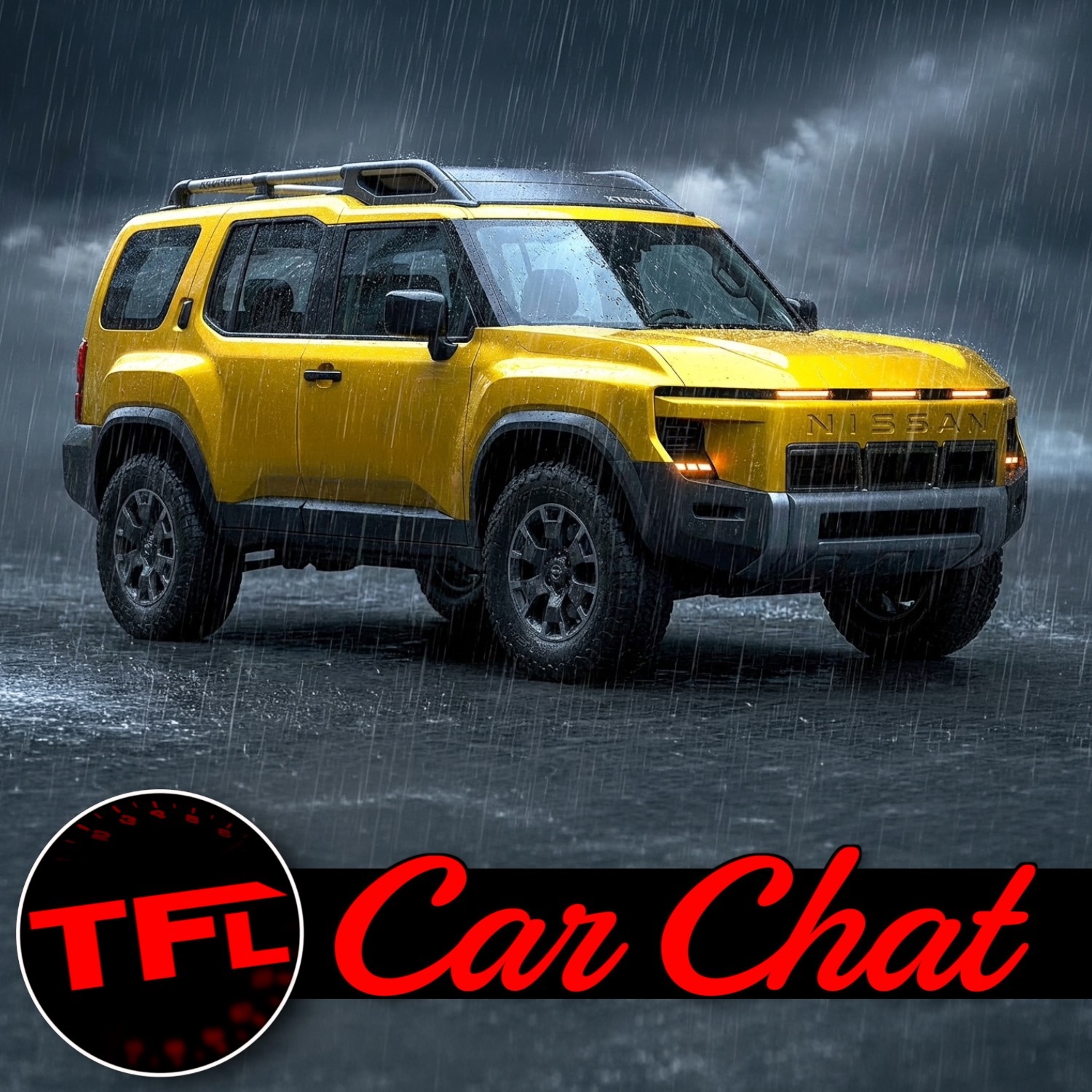
New Nissan Xterra VS Scout Traveler VS Ford Bronco VS Jeep Wrangler! | Ep. 335
About this episode
Nissan’s confirmed return of the new Xterra sparks a deep dive into why the last one died—CAFE fuel-economy categories and an aging, inefficient platform—plus what Nissan must nail to make it competitive again (35-inch capability, body-on-frame authenticity, reliability, and a sub-$40k target). The guys then weigh the Hyundai Boulder concept, the delayed electric-first Scout Traveler, and rumors of a new GM Jimmy and next-gen Wrangler/Bronco. Expect lots of debate about timing, electrification, and whether concepts will survive production reality.
( https://www.alltfl.com/ ) Check out our new spot to find ALL our content, from news to videos and our podcasts!
The off-road landscape of 2028 is looking crowded, and in this episode of TFL Car Chat, Roman and Tommy break down the five (or six!) serious dirt-munchers that are about to battle for your driveway. We kick things off with a massive bombshell: the return of the Nissan Xterra. Roman recently flew to Japan and got an exclusive look at the upcoming 4x4, and while he’s sworn to secrecy on the fine details, we dive into what Nissan needs to do to win. From body-on-frame construction and a sub-$40k price point to the departure from "lifestyle" crossovers, we analyze if Nissan is finally ready to reclaim the throne from the 4Runner and Wrangler.
The conversation gets even deeper as we look at the competition. We discuss the delays surrounding the Scout Traveler and why its launch is getting kicked down the road, plus the arrival of the all-new Hyundai Boulder—a concept that looks suspiciously like a mix between a Defender and a classic Bronco. We also touch on the rumors of a GM "Jimmy" revival, the upcoming refresh for the Jeep Wrangler (will it be the JM?), and why Ford might be skipping a mid-cycle Bronco refresh to go straight to an all-new generation. Is the market ready for six serious lockers-and-35s off-roaders, or are the legacy brands moving too slowly compared to the rapid innovation we're seeing globally?
( http://www.patreon.com/tflcar ) Visit our Patreon page to support the TFL team!
Advertising Inquiries: https://redcircle.com/brands
Privacy & Opt-Out: https://redcircle.com/privacy
lockers
"...I mean like lockers, plenty of ground clearance, rolling on 35 off-roaders. And so in this podcast, let's talk about them."
Lockers are traction helpers for off-roading. They make sure both wheels on an axle spin together, so if one wheel slips, the other can still keep moving the truck.
In off-roading, “lockers” usually refers to locking differentials (or a locking rear differential) that force the left and right wheels to rotate together. This improves traction when one wheel loses grip in mud, sand, or rocks.
ground clearance
"...like lockers, plenty of ground clearance, rolling on 35 off-roaders. And so in this podcast, let's talk about them."
Ground clearance is how high the truck sits off the ground. The higher it is, the less likely you are to hit the bottom on bumps and rocks.
Ground clearance is the distance between the lowest part of the vehicle and the ground. More clearance helps prevent the underbody from scraping on rocks, ruts, and uneven trails.
35 off-roaders
"...lockers, plenty of ground clearance, rolling on 35 off-roaders. And so in this podcast, let's talk about them."
“35 off-roaders” refers to 35-inch off-road tires, a common size target for serious trail rigs. Larger tires can improve obstacle clearance and traction, but they also affect gearing, ride quality, and steering effort.
10 year product cycles
"...I mean that vehicle is going to be 10 years old in 2028 and they have 10 year product cycles on Wrangler, 2008 to 2018 and then 2018 to 2028."
A product cycle is how long a car generation usually stays on the market before it gets replaced. They’re using Wrangler’s history to guess when the next one might show up.
A “product cycle” is the planned lifespan of a vehicle generation before it’s redesigned or replaced. The hosts are using Wrangler’s typical timeline (about a decade per generation) to predict when a new Wrangler could arrive.

Boulder Hyundai Boulder
"... So that's four. And then I forgot the fifth one. Hyundai Boulder. Yeah, that's right. The new Hyundai Boulder. Th..."
The “Boulder” is a new vehicle name mentioned for Hyundai. The podcast talks about it as part of a group of cars being compared or counted. It’s included because it’s a new model that could matter to buyers.
The “Boulder” mentioned in the podcast appears to refer to the Hyundai Boulder, described as a new model. The context suggests it’s being counted alongside other vehicles in a discussion, implying it’s part of a lineup or product plan being evaluated. It’s discussed because new nameplates can signal shifts in what a brand is targeting.
facelift
"Well, there's a facelift coming because the last news I read was they're not facelifting it... So they're just going to be a brand new one."
A facelift is when a car gets updated during its model run—usually styling changes and maybe some new features. The hosts are wondering if the Bronco will get that kind of update or a whole new generation.
A facelift is a mid-cycle update to a vehicle—typically changes to styling, lighting, bumpers, and sometimes tech or powertrain tweaks—without fully redesigning the platform. In this segment, it’s used to discuss whether the Bronco will be updated cosmetically or replaced with a new generation.
front fascia
"...this was from Nissan... And this is the front end of the upcoming XTERRA... It's just the front fascia and you got this kind of line of lights..."
The front fascia is basically the car’s front “face”—the main styling pieces you see up close, like the grille and headlight area. The hosts are pointing out what the new Xterra’s front might look like.
The front fascia is the vehicle’s front-end bodywork area, including elements like the grille, headlights, and bumper styling. Here it’s used to describe the visual design cues of the upcoming Xterra concept shot.
front end of the upcoming XTERRA
"...And this is the front end of the upcoming XTERRA. Now, if you're not watching this live, what we're looking at here is a bright yellow concept shot in the rain."
They’re focusing on the front of the next Xterra and describing the styling details. It’s a way to talk about how the new model might look before it’s officially revealed.
This phrase is used to frame the design discussion around the Xterra’s exterior styling. The hosts break down specific visual details—like the hood shape and lighting layout—to infer the direction of the next model.
concept shot
"...what we're looking at here is a bright yellow concept shot in the rain. It's just the front fascia..."
A concept shot is a preview image that shows an idea of what a car could look like. It doesn’t always match the final production version exactly.
A concept shot is an image (often from a manufacturer) showing a possible design direction rather than the final production vehicle. The hosts use the concept imagery to discuss likely styling themes for the next Xterra.

Nissan Pathfinder
"...with the three marker lights. Very similar to, for example, the original Nissan Pathfinder..."
The Nissan Pathfinder is another Nissan SUV. The hosts mention it because the new Xterra’s front lighting and shape remind them of an older Pathfinder look.
The Nissan Pathfinder is a family SUV that has been on the market for decades, with multiple generations and styling updates. The hosts use it as a reference point for the Xterra’s lighting and front-end design cues.
power dome
"...and then a very sculpted out hood with a bit of a power dome in the middle."
A power dome is a raised “bump” on the hood. It can look aggressive and sometimes helps with airflow or space under the hood.
A power dome is a raised section on the hood that can be purely stylistic or designed to improve airflow and engine packaging. In this segment, it’s part of the described sculpted hood design on the upcoming Xterra concept.

Toyota 4Runner
"They basically got out of the market, left the market to the Toyota 4Runner just when overlanding and offroading was becoming red hot."
The Toyota 4Runner is a rugged SUV that many people use for off-roading and long trips. The hosts say it became more popular when Nissan wasn’t selling the Xterra anymore.
The Toyota 4Runner is a midsize off-road SUV that’s often associated with overlanding and trail use. The hosts mention it as the beneficiary of Nissan stepping away from the off-road market, implying the 4Runner filled the gap for buyers.
overlanding
"...left the market to the Toyota 4Runner just when overlanding and offroading was becoming red hot."
Overlanding means taking long trips, often to remote places, and being prepared to drive off-road and handle basic needs without much help. The hosts say this lifestyle trend made off-road SUVs more popular.
Overlanding refers to long-distance, self-reliant travel—often off-road—using a vehicle equipped for remote conditions. The hosts connect overlanding’s rise to why off-road SUVs like the 4Runner gained momentum when competitors like Nissan stepped back.
CAFE rules
"his answer was because of the new legislation that basically de-teeths, de-fangs the new CAFE rules, which allows Nissan to start building body on frame trucks, off-roaders... Do you know why it died in the first place?... It is because of CAFE."
CAFE rules are government standards that push car companies to make their overall lineup get better gas mileage. If the rules change, it can make it easier (or harder) for companies to sell less-efficient trucks and SUVs.
CAFE (Corporate Average Fuel Economy) rules require automakers to meet fleet-wide fuel-economy targets. The podcast discusses how changes to these rules can “de-fang” or relax requirements for certain vehicle types, which affects whether models like the Nissan Xterra can be built profitably.
body on frame
"...new legislation that basically de-teeths, de-fangs the new CAFE rules, which allows Nissan to start building body on frame trucks, off-roaders without having to have more leaves and more arias..."
Body-on-frame is a construction method where the vehicle’s body mounts to a separate ladder frame. It’s common on traditional off-roaders and trucks because it can handle rough use well, but it often comes with higher weight and lower fuel economy than unibody designs.

Nissan Xterra
"...he gave me the lowdown as to why they killed the XTERRA... And what happened was... the CAFE numbers... de-incentivize the smaller vehicles... the problem with the XTERRA is it had a much shorter wheelbase..."
The Nissan Xterra is an off-road SUV that the podcast says got discontinued. The reason wasn’t just sales—it was also because fuel-economy rules made it hard for Nissan to keep it profitable.
The Nissan Xterra is discussed as a model that was “killed” due to CAFE compliance challenges. The hosts argue its shorter wheelbase and overall size put it into a stricter CAFE category, and its poor fuel economy made it difficult for Nissan to meet fleet targets.
CAFE category / bucket
"...the CAFE numbers... de-incentivize the smaller vehicles and those with shorter wheelbases. And the problem with the XTERRA is it had a much shorter wheelbase... Therefore, it fell in a different CAFE... category or bucket."
CAFE rules don’t treat every vehicle the same. Smaller or differently sized vehicles can fall into a category with tougher fuel-economy expectations, which can affect whether a model stays on sale.
CAFE compliance is influenced by how vehicles are classified into different categories (often tied to size and wheelbase). The podcast explains that the Nissan Xterra’s shorter wheelbase and overall length put it into a different category with stricter fuel-economy requirements, making it harder to meet targets.

Toyota Prius
"...they didn't have, at the time, of course, like a Prius that could offset those numbers. Well, they, they didn't."
The Toyota Prius is a well-known fuel-sipper. The podcast brings it up to explain that some very efficient cars can help a company meet fuel-economy rules when other cars don’t.
The Toyota Prius is mentioned as the kind of highly efficient vehicle that can “offset” fuel-economy shortfalls in CAFE calculations. The point is that Nissan lacked enough efficient models at the time to counterbalance the Xterra and Frontier’s poor efficiency.

Nissan Leaf
"...they didn't have, at the time, of course, like a Prius that could offset those numbers. Well, they, they didn't. They had a leaf, which came out in 10, 11."
The Nissan Leaf is Nissan’s electric car. The podcast uses it as an example of how having very efficient vehicles can help a company meet fuel-economy rules when other models are less efficient.
The Nissan Leaf is referenced as an efficient vehicle (and later an electric car) that could help offset CAFE penalties from less-efficient models. The podcast notes the Leaf came out around 2010–2011, but at the time the Xterra was being killed, Nissan didn’t yet have enough efficient vehicles to balance the fleet.
aftermarket
"...it was especially unfortunate because there was like an aftermarket that was starting to build around the XTERRA. Our local Nissan dealership here was big into that."
The aftermarket is the community of companies that make replacement parts and upgrades for a specific car. The hosts say people were starting to build support for the Xterra, so killing it hurt that momentum.
Aftermarket refers to parts, accessories, and modifications sold by companies other than the original automaker. The podcast notes an aftermarket was starting to build around the Nissan Xterra, which made its discontinuation feel especially unfortunate for enthusiasts.

Toyota FJ Cruiser
"Same era. We were there. I know we were there. Same era as the FJ Cruiser."
The Toyota FJ Cruiser was a popular off-road SUV from the mid-2000s. They mention it to remind you what the off-road market looked like back then.
Toyota FJ Cruiser is a retro-styled, trail-focused SUV that became a symbol of the mid-2000s off-road boom. The hosts reference it to place the Xterra/Wrangler/4Runner competition in the same timeframe.
a frontier without a bed
"So I'm going to simplify this because I'm sure it's a lot more complicated than this, but in essence, an XTERRA is a frontier without a bed. Sure, but in the same way. Same powertrain, same suspension, you know, same chassis."
They’re basically saying the Xterra is like Nissan’s Frontier pickup, but turned into an SUV instead of a truck with a bed. The idea is that it keeps the rugged, off-road-friendly basics.
This is a comparison concept: the Nissan Xterra is being described as a “frontier without a bed,” meaning it shares the Frontier’s truck-based underpinnings and off-road hardware, but packaged as an SUV. It highlights how Nissan used a truck platform to create an off-road-oriented vehicle.
same powertrain, same suspension, you know, same chassis
"So I'm going to simplify this because I'm sure it's a lot more complicated than this, but in essence, an XTERRA is a frontier without a bed. Sure, but in the same way. Same powertrain, same suspension, you know, same chassis."
They’re saying the Xterra and the Frontier use very similar core mechanical parts. That can make the SUV feel and behave a lot like the pickup, especially for rough roads.
Sharing “powertrain, suspension, and chassis” means the Xterra and Frontier use closely related mechanical foundations. That matters because it can translate into similar driving feel, durability, and off-road capability—while still allowing different body styles (SUV vs pickup).

Titan
"...instead of putting all that money into the Titan for them to also introduce a new XTERRA, which unfortunately they did not."
The Nissan Titan is Nissan’s larger pickup truck. They’re saying Nissan spent money on the Titan instead of making a new Xterra at the time.
Nissan Titan is the brand’s full-size pickup, and the hosts mention it as an example of where Nissan put development money instead of introducing a new Xterra. This is part of their argument about product planning and lineup focus.
trimming their worldwide product line by a lot
"...one of the things that they have said is that they are trimming their worldwide product line by a lot. So they're they're focusing on their core vehicles."
This is basically Nissan saying they’re going to sell fewer different models worldwide. The goal is to focus money and effort on the vehicles that matter most.
“Trimming the product line” is a strategy where a manufacturer reduces the number of models/variants it sells globally to concentrate resources. In practice, it can mean fewer niche vehicles, faster updates for core models, and less spending on platforms that don’t sell well.
speeding up the amount of time it takes them to develop a vehicle by about 30%
"The other thing they're doing is they're speeding up the amount of time it takes them to develop a vehicle by about 30%. This is what they said. So instead of taking five years, it's going to take"
They’re saying Nissan wants to build new cars faster—about 30% quicker than before. That can help them react to what buyers want and get new models to market sooner.
This refers to shortening the vehicle development cycle—how long it takes to go from concept to production-ready car. A faster development timeline can improve competitiveness, reduce costs, and help manufacturers respond quicker to changing regulations and customer demand.

Jeep Wrangler
"People are kind of getting bored of Wranglers and forerunners and Broncos. And they'd be, you know, right at the sweet spot of when the market is looking for something fresh and interesting and different."
The Jeep Wrangler is a popular off-road SUV. In the conversation, it’s used as an example of a vehicle that many people already know well, so the hosts think buyers may want a new option.
The Jeep Wrangler is a compact-to-midsize SUV famous for its removable roof and doors and its strong off-road capability. Here, it’s mentioned as a model people are “getting bored of,” which sets up the idea that the market wants something fresher and less repetitive.
Mitsubishi
"It's actually going to be developed in partnership with Mitsubishi. So Mitsubishi has a small youth that they sell around the world, right? And that next generation of truck is going to be co-developed with Nissan."
Mitsubishi is another car company. In this discussion, they’re being talked about as a partner that helps Nissan build a new truck platform, which can affect timelines for other vehicles too.
Mitsubishi is the Japanese automaker mentioned here as a development partner for the next-generation Nissan Frontier platform. Platform partnerships are common when companies want to share engineering costs, speed up development, or spread risk across multiple models.
product cycles for development have gotten longer
"Let's take like, let's go 30,000 feet in the air right now and look down at what's happening in the market in general. What's happening is because of COVID, because of chip shortages, because of tariffs, the product cycles for development have gotten longer, not shorter."
A “product cycle” is how long it takes a company to go from planning a new vehicle to actually selling it. The hosts say recent supply-chain problems and trade issues have stretched those timelines, so new cars arrive later than planned.
“Product cycles” are the timelines automakers use to design, engineer, test, and launch new vehicles. The hosts attribute longer cycles to COVID-era disruptions, chip shortages, and tariffs, which can delay new models and push back launch dates like the Xterra’s rumored timing.
chip shortages
"What's happening is because of COVID, because of chip shortages, because of tariffs, the product cycles for development have gotten longer, not shorter."
Modern cars need computer chips to run many systems. If chip supplies are limited, carmakers can’t produce vehicles on schedule, so new models and updates get delayed.
Chip shortages refer to disruptions in the supply of semiconductors used in modern vehicles for everything from infotainment to engine and safety systems. When chips aren’t available, automakers can’t build as many cars, which can delay launches and extend development timelines.
tariffs
"What's happening is because of COVID, because of chip shortages, because of tariffs, the product cycles for development have gotten longer, not shorter."
Tariffs are extra taxes on imported products. If car parts cost more because of tariffs, it can slow down production and make new vehicles arrive later.
Tariffs are taxes or trade barriers applied to imported goods, and they can raise the cost of parts and materials used in vehicle production. In the segment, tariffs are cited as one reason development and launch timelines have stretched.
right offs
"And what we're seeing is manufacturers pulling back because they're taking these huge right offs. They're of course blaming electric cars, which is to me seems like an easy scapegoat, right?"
A “write-off” is when a company has to admit some planned spending or inventory isn’t going to pay off as expected. The hosts are saying these financial hits are part of why automakers are slowing down.
“Right offs” here likely refers to large accounting charges or write-downs automakers take when plans change—such as canceling or reducing production and absorbing costs. The hosts connect these financial impacts to manufacturers pulling back on launches and inventory decisions.
packages and trim lines
"...they've got 12 different, like they're not models, they're there like packages and trim lines to breathe a little bit of excitement into the Wrangler lineup."
Packages and trim lines are ways automakers differentiate a vehicle without redesigning the whole platform. Packages bundle features (like off-road equipment or tech), while trim lines define equipment levels and sometimes different powertrain or interior options.
shared componentry
"...one of the reasons they're doing that is because they do a lot of shared componentry, which our manufacturers don't do."
Shared componentry is when different cars use the same parts. That can make it quicker and cheaper to build new models.
Shared componentry means multiple vehicles use common parts—like engines, transmissions, electronics, or platforms—across different models. This can reduce development time and cost, making it easier to launch new products faster.

Rivian R2
"...Rivian has done the same thing, right? Instead of doing the R three, right, the off-roader, they've come out with the R two."
Rivian’s R2 is an upcoming/introduced electric SUV that’s meant to be a more attainable option. The point being made is that building a new car—especially an off-road one—is really hard, even for fast-moving brands.
The Rivian R2 is positioned by the brand as a more accessible off-road-oriented electric vehicle compared with its larger models. Here, it’s referenced to illustrate how even companies with strong EV momentum still face major development challenges when creating new vehicles.
developing a new car
"...what we're discounting is how unbelievably difficult it is to develop a new car. You know, if you figure a car has well over a thousand parts in it, and those are a thousand parts that are manufactured across many different suppliers..."
Making a brand-new car is hard because it’s not just one thing—you need tons of parts to work together. And those parts come from many different companies, so everything has to be timed correctly.
Developing a new car is a complex, multi-year process because modern vehicles rely on thousands of parts sourced from many suppliers. Coordinating design, validation, manufacturing readiness, and supply chain timing is what makes “starting from scratch” so difficult.
platform sharing
"a lot of the vehicles in China are all kind of the same car underneath. Yeah. So that saves a lot of time, though dad."
Some car companies build several models on the same basic “skeleton.” That means they don’t have to design everything from scratch for every model, which can lower cost and speed up development.
Platform sharing is when multiple vehicle models use the same underlying architecture (hard points, chassis/suspension layout, and often powertrain mounting). That reduces engineering time and cost, and it can make different cars feel similar “underneath” even if their styling and interiors differ.
1.5 liter engine
"the stuff you don't see in a Chinese car is the same like all those Chinese cars that are hybrids, they all have the same 1.5 liter engine."
Engine size is measured in liters, and 1.5 liters is a fairly common size for everyday cars. If many cars use the same engine size, it can be easier and cheaper for the company to build and maintain them.
A “1.5 liter” engine refers to the total displacement of the engine’s cylinders—here, 1.5L is a common size for many mainstream cars. Using the same displacement across many models is often tied to shared components and simplified development.
Bosch
"they don't have to go to like Bosch and different suppliers and say, Hey, we need this part specifically for this car"
Bosch is a company that makes car parts for many different brands. The idea here is that some automakers can use common supplier parts instead of designing unique ones.
Bosch is a major automotive supplier that provides components like electronics, sensors, and various vehicle systems. In the context of the discussion, the point is that manufacturers can source standardized parts from large suppliers rather than creating everything in-house.
labor cost differences affecting car development
"cost of building a car is much cheaper in China, because of labor costs... it's impossible to hire America for under $20,000..."
Making a car costs money, and a big part of that is paying workers. If labor is cheaper in one country, it can make it easier for companies to build cars for less money there.
The segment argues that lower labor costs in China can reduce the overall cost of building vehicles. It also claims that hiring and operating costs in the U.S. make it difficult to build cars at very low price points, affecting competitiveness and pricing.
Euro NCAP and NHTSA crash test standards
"You know, their crash test standards were far less than what we experienced in Euro NCAP and NHTSA, right? So it was perhaps easier also to develop a new model."
These are crash-safety testing programs. They put cars through standardized crash tests and score how well they protect people, so automakers have to design and prove safety to meet those rules.
Euro NCAP and NHTSA are major organizations that evaluate vehicle crash safety. They test how well cars protect occupants in crashes and assign safety ratings, which can affect how quickly automakers can develop and certify new models for different markets.
Chinese automaker cars not sold in the US (yet)
"So I just don't know if they're necessarily comparable because, and especially because those cars aren't sold in the US. Yeah, not yet."
When a vehicle isn’t sold in the US yet, it often means it hasn’t been certified to US regulations and safety standards. That can limit direct comparisons because the car may be a different spec or may not have gone through the same compliance process.
Detroit Auto Show
"So it will be 2012. We were at the Detroit Auto Show and there was a Chinese automaker at the Chinese Auto Show."
The Detroit Auto Show (historically a major US venue for automakers) is referenced here as the place where the hosts saw a Chinese automaker’s presence. It highlights how global brands try to build awareness in the US market.
Chinese Auto Show
"We were at the Detroit Auto Show and there was a Chinese automaker at the Chinese Auto Show. And I remember in 2012, you told me, give it two years of these cars will be here."
This is a major auto event in China where car companies display their newest models. The hosts bring it up to set the timeline for how those cars later appeared in the US.
The Chinese Auto Show is mentioned as the counterpart event where the Chinese automaker was present. The comparison underscores how quickly global automakers can change offerings and how market timing affects adoption.
Chrysler
"At some point, the reality of the situation is that I think this administration would probably be happy if, let's say, Chrysler decided that they're only selling one car and they have a factory that's idle right now, just sell that to the Chinese or sell the brand to the Chinese..."
Chrysler is a US car company. The discussion uses it as an example of how a company might respond to pressure by selling fewer models or partnering with another market.
Chrysler is referenced as an example of a US automaker that could potentially sell a brand or consolidate offerings. The point is about how corporate strategy and market access can be influenced by broader political and trade realities.
Tesla
"[1083.2s] afford, they're building the very expensive car that nobody can afford. Which makes sense. Be that [1087.7s] Tesla, be that Lucid, be that Rivian. It's easier to make money selling expensive cars."
Tesla is one of the best-known EV makers. The point here is that it’s often easier for a company to make money on pricier cars than on cheaper ones.
Tesla is referenced as an example of a company that has focused on higher-priced EVs. The hosts use it to argue that selling expensive cars can be easier for profit than selling mass-market vehicles.
Lucid
"[1083.2s] afford, they're building the very expensive car that nobody can afford. Which makes sense. Be that [1087.7s] Tesla, be that Lucid, be that Rivian. It's easier to make money selling expensive cars."
Lucid is another electric-car company. In this conversation, it’s used as an example of a brand that makes pricier EVs rather than cheaper ones.
Lucid is mentioned alongside Tesla and Rivian as an EV maker that sells higher-priced vehicles. The hosts use it as part of a broader argument about EV manufacturers targeting expensive segments instead of affordable mass-market cars.
profit margins
"[1097.9s] No, I think people are especially now with the way the economy is going. I think there's a huge [1101.7s] opening there to actually start selling affordable cars. That's why right now used cars are having [1106.9s] a moment because people can't afford new cars. I'm not saying they wouldn't sell. I'm just saying [1110.2s] from a manufacturer standpoint, the profit margins on a million dollar car versus the profit margins [1115.1s] on a twenty thousand dollar car."
Profit margin is how much money a company keeps from each sale after costs. The point here is that a high-priced car can be easier to profit from, which is why some companies focus on expensive EVs.
The hosts discuss how profit margins scale with vehicle price: selling a very expensive car can yield more profit per unit than selling a cheaper one, even if the cheaper car costs more to engineer relative to its price. This frames why manufacturers may chase high-end EVs instead of mass-market affordability.
assembly line
"[1121.2s] but you make a lot more money on the expense of those economics were the same in the 1910s when [1126.3s] Ford came out with the Model T was much cheaper to develop cars than no. No, I mean, it was the same [1131.3s] problem except that he came out with an innovative thing called the assembly line to make a cheaper [1136.3s] and the Chinese have come with an innovative thing basically part sharing."
An assembly line is a factory process where workers and machines build a car step-by-step in a set order. It helps companies build cars faster and cheaper, which is why it mattered for making the Model T affordable.
The assembly line is a manufacturing method where a product moves through a sequence of stations, allowing faster and cheaper production. The hosts compare Ford’s Model T era approach to modern EV strategies like part sharing, arguing that cost-effective manufacturing is key to affordability.
part sharing
"[1136.3s] and the Chinese have come with an innovative thing basically part sharing. So so I'm saying, [1141.4s] yeah, you could you could come up with excuses all day long while you can't do it. But at the [1145.0s] end of the day still leaves you in bankruptcy court."
Part sharing is when different car models use the same parts. That can lower costs because the company doesn’t have to design and build everything from scratch for every model.
Part sharing means using the same components across multiple models to reduce development and manufacturing costs. The hosts suggest Chinese automakers are using this strategy as a modern “innovation” to make vehicles cheaper to build, similar in spirit to Ford’s earlier manufacturing breakthroughs.
cutting production time
"[1150.0s] you can't keep doing business the same way it was done five years ago. You got to start to [1155.1s] change the way that you're doing it. And what Nissan said was we're doing that. We're cutting [1158.6s] our production time. We're, you know, taking 30% out. We're concentrating on core models. I'm just"
Cutting production time means building cars faster in the factory. The goal is usually to reduce waste and cost so the company can sell cars more competitively.
Cutting production time is a lean-manufacturing approach aimed at reducing how long it takes to build a vehicle, often by streamlining processes and reducing waste. The hosts connect it to Nissan’s plan to improve competitiveness and profitability in a market where affordability is becoming more important.
price point under $40,000
"...they also said that they want to target the price point under $40,000, which would be massively successful."
They’re talking about keeping the vehicle’s starting price below $40,000. That matters because many people have a hard budget limit, and crossing it can dramatically reduce sales.
“Targeting a price point under $40,000” is about hitting a psychological and budget threshold where buyers are more likely to consider a new vehicle. For off-road SUVs, pricing strongly affects how many units a brand can sell, especially when competing with similarly equipped models.
big tires
"...So 33s or 32s aren't going to cut it. You're going to you're going to agree that's kind of the new standard that 35 is a new 33. So you're going to have to have big tires."
Bigger tires help an off-road SUV get over rough ground and can provide better grip. They’re saying that buyers now expect larger tire sizes as part of the “real off-road” package.
Bigger tires improve off-road performance by increasing ground clearance and traction, and by helping the vehicle roll over obstacles more easily. The hosts frame “35s” as the new benchmark, arguing Nissan needs to offer a setup that feels current for off-road buyers.
special shock absorber
"You're also going to have to have some kind of a special shock absorber, I think. So be it King, Fox, whatever, but it's got to be branded and it's got to be different."
Shocks help control how the wheels move when you hit bumps. For off-roading, you usually want shocks that are built and tuned for rough roads, not just for smooth pavement.
Off-road shock absorbers are tuned to control wheel movement over bumps and uneven terrain, improving ride quality and traction. The hosts suggest Nissan should use a branded, purpose-built shock setup (rather than generic suspension) to make the vehicle feel truly off-road.
Roush
"And they've kind of taken the step toward that already with their partnership with Roush with the new frontier. Sure. The problem with the Roush frontier is that there's no more horsepower."
Roush is a company that works on performance and special vehicle packages. They’re saying Nissan’s Roush-linked off-road version looks promising, but it may not add the power people want.
Roush is an aftermarket performance and engineering company that partners with automakers to develop special packages and upgrades. Here, the hosts reference Nissan’s partnership with Roush on the “Frontier,” implying it adds branding and off-road appeal but may not deliver the performance buyers expect.
hybrid V6
"...It's going to have a naturally aspirated V6 and a hybrid V6."
A hybrid V6 uses both a gas engine and an electric motor. The goal is usually better efficiency and smoother power, especially at low speeds.
A hybrid V6 combines a gasoline V6 with an electric motor and battery system to improve efficiency and provide extra torque. In this context, the hosts suggest Nissan may use a hybrid V6 to meet modern expectations while still aiming for durability and simplicity.
naturally aspirated V6
"Now, what folks are saying is the new front, the new exterior is going to have two engines. It's going to have a naturally aspirated V6 and a hybrid V6."
A naturally aspirated V6 is an engine that makes power without a turbo. The idea is that it can be simpler and easier to live with, which some buyers prefer.
A naturally aspirated engine doesn’t use a turbocharger or supercharger; it relies on atmospheric pressure to draw air into the engine. The hosts mention a naturally aspirated V6 as one of the proposed powertrains, likely because it can be simpler and more durable than forced-induction setups.
four wheel drive
"...it really needs to have to is that authentic authenticity as to what a four wheel drive is."
Four wheel drive means power can go to all four wheels, which helps on dirt, snow, or rough trails. They’re saying Nissan needs to make the truck feel genuinely capable, not just look the part.
“Four wheel drive” (4WD) refers to a drivetrain that can send power to all four wheels, improving traction on loose or uneven surfaces. The hosts emphasize that Nissan needs to deliver an authentic 4WD experience—meaning the system and hardware should match the off-road identity, not just the marketing.
low range
"[1302.1s] threshold by saying its body on frame. So I think you need to have a low range. And then in terms [1307.1s] of design, I'm one of the greatest things that the old exterior brought to the table was that"
Low range is a gear mode that makes the vehicle move slower but with more pulling power. It helps when you’re going up steep hills, crawling over rocks, or driving on slippery ground. It’s the kind of feature off-roaders rely on for control.
“Low range” refers to a low-gear setting (usually via a transfer case) that multiplies torque for slow-speed crawling. It’s especially useful for steep climbs, rock crawling, and slippery surfaces where you need maximum control and traction. The hosts argue that body-on-frame alone isn’t enough—you also need low-range capability.
buttons and toggles
"[1312.7s] stadium seating. So I think they're going to have to have stadium seating. I think you need more [1316.9s] buttons and toggles and less screens. Yeah, I agree."
Buttons and toggles are the physical knobs and switches you can use without hunting through menus. Off-road, that matters because you might be wearing gloves or your hands are busy. Screens can be harder to use when you’re focused on driving.
The hosts are contrasting physical controls (“buttons and toggles”) with modern screen-heavy interfaces. For off-road use, physical controls can be easier to operate with gloves and while bouncing around on trails. Their point is about usability and tactile feedback rather than just aesthetics.
real door handles
"[1316.9s] buttons and toggles and less screens. Yeah, I agree. I also think you need real door handles. I [1323.3s] think you need vents that you can operate with your hands that with, you know, a swipe on the"
Real door handles means normal, physical handles you grab to open the door. Some newer cars use touch or electronic systems instead, which can feel less direct. The hosts prefer the traditional approach for reliability and ease of use.
“Real door handles” implies conventional exterior handles instead of touch-sensitive or screen-based access. In off-road and adventure contexts, traditional handles are typically more intuitive and less dependent on electronics. The hosts frame this as part of making the vehicle feel “honest” and straightforward.
CVT
"[1336.7s] of Nissan. There are a couple of things that are Nissan DNA, right? First and foremost is reliability, [1342.3s] which they kind of lost when they introduced the CVT and they kept doubling down on it"
CVT is a type of automatic transmission that can smoothly change ratios instead of shifting gears like a traditional automatic. Some people like how it feels, but it can also be a concern if a brand’s CVTs have had reliability problems. The hosts are saying Nissan’s CVT reputation affected how trustworthy the brand felt.
CVT stands for continuously variable transmission, which uses a belt or chain and variable pulleys to keep the engine in an efficient RPM range. The hosts argue Nissan “lost” some of its traditional reliability reputation when it leaned heavily on CVTs. They also mention that Nissan’s CVT strategy “hurt them,” tying it to consumer confidence.

Toyota Crown
"...happened is that the Koreans have taken that that crown away from Nissan because Nissan was always a Jap..."
The Toyota Crown is a car name used by Toyota for more upscale models. The podcast mentions it while talking about which brands are leading in a certain category. It’s included because it represents that “top” position in the discussion.
The Toyota Crown is a nameplate that’s often associated with a premium sedan or crossover-like lineup depending on the generation and market. In the podcast, it’s mentioned in a discussion about who holds the “crown” in a segment, specifically referencing Nissan losing that position to Korean brands. It’s brought up because the Crown is part of the conversation about brand positioning and competition.
King of the Hammers
"[1373.0s] cred. So they're going to have to somehow show whether it's doing a King of the Hammers version [1378.8s] or I was thinking about this, you know, how we just came back from the Easter Jeep Safari."
King of the Hammers is a famous off-road race in the desert that’s known for extreme rock crawling and high-speed desert sections. When the hosts reference it, they’re saying Nissan needs to prove serious off-road credibility, not just look the part. It’s a benchmark event for hardcore capability.
Easter Jeep Safari
"[1378.8s] or I was thinking about this, you know, how we just came back from the Easter Jeep Safari. [1384.5s] There's a lot of other things you can do outside of like one of the things that was always weird to me"
Easter Jeep Safari is a big off-road gathering in Moab, Utah, around Easter. Jeep uses it to show off special off-road vehicles and attract attention. The hosts are using it as an example of how one brand can dominate the spotlight in a specific place.
Easter Jeep Safari is an annual off-road event in Moab, Utah, where Jeep enthusiasts and media gather and manufacturers showcase off-road builds. The hosts reference it as context for how Jeep’s brand presence in Moab affects competitors’ marketing. It’s used to illustrate the “where you show up” strategy in off-road culture.
Moab
"[1384.5s] There's a lot of other things you can do outside of like one of the things that was always weird to [1389.2s] me is that the Bronco kind of stepped on cheap's party because they were doing all this activation [1400.7s] someone else's party. There are a lot of off road events off roady trails that you could [1413.0s] hang the exterior around that isn't Jeep based."
Moab is a famous off-road area in Utah with lots of trails and desert terrain. Many off-road brands and events happen there, so it becomes a “center of gravity” for off-road credibility. The hosts are saying you don’t have to always chase Moab to have real adventures.
Moab, Utah is a major off-road destination known for trails and desert scenery that attract brands and enthusiasts. The hosts discuss how events and marketing in Moab can shape perceptions of off-road authenticity. They also argue there are other trails and locations beyond Moab.
Wrangler Rubicon
"... just get away from Moab. You know how Jeep has a Rubicon trail, pick a different trail, pick a different ..."
The Wrangler is the Jeep SUV that’s built for off-road trails. The podcast talks about picking different trails to drive on, which is part of how people use Wranglers. It’s mentioned because it’s strongly tied to that kind of driving.
This “Wrangler” reference is to the Jeep Wrangler, the rugged off-road SUV known for its trail-focused design and customization options. In the podcast, it’s mentioned in the context of choosing different trails—like how Jeep has a Rubicon trail—highlighting the Wrangler’s role in off-road culture. It’s discussed because the Wrangler is closely associated with specific trail experiences.
Rubicon trail
"[1413.0s] There are other places in the country that provide similar things. They do have a Nissan off road [1417.6s] event. Yeah, yeah. What's that? I don't know what's called, but it is in Moab. Yeah, but I'm just [1422.0s] saying just get away from Moab. You know how Jeep has a Rubicon trail, pick a different trail,"
The Rubicon Trail is a well-known off-road route in California associated with Jeep’s off-road reputation, especially the Wrangler Rubicon. When the hosts say “how Jeep has a Rubicon trail, pick a different trail,” they’re emphasizing that off-road credibility comes from specific, recognized routes—not just marketing. It’s a discussion of brand storytelling through trail choice.
Grenadier Gathering
"I mean, cruise Moab, you've got Easter Jeep Safari, you've got the Grenadier Gathering, you've got the solely whole society does their event in Moab."
The “Grenadier Gathering” is referenced as another Moab event, used here to show that multiple off-road communities converge on the same destination. It highlights the broader trend of brand/owner events driving engagement.
Extero
"I think the color is good. I think if you look at the design, Extero has always had, especially with that stadium seating, has always had kind of a unique shape."
“Extero” sounds like it’s referring to the Nissan Xterra. They’re talking about how the Xterra looks and how it’s usually priced to be more affordable than some competitors.
“Extero” appears to be a mis-transcription of “Xterra,” Nissan’s off-road SUV. The segment discusses Xterra’s design identity (including “stadium seating”) and its pricing positioning versus rivals like the Wrangler and Toyota.
stadium seating
"I think if you look at the design, Extero has always had, especially with that stadium seating, has always had kind of a unique shape."
“Stadium seating” describes an upright seating position and higher hip point that gives drivers and passengers a commanding view over the road. On off-road SUVs, it’s often used to improve visibility and make the cabin feel more spacious.

Nissan Frontier
"How about manual? Does it need a manual before we move on? No. Can you get a manual on the frontier? No."
The Nissan Frontier is Nissan’s midsize pickup, and the hosts specifically say you can’t get it with a manual transmission. That’s used to support the broader point that manuals are becoming rare in this segment.
manual transmission
"How about manual? Does it need a manual before we move on? No... off-road manuals are just not as good as automatics."
A manual transmission means you shift gears yourself with a clutch pedal. The hosts are saying that while manuals are fun, they can be tiring or less ideal for off-roading compared with automatics.
A manual transmission lets the driver select gears using a clutch and gear lever, which can be engaging and precise. In off-road use, the hosts argue manuals can be more difficult to live with than automatics due to workload in slow-speed crawling and frequent gear changes.

Toyota Tacoma
"I mean, like everyone loves the manual in the Tacoma, but I think I was reading that the sales numbers on them are just abysmally tiny."
The Toyota Tacoma is a popular midsize truck. They’re saying manuals are loved by some people, but the data suggests very few buyers actually choose them.
The Toyota Tacoma is a midsize pickup known for offering a manual transmission in some configurations and for having a dedicated enthusiast following. The hosts bring it up to argue that manuals can be popular, but that manual availability in off-road SUVs/pickups may not sell in large numbers.

Jeep Gladiator
"They are bringing it back, though, in the Gladiator. And you can get the Bronco in a manual."
The Jeep Gladiator is a Jeep pickup that offers a manual transmission option (as mentioned here), which the hosts call out as a notable exception. It’s used to illustrate that manuals still exist in the off-road world, but are limited to certain models.
dual clutch gearbox
"the same thing about like a flappy paddle, dual clutch gearbox is better on track than it is on than it is as a manual because you have less to think about. But the fact is, on-road, a manual is more engaging."
A dual-clutch gearbox is an automatic that shifts gears very fast. It uses two clutches so it can be ready for the next gear ahead of time, which can feel great on a track but may not feel as “hands-on” as a manual.
A dual-clutch gearbox (DCT) uses two separate clutches—one for odd gears and one for even gears—so it can shift very quickly. The tradeoff is that it can feel different from a traditional manual, especially in how smooth and predictable it is at low speeds and off-road crawling.
flappy paddle
"the same thing about like a flappy paddle, dual clutch gearbox is better on track than it is on"
Flappy paddles are the little shift buttons on the steering wheel. They let you tell the car when to change gears, even if the car is technically an automatic.
“Flappy paddles” are steering-wheel-mounted shift paddles that let you manually command gear changes while still using an automatic or dual-clutch transmission. They’re often used to mimic manual control for faster, more driver-focused shifting.
Hyundai Boulder
"So I want to talk about the newest entrant here, which is very interesting indeed. That's the Hyundai Boulder. So this car was revealed as a concept in New York, but it is hinted that they are going to put this into production."
The Hyundai Boulder is a concept SUV Hyundai showed off, and it sounds like it could become a real vehicle. People are debating its looks because it resembles other rugged, boxy off-road SUVs.
The Hyundai Boulder is a concept SUV Hyundai revealed in New York, and the discussion suggests it may be heading toward production. It’s described as a body-on-frame truck/SUV approach, and its styling is drawing controversy because people compare it to other boxy off-road icons.
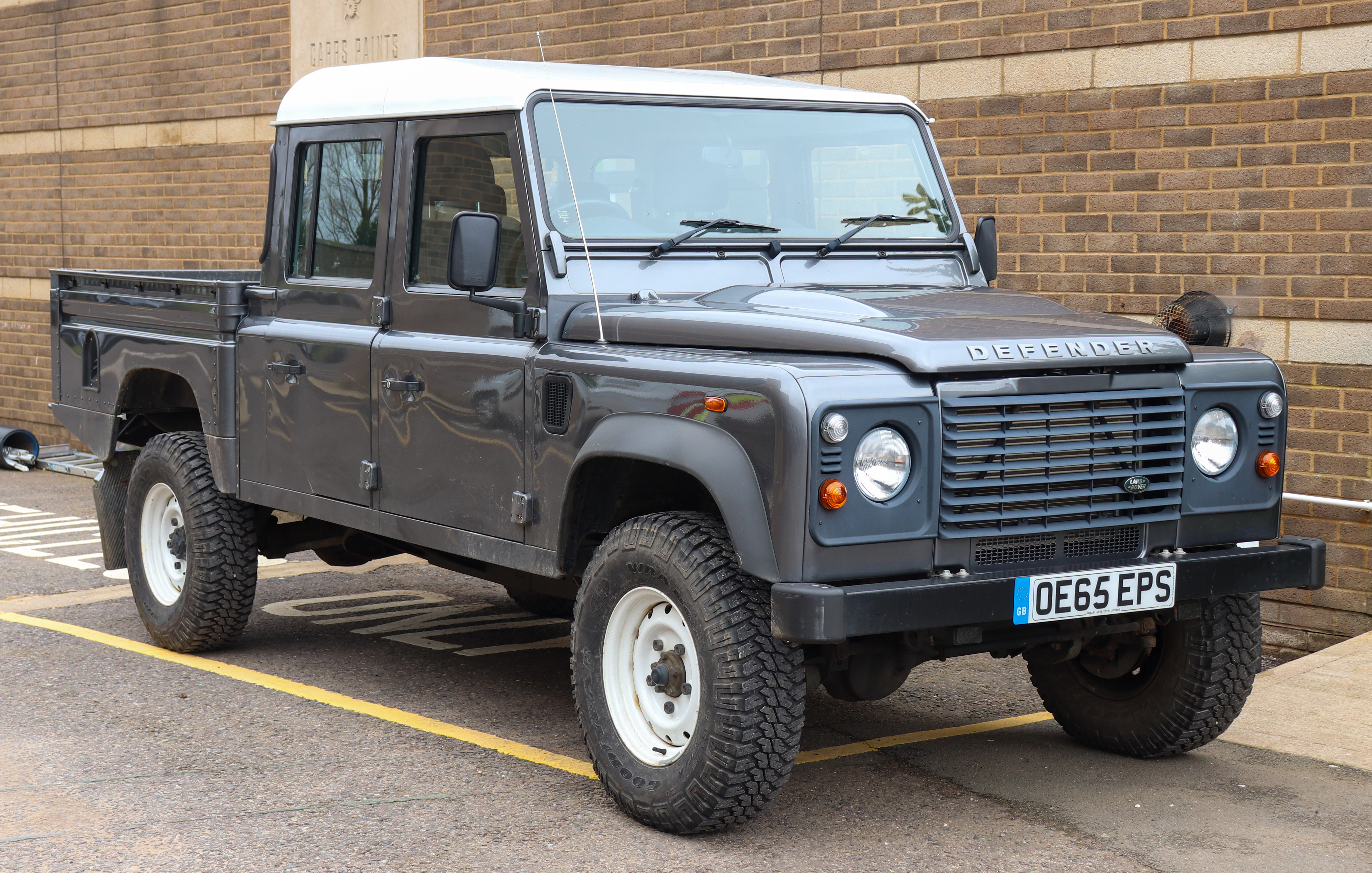
Land Rover Defender
"...ying it looks a little Bronco. It looks a little Defender. You know what it looks like. Cole, if you can Go..."
The Land Rover Defender is an SUV built to handle rough terrain. The podcast mentions it when talking about how some newer off-road SUVs look similar. It’s known for having a strong off-road look and purpose.
The Land Rover Defender is a rugged SUV designed for both off-road capability and everyday usability. In the podcast, it’s mentioned in a comparison-like way—described as looking a bit like a Bronco—highlighting how design cues can overlap in the off-road SUV space. It’s discussed because Defender’s styling and off-road identity are central to its appeal.

Hyundai Santa Cruz
"So let's talk about this. So I hope they've learned the lesson. Hyundai has just announced that they're killing the Santa Cruz, which is their compact pickup truck."
The Hyundai Santa Cruz is a small pickup truck. The hosts say Hyundai is ending it, and they’re using that as an example of what Hyundai learned (or should learn) about making trucks.
The Hyundai Santa Cruz is mentioned as Hyundai’s compact pickup truck that the company has announced it’s killing. This is used as a lesson in product strategy—how Hyundai’s truck lineup decisions may affect what it builds next.

Ford Maverick
"Yeah, and I hope that they've learned the lesson in that lesson being that Ford built the compact pickup truck called the Maverick. And if you make a pickup truck, make a truckie, not"
The Ford Maverick is a compact pickup that Ford made and it’s being held up as the better example. The hosts are basically saying that if you make a pickup, it needs to be the kind of pickup people actually want.
The Ford Maverick is cited as the successful compact pickup that Ford built, contrasted with Hyundai’s Santa Cruz being discontinued. The underlying idea is that the market rewards the right kind of “truck” product in the compact segment.
37s
"...I think these are 37s, minimum 35, if I remember right, solid or axle body on frame. So it's already the formula as well beyond what the Santa Cruz or any XRT model has ever been."
“37s” means very large off-road tires (about 37 inches tall). Bigger tires can help the truck clear obstacles, but they’re also heavier and can be harder/expensive to run.
“37s” refers to tire size around 37 inches, which is common on serious off-road builds. Larger tires can improve ground clearance and obstacle rollover, but they also increase cost, weight, and fitment complexity.
solid axle
"...I think these are 37s, minimum 35, if I remember right, solid or axle body on frame. So it's already the formula as well..."
Solid axle means the wheels are connected by a rigid bar, so one wheel can move while the other stays supported. That can help the vehicle keep traction on uneven rocks or ruts.
A solid axle is an axle design where the left and right wheels are connected by a rigid beam, allowing better wheel articulation over uneven terrain. It’s often associated with more capable off-road setups than independent suspension in certain crawling scenarios.
approach angle
"You look at the design, it looks like they've thought about approach angle, they've thought about departure angle, right?"
Approach angle is how well the front of the vehicle can “get up to” a hill or obstacle without scraping. Bigger approach angle usually means fewer front-end hits off-road.
Approach angle is the steepest angle a vehicle can climb toward an obstacle without the front bumper or underbody hitting it. It’s a major off-road geometry metric because it affects how well the vehicle handles steep inclines and rocky entries.
departure angle
"...they've thought about approach angle, they've thought about departure angle, right?"
Departure angle is how well the back of the vehicle can come down off a bump or ledge without scraping. Better departure angle means fewer rear-end hits off-road.
Departure angle is the steepest angle a vehicle can descend from an obstacle without the rear bumper or underbody contacting it. Along with approach angle, it’s used to judge real off-road clearance and obstacle performance.
recovery hooks
"...my, uh, my criticism of this design 37, yeah, is that I see a lot of like concept the vehicle... but never get, never get implemented when actually like, look at those recovery hooks, right?"
Recovery hooks are strong tie-down points on the vehicle for pulling it out when you get stuck. If they’re included from the factory, it usually means the vehicle is meant for serious off-roading.
Recovery hooks are points on a vehicle used to attach a winch or tow strap during recovery. They’re important because they indicate the vehicle is designed for real off-road situations where you might need to pull out of mud, sand, or a rut.
concept car
"So this feels to me like a concept that is just that a concept. Well, it's going to get severely toned down when it goes into production."
A concept car is a “preview” vehicle that automakers show to hint at what they might build next. The final production version can look similar, but it usually changes to meet rules and cost targets.
A concept car is a show vehicle built to preview styling, technology, or future direction. It often looks close to the production model, but features and specs usually get toned down for cost, regulations, and real-world usability.

Kia EV9
"... some of the key concepts. And if you look at the EV9 concept and the EV9 production car, basically id..."
The Kia EV9 is an electric SUV with three rows of seats. The podcast says the production version is very similar to the concept car that was shown earlier. It’s brought up because it’s designed to be practical for real family use.
The Kia EV9 is a fully electric, three-row SUV aimed at families who want EV practicality. The podcast references the EV9 concept and the production EV9, noting that the production car closely reflects the original idea. It’s discussed because it’s an example of an EV built around space and everyday usability, not just performance.
EV9 concept
"And if you look at the EV9 concept and the EV9 production car, basically identical."
The Hyundai EV9 is Hyundai’s electric family SUV. In this discussion, the “EV9 concept” is the earlier preview version, and the host is saying Hyundai often makes the real car look very similar.
The Hyundai EV9 is Hyundai’s electric three-row SUV, and the “EV9 concept” refers to the earlier show version. The key point here is that Hyundai has a track record of keeping the concept’s design very close to the production EV9.
MPG
"...that'd be a nine MPG off-roader and that's not going to fly from either, you know, a corporate leadership role."
MPG means how many miles you can drive on one gallon of gas. Lower MPG usually means you’ll spend more money to drive the same distance.
MPG (miles per gallon) is a measure of fuel efficiency for gasoline vehicles. When the host says a vehicle would be a “nine MPG off-roader,” they’re arguing that extremely low efficiency can limit mainstream acceptance due to operating costs.
392
"...Jeep tried to go and build a Wrangler that was $120,000 when the 392 first came out with the AEV version."
“392” here is shorthand for a bigger, more powerful V8 engine option. Bigger engines usually cost more and can use more fuel.
In this context, “392” refers to the 6.4L V8 engine used in certain Jeep Wrangler and other Stellantis performance models. It’s a performance-focused powerplant that typically increases cost and fuel consumption versus more basic engines.

GMC Hummer EV
"I think Hummer tried it with the EV. It also didn't fly right. Right now the Hummer EVs are sitting on lots."
The Hummer EV is the electric version of the Hummer, built to be a big off-road truck. The point here is that it’s expensive, and that price can make it harder to sell.
The GMC Hummer EV is an all-electric supertruck designed for off-road capability and high performance. The host notes that many are sitting on lots, attributing it to price and market “ceiling,” not just the vehicle’s electric nature.

G-Class G Wagons
"...they can't keep luxury off-roader. They can't keep G wagons on the lot. But that's the G wagon is its own thing."
“G wagon” is what people call the Mercedes-Benz G-Class. It’s a luxury off-road SUV, and the host is saying it’s one of the few that still sells well because it has a loyal audience.
“G wagon” is the common nickname for the Mercedes-Benz G-Class, a luxury off-road SUV with a long reputation for ruggedness. The host contrasts it with other luxury off-road attempts, suggesting the G-Class has a dedicated buyer base that keeps it selling.

Land Range Rovers
"And Range Rovers are selling really well too. Full-size Range Rovers, but they are off-roaders"
Range Rover is Land Rover’s luxury SUV. The host is saying that, unlike some other expensive off-roaders, Range Rovers are still selling well.
Range Rover is Land Rover’s flagship luxury SUV line, offered in multiple sizes including full-size models. The host uses it as another example of luxury off-roaders that are selling well, implying the market can support high-end pricing when the brand and product fit are right.
UV
"Tad says, every manufacturer needs to develop a body on frame with UV. Well, it takes a huge amount of effort to develop a car."
“UV” here doesn’t sound like a normal car part or feature. The point the speaker is making is that regulations and rules can make it much harder and more expensive to design and build a vehicle.
In this context, “UV” is likely shorthand for regulatory compliance requirements (the speaker later mentions regulatory burdens and labor laws). It’s not a standard automotive acronym by itself, so the key takeaway is that meeting regulations adds development cost and complexity.
European standards / regulatory issues
"Market trend for those vehicles was self-evident over a decade ago. Well, first of all, that's not true because they're building cars in Europe and the Europeans are very strict when it comes to labor laws and regulatory issues."
They’re talking about rules that carmakers have to follow in Europe. Even if a car is built in another country, if it’s sold in Europe it still has to meet European requirements.
The hosts discuss how vehicles built for Europe must meet European regulatory requirements, including emissions and safety rules. Even if production happens in China, the end product sold in Europe still has to comply with those standards, which limits how “anything goes” manufacturers can be.
range extender
"I love the fact that it's a range extender because they're having a moment right now. But yet the fundamental I think mistake that they made was they wanted to keep the frunk..."
A range extender is an auxiliary power source (often a small engine or generator) used to recharge the battery and extend driving range in an electric vehicle. It can be packaged in different locations, and where it sits affects weight distribution and available space for towing hardware and payload.
frunk
"...the fundamental I think mistake that they made was they wanted to keep the frunk and in doing so... they stuck it under the bed..."
A frunk is a trunk in the front of the car. Here, they’re saying the designers wanted that front storage, so they placed the range-extender somewhere that makes towing harder.
A frunk is a front trunk—storage space in the front of a vehicle, commonly used on EVs because there’s no traditional engine there. In this segment, the hosts argue that keeping the frunk forced the range extender into a less ideal location, which then impacts towing.
towing capacity
"...specifically having a vehicle that can tow because what ends up happening is when you put... that under the bed, you severely limit how much the vehicle can tow..."
Towing capacity is the maximum weight a vehicle can tow safely, determined by factors like payload limits, hitch/tongue weight limits, cooling, and suspension capability. In this segment, the hosts argue that relocating the range extender under the bed constrains payload/tongue weight, which directly reduces towing capacity.
tongue weight
"...you severely limit how much the vehicle can tow because you limit payload and you limit tongue weight."
Tongue weight is the weight that presses down on the hitch from the trailer. If tongue weight is too high, the vehicle can feel unstable and may exceed its safe towing limits.
Tongue weight is the downward force the trailer exerts on the hitch. It’s a key part of towing capacity because it affects how much load is placed on the vehicle’s rear suspension and how safely the vehicle can handle the trailer.
Request an Explanation
Heard something you'd like explained? We'll add it to this episode.
Sign in to request explanations for terms you heard.
Want to learn more?
Browse our glossary for plain-English explanations of automotive terms, jargon, and concepts.
Help improve this episode
See something that's not quite right? Our annotations are AI-generated and can sometimes miss the mark. Click the flag icon on any annotation to suggest a correction.