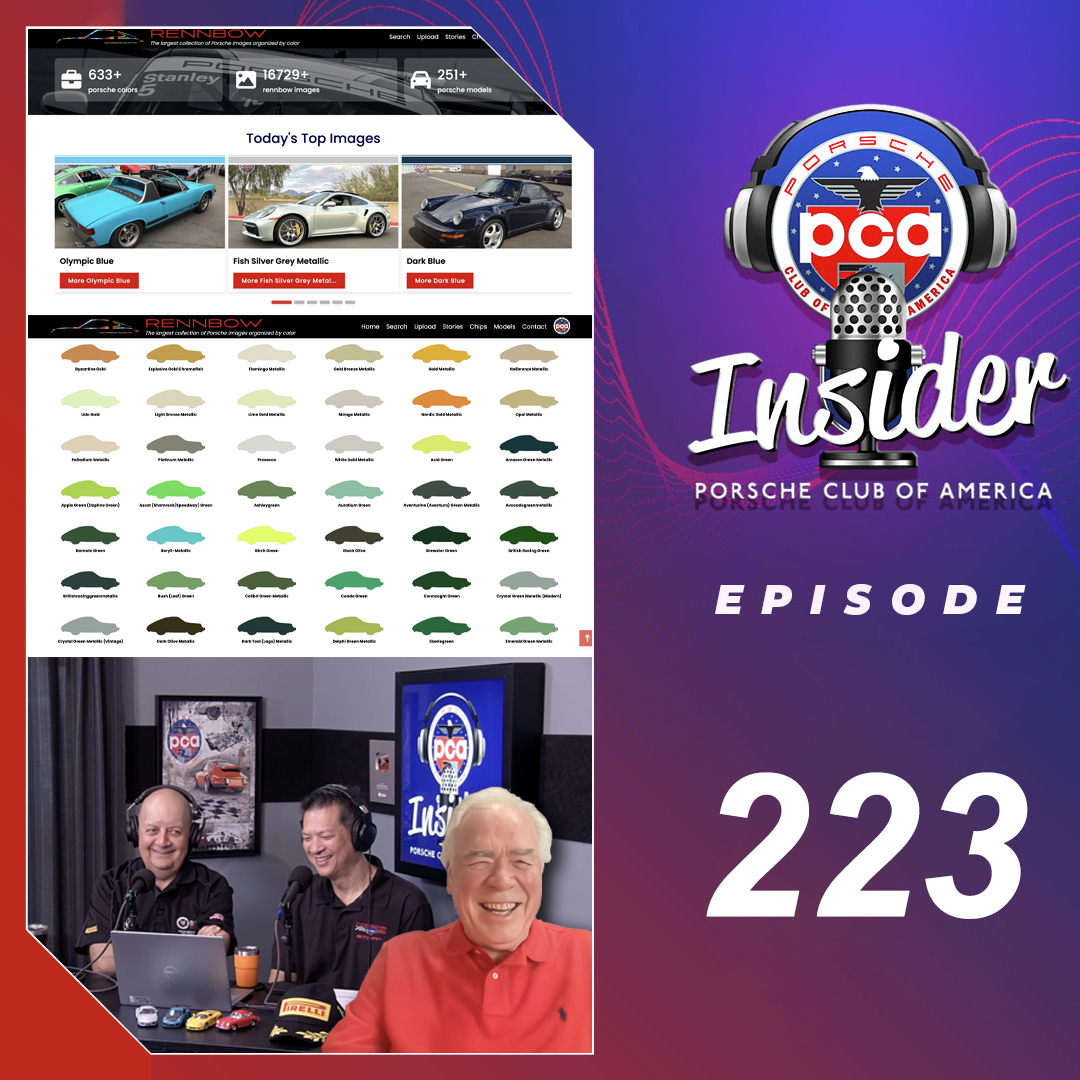
Rennbow.org: How the Porsche Club of America Catalogs Every Porsche Color
About this episode
Porsche Club Insider digs into how PCA’s color projects—centered on Rembo/Renbow—catalog Porsche paint with real-world rigor. The hosts trace the origin of Rembo.org around 2019, then walk through how volunteers maintain the database, verify submissions, and use standardized photo guidelines. Along the way, they connect color rarity to “paint can” ratings, explain why paint-to-sample and repaints complicate matching, and share stories about finding specific shades and paying premiums for unique colors.
Ever spent hours staring at Porsche paint samples? Welcome to your new obsession. In this episode, we sit down with Jim Moore, Lead Volunteer for Rennbow.org—the Porsche Club of America’s authoritative color wiki. We dive into how Rennbow catalogs everything from common "one-can" shades to ultra-rare "five-can" unicorns. Discover why owner-submitted photos change how we see these cars and learn about the mythical Porsche colors that have still never been caught on camera.
Porsche Club of America
"We tried to run it as current as possible, which is what Jim and the volunteer team does there and just making sure that we have the colors listed, the color codes..."
The Porsche Club of America is a big Porsche owner/enthusiast group in the U.S. Here, they’re helping build a database of Porsche paint colors so people can look up what colors exist and see examples.
The Porsche Club of America (PCA) is a member organization that supports Porsche owners and enthusiasts in the U.S. In this segment, they’re described as running a volunteer effort to catalog Porsche paint colors and color codes going back to 1950.
color codes
"there and just making sure that we have the colors listed, the color codes, but then also members and non-members alike..."
A color code is like a paint’s ID number. It helps shops and owners get the exact right shade when repainting or restoring a car.
A Porsche color code is the manufacturer’s specific identifier for a paint color, used to match the correct formulation. That matters for restorations and repainting because the same color name can vary over time, but the code points to the intended exact shade.
slippery slope
"You kind of fall into that slippery slope when you get into this site because they're just..."
They’re using “slippery slope” to mean “once you start, it’s easy to get pulled into more and more.” In this case, looking at colors can lead to bigger decisions like repainting or buying a specific car.
“Slippery slope” here is used as a metaphor for how getting into a niche site can pull you deeper into the hobby. Once you start browsing color histories, you may start planning paint work or shopping decisions based on what you see.
air-cooled
"“I love the air-cooled, so I do have a couple of water-cooled Porsches also...”"
“Air-cooled” means the engine is cooled mostly by air flowing over it, not by liquid coolant running through a radiator. Porsche fans often prefer the air-cooled cars because they feel and sound different and have their own set of quirks.
“Air-cooled” refers to an engine cooling approach where heat is removed primarily by airflow over finned engine surfaces rather than by circulating coolant through a radiator. Porsche’s air-cooled era is a major enthusiast topic because it changes how the engine runs, how it’s packaged, and what maintenance concerns people watch for.
water-cooled
"“...so I do have a couple of water-cooled Porsches also...”"
“Water-cooled” means the engine uses liquid coolant to move heat to a radiator, where air helps cool it. It’s the opposite approach from air-cooled, and Porsche owners often talk about the difference because it changes how the car feels and what you maintain.
“Water-cooled” means the engine uses liquid coolant to carry heat to a radiator, where airflow cools it down again. In Porsche discussions, this term is often used to contrast with air-cooled engines because the cooling system design affects engine behavior and long-term service considerations.
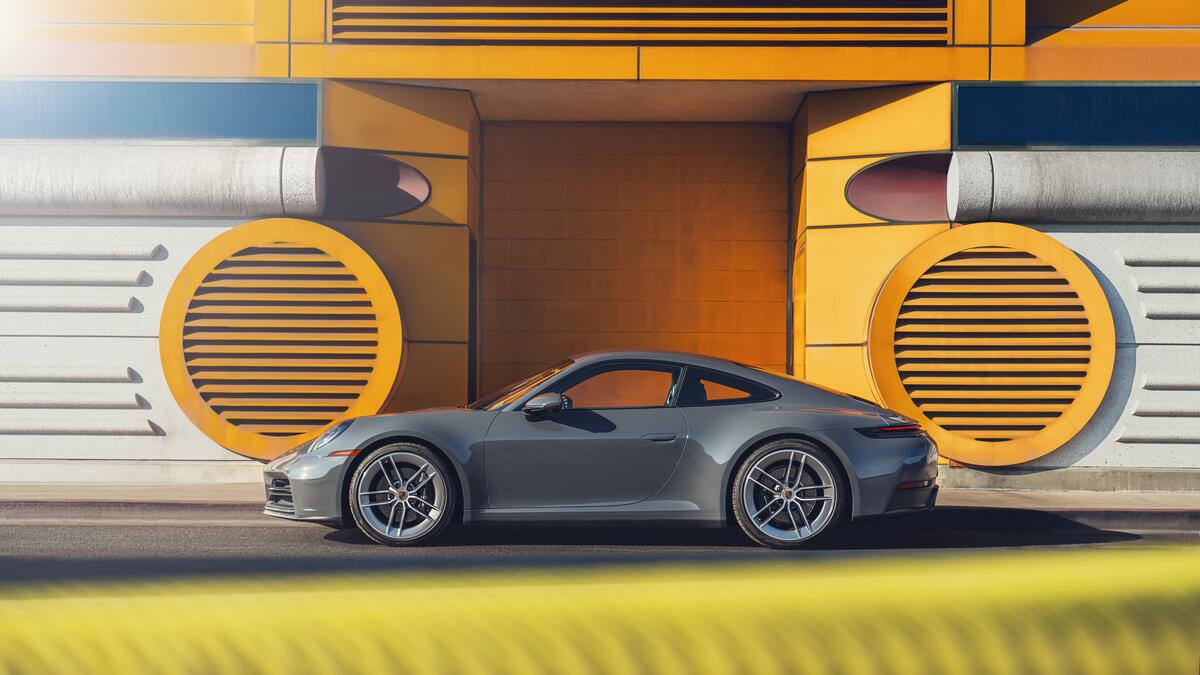
Porsche 911
"“...I started with Porsche Club when I bought this 86 911, the real one of it.”"
This is a Porsche 911 from 1986. The 911 is Porsche’s famous sports car, and in this story it’s the “air-cooled” kind they’re talking about—meaning it uses an engine cooling design that doesn’t rely on a liquid radiator system.
A Porsche 911 is the iconic rear-engine sports car Porsche has built for decades, and the “86” indicates the model year of that specific 911. In this segment, the host is also contrasting it with air-cooled vs water-cooled Porsches, which matters because 1980s 911s are typically associated with the air-cooled era.
totaled the car
"“...it totaled the car out, was a member of the family...”"
“Totaled” means the damage was so bad that it wasn’t worth repairing. The car is considered a write-off, even if some parts might still be usable.
When a car is “totaled,” the insurer or repair assessment determines the damage is too expensive to fix relative to the car’s value. In enthusiast terms, that often ends up meaning the car is effectively removed from the road, even if parts could be saved.
Fonsac Mac
"Just black, yeah. [399.9s] It's not Fonsac Mac or any black, it's black. [402.9s] My silver 86, my 68 was ivory, but my background is I have a degree in art, I worked in the"
They’re talking about a specific named paint color. Even if it’s “black,” different paint names can look slightly different depending on the exact formula.
“Fonsac Mac” is mentioned as a specific black-related paint name, implying a particular Porsche color rather than generic “black.” In Porsche color discussions, enthusiasts often distinguish between factory paint codes/names because different blacks can look different under light.
Python Green
"...I've said when I've seen Python Green, Macan, wow, that really looks great."
Python Green is a named Porsche paint color. It’s not just “green”—it’s a specific shade Porsche uses, and it can look different depending on the light.
Python Green is a specific Porsche paint color name. In Porsche color catalogs, named shades like this matter because they’re tied to exact formulas and how the color looks under different lighting.
paint can color
"...the Silver's, White's, the more what I would call one paint can color, because that's what they can sell very easily"
“Paint can color” here means a mainstream, easy-to-sell paint shade that dealers can stock and order without taking on too much risk. It’s contrasted with more distinctive, less common custom or special colors.
ABS brakes
"So to me, that was the 964 was the next in the evolution with airbags, ABS brakes. [656.6s] So I started putting a search out for 964s in a unique color."
ABS is a braking system that helps stop your wheels from locking up. That way, you’re more likely to be able to steer while braking, especially on wet or icy roads.
ABS brakes use wheel-speed sensors and a control unit to prevent the wheels from locking during hard braking. That helps maintain steering control and reduces stopping-distance variability on slippery surfaces.
airbags
"So to me, that was the 964 was the next in the evolution with airbags, ABS brakes. [656.6s] So I started putting a search out for 964s in a unique color."
Airbags are safety cushions that pop out during a crash to help protect you from hitting the steering wheel, dashboard, or other hard surfaces.
Airbags are supplemental restraint devices that deploy rapidly in a crash to help reduce injury. In the context of older Porsche 911s, their presence marks a shift toward more modern occupant protection.
needle in the haystack
"So to find the car, which I eventually found after a nine-month search of a cobalt blue [692.4s] metallic 964 coupe, was finding the needle in the haystack, I have to say."
It’s an expression meaning “something really hard to find.” They’re saying their exact car and color were hard to track down.
“Needle in the haystack” is a metaphor for something extremely hard to find. The speaker uses it to describe how difficult it was to locate a good-condition Porsche 964 in a specific rare color after months of searching.
Chevrolet Cobalt
"...I eventually found after a nine-month search of a cobalt blue metallic 964 coupe, was finding the needle i..."
The Chevrolet Cobalt is a compact car made by Chevrolet. People may talk about it when they’re searching for a specific color or specific version. In the podcast, it’s connected to the idea of finding a car in cobalt blue metallic.
The Chevrolet Cobalt is a compact car that was offered in multiple trims and powertrain options, typically aimed at practical, everyday transportation. In the podcast snippet, it’s mentioned in the context of searching for a specific car color (cobalt blue metallic), which highlights how enthusiasts track down particular looks. It may be discussed as part of a story about finding the right example rather than as a performance centerpiece.
cars and coffee
"Do your people asking you, like cars and coffee and car shows, what color is that? [719.9s] Oh yeah, that's the most common question is, what color blue is that?"
Cars and coffee is a casual car meet where people show up with their cars and chat. The speaker mentions it because people often ask what color the car is.
Cars and coffee is a casual car meet-up format where enthusiasts gather in the morning to talk about cars and show them off. The speaker references it because color comparisons and questions about paint shade are common at these events.
sapphire blue
"People are thinking it might be sapphire blue because that's a more modern blue, and it [731.2s] was interesting."
Sapphire blue is a named blue paint color. They’re saying people think their cobalt blue might actually be sapphire blue, but the speaker explains the difference.
Sapphire blue is a specific blue paint color name that’s being used as a likely misidentification for the speaker’s cobalt blue. The speaker later compares the two shades next to a 991 to explain why cobalt looks richer and sapphire looks brighter.
unique color Porsche
"is extremely difficult to be able to find one that is in good condition [775.9s] worth buying that's in a unique color. [778.6s] Like you said, you literally did find that needle in the haystack, but you spent nine [781.4s] months doing it."
A “unique color Porsche” refers to a less common factory paint color (or otherwise distinctive color) that stands out from the most typical options. The speaker claims these cars often command a premium because they’re more desirable and generate more discussion at shows.
bring a trailer
"A lot of failed bids on bring a trailer, a P-car, I also, what happens with unique colors [795.7s] is they go for a premium, they tend to."
Bring a Trailer is a popular website where car enthusiasts buy and sell cars through auctions. The host is saying their search involved trying to win one there.
Bring a Trailer is an enthusiast-focused online auction site where many classic and performance cars are sold. In this context, the speaker mentions failed bids there while searching for a rare Porsche color, highlighting how competitive and price-sensitive the market can be.
P-car
"A lot of failed bids on bring a trailer, a P-car, I also, what happens with unique colors [795.7s] is they go for a premium, they tend to."
“P-car” is just a nickname people use for a Porsche. They’re talking about trying to buy a Porsche during their search.
"P-car" is a common enthusiast shorthand for a Porsche. Here, it’s used alongside Bring a Trailer to describe the kind of Porsche the speaker was trying to buy during their search.
one paint can Porsche
"You can pay up to 20, 30% more for a unique color Porsche over what I'll call a one paint [806.0s] can or a two paint can Porsche, so even though I'd find the car, I still had a budget as"
They’re using a shorthand for how complex the paint job is—how many paint colors/steps are involved. The point is that rarer, more special paint setups can raise the price.
“One paint can” and “two paint can” are shorthand for how many paint colors/steps are involved in the factory paint scheme. The speaker contrasts these more common paint approaches with a “unique color,” claiming unique-color cars can sell for 20–30% more.
premium
"So without getting into too much of the personal price of the car, did you have to pay a premium because it was cobalt blue? Did you feel like you paid a premium..."
They mean paying extra money for something special. Here, the “something special” is the car’s color, and they’re debating if you get that extra cost back later.
In this context, “premium” means paying extra money above the usual price for a desirable configuration—here, a specific Porsche color. The discussion is about whether that extra cost is recouped when the car is sold later.

Macan GTS
"I had the same thing with the, the Carmine Red I mentioned when I bought my Macon. I wanted a Carmine Red Macon GTS. Once again, it's hard to find vehicle, but and at that time the Macon, the Carmine Red"
They’re talking about a Porsche Macan GTS, which is a sportier version of the Macan. They chose a rare red color and believe it helped the car’s value later.
The speaker references a Porsche Macan GTS, a performance-oriented compact SUV variant. They’re specifically discussing ordering it in a rare color (Carmine Red) and how that color choice can influence both desirability and resale.
aubergine
"[935.6s] And one day he shows up in the, um, let's see, a plant, aubergine, aubergine, aubergine. [941.4s] I'm like, wow, I'm like, yeah, you got a second 9-11. [944.1s] He goes, no, it's the same one. [946.3s] And I said, but it was Viper Green."
Aubergine is a deep purple color. They’re using it to describe what the car looked like, then explaining how that color relates to other repaint colors the car had.
Aubergine is a named color described as a deep purple tone. Here, it’s used as the color the car appeared to be, and the discussion contrasts it with later repaint colors to explain how the car’s paint history changed over time.
Viper Green
"[946.3s] And I said, but it was Viper Green. [948.4s] He goes, well, that was a repaint. [949.8s] He goes, this, it was actually originally our, our virgin and at some point, uh, it"
Viper Green is a named paint color. In this context, they’re saying the car was painted that color at some point, even if it wasn’t the original factory color.
Viper Green is a specific paint color name used in Porsche color catalogs. When someone says a car was “Viper Green,” they’re referring to a particular factory color (or a later repaint matched to that color name).
repaint
"[944.1s] He goes, no, it's the same one. [946.3s] And I said, but it was Viper Green. [948.4s] He goes, well, that was a repaint. [949.8s] He goes, this, it was actually originally our, our virgin and at some point, uh, it"
A repaint is when someone changes a car’s paint color by redoing the paint job. Collectors care because it can mean the car doesn’t have its original factory color anymore.
A repaint is when a car’s existing paint is stripped or covered and refinished in a different color. In collector circles, repainting can affect how “original” a car is considered, and it’s why color documentation matters.
Cardex
"[982.1s] Okay. I got you my car, right? [985.1s] On its Cardex, originally beautiful, mice and blue, probably the most beautiful [990.9s] colors you can have on it. [992.6s] Mice and blue was the original color of my car."
A Cardex is Porsche’s paperwork that shows how the car was originally built, including the original paint color. Collectors use it to check whether the current color matches the factory order.
A Cardex is Porsche’s historical build/option record card used to document how a car was originally ordered from the factory. In color discussions, it’s used to verify the original paint and option codes versus what the car looks like today.
surplus
"[1002.4s] I have any nine 14s were repainted black, red or white because the 70s moved to the [1010.0s] 80s and the Jim's point about guards, red, you know, suddenly Porsche, it was like [1014.1s] they bought a surplus of guards, red and every nine 44 of the guards, red. [1018.6s] People wanted to make their car look more modern."
Here, “surplus” means Porsche had extra stock of a certain paint color. If they had a lot of it, they might paint more cars that color during that time.
In this context, “surplus” means Porsche had extra inventory of a particular color (guards red) and used it to paint many cars. That kind of supply-driven color availability can explain why certain colors show up repeatedly in a specific era.
guards, red
"You mentioned guards, red. [1029.9s] I think for a longest time, guards, red, kind of, it was so prevalent in the 80s [1035.5s] and early nineties that it kind of went away."
Guards Red is a particular named red paint color used by Porsche. The speaker is saying it was very popular decades ago, but it’s less common on modern cars now, so it stands out.
Guards Red is a specific Porsche paint color name, not just “red.” The speaker discusses how it was extremely common in the 1980s and early 1990s, then became rarer on modern cars—so seeing it again feels special.
Rosso red
"Uh, with, with, uh, Ferrari owners, you may get them caring about color more [1128.3s] that they want it to be Ferrari red. [1131.2s] Rosso red. [1132.0s] If you aren't Rosso red, they'll chastise you."
“Rosso” is Italian for red, and Ferrari often uses specific red shades with that name. The host is saying some Ferrari owners care a lot about having the right red color.
“Rosso” is an Italian color name commonly used by Ferrari to refer to its traditional red shades. In this segment, “Rosso red” is used to describe how some Ferrari owners feel strongly about getting the “correct” red for their car.

Ferrari 308
"Uh, with, with, uh, Ferrari owners, you may get them caring about color more ... Again, every couple of years they come out with a new model of 308, the 328 Testerosa."
Ferrari 308 is a famous older Ferrari model. The host brings it up to compare how Ferrari fans talk about specific “right” colors for their cars.
The Ferrari 308 is a classic mid-engine Ferrari model that’s often discussed in terms of its model-line evolution and styling. In this segment, it’s used as an example of how Ferrari owners may focus on specific color choices tied to a particular model identity.

Ferrari 328
"Again, every couple of years they come out with a new model of 308, the 328 Testerosa. Somebody has a different car, but with Porsche, it's really becomes the"
Ferrari 328 is a well-known older Ferrari model. In the conversation, it’s part of the example list showing how Ferrari fans may care about color along with the model itself.
The Ferrari 328 is another well-known mid-engine Ferrari from the same era as the 308, and it’s commonly referenced when talking about Ferrari’s model progression. Here it’s mentioned to illustrate that Ferrari’s lineup changes more frequently, while Porsche owners differentiate cars heavily through color.

Ferrari Testarosa
"Again, every couple of years they come out with a new model of 308, the 328 Testerosa. So somebody has a different car, but with Porsche, it's really becomes the"
Ferrari Testarosa is a famous older Ferrari. The host mentions it to compare Ferrari fans’ color preferences versus Porsche owners’ obsession with color as a differentiator.
The Ferrari Testarosa is an iconic 1980s mid-engine Ferrari known for its distinctive styling and strong visual identity. The host uses it as part of a Ferrari example to contrast with Porsche, where color is framed as a primary way owners differentiate their cars.
tangerine
"it's through color. Unlike, uh, uh, let's use Ferrari as an example. Again, every couple of years they come out with a new model of 308, the 328 Testerosa. So somebody has a different car, but with Porsche, it's really becomes the [1182.9s] color is where you can start showing off that maybe a seventies in a 70 bright [1188.5s] color that you mentioned, Manny with a tangerine or a very per green or"
Here, “tangerine” just means a bright orange paint color. The point is that some Porsche owners love loud, distinctive colors from the past.
In this context, “tangerine” refers to a bright, orange-like paint color used on older Porsche cars. The host is using it as an example of the kind of bold, period-correct color that helps owners show off individuality.
oak green metallic
"They started taking oak green metallic and making an oak green metallic kneel, making the Ruby star kneel, uh, to signify it's a new version of a historic color"
It’s a named Porsche paint color. “Metallic” means the paint has tiny shiny particles, so the color looks different depending on the light.
“Oak green metallic” is a specific Porsche paint color name, with “metallic” indicating the paint contains metallic flakes that change how it reflects light. In this segment, Porsche is described as reworking this historic color into a newer “kneel”/variant for modern cars.
Ruby star kneel
"They started taking oak green metallic and making an oak green metallic kneel, making the Ruby star kneel, uh, to signify it's a new version of a historic color"
This is a named Porsche paint color that’s meant to feel like a throwback. The host is saying Porsche updates the old color idea for newer cars.
“Ruby star” is a Porsche paint color reference tied to historic styling, and “kneel” here appears to be the host’s pronunciation/label for a newer color variant. The key idea is that Porsche is creating modern versions of legacy racing colors while keeping the heritage connection.
tying back to that heritage of Porsche racing
"particularly if you look at racing in particular, and Porsche has used a lot of different unique colors in, in racing and, uh, you know, you could on your modern day, such as I just had a"
The host is saying Porsche owners use paint colors to connect their car to Porsche’s racing past. It’s like choosing a color that tells a story about where the brand came from.
This segment frames Porsche color selection as a form of “heritage linking,” where modern paint choices reference historic racing colors. For Porsche owners, the visual connection to motorsport history is presented as a major reason people care about specific color names.
golf blue
"such as I just had a, was that a show and somebody had golf blue GT for RS."
“Golf blue” is a specific Porsche paint color name. The idea is that using an older, historic color on a newer car makes it feel connected to Porsche racing history.
“Golf blue” is a named Porsche paint color associated with the brand’s history, including racing-era palettes. The host’s point is that applying a historic color name to a modern Porsche (like an RS) is a way to visually connect the car to Porsche’s motorsport heritage.
Mison blue GT four
"I had two cars, one a Mison blue 356 and a Mison blue GT four right next to each other."
The Porsche GT4 is a more track-focused Porsche than the regular versions. They’re using the same “Mison blue” paint on a GT4 to show how a classic color can look on a modern performance car.
The Porsche GT4 is a track-focused Cayman/Boxster-derived model line known for sharper handling and a more driver-oriented setup than a standard car. Here, “Mison blue” is used to show how Porsche can carry forward heritage color choices into modern GT4 styling.

Mison blue 356
"I had two cars, one a Mison blue 356 and a Mison blue GT four right next to each other."
The Porsche 356 is one of Porsche’s earliest famous cars. Here, they’re talking about painting it “Mison blue” so you can compare how that same color looks on an old Porsche versus a newer one.
The Porsche 356 is Porsche’s early, air-cooled sports car that helped define the brand’s classic design language. In this segment, “Mison blue” is being used as a specific paint color to compare an original 356 to a modern Porsche in the same shade.
Porsche heritage
"but people like to tie back to that Porsche heritage and colors, one way they can do it in the modern Porsches."
Here, “Porsche heritage” means Porsche’s history and classic roots. They’re saying people like to connect today’s cars to older Porsches, and paint color is one way to do that.
“Porsche heritage” in this context means the brand’s historical identity—especially classic cars and their original color palettes. The speaker connects that heritage to modern Porsche paint choices, suggesting buyers use color as a link to the past.
allocation for paint to sample
"I think that's what is great about Renbow.org is you can use it as a resource if you're lucky enough and you get an allocation for paint to sample, but man, I think that's probably the most difficult thing."
An “allocation” is basically a limited permission/slot to request the special paint option. Since it’s limited, you might not be able to get the exact paint-to-sample choice you want.
An “allocation” here means a limited production/ordering slot Porsche grants for special paint requests like paint-to-sample. Because these slots are constrained, not every buyer can get the exact color sampling option they want.
over 600 colors
"Cause how many color, how many colors are on renbow.org now? Roughly, uh, there are over 600 colors on renbow.org right now."
The speaker is referencing the Renbow.org catalog’s breadth—“over 600 colors”—as evidence that Porsche color history and options are extensive. For enthusiasts, a large color database makes it easier to find heritage shades and compare them to modern paint offerings.
126 paint to sample colors
"There are, I believe it is 126 paint to sample colors that you could choose from and it, it's interesting as people say, well, if you could buy any car,"
They’re saying the paint-to-sample program has 126 color choices. Even though that’s a lot, picking one still feels tough because there are so many options.
The segment claims Porsche’s current paint-to-sample program offers 126 selectable colors. That number frames the practical challenge: even with a large palette, choosing the “right” shade is still a major decision.
paint the sample
"Uh, so paint the sample for the new to the hobby or new to Porsche is, um, uh, colors that aren't on the normal palette, if you will, uh, when you go to the configurator, you're going to see all these different colors and levels of cost."
“Paint the sample” means you’re not limited to the usual paint colors. You can request a custom color, and Porsche has to create and verify the paint so it looks right on the car.
“Paint the sample” is a Porsche paint program where you can specify a custom color rather than choosing from the standard palette. The factory typically has to formulate and test the color to ensure it matches the reference and performs correctly on the car.
configurator
"Uh, so paint the sample for the new to the hobby or new to Porsche is, um, uh, colors that aren't on the normal palette, if you will, uh, when you go to the configurator, you're going to see all these different colors and levels of cost."
A configurator is the website or ordering system where you pick options for your car. Here, it’s where you choose paint colors and see which ones cost more.
A configurator is the online (or dealer) ordering tool that lets you choose your car’s options—like paint color and trim—and shows what’s available. In this context, it also reflects different paint choices and their cost levels.
swatches
"And when you open it up, it's like a palette of a hundred and some colors. You can buy a nice little thick book with swatches on it."
Swatches are small physical paint samples. They let you see what a color looks like before you order it.
Swatches are physical paint samples that show a color’s appearance under controlled conditions. For custom Porsche colors, swatches (and color books) help buyers preview how the paint will look before committing to a specific formulation.
test these colors
"I would imagine the allocations for that are very limited. And I think it can take up to two years because they have to test these colors. Just like they would any other color."
Custom paint takes time because Porsche has to verify the color formula and make sure it comes out right on the car. That’s why it can take a long time to deliver.
When Porsche creates custom paint, the factory must test the color formulation to confirm it matches the reference and behaves correctly as a finished automotive coating. That testing is part of why custom programs can take a long time (the host suggests up to two years).
PTS
"And that can take a long time where PTS, the colors I've already been tested, [1499.1s] they've all been already been improved."
PTS means "paint to sample." It’s when you pick a custom color for your Porsche instead of choosing one from the normal paint list. Because the paint has to be mixed and tested, it usually takes longer and costs more.
PTS stands for "paint to sample," a Porsche option where you specify a color that isn’t part of the standard catalog. Porsche then mixes, tests, and applies the custom paint, which can take longer than ordering an off-the-shelf color.

Porsche Cayman
"Then like on a nine 11 or a Cayman, this was a lot of orange, but then someone [1529.6s] said, Oh, it's a PTS."
The Porsche Cayman is Porsche’s mid-engine sports car. In this segment, it’s used as a comparison point to show that the same custom paint can look different on different Porsche body shapes.
The Porsche Cayman is Porsche’s mid-engine sports car (smaller and more compact than the 911), and its proportions can make the same paint color look different. The host notes that the orange PTS color looked more intense on a 911 or Cayman before learning it was a specific PTS shade.
golf orange
"[1531.0s] It's golf orange and it's only, he got a pass. [1535.4s] I'm like, well, now that's cool."
“Golf orange” is a specific orange paint color name. The host thought the orange looked extreme until someone explained it was a particular PTS color called Golf orange.
"Golf orange" is a named Porsche paint color mentioned as the actual PTS shade behind the striking orange the host saw. The point is that what looked like an overwhelming orange was actually a specific cataloged/custom color choice.
paint to sample plus
"If you get the opportunity to do paint to sample plus, which is where you [1579.4s] bring in the special color that you want and they have to mix it, test it, so on"
Paint to sample plus is for when you want a very specific color. Instead of picking from Porsche’s existing paint options, they have to create the color for your car and verify it, which typically increases cost and lead time.
"Paint to sample plus" is a step beyond standard PTS: you bring in a special color you want, and Porsche has to mix and validate it. That extra mixing/testing is why it can cost more and take longer than choosing from an existing palette.
paint chip
"because I know there's colors that I like, but looking at a, a paint chip or a swatch doesn't necessarily mean that I would like it on a car... A paint chip is, it's hard to tell."
A paint chip is a little sample of a color. It can look different on a real car because of lighting and the car’s shape, so it’s not always a perfect preview.
A paint chip is a small physical sample of a color used to preview how it might look. On cars, the final appearance can change with lighting, metallic/pearl content, and the way the color interacts with body-panel shape—so a chip doesn’t always match the real-world look.
standardize more the photography
"And one of the biggest things that came out of that also was then, well, is there a way you can standardize more the photography, the looks of, uh, the photos are in there because they're all user generated."
Standardizing photography means trying to make the photos look more similar—same lighting and style—so color comparisons are fair. Otherwise, the same paint can look different just because of how the photo was taken.
Standardizing photography means making user-submitted images more consistent so color comparisons are more reliable. If photos vary widely in lighting, angle, and camera processing, the same paint color can appear different, making the catalog less useful for shoppers.
user generated
"the looks of, uh, the photos are in there because they're all user generated. So you can imagine there are over 16,000 photos in Renbow currently all being uploaded by members and non-members of PCA, I have to say."
User-generated content means the photos are uploaded by regular people. That’s helpful because it shows real cars, but the photos can vary a lot in lighting and editing.
User-generated content refers to photos uploaded by members and non-members rather than images produced under a single, controlled setup. For color catalogs, this can be both a strength (real-world appearance) and a challenge (inconsistent lighting and editing).
Porsche 930 turbo
"I had a one recently, uh, 930 turbo got submitted a Marsala metallic. We didn't have it in the database."
This is a specific older Porsche 911 generation that came with a turbocharger. The host is using it to show how the club checks whether a submitted paint color is real.
The Porsche 930 is the G-Series 911’s turbocharged era (1970s–1980s), and “turbo” refers to the factory turbo setup. In this segment, it’s used as an example of a rare color submission that the Porsche Club of America had to verify historically.
historical search
"We went through a whole historical search and we could not find this color listed, but he sent us the data plate and it showed it was a paint to sample"
A “historical search” here means digging through archives and prior records to verify whether a paint color existed for a given model and era. It’s the club’s method for validating rare or unusual color claims beyond what’s already in their database.
data plate
"but he sent us the data plate and it showed it was a paint to sample color, uh, had the right code for paint to sample back in that day."
A data plate is a factory label on the car that lists important build details. Here it’s being used to prove the correct paint code for the color being claimed.
A data plate is an identification label on the car that records build information such as paint codes and options. In this segment, it’s used as evidence to confirm the submitted “paint to sample” color code.
Marsala metallic
"When you mentioned Marsala metallic, I'm trying to envision what color it was... Turns out it's more of a purple hue... Beautiful purple metallic."
“Marsala metallic” is a named Porsche paint color. “Metallic” means it has tiny sparkly particles, so it can look different depending on the light. Here, they explain it actually looks more purple than brown or red-brown.
“Marsala metallic” is a specific Porsche paint color name, and the “metallic” part means the paint contains metallic flakes that make it look different under different lighting. In this segment, the hosts clarify that Marsala reads as a purple hue rather than the brownish/red-brown color one might expect from the name.
photo submissions
"It was interesting owner actually had a lot of documentation and I'll have to say that's one thing we rely on, not only for photo submissions, but information and documentation..."
They’re using submitted photos as evidence for what color a Porsche really is. The goal is to confirm the color is accurate and historically correct, not just what someone thinks it is.
The hosts describe using “photo submissions” as part of a verification workflow for the Porsche color catalog. The idea is that images and supporting paperwork help confirm what a car’s paint color actually is and whether it matches a historically correct Porsche color offering.
documentation
"It was interesting owner actually had a lot of documentation and I'll have to say that's one thing we rely on, not only for photo submissions, but information and documentation..."
Here, “documentation” means paperwork or records the owner has that help prove what the car’s original color was. They use it to avoid mixing up factory colors with later repaint jobs.
In this context, “documentation” refers to owner-provided records used to validate a car’s paint color history. The hosts emphasize it as a key input for distinguishing genuine Porsche colors from later repaint choices.
Porsche color verification
"information and documentation as far as does, was this car color a real portion of color? ... Because you mentioned it, Manny, there's a lot of repaints out there... sometimes we've looked at it and no, it was an Audi color, but it wasn't a Porsche color. So therefore we're not going to accept it."
They’re double-checking whether a paint color name really belongs to Porsche. If it turns out the color was actually from another brand, they don’t include it in the Porsche color list.
The segment outlines a verification process for whether a named paint color is actually a Porsche color. They note that some colors people claim are Porsche colors turn out to be from other brands (e.g., Audi), and those are rejected by the catalog.
flat black
"I think one of three, maybe, um, nine thirties that were painted in flat black, which, uh, wasn't, it was re, re, it was restored and the painter happened to be there."
Flat black is paint that doesn’t shine like regular glossy paint. It’s a specific look, and matching it correctly usually means using the right paint and finish, not just “black paint.”
Flat black is a low-sheen paint finish (not glossy). On a Porsche 911 Turbo (930 generation) like the one discussed, the flat-black look is especially notable because it requires the correct paint formulation and finish quality to match period-correct samples.
restored
"which, uh, wasn't, it was re, re, it was restored and the painter happened to be there."
“Restored” here implies the car’s appearance was brought back to a prior condition, likely including repainting to match the original flat-black specification. Restoration matters because paint finish and color matching are key to authenticity when you’re verifying period-correct details like “paint the sample.”
color number
"including the paint the sample, uh, um, uh, documentation of what the color number was and someone from Porsche was there as well looking and he peered over my shoulder and he said, that's legitimate."
A “color number” is like a paint ID code from the factory. It helps confirm the exact shade/formula the car was originally specified with.
A “color number” is the factory code that identifies the exact paint formulation for a specific exterior color. In this segment, the documentation includes the paint sample and the color number, which helps verify the car’s finish is correct for its period specification.
Renville dot org
"As soon as someone starts talking about a color, I see them whip out their phone and go to Renville to see if they can find it. [2048.4s] The only thing I wish we had that technology be able to scan the color"
They’re talking about a website people use to look up Porsche paint colors. When someone mentions a color at a meet, others check the site to figure out the exact name.
The speaker is referring to a Porsche-color catalog website (Renville.org) that helps people look up paint colors. It’s used by enthusiasts to identify what a specific car’s color is when they see it at events.
Carmine red
"And then there's in between, you have, uh, the scale such as I mentioned [2127.1s] my Carmine red, it's a three paint can, cause it was an optional color when [2132.3s] it was offered on the various models."
“Carmine red” is a specific Porsche paint color. In their system, it’s considered moderately rare (a three out of five) because it was only offered as an option for certain model years.
“Carmine red” is a named Porsche paint color discussed in the episode’s rarity scale. The host says it’s rated as a three paint can color because it was an optional color when it was offered on various Porsche models.
PCA site
"But yeah, it is a PCA site and not a Porsche worldwide site. So we really have, we don't have actual production numbers to rely on."
They’re saying this is the Porsche Club of America’s system, not an official worldwide Porsche factory database. Because of that, they have to use club knowledge and old records to figure out how rare colors were.
“PCA site” here means the Porsche Club of America’s cataloging/knowledge base rather than a global Porsche (factory) database. The host emphasizes that the PCA approach can’t rely on official production counts, so it depends on member knowledge and historical documentation.
historical data
"We, uh, go back through a lot of historical data to just try to see, um, like when I was at Monterey works, I was, uh, making contacts..."
They’re using old records and documentation to figure out what colors were actually used. It’s especially important because they can’t just look up official production totals.
“Historical data” in this context means using past records and documentation to reconstruct how Porsche colors were categorized and how common they were. The host contrasts this evidence-based approach with the lack of official production numbers.
paint can ratings
"And so it, uh, has become a real, uh, interesting point of how, how do you place these paint can ratings on it? And what's most interesting now is it's becoming an industry standard."
They’re talking about a way to rank paint colors by how common or rare they are. Higher rarity rankings tend to make the color more desirable to collectors.
“Paint can ratings” is the Porsche color-collecting practice of categorizing how common or rare a specific paint color is, often using a tiered scale. The host describes it as moving from internal club knowledge toward a broader “industry standard,” which matters because it influences how people value and verify colors.
four paint can rating
"You will often see on a Porsche listening that this is a four paint can rating. So watch the price go up because of that."
They use a numbered scale to rate how rare a paint color is. A “four” level is treated as rarer, and that can push prices higher when cars are listed or sold.
A “four paint can rating” is a specific level within the tiered Porsche color rarity system the host is describing. The key point is that collectors and marketplaces treat these ratings as meaningful signals, and the host explicitly links them to higher prices.
paint can stickers
"people have created their own four or five paint can stickers and put it on the cars."
These are custom-looking labels people put on their cars that point to the paint color code. In Porsche circles, it’s a fun way to show what color the car is (or what color it’s referencing) using the same kind of labels the club uses.
“Paint can stickers” refers to the club/owner practice of using color-code labels (often associated with Porsche paint “cans”) as decals on the car. It’s a visual way to identify or reference the car’s paint color in a standardized, enthusiast-friendly format.
one paint can decal
"Like I would rock a one paint can decal on my black 996 just because I think it's funny."
This is a playful way of saying “I’m only putting one paint-color label/sticker on the car.” It’s basically about referencing the paint code(s) in a simple, fun way.
A “one paint can decal” is shorthand for using a single Porsche paint-code label as a sticker on the car. The implication is that some colors are represented by one primary paint reference, while others may involve multiple references (the host later jokes about “half a paint can”).
paint a sample
"Getting these paint a sample and plus allocations is also very tough."
A paint sample refers to the process of verifying or selecting a specific factory color (often via approved samples) before the car is built. In Porsche ordering, this can be part of the workflow for special or less-common colors.
GT three RS
"No, I, I don't think it's a must have, uh, knowing various people who have bought GT three RS's and, uh, uh, GT four RS's, et cetera, they, they don't always seem to strive for the paint to sample"
The Porsche 911 GT3 RS is a high-performance 911 built to feel very “race car” on track. Here, they’re talking about how some GT3 RS buyers don’t always chase the rare custom paint options.
Porsche 911 GT3 RS is a track-focused 911 variant known for its high-revving performance and aggressive aero. In this segment, the host mentions owners buying multiple GT3 RS cars and how some don’t prioritize paint-to-sample colors, treating the color as a way to stand out rather than chasing rarity.
paint sample plus colors
"they, they don't always seem to strive for the paint to sample and, and, uh, paint sample plus colors because they see those cars as standing, allowing them to stand out just based on what the color is."
They’re talking about custom paint choices—basically, how people can pick special colors and whether they’re trying to make the car as unique as possible. Some buyers care more about the look than about having the rarest possible paint.
The host is referring to Porsche’s paint-to-sample custom color approach and how buyers may also consider additional color-related options. The key point is that some owners prioritize the car’s ability to stand out over chasing the absolute rarity of a bespoke paint match.
$15,000 or $30,000
"I think it's, uh, the special person who wants to spend that, as you mentioned, $15,000 or $30,000 to then separate that car a little more."
They mention that custom paint can cost a lot of extra money—tens of thousands of dollars. That’s why not everyone chooses the rarest paint option.
The host cites a price range for getting a more exclusive Porsche color outcome, framing paint-to-sample as a significant discretionary spend. This helps explain why not every buyer pursues the rarest custom paint options.
one of a kind color
"if it's a paint sample color, that is basically a one of a kind color and paint to sample, uh, the first, first level of it."
They’re saying that with paint-to-sample, the color is basically unique to that car order. That uniqueness is part of what makes the Porsche color choices feel special to fans.
In the context of Porsche paint-to-sample, “one of a kind color” means the specific custom paint is effectively unique to that order. The host uses this to argue that paint-to-sample is the first “level” of exclusivity and a major part of why Porsche colors feel special in the enthusiast community.
black on
"Well, hmm, I know there's definitely a cyclical nature of colors. And I think right now, the, what you mentioned, black on is, it's pretty trendy."
They’re talking about a trend where black cars (like a black GT3 RS) are especially popular. Even if people like rare colors, some colors still go in and out of fashion.
“Black on” is shorthand for a popular color combination where black is the dominant paint choice (e.g., “black on GT3 RS”). The host uses it to discuss how certain color pairings become trendy at a given moment, even within a community that values uniqueness.
period correct
"I think at some point that will go away as being, uh, to period correct for the, this point in time, uh, just like in the seventies, the bright jellybean colors..."
“Period correct” means making the car look like it did in the time period it came from. In this segment, they’re talking about how color preferences tied to that idea may change over time.
“Period correct” means matching the look a car would have had in its specific era, often including paint color choices. The hosts suggest that as time passes, the club’s color-cataloging expectations may shift away from strict “period correct” assumptions.
hue
"you'll look at a color of a portion and say, oh, that's the seventies portion or that's the nineties portion, just based on the hue of the color."
“Hue” is basically what kind of color it is—like whether it looks more red, more blue, or more green. The hosts say you can sometimes tell the era by the hue of the paint.
“Hue” refers to the color’s basic shade (for example, how “red” vs “blue” it looks), which the hosts say can be used to identify whether a Porsche color resembles the “seventies” or “nineties” look. They’re using hue as a practical visual cue for era association.
Arctic silver
"I think Arctic silver should be more than one paint can. Pretty sure Arctic silver should be half a paint can."
“Arctic silver” is the name of a particular Porsche paint color. In this segment, the hosts are arguing about which numbered color category it should fall into.
“Arctic silver” is a specific Porsche paint color name used in the club’s catalog. The hosts debate what “paint can” rating it should receive, implying the catalog’s color buckets are tied to hue/appearance and community submissions.
black silver
"Just like my black silver is going up."
“Black silver” is a named Porsche paint color. The host suggests its category number should increase as more owners weigh in.
“Black silver” appears as another named Porsche paint color in the club’s color-rating discussion. The host says it’s “going up,” meaning the catalog’s bucket/rating for that color may be trending higher based on new evidence from submissions.
seal gray
"So seal gray."
“Seal gray” is a specific Porsche paint color name. It’s brought up as another example of a color whose category number might need adjusting.
“Seal gray” is a named Porsche paint color referenced while the hosts compare how different silvers/grays should be bucketed. It’s mentioned in the context of adjusting “paint can” ratings as the community submits more examples.
cobalt blue
"partial fend, and yes, it shows the color, but I'm not sure that's going to help somebody evaluate that, that cobalt blue, what it looks like on an entire car."
“Cobalt blue” is a specific blue paint color name. The host is saying that to judge whether a car really is that color, you need to see the whole car in good lighting—not just a small body panel.
“Cobalt blue” is a named paint color used in Porsche color discussions. The key point here is that the same named color can look different depending on lighting and how the whole car is photographed, which affects how owners and editors evaluate color accuracy.
lighting conditions
"we do like to see the cars though in different lighting conditions because many of the Porsche colors really change color,"
“Lighting conditions” means the way light hits the car—like bright sun versus shade. Paint can look different depending on the lighting, so editors want photos that show the whole car clearly.
“Lighting conditions” refers to how the color appears under different illumination (sunlight, shade, indoor lighting, etc.). The host notes that many Porsche colors can change visually with lighting, so photo submissions need consistent, well-lit, full-car images to evaluate color correctly.
midnight blue
"and midnight blue. [2844.1s] And, uh, my wife first saw and she goes, this is a black car. [2848.4s] And I said, no, it's in the shade. [2851.5s] Go to the other side where the sun's hitting it."
“Midnight blue” is the name of a specific blue paint color. The point they’re making is that the same car can look almost black in shade, but clearly blue when the sun hits it.
“Midnight blue” is a specific paint color name used to describe a Porsche exterior shade. The segment highlights how metallic or deep colors can shift visually between shade and direct sun, which is why accurate color identification needs consistent lighting.
clear, sharp photos
"So, uh, it's, it's a lot of just clear, sharp photos of the entire car is what [2866.9s] we asked for is kind of the first basic criteria and then we'll get into [2871.9s] whether it's, uh, not, uh, needs lighting changes or, or whatever."
They’re saying the photos need to be clear and sharp so the paint color can be judged correctly. If the pictures are blurry or only show part of the car, it’s easier for people to get the color wrong.
“Clear, sharp photos” here refers to image quality requirements for accurately assessing a car’s paint color and overall appearance. The segment implies that blur, partial framing, or poor lighting can lead to incorrect color identification and make it harder for buyers to trust the listing.
unicorn colors
"So every month, every year, those unicorn colors are, are changing as we learn a little more and as Porsche introduces new colors, you know, we're getting ready in 20, 27 Porsches bound to introduce new colors into their color palette."
“Unicorn colors” means super rare paint colors. The idea is that only a tiny number of cars were painted that way, so they’re hard to discover and track.
“Unicorn colors” is a fan/club term for extremely rare paint colors—often ones that may exist on only a handful of cars worldwide. The host uses it to describe how the club’s catalog evolves as they learn about obscure Porsche paint codes and one-off offerings.
icon
"So it's no longer the unicorn color that, uh, has that little icon that we can fill that slot."
Here, an “icon” is just a small picture/symbol on the website that helps identify a color category. They’re debating whether that symbol is enough or if the site should list the color details.
In this context, an “icon” is a specific visual marker in the club’s online color catalog used to label certain paint colors. The hosts are discussing whether to rely on the icon alone for paint-to-sample colors or to create full entries only when confirmed.
Porsche colors
"But, uh, as, as you know, first it's been important to just establish rainbow as, as it's been established as the premier color, uh, wiki, if you will, for Porsche colors."
This is about the exact paint colors Porsche used from the factory. Collectors care because “blue” can mean many different shades, and the exact color name/code can be important.
“Porsche colors” refers to the specific factory paint colors Porsche offers (and has offered over the years), often with distinct names and codes. For collectors, these details matter because two cars can both be “blue” but be very different shades and eras of availability.
concor field
"I almost want to put the PC juniors to work and say, here's a list of colors. Oh, go out to the concor field and see if you can find us any of these colors and come back..."
A concours field is where cars are lined up at a car show for people to look at them closely. It’s a good place to see rare paint colors in real life.
A “concor field” (likely referring to a concours field) is the display area at a concours d’elegance event where cars are parked for judging and viewing. It’s a common place to spot rare factory colors in person and confirm what cars actually show up at events.
speedster
"Like a, I think it's a speedster. That's pure blue though. Is pure blue is the, the late model speedster, like the original old school speedster, it was just blue."
A speedster is a type of Porsche that’s usually open-top and built to feel light and sporty. Here it’s mentioned because the discussion is about a rare Porsche color associated with that kind of model.
A speedster is a specific Porsche body style/variant concept: typically a lightweight, open-top roadster with a more minimal, driver-focused design. In this segment, the host uses “speedster” to talk about a late-model example where the color is described as “pure blue,” echoing the idea that some colors are strongly tied to particular Porsche variants.
Porsche Macan
"Like a, I think it's a speedster. That's pure blue though. Is pure blue is the, the late model speedster, like the original old school speedster, it was just blue. My macan can be white."
The Porsche Macan is Porsche’s smaller SUV. Here it’s mentioned just to give an example of what color a Porsche SUV can be.
The Porsche Macan is Porsche’s compact luxury SUV, known for bringing Porsche-like handling to a more practical body style. In this segment, it’s used as an example of how a specific Porsche color can show up on a modern model.
Rennbow.org
"Speaking of the future, what can we expect, uh, of rembo.org in the next couple of years? [3361.2s] What are you guys hoping to do?"
Rennbow.org is the website they’re talking about. It’s focused on Porsche colors and plans to add more detailed stories.
Rennbow.org is presented as the Porsche-color catalog site being discussed in this episode. The hosts talk about expanding it into a more “premium” content destination focused on Porsche paint and the stories behind it.
color expert
"Well, uh, what we'd like to do is continue and increase the awareness and an establishment of it as a kind of the color expert out there. What we want to do by doing that is make it real, uh, premium content site, if you will, right now, people come to it looking at color palettes and whatnot."
They’re describing a specialized role: being the go-to source for Porsche paint colors. The idea is that the site won’t just show colors, but also explain where they came from.
“Color expert” here is about specialization in Porsche paint codes and the historical context of specific factory colors. The episode’s premise is that the site will become a go-to reference for Porsche color palettes and the stories behind them.

Porsche 944
"I think people really enjoy reading about that. The cover story of panorama, not too long ago with the woman with her, I think it was a 944 and, uh, yes, special."
The Porsche 944 is a classic Porsche sports car from the 1980s and early 1990s. In this segment, it’s referenced as part of a story about a particular paint color.
The Porsche 944 is a front-engine Porsche sports car that’s especially known for its balanced handling and classic 1980s/early-1990s styling. Here it’s mentioned in the context of a “cover story” tied to a specific color, showing how Porsche color history gets documented across models.

Saturn Vue
"So we have lots of ideas. We're working with the EC and with Vue's team on trying to determine, you know, where should we go next with, uh, the first opportunity."
The Saturn Vue is a compact SUV. It’s a regular family-style vehicle meant for everyday driving. The podcast mentions it while talking about what to do next with the Vue team or project.
The Saturn Vue is a compact SUV that was produced by Saturn, a brand focused on making vehicles more accessible to a broad range of drivers. In the podcast context, it sounds like the Vue is being referenced as part of a discussion about planning or next steps with a team. It’s the kind of vehicle that may come up when talking about product development, fleet ideas, or design direction rather than pure performance.
paint books
"And this is where again, Rambo is going to be a phenomenal reference because paint chips and paint books and stuff like that, um, creating the color on a paint chip or on paper is quite difficult."
Paint books are collections of color samples in one place. They help you pick the right paint color by comparing swatches. It’s like a reference guide so everyone is talking about the same color.
Paint books are reference collections of color swatches used for identifying and matching paint codes. They’re often organized by manufacturer and sometimes by production year or paint system. For Porsche color work, a paint book provides a standardized way to communicate “this exact color” between people and processes.
W 60
"And this is where again, Rambo is going to be a phenomenal reference because paint chips and paint books and stuff like that, um, creating the color on a paint chip or on paper is quite difficult. Man, you have a story and I have a story where you tried to get club, blow for your, which is, I think W 60 is the, is the color. Yes. W 60."
“W 60” sounds like a specific paint identifier—basically a code for one exact color. Instead of just saying “that blue,” the code helps you find the right paint match. They’re using it to check whether the wheel color is truly the same.
“W 60” appears to be a specific Porsche paint color code/name used in the club’s cataloging process. Color codes like this are how Porsche owners and restorers identify the exact formulation rather than relying on a vague description like “blue-gray.” The segment treats it as the authoritative label to compare against physical samples.
Request an Explanation
Heard something you'd like explained? We'll add it to this episode.
Sign in to request explanations for terms you heard.
Want to learn more?
Browse our glossary for plain-English explanations of automotive terms, jargon, and concepts.
Help improve this episode
See something that's not quite right? Our annotations are AI-generated and can sometimes miss the mark. Click the flag icon on any annotation to suggest a correction.