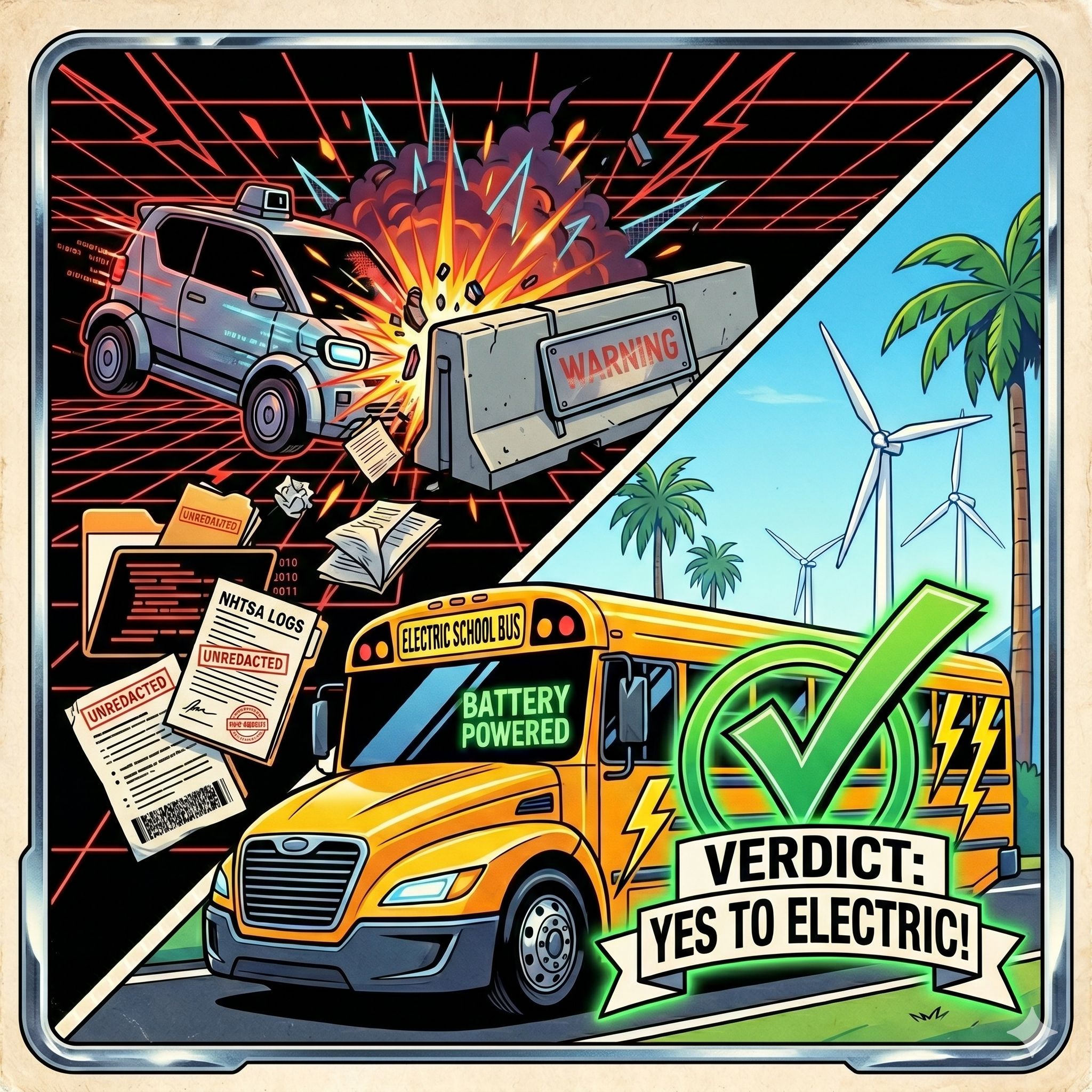
Robotaxi Crashes and A School Bus Driver’s Verdict on Going Electric
About this episode
Rivian and Aptera take center stage in the EV news roundup, from Aptera assembling “five validation vehicles” to Rivian R2 pricing and range across trims. The show then pivots to a real-world electric school bus perspective: a driver “moved from a diesel bus to an electric bus” and “has no desire to go back.” Finally, the host tackles Tesla Cybercab robotaxi crash reporting, arguing “we have transparency” amid NHTSA-redacted incidents and questions about tele-operator safety.
Description:
In this episode of Kilowatt, we dive into the EV news, starting with Aptera’s massive milestone of assembling its first five production-intent validation models to prove the solar EV movement is very real. We also explore the newly live Rivian R2 configurator, breaking down the diverse trim options, initial pricing structures, and the agonizing wait for the brand's best colors. Tesla dominates much of our discussion as we dissect the unredacted NHTSA logs detailing 17 "Robotaxi" crashes, exposing what really happens behind the scenes with teleoperator interventions and minor collision data. Additionally, we analyze driver feedback on the controversial Tesla FSD 14.3.2 update to see if the system's performance is truly taking a step backward. Finally, we take a look at a massive Cybercab car wash being erected under the lights of Las Vegas, and share an inspiring story from an electric school bus driver who vows never to return to diesel.
Support the Show https://www.supportkilowatt.com/
Other Podcasts:
News Links:
- Wooshn YouTube Channel: Really How Bad Is Tesla's FSD 14.3.2 Update?
- InsideEVs: The Rivian R2 Configurator Is Live. But You'll Have To Wait Until 2027 For The Best Color
- Electrek: Rivian opens R2 configurator: here are all the options and pricing
- Electrek: Tesla finally reveals what happened in 17 ‘Robotaxi’ crashes
- CleanTechnica: Electric School Bus Driver Will Not Go Back To Diesel
- Teslarati: Tesla is building a massive Cybercab car wash in Las Vegas
- Ars Technica Cars: Vaporware or not? Aptera assembles its first five validation models.
*Show Art Created By Gemini
Hosted by Simplecast, an AdsWizz company. See pcm.adswizz.com for information about our collection and use of personal data for advertising.

Aptera
"Let's go ahead and jump right into our news. Aptera has assembled five validation vehicles. Now this ..."
Aptera is working on an electric car. The company built a small set of test cars to check that the design works correctly in real conditions. These test vehicles help them confirm the car is ready for the next steps toward production.
Aptera is a company building very efficient electric vehicles, and the podcast segment is about it assembling five “validation” vehicles. Validation cars are prototypes used to test real-world performance and systems before a wider production rollout. This kind of update matters because it signals progress from early development toward vehicles that can be validated for safety, durability, and functionality.

Tesla Model S
"Two seater car, three wheels, looks really unique and will be affordable and you know 2012 that's around the time the Model S was coming out at an affordable $70,000 to $80,000"
The Tesla Model S is one of the most famous electric cars. The host is comparing its time period and price to what they were hoping to see from a cheaper EV.
The Tesla Model S is a long-range electric sedan that helped define the modern EV mainstream. Here it’s used as a pricing benchmark for when the host says they first noticed Aptera—around the time the Model S was becoming more widely available.
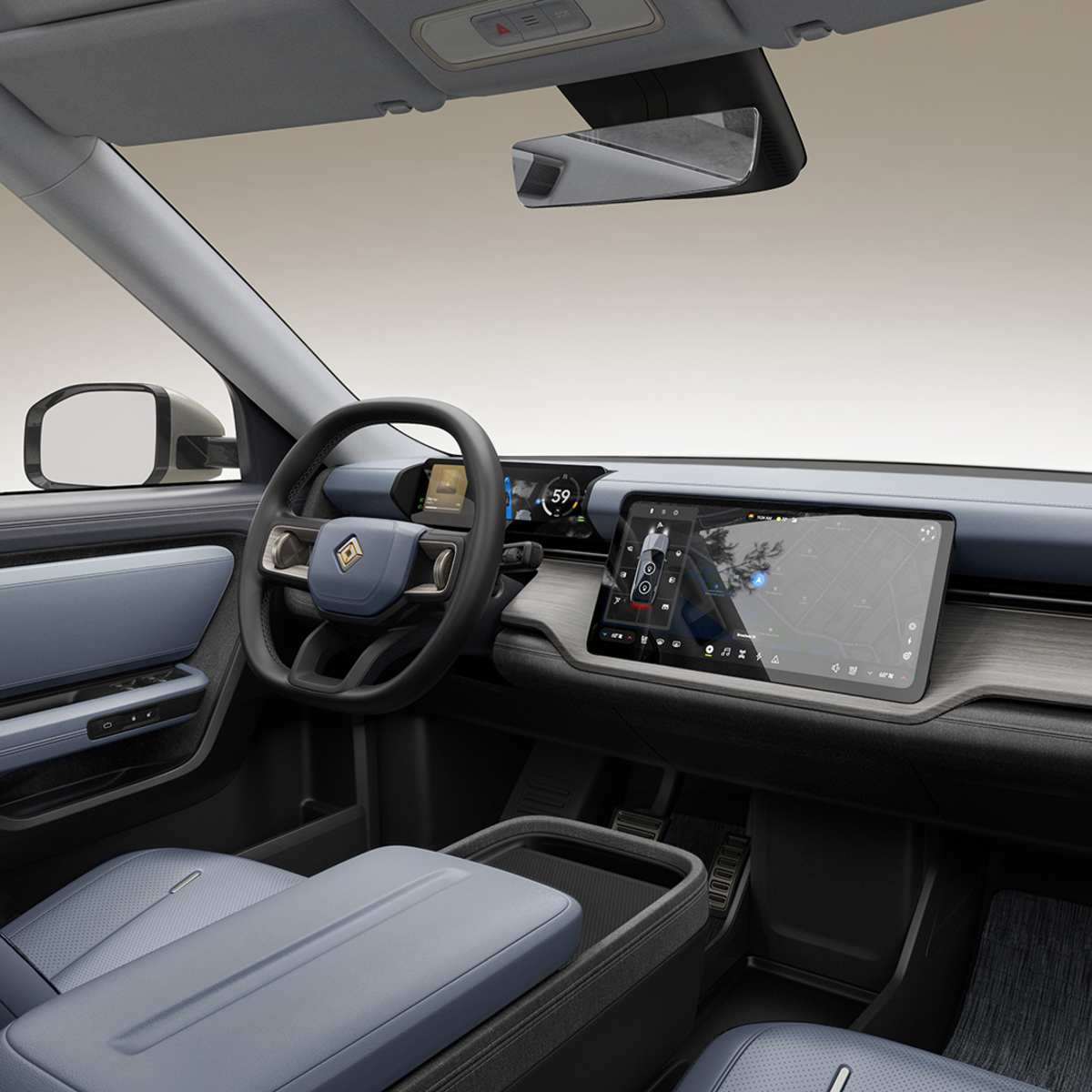
Rivian R2
"It looks like Rivian's getting the R2 over the finish line because you can now officially configure the Rivian R2 so I'm going to break down the trims for you. So starting at $49,000 you get the standard package that gets you 345 miles of range it's rear wheel drive..."
The Rivian R2 is an electric SUV/truck model from Rivian. The host is explaining the different versions you can buy and how features change the driving range and price.
The Rivian R2 is an electric vehicle lineup where Rivian offers multiple trims with different drive types and range. In this segment, the host walks through pricing and how options like all-wheel drive, wheel size, and interior choices affect range and cost.
rear wheel drive
"So starting at $49,000 you get the standard package that gets you 345 miles of range it's rear wheel drive although you can get a all wheel drive version..."
Rear-wheel drive (RWD) means the electric motors (or drive power) send torque to the rear wheels. Compared with all-wheel drive, it can be simpler and sometimes more efficient, which can help preserve EV range.
range
"So starting at $49,000 you get the standard package that gets you 345 miles of range it's rear wheel drive although you can get a all wheel drive version... ...your range will drop down to 330 miles..."
Range is how far an electric car can go before it needs charging. In this segment, the host shows how different versions of the Rivian R2 can go different distances on the same charge.
In EVs, range is how far the vehicle can drive on a full battery charge under specified test conditions. It’s used to compare trims and options, since features like all-wheel drive and larger wheels can reduce efficiency and therefore range.
all wheel drive
"rear wheel drive although you can get a all wheel drive version if you add another $3,500 onto the price tag but your range will drop down to 330 miles... ...it is all wheel drive there are six paint colors..."
All-wheel drive powers both the front and back wheels. That can help the car grip better, but it may use more energy—so the host says the range drops on the AWD version.
All-wheel drive (AWD) sends power to both the front and rear wheels, improving traction and stability in low-grip conditions. In EVs, adding AWD often increases weight and energy use, which can reduce the rated range versus RWD.
19 inch wheels
"but your range will drop down to 330 miles 19 inch wheels are standard but for a little extra you can get 20 inch wheels."
Wheel size can change how efficiently the car rolls. Bigger wheels often mean the tires don’t flex as much, which can make the car use a bit more energy and go a little less far.
Wheel size affects EV efficiency and ride characteristics. Larger wheels (like 20-inch or 21-inch) can increase rolling resistance and change tire sidewall height, which can reduce range—something the host ties directly to Rivian R2 configurations.
20 inch wheels
"19 inch wheels are standard but for a little extra you can get 20 inch wheels. ...standard wheels are 20 inch but if you want a 21 inch wheel..."
20-inch wheels are a bigger wheel option. The host is pointing out that choosing bigger wheels can affect how much range you get.
20-inch wheels are a configuration option that can influence efficiency and comfort. In this segment, the host links larger wheels to changes in pricing and range across Rivian R2 trims.
21 inch wheel
"standard wheels are 20 inch but if you want a 21 inch wheel that'll cost you an extra $2,000..."
21-inch wheels are the largest wheel option mentioned here. Bigger wheels usually come with tradeoffs, and the host is listing the cost of that upgrade.
A 21-inch wheel option is a larger wheel choice that can affect tire behavior and vehicle efficiency. The host includes it as a paid upgrade while discussing how configuration choices impact the overall cost and specs of the Rivian R2.
tow package
"you do get an option for a white or black interior which is great the white is an extra grand and you have the option to add a tow package which is $950"
A tow package is an add-on that helps the car tow a trailer. It usually includes the extra connections and settings needed so towing is supported safely.
A tow package is an option that adds the hardware and/or software needed to tow trailers safely. It typically includes things like trailer wiring and may include cooling or control calibration changes to handle the extra load.
autonomy plus package
"Oh by the way on all of the cars you can pay an extra $2,500 for the autonomy plus package"
An autonomy package is a paid upgrade for advanced driver-assist features. It’s the kind of option that can add more automated help for driving, beyond the basic version.
An autonomy package is a bundle of driver-assistance and automated-driving features. The “Autonomy Plus” wording suggests a higher tier of such capabilities that you can pay extra for on top of the base trim.
unsupervised FSD
"[469.3s] Tesla's unsupervised FSD so $2,500 is downright reasonable"
FSD is Tesla’s set of driving-assist features. “Unsupervised” means the system is supposed to handle driving with less (or no) help from the person behind the wheel, which is a big deal—and also something to be careful about.
“FSD” (Full Self-Driving) is Tesla’s software package for advanced driver-assistance and automated driving features. “Unsupervised” implies the system is intended to operate without the driver actively monitoring and taking over, which is a major claim because most real-world systems still require driver attention.
compact spare tire
"[469.3s] Tesla's unsupervised FSD so $2,500 is downright reasonable and then if you wanted a spare tire [477.6s] you could pay an extra $755 for a compact spare tire which is too much money"
A compact spare tire is a temporary spare that takes up less space in the car. It’s meant to help you limp to a shop, but it’s not meant for long distances or high speeds.
A compact spare tire (often called a “donut”) is a smaller, lighter temporary spare designed to get you to a repair shop. It usually has speed and distance limits and may not handle like a full-size tire.
all-season tires
"[552.4s] that's an extra thousand dollars this trim comes standard with 21 inch all season tires however if [559.1s] you want all-terrain tires you can get the 20 inch all-terrain tires for another thousand dollars"
All-season tires are meant to be a “do-it-mostly” tire for different weather. They’re not as specialized as summer-only or winter-only tires, but they’re convenient for year-round use.
All-season tires are designed to work across a range of temperatures and conditions, typically balancing dry grip, wet traction, and moderate cold-weather capability. They’re a compromise compared with dedicated summer or winter tires.
all-terrain tires
"[559.1s] you want all-terrain tires you can get the 20 inch all-terrain tires for another thousand dollars [565.9s] now here is where I think the value comes in with the launch package"
All-terrain tires are designed for both regular roads and rougher surfaces like dirt or gravel. They usually have a tougher tread, but they can be noisier and feel less smooth than regular tires.
All-terrain tires are built for mixed driving—pavement plus dirt, gravel, and light off-road use. They typically have more aggressive tread patterns than all-season tires, which can improve traction off-road but may reduce ride comfort and increase road noise.
launch package
"[565.9s] now here is where I think the value comes in with the launch package that comes with the $58,000 [574.1s] that you're buying the car for you get autonomy plus included"
A launch package is a bundle of extras you can buy with a new car when it first comes out. Instead of paying for each add-on separately, you get a set of features together for one price.
A “launch package” is a bundle of options and features sold together for a specific model’s initial release. In this segment, the host lists items included in the package (like autonomy features, a tow package, and a specific paint/key fob), framing it as better value than buying each separately.
launch key fob
"[591.5s] looks the same and then you get a launch key fob which I don't know if that's all that important [597.3s] to many people but you get all that included in the $58,000 price"
A key fob is the remote you use to control the car. The “launch key fob” sounds like a special version included with the launch bundle, more for style than for driving capability.
A key fob is the wireless remote used to lock/unlock and start many modern vehicles. A “launch key fob” here likely refers to a special edition fob included with the launch package as a cosmetic/collector item.
battery degradation
"affect the battery [695.9s] range and then over time we have battery degradation I think we all could agree or at least the folks"
Over time, an EV battery slowly loses some of its ability to store energy. That can mean the bus goes fewer miles between charges later in the vehicle’s life.
Battery degradation is the gradual loss of a battery’s capacity and/or ability to deliver power over time. For fleet vehicles like school buses, this matters because reduced capacity can shrink usable range as the years go on.
EV route planning vs bus routes
"but if you really understand how EVs work and how you know bus routes work [717.8s] in most cases it's not a big deal now if you have a bus route that falls outside of that"
It’s about making sure the EV can handle the bus’s daily trip and still have enough charge. If the route is unusual or too long, you may need a different plan (or a different bus).
EV route planning is matching charging needs to real daily driving routes. The host’s point is that many bus routes can be handled with EVs, but outlier routes may require different vehicle choices or charging strategies.
diesel bus (used when appropriate)
"so it was about an hour [744.0s] ride sometimes even more than that when it was when the weather was bad so I am fully aware of what [751.4s] these bus routes look like in those cases you just use a diesel bus"
Diesel buses are the traditional type of school bus. The host is saying you don’t have to switch every bus at once—use electric where it works well, and diesel where it’s necessary.
A diesel bus is a conventional school bus powered by a diesel engine. The host argues for a pragmatic approach: use electric buses when the route and conditions fit, but use diesel when they don’t—so the fleet isn’t “burning diesel all the time.”
tailpipe emissions
"there are no tailpipe emissions so the interior of the bus is more pleasant to be in notice you [1147.5s] know she's not talking about air pollution she's not talking about you know climate change or"
Tailpipe emissions are the dirty stuff that comes out of a car’s exhaust pipe. Electric vehicles don’t have an exhaust pipe, so they don’t produce those emissions while driving.
Tailpipe emissions are the pollutants released from a vehicle’s exhaust pipe while it’s running. With an electric bus, there’s no exhaust pipe, so there are no tailpipe emissions during driving.
diesel smell
"and I [1156.6s] can attest to that as a kid you know I definitely remember that diesel smell and how especially in [1164.1s] in my communities because as I could just open the bus window and you know when you're sitting"
“Diesel smell” is the strong odor you can notice from diesel exhaust. It’s a sign the engine is burning fuel and producing exhaust gases.
“Diesel smell” refers to the characteristic odor from diesel exhaust, which can be noticeable around buses and other diesel vehicles. It’s often associated with combustion byproducts that also contribute to air pollution.
idling
"in my communities because as I could just open the bus window and you know when you're sitting [1172.3s] in idling and you have the bus window open the exhaust is going somewhere and it's inside the"
Idling means the bus is stopped, but the engine is still running. That can still produce exhaust, which is why you might smell it even when the bus isn’t moving.
Idling is when a vehicle’s engine is running while it’s stopped. For diesel buses, idling can increase exposure to exhaust near the vehicle, especially if windows are open.
charging
"did require some extra planning and consideration [1195.1s] when it came to like charging and routes and things like that but her route is"
Charging is how an electric bus gets its battery power back. The driver has to plan when and where to charge so the bus can finish its route.
Charging is how an electric vehicle replenishes its battery energy. For electric buses, charging needs to be scheduled around routes and time windows, which can affect daily operations in colder weather.
route planning for electric buses
"did require some extra planning and consideration [1195.1s] when it came to like charging and routes and things like that but her route is [1201.9s] assigned but anyway did you had to um have a little bit of extra thought in"
Route planning for electric buses means figuring out the trip schedule so the battery doesn’t run out. If you have to stop to charge in the middle, that can make the route harder to run.
Electric bus route planning means designing daily trips around battery range and charging opportunities. The segment highlights that colder temperatures and the need to charge mid-route can change how feasible a route is.

Tesla Cyber Cab
"for the cyber cab in las vegas this is going to be as advertised a 36 000 square foot car wash"
The Tesla Cyber Cab is Tesla’s self-driving taxi idea. The hosts are talking about a special car wash Tesla is building for it, because these vehicles need regular cleaning like any car—just at a larger, more automated scale.
The Tesla Cyber Cab is Tesla’s robotaxi concept—an autonomous, ride-hailing vehicle designed to operate with minimal human involvement. In this segment, Tesla is building a dedicated car wash for it in Las Vegas, highlighting how infrastructure is being planned around autonomous operations.
FSD 14.3.2
"then they have fsd 14.3.2 um this is fsd supervised i mentioned"
FSD 14.3.2 is a particular software update for Tesla’s self-driving features. Even with it running, a person still has to watch and step in if the car needs help.
FSD 14.3.2 refers to a specific release of Tesla’s Full Self-Driving software version. Here, the key point is that it’s “supervised,” meaning the system can drive but a human driver must monitor and take over when needed.
FSD supervised
"this is fsd supervised i mentioned that carry murphy has a really good video on this"
“Supervised” means the car is doing the driving, but you’re still responsible for watching it. If you take over, the car asks you to explain why so the system can improve.
“FSD supervised” describes a mode where Tesla’s driver-assistance/autonomy system drives, but the human remains responsible for safety. When the driver intervenes, the system prompts for feedback so Tesla can learn why the takeover happened.
driver intervention feedback prompt
"when using fsd supervised 14.3.2 drivers will now need to provide feedback each time they intervene so what happens is if you intervene with the with fsd when it's turned on a prompt will come up on the screen"
When the self-driving system needs help, it asks the driver to report what went wrong. The driver can pick a reason on the screen or record a short voice message, and that’s how the system learns from real-world situations.
The segment describes a new workflow in supervised autonomy: when the driver intervenes, a prompt appears asking why. The prompt stays on-screen until the driver either taps the screen for the reason or records a voice note, creating structured feedback for the system.
National Highway Traffic Safety Administration
"the national highway traffic traffic safety administration had at least 17 incidents that [1475.6s] were redacted so there was the incident and then the narrative just read redacted may contain confidential business information"
This is a U.S. government safety agency for cars. Here, they’re mentioned because they track and collect reports about crashes involving driver-assistance or self-driving systems.
The National Highway Traffic Safety Administration (NHTSA) is a U.S. government agency that oversees vehicle safety. In this segment, it’s referenced as having incident reports related to autonomous-driving testing.
autonomous-driving testing in public
"my opinion hasn't changed i i do think when [1492.6s] you're testing these these vehicles in public you owe it to the public to explain why or what happened so that we have transparency"
The host is saying that if self-driving tech is being tested on real roads, the company should explain crashes clearly. That way, people can understand what went wrong and whether the system is safe enough.
The speaker argues that when autonomous-driving systems are tested in public, companies should clearly explain what happened after incidents. The underlying idea is that transparency helps the public understand risks and improves accountability for systems that may not be fully validated.
safety monitor
"the safety monitor requested support because the ads [1569.3s] wasn't proceeding forward the tele operator took over and drove the car"
A safety monitor is a person watching the self-driving system while it’s operating. If the system struggles, the monitor can step in or request help.
A safety monitor is a human oversight role used during some autonomous-driving tests. The speaker describes it requesting support, later reporting observations, and coordinating when the system isn’t handling the situation as expected.
tele operator
"the safety monitor requested support because the ads wasn't proceeding forward the tele operator took over and drove the car left up a curb"
A tele operator is a person controlling the car remotely. The segment describes a situation where the car paused, and a remote operator took over to drive it.
A tele operator is a remote human operator who takes control of a vehicle during certain autonomous-driving test scenarios. In the examples, the tele operator takes over when the system stops progressing, then the vehicle proceeds and crashes.
right turn only slip lane
"the tesla ads was in a right turn only slip lane with a yield sign uh yielding for cross traffic the ads was stopped then crept forward at two miles per hour"
This is a special lane for right turns that merges into traffic. The host is using it to describe a specific crash scenario and whether the self-driving behavior matched what a careful driver would do.
A right turn only slip lane is a roadway design where vehicles turn right from a dedicated lane, often with yield signage for merging/cross traffic. The speaker uses this geometry to question whether the autonomous system behaved like a cautious human driver.
yield sign
"the tesla ads was in a right turn only slip lane with a yield sign uh yielding for cross traffic the ads was stopped then crept forward"
A yield sign means “let other traffic go first.” The segment mentions it because the self-driving car was supposed to follow that rule at the intersection.
A yield sign instructs drivers to slow down and give the right-of-way to cross traffic before entering an intersection or merging area. Here, it’s part of the described autonomous-driving behavior during a right-turn scenario.
rear ended
"there shouldn't be a fault for this they got rear ended that that's in america that's typically"
A rear-ended crash is when someone hits the back of another car. In many cases, the person behind is expected to leave enough space to stop.
A “rear-ended” crash is when one vehicle strikes the back of another. These are commonly used in fault discussions because the following driver typically has a duty to maintain enough distance to stop safely.
Automated Driving System
"the tesla ads was proceeding straight in a center lane approaching a green light when a dog ran into the intersection from the right so the ads reduced speed and steered left"
An Automated Driving System is the car’s “self-driving” software and hardware working together. It can do things like steering and slowing down, but the driver may still need to watch and be ready to take over.
An Automated Driving System (ADS) is the combination of sensors, onboard computing, and driving-control software that performs driving functions without constant human input. Depending on the system and region, it may handle tasks like steering and speed while the driver monitors and can take over.
center lane
"the tesla ads was proceeding straight in a center lane approaching a green light"
A center lane is the middle lane on a road with multiple lanes. Where the car is positioned affects what can cross its path and how quickly it can react.
A center lane is the middle lane on a multi-lane road, often used for through traffic rather than turning. In crash narratives, the lane matters because it affects which vehicles can enter the path and how much time the driver/ADS has to react.
green light
"approaching a green light when a dog ran into the intersection from the right"
A green light means you’re allowed to go through the intersection. It’s important in crash stories because it affects who had the right to be there.
A green light indicates the intersection is open for through traffic to proceed. In accident reports, the signal state helps establish right-of-way and whether a vehicle should have been moving or stopped.
pedicab
"a pedicab approaching a pedicab is you know somebody with a bicycle and they have a little carriage in the back that people sit in"
A pedicab is like a bicycle taxi with a little seat/carriage for passengers. It travels differently than cars, so it can be harder to predict in traffic.
A pedicab is a human-powered taxi: a bicycle that pulls a small passenger carriage. Because it moves differently than cars (slower speed, narrower profile, and different stopping/visibility patterns), it can create unique collision scenarios in bike lanes and intersections.
bike lane
"the bike lane clipped approaching from behind and it clipped the right side of the tesla mirror as it rode past"
A bike lane is a lane meant for bicycles. If a car is passing nearby or turning, the bike lane location changes what parts (like mirrors) might get hit.
A bike lane is a roadway lane designated for bicycles, typically marked and sometimes separated from car lanes. In these stories, the bike lane placement affects how a vehicle’s side mirrors and turning paths can be struck.
side mirror
"the tesla ads made a left turn onto a residential street as it passed the house the ads's side mirror made contact with a dump trailer's goose neck hitch sticking out into the street"
The side mirror is the mirror on the outside of the car that helps you see traffic next to you. Here it gets hit by something sticking out from a trailer, showing how tight spaces can cause damage.
A side mirror (often called an exterior mirror) is the driver’s primary view of adjacent lanes and objects near the car’s flanks. In the transcript, the side mirror is struck by a trailer hitch, which highlights how close-passing vehicles can impact exterior components even at low speeds.
gooseneck hitch
"the ads's side mirror made contact with a dump trailer's goose neck hitch sticking out into the street"
A gooseneck hitch is the part of a trailer that connects to the truck and often sticks up. If it’s sticking out into the road, it can hit a car’s mirror or side when the car passes.
A gooseneck hitch is a trailer coupling design where the hitch rises up from the trailer bed and then connects to the towing vehicle. Because it can extend higher and farther into the roadway than people expect, it can be struck by vehicles passing close to the trailer.
traffic stop
"the tesla ads was stopped behind a traffic stop behind traffic at a red light a person on a motor scooter approached from behind"
A traffic stop is when police stop a vehicle on the road. It can make traffic patterns weird for a car trying to drive on its own.
A traffic stop is when law enforcement pulls over a vehicle, often creating a temporary hazard zone with changing vehicle positions. In automated-driving crash discussions, stopped or slow-moving traffic can reduce reaction time and complicate safe merging or gap selection.
motor scooter
"a person on a motor scooter approached from behind moved into the gap behind the ads steered right and made contact with the rear end"
A motor scooter is a small two-wheeled ride. It can move differently than a car, so it may slip into gaps and be harder to predict.
A motor scooter is a small two-wheeled vehicle that can accelerate and maneuver differently than cars. In collision scenarios, scooters can appear suddenly in gaps and may have different braking and visibility characteristics.
gap
"moved into the gap behind the ads steered right and made contact with the rear end"
A “gap” is the space between cars. If another vehicle moves into that space quickly, it can create a crash risk.
In traffic, a “gap” is the space between vehicles or between a vehicle and the edge of the lane. Automated driving systems must judge gaps for safe positioning; scooters entering a gap can create sudden side/rear hazards.
reversing into an empty parking space
"the tesla ads was reversing into an empty parking space when the right rear tire"
Reversing into a parking spot is when the car backs into a space. It’s tricky because you’re watching the area behind you and the car has to steer accurately.
Reversing into a parking space is a low-speed maneuver where the vehicle’s path depends heavily on steering angle and object detection around the rear. These maneuvers are often where sensors and driver-assist logic can be stressed by nearby obstacles, pedestrians, or uneven sightlines.
navigation help
"the safety driver requested navigation help the teller operator took over the ads when stopped and drove straight into a temporary construction barricade"
Navigation help means someone steps in to assist with where the car should go. In this story, that help is tied to moments when the remote operator takes control and accidents follow.
“Navigation help” here refers to a human-assisted intervention to guide the vehicle’s route or driving decisions when the automated system is uncertain. The speaker uses it as a trigger for when the tele-operator takes over, which then leads to collisions with curb and construction barriers.
construction barricade
"drove straight into a temporary construction barricade scraping the front end of the fender"
A construction barricade is a temporary barrier used at road work sites. The speaker is saying the robotaxi had trouble with these barriers during takeover situations.
A construction barricade is temporary roadside hardware used to block off lanes or guide traffic around work zones. The segment treats these barriers as a common failure point for robotaxi behavior when the system (or tele-operator) doesn’t handle the work zone correctly.
front end of the fender
"drove straight into a temporary construction barricade scraping the front end of the fender"
The fender is the outer body panel near the wheel. Scraping the front fender usually means the car hit something like a curb or barrier.
The fender is the body panel above the wheel, and damage to the front end of the fender typically indicates a collision with a curb, barrier, or other roadside object at low-to-moderate speed. In this segment, the speaker uses fender scraping as evidence of what went wrong during specific robotaxi incidents.
robotaxi
"tesla made such a big deal about having no safety monitors in the vehicles when it first started the robo taxi or right before it started robo taxi"
A robotaxi is a self-driving taxi you can summon like an app ride. The speaker is talking about how humans still get involved to keep it safe.
A robotaxi is a ride-hailing vehicle that drives itself without a human driver at the wheel, typically relying on sensors and automated driving software. This segment discusses robotaxi safety practices, including how human oversight (tele-operators and safety monitors) fits into real-world operations.
slam on the brakes
"who's in the driver's seat can override that and slam on the brakes whereas in these two situations"
It means hitting the brakes very hard, like an emergency stop. The point here is that a human can override the system and brake quickly.
“Slam on the brakes” describes an emergency-level braking input—full or near-full brake application intended to rapidly reduce speed. In autonomous/robotaxi contexts, it highlights the difference between automated control and a human override capability.
safety operator
"i'm sure the safety operator was not pleased when you know they jump a curb and hit a metal fence or get run into a barricade"
A safety operator is a person whose job is to watch over the automated driving and step in if something goes wrong.
A safety operator is a human responsible for overseeing a semi-autonomous or autonomous system and intervening when needed. The transcript implies they’re monitoring safety-critical behavior, like avoiding obstacles and managing control handoffs.
Cruise
"i had at one point in time access to the chevy cruise one of the vp's at cruise or gm cruise"
Cruise is a company that works on self-driving technology. The speaker is saying they got special access to ride or drive one of its cars.
Cruise is an autonomous-driving company associated with robotaxi development. In the transcript, the speaker mentions having access to a Cruise vehicle through a GM Cruise executive, framing it as an opportunity to experience the system firsthand.
Wamo
"i've driven in the wamos multiple times uh i had at one point in time access to the chevy cruise one of the vp's at cruise"
“Wamo” is what the speaker calls the autonomous robotaxi they rode in. They’re using it as an example of what it’s like to be a passenger.
“Wamo” appears to be the speaker’s shorthand for a specific robotaxi/autonomous-driving service they rode in. The segment uses it as the main example of how the experience feels during freeway driving and during safety-critical moments.
autonomous vehicles
"but i'm pro autonomous vehicles and they don't they don't scare me you know i said recently i took a wamo on the freeway"
Autonomous vehicles are cars that can perceive their surroundings and drive with little or no human input, using sensors and software. The segment discusses how a rider’s mindset changes when the system is in control versus when a person could intervene.
Elon
"tesla this is these none of these are that big a big deal um i know i don't even think like one comment from elon is way more one more comment"
“Elon” is Elon Musk. The speaker is saying his comments can affect public opinion more than the crash details do.
“Elon” refers to Elon Musk, whose public comments can influence perception of autonomous-driving and EV companies. The speaker argues that reputational impact from a single comment can outweigh the crash-related story in the moment.
Request an Explanation
Heard something you'd like explained? We'll add it to this episode.
Sign in to request explanations for terms you heard.
Want to learn more?
Browse our glossary for plain-English explanations of automotive terms, jargon, and concepts.
Help improve this episode
See something that's not quite right? Our annotations are AI-generated and can sometimes miss the mark. Click the flag icon on any annotation to suggest a correction.