
Ron Ananian, The Car Doctor - Classic Car Doctor - September 5, 2015 - Hour 2 - Dead Mans Curve Car Show
About this episode
Live from Dead Man’s Curve’s Wild Hot Rod Weekend in Mahwah, New Jersey, Ron Ananian (“The Car Doctor”) talks shop, storage, and creativity with a lineup of guests. Candy Clark (American Graffiti) shares how the film inspired generations of hot rodders and discusses the sequel’s darker turn. The Doucebags explain building a custom “adult beverage” bar and keeping car culture family-friendly. Motor Car Manor’s Matt covers climate-controlled vehicle storage and prep tips. Hot Rod Harry and Slag dive into custom fabrication, design guidance, and passing the craft to younger builders.
Dead Man's Curve Car Show – September 5, 2015 | Classic Car Show Interviews & Automotive Insights
We’re back with the second hour from one of our favorite on-location broadcasts—and if you love classic cars, car shows, and automotive culture, this hour delivers.
Kicking things off is Candy Clark from American Graffiti, sharing stories from one of the most iconic car movies of all time and her connection to the golden age of cruising.
From there, we dive into conversations with industry experts covering:
- Classic car storage tips and long-term vehicle preservation
- Custom car building, fabrication, and restoration techniques
- Real-world advice from professionals in the automotive aftermarket and car hobby community
Whether you're into muscle cars, hot rods, restoration projects, or weekend car shows, this hour is packed with insight, experience, and passion.
Take a listen and enjoy Hour 2 from the Dead Man’s Curve Car Show—where car culture, classic vehicles, and real-world automotive advice come together.
Car advice, done right.
- Grab your Car Doctor gear – T-shirts & more at CarDoctorShow.com
-
Follow the wrench – Instagram @ronananian for shop life & behind-the-scenes
-
Watch & learn – Auto repair tips & videos on our YouTube Channel
-
Got a car question? Call the Car Doctor Hotline 24/7 – (855) 560-9900
-
Join the conversation LIVE – Saturdays 2–4 PM Eastern
See omnystudio.com/listener for privacy information.
car collecting
"...a lot of people got their inspiration to go into the field of car repair, cars, pinstriping, car collecting, customizing, you know, as an inspiration to a ton of people."
Car collecting means people buy and keep cars they love, sometimes because they’re rare or have a special history. Here, they’re saying the movie inspired people to take up that hobby.
Car collecting is the hobby of acquiring and preserving vehicles, often focusing on specific eras, brands, or styles. In the context of this segment, the hosts connect “American Graffiti” to inspiring people to pursue collecting and customizing as a passion.
customizing
"...car repair, cars, pinstriping, car collecting, customizing, you know, as an inspiration to a ton of people."
Customizing is when someone changes a car to make it look or feel the way they want. That can be things like paint, wheels, and other style changes, and sometimes more mechanical upgrades too.
Customizing is modifying a car’s appearance and/or performance to match the owner’s taste—commonly including paint, trim, wheels, interior changes, and sometimes engine or suspension upgrades. The segment frames customizing as part of the broader hot-rod and street-culture ecosystem that the film helped popularize.
pinstriping
"...car repair, cars, pinstriping, car collecting, customizing, you know, as an inspiration to a ton of people."
Pinstriping is the fine, decorative line artwork you see on some custom cars. It’s a style detail that makes a car look more personalized.
Pinstriping is a decorative painting technique—thin, detailed lines—often used to add character to custom cars. It’s closely associated with traditional hot-rod and custom-car aesthetics, and the segment lists it as one of the creative paths inspired by car culture.
hot rod show
"They had a huge hot rod show there. It's been going on for ten years. Modesto has a big one."
A hot rod show is a car event where people bring cars that have been modified for style and performance. It’s usually about older cars that have been customized, not brand-new cars.
A “hot rod” show is an event focused on modified, older cars—often with custom bodywork, engine swaps, and period-style upgrades. These shows are a big part of classic-car culture because they celebrate creativity and preservation of an era’s look and feel.
American Graffiti shows
"There's so many American Graffiti shows. It's it's just really great. Do you ever see any of the cast members all the time?"
American Graffiti is a famous movie that made people really interested in old-school car culture. So “American Graffiti shows” are car events that celebrate that same nostalgic style.
“American Graffiti” is a pop-culture touchstone from the early 1970s that helped spark interest in 1950s-era cars and cruising culture. When the host mentions “American Graffiti shows,” they’re referring to car events themed around that vibe—classic styling, street culture, and nostalgia.
Mercedes
"Tell me Mercedes gott you a hot rod? Honda? All right, why do you ask?"
Mercedes is a car brand that makes mostly luxury cars. Here it’s being mentioned as a contrast to hot rods and custom cars.
Mercedes is a major German automaker known for luxury cars and engineering. In this segment, the host uses “Mercedes” as a starting point for a conversation about hot rods, contrasting mainstream brands with custom builds.
Honda
"Tell me Mercedes gott you a hot rod? Honda? All right, why do you ask? I'll tell you. I'll tell you, afair what Honda stands for?"
Honda is a well-known Japanese car and motorcycle company. In this conversation, it’s mentioned as part of a brand discussion before they get back to hot rods.
Honda is a Japanese automaker famous for reliable everyday cars and motorcycles. The speaker brings it up in the context of “what Honda stands for,” which is a common way people talk about brand identity even when discussing hot rods.
car clubs
"But we're here to talk about a different car club, and we're here talking about hot rods in general. ... Let's talk a little bit about car clubs and the deucebags."
Car clubs are organized groups of enthusiasts who share a common interest—often a specific type of car, like hot rods or classic vehicles. They typically coordinate events, meetups, and shows, which is why the host is discussing clubs alongside the cars themselves.
body guys
"...you're gonna turn to the gentleman to my right, Uh, that being Ron Schmidt. Ron is one of the body guys..."
“Body guys” are the folks who fix dents and damage and prep the car for paint. They focus on the outside of the car, not the engine.
“Body guys” refers to the people who specialize in bodywork—panel repair, metal shaping, filler work, and prep for paint. In a shop or club, they’re often distinct from mechanical techs.
collision work
"...doing rods and customs versus doing collision work. This is much better."
“Collision work” is fixing a car after an accident. It’s about repairing damage and getting the car back to the right shape and safety level.
“Collision work” means repairing cars after crashes—restoring structural alignment, replacing panels, and returning the vehicle to safe, factory-correct condition. It’s typically more process-driven than custom fabrication.
custom paint
"...does somebody bring you a car and say, painted, what would you make it look like? How would you make it. Look I'm not I'm not really a custom paint or I do regular paint work."
Custom paint is when a car gets a unique paint look instead of a normal color. It can be something flashy or detailed that takes extra work to create.
Custom paint refers to one-off or highly personalized paint jobs beyond standard factory colors. It can include special finishes, graphics, and multi-step processes tailored to the owner’s vision.
fab
"So so what I do a lot of stuff that people can't do. I do a lot of weld and fab in this and that, or you know, I do paint jobs."
“Fab” is short for fabrication—making or modifying parts from raw materials or existing components. It often includes cutting, shaping, welding, and fitting parts to achieve a custom result.
weld
"So so what I do a lot of stuff that people can't do. I do a lot of weld and fab in this and that, or you know, I do paint jobs."
Welding is how you attach metal pieces together permanently. A fabricator uses it to build or repair metal parts for a custom project.
Welding is the process of joining metal parts by melting and fusing them together. In fabrication shops, it’s commonly used for structural repairs, custom brackets, and metal body modifications.
car culture
"And I'll tell you what, if we had a television camera here, that wouldn't describe it. You have to be here and be immersed in it to really appreciate what's going on. But there's all facets and all sorts of things going on all ways that the car culture is covered."
“Car culture” just means the whole community of people who love cars. It includes car shows, meetups, and the people who talk about cars and work on them.
“Car culture” refers to the community and lifestyle around cars—events, shows, clubs, and the people who share knowledge and enthusiasm. In this segment, the host emphasizes that you have to be there in person to truly understand the energy and variety of what’s happening.
match box cars
"Well your words to me were, I started collecting match box cars as. A kid, That is correct, and I still have Them the same match box."
He’s talking about Matchbox toy cars—little model cars you can collect. It’s a hobby he started as a kid and still does as an adult.
“Match box cars” refers to Matchbox die-cast toy cars—small metal/plastic models made for collecting. The guest’s collecting background is used to set up the conversation about collecting and preservation, even though it’s not real vehicles.
original car / 100% original interior
"I have a nineteen fifty seven Chevy Nomad and it's a very original car. The interiors one hundred percent original, still has the original plastic seat."
When someone says a car is “original” or has a “100% original interior,” they mean it still has the factory parts. Collectors usually like that because it’s more authentic and can be worth more.
“Original” (and especially “100% original”) refers to a car that retains its factory components rather than being heavily modified or restored with replacement parts. For classic cars, originality often affects value, authenticity, and how the car is judged by collectors.
fuel injection
"But what makes the car super unique is that it is a fuel injection car. Oh wait a minute, Oh, this is that Matt fifty Oh now I know who this is."
Fuel injection is how a car puts gas into the engine. Instead of using a carburetor, it uses valves/injectors controlled by the engine to spray the right amount of fuel.
Fuel injection is a method of delivering fuel to the engine using electronic control and injectors instead of a carburetor. It’s often associated with more precise fuel metering, better cold starts, and improved drivability—especially on older engines when converted or when built with injection from the start.
dehumidifier
"If I could, yes, and a giant dehumidifier. So let's talk about that a little bit."
A dehumidifier removes extra moisture from the air. That helps prevent rust and damage when you’re storing a car for long periods.
A dehumidifier reduces moisture in the air, which helps protect stored vehicles from corrosion and deterioration. For classic cars, controlling humidity is especially important because trapped moisture can accelerate rust on metal panels, fasteners, and underbody components.
clean room
"As they walk down a narrow hallway, he felt these blasts of air, you know. And he got to the end of the hallway and he said to the guy that was running the toys, and he said, well, we're blowing the dust off your clothes because you're now about to enter a clean room."
A clean room is a very controlled space where they try to keep dust and dirt out. For building engines, that helps protect sensitive parts from getting contaminated.
A “clean room” is an environment designed to minimize dust and contaminants. In engine building, that matters because dirt can affect precision parts, bearings, and internal surfaces—so the shop may use filtered airflow and strict cleanliness practices.
battery tender
"It's super important to you know, battery tender or the pull the battery. You want to fill up the gas tank to prevent any moisture build up, or you can completely empty the tank."
A battery tender is a device you plug in to keep the battery healthy while the car sits. It’s like a gentle charger that prevents the battery from going dead.
A battery tender is a smart charger/maintainer that keeps a car’s battery at the right voltage during long storage. It helps prevent sulfation and dead-battery issues without overcharging.
fenders
"if the guy wants you to hang the Sodo fenders on a ford. And yeah, that's not it's not gonna work right. Yeah, it's not gonna it's not gonna look right."
Fenders are the panels above the wheels. If they’re not the right ones or not mounted correctly, the car won’t look right and the wheel may not fit properly.
Fenders are the body panels over the wheels, and they’re critical for both fitment and appearance. In custom work, getting the correct fender shape and mounting points matters so the car looks right and the wheels clear properly.
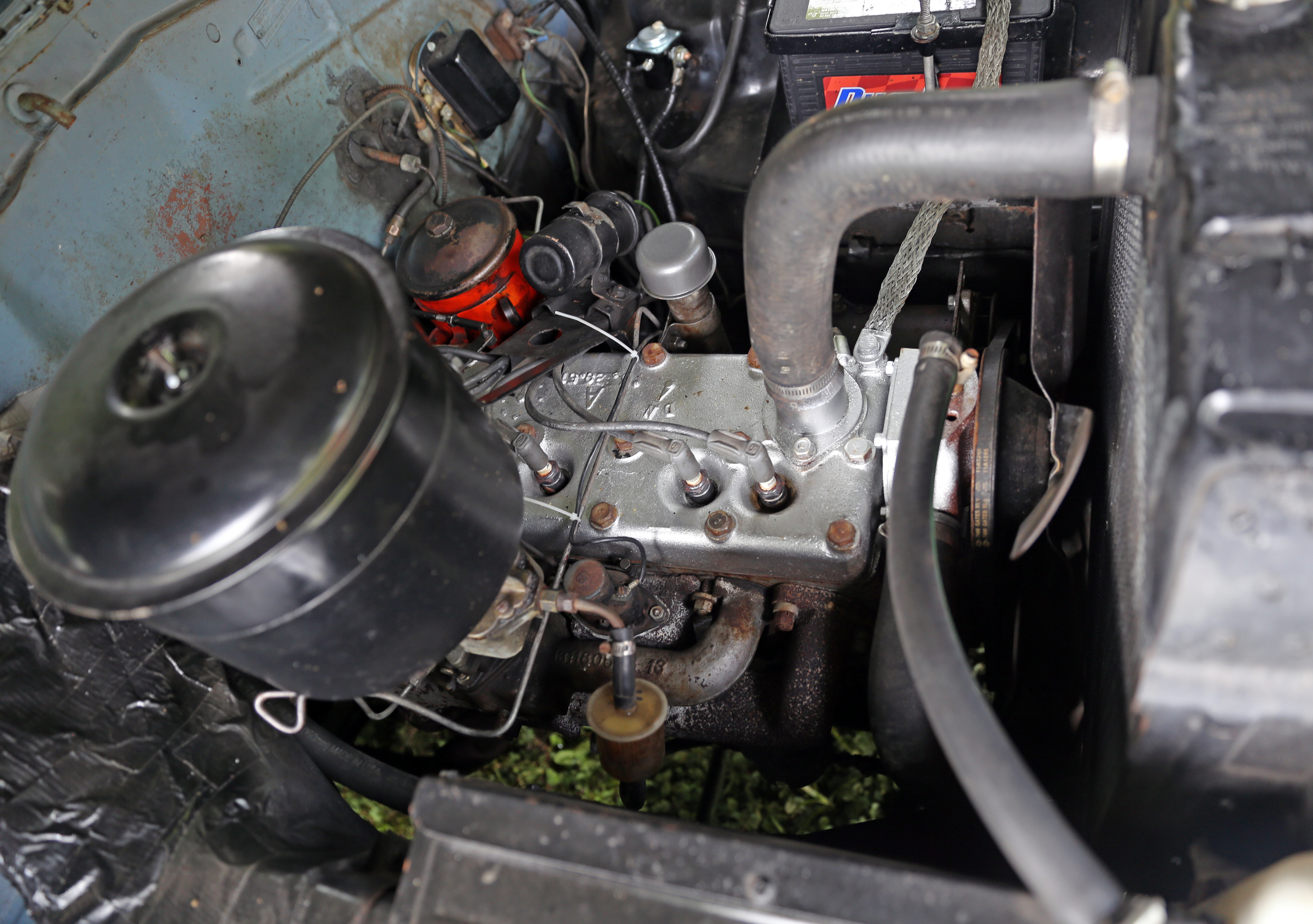
Plymouth Cranbrook
"Well, we're here this weekend shopping my fifty two Plymouth Cranbrook, Florida. Or right."
A Plymouth Cranbrook is a classic car model from Plymouth. Here they’re talking about a 1952 one they’re working on and getting running again.
The Plymouth Cranbrook was a mid-level model in Plymouth’s lineup, and in the early 1950s it was a popular choice for classic-car builders. In this segment, the host is talking about working on a 1952 Plymouth Cranbrook and getting it back on the road.
four inch chop
"There's it's a four inch chop two door sedan, nosed and deck shaped door handles lowered about six inches, Foxcraft original fifties and needle those bubble skirts wide white w fifty five old tobcaps."
A “four inch chop” means the builder cut down the roof by about four inches. That changes the car’s look and makes it sit lower. It’s a big body modification, not a small trim change.
A “four inch chop” refers to cutting and lowering the roofline by about four inches, then reshaping the body to match. This is a classic hot-rod/custom technique used to change the car’s proportions and stance. It’s a major bodywork operation that affects glass fitment, structure, and overall styling.
lowered about six inches
"There's it's a four inch chop two door sedan, nosed and deck shaped door handles lowered about six inches, Foxcraft original fifties and needle those bubble skirts wide white w fifty five old tobcaps."
“Lowered about six inches” describes the car’s suspension ride height being significantly reduced. Lowering changes handling feel, center of gravity, and tire-to-fender clearance, and it often requires suspension modifications. It’s also a key part of the visual “stance” that custom builders aim for.
one-off gas tanks
"I create custom. One off gas tanks, bodywork. The impossible is. What I do? Right, So, Harry, how wrought?"
“One-off gas tanks” means a custom, unique fuel tank fabricated for this specific build rather than using a production tank. Custom tanks are often needed to clear chopped/lowered bodywork, fit a specific chassis, or accommodate engine/transmission packaging. This is a specialized fabrication job because fuel system safety and proper venting are critical.
bodywork and paint
"You know that it's not just it's not bodywork, it's creation. [1910.2s] Yes, it's a combination of both because in a final result, it does go for bodywork and pain."
Bodywork and paint are the steps that make a car look straight and clean. Bodywork fixes the metal and shape, and paint is the final coating that gives it its color and protects it.
“Bodywork and paint” refers to the restoration or modification of a car’s outer panels (bodywork) and the application of paint for appearance and protection. In classic-car work, this often involves metal shaping, panel alignment, surface prep, and multiple stages of finishing.
car show
"because it's not a car show, it's an event with a car show, and every other thing is an attraction here, whether it be a celebrity. It's a party. Yeah, it really is an extravaganza."
A car show is an event where people bring cars to show them off. Some shows are just displays, but others are bigger events with lots of activities.
A car show is an organized event where vehicles are displayed and judged or celebrated, often with vendors, entertainment, and community activities. The speaker emphasizes that this one is more than just a static display—it’s an “event with a car show,” with multiple attractions.
Request an Explanation
Heard something you'd like explained? We'll add it to this episode.
Sign in to request explanations for terms you heard.
Want to learn more?
Browse our glossary for plain-English explanations of automotive terms, jargon, and concepts.
Help improve this episode
See something that's not quite right? Our annotations are AI-generated and can sometimes miss the mark. Click the flag icon on any annotation to suggest a correction.