
Savant Young: How an MMA Fighter is Funding Racing With Beer
About this episode
Savant Young—former MMA champ and Japan-traveling fighter—breaks down how fighting funded his obsession with vintage JDM cars. He traces his path from South Central karate to MMA, explains why wrestlers are the hardest opponents, and shares the career leap that came after training with Rampage Jackson. The conversation pivots to his LA car community, Vintage Motor Union in Boyle Heights, and how he’s building an inclusive “car district” hub. He also details his “Race Related” beer collabs that generate real funding for racing, plus his RX-3 rotary build plans and a big Cinco de Mayo book-release event.

Chevy Colorado
"Chevy Trucks have you covered when the road takes you from smooth sailing to... Chevy Colorado will eat up some of the toughest terrains with five available drive modes, and Silverado and Silverado HD have the muscle to take you out for some serious,"
The Chevrolet Colorado is a smaller pickup truck than a full-size Chevy. The “drive modes” are settings that help the truck behave differently on things like dirt, sand, or slippery roads.
The Chevrolet Colorado is a midsize pickup truck. In this segment, it’s positioned as capable off-road thanks to “five available drive modes,” which typically let you tailor throttle/traction behavior for different surfaces.
drive modes
"Chevy Colorado will eat up some of the toughest terrains with five available drive modes, and Silverado and Silverado HD have the muscle to take you out for some serious,"
Drive modes are like different “personalities” for the truck. You pick the mode for the road you’re on, and the truck changes how it accelerates and grips.
Drive modes are selectable settings that change how a vehicle responds to inputs and traction conditions. On trucks, they often adjust throttle mapping, transmission behavior, and traction control/4WD engagement to better match the terrain.
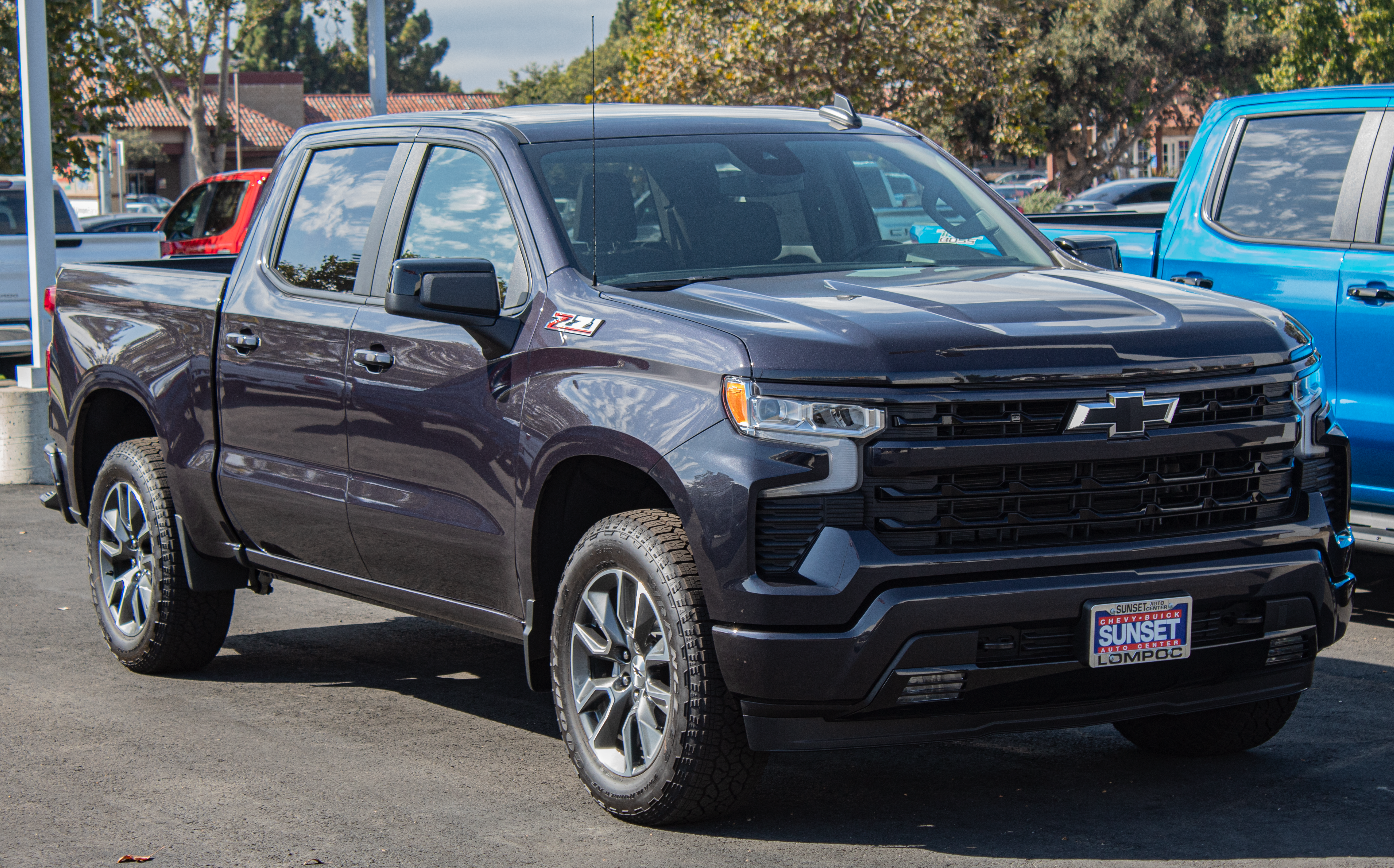
Chevrolet Silverado
"and Silverado and Silverado HD have the muscle to take you out for some serious, with multiple engine options and impressive towing,"
The Chevrolet Silverado is a big pickup truck. People buy it because it can handle heavy hauling and towing.
The Chevrolet Silverado is a full-size pickup known for strong towing and multiple engine choices. Here, it’s described as having the “muscle” for serious trips, which is a common selling point for Silverado trims.
towing
"with multiple engine options and impressive towing, while Silverado EV is the perfect combo of performance and capability,"
Towing is when you pull something behind your vehicle, like a trailer. Trucks advertise towing capability because it affects how much weight they can safely pull.
Towing refers to pulling a trailer or other vehicle behind the truck. It depends on the truck’s engine/transmission, cooling capacity, hitch setup, and often the availability of towing packages.

Chevrolet Silverado EV
"while Silverado EV is the perfect combo of performance and capability, making it a snap to hitch up this electric truck and hit the road."
The Silverado EV is Chevy’s electric pickup. The point here is that it’s meant to be capable for real-world truck tasks, not just driving around.
The Chevrolet Silverado EV is an electric pickup truck in the Silverado lineup. This segment highlights its “performance and capability” and specifically mentions hitching up, implying it’s designed to be used like a practical tow-capable truck.
vintage JDM cars
"And he's obsessed with vintage JDM cars. He basically fought his whole life so that he could afford them and endured a lot of hardships along the way."
JDM means cars that were made for the Japanese market. “Vintage JDM” means older classic Japanese cars that a lot of enthusiasts love.
JDM stands for Japanese Domestic Market, referring to cars that were originally sold in Japan. “Vintage JDM” usually means older, enthusiast-focused models that have become popular worldwide for their design, engineering, and motorsport heritage.
vintage Japanese cars
"Let's talk about cars. How did you get into vintage Japanese cars?"
This means older Japanese cars that enthusiasts really like. The speaker is explaining how they got interested in that world.
“Vintage Japanese cars” refers to older Japanese models that became popular with enthusiasts for their engineering, parts availability, and motorsport heritage. In this episode, the phrase sets up the speaker’s personal connection to cars like the Mazda RX-3 and Nissan 510.
Tyco
"like the little Tyco race cars."
Tyco is a toy brand. The speaker is saying the Japanese cars reminded them of the little toy race cars they played with.
Tyco is a brand known for toy cars and other consumer products, and the speaker is using Tyco “race cars” as a childhood reference. In context, it’s a vivid way to describe how small and “toy-like” the Japanese cars felt compared to big American classics.
customization
"But I know, you know, they were all into, not only into cars, they were into like customization also. So they would do little things to their cars to kind of personalize them."
Customization here just means people changing small things on their cars so they look or feel more like “their” car. Back then, that was a big part of car culture.
In this context, “customization” means owners modifying small visual or comfort details to make their cars feel personal. It’s a common car-culture theme—especially with older, affordable cars—where styling choices become part of identity.
steering wheel cover
"And then they really put little louvers on their cars or everybody has some kind of stern wheel cover or whatever."
A steering wheel cover is a sleeve you put over the steering wheel. It can make the wheel feel better in your hands and can also change the look of the interior.
A steering wheel cover is an aftermarket wrap placed over the steering wheel rim for grip, comfort, and protection. In older cars, it was also a common way to personalize the interior and improve feel.
driving gloves
"Or the driving gloves. That was a big deal back then. The little like. The half ones. Half finger."
Driving gloves are gloves people wear while driving to help with grip and comfort. In this story, they’re also part of the “racing” look and vibe people had back then.
Driving gloves are protective and grip-enhancing gloves used by drivers, especially in motorsport or spirited driving. The mention of half-finger gloves reflects a period style where drivers wanted better control and comfort while also matching a “racing” aesthetic.
RC cars
"[797.0s] And, you know, I was one of those kids that if it moved, we really wanted to be in it. [802.8s] You know, as I mentioned, you know, we had RC cars. [806.9s] And then from the RC car, we had mini bikes and go carts."
RC cars are remote-control toy cars. For a lot of people, it’s the first step toward loving cars and learning how driving feels.
RC cars are radio-controlled toy cars, and they’re often a gateway hobby for future motorsport and wrenching interests. They teach basic vehicle dynamics concepts like steering response, traction, and control inputs—just in a smaller, safer format.
mini bikes and go carts
"[806.9s] And then from the RC car, we had mini bikes and go carts. [811.3s] And, you know, from the mini bike and go cart, we like stole our first car at like, you know, 14 or whatever, you know."
They’re talking about smaller bikes and go-karts you can ride. It’s like training wheels for driving skills, and it helps people get comfortable with speed and control.
Mini bikes and go-karts are entry-level motorsport experiences that build real driving skills—throttle control, braking habits, and line choice—before someone ever drives a street car. They’re a common “ladder” for future racers because they’re low-cost and easy to practice with.
low riders
"[1312.1s] Like there was like this in surge, this like surge of, um, low-rise cars. [1318.7s] Low riders. [1319.4s] Yeah. [1320.2s] There, which I thought was funny because I saw low riders here at home and I thought, you know, low riders are dope."
Low riders are cars that are lowered to the ground and styled to look a certain way. The speaker is pointing out that Japan treats that style like a car culture, not just a specific stereotype.
“Low riders” are cars modified to sit very low to the ground, often with styling and suspension setups that emphasize that look. In the U.S., the culture is frequently associated with street scenes, but in Japan it can be embraced more broadly as a fashion-and-car hobby.
taxed on displacement
"[1348.4s] Like who you looking for out here? [1350.6s] It's funny too. [1351.3s] Cause like over there, they're taxed on displacement."
Displacement is basically the engine’s size. If a government taxes cars based on that, people tend to choose smaller or different engines to keep costs down.
“Displacement” refers to engine size (how much air/fuel the engine can move, typically measured in liters or cubic centimeters). When a country taxes cars based on displacement, it strongly influences what engines people buy and how common certain engine sizes become.
V8s
"So like those big V8s, those have to be like well off. You know, I didn't even think about that."
A “V8” is an engine with eight cylinders. People often associate V8 cars with bigger, louder, more expensive-feeling vehicles.
“V8” refers to an engine with eight cylinders arranged in a V shape. In car culture, V8-powered cars are often associated with higher power and higher fuel use, which can make them feel “luxury” or “status” oriented.
right hand drive
"Like we have so many JDM cars over here, like right hand drive cars. Like we have a couple here, this is right hand drive."
Right-hand drive (RHD) means the steering wheel is on the right side of the car, which is common in Japan, the UK, and other countries. It affects driving feel, visibility, and even how cars are imported and serviced in markets that typically use left-hand drive.
street racing
"[2309.3s] Were you racing at this point? [2310.7s] Just street racing. [2311.5s] Nothing in the realm of like what we're doing now. [2314.5s] It was just basically, you know, meetups."
Street racing means racing on public roads without permission. It can push people to modify cars for speed, but it’s also very dangerous and illegal.
Street racing is competitive driving on public roads without official sanction. It often leads to cars being modified for quick acceleration and top speed, but it also carries major safety and legal risks.
race car
"And the only reason why I'm really doing that is because it's a race car. And I know I need to know how to build a motor..."
A race car is a car used for racing, not just driving around. Because it’s pushed harder, parts can fail, so being able to fix things quickly matters a lot.
A race car is built and used with competition in mind, which usually means more stress on components and a focus on performance and durability under track conditions. The speaker’s concern about an engine blowing up and needing to fix it at the track highlights how race cars are operated differently than street cars.
saving money by doing repairs yourself
"...not be able to like fix it at the track. Yeah, and save money. I mean, now that I'm racing, I'm going broke doing that."
They’re saying doing the work themselves can save money. Racing costs add up fast, so learning to fix things can help keep the budget under control.
The transcript connects DIY engine work to cost control—avoiding labor and shop fees when something breaks. In motorsports, frequent maintenance and repairs can quickly become expensive, so self-sufficiency is a practical strategy.
sponsorship
"They know that we can't race these cars without doing this. So it's kind of like a sponsorship, but it's not like we're just saying, hey, let us put our stick, your sticker on the car and pay us."
Sponsorship is when a brand or business helps fund something (like racing) and, in return, gets exposure. Here, it sounds like it’s not just a logo swap—it’s also about showing what each side brings and helping make the racing possible.
A sponsorship is when one party supports another—often with money, services, or promotion—in exchange for visibility and brand alignment. In this segment, the speaker frames it as more than just putting a logo on a car; it’s tied to demonstrating value and enabling racing activities.
analytics
"You have like cut and dry, you know, analytics to give them. [2724.8s] Yeah. That's awesome."
They’re saying they can show proof that the event helped. Instead of guessing, they use numbers to see how many people showed up and how much interest it created.
They’re talking about using measurable data to show marketing impact. In practice, this could mean tracking attendance, sales lift, or social/brand reach tied to the event.
car district
"we need to coin it so that way people can, you know, not that they're not attached to it now, but let's give it a name. [2901.9s] Yeah. Like, let's give it a name. [2903.5s] We'll call it the car district."
They’re basically giving a neighborhood a name so people think of it as a place to go for cars. The goal is to bring in visitors and make it feel like an event spot, not just random street parking.
The speakers are describing a neighborhood area they’re branding as a “car district” to make it feel like a destination. In car culture, these kinds of named districts help concentrate events, shops, and community activity so visitors know where to go.
car shows
"And, you know, we started, you know, selling shirts, [3028.4s] doing little small car shows, things that kind of generate money."
A car show is an event where people bring cars to display and talk about them. The speaker is saying they used small car shows to raise funds.
“Car shows” are events where enthusiasts display vehicles and build community. In this segment, they’re described as a way to generate money to support the group’s space and activities.
smog exempt
"Like if it has metal bumpers on it, we you know what I mean? That's it. It has metal bumpers, a smog exempt. So we drop the Japanese just to be more inclusive for everybody to be a part"
“Smog exempt” means the car doesn’t have to go through the usual emissions testing rules. For older cars, that can make ownership simpler.
“Smog exempt” refers to vehicles that are exempt from certain emissions testing requirements, usually because they’re old enough or meet specific criteria. This matters for enthusiasts because it can make registration and compliance easier than for newer cars.
sim rig
"[3223.3s] If there's traffic and you want somewhere to come in and hang out, [3227.6s] to have a beer, jump on a sim rig, you know, just like a great work day. [3234.0s] You know, we do that."
A sim rig is a racing video-game setup with real steering wheel and pedals. It lets you “drive” in a simulator, usually for practice or fun, without using a real car.
A sim rig is a home or club setup for racing simulation—typically a steering wheel, pedals, and a screen or VR—used to practice or just enjoy motorsport virtually. In a car-focused community space, it’s a way to keep people engaged even when they’re not wrenching on real cars.
lift
"[3234.0s] You know, we do that. [3238.1s] In addition to that, we we put a lift in, we have tools here for people [3243.5s] that want to come and wrench on their own car. [3246.4s] That's one of the, I guess, things to look forward to having."
A lift is a machine that raises your car up off the ground. It helps you get underneath to do repairs or maintenance more easily.
A lift is an automotive hoist used to raise a car so you can access the underside for maintenance and repairs. Having one in a community workspace makes it much easier for members to do their own work safely and efficiently.
Volkswagen
"[3548.9s] That's awesome. I mean, it was it was made there up until like 2003 or something, right? [3553.2s] Yeah. So this book is going to release that day. [3556.9s] So we're going to have a Cinco de Mayo party slash book release party. [3561.5s] So we're expecting to have a pretty heavy VW presence."
Volkswagen is the car company that makes the Beetle. They’re saying the event will have lots of Volkswagen cars there.
Volkswagen (VW) is the automaker behind the Beetle and many other air-cooled and water-cooled classics. The hosts mention expecting a “heavy VW presence,” which signals that the event will feature multiple Volkswagen cars and enthusiasts.
Japanese roots
"And we'll always have Japanese roots since we have, you know, prime primarily a lot of Japanese cars. So I think we made the right decision."
They’re saying the group started with mostly Japanese cars. That often means the club’s early members and favorite cars were from brands like Toyota or Honda.
The speaker is describing the club’s origins and focus as primarily Japanese cars. In car culture, “Japanese roots” usually means the community started around brands like Toyota, Honda, Nissan, Mazda, and Subaru and the events reflect that heritage.
Vintage Motor Union
"Well, Savant, thank you so much for talking with me. I appreciate you. Check out Vintage Motor Union on Instagram or drop by the shop."
They mention “Vintage Motor Union” as the shop you can visit. It sounds like a place where the group hangs out and works on cars.
Vintage Motor Union is referenced as the shop/organization the host wants listeners to check out. For automotive listeners, this is likely the local hub where the club meets and where cars are worked on or prepared for events.
Request an Explanation
Heard something you'd like explained? We'll add it to this episode.
Sign in to request explanations for terms you heard.
Want to learn more?
Browse our glossary for plain-English explanations of automotive terms, jargon, and concepts.
Help improve this episode
See something that's not quite right? Our annotations are AI-generated and can sometimes miss the mark. Click the flag icon on any annotation to suggest a correction.