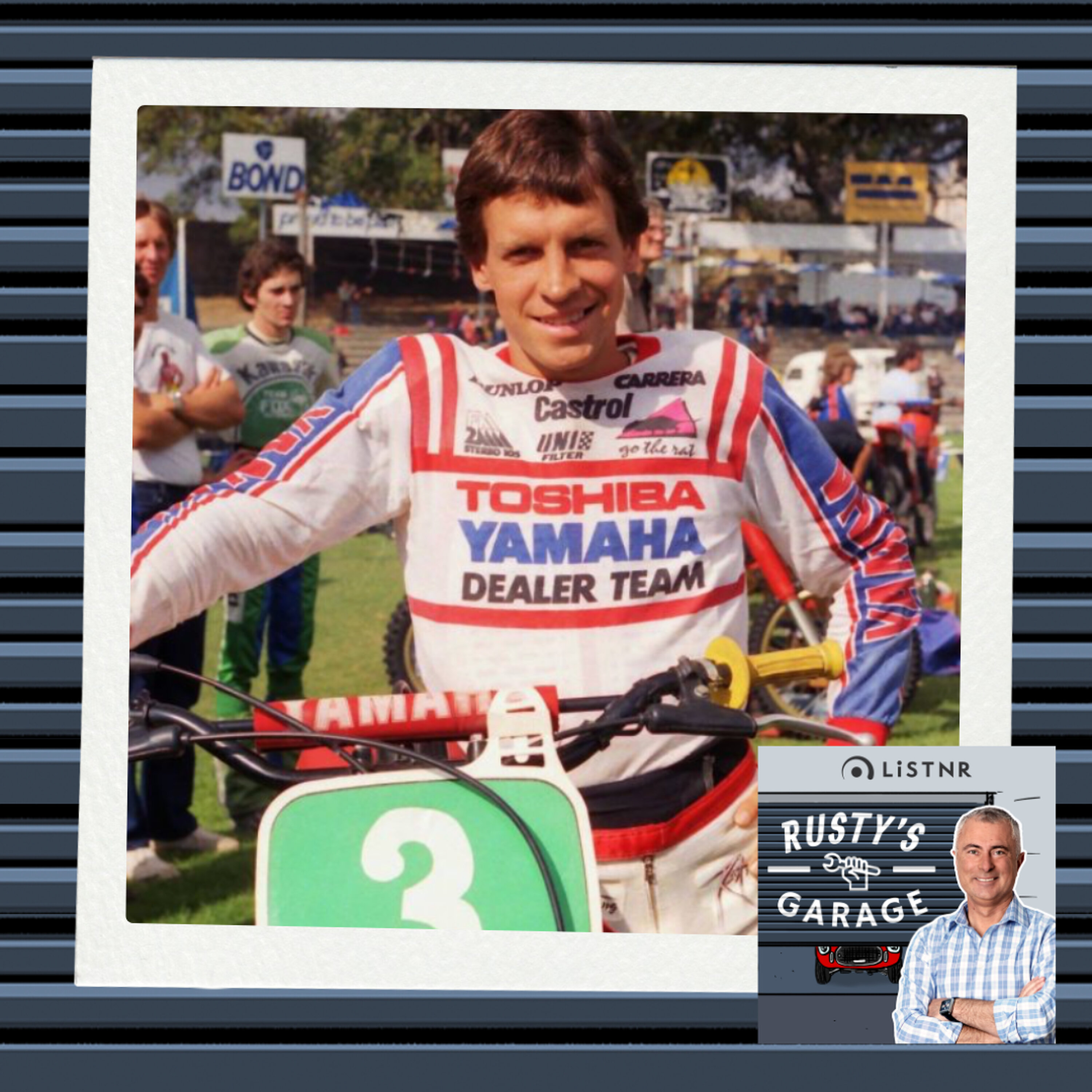
Stephen Gall’s path from Sydney paddocks to motocross, speedway, and international battles comes through in stories about grit, training, and mentorship. The conversation covers his Thursday-morning Yamaha YZ450 routine, the mental load of motocross, and how being “got my butt kicked” in the U.S. pushed him into reading about “nutrition hydration psychology.” Rivalries with “Grunt” and Anthony Gunter sit alongside Yamaha loyalty, motocross line tactics, and even how racing gained tax recognition.
Glory days with his brother Dean on the family property in Sydney’s south roaring around on home made dirt karts and fold up bikes.
How a trip to see legends like Roger De Coster at Oran Park in the early 1970’s left a lasting impression.
Why his Dad wasn’t keen to begin with and where he gets his trademark commitment and determination.
The much loved officials (who were part of the fabric of the sport) that quietly turned a blind eye to allow him to compete in his teens.
And the bike that really started the journey on his rise to Mr Motocross.
Befriending and battling the late Anthony Gunter or ‘Grunt’ as they called him.
Plus the marketing genius of Vincent Tesoriero at Forcefield - together they helped to change perceptions ushering in a professional era.
This episode coincides with the release of his fabulous new book ‘The Stephen Gall Story: No Easy Way’. Check it out & order your copy at www.noeasyway.com.au
Head to Rusty's Facebook, Twitter or Instagram and give us your feedback and let us know who you want to hear from on Rusty's Garage.
"I needed to get my Thursday morning fix which was at Queensland motor park on my YZ450
[224.2s] and a few 15 minute motors later I was happy and I drove home and geared up for this."
YZ450 is a Yamaha dirt bike that’s built for motocross racing. In the episode, it’s the bike he rode at the track, and they talk about how racing is different from just riding.
YZ450 refers to Yamaha’s YZ450 motocross bike, a high-performance 450cc dirt bike commonly used in racing. The mention here is specific because the host ties it to riding at Queensland Motor Park and discusses race pace versus riding pace—both concepts that matter a lot on a motocross machine like the YZ450.
"I know the difference between a race pace and a riding pace.
[243.6s] I can ride for 30 minutes but I can't race for 30 minutes."
Race pace means how fast you ride when you’re actually competing. It’s usually harder to hold for as long as casual riding because you’re pushing harder and staying focused.
Race pace is the sustained speed and effort you can maintain during actual competition, where you’re managing fatigue, traction, and decision-making lap after lap. The host contrasts it with riding pace to emphasize that racing demands a different level of intensity and consistency.
"I know the difference between a race pace and a riding pace.
[243.6s] I can ride for 30 minutes but I can't race for 30 minutes."
Riding pace is how fast you ride when you’re not racing—more like training or cruising. The point is that it’s easier to keep up than race pace.
Riding pace is the speed and effort you can maintain while riding for practice, fun, or training rather than full competition. In this segment, it’s used to explain why someone might be able to ride for 30 minutes but not sustain the higher demands of race pace for the same duration.
Car
Honda XR 75
"at quite a young age I think you had like a fold-away army bike
[514.0s] a Kawasaki 75 a Honda XR 75 but you get your hands"
Honda makes motorcycles, and the XR is their off-road style. “75” means it’s a small 75cc engine bike, often used for kids or beginners.
Honda’s XR line is known for off-road-oriented bikes, and “Honda XR 75” indicates a 75cc XR model. These small XR bikes are popular as youth dirt/minibikes because they’re built for rougher terrain and are easier to handle than larger machines.
"It was and it wasn't just the bike the first ever Yamaha Minibike was a JT160 CC bike
[533.2s] and but it wasn't all about the bike sure the bike was good"
A Yamaha Minibike is a small motorcycle meant for younger riders. The host is saying this was their first Yamaha and it hooked them on the brand and riding.
The Yamaha Minibike is a small-displacement youth bike line, and the speaker describes it as their “first ever” Yamaha. In this context, it’s notable because minibikes are often where riders build early throttle control and racing instincts.
"but it wasn't all about the bike sure the bike was good
[536.7s] but it was about the dealer Trevor Hunter at Stony Creek Motorcycles
[541.4s] he helped me initially and then Macklin Motorcycles and other Yamaha dealer"
This is the name of a motorcycle shop/dealer. The speaker says the dealer helped them get started with their Yamaha riding.
Stony Creek Motorcycles is mentioned as the Yamaha dealer where the speaker’s early support came from. For many riders, local dealers can be crucial for parts, setup help, and introductions to the racing community.
"he helped me initially and then Macklin Motorcycles and other Yamaha dealer
[545.9s] Harry Macklin helped me and Steve Ashkenazi would eventually became one of my mechanics"
This is another motorcycle shop/dealer name. The speaker is saying they helped support his Yamaha journey.
Macklin Motorcycles is another Yamaha dealer the speaker credits with helping them early on. Dealer relationships can matter in motorsport because they influence how quickly you can get parts and service support.
"there's road racing there's think there's a lot
[582.5s] there's a little bit of the sprint car back in the day
[584.8s] so they've really been good people"
A sprint car is a race car that runs on short tracks. It’s usually fast and built for quick, aggressive racing.
A sprint car is a type of open-wheel race car typically raced on short oval tracks, often with high power-to-weight and quick acceleration. The speaker mentions “a little bit of the sprint car back in the day,” suggesting they had exposure beyond motorcycles into that style of racing.
"[1040.8s] or a Jag XJ6
[1042.3s] or
[1042.8s] or a V12"
The Jaguar XJ6 is an older Jaguar sedan. “XJ” is the model line, and “6” refers to a six-cylinder engine.
“Jag XJ6” is short for the Jaguar XJ6, a luxury sedan known for its long-running straight-six engine and classic British road-car feel. In a workshop story like this, it signals the kind of cars that were common enough to be serviced or worked on.
"[1042.8s] or a V12
[1043.8s] E type
[1044.5s] or whatever it was"
A V12 is an engine with 12 cylinders. The cylinders are arranged in two rows that form a “V,” and it usually means the engine can run very smoothly.
A V12 is an engine with 12 cylinders arranged in a “V” shape (two banks of six). It’s often associated with smooth power delivery and strong performance character, especially in classic grand-touring and luxury cars.
"[1043.8s] E type
[1044.5s] or whatever it was
[1045.3s] all sorts of stuff"
“E type” refers to the Jaguar E-Type, one of the most famous classic sports cars ever made. It’s known for its sleek styling and for being powered by Jaguar’s straight-six engines in many versions.
"but now Alpine star I've got tech air
[1469.5s] the motocross
[1470.5s] so the airbags inflate if you hit the ground"
Alpinestars Tech Air is a wearable airbag for riding. If you fall or crash, it can automatically inflate to help protect your upper body.
Alpinestars Tech Air is an airbag-style motorcycle riding protection system. It uses sensors to detect a crash and then inflates an airbag to protect the rider’s torso and shoulders during impact.
"so the airbags inflate if you hit the ground
[1474.0s] I wore it that today
[1475.6s] you know it's
[1476.4s] I didn't crash of course"
When the rider crashes, the system can deploy an airbag automatically. That airbag inflates quickly to help absorb some of the impact.
In crash-protection gear, “airbags inflate” refers to an automatic deployment triggered by impact detection. The goal is to add a cushioning layer at the moment of a fall to reduce injury risk.
Topic
Oren Park
"[1618.2s] at Oren Park
[1619.4s] and he gets his factory
[1622.0s] RN370 Suzuki"
Oren Park is the name of the track where the championship races happened. Different tracks favor different riding styles, so the location matters for understanding the results. The host is using it to set the scene for a key season.
Oren Park is the race venue being referenced for the “last championship” run. Track-specific conditions (layout, traction, jumps, and braking zones) can strongly affect who wins, so naming the circuit helps explain why a rider might dominate “on the day.”
Concept
Mr Motocross crown
"in the middle
[1633.9s] is 78
[1635.0s] you win
[1636.1s] your first Mr Motocross crown"
“Mr Motocross crown” means winning the big motocross championship. It’s not one single race—it’s the overall title for the season. The speaker is treating it like a huge career achievement.
“Mr Motocross crown” is a nickname for a top motocross championship title. In other words, it’s the season-long points win that marks the rider as the best across multiple races. The host frames it as a major milestone in 1978.
"and people who don't know what a power valve is
[1737.4s] there's this valve that goes over the exhaust port"
A power valve is a device that changes how the exhaust gases leave the engine. It helps the bike feel stronger both at lower and higher engine speeds, instead of only being fast in one RPM range.
A power valve is a variable exhaust-valve system used on some performance motorcycles to change exhaust flow. By opening/closing (or varying timing/area) it helps the engine make more power across a wider RPM range, rather than only at one narrow band.
"and gives a more torquey response [1742.0s] like today there is with a four stroke motocross bike"
“Torquey” means the engine feels strong when you first get on the throttle. That “pull” is torque, which helps the bike accelerate quickly, especially at lower speeds.
“Torquey” is shorthand for an engine that makes strong low- to mid-range torque, so it feels punchy when you open the throttle. Torque is the twisting force the engine produces, and it often matters more than peak horsepower for how quickly a bike accelerates out of corners or off jumps.
"[1742.0s] like today there is with a four stroke motocross bike [1745.6s] so it was a really good bike"
A four-stroke engine uses four steps to make power: it sucks in fuel/air, compresses it, burns it to push the piston, then lets the exhaust out. It’s a common engine design, and it can feel different from two-stroke engines.
A four-stroke engine completes its cycle in four piston strokes: intake, compression, power, and exhaust. Compared with two-strokes, four-strokes generally run cleaner and can be tuned for strong torque, which is why motocross bikes often get discussed in terms of “four-stroke” versus “two-stroke” behavior.
"so it was a really good bike [1747.3s] and the next year we put that engine [1749.5s] in a 250 frame because it was centre port [1751.8s] the exhaust port was centre [1753.7s] which the frame encompassed that"
The exhaust port is the opening where burned gases leave the engine. Where it’s placed (and how it’s shaped) can change how the engine performs and how the bike’s frame has to be designed around it.
On many motocross engines, the exhaust port location and shape strongly affect how the engine breathes. In this segment, the speaker contrasts a “centre port” setup with an exhaust port positioned to exit through the middle of the frame, which can change power delivery and packaging for the bike.
"[1747.3s] and the next year we put that engine [1749.5s] in a 250 frame because it was centre port [1751.8s] the exhaust port was centre [1753.7s] which the frame encompassed that"
“Centre port” means the engine’s port (the opening for gases) is located toward the middle. That can affect how the engine breathes and also whether the frame needs to be shaped to fit the exhaust path.
“Centre port” refers to an engine’s intake/exhaust porting arrangement where the relevant port is positioned in the middle of the cylinder. Port placement affects airflow timing and how the engine can be packaged with the frame, which is why the speaker says they swapped the engine into a specific 250 frame to match that layout.
"but there's been very few factory bikes in Australia [1766.5s] that was one of them [1767.5s] I also had a factory 250 and 77 to ride"
“Factory bikes” are race bikes backed by the manufacturer, not just regular bikes sold to the public. They usually get the newest parts and support for competition.
“Factory bikes” are race machines supported directly by the manufacturer, typically with the latest development parts and team-level setup. The speaker contrasts factory-supported bikes with the limited number that made it to Australia, implying a gap in access to top-spec equipment.
Concept
500 motocross bike era
"you saw the kind of end of the 500 motocross bike era
[1805.6s] in some respects didn't you?
[1807.0s] it went out and four strokes came in"
In motocross, “500” means the bikes were around 500cc. The speaker is talking about a time when those bigger bikes were the main thing, before the sport shifted toward newer four-stroke designs.
The “500” motocross era refers to the period when 500cc-class bikes were the top displacement category in motocross. In this segment, the host connects that era to a major rule/technology shift that helped usher in four-stroke dominance.
Topic
Thumpernat races
"[1816.4s] and I'd turn up and have a bit of a ride
[1818.1s] but I wasn't really into racing at that stage
[1818.1s] it was my job
[1822.4s] it was my job"
This sounds like the name of a dirt-bike race series. The speaker says he would show up to ride there, even though racing wasn’t his main focus at the time.
This is a named event/series in the transcript, likely referring to a motocross or dirt-bike race gathering. It’s mentioned as part of where the speaker would ride during his motorcycle-school work.
"Gary Ben came back from Europe. He was an excellent mechanic. He knew
[2672.0s] how to set up suspension."
Setting up suspension means adjusting the bike’s shock and spring settings. The goal is to make it handle better on that track and feel more predictable.
“Set up suspension” means tuning the motorcycle’s suspension settings—like spring rates, damping, and ride height—so the bike handles the track consistently. Small changes can affect traction, stability, and how the bike responds under braking, cornering, and bumps.
"And to come forward to last year, Motocross of Nations in America at Ironman Track,
[2777.0s] Ray, Jeff and I got our arms around one another."
Motocross of Nations is a big motocross race where riders compete for their country. It’s more of a team event than a solo race.
Motocross of Nations is an international motocross event where riders represent their countries. It’s a team-based competition, so it’s as much about collective performance and strategy as it is about individual speed.
"Motocross of Nations in America at Ironman Track,
[2777.0s] Ray, Jeff and I got our arms around one another."
Ironman Track is a motocross venue referenced as the location for Motocross of Nations in America. Track layout and surface strongly influence suspension setup and riding technique, which is why the speaker calls out the specific venue.
"And he tells a good yarn around a preseason race in 82 at Nara. And he says you had to ride, it was an interesting format on the day you had to ride a 125, a 250 and a 500 on the day."
That “125, 250, 500” is about different bike classes. Bigger numbers usually mean a bigger engine, so the bike feels different and you ride it differently.
In motorcycle racing, a “125/250/500” format refers to different engine-displacement classes (in cubic centimeters) run as part of the same event. Riders may compete in multiple classes on different bikes, which changes how the bike delivers power and how you ride it through corners and jumps.
"And he'd watched you land from a particular jump and in that kind of very precise manner, you were landing in much the same place."
In motocross-style racing, a “jump” is a purposely shaped ramp or takeoff where the bike becomes airborne. Landing consistently—like the speaker describes—matters for traction, suspension compression, and staying in control as you hit the ground and accelerate out.
"I probably would have went to his line because I could see this lining me up. So you take his line on the last lap or near the last lap to block him."
In racing, the “line” is the path you choose through the track. “Blocking” means you place your bike so the other rider can’t go around you.
“Taking his line” and “blocking” describes racecraft: choosing the path (“line”) through a corner or section so the other rider can’t pass. On the last lap, small positioning choices can force a rider to take a worse entry/exit or avoid contact, sometimes leading to crashes.
"And there was no AIS or Institute of Sport at that particular time. There was no training venues."
AIS here means a sports training program. The speaker is saying that back then there weren’t programs like that, so training was more self-guided.
AIS stands for the Institute of Sport (referred to here as “Institute of Sport” and “AIS”)—a structured sports training program/academy. The speaker contrasts that with an earlier era where athletes had fewer dedicated training facilities and relied more on self-directed reading and preparation.
"And no matter what it is, I can go quick. And one thing I didn't do was do enduroes. And you know what? Because I didn't like working on the bike... And I never really got enduroes because I had to change my tires and do all that sort of stuff."
Enduro is a type of off-road motorcycle racing. It usually involves riding for long stretches over rough terrain, and it can mean more maintenance work during the event—like tire changes.
Enduro (often spelled “enduro”) is off-road motorcycle racing focused on long, mixed-terrain stages rather than closed-circuit speed. The rider says he didn’t get into enduro because it required extra work like changing tires and dealing with the bike more.
"But anyway, but the road racing was pretty special because I'd turn up the week before the Castrol six-hour with leathers and my four-face helmet."
Road racing is motorcycle racing on paved tracks. Instead of dirt trails, it’s about riding fast around a circuit and competing for position.
Road racing is motorcycle competition on paved circuits, where riders chase lap times and race position rather than off-road endurance. Here, the speaker contrasts it with enduro and describes how he prepared for major events.
Term
Castrol six-hour
"But anyway, but the road racing was pretty special because I'd turn up the week before the Castrol six-hour with leathers and my four-face helmet."
A “six-hour” race is an endurance event where teams or riders compete over a long time window rather than a short sprint. The speaker says he’d show up the week before this Castrol-branded six-hour event to get ready.
"But anyway, but the road racing was pretty special because I'd turn up the week before the Castrol six-hour with leathers and my four-face helmet."
“Leathers” are protective riding suits worn on motorcycles. They’re meant to help protect you if you slide or crash.
“Leathers” are motorcycle riding suits made from leather (or similar abrasion-resistant materials) designed to protect the rider in a crash. The speaker mentions wearing leathers as part of his road-racing preparation.
Term
four-face helmet
"But anyway, but the road racing was pretty special because I'd turn up the week before the Castrol six-hour with leathers and my four-face helmet."
This sounds like the rider is talking about a full-face helmet. It covers your whole head and face to protect you better in a crash.
A “four-face helmet” appears to be a transcription of a helmet type used in racing—likely referring to a full-face helmet. Full-face helmets enclose the face to protect the rider’s head and jaw area during impacts.
"And to win, or to get onto the podium on the XS1100 with Ron Bolden that year in the wet was quite an achievement."
Riding in the wet means the track is slippery. Tires don’t grip as well on wet pavement, so it’s harder to go fast and stay in control.
Riding “in the wet” means reduced tire grip because water lowers friction between the tires and the track surface. The speaker highlights that getting a podium on the XS1100 in wet conditions was a notable achievement.
"because Amaru Park and then Oren Park, it was dangerous. The fences were right there. And I had this self-belief to look after myself."
He’s talking about safety on the track. If crash barriers are very close, there’s less space to recover, so accidents can be more dangerous.
The speaker is describing track safety: when barriers (“fences”) are close to the racing line, crashes have less room to slow down or for the rider to avoid impact. He says this made Amaru Park and Oren Park feel dangerous, influencing his decision not to race there.
Select text to request an explanation
A listener production.
I'm automotive commentator and journalist Greg Rust and this is Rusty's Garage.
For this episode I'm at one of listener's sister studios, triple M, quite fitting in some ways
because today's guest was sponsored by the Hit FM radio station during the heights of his racing career in Australia.
We're on the Gold Coast for the chat because that's where Steven Gaul is based now and has been for some time.
But he cut his teeth with his brother Dean on paddocks and tracks in Sydney's south
and that fun during his upbringing would have a lasting, very powerful impact on where Steven ended up as a star of Mr Motocross
and later in Speedway racing midgets and sprint cars.
How a visit to Oren Park in the early 1970s to see the guns of international motocross then left him mesmerized
and the vivid memories that he has more than 50 years on from that race meeting.
His rise to success built on more than talent, an incredible inner drive and a commitment to proper athlete preparation
off the bike, physically, mentally, kind of changing the culture if you like to one of professionalism in every aspect.
His timing together with the amazing work done by Vincent Tesserero with force field marketing
really helped to transform the sport and we'll talk about that.
Gaul, he also opens up about some key and very cool bikes as well as friendships that were also rivalries,
the great battles with the late Anthony Gunter grunt for example and seeing the emergence of the next wave
like Craig Dak and Jeff Leeske who you can find in our library.
How he channeled their arrival to see what metal they were made of and to keep bettering himself too.
His natural move into coaching and the creation of an academy with highly regarded programs that he ran here and abroad.
His eye for that stuff is still as sharp as ever as you'll hear in the conversation with some reflections on modern day stars.
Plus the move into speedway which in some ways was his first love and how he applied the kind of same principles
that he become famous for on two wheels to four.
Our convo also includes details of a supercar's test that I didn't know about and a whole lot more.
Because we get so engrossed in the conversation, I didn't get to his work on the recent Mad Max films,
Fury Road and Furiosa that is my bad there.
Where he helped to create spectacular stunts with a team of Aussie riders and mechanics.
From a short lived apprenticeship working on Jaguars to a life spent around bikes and racing
with an overarching message to aspiring racers and to fans that there is no easy way
and that is the title of his fabulous new book.
I'll put a link with details of where you can find it, how you can buy it in the F description.
Time to fire it up. I hope you enjoy the story of Stephen Goall's journey.
Hello mate, how are you?
I'm very good Rusty.
Hey we are recording this on a beautiful kind of autumn afternoon here on the Gold Coast but you have not wasted the day
which is typical of you mate isn't it? Where were you this morning?
You were at the motor park weren't you? Tell me about that.
Yeah well I asked you to do a little bit later in the day for obvious reasons.
I needed to get my Thursday morning fix which was at Queensland motor park on my YZ450
and a few 15 minute motors later I was happy and I drove home and geared up for this.
They tell me you're still pretty handy and you can smash out a 30 minute motor too is this true?
Yes it's true but at a subdued pace and with a lot of years of training other individuals
I know the difference between a race pace and a riding pace.
I can ride for 30 minutes but I can't race for 30 minutes.
That's still amazing mate, I look at you and you've preserved I feel your age, your youth.
So well mate that's amazing that you still that and you've never lost the love for it have you?
No, no, no I really think as far as preserving being an athlete you've got to look after yourself
and for years and years I did stories in the Australian dirt bike magazine 38 years actually
and people always perceive me as a health freak and always fit so it would look really silly
if I went the other way.
Let yourself go.
That's right so the pressure was on because they fit, they look good but I like it you know I like it a lot
and I think the motorcycling now I'm not a much of a reader I don't do puzzles
so the cognitive ability of your brain to handle motorcycle off-road and motocross
each hand is doing something different, your fingers doing something different to your hand
your eye line, your body, both legs doing different things
so the cognitive ability of your brain is working overtime to ride a motocross bike
let alone a regular motorcycle but a motocross bikes on the edge of heightened ability
because you've got ruts, you've got holes, you've got rocks to miss, you've got lines to pick
you know it's a bit like most racing but there's so many variables there
so I think it's really good for my mental outlook.
I mean people as they age like to do things like crosswords forget it
that's from a mental perspective what you've just described is way better than that isn't it?
It is when I'm motocrossed.
Can we come to early life for you if you don't mind?
I'm glad that you bring up ADB magazine there too because I think they were
often regulars at the family farm when you were younger you would do some riding along the way
but I mean it was correct me if I'm wrong here an 11 acre family farm
men eye in Sydney's south and Gauley had sounded like a fun place with different
toys and things that you and your brother could roar around in bush bashing and so on couldn't you?
I was very lucky yeah my dad had Shetland ponies and there was a 11 acre property
and he liked go-karts in the early days so he had an oiled go-kart track at the back dirt
and I used to be on the track degrading it and sliding a dropping oil on it
my brother Dean would do the same thing and you know I was driving go-karts
and in my book I've got a pager where it all began it's a classic photo because
It's a beautiful photo.
I've got a cap on I've got thongs on the inside front wheels off the ground
the things slide in it's just a classic and anyway look at it the day go
oh god that's dangerous but anyway it was good fun.
You can without doubt it's unmistakably you can see the eyes and the kind of look
it's a mixture of fun but an early glimpse I reckon of the bit of the intensity
that we came to know from you.
Speedway which we will come to later in the conversation was very much in the family
kind of DNA your dad loved it didn't he?
He did he really loved the Speedway the Sydney show ground and not only did he present
his horses during the Easter show at the show ground but every Saturday night
we went sat in the member stand watched the legends go around the Jim Ares and the Gordon
Gascos and the Billy Warners you know Howard Ravel, Johnny Stewart was my hero
back in the day all those guys I just loved it you know and I don't know where
the smell of methanol and castrol came from back in the day but I've always loved
going fast in and it's actually a bit of a worry to me nowadays as I just explained
before to you but you get that.
Yeah I mean an amazing and iconic place from a Speedway perspective you brought up
the Shetland ponies there a moment ago your dad Bert had a few kind of rules around
if you're going to muck around on the property with noisy things bikes
bushbashes whatever you weren't allowed to scare the ponies were you?
No and in fact he threw me on the Shetland ponies to break them in sometimes
because I was young and a bit more invincible than anyone else was so
but I never liked one horsepower.
That's the best way I can say it I never liked one horsepower so I needed multiple horsepower
which certainly developed that way later on with sprint car racing.
Definitely I'm always amazed when I'm up to like 400 episodes of this now
and I'm always amazed about how athletes in any sport but mainly motor racing
latch on to gravitate to connect with their thing.
Now if I look for you I mean you clearly fall in love in a two-wheel perspective
at quite a young age I think you had like a fold-away army bike
a Kawasaki 75 a Honda XR 75 but you get your hands
ultimately on a Yamaha and it's kind of love it first sight a deep connection
there mate wasn't wasn't there?
It was and it wasn't just the bike the first ever Yamaha Minibike was a JT160 CC bike
and but it wasn't all about the bike sure the bike was good
but it was about the dealer Trevor Hunter at Stony Creek Motorcycles
he helped me initially and then Macklin Motorcycles and other Yamaha dealer
Harry Macklin helped me and Steve Ashkenazi would eventually became one of my mechanics
he worked for Harry and it was the love that they put into the sport
and I could see that love and I sort of gravitated towards it
but I can't really explain why but Yamaha then I've been now Yamaha for 52 years
and there's very few athletes sports people out there
that have ever been with one company for 52 years
and Yamaha has just been so good to me over the year
backed me right through my racing 15-16 years of schooling
that I traveled Australia teaching safer motorcycle schools to people
you know there's road racing there's think there's a lot
there's a little bit of the sprint car back in the day
so they've really been good people
I think when you look globally at the example you just given right
I mean the only one I can immediately think of is like Sir Jackie Stewart
who has a 58 year relationship with Rolex
but there's very few athletes that have been able to have that longevity
we probably need to tell more of your full kind of timeline
in the discussion here to get to that
but what is the secret of that longevity
because that is a great example I think to young athletes of what is possible
and in your case when you look at your story
it isn't just about the wins
it isn't just about the stats and successes
it's the relationship and what you built with them isn't it?
It is and like I said before nice people
and I think it was drilled into me by my mother
more than anyone that you've got to be a stable individual
look after the people look after you
hang with them don't just you know kick them aside
which a lot of people do these days
and yes I had opportunities
Honda came to me once
BMW came to me once
I had all these other opportunities
but I never really went there because Yamaha were always so good to me
and through a lot of my racing and into my schooling days
there's a guy called Steven Cottrell
who was in charge of Yamaha
and he was really good to me over the years
and you've got to give back and that's what I did
I can't remember with him
what was his total was like 37 years with a business or something or other
wasn't he was with them forever
yeah and he started some really smart things with Yamaha
and in as far as financial and insurance
and at Yamaha Australia
there's always been a Japanese individual
it's been above everyone
but when Steven was there
they actually put him as the head guy
because they respected his ability so much
so take my hats off to Steve
he's retired now and he's enjoying Sunshine Coast
but good on him
good on him great fellow too
did you keep that first bike?
what became of it?
but Yamaha
oh I don't know
that first JT-1 went
but what I did keep
was this is a little story too
in 74 the first YZ came out
which was a road race
engineered design motocross bike
and it had drill clever pins
and all sorts of magnesium on the bike
in 74 we're talking
and the bike was so trick
I walked to Harry Macklin shop
and it was on display in the window
and I'm just sitting there as a 14 year old
googling at this bike
and thinking how cool it was
well I still have that bike
awesome
at home
my boss bought it
I raced it with my boss
and then when I got it back
which is a bit of a story
because the guy that's supposed to restore it
did a runner and took most of the bike with him
and I had to buy bits all over the world
to get it back together again
but I restored it back standard
as I looked at it in the window of that shop
not as a race bike
standard
brilliant
yeah I love it
you have over time
with your passion around motocross donations
sold off various bits of memorabilia
to assist that program
I'm so pleased that you've kept that
we'll come to donations
as we go here
was it the St George Motorcycle Club
what's the early club involvement for you
and what happens here
because your dad was a little bit nervous
about you doing kind of open races
and things
what transpires in the early part
of your racing career?
well dad said no way son
you're not racing
you're not going anywhere else
you might can ride up the backyard
but that's it
well Arthur Blizzard
the late Arthur Blizzard
rest in peace Arthur
and Jan beautiful people
beautiful
but Jan's around now
she's very very smart
still in the 90s
Arthur went to dad
and said dad look we'll look after him
we'll make sure he's got the safe gear on
he's looked after blah blah blah
and so that was the excuse that I needed
so I got into some club racing first
and it did really really well in club racing
and then they talked to me
to let me do an open event
an open dirt track event
which just C grade teams
they which we won
the first ever event we went to
and then it just went on from there
and dad then had nothing to say
but you know dad only went
to two ever race meetings in my life
really
mum went to a lot
dad was
he said he was too nervous
really
so didn't worry me
I just got on with it
yeah
had fun you know
Arthur
correct me if I'm wrong here
I think
he turned a blind eye
in a good way
in a good way
in the early part of those
of your career there
to enable you to grow
and experience
and so on
and I'm really glad
that you brought up here and Jan
they were just part of the fabric
they've done so many great things
in motorcycling didn't they
they certainly have
they've been lovely people
so tell me about
what that enabled you to do
because you got to
throw your leg over
a couple of bikes that were
yeah well they should
not only trim a leg over
some important bikes
but also he got me
racing at 15 and a half years of age
instead of 16
so he sort of snuck it in
and maybe changed the dates
here and there to get me going
and that's what
the guy who is in charge now
you know
Peter Doyle
who's in charge of
motorcycle Australia
he's been on the pod
yeah he's
so good for the sport
Peter was a mechanic
with Neville Doyle
back in the day
when the factory Kawasaki team was
with Anthony Gunter
and Trevor Williams
what was my main
competition back in the day
so I've worked with Peter
for years
because then
I went to America
and I did some training
with Matt Muladden over there
and Peter was the
the manager of that team as well
they won seven USA
superbike championships
so Peter's a great operator
been from the start
to the finish
knows how to do it
and MA is going so well
at the moment with Peter
in control
the helm there yeah
can I come
mate if I can too
I often ask about
the influence of heroes
or people maybe
that are star status
at a significant moment
in your life
there is a yarn here
that you share in the book
around maybe the early 1970s
perhaps 72
Auron Park
the influx of some heroes
for a big race there
and the likes of Roger DeCoster
and others
and you were wowed
by that weren't you
I certainly were
you know I was a young boy
and went up on the hill
and sat in the bleachers
or not in the bleachers
at Auron Park
then it was on the dirt
like you'd have a ruck
under you know how it is
and I just saw
Joel Revere and Roger DeCoster
ride and it just
they blew away the Australian riders
just badly that day
and I went oh that's so good
I want to do this
and this was when I was
going out of the Speedway
all the time
and watching the Jim Ares
and the Bill Warners
and the Johnny Stewart
and the Howard Reveils
and then I just started
with two wheels
and I want to do this
this is me
and with my mum's influence
and my brother's help
in the early days
and St George Motorcycle Club
giving a good
it sort of got me going
and I didn't know
I was any good
I just rode
and then I just
gee I'm going pretty good here
I might as well have a go
and it just went from
level to level yeah
Before we
sort of venture more into
the sort of adult part
of your career
from a schooling perspective
you I think you went to
Logano then Pekers
was it Pekers High
maybe that you went to
but you only really had
one job
beyond high school
the rest of your life
has been everything to do
with motorcycle racing
and you
I don't know whether you finished it
but was it
an apprentice mechanic
at a Jaguar
dealership tell me about that
yeah we
we specialised in Jags
and BMCs
and my boss was Bruce Jones
and Bruce was an avid
racer himself
back in the day
with his friend Warren Weldon
who was a
a legend of a driver as well
and
but Bruce was
he and I were there
he taught me a lot of things
he taught me how to be clean
how to present things really well
he was a great boss
he really was
but a little story about this
is when I wasn't working on
either a
an 1800 Austin
or a Jag XJ6
or
or a V12
E type
or whatever it was
all sorts of stuff
he would get me
because the back
rear engineer business
had these jobs
that they had to do
and there was the multiples
I'm talking thousands
of a machining
putting a thread on
parting it off
putting a new bit in the lathe
and I'd sit there
bored as
and I'd say to myself
I need to be better
at motorcycle racing
I want that to be my career
this bored the hell out of me
so it was one of the more
motivational aspects
that pushed me on to being
a better person
to do a better job
at what I was doing
because I was so bored
doing a regular
regular job
and through more years of coaching
the academy
and the university of motocross
for years
I used to tell kids these
these things that
you know you think that
you want to be a hero in the sport
but on the other side too
if you
have got a boring job
of a builder
hitting in nails all the time
that may not suit you
so putting F&D motorcycle racing
you know it might be fruitful
for you because very few people
are ever that good
at motorcycle racing
there's only a few
when did that
hit home to you
you transformed the sport mode
in so many ways
and we will discuss that
but
understanding
the value of being
professional
dedicated
disciplined
athlete
is that a learn thing
from your upbringing
is that something that
competition taught you
and how did you become
that person
good question
but I think a lot of it
came from my mother
did it
what she taught me
what she said about being
truthful to who supports you
and to hang in there with things
and then
I went to America in 1980
after all was Mr Motocross
back in those days
which was the best in Australia
and I'd won Mr Motocross
for the second time
and finished second to Anthony Gunter
twice before that
so basically
I was one of the best
with Anthony in Australia
and both here
I went to America
good story
this one
went to Saddleback Park
in Southern California
got my butt kicked
really
yes severely got my butt kicked
so I finished these races
and I've gone
wow
this is telling me something here
I need to get my act together
and I started reading books
learning about nutrition
hydration
psychology
and then
watching what the Americans did
because they were the leaders
of the pack at that particular time
they won multiple motocross donations
all 12 in a row
or something from that era
and those guys
were all really really professional
and good
and I'd look at that
go to the races
and it just sort of grew on me
and that's what I wanted to do
and that's why I developed
I tried to develop
Australian sport
the way it has
that's more than a fascination for you
you enjoy that side of it I know
and we can cover a bit more of that
in the 70s
you've brought up Mr Motocross
which I love
let's go there right
so
Amaru Park
I don't know what year
maybe 74
or early to mid 70s here
you win a C grade race there
you come across Vincent Tesserero
for the first time
a very respected promoter
who you had a great relationship with
and at the end of the day
I think
an opportunity arises
for you to actually contest
the main events here
he gives you the opportunity
I think to have a crack at this
please tell me if I have this wrong
13th, 10th, 8th, 5th
unreal mate
yeah it wasn't too bad
and at the start of the day
I won the 250 race
and some of the top Australian guys
were in that race
and Vince said
we want this guy out there
and Mr Motocross
they put me from C grade to B grade
that day
so that I could ride the race
and then I got those places
that you said
so yeah I did pretty good on the day
and this young boy
in amongst all these experts
and I just had a go
what did he see in you?
well he must have seen the speed that I had
and other attributes
that I had
and maybe
he never really spent much time with me
until after that
because once I got on
the next year
which was the Grace Brothers team
I was a member of that
we would do install promotions around Australia
I'd have to talk to the crowds
and we did a lot of
promoting of the sport
in radio stations like this
TV, DVDs, all sorts of stuff
so it taught me as the early time
to do it right
and Vincent was a man before his time
yes
you know I'm still a great mate of Vincent now
and he's such a good guy
he thinks forward
I wish he was still running a lot of the sport nowadays
because I know it would be better for it
but unfortunately he isn't
he in a promotional sense
you know that connection that he had with
you know either
motorcycle dealers, brands
and companies that he was able to
I guess entice into the game
so it's in a period
of nice or beautiful
growth in a commercial sense
too mate I mean brands like
Triple M where we are now
Grace Brothers you've just mentioned
Pepsi, Toshiba
and more over that late 70s
80s period come into the game
don't they?
yeah it was so good
they had big names
and Maya was another one
it was just amazing
these names that you wouldn't see today
that were involved in the sport
really helped lift the sport up
and helped with advertising
of course and the radio and the TV
and he would give everything back to them
you know as far as clippings and newspaper
clippings and things like that
which was what you did back in the day
and a copy of this like interview like this
he'd give that back to them
because their name was mentioned
things like that so
a different world today that's for sure
but yeah he was the man before his time
two wheel game can be dangerous at times
that's just the game you play
were there any kind of early wake up calls
were there any little moments that you think
back on and realize that were tough
or was that clean you know
riding style that professional
clinical kind of style
was that something from the very outset
yeah I never really got injured in the early days
in 78 I went to New Miya
because I raced in New Miya in Tohi
just for fun at the end of our season
and I broke my ACL and my left leg
in 78 but I didn't really realize
what I had done to tell the truth
and some people can't really function too much
without the ACL and some people can
well I could and I still could run
and do everything with a fracture
it's still gone now and I haven't had anything done to it
really?
that's another story
we'll talk about two new knees that I need later
later in the story
I'll be the barnick man soon with a new hip already
in the two new knees
but anyway that's another story
mothers are going to be
I don't want my kid doing motorcy
all these guys
anyway that's another story
so yeah I didn't have too many accidents
over the over the years
and still to today
I have not broken anything in my upper body
which is
that's a remarkable
which is pretty remarkable
couple of cracks in ribs through falling on things
a lot of it's been mountain biking these days
e-biking
trying to be too young for my age
I might add
but yeah I've had a
but I put it down to a few things Greg
and the one thing is to wear the protective gear
which today the boys
it's not cool to wear shoulder or body armor
but now Alpine star I've got tech air
the motocross
so the airbags inflate if you hit the ground
I wore it that today
you know it's
I didn't crash of course
but I wore that today because it's such
a good insurance policy
if you get fired over the handlebars
or you have a fall
it inflates
and it protects the vital organs of the body
and your shoulders
so they need to be on top of it these days
these young kids
but back then I wore all the best body armor
that I could
the best helmets of course
I was always flexible
and I learnt that the first year in America 1980
I went to a gym
and that's what my book is called
No Easy Way
Yes
because it was written in bold words
on the gym
really
and that's just stuck in my head over the years
that's another bit of influential
activity that I saw
and I went
you know what
that's very true
you've got to work hard at what you do
to do
and that No Easy Way
just stuck in my head for years
but what I did
was racing
bikes, cars
you know travelling Australia
doing motorcycle schools
leaving my family for six weeks at a time
to do what I had to do
No Easy Way is certainly
when it comes to being professional
you can't have it always the good way
there's
No Easy Way suits it
amazing
very much so
can we come to the sort of late 70s around
Mr. Motocross
I mean firstly
you bring up
Anthony Gunter there
a moment ago
Grant was
a
in kind of a good way
a nemesis
a great rival
but an amazing friend
to you too
my great friend
much missed
yeah
unfortunately
have you got a memory
of a lasting memory of him
just Anthony
was just a grit and determine
sort of guy
a lot of guts
and really put it on the line
and so many races
that he beat me in
where maybe the tyre
was flattened
and still was faster
and sometimes
he'd grit his teeth
and just hold it on
and that's why they're
called in grunt
he didn't say much
but he grunted at you
and did the job
but we were great mates
and it was a shame to seem
lost through bowel cancer
yeah
and you know
talked at his funeral
and it was very sad
but we're all going to go at one time
so it's just the way it goes sometimes
you had some amazing
and very special days
with him
can I illustrate
what you've just spoken about
if you don't mind
77
you are both in contention
for the final of Mr Motocross
you win
the final round
but grunt takes the title
and I think he had broken bones
in his foot that day
or something too
is that right
yeah
and in 79
I've got a 21-point lead
going to the last championship
at Oren Park
and he gets his factory
RN370 Suzuki
and blows my doors off
in every race
and yeah good on him
you know he did a great job
but yeah
I lost that one in 79
because he was just too good on the day
in the middle
is 78
you win
your first Mr Motocross crown
and there were plenty of things
to test you
along the way too
I mean
people talk about savouring some things
I mean that your career results
golly are unbelievable right
but is this one
because it's maybe the first
and because of the challenges to get it
is that one that sort of sticks
in your memory
in your mind
yes and no Greg
sort of
it was important because it was the first one
and you work towards it
but like I said
in my early days
I was just sort of having fun
I was just out there riding
and I had this ability
that I didn't realise that I had
I could go fast on a motorcycle
so there was people around me helping me
so yeah it was really good
and I went okay well let's carry on
let's see what we can do in the future
so it was good
but it's only one of many things
that are very good to me
okay in the 80s there
I want to say in
may have been 81
did you get your first works bike
tell me about that thing
that sounds incredible
it was one of a few
or maybe the only in the country
we only got one in Australia
two went to Europe
and two went to America
people like Brock Lover
Hikey McCullough
they had the bikes
and unfortunately the bike
was awesome as far as its design
it was really trick to look at
but unfortunately the rear suspension
didn't work too well
and on a really rough track
I'd run the production bike
with factory suspension changes
really
and then on the smoother tracks
I'd run the factory bike
because the engine was so awesome
it was a four speed power valve
and people who don't know what a power valve is
there's this valve that goes over the exhaust port
and gives a more torquey response
like today there is with a four stroke motocross bike
so it was a really good bike
and the next year we put that engine
in a 250 frame because it was centre port
the exhaust port was centre
which the frame encompassed that
to go out the middle
and I did really good in 82
because of that particular engine in that bike
and yeah, a legend bike
but there's been very few factory bikes in Australia
that was one of them
I also had a factory 250 and 77 to ride
at the Australian titles at Dargle
and Kawasaki had the factory bikes
that Grunt and Trevor Williams did
there was the factory Suzuki
that Anthony won the 79 Mr Motocross
but after that
there's not many factory machines
that ever made it to Australia
apart from Wayne Gardner's practice bike
that's another story
writing with Wayne
he had a factory 500 cc HRC thing
at one stage
what was that thing like?
a beast
because you saw in your career
you saw the kind of end of the 500 motocross bike era
in some respects didn't you?
it went out and four strokes came in
I was travelling Australia teaching motorcycle school
so I wasn't out there riding and racing
at all at those days
and I'd turn up and have a bit of a ride
at some of the Thumpernat races
but I wasn't really into racing at that stage
it was my job
and I had a family
had a mortgage
so my job was to do the schools for Yamaha
around the country
and I was the first guy to do that
to get out into Australia
after I got taught by a mate of my Lenny Wimson
they had the soft earth motocross school
they invited me to one
to be just an assistant instructor
and a demonstrator
and I got a bit of the joy of helping people
I still have today
I love to help people
and I love to see the smile on their face
that you help them
and they go a bit faster
or they present themselves at the race better
as far as the placing
and I see that in the smile on their face
and it brings back my memories of what I did back in the day
so it's just like watching Australian Idol on TV
last night the winner
and just to see how they take that on
and wow they can't believe it
well I love that
it brings a tear to my eyes sometimes
I know that's really silly
but I love to see young people realise their dreams
It's great that you bring up Lenny there a moment ago too
I mean for a time there
I think he was team manager
for the motocross donation squad wasn't he and so on
did he not teach you quite a valuable lesson
maybe around toughness
around that precision we talked about before
and the clean style that you had and so on
but he was like if you're going to go to places like the States
or to whatever else
and you've got to be prepared to bang bars and wheels here
and like did he teach you a bit of a lesson in that regard?
He did
he used to come to my track at Menai
and we had a little bit of a motocross track there
in the dirt track we talked about
we had the go-karts on
and he'd carved me up
he put me on the ground a couple of times
and he'd said well you left yourself open
you've got to cover that line
and he taught me a lot about line selection
and protecting your line
so yeah he taught me a lot
but to tell you who also taught me a lot
in the early days when I started racing motocross
I went off and did dirt track
in those days it was called short circuit
and for Americans it's flat track
well those older guys in that particular era
they were amazing
they were on the sliders
you know the speedway bikes
two gears in the gearbox had a front brake on it
which didn't work that well anyway
but they would use different lines
and they would carve you up before they even looked at you
you know they didn't care
it was hard racing
they don't do it these days
the boys don't do it at all
and you know another specialist motocross guys
ever do what I do
what I did back then
they don't diversify like I did
but that's because there's more pressure
on them from their sponsors to do one thing
but those guys those old guys taught me so much
and Anthony and I did a whole lot of that racing
back in the day
and you know I managed to get a three
Australian dirt track titles from those guys
and good fun good fun
but they taught me a lot about being a hard person
Let's get started
Craig Dak joined the garage library back in 2024
after being around Craig
and his CD-R team at Supercross broadcasts
over the years
Rusty had no idea that Dakar
had kept some special machines
from his own racing career
I got my first bike
and I got my last bike
and they sit in my gym
and every morning I'm doing
I sit up, I'm doing my weights or whatever, I have a look at the first bike and the last bike
and just keeps it in perspective from where I've started or where I've come to.
He also talks about working with Chad Reed, running his own team now and much more.
Like Gally, the Kray Dac episode is another great Aussie dirt bike racing story.
Search for it later. Now back to Stephen and Rusty.
When we talked before about the first Mr Motocross title, did you keep the check?
I think, did you get a two and a half grand check or something?
Yeah, that's at home. I've got rid of a lot of my memorabilia acts.
I've been raising money for Motocross and Nations team by not keeping the money,
but selling that stuff off. Just whatever you want to pay for it, give me that and that goes
into the kitty too. Motocross and Nations, I'll let you come into that, but I started in 84.
I was the first one to say to Len, let's go do this, Len. He had the motivation to follow it up,
to chase it up because he's a steward at the time. I provided the motivation,
but he did it. We raised all the money ourselves. We did that for 10 years between us.
We did the whole thing before MA then ACU took over and then started to do it,
but we did it for 10 years just because we wanted to get Australia on the map.
That was 42 years ago and you can imagine how elated I was a couple of years ago when we won
the thing with the Lawrence brothers. I had tears coming out of my eyes. It was just so special for
me. Let's come to that and to a little later how special those guys are to the commercial side of
it. We talked about Vincent Tesserero there before. Somewhere along the lines here, maybe
it's late 70s, maybe it's early 80s. I can't remember. You get one of your first big contracts
and it's around like the $40,000 mark or something rather, which back then was probably
a lot to go motorcycle racing. The money from Yamaha. Yes, that's right.
Where are you in life at this stage? Are you married or have you got your own home and how
helpful was that in terms of A, the dream, but B, getting financial reward for it too?
Yes. Well, that reward started really early and that reward stayed there all through the
years of racing and into the coaching that it did right up to 2003. That same monetary reward,
although it wasn't as valuable in 2003 as it was when I first started, but still that's why
Yamaha had been so good. That's why I'm hanging in there with them. That was a really big help back
in the day, but it's important to me to, you know, nowadays, I've got a beautiful wife,
Gay, I've been with her for 47 years. We had two kids, Sean and Alex. Sean's got two girls,
Alex has got two boys. Lovely. They're three and two and the girls are six and 46 and three.
What are you, mate? Are you your granddad? Are you Poppy or what? Poppy.
I'm a Poppy, but, you know, they're a lot of fun and the young boys, they're into their balanced
bikes and lots of stuff. And, you know, I never pushed my kids either. I bought them motorcycles.
Sean came along to those schools that we did and rode and said, Dad, I just don't want to go. It's
fun, but it's hot and it's hard. And I said, okay, son, no problem, mate. It's not you. It's not
you. I'm not a dad that wants to stand on the sidelines and yell at the kid when he comes in
because he hasn't done any good. That's not how you develop champions. And the way you get
champions is they want to do it. They need the want. And I had the want over the years,
and I can see if my kids didn't have the want. No problem. I'll support them or what they wanted
to do. What a great line, need the want. That's a good little takeaway for some young riders here
today, among others that I'm sure that you'll share. Yeah, without that, you've got no chance.
So, just to sort of underscore what you're talking about around the longevity, the commercial
recognition, if you will, and so on. In the book, I'm paraphrasing a little bit here,
but I think this is a line from Vincent Tesserero's contribution. He talks around
just how you and Grant helped significantly to kind of pioneer the sport in that phase.
You proved its legitimacy in the commercial arena, and you really understood, gravitated,
and rolled your sleeves up and got your teeth into the promotional side, didn't you?
Yeah. Well, I could see that was going to help the sport. And not only was I training people
at that time and also racing at a high level, but I could see the sport needed help.
And it still needs help today. But that's why I tried to be as professional as I could. I tried
to talk as good as I could and sounded like an individual and knew what he was talking about.
And, you know, it was just important for us to get the business side of the sport going.
And in fact, another little addition to that, in the early 90s, the tax department in Australia
deemed motorcycle racing as not a human endeavor. What? And sailing as well. So, I just started
going to the Institute of Sport at that stage. The door was opened by an exed,
he was from basketball, Henry Daigle. He was controlling MA at the time, which hadn't changed
the motorcycle industry at that stage. And he got us into the Institute of Sport. So,
we did testing down there. So, the testing that I did and with Henry and the specialist
in the Institute of Sport, we presented that to the tax department and they went, oh, okay,
via two max of this, high heart rates, lactate levels of this. Oh, you guys are sports people.
So, then I changed that for riders from then on as far as getting legitimate tax deduction.
Yeah, right. Yeah, for our sport. And the change that you help, I think, goes beyond that too.
There's recognition at whatever, a government or administrative level, right? But even in a
public perception sense. And Vincent, I think draws the parallel about how in the 70s, it was
probably like football jerseys and leather bike pants. You were about professional look, the
safety you talked about before and so on, weren't you? Clean jersey, a nice cap at the presentation,
speak correctly. Yeah, I was all, and I think that came from Mum.
Did it? Yeah, most definitely not Dad. Okay. Dad taught me what not to do.
Okay, so the media stuff came, like we're doing now, that came easy to you,
that was a learn thing or you just love doing it? Yeah, come pretty easy to me and I didn't,
you know, Vince helped me along the way as well. And so, yeah, it was just sort of something that
fell in my lap and it was really nice to look back and say that it helped sport.
We'll talk about Leeski because I've spoken to him on the phone before you came in today.
He reckons there was one win somewhere and you were on, maybe on the podium or on stage or whatever,
and to ensure that you never missed thanking the right sponsors. You had the boys write
all the sponsors on the pit board, didn't you? So you could see it in the distance.
Exactly, that was a great technique. I had Steve or who were Frank Ponds, Steve Ashkenazi,
my brother, Dean, they had the lap board flipped over backwards and I'd have my stickers aligned
in the seniority of who pays the most so that I could just read it away and not forget anyone.
Yeah, it was pretty easy. Instead of, you know, when there's 15 different people that help you,
it's really hard to remember them all and I'm no one sign. That's for sure. So I needed some help.
Well done. You corrected me there too. Thank you. I think I said pit board as in a car racing thing
was the lap board that they use. Can I come before I get to Leeski to DACA? He's been on the pod with
us too. He talks about meeting you at Hungry Creek, I think, the motorcycle park then north of Sydney,
Sydney rather in the 1970s, and the memories that you might have of him from back then.
I mean, his dad was insistent on doing some of your courses and things, wasn't he?
Yeah, he was and Craig was a young guy, really quiet, just a kid out of school.
And I really befriended him and I could see that he had talent, so I was like, oh, I'll try to help
you. And I really did mentor him a lot in the early days. And he lived with a friend of mine
called David Hirsch just down the road from where I lived at Cronulla, where I live with my wife.
And we used to ride and train and do a lot of fun things together. I took him to America a couple
of times and stayed with Goat Brecker, a factory rider over there. And just good, good mate, Craig
is. And he's done so much for the sport too now, you know, like whether I end films in that regard
to carry on into the sport. And I was talking to Todd Waters, who's in charge of Raceline and
Factory Husky now. And he told me the other day, he said, you've inspired me so much, Steven, that
there's life after finished racing. I can do more. And good on you, Todd. You know, that's
what we need. We need people that are full thinking and going forward in the sport and
developing aspects of the sport that can make the money and make the sport bigger.
Bringing the skill set and applied in a different area of the game. If the competition aspect is
over or winding down, there's no reason you can't apply yourself in another area of the sport.
Dakar, you would, I think, help introduce him to sponsors along the way that helped him. And
then ultimately, he ended up with you at Toshiba Yamaha, didn't he?
He did. Yeah, we're on the same team for a while, as was Jeff Lees in the 81-82 era. And yeah, Craig
was a great rider and developed into a really strong competitor. And Craig won four Mr.
Motocross titles like I did too. He equaled my record, which was really good that we were
both sort of so friendly, and we both got that title. And then later on,
Jay Marmont has also won four now, and also Dean Ferris has won four. Now, Dean's back this year
too. If he wins this year, he's going to jump ahead of all of us and be probably the greatest as far
as 500 cc or open class winners are concerned. Concerned, brilliant. Just on Dakar, at this
stage of your career, are you naturally team leader or mentor? Is a bit of that kind of coming
in at this stage with Dakar, with Leeski and these sort of guys coming through? Are you thinking
like that, or you're just thinking about, I'm competitor, I've still got to beat you and just,
you know, we get on pretty good when we take the helmet off or whatever. What was the relationship
like in that stage? Back in the day, it was fine. And with Jeff, I could see that he had a great
package. You know, Gary Ben came back from Europe. He was an excellent mechanic. He knew
how to set up suspension. The Honda was good at that particular era. And Jeff was a young kid
coming through and was very motivated. And I'm a realist, so I could see that that package was
going to be really, really hard to beat, which it was. And the same with Craig a little bit later
on. Craig had good help, had good support around him, had a good motorcycle, had the want that
really trained hard. And you know, I remember the early days going training with Craig,
and we'd be the sandhills at Cooner when there was sandhills. That's a different other story.
And we'd be running in there and I'd always smoke him and he'd go, oh, golly, I'll never beat you.
And I said, mate, one day you'll smoke me. Don't worry. And sure enough, you know,
he's down the line. My tongue's hanging out and he's leading me. Yeah, just the way it moves on.
You know, that's the way it evolves.
Leeski tells a very similar story about runs that the peer review did and the competitive
element in that. And I think he felt like you could understand your teammate a bit better,
how far they could go, what they're in a will was like.
Yeah, well, you can really develop that when you see how much they put in in their training,
how much that's that want we talked about. I want to be good. We can see that in someone.
You can see that very easily when you're around someone like that. And I saw that in Craig and
Jeff for sure. I also saw that in Ray Vanderberg. It took the championship off me in 83 with a great
ride. I went into that with a 20 odd point lead too in 83. And, you know, I could have won six
of those things, but I missed out on two. But anyway, it was good that Ray did really, really well.
And to come forward to last year, Motocross of Nations in America at Ironman Track,
Ray, Jeff and I got our arms around one another. We've all got tears coming at our eyes because
we've just won Motocross of Nations again. You know, it's so good to bring the boys back together.
And all three of you still, you know, whatever age you are, respectively, now as passionate about
it as as ever. To Jeff briefly, I mean, he talks about meeting you, I think, as a 12 year old or
what would have been King of the Cross, maybe in Western Australia there. You were a senior,
he was a junior, and he was immediately struck even as a young boy like that at the commitment,
the kind of intensity from you. And he tells a good yarn around a preseason race in 82 at Nara.
And he says you had to ride, it was an interesting format on the day you had to ride a 125, a 250
and a 500 on the day. And he was chasing you in the two or aboard the 250 in one of the races there.
And he'd watched you land from a particular jump and in that kind of very precise manner,
you were landing in much the same place. And he thought, right, if he's always landing on the
left, I'm going to get him on the right at some point here. And so he launches, but you didn't,
you went the other way on this particular occasion. I think he landed on top of you and you both ended
up in the dirt. And it got pretty, pretty fiery there for a moment, I think. I probably would have,
I don't remember it too well, but I would have went to his line because I could see this lining
me up. So you take his line on the last lap or near the last lap to block him. But unfortunately,
it ended in tears when he jumped on me. Yeah. The forward in the book is by
Mick Doon. And he talks about you inspiring a generation on how to complete at the very highest
level, how you go about preparing to win the training that we've discussed, the physical and
the kind of mental conditioning. You set a benchmark that hadn't been done before. And I think
in Formula One, they use people like Senna and Schumacher as key benchmarks in the last
30, 40 years, whatever, of turning the game around. And you did that here. You talked about
your mum, but where are you drawing the physical, you're reading books. So is there things from
America? Where are you drawing some of this stuff from? Yeah, books from America, Gary Bailey's
training. I knew Ricky Johnson would talk to him a little bit, but I don't really know. It just
came from within that I could see what I needed to do. And there was no AIS or Institute of Sport
at that particular time. There was no training venues. It was just what I read about, what I
had to do. And I hurt the knees. So then I started cycling. So then I got right into cycling and I
do a lot of kilometers with road cycling, not so much mountain bikes. It wasn't an equaled
mountain bikes back in those days. But I can't really answer that, Greg, because it just sort
of evolved. And I just learned what I had to do. And I did it. And mum helped me a lot. And
my brother was always very professional with everything he did. And that installed it into
me that I had to do it that way. And people around me, like my boss that I said, Bruce Jones,
he was that way, is very professional. So I suppose all of that rubbed off on me to do the right
thing. And it still is today. I still try to do the right thing today when it comes to all these
aspects. You've maintained that whole healthy life ethic or whatever you want to want to call it,
right? Neil Crompton sometimes in commentary uses a great line about peak of your powers.
Is there a year? race season or something where you just felt like
Stephen Gore was at his very best? 82. Tell me about that. Yeah, 82. I had that factor engine,
the 250 frame, the bike was awesome. I had Steve Eschanazi, he's a mechanic where I'm
willing was helping the year before. Rest in peace, Warren. And it was just a year that I
felt really comfortable. I went back to America for the third time, because I would go to America
from 80 to 85 for a month to six weeks, spend all my own money to do it just as like was my
apprenticeship. I went there for training, learnt from the best. Keep testing yourself, keep pushing
yourself. That's right. And when I started, like I said, I was battling to get to the top 10.
When I finished in 85, I was racing at the upper level with all those top guys. So I improved a
lot over those five years. And that was because of what I learnt there and what I learnt in myself
and just got better and better and better. So I think you've got to look and absorb and read and
sort of have the want to do it, the determination and the want to get out there. On the two-wheel
side, mate. I mean, you've talked about the tally of Mr. Motocross wins. There are Australian
Motocross Dirt Track Championships. You have won the Fink Desert Race. There is World Masters Supercross
in London, an European six-hour dirt track race. I should bring this in here. You podiumed at the
Castrol six-hour road race. There are all these things that you have. Well, it just probably
shows that I can ride a motorcycle. And no matter what it is, I can go quick. And one thing I
didn't do was do enduroes. And you know what? Because I didn't like working on the bike.
Really? I think I got spoiled over the years that someone would work on the bike for me.
And I never really got enduroes because I had to change my tires and do all that sort of stuff.
I know that sounds really like I was spoiled and I probably was. But anyway, but the road
racing was pretty special because I'd turn up the week before the Castrol six-hour with
leathers and my four-face helmet. Which were the Amarupaki?
And I could get within about a second of the best guys. We're talking the best out of Europe,
the best out of America, you know, the dunes, the gardeners, all the top guys, Paul Feeney.
Paul Feeney was one of the top guys back then. And all those guys were very respectful, very
helpful. If I asked a question, that helped me out. And that also embedded in me about helping
the young kids because those older people were helping me. And I think I only fell off that
thing twice. And I shocked a lot of people how fast I rode that XS1100 around there. But that
was just fun. To me, it was fun. I just had to go. And I did pretty good at it. And to win,
or to get onto the podium on the XS1100 with Ron Bolden that year in the wet was quite an
achievement. I got a fifth another year also. So yeah, as one of the guys tells me, he said,
there'd be a lot of people who'd be very proud of your career. And I don't think much of it,
because it was just something that I did. And it was fun at the time. But when I look back,
I think, yeah, I didn't do too bad there. And quite honestly, I could have went on to bigger
and better things with road racing. Why didn't you then? There's a good question. I was hoping
you're going to ask that, Greg, because Amaru Park and then Oren Park, it was dangerous. The
fences were right there. And I had this self-belief to look after myself. That's why I haven't hurt
myself much over the years. And so I never went there. And I think if it was today, and I had to
go, honestly, I reckon I could run at a very, very high level if today was back then with the
tracks. Got you. With the safety. With the safety and the bike. I look at the day and I go, oh,
yeah, that doesn't blow me out. You know, I've been to motor GPs and I watch all that stuff.
It doesn't blow me out at all, because I reckon I could have done that at a fairly high level.
And would you believe that Jack Miller has been to one of my schools? That's awesome.
Yeah, I went, here's the great story. I'm down at the Bend one year, just hanging out with
Dan Stalford and the boys and the Jucati and the Yamaha team. And Jack's there and I,
Jack, my son-in-law would really love a photo with you. Can I get a photo? I'm a really nice
to him, you know, as I am. And I take the photo and he says, now, Gaulie, he said, I want a photo
with you. I did one of your schools. I went, really? That's fantastic. I've forgotten all this.
How old, what are you being, Durigan? I don't even know. Yeah.
It must have been like early teens or little. Yeah, it was. It would have been probably 14,
15. I was in Townsville where he'd come from. Yeah, so that was really cool. Another one's
Troy Bayless. He did the Hungry Creek schools back in the day. And he just loved it. I still
know Troy really well today. I ride at his place sometimes and we hang out together a little bit.
So really nice to see that some of those guys actually, you know, I did some training with
them back in the day and maybe some little piece stuck in the head that I helped them with.
I would 100% believe that with both of the people that you've just rattled off made more than a
little bit, I reckon, has been a takeaway. That's the end of part one of my podcast with Stephen
Gaul. But we are not done yet. There is a fabulous part two for you, which is scheduled for release
just 24 hours after our first installment here. We'll talk in that about his move into other
forms of bike racing and the success that he enjoyed there from desert competition and conquering
the iconic pink desert race to a podium at the Castrol six hour circuit racing, moving it to
Speedway and a title win in speed cars or midgets plus his vivid recollections of a crash in sprint
cars and a deep desire to share the knowledge through an academy that became widely acclaimed,
why he was the perfect person to help train the next generation of competitors, rewriting methods on
and off the bike, exploring ideas other codes had embraced as his own sport kept pushing,
kept breaking new ground in a professional era. It's quite the ride and it's all ahead here on
Rusty's Garage.
Request an explanation for:
2 cars
2 cars featured
Request an Explanation
Heard something you'd like explained? We'll add it to this episode.
Sign in to request explanations for terms you heard.
Want to learn more?
Browse our glossary for plain-English explanations of automotive terms, jargon, and concepts.
See something that's not quite right? Our annotations are AI-generated and can sometimes miss the mark.
Click the flag icon on any annotation to suggest a correction.