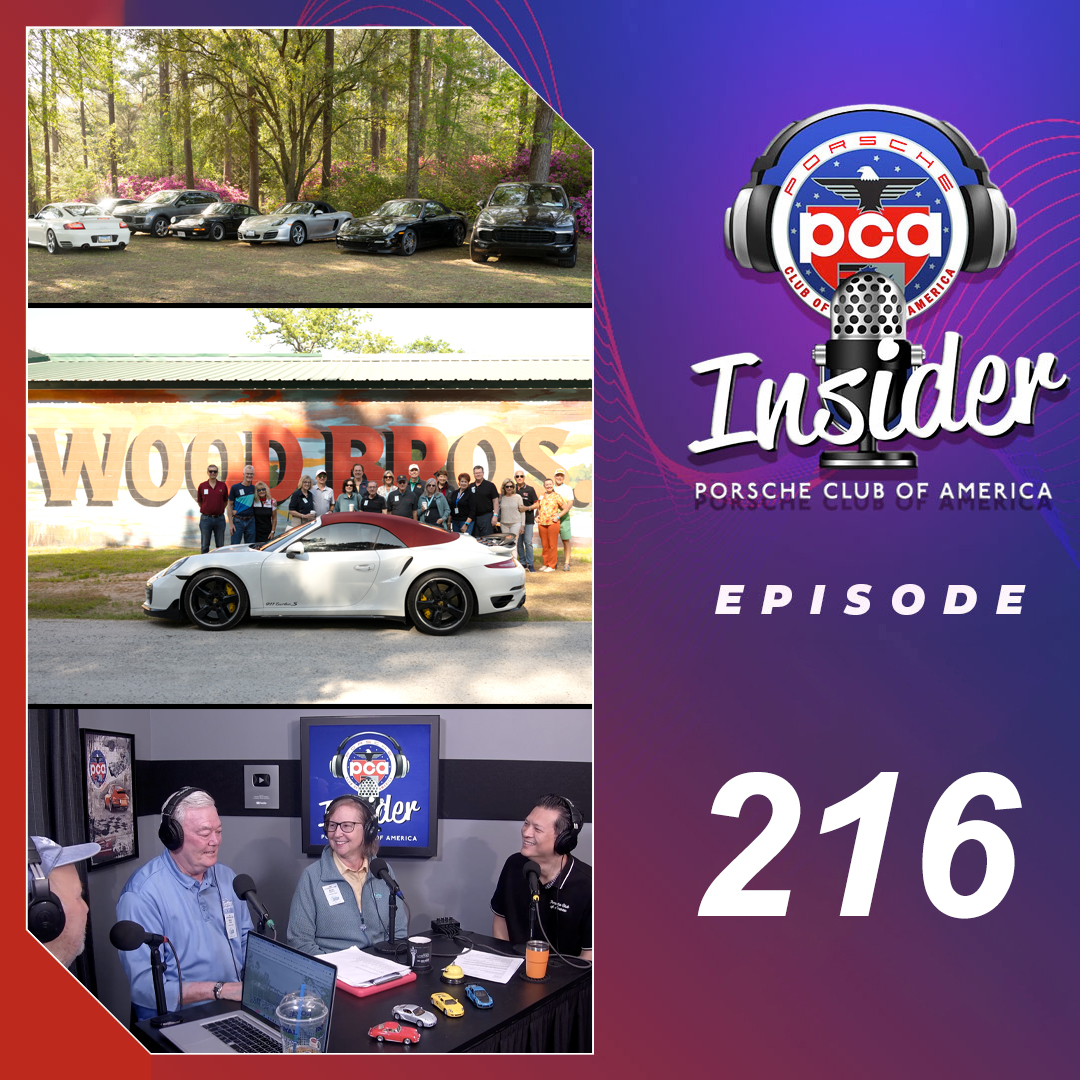
The Treffen Experience: More Than Just a Drive
About this episode
Chesapeake Region PCA president Steve Bus and registrar Marcia Bus break down what makes Treffen different from a typical car tour: a four-to five-day, all-inclusive “bucket list” experience built around structured drives, five-star resorts, and heavy social time. They trace Treffen’s roots from the earlier “Escape” concept and explain the volunteer-led tour system (leads, mids, sweeps) that keeps cars together and safe. They share their favorite Lowcountry stop at Montage Palmetto Bluff, plus insider registration tips and what’s next for Treffen at Sea and upcoming events.
What exactly is PCA Treffen, and why do people rush to get in when registration opens? On this episode, we’re joined by Steve and Marsha Buss, long-time attendees, and dedicated volunteers. They share the stories behind their many Treffen adventures and explain why these events are about so much more than just the drive. We explore the history of Treffen, dive into the "on-the-ground" experience and get an inside look at the recent Treffen Low Country highlights. If you've been curious about these premier tours and destinations, this is the episode for you.
episode 216
"Welcome everyone to episode 216. Today we're going to talk about a program that rivals the Taylor Swift concert tickets."
This is the show’s episode number. It helps you find this exact episode again in the podcast feed.
This marks the episode number for listeners tracking the series. It’s useful for organizing the show’s archive and referencing this specific discussion later.
Treffen's North America program
"We're going to be talking about Treffen's North America program, but before we get into it of course we want to thank our sponsor Pirelli."
Treffen is a Porsche club event—basically a big get-together for Porsche owners. This episode is focusing on the North America version and how it’s about the whole experience, not just driving.
“Treffen” refers to Porsche club gatherings, and the North America program is the organized version of those events across the region. The episode frames Treffen as more than just a drive—an experience built around community, planning, and participation through Porsche clubs.
Pirelli
"before we get into it of course we want to thank our sponsor Pirelli. Pirelli tires have to achieve the highest levels of performance, safety, noiselessness, and grip on the road surface."
Pirelli makes tires for performance cars. The host is saying their tires are designed to grip well, be safe, and stay quiet while driving.
Pirelli is a major tire manufacturer that supplies performance-oriented tires for many sports cars, including Porsche models. In the episode, they’re positioned as meeting high standards for grip, safety, noise, and overall performance.
VIN
"If you aren't currently a PCA member and own a Porsche, what are you waiting for? Be sure to have your VIN handy and for those of you that don't currently own a Porsche, check out our test drive program."
VIN means Vehicle Identification Number. It’s like your car’s unique ID number, and it’s often needed when signing up for programs or verifying ownership.
VIN stands for Vehicle Identification Number, a unique 17-character code used to identify a specific car. The host mentions having your VIN handy because it’s commonly required for membership, vehicle verification, or program enrollment.
PCA.org
"Be sure to have your VIN handy and for those of you that don't currently own a Porsche, check out our test drive program. Just head over to PCA.org and take care of your membership."
PCA.org is where you go to learn about and join the Porsche Club of America. The host is telling non-members to check it out for membership and Porsche test-drive opportunities.
PCA.org is the website for the Porsche Club of America (PCA), which organizes events and member programs. The host points listeners there to join and access Porsche-related activities like test drives.

BMW convertible
"“It was actually an interesting story that we had a BMW convertible and didn't get driven that much. And I said, let's just sell the car.”"
The “BMW convertible” is mentioned as the prior car they didn’t drive much, which led to selling it. While the exact model isn’t specified, it provides context for Marcia’s entry into Porsche ownership. It’s also a reminder that lifestyle fit (how often you actually drive it) often drives car decisions more than specs.
Porsche 996
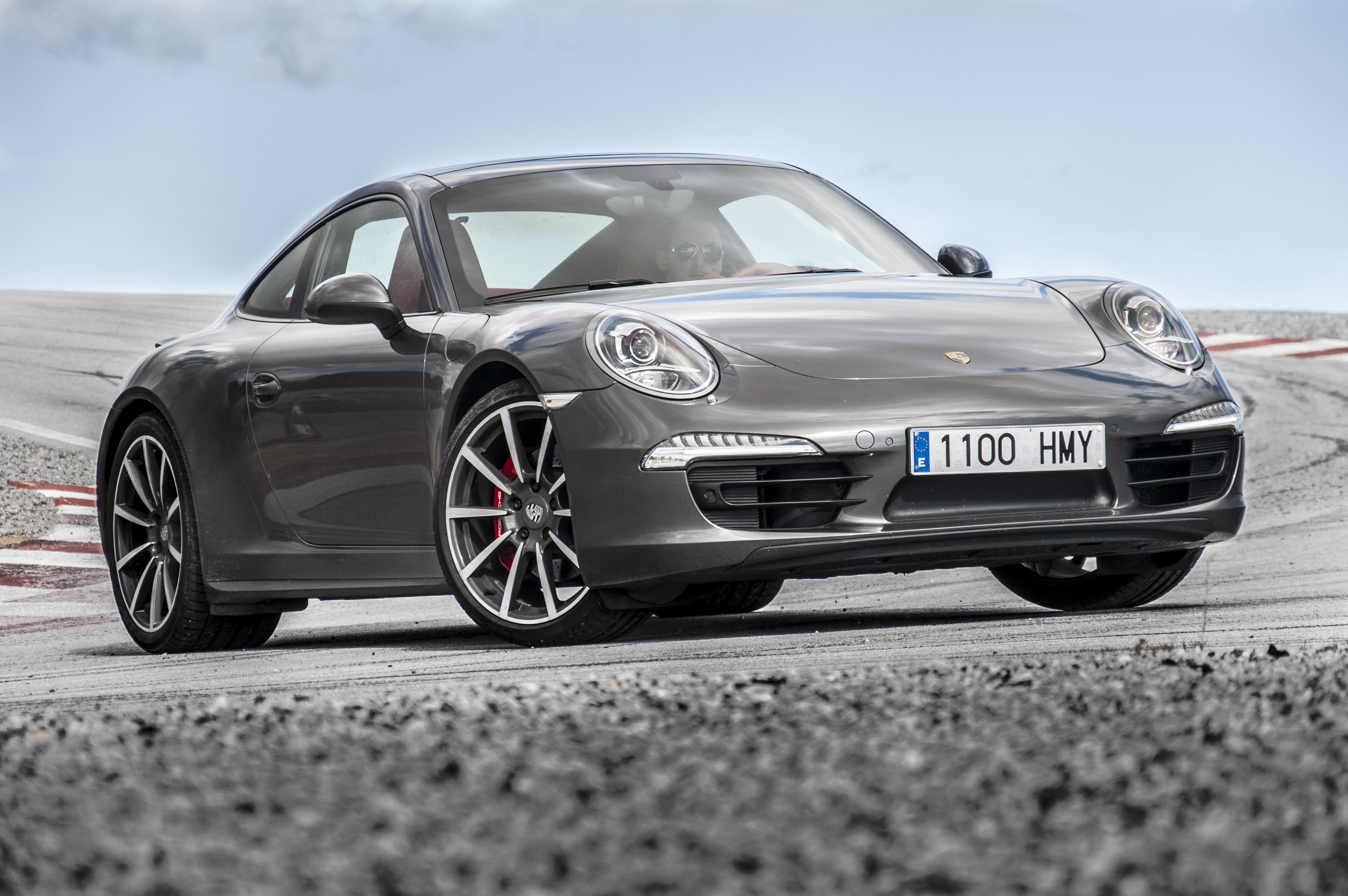
"“But that wasn't the car that you took to Japan? No. You had another car? We did. We had the 997. Yeah, yeah, that's right. So the 2004 996 was a manual and Marcia's knees were starting to give her some problems and she couldn't drive it.”"
“Porsche 996” is a specific generation of the 911. Here, they’re talking about a 2004 manual 911 that Marcia couldn’t drive comfortably because of knee problems. So even if it’s the “right” car for enthusiasts, it still has to work for your body.
“Porsche 996” refers to the 996-generation 911. In this segment, they mention a 2004 996 that was a manual, and that Marcia couldn’t drive it due to knee issues. It’s a good example of how real-world usability (like pedal effort) can affect which Porsche you choose.
manual
"“...So the 2004 996 was a manual and Marcia's knees were starting to give her some problems and she couldn't drive it.”"
A “manual” transmission means the driver shifts gears using a clutch pedal and gear lever. In this story, the manual 2004 996 became difficult because Marcia’s knees were starting to cause problems. It’s a practical example of how transmission choice affects comfort and long-distance drivability.
PCA Treffen program
"So you joined PCA specifically wanting to go on a Treffen program. I did not know that. Yeah, I didn't even think about it until you asked us to come today."
PCA is the Porsche club in the U.S. A “Treffen” is one of their big event weekends where you go on organized drives together and then hang out at the destination.
PCA (Porsche Club of America) “Treffen” is a club event format built around guided touring and social activities, not just track time. The program structure (tours plus destination experiences) is why people join—so they can drive together and also enjoy the trip as a whole.
escape (previous name of Treffen)
"Before then it was called escape. It was nowhere near the level of refinement, if you will, four or five star resort type."
They mention that Treffen used to be called “escape.” The point is that the event changed and got more polished over time.
The hosts say Treffen used to be called “escape,” implying the event evolved over time in format and level of polish. This is relevant because it frames Treffen’s growth from a simpler touring concept into a more refined, resort-style experience.
zone rep meeting
"And we were down in Fort Worth. We had a zone rep meeting every time I went to EC met."
This is a meeting of club leaders for a specific “zone.” They coordinate responsibilities and planning, which matters because the way events were run depended on who was hosting and managing the logistics.
A “zone rep meeting” refers to internal Porsche Club leadership coordination at the zone level. Here it’s used to explain how the event/parade responsibilities were organized before the club’s current national structure existed.
parade
"I was moaning about how much of a pain it was to chair parade because back then we didn't have the whole national structure that we have now."
Here, “parade” means a planned club event with a lot of logistics. The host region or zone had to run most of it, while the national group mostly provided guidance.
“Parade” is used as the name for a structured club event operation where hosting regions/zones handled the full logistics. The segment explains that, at the time, the national staff mainly oversaw and advised rather than running the whole operation.
sponsorship
"There was no sponsorship because everything is the only we've done at the time when parade was going on. We were enslaved into what the sponsors wanted."
“Sponsorship” means companies paying or supporting the event. The point here is that sponsors used to have a bigger say in what happened during the parade.
In this context, sponsorship is discussed as a force that shaped what the event could do during parade planning. The speaker contrasts that earlier sponsor influence with how things changed after new leadership took over.
Holiday Inn Express
"We stayed at a budget hotel, like Hampton Inn, Holiday Inn Express."
They used common budget hotels like Holiday Inn Express. It’s part of the story about how Escape kept things simple and affordable.
Holiday Inn Express is cited alongside Hampton Inn as the type of budget hotel used during early Escape events. This helps illustrate the event’s practical, accessible approach.
Hampton Inn
"We stayed at a budget hotel, like Hampton Inn, Holiday Inn Express."
They stayed at regular, affordable hotels like Hampton Inn. It’s mentioned to show the early Escape events were more budget-friendly and experience-focused.
Hampton Inn is mentioned as an example of the budget lodging used during early Escape events. The detail supports the idea that Escape was designed to be accessible and focused on the experience rather than luxury accommodations.
higher price tag
"And our members, it's not for everyone because it is a higher price tag. Just like, you know, porches are not for everyone. There's a higher price tag. And but you do get something very different."
They’re saying the event costs more, and that higher cost is part of what makes it feel more special. They’re also comparing it to other events that are run for profit and may be cheaper.
The hosts connect event pricing to the quality of the experience, implying that higher costs fund curated logistics, dining, and tours. They also contrast it with for-profit competitors, suggesting that pricing affects both access and the overall “feel” of the event.
for profit
"Oh, yeah, for sure. Competitors outside of PCA that are for profit, much less expensive. Yeah."
They’re comparing the Porsche club event to other events run by companies that make money. The idea is that the goals and incentives can be different, which can change the experience.
The segment contrasts PCA’s member-focused approach with for-profit competitors, implying different incentives and potentially different event quality or pricing. This helps explain why Treffen is positioned as a premium, curated experience rather than a mass-market event.
tickets, quote unquote
"That's that's impressive that you got tickets, quote unquote, to 12 of them. And I know it's stressful."
They’re talking about getting in—like tickets or registration—but it’s limited. People get stressed because you can’t just sign up for everyone.
The hosts use “tickets” informally to describe limited entry/registration for Treffen. The emphasis is on scarcity and stress around getting accepted, which ties back to their point that capacity is controlled to protect the experience.
Disney World shuts its gates
"I think Manny is the one that put it even Disney World shuts its gates once it gets to a certain amount because it doesn't want to diminish the value that people are going to get when they when they go."
This is an analogy for capacity management: once a venue reaches a certain limit, it restricts entry to avoid overcrowding and preserve the guest experience. In the context of Treffen, it supports the idea that limited access helps maintain perceived value and enjoyment.
bucket list destinations
"...the staff here at HQ look for bucket list destinations. And, you know, some of them you might know... But the team knows that you need to go there... hopefully you'll share with us later that it did turn out to be a bucket list..."
A “bucket list destination” is a place many people dream of visiting. Here, the Porsche Club trip is planned so you drive there and also get a great vacation experience once you arrive.
The hosts use “bucket list destinations” to describe high-desirability places the group plans trips around. In a car-club context, it means the driving is paired with a curated travel experience rather than being the only goal.
happy hour
"And then there's happy hour, then there's dinner and you wake up the next day, do it all over again."
Happy hour is a social time where people meet up, usually for drinks, before dinner. They’re using it to show the event is fun beyond just driving.
Happy hour is a social time—often with discounted drinks—used here to describe the event’s schedule and atmosphere. It’s part of the “more than just a drive” theme that makes Treffen partner-friendly.
PCA members
"I mean, PCA members, yes, we love the cars, but we love dining. We like, like spirits and wine."
PCA is the Porsche Club of America. It’s a big group of Porsche owners who plan events together.
PCA stands for Porsche Club of America. In this episode, “PCA members” refers to the community organizing and attending Porsche-focused events like Treffen.
spirits and wine
"We like, like spirits and wine. And I think many of you that are listening, it's probably not a hard guess to think that you would enjoy that too."
“Spirits and wine” refers to alcoholic beverages that are part of the social side of PCA events. Mentioning them reinforces that Treffen includes hospitality and shared meals/drinks, not only driving.
car event is so car focused
"Because sometimes let's face it, a car event is so car focused that if your significant other isn't into cars, like they're not too excited to go."
This is about the “audience fit” problem: some car events are heavily centered on cars, which can make them less appealing to partners who prefer social activities. The episode frames Treffen as a solution by mixing driving with dining and attractions.
road trip route planning (California → Salt Lake City/Boise → Bend, Oregon → Yellowstone/Glacier/Teton/Badlands)
"We bought a 2016, uh, Cayman ... through the mighty five up to, uh, Salt Lake city and Boise over to Bend, Oregon for the Treffen. ...and then we left there and we did some more national parks at Yellowstone, uh, Glacier, Teton's, Badlands."
This segment highlights how owners plan long-distance routes to combine a club event with major scenic destinations. For sports cars like the Cayman, route planning affects comfort, fuel stops, and how you pace the drive over multiple days.

Porsche Cayman
"We bought a 2016, uh, Cayman night one and Jovi to your 70 cross through the mighty five up to, uh, Salt Lake city and Boise over to Bend, Oregon for the Treffen."
The Porsche Cayman is a sports car made by Porsche. It has the engine placed toward the middle of the car, which helps it handle nicely—great for driving events and road trips.
A Porsche Cayman is Porsche’s mid-engine sports car (distinct from the 911). The Cayman’s layout helps it feel balanced and agile, which is why it’s popular for long road trips and club events like a Treffen.
burner car
"And I was, it was going to be kind of like a burner car. We were just going to sell it when we got home. Cause it was my fourth Porsche and I don't need four."
“Burner car” is slang for a car you plan to use for a limited time or a specific purpose, then sell afterward. In this context, they’re describing the Cayman as a temporary trip car rather than a long-term keeper.
American club
"He did that for Wisconsin. Yeah. He did the American club. He bought one here, I think, and drove it there."
They mention an “American club” as a different place or group for the Porsche event. The idea is that these trips can happen in different regions.
“American club” here likely refers to a Porsche club event or regional club activity in the U.S. The key point is that the speaker is describing different Treffen-style experiences across locations.
Turro
"So, and then if, uh, if, if we don't drive, we'll look on Turro to see if we can rent a Porsche."
Turo is like an Airbnb, but for cars. People can rent a car from an owner, which is why they mention it as a way to get a Porsche for the trip.
Turo is a peer-to-peer car rental marketplace where owners list vehicles for others to rent. In this context, they’re using it as a backup plan to rent a Porsche if they don’t drive their own car to the event.
rent a Porsche
"So, and then if, uh, if, if we don't drive, we'll look on Turro to see if we can rent a Porsche."
Sometimes people rent a Porsche instead of driving their own. It’s useful when you’re traveling and want the event experience without putting miles on your personal car.
Renting a Porsche for an event is a practical strategy when you don’t want to drive your own car or when you’re traveling from far away. It also changes the planning—availability, pickup/drop-off logistics, and cost become part of the decision.
CSC
"We kind of put them in the back of the line. That's what the CSC is doing a better job. It's not because we don't like them."
CSC is referenced as an organization or group that’s “doing a better job” with how they manage the event experience. Without the full expansion in this excerpt, it’s best treated as an internal club acronym rather than a specific car component.
volunteer
"And, and Marsha and I volunteer at the Treffen. [963.2s] So, um, ... No, so we sweep. [1021.0s] Okay. [1021.4s] I explain what sweep is for people."
They’re talking about club members helping out. Instead of just attending, people volunteer their time to make events run smoothly.
The hosts discuss volunteering at different levels of Porsche Club organization (region, national, and Treffen). This highlights how club events rely on member support for logistics, coordination, and on-site operations.
Porsche experience
"And, and the Porsche experience just brings it out in us. [1003.0s] So it's a lot of fun."
They mean that owning a Porsche is about more than just driving the car. It’s also the community and events—like the Treffen—where people connect and share the hobby.
“Porsche experience” is the idea that Porsche ownership is more than the car—it’s the community, events, and shared driving culture. In this context, the Treffen is part of how that experience is expressed through club activities and volunteer involvement.
sweep
"No, so we sweep. [1021.0s] Okay. [1021.4s] I explain what sweep is for people."
“Sweep” refers to a club-run support role during an event drive—typically a vehicle or team that stays near the back to help participants who fall behind or need assistance. It’s a safety-and-operations function that keeps the group together and addresses issues without disrupting the main pace.
walkie talkies
"“And then the sweep and the sweeps carry a walkie talkies. We can communications with the lead driver and make sure everybody gets through the… intersections and… we keep together.”"
Walkie talkies let the cars in the group talk to each other while driving. That way the lead can warn everyone about turns or problems and keep the group together.
Walkie talkies are used for short-range convoy communication between the lead and sweep cars. In a group drive, this helps coordinate turns, intersections, and pacing so the group doesn’t lose cars.
registration check
"“...if you need anything, Marsha and I are here a couple of days early and he goes, so we actually helped with a registration check in as well.”"
Registration check is the sign-in process at the event. Volunteers help make sure everyone is on the list and ready to participate.
A registration check is the process of verifying attendees and paperwork when they arrive at the event. Volunteers may help confirm names, credentials, or group assignments before the cars head out on tours.
group drive logistics
"If someone has an incident or someone has a flat tire, you know, the whole, the whole train of cars doesn't have to stop. There's somebody that can tend to the one that needs help and people can move on and things just flow."
They’re saying the event is organized so that if someone gets a flat tire or has an issue, the whole group doesn’t have to stop. Volunteers and assigned roles handle the problem so the drive keeps flowing.
The hosts emphasize that incident management is built into the event design. If someone has an issue like a flat tire, the rest of the “train” doesn’t necessarily stop because designated helpers can handle the problem while others continue.
flat tire
"If someone has an incident or someone has a flat tire, you know, the whole, the whole train of cars doesn't have to stop. There's somebody that can tend to the one that needs help and people can move on and things just flow."
A flat tire means the tire loses air, and the car may not be able to drive safely. Event organizers plan for this so someone can help without stopping everyone.
A flat tire is a puncture or loss of air pressure that can immobilize a car during a drive. In organized club events, having a plan for flats is important so the group can keep moving while assistance is provided.
The Treffen Experience: More Than Just a Drive
"[1181.6s] Yeah, it's not crazy life changing. ... [1234.6s] Like, do you find yourself too busy or are you too stressed? [1237.7s] Just the opposite."
They’re explaining that the Treffen isn’t only about driving. It’s also about the people you meet, the activities you do, and how the club experience feels bigger than just a road trip.
This segment discusses the “Treffen” experience as something broader than driving—emphasizing community, volunteering, and travel as part of Porsche club life. It sets up the idea that the social and service aspects can be as meaningful as the cars themselves.
treffins
"And I really think it enhances that because you get to meet people and then you see them over again... we became friends and went out to dinner and then saw each other at the next treffin and saw each other at the next treffin at sea."
A “treffin” is a Porsche club meet-up. It’s a chance to hang out with other owners and see familiar faces again, not only to go for a drive.
“Treffins” refers to Porsche Club gatherings where members meet up in person. The hosts are emphasizing that these events are about community and repeat connections, not just driving.
meet people and then you see them over again
"And I really think it enhances that because you get to meet people and then you see them over again... There's numerous examples of people that we've met over the years that we look forward to seeing at the treffins."
The idea is that car events aren’t just one-off drives. You meet people, build friendships, and then you get excited to see them again at the next event.
This describes the social “flywheel” of car-club events: meeting fellow owners creates relationships that make future gatherings more meaningful. Over time, attendees look forward to seeing the same people repeatedly, which strengthens the club culture.
Porsche Club Insider
"So it's a it's a great social environment and a great place to connect... Once you see them again at treffin at sea or treffin North America, you just pick up from where you left off."
They’re basically saying these Porsche meetups aren’t just about the cars. It’s also about building friendships, and when people see each other again at the next Treffen, it feels like you pick up right where you left off.
This segment is describing how Porsche club “Treffen” events function as more than driving—there’s a strong social component and recurring community relationships. The “soap opera” idea highlights how conversations and friendships continue across multiple Treffen locations and years.
Treffen North America
"Once you see them again at treffin at sea or treffin North America, you just pick up from where you left off."
This is the North America version of the Treffen meetup. The hosts are emphasizing that it’s the same community, so friendships and car talk continue when people meet again.
“Treffen North America” is a regional Porsche club event where members meet and continue the same community relationships from earlier Treffen gatherings. The key point here is continuity—people return to the same community across different locations.
regional president
"You're president of a region, so you have a lot to talk about... And we're not a region that does like events every quarter."
They mention someone who leads a regional Porsche club group. That role usually means organizing meetups and activities, so the conversation includes planning—not just cars.
Being “president of a region” implies an organized leadership structure within the Porsche club, responsible for coordinating events and member activities. In this context, it explains why there’s a lot to discuss beyond cars—planning and scheduling are a major part of club life.
over 60 events on the calendar this year
"We have over 60 events on the calendar this year. Sometimes twice in one day."
They’re saying their Porsche club is really busy, with lots of meetups scheduled throughout the year. It’s not just one or two car events—it’s frequent.
The hosts quantify the event density—“over 60 events” in a year, sometimes even twice in a day. This supports the episode’s theme that club life is highly active and not limited to occasional car-focused drives.
historic Savannah and Charleston at a plantation
"We have the destinations are always a lot of fun, especially when we were down at the low country. So we had historic Savannah and then up in Charleston at a plantation. Just, you know, those are the types of things you get to do in Treffen."
They’re describing the kinds of places the group visits on the tour—like Savannah and Charleston, including a plantation. It’s part of the fun of the event, not just the drive itself.
The hosts give examples of tour destinations—historic Savannah and Charleston, including a plantation stop. These destination choices illustrate the “experience” side of Treffen beyond pure driving.
tour day
"Yeah, wake up, go get breakfast and get your car and drive over to the staging area. Is it all early in the morning or this is all early? Although they, they arrive at staggered times because you're checked in at the entrance to the staging area."
The hosts describe a “tour day” as the core daily activity during Treffen—organized driving with a planned departure flow, staging area check-in, and a destination itinerary. It’s essentially the event’s main “drive” component, but with club-style coordination.
staging area
"Yeah, wake up, go get breakfast and get your car and drive over to the staging area. Is it all early in the morning or this is all early? Although they, they arrive at staggered times because you're checked in at the entrance to the staging area."
A staging area is where everyone gathers before the group drive starts. They stagger when people check in so not everyone leaves at the same time, which helps avoid chaos.
A staging area is the organized holding zone where participants line up before departing on the tour. The staggered check-in times help prevent a traffic jam and keep the group from leaving all at once, which improves safety and flow.
drive programs
"...they reach out to the local region who knows the area, knows all the good spots to eat and knows the good roads and they work with the local region to come up with these drive programs."
A “drive program” is a planned route for the group. It usually includes where you stop to rest and where you eat, and locals help pick the best roads and spots.
“Drive programs” are planned driving routes and schedules that events like Porsche Club of America (PCA) put together for attendees. They typically combine scenic roads, planned stops, and local guidance so the drive is more than just point-to-point transportation.
tour destinations (scenery, museums, food venues)
"You go to destinations to look at your scenery, look at museums, look at, you know, a food venue and typically you drive how many hours in a day?"
The hosts describe tours as destination-focused experiences—scenery, museums, and food stops—rather than just driving time. This is a key part of how club events create a “whole day” experience for participants.
back roads
"You come back, however, they, they will, they will provide you directions back if you want to take the fast way back, but if you want to take your back roads back."
“Back roads” are the smaller roads instead of the main highways. They’re often more scenic and fun to drive, but you may have to pay a bit more attention to directions and traffic.
“Back roads” refers to driving on smaller, less direct roads rather than highways. In a Porsche club context, it usually means more scenic routes and more interesting driving roads, but it can also mean slower speeds and more navigation complexity.
group splits up
"And so on the way back, you guys, the group splits up. It's on your, on your own to get back."
“Group splits up” means the cars don’t stay together the whole way back. Everyone takes their own route and drives at their own pace, so you’re responsible for getting back.
When the group “splits up,” each car/driver navigates and returns independently. This changes the experience from a tightly managed convoy to a more personal drive, which can affect pacing, route choice, and how drivers manage safety and spacing.
wait list
"But I would recommend if you don't get signed up for it, get on the wait list. Yeah. But that's true with anything PCA. Right. Get on the wait list because wait list gets cleared."
If an event is already full, you can join a wait list. If someone cancels, your spot may open up and you can still get in.
A wait list is a backup list for events that are full. In PCA (Porsche Club of America) events like Treffen, cancellations can free up spots, and the wait list is what gets those openings filled.
autocross
"Marsha, but this will be my last autocross of the year. Can you somehow get me into this? I didn't say it... So, um, other people might have said it. Yeah, maybe, but you have to sign up."
Autocross is a driving event where you steer through a cone course. It’s usually shorter and safer than a race track, and it’s great for learning how your car handles.
Autocross is a motorsport format where drivers navigate a course marked with cones at relatively low speeds compared to track racing, but with high cornering forces. It’s often run by clubs and is a common way for Porsche owners to build driving skills and experience the car’s handling limits safely.
entrance fee
"So real quick, before we get to dinner for the breakfast, is that provided by Treffen or you just hit the hotel restaurant? No, it's part of your entrance fee. So that's a beautiful buffet."
An entrance fee is the cost to participate in the event, and in this case it includes breakfast/buffet. This matters for attendees because it clarifies what’s covered versus what you’d pay for separately at the hotel.

Porsche Career Gt
"...xville, Tennessee, after a record-setting global career GT gathering in 2025, Platica is back with the 911R..."
The Porsche Carrera GT is a very fast, special-edition sports car made for performance. It’s the kind of car people talk about because it’s rare and built to feel exciting to drive. Podcasts may mention it when discussing major Porsche events or the brand’s most impressive cars.
The Porsche Carrera GT is a high-performance, limited-production supercar known for its track-focused design and extreme performance. It’s often discussed in Porsche circles because it represents a pinnacle of engineering and driving experience, especially in events and collector conversations. In a podcast like Porsche Club Insider, it may come up as part of the brand’s standout “GT” legacy and the kind of cars that draw major attention at gatherings.
air-cooled, water-cooled
"experienced the finest offerings from air-cooled, water-cooled, and motorsport Porsche models at the Corey."
Porsche has made engines that cool themselves in two different ways. Some use air cooling (heat is removed by airflow), and others use water cooling (coolant carries heat to a radiator). This matters because it’s a big part of how different Porsche eras feel and sound.
Porsche has used both air-cooled and water-cooled engine designs across different eras. Air-cooled engines rely on airflow and finning to shed heat, while water-cooled engines use a radiator and coolant to manage temperature. The hosts are framing the event as a showcase of multiple Porsche “generations” and engineering philosophies.
motorsport Porsche models
"experienced the finest offerings from air-cooled, water-cooled, and motorsport Porsche models at the Corey."
“Motorsport Porsche models” points to Porsche vehicles developed with racing heritage or track-oriented setups. That can include stripped-down trims, performance-focused tuning, and components designed for repeated high-load driving. The segment uses this to highlight that the event isn’t just about normal road cars—it’s about Porsche’s racing DNA.
Spring Treffen
"Now, Spring Treffen was one of those locations that I had never heard of. We had not either. Yeah, which is what makes Treffen so cool."
“Spring Treffen” is a Porsche Club of America (PCA) gathering/event format where members meet, socialize, and often drive together. In this segment, the hosts discuss how the location choice and setting make the experience memorable. It’s presented as more than just a drive—more like a destination and community event.
Palmetto Bluff Montage Palmetto Bluff
"And hopefully, it was called the Palmetto Bluff. Montage. Montage Palmetto Bluff in South Carolina. Yep, just outside of Savannah."
They’re talking about the resort where the Treffen happened: Montage Palmetto Bluff. It’s in South Carolina near Savannah. The point is that the location makes the event feel special, not just the cars.
“Montage Palmetto Bluff” is the resort location they identify for the Spring Treffen experience. The hosts emphasize that the setting—near Savannah, South Carolina—contributes to the event’s appeal beyond the driving itself. This is a key “where” detail for listeners who might attend future Treffen events.
on-season
"I always thought we went to these resorts in the off-season, but this time of year seems to be the on-season because you don't want to go in two or months."
“On-season” just means the best time of year. In this case, spring is when the weather and scenery are at their nicest, so more people want to be there.
“On-season” means the time of year when conditions are best for the event—here, springtime weather and landscaping. For car clubs, that can affect turnout, traffic, and how comfortable it is to do outdoor activities like judging or photo sessions.
Jackson Hole
"But what we did, Treffen and Jackson Hole, and that was in the fall, all the aspens were... Is that the worst node one day?"
They mention “Jackson Hole” as another place they went for a Porsche club event. They’re using it to talk about how the season changes what you see and how the trip feels.
“Jackson Hole” is referenced as another event location compared with Treffen, specifically in the fall. The hosts use it to illustrate how seasonal conditions (like fall foliage) shape the overall experience for Porsche club members.
Blue Ridge Parkway
"But it was... And then the drive home was... Even longer. A Blue Ridge Parkway and Skyline Drive the entire way."
The Blue Ridge Parkway is a famous scenic road in the mountains. People like it for road trips because the driving is beautiful and there are places to stop and take in the views.
The Blue Ridge Parkway is a scenic highway in the Appalachian Mountains, known for sweeping views and winding roads. For car events, it’s a popular route because it’s enjoyable at a steady pace and offers lots of pull-offs.
Skyline Drive
"A Blue Ridge Parkway and Skyline Drive the entire way. Wow."
Skyline Drive is a scenic road in Virginia’s Shenandoah area. It’s popular for drives because it has lots of curves and great places to stop and look around.
Skyline Drive is a scenic route through Virginia’s Shenandoah National Park, famous for curves and overlooks. It’s often chosen for drives because it’s visually rewarding and encourages a relaxed, scenic pace.
95
"Okay, if you just did it in one shot. Just by 95."
“95” is shorthand for a big highway called I-95. It’s a common route for getting from one East Coast city to another, though traffic can vary.
“95” refers to Interstate 95 (I-95), a major north-south highway on the U.S. East Coast. In road-trip planning, it’s often the fastest corridor, but it can mean more traffic depending on the time of day.
scenic route
"But you guys took the scenic route. Absolutely. Oh, that's fantastic."
A scenic route is just a drive planned for enjoyment instead of speed. It’s usually more fun roads and nicer scenery, which fits a club outing.
A “scenic route” is a deliberately chosen drive that prioritizes interesting roads and views over the fastest path. In a Porsche club context, it often means routes with better driving character—twisty roads, elevation changes, and photo-worthy stops.
Leisurely
"Yeah. Leisurely. Right. And during the trip back and forth, you and I would be doing like 95 bonsai ride."
They’re saying the trip wasn’t rushed. It was a relaxed pace where people could enjoy the drive and hang out.
“Leisurely” here describes the pace of the trip—more relaxed driving and social time than a performance-focused run. That matters for how club events are experienced: less about pushing cars and more about route enjoyment and camaraderie.
dedicated wash stations
"There's dedicated wash stations because everybody wants to get all the grime off of their car and the hotel or the venue typically has all the supplies."
A dedicated wash station is a specific area where people can wash their cars during the event. It helps remove dirt and pollen so the car looks better and doesn’t get worse while you’re there.
Dedicated wash stations are set up so attendees can quickly clean off road grime before or after socializing. At car events, this matters because pollen, dust, and bugs can bake onto paint, and a quick wash helps keep cars looking good for photos and judging.
Griot's
"We have sponsors like Griot's. Yeah, I think Griot's has been the sponsor. I didn't use it this year."
Griot's is a company that sells car cleaning and detailing products. If they sponsor an event, it often means there are good supplies available so people can wash and polish their cars.
Griot's Garage is a well-known detailing brand that makes car wash, wax, and paint-correction products. When a Porsche club event sponsors detailing supplies, it usually means attendees can clean and prep their cars on-site with pro-grade products.
Treffen website
"I will say people listening, when you get home, go to the Treffen website, which is treffen.pca.org."
The Treffen website is the event’s official hub for information like schedules, check-in details, and logistics. For attendees, it’s the best place to understand what’s planned on-site (like parking, wash stations, and activities).
Low Country
"So what was your favorite about Low Country? Southern hospitality. Obviously the Southern hospitality and the hotel was just fantastic."
“Low Country” is a region in the southeastern U.S. In this episode, they’re talking about it as the place where the Porsche club trip happened.
“Low Country” refers to a coastal region in the southeastern U.S., and here it’s being used as the trip’s setting. Listeners may not realize it’s a specific geographic vibe—marshes, historic towns, and that humid, lush vegetation.
twisty, curvy, tree-lined roads
"The drive-in is about five or six miles of twisty, curvy, tree-lined roads with Spanish moss hanging down."
They’re describing the roads as fun to drive—lots of curves and turns, with trees along the sides. That usually makes the drive more enjoyable and scenic.
This describes the kind of road layout that typically makes club drives fun: lots of bends, changing direction, and visual scenery. “Tree-lined” also implies reduced glare and a more shaded, comfortable driving environment.
Magnolia plantation
"So historic Savannah and then a plantation outside of Charleston. Magnolia plantation. Magnolia plantation. It was just beautiful. Basically a botanical garden."
They visited Magnolia Plantation, which they describe like a botanical garden. It’s an example of how the trip includes sightseeing stops, not just driving.
Magnolia Plantation is referenced as a plantation stop outside Charleston, described as “basically a botanical garden.” For listeners, this highlights that the Treffen itinerary blends driving with destination experiences rather than focusing only on the route.

Porsche Cayenne
"That is where we went off road with the Cayennes. Well, I was going to say, that's back in 2003, maybe 2002. We had a board meeting there and Porsche brought the Cayennes."
The Porsche Cayenne is Porsche’s SUV. Here they’re talking about using it for an event where they even went off-road, not just normal city driving.
“Cayennes” refers to the Porsche Cayenne SUV. In this segment, they’re describing Porsche bringing Cayennes to an event and even going off-road with them, which highlights how the Cayenne is used beyond pavement.
traffic jam
"That's not a tour anymore. That's a traffic jam. So unfortunately, it's very limited."
They’re saying that if you pack too many cars onto the road at once, it stops being a fun group drive and turns into slow, crowded driving—like normal city traffic.
The hosts are contrasting a planned group tour with uncontrolled congestion. When too many cars travel together, the convoy stops behaving like an organized drive and starts acting like traffic, which can be less enjoyable and harder to manage.
Toro
"We've already got our Toro. Wow, you're very confident. But it's still going to be around in a year or six months or whatever it is."
“Toro” sounds like a nickname for a car they’re talking about for the trip. The exact meaning isn’t clear from this snippet, but it seems like they’re referring to a particular vehicle they already have lined up.
“Toro” here likely refers to a specific car or vehicle used as a placeholder/backup for the trip planning. However, the transcript doesn’t provide enough context to confirm whether it’s a model name, nickname, or a specific Porsche-related reference.
Treffen tickets
"Unfortunately, you can't buy Treffen tickets from a scalp or somewhere. It's just something that."
A “Treffen ticket” is basically your official spot in a Porsche Club event. They don’t want people buying from scalpers, because the event has limited space and sells out fast.
“Treffen tickets” refers to the registration access for a Porsche Club event (a Porsche Club Treffen). Because these events are limited-capacity, tickets typically sell out quickly, so the process is designed to reward early, legitimate registration rather than resale.
Choose your tours
"Choose your tours. Choose the second choice tour. Choose everything with the backup in case it sells out."
During registration, you choose which tour/route you want to do. The hosts recommend picking a backup choice too, because popular options can fill up.
“Choose your tours” refers to selecting specific guided driving/itinerary options as part of the Treffen registration. The transcript emphasizes picking a primary tour and also a backup option in case the first choice is unavailable.
backup in case it sells out
"Choose everything with the backup in case it sells out. And just go in there and click, click, click."
The “backup in case it sells out” strategy means selecting multiple tour options during registration so you’re not blocked if your first pick becomes unavailable. This is especially relevant for limited-capacity events where inventory can disappear quickly.
sold out
"Never checked out because by the time they checked out, not only was the event sold out, but the waitlist was sold out."
“Sold out” means there are no remaining spots left for the event. And if the waitlist is also sold out, that means there’s no backup option left either.
“Sold out” means the event’s available spots are fully taken, so no new registrations can be completed. The transcript also mentions the waitlist being sold out, which indicates even overflow demand exceeded capacity.
all inclusive
"[2642.6s] It's, Treffen isn't like that. [2644.1s] You just go in and you pick your tours. [2646.7s] Like you said, it's kind of all inclusive, right? [2648.7s] You don't have to pick your meals. [2649.9s] It's like, it's all included. [2651.1s] It's one set price."
“All inclusive” just means the main stuff is included in the one price. You don’t have to keep paying for each individual activity separately.
“All inclusive” means the event price bundles key activities together, so you don’t have to buy separate add-ons for each part of the experience. In this context, the tours and some logistics are included under one set price, unlike a more à la carte setup.
Ryder Cup
"Like the All-American Club in Wisconsin was one week after the Ryder Cup was played there. [2768.5s] And they still had all of the memorabilia."
The Ryder Cup is a big, famous golf tournament where teams from Europe and the U.S. play against each other. They’re saying the Porsche event was timed so the location still felt like it had just hosted something major.
The Ryder Cup is a major international team golf competition between Europe and the United States. Mentioning it provides context for why the venue had fresh memorabilia and why the timing made the trip feel extra “eventful.”
Fairmont in Sonoma
"I didn't even know that the Palmetto bluff existed. [2787.0s] You know, Sonoma. [2789.3s] That was beautiful. [2791.1s] The Fairmont in Sonoma."
They’re mentioning a luxury hotel in Sonoma. The point is that Treffen trips can include really nice places to stay, not just car-related activities.
The Fairmont is a luxury hotel brand, and “Fairmont in Sonoma” points to a high-end destination stop associated with the Treffen experience. The takeaway is that these events can include premium lodging and scenic regions.
events manager
"[2800.2s] I feel bad because I have inside information, not because they're coming to me and telling [2805.2s] me, but because I sit catty corner for Melanie, the events manager."
An events manager is the person who organizes the event details—scheduling, planning, and keeping everything running. They’re basically the organizer behind the scenes.
An events manager is the person responsible for coordinating the logistics and programming for club events. The speaker’s mention highlights how much planning goes into Treffen beyond the driving itself.
trust the process
"So trust the process, trust their choices. They're not using a magic eight ball."
“Trust the process” here refers to how event organizers plan: they research multiple candidate sites, visit them, and only then make a final decision. It’s an operations concept—reducing the risk of a bad venue by doing due diligence.
French Lick
"We actually went to French like on their way to the American club. Just because of all the great reviews. Yeah, because they heard such great things about it."
“French Lick” is where they stayed for a previous Porsche club trip. They’re using it as an example of how a destination can turn out great after the club actually goes and checks it out.
“French Lick” is the venue/location the hosts discuss for a prior Porsche club trip. While not an automotive component, it’s part of the event planning context—how the club chooses resorts and destinations based on reviews and firsthand experience.
super unleaded
"...we were told we have to get extra super [2899.1s] unleaded that week because you guys use a lot of super unleaded. [2905.1s] I'm like, that's awesome."
“Super unleaded” is a type of gas with a higher octane rating than regular. Some performance engines need it to run smoothly and avoid pinging/knocking.
“Super unleaded” is a higher-octane gasoline than regular. Higher octane can help prevent knock in engines that are designed to run higher compression or more aggressive ignition timing—common in performance-oriented cars.
Porsche Club of America (PCA) cruise takeover experience
"I always tell my brother about Truffin SC because he uses another [2949.7s] cruise company, goes on a lot of cruises. [2951.6s] And I said, as he said, do you take over the whole ship? [2954.6s] I said, oh no, maybe a third at the best."
They’re talking about how a Porsche club trip can feel like a real Porsche community, not just a normal vacation. The key idea is that the event is organized so members feel like they’re all part of the same thing.
This segment focuses on how a Porsche club event can feel immersive—like the entire venue (in this case, a cruise ship) is Porsche-themed. It’s less about the cars themselves and more about the social structure and “club identity” that drives the experience.
take over the whole ship
"I always tell my brother about Truffin SC because he uses another [2951.6s] cruise company, goes on a lot of cruises. [2954.6s] I said, oh no, maybe a third at the best. [2957.6s] I said, but when you walk on that ship, you think the entire thing is Porsche, [2962.3s] Club of America."
This is about a cruise where most of the people are from one Porsche club. When that happens, it feels like the whole trip is “Porsche-themed,” not just a normal vacation with a few enthusiasts.
“Take over the whole ship” describes an event format where a cruise is largely dominated by one car club’s members. That kind of concentration creates a stronger sense of community and identity—so the experience feels like a Porsche event first, not just a random cruise with a few cars.
Truffin SC with 900 people
"But going there with several hundred people, going on Truffin SC with 900 people. And they're all enthusiasts as well. So it's driving enthusiasts."
They mention a big group drive called “Truffin SC.” With hundreds of people, it feels more like a community event than a normal drive.
“Truffin SC” appears to be the name of a group driving event or route, and the hosts emphasize the scale—900 people. Large-group drives change the vibe: more coordination, more community energy, and more “enthusiast-to-enthusiast” interaction.
Porsche cruise / cruise on a ship
"Even if you're not even, Manny was not even wanting to consider a cruise. Dumbest thing I've ever heard. He's like, why in the world are we doing cruise? On a ship for a week. The Porsche didn't make sense."
They’re talking about a trip where you spend a week on a ship with other Porsche fans. It’s less about driving routes and more about hanging out with people who like the same cars.
They’re contrasting a “cruise” style trip (a week on a ship with Porsche owners) versus a traditional driving-focused event. The point is that the experience is more about social engagement and shared interests than just the driving itself.
flying to Calgary / going to Banff
"So what we're doing this year is we're flying to Calgary. I finally get to go to Banff. Oh, perfect."
They’re saying this year they’re flying to Calgary and then heading to Banff. It’s about how they’re organizing the trip and where the fun happens.
They describe changing the logistics of the event—flying to Calgary and then going to Banff—rather than doing everything as a ship-based cruise. This is relevant to how Treffen-style gatherings are planned around regional driving and tourism.
out of Vancouver
"Rooms are still available and we're going out of Vancouver, September 19th. It's a later departure. So you can actually get in there the morning of September 19th. Do stuff in Vancouver."
This just means the trip starts in Vancouver. That affects your schedule—so you can do things in Vancouver first, then board the ship.
“Out of Vancouver” describes the departure logistics for the cruise portion of the Treffen at sea itinerary. It matters because it changes how early you need to book travel and how much time you have to do activities in Vancouver before boarding.
Pebble Beach
"He's the kind of person you want to hold his hand going through Pebble Beach. Yes."
Pebble Beach is a major car event where people show off beautiful and rare cars. It’s especially focused on history and details, not just driving.
Pebble Beach is a world-famous luxury car concours and event held in California. It’s known for showcasing rare and historically significant cars, so having someone who can guide you through the details there is a big deal for enthusiasts.
pre-war era
"For any concord it has, especially pre-war era, foreign. He's just the light to listen to, so articulate."
“Pre-war era” means cars from before World War II. Collectors care about them because they’re older, historically important, and often have unique designs you don’t see on newer cars.
“Pre-war era” refers to cars built before World War II, typically from the 1920s through the late 1930s. These cars are often valued for their historical significance, coachbuilt bodies, and early engineering approaches that differ a lot from modern designs.
foreign (cars)
"For any concord it has, especially pre-war era, foreign. He's just the light to listen to, so articulate."
Here, “foreign” likely means cars from other countries, not the local brands. At big collector events, people often spotlight these because they can be rarer and have interesting histories.
In collector-car talk, “foreign” usually means non-domestic makes—cars from outside the speaker’s home country. At events like Pebble Beach, this often highlights European and other international brands that may be less familiar but historically important.
Jay Leno
"Whenever there's a Donald Osborn video, I click on it immediately. He does a lot with Jay Leno. That's great to hear."
Jay Leno is a well-known automotive media personality who hosts car-focused content and interviews. Mentioning that Donald Osborn does a lot with him signals Osborn’s credibility and reach in the car world.
detailing tips
"Nathan Merz is going to be there. Tim McNair is going to be there to share with some detailing tips. So again, if you haven't considered going on a cruise, if you haven't considered Treffen at sea,"
“Detailing tips” are practical advice on how to clean and care for a car so it looks its best. It usually means washing safely and adding protection so the paint stays nice.
“Detailing tips” refers to advice on cleaning and restoring a car’s appearance—often including paint-safe washing, drying, and protection steps. In enthusiast circles, detailing is treated as a skill set that can preserve finish quality and improve how the car looks at events.
Treffen at sea
"So again, if you haven't considered going on a cruise, if you haven't considered Treffen at sea, this one here from Vancouver down to LA, much like Treffen, North America."
“Treffen at sea” is a Porsche club meetup where people go on a group trip by boat. The point is the whole experience—hanging out with other Porsche fans—not just one stop.
“Treffen at sea” refers to a Porsche Club event format where attendees travel together by ship and make the trip part of the experience. It’s less about a single car show and more about community, shared driving/travel, and scheduled activities.
Vancouver down to LA
"this one here from Vancouver down to LA, much like Treffen, North America. It's pretty much one payment, all your food, 15 drinks."
They’re talking about a planned route where the group travels from Vancouver to Los Angeles. It’s an example of how these events are set up as longer trips.
The hosts describe a specific group route from Vancouver to Los Angeles as part of the event experience. For listeners, this highlights how these Porsche Club trips are structured around long-distance travel rather than a short local drive.
Request an Explanation
Heard something you'd like explained? We'll add it to this episode.
Sign in to request explanations for terms you heard.
Want to learn more?
Browse our glossary for plain-English explanations of automotive terms, jargon, and concepts.
Help improve this episode
See something that's not quite right? Our annotations are AI-generated and can sometimes miss the mark. Click the flag icon on any annotation to suggest a correction.