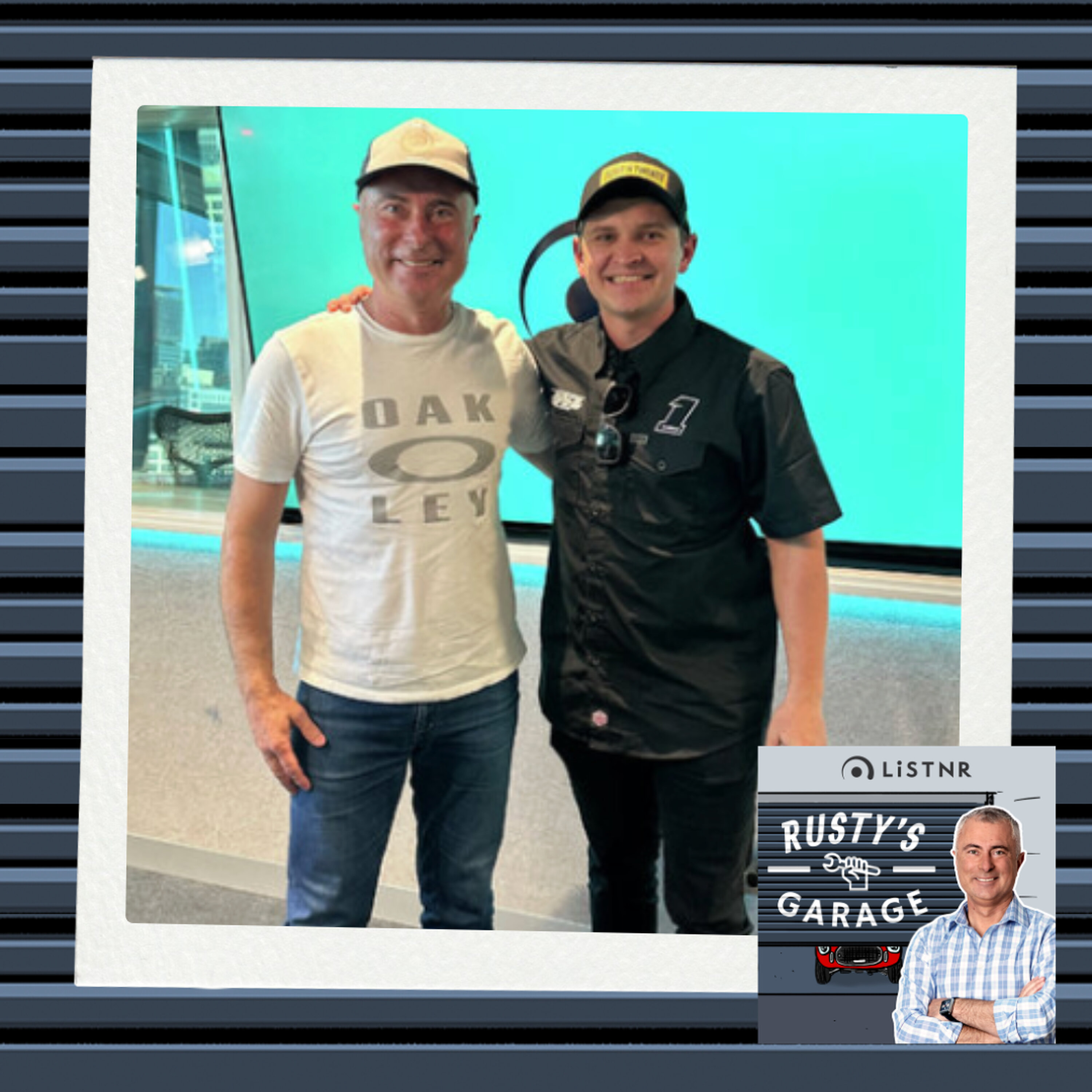
Todd Hazelwood | Part 1 - Dirt karts and Dad’s bucket list Finke
About this episode
Todd Hazelwood’s path to Supercars is traced back through dirt karting, family influence, and a lot of practical preparation. The conversation moves from his dad’s motorcycle background and the family’s Ford XC Falcon hill-climb era, to Todd’s rain-loving karting skills and the grind of sponsorship, fundraising, and limited testing. Along the way, Todd shares Supercars dreams, early open-wheel steps, and the pressure of Adelaide 500 funding—then closes with his current Tanuki Racing S13 and upcoming Darwin commitments.
Why didn’t we do this sooner! Rusty catches up with Bathurst and former Super 2 champion Todd Hazelwood for a gripping convo.
His Dad’s Desert Racing and why “Rusty” traded the bike to Hill Climb a special family car.
Todd begins his own racing journey on dirt and is immediately hooked.
Moving to bitumen and coming up against a young Cam Waters and Anton de Pasquale.
Making ends meat….that’s not a typo….how Todd and the family began Sausage Sizzle fundraising to keep the dream alive.
Formula Ford learnings and Formula 3 fascination.
And where Todd gets his unwaivering belief from even when the Mountain seems impossible to climb to the rest of us.
There is some great takeaways here for young racers from a self taught scholar in what our game calls the University of Motorsport.
Head to Rusty's Facebook, Twitter or Instagram and give us your feedback and let us know who you want to hear from on Rusty's Garage.
See omnystudio.com/listener for privacy information.
See omnystudio.com/listener for privacy information.
Supercars round
"and is just about to head to Darwin for the Supercars round to contest the Trans Am Support races where he's the reigning champion."
A “Supercars round” is a race weekend for Australia’s Supercars series. It’s one stop on the championship calendar, with races across the weekend. The host is basically saying Todd is going to the Darwin event.
A “Supercars round” is one event weekend in Australia’s Supercars Championship calendar, where multiple races are held. The host mentions Todd is heading to Darwin for that round, tying it to the broader racing schedule. It’s a structural reference to how the series is organized.
Trans Am Support
"and is just about to head to Darwin for the Supercars round to contest the Trans Am Support races where he's the reigning champion."
“Trans Am Support” is a set of races that happen during the same weekend as the main Supercars event. Todd is competing in those side races, not the main Supercars races. It’s like the “extra” racing program on the schedule.
“Trans Am Support” refers to support-category races run alongside the main Supercars event. It’s a named racing support program, meaning Todd competes in a different (support) series while attending the Supercars weekend. This is more than generic “support”—it’s a specific event slot.
Super 2 title
"From a humble family that truly loved motorsport, Todd has overcome some hurdles to win the Super 2 title and a very memorable Bathurst 1000 with his mate Brody Kastecchi in recent years."
The “Super 2” title is a championship in Australia that’s meant to develop drivers for the top-level Supercars series. Winning it is a big deal because it shows you’re one of the best up-and-coming racers. The host is mentioning it to explain Todd’s success.
The “Super 2” title refers to winning the Supercars feeder/second-tier championship in Australia. It’s a stepping-stone series that helps drivers develop before moving up to the main Supercars category. The host is using it to highlight Todd’s career progression.
Bathurst 1000
"Todd has overcome some hurdles to win the Super 2 title and a very memorable Bathurst 1000 with his mate Brody Kastecchi in recent years."
The Bathurst 1000 is a major long-distance race in Australia that’s famous with race fans. It’s hard to win because it takes strategy and consistency over a long event. The host is highlighting Todd’s standout result there.
The Bathurst 1000 is Australia’s famous endurance race at Mount Panorama, known for long stints, strategy, and high drama. Winning or even performing well there is a major achievement in Australian motorsport. The host calls Todd’s Bathurst 1000 moment “very memorable,” signaling its importance.
world time attack
"Having such a good convo here and I was conscious of time and studio bookings that we didn't get into world time attack, that's my bad."
“World time attack” refers to time-attack-style competition at a global level, where cars are judged by fastest lap times rather than head-to-head racing. The host says they didn’t get into it due to time constraints, implying it’s a topic they planned to cover. It’s a motorsport format label rather than a car part.
desert racing
"Yeah so desert racing as a kid growing up in the Mallee farm here in South Australia, [197.0s] sorry down South Australia and yeah just love motor GP."
Desert racing is racing over rough, sandy ground. It’s tough on the vehicle because the surface is loose and the conditions are harsh.
Desert racing is off-road motorsport run over sandy, dusty, and rough terrain where traction and durability matter as much as speed. It’s often associated with long-distance events and requires cars or bikes to handle heat, vibration, and loose surfaces.
Wayne Gardner
"Mum and dad used to go to the races back in the day cheering on Wayne Gardner and McDowen [205.6s] and eventually that started to follow into cars as well"
Wayne Gardner is a famous Australian motorcycle racer. The host is saying their family followed his racing when they were kids.
Wayne Gardner is a well-known Australian motorcycle racer whose success made him a household name in Australian motorsport. Mentioning him signals the guest’s early inspiration coming from top-level racing.
Dick Johnson
"and eventually that started to follow into cars as well and Mum was a massive Dick Johnson [210.2s] fan so quite ironic full circle."
Dick Johnson was a very famous Australian race driver. The story uses him as a reference point for how the family got into motorsport and Ford-related racing.
Dick Johnson is an iconic Australian touring-car driver and team figure, strongly associated with Ford racing in particular. The guest’s mum being a “Dick Johnson fan” ties the family’s motorsport interest to a specific era and marque culture.

XC Falcon
"did he have an XC? [230.8s] What did he have and he started doing some hill climbs and things like that is that right? [234.4s] Yeah correct yeah basically the two wheel dream pulled the pin basically when dad broke his back and Mum was pregnant with me at the time so Mum was basically like well you either keep the bike or you divorce me basically it was a pretty serious automation I guess [248.5s] but dad sold the bike and yeah so dad actually brought an XC Falcon"
The Ford Falcon is a classic Australian car. Here, the “XC Falcon” is the specific older model they bought, and it’s what got them into car racing and hill climbs.
The Ford Falcon (the XC generation) is an Australian-built muscle-era car that became a popular platform for grassroots motorsport. In this story, the XC Falcon is the family’s pivot from bikes to car racing via hill climbs and track sprints.
hill climbs
"did he have an XC? [230.8s] What did he have and he started doing some hill climbs and things like that is that right? [234.4s] Yeah correct yeah basically the two wheel dream pulled the pin basically when dad broke his back"
Hill climbs are races where you drive or ride up a steep hill as fast as you can. It’s usually timed, and grip and control matter a lot.
Hill climbs are motorsport events where a car or bike races up a steep course against the clock. They emphasize traction, braking control, and power delivery because the course is short, steep, and changes grip as it climbs.
Rally Pack
"Yeah XC Rally Pack Pine and Lime brought yellow and dad brought it off Grandpa and did it up [267.2s] did a bit of hill climbs down at Collingrove"
“Rally Pack” is a factory option package that was meant to make a regular car better for rally-style driving. It usually bundles multiple upgrades together.
“Rally Pack” refers to an option package intended to make a road car more suitable for rally-style use, often bundling upgrades like suspension and drivetrain-related components. On classic Falcons, it’s a recognizable trim/option identity rather than a single universal part.
track sprint
"did it up [267.2s] did a bit of hill climbs down at Collingrove took it out to Malar and the track sprint [271.8s] and that was really my first introduction to motorsport"
A track sprint is a short race on a track. The goal is to be fast over a brief session, rather than racing for a long time.
A track sprint is a short-format timed or bracketed race on a circuit, typically focused on quick acceleration and consistent lap pace. Compared with endurance racing, it’s more about getting the car set up for fast, repeatable runs.
VHS
"you would even from a very young age you would grab those VHS's and it might have been Bathurst Turing car races whatever and she said that was your in the way other kids would go and obsess about something that was you mate wasn't it."
VHS is an old way of recording and watching video, like a home video tape. Back then, people would record races on VHS to rewatch them later.
VHS (Video Home System) is an older home video format used for recording TV and home footage. In motorsport culture, it’s how many fans recorded races and documentaries before digital streaming.
track days
"we had the XC Rally Pack at home so dad would be working on that in between hill climbs and track days and we had a little Mini Cooper as well which was a lot of fun"
A track day is an event where drivers take their own cars onto a closed circuit for practice and fun, usually with coaching and safety rules. It’s a common way enthusiasts learn car control beyond normal street driving.
hot wheels
"everything about my life was all cars and you know it's crazy how they say you know you buy hot wheels and that's the cheapest car you'll ever buy because they just get more expensive as you get older"
Hot Wheels are toy cars. The host is making a joke that the toy is cheap, but real cars and the hobby get more expensive as you get older.
Hot Wheels is a brand of die-cast toy cars, and the host uses it as a comparison for how real car costs can rise with age and interest. The point is about the hobby’s “entry cost” feeling versus real-world car ownership.
go kart
"if I was to go go kart racing which I started when I was seven that they knew that was what I wanted to do"
A go-kart is a small race car you drive on a track, often used to start racing. They’re designed to be lightweight and fun, so your driving technique matters a lot.
A go-kart is a small, lightweight racing vehicle typically powered by a compact engine and used as an entry point to motorsport. In karting, the emphasis is usually on driver skill—lines, braking, and throttle control—because the cars are relatively simple.
dirt karting
"at the time I started out in dirt karting so dirt karting was great because quite cost effective massive in South Australia so we're racing big fields almost every weekend"
Dirt karting is racing go-karts on dirt instead of pavement. Since the surface grip changes a lot, you have to drive differently and the karts can feel less predictable.
Dirt karting is go-kart racing on loose, unpaved surfaces (like dirt or gravel) rather than smooth asphalt. Because traction changes constantly, driving technique and tire grip management are very different from road racing.
tip for tap
"of cam and he passed me back and I kept passing him back and it was like this real tip for tap battle so they're probably like who is this kid too in the same breath yeah and I'm like man who"
It means two racers keep challenging each other—one makes a move, the other immediately responds. It’s basically a “you do this, I’ll do that” kind of race battle.
In racing, “tip for tap” describes a back-and-forth duel where drivers trade moves—passing, responding, and countering—rather than one car pulling away. It’s a way of describing competitive, closely matched racing behavior.
bitumen
"your short race so I would always just kept passing and passing whereas bitumen was a bit you know played a long game worked together and push each other along whereas yes I think I sort of rattled"
“Bitumen” is just the paved asphalt surface. On pavement the grip is usually steadier than on dirt, so drivers can plan moves over more laps.
“Bitumen” is Australian terminology for asphalt/paved road surfaces. Compared with dirt, paved tracks usually provide more consistent grip, which can encourage longer, more strategic racing rather than constant immediate passing.
Australian title bid
"was it second in your first ever Australian title bid in in terms of of circuit racing karting not on dirt basically yeah so yeah 2005 so it was my very first Australian title over subscribed field I think there was 50-odd karts"
It means trying to win a national championship in Australia. The host is talking about their first big shot at a title.
An “Australian title bid” refers to a driver’s attempt to win an Australian championship in a specific discipline. The speaker frames it as their first major national championship effort, including qualifying/pole and then finishing near the front.
pole award
"had enough points to start poll for the finals I got the pole award which was you know I was completely frightened you know and um it was nine years old racing these 14-15 year olds"
Pole position means you start at the very front of the starting line. It’s an advantage because you avoid getting stuck in traffic right away.
A “pole award” means the driver earned pole position—starting first on the grid—typically by setting the fastest qualifying time. Starting up front is a major advantage because it reduces traffic and gives cleaner air at the start.
Daniel Peska
"and um it was actually Daniel Peska was a reigning champion you know he's well known and sprint cars now and supported by Rosenberg and yeah I remember starting next to him absolutely shitting myself to be honest I was"
Daniel Peska is a racer the host says was already a champion at the time. The point is that he later became known in sprint cars, showing how karting can lead to bigger racing.
Daniel Peska is mentioned as a reigning champion in the karting context, and the speaker notes he’s “well known” in sprint cars later. This highlights the pathway from junior karting into higher-level open-wheel racing.
Rosenberg
"reigning champion you know he's well known and sprint cars now and supported by Rosenberg and yeah I remember starting next to him absolutely shitting myself to be honest I was"
Rosenberg is mentioned as the kind of support behind the racer. In racing, that usually means a sponsor or team backing.
Rosenberg is referenced as a support/association connected to Daniel Peska in the sprint-car world. In motorsport audio, such mentions often point to a sponsor, team, or backing entity rather than a car part.
grid
"and um it was actually Daniel Peska was a reigning champion you know he's well known and sprint cars now and supported by Rosenberg and yeah I remember starting next to him absolutely shitting myself to be honest I was crapping my back sitting there on the grid and yeah finished second"
The “grid” is where everyone lines up before the race starts. If you’re near the front, you usually have an easier start.
The “grid” is the starting lineup arrangement of cars/karts on the track for the race. Your position on the grid (like pole) affects how much clear space you have at the start and how easily you can control the opening laps.
Fujitsu
"I had a little sponsorship with Fujitsu which kick basically helped kickstart my my open-wheel career yeah formula making"
Fujitsu is a company that sponsored a driver program. In the story, that sponsorship helped open the door to racing in Formula Ford.
Fujitsu is the sponsor behind the “Cool Driver”/driver program mentioned in the episode. In this context, it’s important because the program provides a pathway from go-karts into Formula Ford opportunities.
open-wheel career
"which kick basically helped kickstart my my open-wheel career yeah formula making that bridging that gap out of go-kart"
Open-wheel racing means the race cars have exposed wheels. The host is saying the sponsorship helped him move from go-karts into bigger single-seat racing.
An open-wheel career refers to racing in cars where the wheels are exposed (not covered by a body). The host uses it to describe moving from karting into higher-level single-seater categories like Formula Ford.
formula Ford
"I actually won a test day in a formula Ford ... so um that was just after I actually ... they then gave me an opportunity to get to a free race meeting in a formula Ford"
Formula Ford is a type of open-wheel race series with single-seat cars. Many drivers use it as a training ground before moving up to bigger, faster racing categories.
Formula Ford is a single-seater open-wheel racing category known for being a stepping stone from karting to higher formulas. It’s typically associated with driver development and relatively close competition, making it a common “next step” for young racers.
test day
"I actually won a test day in a formula Ford ... they basically said whoever shows the prompt most promise out of the test day we'll get a free race meeting"
A test day is when a driver gets time to try the car and show what they can do. It’s often used to decide who gets the next chance to race.
A test day is an organized session where a driver gets time in a race car (or series) to demonstrate pace and potential. In motorsport, test days are often used to evaluate talent before awarding further race opportunities.
Cool Driver
"was it the Fujitsu cool driver yeah cool drive program so um that was just after I actually the our rewards program was put in place"
“Cool Driver” is a sponsored program that picks promising young drivers. The winners get chances to test and race, which can help them move up to bigger racing series.
“Cool Driver” (as referenced here) is a branded driver development program run by Fujitsu. The host describes it as selecting promising drivers based on credentials and results, then awarding test-day and race-meeting opportunities.
Formula 4
"Chris was sort of saying [1277.4s] well we want to do the same with you with the Fujitsu call driver program because Scott he had [1281.2s] Fujitsu I was in Formula 4 with Fujitsu and was like right let's make a bit of a path out of this"
Formula 4 is a junior open-wheel racing series. It’s meant to be an affordable first step for drivers trying to move up toward bigger racing categories.
Formula 4 is an entry-level single-seater open-wheel racing ladder designed to be a stepping stone for young drivers. It’s typically where drivers learn racecraft and car setup with relatively controlled costs compared to higher formulas.
old Macau
"and we started doing fundraising we had the oldest car in the field we brought this [1301.1s] old bus at old Macau and that was our introduction to I guess the world of motorsport you know be"
Macau is a place where big racing events happen. The speaker is saying their team’s experience there was an early, eye-opening moment in motorsport.
Macau is referenced as a motorsport venue where the speaker’s team had an introduction to the racing world. The context implies a significant event/trip that exposed them to the realities of motorsport operations and trust.
testing
"Formula 4 terms that's actually not enough mate is not not [1326.2s] no so we had no testing we were turning up to race meetings with old tyres or brakes and that [1330.9s] come with its challenges as well but we got through it"
In racing, testing means practicing and experimenting with the car between races. If you don’t get much testing time, it’s harder to know how the car will behave on race day.
In motorsport, testing is time spent running the car outside of race weekends to learn setup changes, tire behavior, and performance trends. Limited testing can make it harder to dial in the car and prepare for race conditions.
old tyres
"so we had no testing we were turning up to race meetings with old tyres or brakes and that [1330.9s] come with its challenges as well but we got through it I think we were fourth out of 40 cars"
Tyres are what actually grip the track. If they’re worn out or old, the car may not stick as well and can feel less controllable.
Tyres are the tires used for grip, and in racing their condition strongly affects lap times and consistency. Using old tyres can reduce traction and make the car harder to drive predictably.
Formula 3
"then that was [1344.8s] when I had a phone call from Ian Richards from Artec in South Australia running a Formula 3 team [1349.5s] national Formula 3 so it wasn't the outright championship but for me it was like well it's"
Formula 3 is a step up from junior racing like Formula 4. It’s where drivers compete at a more advanced level and prepare for even bigger series.
Formula 3 is a higher-level open-wheel racing category than Formula 4, often used as a key development stage before reaching top-tier single-seater racing. Teams and drivers typically face more competitive fields and more complex car development.
Artec
"then that was [1344.8s] when I had a phone call from Ian Richards from Artec in South Australia running a Formula 3 team [1349.5s] national Formula 3 so it wasn't the outright championship but for me it was like well it's"
Artec is the name of a racing team. They run a Formula 3 program, meaning they help prepare the cars and support the drivers.
Artec is referenced here as the team organization in South Australia that runs a Formula 3 program. In motorsport, teams like this handle car preparation, engineering support, and driver development.
Ian Richards
"then that was [1344.8s] when I had a phone call from Ian Richards from Artec in South Australia running a Formula 3 team [1349.5s] national Formula 3 so it wasn't the outright championship but for me it was like well it's"
Ian Richards is the person the host talks to about joining a Formula 3 team. He’s connected to Artec and helps run that racing opportunity.
Ian Richards is mentioned as the person behind Artec’s Formula 3 team in South Australia. The context suggests he’s offering the speaker a potential next step in the racing ladder.
Shannon's supercar showdown
"I think we're talking 2014 here now the the Shannon's supercar showdown thing we didn't just in [2623.6s] closing that off too"
They’re talking about a TV supercar competition called Shannon’s Supercar Showdown. People race on track and the fastest contestants move on.
This segment references Shannon’s Supercar Showdown, a TV-style supercar challenge format. The discussion centers on teams, contestants, and timed track laps used to advance through rounds.
fpr
"being in awe being at the workshop there at fpr and seeing [2645.7s] the factory Ford team"
“FPR” sounds like a workshop or racing facility. In the story, it’s the place where they saw the Ford team working.
“FPR” is mentioned as the location of a workshop/factory environment, likely referring to a racing team or performance shop. In this context, it’s where the speaker observed the factory Ford team.
semi-final
"he actually handpicked me to go through to the semi-final was like a judge's choice and then that was [2659.9s] you know the semi-final was my first taste of a supercar"
A semi-final is the round before the final. It’s where the best competitors usually get selected to keep going.
A semi-final is a round in a competition where the field is narrowed to a smaller group before the final. In motorsport-style challenges, it often determines who gets to race again on the main stage.
short track
"down here I think is that right uh it's a quarter park park on the short track for the [2669.3s] was it short track I can't remember now for the semi-final then we went the full track"
A short track is a smaller version of the race course. Because it’s laid out differently, it can feel faster or more technical than the full track.
A short track is a shorter configuration of a circuit, typically using only part of the full layout. Shorter configurations can change braking points, corner frequency, and overall rhythm, which affects lap times and driver confidence.
quarter park
"down here I think is that right uh it's a quarter park park on the short track for the [2669.3s] was it short track I can't remember now for the semi-final then we went the full track"
Quarter Park (as mentioned in the segment) appears to be a race track used for the semi-final and full-track laps. Track layouts matter because lap time depends heavily on length, corner types, and how much of the course you’ve practiced.
full track
"was it short track I can't remember now for the semi-final then we went the full track so I'd never [2673.4s] done laps at quarter park"
The full track means they used the entire race course. It’s usually longer and more complex than a short-track layout.
The full track refers to the complete circuit layout rather than a shortened configuration. Using the full track usually increases lap distance and the number of corners, making it more demanding and often more sensitive to setup and driving technique.
a tenth of a second
"basically it was whoever's [2677.6s] fastest won the show so one by a tenth of a second looking back"
A tenth of a second is a tiny difference in a race. In motorsport, that can be the result of just a slightly better (or worse) line or cornering moment.
A tenth of a second is a very small time gap in racing, often decided by braking consistency, corner exit traction, and line choice. In timed laps, even tiny differences can reflect meaningful changes in speed through corners.
Request an Explanation
Heard something you'd like explained? We'll add it to this episode.
Sign in to request explanations for terms you heard.
Want to learn more?
Browse our glossary for plain-English explanations of automotive terms, jargon, and concepts.
Help improve this episode
See something that's not quite right? Our annotations are AI-generated and can sometimes miss the mark. Click the flag icon on any annotation to suggest a correction.