Dive into a laid-back chat covering a 1962 Ford Galaxie tune-up and troubleshooting, including spark plug wire mix-ups and oxygen sensor swaps. The hosts also share insights from a SEMA Hot Rod Industry Alliance meeting, highlighting education, advocacy, and community-building efforts in the hot rod world. Trivia questions about the Zimmer Quicksilver's origins and the first steering wheel in a car add fun historical touches. Plus, plans for future episodes tease critiques of famous movie cars and updates on project vehicles like a GTO and a Suburban transmission rebuild.
Join hosts Kevin Oeste and Mike “Cue Ball” Clark for another fun, no-fluff episode of V8 Radio! Kevin recaps his spring shakedown of the 1962 Ford Galaxie with a full tune-up, clever fixes, and real-world lessons learned the hard way. Kevin shares the inside scoop from the SEMA Hot Rod Industry Alliance long-range planning meeting in Florida, plus stories from the Edison & Ford winter estates. The guys also drop two fresh automotive trivia questions to keep you guessing until the very end.
On This Episode:
Automotive trivia questions
Kevin’s 1962 Ford Galaxie season opener: tune-up, new MSD wires, NGK plugs, EGR cleaning, and throttle body mods
Real talk on parts ordering mistakes (wrong spark plug wires and O2 sensors) and re-homing strategies
Kevin's recap of the SEMA Hot Rod Industry Alliance (HRIA) planning meeting, with a deep dive into HRIA programs: education days, builder roundtables, Hammer Down podcast, and feature vehicles
V8 Speed and Resto Shop updates, Mike's Suburban transmission plans, and teaser for a future episode on disappointing famous cars
"When was the first steering wheel installed on a car and the bonus? What car and country?"
A steering wheel is what you turn with your hands to make the car go left or right. Early cars didn't have this and used other ways to steer.
The steering wheel is the circular device used by the driver to control the direction of a vehicle. It replaced earlier steering mechanisms like tillers or sticks and became a standard control interface in automobiles.
"season drive of my 62 Ford Galaxy. Hey, hey, right on, man."
The 1962 Ford Galaxie is an old American car that was big and had a strong engine. People like it because it's a classic car from the 1960s.
The 1962 Ford Galaxie is a full-size car produced by Ford in the early 1960s, known for its classic American styling and V8 engine options. It represents the era's typical large, powerful family cars.
"So real quick, it was a some basic tune up stuff. Cap, rotor, plug wires."
The cap is a part that helps send the spark to the right place in the engine so the car can run properly.
The cap refers to the distributor cap, a component in older ignition systems that routes high voltage from the ignition coil to the spark plugs in the correct firing order.
"So real quick, it was a some basic tune up stuff. Cap, rotor, plug wires."
Plug wires are cables that carry electricity to the engine parts that make the car run.
Plug wires, or spark plug wires, carry the electrical current from the distributor or ignition coil to the spark plugs, igniting the fuel-air mixture in the engine cylinders.
"So real quick, it was a some basic tune up stuff. Cap, rotor, plug wires."
The rotor is a part inside the car that spins and helps send the spark to the engine to make it run.
The rotor is a rotating arm inside the distributor that spins and transfers the ignition coil's voltage to the distributor cap terminals, which then send it to the spark plugs.
"I put a brand new set of MSD superconductor eight mil wires on it."
MSD is a company that makes parts to help your car's engine run better by improving the spark that makes the engine work.
MSD (Multiple Spark Discharge) is a company specializing in high-performance ignition components, including ignition coils and spark plug wires designed to improve spark energy and engine performance.
"I put a brand new set of MSD superconductor eight mil wires on it."
Superconductor wires are special cables that help send electricity better inside the car to make it run smoother.
Superconductor wires are a type of high-performance spark plug wire made with advanced materials to reduce electrical resistance and interference, improving ignition efficiency.
"So did that through a new set of NGK spark plugs in it and added changed out the pair of oxygen sensors..."
Spark plugs are small parts that help start the engine by creating a tiny spark. NGK is a popular brand that makes these spark plugs.
NGK is a well-known manufacturer of spark plugs, which are essential components in gasoline engines that ignite the air-fuel mixture to power the engine.
"changed out the pair of oxygen sensors, which were also from night from 2000. Oh, right. That's right."
Oxygen sensors check how much oxygen is in the car's exhaust to help the engine run better and cleaner.
Oxygen sensors (O2 sensors) measure the amount of oxygen in the exhaust gases to help the engine control module adjust the air-fuel mixture for optimal combustion and emissions.
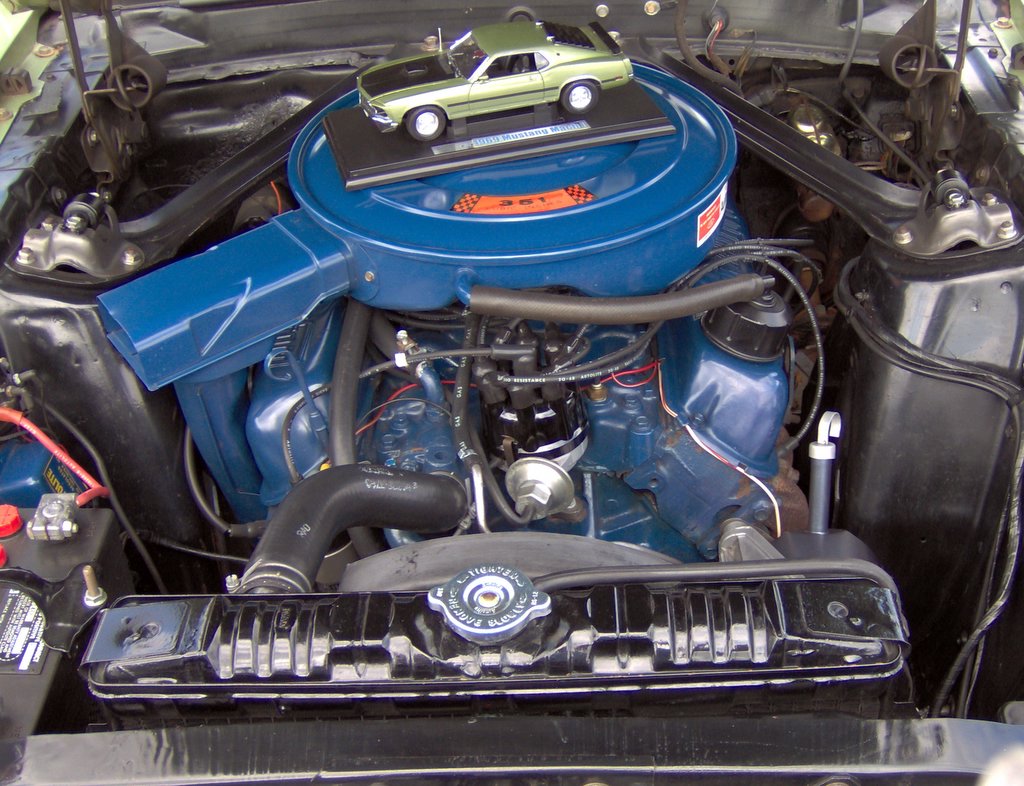
"So this is a 351 Windsor Ford motor with some of the emissions equipment that come on a 50 style from the 90s."
The Ford 351 Windsor is a type of V8 engine made by Ford that was used in many cars and trucks. It's known for being strong and dependable.
The Ford 351 Windsor is a V8 engine produced by Ford, known for its use in various Ford vehicles from the late 1960s through the 1990s. It is part of the Windsor engine family and is popular for its performance and reliability.
"So it's got an EGR valve. So I took the EGR valve apart, cleaned it all out."
The EGR valve helps reduce pollution by sending some exhaust gases back into the engine to burn again, which makes the car cleaner.
The Exhaust Gas Recirculation (EGR) valve reduces nitrogen oxide emissions by recirculating a portion of the exhaust gases back into the engine intake, lowering combustion temperatures.
"I cleaned the intake manifold out. There was an accumulation of soot and oil in the intake, you know, and the way these systems work on these cars."
The intake manifold is a part that sends air and fuel to the engine's cylinders. Sometimes it gets dirty and needs cleaning.
The intake manifold distributes the air-fuel mixture to each cylinder in the engine. It can accumulate soot and oil deposits over time, which may affect engine performance.
"And there's where PCV vapors go to be reintroduced into the system and burned. Sure."
PCV vapors are gases from inside the engine that get sent back to be burned again so the car pollutes less.
PCV (Positive Crankcase Ventilation) vapors are gases from the engine crankcase that are routed back into the intake to be burned, reducing emissions and preventing pressure buildup.
"But interestingly, this intake manifold, it's an Edelbrock intake."
Edelbrock is a company that makes parts to help car engines perform better, like special air intake parts.
Edelbrock is a well-known aftermarket company specializing in performance automotive parts, including intake manifolds, carburetors, and other engine components.
"it had a Ford AOD transmission, which is a mechanical overdrive for speed, right, meaning no electronic controller."
Mechanical overdrive is a special gear that helps your car use less gas by making the engine turn slower when you drive fast. In older cars, this gear works using mechanical parts instead of computers.
Mechanical overdrive refers to a gear in the transmission that reduces engine RPM at higher speeds to improve fuel economy and reduce engine wear. In older transmissions like the Ford AOD, this engagement is controlled mechanically rather than electronically.
"There is one major variable when I when we first built the car, it had a Ford AOD transmission, which is a mechanical overdrive for speed, right, meaning no electronic controller. And the AOD, you could you could only adjust the shift points and the overdrive engagement through hard parts, throttle body modifications, take it apart, that kind of stuff. I mean, valve body."
The Ford AOD transmission is a type of automatic gearbox from the late 1970s that helps your car save fuel by adding an extra gear called overdrive. It works mostly with mechanical parts, so you can't easily change how it shifts without taking it apart.
The Ford AOD (Automatic Overdrive) transmission is a 4-speed automatic transmission introduced in the late 1970s. It features a mechanical overdrive gear but lacks electronic controls, meaning shift points and overdrive engagement are adjusted mechanically through components like the valve body.
"And the AOD, you could you could only adjust the shift points and the overdrive engagement through hard parts, throttle body modifications, take it apart, that kind of stuff."
Shift points are the moments when your car's automatic transmission changes gears. Changing these can make your car feel sportier or save gas.
Shift points are the engine speeds or vehicle speeds at which an automatic transmission changes gears. Adjusting shift points affects performance, fuel economy, and driving feel.
"And the AOD, you could you could only adjust the shift points and the overdrive engagement through hard parts, throttle body modifications, take it apart, that kind of stuff. I mean, valve body."
The valve body is a part inside an automatic transmission that helps control when and how the car changes gears by moving fluid around.
The valve body is a complex component inside an automatic transmission that directs hydraulic fluid to control gear shifts. Adjusting or modifying the valve body can change shift timing and feel.
"So we ditched that in favor of a four R 70W, which is also known as an AODE, but a wide ratio AODE. And that has an electronic controller. And so now I can with the laptop, you know, my Windows XP machine, I can change the, you know, tune the to the transmission that I want, engage and disengage, overdrive and all that stuff, lock up converter."
The 4R70W is a newer type of automatic transmission from Ford that uses electronics to control how and when it shifts gears. This makes it smoother and easier to adjust using a computer.
The Ford 4R70W is an electronically controlled 4-speed automatic transmission, also known as a wide ratio AODE. It allows for electronic tuning of shift points and overdrive engagement via a computer, improving drivability and efficiency compared to the older AOD.
"which is also known as an AODE, but a wide ratio AODE. And that has an electronic controller. And so now I can with the laptop, you know, my Windows XP machine, I can change the, you know, tune the to the transmission that I want, engage and disengage, overdrive and all that stuff, lock up converter."
An electronic controller is like a computer inside your car's transmission that helps decide when to change gears to make driving smoother and more efficient.
An electronic controller in a transmission uses sensors and computer software to manage gear shifts and overdrive engagement, allowing for more precise and adaptable performance compared to purely mechanical systems.
"I can change the, you know, tune the to the transmission that I want, engage and disengage, overdrive and all that stuff, lock up converter."
A lock-up converter is a part in automatic transmissions that helps the engine and transmission work together better when driving steady, saving gas and preventing waste.
A lock-up converter is a feature in automatic transmissions that locks the torque converter to eliminate slippage at cruising speeds, improving fuel efficiency and reducing heat.
"Ford cars that had a sticker in the side window in the back, it said automatic overdrive, you know, that's what that was."
Automatic overdrive means the car can shift into an extra high gear when driving fast, which helps save gas and makes the engine work less hard. Some Ford cars had a sticker to show they had this feature.
Automatic overdrive refers to a transmission feature that allows the vehicle to shift into a higher gear at cruising speeds, reducing engine RPM and improving fuel economy. It was often indicated by a sticker on Ford cars to highlight this technology.
"Well, you'll have to figure that out when we do our a little cross country cruise whenever I get my GTO back on the road."
The Pontiac GTO is a famous fast car from the 1960s that many people think of when they hear muscle car. It has a strong engine and looks tough.
The Pontiac GTO is a classic American muscle car originally produced in the 1960s, credited with popularizing the muscle car segment. It is known for its powerful V8 engines and aggressive styling.
"Maybe I'll just I'll drive this suburban. Well, gotta drive something."
The Chevrolet Suburban is a big SUV that can carry lots of people or stuff. It's been made for a very long time and is good for families or towing things.
The Chevrolet Suburban is a large SUV known for its spacious interior and long production history. It is often used as a family hauler or for towing due to its size and capability.
"There were 351 Cleveland instead of Windsor spark plug wires. And they're vastly different."
The 351 Cleveland is a type of Ford engine from the 1970s that needs special parts to work right.
The 351 Cleveland is a Ford V8 engine produced in the 1970s known for its performance characteristics and distinct design compared to the 351 Windsor engine. It requires specific parts like spark plug wires tailored to its architecture.
"And the architecture, the design of those had the ignition coil mounted on the driver inner fender. So the coil wire is like two feet long. Oh, OK. And I have the same setup."
The ignition coil is a part in your car that makes a strong spark to help start the engine.
An ignition coil is a component that transforms the battery's low voltage to the thousands of volts needed to create a spark at the spark plugs, igniting the engine's fuel. Placement of the coil can vary by vehicle design.
"I mean, the big one for them is advocacy to make sure that it's still legal for us to have hot rods and to work on them and to make the parts."
A hot rod is an old car that people change to make it faster or look cooler.
A hot rod is a classic or vintage car that has been modified for increased performance, style, or both. Hot rodding is a popular hobby involving customizing older cars, often American models from the mid-20th century.
"I mean, the big one for them is advocacy to make sure that it's still legal for us to have hot rods and to work on them and to make the parts."
Advocacy means working to keep rules that let people fix and change their cars.
Advocacy in the automotive context refers to efforts by organizations to influence laws, regulations, and public opinion to protect the rights of car enthusiasts, such as ensuring it remains legal to modify and restore vehicles.
"And what the HRA really does when it comes to education is they have several with the called Education Day seminars at a couple of events."
Education Day seminars are classes where people learn how to put in and use car parts and how to sell them.
Education Day seminars are sessions organized by the SEMA HRIA where manufacturers and experts teach attendees about installing, using, and selling automotive products, helping to spread knowledge within the hot rod community.
"So like Vintage Air takes advantage of this all the time. They're a long time HRA member."
Vintage Air makes air conditioning parts that you can add to old cars to keep them cool.
Vintage Air is a company specializing in aftermarket air conditioning systems and components designed for classic cars and hot rods, helping enthusiasts modernize their vehicles' comfort.
"And if you want to know everything there is to know, plus have Q&A time with the manufacturer, you can go sit in on that session."
This is a time when people can ask questions and get answers from experts or car makers.
A Q&A (Question and Answer) session is a part of an event where attendees can ask questions directly to experts or manufacturers and get detailed responses, enhancing learning and engagement.
Select text to request an explanation
All righty ladies and gentlemen, you have done it once again.
You've clicked the record button on yet another Kevin, another amusing episode of V8 Radio.
Amusing.
All right.
I like to be amused.
I even know what that means.
Right on.
That's why I picked it.
I'm not sure this show is amusing, we'll find out.
You've chosen to tune into an amusing episode of the V8 Radio podcast.
I'm your host, Kevin Ostejoin, as always by our esteemed co-host, Mr. Mike Cuball-Clark.
What's happening?
Not much is happening, to be honest with you.
Just kind of doing my thing and plugging away.
Doing your thing and plugging away.
That's right.
Are you amused?
Yeah.
I mean, you know what that sounds like?
That sounds like, you know, when you're on the phone back in the dating days, when you're
on the phone with somebody you're not that interested in.
Not at all.
Not at all.
And they're like, hey, what are you doing?
Yeah, you know, just kind of doing my thing and plugging away, you know.
And nothing.
All right.
All right.
And we're off to a great start, ladies and gentlemen.
Completely non-descript.
What are you doing?
All right.
Well, maybe we can pour some coals to this fire by launching into our V8 Radio Automotive
Trivia competition that we have.
Of course, being a loyal listener, you know we do this all the time.
And we launch our question at the beginning of the show and then answer it at the end.
And this way, you've got a reward for tuning in the whole time, right?
Correctamundo.
Do you, in fact, have a trivia question, Mr. Q?
Absolutely.
Here we go.
All right.
Kevin and listener, the Zimmer Quicksilver was a personal luxury car built by the Zimmer
Motors Corporation that was based on an already established vehicle.
What was that vehicle?
That vehicle, the Zimmer Quicksilver.
Interesting car.
Not a horrible looking car.
You think?
Well, I mean, I mean, from what I understand, there was some kind of, was there some kind
of German connection there?
I don't know, maybe besides the name, I don't know.
Yeah.
Well, the Zimmer was, yes, a personal luxury coupe and, or just kind of a personal coupe
anyway.
Right.
That was a custom built vehicle that was based on a GM product of the time that you
could buy at your local dealership, right?
You could buy these at the parent brand dealership.
I don't think Zimmer had their own dealers.
I don't think they did either.
Yeah.
I think they were bought through a different dealer chain.
The car that they dolled up was, of course, a Pontiac Fiero.
Ooh.
Yeah.
That sounds wonderful, doesn't it?
Well, I mean, if you took a Pontiac Fiero and I think they added about 11 or 12 inches
to the nose and really put an extended snorkels on the front of the thing.
Now that is an overselling adjective.
And then they went ahead and, I think they also added a neoclassic styling element to
the tail end in the form of a pseudo spare tire hump, a la the continental style.
It wasn't like an individual spare tire, like a continental kit tucked behind a bumper.
It was just a bulge also known in the Chrysler and Lincoln world as a toilet seat.
Oh, very nice, very nice.
But inside, I don't know how much they changed.
And you know, it was an interesting, if I'm right, it's an interesting concept because
the Fiero had a lot of innovations like the space frame and the ability to pop off the
plastic body panels and pop on some longer ones, apparently.
And I think that's what they did.
So that's my final answer is it is a Pontiac Fiero.
Final answer, duly noted, sir, and we'll find out at the end of the show.
Duly noted, Mr. Q. Duly noted.
Industry guy, my ass.
You've been working with someone.
Yeah, you know.
It's called the Internet boredom.
That is awesome.
That is awesome.
Oh, man.
Welcome to another Splendiferous episode of the V8 radio podcast.
We hope you brought something to do while you're here, because these guys blow.
Oh, Jesus.
I think I'm about to get fired.
This guy's great.
He's really good, huh?
Someone has been bored behind the keyboard.
Yeah.
All right.
Well, I also have prepared a trivia question.
This is an easy one.
Says you.
Well, it's an easy one to read.
Here's what I meant.
Oh, sure.
OK, here we go.
When was the first steering wheel installed on a car and the bonus?
What car and country?
Oh, all right.
So so looking back at our automotive history, the very first cars just had
kind of a stick coming through the floor that was connected to a steering
linkage that would steer you around.
There was no steering wheel per se.
I'm going to say, well, this kind of takes me back a little bit to the trivia
question we had regarding when was the steering wheel first put on the left side?
And that was going to go on a car before they put it on the left.
Yes.
Yeah, indeed.
So and that was a Henry Ford thing that everybody adopted.
And I believe that was gosh, it was in the 20s, I thought that became
adopted across the United States.
So I'm going to say the first steering wheel appeared
on the 1910.
Pierce Arrow.
Oh, nice.
Yes, from the United States, from the good old US of a US of a.
All right.
Is is that your final answer?
You know what the man's about to say?
Duly noted, Mr. Q. Duly noted.
Oh, that is so great.
OK, we'll find out at the end of the show.
That's right.
The answer to these riveting questions and so much more.
All for the same price.
So worth it.
Yes, I do have to say that we're starting this recording session here
today with all the best of intentions.
But I'm in my garage, which is wonderful.
We've got some springtime weather finally.
However, there's also a tornado watch going on.
So any moment it's going to start raining very hard
and we might lose all connection.
So fantastic.
I can't wait to end up in Kansas or something.
We'll find out.
Yeah, let's hope it holds out.
Yes, because I'm celebrating a little triumph today.
Oh, do tell. Yeah.
Yeah. Well, I just got back from the inaugural
season drive of my 62 Ford Galaxy.
Hey, hey, right on, man.
Yeah.
So I completed some upgrades and fixes, kind of alluded to them last time
and got the whole smear back together and took a four ride.
And I think I solved some of my problems.
What a deal. Yes.
So real quick, it was a some basic tune up stuff.
Cap, rotor, plug wires.
I put a brand new set of MSD superconductor eight mil wires on it.
Or eight and a half, whatever they are.
And realizing that the previous set were installed in 1999.
Well, I mean, they're still fresh.
I don't know why he changed or 2000, 2000.
So 2026 years on a set of plug wires isn't bad.
Not bad. Yeah, especially because from the 1900s.
Yeah, right. And I didn't have a failure either.
I just it was just time, you know, and I kept them.
So I'm going to I'm going to own them out and see over time
if they've increased in resistance
and also kind of flop them around to see like, you know,
is there a crackly connectivity issue inside them?
Because I don't really don't think there's anything wrong with them.
But the new ones are black, the old ones are red.
I wanted to change that too.
So did that through a new set of
NGK spark plugs in it and added
changed out the pair of oxygen sensors, which were also from night from 2000.
Oh, right. That's right.
And I realized that it actually remembered that at one point
I had one of the O2 sensor connectors get a little close to the exhaust
and kind of mushed, melted a little bit.
So I so I changed that pigtail.
And then took the so this is a 351 Windsor Ford motor
with some of the emissions equipment that come on a 50 style from the 90s.
So it's got an EGR valve.
So I took the EGR valve apart, cleaned it all out.
I cleaned the intake manifold out.
There was an accumulation of soot and oil in the intake, you know,
and the way these systems work on these cars.
Anyway, the oil fill tube on the valve cover has a hose,
a hard, rigid hose that goes right into the throttle body.
And there's where PCV vapors go to be reintroduced into the system and burned.
Sure. But interestingly, this intake manifold, it's an Edelbrock intake.
And it's just, you know, if you're familiar with these things,
the throttle body is on the passenger side of the car.
And there's a straight shot that goes in across to the driver's side,
to which there's a common like air box.
And then the air goes towards the center of the car down the individual
runners and then into the lower intake where it splits and goes to the
driver's side bank or the passenger side bank.
So I think if you took a tape measure and went from the throttle body opening
all the way and trace the whole path, it's got to be
two and a half feet long, two feet long.
It's quite a journey.
It's a long ram, you know.
And but what I found is that oil vapor coming out of the PCV
would condense inside this aluminum manifold because it's the manifold's cool.
And it would actually puddle up on the one side of the manifold.
So I installed a catch can coming out of that PCV, an aluminum catch can
to capture that vapor.
So, so that's cool.
And then I had some bad wires that over time, when we built this car,
the current generation, the forward harness was still original.
The engine harness is all new, but some of the forward harness things
are completely shot at this point. Oh, boy.
And very crispy, you know, you bend the wire and it just cracks.
And I have a whole American auto wire classic update
wiring harness to go in this. Right.
And I think that might be this coming winters project.
OK, so I just kind of fixed a few things to get that all together.
And yeah, is that putting that kid in?
That's kind of a commitment to get all that in there, isn't it?
I mean, you're going to have to cut the interior out
and really go through everything and yeah, run it, run every wire.
And it'll be great when it's done.
But yeah, it's definitely not something you want to start tackling
when you want to start driving this car.
That's kind of the big thing is, you know, getting the wetters
starting to get nicer here.
And I want to I really, you know, one of the things
that really brings me joy is driving this car now.
Well, sure. So it's a cool car.
Why wouldn't it? Yeah.
Well, I appreciate that.
So the other part of the American auto harness,
American auto wire harness is that
I'm kind of planning on other things to go in the car, you know,
gauge wise, audio system and OK.
And like all that stuff's not ready to go at this moment.
But maybe by the end of the year, it will be.
So then it'll be just like you're saying,
front to back and and all do it all.
LED lighting and audio and maybe maybe a power window upgrade
and you know, a whole bunch of stuff.
So for now, you know, let's just make it safe.
So yeah, did all that.
And then, you know, kind of put the whole thing back together again
last night and I had my battery and a trickle charger
and reinstalled that and got it all fired up.
And I had my I mean, everything installed.
And I had my fire extinguisher, you know, next to me and try to be responsible
and, you know, of course, turn the key and get absolutely nothing.
Oh, man.
And I was like, really?
And fortunately, I was smart enough to take a whole bunch of photographs
before I took this apart, because it's been a couple of months.
It's been two and a half months since three months since I took.
I started taking this thing apart and I don't have time to start and go to finish.
So it's been like 15 minutes here and 10 minutes there.
Sure.
So scrutinizing the photographs.
And it's like, yeah, I don't I don't really know what changed.
And it was acting like like maybe a major fusible link
had blown or something like no headlights, no ignition power,
like nothing.
So I went to bed and slept on it and derived a few tests
to kind of check and see, you know, and and I measured power at the starter
solenoid, everything in front of the firewall had power.
But the actual action of turning the key gave you nothing.
And fortunately, I thought, what's my least invasive way to start
diagnosing this, you know, before before you just start tearing things apart
and going back in everything.
Right.
And you recall a couple of years ago, maybe last year, two years ago,
I fixed the horn.
That's right.
And the horn on this car has its actual an air horn with a compressor
and all that stuff.
And the horn operates independently of the key.
So I hit the I was getting great voltage under the hood at the battery
and all in, I hit the horn and it goes.
Well, well, well, instead of the triumphant trumpeting that it should
be resounding across the countryside.
So it sounded like it didn't have enough power.
And so I took the battery cables off and kind of cleaned up the terminals
and reconnected that through the key in it.
And it lit right off and started up right away, right on.
So again, another thing that you don't want to overlook is those simple things,
you know, corrosion on battery cable terminals and yeah, it'll get you do it.
It will, it will.
So especially if there's even like a hairline crack on the terminal
that you don't really can't really see, but it's not tightening up properly.
Yes, that'll cause you a lot of a lot of grief as well.
Yeah, exactly.
So I was able to, I also did an oil change and a filter change
and I got a fuel filter and, you know, so I fired it up.
And the cool thing with this EFI system, it's a Ford E4 computer
from the 80s, basically.
So it's way out of date, but still works great.
And it forgets all of its tuning refinements if you disconnect power for
a couple of days. Oh, boy, that's good, though.
You need to do that every once in a while.
OK, because it can't do much, but it adjusts the fuel trims,
you know, based on certain things.
So gave that a clear shot.
And I still have this device on here called the tweaker,
which is a tuning device for that style, which is actually still made,
interestingly enough.
And I have a four or a five position dial.
I can pick which tune I want, which calibration.
So I resurrected my Windows.
NT or X XE.
What was it, XT? What was the XP?
Yes, my Windows XP laptop that's still running that software.
That's awesome. I love Windows XP.
It's my favorite operating system. Yeah, it was easy.
It was nice and reliable.
So verified that that calibration was the same and made sure
that my EGR settings were what I wanted and.
And lit it off, you know, and it runs great.
And it's I need to drive it around a little bit to have those fuel
trims relearn and kind of come back.
But one of the other things that I solved, I actually solved the problem
doing all this, which was good.
And that is this car and a lot of Ford products.
I'm sure others do it, too.
But it's pretty well known and like the Mustang world.
They develop a whistle on throttle tip in if you put an aftermarket throttle body on.
Really?
Yeah. And it's kind of annoying, you know, because you're cruising on the road,
you give a little gas and it's like.
You know, and it's like, I don't want to hear that, you know.
That's weird. What causes that?
Well, that was the thing.
And I started to do some research on it.
And there was a whole bunch of dead end videos and information.
But what the fix is.
Is inside that throttle body, it's a billet machine.
This one is a BBK 75 millimeter or whatever the heck.
And there are ports in the throttle body, one being like where that
that PCV oil vapor gets reentered into the air stream.
Right.
So when they manufacture these, it's done on a, you know, five axis CNC machine
and they just bore a hole inside of it.
Well, those holes, there's several of them, one for an EGR,
one for the idle air control motor, one for that PCV.
They have rough edges, like it's just a straight cut into the tube.
I see. And if you chamfer all those, you take this apart to a degree
and, you know, take an air dye grinder, a Dremel or whatever you got
and round off all those edges, you reduce that turbulence around those holes.
And sure enough, it works.
Really? Well, look at you.
Yeah. And it's not gone completely.
But it is so dramatically reduced that I'm happy with that.
So that was a success.
Yeah. So do you think just kind of remembering back to your last drive
last season to this drive, does it feel like it's running any smoother
or better or has a better, better acceleration, a better power?
I don't know yet. I only drove it like down the road and back.
I just wanted to make sure nothing was leaking.
And I wanted to listen to that throttle whistle.
And it's still on last fall's fuel.
But I added stable to it.
So the fuel, you know, it started first click, you know,
sure, in half a crank. So I wasn't really worried about that.
The test is going to be one of the reasons why I did this is because my fuel economy
had been tanking over time. Right.
And when we first built this car, I was getting like 20, 21 to the gallon on the highway.
And now I'm down to like 14.
So and nothing really changed outside of time and where.
So I'm kind of hoping that the O2s and the tuna parts and, you know,
those things are going to help bring that economy back around.
Yeah, I'm kind of curious to see how that's going to turn out.
I'm hoping that maybe it'll even be better, which would be fantastic.
I mean, that would be great.
There is one major variable when I when we first built the car,
it had a Ford AOD transmission, which is a mechanical overdrive for speed,
right, meaning no electronic controller.
And the AOD, you could you could only adjust the shift points
and the overdrive engagement through hard parts,
throttle body modifications, take it apart, that kind of stuff.
I mean, valve body.
So we ditched that in favor of a four R 70W,
which is also known as an AODE, but a wide ratio AODE.
And that has an electronic controller.
And so now I can with the laptop, you know, my Windows XP machine,
I can change the, you know, tune the to the transmission
that I want, engage and disengage, overdrive and all that stuff, lock up converter.
But I think the AODE takes more oats to spin than the AOD.
Oh, I see.
Yeah, that can cause cause a reduction in the economy.
Yeah. And it's interesting because the AOD, one of the things
I did not like about it, in addition to the lack of tune ability,
was the fact that when overdrive engaged,
it locked, it literally like there's a shaft that locks the crank
to the, to the input shaft and the transmission.
And there is zero slippage, which sounds wonderful, but it's like clunk.
You know, it was like a, you could feel it.
And I see the AOD came out in the late seventies, I believe.
And if you remember cars, you know, Ford cars that had a sticker
in the side window in the back, it said automatic overdrive, you know,
that's what that was.
And those cars had an entirely different
transmission mounting structure than what I have in this thing.
You know, so they had a softer mount and cushions and stuff
so that when AOD transmissions engaged, plus they were also
not built the same way as the one I had.
Mine was designed to have a slightly
firmer shift, you know, a little more performance.
So that coupled with a more rigid mounting structure and a full frame car
like this Galaxy, and it was like, boom.
And it felt like something wasn't right.
So the E variant, the electronic one, you can you can adjust
how hard that engages and not and whatever.
Yeah, you can ease it in there, right?
Yeah. So I think, I don't know, that that could be a culprit
of a little bit of the fuel economy.
But hopefully, I mean, we'll see.
So the only way to know is to drive it, run some tanks of gas through it and see what we got.
Well, you'll have to figure that out when we do our a little cross country cruise
whenever I get my GTO back on the road. That's right.
Maybe I'll just I'll drive this suburban.
Well, gotta drive something.
Yeah, for sure, for sure.
Oh, man, well, that's cool.
I'm glad I'm glad you got that accomplished.
And you got a few miles under your belt this year on your Galaxy.
That's that's great news.
Yeah, I'm excited about it.
I mean, it was kind of driving me crazy having the car apart.
And you know how that is.
And we all know how that is. Yeah.
But I surmised that what I was doing wasn't going to be a very long project.
And like all things car related.
It takes longer for all the reasons.
And so, you know, here we are.
So it was funny because some of the frustrations we have at V8 Speed and Resto in the shop,
I was 100% victim to or the cause of myself.
So I had I had these MSD spark plug wires sitting on the shelf for a couple of years,
you know, waiting for this opportunity to do this.
And it wasn't until I started doing it that realized they were the wrong ones.
Oh, brother.
There were 351 Cleveland instead of Windsor spark plug wires.
And they're vastly different.
Really? Yeah. Well, the big one is again, everything under the hood
on my 62 Ford is basically 90s Mustang, early 80s, early 90s Mustang.
And the architecture, the design of those had the ignition coil mounted on the driver
inner fender. So the coil wire is like two feet long.
Oh, OK. And I have the same setup.
And the Cleveland, the coils mounted on the intake manifold.
So it's a 10 inch long coil wire.
So that was the first thing I was like, oh, rats, you know.
And the rest are fairly tailored for this engine.
So I wanted to I see not as clean as if I would have made them.
You know, normally I like to make the plug wires when we do it, we build a car
in the shop, we make them and they're they're exact perfect, you know.
But this time I was like, just out of the box will be fine.
Just give me the right box.
Yeah, that would help.
That would help for sure.
Oh, man.
So that was a work stoppage setback.
A little bit, a little bit.
You know, the worst part about 20 a quick 20 minute project is the first seven hours of it.
Yeah, right.
100 percent.
And then I realized that I should have listened to this show.
I didn't pay attention to the Amazon fine print.
Oh, no.
On a set of two sensors.
Oh, brother.
So I bought, I ended up buying four wire oxygen sensors and my car has three wire.
It's the same plug and cross compatibility generally.
But all right.
So now we're going to find out what the difference is between a three wire and a four wire.
And they're heated oxygen sensors.
So when you turn the key, the circuit opens and starts heating them up.
So that's two wires.
The heat gets a power and a ground, then there's a signal that actually goes
to the ECM to say what the reading is.
And then on a four wire, there's a separate ground for the signal as well.
Three wire grounds through the sensor body and through the exhaust.
So interesting.
OK.
So now I got these two sensors and I'm thinking, well,
I could put a pin in the harness and make a ground for the signal and run it back to the ECM.
But that's going to add a lot more time.
Yeah, a little, a little, a little more complexity.
Yeah.
So I ended up getting some three wires, Bosch sensors and switched them out.
So but again, those that was the right move.
Those oxygen sensors were sitting on the shelf past the return window.
Of course they were.
Absolutely.
Yeah.
Yeah, that is funny, because we struggle with that at the shop.
As far as when we're ordering parts, you know, we don't want them to sit.
We want to be able to have them when we need them,
but we don't necessarily want them so far that they are past the return window.
If they find if we end up, you know, putting them on and there's something wrong with them.
So, yeah, that's definitely a dance that you got to contend with.
So my lesson learned is that what I really need to do is
pay a little more attention when ordering.
And that would have maybe headed off the 351 Cleveland plug wire thing
because the part number clearly says Cleveland and I just was blinded by the
351 part, right?
Sure, sure.
So that would have been the first step.
The second step is when those parts arrived, I should have looked at them that day
and said, this is Cleveland, send it back.
And same with the two sensors.
I should have paid more attention.
And interestingly, I only noticed that it was a three wire versus four wire.
When I took my two's out and just because I'm a dork and kind of a nerd with documentation,
I put both connectors in my hand and looked down the barrel of both of them
and took a photograph just because it's what I do.
I photograph everything and I blew it up and I'm like, wait a minute, look in there.
These are these are different configurations, right?
I went back and looked at the the listing for that four wire and it
I don't know that it actually said that it was a four wire it might have,
but it was way buried in there.
So let me let me back up here for a second.
So the connector you have on your harness for your O2 sensors would have
fit those four wire.
OK, thank and if you hadn't taken those photographs and you would have put those
in, you would have had a nightmare on your hands trying to figure out why your
cars run either running so poorly or not starting at all.
Something would have happened.
Yeah, yeah, exactly.
And because it is interchangeable and you can throw them right in there.
Everything else is exactly the same.
So again, my own.
The way I do things, I scrutinize things, but at the wrong time, apparently.
But well, the point is you you did catch that.
Yeah, a little late, but not so late that it caused any any poor running or or
God forbid, any damage.
Yeah, no, definitely.
Now I just got to figure out a way to re-home these oxygen sensors to somebody
who needs them, you know, because otherwise I'm out the money.
You know, that's just.
Well, I know a guy that goes with a lot of swap meets.
Maybe you can throw him to him.
And yeah, Mr.
Brian Wibbendmeyer at our shop.
But that's a weird thing, you know, oxygen sensors that are swapping.
Yeah.
So.
So this all turned into the next chapter, which is like, well, I could Facebook
Marketplace, my plug wires and my oxygen sensors.
But I might as well just throw them out, you know, for the amount of time I'm going
to waste jerking around with the listing and and unfortunately, people that are
not serious or, you know, that's been my experience.
Sure.
And then on top of that, it's like, well, maybe in fact, I asked an AI system today.
What's the best way to eBay parts in 2026 without having to get killed on fees?
And, you know, all the rest of it.
And it recommended.
Some things I wasn't aware.
I mean, eBay charges a listing fee, then there's a final assessed value fee.
And then if you're a crappy eBay or it throws another percentage on top of that,
if you don't respond your emails in certain times,
it penalizes you for all that.
So, you know, there's ways to be as fee low as fee as possible.
But, you know, I don't know.
So I think the strategy is going to be just work the efficiencies.
So I'm going to go through the whole garage and find like a bunch of things
that I don't need and line them all up and photograph them all at the same time
and let AI help me write some descriptions and just get them all posted
somewhere all at once.
And that'll knock down a whole bunch of the time, you know,
just doing them bang, bang, bang.
And then and then we'll see, you know, I might start dropping,
you know, the plug wires into a Facebook group of people that build Cleveland
motors or, you know, that kind of thing.
Target them.
Got you, right?
Yeah, for sure.
Definitely.
These are all very valuable, you know,
car guy skill sets, by the way, to be able to re-home parts and.
Oh, 100 percent.
Yeah, if you if you don't need them, somebody's going to want them.
Hopefully it's just a matter of finding the right person who wants it.
But I would say double check your documentation before you order and check
the parts as best you can the minute they get in.
For sure.
Because there's other things that could have happened too.
I mean, I could have bought any of this stuff and it could have been the wrong
one in the box.
And if I just did a casual glance, that oxygen sensor looks about right.
You know, that could have been it.
But you got to you got to do the diligence or be prepared to deal with people on Facebook.
You know, yeah, just still available.
You still have it.
And then crickets.
I'll give you one dollar.
Yeah.
I have all the money.
I'm going to pay you all the money you're asking and then they get there.
And it's no, I'm going to give you one dollar.
Take the dollar for it.
Yeah, I drove all this way, dude.
Come on.
Yes, I sold a car a couple of years ago and I had that one.
You know, this guy first, he's like, hey, I want the car.
I go, great. He goes, take it off Facebook.
I'm like, no.
Well, no, I'm going to buy it.
Take it off. No.
I said, you just send me a whole bunch of money or it's staying on.
Oh, yeah.
Don't be a dick, man.
Now, hey.
So he's like, all right, your asking price is fair.
So I'm going to just, I got all the money I'm going to bring it to you.
You know, and then he shows up and he's like, oh, dude, I ain't paying all that.
And I'm like, well, you can go home.
You know, I have a nice day.
I know it's a good deal.
I had to take a half a day off work and my kids at daycare and I drove 40 months.
You know what? That's I feel for life, man, not mine, but those are kind of your
decisions and we talked about this before you got here.
I said, is this going to affect your negative, your life in a negative way
to come here in any way? No, no, it's all great.
I got all the money.
Hmm.
Yeah, people are nuts.
Some are.
Yeah, I'm one of them.
You know, a man brother.
So anyway, that was.
It took a little longer than expected, but here we are.
And hopefully the car is ready for the for the springtime season.
Good deal. Good deal.
Do you want to buy some plug wires?
I think it's a 351 and Pontiac 400 and for you.
Pontiac 400 and for 351.
Perfect fit.
I'll take those two sensors off your hands.
So how about that Cleveland's not far from Pontiac, Michigan?
That's, you know what, you're not wrong.
This past week was also kind of fun.
On the other side of the spectrum, I was at a SEMA hot rod industry
alliance, long range planning meeting in Florida.
Ah, very cool.
What are our long range plans for the HRIA?
Well, the cool thing is
there's some clarity on like, you know, what what what the whole program is.
Right. So the HRIA exists to help companies in the hot rod world be more
successful through communication, culture, education and events.
Right. So that's the that's kind of the standard pitch.
So it's only open to companies.
So if you've got a company in the business and you you have to be a SEMA
member and if you're a SEMA member, but in the hot rod world, you can join the HRA
and bond together with other hot rod related companies.
It's shops, it's manufacturers, it's media people, it's events.
It's kind of all the above.
And the goal is to kind of come together and be able to help each other out if you
got problems and and do things.
And what we really did this time is land on
some overarching
principles that the SEMA association itself is putting forward and then seeing
how the things that the HRIA does can support those.
Right.
So one of the overarching.
You kind of pillars of the SEMA association is to
enhance community and grow the industry, you know, makes sense.
Yeah.
So there's a lot of things that we can do
that have that nod of, yep, this is helping grow the industry and it's it's
supporting that, which is good.
And, you know, many years ago, the SEMA association had like a lot of different
missions that they were trying to accomplish.
And they've kind of streamlined down to basically three of them.
I mean, the big one for them is advocacy to make sure that it's still legal for us
to have hot rods and to work on them and to make the parts.
And of course, they're always concerned with the health of the association to make
sure that, you know, they can be effective and then the community.
So those kind of three pillars.
So as we look at like what the HRIA does, it's like, let's just make sure that,
hey, maybe we do some things that help spread the word on the advocacy or help
people get involved or, you know, grow the community and whatnot.
So much like your very general statement at the beginning of the show when I asked
how you were doing that that elevator speech of the SEMA HRA, we we help
through communication, education, events and community culture.
It's like, OK, well, what does that really mean?
What do you do?
Right.
And what what the HRA really does
when it comes to education is they have several
with the called Education Day seminars at a couple of events.
Louisville Street, Red Nationals, Good Guys, Columbus, in which
HRA member manufacturers have sessions for 90 minutes a piece on how to
install certain products and how to use them and even how to sell them and how to
educate customers and how to use them.
So like Vintage Air takes advantage of this all the time.
They're a long time HRA member.
And at those events, you can sign up.
It's free to go to if you're there as an attendee.
You don't have to be in the in the association or anything.
You can just be a person.
And if you want to know everything there is to know, plus have Q&A time with the
manufacturer, you can go sit in on that session.
So these are very valuable and they go all day and there's a lot of them.
So a bunch of different companies take advantage of them and it's a great way
to educate people and then eventually grow the business.
So that's a specific.
They do a couple of builder roundtables.
One is at the SEMA show.
Another one was at the Grand National Roadster Show where they have famous
builders and they can share their experiences and it's a Q&A type panel
and people that are either just interested in it or shop owners or again,
manufacturers, whatever can get time with the likes of Bobby Allaway and Fuss
and Troy Japanier and and even some up and coming builders.
We always try to have people that you've never heard of before
to share what it's like to try to get into the industry today, you know,
and how they're making it happen.
So those are both examples of kind of on the education side.
The communication side is,
of course, posting on social media about things that are important to the
hot ride community, the Hammer Down podcast, which I produce and you help with
as an HRA member at large, which we appreciate that.
That is really nothing but helpful information.
You know, again, education tips, how to get, how to do all kinds of stuff.
We've had episodes that cover how to get into merchandising.
You want to make t-shirts and stuff to to why join SEMA and stories of builders
and, you know, everything in between and how to watch out for counterfeit products.
It was a great one. Yeah, yeah.
The huge one. It's a huge issue that everybody should everybody should listen
to the eight that that episode of the HRA podcast to help avoid getting taken
by counterfeit parts vendors.
Yeah, and that that podcast is also consumer facing.
It's not just for industry people.
So, yeah, so, yeah, there's that.
We got another episode coming pretty soon that is going to deal with product data,
which I think is pretty cool because nobody knows anything about that.
Generally, and the context there is that if you're a manufacturer,
if you're a big one, you definitely need to know about this stuff and probably do
already, but who knows if it's enough.
But if you're a shop or an individual who's got an idea to make something right
and go into manufacturing,
the online retailers, your your Amazons, your your summits, your motor state
distributing on a wholesale side,
they all have requirements for the data that comes with your product.
So it's like they need to know a variety of different images.
They need to have a certain type of description format.
They need to have weights.
They need to have packaging sizes and all these things.
And if you can't provide that, they can't list it and you can't sell it.
So SEMA has a whole division called SEMA data that does this and a lot more.
So that's going to be an interesting episode.
So there's another resource for helping the industry out.
And then there's some other fun things that the HRA does.
And one of them is the feature vehicle program,
which is at the SEMA show where people can apply between now and kind of just
before the SEMA show to have builders apply to have their vehicle on display
in the HRA booth or at the outdoor space right next to it.
And if you're if you're chosen to be one of the outdoor feature vehicles,
that not only comes with that that space, you know, right in the center of the show,
but we shoot a feature video on the car and then the car gets moved into the
Wednesday night HRA reception, which is kind of a mini banquet.
I say many, it's 500 people, but it's, you know,
not this is the second most attended thing at SEMA.
Oh, right.
I'm fortunate to be able to MC that one and we get the feature vehicles are there.
There's six or seven vehicles in the in the ballroom, you know,
and then we show the video of interviewing the builder.
And it's just a great way to show off the car and get to know the builder.
And everybody that you want to know in the industry is in that room on that
Wednesday night. So again, your manufacturers that you're buying from and parts
are using to builders and the media guys and event people are all there.
So that strengthens the community and it strengthens the
awareness of the cars and you get to see, you know,
these handpicked, you know, awesome cars and trucks that people are building out
there. It's great. Yeah, that is great.
Yeah, that's exciting.
Yeah. So these are all and that's not everything,
but these are just the big things that the HRA does.
And it was nice to really just kind of put a fine point on that.
So it wasn't like, yeah, we helped the industry.
Well, yeah, but here's how, you know.
Yeah, I'll tell you what, I did not have any kind of frame of reference of how
widespread the reaches that that SEMA has in the industry until I actually became
part of the industry.
Industry guy, my ass.
Oh, you know it.
Nice. Nice.
Oh, you've been waiting for that one.
Yeah, your mouth hovered over that one.
Come on, say it.
Maybe if we start talking about SEMA, he'll go there.
Oh, man, I'm going to call Ira.
That's unbelievable.
Nice. Nice.
As I was saying,
I don't even know what I was saying.
No, but the reach that the influence that SEMA has on the industry
through all of those subcommittees, all those sub programs is just it's
immense at how deeply entrenched it is with the industry.
I mean, it practically is the industry.
So it's it's great that it's out there for us.
Yeah, yeah, no, it really is.
And it's cool once you get involved because you get to meet people and work
alongside people that you wouldn't have the chance to otherwise.
And so, for example, in the HRA select committee, which is who is in this meeting,
you've got an individual from whose day job works at Blueprint Engines,
another one at Hush, Matt and Xycoat, another one who's got a shop,
another one who's got another hot rod shop in the Pacific Northwest,
a guy who just started a car finding business and show car management stuff.
A person who runs a museum,
you know, another dude who does manufacturing of hot rod parts.
You know, so it's a widespread
cross section of the industry.
And now we all get together and chat about how to put these programs in motion
and let people know about them and and maximize the value to the members.
And it's great because the byproduct is,
you know, you make friends that that work in other areas of the industry.
And now you've got this common bond and, you know,
we've all got some of the same challenges and, you know,
there's a personal learning experience along the way too.
So it's it's really cool.
And that was a fun experience.
A lot of great stuff coming in that direction.
And there's a gentleman who actually runs the SEMA show.
His name is Tom Cattuso.
So and Tom, Tom said it best, I think, you know, because people
and we've talked about this here too, the SEMA show, they think it's, you know,
a lot of people think it's a car show.
A lot of people think it's just a trade event.
Some people think it's a circus, you know, everybody has their own opinion.
But what Tom defined it as in the most simple basic terms, he said,
the SEMA show and kind of ultimately the SEMA association,
but the SEMA show is a mirror.
It's just a big, big mirror that you hold up and it reflects the industry.
So whatever's happening in the industry is going to happen at the SEMA show.
So if you see things that you, you know, that are happening in the industry,
in four wheel drive or in government advocacy or in interior
electronic modifications, I mean, if it's at the show, it's happening out in the world, you know.
And of course, there's a flip side.
If there's things that are happening at the show that you don't dig, well,
it's because they're happening out in the world too. Same thing.
You know, you have to figure out a way to maybe address those.
But right on. Yeah. Yeah.
For sure. I like that analogy.
Yeah, I did too.
And one of the kind of the neat things at this meeting.
So another gentleman just joined the select committee, Zack Straits, good friend of ours.
Yeah, good guy.
Zack is a good dude.
I met him just being out at events and many years ago.
And Zack was always interesting because he,
his day job was a lumber salesman.
He was in the building, the home building industry,
but just a super passionate car guy and got so deep into cars that he actually
restored a couple cars for George Poteet.
Yeah, he sure did.
Zack has records at Bonneville on the soft flats.
Thanks to our friends at Chessel
that built the pickup truck that a lot of people have had the fortune to drive,
including, including Zach.
And he just retired out of the home building industry and is now he started
a car business called Dream Car Connection to where he's helping people find
their dream car and he'll concierge that process and he'll work with a builder
if you need it restored and he'll work with getting cars to shows and events
and transport and all that stuff.
So he's kind of like, you know, a good guy to know if you're going to be involved
in all this stuff.
Yeah, for sure.
But one of the things that Zack brought to the table is back at the Homebuilding
Association or in that industry, he was part of the Homebuilding Association.
So kind of the the SEMA of the homebuilding world.
I got you.
So he knows what the deal is.
Oh boy, does he ever.
And yeah, and it was really cool to get his perspective because SEMA has over
7000 member companies, you know, it's a big association.
Yeah, the Homebuilding Association had over 140,000.
Holy cats.
Well, everybody has a home.
That's what he said.
Everybody has a home.
Not everybody has a cool hot rod.
Right.
So when it comes to like working in an association and and and getting the
messaging out there and doing things that help people understand like what the
the reason to join and what they can do for you, he's all over that.
So he brought a lot of those great points
to the to the meeting and it was it was cool.
So yeah, very, very valuable to be part of and the value is trickling out to the
members to take advantage of.
And, you know, even a small business, if you are a SEMA member, which
depending on how many people are in your company, I guess, is how they do that.
It could be just a couple hundred bucks.
And then to join the HRA is a hundred dollars to get involved.
And OK, I tell you what, if somebody told me 30 years ago that for an extra hundred
bucks, I could be in that room at the HRA reception in Vegas.
The ticket price alone is worth more than a hundred bucks.
It is 100 percent to be able to rub
elbows and meet and network with all your hot rod heroes.
I mean, come on, take my money.
So all day long.
Yeah.
Heck of a benefit for sure.
Yeah, plus all the rest of it.
So I'm not here to sell it, but I'm I believe the value.
I think it's a good thing to do.
So yeah, I do too.
And that's why I wanted to get a little deeper involved with this and do more
for the HRA and and just the industry in general and really be an industry guy.
Right.
You know, because you are industry guy, my ass.
There he is.
There he is.
Oh, my God, I'm getting slap happy.
Yeah.
Yeah.
So we did allude very quickly to
we don't the fact we don't really have much of a GTO update at this point.
No, we have zero update.
But I got nothing for you, unfortunately.
We certainly will when the time comes, right?
Yes, we will when the time comes.
Yeah, I have to.
Speaking of the suburban from earlier, I have to get that transmission rebuilt.
So that's going to take up some of those resources for that I was earmarking for
the GTO. So that's where I've landed that it is a rebuild.
Yeah, it's a rebuild.
I have to call or we have a place by the shop that does it and I'm going to have
them do it the next time I'm down.
And that's where you get involved.
So one of you or your your lovely wife might have to be my chauffeur while while
I'm down there with pleasure.
So thank you.
Appreciate that.
Put on a hat and some gloves or something.
All right, sounds good.
I'll be sure to tip you.
Don't drink the water.
Oasty, Oasty.
I need to be picked up.
Oasty.
So that's I mean, you have to understand that that is a little bit of a gamble.
Well, you just laid out.
It is. It is.
I'm, you know, praying for no whammies on the drive down.
I'm not even saying that.
I'm saying just dropping off the truck and saying, OK, rebuild this.
You got three days.
Well, I've I called them already and try to kind of make pre arrangements and let
them know what my situation is.
And they said, just about a week before you come back down, give us a call and we'll
get it and you know, we'll get it worked out.
So they're a good shot.
I might be down there a few more days extra and that's fine.
I'll just have to deal with it.
I'll you know, I'll pack for it and all that.
OK, so are they are they going to pull it and rebuild it and put it back in?
Yes, yes, there's any opportunity for them to build one now and have it waiting
and just swap them?
Well, they did say they had one in stock.
So that might be what they do is just swap them out.
I would hopefully go for that.
Yeah, for sure.
Yeah, when I call them again, I'll verify.
I'll clarify exactly to figure out what they have and what they're what they're
going to do, because you're like a better timeline and you're going to have the
four wire action sensor in your transmission and it's going to be three months
of the thing on the bench and that's a long walk.
You know, it is a long walk.
Eighteenth of the month will be up in your neighborhood.
But, you know, you don't want to, you know, next month, you don't want to be here
that long.
Believe it or not, my wife may miss me.
Oh, of course you will.
Kids not so much, but your wife.
No, no, as long as the money keeps flowing, they're happy.
You know, online banking, they love me.
That's right. That's right.
Well, good.
Hopefully that goes smoothly.
I'm sure it will.
Like I said, that's a good trans shop and we trust them with all kinds of stuff.
And they yeah, we sure do.
It's only the real oddball stuff that they
they don't do, which they're quick to say, hey, that's out of the wheelhouse.
And I I appreciate that more than sure.
We'll try.
Yes. Yes.
Agreed.
Yeah, they're not big fans of the 204 R transmission.
No, they're not, which is unfortunate.
Yeah, it is. They're like, yeah, you don't want to build that.
You want to do this and that and the other.
Not that.
All right, buddy.
Thank you. Thank you very much.
Yeah.
But their their their pricing is very reasonable, way better than what I would
get up here or otherwise I would just have it done up here.
But there's the savings is significant.
So yeah, that's that's a big plus.
And plus, you know, it's a shop that we use that we trust.
So I trust them.
Yep. Yep.
Well, right on. That helps.
Yeah, man.
So all right, hopefully it gets done right the first time and it doesn't fall out
on the drive home. No, no, I wouldn't think that I wouldn't think there be.
I think the only risky part is that they have the parts in that time window.
That that's to me is a number one thing.
And like I just the beginning of this episode, having the parts, the right parts
at the right time, that's the goal.
And it seems to be, you know, a challenge everywhere.
So yep.
You know what else is a challenge?
The answers to your trivia questions.
Wow. That's a great point.
Yeah, absolutely. Crazy. Crazy.
What a segue.
You're the master of that.
All right, Kevin.
So I asked you about the Zimmer Quicksilver.
Oh, yes.
And what car was it based on?
And you said that was based on the Pontiac Fierro.
And congratulations, Mr. Kevin.
You are 100 percent correct.
It was based on the.
Yeah, too bad you don't have the prices right sound effect on the ready.
My head's still ringing from last time.
No, well, I I recut it so it's a lot quieter now.
But yeah, the Zimmer Quicksilver was based on the 86 through 88 Pontiac Fierro.
It was the front end was stretched by 16 inches between the front wheel and the
A pillar and 13 inches behind the rear wheel,
all for a two-seater interior that was still stock like a Fierro interior.
For the low low price of fifty one thousand nine hundred and fifty dollars.
Holy mackerel.
Yeah, that's yes.
That's a big thing.
And that's why they didn't sell a whole lot of them.
Yeah, yeah, interesting.
Well, I'm guessing that you had that Fierro on the brain because the one we have
in our shop.
Yeah, that's a nice, nice car.
The 88 Fierro GT.
Yeah, very nice with 10,000 miles on it.
That's that's insane.
Yeah, it's like brand new.
Yeah, it really, really is.
Yeah, so this we have a really good customer.
We're working on full well, a full build right now.
This is the third car that we're doing for him.
And he called and said, hey, I want this Fierro says number four,
which is wonderful.
But he doesn't want to do a lot to the Fierro, which I don't I don't really blame
him. His car is like it's very new, like I said.
And it's interesting because it's a GT and it's a manual.
And for 88, they redid the suspension on those so that they actually handle well
and all that stuff and then they killed it right away, you know, right after.
Yeah, yeah.
But it's got the basket weave Fierro GT wheels.
But they're painted black and the car is black.
And the GT waffle spoke wheel was supposed to be gold.
And the formula Fierro formula had the black wheels.
Gotcha.
And so we were kind of debating because the the finish is peeling off his wheels
because somebody just painted a black and there's gold underneath.
And we're like, oh, yeah, he should go back to the gold.
But I think he's going to keep the black.
We're going to reshoot him or we're going to have a shop re-powder coat him.
But other than that, I think we're just doing some tune up stuff on that car
and sending it. So yeah, just going through it, make sure everything is cool
and everything is as it should be.
No, we're not extending it by 16 inches in the front and 13 in the back.
We're not going to do any stretching.
So he can relax.
Yeah, that quick silver was when I saw it, I'm like, that is an unfortunate looking
car. I did not care for that at all.
The front doesn't bother me so much.
I think the nose angle kind of matches the windshield and it's got kind of that
chrome thing where it that seems to fit.
OK, the back I'm not so fond of.
Yeah.
And they still have pop up headlights, too, which looked even stupider when the
headlights were up and are they and they're like back halfway up the fender, too,
because they're there before the extension.
I think so.
No, actually, I think they're I think they're forward of that, but there's still
the pop up Fiero headlights.
Yeah, yeah, I don't like it.
Not a fan.
Well, speaking of not a fan of popped up, popped up headlights,
I recently saw that
a picture of the grease lightning movie car.
Yeah, that is the most awful thing in the world.
It's not a good looking car.
No, it is not. It's horrible.
And so not today, but a future episode.
We're going to touch on
cars that we may have perceived to be kind of cool, but with a critical eye are
disgusting, and that's one of them.
But it's automatic.
It's hydromanic.
It's really the fantasy version is the one that's like the really the worst.
When, you know, in the whatever the part of the movie was where they it's red.
And it's like that dream sequence kind of thing.
It's like I don't know if it was like super George
Barris having, you know, some kind of Coylute addiction and a stroke at the same time.
I don't know what it was, but
that plexiglass hood coming down.
And as the engine was descending into it, the fan is turning.
Of course. Now, that was cool.
I didn't think that was kind of there.
But the rest of it kind of blows.
Yeah. But the car itself was pretty gaudy looking.
Yeah. So start making a list, you know, we'll go over.
OK. Movie cars and not just movie,
other famous vehicles that that aren't what they cracked up to me.
All right. So the Corvette summer car is automatically disqualified just
because it is that heinous.
I kind of dig it.
Well, we'll get there on that episode.
Oh, God bless America. Oh, man.
Oh, man.
All right. My question to you was when was the first steering wheel installed
in a car bonus? What car and what country?
And your answer was the 1910 Pierce Arrow from the good old US of A.
And I got to tell you the reason why this question kind of came up is on our
SEMA excursion offsite meeting.
We're in Fort Myers, Florida.
And as a group, we took a tour of the Thomas Edison
home, the winter home in Fort Myers, which was also split with Henry Ford.
So you've been there?
I have not. I would like to go there.
It's cool. I was there on a family and unlike the last family vacation we took
in 1987, drove the van, the first van down there.
Oh, man. That's awesome.
And and I remember kind of seeing what I wanted to see and getting burned out.
And my mom was like, no, we got to go look at this now.
And it's like, all right, you know.
OK, so there's a picture of my mom or my sister, my dad and I all looking not amused.
I'll make that the episode image for this one.
Awesome.
And wearing this, you know, this acid washed denim, blue jeans and jean jacket
from 1987 and the episode title will be just plugging away.
That's it. Yeah, doing my thing.
Doing my thing.
Plugging away.
But this time we really enjoyed it because, you know, I'm not the same idiot I was
back then and got to learn a lot about some of the stuff that Henry Ford was
doing back then. And and and so I got to see images.
They don't have it there, but images of the original Henry Ford Quadra cycle,
you know, his first car, so to speak.
And it had a tiller, a steering tiller.
And I went, interesting, I wonder when.
So that's what this question.
So the correct answer, actually,
is that the first steering wheel used in a car debuted in 1894.
Come on.
And it was installed by a French engineer named Alfred Vacheron in his
Panade 11 saw, which was
for the world's first automobile race.
Oh, another trivia question.
One by the Durier brothers.
No, I don't know.
It was run from from Paris to ruin wherever that is.
78 mile in Europe.
So before I don't think Durier attended that one.
Durier was in the US.
The US car in the first race in the US.
Yeah.
So yeah, most of it tillers or handlebars and cranks and whatnot.
But that that auto manufacturer is a French company.
They they made them
standard equipment by 1898 and the next expansion was Charles Rolls.
Oh, of Rolls and Royce.
Yeah, Royce and Rolls.
You ever see a guy with a Rolls Royce and ask him how his Royce Rolls is?
No, I have not.
Oh, yeah, I'm sure that's great.
I'll go over as well as is talking to a Mustang two owner and saying, hey,
nice pinto. Oh, yeah, yeah, you don't do that. Yeah.
So, you know, you're only off by a few years.
A couple of years, 15 years, a couple of years, 16 years.
All right. It's all good.
Yeah. I mean, that's practically a win.
So you hardly write it down.
Well, and yeah, another shout out to our friend Yardley and his lovely wife
for tuning in and enjoying our show and sending us texts along the way while
they're yelling at the radio about the trivia questions and our bad decisions.
Right. Appreciate that.
And the dirty looks his wife shoots him sometimes because of the things we say.
Well, you know, that was so funny, by the way.
Yeah, because in our previous episode, we were talking about
the modifications made to a car that are maybe misunderstood by other people in
the family and we mentioned the significant under other coming through
the garage saying, hey, you spent all this money on this car.
Why does it shake and make noise?
And he said at that moment, his wife looked at him like, uh-huh.
So sorry.
Sorry, Yards.
Yeah, but our show is steeped in truth, unfortunately.
Yeah, it is. It is definitely.
Yeah. All right.
Well, that was a good question.
I liked it.
Glad you enjoyed that one.
All right. Well, this has been yet another fun episode.
Kind of went by fast.
So I appreciate tuning in and sharing the time.
Again, a future episode might have some stuff about movie cars and other other
nonsense. Always have a lot of that to spare.
Any final thoughts before we return control of people's devices to them?
Before we turn control.
Golly, just keep your cars on the road, man.
Just keep keep plugging away, doing your thing.
That's it. Well, hopefully I plugged away and did some things and my car stays on
the road. So I'll take that well wish.
Hopefully we have a positive story about the transmission rebuild next time, too.
And that's probably going to be a couple of a couple of episodes down.
All right. Well, this has been the VA radio podcast.
If you like this, smash away on that subscribe button.
Check out our socials.
There's a fun page on Facebook and there's also there is a YouTube feed of this.
It doesn't do very well.
But if you if you want to look at a still image and look at and listen to us,
you can do that on YouTube. That's fun.
Awesome.
Correspondify and Apple and all the rest of the places that you want to listen to.
We're there. The Facebook page, leave comments.
We're always happy to eventually discover them and respond.
And if you need to, you know,
anything done on a hot rod or muscle car or custom, even a cool truck,
you can always find the shop v8 speed and rest of shop at v8 speed shop.com.
We had somebody contact the shop who said he listens to the show.
And it was about an engine issue.
He was thinking about maybe having an engine rebuilt and I called him back
and I said, hey, this is Mike Q ball Clark from the V8 speed and rest of shop.
And he says, you sound a little different on the phone than you do on the radio.
Nice.
I'm like, yeah, I'm like, yep, Bill Buford.
Justice, you sounded much taller on the radio on the radio.
All right. Well, now's your chance.
Give the cue a call.
There you go. All right.
Well, for Mr. Mike, you ball Clark, I'm your host, Kevin Ose reminding you to
keep shiny side up, keep it under a hundred and the V8 radio podcast
hosted by award-winning GTO driver and recognized industry guy, Mike Q ball Clark.
Oh, yeah. And Kevin Oste.
Oh, yeah.
Oh, man, my God.
You and I, we're going to have word after this.
All right. Well, that's all I got.
See you next time on V8 radio.
Request an explanation for:
3 cars
3 cars featured
Request an Explanation
Heard something you'd like explained? We'll add it to this episode.
Sign in to request explanations for terms you heard.
Want to learn more?
Browse our glossary for plain-English explanations of automotive terms, jargon, and concepts.
See something that's not quite right? Our annotations are AI-generated and can sometimes miss the mark.
Click the flag icon on any annotation to suggest a correction.