This is a type of race series where the cars are based on models you could buy, but heavily modified for racing. “Two-litre” means the engine size was limited to 2.0 liters, which strongly affected what cars showed up and how they were built.
“Porsche Cup” is a racing event where the cars are all Porsches. In this story, it’s one of the categories they’d watch on TV during the same weekend highlights.
Term
Formula Brabham
“Formula Brabham” refers to a junior open-wheel racing series. The host is saying that’s what it was called back then, even if the name is different today.
“Monocoque” means the body itself is the main structure that holds the car together. Using carbon fiber makes that structure lighter and stiffer, which helps the car handle better in racing.
An “SBS deal” refers to a television broadcasting agreement with SBS, which can directly affect motorsport exposure and funding. When the deal ends, the series may need to rethink sponsorship and audience strategy because the broadcast platform is no longer guaranteed.
Concept
super-turing
“Super-turing” refers to a touring-car racing category in the UK. The big point is that it was becoming popular and was relatively cheaper to get into, so more teams could race.
Privateers are independent race teams that aren’t factory-backed. They often buy cars and enter races themselves, competing alongside the big official teams.
The Alfa Romeo 155 is a race car based on an Alfa Romeo road car. In 1994, it won the British Touring Car Championship, which is a big deal in UK touring-car racing.
Data acquisition is the race car’s way of recording what’s happening while you drive. Sensors collect information during the run, and the team can review it later to understand how the car performed. It helps teams improve setup and reliability.
Gear ratios control how the car pulls in each gear and how fast it can go at a certain engine speed. Different tracks need different ratio “tuning.” That’s why race teams may bring multiple gear options.
Suspension is what helps the tires stay in contact with the road. It affects how the car handles bumps and corners. Race teams adjust it a lot because it changes grip.
Magneti Marelli is a company that makes race-car electronics and software. The host is saying they didn’t have the right software to operate the car’s systems, so it was harder to set up and troubleshoot. It was a language and tools problem as much as a mechanical one.
Aerodynamics is how the car’s shape affects airflow. In racing, teams use aero parts to increase grip by pushing the car down onto the track. But rules can restrict which aero parts you’re allowed to use.
“Wings” are aerodynamic parts on the car, usually at the back, that help press the car down for better grip. In racing, teams adjust these parts to improve handling. The host is saying the rules and competition pushed teams to develop these aero pieces.
“Super Tourers” is the name for a touring-car racing class. It refers to a specific set of rules and car build standards that made the cars more comparable on track.
Term
extended front
“Extended front” means the car’s front bodywork was shaped differently for aerodynamics. That can help the car stick better to the road at speed.
A “bigger rear wing” is an aerodynamic device mounted at the back to generate downforce. More downforce improves grip and stability, especially through corners, but it can also increase drag.
Term
extended lip sort of spoiler
An “extended lip sort of spoiler” describes a low, extended aerodynamic lip on the car’s bodywork. These small aero elements are used to manage airflow and can add downforce or improve stability without the drag penalty of a large wing.
The “Gold Coast” refers to a motorsport event held on the Gold Coast circuit in Australia. In this context, it’s being used to mark when the speaker first ran the car in that spec.
Place
Philponte
“Philponte” appears to be a circuit/event name referenced as a prior round. The speaker ties it to a tragic crash, suggesting it’s a known stop on the series calendar.
Place
Bondaya
“Bondaya” is referenced as the location where Greg Hansford had his crash. It’s treated as a specific track/event stop within the racing calendar.
A “two-litre round” refers to a race meeting where the competition is limited to cars with a 2.0-liter engine displacement class. These displacement-based classes were common in touring-car and super touring eras to keep competition fair.
“Four-wheel drive” (4WD) means power is sent to both the front and rear axles. In racing, 4WD can improve traction exiting corners, but it can also add drivetrain complexity and weight.
“Drivetrain power loss” means the car’s engine output doesn’t fully reach the wheels due to issues or inefficiencies in the transmission/transfer case/differentials. In racing, that can show up as slower acceleration and reduced ability to maintain speed through corners.
“Quattro” is Audi’s system for driving with power to more than just the front wheels. That helps the car grip the road better, especially when traction is limited. In the podcast, it’s mentioned to explain differences between Audi models that use Quattro.
The Volvo Wagon refers to a Volvo estate/wagon-bodied touring car used in the series the hosts are discussing. Wagon body styles can matter in touring-car racing because they affect packaging, aerodynamics, and weight distribution versus saloons.
Group A was a set of racing rules for touring cars based on real production models. Converting a car to Group A means modifying it so it can legally race under those rules.
The Honda Accord is a regular, everyday car (a sedan) made by Honda. A “95 spec” just means a version from around the year 1995. It’s often mentioned because it was common and practical for daily driving.
Term
95 spec
“95 spec” means the car was set up to match the 1995 racing rules and configuration. It’s basically the version of the race car for that season.
TCR is a touring-car racing category with rules meant to keep costs down and make it easier for teams to compete. The host is saying it later used a similar approach to how TOCA operated.
“Electronics” here means the car’s computer and sensors that control how the engine runs. Tuning the electronics means adjusting the settings so the car behaves the way you want.
A “wrapped round seat” is a race seat that holds you in more tightly than a normal seat. The idea is to keep your body from moving too much during a crash, especially around your head and neck.
“Super touring” is a type of race series for cars that are based on models you could buy. The rules are designed to keep cars similar enough that driver skill and setup matter.
Term
super production
“Super production” is a racing class where the cars are meant to stay closer to what you’d find on the road. The goal is to limit how extreme the modifications can be.
Term
GT production
“GT production” is a class for sporty cars (the kind of grand tourers you might see on the road) that are raced with rules tied to production versions. It’s not a completely free-for-all race car category.
The Volvo S40 is a small sedan made by Volvo. It’s the kind of car you’d choose for everyday driving in a smaller size. The podcast mentions it in the context of comparing what other brands were doing around that time.
An independent driver is basically a privateer—someone racing without full factory support. The big point here is that it’s harder to beat the official manufacturer teams.
Front wheel drive means the front wheels do the work of both steering and moving the car. The speaker says that setup made their race starts harder compared with rear-wheel-drive BMWs.
Rear wheel drive means the back wheels provide the power. The speaker is saying that, in their race situation, the rear-wheel-drive BMWs got off the line better.
All wheel drive sends power to all four wheels. That can help the car grip the road better, which matters a lot when you’re trying to get a strong launch in racing.
Yokohama is a tire brand. In racing, tires are a big deal because they control how much grip the car has, so choosing a certain brand can help you go faster.
Topic
British Truing Car Championship
This is a UK touring-car racing series. The speaker is using it to explain that a tire brand that worked in Japan didn’t perform as well in Britain.
A Grand Prix is a big, high-profile race event. The speaker is saying their V8 cars also showed up at a Grand Prix weekend, not only in the regular touring races.
Australian touring cars are race events in Australia where cars compete under touring-car rules. The host is saying their V8 effort included a lot of Australian rounds, not just one championship.
V8 touring cars are race cars that use V8 engines and are based on regular road cars. They race under touring-car rules, which are different from open-wheel racing.
Brand
Valveline
Valvoline is a company that makes motor oil. They often sponsor racing teams, and the host is referencing that sponsorship here.
Race tyres are special tires built to give the best grip during racing. The host is saying they didn’t use the top competition tires for the ride, which changes how the car feels.
Calder refers to the Calder Park racing circuit in Australia (often shortened to “Calder” in conversation). Here, it’s where the speaker did a test day that helped make driving feel less intimidating.
A testing restriction day is when the rules limit practice/testing before a race. The speaker says they tested before those limits kicked in, so they could drive more freely.
A fastest lap is the quickest one lap the car completes during the race. The goal is to be at your best at the right moment so you can set the quickest lap time.
Radio communication in racing is the driver’s two-way link to the pit crew, used to relay strategy and instructions during a stint. It can include lap-time targets, tire/brake management guidance, and when to defend or make passes.
Mount Panorama is a well-known race track in Australia with a lot of steep uphill and downhill driving. That makes it tricky because the car behaves differently depending on where you are on the hill.
A pace car is a car that leads the race cars slowly when something dangerous happens on track. It keeps everyone from driving at full speed until the track is safe.
A "wet car" in this context means the car is running on a wet track. The tires have less grip, so turning and braking are harder and the car can slide.
“Five-liter” means the engine is around 5.0 liters in size. Bigger displacement often means more potential power, and racing rules can use engine size to level the competition.
Homologation is basically the rule that says the race car has to be based on a real, eligible road car. It’s how racing series make sure teams aren’t building completely unrelated machines.
A “factory team” is a racing team backed by the car maker itself. It typically gets more official support and resources than smaller independent teams.
Topic
V8 round
A “V8 round” is one event in a racing series where the cars use V8 engines. It’s basically one stop on the racing calendar.
Triple Eight Race Engineering is a racing team that builds and runs cars for competition. Here, it’s the new team that’s taking over as the host arrives in the UK.
Ian Harrison is one of the people helping run Triple 8 Race Engineering. The host mentions he has racing experience, including work connected to Formula One and touring cars.
Derek Warwick is named as one of the partners in the Triple 8 Race Engineering setup. The host is using him to highlight the team’s racing connections.
Roland Dane is one of the people behind Triple 8 Race Engineering. In this story, he’s also the boss figure connected to the test the host is arriving for.
The Nissan Primera is a regular Nissan car that was used in racing. Here, the team switched to it from a Honda because their race program needed a different car to keep up with the competition.
Term
STW
STW refers to the German touring-car championship. The hosts are saying it was a major series in Europe, so Nissan invested in it.
Alec Poole is the person the host says they met who led Nissan’s motorsport operations in Europe. The meeting is part of arranging support and parts for the racing effort.
Ray Malik Limited is mentioned as one of the companies helping design parts of the race program. The host is describing who did what in the development process.
Rossbergs is a company the host says helped with the racing car development. It’s part of the team of partners working across different countries.
LIVE
Parramatta Toyota is Sydney's Toyota dealer with a passion for performance and
motorsport. They're your complete Toyota destination for sales, finance, servicing
and Toyota genuine parts. Whether you're looking for a new Toyota, a family SUV,
hybrid technology or the excitement of Toyota GR performance, the team at
Parramatta Toyota is here to help. Proudly serving Western Sydney for over 50
years, visit Parramatta Toyota and experience the difference.
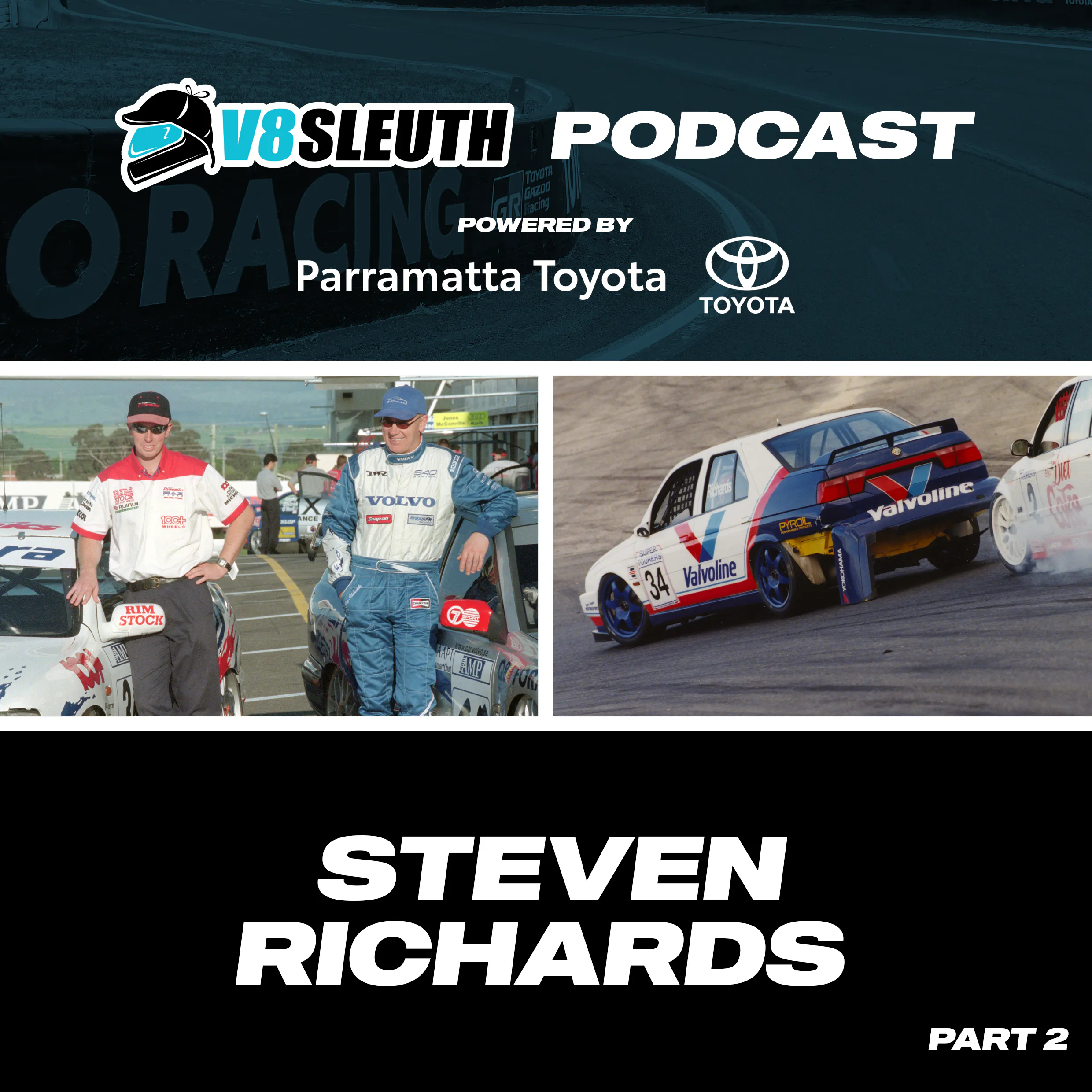
Hey there, it's Aaron Noonan, great to have you with me on this episode. It is the
podcast powered by Parramatta Toyota, Sydney's Toyota dealer with a passion for performance and
motorsport. We got into a good flow didn't we with Richo in part one, so in part two we're
going to keep it rolling. We're going to deep dive in that amazing two-litre super touring era. If
you're a V8 fan and you don't really like the two-litre stuff, don't worry there's still
plenty of V8 chat in and among part two, but if you're a two-litre tragic you'll love the chat
about the GRML for the Honda Recorder Nissan Primera and how Richo found himself on a path to
becoming the Nissan British Touring Car Championship test driver. Plus, he opens up on his regret on how
that all went down with Gary Rogers and how he stayed the night at a bloke he'd never met's house
before. Cool Rollin' Day. Let's get back into it, it's Steve Richards on the V8s with podcast
Powered by Paramatta Toyota because then GRMLives Oscar Super Touring. Yes, two-litre touring cars
is sort of a, well it starts in 94, so when you and your dad are driving the Porsche and swapping
on the weekends, that's at the two-litre rounds that was the, the Velvet in Australia manufacturer
is Chavich, if it's the official title. That's right. You had to get up at 6.30 a.m. on a Saturday
morning to watch the highlights on Channel 9. I did it every week. You'd get your two-litre,
you'd get a little bit of British touring cars, you'd get a bit of super production,
you'd get a bit of Porsche Cup, and you'd get a bit of Formula Brabham as it was then known.
With the young Gregory Murphy first appearing in a, you know, White Rolte, might have been.
No, Rick, might have been. Might have been a Rolte because he drove a Reinhardt in New Zealand.
Then he got together with Graham Watson, I think. I think he had the Rolte to begin with here.
That's right. He had the Reinhardt in New Zealand. Yeah, yeah, yeah.
Remember he flew through outside? Yep, yep, yep. The Rolte was an aluminium,
was an aluminium car, and then they went to carbon, full monocoque carbon
a little bit later, like 90. Well, Lounsey's in the cheater at that stage, which is the
Brian Samson car. Anyway, point being, that's the start of two-litre as its own thing split away
from the V8, you know, strain-turing car thing. So was that the lure of doing that that meant
the withdrawal from the Oscar, or what sort of paved the way that he had? So what actually happened
was Bob, the races were broadcast live on SBS. Yeah, so it had been on 7 for years,
and then he did an SBS deal. Yep. And then the SBS deal finished.
Valvoline Gary now was fully entrenched, or he's always fully entrenched, Valvoline's my
but had got to a point now where it was like Valvoline were sort of, well, what's next? You
know, if there's no TV really, is this something to be involved in? And that's when the decision
was made. And at the time, because the super-turing thing in the UK was going so strong, and V8
touring cars as it was, and it just sort of kicked off in its infancy in 93,
we didn't quite really know where we were heading. I think Gary had been and just had
got some interest with Peter Adderton and Terry Morris and those guys around what the future of
super-turing was like. And I think it was a better cost, it was a better entry level
cost into the series, because you could just go and buy the car. You buy the car,
you didn't have to build the car, you could buy older supercars, but even at 93, 94,
the take-up in secondhand V8 touring cars was massive. People were just privateers
are gobbling up the factory teams and going racing. So Gary thought, well, let's do this first.
And he went to Italy, and this is... Could you imagine an overseas trip with gas?
Did you go? Not to that one. So he went over with Kay, his wife, and
they went to this... So in 1994, the Alfa Romeo 155 won the British touring car championship.
Gabrielle Taquini dominant. Yeah, the red, the course, got up at 630 every Saturday.
Yeah. So he went to Italy, graph racing, and he bought the car. And Gary and Kay
themselves loaded the container in the pouring rain with all the spares and all the bits and
pieces. And he spent... I think he spent three days loading and they gave us... So one of the...
One of... You have all these unbelievable memories that you go through during motorsport. One of
those is when that container turned up at Gary Rogers and Glenn Waifley. And we opened the doors.
It was like Christmas. There was this beautiful little yellow Alfa that was... At the time,
they were so technically advanced and well engineered data acquisition, because that was
only new back then. They... All the touring cars had data acquisition, but spares, gearboxes,
engines, diffs, springs. So there's more packages to open. Gear ratios, wheels, suspension. It was
just incredible. I could not believe my eyes. And Gary and Kay... Kay had packed it all
at the back of this little alleyway next to graph racing. And I think it was Modena, Italy,
or somewhere like that. Incredible. So as a young guy then, having... This is for you.
You get to play with this. Yeah. Yeah. Yeah. Incredible. And we really... As a team, we really
struggled running it, because of course, you buy everything secondhand. You don't know what's fresh,
what's good, what's... So we had... We did. We had some struggles. We didn't have the
management software, Magneti Morelli, which is all Italian, and came in Italian.
Who could speak Italian? No. No. That's right. So we sort of battled along. But what actually
happened was, we started to go to these events and actually started to go half right. And we
weren't allowed to run the aerodynamics that they ran. I was... Yeah. Because the big thing with that
Alpha was the previous year, where they turned up with it at a brief steering current with this
massive rear wheel off the back. And everyone went, bugger off, you can't do that. That's not in
the rules. But they went, no, no, no. I'm not going to do an Italian accent here. But they basically
went, no, no, no. That's part of the standard car. It's in the package of the car. You just got to
right. So that's how... And that's why the wings all started forming on... Well,
what became Super Tourers in 95, they started calling it that. That's right. But see, we weren't
allowed to run... We had to run... I don't know why they wouldn't allow us to run it. I don't know
if the regulation set was from... Yeah. I had a feeling... That I remember... We could run the
extended front... Yeah, because it had a bigger rear wing and an extended lip sort of spoiler.
But I have a weird feeling of seeing photos of the car in that spec. Did you run it? Because the
Gold Coast... You missed the first few rounds waiting for it to turn up. Gold Coast non-champ
was the first time you ran in the car, which was just after the first round, which had been at
Philponte, which was tragic because Greg Hansford had his crash at Bondaya. But it was a non-champ
Gold Coast event that I think you debuted in. And I've got a weird feeling. I haven't looked it up
before we chatted that I had a weird feeling you used that package once. Yeah, okay. I don't...
Because it was non-champ. Yeah, it may be. Anyway. But I have a vivid memory of at Simmons Plains,
which was the only two-litre round that it hosted for many years there. And we dug out this video
with... So Super Touring Sleuth is a Facebook page out there. If you haven't followed it,
get on board with it. That's right. We're putting all the old two-litre stuff that we've come across
in our time. We've got so much more stuff and just not enough time to do it. But there's a great
clip. And I totally forgot this till I dug it out. I was at Tassie at the Supercar round this
year. And one of the guys, Dave Weimer, what we're trying to engine guy for many years.
Winesy. Winesy had said to Murph, hey, Murph, apart from a Supercar, would you ever race anything
at Tassie? And he went, nah, nah, never. And then I was in the pit lane talking with Murph and
Carl Foe. And then this chat comes up and I'm like, you drove the Audi? Yeah. Did I? So I pulled
out this clip and he's you and him racing in the Alfa and the Audi. But the Audi was the 80.
Yes. The first Audi that they brought. Four-wheel drive. Out of the hairpin. Yet he's like three,
four car links in front of the way out. But by halfway through the sweep, he's passed him.
Yeah. Yeah. It was a quick little car. So was the Alfa really good or the Audi really...
No, the 80 definitely suffered through the drivetrain power loss.
Right. Yeah, absolutely. Whereas the A4 Quattro was a much... So I don't know what they did,
but a four-wheel drive system was a lot less restrictive and it was quite good. It still
had a bit of a deficit in a straight line, but it was a lot better car. Yeah. Yeah. But yeah,
they were great time. Great. And we, you know, like I think, I'm pretty sure I qualified on
pole. Qualified on pole there. And here we were in front of the BMWs and the Audi,
isn't it? It's like three cars. The Volvo Wagon, the... Yep. Like you're a privateer.
Yes. You get nothing from Alfa. No. There's no support. No. You're on your own. There's me,
Sheryl, Mike. I think Brett Smith, he was there. A couple of guys from the dealership. Like we were,
and here's this thing where we're just scratching our heads trying to keep the wheels on it.
You know, let alone racing against these other guys. It's cool little... Because it's always
overshadowed by the five-litre slash V8 supercar stuff. But factory Audi's, which that was the
first year of them with Brad and Berth. Factory BMWs with Paul Boris and Jeff Brabham, who
had won Le Mans and IMSA championships and all that. Volvo are in with the Wagon to begin with
and they got the saloon later on. It's a pretty strong core of privateer independence. Yeah.
There was the Hyundai bubbling around. Remember that? Jim actually drove one of those at one
point very briefly. If you converted Group A cars, the Steve Allerys, Charlie O'Brien, BMWs,
Phil Ward with the Merck, the old DTM car. Yeah. Some converted Sierra's. Cool stuff. There it was.
People probably forget a lot of that now. It's 31 years ago. It's insane. But you could run your own
little... Yes. Yeah, you could. And the beauty of it was you could go and buy a car with everything
coming out of the UK and you could go and race it with a good spare's package and a good spare.
Even by today's standards, those cars to drive are just unbelievable. They're unbelievably good
cars to drive. I mean, you've done a little bit of driving the two-litre cars in historic stuff,
too. But there's a few guys that I found that either love driving the old cars or avoid them
because they're like, I don't want to change my memory of it because it was good then,
but it might not be as good now. So if I drive it down, it's not good. No, those were and they
still are. And even if you ask, you know, Murph and I do a fair bit of stuff together in New Zealand
and Paul Radisic and they are still as good today as they were back then. So the Alpha gave way
to the Honda. Yep. So there was a Honda Accord that was a 95 spec. Yes. Sacri-car that came out.
But again, I think that was late getting here because you use the Alpha.
Yes. Sort of at the start there from memory. Yeah. So was this at the point where I think
TOCA, we sort of replicated with TCR many years later, where the organising body sort of funded
a few cars, bought a few cars. Was that the case with the Honda at that point? Or maybe the Nissan
after that? I'll be honest with you. I was never involved in those conversations. So I don't
Yeah, I don't actually know. I think the Nissan.
Paramata Toyota is Sydney's Toyota dealer with a passion for performance and motorsport.
They're your complete Toyota destination for sales, finance, servicing and Toyota genuine parts.
Whether you're looking for a new Toyota, a family SUV, hybrid technology or the excitement of Toyota
GR performance, the team at Paramata Toyota is here to help. Proudly serving Western Sydney for
over 50 years, visit Paramata Toyota and experience the difference.
In hindsight now, I think the Honda was, but I didn't know that at the time. I thought Gary
gone bought it. But see the Honda and the Nissan, so the Honda Gary and I went to the UK and we
have to pack the container as well. No, no, no, they packed the container, but we went over and did
the deal and you know, did you have it in mind? Why did you go Honda? Why didn't you go something
else? Because the Honda was really competitive the year before 95. I think Dave Leslie finished
second in the in the touring car championship, second or third. So they were really competitive car,
but they were also quite a simple car. There wasn't too much.
You didn't need much. We were better off than the Alpha because the stuff that was required was all,
at least it was written English in English. But it was a good car. The Honda was a very,
very good car and it ran, it really ran on other than the big accident at Lakeside,
it ran on the smell of an oily rag. So we had one engine the whole year. We had the ability
to tune it and we were really starting to and Mike Excel was really starting to get the get the
handle on all the electronics and and you know, we were going out to John Shepard's dyno and we
were able to run run things properly and do things a bit better. We'd established a bit better
professionalism, but that that car was really good. But the trip over the experience
over to the, you know, one of my favorite memories I had with Gary is when we were going over to
get the Honda. We stopped off in Singapore for like a like a 12 hour stop or 24 hour stop over
and Gary and I were walking the back streets and we walked past this like a like a rotunda sort of
shop and in the window it was packed. There's like a little cafe restaurant thing. It was packed
all open up in the Indian part of Singapore and we went in there. There were three things you could
get, duck or hanging in the window, rice and big Carlsberg beers that like were liter liter bottles.
So Gary and I, we thought this looks all right, must be all right. We'll park here. We'll park here
for the afternoon waiting for the flight. Anyway, we stumbled out of there after three big Carl,
eight percent Carlsberg beers and and and the food was incredible in two or three bowls of this
duck and rice and you know, every almost not every time, but a lot of the times that Gary and I
would get together he goes, Stevie, remember that time we went to get the Honda? Remember that time
at that place and there was just duck that were just cutting the ducks up with big
meat cleavers and we had that. He said that was just one of the best things we did.
It's the journey, not the location or the destination that's the bit that's exactly
similar. You mentioned just before about that crash at Lakeside. I mean, that was,
Lakeside is wild. I'm not a racer, but lucky enough to go for a hot lap there one day
and I don't think I've been more scared and I was with a very good driver and a very good car
and I could look at the walls and think, oh my God, this is wild. So, so this is,
yeah, 96. You and Morris and then touch, touch, touch, you get spat off the road hard at,
what was it called? You run towards the bridge there where there'd been that massive crash years
ago with the fire. That's right. The Echie and Seaton and all those guys. 89 I think. 89, correct.
There you go. Do you want to drop? Slipped by, I need you. But you end up like,
that's, is that the biggest crash? Yeah, it will be. Yeah, it'd be a by-law one. Do you remember
Ely? Yeah, no. Yeah, so it came out of, what was it, Southern Loop, I think they used to call it.
The, the sort of the right hand, the straight term one big hander and Paul dropped a wheel off
on the left and that gave me a run up the right. And, and I probably think back now,
and I think it's probably a bit young and silly, I'd got up on the outside and he did,
he did run me wide. He did run me off the road, but being a bit stupid, I'd, and probably angry
for that happening. I just stayed up it on the grass and I went sort of side by side with him
down the grass and it jigged one way, jigged the other and fired off to the left hand side and
more or less hit, hit side on it about 140k on the arm car. And there's no, there's no gravel
or anything on there. But me being young and stupid, as it, as it was happening, I remember
going, oh, this is going to hurt. And I, and I, that was, that was the first car we had that had
head side. Oh, the wrapped round seat? That was the first car. Do you go in, drive aside? Yeah,
yep. And it's probably the worst thing to do, but I pulled myself away from the pillar just to
give, when I hit, gave me a better run up to, to smack my head against the, against the seat,
good theory. And, and yeah, I was, finally, I was knocked out, even though the vision shows me
getting out. It shows me sitting on the stretch, stretcher. I used to, I used to have my cat,
my valvoline hat used to tuck under my leg when I, so when I get out of the car, I could, I could
just put my hat. When you get interviewed or podium or, yeah, yeah, that's pro, that's pro.
There you go. And I've done that even though I can't remember it. Oh, you got the cap out?
I got the cap out, put the cap on, but they had to cut my helmet off because I was knocked out for
quite a while before I got out of the car. Yep. And I got on the stretcher and again, it was the
super touring events, super production, GT production, whatever it was, was racing. So Dad
was there and he happened to be standing on the top of the hill on the other side of the track.
So he'd raced over, saw it seen the accident happen, raced over the bridge. He was sort of there
on, on the scene kind of thing to get me out of the car with the, with the, the medicos. And then
they obviously knew I was pretty whack because taken, taken in the ambulance to the hospital.
Now I came to halfway between the track and the hospital and, and laying in the, in the ambulance
and I, I was in the back and said, I could hear Gary. Gary was in the front of the ambulance.
I said, Gary, Gary, is that, is that you? He goes, yeah, Stevie. Yep. Yep. Yeah. You always used to
call me Stevie. Yep. And I went, I've had an accident, haven't I? And he goes, yep, yep, yep.
How's the car? I don't worry about the car. Cars are all right. And anyway, the whole, but
I guess it goes to show a little bit nowadays how different things are treated. But
after that incident, so yeah, I go and get the scans, everything's okay, appears to be okay.
Still make the flight that night to go back to Melbourne, have the worst headache in the history
of all headaches, get melt and have, have the next day off, trucker rides back. I think I'll
back out at work on that. I'm going to say that you, day off, go back to work. And of course,
I'm working the work, pull the car apart because we're now working out how we're going to fix it.
It's quite badly damaged. We're going to send it to the TAFE College. Did that. It all got fixed up
five or six weeks later. It comes back and I got to put it back together. I couldn't remember
how to put it back together. I couldn't remember where I'd put the parts to the car that I'd
taken off on that Tuesday. I couldn't, I couldn't, for the life of me, I'd had headaches for like
two weeks after. So it's like a delayed, actually. Yeah. Cushed the memory. Yeah. But I just, I just
couldn't remember how to, what went where, how we, you know, I'd pulled most of it apart. There was
any like two days after the accident, you know, but just the way we treat things, that sort of
stuff now is, is completely, completely different. It's a whole nother world. It's a whole nother
world. But that was the worst one. That was the biggest one. Yeah. And it's, for those, I mean,
who might not have seen it, I think we've run it over time on Super Touring Sluth. If you don't
follow it, go and have a squeeze, but it's, because the car stops in. Yeah. There's no run up to it.
There's no energy dissipating, spinning down the road. It's lead iffy. That's right. That's right.
It's a very young lead iffy doing the, the two leader back in the day. Yep. The legend himself.
Yeah. He has gone on and done quite well for himself, hasn't he? Has, has stiffy. So the other
part with the Honda that people probably forget, they probably remember that more because it's a
spectacular incident and all that stuff. You were the only independent driver to beat the factory
cars in a race of Super Touring and it came in that Honda. Yeah. At Winton, whereas 94,
the BMWs won every fifth. Yeah. 95 was a mixture of Audi and BMW. 96, apart from your win, was
Audi and BMW. Yep. And then the history roll on in a 97, it was Audi, BMW. And it took until
your old boy won in the S40 and 98. There's something other than a BMW or Audi.
Yeah, well, I didn't know that. So to win it as an independent,
up at your private or whatever they call it at the time, up against factory cars and then probably
the 96 season is probably the, the peak. Yeah. The two leader probably would be in Australia.
Two or three dyke, Coke, BMWs, the two factory Audi's, Brock in the Volvo, the Peugeot's,
yourself, McLean. Yep. The quality in the level is probably the highest it got to
of the competitiveness. And you win. And it came the first race after the big accident.
So because the alpha had to get rolled out for, that's right.
I was in Amaru around to just fill the gap. Yep. And then that's a pretty good way to
win. Well, you must have remembered where all the bits were, to put all that together. All right.
That's right.
But that's an achievement and a win that doesn't really, you know, in your career,
there's a lot of wins. But I reckon that's what I was impressed with.
It was. It was. And at the time, we, we very much, as a little team, we very much recognize
what we've done. We hadn't, we hadn't fallen across because the blokes had broken down.
You know, being a front wheel drive car against rear wheel drive BMW, I'll be using an all wheel
drive Audi's. The starts were never as good as them. So we were always coming, we were coming
from a position back, we had, had to pass cars to get the result. And the other thing,
and I think this helped a bit later on, because, because of the bud, we had good relationship
to Yokohama. We were the only team that used to run the Yokohama Tire, which Europe, they wouldn't
go near the Yokohamas. A couple of teams tried it. The, the Nissans of Keith Adour, they had tried
the Yokohamas and the British Truing Car Championship, but they just weren't competitive.
In Japan, they were competitive for whatever reason, because they were probably on factory open
tyres that they were running as stick tyres. But that was the other thing that was impressive.
We were the only team, I think Audi were on the Dunlop's, BMW on Michelin's. Sometimes, yeah,
BMWs had been Yokos, but I think they started to push towards Michelin that year. Yep, from memory.
Yep, that's right. That's right. So for lots of reasons, it was a, and I remember at the time,
it was massive. It was massive for our team, and it was massive for us as, as
the privateers to get the results. It was really, really cool. And the other part in that 96 is,
it's not just the two-litre car, because you're going five-litre V8s at the time. That's right.
So it's, Gary was mad. Oh no, he just must have gone and asked us for it. It'll be fine.
Yep. So to do, so you, in 96, so you're out of the Oscar by this stage, that's all done.
We get a Honda, so there's eight rounds of two-liters, plus non-champ at the Grand Prix,
where you've got a double, because the V8's there as well. That's right. There's double on the Gold
Coast, which I think that was an alpha, that was in the period when the Honda's been your piece.
So there's double there as well. You got 10 rounds of Australian touring cars in the V8,
plus Sand Down plus Bathurst. Yep. There's one little team of how many people do it?
I think at this point, we'd grown to six full-timers, I'm pretty sure. Yeah, yeah,
where there were six of us in the team. Was that driven by Valveline to do the V8 thing?
Again, you know, you think of those exciting points of your life, that was one of them.
When the decision was made that, hey, we're going to do, do
V8 touring cars as well. Because again, at that point, it was like, right, I think the other,
looking back now, the other side, the super touring side was sort of supported by
the TOCA Australia in terms of the cost for things. And the V8 touring cars,
it's gathering momentum. Big grids were just getting bigger and bigger and bigger.
And yeah, Valveline, we're all for it. It was like, okay, we need to do something here. So,
yeah, we bought a Gibson Motorsport car. Now you'll be able to tell me what car.
I'm only going to do this. Well, the thing that springs in my mind is it was a car you were
familiar with. That's right. Yeah. Which guides way me to your Bathurst day two in 95.
Winfield, Gibson's, the Laydowners, Oliveson. Yes. So your first, so you'd won the Formula
Ford race in the Wedder 94 at Bathurst on the summer day morning? Yeah.
Was that your first time racing at Bathurst? No, I'd driven Mike Bourlin's car. The only,
the only event we did in a state in 91, that former Ford was in Mike Bourlin's car at Bathurst
in support race. Right. So you haven't done much at Bathurst? No, no. So we talk about now, you
know, drivers having to do miles and getting experience and driving other cars there. So
you just go Formula Ford bang, V8 touring car, super car of its day, wasn't called out at the time.
Don't do the sand down at 500. No. The team only ran one car there.
So how does that come to be? Obviously your dad's driving. He's been with Fred for a long time
by that stage. Your credentials are built in. The two-lead Alfa's gone pretty good that year.
How does that, did dad stay completely out of this? And it's a... He did, obviously. Yeah. So
1994, the Formula Ford thing was a pretty dominant year for us. And
I hadn't had a drive of the car, but at Oran Park in 94, there were some hot,
meteorites and Fred, it said to me, hey, you should go for a ride with your dad in the,
in the touring car, in the windfield, so windfield car. Oh yeah, that'd be awesome. So I got in the
car and again, you think of these moments and went for a ride with dad. Okay, they use old
tyres, they're not going to use the race tyres on the weekend. And I remember thinking, if that's
how you've got it, I just thought, it almost shattered me. I thought, I am never going to be
able to drive a car like I've just experienced dad. Like I said, I might, I might as well just
give up now because it was so overwhelming what was going on. And it was at Oran Park. So you
know, the gear shifts and everything, way faster than I'm being able to process.
And I got out of it thinking, I might as well just throw this away. I'm not even close to this
level. So anyway, the next year, we're doing all the other racing and dad said, I can't,
I must admit, I can't remember how it happened. I know Fred was going to give me an opportunity to
have a test in the car. And it happened out at Calder. And I'll be honest with you, I don't know
if the test happened or I already knew that I was going to drive as a co-driver. I can't quite
remember that. But I went and did the test and all of a sudden it wasn't that freaky and it wasn't
that scary and just another car, you know, we're driven the supertrip as another car. And it was
after that test day that they sort of, I'm pretty sure they confirmed that I was going to drive
at Bathurst. But you're right, there was, I think I went to Malala. I did a, I did a test day at
Malala. This is before the testing restriction day. So you could do whatever wherever, however.
Yep, pretty much. I had had a few different drives of the different locations and it all
started to, started to feel a bit normal, but then you get to Bathurst.
Start again. Yeah, you just start again. So if we're talking about the 95 thing now, well,
I was the co-driver and this was going to qualify the car. And Fred said, he said, look,
there's no, Steve, there's no pressure with this. It's just an opportunity for you to learn.
And the whole objective is that you, in your last stint on Sunday, whenever that occurs,
you'll end up doing a fastest lap. You'll have done all the laps you possibly can to get serious.
And at that point you'll be, you'll be surprised how well you're going. And I went, yeah, okay. So
it was great. It was, it was a perfect introduction. Did the, did the practice and has qualified it.
We got into the race and again, and it started the race. I got in, did my bit slowly. I got faster
and better and felt more comfortable in the car. And I don't, okay, it just, it's just the way it
worked out, but it got to a point where I was actually going okay in the car. And, and maybe
it's just the way that the stints rolled out, but I was going to end up in the car for the last,
for the last stint. Okay. And just young boy, you, you're like, okay, that's, that's what's going to
happen. And, and just keep, I just kept getting better and better.
And then he was right. Everything he said and he said, don't risk anything. Don't lay it on the line.
We don't care how fast you go. We just want you to learn. And then by the last stint, I was really
starting to feel comfortable. I was getting up to speed. We started catching gore, you know,
you laying it right. Use that, use that next car as a character, catch them, make a pass. And,
and we got up to, you know, I remember late in the race where we're battling, I think we're in
sixth place, get into fifth. And then there's a coke car up the road and we slowly start to catch
that. A Bradley. Yeah. Yeah. And I, and I, and I just, I'm, I'm thinking, I lay it down all.
Is this right? It's just, I mean, we had radio communication. So I was obviously being told
the right things, but, but it was like, okay. And then yeah, we ended up fourth. Unbelievable.
The first bath is the best room. Yep. Wouldn't have expected that in my wildest, wildest dream.
Somewhere, I don't know where it'll be at work somewhere. It'll be in a box at home or something.
So I camped on top of the hill that year with my dad and my cousin and my uncle. And this is before
the days of digital cameras and phones. This was like the little, um, well, they, um, Kodak disposables.
Taking photos of fast moving race cars at the top of Mount Panorama with a Kodak disposal in 1995
is really hard to get the car in frame and in focus. We don't know until you get the photos
developed. Exactly, Rich. Exactly. You had to wait a couple of weeks to know whether you had any good
shots or not. So, um, as it turned out, I got a couple of good ones in, a couple of duds that
were blurry and no good. But I've got this photo and I'll have to post it on so where it's you in
the windfield car. I'm pretty sure. And it must be Bradley in the Coke car. And it's that, that
you have that little shelf run before you get to the drop before the, the right hander before
the drop down into the elbow. It's there up on the bank at the top there, looking down because
it's quite elevated from where the fans can stand there. And I've fluked it where I've hit the button.
You and the other Coke car, there's two like trees that are like casting a shadow and it's
between the two cars and the cars are in focus. The greatest fluke in the history of motorsport
photography. You should place that. You actually should put it up for an award. There's no award
that's going to ever be won by that, mate. There is no chance that's ever going to be won.
But that could go alongside the handwritten letter. Yes. That celebrates its 30th anniversary this
year. Wow. So, um, people who watch Channel 10's coverage of V8s back in about 20, it was 18,
was 18. You were lounging in the auto barn car. We did a little story with you at Sand Down
up in the grandstand there. I was doing stuff for 10 at the time when they did the marquee rounds.
And when the guys said, Hey, we need you to do a chat with Craig and Steve, I said, Yep, cool.
I know. Yep. Plenty to talk about here. We'll, we'll be right. You know, it's pre-bathis. Yeah.
What's to talk about. And I thought, Oh, you got something in the files here to wheel.
So, um, in 96, which is a year we've discussed Louis here, it's 2026 now. It's 30 years.
So I was, I was on a blitz then because the way to communicate or to, to send fan mail was to
write to the race teams. Hi, my name is Aaron. Can I get a poster? Can I get an autograph?
Yeah. But I was more geared to, I've got some questions. Could you answer these questions?
And I'll make an article in my car club magazine and Stevie Johnson got a letter yourself,
Scafie, Crompton, all these bikes and everyone wrote back, but you took it to another level.
A three page, three page. I've still got it handwritten letter, letter on GRI.
Yeah. And said every question, not just one line or one word. It was full. I made the best
story out of that ever. So it's partly your reason why I ended up doing it.
It was, it was a riff a mate that was, that was, and you sprung it on me in the interview.
Yeah. And I, and I remember, remember it. And
yeah, that was, that was very, very cool. Very pre-social media. Very
pre-social media. You had to put effort in. It was just far off a tweet for someone and,
you know, send them a note. You had to actually sit down and write. And it was handwritten.
It wasn't, you got some high score. It would have been all in capitals.
There was. Yep. Yep. That's how I, that's how I did mine.
Impressive. Impressive. It was cool. And I've still got it. Still got it.
So 96. Yeah. So that, that gets us back on the 96 train. So the car that you drive with Anders,
who by the way, is probably the most, one of the most underrated international visitors to come
to Bathurst. Yeah. Softly spoken, sweet, bespectacled, Nissan factory driver who drove their touring
cars and sports cars. He'd come out and done the HR 31 thing for a few years in the 80s.
But it was kind of strange. Like they, he didn't come and do the GDR. Oh, you did the GDR thing
with Crompo. With Crompo. Yep. Which, if you look at the vision of that famous day at Bathurst when
Jim's in the fence, they're all, it's raining. You're all a pack of assholes. When, when that race
is declared, if you watch the vision close enough, you're there in the bunker. Yeah, I was in the
bunker. You're right. You're right among it all. Yeah, yeah, yeah. 92 Bathurst. What do you remember
that? Well, lots of, lots of things. I mean, just the event itself, but I, one of the, one of the
vivid memories is, is when any passed away. Yeah. So Denny, when Denny, quite often when he'd come
to Australia, he'd come and stay with us with his, with his daughter Adele and, and his partner,
Sandy. And so we, dad had a, and I, I'm not sure when that connection happened. It probably happened
through some racing that dad was doing in New Zealand. Well, I remember that Denny did run at
Bathurst with the JPS, been WTC in the 80s. That's, that's exactly right. That's exactly right. That's,
that's where, and so yeah, I think back to those times, you know, Denny Holm, who world champion,
champion who, you know, didn't, I knew that, but didn't appreciate it. So anyway, so the first part
of that 92 Bathurst was dad was out of the car and he, well, you know, I was standing at the back
of the, back of the bunker there and it had just all happened and dad had come up to me and he said,
hey, just let you know, Denny passed away. And it was like, well, yeah, massive.
He's had a heart attack in the car on Colorado. Yeah. Parked it up there. So that's, that's
probably one of the biggest memories I have from that day. I remember,
it's just through the relative, what are you, yeah, I'm, what am I, 20s? Yeah, 1920.
And then, then the whole chaos with the rain and it just kind of come from nowhere and,
and all of the stuff that happened and, and seeing, you know, the chaos in the, in the,
in the bunk with what was going on and then the, you know, seeing on the radio dad had crashed and
then race gets stopped and he gets driven back in the pace car and just how shattered he was.
Because he think he's just cost him the race. Yeah. Yeah. Yeah. He's just like,
well, John sligs on a wet car, a wounded car. No one was making around that corner,
not even the guy with his skill was going to get around the corner.
Or a car with all wheel drive with three wheels on it.
So, yeah, I mean, you remember that those are the moments I remember, but,
but I was, I was there because, you know, Fred, Scafie, dad, it was like just come and soak,
soak it in, you know, if ever anything might happen, what a, what a place to be. But even
the JPS days, I remember I was always, I wasn't in the, in the back of the pier at that time,
but I was always amongst it. I was always, you know. You're part of it. Yeah, I was,
I was, I was, yeah, I was always around dad and going with him to wherever,
where if he's going to an appearance or I think I've been sat in on a driver's briefing once,
as a kid at Bathurst under the tower there and that big room out the back. So, yeah,
I mean, that, that was, that was a pretty monumental moment. And, you know, a lot of
going on that day and, and dad has never really mentioned much of it. But, you know,
if you add up all the things that happened, the disappointment of, of the crash, the fact that
are made of his had passed away. There's a lot going on that day. So it's probably.
And it leads to what happened because it's out of character, so isolation. But when you add up
the other things, you go, okay, that starts to make a, make a bit more sense. So, yeah. So,
I love how we get off track here. Well, we changed tracks. No, they were off track. They're all
cool tracks. We're still back in 96 somewhere. We've got a way to go here, mate. It's, don't
worry, it gets good. It's still good from here on in. So 96, the decisions made to go five-liter
racing with GRM in an ex Gibson car because at Gibson, they're downsizing. Yes. Cigarettes go,
your dad's not driving there anymore. They can only run a car for Mark. GRM grabs a car from them,
which is the car that becomes your valvoline car, which is the car you drove. And it's
long way around, but I got back to it eventually. The giveaway, if you look at the old photos,
is it's got the red interior. That's the limit. It's just got the valvoline 32. Couldn't get 34
at the time. Someone must have had 34. I think Claude Georgie in Western Australia had it. So
you couldn't get Gary's 34. Hence why it was 32 for that first season. So point being,
massive year of motor racing, VA program, two-liter program. But other, the other part
at all of this is people have clearly been watching over in the UK at what you've been doing in two
liters here. Yep. How does the test, so you test with Vauxhall later in 96, but didn't you go over
there earlier in the year, mate? No, it was, it was, how did that all come to be? It was after
Bathurst. So it actually came from Alan Gow. Alan got in touch with me and he said, hey,
Mike Nicholson, who was the GM, general manager of motorsport in the UK. He'd been talking,
Alan Gow had been talking to Mike and they thought that it would be, there was an opportunity there
for me to go and have a test in the, in the Super Tourer. Now it's sort of, it, you know,
all these moments that little sliding door things that happen and, and paths that you cross. So
James Kay had been competing in Australia in Super Touring and I'd met James Merford,
driven that car owned, owned by Bruce Miles in New Zealand. Yep. Yep. And, and through that,
you know, I was doing the Porsche cup thing when they were racing and we were sort of involved
at the Super Touring, at those Super Touring meetings. And I'd met James, believe it or not,
when we were out afterwards having beers and things like that, having a laugh. So when this
popped up, I'd rang James and said, hey, I've got this opportunity. I'm going to the UK. Could I,
could I get a car from you? Could I, could I borrow a car while I was there? Anyway,
a long story short, that got a car off, off Voxel. But James said, sure, mate, you stay,
stay with me while you're there. And the test was out at Pembray in Wales. It was like a
four hour drive from, from the UK out west. So anyway, in the meantime, I've found out that
the team that were running the Voxel program in the UK, Ray Malek Limited, who I get a connection
with, they come up again, again. They were actually in the final year of their contract
and to be the Voxel factory team, British Touring Car Championship. And they were, there was a new
team in the mix. So by the time, so literally I left Bathurst 96 for the V8 round where you
drove with dad for the first time. Yeah, drove with dad, Gary Rogers, and I'd spun
at the exit of the chase and, and back the thing in the fence and that was it game over.
I went from there to the airport in Sydney, jumped on a plane and went to the UK on the, on the
Monday. Anyway, so things had changed quite a bit. There were, there's obviously a lot of
things going on in the background and Voxel had decided that they were, they were changing teams.
There was going to be this new team startup and whatever would happen, I landed in the UK.
This test was happening in Pembray and it was the first time there was like a handover from
Ray Malek to this new team. You know, it turns out this new team that's being established is
Triple 8 Race Engineering. Three partners, Ian Harrison, who, who was ex Williams Formula One,
ex, I think he worked in the O Touring Car, which Williams, we're running.
Derek Warwick and a, and a fella called Roland Dane.
Turns out when I get off the plane and drive to
find James Kay, who I'm going to stay the night with, I ring him up when I land
and he goes, oh look, things have changed a bit. I actually
haven't a bit of drama with my wife. Oh no. Right. So you won't be able to stay with me,
but my boss, I don't know this, but my boss is going to, he's actually going to the test.
And this is Park Lane. This The business of the car.
Of where James, James works and I get there and his boss is Roland Dane.
So what happens in the course of that? He said, I've spoken to Roland, he's going down there,
you can stay with him tonight. So I jump in the car after getting to Park Lane,
follow Roland home to his house through the little tickets. He's in his, he's in his rangey.
Follow him, spend the night at the house and I'm this quiet shy, what am I, 96? I'm 23, 24.
And Roland's got a pretty nice house and I've hardly say two words to anyone to meet
Roland and Jess and Allie, Roland's daughters who are 88 years old. Jess, I think was
eight years old. She actually remembers this quiet Australian boy that didn't say too much.
So we get up next day, we go jump in the car, go to Pembray and
and this is not a test specifically for you. No, no, no, it's not. It's a hand over. It's the hand
over. But there are some other drivers there. Ray Malik were there. So they had their regular
driver David Leslie and John Clalland, pretty sure. No, James Thompson and James Driver with
Clalland. That's right. Yes, James Thompson and yeah, but Thompson was going to Honda 97 and
he ended up there. Yep. Because all those preparation businesses swapped and chopped
whose cars because it was, you had MST had been the Honda team. That's right. But James K had
driven for Honda in the British championship in 95 Avenue had had a Honda in, I think your car
was actually ex James K. But it probably was. Yeah, So there's all these
weird little links as a point to it that you look back on and go, wow, if you whiteboarded this,
you're going to run out of text. It's crazy. Yep. Yep. So I end up at Pembray and all of a sudden
I'm starting to work out what's going on. I don't think I was ever really in contention for a drive
because of this happened and Derek Warwick had left Alpha. He was now a part owner in triple eight
and he was driving the car on the same day for the first time as well. And anyway, it's still
though unbelievable experience and look by all accounts, I did a pretty good job. It wasn't,
it wasn't a case of not being fast enough. It was just a case of, you know, the reality of a,
and it is Formula One driver in a known, in a known market where Voxel, the biggest
man. Yeah. There's a name there that can sell some of the product and knows all the tracks and can
get a good result. So it was a real, it's hard to sort of, yeah, you can't, you can't, but it's a
good experience and it's unbelievable. It sort of sets subsides for, yep, later on, sort of down the
line. So the dual program keeps going here. So this is quite a happy home. This is all, you know,
sort of the little team that can, which is kind of a thing JRM's had for a long time. Yes. But
97 is dual program again, but a newer Gibson car than the other car and another swapped this
time to a Nissan Primera from the Honda. So why the Nissan there? Cause we're jumping horses every
time in two liter, but I guess you kind of got to because if you're one year behind, you just,
that's exactly right. Yeah, you've got to have to update. You There was like,
there's a second lap difference between, between each year in terms of the pace of development
of these cars and the amount of money that was being spent. So huge money. British Trinkar budgets
were wild. Exactly. So Nissan were getting quite serious with their British Trinkar championship
program. They'd moved from Keith Adore's team, Keith Jansby and Keith had been killed a couple
of years earlier at Arvis 95. Yeah. Yep. Yep. They hadn't spent, you know, they basically
sort of pulled the plug from that cause, cause this month was Jansby. They built up their program
together. That sort of finished, but then Nissan were about to get back involved.
So, so Ray Malik who'd get the asses of the Vauxhall team because the Nissan team for 97
when Nissan come back in. Very much so. Yeah. But, but, but the program was, was
and, and on the continent in Germany, Nissan were going to the German championship was the biggest
the super, super Turin wagon. The Turin wagon, the STW, they were the biggest championship
out side of the British Trinkar series. So they wanted a team, they had a team,
Rossberg, Kiki Rossberg team, Kiki Rossberg team. And then they had Ray Malik running that,
but under Nissan's, Nismo, Nissan Motorsport Europe's umbrella. Overall. Yep. So they were
also in control at the time of the Walkinshaw Le Mans program, the 390, 390 C's, I think they
were gone, gone to a bit more of a production based sports car than a, than an out and out
group C style race car. So I was, so how long story short? Do you go with Gary on another
overseas trip? No, no, Gary sent me on my own. Oh, he didn't even go. No, he didn't even go.
So I went, I, I headed over at the start of, did you go via Singapore to that place with
the beers and the day for the rise? No, no, I don't think I did. There's a quick stop over
and then, then the trip to the UK, but it was unreal. So I was there basically doing the deal.
Again, I didn't really know. Were you haggled? Yeah, yeah, yeah. Oh, so you
weren't doing it at all. I'm, I'm, I'm organizing the parts. I'm, I'm going through. So I meet,
I meet Alec Poole, who's the, who's the head of Nissan Motorsports Europe at the time.
And I'm doing the, the deal. They sort of had developed this, they'd run a car in 96 at a,
at a, at a entry level, just let's get back in and understand what the championship,
they were, they were designed, they were going to a new model, Primera,
and they had developed these 96 and a half spec cars that would go in 96 Bs. Yeah,
96, 95s and 96 Bs. Yeah, they were. So anyway, there's, there was one of those. So they basically
had the same suspension running gear as the new P 11 road car Primera model that was,
that was coming to the market. And, and it was a great deal. They were a factory, full factory,
running them in Japan. So that, so there was lots of development going on between
Nissan Motorsports Europe, Nismo in Japan, Rossbergs in Germany, Ray Malik Limited was
still doing some of the designs. Nissan Motorsport Europe were doing 75% probably of the design work
for the cars. Ray Malik Limited were doing, you know, 25% and all of the racing specific racing
program. Yep. Yep. Yep. Anthony Reed and David Leslie were driving those cars. So anyway,
I went over there, we did the deal spares. I met all the people, all the engineers, all the best
thing about that program that, and this is what eventually helped me to do what I did in 98 was
I knew, you know, I got to know a couple of the engineers and the support that they gave
Gary's team in 97, they, they flew engineers out. Full pollen. Yep. Full pollen. No, no cost.
Really? No invoice record? No, no, no. And, and I had the engineer that came out for that event
was a guy called Chris Crawford. He stayed with me at, at our place in Glen, in wherever it was.
And, and we went down to Phillip Island, but we actually had a game. We're a team running on
Yokohama tyres that weren't getting used in Europe. And we were competitive against the factory
cars. And that, that sent a reasonable message back to the UK with, with the engineers. So we
continued on through the year with the engineers coming back every odd event. Then another guy
called Ricardo de Villier, who was Emerson Fittipaldi's main man when Emerson came to Formula
1 in the 70s, designed the Copsucar, Formula 1 car. Ricardo came over and stayed with us again,
come to some racing. So I was starting to get some good contacts within Nissan Motorsports in Europe.
You're starting to learn that this is all about people. Yes. Relationships and yep,
yep, great that you can drive fast and you can talk nice on a microphone, but at its whole core
of the career in motor racing is people based. Yep. And, and of course the super touring thing
was getting bigger and bigger. And we're all seeing it, you know, you, me, the highlights packages,
it was like, oh, this is unbelievable. And as much as VA touring cars at the time was huge,
this to me was like eyes wide open stuff. And we were really getting, getting
exposed to factory racing through our own little Nissan program. It was really, really good.
So anyway, what happened from there on the, on the other side of things,
that, that all went really well through. We didn't, we didn't have as probably as
good a results as we had in 96 with the Honda. The competition had lifted, but it was good enough
to send a bit of a message to the UK at that time for what we were doing as a little privateer team.
They're clearly seeing it going well. Yep. Team and driver in Australia. Pretty good. Yep. Pretty
good. So the other thing there is that we haven't sort of covered off and it's sort of,
it's easy to gloss over it, but when all these things that we stop and go, wow, that's cool.
We glossed it a bit because you're jumping on a plane to go to the UK, but
in 96, your dad decide. Yes. He makes the decision to come and drive at GRM with you.
Yeah. Yes. But he had a drive at Gibson to co-drive with Mark, even though he didn't have
a full-time drive, but he went, you know what, I'm going to come and do this. That's cool.
It is. I mean, he wasn't like he was forced to. It wasn't like kicking and screaming or
no one else rang him or whatever. No, no. He rang Gary. He could have driven with any team.
If it wasn't Gibson Motorsport, someone else would have signed him. He could have driven
with anyone, but he went to Gary and he saw the opportunity to be able to help the team
at a really, obviously, and help his son at a really important time of where the team we're at
to try and give them an opportunity. And also, Wally's never said it, and I understand it now,
having Clay doing some driving, an opportunity to drive against, sorry, with Steve, because
we'd raced against one another in the super touring stuff, because he had already.
Cavalier, spectre or whatever. And the Mondeo. We had an unbelievable battle
at Adelaide. Grand Prix. Yeah, Adelaide Grand Prix, the last event, 95.
And I thought I had him until the last. So you bring back the old woods.
Yeah. So looking back now, I mean, to have Dad come and do that, because in reality,
he could have driven with anyone. He could have added another Bathurst win to his driving for whoever.
We were never going to win that race. It doesn't matter whether Adelaide has
speared off and crashed or not. We weren't going to win the race in that car, but he wanted to
come and be a part of that. And that was unreal. It's cool. Yeah, very cool. But then that starts
this, I don't know if we're sidelining again, but that's what we're doing. Your era of the late
90s, early 90s at Bathurst is, and we'll deeper dive it, but it's unbelievable. And I'll just,
just the helicopter view of this. So, okay, you back it in in 96. 97, there's two races now. So
you do all the two litres and the V8s that are after that. So 97, two litre, Matt Neal comes out.
Yep. DNF, no result there, but V8 race you and your dad's second. 10 seconds behind,
Larry and Russell, like in the game. Not fast enough, but good, but second, unbelievable.
At a time when the reliability is still an issue with all the cars, they're not as bulletproof.
Next year, two litre racer, we'll deep dive that, but second in the listen with Matt.
Win the V8 race a month later with Brydie. Win the V8 race the next year with Murph in the winds
car. Yep. Third with Murph in 2000 in the K-Mart car. O1's a little bit with CEDA that could have
been a result that didn't quite late. Yeah. O2 second with Russell in the Larry Castrol car.
And then come back and be second, win the 24 hour race in the Monaro. O4 fourth with Larry
and not far off the podium after he crashed it in Friday or Saturday morning. No, no, fourth was with
JR. No, no, fourth was when you were firing, you and JR were getting into it late in O3.
Yeah, yeah, sorry, sorry, yes. And then O3, sorry. And then second in the 24 hour and then
poll in O4. Yep. And then the kangaroo happens in O4. Yes, yes, yes. That is an amazing run
of Bathis race results. Okay, they're not all wins. No, no, no. But you're in the game in pretty
much everything. And mate, you are like a cult, you should have taken out a mortgage on the podium
at Bathis. You're always hanging out up there. Like it's an amazing stint and but blended in with
with dad against dad. Yeah, yeah, it's cool. Yeah, I mean, it is then at the time you just
I'm sort of yeah, it's normal. And I'm thinking, shit, this is all right, sort of
if we just get a finish here, we're going to end up on the podium. Not not not to that degree of
naivety. Yeah, but but that's what it felt like. It sort of felt like we turn up and we keep doing
a good job and you develop my methodology at Bathis while stint to stint may have changed the
methodology of how you and it would have started right from 95. It's just like you've got to be
there at the end. So the Fred doesn't matter what you do. You do as much as you can to contribute
in and out of the car. But you've just got to be there at the end, you got to get the end first
and then see where you are. And as it turned out that kind of my own view of that just continued
for the whole time I ever raced at Bathis. And I've got to say that a lot of the time it worked
absolutely perfectly. If a salt sheet would say that. Yeah, so no, it was a great time. And you
know, but hey, there was a fair old drought for a while. They've got to that bit. Yeah. Yeah,
but no, no, you're right. Like as a young guy, you're not thinking about you're not reflecting
on that and going, wow, that was really good. Wow, that was really good. But it makes sense because
you try to do the next thing. You're in the moment. Yeah, you're in the moment. Correct, correct.
So 97 is second at Bathis. This is the real standout. But GRM is single car team still in
the V8. It's the two litre thing still going. But 98 is no super touring just V8 because it's
two cars because Bards arrives. Yeah. But 98 is a whole, there's a whole pile of stuff in 98
to unpack. But how does the pathway and what we've talked about with the Nissan stuff and
Malik and the British touring car stuff, how does that all end up with you leaving after a
couple of rounds in 98? Like what's the pathway to that all? Because someone leaving a team
mid-year, not even mid-year, we didn't get mid-year, is really unique. But the opportunity
that was provided was, well, that's hard to say. It's certainly not a regret of mine. And at the
time it never was. It probably post that all happening, I think, back in it now. And I go,
at the time it was a young guy that was just hungry to do the next best thing. And the exposure
that I'd had through Nissan got me to a point where I was in constant communication because I
really was the conduit in Australia between our Nissan super touring program and what was going
in the UK. I was ringing the engineers and I was asking for information and I was saying, hey,
they would say, hey, we've just developed this new thing on our 97 cars. It's a suspension
upgrade. You should do it. I'd go to Gary, see what it costs. And quite often that actually
just send us stuff. We wouldn't even have to pay for it. Not all the time, but just little bits
and pieces that were development stuff that they said, hey, this made a difference. And they were
still coming out to the races and bringing this stuff out. So you're not just a driver here.
Yeah, absolutely. You don't have to bring your helmet on a weekend pro driver. You are embedded
and ingrained in making shit happen in this team. So what happens in 97 with the British
touring car championship is it was probably one of the most, it probably was the most
in terms of incidents and accidents and drivers deliberately taking other drivers out to protect
points in the championship and all this sort of stuff. And it was rough and tumble anyway.
So Toca had decided that they were going to implement for the following year.
Literally, if this was going on, you could be excluded from events.
Parked up on the side. Can't drive. Can't drive. Yep. Yep. Red card. Red card.
So for that view, and you've got to remember now, the Nissan Motorsport,
Europe things are pretty evolved thing. Ray Malik running the team,
they're starting to get some results. They're getting in that top five,
Anthony Reid and David Leslie, the drivers. So Nissan Hedges events go, right, we actually need,
we need a third driver, right? We need someone that if this happens and we're in
championship contention, we need someone that can front up and drive the car because
I mean, we're not scrambling. Yeah. What do we do now? Yeah. Which has happened,
you know, where drivers have got ill and all stuff. No one sort of thought about that.
So they had test drivers in the UK. Obviously they had Matt Neal, an independent who was racing
a Nissan over there. They had a guy called Chris Goodwin who was doing a lot of the,
the grunt work, you know, at the, at the proving grounds and running things and aero testing
and all that sort of stuff. They had a young guy over there. Not sure how he was connected,
he was connected through Ray Malik. This young Scottish guy called Bryce Wilson,
who had been racing Renault Spyder Cup. They were like an open wheel pseudo sports car thing.
Wasn't that a thing Jason Plato came out? Yeah. Yep. Exactly. Exactly. And then they had this
young guy in Australia that, you know, that was going pretty good against the factory teams and
probably curiosity from the UK Pete and also the connection with Alan Gow. So I'd been over and,
you know, there were, there were lots of points where people could reference who's this guy,
what's he done? What's he part of? So they come late, late 97. They, they, Nissan Motorsport said,
we're going to do, we've got to fill this gap. We've got to have a test driver that can also
fill a hole. We're going to do it. We're going to do a test for our 98 cars in Spain in February.
I was like, Elba City. Elba City. Yeah. Yeah. Elba City. We'd like you to come and be part of
the program. They had five drivers that they were going to, to test. So I flew
over in the February. They had a very specific program the way in terms we're going to write.
This is February 98. So is the, are you keeping this on the DL? No, no, Gary,
he knows about it. Gary is fully aware of this situation and, but we don't know the timelines on
what, in terms of when they're going to make this decision or how they're going to do it. So
we turn up, Nissan have, you know, and the other thing to mention here is the scope
and the level at which the British Turing car championship is now at, where you've got Formula
One teams, you've got, you've got manufacturers spending millions of pounds on these racing programs.
And the test was set up for the 98 car at Elba City with the 97 car for five guys that were,
flown out, accommodated, and we're running through a set program. You know, we had the big meeting
in the closed room and it was like, okay, this is how this is going to run. And here's the test
team. They clearly go to places that are warm that time too. You're not having to go to
Geneva at this time of year. So they go, okay, we're going to run this program. They go through
the steps of it and it starts the next day. And I can't even, I must admit now I can't remember.
I was one of the, one of the last ones to run, maybe the second last they ran through this program.
So it was split into half days. Every driver had a half day in the car, what was termed half day,
and it was a very specific criteria. Go out, run on some used tyres, get used to the car,
get used to the track, put a new set of tyres on, qualifying run, come in, debrief, speak to the
engineers, go out on that same set of tyres, race run, see how you go, come back, debrief.
I still remember the format. Then the last, the last run was, right, brand new set of tyres,
you've got, you've got all the laps under your belt now, you know the track, car,
you've had the opportunity to ask the engineers for changes that you require,
go, go, shoot out until, until you go slower, all right, done. Now that's all good in theory,
but as the days run on, so one morning was fogged out, one of the drivers didn't,
he ran into the afternoon conditions. Never goes as planned.
Another guy, the, the, the time, the cooling belt came off, cooked, cooked the engine,
they had to do an engine change, cut a long story short, it didn't run as effectively
as, as it could have and should have, right. Matt Neal also was one of the drivers,
so he was asked to come and do it. So on the last night, they come in, they say,
this is sort of typical, they've spent millions of dollars to do this test.
We sit in the, in the same room, the fastest guy, so this guy, Bryce Wilson, he turned out
to be the fastest guy apparently and, but he couldn't stay, he had commitments, right.
Sorry, I've jumped, I've jumped the queue a bit. Again, in the room, they say, look,
hasn't quite gone the way we hoped before, we've all seen you've all done a good job,
but tomorrow we're going to get you all in the car, one set of tyres, shoot out,
lap and we'll make, we'll base our decision from the other stuff, but also more or less on your
speed on one tyre. The Scottish guy being fast for some reason, he's making an excuse like he
couldn't be there, maybe he couldn't, but he had to fly, so he couldn't do it. We all went and did
the thing and I went, okay, thank you everyone, that's it, tests over, go home, we'll, we'll,
we'll contact you basically. So month went by, nothing, I was in touch with Alec Poole, no,
no decisions being made. You had a couple of different factions, you had Nissan Motorsport
Europe who, who needed to make a decision for themselves, they controlled the whole program,
both in the UK and Germany, and then you also had Ray Malik, the race team, also had their own,
who they wanted to, to be part of the team. So it sort of turns out, I think that they wanted
Bryce Wilson, who was a, who was a Scottish guy by the sounds of it, Nissan Motorsport Europe
were pretty keen on me, but I didn't know, I didn't know that, I found that out later.
And we got to a point where there's now, we're now into, we're now into the touring car season
in Australia in 98, get the first two rounds underway, I think, I think we,
yeah, there'd been the Grand Prix, and there'd been round one was Sandown,
and round two was Tassie, yep, and round three was Lakeside, of course Adelaide wasn't even on the,
on the, no, that was the next year, yeah, that's right, yeah, yeah, so we go to Lakeside, we now
got, we're now running two cars, bugs in the second, in the second car, and it's Saturday night
at Lakeside, round three, phone rings at, like, I'm in bed, it's 10.30 at night, phone rings,
Alec Poole, okay, Nissan Motorsport. Do you think this is the answer? Well, I know that this is
the phone call, I don't know, it's good or bad, I know this is a call, and, oh Steve, you know,
yada, yada, yada, look, we'd like you to take the role of, of the Tesla relief driver.
Wow, unbelievable, and I said, okay, and I'm, I'm wrapped, this is like, this is like my world,
my whole goal at this point is to become a driver in the British Touring Car Championship,
you know, overseas, grass is always greener, the biggest Touring Car Championship in the world,
this is my entry to try and get a, get a gig. I said, Alec, okay, yeah, great, great, great,
when do you want, you know, when, when do I, when can I come over, how long have I got?
He said, as soon as possible. I went, two weeks, but no, no, this, this week, right, okay,
so I, I sat on it, I didn't, and, and clearly Gary knew I was going to do that, I'd had to
leave to go and do the test in Spain, and then I was being considered for this opportunity,
there was never any doubt about that, but probably we all thought that it either happened a lot
earlier, and it just didn't need to be made before the start of the season, or, or it's a no, all right.
So just how I didn't say anything on Sunday, we went, race the cars, end up with a pretty good
result, fourth or fifth in the, in the final race or whatever. And on you, I had to, you
know, like to me, I'm now, I'm, it's now a bit of a thing, yeah, I have to make a
call. So I think I got, might have had a discussion with Gary that night, once we'd got
off the plane back in Melbourne, I said, I've got to call you tomorrow. I've had a decision on, on
testing thing in the, in the UK. He said, yeah, no problem, ring in the morning. So I rang him in
the morning, I said, they've given me the nod, I'd like to go. He said, okay, okay, when, when are
you going? He said, I've got to go this afternoon. So, yeah. Oh, absolutely, absolutely. Because as
much as I wanted, that's what, that's the direction I wanted to go in, all the opportunity that Gary
it's funny because he accepted it. He's not wasn't, you know, I don't think necessarily happy with the
way, with the way that it occurred. And particularly because I think we all thought that potentially
it was going to be a no because it had taken so long for a decision to be made. But that afternoon,
I was on a plane in a day, I was on a plane and Anjan and I just bought a house.
We, you know, but I guess the, the, the curiosity of youth or the excitement or the,
you know, it was like, go, you know, here we go. This is, you know, this is the ticket.
Years gone by, it's probably something I thought, oh, you know, like for Gary to sort of accept
and then let me go.
Didn't try to hold your door contract.
Well, we didn't have a contract. It was just at that point in time, it was an agreement.
I was working in the workshop and it was verbal. It was a verbal agreement.
That is very Gary and Barry Rogers. That's how they do their deals. Like they're not sticklers
for paper and signatures and stamps. Don't get me wrong. It wasn't a surprise to Gary that the
possibility of it happening, but I think the timing and the way it happened never would have
envisaged them that and, and at the time I was just this hungry. I just wanted to go. I just,
this was it. This was the, and I think now I think you got up and left a perfect for no guarantee
of anything other than you're going to drive the car. You're going to drive the car and the,
the hope is that eventually you get considered for a drive, right? And, and that happened that year
of 98. But yeah, so my only regret through that whole thing is the way that that occurred.
And that's out of your hands. I know. Yeah, it is, but, but I still have enough of a conscience.
Yeah, I get it. Knowing you, I understand why you would feel that way and still feel that way.
Yeah. And it was a bit of a bug to bear. I think when I came back from the UK
with Gary, but then through the Holden connection, we kind of got reunited a bit for the 24 hour
thing and it all, it was nothing ever said about it. Other than a letter that I got from Gary
when I was in the UK, he sent me a letter and I found it like when we were moving house here.
I found it in an old filing cabinet and it was a letter about, you know, hey, Stevie, you know,
you know, sort of what happened, why, not a, a nothing nasty,
not a terrible, just, just a reflective sort of thing. Yeah. Yeah. So I have still got it
somewhere and I, and I just found it completely by surprise. And, and, and that arrived when,
when we were over in the UK, they got sent, sent to me sort of mid-year because I, at the same time
that year, I, I decided not to co-drive with them at Bathurst. I decided to go down my own path,
find my own way with the V8 thing when I was in the UK. So that's what I was going to ask you,
was the deal that, oh, well, okay, you got to do this, but come back and co-drive.
Wasn't, wasn't stated as that, never had that. It might have been assumed. And I remember
getting in there a little UK and ringing Gary and saying, hey, because Ed was still driving for,
yes, yeah, Gary, I just, and I said, look, I, I, I want to do something different. I don't,
I don't want to, you know, I'm, I'm not going to be able to drive for you. Yeah. And, and that's,
that's sort of, I'd already started speaking to stone brothers and that was bubbling along and,
um, yeah, anyway, I sort of, I think subconsciously thought it was a way for me to take the next,
what I thought was the next step into a, a team, an opportunity to go to a team that was
winning races that, that, that would, you know, I wasn't thinking of going back to Australia other
than for the, for the co-driving stuff, but I think it was another door that opened and I had
so much respect for Austin and had a good relationship with them during the years that I
was driving, talking to them about things. And I thought, you know, Jason Bright, he's going,
he's going to be really good. So yeah, that was probably my only regret for that whole thing,
but it turned out great. Like, you know, experience that you wouldn't have got it.
I still felt at that point that I was, um, you know, just out of home. I was with Ange,
we just, we just got engaged. Um, it was, it was a decision. I remember the decision to go with
Stones was a little bit against Dad's decision. Dad sort of said, oh, you know, Gary's done so
much for you. And everything he said was absolutely right. But I felt like I'd made the right decision
with the Nissan thing to go overseas. Trust your gut. Trusted my, trusted my gut for probably the
first, it was the first big decision that I'd made off the base of the things that I knew.
And, um, the stone brother thing was the same thing. I just thought, you know, what these guys
are going so good in the Australian, like, you know, watch, get sent the tape and I thought,
it's just got something. There's something about this, you know, Ross and Jimmy, there's the detail
and, you know, it was the right decision, but it was probably the first time in my life almost
that I'd validated my own decision-making processes to do something different against
probably, you know, it sounds crazy. Why would you leave, why would you leave a full-time drive
in Australia? Why would you, you know, there's plenty of those decisions where you go, why would
you do that? Why would you do that? But it was all based off what I felt was not fluff and, and
you know, it was, it was real. It was a real decision made on facts, why I made these decisions and
it validated a lot of, of things for me. But the only regret is the, the Gary stuff.
How, the how, the how, just the timing of it works in such a way. There's probably no other real
way to, yes, to do it. And if you let that opportunity pass by, it doesn't come back.
No, that's, that doesn't come back. So, so was there ever, so you go over as the test driver
for the, because there's official toker tests, you're there in case one of them gets benched,
sink injured, whatever, was there ever a real chair? So if you look back on it off the basis
that you made the decision for the, for the purpose of trying to get you into a British
touring car drive, to put the harsh lens on it, do you go, in all reality, you're not from the UK,
you don't have dollars, you don't have, okay, your thought of well Biden's manufacturer team,
everything, and that's all nice. But what's the real possibility that you're going to shoulder out?
Anthony Reid, David Leslie, Laurent Aiello comes for the next year with Ludo. Is that a pipe
tree? And I'm putting the really harsh lens on it to go as great as it is for all the experience
and the exposure and the contacts and the opportunity, and we'll talk about Bathurst as well.
The chance to actually get a British touring car drive, which was the aim of doing it,
was perhaps, I'm not, perhaps fanciful. Yeah, you're right, to a degree, you're right. But
the deal was for two years, bro. My deal with Nissan was a two year deal to the end of 99,
and there was an opportunity. So what happened in 98 was, and look,
the way it panned out was exactly right, the way Nissan should have played it, and they did play
it. But so what happened in 98? I'd go to all the toka test days in the third car.
It was like on the Friday. Yeah, Friday. On the Friday, you'd get like four hours of practice.
I've got my own car with my own engineer, who's a great friend to this day, who's actually running
the Nielsen Racing LMP2 team at Le Mans this weekend. Ron Hartfeld is a great, one of my best
mates, and he was in the, he was the engineer for the for the test car, with our own team. And then
the other thing to say also was, because I was over there, the only role I had was to drive the car.
I was employed by Nissan Motorsport Europe, not Ray Malik, and in some ways,
there was resistance from Ray, because he didn't, this is what I always felt. He never got his driver
in his test relief driver. It was Nissan Motorsport. And it was always a bit of,
he's sort of not his guy. You're not his guy, right? And, and, and I don't think that ever changed,
but, but he warmed, I think this person I am sort of saw that I was pretty genuine. And, and because
I'd come from the background of working on cars, when I would, I would go, I would make sure
that at 8 30 in the morning at the Samoesport Europe, I'd be there. Was this in did kit? Yeah.
Yeah. In coverage. I didn't have to go there. I didn't have a role to go there. I could do whatever
I wanted during the day for as long as I wasn't being employed to drive the car at a, at a proving
ground or, or a straight line test for development parts or whatever the case may be, or a TOCA test
day. I didn't have a role, but I went to Nissan Motorsport Europe every morning at 8 30. I'd be
there before all the management team would get there, form really good relationship with it.
They'd have workshop as they ran their European rally program out of there. That was where all of
the Le Mans stuff was, was, was held. That's cool. Yeah. And I'd go, I'd go in there and
if I had nothing to do, I'd help the guys prepare to Belgium pro car, Nissan Belgium pro car
thing. Rings a bell. You've told me, didn't you prep some super production cars for the Spa 24
air? Yeah. But you didn't have to do any of this. Just going before I just wanted to be there. I
didn't want to be, I just, I didn't want to be forgotten. And I wanted them to know I was prepared
to do anything. Yeah. I was going to go in there. If they, they got me one time, right, I rocked in
there in the morning. Alec Poole goes, Hey, Rossberg's need some engine and then a spare engine and
damp it at Hockenheim this weekend. Oh yeah. Okay. He goes, can you take it down for me?
Now at this point in time, we're talking in an era where you're using atlases, right? And, and maps.
There's no GPS. And I know the countries in Europe, but I sort of don't actually
know they're linked up through Europe, you know, where you've got to go. So they go within half an
hour of walking in the joint. I'm off to pick up an engine from the top of the UK where one of
this engine supplies was down to the chat. There were two engine supplies, wasn't there? Yeah,
yeah. Three in the end. But anyway, I had to, I had to hustle and make, I had to stop in at Coney
in Holland. So I had to get all these different currencies within the space of an hour. I had to,
had to get all these different currencies handed me the keys for this Volkswagen,
and Caddy, small wagon thing, driving on the wrong side of the road as this young guy,
like I had no idea. Anyway, it all worked. I got to, I got to like Coney, I got to the gates of
Coney at three in the morning, slept in the back of the Caddy on top of the engine box with my
jacket over the top of me. They had come up, the gates opened, the shocks were there at the gate
house at Coney shock absorbers. I picked them up, jumped them down to Hockenheim, turned up with
the engine, took the engine and spent the weekend at Hockenheim and then drove home on the Sunday
night. But it was all these moments were all about me. There's no way they're going to forget
who I was and what I had to do. And that was great. I was being invited to the
engineers' houses for barbecues on the weekend and really had a good relationship for it. So
I've lost the point. So what I was saying there, I really tried to entrench myself in it,
but what was happening at the Tocca Test days is David or Anthony would blow an engine up.
Take yours. Take my car. Now you know how Brad fell from for Brock in this year.
So probably I only really had five of the eight events were really good solid test days forming
and it was through that process. I think Alec Poole recognized that. And so the Australian
thousand K super tour races coming up. Alan Gow is getting, trying to get some of the British
Turing Car Championships teams to get on board with it. And it was a bit slow getting organized.
Anyway, coming one morning and all goes right. We're going to Bathurst.
Great. Awesome. Here's my opportunity. I'm actually going to get to race. Get to race. Yeah.
You've sat around not racing for months now. I'm going to get a car back to Australia and race
that car in Australia around the same time. Anthony Reed, who was on a, so Nissan's
BTCC program was 97, 98, 99 contracted. Right. At the end of 99, they were either,
they had to win the championship to guarantee the funding for whatever happened after 99.
Or it probably wasn't going to, wasn't going to go ahead. And with all the money that was
being spent in some of the manufacturers pulling out, you never knew what was quite going to.
So anyway, Alec said, I want you to put together the program to go to Bathurst. Right. Put together
your ideal team using all of our resources that we've got, including Matt Neal's team,
team dynamic are going to run it, but you choose the engineer. We're going to prep the test car here
at Nissan Motorsports Europe, which I was involved in. Me and a guy called Chris Bailey,
who I'm still in touch with, who worked for Nissan Motorsports Europe. We prepped that car
after the season finished. I towed the car down to Heathrow with all the spares and a trailer
to Heathrow. Met Bill Gibson at the airport and Pete Gibson. I turned up there with my big Mercedes
Sprinter van for the spare parts, which totaled two pallets and a car and a trailer
dropped off next to Vauxhall, who were just offloading their 13 pallets of gear, two cars,
all of the equipment plus TWA with the Volvos, who dad was racing for with Richard Rydell,
unloaded, turned around and went back. But I put together, I arranged the accommodation,
I organised... You were the co-organiser? And again, I came across my file from 98,
where I'd written down. I'd booked the house that CEDO used to stay in across on Mountain
Straight. We all stayed there. Cars from Nissan. I'd organised cars from Nissan for everyone's
I really felt like I had a lot of ownership of that program. Now what had happened was,
so this is where the opportunity presented itself for a full-time drive. Anthony Reid
was the... David Leslie was contracted three-year drive. Anthony Reid had been doing a lot of
racing in Japan in touring cars and open wheels. He was on like a two-year contract with an option
of the third year. Now it's sort of shot... Because in 98, Anthony ended up being the...
He was the form guy of the two, yeah. The two, yeah. Now, he, all of a sudden, it's come out and
it's totally Kazump Nissan. He signed for Ford. Oh yeah, which is pro driver going to run the
Mondeo. He'd signed for Ford off the back of, now I don't know what had been going on the background,
but cut a long story short, he became a Ford driver. So suddenly, when you know that the guy's
leaving, they're not that thrilled to be behind the guy that's going to leave. Yeah, and I went
to Alec's office and I said, hey Alec, like am I... He said, absolutely, nothing's off the table here.
You know, we're our relief driver, you're on consideration for sure. So the first thing for
me was like, right, this is my chance to show what I can do. Because I really hadn't had,
other than wet at Silverstone at one of the test days, where I'd, at the end of the day,
I think I was six or seventh on a wet, because I never got the good tires. I never got the,
you know, I was always, I was running different compounds or I was testing it. Yeah, any pig.
And rightly so, I didn't expect that it was any different. The only time I really got to shine
was in the wet at Silverstone and I think I ended up six at the end of the day. And again,
I wasn't on the same tires, you know, conditions change and all that stuff. But so the right,
Bathurst, that this is my opportunity. We went over there and, you know, the race, the history
of what happened in the race, I thought, right, I'm, you know, I've done, I can't do any more than
I've done, right, if this is going to happen. So when I got back and it all settled down,
I went to see, which you've done everything but win the race. Yeah. Yeah. With it was it,
it looked like a factory car. Yep. It looked similar to the British championship cars.
It's team dynamic. It's you coordinating. Yes. Plucking a few people out to make this
thing happen. Yep. Up against TWR. Yeah. Triple A. And what the Volvo wins by a second and
two seconds. You guys are together all day. Yeah. And it was a great race. Dad and I drove
raced against one another. Well, you've got a little quick theories that I think it's an
understated racing Bathurst history because it's a two-liter one, not a V8. Yeah. But I love the
story around that you start the Nissan and Jim starts the Volvo. Yeah. There was kind of a deal.
There was. There was. David Rose, the longtime commentator from Tasmania. Well, he worked with
Barry Oliver for so many years, who, you know, obviously navigated your old boy at Target for
so many years, too. There was kind of this thing that, well, he brokered the deal, I think,
between the teams. I can't remember which team he went to, but it was basically,
hey, look, if I can get the Nissan team to start, Steve, TWR, will you start Jim and the Volvo?
And both teams agree. Yeah. That's cool. Yeah, it was really good. I could have just said that.
Yeah. It doesn't fit our strategy. Exactly. It's very cool. Very cool.
Sleuthers, I have good news and I have bad news. The bad news, let's get it out of the way.
That's the end of part two. The good news is we had so much to chat about with Steve Richards
that there is a part three. I'll catch you there with the V8 Sleuth podcast powered by Paramata Toyota.
Paramata Toyota is Sydney's Toyota dealer with a passion for performance and motorsport.
They're your complete Toyota destination for sales, finance, servicing,
and Toyota genuine parts. Whether you're looking for a new Toyota, a family SUV, hybrid technology,
or the excitement of Toyota GR performance, the team at Paramata Toyota is here to help.
Proudly serving Western Sydney for over 50 years, visit Paramata Toyota and experience the difference.
About this episode
Steven “Richo” Richards recounts how Australia’s two-litre Super Touring scene took off—starting with early TV coverage, then shifting as UK-style touring rules and costs made it easier for privateers. He explains why Gary Rogers backed the move after the SBS broadcast deal ended, including the wild story of buying a dominant 1994 Alfa Romeo 155 in Italy and shipping it home. Richards also compares the Alfa’s struggles versus later Audi quattro success, and reflects on racing against factory teams while running on limited support.
IN the second episode of this mega three-part V8 Sleuth Podcast, powered by Parramatta Toyota, Steven Richards opens up about his time in Super Touring, both here and abroad.
On these shores, he raced for Garry Rogers Motorsport in the Australian Super Touring Championship aboard a range of machinery, from Alfa
Romeo to Honda and Nissan.
From there, the conversation turns to his foray into Great Britain and the chase for a factory drive at the height of the British Touring Car Championship.
There’s the chance encounter with Roland Dane, plus the tough parting of ways with Garry Rogers, plus much more.
The first episode is now available - stay tuned next week for the final instalment!
The V8 Sleuth Podcast is powered by Parramatta Toyota, Sydney's Toyota dealer with a passion for performance and motorsport. Check them out today >> https://www.parramattatoyota.com.au/
Learn more about your ad choices. Visit megaphone.fm/adchoices