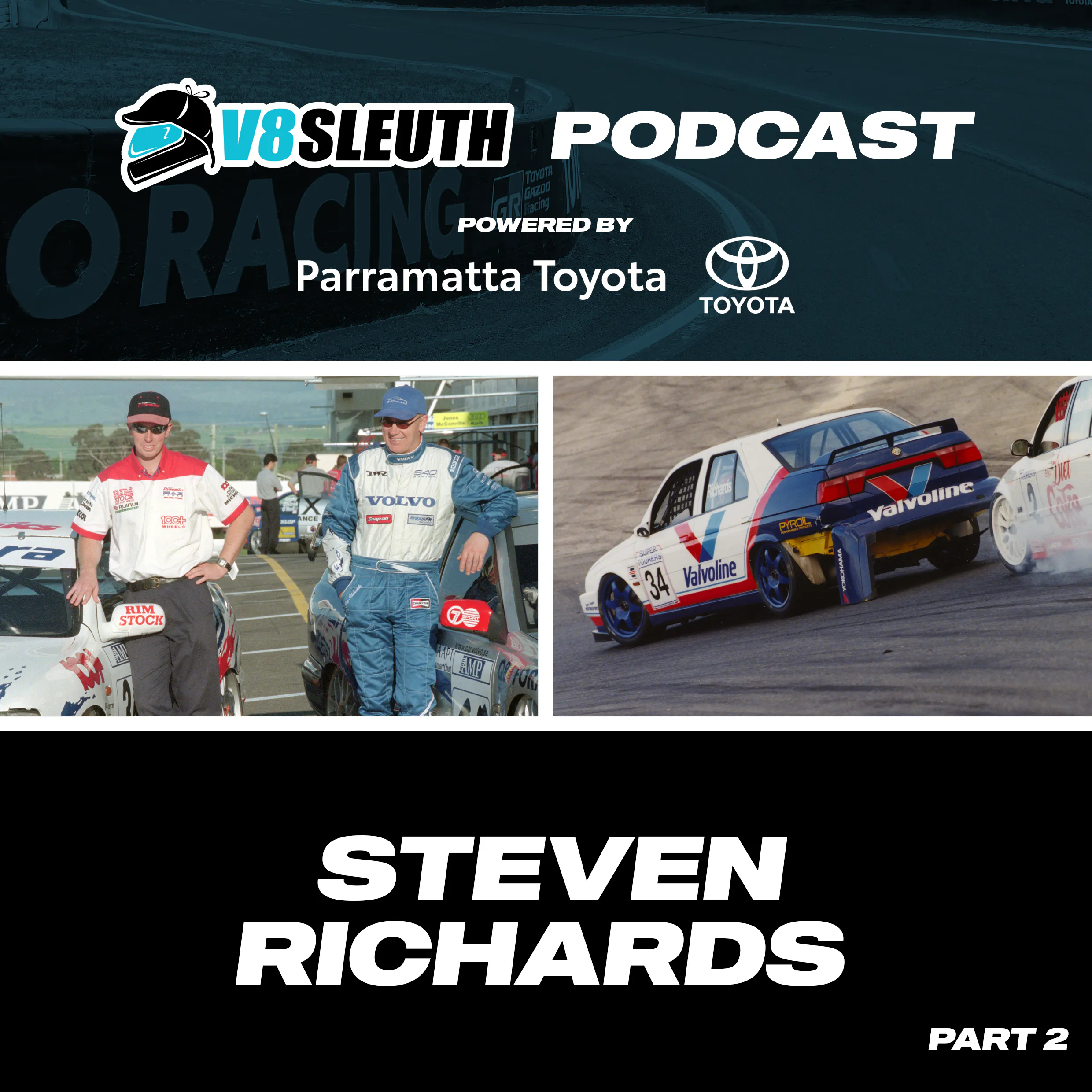
V8SP: Steven Richards | Part 2 – Super Touring & taking on the UK
About this episode
Steven “Richo” Richards recounts how Australia’s two-litre Super Touring scene took off—starting with early TV coverage, then shifting as UK-style touring rules and costs made it easier for privateers. He explains why Gary Rogers backed the move after the SBS broadcast deal ended, including the wild story of buying a dominant 1994 Alfa Romeo 155 in Italy and shipping it home. Richards also compares the Alfa’s struggles versus later Audi quattro success, and reflects on racing against factory teams while running on limited support.
two-litre super touring era
"We're going to deep dive in that amazing two-litre super touring era. If you're a V8 fan and you don't really like the two-litre stuff, don't worry..."
This is a type of race series where the cars are based on models you could buy, but heavily modified for racing. “Two-litre” means the engine size was limited to 2.0 liters, which strongly affected what cars showed up and how they were built.
“Super Touring” was a touring-car racing formula that emphasized production-based cars, typically with strict rules to keep competition close. The “two-litre” era refers to the period when engines were limited to 2.0 liters, shaping which cars and teams could compete.
Porsche Cup
"You'd get your two-litre, you'd get a little bit of British touring cars, you'd get a bit of super production, you'd get a bit of Porsche Cup, and you'd get a bit of Formula Brabham as it was then known."
“Porsche Cup” is a racing event where the cars are all Porsches. In this story, it’s one of the categories they’d watch on TV during the same weekend highlights.
“Porsche Cup” refers to a Porsche-branded racing support series or one-make competition where Porsche models compete under a common framework. In the transcript, it’s mentioned as part of the TV highlights lineup alongside touring cars and other formulas.
Formula Brabham
"you'd get a bit of super production, you'd get a bit of Porsche Cup, and you'd get a bit of Formula Brabham as it was then known. With the young Gregory Murphy first appearing in a, you know, White Rolte..."
“Formula Brabham” refers to a junior open-wheel racing series. The host is saying that’s what it was called back then, even if the name is different today.
“Formula Brabham” is the name used at the time for a single-seater formula series associated with the Brabham name. The speaker notes it “as it was then known,” implying the series name changed later.
Gregory Murphy
"With the young Gregory Murphy first appearing in a, you know, White Rolte, might have been. No, Rick, might have been a Rolte because he drove a Reinhardt in New Zealand."
Gregory Murphy is a well-known race driver from New Zealand. The host is talking about his early career—when he first started appearing in races.
Gregory Murphy is a New Zealand-born racing driver known for touring-car success, including strong performances in Australia. The speaker references his early appearance in a specific car context, highlighting how he entered the racing scene.
full monocoque carbon
"The Rolte was an aluminium, was an aluminium car, and then they went to carbon, full monocoque carbon a little bit later, like 90."
“Monocoque” means the body itself is the main structure that holds the car together. Using carbon fiber makes that structure lighter and stiffer, which helps the car handle better in racing.
A full monocoque carbon structure means the car’s main body is a single-piece “shell” made from carbon fiber composites. In racing, this is used to reduce weight and increase stiffness, improving handling and safety compared with older tube-frame or mixed-material designs.
SBS deal
"Bob, the races were broadcast live on SBS. Yeah, so it had been on 7 for years, and then he did an SBS deal. Yep. And then the SBS deal finished."
An “SBS deal” refers to a television broadcasting agreement with SBS, which can directly affect motorsport exposure and funding. When the deal ends, the series may need to rethink sponsorship and audience strategy because the broadcast platform is no longer guaranteed.
super-turing
"And at the time, because the super-turing thing in the UK was going so strong, and V8 touring cars as it was, and it just sort of kicked off in its infancy in 93,"
“Super-turing” refers to a touring-car racing category in the UK. The big point is that it was becoming popular and was relatively cheaper to get into, so more teams could race.
“Super-turing” here is shorthand for a UK touring-car category (spelled in the transcript as “super-turing”) that was growing strongly in the early 1990s. The key idea is that it was a cost-controlled entry point compared with higher-budget builds, helping more teams and privateers compete.
privateers
"the take-up in secondhand V8 touring cars was massive. People were just privateers are gobbling up the factory teams and going racing."
Privateers are independent race teams that aren’t factory-backed. They often buy cars and enter races themselves, competing alongside the big official teams.
“Privateers” are independent racing entrants that run their own teams (or smaller operations) rather than being part of the manufacturer-backed “factory” program. In touring-car series, privateers often buy cars and compete against factory teams, which can dramatically change the competitive landscape.

Alfa Romeo 155
"So in 1994, the Alfa Romeo 155 won the British touring car championship."
The Alfa Romeo 155 is a race car based on an Alfa Romeo road car. In 1994, it won the British Touring Car Championship, which is a big deal in UK touring-car racing.
The Alfa Romeo 155 is a mid-1990s touring car that became famous in the UK for winning the British Touring Car Championship in 1994. In touring-car racing, the “155” name refers to the homologation-era road car platform that teams raced in heavily modified form.
data acquisition
"At the time, they were so technically advanced and well engineered data acquisition, because that was only new back then."
Data acquisition is the race car’s way of recording what’s happening while you drive. Sensors collect information during the run, and the team can review it later to understand how the car performed. It helps teams improve setup and reliability.
Data acquisition is the onboard system that records driving and vehicle information during a race. In touring cars, it typically captures sensor data like engine behavior, gear selection, and suspension movement so teams can analyze performance and diagnose issues. The host notes it was especially advanced “back then,” making it a big part of the car’s competitiveness.
gear ratios
"So there's more packages to open. Gear ratios, wheels, suspension."
Gear ratios control how the car pulls in each gear and how fast it can go at a certain engine speed. Different tracks need different ratio “tuning.” That’s why race teams may bring multiple gear options.
Gear ratios are the numerical relationships between gears that determine how the car accelerates and how it runs at a given speed. Touring-car teams often carry multiple gearboxes or gear sets so they can match the ratios to a circuit’s speed and cornering demands. The host lists gear ratios among the spares packages they had to unpack and manage.
suspension
"Gear ratios, wheels, suspension. It was just incredible."
Suspension is what helps the tires stay in contact with the road. It affects how the car handles bumps and corners. Race teams adjust it a lot because it changes grip.
Suspension is the system of components that connects the wheels to the car and controls ride height, wheel contact, and how the car responds to bumps and cornering forces. In touring-car racing, suspension setup is critical because it affects grip and tire wear. The host includes suspension among the many packages they had to unpack for the Alfa’s competition configuration.
Magneti Morelli
"We didn't have the management software, Magneti Morelli, which is all Italian, and came in Italian."
Magneti Marelli is a company that makes race-car electronics and software. The host is saying they didn’t have the right software to operate the car’s systems, so it was harder to set up and troubleshoot. It was a language and tools problem as much as a mechanical one.
Magneti Marelli (spoken here as “Magneti Morelli”) is an Italian automotive electronics supplier known for motorsport-grade engine management and data systems. The host says they didn’t have the Magneti Marelli management software, which implies the car’s electronics and data tools were configured for Italian-language workflows. That software gap made it harder for the team to run the car correctly.
aerodynamics
"we weren't allowed to run the aerodynamics that they ran. I was... Yeah."
Aerodynamics is how the car’s shape affects airflow. In racing, teams use aero parts to increase grip by pushing the car down onto the track. But rules can restrict which aero parts you’re allowed to use.
Aerodynamics in racing refers to how the car’s shape and appendages manage airflow to create downforce and reduce drag. The host says they weren’t allowed to run the aerodynamics that the previous year’s car used, highlighting how rule compliance can limit aero packages. They also mention the “massive rear wheel”/rear setup that drew protests about legality.
wings
"So that's how... And that's why the wings all started forming on... Well,"
“Wings” are aerodynamic parts on the car, usually at the back, that help press the car down for better grip. In racing, teams adjust these parts to improve handling. The host is saying the rules and competition pushed teams to develop these aero pieces.
“Wings” here refers to rear aerodynamic wings/spoilers used to generate downforce. The host connects the earlier controversy about the car’s rear setup to why “the wings all started forming,” implying teams evolved their aero designs in response to what was allowed under the rules. It’s a shorthand for the aero hardware that changes handling balance.
Super Tourers
"what became Super Tourers in 95, they started calling it that. That's right."
“Super Tourers” is the name for a touring-car racing class. It refers to a specific set of rules and car build standards that made the cars more comparable on track.
“Super Tourers” is a motorsport category name that evolved from earlier touring-car regulations. In the mid-1990s, the rules and branding shifted, and cars were prepared to a more standardized “super touring” spec for close racing.
extended front
"We could run the extended front... Yeah, because it had a bigger rear wing and an extended lip sort of spoiler."
“Extended front” means the car’s front bodywork was shaped differently for aerodynamics. That can help the car stick better to the road at speed.
“Extended front” here refers to an aerodynamic bodywork configuration, typically meaning the front end had extra extension/shape to improve airflow. In touring-car specs, these aero packages can change downforce and balance.
bigger rear wing
"We could run the extended front... Yeah, because it had a bigger rear wing and an extended lip sort of spoiler."
A “bigger rear wing” is an aerodynamic device mounted at the back to generate downforce. More downforce improves grip and stability, especially through corners, but it can also increase drag.
extended lip sort of spoiler
"We could run the extended front... Yeah, because it had a bigger rear wing and an extended lip sort of spoiler."
An “extended lip sort of spoiler” describes a low, extended aerodynamic lip on the car’s bodywork. These small aero elements are used to manage airflow and can add downforce or improve stability without the drag penalty of a large wing.
Gold Coast
"Because the Gold Coast... You missed the first few rounds waiting for it to turn up. Gold Coast non-champ was the first time you ran in the car..."
The “Gold Coast” refers to a motorsport event held on the Gold Coast circuit in Australia. In this context, it’s being used to mark when the speaker first ran the car in that spec.
Philponte
"Gold Coast non-champ was the first time you ran in the car, which was just after the first round, which had been at Philponte, which was tragic because Greg Hansford had his crash at Bondaya."
“Philponte” appears to be a circuit/event name referenced as a prior round. The speaker ties it to a tragic crash, suggesting it’s a known stop on the series calendar.
Bondaya
"which had been at Philponte, which was tragic because Greg Hansford had his crash at Bondaya."
“Bondaya” is referenced as the location where Greg Hansford had his crash. It’s treated as a specific track/event stop within the racing calendar.
Simmons Plains
"I have a vivid memory of at Simmons Plains, which was the only two-litre round that it hosted for many years there."
“Simmons Plains” is a Tasmanian circuit used for Australian motorsport events. The speaker recalls it as a key two-litre round venue for many years.
two-litre round
"I have a vivid memory of at Simmons Plains, which was the only two-litre round that it hosted for many years there."
A “two-litre round” refers to a race meeting where the competition is limited to cars with a 2.0-liter engine displacement class. These displacement-based classes were common in touring-car and super touring eras to keep competition fair.
Four-wheel drive
"But the Audi was the 80. Yes. The first Audi that they brought. Four-wheel drive. Out of the hairpin."
“Four-wheel drive” (4WD) means power is sent to both the front and rear axles. In racing, 4WD can improve traction exiting corners, but it can also add drivetrain complexity and weight.
drivetrain power loss
"Yeah. Yeah. It was a quick little car. So was the Alfa really good or the Audi really... No, the 80 definitely suffered through the drivetrain power loss."
“Drivetrain power loss” means the car’s engine output doesn’t fully reach the wheels due to issues or inefficiencies in the transmission/transfer case/differentials. In racing, that can show up as slower acceleration and reduced ability to maintain speed through corners.

Audi Quattro
"...wer loss. Right. Yeah, absolutely. Whereas the A4 Quattro was a much... So I don't know what they did, but ..."
“Quattro” is Audi’s system for driving with power to more than just the front wheels. That helps the car grip the road better, especially when traction is limited. In the podcast, it’s mentioned to explain differences between Audi models that use Quattro.
The Audi Quattro refers to Audi’s Quattro all-wheel-drive system and is commonly associated with Audi models that use it for better traction and stability. In podcast context, it’s likely being discussed as a key difference versus other Audi models (like an A4 Quattro) and how that affected performance or handling. Because Quattro is a defining feature, it often comes up when comparing how different Audis behave in real-world driving.

A4 Quattro
"Right. Yeah, absolutely. Whereas the A4 Quattro was a much... So I don't know what they did, but a four-wheel drive system was a lot less restrictive and it was quite good."
This is an Audi A4 with all-wheel drive (quattro). All-wheel drive helps the tires grip better, especially when accelerating or on slippery surfaces.
The Audi A4 Quattro is an Audi A4 equipped with quattro all-wheel drive. In touring-car racing discussions, the point is that four-wheel drive can improve traction and reduce how “restrictive” the car feels compared with front- or rear-drive setups.

Alfa
"Yes. You get nothing from Alfa. No. There's no support. No. You're on your own."
“Alfa” here means Alfa Romeo. The speaker is saying they didn’t get help from the manufacturer, so they had to manage on their own.
“Alfa” is shorthand for Alfa Romeo in this context, referring to a manufacturer that (the speaker says) provides no support to their privateer effort. The key point is the contrast between factory backing and independent racing.

Volvo Wagon
"Volvo are in with the Wagon to begin with and they got the saloon later on."
The Volvo Wagon refers to a Volvo estate/wagon-bodied touring car used in the series the hosts are discussing. Wagon body styles can matter in touring-car racing because they affect packaging, aerodynamics, and weight distribution versus saloons.
Group A cars
"If you converted Group A cars, the Steve Allerys, Charlie O'Brien, BMWs, Phil Ward with the Merck, the old DTM car."
Group A was a set of racing rules for touring cars based on real production models. Converting a car to Group A means modifying it so it can legally race under those rules.
Group A was a historic FIA touring-car homologation category where production-based cars had to meet rules for eligibility and modification. When someone says “convert Group A cars,” they’re talking about preparing cars to fit that specific racing rule set.
DTM car
"Phil Ward with the Merck, the old DTM car. Yeah. Some converted Sierra's."
DTM is a German touring-car racing series. An “old DTM car” means a race car built for that kind of competition, not just a normal road car.
DTM refers to Deutsche Tourenwagen Meisterschaft, a German touring-car racing series. Calling something an “old DTM car” signals a car built to that series’ technical and competition standards, which often influenced later touring-car conversions.

Sierra's
"Phil Ward with the Merck, the old DTM car. Yeah. Some converted Sierra's."
The Sierra is a Ford model that people used as a starting point for race cars. They’d modify it so it could compete in touring-car events.
The Ford Sierra was a popular base for touring-car and homologation-era racing conversions. In this segment, “converted Sierra’s” implies using the Sierra platform to build cars that could compete under the era’s touring-car rules.
spare's package
"And the beauty of it was you could go and buy a car with everything coming out of the UK and you could go and race it with a good spare's package and a good spare."
A spares package is a set of extra parts you keep ready for racing. It helps you repair the car quickly if something breaks.
A “spares package” is a bundle of replacement parts provided alongside a race car or race program. For privateers, having a good spares package can be the difference between finishing events and being forced out by failures.
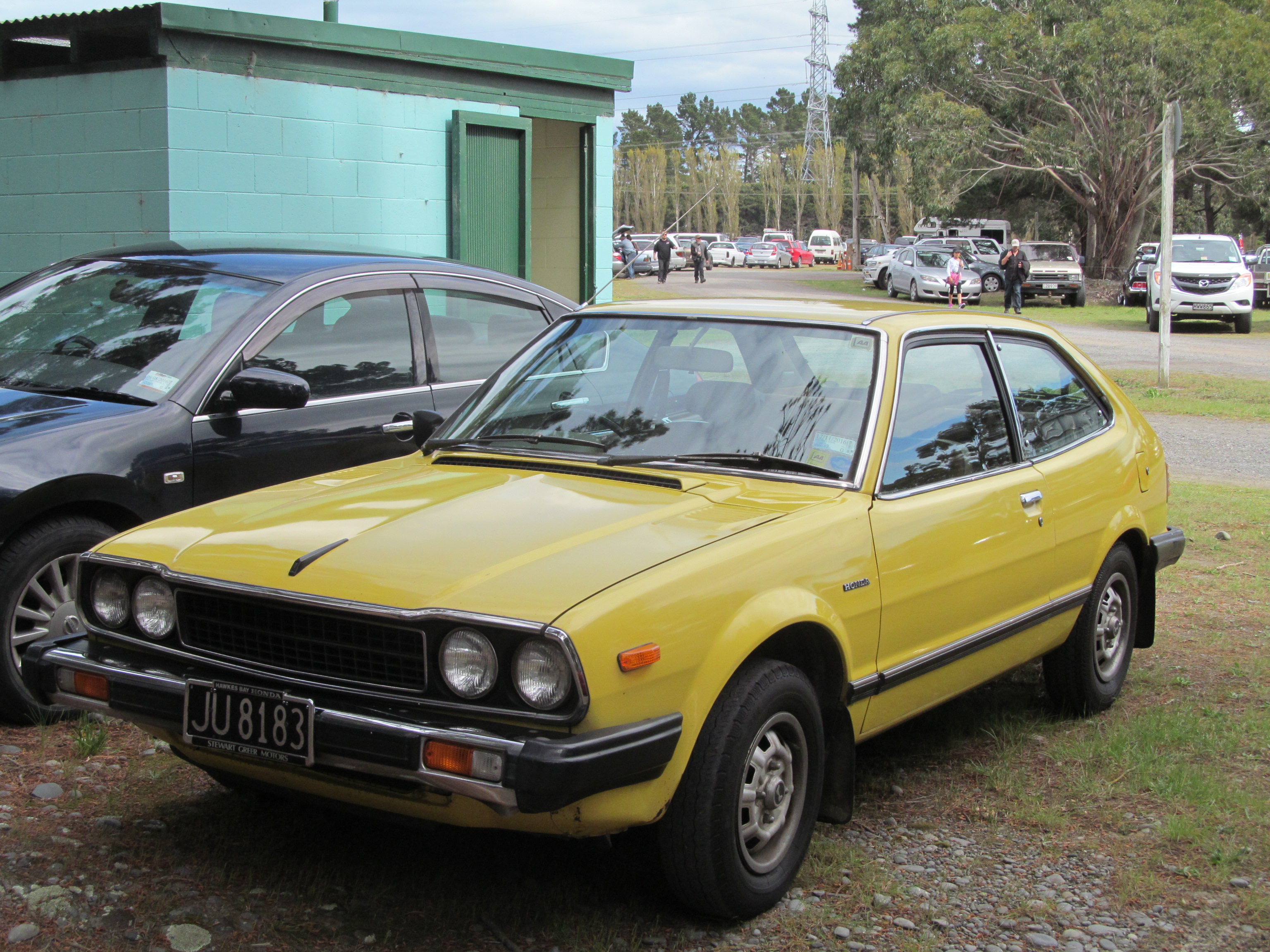
Honda Accord
"... gave way to the Honda. Yep. So there was a Honda Accord that was a 95 spec. Yes. Sacri-car that came out...."
The Honda Accord is a regular, everyday car (a sedan) made by Honda. A “95 spec” just means a version from around the year 1995. It’s often mentioned because it was common and practical for daily driving.
The Honda Accord is a mid-size sedan from Honda, known for being a practical, mainstream car that’s often used as a benchmark for everyday reliability and comfort. In a “V8 Sleuth” style discussion, a specific “95 spec” Accord may come up as a reference point for what was common or notable in that era. It’s the kind of car people remember because it was widely seen and easy to compare against other performance or luxury models from the same time period.
95 spec
"So there was a Honda Accord that was a 95 spec."
“95 spec” means the car was set up to match the 1995 racing rules and configuration. It’s basically the version of the race car for that season.
“95 spec” indicates a specific rules/trim preparation level for the 1995 racing season. In touring-car racing, teams often update cars to match the latest homologation or technical regulations for that year.
TOCA
"But again, I think that was late getting here because you use the Alpha. Yes. Sort of at the start there from memory. Yeah. So was this at the point where I think TOCA, we sort of replicated with TCR many years later, where the organising body sort of funded a few cars, bought a few cars."
TOCA is the group that runs and organizes major touring-car racing in the UK. Here, they’re described as funding and supplying cars for teams.
TOCA is the organization behind Britain’s touring-car racing series (historically the governing/promoting body for the BTCC-era). In the segment, the host describes how the organizing body funded and bought cars for competition.
TCR
"Yeah. So was this at the point where I think TOCA, we sort of replicated with TCR many years later, where the organising body sort of funded a few cars, bought a few cars."
TCR is a touring-car racing category with rules meant to keep costs down and make it easier for teams to compete. The host is saying it later used a similar approach to how TOCA operated.
TCR refers to the TCR touring-car racing formula, which uses standardized rules and cars to make competition more accessible and cost-controlled. The host compares TOCA’s approach to how TCR later replicated a similar “organizing body funds/buys cars” idea.
electronics
"to tune it and we were really starting to and Mike Excel was really starting to get the get the handle on all the electronics and and you know, we were going out to John Shepard's dyno"
“Electronics” here means the car’s computer and sensors that control how the engine runs. Tuning the electronics means adjusting the settings so the car behaves the way you want.
In modern performance cars, “electronics” usually refers to engine management and control systems—sensors, wiring, and modules that regulate fueling, ignition, boost, and other functions. When tuning, getting the electronics “handled” means calibrating those systems so the car runs correctly under real driving loads.
dyno
"we were going out to John Shepard's dyno and we were able to run run things properly and do things a bit better."
A dyno is a machine that tests a car’s engine while it’s strapped down. It helps you see how changes affect power and how the engine runs.
A “dyno” (dynamometer) is a test stand that measures engine output and behavior under controlled conditions. Teams use it to validate tuning changes—like fuel and ignition maps—before taking the car to track or road use.
Lakeside
"You mentioned just before about that crash at Lakeside. I mean, that was, Lakeside is wild. I'm not a racer, but lucky enough to go for a hot lap there one day"
Lakeside is a race track in the UK. The speaker says it’s so intense that even a quick lap can feel really scary, especially with cars running hard.
Lakeside is a UK racing venue known for high-speed sections and close barriers, which can make “hot laps” feel especially intense. The speaker describes being scared even with a good driver and car, highlighting how demanding the track is.
hot lap
"I'm not a racer, but lucky enough to go for a hot lap there one day and I don't think I've been more scared"
A “hot lap” is one fast lap where the driver goes as hard as possible. It’s usually done to show what the car and track are like at speed.
A “hot lap” is a short, maximum-effort lap where a driver pushes hard to demonstrate pace—often used for passenger experiences or track-day thrills. Because it’s driven at the limit, it can feel far more intense than normal driving.
bridge
"you get spat off the road hard at, what was it called? You run towards the bridge there where there'd been that massive crash years ago"
They’re talking about a specific part of the track near a bridge. They connect it to an earlier big crash that happened in that same area.
The speaker describes running toward a “bridge” area at the circuit, referencing a past major crash location. In track terms, specific landmarks like bridges often correspond to well-known corners/straights where incidents have historically occurred.
head side
"And, and I probably think back now... And there's no gravel or anything on there. But me being young and stupid... And that was the first car we had that had head side. Oh, the wrapped round seat?"
“Head side” means the crash hit in a way that involved the driver’s head area more directly. It’s basically describing how the impact lined up.
“Head side” here describes a head-first impact direction/position during the crash, as opposed to a more glancing contact. It’s an enthusiast shorthand for the severity and orientation of the blow to the driver’s head area.
wrapped round seat
"And that was the first car we had that had head side. Oh, the wrapped round seat? That was the first car."
A “wrapped round seat” is a race seat that holds you in more tightly than a normal seat. The idea is to keep your body from moving too much during a crash, especially around your head and neck.
A “wrapped round seat” is a racing seat design that surrounds the driver more closely, helping support the torso and reduce head/neck movement during impacts. In motorsport, this is often paired with head-and-neck protection concepts and improved restraint geometry.
super touring events
"And I got on the stretcher and again, it was the super touring events, super production, GT production, whatever it was, was racing."
“Super touring” is a type of race series for cars that are based on models you could buy. The rules are designed to keep cars similar enough that driver skill and setup matter.
“Super touring” refers to a specific era of touring-car racing, most famously the British Touring Car Championship (BTCC) style rules and the broader international Super Touring category. It typically involved highly regulated, production-based cars with standardized technical constraints to keep competition close.
super production
"And I got on the stretcher and again, it was the super touring events, super production, GT production, whatever it was, was racing."
“Super production” is a racing class where the cars are meant to stay closer to what you’d find on the road. The goal is to limit how extreme the modifications can be.
“Super production” is a class name used in touring-car racing to group cars closer to production specification than purpose-built race cars. The exact rule set varies by series and year, but the intent is to race cars that are still fundamentally stock in many areas.
GT production
"And I got on the stretcher and again, it was the super touring events, super production, GT production, whatever it was, was racing."
“GT production” is a class for sporty cars (the kind of grand tourers you might see on the road) that are raced with rules tied to production versions. It’s not a completely free-for-all race car category.
“GT production” indicates a racing category for grand touring (GT) cars that are based on production models. In practice, it usually means a ruleset that allows performance-oriented GT cars but still ties them to recognizable road-car platforms.
factory cars
"You were the only independent driver to beat the factory cars in a race of Super Touring..."
Factory cars are the official race cars backed by the car company itself. They usually have more support and resources, so beating them is a big deal.
“Factory cars” are race cars run with direct manufacturer involvement—typically more engineering support, parts, and testing than private teams. The speaker uses this to frame why beating them as an independent was such a standout achievement.
Winton
"You were the only independent driver to beat the factory cars in a race of Super Touring and it came in that Honda. Yeah. At Winton, whereas 94, the BMWs won every fifth."
Winton is a race track in Australia. The host is using it to point to a specific event where certain teams (like BMW) were especially strong.
Winton is a motorsport venue in Australia (Winton Motor Raceway). The speaker references it while comparing season results, using it as a specific example of where BMWs dominated in 1994.

Volvo S40
"...i, BMW. And it took until your old boy won in the S40 and 98. There's something other than a BMW or Aud..."
The Volvo S40 is a small sedan made by Volvo. It’s the kind of car you’d choose for everyday driving in a smaller size. The podcast mentions it in the context of comparing what other brands were doing around that time.
The Volvo S40 is a compact sedan from Volvo, typically discussed as a smaller alternative to larger Volvo models. In the podcast context, it sounds like the S40 is being used as part of a comparison—specifically noting a period where it stood out against cars like BMW or Audi. That makes it relevant in conversations about what models were competing for attention in a given timeframe.
independent driver
"So to win it as an independent, up at your private or whatever they call it at the time, up against factory cars..."
An independent driver is basically a privateer—someone racing without full factory support. The big point here is that it’s harder to beat the official manufacturer teams.
An independent driver (often called a privateer) is a racer who competes without the direct backing of a manufacturer works team. The speaker emphasizes how difficult it was to win against factory cars when you’re running with fewer resources.
front wheel drive
"we very much recognize what we've done. We hadn't... fallen across because the blokes had broken down. You know, being a front wheel drive car against rear wheel drive BMW..."
Front wheel drive means the front wheels do the work of both steering and moving the car. The speaker says that setup made their race starts harder compared with rear-wheel-drive BMWs.
Front wheel drive (FWD) means the engine’s power is sent to the front wheels, which handle both steering and propulsion. The speaker contrasts FWD against rear wheel drive BMWs, noting that the starts weren’t as good for the FWD car.
rear wheel drive
"being a front wheel drive car against rear wheel drive BMW, I'll be using an all wheel drive Audi's."
Rear wheel drive means the back wheels provide the power. The speaker is saying that, in their race situation, the rear-wheel-drive BMWs got off the line better.
Rear wheel drive (RWD) sends power to the rear wheels, leaving the front wheels primarily for steering. In touring-car racing, the speaker implies RWD BMWs had an advantage at the start compared with their front-wheel-drive setup.
all wheel drive
"being a front wheel drive car against rear wheel drive BMW, I'll be using an all wheel drive Audi's. The starts were never as good as them."
All wheel drive sends power to all four wheels. That can help the car grip the road better, which matters a lot when you’re trying to get a strong launch in racing.
All wheel drive (AWD) powers all four wheels, improving traction by distributing torque. The speaker mentions using all-wheel-drive Audi cars as a response to start-line competitiveness issues against RWD BMWs and FWD rivals.
Yokohama Tire
"We were the only team that used to run the Yokohama Tire, which Europe, they wouldn't go near the Yokohamas."
Yokohama is a tire brand. In racing, tires are a big deal because they control how much grip the car has, so choosing a certain brand can help you go faster.
Yokohama is a tire brand, and in touring-car racing tire choice can strongly affect grip and consistency. The host is pointing out that their team was willing to run Yokohama when other European teams avoided them, which became a competitive advantage.
British Truing Car Championship
"The Nissans of Keith Adour, they had tried the Yokohamas and the British Truing Car Championship, but they just weren't competitive."
This is a UK touring-car racing series. The speaker is using it to explain that a tire brand that worked in Japan didn’t perform as well in Britain.
This refers to the British touring-car championship the speaker mentions when discussing why Yokohamas weren’t competitive there. It’s a named racing series context for the tire-performance comparison.
stick tyres
"In Japan, they were competitive for whatever reason, because they were probably on factory open tyres that they were running as stick tyres."
“Stick tyres” means tires that are designed to grip the road really well. In racing, more grip usually helps you corner faster.
“Stick tyres” is racing slang for tires tuned for maximum grip rather than durability or low rolling resistance. In this context, the speaker suggests the Yokohamas worked better in Japan because they were likely the factory-spec tires optimized for traction.
Dunlop's
"We were the only team, I think Audi were on the Dunlop's, BMW on Michelin's."
Dunlop makes racing tires. Different teams run different tire brands, and that can affect how the car handles and how long the tires last.
Dunlop is a major tire brand used by racing teams. The mention is about how different teams matched their cars to different tire suppliers, which can change performance characteristics like grip and wear.
Michelin's
"We were the only team, I think Audi were on the Dunlop's, BMW on Michelin's."
Michelin is a tire maker. In racing, the tire brand matters because it affects grip and tire behavior during a race.
Michelin is a tire brand commonly associated with motorsport development. Here it’s used to contrast tire programs across teams (Audi on Dunlop, BMW on Michelin), highlighting how supplier choice was part of the competitive equation.
Grand Prix
"We get a Honda, so there's eight rounds of two-liters, plus non-champ at the Grand Prix, where you've got a double, because the V8's there as well."
A Grand Prix is a big, high-profile race event. The speaker is saying their V8 cars also showed up at a Grand Prix weekend, not only in the regular touring races.
The host is referencing a Grand Prix event as part of a mixed schedule where V8s also appeared. In motorsport, “Grand Prix” typically means a major race weekend, and here it’s used to explain how the V8 category got additional opportunities.
Australian touring cars
"You got 10 rounds of Australian touring cars in the V8, plus Sand Down plus Bathurst."
Australian touring cars are race events in Australia where cars compete under touring-car rules. The host is saying their V8 effort included a lot of Australian rounds, not just one championship.
Australian touring cars refers to the country’s touring-car racing scene, where multiple V8 and production-based categories competed. The speaker is describing a season structure with rounds in Australia and additional events, emphasizing how the V8 program expanded beyond just one series.
V8 touring cars
"And the V8 touring cars, [1620.5s] And yeah, Valveline, we're all for it."
V8 touring cars are race cars that use V8 engines and are based on regular road cars. They race under touring-car rules, which are different from open-wheel racing.
V8 touring cars are race cars based on production models, powered by V8 engines, and built to compete in touring-car rulesets. They’re a distinct category from open-wheel or single-make series because they emphasize close racing with heavier, production-based hardware.
Valveline
"And yeah, Valveline, we're all for it. It was like, okay, we need to do something here."
Valvoline is a company that makes motor oil. They often sponsor racing teams, and the host is referencing that sponsorship here.
Valvoline is an engine-oil brand that commonly sponsors motorsport teams and events. In this segment, it’s mentioned as part of the sponsorship/branding around the racing effort.
Bathurst day two in 95
"I'm only going to do this. Well, the thing that springs in my mind is it was a car you were [1634.5s] familiar with. That's right. Yeah. Which guides way me to your Bathurst day two in 95."
They’re talking about a particular day during a Bathurst weekend in 1995. It’s part of the story of how the driver’s career developed.
This segment focuses on a specific Bathurst weekend detail (“day two” in 1995), tying it to the driver’s background and career progression. It functions as a narrative anchor for how the driver got involved in touring-car racing.
Formula Ford
"So you just go Formula Ford bang, V8 touring car, super car of its day, wasn't called out at the time."
Formula Ford is a type of race series for up-and-coming drivers. It’s known for being a training ground before they move to bigger, faster cars.
Formula Ford is a junior open-wheel racing category known for developing drivers’ skills. It’s often used as a stepping stone before moving into higher-powered touring-car or prototype-style racing.
Oran Park
"And [1707.0s] I hadn't had a drive of the car, but at Oran Park in 94, there were some hot, [1713.4s] meteorites and Fred, it said to me, hey, you should go for a ride with your dad in the,"
Oran Park was a race track in Australia. Here it’s mentioned because it’s where the driver got an experience in the touring car.
Oran Park is a former Australian motor racing circuit near Sydney. In this episode, it’s referenced as the place where the speaker had a ride/experience that influenced their desire to drive the touring car.
race tyres
"Okay, they use old [1730.1s] tyres, they're not going to use the race tyres on the weekend. And I remember thinking, if that's [1735.4s] how you've got it, it almost shattered me."
Race tyres are special tires built to give the best grip during racing. The host is saying they didn’t use the top competition tires for the ride, which changes how the car feels.
Race tyres are specialized tires designed for maximum grip and performance during competition. The speaker contrasts them with the older tyres used for a ride, highlighting how tyre choice affects feel and confidence.
Calder
"I know Fred was going to give me an opportunity to have a test in the car. And it happened out at Calder. And I'll be honest with you, I don't know if the test happened or I already knew that I was going to drive as a co-driver."
Calder refers to the Calder Park racing circuit in Australia (often shortened to “Calder” in conversation). Here, it’s where the speaker did a test day that helped make driving feel less intimidating.
co-driver
"if the test happened or I already knew that I was going to drive as a co-driver. I can't quite remember that. But I went and did the test and all of a sudden it wasn't that freaky and it wasn't that scary and just another car, you know, we're driven the supertrip as another car."
A co-driver is another person who drives the same race car during the event. In long races, drivers swap so each person can rest and stay sharp.
A co-driver is a second driver who shares driving duties with the primary driver, typically in endurance racing. In this segment, the speaker explains that they were going to drive as the co-driver and later had a role in qualifying and stints.
testing restriction day
"I did a, I did a test day at Malala. This is before the testing restriction day. So you could do whatever wherever, however."
A testing restriction day is when the rules limit practice/testing before a race. The speaker says they tested before those limits kicked in, so they could drive more freely.
A testing restriction day is a rule-imposed limit on when and how teams can test cars before an event. The speaker contrasts having freedom to test “before” that day versus being constrained afterward, which affects how much seat time drivers can get.
Malala
"But you're right, there was, I think I went to Malala. I did a, I did a test day at Malala. This is before the testing restriction day. So you could do whatever wherever, however."
Malala is another Australian race track. The speaker says they did a test day there before rules limited testing, so they could drive more freely.
Malala refers to Malala Motorsport Park in Australia. The speaker mentions doing a test day there before a “testing restriction day,” emphasizing that they had more freedom to drive and learn at that time.
fastest lap
"And the whole objective is that you, in your last stint on Sunday, whenever that occurs, you'll end up doing a fastest lap. You'll have done all the laps you possibly can to get serious."
A fastest lap is the quickest one lap the car completes during the race. The goal is to be at your best at the right moment so you can set the quickest lap time.
A fastest lap is the single quickest lap time recorded during a race session. Here, the team’s objective is for the co-driver to time their performance so that their last stint lines up with the chance to set that fastest lap.
stints
"And the whole objective is that you, in your last stint on Sunday, whenever that occurs, you'll end up doing a fastest lap. You'll have done all the laps you possibly can to get serious. And at that point you'll be, you'll be surprised how well you're going."
A stint is a chunk of the race where one driver is in the car. After that chunk, the car switches to the other driver.
A stint is a continuous period of time (or number of laps) that one driver spends behind the wheel before handing off to another driver. The speaker talks about how their “last stint on Sunday” and how the stints “rolled out” affected when they could aim for a fastest lap.
qualify
"Did the, did the practice and has qualified it. We got into the race and again, and it started the race."
Qualifying is the session where drivers try to set their best lap time. That time helps decide where the car starts in the race.
To qualify is to set a lap time during the qualifying session that determines starting position for the race. The speaker says they did practice and “has qualified it,” linking their preparation to how the car would start the race.
radio communication
"I remember late in the race where we're battling, I think we're in [1952.6s] sixth place, get into fifth. And then there's a coke car up the road and we slowly start to catch [1958.6s] that. A Bradley. Yeah. Yeah. And I, and I, and I just, I'm, I'm thinking, I lay it down all. [1965.9s] Is this right? It's just, I mean, we had radio communication. So I was obviously being told [1970.0s] the right things, but, but it was like, okay."
Radio communication in racing is the driver’s two-way link to the pit crew, used to relay strategy and instructions during a stint. It can include lap-time targets, tire/brake management guidance, and when to defend or make passes.
Mount Panorama
"Taking photos of fast moving race cars at the top of Mount Panorama with a Kodak disposal in 1995 [2004.7s] is really hard to get the car in frame and in focus."
Mount Panorama is a well-known race track in Australia with a lot of steep uphill and downhill driving. That makes it tricky because the car behaves differently depending on where you are on the hill.
Mount Panorama is the famous hillclimb/race circuit in Bathurst, Australia, known for its big elevation changes and long, fast sections. In touring-car racing, it’s especially challenging because braking, traction, and visibility vary a lot as you crest and descend the mountain.
factory driver
"Softly spoken, sweet, bespectacled, Nissan factory driver who drove their touring cars and sports cars."
A factory driver is backed by the car company itself. That usually means better support and more direct involvement with the race car.
A “factory driver” is a racer supported directly by an automaker, usually with more technical input and resources than independent teams. In touring-car racing, that can affect car development, reliability, and competitiveness.
HR 31
"He'd come out and done the HR 31 thing for a few years in the 80s."
“HR 31” is the name of a specific Nissan model used for racing. It’s not just a generic “Nissan”—it points to the exact car they were competing with.
“HR 31” is a Nissan model designation used in touring-car racing. It identifies the specific car platform Anders drove in the 1980s, which matters because different generations have different engines, balance, and handling characteristics.
pace car
"then race gets stopped and he gets driven back in the pace car and just how shattered he was."
A pace car is a car that leads the race cars slowly when something dangerous happens on track. It keeps everyone from driving at full speed until the track is safe.
A pace car is a safety vehicle used during a race when conditions are dangerous (like heavy rain or an accident). It leads the field at controlled speed until the track is safe again, helping prevent further crashes.
wet car
"well, John sligs on a wet car, a wounded car. No one was making around that corner,"
A "wet car" in this context means the car is running on a wet track. The tires have less grip, so turning and braking are harder and the car can slide.
"Wet car" here means a car on a wet track with reduced tire grip and more unpredictable traction. In that situation, even skilled drivers can struggle to make the corner without sliding or losing control.
five-liter
"So 96, the decisions made to go five-liter"
“Five-liter” means the engine is around 5.0 liters in size. Bigger displacement often means more potential power, and racing rules can use engine size to level the competition.
"Five-liter" refers to engine displacement—an engine with about 5.0 liters of total capacity. In touring car/super touring rules, displacement limits are often central because they affect power potential and how teams build engines.
two-liter program
"point being, massive year of motor racing, VA program, two-liter program. But other, the other part"
A “two-liter program” means the racing cars are limited to engines around 2.0 liters. That rule affects what kind of engine setup the team can use.
A “two-liter program” means a racing effort built around a 2.0L engine displacement class. That displacement limit shapes the engine design, tuning targets, and the competitive field for the season.
Vauxhall
"How does the test, so you test with Vauxhall later in 96, but didn't you go over there earlier in the year, mate?"
Vauxhall is a car brand from the UK. They also support racing programs, and here they’re connected to the test he did for the Super Touring effort.
Vauxhall is a major UK automaker (part of Stellantis) that has long participated in British motorsport, including touring-car racing. In this segment, it’s referenced as the manufacturer he later tested with.
homologation
"there was an opportunity there for me to go and have a test in the, in the Super Tourer. Now it's sort of, it, you know,"
Homologation is basically the rule that says the race car has to be based on a real, eligible road car. It’s how racing series make sure teams aren’t building completely unrelated machines.
Homologation is the process of certifying that a race car is based on an eligible production model and meets category rules. Touring-car series rely on it to keep competition tied to road-car platforms.
Pembray in Wales
"And the test was out at Pembray in Wales. It was like a"
Pembrey is a race track in Wales. It’s where the test he mentions was done, so it’s a real place in the racing world.
Pembrey is a motorsport circuit in Wales, used for testing and racing events. The host mentions the test location there, which helps listeners understand the real-world logistics of the UK test.
factory team
"to be the Voxel factory team, British Touring Car Championship."
A “factory team” is a racing team backed by the car maker itself. It typically gets more official support and resources than smaller independent teams.
A “factory team” is a racing team that is directly supported by a car manufacturer (or operates as the manufacturer’s official effort). That usually means more direct access to engineering resources, parts, and development compared with privateer teams.
V8 round
"So literally I left Bathurst 96 for the V8 round where you drove with dad for the first time."
A “V8 round” is one event in a racing series where the cars use V8 engines. It’s basically one stop on the racing calendar.
A “V8 round” refers to one race weekend (a round) in a V8-powered touring/car series. Here it’s used to connect the host’s Bathurst experience to the later UK trip.
handover
"This test was happening in Pembray and it was the first time there was like a handover from Ray Malek to this new team."
A “handover” here means one group passing the work to another group. It’s the moment when the new team takes over the testing responsibilities.
In motorsport operations, a “handover” is the transfer of responsibility from one team/program to another—often including personnel, car preparation duties, and test planning. Here it marks the transition from Ray Malek to the newly established team.
Triple 8 Race Engineering
"it turns out this new team that's being established is Triple 8 Race Engineering. Three partners, Ian Harrison..."
Triple Eight Race Engineering is a racing team that builds and runs cars for competition. Here, it’s the new team that’s taking over as the host arrives in the UK.
Triple Eight Race Engineering is a well-known motorsport team/engineering outfit that competes in touring-car and other racing categories. In this segment, it’s described as the new team being established for the UK testing/BTCC-related context.
Ian Harrison
"Triple 8 Race Engineering. Three partners, Ian Harrison, who, who was ex Williams Formula One..."
Ian Harrison is one of the people helping run Triple 8 Race Engineering. The host mentions he has racing experience, including work connected to Formula One and touring cars.
Ian Harrison is named as one of the partners behind Triple 8 Race Engineering. The host also notes his background connected to Formula One and touring-car work, positioning him as a key figure in the team’s leadership.
Derek Warwick
"Three partners, Ian Harrison... Derek Warwick and a, and a fella called Roland Dane."
Derek Warwick is named as one of the partners in the Triple 8 Race Engineering setup. The host is using him to highlight the team’s racing connections.
Derek Warwick is mentioned as one of the partners associated with Triple 8 Race Engineering. He’s referenced in the context of the team’s leadership and racing pedigree.
Roland Dane
"Roland Dane. ... his boss is Roland Dane. So what happens... he said, I've spoken to Roland, he's going down there..."
Roland Dane is one of the people behind Triple 8 Race Engineering. In this story, he’s also the boss figure connected to the test the host is arriving for.
Roland Dane is identified as a partner at Triple 8 Race Engineering and is the person the host’s contact says will be going to the test. This makes him a central figure in the UK testing logistics described in the segment.

Nissan Primera
"97 is dual program again, but a newer Gibson car than the other car and another swapped this time to a Nissan Primera from the Honda."
The Nissan Primera is a regular Nissan car that was used in racing. Here, the team switched to it from a Honda because their race program needed a different car to keep up with the competition.
The Nissan Primera is a European-market compact sedan/hatch platform that Nissan used as a basis for touring-car racing in the 1990s. In this segment, it’s mentioned as the car they swapped to from a Honda, reflecting how Super Touring teams changed homologated race cars to stay competitive.
STW
"The Turin wagon, the STW, they were the biggest championship out side of the British Trinkar series."
STW refers to the German touring-car championship. The hosts are saying it was a major series in Europe, so Nissan invested in it.
STW is shorthand for the German Super Touring championship (commonly referred to as the Deutsche Tourenwagen Meisterschaft in that era). In this segment, it’s described as the biggest championship outside the British series, which is why Nissan wanted a strong team there.
Nismo
"but under Nissan's, Nismo, Nissan Motorsport Europe's umbrella."
Nismo is Nissan’s racing arm. In this story, it’s the group that helped run and support Nissan’s motorsport effort.
Nismo is Nissan’s motorsport division, responsible for racing programs and performance engineering support. Here it’s used to explain how Nissan’s return to racing was organized under Nissan Motorsport Europe.
Alec Poole
"I meet Alec Poole, who's the, who's the head of Nissan Motorsports Europe at the time. [3109.2s] And I'm doing the, the deal."
Alec Poole is the person the host says they met who led Nissan’s motorsport operations in Europe. The meeting is part of arranging support and parts for the racing effort.
Alec Poole is identified as the head of Nissan Motorsports Europe at the time. In the segment, the speaker meets him while organizing the parts and handling the deal for the racing program.
Ray Malik Limited
"Nissan Motorsports Europe were doing 75% probably of the design work [3169.1s] for the cars. Ray Malik Limited were doing, you know, 25% and all of the racing specific racing program."
Ray Malik Limited is mentioned as one of the companies helping design parts of the race program. The host is describing who did what in the development process.
Ray Malik Limited is referenced as a design partner contributing a portion of the work on the racing program. The speaker breaks down responsibilities between Nissan Motorsports Europe, Nismo in Japan, and Ray Malik Limited.
Rossbergs
"Nismo in Japan, Rossbergs in Germany, Ray Malik Limited was still doing some of the designs."
Rossbergs is a company the host says helped with the racing car development. It’s part of the team of partners working across different countries.
Rossbergs is mentioned as a German partner involved in the development work for the touring-car program. The speaker groups Rossbergs with Nissan Motorsports Europe and Nismo as part of a multi-country engineering effort.
Request an Explanation
Heard something you'd like explained? We'll add it to this episode.
Sign in to request explanations for terms you heard.
Want to learn more?
Browse our glossary for plain-English explanations of automotive terms, jargon, and concepts.
Help improve this episode
See something that's not quite right? Our annotations are AI-generated and can sometimes miss the mark. Click the flag icon on any annotation to suggest a correction.