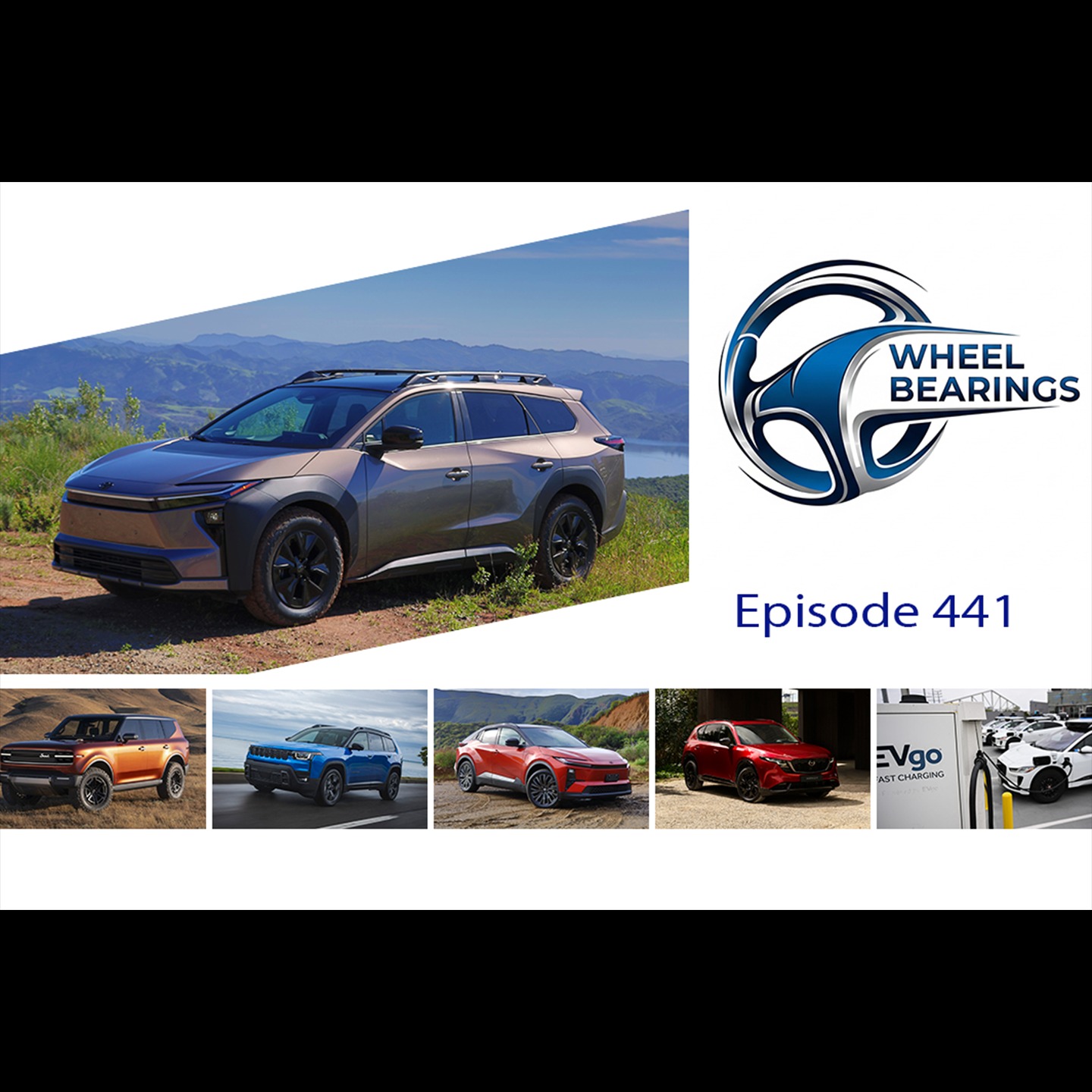
The hosts discuss their recent drives, focusing on the Volvo XC40 B5 AWD and the Aston Martin Vanquish Volante. The Volvo impressed with its winter handling, comfort, and power, though it felt dated with a small screen and wired connectivity. It's ideal for couples or small families but cramped for more passengers. The Aston Martin Vanquish Volante, a high-performance convertible with 824 horsepower, offers a thrilling drive with advanced tech but comes with a hefty price tag and some quirky infotainment challenges. The episode blends practical daily driver insights with exotic car excitement.
We're a little late with this week's show because we were waiting for the embargo to lift on some stuff. Robbie drove the Aston Martin Vanquish Volante, Nicole had the Volvo XC40 and Sam had the 2025 Mazda CX-5.
Nicole had the opportunity to drive the all-new 2026 CX-5 and talk with project manager for in-vehicle technologies, Matthew Valbuena. Sam drove the new Toyota bZ Woodland and C-HR. Uber is building out a suite of tools to support the deployment of robotaxis on its platform. First reviews of the 2026 Jeep Cherokee are out. Scout is denying reports that the Scout launch is delayed to 2028 and Sam discusses some of the unobtanium cars he saw while on vacation in Mexico including lots of Chinese vehicles.
"But, you know, if you got a family, got kids that need to sprawl, you know, maybe you want to step up to the XC60. Yeah, it's just a little, it's not a car for, it's not really a great family car."
The Volvo XC60 is a bigger SUV than the XC40. It has more room in the back seat, so it's better if you have a family or need to carry more people.
The Volvo XC60 is a mid-size luxury SUV that offers more space and comfort than the XC40, making it a better choice for families with children or those needing more rear seat room.
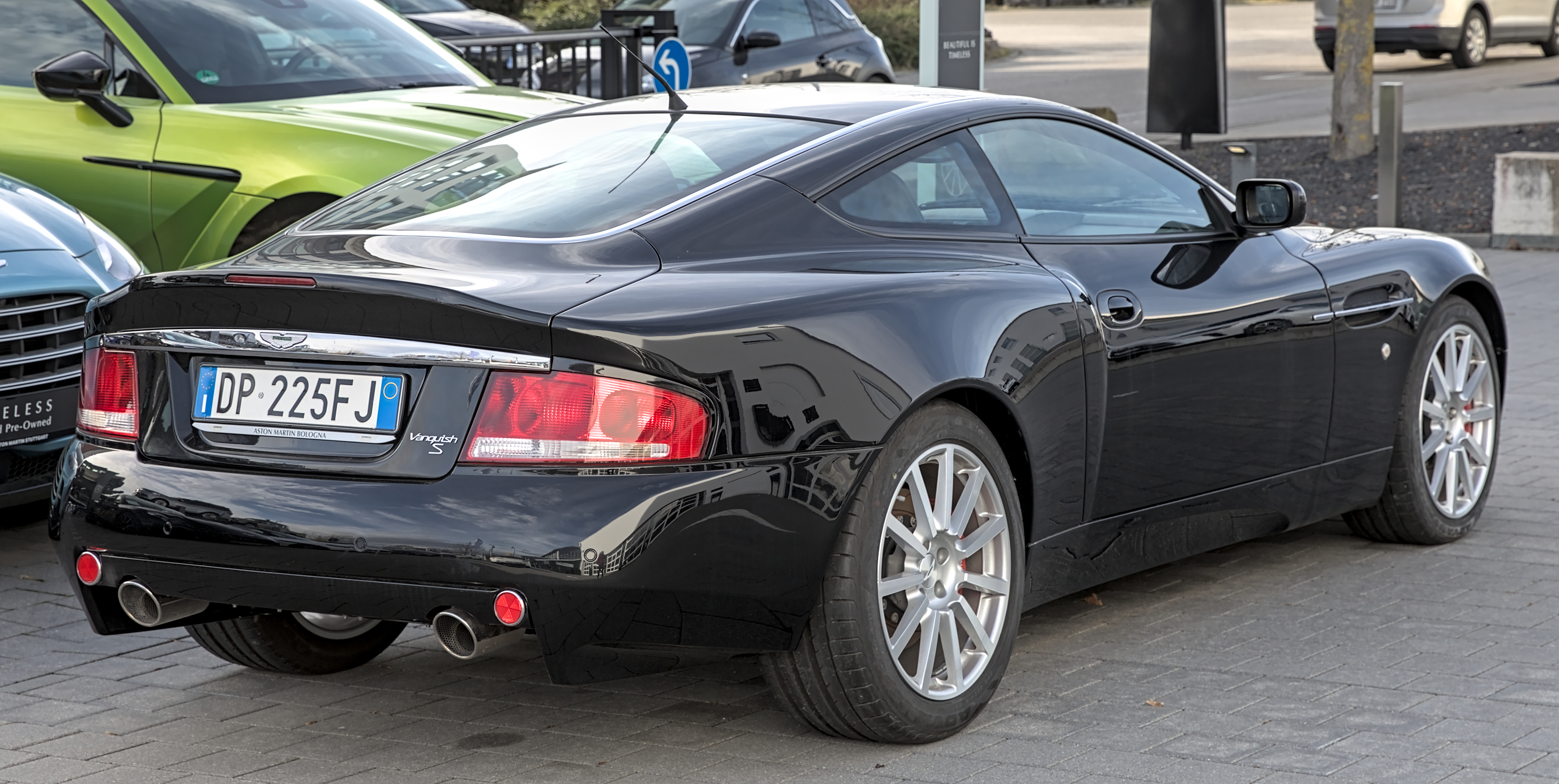
"It's the Aston Martin Vanquish Volante. So it's the, it's the Vanquish, but with that, but it's a convertible. So it's like, ooh, ah."
The Aston Martin Vanquish Volante is a fancy sports car that you can drive with the roof down. It's a stylish and fast car made by Aston Martin.
The Aston Martin Vanquish Volante is the convertible version of the Vanquish grand tourer, known for its luxury, performance, and elegant design. 'Volante' is Aston Martin's designation for convertible models.
Horsepower tells you how strong the car's engine is and how fast it can go.
Horsepower is a unit of measurement that indicates the power output of an engine. Higher horsepower generally means the car can accelerate faster and achieve higher speeds.
This is a very big and powerful engine with twelve cylinders and two turbochargers that help the car go really fast.
This engine is a 5.2 liter V12 with twin turbochargers, meaning it has twelve cylinders arranged in a V shape and uses two turbochargers to increase power output. This setup delivers very high horsepower and strong performance.
"it has, you know, adaptive cruise control and lane keeping assistance."
Adaptive cruise control helps the car keep a safe distance from the car in front by slowing down or speeding up on its own.
Adaptive cruise control is a driver assistance feature that automatically adjusts the car's speed to maintain a safe distance from vehicles ahead, reducing the need for manual speed adjustments.
"it has, you know, adaptive cruise control and lane keeping assistance."
Lane keeping assistance helps the car stay in its lane on the road so you don't accidentally drift out.
Lane keeping assistance is a safety feature that helps the driver stay within their lane by gently steering or alerting if the car begins to drift unintentionally.
"if you're Aston Martin, it's really expensive to do your own infotainment system."
An infotainment system is the screen and controls in a car that let you listen to music, use maps, and connect your phone.
An infotainment system is an integrated system in a vehicle that provides entertainment, information, and connectivity features, often including navigation, audio, and smartphone integration.
Formula 1 is a type of very fast and high-tech car racing where special cars race on tracks around the world. These cars are built to be very fast and use the latest technology.
Formula 1, or F1, is the highest class of international single-seater auto racing sanctioned by the FIA. F1 cars are known for their advanced aerodynamics, extreme speed, and cutting-edge technology.
""It's not lane key. It doesn't center you, but it's lane keep assist.""
Lane keep assist helps your car stay in its lane by gently steering it back if you start to drift. It doesn't keep the car exactly in the middle but helps avoid accidents.
Lane keep assist is a safety feature that helps prevent unintentional lane departures by gently steering the car back into its lane if it detects drifting. Unlike lane centering, it does not actively keep the car centered in the lane.
"Six-speed automatic transmission. And the CX-5 was kind of the first of the Mazdas to really upgrade the interior"
This is a part of the car that changes gears for you automatically, and it has six different gear levels to help the car run smoothly and use fuel better.
A six-speed automatic transmission is a gearbox that automatically changes gears through six forward speeds, providing a balance of performance and fuel efficiency.
The Honda CR-V is a small SUV that many families like because it has a lot of space inside and is easy to drive.
The Honda CR-V is a compact crossover SUV known for its spacious interior, fuel efficiency, and strong reputation for reliability, competing directly with the Mazda CX-5.
The Toyota RAV4 is a popular small SUV that many people buy because it is dependable and useful for everyday driving.
The Toyota RAV4 is a compact crossover SUV known for its reliability, practicality, and strong resale value, often competing in the same segment as the Mazda CX-5.
"You want to take guesses at the destination charge? Ooh, 11. 12 and A size."
Destination charge is a fee you pay to get the car from the factory to the dealer. It's added on top of the car's price.
The destination charge is a fee added to the price of a new car to cover the cost of transporting the vehicle from the factory to the dealership. It is usually a fixed amount and is separate from the MSRP.
"It had all the driver assist features. It had adaptive cruise control with stop and go, blind spot monitoring, lane keeping assist, you know, all that stuff."
Driver assist features are tools in the car that help you drive more safely and easily.
Driver assist features are technologies designed to help the driver operate the vehicle more safely and comfortably, including systems like adaptive cruise control, blind spot monitoring, and lane keeping assist.
"And has 40, 20, 40 split fold seats so that you can, you know, have people sitting on the left and the right and still put like skis or something through in the middle, which is pretty cool."
The back seats are split into three parts, so you can fold down the middle or sides separately to carry people and stuff like skis at the same time.
A seat configuration where the rear seats are divided into three sections with a 40% section on each side and a 20% section in the middle, allowing flexible passenger and cargo arrangements.
"but I'm excited for them to do the hybrid and see how that comes out and see if that really does give you that a little extra oomph."
A hybrid car uses both a gas engine and an electric motor to help it go. This can make the car use less gas and sometimes be quicker.
A hybrid vehicle combines a traditional internal combustion engine with an electric motor to improve fuel efficiency and sometimes performance. The electric motor can provide extra power or assist during acceleration.
"You know, the SkyActiv G engine is still a really wonderful engine. It's a good little engine."
The SkyActiv G engine is a type of engine Mazda makes that helps the car use less gas while still running well.
The SkyActiv G engine is Mazda's line of gasoline engines designed for improved fuel efficiency and performance through advanced engineering techniques.
"It still has really good handling so you don't feel like you've sacrificed a lot. You might not have the power of a more expensive vehicle with the bigger engine and blah, blah, blah, but you still have great handling."
Handling means how easy and fun it is to steer and control the car, especially when turning or driving fast.
Handling refers to how well a car responds to driver inputs, especially in corners, including stability, steering feel, and overall driving dynamics.
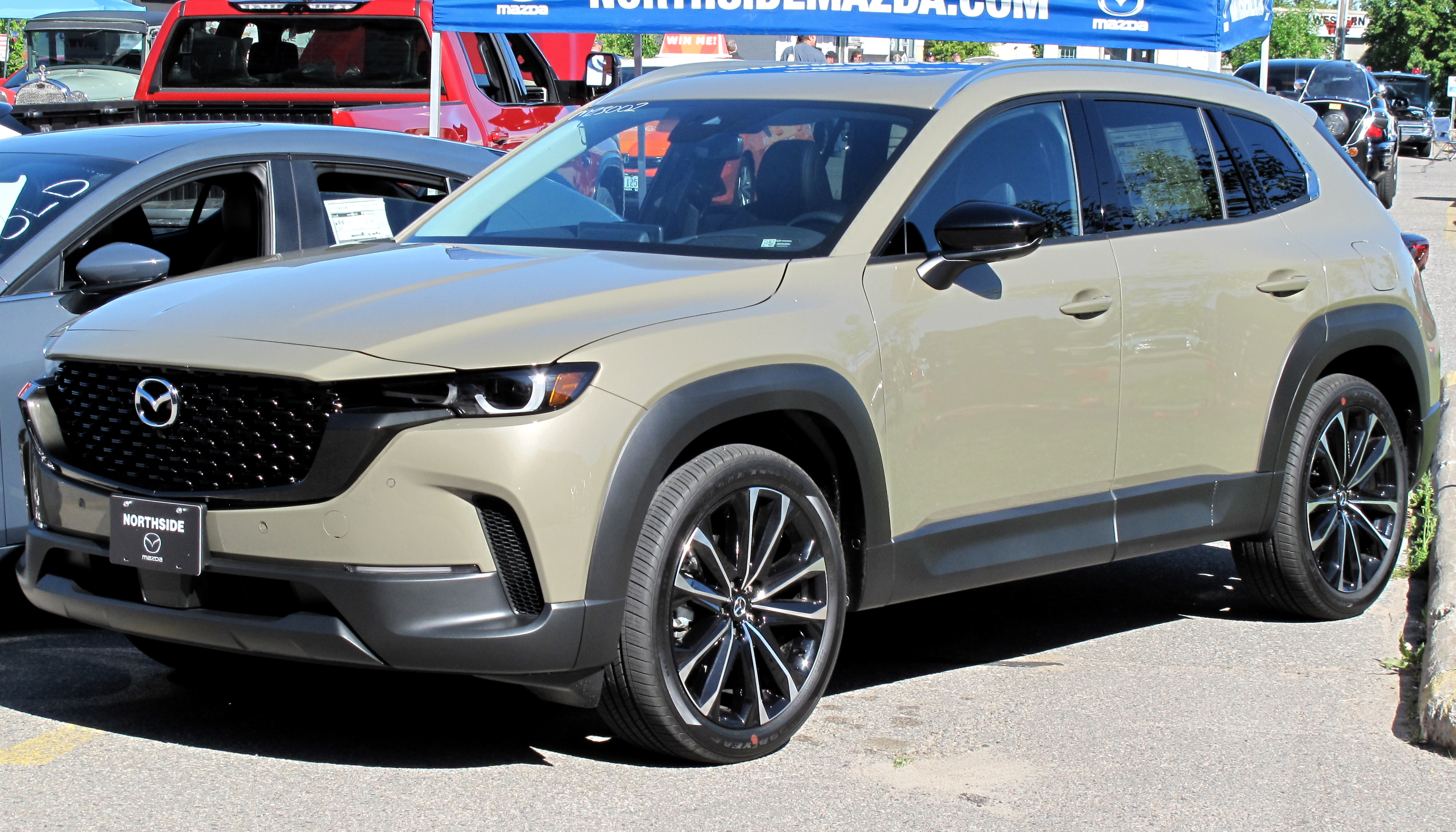
"they've changed the nomenclature slightly. So you've got the CX-90, the CX-70 for the larger ones, the CX-30, replace the CX-3, you know, you've got the CX-50, and then the CX-5 is the only one without a zero at the end for the crossovers. And so, well, you know, CX-5 has been the best selling model for a long time."

"There's a lot of brand equity in that nameplate. And so they decided, you know, rather than rename it to CX-60 or CX-55 or something, they would just keep the CX-5 name. Well, and that's the thing too, you know, and different automakers over the years have done that where they've changed the nameplate."
"Yeah, you know, now they've got two crossovers that are similarly sized with the CX-5 and the CX-50."
A crossover is a kind of car that looks like a small SUV but drives more like a regular car. It's good for people who want space and comfort but also some extra height and style.
A crossover is a type of vehicle that combines features of a car and an SUV, typically built on a car platform but with SUV-like styling and higher ground clearance. Crossovers are popular for their versatility and comfort.
"And because it's Google built-in, we also have access to the Google Play Store, which allows you to download apps. So in the car that you were driving, we had downloaded Spotify, we had downloaded Waze, the Google Chrome browser was downloaded, and the car already had YouTube installed."
The Google Play Store is like an app store on your phone, but in the car, so you can add apps to use while driving.
The Google Play Store is an app marketplace where users can download various applications. In cars with Google built-in, it allows drivers to install apps like Spotify, Waze, and YouTube directly on the infotainment system.
"They can still use CarPlay, they can still use Android Auto, but if they forget their phone and leave it at home, they're not kind of left out in the dark."
CarPlay lets you use your iPhone's apps and maps on your car's screen, making it easier and safer to use your phone while driving.
Apple CarPlay is a system that allows iPhone users to connect their phone to the car's infotainment system to access apps, navigation, and messages safely while driving.
"They can still use CarPlay, they can still use Android Auto, but if they forget their phone and leave it at home, they're not kind of left out in the dark."
Android Auto lets you use your Android phone's apps and maps on your car's screen, making it easier and safer to use your phone while driving.
Android Auto is a system that allows Android phone users to connect their phone to the car's infotainment system to access apps, navigation, and messages safely while driving.
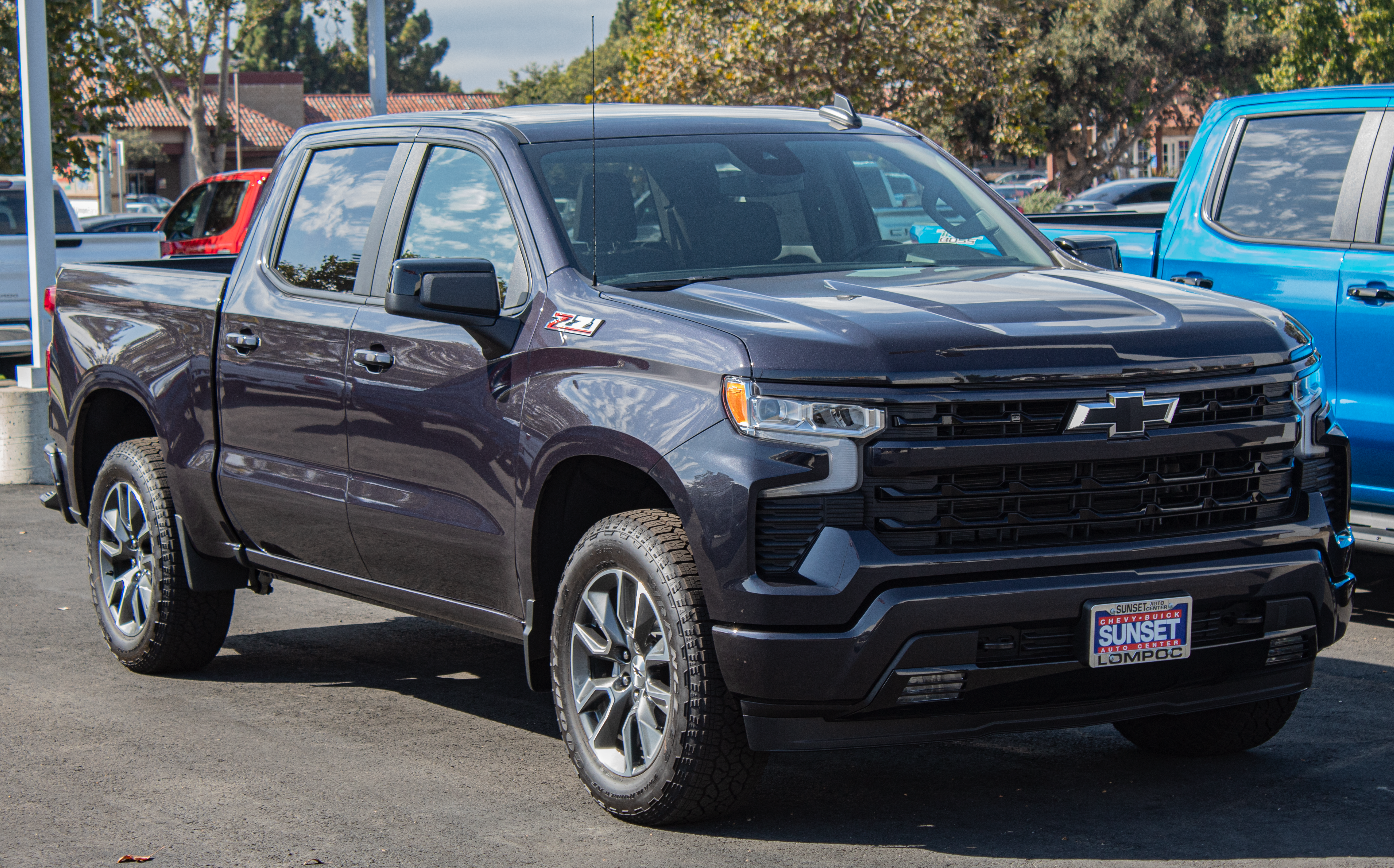
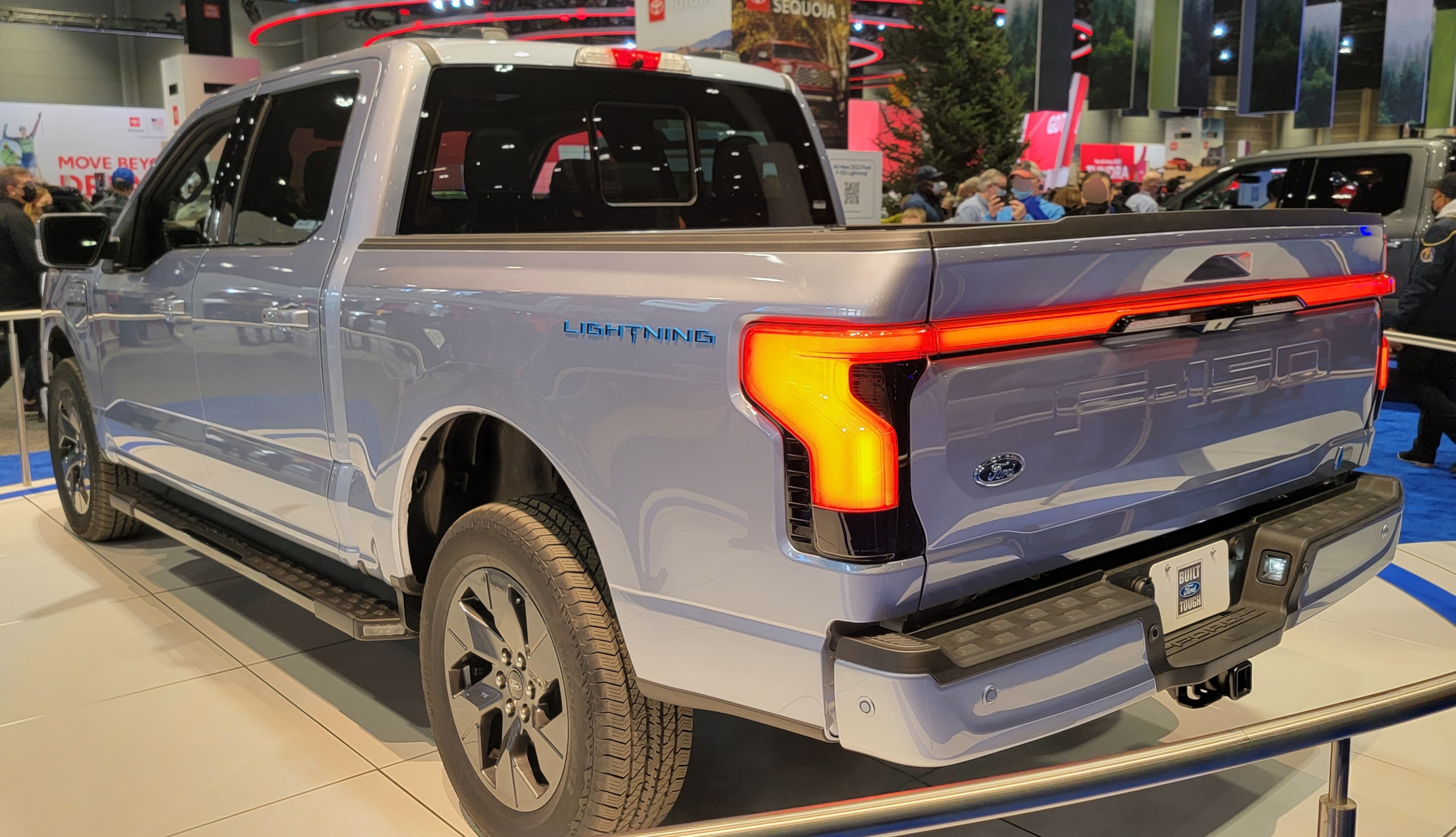
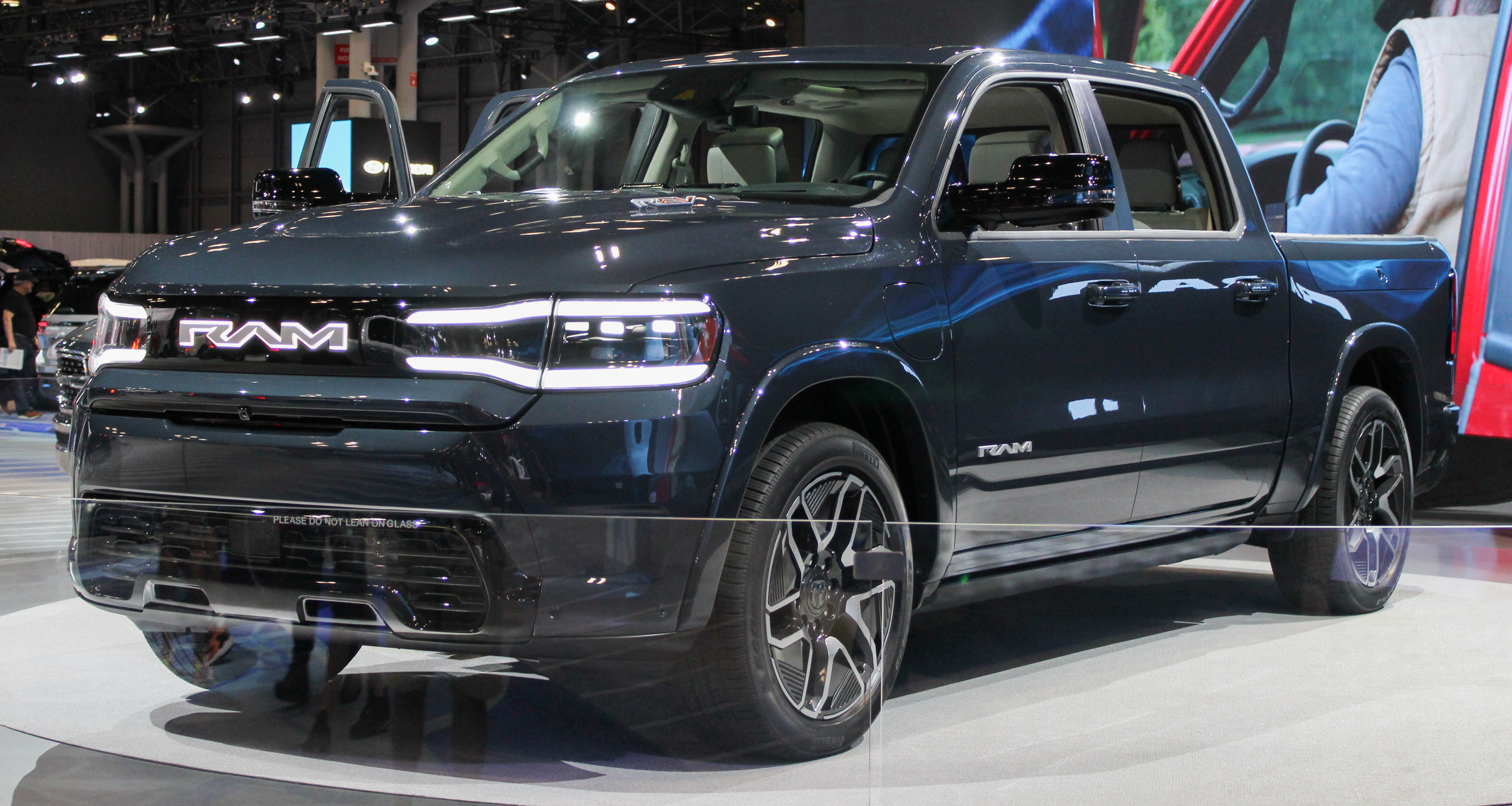
"Most of the, you know, see a bunch of suburban that are being used as airport shuttle vehicles, you know, for the resorts to get people back and forth between Cancun Airport and Playa del Carmen and some of the other resorts. But not many regular people driving full size SUVs and only saw a handful full size pickups like F-150s, Rams and Silverados. Oh, it's funny. The Silverado in Mexico is called the Cheyenne."
"So I'm just like, well, it's fine. I drive my Onix 5 all the way to LA. No big deal."
Select text to request an explanation
This is episode 441 of Wheel Bearings. I am Sam of Bool Salmon from Telemetry.
I am Nicole Wakelin from Top Speed and Test Miles.
And I am Roberto Baldwin from SAE International.
And Nicole, what you been driving?
I had, um, sorry, getting text messages from 18 people at once.
Everyone's asking me a question work related. I'm like, it is podcast time, dang it.
Good Lord. I had the Volvo XC40 B5 all wheel drive, um, which we have like horrible weather.
Like we're having a blizzard as we speak. It is something about that.
I heard you had some snow furries.
This is currently blizzarding in New Hampshire before it blizzarded in New Hampshire.
It just snowed like a half a foot of snow on Friday and we were going away for the weekend
and we took this through the snow and the muck into the White Mountains in New Hampshire.
Our little XC40 was fabulous. Actually, it did really, really well.
Russ was very skeptical. I said, well, you should take the Jeep.
I'm never going to make it. I'm like, it's going to be fine.
I'm like, you don't need a Jeep. So we did take it out.
And actually it was, it handled really well.
Um, you know, we had some deep-ish snow when we got up to the mountains
because they were still doing that plowing and you get those spots
where you have the giant berm of snow that it looks, you know,
it's four times as deep as the actual snowfall.
Um, and it had no problem getting through anything.
It was actually, it was a really nice drive and it was really, really comfy.
Uh, 247 horsepower, 258 pound beautiful torque.
So it moves. It's not huge. You know, it's a crossover.
Um, it's got seating for five people, so it's not this like giant vehicle.
Well, it's got seat belts for five people.
Yeah. It's got seat belts for five.
It really four. I can't see putting more than four people in here.
Even with four people, I think the back seats, it's a little squished,
a little bit squished.
Like Robbie and Russ could not sit front and back behind each other.
One of them would have their knees broken.
Um, it's just crying, sadly crying.
So, but it was, it was a nice car to drive.
The, the base press in this, I have no one, Ronnie,
but the base for the B five all the drive is 4,200 to 800.
You can keep going up depending on which trim that you have.
It goes all the way up to like 52,000.
Um, so it's not an inexpensive proposition.
The one thing I didn't like is there's not wireless, um, apple car play in Android Auto.
It's wired.
So if you don't have an ancient, I know, right?
This is the electric car.
It is approaching the end of its life cycle for the car model.
It is. And it feels like it is because A, it doesn't have that.
And it has that old, the screen that sort of, I don't like it.
Portrait?
Thank you.
He's looking at me making the nine inch screen.
Yeah. It's, I'm not a fan, but it was actually, I think it was bigger.
Was it? No, I guess it was just nine inch screen. Yeah.
Um, it felt very small.
Felt very, very small.
The screen feels tiny, tiny, tiny, which is again, you know, nine inches was once a big screen.
Like there was a five inch screen and your option was a nine inch screen.
Now the nine inch screen feels kind of tiny.
So this, although it's comfortable and it's nice, I love that has this like a sort of, um, felt kind of trim on the interior in the doors.
Handled absolutely beautifully in winter weather, did a fantastic job.
It feels like it's, it's needing a little, little redo, a little refresh, a little, little attention.
Screen feels old, not having the wireless, you know, connectivity.
Those, it's funny how aggravating that was because we were traveling and I don't normally keep wires in the car because everything's wireless.
And so I was bringing you in the hotel because I was using them to charge my phone when I was in the hotel.
Then we get back out and I was like, gosh, gosh, dang it.
And I have to go back and get a cord because I forgot to bring the cord back out with me.
So, um, yeah, I mean, overall, and it's, you know, it's kind of decent little amount of car room.
It's not a huge amount.
I think it's about a 25 cubic feet behind the rear seat.
It's a 57.5 if you fold them flat to have a decent amount, but it's, it's a nice little compact crossover.
I think that has plenty of power handles, great in the snow, looks great, quiet ride, but it feels like it needs some updating.
Just a little.
Just a little bit.
Just a little scotch of updating.
Currently, I put it in the garage though for the blizzard because it's blizzarding and the snow is on our driveway.
On the right side of the driveway, you could almost see the pavement.
On the left side of our driveway, it's taller than me.
That's the kind of wind, little windy.
Yeah, so, yeah, so that's the Volvo XC40.
Yeah, I mean, I've always liked the XC40.
I like, you know, I like the overall size of it, but yeah, the back seat is a little snug.
That's, that is the one downside.
You know, I think, you know, for, for just, you know, a couple, you know, or, you know, empty nesters, you know, or a young couple or a single person.
It's, it's great.
I think it's a great choice.
But, you know, if you got a family, got kids that need to sprawl, you know, maybe you want to step up to the XC60.
Yeah, it's just a little, it's not a car for, it's not really a great family car.
Like, in fact, if you ever have people in the back, I would say really just go up one, one little pip.
It's a great, if you're just you and your, just you, your dog, as long as a corgi and not like a burner, you're fine.
Well, I mean, if you pull the back seat down, the burner will be okay.
Yes, that's true.
They would take up the entire, the entire cargo area from the lift gate to the front seats, but he would fit back there.
All right.
Robbie?
What'd you do?
I drove just a little, like a little compact, like economy car.
It's the Aston Martin Vanquish Volante.
So it's the, it's the Vanquish, but with that, but it's a convertible.
So it's like, ooh, ah.
So if you don't know, the Vanquish is Aston Martin's fancy new, it's essentially a race car, race car coupe.
It has, hold on, let me get my, oops, there we go.
It has 824 horsepower.
That's from a 5.2 liter twin turbo V12 engine.
That's not bad.
You know, that's adequate.
It's, yeah.
It's got a, it's got, you know, it's ready to partay.
It's got a, and what's fun is that like it, for the drive modes, it has GT.
GT is like the chill mode.
You just kind of drive in and then it has sport and then it has sport plus.
And what's, what's fun about this vehicle is that it has, you know, adaptive cruise control and lane keeping assistance.
Because, which I think on one hand, what's great is that there's just an off button in the center console for that.
You hit the off button and a little thing pops up on the screen and says, hey, do you want to turn this off?
Like yes.
You know, you sure?
And you say yes.
And then it turns off the lane keeping assist and all the fancy things to keep you from dying.
Because, because this vehicle, again, it's essentially a race car that looks really pretty and is very comfortable to drive.
But like wherever the wheel is, that's where it's going.
The steering is extremely tight.
And so like I would assume a regular person who is used to a wheel that has like a little bit of play.
There's a little bit of, you know, you have something to sort of move around with without like leaving the lane.
The car doesn't twitch into that direction.
This does not have that.
Like you move a little, hey, you're going left.
Hey, you're going right.
And so if you're driving on the freeway, this might keep you in your lane.
It's definitely not a car you can kind of look away and then look back because you look away and your hands might move a little bit to where your head goes.
That's one of the tricks of driving is look where you want to go.
So if you're looking away and your hands kind of do that, you're just going to go into the other lane.
But since this is just an economy car, I mean, it wouldn't really matter if you got a few dents and dings on it, right?
Yeah, yeah.
It only costs, so the suggested retail price is a very, very low $468,000.
So a half a million.
The vehicle I had delivered to my home was $644,700.
$644,000.
So $645,000.
Yeah.
There's an import tax on it.
Guess what?
The import tax is crazy.
How much is it as much as a car?
Let's see.
From the UK, that's probably going to be what?
25%.
So is that $645,000 include the import tax?
Yes.
Okay.
So then working back from that, it's about $120,000.
It's sold now.
That's pretty high.
$37,900.
So you could have bought a car though.
You could have bought another car.
So you could have bought another car with the import tax.
Who knows what it is now?
I don't even know anymore.
The tariffs are all every day.
We joke every day it's something different, but literally every day it's something different.
It is.
It really is.
It comes with a $500 umbrella, which is kind of nice.
But it's not like, who has the umbrella indoors at Rolls Royce?
Yeah.
Yeah, it's just in the trunk.
It's just in the trunk, but it has its own little straps and everything.
It says Aston Martin on it.
So what exactly does a $500 umbrella entail?
Well, it stops the rain.
What makes it different from a $5 umbrella?
Well, it says it has a little metal handle.
This is Aston Martin on it.
And you can ask for at least $495 right there.
So it's bargain though.
Yeah.
Let me see how much the...
So this one has all the carbons.
So the interior carbon was a $27,400 option.
The exterior, let's see.
Heated steering wheel is $800.
The satin black wheels, $2,600.
Let's see.
The Inspire monotone interior was $10,800.
It's a very expensive car.
No one's buying this car and saying to themselves,
oh, I don't know.
Do I really need that thing?
No, this is one of those cars I think people buy and then they hope to,
like a Bugatti, where they hope to sit on it and hope that it makes some money.
It increases in value and they turn around and sell it,
which makes it even better that I got to just drive it around.
Well, the thing you have to do if you want to buy an Aston Martin
is just wait till it's like 10, 15 years old and then you could buy it cheap.
Yeah, you could probably get this for like $50,000 in a couple of years.
Yeah, well, I mean, that's what TFL did.
Roman bought a 2007 or 2008 Aston Martin Vantage for $33,000 a couple of years ago
and then his son, he sold it to his son Tommy for that.
So, yeah, he's got 18, 19-year-old Aston Martin Vantage now
that they bought for just over $30,000.
That's cool.
Yeah, you could do that.
So, all the things is very expensive.
It's very blue.
I got the blue.
It's got this, what's it called?
Chimera, Chimera, Chimera?
Chimera.
Chimera.
Chimera.
Chimera blue.
Chimera, am I saying it wrong?
And so, I get in the car to start it and I turn it on and I can't see the display
because it's turned down.
And because it's turned down, I cannot figure out how to get the display to work
and how to turn it up.
I cannot increase the brightness.
I'm clicking everywhere trying to figure out how to increase the brightness.
I'm like, you know what?
No one buys this car for the infotainment system.
Fine, whatever.
So, I'm driving.
I stopped somewhere.
I plug my, I add my phone.
This vehicle supports Apple CarPlay Ultra.
This is where CarPlay takes over the entire everything.
And that was that right.
And every time I saw it, I was like, that's dumb.
That's lame.
Nope.
That's not lame at all.
It's actually quite, I could find a display, the brightness display.
It's literally just more, you know, little icons in an Apple CarPlay
that control other things in the car.
That's, and it just looks like Apple CarPlay.
It's the same sort of Apple.
And so it does all the stuff.
It took over the screen, the dash cluster.
Looks nice.
Looks easy.
It's easier to read than the Aston Martin version.
So, yeah, I don't, I mean, if you're Aston Martin, it's really expensive to do your own
infotainment system.
You know, you probably don't care that someone else owns that real estate.
Because you just, people aren't buying, again, people aren't buying an Aston Martin
vanquish because they're like, ooh, the infotainment system is a little slow.
No one's, no one's thinking about that.
No one's like, oh, well, I don't know, it doesn't have Alexa.
So I can't control my lights at home.
No, no one cares.
No one cares.
It's like when you get, you have somebody, if you have $650,000 to spend on an Aston Martin,
you have somebody on staff to take care of your lights at home.
Yeah.
You just call and yell at them.
Yeah.
If their name happens to be, you know.
You're saying chiefs, turn on the lights, please.
Yeah.
So you don't, you don't need any of that stuff.
That's it.
Somehow I got this car during the nicest couple of days in, in a couple of months, 70 degrees.
Just hold.
70 degrees.
Nice.
Just like, just like Nicole.
It's like Nicole, where Nicole's living right now.
Right, it's perfect weather right now.
Popped down, you know, slightly cloudy.
So it's not too sunny.
You know, it's too sunny to kind of bring your head.
Absolutely.
I love driving this car.
I'm terrified of driving it because it's again, $645,000, but I also love driving the car.
I didn't go anywhere.
I just got the car parked in my driveway and I drive it and then it goes right back in
my driveway.
I don't take it to the store.
I don't take it to a drive-through.
I don't take it anywhere.
I saw your post on Instagram about not wanting to park it anywhere.
Yeah.
So it's, it's, I don't park it anywhere.
I went to a mayor island.
It's over in Vallejo to take some photos of it because I know that there's, there's people
that will work there, but this is not, it used to be a military installation and there's
just not as many people as the military had.
So there's always kind of open areas to park it and take photos.
So I took it over there to take photos.
It is really fun to drive.
It is indeed like driving a, a, you know, a GT is, I would say 90% of the time people
are going to be driving this is going to be in GT and they're going to be happy.
A sport, amazing sport.
Plus I am driving a race car.
That's every little, everything you do is just like, so yeah, it is, it is not, it is
not to be trifled with as a car.
If you are thinking about buying one of these and you are a listener, you know, you should
be signing up for our Patreon if you have enough money to buy it for that.
Absolutely.
You should be like five, five of those, you should have like five accounts just for us.
Anyway, if you buy it, just know that this is a sports car first and foremost bordering
on a race car.
I mean, they call it vanquish for a reason.
It's going to vanquish you.
Yes, it will vanquish you.
It does not have like, you know, a nice like chill, you know, steering mode.
Yes, you know, the suspension softens up and, you know, the engine kind of chills out a
scooch when you're in GT mode.
But the reality is that you're still driving this like really powerful V12 824 horsepower
engine.
You're just holding on.
The engines do it every year.
You're like, oh, here we go.
It handles great.
It handles one.
It's everything it's supposed to be.
There is nothing about this car that's just like, oh, they kind of like phoned it in or
oh, nope.
Except for the stock infotainment.
But yeah, who knows?
I don't even know.
I used it for a little bit and then I stopped.
And again, I expect, you know, I think I've talked about CarPlay Ultra.
I was like, I don't think this.
Why would you do this?
This is too much.
I'm fine.
I like CarPlay.
But nope.
Totally works.
No problem.
Easy peasy.
Lemon squeezy.
The problem.
Okay.
There is one issue.
If you use Google Maps, it doesn't show up in the center display in the dash cluster because
it wants you to use Apple Maps.
Oh, no.
Oh, it also didn't tell like the default, the car's infotainment system.
In the dash cluster, it'll tell you the temperature of the tires.
And it doesn't tell you that in CarPlay Ultra.
Okay.
So for someone who's about to go and do some crazy driving, you know.
You want to know the temperature of your tires.
Yeah.
You want to make sure they're not too cold.
They're not too hot.
Just right.
You want them perfect.
Just like an F1 car.
They have sensors to measure the temperature of the tire tire.
Let's see.
It's got dual zone climate control.
All right.
Cool.
Whatever.
It has a lot of buttons.
Volume.
There's a volume.
Not a knob, but one of those rollers.
The temperatures are rollers.
You can turn on the auto for climate control, AC for climate control.
All those are buttons.
They're also in the infotainment system.
But yeah, lots of buttons, which is really nice.
It does have just a cruise control, adaptable cruise control.
What is it?
Adaptive cruise control.
Yeah.
It does have adaptive cruise control.
I tried it out.
It was fine.
I finally turned everything back on on the freeway to test it.
It's not lane key.
It doesn't center you, but it's lane keep assist.
It just knows when you're getting to the edges, hey, hey, hey.
It'll nudge you back into the center of the lane.
You got that going for you.
If you have this vehicle and it's a little much for you at the beginning, this might help.
Again, I cannot stress enough that wherever you turn the wheel, that's where the car is
going to go.
Yeah, eight speed, automatic transmission, super fun to drive.
It's the electronic limited slip differential, so it's fun around corners.
It does not have, you can't raise it.
It doesn't have a button to raise it like the Lamborghinis have, which is really helpful
when you have that splitter, or not splitter, but the rear spoiler up front.
When I got it, they showed me, I'm like, well, here in the front, because you have to go around this car.
It's a little, they're like, yeah, all those cars have it, and then there was a little bit.
I was driving, and there was a 2x4 in the road, which I didn't see.
There was a car in front of me, and then all of a sudden, there's a 2x4, and there's two cars,
and I'm like, oh no, oh no, and I went over, it was fine.
So it's higher than a 2x4.
It's bearish.
I love that you have, that would have given me a panic attack.
I'd have been like, oh god, no, no, no, I'm going to touch.
The 2x4, I'm kind of surprised that it didn't damage one of the tires,
because it's probably three or four millimeters of tire sidewall on that thing.
Yeah, there's no sidewall on the tires.
It was right in the center of the road, so thank god.
Yeah, 10.25 inch touchscreen display.
Again, who cares, to be honest, no one cares.
Again, you're not buying this car, you're like, oh my touchscreen display.
It works.
There's a little bit of a scooch of latency.
I get no one cares.
You don't care if you're buying this car.
You're buying this car because, A, people in chargers and challengers will wave at you
and honk at you and yell at you that they really like your car.
There you go.
People in Mercedes will follow you.
Yeah, it's very nice to have the top down.
It does have those little baffles that go behind you, but those you have to put in manually.
They're in the trunk in a bag, whatever.
This is my hair from being in the wind all day.
No one cares.
Yeah, no, I really, really like this vehicle.
You know what it made me do?
It made me miss my Del Sol.
Oh jeez.
I'm all drive around like, oh, I miss my Del Sol.
I don't know if that's what Aston Martin was going for.
But that's what they did.
I'm sure that was totally top of mind as they were designing the Vanquish.
Yeah, the fact that you can get the regular two of them.
Somebody drove a Del Sol 25 years ago.
I was like, you know what?
What would they want today?
Where have they gone in their lives since the Del Sol was around and built the perfect car for that?
And there you have the Vanquish.
The Vanquish.
Not a lot of trunk space.
Again, when you can afford $650,000 for a car.
If someone just followed you, are you just shipping?
Well, no, you just buy what you need when you get there.
Yeah, buy new stuff.
Then drop it off at the Goodwill.
Just leave it in the hotel room for the staff.
There you go.
Here's some stuff.
What else?
What can I tell you about this?
Oh, someone in a Miata almost got in the head on collision with me because they decided to go straight into the wrong lane around a blind corner.
But the Vanquish's magic brakes stopped that.
Well, that's good.
Yeah, the brakes are fantastic.
Are they?
You know what?
I was going to look this up.
Are these ceramic brakes?
Because they squeak.
So I just assumed they're not.
Yeah, they probably are carbon ceramics.
Yeah, they are fantastic.
For $650,000.
Yeah, they better be.
Oh, here we go.
Brakes.
Learn more.
Carbon ceramic brakes.
Yes, they are.
So they're carbon ceramics.
So they do squeak?
That's just the nature of the carbon ceramic brakes.
But they also will stop you like there's no tomorrow.
So if a person kind of decides to come at you, you can stop on the brakes and just come to immediate stop.
What else can I say about this car besides that I really liked it and that there's no,
it costs more than my house.
I mean, that's almost three times what we paid for our house.
It has a top speed of 202 miles an hour.
The fact that it's a convertible, convertible is way more than their counterparts.
I think it's like 200 pounds more.
But when you're cruising around in a twin-turbo V12, I don't think 200 pounds really matters.
No.
When you get to 850 horsepower, a couple of hundred pounds, not going to make each.
Nothing.
Nothing.
Yeah, there's not a lot of room for space.
So I mean, you're not going to be hauling anything in it anyway.
So that's how you're saving space.
Yeah, exactly.
That's it.
It is really nice to drive around in GT mode.
Like it doesn't, it's not so much a sports car or race car that when you're in GT mode,
it feels like you are trying to rain in a wild horse.
So that is really nice.
So it doesn't feel like, I think some of the issues probably with the Giulia a little bit
was that it always felt like it was ready to go and the brakes were always so tight
that you couldn't stop at like the drive-thru correctly.
So they've sort of eased, they've sort of shaved off all the bits a bit for GT mode
except for the steering because the steering is just a steering.
There's not really much you can do about that.
But it is, I mean, I guess they could have like electronically, but who can, you know.
Does the car you have have the wood veneer on the back of the seats?
No, it's all carbon fiber.
They did the $27,000 carbon fiber.
I think this might just be for the 60th anniversary edition.
The Q, I'm looking at the Q by Aston Martin celebrates 60 years of Volant
with exclusive anniversary editions.
Yeah, so, yeah, for, yeah, so I haven't had cars in a while
and like last week's was like the Corolla Cross.
And this week is the Vanquish.
So you're getting a little variety.
You're mixing it up a little bit.
Yeah.
All right.
Well, maybe someday I'll get to driving Aston Martin, hasn't happened yet.
I drove the Vantage in another one a while.
Hold on, I want to double check, make sure my top speed is correct.
Hold on.
Back when Nathan Hoyt was still at Aston Martin, he promised he'd get me into one eventually,
but now he's not there anymore.
They had a great PR person at Aston Martin who just left.
Exclusives and improvements are already on the way thanks to your generosity.
So if you want to be part of an automotive podcast like no other,
head to patreon.com slash wheel bearings media.
We've updated the wheel bearings merch store and now there's a whole bunch of new choices,
new colors, new styles, t-shirts, sweatshirts, hoodies, hats, mugs, travel mugs, stickers,
aprons, tote bags, you name it, you can get your wheel bearings merch at shop.wheelbearing.media.
Go check it out.
That's shop.wheelbearing.media.
I'm very sad about it.
All right.
Well, let's let's carry on.
So I had the 2025 Mazda CX-5 Turbo Signature.
Is that the whole name?
Turbo Premium.
Sorry, Turbo Premium.
And the only thing that really matters is that it was painted soul crystal red.
Yeah, that's all.
So that makes it essentially perfect because there's really nothing you can do to improve on a car.
Even if it does have a little rotary controller for the infotainment system.
As long as it's soul crystal red on the outside, nothing else really matters.
And Nicole will tell us also about driving a CX-5 in a few minutes.
Yes.
But it was different from the one that I drove.
Correct.
It's kind of funny that you had that one.
The one I drove was the outgoing generation.
And I was there at the LA Auto Show back in 2017 or 2018 when they introduced this generation.
Mazda had an off-site event one evening at some studio in Hollywood.
And I was there and most of the evening I was standing next to Gene Jennings.
And even though the car was nice, just hanging around with Gene for a couple of hours, that kind of made the whole day.
It was worth it.
And Gene had had a couple of drinks and had lots of stories to share.
She was always great to spend time with.
So this generation of CX-5 has been around for a while.
This is the second generation and the third generation is coming up shortly.
This one has the 2.5-liter Sky-Activ G engine.
This is turbocharged.
So it's 227 horsepower, 310 foot-pounds of torque.
I've driven quite a few CX-5s over the years, including the short-lived diesel version,
which was surprisingly good.
But it did not sell very well.
I think they sold fewer than a thousand of those in total over a couple of years,
and then they discontinued it.
But this one, this is kind of the sweet spot, the 2.5 turbo, at least among this generation.
Six-speed automatic transmission.
And the CX-5 was kind of the first of the Mazdas to really upgrade the interior
and really start to move Mazda in the direction of having a more premium feel,
a more premium-looking feel to it.
When you sit inside this thing, it feels like a much more expensive vehicle than it is.
And I remember back early on, like early on in the history of this show,
before YouTube had even joined, when I drove one, I drove a CX-5,
and at the time, it was like $37,000.
And I complained because that was quite a bit more than most of the other crossovers in this segment.
Cars like the RAV4 and the CR-V and the Escape,
they were not that expensive, but this had such a much nicer interior.
The materials, the colors, the fit and finish just felt so much more premium.
But it just felt like, at the time, $37,000 seemed like a lot.
Now, $37,000, not so much.
And in fact, the base MSRP on this version, the premium trim,
is, in 2025, is only $38,000, which is barely more than it was, you know, seven, eight years ago.
And all in with the options on this one, it came to a grand total of $41,520.
You want to take guesses at the destination charge?
Ooh, 11.
12 and A size.
Nicole gets it. It was $1420.
So, you know, $41,000, you know, still not cheap, but considering where this was a number of years ago,
it hasn't really gotten that much more expensive.
And the reality is, and if you listened to the interview from last week's show that I did with Tom Donnelly,
I brought this up with him, that kind of the rest of the segment has caught up price-wise.
So if you look at, you know, the top sellers in the segment, they're all in the high 30s to $40,000 range now.
But none of them today, you know, even the brand new RAV4, feel and look as nice on the inside as the CX-5.
And, you know, we'll hear your impressions of the new CX-5 in a couple of minutes.
But, you know, this one had leather seats, eight-way power driver seat, six-way power passenger seat.
It had all the driver assist features.
It had adaptive cruise control with stop and go, blind spot monitoring, lane keeping assist, you know, all that stuff.
It does still, it did still have the 10.25-inch center screen that is only touch when you're using Apple CarPlayer Android Auto.
When you're using the stock must infotainment, you have to use the rotary controller on the center console.
And next to that rotary controller, there's a smaller rotary volume knob there, which I think, you know, that is,
that's in a good location, you know, makes it very easy to use without looking at it.
You can just drop your hand down and give it a twist.
The, you know, the rest of this vehicle, you know, by the, compared to the current generation of its competitors,
it's a little bit smaller than those.
So the back seat is a little bit tighter than a CR-V or a RAV4 or a Tucson or a Sportage.
But, you know, it's still, it's still very usable by a couple of adults.
You probably don't want to take a long road trip with a couple of adults in the back seat.
But, you know, certainly to go out to dinner or something like that, they'll have no problem at all.
Wireless Android Auto and Apple CarPlay.
There's a G wireless charging pad, all the usual stuff.
It, you know, it's rated at 24 miles per gallon combined, 22 city, 27 highway.
You know, I still, even now, you know, at the end of its life cycle, I still really like this car.
You know, I like the way it looks.
I really like the way it drives.
It drives like what you expect of a Mazda, tight steering, you know, some decent steering feedback.
Really good combination of driving dynamics with the ride quality and the handling.
It's just really, really nice to drive.
And I, you know, even now, you know, before the 26s get to the dealerships, you know, this is still a vehicle that I would recommend to somebody looking for a vehicle in this class, you know, the compact crossover class.
So I think it's, I think it's still a great option.
And, you know, the engine, you know, the 227 horsepower, you know, that the numbers don't seem as high as some of the competitors.
But it feels strong.
It's got a lot of torque.
So it's a really nice engine.
So that is the 2025 Mazda CX-5 2.5 turbo premium in soul red crystal metallic.
So, Nicole.
Yeah.
You also drove a CX-5.
So I drove the 2026 Mazda CX-5, which is the next.
And they've completely broken it, right?
They made it so much better.
You know why?
You know why?
You know why?
I'm so excited they got rid of the stupid knob.
I've never been so excited in my life to see them change something.
The command and commander knob they called it.
I called it the world's most annoying infotainment control ever invented.
I hated that thing.
And they got rid of it.
And I even had a, there's an interview at the end of the podcast with Matthew Valbuena.
I believe I said his name right and he's in charge of figuring that stuff out, like
making that stuff seamless.
And I chatted with him about it because for the longest time Mazda tripled down on that,
right?
Weird.
We're going to keep it.
But he said all the apps that you have, they all use, you know, you're used to a touchscreen.
So when you start mapping it out to that controller, suddenly you can't map it the way that you
want to naturally use it.
So that's why they went with a touchscreen.
So I was overjoyed for that one reason alone.
I'm like, yes.
So don't get the 25 because it has the stupid old controller.
Get the 26 because it doesn't have the stupid old controller.
Get the 25.
No, he's wrong.
He's wrong.
It's the worst.
I hate that.
So it got the new, the other things that changes.
This is a little bit bigger.
The wheelbase gets a little longer.
So there's a little more room for people, a little more room for cargo in here.
So it's a little bit roomier, which is good.
Still has that sort of compact footprint.
Still really easy to move around in urban areas.
So it serves that purpose well, but it's just a little bit more versatile for you, which is good.
And has 40, 20, 40 split fold seats so that you can, you know, have people sitting on the left and the
right and still put like skis or something through in the middle, which is pretty cool.
Pricing on this, it starts at 29, 9, 90.
That's the base.
Then there's the preferred at 34, 250 and the premium plus at 38, 9, 90.
So it still stays well priced.
You don't have the turbo engine though anymore.
That is, that is gone.
You just have the 2.5 liter four cylinder with a six speed automatic.
187 horsepower, 186 pound-feet of torque.
It's, it actually is really responsive.
This isn't, just by getting a little bit bigger, it's not a huge car.
You know, it's relatively compact.
So it's still, it gets out of its own way.
I enjoyed driving and it still handles like a Mazda.
Like Mazda should, should have that nice little handling, should have that little bit of fun.
And I enjoyed how this handled, they did, they worked to make this.
This isn't an all new.
This is like refreshed, I would say.
I don't know.
It's, it's definitely much, I think it's much better than the old one.
I think they did, I guess this is technically the third generation.
So I guess it is all new.
But yeah.
It's the magic number.
Although it doesn't, you know, when you look at it, it doesn't look that much different on the outside.
No, they can't, it still looks very similar.
If you go to Mazda's site, you can see the 2025 and 2026.
You can just keep going back and forth with all new and model your 2025.
And if someone didn't tell you that there was a 2026, you were like, oh.
So it, it's, it's changed enough.
You know, they dropped the turbo engine.
They changed the infotainment significantly.
They made it longer.
There's changes, but it doesn't, it still feels very much like the car was before in the best ways.
Like it truly was an evolution of this.
It wasn't like they took everything they have from the old CX-5 and chucked it out the window and then introduced a new one.
This is really just an evolution of it.
And I think they improved it in numerous little ways to make it a better vehicle.
So I thoroughly enjoyed my time driving this.
I thought it was, I thought it was fabulous.
So, you know, I was earlier today, I was watching Tommy Micah's review of this.
And one thing that he brought up was just the size of the screen.
You know, it's a 15.6 inch center infotainment screen, which he thought was maybe a little too big.
What did you think of that?
I thought the screen was fine.
I didn't think, see, I like a larger screen.
So for me, I thought it worked well.
You know, before the screens they had were a little bit in Mazda's, they were, because they weren't full touch.
At one point they were really far back on the dash.
Then they were a little bit closer.
So I feel like they've made this bigger and positioned it so it's in the right spot for you to be able to use.
And it's the right size.
I thought it was good.
Okay.
Yeah.
I like larger screens because I also feel like they're easier to deal with when you're in areas where the navigation is really complex.
You're in a city or something.
It's easier to follow than trying to follow something small.
It's just because you can keep track.
It doesn't look like you've driven over your own route eight times.
And yeah, so I prefer the larger screens.
Yeah.
I mean, one of the things that Tom Donnelly mentioned when I talked to him was the hybrid system that's coming for next year.
That's going to replace the turbo.
And that system is really designed to provide more performance as well as better fuel efficiency.
And so that's why they're not doing the turbo now because they're going to get even more performance with the hybrid version next year.
Right.
So it'll be interesting to see how that does.
You know, they've done that sort of staggered thing.
You get one engine now.
You'll get the next engine later and you'll like it.
So we'll have to wait if you want that extra performance.
I'd imagine that it's going to be, you know, when they get rid of a turbo and everybody cries because the turbo is gone.
This is still a pleasant car to drive.
It's not like you're crying big crocodile tears because there's no turbo, but I'm excited for them to do the hybrid and see how that comes out and see if that really does give you that a little extra oomph.
Yeah.
Well, you know, and the CX-5 is not, you know, not a sports car anyway.
No.
You know, so, you know, while the turbo is nice, you know, it definitely was not necessary.
You know, the SkyActiv G engine is still a really wonderful engine.
It's a good little engine.
And it's, like you said, this isn't a sports car.
This isn't a Miata.
This isn't something so super high performance.
And that's not why you're buying this.
And what I like about Mazda's in general is they do still, you know, even when it's an affordable crossover like this, it still looks beautiful.
It still has a nice comfortable, quiet interior, and it still has really good handling so you don't feel like you've sacrificed a lot.
You might not have the power of a more expensive vehicle with the bigger engine and blah, blah, blah, but you still have great handling.
It's a really well done package.
And, you know, one thing that was interesting that I learned from a previous conversation with Mazda, you know, when they first announced the new CX-5 some months ago,
you know, I asked, you know, why they kept the name because, you know, all the other Mazda crossovers in the last few years as they've been replaced or new models introduced,
they've changed the nomenclature slightly.
So you've got the CX-90, the CX-70 for the larger ones, the CX-30, replace the CX-3, you know, you've got the CX-50, and then the CX-5 is the only one without a zero at the end for the crossovers.
And so, well, you know, CX-5 has been the best selling model for a long time.
There's a lot of brand equity in that nameplate.
And so they decided, you know, rather than rename it to CX-60 or CX-55 or something, they would just keep the CX-5 name.
Well, and that's the thing too, you know, and different automakers over the years have done that where they've changed the nameplate.
You know, they renamed the whole lineup to make them all fall into a new nomenclature or something.
And it's confusing to people too when you keep changing the names of your vehicles.
So where does that best selling vehicle? Where is a big deal?
Don't get confused. Let people get confused about what it is.
Leave it alone. Leave the name alone.
Yeah, you know, now they've got two crossovers that are similarly sized with the CX-5 and the CX-50.
CX-50 is designed to be a little more rugged, off-roady, you know, versus the CX-5, you know, a little more stylish, sleek.
So it'll be interesting to see how the sales split between those two develops over the next couple of years.
Mm-hmm.
All right. Anything else on the new CX-5?
No, I think that's about it for me.
All right. Well, tell you what, I'm going to drop in the interview that you did with Matt Balbuena right here, and we will be right back after that.
Okay. So first, tell me your name and your title.
My name is Matthew Balbuena, and I am a project manager for Moses in Vehicle Technologies and the Human Machine Interfaces that interact with those technologies.
Is that actually what it says in your business card? Because I think you need three.
It says project manager comma infotainment and HMI.
Okay, close enough.
Right.
But it's like infotainment isn't really a consumer-friendly word, and HMI people don't know.
So it's a lot easier to express it as in-vehicle technologies and how you interact with it.
That makes more sense.
So today I have the pleasure of driving the new CX-5, where you guys have really completely reworked how the infotainment screen and infotainment system,
and particularly you got rid of that knob that anybody listening to the podcast knows hated.
So tell me a little bit about what you did.
So the 2020 CX-5 features Google built-in.
So Google built-in means that for Mazda, Google Maps is the native mapping solution, and Google Assistant is the native voice assistant.
And because it's Google built-in, we also have access to the Google Play Store, which allows you to download apps.
So in the car that you were driving, we had downloaded Spotify, we had downloaded Waze, the Google Chrome browser was downloaded,
and the car already had YouTube installed.
But this allows the user to download the apps that they want to utilize in the car, so that way they don't have to use their phone in the vehicle.
They can still use CarPlay, they can still use Android Auto, but if they forget their phone and leave it at home, they're not kind of left out in the dark.
They still have access to their Google Maps, they still have access to Spotify because of this Google built-in experience.
The other big benefit of this Google built-in experience is it really helps us meet customer expectations.
As I kind of mentioned before you're derived that a lot of customer expectations of what they can do in the vehicle is based on what they can do outside of the vehicle.
And when you look at how much time people spend in the car interacting with infotainment versus how much time they spend out of the car interacting with their smartphone,
with a tablet, with their laptop, with a smart TV, all of those interactions kind of change what they expect to be able to do.
So with Google built-in, we are bringing familiar apps and familiar interfaces.
So when you're on your phone or mainly on your phone with Google Maps, the way you pitch, zoom, swipe, tilt the map view, all of that is capable in the vehicle.
So from an intuitive factor, it's much easier for you to hop into this vehicle and figure out how things work.
And kind of the goal is when you buy a smartphone or when you buy a tablet, when you open the box, there's just a charging cable and a quick start guide.
And the quick start guide basically says, here's where you plug it in, here's how you turn it on, and that's it.
Whereas the car has a three, four hundred page odors manual.
We don't want the infotainment system to require a three to four hundred page manual to figure out.
So the goal is to kind of deliver that easy to use, intuitive user experience.
And do you feel like because that dial for a long time, there was a name for it?
The commander knob.
The commander knob.
That was something that Mazda sort of doubled down on being a better solution than touching a screen all the time.
But now you've given us, of course, voice control is the best way to go.
But you've also now the touchscreen is a touchscreen.
Yes.
Explain the change in why you're like, that still works.
So when we launched the second generation Mazda Connect system with the 2019 Mazda 3, that vehicle was entirely non-touchscreen.
You had to use the commander knob to operate everything, including car plate and Android Auto.
We saw lots of complaints, specifically with the app based experience with CarPlay and Android Auto,
that those interfaces were designed for touch input and that trying to use a commander knob was very difficult and frustrating for the users.
So starting with the introduction of the CX-50, we brought back touchscreen input specifically for CarPlay and Android Auto.
The native Mazda interface still required the use of the commander knob.
So clearly we saw that app based interfaces really had to have the touch interface because they were designed or optimized for touch.
So with this Google built-in solution, because of the fact that we have the ability to run apps from a variety of third parties,
like Spotify or Chrome, for example, trying to be able to map the variety of user interfaces and capabilities to a commander knob becomes a limiting factor, becomes a challenge.
And we didn't want to have those same type of complaints from users saying, oh, I love this app, but it's so difficult to use with this knob.
And again, kind of when I talked about Google Maps, all those swiping gestures and input methods, they just become second nature, don't think about it.
So when you see the similar interface in the car, you kind of already know how to use it, even though you may have never actually interacted with it before.
Okay, so I'm pleased with that because I'm glad to see that the little commander knob is gone.
So what do you think for people getting into a car? And this is a specific question for, you know, the average age of a car is what I think 12 years old now.
The average registered vehicle on the road is about 12 years old.
So if you haven't had a car in 12 years and you get into a car today, it is suddenly like a computer on wheels and it can be really overwhelming.
You talked about not wanting a person to feel like they need a manual.
Do you think that person who is coming from a car that didn't really have an infotainment screen and is now getting into this is going to find it an easy switch?
I believe so simply because of the fact when you look at, I know I keep mentioning smartphone and we're not saying this car is a smartphone on wheels,
but the familiarity with those types of inputs and interfaces, 83% of the adult population in North America has a smartphone.
That means my grandparents have a smartphone. My nieces and nephews have a smartphone.
So this wide range range means that every has this kind of basic understanding of how to navigate through swipe and kind of move.
Maybe they don't know all of the advanced multi-touch capabilities or things of that, but they don't need to in order to interact with the system.
If they can swipe, if they can tap, they understand the interface.
And when you look at, you were talking about people who have a car that is 12 years old.
That is definitely a linear curve, but in my personal case, my son is now 15 and a half.
So he's getting his license in a couple of months.
So for him, he's Gen Alpha?
I think Alpha, that seems right. We'll go with that.
So he grew up around technology and, you know, he had a tablet when he was younger and we would play games on it and stuff like that.
And the first time he sat down in front of a desktop computer, he thought it was a test tree.
He went out and swiped and tried to touch it and it wasn't.
And so I think the expectation there is even in his classroom, you know, his school has Chromebooks.
Every single one of those Chromebooks is a test tree.
So it's just now becoming to a point where it's so ubiquitous that the learning curve has really kind of been diminished compared to trying to teach something in a new operating way.
Like, okay, you have to use this joystick or these buttons to do something and they're like, why can't I just reach out and touch it?
So the other benefit, again, with this system is the fact that it's flexible.
So we talked about the average vehicle on a road being 12 years old, the registration, 12 years.
The average consumer keeps their smartphone for 33 months.
In that 33 month span, they see two to three major OS updates.
So if they had their car for 12 years, in that same time period, they would have had four or more smartphones and they would have seen at least 12 OS updates.
With this Google built-in system, we are able to offer over there updates and keep the system fresh with major OS updates as well as incremental feature additions or bug fixes or revamp the UI.
But the idea is to keep the user experience fresh, just like it does on your phone.
Every year you get a new look and feel, we want to be able to offer that same type of continuous improvement with the in-vehicle experience.
And that's important because you do get into a car even at just a couple of years old and you can already see how some of the things on that interface are starting.
It's not that you're like, this is not new, this hasn't been done in a couple of years.
Well, especially when you look at the app situation, you have these apps that kind of pop up out of nowhere and also become this home run thing.
And with the ability to run these apps natively, if it's available in the Google Play Store, you can add it to your car.
You can have the latest content, the latest app functionality.
And the vehicle does support video and gaming.
So while the car is stopped, you can utilize full screen video viewing.
So YouTube, Amazon Prime Video, HBO, any of the string services that are available, you can utilize that in the vehicle if you choose.
So it's great for, in my wife's case, school pick up.
You know, when you're sitting in line, you're just going to wait until you get out of the car.
You know, yeah, you can watch something on your phone while you're parked, but you now have a larger screen in the vehicle and you can play it through the entire audio system.
Right.
Why not take advantage of that extra few minutes of time to catch up on Bridgerton or whatever you may want to.
Are you a Bridgerton fan?
My wife is a huge one and she's been catching up on it.
And I've been walking into the room and seeing things on the screen going, oh, that's happening.
One of the things that it doesn't have, talking about knobs and controllers, there's no volume knob.
Correct.
That caused a problem for Honda.
The world had a small revolt.
Honda brought back its volume knob.
So tell me about why you guys said, well, let's see what happens if we get rid of it.
Honda did it with a much smaller screen.
And I'm not saying that the screen is a justification for it, but it was a much smaller area to work with.
So it was kind of an interesting choice in that case.
We still have volume controls on the steering wheel and just like Tesla or Rivian, we do have volume controls on the screen,
but it's offset to the passenger side of the screen for the passenger interaction.
We really see the driver keeping their hands on the wheel utilizing the volume control.
So in our evaluation and in our testing, the knob was not a major concern.
It was commented on.
But once they actually got to use the system and interact with it, it didn't become the hotspot that some people thought it might be.
So it's kind of like we're all scarred for life from Honda doing that.
And we need to give other things a little bit of a chance to see how they work in other setups, other applications.
Possibly.
I think a little bit comes down to the total experience.
So maybe in Honda's case, I could have been the straw that broke the camel's back.
You know, but I don't see users complaining about that and other vehicles that are similar.
So again, I bring up Tesla and I bring up Rivian.
Obviously, we're not an EV company, but when you look at those vehicles and you look at customer satisfaction,
you look at online comments and forum posts and even automotive reviewers,
you don't see a lot of animosity for them not having a volume.
So it is interesting how traditional automakers don't get that same leeway.
And I don't know if it's because expectation.
Well, you had a knob before.
You should always have a knob, whereas these guys started off with the clean slate approach.
And for some reason it wasn't expected them.
I had really thought of that, but you're right.
It's the guys who never had one this ago.
That's okay.
But you're you've had one is like wait, you remove my volume knob.
And so I totally get it.
I understand it.
And what I would say is try it.
Don't let the lack of something be a deterrent.
Try it out, experience, take it for a test drive, playing with it at the dealership.
But you spend time with it.
Yeah.
Did you have a...
I actually, to your point, I didn't miss it being there.
Like I have that when you're first sit down in the car and you don't know where anything is because it's new.
You're looking for the way of the lane.
You're looking for the light.
Once I did, it's like, no, it was right here.
So it really, and you can tell Google turned up the volume a little bit.
And so you don't even have to reach for buttons.
So if you had to pick out one thing that was sort of your favorite element of the new tech inside of this,
what would you say?
This is cool.
This is my favorite thing.
I think for me, it's a slight surprise and delight.
But when you are on the home screen, there is a vehicle graphic that is shown.
You can swipe the vehicle to rotate it around.
But if you turn the headlights on, the hazards, the brake lights, open the door,
all of those are reflected in the vehicle graphic.
It's just kind of fun.
It adds some whimsy to it.
But it's also just kind of cool to the show.
You can rotate it.
So I think that is kind of fun.
From a functional standpoint, I would say Google Maps.
Google Maps.
You know, it's such a ubiquitous navigation solution.
There are more than two billion monthly active Google Maps users worldwide.
And because of that, all of that rich PY data and all of that functionality is built in.
So for me, I oftentimes kind of get hungry around 10, 30, 11 o'clock.
And so I'll just kind of see what's new, what's in the area and look up some spots to see how far it was away from the office.
And I'll start the route.
Okay, it's 12 minutes with traffic.
Cancel the route on my phone.
Now I can go out to the car and it'll be my recent destination.
So I just click on that taco spot and I'm there.
So the flexibility and kind of the way when you're in the Google ecosystem, how easy it is to utilize.
My wife and I like to take road trips and a lot of times we'll share a map on Google Maps and we add a bunch of pins.
Well, those pins was favorite.
Those want to want to see or want to visit places or accessible in the car as well.
So if you are on a road trip, you don't have to worry about typing in every navigation destination in the car.
You can do everything on your PC, everything on your computer, but it's still accessible from the car.
Excellent.
Thank you very much.
I appreciate your time.
This is great.
And I'm very happy with the changes.
No more a little funky dial.
Thank you so much, Nicole.
Okay.
And we are back.
And while you were driving the CX-5 in, where is it, Encinitas, I think?
Yes, Encinitas.
I was just a little bit north of there, spending a few days with Toyota to see the new Highlander that we talked about last week.
And to drive their two newest EVs in the lineup, which are basically an extension of the BZ family.
So last year, they relaunched the BZ.
They dropped the 4X from the name.
They substantially upgraded it, fixed all the things that we hated about the first iteration of the BZ 4X.
And now they're expanding that family.
So we've got the BZ Woodland and the CHR name is back after a brief hiatus of a couple of years.
So get to drive both of those.
The BZ Woodland is basically, it is arguably what the new Subaru Outback should have been.
And this is a vehicle co-developed with Subaru.
Subaru is calling their version the Trailseeker.
And they launched that and they launched it last year at the New York Auto Show.
They also unveiled an all-new Outback, which went way off in kind of a different direction.
And arguably what they're calling the Trailseeker is the true successor to the Outback.
And the BZ Woodland is the Toyota Badged version of that car.
And I really like it.
It's basically the BZ as a wagon.
It's really good.
All the improvements they did to the regular BZ are here.
But the roof line is a little bit longer.
Overall length of the car is about six extra inches.
So you got a whole bunch more cargo space in the back.
It's only being offered with all-wheel drive.
So it's got the same motors front and rear.
So the regular BZ is available with front-wheel drive or all-wheel drive with a 221 horsepower motor on the front
and 160-ish horsepower motor on the rear axle.
For the Woodland, they're using the same 220 horsepower motor front and rear.
But the overall, even though that adds up to 442 horsepower,
they're only giving you 375 horsepower in total at a time.
Because what they're doing is, in the interview I did last week with the chief engineer,
talked about this, they're adjusting the front-to-rear torque balance based on the conditions.
So you can get up to 70% to either axle and 30% to the other axle.
So you can get full power on one axle and then less, about half power on the other axle.
And it works really well.
The default is kind of biased towards rear torque.
And surprisingly, it makes this thing drive really nicely on the curving roads we drove around Ohio, California.
They have two different trim levels.
So they're, and I can't even remember what they're called now.
But the two trim levels, and there's two tire options.
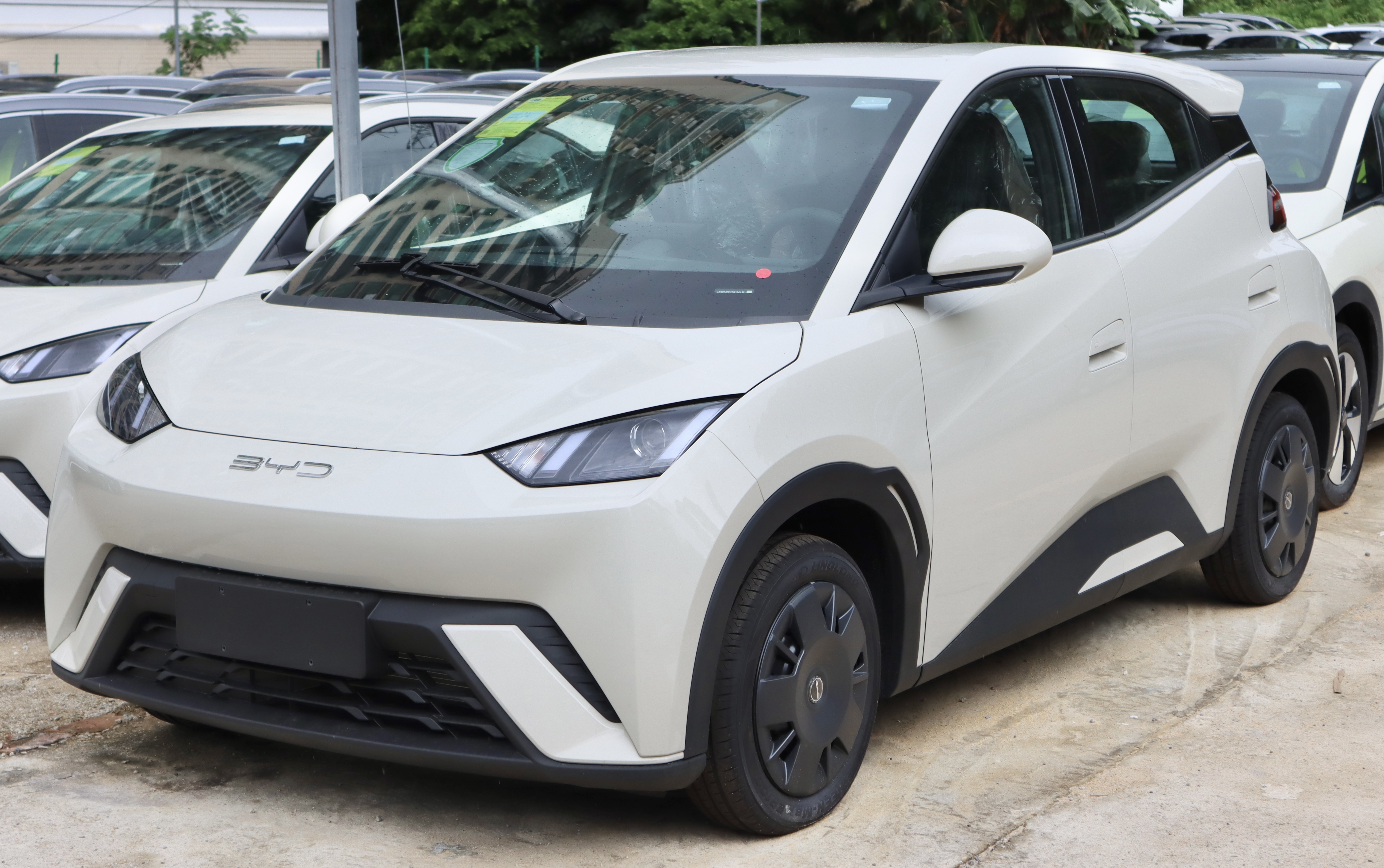
Both of them are the same size tire. They're on an 18-inch wheel.
But you can get it with regular all-season tires or all-terrain tires.
And with the all-terrains, because they have more rolling resistance, you get a little bit less range.
So it's rated at 260 miles of range with the all-terrain tires.
283, 281, sorry, with the all-season tires.
And then, you know, it's not, I mean, this is not a hardcore off-roader, but it is surprisingly capable off-road.
It's got Subaru's X-Mode software in there, so it does the front-to-rear torque balancing and side-to-side traction control with the brakes.
When we drove it, you know, the night that we arrived in Ojai, the first thing, you know, so there were several waves.
I was on the last wave, and we arrived in time to see the unveiling of the Highlander.
And then after dinner, it started pouring rain, and it was just a downpour for several hours.
But then when we, you know, the next morning, the sun was shining, but the place that they had set up for the off-road course was just way too muddy.
You know, they went up there into the mountains into the ranch that used to belong to Paul Walker, who was in the early Fast and Furious movies.
And they got a Tacoma trail hunter stuck in the mud up there.
So they decided, yeah, we're not going to take the busy woodland up there today.
But they did let us, you know, the next day we went up with the woodland, but we didn't get to go all the way to the top of the mountain.
So we didn't get to do some of the stuff like the moguls that people on the earlier waves did.
But I saw some of the videos that they did, and, you know, we did a similar type of course last summer with the Subaru Salterra,
which is essentially the same vehicle, but, you know, without the wagon back on the body.
And we did that with the all season tires on the Salterra, not even all terrain tires.
And it did fine. The X mode stuff works really surprisingly well.
So, you know, the tires that are on the woodland are slightly larger diameter than the ones on the regular BZ.
So you get about two tenths of an inch of extra ground clearance.
So instead of 8.2, you get 8.4 inches, which doesn't sound like a lot.
And it's not, to be fair, compared to most off-roaders.
But it's comparable to what you get on most Subarus.
And compared to other off-road variants, to technically off-road variants of other EVs like the Hyundai Ionik 5 XRT.
The Ionik 5 XRT only has 7 inches of ground clearance.
The Mach-E rally is only 5.9 inches of ground clearance.
Oh wow.
So it's actually pretty useful.
You know, driving up the road, up into the mountains on the ranch there, you know, a lot of the mud had dried.
But the road, the trail was still pretty rough.
And, you know, there were sandy bits in it.
And we got into some of these sandy parts of the trail.
The system worked just fine.
So with the 375 horsepower of this thing, it'll do 0 to 16 in about 4.4 seconds.
It's got 33.8 cubic feet of cargo space behind the second row.
You know, if you fold down the second row seats, you get 74.3 cubic feet of cargo space.
It comes standard with all-weather floor mats on both trims.
Yay.
All-weather floor mats.
I think all cars should just come standard with all-weather floor mats.
Seriously.
Even the Aston Martin?
Well, yeah, even the Aston Martin.
Why do I need carpet?
I'm not driving them with my toes.
You could, though.
You know what?
I do drive the BRZ in the summer.
I take my flip-flops off and I just drive with my feet.
Despite my bare feet all the time.
I was in a Rolls-Royce.
What's the convertible?
Rolls-Royce convertible.
Anyway.
The Dawn?
The Dawn, I think.
And they had the lambswool floor mats.
That when you step on them, they go whoosh, sink.
And I was like, can I just take off?
I did.
I took off my shoes for a minute.
And I was like, oh my god, this is amazing.
So I would drive that in my bare feet.
So that's it.
So, you know, even on the all-terrain tires, though, driving up these curving mountain roads,
the BC Woodland handled surprisingly well.
It was actually a lot of fun to drive.
The steering is good.
It's got decent steering feedback, not really nice steering feel.
It's a really good car to drive.
Do you know if it's the same suspension setup that they have on the outback wilderness?
That outback wilderness did so well just on the regular around corners.
They're like, oh yeah, because we have active suspension now.
It's going to be a little bit different because it's a different platform.
But for the Woodland and the Trailseeker, the development was led by the Subaru engineers.
So it's probably a lot of the same engineers that worked on the outback wilderness that had a hand in this one.
So there's two trim levels, base and premium.
It only comes with all-wheel drive with 375 horsepower.
The base is $46,750, including the $1450 destination fee.
The premium is $2,100 more than that, so $48,850.
So not cheap.
Is it still 400 volt?
It's still 400 volts, 150 kilowatt charging.
So they say it'll do 10% to 80% in about 30 minutes.
It does have a NAX charging port, an SAE J3400 charging port.
It's going to be okay, Robbie.
It's got all the bits that you want.
You're like, oh, it's essentially just a Subaru.
It's a wagon.
It's an EV.
You're like, yay, it's 150 kilowatts charging.
I'm like, come on.
What year is it?
Come on.
They did almost everything right.
How's that?
Yeah, at least the charging curve is vastly better than it was on the original BZ4X.
It took well over an hour to charge.
This will do it in about 30 minutes.
So it's roomy.
The back seat is very roomy.
So you can take your teenage kids, take your adult friends to go camping or whatever.
The charge port is on the front right fender.
So when you nose in to a supercharger station, those nice short cords that they have on the
version three superchargers, they'll fit.
It'll reach.
So it won't charge as fast as a Tesla or as a Hyundai Kia Genesis EV.
But it's not that far off now.
And then the all-terrain tires are a no-cost option because you're losing some range.
So you can choose those for no additional charge if you want.
So I really like this thing.
That's so close.
Yeah, so close.
So close.
I had to charge the, because we took the BRZ and the IONIQ 5 out of the driveway to park
the Aston Martin.
So because the driveway's at an angle, a hill, blah, blah, blah.
So the car takes up two spaces.
So we couldn't charge the IONIQ 5.
We don't charge it every day.
There's no point.
You don't need to charge it every day.
But it was like around 40%.
And then I went and visited family.
And I was coming back as a 20%.
I charged it at the EA station down the street.
And it's really nice when you just plug it in.
It charges at 235.
So you're just like, all right, I don't want to be here for a little bit.
And then I'll be on my way.
We don't charge that car very often at this.
Only when we're on road trips other than that.
Even though it's free.
A life only plugs in the EV6 once, at most, twice a week.
You're just like, oh, here we go.
So the other Toyota that we got to drive is the new CHR, which is also on the same architecture.
But the CHR has a 4.4 inch or 4 inch shorter wheelbase than the BZ and the BZ Woodland.
It's actually 4.4 inches longer than the old CHR.
So did you guys drive the old CHR?
I don't even remember.
Must not have been exciting.
It certainly wasn't exciting from a performance standpoint.
It was not great.
No, it had like 140 horsepower four-cylinder engine with a CVT.
I went back to look up acceleration numbers for the old CHR when I was writing this review.
Oh, geez.
Most of the zero to 60 times recorded for the old CHR between about 10 and 11 seconds.
That sounds about right.
I mean, where are you going, really?
Nowhere. Nowhere's where you're going.
Nowhere fast, that's for sure.
Nowhere fast.
Nowhere at all.
You know what?
I'll get there eventually.
It's quicker than walking.
A little bit.
Have you tried walking to the next town?
It takes a while.
So the new CHR is 6.7 inches longer than the old CHR.
It's a bigger vehicle.
The back seat is definitely tighter than the BZ and the Woodland.
But it's still usable by adults.
Whereas the old one, again, if you ever sat in the back seat of the old CHR,
not only was the back seat tight, but the way the belt line swept up at the back there,
the rear windows were very small.
It was very claustrophobic feeling in there.
It was not pleasant.
This one is much, much, much better.
Better in every way.
So it's also all-wheel drive only.
The dual-motor all-wheel drive.
But it's got the regular BZ's all-wheel drive setup.
So it's front-biased, 338 horsepower, which, again, is 20 for this thing.
That's more than enough.
Yeah.
It does 0 to 16 in about 4.9 seconds.
So quicker than the other one.
Oh, yeah.
A little.
Just a scosh.
Thank God.
It's available in two trims, SE and XSE.
The SE is on 18-inch wheels.
That's the one you should buy.
287 miles of range.
20's on the XSE, 273 miles of range.
Basically, most of what I said about the BZ Woodland and what I've previously said about the 2026 BZ applies here.
Same much improved interior.
You don't have that little instrument cluster display down at the end of this kind of tunnel on the top of the dash and mounted too low so that the steering wheel cuts off half the screen.
It's mounted.
It's the same display, but it's mounted up higher, closer to the base of the windshield.
It does not have the new infotainment system that's on the new RAV4.
It's still the previous generation, which is fine.
My only complaint with the previous gen infotainment system is it does take a while to boot up.
I was reminded of this when I was driving the Corolla Cross a couple of weeks ago and driving these two.
It takes a good 30 seconds before the system is completely fired up and running.
If you need navigation for where you're going, which when we're doing these drives, we typically do, you've got to sit there and wait for it to finish powering up and getting everything on the screen.
You've got to start the car and then put your seatbelt on real slow like.
Then adjust your mirrors, adjust your seat.
Every time you get in the car.
You're really going to take your time.
That's where that 10 seconds would have helped.
Driving this thing up into the mountains, it was a lot of fun to drive.
It's not rear biased torque like the Woodland, but it was still a lot of fun to drive this thing.
It handles really nicely.
I like this car a lot.
I'm not actually sure which one I would buy if I was going to buy one of these.
I like the station wagon layout of the Woodland, but I also like the slightly smaller footprint of the CHR.
It looks really like the Crown.
You're torn. You don't know what you get, huh?
You get a station wagon. Come on, Sam.
I'd be the one wearing my station wagon shirt today.
It probably would be the station wagon, although the CHR is more affordable.
They are pretty pricey for four hundred-volt vehicles, but they're also telling you that some people are going to buy them anyway.
The CHR, the SE, starts at $38,450 including the destination charge.
The XSE is $2,000 more for $40,450.
Again, take the SE.
The main thing that you're going to lose is the 20-inch wheels and the puddle lights in the mirrors.
Who cares? The cloth seats in the SE are really nice, rather than the synthetic suede and leather seats that are on the XSE.
I would probably just go with the SE, save the $2,000 and have some sidewall so that when you hit potholes, you're not going to destroy your wheels all the time.
That is the 2026 CHR.
Both of these, the Beazey Woodland and the CHR, will be in Toyota dealers starting on the West Coast in the next few weeks.
Starting in early March and gradually making their way across the country.
For a company that has been as ambivalent about electric vehicles as Toyota has been over the last several years,
they're suddenly going to have a whole bunch of EVs in their lineup.
They've got the Beazey, the Beazey Woodland, the CHR, the Highlander at the end of the year, and then several Lexus EVs as well.
I don't think they like people looking at the Beazey Forex.
I mean, this is trash. This is not a Toyota. This is not up to snuff.
How dare you put your badge on this vehicle?
There's a little bit of, okay, this is what, and then seeing how well Hyundai's doing, Hyundai's making a profit on this.
We can't let that happen. Come on. We have to beat Hyundai.
I think there's a little bit of hurt ego when they came in their EV lineup where they were just like, well, this is good enough.
Then everyone was like, no, we're not just going to accept this because of the Toyota.
Again, most Toyota vehicles are actually really, really nice and they last a long time.
That's their deal. Then they come out with like, meh.
That's the other thing. The interior of both of these cars was actually so much nicer than materials and everything compared to the new RAV4.
The RAV4, when I drove that in September, it felt really cheap inside.
It was hard plastics. It didn't have nice textures on it.
This has really nice materials. It feels, I wouldn't call it premium, but it feels way better than a RAV4.
It's not quite at the level of a Mazda, but it's getting close to that and it's really nice to drive.
The CHR, for example, we drove it up into the mountains and by the time drove it up and then drove it back down again,
I was driving at a fairly brisk pace. It averaged 3.7 miles per kilowatt hour.
See, that's the thing. That's great.
The Highlander was like 3.1 to 3.7 with the two different battery size or the two different trim levels.
They're essentially, if these were 500 volt vehicles, they would be hitting 4.
I'm sorry, 800 volt vehicles. Did I say 5?
That's really the only thing left that they really need to address is the system voltage.
They would get that really nice efficiency boost once they go 800. They're doing the work.
For that, we applaud them. Absolutely.
For making the EVs, we always knew you could make.
We always knew you could do it.
We knew you could do it. We believed in you. Now give us a Tacoma.
There was also a drive program in California last week for the New Jeep Cherokee.
Unfortunately, well, fortunately, I couldn't go because I was in Mexico to spend some vacation time with my lovely wife.
That's right. You didn't have a vacation.
It had lots of good food, got some sun, went swimming in the Caribbean. It was great. No complaints.
The first drive reviews of the Cherokee came out today.
I've put a link in the show notes to the TFL review. It's a video review.
Case went and drove it.
The vehicle that's being launched right now is not the reincarnation of the old XJ Cherokee.
This is not an off-roader yet. Jeep has said there will be a Trailhawk version of it coming, but that's not here yet.
The version they're launching right now is hybrid only. Did you guys have a chance to watch this review or read any of the other reviews?
I did not. I was driving a convertible around the middle of nowhere.
That has to take priority.
I didn't see that specific review, but I did have some people speak to me about what it was like.
What did TFL's review say?
It said it's mostly really nice. It's roomier than the old one. It looks better.
It drives pretty well. The ride and handling is good.
It wasn't crazy about some of the controls inside.
They have a similar type of touch control panel below the infotainment screen that they have on the swagger and the charger, where the whole panel kind of moves when you press on any of the buttons.
Overall, I thought it was pretty good. The new hybrid powertrain felt really nice.
We'll see how it does in terms of real-world fuel economy, but I think this is just the beginning for the new Cherokee.
The last one, there was a lot of people that didn't like it. From a design perspective, I think people are probably going to like this one a lot better.
Hopefully, we'll get a chance to drive one of these ourselves pretty soon.
Then Scout has reportedly delayed the launch of their new truck and SUV from 2027 to 2028.
But then, Scout's denying it. There were other stories that came out today.
They said, no, we're still on target for 2027. We'll see.
There's now an increasing amount of skepticism as to whether they will ever even launch the fully battery electric version or just go with the EREV.
That's actually one of the reasons given for a potential delay is challenges with developing the EREV version of this thing, which is what they're going to launch with.
What do you think? Do you think they'll ever launch the BEV version of this?
I'm a little skeptical at this point.
If you're Volkswagen and you're just trying to do something, that's the problem with Volkswagen.
If Scout were its own company, if it was divorced from Volkswagen, I would be like, yeah, sure.
2026 production with 2027 deliveries, but they're not divorced from Volkswagen.
Volkswagen is still trying to figure out what it's doing in the United States.
I could see them saying, well, a lot of people wanted this one, so why even bother making the other one?
Why even bother making the BEVs?
When you're in some financial difficulties like Volkswagen is, then yeah.
Of course, they're probably a little gun-shy based on the nostalgia market after the ID buzz, which people were gaga for.
Then it came to market, and then people were like, eh, but that's really all.
But to be honest, that was all Volkswagen's fault.
It's seven years, come on.
They should have been at the longest five years, and they should have had an entry-level version that people could pick up for $55,000.
Instead, they're like, hey, you got to pay $50,000.
Instead, you got to be minimum of $60,000 if you're lucky.
Now you can see I'm discounted, though.
There's a bunch of them that are discounted out there.
As a company, not Scout, but as a Volkswagen company, they're sort of tip-toeing and trying to figure out the best way to bring this vehicle to market.
Unfortunately, I think that tip-toeing is a lack of focus and leadership, to be honest.
You really need someone to just say, we're going to do the E-Rabs first.
We're going to see how they'll sell.
We're going to look at our reservations for the BEVs.
If it's above this amount of reservations, we're going to make the BEVs because we said we'd make them the end.
Instead, it feels like, well, I don't know.
Maybe a lot of people want the E-Rabs, so maybe we should just do that.
What about everyone who already got like, I don't know.
That's a whole other car we have to develop.
Don't you have a platform?
Well, you know our platform.
We've got like 17 platforms right now.
It's sort of...
Well, the thing is, it's the same platform as the E-Rab.
The BEV and the E-Rab are the same platform.
The only difference, and you're going to have the same motors, the same power electronics.
The only difference is the E-Rabs probably going to have a little bit smaller battery, a gas tank, and a range extender engine.
But I think one of the...
Those three things, that's a lot for Volkswagen.
Well, it is.
And I think one of the challenges is they are evidently planning to put the engine.
Instead of putting it under the hood in the front where Ram is doing with their E-Rab system,
they're apparently going to be mounting the engine in the back, under the bed, behind the rear axle.
And that might be part of the problem that might lead to a delay.
I mean, that's actually a lot more complicated to do than the way that Ram is doing it.
Yeah, I don't understand. Are they really that concerned about people saying the front isn't that big?
Because you're removing space from an area of the vehicle that is always being used for space.
And that's the back of the vehicle.
A big frunk is great, but mostly people are using the cargo area in the back.
The trunk.
But it's underneath.
It's behind the rear axle underneath the bed is what we've been hearing.
So it's not actually going to take away from the normal bed volume.
But I'm just curious why they're putting it back there.
I have no idea.
Outside if they want a big front.
It's a mystery.
There's going to be an event at Scout's Tech Center here in Novi next week that I'm going to.
And Scott Keough is supposed to be there doing a fireside chat.
So maybe we'll get a chance to ask the Scout folks.
What are you thinking here?
What's going on with this?
Why are you doing it that way?
What are we doing?
I kind of wish Scott was his own thing.
If you're a Volkswagen dealer and you ask Volkswagen, they will tell you, oh, it is their own thing.
They are separate companies.
It's not part of Volkswagen.
Because, you know, they're planning to sell direct to consumers.
We all know the truth.
I mean, I think it's, I mean, as an e-rev, I think it makes sense.
I think for some people, it makes sense as an EV.
I think it's a cool, I mean, I like the Scout.
So the designs are awesome.
I'm very excited about this vehicle.
I think like the Rivians, they're essentially, Rivians are Patagonia of EVs.
It's the Patagonia jacket.
That's what this is.
You're going up against Rivian with hopefully more money behind you.
Of course, you know, Rivians got a lot of Volkswagen money behind them.
Maybe that's why.
They're like, oh, maybe that's the problem.
Maybe they took all our money.
Oh, no.
Although, you know, Scout is going to be using Rivian's electrical architecture and everything on there.
Oh, that's good.
So at least they got something.
That'll be good.
And, you know, their software platform.
Let's see how that works out.
Yeah.
Well, you know, I think it works well, you know, on the Rivian except for the fact that they don't believe in buttons,
which is ridiculous and door handles.
So, Scout has door handles.
Look at that.
You look at it.
Yeah, lots of buttons and switches.
You could grab it and open it like a proper car.
All right.
A couple more things.
Uber unveiled their autonomous solutions designed to accelerate autonomous mobility and delivery worldwide.
So over the last couple of years, Uber has been partnering with almost every autonomous vehicle company you can imagine
investing in many of them, putting hundreds of millions of dollars into these various companies, including Nuro and Wave.
And I don't think they invested in Waymo, but they've been putting money into...
So they're spreading their money everywhere.
A whole bunch of other companies.
And they've also been partnering with these companies to deploy their robotaxes and trucks and everything on the Uber network.
And so today, Uber announced this autonomous solutions suite, which is basically a bunch of things to make it easier for AV companies and the fleet owners
that are going to run these vehicles in the future to bring their robotaxes to the Uber platform in whatever city they're going to operate in.
So right now, Uber is running some Waymo robotaxes in Austin and Atlanta.
They're running AV Ride vehicle robotaxes in Dallas.
They're running a bunch of others in various other cities.
They're partnerships with We Ride, a Chinese company in the Middle East.
And so what they've done is they've...
They're putting in place all the tools necessary to support these vehicles, to provide remote assistance to the vehicles, mapping services,
training data that the companies can use for developing their systems, regulatory support to work with regulators to get approvals to run these vehicles, fleet financing.
And this is all based on the experience that Uber has already been gaining over the last 15 years running ride-hailing services.
They're taking that and applying it to robotaxes on the operational side.
Because the thing with robotaxes and other automated vehicles is there's developing the actual technology and then there's actually putting it to work.
And that's a whole other problem and very expensive because you got to set up depots and charging networks.
And so Uber is investing $100 million in charging infrastructure for robotaxes because these are all electric vehicles.
They're providing financing to fleets that are going to buy these robotaxes from companies like Emotional and Main Mobility and various others.
And then they already know and have the experience in terms of where you can do pickups and drop-offs for ride-hailing,
especially at places like airports and other stadiums and things like that where it can be really complicated to do that kind of stuff.
They already know all that stuff so they can provide all the information to the companies bringing their robotaxes to their platform and of course all the dispatch and everything else.
So it's pretty interesting what they're doing. They're even providing an insurance program for these vehicles.
I mean that's pretty cool. They're drawing a lot of knowledge they have from the people that they've done stuff with.
And I don't know, I think the robotaxy thing is kind of cool. I'm excited to see somebody pull it off.
I'm curious how they're working with cities because I used to cover Uber back in the day and I was in there interviewing,
I don't know, someone important in Uber, it doesn't really matter. They're probably not there anymore.
I asked, I'm like, so do you work with the city? They're like, oh yeah, yeah, yeah, we work with every city.
And then I kept like, well how do you work with the city? They're like, well, you know, we work with the city.
So I just kept giving them examples of how they could be working with the city and they just kept, no, no, no, no.
The way they work with the city is that they do something, the city gets mad and yells at them and they're like, oh, okay, we'll fix it.
That's how they were working with the city. So I would hope that this is not...
I think that more has changed under Dara Kosher Shahi, the current CEO.
I hope so. And also these charging stations with these EVs, with these robo-taxies.
Don't put them next to a house or an apartment building where cars are just going beep, beep, beep every 15 minutes.
Yeah, you have a lot of money.
We will learn that lesson in Santa Monica.
Yeah. Don't do that. That's not...
So Uber wants to be the operator of robo-taxies.
They gave up on trying to develop their own. They just want to be the platform that runs them and provides all the back-end services for these things to work.
We'll see. I mean, this is like...
But this also tells Waymo and all these other companies, like, oh, we'll take care of the back-end.
So we're going to own the data, which a lot of these companies are going to be super stoked about.
So we'll see how it works. I mean, Uber was, you know, they were going to have their own self-driving cars and that didn't happen.
They were going to have flying, you know, they were going to have air taxis. That didn't happen.
So Uber has a history of like, we're going to do this big thing.
And then like two or three, they hire a bunch of people two or three years later.
They kill it because someone else is already doing it or it's not ready yet, etc.
And it is an investor brief. So again, anytime you do anything with investors and you say autonomous, your stock price goes up.
Just ask Rivian.
Yeah.
True.
All right. And then, as I mentioned, I was in Mexico last week on vacation.
And one of the things I kept an eye on, you know, when we're outside the resort was look at all the different cars that are available down there.
There's a lot of stuff that you can that is on the road in Mexico that you can't get here in the U.S.
Like, you know, Pujos, for example, and Seats and cupras and all a whole bunch of different Chinese brands.
It turned out the the second night we were the first couple of nights we were there was the end of Carnival.
And so there was, you know, right outside the resort.
This is the big local Carnival parade in Playa del Carmen.
And after dinner one night, my wife and I walked out there to watch the end of it and saw a bunch of B.U.I.D.s.
So lots of, you know, quite a few B.U.I.D. sharks, both in the parade, but also in the subsequent days just driving around.
Saw some B.U.I.D. seagulls, which they called the Dolphin Mini in Mexico.
You know, this is the little compact hatchback, electric hatchback that they sell in China for like $10,000 has 180 miles of range.
It's a cool looking little car, but saw some great wall motors, cars and cherries and geelys and assorted other Chinese brands.
And also saw some cars from brands we get that models that we don't get here, like the Kia K3, which is the replacement for the old Rio.
The K3 basically looks like a slightly scaled down version of the K4.
And it's pretty cool looking.
You have to see some cool stuff that we won't have.
Yeah, one thing don't see a lot of there, not a lot of full size trucks or SUVs.
Most of the, you know, see a bunch of suburban that are being used as airport shuttle vehicles, you know, for the resorts to get people back and forth between Cancun Airport and Playa del Carmen and some of the other resorts.
But not many regular people driving full size SUVs and only saw a handful full size pickups like F-150s, Rams and Silverados.
Oh, it's funny. The Silverado in Mexico is called the Cheyenne.
Oh, is it really?
One of the coolest things I saw though was the Volkswagen Robust or probably pronounced Robust.
Robust? What is that?
Do you remember the old rabbit pickup truck from the 1980s?
Oh, yeah, there's a couple of them around my neighborhood.
It's a golf pickup truck.
That's rad.
So it's a two door pickup truck.
You know, the front half is basically like a Mark 7 or I think a Mark 7 Golf and then got a pickup bed on the back.
And then one day we went to visit some friends and watch with them and getting back to the hotel.
We called an Uber and got to ride in a Dodge Attitude.
Attitude.
What's a Dodge Attitude?
Well, I'll tell you this. It doesn't actually have much attitude.
The Attitude is now in its fourth generation.
It's a subcompact sedan.
The first two iterations of the Attitude were based on the then current versions of the Hyundai Accent.
So they were rebadged Hyundai Accents.
The one that we rode in was a third generation Attitude, which is basically a Dodge Badged version of the Mitsubishi Mirage four-door sedan.
Wow.
And, you know, actually I was surprised sitting, you know, sitting in the back seat of this thing.
It was surprisingly roomy.
That's about the best I can say about for it.
But it was surprisingly roomy for a small car.
Fortunately, the one we rode in, the owner I think needs to get some new brake rotors.
Seriously warped brake rotors.
So every time you hit the brakes, you just feel the shuttering as he's slowing down.
And then the current generation that debuted in 2024 is actually made by GAC from China.
It's a Chinese built.
It's based on a model called the Trump Chi M-Powl.
That's a cool name.
That sounds funky.
I would love a Trump Chi M-Powl.
What are you driving?
Trump Chi M-Powl.
Oh.
Wouldn't you rather have it as with a Dodge Attitude badge on it though?
Attitude.
I like this called Attitude.
There's a band called Urge Overkill and in one of the songs like in the middle there's like a little like sidebar where a woman just says Attitude.
But no, it was interesting to see the variety of different cars, mostly small, compact to at most midsize models.
A lot of Toyota Hiluxes.
I only saw one or two Tacomas, but lots of Hiluxes.
And some of the Nissan, not the Frontier, but the global compact truck that they sell, which I think it's called Navara.
So that was kind of interesting.
All right.
We got a couple of listener questions.
Both of them interestingly related to eRevs.
So Ken wrote in, say, I love the idea of 100% electric driving experience.
Instant torque, no gear shifts and smooth power.
I own an Ioniq 5 for local driving, but I still have charging anxiety for long distance trips or towing for our second car.
I'm specifically looking for more options in the eRev category.
Vehicles like the old BMW i3 Rex or the upcoming Ram 1500 Ram Charger.
Actually, it's called the Ram Rev now.
Where the gas engine acts only as a generator and has no mechanical connection to the wheels.
And then we also had another one.
Oh, so it's questions for the show.
Aside from the Ram Charger and the new Scout Harvester models, who else is actually bringing this tech to North America in 2026 and beyond?
Is there a technical or regulatory reason why more manufacturers aren't choosing this series hybrid setup over traditional parallel hybrid plug-in hybrids like the Jeep 4xE or RAV4 Pride?
So there's, Stellantis is also launching an eRev version of the Wagoneer this year.
So you can have a full-size three-row SUV.
And Ford recently announced, when they announced they were canceling the F-150 Lightning, they're bringing a second-generation Lightning in a couple of years that will be an eRev.
So there's that option as well.
I think there's more coming that would just happen.
Hyundai has previously said they're going to bring eRevs to North America.
And I expect we will see others coming in the next five years as well.
It's just, it's new-ish.
Yeah.
I mean, not for BMW, but it's new.
It's, you know, it's new, so it's kind of hard.
And everyone wants to, everyone, I don't think anyone wants to be first, like really first.
I mean, we, you know, you know who built the first eRev?
Fisker.
The Fisker Karma.
Oh yeah, the Karma.
The Karma.
The Karma.
The Karma.
And those are still being built?
They're still being built.
It's the Karma Reverb.
If you're an automaker and you're like, well, this is the best one, that's not a lot of sales.
So I think, you know, I think there, I think a lot of people, I remember when everyone was like,
oh my God, P-Haves are the future.
Everyone's going to be buying P-Haves.
And then you actually look at the data and Bev's outsell P-Haves like 10 to one or something
ridiculous.
Like everyone was like, oh, P-Haves are, and it did help that, you know, the 4xE was a
good car until you couldn't charge it anymore.
Yeah.
And theory was a good car.
Tell us about that, Nicole.
Yeah.
Yeah.
Are you guys able to park the Wrangler in the garage yet?
We can now.
Yay.
It's officially cleared.
It can be plugged in and it can be parked inside of a structure without worries about
it catching fire.
So good days.
Good days.
Fantastic.
So yeah, I think, you know, we might see some more eRev.
I think some folks are, they're going to say eRev and they don't have to do anything.
Yeah.
Everyone just wants to see who has the first one that comes out and how well it sells.
I think everyone's a little, maybe a little gun shy because of P-Haves, the plug-in hybrids,
because they're like, these are going to be huge.
And you look at the numbers like, oh, oh, I remember people telling me on podcasts like,
well, everyone's buying P-Haves now.
I'm like, well, no, everyone's talking about P-Haves.
No one's actually buying.
Yeah.
And I think P-Haves are, you know, it's sort of a great solution for a lot of people.
But I know some people absolutely positively hate P-Haves in the automotive journalism
world.
I'm like, well, they're like, well, just make it a bev.
I'm like, you got to, okay, fine.
And it's, for me, it's, you know, I live in California.
I live, I can't swing a bat without hitting a charging station.
So I'm just like, well, it's fine.
I drive my Onix 5 all the way to LA.
No big deal.
I've done it dozens, dozens, 10 times?
Well, maybe dozens.
I don't know.
I've driven to Southern California a bunch in the Onix 5.
So now I'm bumping up against our allotted mileage for our lease.
That's how much of it is.
So I don't, yeah.
I think the first person, the first company that comes out, everyone's going to be watching.
And then once it comes out, and if it does really well, then you'll see a lot of E-Rabs
suddenly appear two years later.
Yeah.
And, you know, like the second half of this year will be interesting to watch when the
Wagonier and the Ram E-Rabs launch.
You know, those would be the first two kind of really more mainstream E-Rabs to hit the
U.S. market.
And then, you know, probably 20, 20, late 27 or into 2028, we'll see the new Lightning
E-Rab.
And, you know, and then perhaps the Scout at some point, you know, may finally make it
to market.
And Hyundai, Hyundai will probably be somewhere around 2028 when we see their first E-Rabs.
All right.
And finally from Steve, says, in my view, from an untrained automotive observer, the
E-Rab category feels like the sweet spot of migrating to burning fewer fossil fuels,
simpler and lighter drivetrain, and solution for range anxiety.
Yet the industry has offered so many more hybrid and PHEV models.
Why is there hardly anything beyond the Volt and the I3?
Well, I think, I think we, you know, just answered that.
I answered that, yeah.
Yeah.
I think, you know, they're, they're, I mean, the Volt wasn't truly an E-Rab.
It was more of a long, longer range plug-in hybrid.
It was, it was sort of a semi E-Rab.
The I3 was, was an E-Rab, was a true E-Rab, but it was so limited in the power from its
generator, and it only had like a 1.9 gallon gas tank, so it couldn't actually go very
far for range extending.
It was really only for emergency use.
You know, so those two weren't really great examples of E-Rabs.
And then of course, like I said, the Fisker Karma.
So, you know, I think this year is going to be potentially the turning point for E-Rabs
in North America.
If you get an I3 E-Rab, you can actually hack it to, to, to, to actually work well with
as an E-Rab.
Yeah.
Yeah.
You do have to, you can, you can put different software in it.
Yeah.
You can hack it to do that.
If that's your, if you want a cool carbon frame little car that you can cruise around
as an E-Rab that actually, you know, performs like a, like a real car, you can hack, you
can hack your I, you can find one.
It's like the A-Team.
If you can, and if you can find it, maybe you could drive the I3.
Well, if you've ever watched the Rich Rebuilds YouTube channel, he buys, you know, cars from
scrap yards, you know, for practically nothing and fixes them up.
And he bought an I3 Rex, which is the E-Rab version a while back about a year or so ago.
And he, you know, he got it up and running again.
You know, it had a bunch of faults and the range extender wouldn't run and it wasn't,
you know, nothing was working properly.
He got it up and running again and then added a five gallon auxiliary gas tank to it.
So it could actually go several hundred miles on a tank.
Wow.
Not that you drive a 700 miles on an I3.
Well, it's such an amazing, like, several hundred.
Yeah.
So about 300.
It's such a great around town car.
I love the little I3.
There was one in, in, in, uh, the last time I was in Hawaii, were we on Kauai?
Yes, we were in Kauai.
And there was a guy with a, with an I3 and he had the surfboards sticking out the top
or at the back and he had his dog in it.
And I just saw him everywhere, everywhere we went.
There was this guy in I3 and I was like, there's only one road in Kauai, by the way.
So you don't have a choice.
You do kind of see everyone.
One road that basically goes around the island from, from one end of the
Nepali coast to the other.
Yeah.
It does like three quarters of the island and the other part you got to take a boat
or a plane or whatever.
But yeah, I think, you know, I still like the I3.
My wife does not like the way they look.
So did you ever drive the I3, Nicole?
I drove her for like a hot minute.
I didn't really ever have it as a loan or anything.
Somebody had one and I drove theirs.
That was literally the extent of it.
Like quite a while ago.
So yeah, that was it.
I haven't had much time with it.
It was, it was an underrated car.
I think so.
It seemed fun.
He loved it.
He thought it was the best car ever.
So.
Yeah.
All right.
Well, that's it for this week.
Thank you everybody.
And we'll see you next time.
Bye.
Bye.
Bye.
Request an explanation for:
45 cars
Scroll for more
45 cars featured
Request an Explanation
Heard something you'd like explained? We'll add it to this episode.
Sign in to request explanations for terms you heard.
Want to learn more?
Browse our glossary for plain-English explanations of automotive terms, jargon, and concepts.
See something that's not quite right? Our annotations are AI-generated and can sometimes miss the mark.
Click the flag icon on any annotation to suggest a correction.