
What we really think of Elon Musk and my Biggest Fail - Sent and Bent #76
About this episode
The hosts bounce from a ridiculous dream about crushing a Chang Lee into a real off-road mistake on a mossy rock face, then into a muddy skid-steer rescue and a surprisingly detailed detour on giant water bugs. From there, they spiral into amusement-park economics, arguing that private roller coasters make more sense than supercars for wealthy buyers. The back half turns to desert racing, side-by-sides, and why an Audi R8-style body would probably get destroyed almost immediately.

Suzuki Samurai
"...at Chang Lee all the way around to over where the samurai is right now. By the time he got there,"
The Suzuki Samurai is a small four-wheel-drive vehicle. It’s designed to handle off-road driving better than many regular cars. In the conversation, it’s being referenced as the point where someone arrived during an event or route.
The Suzuki Samurai is a compact 4x4 known for being lightweight and capable in off-road settings. In the podcast context, it’s mentioned as part of a route or event where the vehicle’s position and timing matter. That kind of discussion usually highlights how small, simple 4x4s can fit into challenging terrain and racing logistics.
electric dirt bike ride testing
"...Alec and I went up the mountain with the grind hard RTRs to make like the, putting them to the ultimate test video..."
They’re basically doing a real-world test ride to see how the bike performs. Then the weather (snow) ruins the plan.
This segment is about testing an electric dirt bike’s real-world capability on a hard climb, then getting snowed out. The “ultimate test” framing is essentially a field test of traction, endurance, and battery performance rather than a spec-sheet comparison.
battery range (dirt bike)
"...because we were going to see if it had enough battery to make it to the top and like less than half way. We got snowed out..."
They’re checking if the electric dirt bike has enough battery to make it up the hill. In cold or tough conditions, the battery usually doesn’t last as long.
They’re talking about whether the dirt bike’s battery has enough range to reach the top of a climb. On electric dirt bikes, battery capacity and real-world consumption (cold weather, slow traction, lots of throttle) directly determine how far you can ride before it runs out.
foot peg
"But my foot peg started grinding down. So I picked up speed and I fell directly onto the rock face first, did one roll"
A foot peg is where you put your foot while riding. If it starts scraping/grinding on the ground, it can make the ride harder to control and can wear the bike down.
A foot peg is the small platform you rest your foot on while riding, typically on a motorcycle or off-road bike. When a peg grinds on the ground or rock, it can reduce control and accelerate damage to the bike.
skid steer
"...I was doing some work with the skid steer on the rally track... I went down a little bit too far and then, you know, I couldn't go back up the hill with the skid steer. So I just ended up in the pond and I just went full throttle through it."
A skid steer is a small machine used for construction. It can turn very tightly because it controls the wheels on each side independently.
A skid steer is a compact construction vehicle that turns by varying the speed (and often direction) of its wheels on each side. That lets it pivot in tight spaces, which is why it’s commonly used for digging, moving material, and site work on tracks or job sites.
rally track
"...I was doing some work with the skid steer on the rally track and, you know, I filled in where I had that trench dug..."
A rally track is a course used for rally racing. The surface is often loose or uneven, which changes how vehicles handle.
A rally track is a motorsport venue or course layout used for rally-style driving, often with dirt, gravel, and mixed-surface sections. The environment affects traction and how vehicles (including support equipment like skid steers) are used on-site.
full throttle
"[830.1s] of that pond for a while, but so I managed to just, yeah, I just, you know, [834.3s] full throttle and there's, it's surprising what you can do with a hundred [836.8s] horsepower and a skid steer and tracks and just full blast with it."
“Full throttle” just means you press the accelerator all the way to ask for maximum power. Off-road, that helps the vehicle keep moving instead of getting stuck.
“Full throttle” means the driver commands the engine to deliver maximum power by opening the throttle fully. In off-road conditions, that can help maintain momentum and keep the drivetrain from bogging down in soft mud.
tracks
"[844.5s] I would have thought it would have been so muddy and loose in there. [846.8s] You would have. [847.0s] No, just well, cause the tracks, they just sink down to the bottom of the mud [850.7s] and then underneath there, it's still like it's undisturbed ground."
“Tracks” are like the belt system under some machines. They spread the weight out, which helps the machine grip and not sink as easily in mud.
Tracks are continuous belts (often rubber or steel) that spread the machine’s weight over a larger area than tires. That reduces ground pressure, so a tracked machine can sink less and maintain traction in mud.
hydraulic oil cooler
"[1123.5s] Well, the through the oil cooler, the hydraulic oil cooler, hydraulic radiator. [1127.0s] It went through the grill for that and like half filled the engine compartment with mud."
Hydraulic systems use special fluid to move power. A hydraulic oil cooler helps keep that fluid from getting too hot, which helps the machine work smoothly and last longer.
A hydraulic oil cooler is a heat exchanger that removes heat from the hydraulic fluid used by equipment hydraulics. Keeping hydraulic oil temperatures down helps the system maintain proper viscosity and reduces wear on hydraulic components.
hydraulic radiator
"[1123.5s] Well, the through the oil cooler, the hydraulic oil cooler, hydraulic radiator. [1127.0s] It went through the grill for that and like half filled the engine compartment with mud."
Just like an engine needs cooling, hydraulic fluid can get hot too. A hydraulic radiator cools that fluid so the hydraulic system doesn’t overheat.
A hydraulic radiator is a cooling unit that dissipates heat from hydraulic fluid, often using airflow through a grille. It’s similar in function to an engine radiator, but it’s dedicated to the hydraulics circuit.
bearings
"[1180.7s] I guess. [1182.9s] Probably not great for the bearings. [1184.7s] No, but pretty good track support."
Bearings are small parts that help moving parts spin smoothly. If they get dirty or get hit with a lot of bumps, they can wear out faster.
Bearings are components that let rotating parts spin with low friction. In vehicles, they can be sensitive to contamination (like mud/water) and shock loads, which is why rough off-road use can accelerate wear.
flotation
"[1228.4s] you'd still just dig a hole and sink the tracks. [1231.0s] At least they have good flotation. [1232.6s] If the ground is reasonably solid, but anywhere around here, you can go, you"
Flotation is about how well the vehicle stays up on soft ground instead of sinking. Wider contact (like tracks or big tires) helps spread the weight so it can keep moving.
Flotation is how well a vehicle’s tires/track contact area can spread its weight so it doesn’t sink as quickly in soft ground. In mud, more flotation generally helps maintain forward motion and reduces getting buried.
mud bogs
"[1243.4s] Where they do the mud bogs. [1244.5s] It's just like it's just infinite. [1246.4s] Sill."
A mud bog is an off-road situation where cars try to drive through really thick, sticky mud. The tires can sink, so the challenge is not getting stuck and losing traction.
Mud bogs are off-road events where vehicles try to drive through very deep, soft mud. The goal is usually to keep traction and momentum while the tires and underbody dig in and sink.
traction
"[1254.5s] That's also a manufactured mud pit to some extent. [1257.4s] So really? [1258.1s] Yeah. [1258.4s] I mean, all mud bogs are in a somewhat manufactured mud pit, you know, like"
Traction is how much grip the vehicle has on the ground. In mud, the ground gets slippery and soft, so it’s harder for the tires/tracks to grab and keep moving.
Traction is the grip between the vehicle’s tires/tracks and the ground that allows it to move without spinning or sliding. In mud bogs, traction is limited because the surface becomes fluid-like and the vehicle can lose grip as it sinks.
resale value
"[1602.8s] of money don't generally throw it away. [1605.2s] They put it in things that they think are going to increase in value. [1607.8s] Like my rare cars, rare cars, art, that kind of thing. [1612.5s] I mean, I'm not saying none of them throw money away, but like a roller coaster [1615.8s] resale value for a used private roller coaster is probably not much."
Resale value just means what you could sell something for in the future. If something has good resale value, you’re more likely to get a decent amount of your money back.
Resale value is how much an item is worth when you sell it later. In car and collector contexts, people often buy things that are expected to hold value, because the resale market determines how much money you get back.
asset appreciation (buy-and-store investment idea)
"Yeah, but you could put a Ferrari in a garage and it'll gain value. Just sitting there. An amusement park."
They’re talking about the idea that some cars can go up in value just by being owned and kept in good shape, not because you use them for work.
The hosts are describing an “investment” idea where a car (here, a Ferrari) gains value simply by being owned and stored, rather than driven or used as a business tool. This is essentially a discussion of market value increasing over time due to rarity, demand, and condition.

Ferrari F40
"So the there's recent Ferrari F40 auctions. The most recent one was February 27th, 2026 for five million two hundred and thirty thousand dollars. Yup. For an F40."
The Ferrari F40 is a famous, old-school Ferrari supercar. Here they’re talking about how much people pay for one at auction—showing it can be worth millions.
The Ferrari F40 is a mid-1980s supercar known for its raw, analog driving feel and lightweight, race-inspired approach. In this segment, the hosts reference Ferrari F40 auction results to illustrate how certain cars can command multi-million-dollar prices at auction.

Ferrari F50
"And so then there's the significantly more rare, admittedly, admittedly, extremely cool car, the Ferrari F50. Most recent auction, January 30th, 2026, 9.2 million."
The Ferrari F50 is a very rare Ferrari supercar. They’re using auction numbers to show just how expensive and collectible it is.
The Ferrari F50 is a rare, early-1990s Ferrari supercar celebrated for its limited production and high-end performance pedigree. The hosts cite Ferrari F50 auction pricing to emphasize how extremely valuable and scarce it is compared with many other cars.
depreciates
"So more importantly, your F 40 one, if you drive it ever, yeah, it depreciates. Every single mile you put on it lowers its value."
Depreciation means the car becomes worth less. In general, more miles usually make a car less valuable to the next buyer.
Depreciation is how much a vehicle’s value drops over time or with use. In enthusiast terms, mileage can accelerate depreciation because buyers often pay less for cars with more wear and history.
depreciation
"Every single time you drive the Ferrari, it goes down in value. The roller coaster, not so much. It's going to lose X amount of value per year or whatever."
Depreciation means the price of something goes down as time passes. They’re comparing how quickly a Ferrari’s resale value might drop versus the other thing they’re talking about.
Depreciation is how much a vehicle’s value drops over time. The hosts are comparing how a Ferrari’s value can fall after ownership versus how a “roller coaster” asset might hold value differently.
zero to 100 miles an hour in two seconds
"You push a button, the restraints come down in the couch, launches zero to 100 miles an hour in two seconds."
This phrase is talking about acceleration—how fast a car can go from stopped to 100 mph. It’s basically a “how quickly it launches” brag number.
“Zero to 100 miles an hour in two seconds” is a shorthand for 0–100 mph acceleration, a measure of how quickly a car can reach 100 mph from a standstill. It’s commonly used as a headline performance metric to compare how fast different cars feel and perform.
lift hills
"Oh, you're going to have two lift hills. Yeah. I'm going to make the first one drop enough to get you onto the second one."
A lift hill is the part of a roller coaster that lifts the car up. It’s like storing energy, so when it goes down, the ride gets fast.
Lift hills are the raised sections on a roller coaster where the train is pulled up to build potential energy. Once the train crests the lift hill, gravity turns that stored energy into speed for the next drop.
power-to-weight ratio
"And like for most people, it's probably a better machine, but it's way less nimble and heavier and so it's power to weight ratio is not as good. Anyway, it's not a race car."
Power-to-weight ratio is basically “how strong the vehicle is for how heavy it is.” If it’s heavy for its power, it feels less quick and less agile.
Power-to-weight ratio is how much engine power you have relative to the vehicle’s weight. A lower ratio usually means the vehicle feels slower to accelerate and less responsive, while a higher ratio tends to feel more lively—especially noticeable on a track.
suspension technology
"[2674.9s] he's like, oh yeah, he's like, wow, it's really amazing how far [2677.4s] suspension technology has come. [2679.0s] And you know, like that type of reaction, but he'd say that while"
Suspension is what helps the car handle bumps. “Suspension technology” means newer designs that help the car stay controlled and stable, especially over rough ground or jumps.
Suspension technology refers to the systems that connect a car to its wheels and control how the car moves over bumps, dips, and jumps. Improvements here can change ride quality, traction, and how stable the car feels when landing or hitting uneven terrain.
sending it
"[2726.2s] Like he was driving it around the track almost as fast as I would. [2729.2s] Wow, like not quite, but like he was he was actually sending it. [2734.5s] And I was like, nice, he's actually having a blast."
“Sending it” is slang for driving aggressively—often at the limit—such as accelerating hard and committing through a corner or over a jump. In this context, it suggests the driver was pushing the car hard on the track and having fun doing it.
co-driver
"[2737.3s] And that led me to a thought, which is I've been trying to think about [2741.0s] if we actually do a desert race, I need a good co-driver and none of us makes sense. [2747.9s] You guys need to be running the cameras."
A co-driver is the person riding along to help the driver during a race. They can help with directions and planning so the driver can concentrate on the driving.
A co-driver is a second person in the car who helps with navigation and/or pace coordination during motorsport events. In desert racing especially, they often manage route information so the driver can focus on driving.
desert race
"[2737.3s] And that led me to a thought, which is I've been trying to think about [2741.0s] if we actually do a desert race, I need a good co-driver and none of us makes sense. [2747.9s] You guys need to be running the cameras."
A desert race is an off-road race across rough, sandy terrain. It’s not just about going fast—drivers also have to handle the terrain and stay on course.
A desert race is a motorsport event run over long stretches of off-road terrain, where navigation and vehicle durability matter as much as speed. Conditions like sand, washboard roads, and big elevation changes make suspension setup and driving technique especially important.
support vehicle
"Chris could drive the support vehicle down there, the MTV. I'm the chase guy."
A support vehicle is a helper vehicle used during an event. It carries the stuff the team needs to support the main car.
A support vehicle is any vehicle used to assist an event or race team, separate from the main competition car. It can carry tools, parts, crew, and supplies needed to keep the operation running.
chase truck
"Yeah, he can be the pit crew, the chase truck. Anyway, yeah, Chris and I will take the ambulance with a side by side on the back."
A chase truck is a vehicle that follows the main car during an event. It carries people and gear so the team can help fast if there’s a problem.
A chase truck is a support vehicle that follows a race or event car to help with logistics. In motorsports, it’s often used to carry tools, spares, and crew so the team can respond quickly if something goes wrong.
pit crew
"Yeah, he can be the pit crew, the chase truck. Anyway, yeah, Chris and I will take the ambulance with a side by side on the back."
The pit crew is the group that helps the race car during pit stops. They do fast work like repairs and tire changes so the car can get back out quickly.
The pit crew is the team that works on the car during stops, typically in a pit lane. Their job can include quick repairs, tire changes, refueling, and other service tasks to minimize time lost.
side by side
"Anyway, yeah, Chris and I will take the ambulance with a side by side on the back. We'll be the delivery men exactly."
A side-by-side is a small off-road vehicle with seats next to each other. It’s often used to get around a rough area or carry stuff where normal cars can’t.
A side-by-side (SxS) is an off-road utility vehicle with two seats side-by-side, usually with four-wheel drive and roll protection. Teams sometimes use them to move people or gear around a venue when roads are limited.
desert racing
"I was like, oh, obvious answer for a co-driver for desert racing. We got the full race team."
Desert racing is off-road racing across big stretches of sand and dirt. It’s not just about going fast—drivers and co-drivers have to manage navigation and keep the car alive over rough terrain.
Desert racing is off-road motorsport over long, sandy, rocky stretches where traction and durability matter as much as speed. Co-driving and teamwork are important because navigation, tire management, and vehicle setup change constantly over the course.
fiberglass bodies
"Like just the fiberglass is chintzy. I'm saying there's there's like a 10% chance it might survive, but fiberglass bodies on trophy trucks almost never survive the race like carbon fiber"
Fiberglass is a lightweight material used for some car body panels. Off-road racing is brutal—so fiberglass can crack or fail more easily than tougher body materials.
Fiberglass bodies are lightweight composite panels, but they can be relatively flexible and less impact-resistant than more robust composites or metal structures. In off-road racing, repeated hits and vibration can lead to cracking, delamination, or total structural failure.
trophy trucks
"I'm saying there's there's like a 10% chance it might survive, but fiberglass bodies on trophy trucks almost never survive the race like carbon fiber"
Trophy trucks are specialized off-road race trucks built for desert racing. They’re made to take huge hits, but even then, the body materials can still fail.
Trophy trucks are purpose-built off-road race trucks designed for high-speed desert racing. They use reinforced structures and specialized suspension to handle jumps, ruts, and repeated impacts—so body material choice affects whether the vehicle can finish.
carbon fiber
"fiberglass bodies on trophy trucks almost never survive the race like carbon fiber"
Carbon fiber is a strong, lightweight material used in some performance cars. The claim here is that it tends to hold up better than fiberglass when cars get beat up in races.
Carbon fiber is a strong, lightweight composite material made from carbon strands in a resin matrix. Compared with fiberglass, it’s typically stiffer and more impact-resistant, which is why it’s often used in high-performance and racing bodywork where survival matters.
wind screen
"What happens when you hit a cactus without a wind screen? You get annihilated. I've seen videos of drivers just completely covered head to toe with cactus."
A wind screen is a clear or solid shield at the front of the car. It helps protect the driver from debris and harsh airflow—especially when you’re driving off-road.
A wind screen is a protective panel (often on the front of a race car) that helps shield the driver and cockpit from debris and airflow. In off-road desert conditions, it can reduce the chance of rocks and plants hitting the driver during impacts.
nose heavy
"All you'd have to do to destroy the front is just land a jump a little bit nose heavy right front..."
“Nose heavy” means the car’s front end is carrying more weight than the rear. When you land a jump, that can make the front hit harder and be more likely to get damaged.
“Nose heavy” describes a vehicle condition where more weight is carried toward the front axle. In jumps, that front-heavy balance can increase the chance of harsh front-end impacts and damage.
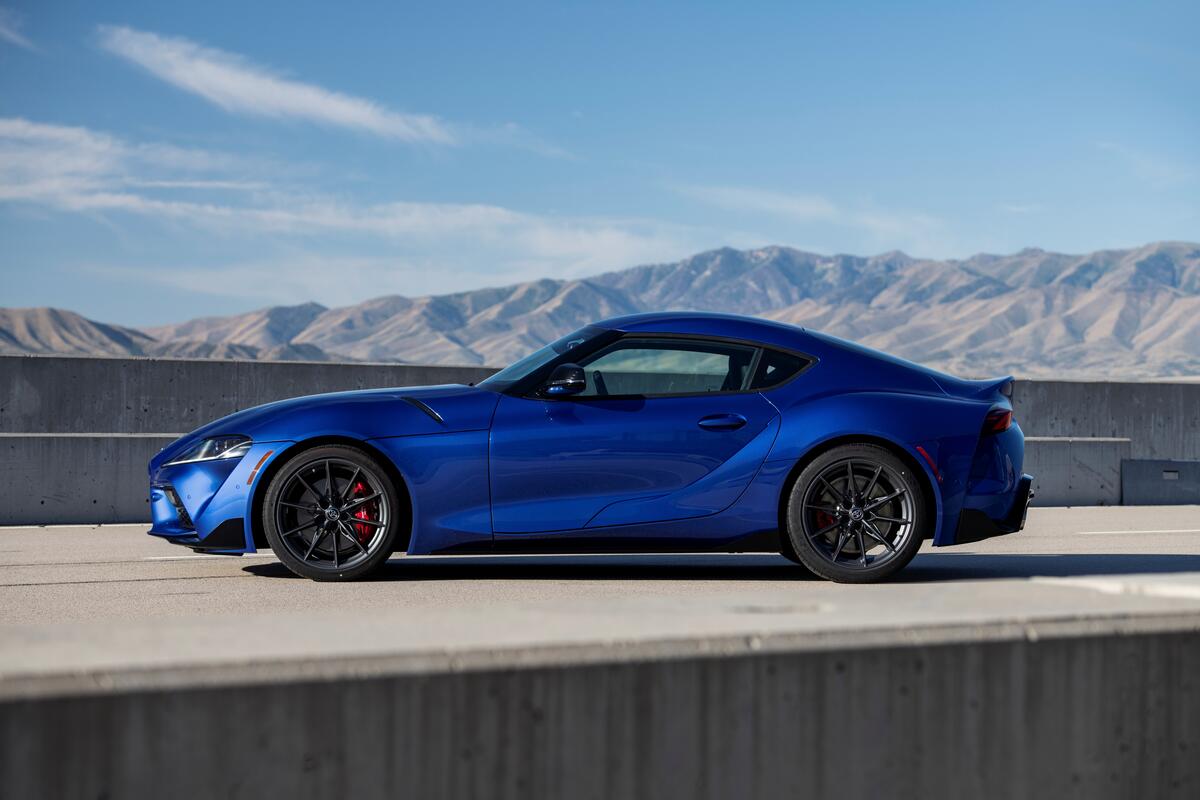
Toyota A90
"of desert racing on fiberglass, like if you had it mounted well enough, it might survive if everything went well, but it's like a 90% count on everything going on in the desert racing."
The Toyota Supra is a sports car made for fast driving. In desert racing, people talk about whether it can handle rough conditions and still keep working. It’s basically about how well it’s prepared and whether nothing goes wrong.
The Toyota Supra is a performance sports coupe known for its strong engine and track-focused reputation. In a desert-racing conversation, it comes up as a car that can be made to survive harsh conditions if everything goes right—tires, mounting, cooling, and overall setup. That’s why it’s often discussed in terms of durability under extreme, off-road-like stress.
suspension travel
"Like we'll probably have to limit the suspension travel by at least a couple inches to make the body fit. So I'm like, well, why do we should have, why don't we just find another one?"
Suspension travel is how much the suspension can “move” when the wheels hit bumps. If you limit it, the car may ride harsher and lose some grip over rough terrain.
Suspension travel is the distance the suspension components can move up and down from their normal position. Limiting it reduces how much the tires can follow bumps, which can change ride quality and traction—especially in off-road or racing setups.
rebody
"And maybe the answer is we find a body that's incredibly cheap and mass produced and rebody it with something that's a little bit less difficult to rebody. Like there's some, there's a guy that rebodied one with a Willy's jeep wagon body."
Rebodying is when you change the car’s outer body (the panels/skin) onto the same underlying vehicle. Builders do it to get the right shape for racing and to make repairs easier.
Rebody means replacing or swapping the outer body panels/structure on a vehicle while keeping the underlying chassis or drivetrain. In racing builds, people do this to achieve a desired look, fitment, weight, or serviceability—like using a body style that’s easier to repair or replace.

Willys Jeep
"produced and rebody it with something that's a little bit less difficult to rebody. Like there's some, there's a guy that rebodied one with a Willy's jeep wagon body. It was at the mats off road games."
The Willys MB is an old, rugged Jeep that was built for military use. Some owners change the body on these vehicles to make the build easier or to get a different look. The key idea is that it’s a tough platform people like to modify.
The Willys MB is a classic World War II-era military Jeep, known for its simple, rugged design and widespread historical use. In the context you provided, it’s being discussed as a base that some people rebody or modify—using a different body style to make the project easier. That’s why it comes up in off-road build conversations.

Jeep Willys
"produced and rebody it with something that's a little bit less difficult to rebody. Like there's some, there's a guy that rebodied one with a Willy's jeep wagon body. It was at the mats off road games."
The Jeep Wrangler is a four-wheel-drive SUV made for off-road driving. People often modify them with different parts and sometimes even change the body. In the conversation, it’s being used as an example of a Wrangler-based project that someone reworked for easier building.
The Jeep Wrangler is a modern-era off-road SUV known for its 4x4 capability and popularity with aftermarket modifications. In the podcast context, it’s mentioned alongside a rebody idea—using a different body style to make a project easier. That’s why it comes up in conversations about custom builds for off-road events.

Jeep Cherokee
"Or can we get something else? Like say an older Jeep Cherokee or something like that? [3096.6s] I mean, I wouldn't, I wouldn't choose a Jeep Cherokee, but yeah, to use that concept. Yeah, absolutely."
A Jeep Cherokee is an SUV that’s commonly used for off-road or rough driving. They’re considering it as a starting point for a project, but they don’t think it’s the best choice.
The Jeep Cherokee is a compact-to-mid-size SUV platform that’s often associated with off-road capability. The hosts mention it as a possible older donor vehicle concept for a build, but they also say they wouldn’t choose it personally.

Mini Cooper
"It's like use a mini Cooper. [3105.2s] Yeah. [3105.7s] A mini Cooper or like preferably something a little older because there's less crap that you have to like work through to get it, you know, like all the plastic off."
A Mini Cooper is a small car. They’re saying it could be a better starting point for their project because it’s easier to strip down and work on than some other choices.
The Mini Cooper is a small, front-wheel-drive hatchback known for being relatively simple and lightweight compared with larger vehicles. Here, the hosts suggest using a Mini Cooper as a donor because it may be easier to work with and has fewer “things” to remove before building.

MGB GT
"Um, but like, you know, uh, an MGB GT or that's a little bit on the expensive set. [3121.3s] Well, not really. [3122.0s] They're only expensive if they're running and we don't need it running for the idea."
The MG MGB GT is an older British classic car. They’re saying it might cost more to buy, but if you’re not trying to drive it, the price matters less because you’d mainly use it for the build.
The MG MGB GT is a classic British grand tourer based on the MGB roadster, with a fixed roof and a more practical body style. The hosts mention it as an option, noting it’s “expensive” only if you need it running—implying they might use it as a non-running donor for parts or bodywork.

Audi R8
"But the point is like, I just realized that the combination of desert racing and the Audi R8 body on a side by side is probably not worth it because we're going to put so much work into making it look cool and we'll be able to rally the crap out of it. And it might last 90 seconds."
The Audi R8 is a high-end sports car. Here, they’re basically saying that putting an R8 body on a desert-racing project would look cool, but it would take a ton of work and probably wouldn’t be worth it.
The Audi R8 is a mid-engine supercar known for its lightweight aluminum construction and strong performance. In this segment, the hosts are talking about using an Audi R8 body as a visual “shell” for a desert-racing-style build, which would require lots of fabrication to make it work in that environment.
wheelbase
"What were they powering those with? [3157.5s] C5 Corvette, everything that built the body to a C5 Corvette wheelbase, and [3162.5s] then they would just buy a C5 Corvette, strip the fiberglass body off, slap that on, done."
Wheelbase is how far apart the front and rear wheels are. It affects the car’s shape and handling, so if you’re building a stunt car body, you need the right wheelbase so it looks and drives correctly.
Wheelbase is the distance between the front and rear axles. It strongly affects a car’s proportions, stability, and how it behaves dynamically, so matching the wheelbase is key when building a stunt body that needs to fit and move like a specific car.

Chevrolet C5
"What were they powering those with? [3157.5s] C5 Corvette, everything that built the body to a C5 Corvette wheelbase, and [3162.5s] then they would just buy a C5 Corvette, strip the fiberglass body off, slap that on, done."
A “C5 Corvette” is a specific generation of the Chevrolet Corvette. It’s often used for stunts because it’s cheaper and easier to modify than supercars, so filmmakers can crash/destroy it for the movie without losing a fortune.
The “C5 Corvette” is the fifth-generation Chevrolet Corvette, known for being a relatively affordable, easy-to-modify platform compared with exotic supercars. In Fast and Furious 7, the production used C5 Corvettes as the underlying chassis/wheelbase so they could build stunt cars and then destroy them without risking expensive cars.
prop cars
"I mean, paint it presumably, but they could have also painted it in post, so [3171.3s] to speak. [3173.6s] But yeah, all the prop cars in that, in all the, like all of the Koenigsegg reguerras and everything, all of them are C5 Corvettes."
Prop cars are the cars used in movies for filming scenes. They’re sometimes built on cheaper cars so the filmmakers can do dangerous stunts and not ruin a rare, expensive vehicle.
Prop cars are vehicles used for filming that may be modified, duplicated, or intentionally sacrificed for specific scenes. Productions often build prop cars on cheaper donor platforms so they can safely perform stunts and destroy the cars without risking irreplaceable exotics.

Koenigsegg Regera
"But yeah, all the prop cars in that, in all the, like all of the Koenigsegg reguerras and everything, all of them are C5 Corvettes. [3180.3s] Yeah, you can't be afforded to crash Koenigseggs, even if you're probably buying like a hundred of them at a time."
The Koenigsegg Regera is a very expensive, high-performance supercar. The point here is that the movie used cheaper base cars to create Regera-looking stunt cars, since crashing a real one would be too costly.
The Koenigsegg Regera is a Swedish hypercar known for its high-end powertrain and extreme performance. In this context, the hosts are saying that the movie’s “Regera” stunt cars were actually built on C5 Corvette underpinnings, because you can’t afford to crash real Koenigseggs.
drift
"I mean, C5 Corvettes are relatively very cheap and they have enough [3189.6s] performance for all the stunts in the movie. [3191.5s] You know, you can drift it, it's rubble drive."
Drifting is when a car slides sideways on purpose while the driver keeps it under control. It looks cool on camera and doesn’t always require the car to go extremely fast.
Drifting is a driving technique where the car intentionally oversteers and the driver keeps the vehicle sliding while maintaining control. It’s commonly used in stunt driving because it looks dramatic on camera and can be done repeatedly without needing the car to reach very high top speeds.
race prep
"Well, even if we do, I'm not totally against that because I mean, race prep side-by-sides are actually not that expensive to buy used..."
“Race prep” is getting a car ready for racing. That usually means making it safer and tougher for hard driving, not just driving it normally.
“Race prep” means modifying and preparing a vehicle specifically for racing use. It can include safety items, cooling and durability upgrades, and changes to make the car handle and survive the stresses of competition.
maintenance
"race prep side-by-sides are actually not that expensive to buy used because people are afraid of maintenance."
Here, “maintenance” means the regular upkeep needed to keep the vehicle running well. Off-road use can wear parts out faster, so upkeep matters more than it does on a normal car.
In the context of off-road vehicles, “maintenance” refers to the ongoing work needed to keep components reliable under harsh use—things like frequent inspections, fluid changes, and replacing worn suspension/drivetrain parts. The speaker implies that maintenance costs scare some buyers away, affecting used pricing.
whoops
"most people that do desert racing, they either have a custom wheelbase that's in between the two or that you could do four door because when you're doing whoops, a short wheelbase is super sketchy."
“Whoops” are those repeated bumps in off-road desert racing. They make the suspension bounce a lot, and if the car can’t handle the bouncing, it can get out of control.
“Whoops” are a series of closely spaced, rolling bumps common on desert off-road tracks. They force the suspension to cycle rapidly; if the timing and vehicle geometry don’t match, the vehicle can lose traction and become unstable, leading to severe loss of control.
cartwheel
"Yeah, you just cartwheel. I mean, I've seen so many videos of side-by-sides cartwheeling in the desert because the frequency of the whoops ends up working out just wrong."
“Cartwheel” is when the vehicle flips over in a violent rollover. It can happen when the bumps make it land wrong and the car can’t stay balanced.
In off-road desert racing, “cartwheel” describes a rollover where the vehicle flips end-over-end due to the terrain and suspension dynamics. It often happens when the vehicle lands awkwardly after hitting whoops, causing an extreme transfer of load that overwhelms stability.
r eight body
"The point, the main point was just the r eight body thing. It's like, yeah, probably we should not try to do a desert race with an r eight body on a side-by-side..."
“R eight body” sounds like a specific body style or kit. The speaker’s point is that putting that kind of body on a side-by-side for desert racing could be very risky and likely to get wrecked.
“R eight body” appears to be a reference to an R8-bodied vehicle or kit used for racing/off-road styling. The key point is that the speaker thinks using that body style on a side-by-side for desert racing is likely to end in destruction unless conditions are almost guaranteed to be safe.
donuts
"If that happens again, that was one of our rules is donuts when we do podcasts and the odds of us pushing a Chang Lee today are extremely high and it's a Monday."
“Donuts” are when someone spins the car in circles on purpose, usually by flooring the gas while steering. It looks fun, but it can wear out tires fast.
“Donuts” refers to intentionally spinning the car in a tight circle, usually by applying throttle while turning the steering wheel. It’s a common stunt that demonstrates tire grip and driver control, but it can be hard on tires and drivetrain components.
skit steer
"We're just going to pick them up with the skit steer and then run them over."
A skid steer is a small machine used on job sites to move things around. It can turn very sharply because each side can move differently.
A skid steer is a compact construction loader that turns by using independent tracks or wheels on each side. In the segment, they’re using it as a tool to move or run over something, which is why it’s mentioned alongside the stunt talk.
Request an Explanation
Heard something you'd like explained? We'll add it to this episode.
Sign in to request explanations for terms you heard.
Want to learn more?
Browse our glossary for plain-English explanations of automotive terms, jargon, and concepts.
Help improve this episode
See something that's not quite right? Our annotations are AI-generated and can sometimes miss the mark. Click the flag icon on any annotation to suggest a correction.