An EV is a car that runs on electricity from a battery. A used EV is the same kind of car, but bought after someone else already owned it, usually for less money.
Pistons are moving parts inside a gas engine that help turn fuel into power. EVs don’t use pistons the way gas engines do, which is why the speaker says there’s less to wear out.
Valve springs are parts in a gas engine that help the engine valves close properly. Since EVs don’t have that type of engine, those parts aren’t part of the equation.
Internal combustion is the usual type of engine in gas cars—fuel is burned to make power. The point here is that EVs don’t have that kind of engine, so there are fewer engine parts to wear out.
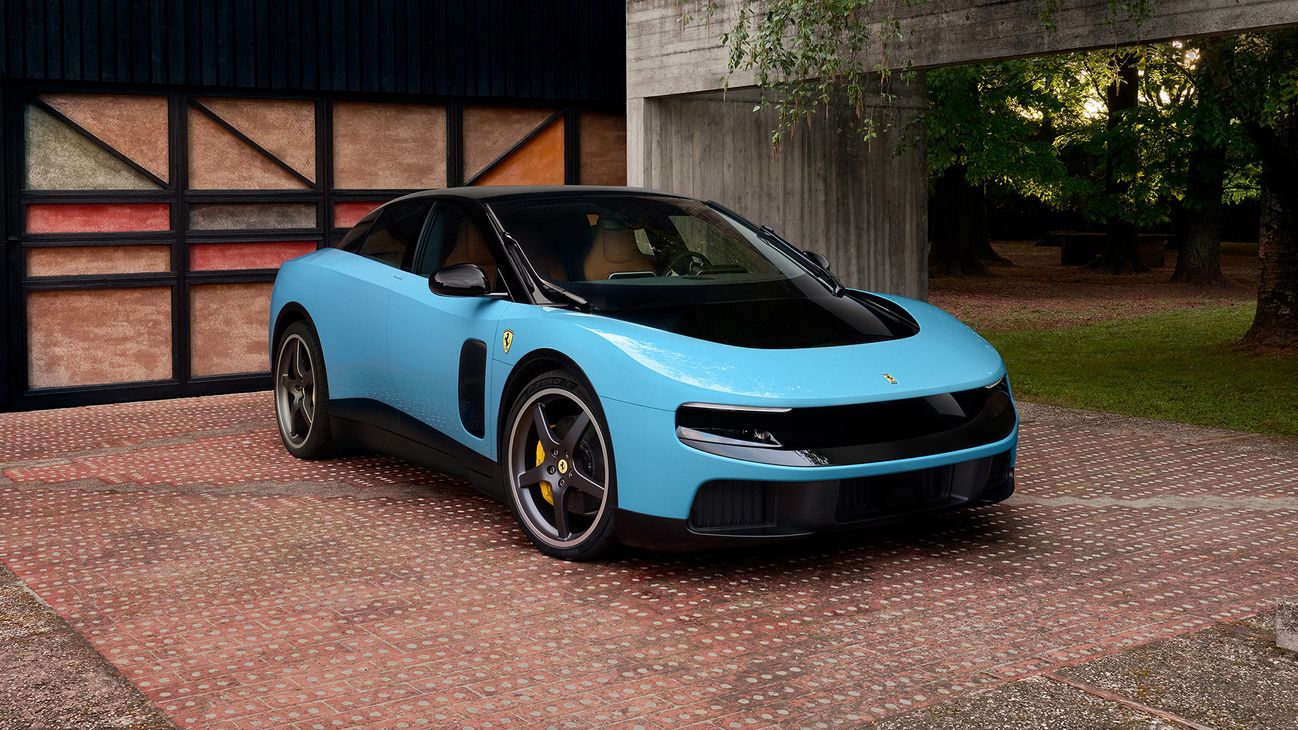
The Ferrari Luce is a Ferrari model name mentioned in the podcast. The speaker is reacting to it as part of a discussion about newer Ferraris. The key point is that it’s a modern Ferrari being talked about, not a classic model.
The Honda E is Honda’s compact electric car. In this segment, they’re talking about it in the context of EV features—how it charges and how many electric motors it has.
Term
lightning cable
They mean the charging cable you plug into an EV to charge it. It’s part of a funny image they’re describing.
The Ford F-150 Lightning is a pickup truck that runs on electricity instead of gasoline. The podcast mentions plugging in the charging cable, which is how you recharge it. It’s brought up because it’s an EV truck and charging is a big part of owning one.
“Four motors” means the EV has a motor for each wheel (or four total motors working together). More motors can help the car grip better and control power more precisely.
The coefficient of drag is a way to measure how “slippery” a car is through the air. If it’s lower, the car needs less energy to move, which can improve range.
The Ferrari F40 is a very famous high-performance sports car from Ferrari. It’s known for being exciting and special, and many car fans recognize it. In the podcast, it’s brought up as an example of classic Ferrari models people care about.
The Ferrari 458 is a famous Ferrari with a V8 engine that you can rev really high. People love it because the engine feels exciting and responsive when you push it.
Your powertrain is the set of parts that makes the car move. For gas cars it’s the engine and related parts; for EVs it’s the electric motor and the system that sends power to the wheels.
Flavio Manzoni is a Ferrari design leader. Here, they’re talking about his ideas for how Ferrari should shape its cars—especially whether they should look “human” or not.
Anthropomorphism means making something non-human look or act human. For cars, it’s when the styling makes it seem like the car has a face, like “eyes” and a “mouth.”
The Ferrari F355 is a famous Ferrari supercar with a mid-engine layout. Here they’re pointing out its pop-up headlights, which can make the car look like it has a face—matching the “human features” design idea they’re debating.
It’s a business model where one platform brings together two groups that want to trade with each other. In this case, it connects used EV sellers with used EV buyers (dealers).
A wholesale auction is a dealer-to-dealer sales event where vehicles are sold in bulk or quickly to other businesses rather than retail customers. For used EVs, this can speed up inventory turnover and affect pricing because dealers bid based on condition, battery health expectations, and resale demand.
“Software-defined” means the car’s behavior is controlled by software. Instead of everything being hardwired, the car can be updated or adjusted through its computer systems.
A leasing loophole means the rules had a gap that let more people get the subsidy than the policy was originally meant for. Here, it’s about how leasing made the EV incentives apply more widely.
Leasing an EV means you rent it for a few years and return it at the end. The big idea here is that subsidies made leasing so attractive that most new EVs were being leased instead of bought.
When EV leases end, the vehicles are typically returned to the leasing company, creating a supply of used EVs in the market. The host frames this as a large upcoming wave of returned EVs that could affect used-EV pricing and availability.
A charging network is the system of public places where you can plug in an EV. If those chargers are hard to use or not available, owning an EV can feel more inconvenient than buying a gas car.
A combustion vehicle is a gas-powered car that makes power by burning fuel in an engine. They’re using it as the “normal” alternative to compare against EVs.
A tax credit is money the government subtracts from what you owe in taxes. For EVs, it can make the car cheaper to buy, which helps close the price gap versus gas cars.
Early adopters are the first people who buy a new kind of product, even if it’s not perfect yet. The idea here is that those first buyers are mostly gone, so selling EVs gets tougher for dealers.
A green premium means paying extra money for something because it’s “greener,” like an EV. Here, it refers to the higher price early EV buyers were willing to pay.
A dealer floor plan is basically how a car dealership pays for and keeps cars in stock. If EVs don’t sell fast, the dealership can run out of room or money to keep more cars on hand.
A “premium” here means EVs are priced higher than similar gas cars. The host is checking whether that extra cost still exists when you shop used, and whether it shrinks enough to make EVs a better bargain.
“Days to sell” means how many days a car stays listed before someone buys it. If EVs take longer to sell, dealers may be more willing to discount them, especially in the used market.
The “Cox report” is data from Cox Automotive, a company that tracks how cars are selling and how long they sit on lots. The host is using it to support the numbers they mention about EVs taking longer to sell.
ICE means internal combustion engine—basically a gas or diesel engine. In this segment, they’re comparing those gas cars to electric vehicles to see which is a better deal in the used market.
“Days of supply” is a way to measure how quickly cars are getting sold. It estimates how many days the current stock would last if sales keep going at the same rate.
A PHEV is a hybrid you can plug in. It has both a gas engine and an electric motor, and you can charge the battery at home or at a charger.
Term
HREV
HREV is a shorthand for another kind of hybrid-electric car. It’s meant to describe cars that use electricity to help drive, but the exact charging/energy setup is different from a plug-in hybrid.
EREV means an electric car with extra range. It drives like an EV, but it also has a backup engine that helps recharge the battery so you can go farther between charges.
Extended range is how much farther the car can go than its battery would normally allow. In these cars, a backup system can help keep the battery charged while you’re driving.
A drivetrain is basically the car’s power system that gets energy to the wheels. In an electric car, it’s especially important because it’s what makes the car drive reliably.
Battery packs are the big rechargeable battery units inside an EV. They store the electricity that powers the car, and recycling them helps reduce waste.
Term
recycling processes
Recycling processes are the factory steps that take old batteries and pull useful materials back out. That way, fewer raw materials have to be mined for new batteries.
Reclaim rate is how much of a used battery’s materials can be recovered and reused. A higher number means recycling is getting more of the valuable stuff back.
The grid is the power network that delivers electricity to where you live and work. If the grid gets cleaner, charging an EV can produce less pollution overall.
Carbon neutrality means aiming for net-zero climate impact. For EVs, people debate it by looking at emissions from making the car and charging it, not just tailpipe emissions.
Diesel is a type of fuel used in certain engines. The speaker is saying that for very heavy jobs—like hauling a big boat—diesel can still be the practical choice.
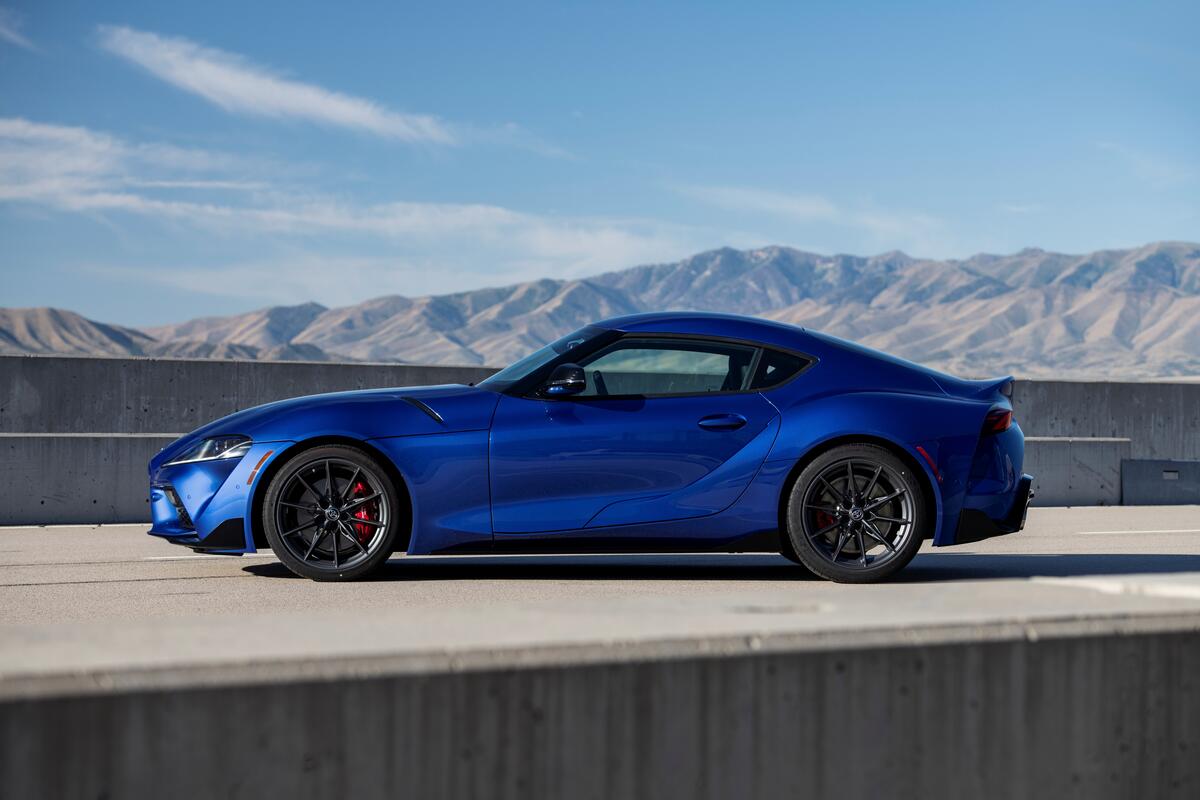
The Toyota Supra is a sports car, meaning it’s designed to drive fast and feel exciting. It’s a two-door coupe aimed at people who want performance. In the conversation, it’s being compared as a good overall choice for most drivers.
“Quad motor” means there are four electric motors working together. That can help the car put power to the wheels more effectively, especially when traction is limited.
It’s just a way of owning: some people keep a car for many years, while others trade it in and switch often. The host is saying used EV pricing can look especially good when you buy after the first owner’s depreciation hit.
Concept
buyer that rinses in repeats
They mean people who keep swapping cars often. When that happens, the first owner usually takes the biggest price drop, and the next buyer can get a better deal.
They’re saying the deal is so good because the used EV’s price drops faster than its real usefulness. So you buy it after the first owner took the big depreciation hit, and you get more value for your money.
They mean how long the car can keep being a good, usable car. Even if it’s only a few years old, it may still have a lot of good driving left—especially compared to how cheap it is now.
They’re talking about how the price of a new EV often drops a lot soon after you buy it. The first owner takes that loss, and the used buyer gets the car for less money.
When you buy a car, it usually becomes worth less over time. The “depreciation hit” is that loss in value, and the debate here is whether the buyer should take it or if a lease structure makes the leasing company eat more of the loss.
They’re talking about a Mercedes-Benz G-Class that runs on electricity instead of gas. It keeps the classic G-Wagon look, and the point is that deals and incentives can make it easier to get into one right now.
Four-wheel steering means the back wheels can turn too, not just the front wheels. That can make the car easier to maneuver in parking lots and more stable when driving fast.
Lithium-sodium is a different type of battery chemistry than the usual lithium-ion. The idea is that it could make EV batteries better—here they’re saying it could extend driving range by roughly 20%.
This means charging your electric car at your house instead of relying only on public chargers. The hosts say it’s the most important question because it affects what EV options are practical for you.
Term
Nax capable vehicle
They mention a “Nax capable” EV as the better choice if you can’t charge at home. The idea is that some cars are better suited to public charging, but the transcript doesn’t clearly define what “Nax” means.
Tesla has its own network of fast charging stations. They’re designed to charge EVs quickly so you can drive longer distances without worrying as much about running out of battery.
Term
North American Chargers
This is talking about the charging stations you can find across the U.S. and Canada. The idea is that you have more choices now, not just one company’s chargers.
Brand affinity just means you naturally prefer one car brand over others. Here, they’re saying that once charging is sorted, personal preference can drive the final choice.
This means the car’s advanced driver-assist features—things like steering help and cruise control that can do more of the driving. People may choose an EV based on how capable and reliable those features are.
The Tesla Model 3 is an all-electric car. The hosts are saying the current lease price is so low that it can feel like you’re getting a great deal compared with gas cars.
The Hyundai Ioniq 5 is an electric SUV/crossover. The point here is that someone leased one, returned it, and then bought a used one right away because they liked it.
Car
Lucids
Lucid makes electric cars. The host is saying people are buying used Lucid cars too, which supports the idea that used EV deals are getting more popular.
Car
Rivians
Rivian is a company that makes electric cars. The host is saying lots of people are buying used Rivian EVs.
This means the car has the extra sensors and computer needed for Tesla’s more advanced driving features. The hosts are saying that if a used car already has this hardware, it can be a better buy.
Term
latest update
They’re talking about a recent software update for the car. With EVs, software can add or improve features, so the car can feel better over time.
Autonomy means the car can do driving tasks on its own. AI in autonomy is the software “brain” that figures out what’s around the car and decides what to do next.
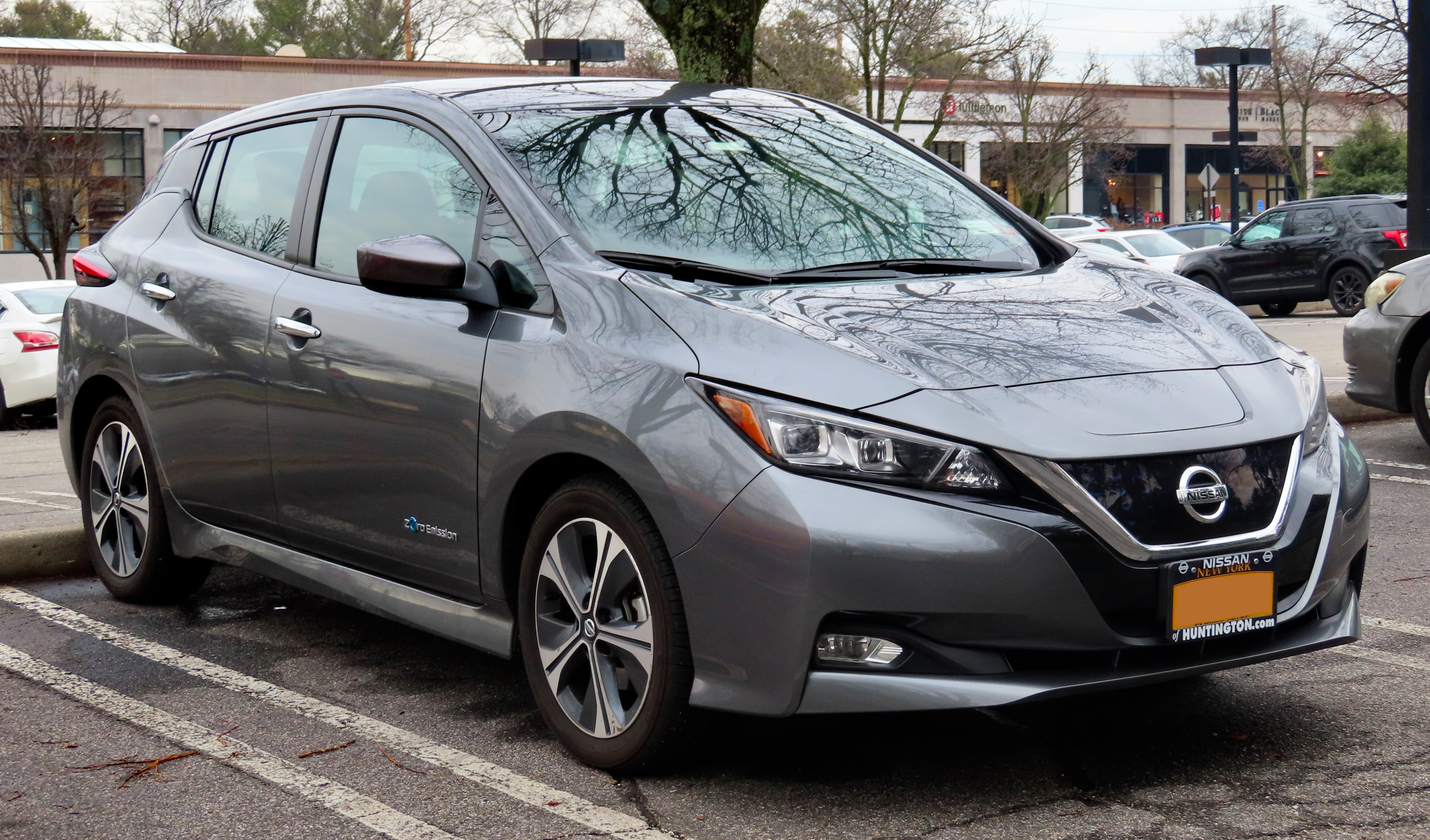
The Nissan Leaf is a popular electric car that many people buy new and then later sell used. Here, they’re talking about what happens to its battery over time and how much range you still get.
The Dodge Charger is a car model known for performance and a sporty look. In the podcast, the word “charger” seems to be about charging a car’s battery, not the vehicle itself. The point is that they couldn’t find a charging station nearby.
Charging speed is how quickly the battery fills up when you plug in. If it’s slow, you’ll spend more time at chargers—especially when you’re away from home.
Battery health testing is a way to see how worn out an EV’s battery is. It helps you guess how much range you’ll still get and whether the battery is in good shape.
FSD usually means “Full Self-Driving,” a set of advanced driver-assist features. When buying used, you need to confirm whether that feature is still included on the car you’re buying.
Software packages are add-on features controlled by the car’s computer. When buying used, you want to know which features you’re actually getting and whether they’ll still work on that specific car.
Charging stations are places you can plug in to charge your EV. Before buying, it helps to know what chargers you can realistically use near home and on your routes.
Sales training means teaching dealership staff how to explain a new kind of car clearly. In this case, it’s about helping salespeople understand EVs so they can guide customers instead of pushing them away.
The BMW i3 is BMW’s early electric car. It was one of the EVs that helped people get used to buying and owning an EV, so it’s a good example in a discussion about how dealers handled EV sales.
The BMW 3 Series is a luxury car that’s meant to feel sporty to drive. Some versions are built for higher performance, like the M3 mentioned in the conversation. It comes up often because it’s a popular model with a strong enthusiast following.
The BMW E92 M3 is a sporty BMW from the E92 generation. It’s the kind of car enthusiasts talk about, so it’s being used here to show that BMW dealer employees weren’t just EV salespeople—they were car people too.
The Mercedes-Benz EQB is an electric SUV from Mercedes. In this part, the host says you should avoid it if you’re buying a used EV, even though they’re comparing it to other options.
The Chevy Bolt is a compact electric car from Chevrolet. The hosts like it because it’s usually cheap for what you get, which is why it comes up in a “best used EV deals” discussion.
“Compact three row” refers to a smaller-sized vehicle that still has three rows of seats, typically to fit more passengers. The host says it’s very hard to find, which is why the Mercedes-Benz EQB (and similar EV SUVs) becomes a key shopping target.
A home charger is a charging station where you park at home. The host is saying you really need this so you can charge overnight instead of relying on public chargers.
Here, “road trip” means driving long distances where you have to stop to charge. The host is saying the charging speed can make those stops take too long.
The Mercedes-Benz EQE AMG is the sportier, higher-performance version of the EQE electric sedan. The host is basically saying it looks great and feels like a standout EV.
The speaker is calling out what they see as exaggerated fear about EVs. They’re setting up the question of whether battery worries are real or just fear.
Term
state of health of the battery
“State of health of the battery” (often abbreviated as SOH) is a measure of how much capacity a battery has left compared to when it was new. For used EVs, SOH helps dealers and buyers understand remaining usable range and how much degradation has occurred.
These are company reports where they share environmental and sustainability information. In this case, the host is pointing to them as where battery-mileage data was published.
It’s a way to measure how much battery “power” is left after a lot of driving. If retention stays high, the battery isn’t wearing out as fast as people feared.
This means a worst-case battery problem—something serious rather than just “the battery got weaker.” The point here is that these dangerous events are uncommon.
LIVE
Hi there, and welcome to The Inevitable.
This is Motor Trends Podcast.
It's our podcast about the future of the car,
the future of mobility, where we going,
how are we going to get there, and how are we going to buy these things
that take us places.
Oh, yes, I'm talking about used EVs.
But before we get to our guests today,
this guy has a message for you.
The Inevitable podcast is sponsored by nobody.
You need a sponsor?
Give me a shout, Edward.loh at Hearst.com.
Don't send me spam.
Just send me some money.
Please sponsor the podcast.
Or sign to Johnny's or my DM on Instagram.
Uh, yeah, today, this is perfect.
This one kind of fell out of the sky.
We have the chance to talk to a guy who's leading a company
all about selling used EVs.
And I know that sounds like, well, who cares?
This is actually like a super crazy moment in time.
First of all, we got a little thing happening
in the straight of what, Johnny?
Hormuz.
Yes, which has sent gas and diesel prices.
Where? Which way? Double?
Well, so they said that, you know,
last week we were talking about how I went to the Hyundai
factory tour.
One of the things that Hyundai was saying was that
about 40% of Americans are EV curious,
meaning that like, they're not necessarily against them
for any political reasons.
However, they need like a push to really do it.
And that push is $4.
It's the push.
$4.50 gasoline.
Right.
If gasoline hits $4.50 a gallon,
that's a pain point for most Americans.
Guess what?
Check this morning.
According to AAA, national average for more of the weekend
for gasoline, $4.53 a gallon.
So we're over the pain point.
Now people that are, maybe EV curious are now EV considering.
Right.
And so.
That's point one.
That's data point one.
The second data point, which everybody's been talking about,
is you remember about six months ago when the end of the EV
incentive was coming and everybody, all the manufacturers
are putting extra incentives out to get a large glut of EVs
that are getting up lots.
Well, that was happening for a year, two years prior to that.
All these EVs were being leased.
They're now coming back from being leased.
And they're starting to flood the marketplace.
And up until about six weeks ago, a lot of these used car dealers,
a lot of these are the Chevy store, your Ford store.
They're like, what are we going to do with all these EVs
that nobody wanted to buy?
Right, right, right.
Because whatever politics.
Yeah, depreciation, whatever.
You never.
You've made it shifted, right?
Well, the Iran situation has shifted back.
There's a huge glut of used EVs coming.
A lot of them are really good, really good.
And if you are at all interested in buying a used EV, hopefully Jimmy
Douglas, the head of plugmotors.com, plug motors, maybe he's got something
interesting to say about how you can buy, sort of have trust, faith,
whatever, just believe in buying a used EV.
Because, I'll be honest, that is the way.
If I like EVs, I think they're, if they've fit your lifestyle, the best way to get
into one is a used EV.
Don't, you don't need to buy new.
There's a lot of really good used EVs.
And, but I'm just going to say, anyways, number one reason is there's not a lot of
stuff to go wrong in an EV.
The normal wear and tear, the consumables, any of the mechanical stuff, there's no
pistons, valve springs, you don't change the oil.
Like they used EVs, you should have fewer problems than they use internal combustion.
All that said, my riveting is currently in the shop.
Let's meet Jimmy.
All right.
Welcome to The Inevitable, a podcast by Motor Trend.
All right, Jimmy Douglas, CEO of Plug Motors.
Thanks for coming on the show.
First question.
I hear you.
Hate the new Ferrari.
Oh, the Luce?
Yes.
I fucking love it.
You do?
Wait, seriously?
What do you mean?
What do you mean?
How?
What do you love about it?
What do you mean by love?
Are you blind?
By the way, we need to check.
Actually, yeah.
Okay.
What do I mean by that?
Listen, like, why do you recruit Johnny Ive?
Like you don't do it.
You don't recruit him to do something incremental.
Right?
You bring him in to do something transformative.
And what's their move here right now?
Is this for their existing audience?
Probably not.
It's probably for a whole new audience that they believe
represents the future and growth for the company.
All of that to say, just for me personally,
I know this is a very unpopular take,
but I think it looks awesome.
The thing they showed yesterday?
That's correct.
That you think looks awesome?
I do.
The outside?
The outside?
The outside looks awesome?
Yeah.
Yeah, I actually like the exterior more than I liked the interior.
In fact, the interior actually needed to grow on me a little bit.
But yeah, I think the exterior looks great.
I'm quite happy that it has four doors.
If it weren't $640,000 starting,
I would consider it as my next family vehicle.
I think that's going to price me out for now.
No, he's not wearing an Apple watch.
So we can't say he's not like a super tech.
Could you say he's a super tech guy?
Well, here's...
Do you drive a Tesla?
It's one of my vehicles, yeah.
Okay.
Yeah, but I'll have you know, I'm 41 years old now.
I owned 30 different cars before I turned 30,
none of which were electric and is almost certainly the sign of a diagnosable problem.
But I'm a...
No, in our world, that's only 30.
Okay, great.
I'm finally inside the asylum that I've been looking for my entire life.
I'm just like...
If that was like, hey, look everybody, it's Skoda's new design direction.
The new Honda E.
Yeah.
Okay, that's interesting.
You know, it's industrial, but like as a Ferrari,
I think it's just like just a mega fail as a Ferrari.
You and my entire X timeline.
The entire.
It is not lost on me that this is a controversial take.
And I think the best like sort of like memed out version of it.
I've seen is the one with it like upside down with like the lightning cable plugged into it.
Like the mouse, like that atrocity that Johnny gave us back in the day.
Yeah.
No, I get it.
But I watched a few videos last night.
The MKBHD one was pretty good.
You know, he did the whole walkthrough and all of the ASMR switches and all of that.
And man, four motors.
Four motors is cool.
There's lots.
I got one of the parking lots got four motors.
You can drive right now.
We have like a quad motor, Rivian or something.
Quad Rivian.
Yeah.
But like you got an X.
Is it a newer one?
No, it's a new one.
I got a new one in my driveway.
But the point is like, like it's got less horsepower than a lot of, you know, EVs that are been on sale for years.
It's got a smaller battery than like the aforementioned Rivian.
Like there's nothing groundbreaking other than these.
My eyes, my eyes.
These, these.
Well, okay.
Yeah, I'm just like, I don't know.
I just, I just as a Ferrari, I just like, I don't get it.
I just, I fail to see any Ferrari-ness, you know, I just don't like, like, yes.
That point is true.
I don't, loves it, hates it.
I will or will drive it until I see it in person.
I won't.
I think I see, I see something in the, where the windshield comes down and the.
Yeah, it's so stupid.
They have to put both windshield wipers sticking straight up.
That's how the windshield comes down.
Well, you had to accomplish coefficient of drag somehow, right?
But it's, no, because whatever, whatever you gain from having the, the, the metal meet the glass,
you lose by having two windshield wipers sticking up.
Is that true?
Yes.
I mean, it's probably worse actually.
Like it's an afterthought.
In other words, it designed the car that like, like the cyber truck.
Oh, shit, we need windshield wipers.
Yeah, I'm sure Elon would have designed that without a windshield wiper if he could.
They did.
They tried.
They did.
Yeah.
And then they said, oh, we can't sell it without a windshield wiper.
Yeah.
You know.
I know that was true of review mirrors, like side review mirrors.
Yeah.
So, but, but, so I'm, I'm, I'm like, gassed at your opinion.
Nice to meet you.
It's okay.
No, no, this was fully.
Yeah.
Well, I think the, his main point, and actually, because we asked the same question of our,
of our previous guests, you guys both landed on the, on the same in a different way, the
same idea, which is it's not for the people who know Ferrari as it is.
So we care about a, an F40 or a Testerosa or whatever.
Like for a new audience.
Right.
It's for the new audience.
It's for people who are used to doing this and taking pictures like this.
They don't hold the camera to their eye.
They don't go to, you know, Villadest or, or the comfort deligents.
They, they're, they want to floss in something that's controversial.
They're going to love it.
But I do think it's, we'll see.
Cause right now we're, we're recording this the day after the Luched dropped the day after
Ferrari share price dropped about 8%.
Yeah.
It did drop 8%.
And their old CEO says going to destroy the brand.
Right.
So we'll see whether this one, now I think it does set the bar low and like once we get
to drive it, maybe it, it climbs out of the,
it might drive phenomenal.
I'm just saying like there is, we talked about this with, with, with Yelkin from, from post
over, you know, I was saying, if you, you know, shut your eyes and I say Ferrari, an
image I think appears and boy, it ain't that image.
It ain't, it ain't the Luched.
It's, it's, it's something different.
Now I'm, I'm old for me.
It's a Testerosa.
You said a 40, but like, boy, that's far from that.
That's just far from that.
So yeah.
All right.
Yeah.
You know, for what it's worth, my introduction, like my real introduction to Ferrari was when
one of my best friends got a 458 when they first came out and he put 20,000 miles on
it in the first year, which is really aggressive.
I think I was passenger side for maybe 20% of that driving.
It was one of the best times of my entire life and I love myself a high revving V8.
Yeah.
And I totally get where you're coming from, but I also brought it up explicitly because
this is the exact reaction I expected.
Yeah.
And I don't, and again, I don't, I don't like, you know, EVs are wonderful, can be wonderful.
I've had plenty of great times in EV.
I'm talking about the power train.
Yeah.
You drove one here.
Yeah.
Yeah.
I drive one every day, but I'm just like the looks of that thing.
It's just like, now one thing, we'll get off for a second, but Flavio, the head of the
design of Ferrari.
No.
Manzoni.
Yeah.
Say it again.
Manzoni.
Manzoni.
Yes.
Flavio Manzoni.
He's very explicitly said he wants to get rid of anthropomorphism as a thing in Ferrari
design.
In other words, we're used to looking at cars and we see a human face, the headlights are
eyeballs, the grills, the mouth.
He doesn't like that.
He wants to like remove humanoid features.
And so, man, this is, this thing is a duck bill of platypus.
Like it's, you know, it's, it's crazy to me.
So it doesn't look like other cars.
It doesn't have a normal face.
I'll give it that.
Man, the pop-up lights of the F355 like hit me in the mind when you talk about the facial
features and that's one of the most iconic designs in my brand.
Beautiful.
Being in Fremont like at the height of their powers.
And this is, this is this guy's first time designing a car.
Well, that we know of, right?
Like there's plenty of speculation of what he was doing when he was still at Apple.
I mean, look, this is, I speculate this was, uh, this was the Apple Titan and they said,
hey, like we've already done a lot of the work.
You want it?
You know, you're, you're not the only one.
Yeah.
Yeah.
All right.
But let's talk about plug, plug, plug.
Let's talk about plug.
What is it?
What do you do?
We sell used EVs to dealers.
Okay.
That's at the core.
That's what we do to dealers.
That's right.
And why that distinction?
Why not to consumers?
Great question.
Uh, the short answer is because dealers are better at that than we would be.
Uh, but it traces back to the origin story and the why behind building it.
So, uh, why don't we start there?
Yeah.
So it's a two-sided marketplace.
We facilitate the buying and selling of used EVs where a hundred percent of the
buyers are dealers and it's a pretty even mix of independent and franchise dealers
all across the U S on the supply side.
We source vehicles on consignment from automakers, lenders, fleet operators,
other dealers, and we also buy vehicles directly from consumers and sell them to
dealers usually the next day inside of our wholesale auction.
The genesis behind this dates back to my time at Tesla.
I was there for five years and ran several North America wide business divisions,
but most notably for here, the used car division.
And in that capacity, my team and I were running what was at the time the largest
used EV operation in the world.
Sure.
And Tesla particularly at the time was really our introduction into the software
defined battery defined computer hardware defined electric vehicle, like really a true
computer on wheels, a direction that I argue were headed toward for the majority of four
wheel mobility.
We say it's inevitable around here.
Yeah, I've heard that.
I don't know where I've seen it, but I've seen it.
Hey, that's what that bell is for.
That's right.
I might not shock you to learn that the used car industry was not necessarily built for
this type of asset.
I bet.
And one of the biggest challenges that I saw in continued EV adoption new car sales,
EV adoption is the efficiency of the secondary market.
And for lack of better term, it was woefully inefficient.
The vast majority of dealers were not participating in it or many of them dip
their toe in and got burned one way or another, whether it was improperly decoding or evaluating
a vehicle, price drops, a lot of things go wrong.
Right.
And the underlying rails that power this industry from the physical wholesale auctions to the
pricing indexes to how vehicles are evaluated for condition and capability in my view needed
to be totally rewritten.
And through all kinds of pain and suffering and ideation, I decided that this problem was
much bigger than what needed to be solved inside of Tesla.
I thought that it was a generational opportunity to build something great that we really need.
So after five years and absolutely loving my job, my career and my team and literally
crying on the way out the door my last day at the factory and finding a flat tire on
my Model X when I got outside, I raised some venture capital money and got this thing ripping
as of three years ago.
Three years.
Okay.
So you started in 2023.
That's right.
What's the scale?
Like how many vehicles are you moving a month?
I thought you know what the metric is.
Yeah.
You know, it's funny.
On Friday, what's today?
Tuesday?
Today's Tuesday.
On Friday, we just crossed 100 million all time sales.
100 million sales.
Yeah, correct.
And dollar value, not number of units.
Okay.
Oh, that's good too.
Yeah.
Yeah.
That's even better.
Yeah.
Yeah.
Thank you.
100 million unit sales a day.
Yeah.
100 million dollars is a big number.
Yeah.
Thank you.
No, my team and we're extremely proud and grateful.
Current velocity, we're running at about six times the throughput today that we were
at this time a year ago and we do roughly between five and 700,000 a day, five days a week.
So just over 3 million a month.
Okay.
But how many vehicles is that?
Yeah.
The average value is about $35,000.
So a normal month right now for us, we move somewhere between 320 and 350.
Okay.
And what is the potential?
Like, you know, how many do you forecast?
I guess when you're, when it's a more mature market, when there's more used EVs available?
Yeah.
We're looking at scaling to 150,000 units annually before the decade ends.
Oh, wow.
Okay.
Yeah.
And that's sort of the social contract I signed when I took money from our Series A investors.
So we just closed on a $20 million Series A financing in December led by Lightspeed
Venture Partners with galvanized and continued participation from our past investors.
And as you all know, when you take venture capital money, you're not signing up for
some sort of linear trajectory.
No.
Yeah.
It's either a generational outcome or you can shut your doors and give us back whatever
wasn't spent.
Right.
They're not patient.
I guess what you're saying.
It's not that they're not patient.
It's that the outcome that you're shooting for is a very specific one, which is exponential
scale.
Right.
This valuation by such as up to date.
Yeah.
Pretty much.
So you're a real positive happy guy.
But you are, which you need to be.
You're a CEO.
You started this in 2023.
Yeah.
That was a totally different landscape.
Sure was.
But I built it for this landscape at that moment in time.
You built for the straighter for moves?
Listen, if I were that good, that would just be an oil trader.
No, I built it for the three year trailing period from the start of the inflation reduction
act.
Interesting.
So you're some other words.
You knew that you saw what coming?
What what?
What were you?
What were you keyed in?
You saw a lot of EVs coming off lease.
Bingo.
So it was a loophole.
It wasn't supposed to happen, but it did.
And you might remember the inflation reduction act was supposed to subsidize vehicles that
were built here that had battery cells sourced from friendly locations financed to families
that otherwise might have a tough time affording it.
The leasing loophole enabled everybody regardless of how much money they made and regardless
of where the vehicle came from and regardless of the batteries to lease it with the subsidy.
So EV leasing became majority of new EV sales.
And here we are 36 months later.
We're about to see 1.1 million leases be returned over the next three years.
And that's a tidal wave.
I have described it and this is prior to this Iran situation.
Like we're talking like six, whatever, six weeks ago, two months ago.
I was saying because I've been reading, you know, X or looking at just talking to people
dealers, big dealers were freaked out at the amount of EVs that were coming back off of
lease because they were really worried that they would not.
They're going to be stuck with these vehicles.
They don't know what to do with them.
That's accurate.
It is.
And it's part of the reason I started the company.
So going back to the original premise, there was very low dealer participation.
At this time last year, there were maybe 400 rooftops on top of CarMax and Carvana that
were accounting for over half of all used EV sales.
So it was very asymmetric.
And that's because the majority of dealers out there don't look at a used EV and see
a profitable asset.
They see a problem.
So what we set out to do was to make EVs an approachable asset that makes them money.
And that's us meeting dealers where they are.
And for the record, I picked myself off the ground as a young person working at a dealership.
So I've been on both sides of this paradigm.
So before we talk about the now, like this current situation and what an incredible opportunity
it has to be for you, walk us through this dark period though, which is probably about
a year or a year ago last, last, last six to 12 months or a year, 18 months or maybe
a year.
Sorry if I'm in a low tax credit, it goes away.
Right.
Trump really starts to like go like everyone, the mood shifts.
Yeah.
Who wants an EV?
Like is this, are you like climbing the walls?
Like, oh my gosh.
Or are you seeing through this like this is cyclical, this will pass?
I mean, we were believers.
And it's a good thing our investors were believers too because the sentiment was real.
For better or worse, I kicked off our Series A fundraising process right after the tax
credit cliff ended.
So it was record breaking sales in September because all of the demand got pulled forward.
And then in October, everything fell out from underneath.
Granted there was no supply to sell, right?
Like anything that was remotely like out of a factory like had made its way.
Had been sold.
Even if it was already sold, that was on a truck.
Like it wasn't going to be sold in the following week.
November was also really tough.
But then, oddly enough, December was the biggest month we had ever had in our history
at that point in time.
And I'm not going to pretend that it wasn't difficult.
And it's true, there were a couple aspects of our business that made a certain number
of venture capitalists immediately opt out of the round.
And one of them was they had their own uncertainty around where EVs are going in this country.
And the second was that we went from being a pure play sort of pass through technology
marketplace to a hybrid business model where all those consumer cars we buy, we actually
own them through a dealer license for a brief period of time.
And what's the advantage of you owning them?
We can guarantee that the sale will actually happen.
I see.
Oh, right.
Okay.
Yeah.
So going back to meeting dealers where they are, and this is really like where we spend
all of our calories is these relationships with dealers.
Dealers have no shortage of outlets to buy cars from, right?
There's all the traditional auction.
There's plenty of startups.
They want to do as many street buys as they can.
And when you're sourcing a vehicle from a consumer that you don't physically have in
front of you somewhere on the other side of the country, it's generally not worth your
time to invest in researching and bidding if there's uncertainty around a transaction
actually taking place.
So when we own the vehicle and we connect to it remotely, we accurately represent it.
When they see that plug is the seller, they know it's selling that day because I have
a one day turn time policy on our inventory, even if we lose money.
What do you mean by a one day turn?
You get rid of it in one day no matter what.
Is that a good policy?
Can I browse your site?
Yeah.
Is there a clock running on the store?
You can become a dealer.
If you have a dealer license.
It's $1,500 in a one hour class.
Do you have an expiration timer going on on these cars?
Yeah, so here's how it works.
We run a sale every weekday.
We ran one today.
I'm not sure how many we probably sold like 25 cars today or something like that.
Some mix of them were sold by commercial consignors, mainly OEMs.
The others were likely owned by us and the majority of vehicles owned by us were probably
purchased by us over the weekend.
Okay.
Interesting.
Yeah.
EVs are far more volatile in their value.
This is very well known.
The prices go down faster or there's cataclysmic events.
There's a new model announcement.
There's a price change.
Elon cuts the price by $10,000.
Yeah, no.
That's real.
Yeah, exactly.
That's real.
So the way that we fend off any inventory risk is the one day inventory turn time policy.
So we don't hold inventory risk.
We don't.
Yeah, we acquire vehicles sight unseen all across the country.
We evaluate it remotely and we represent it in our auction such that it can be confidently
purchased by a dealer the next day.
Now I will say there is some experimentation in outlier cases.
Sure.
It's not 100% selling in one day, but that's the baseline metric.
Could you just walk us through and you touch it on a briefly, but dealers, what is their
real problem with EVs?
Your traditional car dealership and man, you just hate EVs for what are the reasons?
Yeah, there's a couple of ways of looking at this.
One is the fact that a lot of new EV products that have been rolled out over the years were
just not easy to sell.
They were too expensive.
The charging network situation was a total mess and you could buy a gas car where you
don't have any of those problems or concerns for considerably cheaper.
Even today, the average new EV is $7,000 more than the average new combustion vehicle.
If only there was a $7,500 tax credit.
Yeah, if only.
Right?
Yeah.
But people, Americans just want to buy the best tool for the job for the best amount of
money and we had plenty of early adopters that would pay green premiums.
They would actually be fine with less convenience and more money to have a vehicle that isn't
contributing to greenhouse gas emissions or had better technology or whatever.
The early adopters have all been exhausted.
They're already, most of them are on their second or third EV by now.
That leaves dealers in a really tough spot because they only have a certain number of
parking spaces, a certain amount of room on their floor plan and they're in the business
to make money.
If they're getting saddled with product that nobody wants and feel like the federal government
is shoving it down their throats, of course they're going to be up in arms about it.
Right.
Let me ask you, so of course I know the premium on EVs is roughly $7,000.
Does that exist in the used market?
Like apples to apples?
Is that premium?
I'm so glad you asked.
There's two vectors here.
There's how much more do you pay and it's how much longer do they take to sell?
So on new cars today, it's a $7,000 premium and the days to sell on new, if I remember
correctly, it's like a seven day difference.
I can't remember the exact number from the Cox report, but it was like 70 versus 77 days
on new car supply right now.
So 77 being the EV.
Yes.
It takes a week longer to sell.
So that's one more week on the lot.
Those are on the 7,000, seven days longer for a new ICE to new EV.
What's the split on used?
On used, it's less than $1,000 difference.
Oh, wow.
It's $35,000 versus $34,000.
EV is slightly more expensive.
So it's the same basically.
But days of supply is lower.
Days of supply on used EVs is 35.
People snap them up for Uber and Lyft and.
For whatever reason.
Is that a current phenomenon?
Because of the high gas prices.
Well, maybe.
Last year, it was pretty much like this all year.
It was about a $35,000 purchase and it was nominally more expensive than a used gas car.
And days of supply was basically the same.
And people would make the argument is because there was a tax credit, but not really because
the tax credit on a used EV capped at $25,000.
And remember, the average price was 35.
The majority of used EV price transactions last year didn't even qualify for that $4,000 credit.
And I mean, just anecdotally, I know so many people that are interested in like a used
Model 3 because it's like you can get one, whatever it is, $21,000.
Yeah.
And it's a hell of a car compared to a like if you get a Corb that's $21,000, it's pretty
high mileage at that point.
Totally.
Yeah.
So it's a much better vehicle and you're getting much, you know, now you can get full self-driving
and, you know, and so I know a lot of people just anecdotally around LA that, you know,
they're embarrassed now.
They're not too into what Elon's up to, but they're like, you know, the car is great and
they love the car.
It is.
It is.
And I listen, I hear that a lot.
And my message to anyone that's thinking about that is to consider the other 120,000
people that are sprinting every day to make this happen.
Having been one of those people.
I raise an argument all the time.
Absolutely.
Well, thank you for doing that.
I also raise the other arguments.
Yeah, I understand.
But let me ask you, because you probably just answered it just then and it says a little
bit dumb to ask somebody who worked at Tesla for five years, but you said a while back
that you're a true believer in this and EVs, but you also have owned at some point 30 cars
that were not EVs.
I own a gas car right now on top of owning EVs.
Yeah.
So then why, and so you're an American, you're working at Tesla at an American company.
Plug motors is North America?
Just America?
Yeah, it's just the US right now.
Why are you still a true believer in EVs?
When most of the world, although again, I really feel like we're in this unique moment
where people who hate on EVs, they're really getting kicked in the wall.
They're looking at $5 of gas, yeah.
Or higher, right?
Well, here, but yeah.
Why are you still like, the title is saying, you still believe that this is where it's
all going?
I mean, Ed wanted real quick, just to preface that Ed wanted to change the name of the show.
No, I did not.
Yeah, remember that was your whole thing for season three was like, is it still inevitable?
Well, it is.
And now you said it twice.
I mean, there it is.
One new gimmick desperately.
Why do I continue to believe that electrification of transportation is inevitable?
Right.
Yeah.
And I want to be clear, I'm not an EV extremist.
Like, I don't go out there and saying everybody needs to drive an EV today.
Every dealer needs to adopt EVs and use EVs today.
In fact, the latter is physically impossible.
Like, used EVs are only not even 3% of the used car market.
It's my belief that within my lifetime, the majority of new auto sales globally and in
this country will be some form of electrified drivetrain and very likely a very high mix
of battery electric vehicle.
Potentially a continued mix of some Phev, maybe a little more the HREV like as we said
to season.
Yeah, the EREV, thank you.
Yeah, yeah, yeah.
But that's going to be, yeah, the extended range.
I think we're going to see quite a bit of that.
The reason I believe that is because the drivetrains themselves are insanely reliable.
The technology is becoming increasingly affordable as we hit economies of scale.
We're almost hitting that first point of the cycle where we'll start seeing battery packs
go through recycling processes and I'm sure you both know it's over a 99% reclaim rate.
We're keeping up, we're keeping up, yeah.
Yeah, and it's also my belief that the grid overall will see its own transformation to
one that relies increasingly on renewables.
The carbon neutrality question, which comes up rightfully so, will no longer be a difficult
equation.
It feels inevitable to me and we can simply look it to the global markets given that we're
the most developed large scale market that is behind on the transition.
Crazy, right?
Yeah.
Whoever thought America would be behind, yeah, it's weird.
Everything you just said, I totally agree with that.
I think we'll stupidly because of just dumb American reasons, we're going to be five years
behind the rest of the world, but yeah, the overwhelming majority of personal transportation
will be electric.
It's a better power train, it's a better solution for most people most of the time.
Yes, if you have a 90 foot boat you have to haul around, you probably want to diesel.
Yeah.
But also now, diesel's like nine bucks a gallon, so maybe you don't.
Yeah, dang.
Yeah, maybe that quad motor Rivian's a good tool for that job as you have enough charging
along the way.
Yeah, yeah, yeah.
Let me not lead the witness because I think I know what you're going to say, but because
of what you do.
You never know, man.
You remember what I said about the luge?
I'm so a little like.
By the way, I'm also half Italian.
My mother was born in Napoli.
I know a lot of Italians that are very depressed right now.
So for the person who might be listening who's like, okay, okay, fine.
I really don't want to pay $5 gasoline.
I want to buy, I'll dip my toe.
I'll buy an electric vehicle.
What is the best way to buy an electric vehicle?
Is it new now?
Is it used?
If it's used where?
If it's used.
What?
What?
And what to look for.
And what to avoid?
Wow.
Okay.
Lots of questions.
Yes.
Really great question.
Let's start with the first one.
Okay.
So there's two different types of buyers, right?
There's the buyer that buys and holds and there's the buyer that rinses in repeats and
goes through every few years.
The used EV is the greatest financial arbitrage of all time when it comes to car purchases.
Why?
1000%.
Yeah.
He says this often.
Yeah.
Yeah.
So we don't know exactly how far into its useful life like a three-year-old vehicle is.
Let's I'll say something controversial.
Let's say it's 10% into its useful life, but at the same time, it's 50% off.
The first owner took the biggest hit.
They did.
They just come in and just pick up the pieces and they're beautiful.
And you know, that was a brilliant statement, Ed, because that's how I answer the other
part of that question is if you're going new, who should take the depreciation hit?
Should you take it or should the leasing company take it?
And if I were going brand new right now, I would be leasing for that reason.
There's all kinds of subsidies going on right now from the manufacturers, not the federal
government, because they do need to move this product and they need to hit economies of
scale.
I tell you, if you want an electric G-Wagon, now's the time.
I kind of do.
I just, I just wonderful.
I mean, it's the best G-Wagon.
They're wonderful.
And they're on sale, baby.
Don't tell me that.
Like I, they're on fire sale.
Yeah.
That four-wheel steering looks just absolutely epic.
I just wish like it's what, like a 240 mile range or something.
It's a bad range.
Yeah.
It's a bad range.
It's a bad range.
But soon they'll have a new battery chemistry, lithium sodium.
I don't know what that is, but lithium sodium and it'll be, it'll be 20% better.
So it'll be like 280, which is totally livable.
I'm definitely bullish on electric G-Wagons.
Oh my God.
So you said, if you're going to go new, at least.
Yep.
If you're going to go, if you otherwise used.
Yeah.
Okay.
All right.
From who or what?
Yeah.
What, like, what do I buy?
Which is the model three.
Model three.
Model Y.
Question number one, can you charge at home?
Right.
Yes.
That's the biggest question.
Yeah.
If you can charge at home, then, man, the options are kind of endless, but let's like keep going
down the ladder really quick.
Yeah.
Let's say you can't charge at home.
If you cannot charge at home, then I would say a Nax capable vehicle is probably the
better choice right now.
And what you're, what we mean by that is something that's able to jump on the Tesla Supercharger
Network.
North American Chargers later.
Exactly.
Yes.
Exactly.
That's the best advice of today.
Go ahead.
Okay.
Great.
Yeah.
We've got more time.
Yeah.
And, you know, most often that's going to be a Tesla, but as you both know, like, not
necessarily exclusively anymore.
Well.
When we've seen Hyundai's come through with Nax now.
On road trips, that's where I take my Rivian.
Yeah.
And from there, if you can charge at home, your options are basically unlimited.
And at that point in time, you know, it'll come down to like, do you have any brand affinity?
Do you care about luxury or do you care about the best self-driving technology?
Right.
Is there anybody politically that you love or don't love?
You know, like, it's such a nuanced question.
But there's something for basically every situation now, which wasn't the case a few
years ago.
What's a screaming deal?
I was quoting like, you can buy a Model 3 for like $15,000.
$299 a month right now leasing one, man.
It's like insane.
Yeah.
A new Model 3 for $299 a month.
Yeah, that's a free car if you're coming from gas, basically.
That's a free car.
I mean, look, I don't make that much money, but I don't know if I noticed $300 a month.
Yeah, for sure.
It's a horrible thing to say.
But like, I think with my phone bills around that.
That's just a Garband tab or something.
Yeah, easily.
Yeah.
I mean, there's so many deals right now.
I have a friend that just turned in their Ioniq 5 lease and then they immediately bought
a used one just like it.
And they absolutely love the car and they just wanted to stay inside of it.
Yeah, great cars.
Yeah, we see people picking up used Rivians and Lucids like crazy.
Great cars.
Yeah.
There's...
But numbers, give me a number.
Like I was saying for a while, this was like when Model 3s went under, used Model 3s went
under $25,000.
Yeah.
I started to perk up.
They're now under $20,000.
Yeah, Model Ys are under $25,000 now.
That is bananas.
It is.
Especially if you get the full self-driving hardware on there.
Totally.
Yeah.
Like we've talked about this at Nozium, but like it's such a game-changing technology.
I'm still shocked by how good it is.
I agree.
And I actually, I really appreciate that take and that the two of you did a segment dedicated
on the latest update.
One thing that I continue to hear is that other manufacturers are either up to speed
or really close.
I have yet to see that actually be true.
And I want it to be true.
I really do.
It will be true.
It's going to take some time.
But like, I mean, you were in the car, we got a demo from Rivian on their AI in autonomy
day and it's just going, it's making a left-hand turn.
I don't know.
I just spent...
But I said to the engineer, I said, like, is there a time where it feels like it's not,
it didn't learn to drive this morning?
Whereas, I mean, you know, full self-driving, it's just incredible.
It's wacky how good it is.
I mean, you have to hand it to the team there.
Oh, 100%.
We were collecting training data on every FSD capable vehicle back in what, 2018, whether
you had the software package or not.
That's a lot of cameras.
Probably earlier.
I mean, just camera data, you know.
My understanding is earlier.
7000000000 miles or something.
Is there any red flags of someone's looking to get a used EV?
Like, you know, we know, I'm making this up.
Like a Nissan Leaf, like, you know, the battery.
I had a friend, they had a first gen Nissan Leaf.
Those ones are tough.
And they held on to it till they had like 30% of the range left.
I'm like, what are you doing?
What is that, like 25 miles?
Yeah, but they're like, well, we just drive to the kids' school and work and that's it.
We don't do anything.
We can't find a Chabinville charger anywhere.
Right.
Yeah, weird.
They charged like a one-ten at home.
They were really, you know, they wound up getting R1S.
You know, they went big.
Wow.
You could practically fit the first one inside of the second one.
Absolutely.
But is there any like real, like for people to look out for?
Exactly.
Like, yeah, what are some of the red flags?
What are the dogs?
What do the do not buys?
I mean, there are no like specific, like do not buy, like makes and models.
Obviously, like there's a huge difference between like second gen EVs, like mostly what
we're talking about today versus that very first run.
Yeah.
Right.
Mitsubishi Aimee.
Maybe that's not.
Yeah.
I mean, at this point, if you're in the market and you're looking for an EV, we can assume
that you're looking for something that's been made in the last like five years or so.
Right.
If you're looking at anything that's really old, like really high miles built like prior
to what probably 2016, 17.
First gen bolt or something.
Yeah.
Like that's, there's a lot of considerations there.
Like some gotchas, like the charging speed like is going to be very limited.
Right.
Good point.
There's just so much benefits.
They're just going a little bit newer, even if you have to wait a little bit longer.
And when it comes to buying a used EV, honestly, the best thing you can do is just make sure
you're buying it from someone that knows what they're talking about.
Right.
That will solve the majority of your problems.
There's a lot of question around like battery health testing as an example, understanding
like what software packages you're getting, the FSD actually stay on this car and to actually
get it.
Right.
Can I really charge this thing at all these stations here in my house?
The dealers that we primarily work with have sales teams that are really well trained on
this and that can make or break the experience.
So it's interesting.
That's an interesting point because I remember, you know, talking with, I think it was BMW
and they were saying that, you know, what they're trying to do differently is that a
lot of car makers will suddenly come out with an EV, no training at all for the salespeople.
Never.
As a salespeople just want to make a sale.
So some of them might come in curious about an EV and leave with a gas car because the
salesperson was like, ah, you don't want to deal with that.
Yeah.
Happens all the time.
And they push them.
Whereas BMW said, we, you know, this is quoting BMW.
I don't know what reality is.
We train our salespeople like you want to sell on the EV because, you know, it'll make them
happier.
They'll enjoy the product more and more features, updates, blah, blah, blah, blah.
It'll keep them as in BMW longer.
I think that's smart.
You know, a member of our team is a former BMW genius actually.
And man, I remember back when the I3 first came out and I had all kinds of, I was in
Portland, I had a ton of friends that worked at the BMW dealer.
It's now a Latvia store or something.
And man, they were all driving I3 leases on top of whatever like monstrous, like probably
what was it, E92 M3 that they were driving.
Which I had one at that time as well.
Great car.
Yeah.
It was one of the best cars I've ever owned by far.
Not the I3.
Yeah.
I never had an I3.
I kind of want an I3.
But let me, let me just come back and just put an asterisk on.
If you're looking to buy a used EV, something made in the last five or so years, I would
avoid the Mercedes Benz.
What?
EQB.
Oh yeah.
Oh yeah.
Even the gas powered one.
Yeah.
As much as I love the form factor of the Chevy Bolt and the price because it's super cheap.
And I'll tell you why for both.
Like we were looking to buy an EQB.
My wife was like, I want an EV.
What?
Because we wanted a compact three row.
Okay.
Very hard.
Very hard to find something that has three rows.
Occasionally used third row because we got my brother's family, whatever.
Also, I couldn't resist it was so cheap.
The peak charging speed, 50 kilowatts for the Bolt.
That's tough.
And 100 for the EQB.
You can only consider buying this if you have a home charger and you're just going to charge
overnight.
And because of any kind of road trip, you are screwed.
I saw a guy pull up and this poor guy pulled up the EQB out of the memorial.
They come down and I'm like, oh, I mean, if you're trying to get to LA, you'd be a partner
for like over an hour to get home.
It just doesn't work.
It's rough.
I'm like, man, some of those Mercedes, the EQ E's and S's.
Oh, yeah.
They're nice.
They have to be, I mean, like the, the looks like a bar soap at the EQE AMG, the little
sedan, like that is such an incredible car.
It's such an incredible car.
The deals are really, really good.
Oh, they're telling us.
They just wants to.
Yeah.
Yeah, no, they're, they, they, they take a pretty hard hit.
Yeah.
Because I mean that like, I forget the horsepower, but like too much and it's got the crazy rear
steering where you can just, you know, make a U turn in the lane.
They're amazing cars.
And, you know, those batteries, for whatever reason, the, the, because the Germans are so
frightened of diesel gate is my theory, but they underwrite the hell out of them.
So if it says 380 miles of range, you're going to get 420 miles of range.
I've seen that.
The opposite of Tesla, you know.
Let me, let me tell you that.
What about people that are really concerned?
Because, you know, all the, all the anti EV hysteria that's out there.
Sure.
Derangement syndrome, you know, where people worried about batteries.
Yeah, they are.
So what, how legit is that worry?
And is that, does that factor into what you do at plug it all?
Of course.
Yeah.
You know, so we sell to dealers and dealers very legitimately want to make sure that they're
selling a good product to their customers.
Yes.
Because there's legal ramifications if they don't.
Yeah.
Among other reasons, but that certainly is one.
I know dealers, but go ahead.
Yeah.
Having some sort of indicator on the state of health of the battery is really important.
It's not a standardized measurement today.
So there's all kinds of different means for gathering an indicator.
The reality is, is most batteries are way better than anybody thought.
There isn't a lot of publicly available aggregated data.
There's a one Tesla story.
That's right.
Yeah.
And they released it in two parts, two different years in their environmental impact reports.
And it said 200,000 miles.
Battery capacity retention was 85% for three and why and 88% for SNX.
And that's a 200 K miles.
Now, granted, remaining capacity, state of health is not an indicator of likelihood of
a catastrophic failure.
Right.
That's a totally different metric and one that's also not standardized yet.
But catastrophic failures are very rare.
It's my belief that we're going to enter a world where it's quite normal to buy a used
200,000, 300,000 mile EV.
And at that point in time, for dealers that are listening, it's the ultimate FNI opportunity,
right?
Because even myself, like a person that's very comfortable with EVs, I'm definitely buying
a protection product for that.
Oh, sure.
And lucky is catastrophically expensive.
Yeah.
I'd love to see an actual study because, I forget, you just said it was like 85% and
88%.
But remember, in the early days, people just charged them every single day to 100%.
There was no thought whatsoever about, I only really need to charge to 70 or 80%.
I don't need to run it down to zero.
I can plug it in at 20.
No one knew anything.
Yeah, the hygiene was totally off.
You know, it's funny.
So yesterday, I was in Vegas and I had an Uber driver and an R1S.
He had 180,000 miles on him.
Hell yeah.
And he's like, yeah, I have the highest mileage like R1S in the world.
I was like, wow, yeah.
How's the interior hold on?
Really cool flex.
It was beautiful in there.
Dude, yeah, the interior, I have 45,000 miles of mine.
The interior is new.
It's crazy.
Yeah, like the durability is nuts.
Yeah, for first time products, it's really over the top.
Over the top, absolutely.
And I asked him to pull up because it has a battery capacity indicator in the dash and
I had him pull it up and we extrapolated it.
It was like 89%.
Oh, yeah?
Yeah.
Okay.
I mean, that's amazing.
If you're listening at home, you don't believe any of this because I was like, oh, these
batteries are good.
They were replaced.
It was going to be $20,000.
Like look, if EV batteries were failing en masse, first of all, there would be news stories
about it.
And if you think there's a conspiracy theory, then there'd be Reddit threads devoted to
how, oh my God, did you hear about the other burning all these, these dead EV batteries
in the desert because they're all failing?
No, it's not happening.
We would have reported on it.
We're not that jaded.
But let's talk about, let's plug plug.
Yeah.
Plug plug.
So the site is plugmotors.com.
That's right.
There's a little tab here called sell.
Yeah.
Get cash off for you.
And I can, yes, exactly.
So my wife bought, we bought...
Wait, do my, do my...
Yeah, let's buy his room again.
You know the van off the top of her head?
Yes, of course he does.
Yeah.
All right.
So, but let me just...
Let's do this live.
Let's see how long it takes.
Let's set this up.
We bought my wife's, we bought a Porsche hybrid off of Carvana.
It was the Cayenne E hybrid.
That's sick.
Cayenne SC hybrid.
It was great.
She loved it.
And then we bought a full EV.
We leased it from Hyundai.
But the Carvana experience, because we sold it back to them too, was great.
So sell me on why should I sell my EV to plug and not somebody else?
The answer is if you're comparing us to somebody else, like you're just going to pick the higher
number.
Like that's how most people are going to act.
We're certainly no less convenient than anybody else.
Will you pick up my car from my house?
Oh, Carvana?
Will it be a fancy flatbed?
No, no, it's not a fancy branded flatbread.
You know, Ernie's got a little more money than me.
But, you know, we'll get there.
For now.
For now.
But yeah, no, we'll get there.
But yeah, if you...
The reason to do it is because we're the most accurate.
And that doesn't mean that we offer the most every single time.
I will say in the studies that we've performed, we generally offer the most about 70% of the
time.
So, more likely you're going to sell it to us versus somebody else because you wanted
more money.
But experience wise, depending on your vehicle, you'll either get an offer instantly.
On a revue and you won't, it'll probably take about 10 minutes, but you can keep me
honest here.
It's live.
The team doesn't know we're doing this.
There might be a couple of added questions, maybe not.
We will ask you to inspect the car for us with a digital, like a web link.
Takes you a few minutes.
And then if it's all good, then we send you a docuSign.
And if you have the title in hand, then we'll pay you immediately.
I have the title in hand.
Yeah, great.
I'm saying this.
Yeah, because he said he could.
Yeah, he could.
That's all right.
It's OK.
Yeah.
A little.
Yeah.
So anyway, we'd like to think it's just as convenient
as selling to anybody else.
We have a lot of very positive Google reviews
that point to that.
And mind you, we don't ask people to leave reviews.
They just do, which is great.
It's funny.
I actually sold a car through Carvana
because I was trying to sell it privately,
and it was a Ford Fiesta ST.
And I will say how to put this.
The people that are interested in buying
used Ford Fiesta STs are difficult to do a business
deal with.
I get it.
And after about two of them, where I was like,
this is ridiculous.
I've owned like 10 GTIs, man.
But you know what I mean?
Like you can low ball, but there's also like, let's be real.
I put in my ex-girlfriend's phone number.
Perfect.
And then I decided not to.
Yeah, she's getting texted by a guy I thought or any of that.
I can't believe you still know it.
Yeah, I hear.
But you know what I mean?
So it was super convenient.
You owned this.
You picked this paid off.
Yeah, yeah, yeah.
OK.
And any accidents?
Any accidents?
No, no accidents.
OK, great.
All right, next tab.
We've got four of these.
Is your EV in good condition?
Yes.
Well, except for being at the shop.
But yes.
Yeah, it's fine.
Yes.
No foul odors?
No.
No cracked glass?
An absolutely no cracked glass?
No, no cracked glass.
Absolutely no frame damage?
No.
Tires are near new condition or good?
I can put a brandy set on in five minutes.
I have two brandy sets in the garage.
On-board computer is not.
The screen is not cracked.
No.
There are no minor defects to the exterior.
Oh, yes.
There's one.
There's a hole in the tailgate.
Let's say no, because I know I can get that fixed.
There are minor damage to the interior.
No.
The vehicle has zero, capital zero accident history.
Zero.
Anything else you want to tell us?
It's beautiful yellow, right?
Yeah, launch edition.
Oh, sick.
Launch edition.
Yeah, we want that.
Copa's yellow launch edition with the green interior.
No way.
Yeah.
Oh, that's a nice spec.
Spinach omelet.
It's rare spec.
Which battery pack do you have?
At the time, the launch edition was just a large pack.
It was the large, right?
Yeah.
By famous.
Yes, owned by a very famous car journalist.
Super stuff.
So I'll go back and be more specific.
It's been a long time.
The real why behind people selling to us more often
and why our offers are better is because we look at these things.
So if you have a large pack, max pack, we're going to pay more.
If you have a quad motor, a tri-dual, we're going to pay more.
So you know the market.
Yeah.
We understand EV specifics down to this is a Tesla with free
unlimited supercharging that'll transfer to the next owner.
And we know how to tell.
And there's value.
Right.
Oh, yeah.
No, that's worth thousands of dollars.
Right.
Yeah.
So that's what it really comes down to.
It's more accuracy around EVs because it's the only thing that we do.
And we have our own means for decoding those options that are proprietary to us.
We're not relying on anything that is accessible to everybody else when they
make their offers.
OK.
So put your Instagram handle in for the vehicle description page URL.
OK.
Submit for offer.
Thank you for submission.
I also signed you up for all the text messages and marketing information.
Great.
Let it rip.
Let it rip.
It's fantastic.
We're going to hit you.
Hey, Johnny.
Yeah.
You thinking about selling that R1S?
I mean, it's a T.
It's a T.
Oh, it's an R1T.
Great.
Oh, yeah.
Oh, yeah.
The yellow truck.
Oh, man, that's awesome.
I might drive that around myself if you sell it to us.
It's great.
I'm never selling it.
I'm just a little old.
OK.
So we just did it.
We pretended to sell.
So if it was not an Rivian, it was something else you would get.
He would get an immediate offer in the inbox.
Model 3 and Y right now, we would have presented you an offer immediately.
Just keep looking at the emails.
For the most part, depending on the year, some SNX as well.
It's something like last week out of the offers we made, I want to say 40% were
immediate, generated by our pricing algorithm entirely.
Whereas on a Rivian today, we have a semi-human powered process where we confirm
a couple things before we let it rip.
Because it's a more premium vehicle or just because there's more nuance in a Rivian?
Our ability to automate really just comes down to scale.
So we sell so many threes and whys.
And we run our own pricing index.
And because we have enough data points out of our own proprietary pricing,
we can very confidently make an offer immediately.
Whereas on units that have not quite as much throughput,
we do sell a lot of Rivians, but not quite as many.
We want just a little bit human intervention because we
make a $10,000 mistake pretty easily.
Sure.
And we prefer to not do that.
Is this, can I ask you, is this a system that you pioneered or took when you left Tesla?
Definitely didn't bring any IP with me when I left Tesla.
OK.
But is the concept roughly the same?
Because I remember I've been looking, I've looked,
Tesla has pioneered many things, including buying and selling, I mean,
well, sorry, selling used EVs via their app.
Yep.
Is it similar?
Not really.
It starts with the dealer facing flow.
And certainly that's totally proprietary to us.
And then the concept of making cash offers on something,
a commodity based on how much you know you can sell it for,
isn't really all that novel.
OK.
Right.
So yeah, no.
There isn't really anything uncommon that I can think of.
Let me just pivot to you because you mentioned you have a lot of experience
buying and selling threes and whys.
Yep.
It's like in the Bay Area where everybody's three and whys
been broken into because of that rear, the quarter window.
Oh, yeah, yeah, yeah.
Is that something you guys have in your algorithm?
Like, if you...
No.
Is that considered minor damage?
Or if you had your car broken into,
do you have to disclose that or no?
If it's not going to hit the car fax or the auto check, then no.
Oh, OK.
Interesting.
Yeah.
Because what it comes down to is, what does it mean to the downstream dealer
that bought it and has to very comfortably sell it to a retail customer?
Right.
And I don't know if you lived in the Bay Area.
I did.
Yeah.
So man, they love breaking in the cars.
They do.
And have you been to a glass replacement place there lately?
They run like factories.
I went to one in South San Francisco.
You can't make an appointment.
You're just told, yeah, just show up.
You're in line.
There's five other people that just showed up with you.
They all came from San Francisco.
You're in and out of there in 30 minutes and you spent, I don't know,
$800 or something.
It's a warehouse.
Every single window you can ever imagine.
You might think they're hiring the guys to break into the...
No.
Oh, for sure.
I mean, certainly like anybody sitting there has that thought crossed their mind.
I lived there in the 90s and I had a Nissan Sentra and my rear three-quarter
window was busted in once a week.
Yeah.
It was insane.
With nothing in the car.
The car unlocked.
Nothing.
Yeah.
They were steel cigarette butts.
It was insane.
My sister lives in the Mission.
She used to work nearby.
She paid at work at a premium to park in a fenced-in lot.
And she got broken in so many times.
She took to rolling the windows down and leaving like a big paper that said
nothing to steal in here.
Yeah.
They weren't stealing.
Yeah.
No, it's hard up there.
Okay.
So back to the volume of threes and wise you so.
What is the most common like?
I don't know.
Additional information requested.
What?
What do we need?
Let's see.
Can you confirm what level battery package you have?
Oh, yeah.
I'm going to say large pack.
There you go.
What's the most common?
I don't know.
Thing that you look for like a defect in a use three or why.
Glass.
But what do you mean?
Like a crack like a chipped windshield or something.
Well, so like if there's like roof glass that's damaged as an example,
dealers just hate dealing with that.
And it's not that they won't, but it there's plenty of Tesla's out there for
them to buy, whether it's in our platform or otherwise.
And if they get to choose between two similar cars, one with a crack roof and
one without, they're always going for the one without a crack roof.
Now let me ask you a question.
Yeah.
Well, like my truck, I've done a lot of like window tinting.
Yeah.
Windows are all fine, but they're tinted.
It's got a extremely, stupidly expensive wrap on it.
Cool.
Aftermarket wheels, aftermarket tires.
Do you take that into account or you don't care?
Can I write them back?
Like you're making an offer like here, you're going to give you 45,000.
I'm like, it's got to be 55 because of the wheels and the wrap.
Yeah.
No fair point.
Yeah.
No, we won't add any value for any modifications.
And all of our offers are final.
Like we, unless we got something wrong, we don't negotiate on them because
generally speaking, we're offering the exact amount we believe we will sell the
car for the next day.
We're pricing them to move and we have fees that the dealers pay that create
margin for us.
But going back to that zero inventory turn time policy, but also a need for high
conversion on consumer offers, it's a throughput game.
No, no famous influencer markup.
You know, for you, you can have all the money in my wallet.
Right.
Oh, well.
I just got back from Vegas.
So that could mean one of two very different.
I mean, joking, not joking.
For somebody who wants to budge on a Lieberman's car, you probably, you would,
you would sell on, on a bring a trailer or cars and bits.
I don't know what I would do and get in the comments.
Yeah, maybe, maybe, you know, but it's just your rap and your will.
But it is one of those.
Don't add any value.
Well, except for they don't add to him.
Not to him, but to some fan.
Yeah.
Well, I don't want a fan, but like people who want to go off for a weird
stock, it's like actually are having a Johnny's truck.
But for having it fully wrapped in ceramic coated, that's actually.
I want to touch the screen.
The Johnny.
Yeah.
Like any.
It's like we've all owned enthusiast cars, right?
Like any enthusiast vehicle that's not like a commodity vehicle, like
you're likely going to take the time to see it through to another individual buyer.
And yeah, I use like a bring a trailer or cars and bits or something.
That was one of the things I had to come to terms with when I sold my fiesta was
like, man, I did a lot of modification.
It had really cool wheels.
Yeah.
The car, Von, they didn't care.
No, of course not.
They wouldn't give me anything extra.
And I was like, you know what, I'll take the hit because I can't deal with these
vaping dudes that are, you know, looking at it and then like, low ball.
Yeah.
Your average R1T buyer is probably not showing up with a vape in their mouth.
So like, yeah, you think it's a zin packed.
Yeah.
Well, that's a that's probably a positive signal.
Like that's a performance enhancing drug in 2026.
OK, all right.
I don't know what that's going on with the email, but I'll check again.
How does this differ?
So we got the private seller.
It's guys on it.
Who is it?
Joseph.
All right.
I think Joseph's new on it.
Thanks.
OK.
All right.
Thanks, Joseph.
How does this differ from a dealer?
But if we if I click the I'm a dealer button, is it a is it faster?
Yeah, it's faster.
Yeah, we assume that if you're a dealer, you've got a customer standing in front
of you trying to buy a new car from you.
And therefore we have exactly two seconds to keep their attention.
Get scared and run away.
Yeah, exactly.
OK.
So the also you're a portal for literally like a salesperson on the floor.
Oh, not like somebody who just got a truck of of whatever.
I'm always saying the dealer, the guy who the rich dealer
who's got the Chevy store, he's got the Mazda store, he's got the Subaru store.
We work with some of those.
And he's got he's got this lot of used cars that he's trying to like move
to somebody else or sell or something like that.
The tool for the job for that is generally like one of the existing wholesale
auctions. Yeah, for us, we really try to be at that point of appraisal
and be used as a closing tool because so many dealers, like you said earlier,
like all the oxygen gets sucked out of the room when an EV pulls up onto the lot.
And so for us in the dealer version of this product, we thought, well,
what if an EV pulling up means I'm selling a car today?
OK.
So what is your day to day?
Like are you traveling around meeting dealer bodies and talking to them?
Yeah, it's my day to day is insane. OK.
Yeah, so just in the last few weeks, I've been to a few different conferences
where I've been a speaker and I've met with partners and dealers.
I'm I generally am on the road meeting with OEMs, some fleets, some finance companies.
I mean, like what do you mean? Like automakers?
Yeah, I know. But like in what capacity? Like, what are you telling them?
Yeah, so it depends.
But for like a direct consumer EV automaker that might receive
lease returns and trade ins in their own inventory and they're looking for
multiple sale outlets, that's a source of inventory for us. OK.
Right. So that would be Tesla and Rivian and Lucid and that's kind of it right now.
But those are all examples of direct consumer EV automakers.
Gotcha. OK.
You go like NADA. Yeah. Yeah. No. We were you there? Yes.
Did you see the humanoid cage fighting robots?
I saw it online. OK, that was us. Yeah.
What do you mean that was us? I mean, literally.
So we bought a booth space.
And you bought humanoid robots?
Yeah, we didn't bring a booth. We built an octagon.
And what? Yeah, the whole booth space was an octagon. Why?
For views. Because the number of dealers at NADA that want to talk about
EVs is exactly zero. But the number that loves violence is all of us.
100 percent. Yeah.
So yeah, no. So we hired a company that came in and brought humanoid robots
that literally are cage fighting robots.
And we had dealers come on board and use virtual reality headsets to literally
punch each other in the face in robot form. Perfect. We had.
I know dealers. This is great. Yeah, it was awesome.
Yeah, no, we had we had a huge belt at the end that we handed over to the
dealer that won the bracket tournament.
I took all of my meetings inside of the octagon.
And yeah, we didn't close any deals, but everybody knew about us.
Right. Right. Right.
Do you have sweet merch? Like?
Oh, yeah, actually, yeah, we do. Yeah, we should have brought you some jackets.
Next time. Next time.
Yeah, no, we have we have good merch. OK.
So one question we sort of got to with Dancer and a little bit.
Has there been an uptick for plug since gas presses have kind of skyrocketed
over the last three months? Yeah. So have you noticed like more consumer selling?
A bunch more selling.
Yeah, our hundred dollar oil barrel is good for my business.
Yeah. Yeah. It's kind of nuts.
Yeah. So the biggest change that we've seen is just dealer participation.
We we we generally are happy if at least three different dealers
are competing for every single vehicle on average.
And about this time last year, we were at an average of about three
unique bidders per vin, as we call it, and adding up to about 10 bids on every vehicle.
Today, the number is four unique dealers for every vin and average of 20 bids
per vehicle, which is like pretty extraordinary.
That's great. Yeah. And so that means that you you're getting a higher price.
The more bids means that your plugs profit is higher.
Yeah. Well, or whoever owns the vehicle, whether it's
S. Orff, it's one of our consignors.
The outcome for them is better if there's more competition.
And one of the really important things that we do is pretty much every dealer
that sells us DVs is very comfortable with the Tesla product.
But we try to get them hooked on everything else, too.
It's like, have you have you sold Lucid's?
Have you sold Rivians? VinFast's?
Like and we we are very consultative on the front end and human capacity.
But the technology very accurately represents all of these features.
And once dealers become familiar with the glossary for each make
and they get a taste of making money on one, then they realize they don't have
to compete so hard for every single model X they see.
Like let's get a let's get some R1S's in here.
And about half the dealers we work with are franchise dealers versus independence.
100 percent, basically, of the franchise dealers in the auction
are buying EVs that do not match their nameplate.
So we've got a Volkswagen dealer that loves to have as many Rivians as possible.
We've got CDJR stores that love to go crazy on Teslas.
Yeah. And actually, why?
Why do they diversify?
Yeah, but for that exact reason, like diversification is just another
customer segment you can bring into the showroom that you otherwise wouldn't have.
Funny enough, actually, Ford stores actually they love buying F-150
lightings at the extended range specifically.
Who does Ford dealers?
Ford dealers believe it or not.
Yeah, if you have an extended range F-150 lightning, sell me that shit.
Like there is a dealer that wants it.
Really? But it's got a dent in the bumper.
It's OK. Why do they want it?
Because customers want them. Right.
Yeah. Yeah.
And it's it's it's really unfortunate that that vehicle has been discontinued at this point in time.
I think it's coming back with something a little better.
I think that you rev, right?
Like there's going to be maybe that.
But also just, you know, they got a whole new whole EV division.
Well, right, I'm really excited about that.
Yeah. I want to go back to something you said because you just you just dropped it like
casually. You said you said the viewer, you said VinFest.
Yeah. Really? You guys are like those people you convincing there are dealers out there
that they're like, I want to buy VinFest and I can confirm
that there are dealers in this country that very happily buy VinFest at
an auto auction. Right. I saw one driving here today.
We saw an orange. How about Fisker Oceans?
Yeah. So that was a little harder.
The answer is.
The smile is what kills me.
We saw all this with a straight face.
The answer is not no, never.
But but the service component of that one is really challenging.
Yes. Right. Like that's like a that that feels riskier to people.
Sure. But they're cheap.
Stopping penny. They are cheap.
No, they're they're they're really inexpensive.
And they're nice. They're still in production, correct?
Yeah. Right. Yeah.
So there's a dealer network somewhere.
There is. OK. Yeah.
Let me ask you this.
The regionality, like where are you seeing growth in in regions
that people listening wouldn't expect like is red states, man, all the way.
So really? Yeah. Yeah.
Oh, do you tell? Yeah.
Well, our number one sales state is California, which surprises nobody.
Right. But then we've got Texas, Arizona, Florida and Utah are.
That also surprises me, not in the least.
Yeah. Yeah. Big populations.
Yeah. No, absolutely.
Well, Texas is already like what a top three nation.
Well, California by a mile. Yeah.
And then it's Florida and then it's Texas. Yeah.
For E.V.C.
E.V.C.
New E.V. registration is California.
Like double. But Texas is 30 million people.
Almost Florida is almost 30 million.
Yeah, it's hard to say for sure.
Like there's a very small number of dealers out there that drive a majority
of the volume, but it's it's a really affordable car.
There's plenty of options that are really great for families like the R1S,
the Model X, the E.V.9.
Yeah, it's hard to say exactly why.
OK. So you you're around time here.
I got a couple more questions.
You're you're in this interesting spot because you saw this thing three years
ago with the Inflation Reduction Act.
It's mostly come to pass with this.
This the slight kicker being straight or Hormuz,
which is only actually helping your business, which is incredible.
But let's get also been going down to where's the.
Where's the peak?
Where's the title?
The title wave is hitting now right now.
Yeah. Or is it the tail end is to two more years when when when the
$7,500 credit?
Yeah, yeah. The the peak of the lease return wave is the end.
Yeah, so that hits in 2028.
Although, you know, lease returns are only one component of the overall market.
And it's just a big bubble.
That's a big embolism. Exactly.
It's by our projections, the used E.V.
market should be worth $100 billion in this country alone by the end of the decade.
Wow. That's a big number.
So then and then after that, it's going to be a little bit
fallow because there's not been a lot of E.V.
manufacturers pulled back the retrenching.
But then you got a couple like GM, like with with Cadillac,
Soon we'll probably start making some hires on the finance team.
It's a great time to be joining us.
It's a really exciting company.
And if you're really invested in the future of mobility
and electrification, then you'd be amongst like-minded company.
OK. Equity.
Yeah, yeah.
Every every full-time employee is also issued equity
as part of their offer.
I'm actually really hardcore about making sure that's part of it.
All right.
You need an ops person?
Actually, yeah, we need a few.
OK, I'll tell my wife.
Yeah, great.
All right, well.
Need a lawyer?
I'll tell my wife.
I don't look at her at the site.
There's no legal, chief legal office.
Yeah, yeah, you know, it might be.
It might be time to consider a general counsel.
Too bad she doesn't know anything about cars.
She really knows nothing about cars.
That's all right.
She could lawyer though.
She could learn DMV.
Like that's- Yeah, she could.
Yeah.
All right, great.
Well, Jimmy Douglas, this was awesome.
A pleasure.
It's great.
I liked everything, especially the part about the Ferrari.
I know.
That was controversial.
Yeah, that's where all the virality for this one's going to come.
I think you don't like.
You put that in a clips and people are going to just be
hammering me in the comments.
Yeah, yeah, we can get it.
Yeah, let them know.
Sound off in the comments.
Jimmy Douglas, plug motors.
We'll check in with you in, I don't know, a year, 18 months.
Yeah, things are going as we ride.
Ride the bubble of lease return and just a used EV market.
It'll be fun.
Thank you.
Thank you both.
About this episode
Gas prices pushing past the “EV-curious” pain point and a wave of leased EVs returning to the market are making used EVs look like the best value in years. Plug Motors CEO Jimmy Douglas explains how his company sells certified used EVs to dealers, aiming to reduce risk and boost trust in a category still fighting stigma. The conversation also detours into hot takes on the new Ferrari “Luce,” debating whether it’s a bold design for a new audience or a brand misfire—then ties back to how perceptions shift when expectations change.
Used electric vehicles are flooding the market—and they may be the smartest automotive purchase you can make today. In this episode of The InEVitable, Ed Loh and Jonny Lieberman are joined by Jimmy Douglas, CEO of Plug Motors, to explain why falling prices, lease returns, and rising gas costs have created a once-in-a-generation opportunity for used EV buyers.
The discussion explores EV depreciation, battery health myths, Tesla's used market, Rivian, Lucid, charging infrastructure, and how Plug Motors is helping dealers navigate the growing used EV market. Jimmy also shares his outlook on the future of EV adoption, autonomous vehicles, and why he believes electrification is still inevitable.