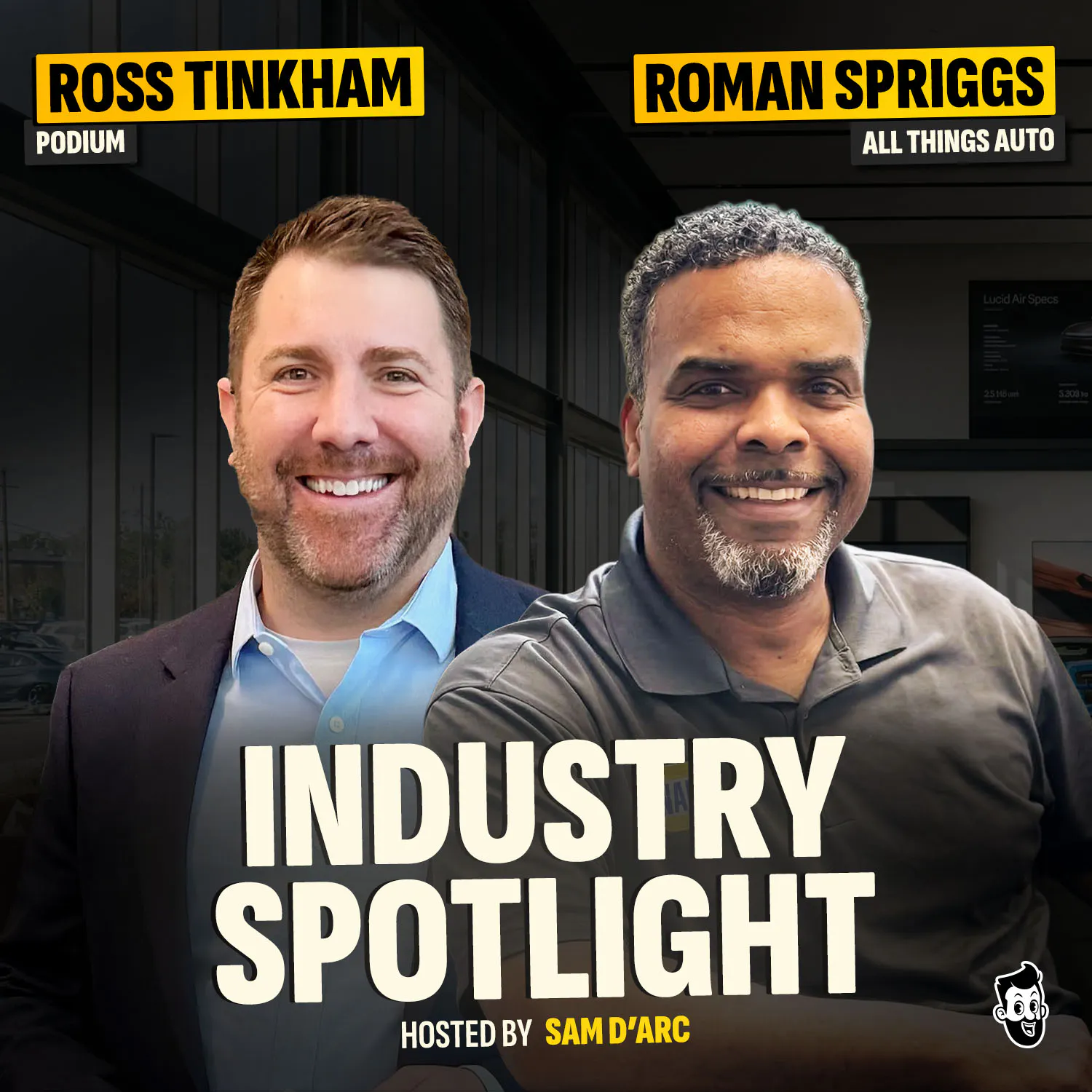
Podium is a company known for customer messaging and engagement tools used by businesses, including automotive dealers. In sales and service, these platforms often help manage inbound leads, texts, and follow-ups to improve response speed and conversion.
A “dealer group” is a company that runs more than one dealership. If your local dealership is part of a group, it may follow shared rules for things like advertising, pricing, and how the sales team is trained.
Dealerships track how many cars a salesperson sells each month. Selling 30–40 cars is a strong performance level and usually helps someone move into leadership roles.
A sales manager is the person who leads the sales team at a dealership. Their job is to make sure salespeople are working leads and closing deals consistently.
Ziggler Auto Group is the dealership company the speaker is talking about. Being part of a group can change how they roll out new tools to help customers.
A service appointment is just a scheduled time to bring your car in for maintenance or repairs. Dealerships try to respond quickly because customers expect fast communication.
“Make every dollar count” means being very careful with spending. If the store is smaller, they need to be sure any new tool like AI actually pays off.
They’re talking about a small used-car shop that isn’t part of a big brand. Because it’s smaller, they have to work harder to make customers feel taken care of.
They mean how the dealership treats people from the moment they walk in until the deal is done. It’s about making the whole process feel easy and respectful.
Think of an AI agent like a digital assistant that can do tasks for you, not just chat. For a car dealership, it might answer questions or help with leads so customers don’t wait.
Independent dealers are car sellers that aren’t tied to a brand’s franchise system. They may be slower to try new tech because the owner is personally responsible for how customers feel.
A franchise dealer is a car dealership that sells a specific brand (like a brand’s official network). It usually has more rules and structure than an independent dealer, which can affect how they run the business.
“Moving units” just means selling cars. If a dealership is focused on moving units, it’s usually trying to sell a lot of vehicles rather than spending most of its effort on service work.
“Multiple hats” means people are doing more than one job at the dealership. When there aren’t many staff members, AI can help take over some of the routine work.
Customizing AI means setting it up so it sounds and behaves the way your dealership wants. Instead of generic replies, it can match your style and help customers the way you prefer.
Scheduling a test drive is when you book a time for a customer to come drive the car. The host is saying AI should do more than just book it—it should also communicate in the right way.
Tone is how the messages “sound” to the customer—like friendly, confident, or helpful. The point here is that AI should match the dealership’s personality.
Voice is the way the AI communicates—what it sounds like and how it delivers the message. The host is saying customers connect better when it feels like the dealership, not a robot.
The sales floor is where the sales team actually works with customers day to day. The speaker is saying the right tools can make that area feel more active and productive.
Early adopters are the first people to try a new tool. This episode suggests some dealerships prefer to wait until it’s proven instead of jumping in immediately.
Sometimes AI can “make things up” even though it sounds sure of itself. In car sales, that could mean giving customers the wrong info or messing up follow-ups. Good setup and using the right data helps prevent it.
This is about booking test drives, consultations, and service visits. If AI can schedule appointments quickly and correctly, customers don’t fall through the cracks.
NADA is a big U.S. dealer industry organization. “Coming out of NADA” means they just finished talking about what dealers are planning after that industry conference.
It means one shopper can ask many dealerships for info at the same time. Dealers then have to respond quickly and clearly, or they’ll lose the customer to someone else.
LIVE
Hey everybody, welcome back to another episode
of the Cardulorship Guy Industry Spotlight.
I'm your host, Sam Dark.
And coming up today, 35 car a month salesperson,
Roman Spriggs, turned sales manager,
then turned general manager, shares his strategy
in small town America to deliver vehicles
coast to coast, all utilizing an AI agent
he named after his own son, Alex.
Learned three tips for buying, installing,
and training AI in March, 2026,
and two things to absolutely avoid
when considering who to trust with the tech solution.
Joining the show today, Roman Spriggs,
GM, All Things Auto, and Ross Tinkham,
Vice President of Automotive Sales Podium.
Thanks to Podium for supporting today's content.
Let's get into it.
So Roman, you are a independent use dealer in a rural area.
How'd you get into the car business?
How'd you get into being a used car GM
at a dealership that's part of a larger dealer group?
What's the Roman Spriggs story?
I was introduced by a sales manager
that, like my charisma, years and years and years ago,
and I was introduced into the business
in our Subaru Hyundai store back in Cumberland, Maryland,
as a salesperson.
I sold 30 to 40 to upper 40s cars a month.
Sold a lot of cars.
How long ago is this, Roman?
Back in 06, 17, sold cars for a few years.
And of course, then here comes general sales manager talk
and led a successful floor sales managing.
You sold a ton of cars as a salesperson.
What made you say, hey, I want to take this leadership role.
I want to become a sales manager.
I would say, and I don't want to put everybody in a group,
but most high-performing salespeople
or salespeople, period, look over at the desk, right?
I want to do that.
No, no, because a lot of high-performing salespeople
are like, you know what, I can connect with a customer.
I can answer the phone calls.
I can respond to the emails.
Right up until the number you said, 30, 40 cars a month,
I did it, and it lights a certain character type up.
I think you might be that.
So what was it about leadership that got you to say,
hey, I want to take that call.
I want to answer that call.
I want to go down that road.
I like the people I work for.
I like Mark, Mark Thomas, obviously,
and Chris Carpenter at the time.
He is now a partial owner and sat down and talked.
And hey, if you could touch all of the customers, right,
in our narrow shape of minded then, right?
Because obviously the way it shakes out
is that never happens,
because once you're a sales manager,
you get all these other things.
You're chasing used cars and chasing.
And I wanted to help them.
I thought we could move the needle, which we did.
And it's funny you said what you said,
because my sales manager before that, he said,
hey, listen, you're going really well.
Just do me one favor.
Whenever they come asking you to be a manager,
please just stay a salesperson.
And I don't want to say just,
I don't want to say just to minimize it.
Just stay a salesperson.
Was there gonna come?
And I didn't heed to that advice.
And why not?
Because by the way, I can tell from your personality,
you do really well connecting with a customer.
You do really well telling your story.
And you probably thrived and loved selling cars.
I would imagine.
Teaching, training, what led to the managing part
was teaching and training,
diving into the hearts of the employees.
And I still do it today.
But let me answer your question and be honest.
Ego, let's just call space.
Ego, right?
Early on as a salesperson.
So I got a question for you.
You had that success 30, 40 cars a month.
Most people in automotive don't get up to that unit count.
Didn't it just drive you nuts when you had a sales team
and they weren't picking up the phone?
And they weren't engaging with the customer
and they weren't responding to those leads.
How'd you deal with that in the early days
as you were building that sales floor?
It was tough.
It was tough because you know what you know.
And one of the challenges was trying to convey
what something might have been natural to me
to convey to someone else.
Hey, listen, listen, listen.
And then on any sales floor,
trying to get them to figure out that
we're on the same team here.
I'm not brow beating you.
I just, you're missing some things
that could really be helpful to you.
And then in the newer generation,
they don't want to hear,
I used to score 40 points a game, you know?
Yeah, yeah, yeah.
But biggest challenge is conveying
and getting them to understand how important it is
and trying to get them to picking up the phone,
answering questions and asking the right questions.
It all is a part of the bigger picture.
Why do you think you as a salesperson
all those years ago in the early days
were so good at sales on the phone,
responding, engaging?
Why is it such a challenge today in March of 2026
to get salespeople, BCs to do the exact same?
Why isn't it easier to train on that
and to get that engagement?
Because in my role, Ziggler Auto Group,
I see the challenge getting this younger generation
to really engage in a way that connects with the customer.
And by the way, add to that borderline,
sometimes unreasonable expectations by customers.
They want to get a phone call picked up
at two a.m. in the morning,
or a service appointment responded to it
six o'clock at night, right?
So enter general manager, use car facility,
part of a three store group, very well regarded in your area.
You want to win, sell a ton of cars.
You got salespeople, you went to AI and technology,
rather than going to forcing people to do something
that is just hard to get them to do.
There was that decision moment where you're like,
am I willing to spend the money,
the time, the effort to engage in this AI
versus forcing people to do something?
Why did you decide to go the AI route?
Small store, you got to make every dollar count.
What made you confident enough to invest in AI?
I was on a fringe of hiring another salesperson,
our principal, and around the org,
he likes to add salespeople and I pitched it to Mark
and I got an idea from another couple guys
that in the org, who I regard highly,
instead of hiring a physical person,
I can hire somebody and I don't want to throw
your numbers out there, but X amount of dollars, right?
For this agent, I looked at it as an employee
that I can tell exactly what to do, it's going to do it,
it's not going to talk back, I don't have to write it up,
I don't have to spend time correcting it or...
But you do have to train it,
you got to get it bought off in your culture
and the way you do business.
You named this agent as you called it something
that was meaningful to you, what did you name it?
Son's name, Alex.
Alex, very cool.
Pender neutral and just, yeah, yeah.
So enter Ross Tinkham, podium, Ross,
when you got the call from Roman and he's like,
look, small dealer, independent used,
I want my guys to deliver an incredible customer experience
to every single customer walking in here.
I'm going to hire an AI agent,
I'm going to name them after my son.
What went through your mind, Ross?
Well, I think absolute perfect fit for podium and for AI.
I mean, we pay a lot of attention, Sam,
to what happens in the franchise world
and we know the appetite for AI
and that gets talked about a lot.
It doesn't get talked about as much in independent
and generally my observation is independent dealers,
I think, or maybe a year, year and a half
behind sort of the adoption curve.
Just appetite, spend dollars, budget, why?
That's a good question.
I don't know.
That's a general statement.
I'm sure there are a lot of folks who do innovate
and right ahead of the curve.
But listen, AI is a new technology.
I think when you're running a smaller store
and it's all on you and your own reputation,
I think there's a lot of hesitancy
of if we hire this AI agent and it messes up
with a customer that reflects poorly on me
as a business owner.
I'm not saying a franchise dealer doesn't operate that way,
but I think it's a little bit different,
it's a little bit more intimate
with a lot of the independent dealers we work with.
But the other side of the coin is
like they are running so thin.
In most cases, there is no service drive.
It's all about moving units.
Everyone's wearing multiple hats.
And yeah, you're not obviously staffed to the degree you are
with humans like a franchise where AI can become a great fit
even for somebody in a more rural area.
So Ross and Roman, I often talk on the show
and I say, look, in this world of AI today,
a new role of a general manager,
no matter the size of the store,
is to grow, develop and invest in these AI agents
so that they become a part of your culture.
Roman, when you plug this new AI agent in
and you start having this experience,
what were some of the early challenges you faced
or learnings you had to get around
in order to make it successful
and make it work in your store?
Tell you, the first, the challenge was,
they plugged it in on a, I don't know,
let's say a Wednesday night.
I come in on a Thursday morning,
I'm trying to figure out how he made disappointment
on the first night and the customer showed.
And I'm thinking, that was my biggest challenge.
Like one night, literally the first customer,
I come in in the morning and I'm looking at podium
and I'm thinking, and then I had to start
thinking process, right?
Because initially, I'm like, okay,
they told me all these things,
which I will say that in most cases,
people overpromise and underdeliver,
they underpromise, really.
And I'm not, I'm not, I'm no spokesman for-
In what way, in what way, Roman,
did they underpromise as you had this tool?
Austin had about an hour with me on a demo
and I think he even went over
because I was so, so inquisitive, right?
And the way he explained it very, very professionally,
I have gotten more than he demoed, I can tell you that.
And that's no short, but Austin,
because he did a great job, as well as the rest of the team.
They shorted themselves.
And I know Ross is sitting there tickled pink, I'm sure,
but it's just the facts.
Like, I didn't expect to get what we got.
Roman wasn't expecting what he got, it overdelivered.
Yet, I think in the independent world
and smaller dealer world, a lot of dealers
wedge against new car dealers by saying,
you know what, we're not like those big city guys.
We're not like the big town.
You're gonna get a different experience here.
And Ross, podium or related AI companies,
you have a responsibility to defend that small town field.
You've got a responsibility to defend the perception that,
you know, we connect with a consumer better
than the big guys do.
How do you do that at podium with an AI technology?
How do you deliver and deliver above and beyond?
Well, I mean, I think the most important thing
that we can do to support that statement and to overdeliver
is the ability in which you can customize AI
to be whatever it is you need it to be.
And so that goes much further than how you schedule
a test drive or following process steps, but it's tone.
It's voice.
It's, you know, what language you would like it to use
to interact with your customers.
And I think we make that pretty darn easy
and do it in a way I haven't seen anyone else
in the market do.
So, because again, if we go back to what you're doing,
you're hiring an employee.
Like that's the framework you have to operate from.
And if you do that with a human,
like you can build it into whatever you want it to be
and it should really be the same with AI.
So, Roman, how many sales people do you have right now?
Excluding Alex.
I have three and a sales manager.
So, when you went to your sales people
and your sales manager and you're like,
I'm gonna plug in this AI agent,
I'm gonna name him after my son,
we're gonna train him and he's gonna help us set appointments.
What was some of the skepticism you got initially
before Alex started actually setting the appointments
you were just talking about?
I didn't get much, Sam.
I didn't get much and I'm a pretty strong personality.
And they trust me, right?
And I have to say this that, again,
Austin podium caught me at the right time
because I was going through a DMS change
and I was going from a Cadillac to a Cobalt.
And the CRM and the way the response to the leads, man.
And that's why I said to Ross,
I wouldn't even wanna know where we'd be
without podium right now.
And no skepticism at all, they were excited.
And that's why I wanted to lead into a little bit
and maybe go off a little bit on the fact that,
man, this sucker has reinvigorated the sales floor.
Like you, well,
we've all been on sales floors where you walk in,
hey, follow up, do this, did you do your task?
And the sales people are just demotivated, right?
This thing all of a sudden has the floor buzzing.
People asking questions, selling cars
because sales people really do wanna work, right?
And we think in the dealership, replace them,
pimp them, get them out of here.
No, we have to find a way to motivate them.
And what it did was it helped me motivate that sales floor
and we had two record months in January and February.
We usually start off the fourth quarter behind the mark.
And again, I said to Ross, just in a blanket statement,
I'd hate to see where we were at,
but I love where we're at and I know why.
It's the smaller things that it's done.
It's reinvigorated and it has people selling,
having fun selling cars where you come in before
and you get off when these sales people,
I can't get a hold of a customer and they won't respond.
This thing has made them come into work
and first thing they check in the morning, Jack, podium.
For other dealers your size, walk us through
what podium it actually does for the dealership day to day.
What does it look like once it's in place?
How do you engage and interact with that?
How do you train it, Alex?
It makes it easy and they keep adding things
like I noticed the other day.
One of the, not a pain point,
just a little bit of a thing we had to figure out,
it would say the car was available, right?
So now it asks the question before it responds
to the customer, is this car available?
And I get it at night.
I answered one last night, right?
Initially they came in, they check their,
they check what's podium look like in a day to day.
They check their dashboard, see what's going on.
Check reviews because it gives reviews
and you wanna check and see if your customer's
given a review and it does that.
It checks their funnels.
I make sure they check their new leads first.
We assign those leads, then they have to
placement a funnel, follow up, do all the things.
But more importantly, it keeps a running tab
in real time of what's going on with your customer.
The AI agent itself lets you know what's going on.
It makes notes because God knows salespeople
love making notes, right?
Alex loves making notes to let you know
exactly what's going on.
Transcription, but during the course of the day,
you can't miss it because it beeps my phone.
Hey, Alex needs your assistance.
If the AI needs assistance with anything
on a customer question of negotiating
or things like that, it knows it's bound.
As far as training it, if you don't like a response,
you just give it a thumbs down.
You tell it what it wants to say
and I bet you the next one or two responses, it says it.
Yeah.
I don't want to say to take anything away.
It's really been a plug and play.
And that's a fair point, Roman,
because if you implement something like this,
you onboard it as an employee, you don't train it.
You don't spend the time working with it,
giving it thumbs up, thumbs down,
answering questions as it converts it over to you.
It's not gonna develop into part of the culture.
You've got to make that investment, Roman,
which you've done.
Yeah.
And I don't want to tear the industry up,
but that's the negative in the industry, right?
We try to plug and play people,
give them their business cards,
give them their passwords and say,
go sell with no commitment or investment, right?
And I know this was my first, and I tell you what,
it was my first decision as a general manager.
So guess what?
It's gonna work.
It's gonna work.
And I'm going, right?
So Roman, walk us through your thought process here.
Thinking about the next couple of years,
go two years down the road.
What is dealership life at your dealership,
independent, smaller town,
look like in two years versus without AI?
How far behind will dealers be
that don't have this in two years?
You say two years, if you don't have it, now you're behind it.
Yeah, why?
You just don't, that's where it's at.
I mean, that's, right now within the AI industry,
cause I pay attention now,
it just keeps evolving.
If you are not there now, you're done,
you're, especially for this selling season,
you're behind the mark.
Two years from now, I don't even want to know.
Ross, it's interesting from podium's perspective,
automotive, we're not early adopters.
We want something that's proven before we plug it in.
And in Roman's case,
he had to have enough confidence
to be able to make this bet.
Of course, he took a little bit of a risk,
but named it after his son and it's had success.
What advice do you give to most dealers
that are kind of on the fence?
How do we implement AI?
When do we implement it?
And then once we've implemented it,
how do we engage with it to ensure it succeeds?
I think we run into most frequently
what I would call two types of buyers.
Those who are on the fence who have not tried it
or those who have tried it and it's gone very poorly.
I mean, that is generally what you run into.
And for the most part, the folks that we talk to,
like have tried it and just aren't happy
with what else they're using.
I think the level of comfort in the industry
of like AI is at a level
where if you're working with the right provider
and you onboard it well
and you integrate it into your processes
and into your people,
like you're in a pretty good spot to have success.
Early on two years ago, probably,
a lot of hallucinations, a lot of challenges.
But I think the industry's largely worked through there.
So I think for the most part,
you can feel pretty confident
that if you do it the right way,
and then that's more than just the software,
it's getting buying from your team,
it's adjusting people's complaints if you run a BDC.
There's a lot to think about there.
But if you do it the right way,
you're I think in a pretty good spot.
We try to make it very easy for you to understand
what is AI delivering to you?
Like what is it scheduling for appointments?
I mean, we're now doing a lot,
start on the sales side,
we're now on the service side,
trying to break those two pieces apart,
like help the dealer understand the value AI is driving.
And like if we're not doing that, you're not gonna know.
So you've got to be doing that.
And I think it really is just the ongoing training
is things change for you and for your team, right?
Of continuing to fine tune AI
and bring it along with you
as things change for the dealership.
So thinking about what podiums tool Alex in this case,
again, named after Roman's son,
has given him and their dealership
in terms of scheduling, customer communication,
customer interaction, engagement.
What's next for the independent auto
or even the franchise dealer in AI?
Where are things headed over the next six months,
the next year, Ross?
What can we look forward to next?
Listen, just coming out of NADA,
I'm hard to believe it was a month ago,
feels like it was a year ago.
But I mean, everyone just wants to talk about voice.
I mean, I think like that,
that's been mentioned on your show quite a bit, Sam.
That is fine there.
It's getting, it's, you can still tell it's not,
you can tell it's not a person, right?
I've not listened to any voice solution where it is,
you know, it's as good as a human.
But when will it be there, do you think, in your opinion?
And what's the benchmark for success in voice AI?
There will be a point in time
in which you will not be able to distinguish AI voice
from human voice.
When does that happen?
I don't know, six months,
probably too soon, a year, a couple of years,
18 months, not far on the horizon.
But not quite there.
But the question though, Sam,
is does that matter as much?
Like if you're calling to make a service appointment
and nobody ever picks up the phone and you leave a voicemail
and can't get in touch with anybody,
would you prefer that versus an AI agent picking up the phone
and helping you with what you need help with?
Like the people care as much as long as their problem is solved
or their need is taken care of.
And that's where I think we're at,
where like it can do the job.
It might not sound like just like a human,
but it can get the job done in a far better way
than a lot of the existing processes
most dealers have in place.
So I know Podium has a newer voice AI tool, right?
I think you launched it at NADA.
Roman, do you use that yet?
Have you implemented voice AI into your operation?
As part of what you're doing? No, sir.
No, man, what's the bench?
When will you, Ross, when would you go to Roman
and say, hey, it's there?
Or would you say, hey, wait a little bit?
Or would you experiment with it?
What should my strategy be at a smaller store
where every dollar spent is so valuable today?
Yeah, I mean, it is really important.
The company that you're dealing with is really important.
Like I am sure, and I want to make assumptions Roman,
you get a lot of calls for people trying to sell you AI
as every dealer does.
And I hear about it every day.
Yeah, you drive it. I'm sure, yeah.
And it's noisy.
Like I think here's what I think you need to be cautious of.
If you're going to enter in with a voice product,
connect with a company that like has a track record
of really taking your feedback
and being able to make the product better based on that.
Because I think for a lot of companies,
that's where voice is, where it's not perfect,
but it's getting there.
But we look for, it's cliche to say we look for partners,
but saying we look for partners
because we want feedback from our customers.
We know everything isn't always perfect,
but like we want the feedback
and we certainly use that to level up the product
every single day of the week.
So truly, I think looking for a partner is really important
when it comes to new technology, especially
when we're talking about an AI agent
that talks to your customers for you.
So I think the experience of the business
you're working with matters.
They've got five customers, but have an awesome demo.
Run away, run away yesterday,
like save yourself the trouble there.
So yeah.
All right, so voice AI is emerging
and that is probably gonna be the buzzword for 26
as dealers become more comfortable
with the figure out how to engage in it.
What's beyond that?
What's just beyond that, Ross, for a dealer like Roman?
So there's two ways to maybe answer that question.
One is like from a dealer's perspective.
The other is from a consumer perspective.
And I think what is starting to get talked
and talked about more is we as consumers,
we use AI to do things like go source a car
that will take me and let me shop
a hundred dealerships simultaneously.
And so most of the orders are gonna
probably see lead volume go up,
but there's gonna be a whole lot more to sift through.
And so I think part of it is like what's coming next
in the technology from a dealer standpoint,
but also how are your customers gonna leverage AI
to a greater degree to buy from you
in the next six to 12 months?
And that's probably more important to think about.
Yeah, you know, it's interesting
as we kind of get towards the end of our time together.
I love Roman's story.
Sold cars, sold a ton of cars, was very successful.
Wanted to share that success with others
and realized in this competitive environment
something that we believe at My Auto Group a lot,
which is AI is creating a level
of expectation by consumers
that very quickly is gonna be absolutely impossible
for people.
Not only tough, because we don't like to answer
the phone period, but impossible to deliver on.
Phone calls at 2 a.m., right?
Text messages at 5 a.m.
A service update, Roman, at 5 p.m.,
when everybody's checking out a service all at once.
And AI well-trained can deliver that.
And I love that you named him the AI agent after your son.
Like what does that mean to you that you've given,
you've kind of set an example and automotive
that really kind of continues the legacy
that you began selling cars with.
I mean, I think that's pretty cool, Roman.
Yeah, it's cool to go around a dealership
and no one, there's no negative, right?
If you're in the auto industry, Sam, like yourself,
there's always the chatter and the huddles, right?
About what's not working and what's,
they never talk about what's working,
but when I walk through there, man, check this out, Roman.
Look what Alex said here.
And it's just like another employee, it's cool, it's cool.
And like I said.
It's making automotive fun again.
And like automotive became not fun for a hotline.
And I'm sure you can find some showrooms
that still are not fun.
That's the biggest little thing, right?
Is it's exciting again.
And that's a low part to a product.
All right, Roman, so as we close out,
what advice would you give to the dealer
that's sitting squarely on the fence right now?
They're like, hey, you know what, this AI thing,
I know it was the buzzword of NADA.
I know I hear a lot about it all over the internet,
but I'm not totally convinced at the end of the day,
the smaller store, I can't just deliver
for every customer a great experience.
What's the advice?
If you haven't done it, you're late.
Any advice is look into it,
check your lead responses in your CRM,
see if you're tired of the CRM and task and all that things.
And do you want to work harder or smarter?
And do you want your customers to hire you
or silently fire you?
Or do you still want to keep chirping down
your salespeople's back and your sales managers back
about tasks and follow-ups?
And I mean, do you really have time to do that?
And my answer is a sales manager to a general manager.
No, no, pay somebody to do it.
We do it everywhere across the industry, right?
We pay the debt guy and the paint touch-up guy.
Why aren't we paying for the guy
who takes care of what we like to do?
And at the effectiveness that they do it.
And that's pretty insane to me.
And Ross, as we wrap up,
it does occur to me based on what Roman is saying,
success in 2026 and automotive, big, big small dealer.
You can't just plug an AI tool in
and just have the lights come on
and it's just automatically working.
You do have to develop it.
You do have to understand it.
You do have to train it to adapt to your culture.
Timing is an important element of implementing AI in 2026.
I learned that at NADA just walking around and seeing it.
There are dealers that are so far ahead
and there are others that are behind.
Any thoughts as it relates to timing and training
as an expectation into 2026, Ross, as we wrap up?
Yeah, I mean, I think anything,
anywhere the investment is gonna take some time
on your part, especially when we're talking about replacing
or augmenting your staff with an AI employee.
And so generally what I would say is,
if you're a single point dealership
and we're just getting off the ground with you,
you really gotta invest in those first 30 to 60 days.
If you're a larger group,
you might extend that timeline a bit.
But it's gonna take your first 60 days to put in the work.
But again, look for something
that makes it easy for you to do that.
You don't wanna have to put together an email
and send it to a support address
to get changes made to your AI agent.
You should be a mess for that matter.
Who does that?
Ross, who does that?
I can list them, yeah.
But yeah, put yourself in a position
where you have full control over the outcome, and I think...
Wait, isn't it ironic, Ross, that with AI,
it's having better people
that is the difference maker versus just more AI?
Like, I don't wanna send a support case to an email address.
I want someone I can talk to and get it taken care of, so.
Yeah, or you should be able to talk to the agent yourself
and tell them what to do,
and I think that's what we try to deliver on, so.
Yeah, yeah.
Well, Ross Tinkham, Roman Spriggs,
thank you so much both for coming on
to share your perspectives on all things AI
in small town America used automotive.
And Roman, thanks for being forward thinking
in naming your AI and sharing your experiences,
not only for yourself, but for your team.
And thanks for sharing your best practice here
on Cardiola Ship Guy Industry Spotlight.
Thanks for being on the show.
Oh, my, thank you.
Thank you for having me.
About this episode
Roman Spriggs, GM of a rural used-car store group, explains how he went from high-volume sales to leading with an AI agent named after his son, Alex. With Podium’s help, he replaced some lead follow-up and appointment-setting work, reinvigorating a demotivated sales floor and driving record months. The discussion covers what to buy, how to onboard and train AI (thumbs up/down, culture fit), early pitfalls, and why voice AI matters less than solving customer needs. Ross Tinkham adds guidance on choosing an AI partner and investing in the first 30–60 days.
In this episode of the Industry Spotlight, joining host Sam D’Arc are Roman Spriggs, General Manager of All Things Automotive, and Ross Tinkham, VP of Automotive at Podium, to discuss how Roman replaced a potential human hire with an AI agent named Alex.
This "AI employee" helped the small-town independent dealer achieve record sales months in early 2026 by managing 24/7 customer inquiries and setting appointments overnight.
Tinkham emphasizes that successful integration requires a 30 to 60-day commitment to training the technology to match the dealership's unique culture and voice.
Ultimately, the group warns that dealers who fail to adopt AI now risk being "silently fired" by consumers with modern expectations.
This episode of the Car Dealership Guy Podcast is brought to you by Podium.
Podium - The AI platform trusted by one in three dealerships. Podium helps dealers consolidate sales, service, messaging, and voice into one connected system that actually runs the work. If your AI isn’t driving real outcomes, it’s time to take a closer look @ https://www.podium.com/car-dealership-guy.
Check out Car Dealership Guy’s stuff:
For dealers:
CDG Circles ➤ https://cdgcircles.com/
Industry job board ➤ http://jobs.dealershipguy.com
Dealership recruiting ➤ http://www.cdgrecruiting.com
Fix your dealership’s social media ➤ http://www.trynomad.co
Request to be a podcast guest ➤ http://www.cdgguest.com
For industry vendors:
Advertise with Car Dealership Guy ➤ http://www.cdgpartner.com
Industry job board ➤ http://jobs.dealershipguy.com
Request to be a podcast guest ➤ http://www.cdgguest.com
Topics:
03:45 Your Sales Team Isn’t the Problem… This Is
06:00 I Replaced a Salesperson With AI… Here’s What Happened
13:10 This AI Turned a Dead Sales Floor Into Chaos
17:10 If You Don’t Have AI Yet… You’re Already Losing
20:30 You Won’t Be Able to Tell AI From Humans Soon
21:50 Most AI Companies Will Burn You
23:20 Buyers Can Now Shop 100 Dealers Instantly
24:10 Customers Now Expect Replies at 2 AM
26:05 CRM Tasks Are Killing Your Dealership
Car Dealership Guy Socials:
X ➤ x.com/GuyDealership
Instagram ➤ instagram.com/cardealershipguy/
TikTok ➤ tiktok.com/@guydealership
LinkedIn ➤ linkedin.com/company/cardealershipguy
Threads ➤ threads.net/@cardealershipguy
Facebook ➤ facebook.com/profile.php?id=100077402857683
Everything else ➤ dealershipguy.com