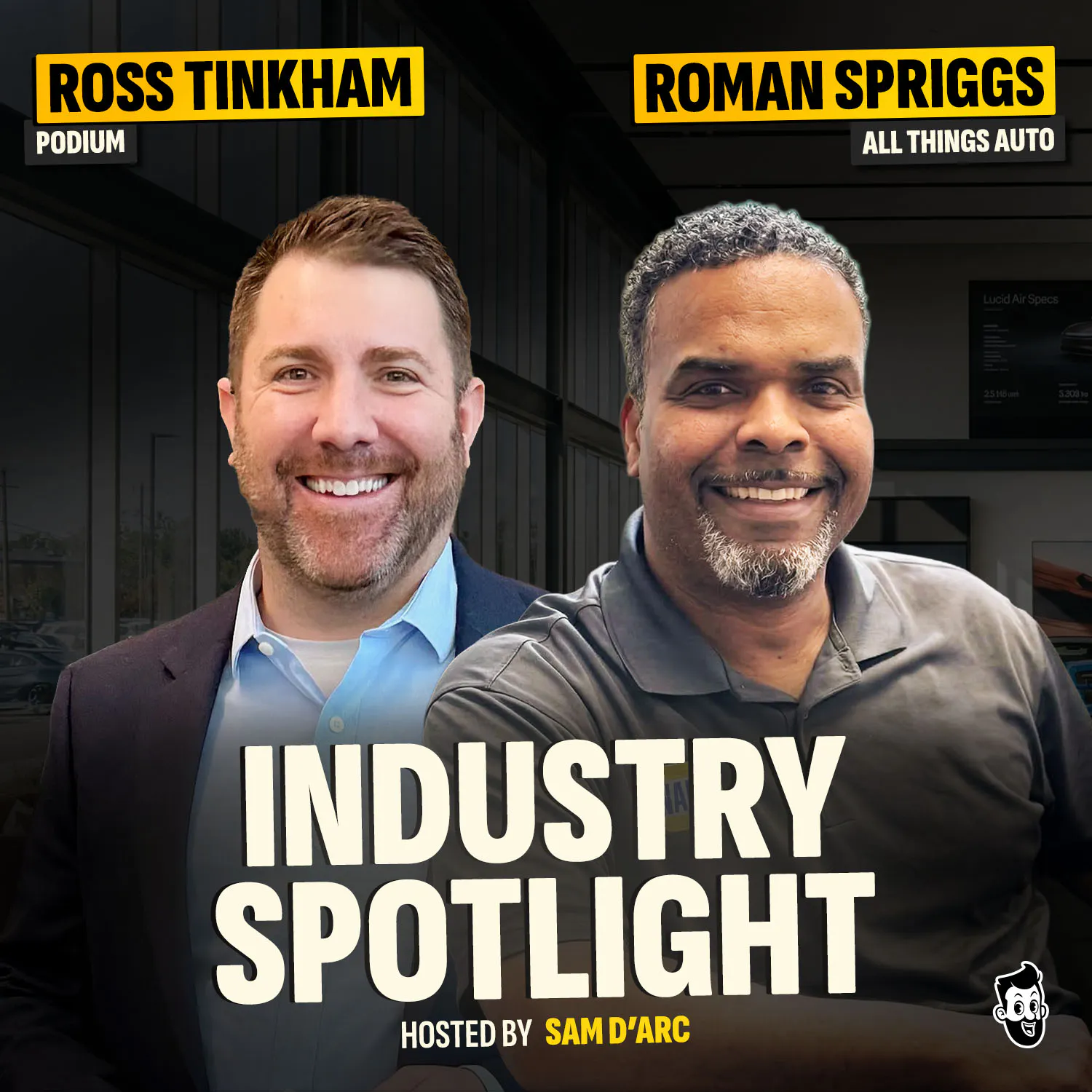
“You're Already Late!” Why AI is No Longer Optional in March 2026 (+ How To Hire Your First Agent)
About this episode
Roman Spriggs, GM of a rural used-car store group, explains how he went from high-volume sales to leading with an AI agent named after his son, Alex. With Podium’s help, he replaced some lead follow-up and appointment-setting work, reinvigorating a demotivated sales floor and driving record months. The discussion covers what to buy, how to onboard and train AI (thumbs up/down, culture fit), early pitfalls, and why voice AI matters less than solving customer needs. Ross Tinkham adds guidance on choosing an AI partner and investing in the first 30–60 days.
Podium
"[35.3s] Joining the show today, Roman Spriggs, [37.2s] GM, All Things Auto, and Ross Tinkham, [39.6s] Vice President of Automotive Sales Podium. [42.7s] Thanks to Podium for supporting today's content. [45.7s] Let's get into it."
Podium is a company known for customer messaging and engagement tools used by businesses, including automotive dealers. In sales and service, these platforms often help manage inbound leads, texts, and follow-ups to improve response speed and conversion.
larger dealer group
"[54.5s] How'd you get into being a used car GM [57.9s] at a dealership that's part of a larger dealer group? [62.1s] What's the Roman Spriggs story?"
A “dealer group” is a company that runs more than one dealership. If your local dealership is part of a group, it may follow shared rules for things like advertising, pricing, and how the sales team is trained.
A “dealer group” is a company that owns or operates multiple dealerships, often across different locations. Even if someone is an independent operator locally, being part of a larger group can affect pricing, marketing, training, inventory sourcing, and reporting.
30 to 40 cars a month
"I sold 30 to 40 to upper 40s cars a month... Right up until the number you said, 30, 40 cars a month, I did it, and it lights a certain character type up."
Dealerships track how many cars a salesperson sells each month. Selling 30–40 cars is a strong performance level and usually helps someone move into leadership roles.
Monthly unit volume like “30 to 40 cars a month” is a key dealership performance metric. It’s often used to gauge a salesperson’s productivity and can influence pay plans, ranking, and promotion opportunities.
sales manager
"then here comes general sales manager talk and led a successful floor sales managing."
A sales manager is the person who leads the sales team at a dealership. Their job is to make sure salespeople are working leads and closing deals consistently.
A sales manager runs the dealership’s sales team and is responsible for hitting volume and customer-experience goals. They typically oversee lead handling, deal structure, and daily “floor” activity to keep salespeople productive.
unit count
"You had that success 30, 40 cars a month. [227.0s] Most people in automotive don't get up to that unit count."
“Unit count” just means how many cars you sell. Dealerships track it like a scorecard—usually by month.
In car sales, “unit count” means how many vehicles a salesperson or store sells in a given period (often monthly). It’s a key performance metric dealerships use to judge productivity and set goals.
leads
"they weren't responding to those leads. [240.0s] How'd you deal with that in the early days"
A “lead” is someone who might buy a car. Dealerships need to follow up quickly so the person doesn’t disappear.
“Leads” are potential customers who show buying intent—often from online forms, calls, or ads. In dealerships, lead response time and follow-up determine whether leads convert into test drives and sales.
Ziggler Auto Group
"Because in my role, Ziggler Auto Group, I see the challenge getting this younger generation to really engage in a way that connects with the customer."
Ziggler Auto Group is the dealership company the speaker is talking about. Being part of a group can change how they roll out new tools to help customers.
Ziggler Auto Group is the dealership group the speaker works with. In dealership discussions, the group’s structure (multi-store ownership) can influence how quickly they can adopt new customer-communication technology like AI.
customer expectations
"And by the way, add to that borderline, sometimes unreasonable expectations by customers. They want to get a phone call picked up at two a.m. in the morning..."
Customer expectations are what customers think they should get from the dealership. In this case, they want super-fast responses, even late at night.
Customer expectations in dealership retail include response time and availability—like expecting calls to be picked up late at night or service messages answered quickly. When expectations rise, stores look for automation/AI to maintain service levels without burning out staff.
service appointment
"They want to get a phone call picked up at two a.m. in the morning, or a service appointment responded to it six o'clock at night, right?"
A service appointment is just a scheduled time to bring your car in for maintenance or repairs. Dealerships try to respond quickly because customers expect fast communication.
A service appointment is when a customer schedules time for vehicle maintenance or repairs at a dealership or shop. In dealership operations, speed of response and follow-up can strongly affect customer satisfaction and retention.
general manager
"So enter general manager, use car facility, part of a three store group, very well regarded in your area."
The general manager runs the dealership day-to-day. They make big decisions about staffing and how the dealership handles sales and service.
A general manager (GM) at a dealership is responsible for overall performance—sales, service, staffing, and profitability. Their decisions often determine how the store invests in tools like AI and how customer communication is handled.
make every dollar count
"Small store, you got to make every dollar count. What made you confident enough to invest in AI?"
“Make every dollar count” means being very careful with spending. If the store is smaller, they need to be sure any new tool like AI actually pays off.
“Make every dollar count” reflects tight dealership budgeting, especially for smaller stores. It’s used to justify investing in AI because the ROI must be clear when resources are limited.
independent used dealer
"So enter Ross Tinkham, podium, Ross, when you got the call from Roman and he's like, look, small dealer, independent used, I want my guys to deliver an incredible customer experience to every single customer walking in here."
They’re talking about a small used-car shop that isn’t part of a big brand. Because it’s smaller, they have to work harder to make customers feel taken care of.
The speaker is describing a small, independent used-car dealership rather than a large franchise store. In practice, independent used dealers often rely more on process, training, and customer experience to compete on trust and responsiveness.
customer experience
"I want my guys to deliver an incredible customer experience to every single customer walking in here."
They mean how the dealership treats people from the moment they walk in until the deal is done. It’s about making the whole process feel easy and respectful.
“Customer experience” in dealership talk usually means the end-to-end journey—how quickly you respond, how transparent the process is, and how smoothly the sale and paperwork go. For used-car stores, it’s often a key differentiator when inventory and pricing aren’t dramatically different.
AI agent
"I'm going to hire an AI agent, I'm going to name them after my son."
Think of an AI agent like a digital assistant that can do tasks for you, not just chat. For a car dealership, it might answer questions or help with leads so customers don’t wait.
An AI agent is software that can take actions on your behalf—like replying to customers, gathering information, or routing leads—rather than just answering questions. In a dealership context, it’s often used to handle repetitive tasks and speed up response times.
independent dealers
"It doesn't get talked about as much in independent and generally my observation is independent dealers, I think, or maybe a year, year and a half behind sort of the adoption curve."
Independent dealers are car sellers that aren’t tied to a brand’s franchise system. They may be slower to try new tech because the owner is personally responsible for how customers feel.
Independent dealers are not part of a manufacturer’s franchise network and typically run with more autonomy. The discussion highlights that independents may adopt AI later due to budget constraints, risk concerns, and the fact that the owner’s reputation is directly tied to every customer interaction.
franchise dealer
"I'm not saying a franchise dealer doesn't operate that way, but I think it's a little bit different, it's a little bit more intimate with a lot of the independent dealers we work with."
A franchise dealer is a car dealership that sells a specific brand (like a brand’s official network). It usually has more rules and structure than an independent dealer, which can affect how they run the business.
A franchise dealer is an independently owned dealership that sells and services vehicles under a specific automaker’s brand agreement. The franchise structure often comes with more standardized processes, staffing expectations, and corporate oversight than independent dealers.
moving units
"In most cases, there is no service drive. It's all about moving units. Everyone's wearing multiple hats."
“Moving units” just means selling cars. If a dealership is focused on moving units, it’s usually trying to sell a lot of vehicles rather than spending most of its effort on service work.
“Moving units” is dealership shorthand for selling vehicles—prioritizing throughput of inventory. In lean stores, the business model may emphasize sales volume over service operations, which changes staffing needs and how technology is deployed.
multiple hats
"It's all about moving units. Everyone's wearing multiple hats. And yeah, you're not obviously staffed to the degree you are with humans like a franchise where AI can become a great fit"
“Multiple hats” means people are doing more than one job at the dealership. When there aren’t many staff members, AI can help take over some of the routine work.
“Wearing multiple hats” describes lean dealership staffing where employees handle more than one role (sales, service coordination, admin, etc.). This matters because AI agents can help cover repetitive tasks when headcount is limited.
customize AI
"is the ability in which you can customize AI to be whatever it is you need it to be. And so that goes much further than how you schedule a test drive or following process steps, but it's tone."
Customizing AI means setting it up so it sounds and behaves the way your dealership wants. Instead of generic replies, it can match your style and help customers the way you prefer.
“Customize AI” means configuring an AI system to match a dealership’s specific needs, brand voice, and customer-handling style. In dealership operations, this often impacts how messages are written, how quickly questions are answered, and how the AI guides customers through next steps like scheduling.
schedule a test drive
"And so that goes much further than how you schedule a test drive or following process steps, but it's tone. It's voice."
Scheduling a test drive is when you book a time for a customer to come drive the car. The host is saying AI should do more than just book it—it should also communicate in the right way.
Scheduling a test drive is a core dealership sales workflow step—moving a lead from interest to an appointment. The speaker contrasts this basic automation with higher-value AI customization like tone and voice, implying that “just scheduling” isn’t enough to win.
tone
"but it's tone. It's voice."
Tone is how the messages “sound” to the customer—like friendly, confident, or helpful. The point here is that AI should match the dealership’s personality.
In AI-driven dealership messaging, “tone” refers to the style and personality of communications—friendly, professional, urgent, or empathetic. The speaker implies that customizing tone is key to making AI feel like a better “small town” experience rather than a generic chatbot.
voice
"but it's tone. It's voice."
Voice is the way the AI communicates—what it sounds like and how it delivers the message. The host is saying customers connect better when it feels like the dealership, not a robot.
“Voice” here likely means the AI’s spoken or written communication style—how it delivers responses in a way that matches the dealership’s brand. The speaker groups voice with tone, suggesting that perception and customer connection are part of the AI strategy.
CRM
"And the CRM and the way the response to the leads, man."
A CRM is a system that helps a dealership keep track of leads and customers. It’s basically how they manage “who’s interested” and what to do next.
CRM stands for customer relationship management. In dealerships, CRM is used to manage leads and customer interactions, including how quickly sales teams respond and how follow-ups are scheduled.
sales floor
"...man, this sucker has reinvigorated the sales floor... People asking questions, selling cars..."
The sales floor is where the sales team actually works with customers day to day. The speaker is saying the right tools can make that area feel more active and productive.
The “sales floor” is the active showroom area where salespeople work, greet customers, and manage ongoing deals. The segment emphasizes that better lead tools and communication can change the energy and productivity of the sales floor, not just the numbers.
early adopters
"Ross, it's interesting from podium's perspective, automotive, we're not early adopters. We want something that's proven before we plug it in."
Early adopters are the first people to try a new tool. This episode suggests some dealerships prefer to wait until it’s proven instead of jumping in immediately.
Early adopters are the first dealerships (or businesses) to implement a new technology before it becomes standard. The speakers contrast that with a “proven first” approach—adopting only after the tool has demonstrated real results.
AI hallucinations
"Early on two years ago, probably, a lot of hallucinations, a lot of challenges."
Sometimes AI can “make things up” even though it sounds sure of itself. In car sales, that could mean giving customers the wrong info or messing up follow-ups. Good setup and using the right data helps prevent it.
“AI hallucinations” are when an AI system generates confident-sounding information that’s incorrect or made up. In a dealership context, this can lead to wrong answers to customer questions, inaccurate lead follow-ups, or bad guidance for sales staff. That’s why onboarding and integration with real dealership data and workflows matter.
scheduling for appointments
"Like what is it scheduling for appointments? I mean, we're now doing a lot, start on the sales side,"
This is about booking test drives, consultations, and service visits. If AI can schedule appointments quickly and correctly, customers don’t fall through the cracks.
Appointment scheduling is a core dealership workflow where AI can reduce response time and improve lead-to-appointment conversion. When AI schedules correctly, it helps keep sales and service pipelines moving without relying entirely on manual follow-up.
NADA
"Listen, just coming out of NADA, I'm hard to believe it was a month ago, feels like it was a year ago."
NADA is a big U.S. dealer industry organization. “Coming out of NADA” means they just finished talking about what dealers are planning after that industry conference.
NADA is the National Automobile Dealers Association, a major U.S. dealership industry group. When the hosts say they’re “coming out of NADA,” they’re referencing a period right after that industry event where dealers discuss trends like AI, customer communication, and sales tools.
shop a hundred dealerships simultaneously
"go source a car that will take me and let me shop a hundred dealerships simultaneously. And so most of the orders are gonna probably see lead volume go up,"
It means one shopper can ask many dealerships for info at the same time. Dealers then have to respond quickly and clearly, or they’ll lose the customer to someone else.
This describes a new shopping behavior where a single buyer can contact many dealerships at once, often via automated workflows. For dealers, it raises the importance of speed-to-lead, consistent pricing/offer communication, and strong lead qualification to avoid being outpaced.
Request an Explanation
Heard something you'd like explained? We'll add it to this episode.
Sign in to request explanations for terms you heard.
Want to learn more?
Browse our glossary for plain-English explanations of automotive terms, jargon, and concepts.
Help improve this episode
See something that's not quite right? Our annotations are AI-generated and can sometimes miss the mark. Click the flag icon on any annotation to suggest a correction.