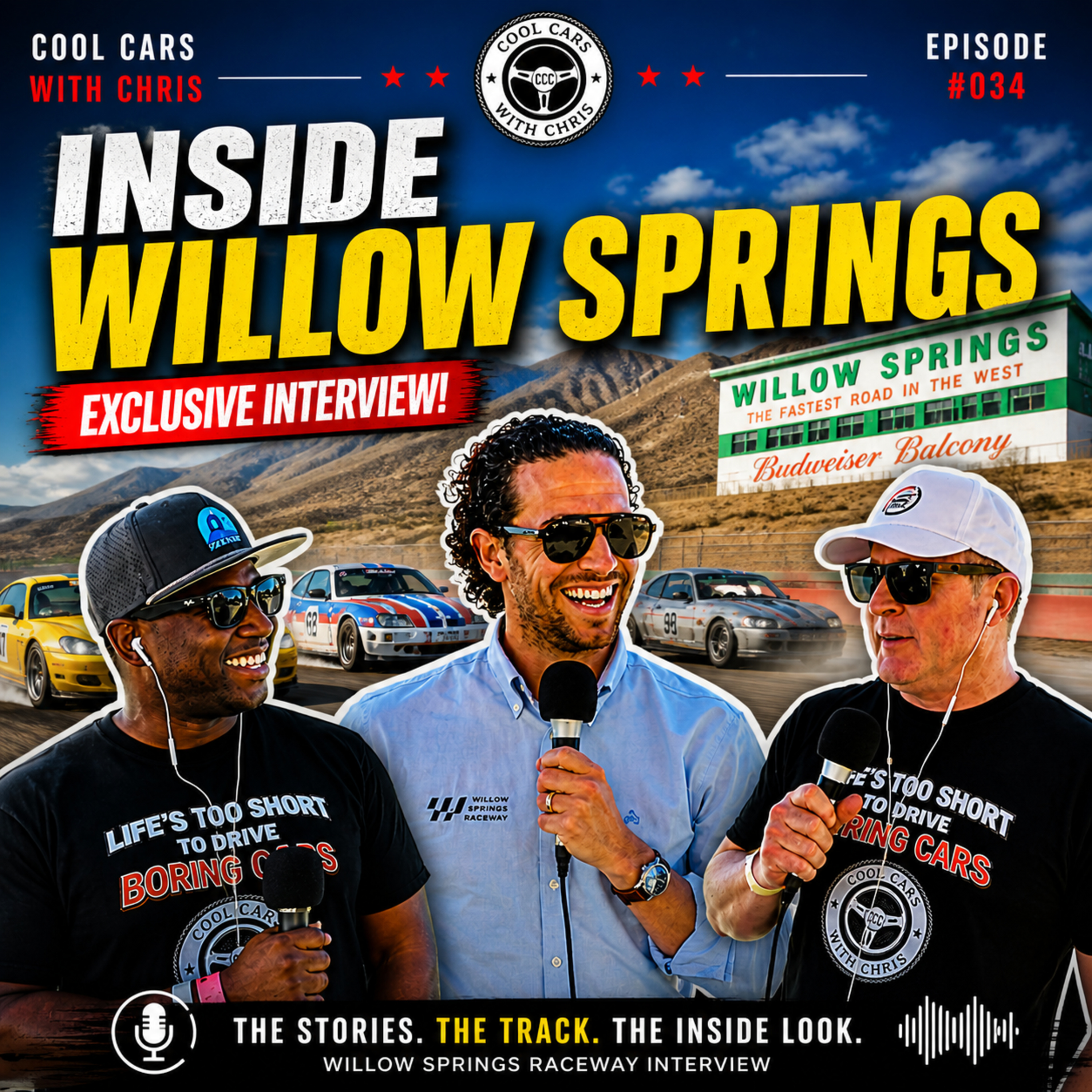
034 | Willow Springs Raceway: How to Drive the Track + Insider Secrets (Kevin Hart Interview)
About this episode
Willow Springs Raceway takes center stage as Chris and the team talk track operations, access, and what it’s like to drive the layouts. Kevin Hart—who runs the facilities—joins the conversation, alongside staff explaining drift activity, scheduled open test days, and how noise rules and certification affect bigger events. They break down Big Willow’s course-record context, translate pro benchmarks into amateur expectations, and cover how filming crews and YouTubers get approvals. The episode also touches on vintage-car events and the track’s “reimagined” reopening.
In this episode of Cool Cars with Chris, we take you inside Willow Springs Raceway, one of the most iconic racetracks in California, for an exclusive interview with Kevin Hart, who runs sales, events, and business development at the track. If you’ve ever wondered how a real racetrack operates, how to attend track days, or how to drive your own car on a professional circuit, this episode breaks it all down.
We cover everything from open track days and racing events to lap times, track layouts, and the six different courses at Willow Springs, including Big Willow. Kevin also shares insider details on renting a racetrack for film productions, why Willow Springs is a popular location for movies like Ford v Ferrari, and how YouTubers and brands use the track for automotive content.
Whether you’re into car culture, motorsports, racing, or track day driving in California, this episode gives you a behind-the-scenes look at one of the most legendary racing facilities in the U.S.—plus how you can get on track yourself.
🏁 What You’ll Learn in This Episode
- How Willow Springs Raceway operates day-to-day
- The difference between track days, racing events, and private rentals
- How YOU can legally drive your own car on a real racetrack
- The 6 different tracks at Willow Springs (including Big Willow)
- Lap times, speeds, and what counts as “fast” on track
- How movies like Ford v Ferrari used the track for filming
- What it costs (and how it works) to rent a racetrack
- The return of major events like Willow Springs Reimagined
🚀 Start Your Own Podcast
This episode is brought to you by Podtastic Audio.
Want a professional podcast without the hassle?
Chris and his team handle everything—recording, editing, and production.
👉 Podcasting Made Easy - Podtastic Audio
https://forms.gle/tAuGfhrB9PHYhQ346
- Work directly with Chris
- Get a FREE copy of The Podtastic Playbook
00:00 🚗 Intro – Welcome to Cool Cars with Chris
00:07 🎥 Audio vs Video Experience (Watch This Episode)
00:22 🏁 Willow Springs Overview + Guest Kevin Hart
00:57 🎙️ Sponsor: Podtastic Audio
01:51 🎧 Interview Begins at Willow Springs
02:24 👨💼 Kevin Hart’s Role at the Racetrack
02:46 🛠️ Daily Operations at Willow Springs Raceway
03:27 📅 Track Schedule & When It’s Open
03:53 🏎️ How to Drive Your Car on the Track (Track Days)
04:23 🔊 Noise Limits & Location Advantages
05:02 🏆 Racing Events & Track Certification Explained
05:47 🗺️ All 6 Tracks at Willow Springs
06:47 ⚡ Lap Times, Speeds & What’s Considered Fast
07:17 🎬 Filming Movies at the Track (Ford v Ferrari)
08:37 🎥 Renting the Track for Productions & YouTubers
08:51 🏁 Quarter Mile Track & Drag Racing History
09:32 🚫 Why Open Testing Has Changed
10:15 🎉 Willow Springs Reimagined Event Details
11:13 🙌 Outro & Wrap-Up
n this episode of Cool Cars with Chris, we explore Willow Springs Raceway, a legendary California racetrack known for track days, racing events, and motorsports history, with an exclusive Kevin Hart interview covering how to drive your car on a racetrack, open track days in California, and what it takes to run a professional racing facility. We break down the Big Willow track layout, lap times, racing speeds, and all six tracks at Willow Springs, while also diving into car culture, automotive content creation, and filming locations like Ford v Ferrari. Whether you’re searching for a car podcast, motorsports podcast, track day driving tips, or how to get on a race track in California, this episode delivers insider knowledge on racing, track rentals, automotive events, and performance driving at one of the most iconic race tracks in the United States.
#WillowSpringsRaceway #TrackDay #CarPodcast #Motorsports #RacingLife #CarCulture #BigWillow #TrackDaysCalifornia #AutomotivePodcast #RaceTrack #FordVsFerrari #PerformanceDriving #CarEnthusiast
noise ordinances / noise limits
"One question I'm always kind of curious about, because I know some track kind of have like noise ordinances, like noise limits. Is that a thing? ... Given we're, you know, really enough, some tracks ... they didn't have residential and now they do. And now they got to conform."
Cities sometimes set rules for how loud places are allowed to be. If homes get built nearby, a track may have to adjust events or car setups so it doesn’t exceed the allowed noise level.
Some areas regulate how loud a racetrack can be through noise ordinances or noise limits. If nearby residents move in, tracks may be required to change event schedules, car/engine setups, or operating procedures to stay within those limits.
track certification
"That's our racing league. The plan is to have the track certified to be able to host larger level. ... So what would be the requirements for having a track certified versus like non-certified?"
Track certification is an approval process that determines whether a facility meets safety and operational standards to host higher-level events. In practice, certification can involve track layout requirements, safety barriers, run-off areas, and procedures for race control and emergency response.
Willow Springs Raceway track layout (Big Willow, road course, other road course, karting track)
"Big Willow is the one behind us, right? ... We actually have six operable tracks. So I got Big Willow, the two and a half mile road course ... the other road course ... We've got the Jensenbund carding track right here. ... this one here that they're running on, how long is this track? Two and a half mile."
They’re describing the different tracks inside Willow Springs Raceway. Different layouts feel and drive differently, so the way you drive (and sometimes how you set up the car) can change depending on which one you’re on.
This segment maps out the different circuits at Willow Springs Raceway, including Big Willow and multiple road course configurations, plus a karting track. Knowing which layout is being used matters because each circuit’s length and corner types change driving technique and car setup.
lap
"lap, whatever it is, in a little bit here."
A lap means one full trip around the track. When people talk about lap times, they’re comparing how fast you can do that same full circuit.
A lap is one complete circuit around a track course. Track discussions often use lap counts and lap times to compare performance, because it normalizes driving over the same distance and layout.
course record
"Well, I know the, the course record on Big Willow, it was back in the 80s."
A course record is the best/fastest lap time that’s been officially recorded on that track. Think of it like the track’s “all-time fastest” benchmark.
A course record is the fastest time ever officially recorded on a specific track layout. It’s usually set under defined rules (car class, timing method, and sometimes driver/vehicle requirements), so it’s a benchmark for what’s possible.

Alpine A106
"Well, I know the, the course record on Big Willow, it was back in the 80s. It was in an, it was in an Indy car. And I believe it was a 106 lap. Okay, so 12 and a half miles. So if you do the math, yeah, well, what is considered like a good time for like an amateur car, like a"
The Alpine A106 is an older sports car from France that was made to be fast and handle well. People bring it up when they talk about racing and old track achievements, like how many laps a car could complete in a set time. It’s remembered because it was built for competition, not just everyday driving.
The Alpine A106 is a classic French sports car best known for its lightweight, compact design and its use in motorsport during the mid-20th century. It’s often discussed in the context of racing history and track records because cars like this helped define the era’s approach to speed through agility and efficiency. In a podcast, it may come up when talking about long-distance lap counts and historic performance on famous circuits.
track rental for filming and testing
"Right. I see a lot of YouTubers do like test runs on cars. They take them out here, [495.3s] the all kinds of stuff out here on this track. I was kind of wondering how that all worked, [498.1s] you know, like how do you get like the production? How do you get like signing off on it?"
They’re talking about renting a race track so people can film or test cars safely. The track has rules and approvals, so it’s not just “show up and drive.”
The hosts describe how YouTubers and production crews rent a race track for filming and testing. Track operators typically control access, scheduling, and safety requirements, which is why “signing off” and permissions are part of the process.
skid pad
"Okay. You know, not all, not all shoots need to [523.6s] be on the big track. We've got skid pads and we've got a carting track and we've got dirt off-road."
A skid pad is a dedicated paved area designed to let drivers explore traction limits in a controlled environment. It’s commonly used for learning car handling and for testing tires and stability behavior without needing a full road course.
quarter-mile track
"So you have a quarter, do you have a quarter mile track? Yeah, we do. [533.0s] Wow. Is that, is it open? It is."
A quarter-mile track is a straight stretch about 1/4 mile long. People use it to test acceleration and top speed, not turning.
A quarter-mile track is a straight acceleration strip measured in 1/4 mile (about 402 meters). It’s used for drag-style testing where the focus is on speed and acceleration rather than cornering.
open door testing
"for, [556.6s] for coming out and testing, we, we don't have the ability or we don't offer any more just [561.1s] open door testing, which like you mentioned before, that, that used to be the case where [565.4s] you could come in the door and, you know, pay a couple hundred bucks"
“Open door testing” means you could basically show up and pay to test your car. They’re saying that option used to exist but now it’s more restricted and costs more.
“Open door testing” refers to informal, walk-in style track access where individuals could pay and test without a more formal event structure. The speaker says Willow Springs no longer offers this, implying higher requirements or pricing for controlled access.
eighth-mile track
"Well, I mean, that's tough. It's good to know because quarter [575.6s] mile strips in California are really like dwindling down. I think like the eighth or whatever."
An eighth-mile track is a shorter straight stretch—about half the distance of a quarter-mile. They’re saying quarter-mile strips are harder to find now.
An eighth-mile track is a shorter straight acceleration strip measured in 1/8 mile (about 201 meters). The speaker contrasts it with quarter-mile availability, noting that longer strips are becoming rarer.
Request an Explanation
Heard something you'd like explained? We'll add it to this episode.
Sign in to request explanations for terms you heard.
Want to learn more?
Browse our glossary for plain-English explanations of automotive terms, jargon, and concepts.
Help improve this episode
See something that's not quite right? Our annotations are AI-generated and can sometimes miss the mark. Click the flag icon on any annotation to suggest a correction.