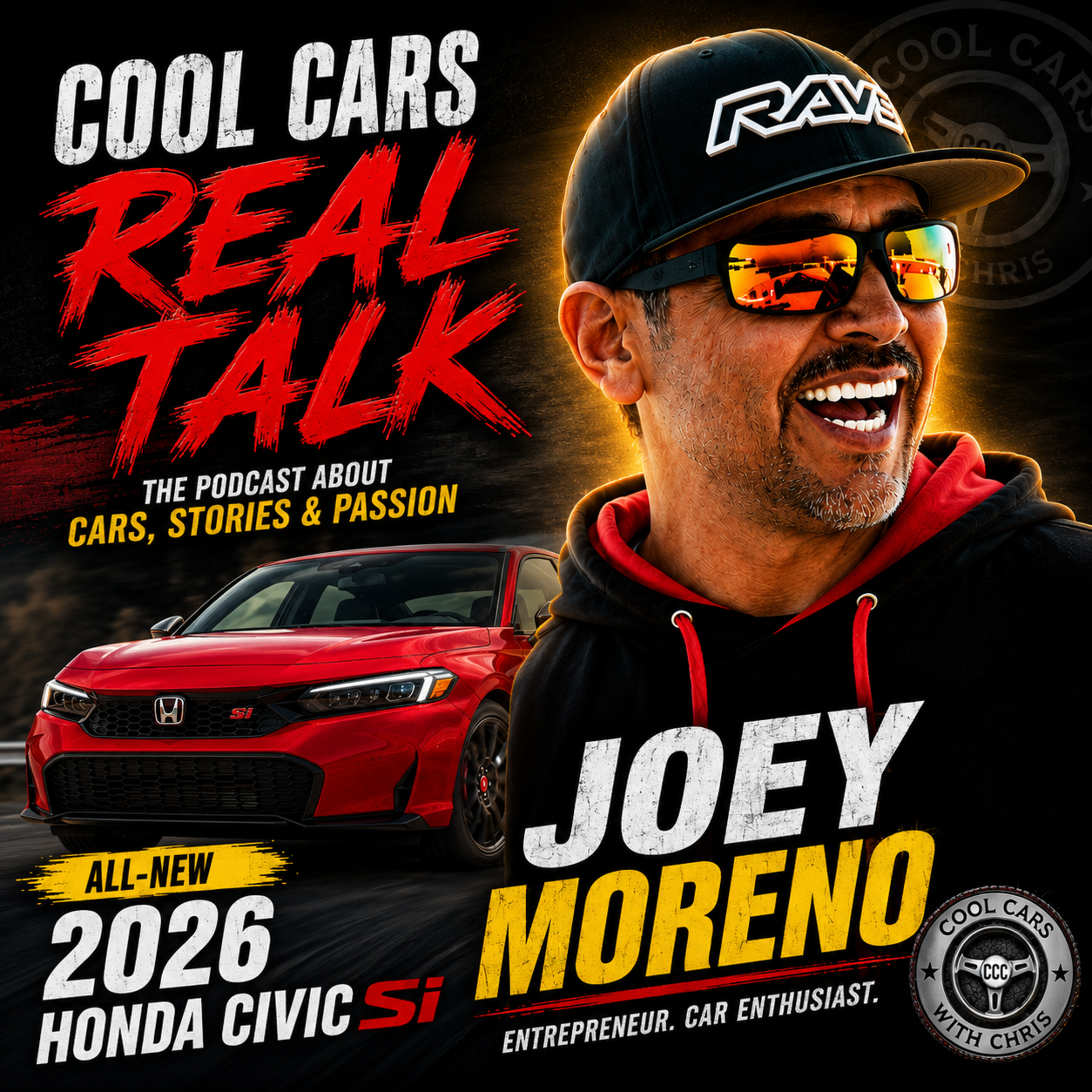
036 | 2026 Honda Civic Si Build: 30 PSI Boost, Mods & Cars and Coffee 805 with Joey Moreno
About this episode
Joey Moreno’s 2026 Honda Civic Si build takes center stage, from buying the car new to immediately modifying it and chasing boost targets—first around 18 psi and ultimately near 30 psi. The discussion connects those numbers to live ECU tuning, PRL bolt-on parts, and what supporting hardware needs to handle higher stress. Between build talk, they also cover Cars and Coffee 805 at Willow Springs and planning a downtown Ventura event, including street-closure logistics and permits.
Back at Willow Springs Raceway, I sit down with Joey Moreno to talk about the growing Cars & Coffee 805 movement, Ventura car culture, and his aggressively modified 2026 Honda Civic Si.
Joey shares how the 805 car community is building momentum through pop-up meets and local Cars & Coffee events across Ventura, Camarillo, Moorpark, Montecito, and Santa Barbara. We also talk about what it takes to organize automotive events in California, working with city permits, and why building a safe and positive car culture matters.
We also break down Joey’s brand-new Civic Si build — a car that barely stayed stock for a week before getting full bolt-on modifications, PRL performance parts, Hondata tuning, and nearly 30 pounds of boost on stock internals. Joey explains the tuning process, horsepower gains, future plans for a 400HP setup, and what it’s like modifying a brand-new platform right out of the showroom.
https://www.instagram.com/carsandcoffee805/
If you’re into Honda tuning, grassroots car culture, track days, turbo builds, or the SoCal automotive scene, this episode is packed with enthusiast insight and real garage talk straight from Willow Springs.
- Cars & Coffee 805 and Ventura car culture
- Organizing automotive meetups in California
- Building a community-focused car scene
- 2026 Honda Civic Si modifications
- PRL Motorsports performance upgrades
- Hondata live tuning
- Running 30 PSI boost on stock internals
- Future 400HP Civic Si goals
- California car laws and tuning culture
- Willow Springs Raceway atmosphere
🎙 Follow the podcast for more car builds, track days, interviews, and automotive culture stories.
This episode is brought to you by Podtastic Audio — helping creators launch and grow professional podcasts from recording to production and marketing.
https://forms.gle/iUYAtaQbTsQBhurx5
Follow & Connect
🌐 Website: https://coolcarswithchris.com/
📸 Instagram:https://www.instagram.com/cool_cars_with_chris619/
📺 YouTube: https://www.youtube.com/@CoolCarswithChris619
Follow Cool Cars with Chris for more car builds, track days, automotive events, and conversations with enthusiasts from all over the car community.
Follow Courage:
https://www.instagram.com/thedrivendad22/
https://www.youtube.com/@TheDriveNDad22
00:00 – Intro & Video Podcast Announcement
00:39 – Meet Joey Moreno at Willow Springs
01:12 – Cars & Coffee 805 & Ventura Car Culture
02:11 – Supporting Local Car Meets Across the 805
03:05 – Planning Future Ventura Car Events
03:52 – City Permits & Organizing Car Shows
04:29 – Safe Driving & Car Community Responsibility
04:49 – Joey’s Brand-New 2026 Honda Civic Si
05:20 – Full Bolt-On Mods & PRL Performance Parts
05:44 – Hondata Tuning & Power Gains
06:06 – Turbo Setup & 30 PSI Boost
06:44 – Limits of Stock Honda Internals
07:02 – Future 400HP Civic Si Plans
07:32 – Modifying a Brand-New Car
08:07 – Dealer Reactions & Sleeper Civic Talk
08:39 – California Car Laws & Outro
On this episode of Cool Cars with Chris, Chris heads out to Willow Springs Raceway to talk with Joey Moreno about the growing Cars & Coffee 805 community, Ventura car culture, and his heavily modified 2026 Honda Civic Si. Joey breaks down his full bolt-on Civic Si build featuring PRL performance parts, Hondata tuning, upgraded turbo performance, and nearly 30 pounds of boost on stock internals. The conversation covers Honda tuning, turbo Civic builds, SoCal car meets, Ventura County automotive events, and the future of grassroots car culture in Southern California. Joey also shares his plans for a future 400 horsepower Civic Si setup while discussing the realities of California car laws, aftermarket modifications, and performance tuning. If you’re into Honda Civic Si mods, JDM culture, track days, Willow Springs Raceway, Cars & Coffee events, turbocharged Hondas, or automotive podcasts, this episode is packed with enthusiast insight and real-world tuning talk.
#HondaCivicSi #HondaTuning #TurboHonda #CarsAndCoffee #CarPodcast #podcast

2026 Honda Civic Si
"Plus he bought himself a brand new 2026 Honda Civic SI. Now those SI's are pretty cool right out of the box, you know, and they're pretty cool cars, I would say, but Joey didn't sit with that."
The Honda Civic Si is a sportier version of the regular Civic. It’s meant to drive more enthusiast-style, and in this episode Joey’s 2026 Si is the car he’s building up with upgrades right away.
The Honda Civic Si is a performance-focused trim of the Civic, typically tuned for a more engaging driving feel than the standard models. In this episode, Joey Moreno’s 2026 Honda Civic Si is the base platform he immediately starts modifying after purchase.
30 pounds of boost
"And this fantastic episode has brought you by my company, Podtastic Audio. Hey, look, I make this look easy... including that modifications, he's actually pushing the car up to 30 pounds of boost."
Boost is extra pressure from a turbo that forces more air into the engine. “30 pounds of boost” means the turbo is running very hard, which can make more power but also puts more stress on the engine and needs the right setup.
“Boost” is the extra air pressure a turbocharger (or supercharger) forces into the engine to increase power. Saying he’s pushing “30 pounds of boost” means the intake pressure is being raised dramatically above atmospheric levels, which usually requires supporting modifications and careful tuning to stay safe.
Willow Springs
"Cool. We are with Joey at Willow Springs. Joey, what brings you out here, man?"
Willow Springs is a real race track in California. People go there for track days and driving events, so it’s a big deal for car enthusiasts.
Willow Springs is a well-known motorsports facility in California where drivers and teams test and race. It’s especially associated with track days and performance-car events, so meeting there signals a more enthusiast-focused crowd than a casual parking-lot meet.
Cars and Coffee 805
"Cars and Coffee 805. We're going, I guess, overall, to support in the community. So there's specific cars and coffees, Ventura, Moorpark, Camarillo, Montecito."
Cars and Coffee 805 is a local car meet where people gather to show their cars and hang out. In this episode, they talk about meeting in different nearby cities and sometimes doing pop-up events.
“Cars and Coffee 805” refers to a local Cars and Coffee meet in California’s 805 area code region. The hosts describe it as a recurring community event with multiple satellite meet locations (Ventura, Moorpark, Camarillo, Montecito) and a rotating “pop up” setup.
pop up setup
"So right now we're we're doing more of the pop up setup. So as much as we can to go out there and support the individual cars and coffees"
A “pop up setup” here means a temporary, flexible meet location rather than a fixed monthly venue. That matters because it changes how attendees plan to show up and how organizers coordinate with different local car communities.

Tesla Model Si
"...I had some bad luck with the previous model. Same model SI with a 2022 head gasket blown. I had a couple of ..."
bolt on
"But I did a full bolt on with PRL. So that's a real company that I really do enjoy to at least partner with"
A “bolt-on” upgrade is a modification you can install with normal tools, without major cutting or rebuilding. It’s usually meant to be straightforward compared to deeper engine work.
“Bolt-on” refers to aftermarket performance parts that install without major fabrication or engine machining. In practice, bolt-on mods are often used to add airflow, improve exhaust flow, or support tuning—like the PRL parts mentioned right after.
PRL
"But I did a full bolt on with PRL. So that's a real company that I really do enjoy to at least partner with"
PRL is a company that makes aftermarket performance parts. In this story, they’re the brand of parts the speaker used for their Civic Si build.
PRL is an aftermarket performance company the speaker partners with for modifications. Here it’s tied to a “full bolt on,” implying PRL supplies parts intended to improve the Civic Si’s boost and tuning potential.
live tuning
"And team team Han data, they support the module so I can do any type of live tuning. And I use a fear of all down down in, I think, I think throughout LA,"
Live tuning is when someone changes the car’s computer settings while the car is running. They use a laptop to help set things like boost so the car makes power the way it should.
Live tuning means adjusting the engine control unit (ECU) settings while the car is running, typically using a laptop and tuning software. The goal is to dial in boost and fueling so the engine makes the target power safely under real conditions.
270 torque and horsepower
"But with my computer laptop, I'm running right around 270 torque and horsepower. So off the off the floor showroom floor, it's about a two to 20 conservative."
Torque and horsepower are ways to measure how strong the engine is. Torque is the “twisting pull” that helps you accelerate, and horsepower is another number people use to compare power between cars.
Torque and horsepower are the two main measures used to describe engine output. Torque is the twisting force that strongly affects acceleration, while horsepower is a derived measure that’s often used for overall power comparisons.
turbo
"OK. Yes, I know those will come with turbos. Do you want to get the size?"
A turbo is a device that uses the car’s exhaust to spin a compressor. That pushes extra air into the engine so it can make more power.
A turbocharger uses exhaust gas to spin a turbine, which forces more air into the engine. More air allows more fuel to be burned efficiently, which is why turbo setups can produce higher power than a naturally aspirated engine of the same size.
one point five liter
"Do you want to get the size? Yes. OK. Yeah. One point five liter. It does have the smaller motor has the turbo on there."
“1.5 liter” is the engine size—how much space the pistons move through. Smaller engines can still make good power when they’re turbocharged.
“1.5 liter” refers to engine displacement, which is the total volume swept by the pistons. Smaller-displacement engines are often paired with turbocharging to achieve strong power while keeping packaging and fuel consumption reasonable.
boost around 18
"It does have the smaller motor has the turbo on there. And initially it'll boost around 18."
Boost is how much extra pressure the turbo adds to push more air into the engine. Higher boost usually means more power, but it also needs the car to be tuned correctly to stay safe.
Boost is the extra air pressure a turbocharger creates above atmospheric pressure, and it’s a key driver of how much power the engine can make. “Boost around 18” indicates the turbo is targeting a relatively high pressure level, which makes safe tuning and supporting hardware especially important.
boost tables
"But you have it to just right, you know, and the tuner takes their time to make sure they expect the power in the right way and the boost tables are appropriate."
Boost tables are the computer’s instructions for how much boost to run. They help the tuner make sure the engine gets the right amount of boost for each driving situation.
Boost tables are the engine-tuning maps that tell the ECU how much turbo boost to target under different conditions (like RPM and load). A tuner adjusts them so the engine gets the right boost at the right time without running into knock or over-stressing components.
tuner
"But you have it to just right, you know, and the tuner takes their time to make sure they expect the power in the right way and the boost tables are appropriate."
A tuner is the specialist who adjusts the car’s computer settings. On turbo cars, that’s especially important so the engine gets the right boost and fuel safely.
A tuner is the person who calibrates the car’s ECU/engine management for the specific setup (mods, fuel, target power). With turbo cars, tuning is critical because it controls boost targets, fueling, and ignition timing to match the engine’s limits.
head gasket
"At that point, at least the head studs start working on the head gasket, because that's the first thing to go on these guys."
The head gasket is a seal that keeps hot combustion gases and fluids separated inside the engine. With higher boost, it can become the weak point if the engine isn’t reinforced.
The head gasket is the sealing layer between the cylinder head and engine block that keeps combustion gases and coolant/oil from mixing. On turbo/high-boost setups, the extra cylinder pressure can cause the head gasket to fail first if the engine isn’t built and tuned to handle it.
head studs
"At that point, at least the head studs start working on the head gasket, because that's the first thing to go on these guys."
Head studs are stronger bolts that hold the engine’s top (the cylinder head) tighter to the engine. When you run more boost, they help keep everything sealed so the head gasket is less likely to fail.
Head studs are upgraded fasteners that clamp the cylinder head to the engine block more securely than stock bolts. On high-boost builds, they help resist head lift and maintain proper sealing, which is important for preventing head-gasket failure.
ethanol kit
"Hopefully, you know, an E 30, potentially 55 ethanol kit. But you got to do the internals right bigger turbo."
An ethanol kit lets you mix ethanol with regular gas. Ethanol can help the engine tolerate more boost and make more power, but it needs the right setup and tuning.
An ethanol kit is an aftermarket system that blends ethanol with gasoline (often using sensors and a controller) to increase knock resistance and allow more aggressive tuning. It’s commonly used on turbo builds to support higher power targets.

BMW E30
"It'll be it'll be 400 horsepower internals. Hopefully, you know, an E 30, potentially 55 ethanol kit. But you got to do the internals right bigger turbo."
The BMW 3 Series is a compact luxury car that’s made to drive well and feel sporty. People often modify it to make more power, like upgrading the engine parts and adding a bigger turbo. The podcast is talking about doing those upgrades properly so the car can handle the extra stress.
The BMW 3 Series is a compact luxury sports sedan/compact car line known for strong performance and a big aftermarket following. In the podcast context, it’s being discussed as a platform for higher-power builds—things like upgrading internal engine components, adding a larger turbo, and potentially using an ethanol setup. That kind of talk is common because the 3 Series responds well to performance modifications when the supporting parts are done correctly.
intercooler
"I built it from the ground up. So intercooler to exhaust."
An intercooler cools the hot, compressed air from the turbo. Cooler air helps the engine run more safely and efficiently when you’re making boost.
An intercooler cools the compressed air coming from the turbo before it enters the engine. Cooler intake air is denser and helps reduce the chance of knock, which supports safer higher boost operation.
off the lot
"[477.2s] like, now we're going to have you come over here and put some design on our cars [480.5s] because some of the dealers start to put their own mods on the side. [483.9s] Yeah, I've heard. And they do the RL off the lot."
“Off the lot” here means the car is already modified before the buyer even takes delivery—often by the dealer. That’s different from a typical owner build where modifications happen after purchase.
sleeper
"[491.4s] It's like a 10 bucks more of your payment or whatever it is, you know. [493.8s] Exactly. Well, it's a bit of a sleeper. [496.1s] Like, you know, people people don't probably don't expect that, you know."
A “sleeper” is a car that doesn’t look that fast, but actually performs really well. People often underestimate it until they see it in action.
A “sleeper” is a car that looks relatively normal or understated, but has performance upgrades that make it faster than people expect. The speaker connects it to the idea that a newer Civic Si can still surprise others despite not looking extreme.
Request an Explanation
Heard something you'd like explained? We'll add it to this episode.
Sign in to request explanations for terms you heard.
Want to learn more?
Browse our glossary for plain-English explanations of automotive terms, jargon, and concepts.
Help improve this episode
See something that's not quite right? Our annotations are AI-generated and can sometimes miss the mark. Click the flag icon on any annotation to suggest a correction.