
119 - Another month of EV sales booming, and your calls on your first EV!
About this episode
EV sales are surging in Australia, with the hosts pointing to figures like “16.97% of all cars sold in April were electric vehicles” and the broader takeaway that “one in six vehicles sold was electric last month.” They then zoom into rankings (Toyota, BYD, Kia, and Tesla’s absence from the top 10) and incentives, before fielding real first-EV stories—leases, test drives, charging setups, and even roadside 12V and range surprises.

Tesla Model 3S
"...right no so as usual you 3447 Tesla they sold 400 model 3s and 800 model y so so there's other brands that a..."
The Tesla Model S is an electric sedan, meaning it’s powered by a battery instead of petrol. It’s one of Tesla’s main models and is known for advanced EV features. The podcast mentions it while talking about how many Teslas of different models are sold.
The Tesla Model S is Tesla’s flagship electric sedan and is often used as a benchmark for EV performance and technology. In the podcast snippet, it’s mentioned in the context of Tesla sales figures alongside the Model 3 and Model Y, which helps illustrate how different Tesla models contribute to overall EV volume. That’s why it comes up in market-share style conversations.

Toyota RAV4
"the RAV4 was the number one car beat the Ford Ranger which was huge"
The Toyota RAV4 is a popular non-EV model that topped the sales chart in this segment. The hosts mention it to compare where EVs are landing versus regular cars.
The Toyota RAV4 is mentioned as the number-one vehicle in the chart, beating the Ford Ranger. It’s included to show how EVs are rising in the overall sales rankings alongside mainstream models.

Ford Ranger
"the RAV4 was the number one car beat the Ford Ranger which was huge"
The Ford Ranger is a well-known truck model. In this excerpt, it’s mentioned as the runner-up to the RAV4 in the sales list.
The Ford Ranger is referenced as the vehicle the RAV4 beat in the sales chart. It’s used as a mainstream benchmark while the hosts discuss EVs appearing in the top-10.
BYD
"BYD Dolphin in nine so BYD had five vehicles in the top 10 ... BYD is up 140 percent year on year"
BYD is a car maker that the hosts say is doing extremely well in EV sales. They mention BYD has several models in the top-10 and that its sales are growing fast.
BYD is presented as the standout EV seller in the top-10 list, with multiple models mentioned and strong year-on-year growth. The hosts also note BYD sells hybrids alongside fully electric cars.

Tesla Model Y
"um Tesla Model Y was the third best selling car the EV5 was the fourth best"
The Tesla Model Y is a popular electric SUV. Here, the hosts mention it as the third best-selling car, helping show how competitive the EV market is.
The Tesla Model Y is an electric crossover that the hosts describe as the third best-selling car in the chart. It’s used as a benchmark against newer or non-Tesla EVs appearing in the top rankings.

BYD Dolphin
"and then add oh three add oh two add oh one in five six and seven wow the BYD Dolphin in nine so BYD had five vehicles in the top 10"
The BYD Dolphin is an electric car from BYD. In this segment, it’s called out as one of the models that sold well enough to make the top-10 list.
The BYD Dolphin is a BYD electric car that the hosts say placed in the top-10 sales chart. It’s mentioned as part of BYD having multiple models in the same sales ranking.
year-on-year growth
"a year on year that's they're looking like a genius crazy year on year growth Geely went from 324 last year to 2,000 this year so 519 percent"
Year-on-year growth means “how much higher (or lower) sales are compared to the same time last year.” The hosts use it to show EV sales are rising fast.
Year-on-year (YoY) growth compares sales in a given month (or period) to the same month the previous year. The hosts use it to quantify how quickly brands like Geely and BYD are increasing sales.
Geely
"Geely went from 324 last year to 2,000 this year so 519 percent they have some hybrids and other cars"
Geely is the company behind some of the cars being sold. The hosts say Geely’s sales are rising a lot year over year, and that not all of its cars are fully electric.
Geely is discussed as a brand/company whose sales growth is quantified in the segment. The hosts mention Geely’s jump from 324 to 2,000 units, and note it sells some hybrids as well as EVs.
government rebates
"we'll there's also uncertainty around um financing and government rebates we'll talk about that at the end of the show because there's been some news on the government rebates"
Government rebates are discounts or money-back incentives for buying an EV. If they change or become uncertain, it can affect how many people decide to buy now.
Government rebates are incentives that reduce the effective cost of buying an EV. The hosts say there’s uncertainty around financing and rebates, implying these incentives can materially affect demand.
EV
"where are you at your your petrol car or an evi owner uh we are not an evi owner yet but we've got a we've signed a lease on on one soon"
EV means electric vehicle. It runs on electricity from a battery, not petrol or diesel.
EV stands for electric vehicle, meaning the car is powered primarily by an electric motor and a battery rather than a gasoline or diesel engine. In this episode, the caller is deciding whether to keep their current cars or switch their “runabout” to an EV due to fuel costs.

Kia Carnival
"where we started our journey was that we had a a kia carnival which is a diesel so we were really hurting with the recent fuel prices"
A Kia Carnival is a big family van. Here they’re talking about the diesel version they had before they started looking at electric cars.
The Kia Carnival is a family-focused minivan that’s typically bought for space and long-distance practicality. In this segment, the host mentions a diesel Kia Carnival as their starting point before moving toward an EV.
diesel
"where we started our journey was that we had a a kia carnival which is a diesel so we were really hurting with the recent fuel prices"
Diesel is a type of fuel used in some cars. They’re saying the diesel fuel cost was getting expensive, pushing them toward electric cars.
Diesel is a fuel used in compression-ignition engines, commonly found in many minivans and SUVs. Here it matters because the speaker says they were “hurting” with fuel prices, which is part of why they started looking at EVs.

Mazda CX-5
"we upgraded to a mastas cx 5 2020 akira with all the bells and whistles we got a great drive away price"
The Mazda CX-5 is a popular compact SUV. They bought a 2020 one as a replacement car, but after fuel prices stayed high they started thinking an EV might have been the better choice.
The Mazda CX-5 is a compact SUV known for being a practical daily driver with a comfortable ride and strong real-world usability. In this segment, the speaker bought a 2020 CX-5 (with a “great drive away price”) as their replacement for an older second car, then quickly started questioning whether they should have gone EV instead.
drive away price
"we upgraded to a mastas cx 5 2020 akira with all the bells and whistles we got a great drive away price"
A “drive away price” is what you actually pay so you can drive the car off the lot. It usually includes extra fees on top of the sticker price.
“Drive away price” is the total amount you pay to take the car home—typically including the base price plus on-road costs like registration and stamp duty (and sometimes dealer delivery). It’s a useful way to compare deals because it reflects the real out-the-door cost rather than just the advertised price.
salary packaging
"we both have access to salary packaging and we were looking at it a little bit more closer with the fbt and gst discount at the moment"
Salary packaging is a way your workplace can set up part of your pay so you may pay less tax on it. That can make buying an EV easier to afford because the overall cost can come out lower.
Salary packaging is an employment benefit where part of your pay is arranged through your employer in a tax-advantaged way. In some countries, that can make an EV purchase (or lease) effectively cheaper by changing how the costs are treated for tax.
FBT
"looking at it a little bit more closer with the fbt and gst discount at the moment"
FBT is a tax your employer may pay when you get a benefit that isn’t just salary—like certain car arrangements. If EVs are treated more favorably, it can lower what you end up paying.
FBT (Fringe Benefits Tax) is a tax on non-cash benefits provided by an employer. EVs can be affected by how the benefit is valued, which can change the effective cost of driving or owning one under salary packaging.
GST
"with the fbt and gst discount at the moment"
GST is a sales tax added to many purchases. If an EV deal has GST discounts or special treatment, the total price can be lower than you’d expect.
GST (Goods and Services Tax) is a consumption tax applied to many goods and services. Some EV purchase/lease structures can qualify for GST-related discounts or treatment, which can materially affect the out-the-door cost.

Kia EV5
"we actually started by booking a test drive with akia ev 5 um and that that was actually fantastic drive a little bit weird with the center console not being a console sort of an unusable with a weird bench seat"
The Kia EV5 is a battery-electric crossover aimed at mainstream buyers, so it’s often evaluated on packaging, usability, and price-to-range/value. In this segment, the hosts focus on the EV5’s interior layout (especially the center console/seat arrangement) and whether the tech justifies the asking price.

BMW X5
"...v 5 then we went to the geely um the extended the x5 um yeah funny cx 5 to ex 5 maybe um yeah that the..."
The BMW X5 is a larger, comfortable SUV made for everyday driving and family use. It’s designed to feel “upmarket,” with a focus on comfort and driving feel. In the podcast, it sounds like it’s being mentioned as part of a discussion about SUVs.
The BMW X5 is a mid-size luxury SUV that’s typically discussed as a mainstream family option within BMW’s lineup. In the podcast snippet, it’s referenced in a way that suggests a comparison or a naming/variant mix-up (the “extended the x5” and “cx 5 to ex 5” wording). It may be brought up to anchor what people consider when moving between different SUV types and powertrains.
regenerative braking
"it was actually once we understood how to use the regenerative braking and things um and and uh climatize our style of driving um it was actually fantastic"
When you slow down in an EV, the car can use the electric motor to help slow you down and also recharge the battery. It’s like braking that also recovers energy instead of just wasting it.
Regenerative braking is how many EVs slow down while turning some of the car’s motion back into electricity. Instead of wasting that energy as heat in the brake pads, the motor acts like a generator and recharges the battery.
boot
"in fact we would be making money if we if we bought that car i think we just felt the interior was a little bit small for the three kids although the storage space in the boot was fantastic"
The boot is the trunk/luggage space at the back of the car. They liked how much stuff it could hold, even if they thought the cabin felt a bit tight.
In car terms, the boot is the trunk area used for storing luggage and cargo. The hosts say the boot storage space was fantastic, even though they felt the interior was a bit small for their three kids.
over the air
"then over the air no updates and there were a few things they were saying they may tweak"
“Over the air” updates are like updating your phone, but for the car—sent wirelessly. It means the car can get software changes without you going to a workshop.
“Over the air” (OTA) updates are software updates sent wirelessly to a car, usually over the cellular network. The segment suggests the car may receive tweaks via OTA, but the dealer isn’t fully confirming what will change.
trickle charger
"we are going to go with the trickle charger but they actually threw in a wall charger as part of the promotion as well"
A trickle charger charges the EV slowly, usually over many hours. It’s often used when you don’t have a faster home charger installed yet.
A trickle charger is a low-power EV charging setup intended for slower charging over a longer period. The caller plans to use one initially, implying they’ll rely on overnight/slow charging until their situation is fully sorted.
wall charger
"but they actually threw in a wall charger as part of the promotion as well even though we didn't get finance with geely"
A wall charger is a dedicated charging box installed at your house. It’s meant to make charging easier and usually faster than plugging in with basic gear.
A wall charger is a dedicated EV charging unit installed at home (often a “home charger”) that can deliver higher power than a basic portable setup. Here, the promotion includes a wall charger even though the buyer didn’t take financing.
three phase
"what do you got three phase at home you should be fine hey yeah yeah we're on single phase but"
Three-phase is a type of household electricity supply. It can support faster EV charging, but this caller says their home is single-phase instead.
Three-phase power is an electrical supply method that can allow EV chargers to deliver more power efficiently. The caller mentions they have single-phase at home, so the electrician will need to account for that when installing/using the charger.
single phase
"hey yeah yeah we're on single phase but our native the sparky so yeah we'll be on to him very quick"
Single-phase means your house uses a simpler electricity setup. It can affect how fast your EV can charge at home, depending on the charger and the car.
Single-phase power is a simpler household electrical supply compared with three-phase. For EV charging, single-phase can limit the maximum charging power depending on the charger and the car’s onboard charging capability.
roadside assistive
"and anyway she bricked it and and the the jacu roadside assistive absolutely fantastic great [1123.3s] even out there they were just great to hear that's good yeah they came out they picked her up"
They’re talking about roadside help—service that comes out if your car won’t run or you can’t drive it safely. For EVs, that might mean towing or getting the car home.
“Roadside assistive” refers to roadside assistance services that help if a vehicle breaks down or becomes inoperable. In EV ownership, this can include towing or recovery when the car can’t be driven to a safe location.
freeway driving vs stop-and-go driving efficiency
"difference between freeway driving yeah absolutely the range could be a bit trickier on the freeway [1139.5s] because it's opposite of a petrol car and actually yeah absolutely petrol cars love the freeway [1144.6s] whereas EVs love the stop and start"
They’re comparing how EVs do on fast, steady roads versus traffic. EVs often get better efficiency in stop-and-go driving because they can reuse some energy when slowing down.
The hosts contrast EV efficiency on freeways versus stop-and-go driving. EVs often do better in city traffic because they can recapture energy during deceleration (regenerative braking) and because speeds are lower, reducing aerodynamic losses.
12 volt battery
"they've got a 12 volt battery in them yeah how do they charge you know it's a fascinating question ... the 12 volt was faulty ... the alarm on the car for a rear seat sensor problem"
Even electric cars usually have a small 12-volt battery. It runs things like alarms and sensors, so if it’s weak or gets drained, the car can act up even if the big battery is okay.
An EV still uses a 12-volt battery to power low-voltage electronics like alarms, sensors, and control modules. The hosts describe how 12-volt battery faults (and software behavior that can drain it) can trigger roadside problems even though the main high-voltage battery is fine.
software update
"it was it was fixed in the software update broadly but I will admit that we've had the roadside to our house twice"
A software update is like a patch for the car’s computer. In this story, they say an update was supposed to prevent 12-volt battery problems, but real-world issues still happened.
A software update is a change to the car’s onboard computer code that can fix bugs or adjust how systems behave. Here, the hosts say the 12-volt battery issues in the Kia EV6/EV9 were “fixed in the software update,” but they still encountered cases where the problem persisted or a different fault (a faulty battery) was involved.
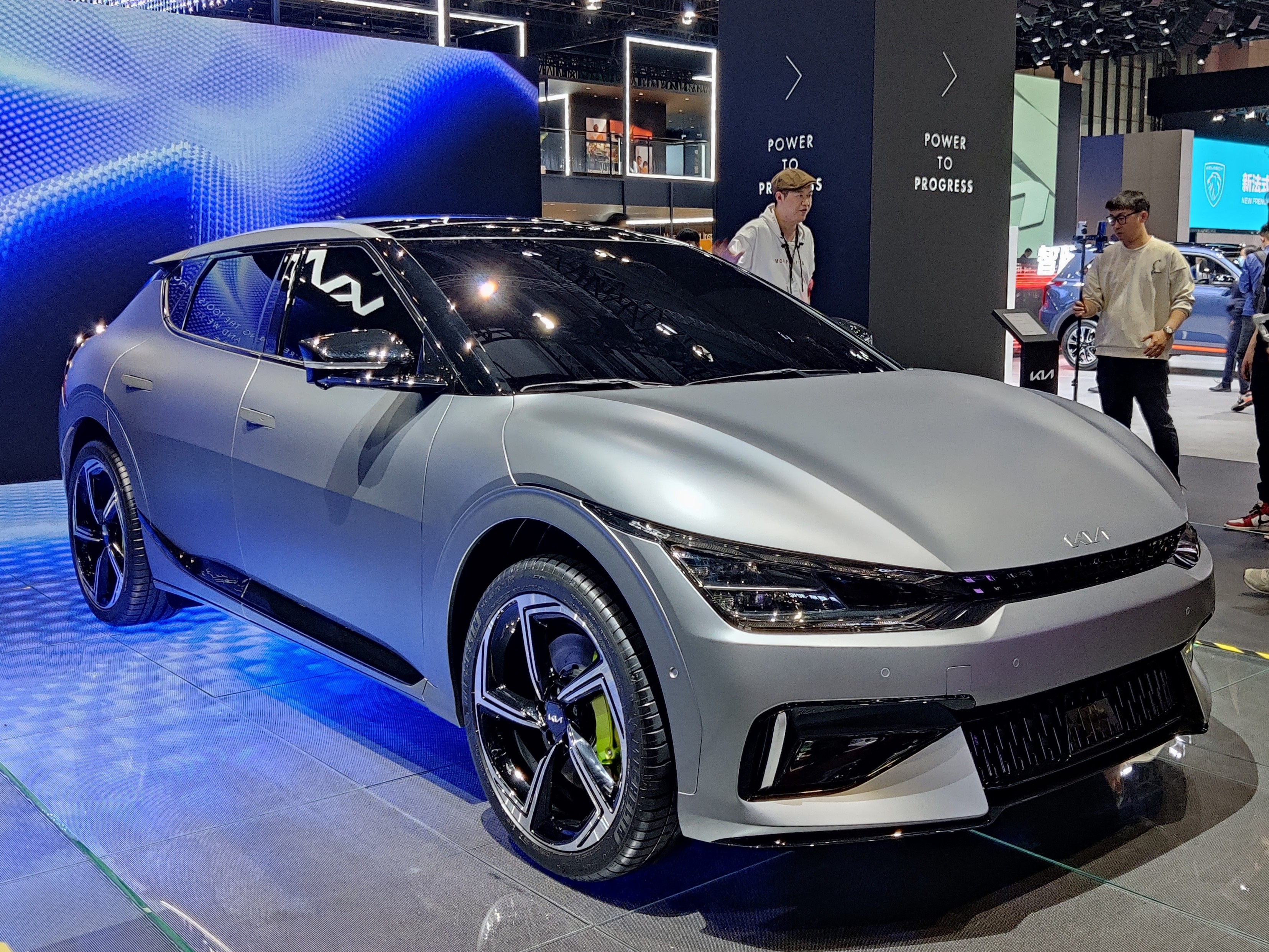
Kia EV6
"...ues with uh with the 12 volt batteries across the EV6 EV9 and others and it was it was fixed in the sof..."
The Kia EV6 is an electric car that uses a big battery to drive the wheels. It also has a smaller 12-volt battery that powers the car’s electronics. The podcast is talking about a fix related to that 12-volt system.
The Kia EV6 is an electric crossover built to offer practical range and fast, modern EV usability. The podcast context highlights a specific ownership topic: the 12-volt battery system used alongside the main high-voltage battery, and that a software fix addressed an issue. That kind of detail matters because the 12-volt battery can affect starting and electronics even though the car is electric.

Kia EV9
"...with uh with the 12 volt batteries across the EV6 EV9 and others and it was it was fixed in the softwar..."
The Kia EV9 is an electric SUV with room for passengers and cargo. It also has a small 12-volt battery that runs the car’s electronics. The podcast is talking about a fix related to that 12-volt system.
The Kia EV9 is a larger electric SUV designed for families who want more space than a typical crossover. The podcast context again points to the 12-volt battery system shared across EV6/EV9 and notes that a software fix resolved an issue. That’s relevant because the 12-volt battery can impact the car’s electronics and overall drivability.
rear seat sensor
"there's an alarm on the car for a rear seat sensor problem and it's like we don't really care because the rear seat doesn't get used much"
A rear seat sensor is a small device that detects something about the rear seats. Here, it caused an alarm, and the hosts connect that kind of fault to the car’s 12-volt battery being drained.
A rear seat sensor is a low-voltage input used to detect conditions related to the rear seating area, often for safety systems or occupancy-related logic. In the segment, an alarm was triggered due to a rear seat sensor problem, and the hosts discuss how that fault might contribute to draining the 12-volt battery.
car waiting for you (software behavior while parked)
"in really simple terms things like your car being parked and the lights being on in a petrol car drains your battery so you know in an electric car one of the concerns ... is your car waiting for you ... is your car unlocked is your car kind of working thinking is this person near me now"
When the car is parked, it should go into a low-power mode. The hosts are saying that if it keeps “checking” for you (like key/unlock logic), it can drain the small 12-volt battery.
The hosts are describing “sleep” vs “awake” behavior: when a car is parked, software may keep systems active to check for a nearby key, unlock request, or other triggers. If the car doesn’t fully go into low-power mode, it can drain the 12-volt battery, causing faults even though the main EV battery isn’t being used for those electronics.
98 kilowatt battery
"[1294.2s] battery can't be jump-started by the big you know 98 kilowatt battery you've got to drive just like [1299.9s] in a petrol car it's got to be on the road and so while ever you are in motion the 12 volt is"
Your EV has a big battery that powers the motor. But it usually doesn’t act like a jump-start source for the small 12-volt battery that runs the electronics.
The “98 kilowatt battery” refers to the EV’s high-voltage traction battery capacity (commonly discussed in kWh, but the speaker uses kW). This is the main battery that powers the electric drive, but it typically can’t be used to directly jump-start the separate 12-volt system.
jump starters
"I've ended up buying and look sorry I'll be very very clear I haven't bought I'm reviewing [1323.8s] with thanks to c-tech a couple of those little 12 volt jump starters yeah because you know what [1330.0s] it can happen and look it goes to that point earlier if it happened to my wife on the freeway"
A jump starter is a small battery you can use to get the car’s 12-volt system working again. It’s especially useful for EVs because the small battery can go flat even if the main electric battery isn’t the problem.
A 12-volt jump starter is a portable battery pack used to revive a flat 12V battery without needing another vehicle. In EVs, this matters because the 12V system can be what prevents doors, charging, or electronics from working—even when the high-voltage battery is fine.
c-tech
"I've ended up buying and look sorry I'll be very very clear I haven't bought I'm reviewing [1323.8s] with thanks to c-tech a couple of those little 12 volt jump starters yeah because you know what [1330.0s] it can happen ... [1369.1s] should get one of the c-tex as well and have it plugged into your car when it's parked for long [1373.1s] periods"
C-tek is a brand the host recommends for 12-volt jump-starting/charging gear. The idea is to keep the EV’s small 12-volt battery from going flat when the car sits.
C-tek is mentioned as a supplier of 12-volt jump starters/chargers. The host’s point is that having the right 12V accessory can prevent EV “dead 12V” situations when the car hasn’t been driven for a week or two.
critical condition level
"and can't take the kids wherever I want I want a solution in my murk I've had a couple of warnings [1348.9s] to say you know critical condition level because I haven't driven the car for a week or two I get [1353.9s] him in the Cooper and Jackson texts me goes this is a message"
That warning means the car thinks something is dangerously low or wrong. In EVs, it often shows up when the small 12-volt battery is running low.
“Critical condition level” is a warning state indicating the car has detected a serious issue, commonly related to low 12-volt battery voltage in EVs. When the 12V is low, the car may limit functions and alert you that the battery needs attention.
parking mode
"him in the Cooper and Jackson texts me goes this is a message and what we think Ronan is it's the [1358.8s] dash cam because the dash cam is in parking mode and it is using the 12 volt and the car is being [1364.0s] smart enough to go hey there's a problem there's parking mode you're right so that's again why you [1369.1s] should get one of the c-tex as well"
Parking mode is when a dash cam stays on or watches for events while the car is parked. If it’s powered from the car’s 12-volt battery, it can drain that battery if the car isn’t driven for a while.
“Parking mode” is a dash-cam setting where the camera monitors while the car is parked, typically using the 12-volt system for power. If the dash cam is wired to the 12V, it can contribute to 12V drain when the car sits for days or weeks.

Chevrolet Volt
"...owners because they've got to realize that the 12 volt is separate to the big battery 12 volt battery ye..."
The Chevrolet Volt is a car that can run on electricity, but it can also use petrol when needed. Like many cars, it has a small 12-volt battery that powers the electronics. The podcast is emphasizing that this 12-volt battery is separate from the big battery.
The Chevrolet Volt is a plug-in hybrid that uses both an electric drive system and a gasoline engine. The podcast context focuses on the fact that the car has a separate 12-volt battery in addition to its larger battery pack, and that this smaller battery can be a key part of reliability and ownership. That’s important because 12-volt issues can cause problems even when the main battery is fine.
high-voltage battery pack
"they've got to realize that the 12 volt is separate to the big battery 12 volt battery yeah that's right main battery"
The high-voltage battery pack is the main energy storage system in an EV that powers the electric drivetrain. The discussion contrasts it with the separate 12-volt battery, emphasizing that the car’s low-voltage electronics and the driving range come from different sources.
dash cam
"also the dash cams are set to stop draining when they detect the the 12 volt being at a certain point"
A dash cam is a camera mounted in the car. When the car is parked, it may still use some power, so some models shut off automatically to avoid draining the car’s 12-volt battery.
A dash cam is an in-car camera that records while driving and can also draw power when parked. The segment notes that the dash cam is set to stop drawing power when the 12-volt battery drops to a certain level, preventing it from draining the auxiliary battery.
range calculation
"your wife has not been put off and you've very understanding wash by by an issue that she had with range calculation"
Range calculation is the number your EV shows for how far you can drive. It’s an estimate, and it can change based on how you’ve been driving and conditions like weather and speed.
Range calculation is the EV’s estimate of how far you can drive before the high-voltage battery runs out. It can feel unpredictable because it’s influenced by recent driving, speed, temperature, and charging habits, which is why some owners experience “range anxiety.”
range anxiety
"I was one of these people that was always had range anxiety before I bought one so that's why I didn't get one"
Range anxiety is the fear that your EV won’t have enough charge to get where you’re going. Many people feel it at first, then get more confident as they learn how far they can actually drive.
Range anxiety is the worry that an EV won’t have enough battery to reach the destination or a charging point. It often improves after ownership because drivers learn how their real-world consumption affects the estimate.
charging at night
"it's obviously disappointing societally that your wife didn't feel comfortable charging at night but that's unfortunate"
Charging at night just means plugging in while you’re sleeping. Some people prefer different times of day for comfort or practical reasons, so planning your charging schedule can help.
Charging at night changes when the EV draws electricity from the grid, which can matter for convenience, cost, and how comfortable someone feels about leaving it charging unattended. The hosts suggest thinking about the time of day to charge as part of planning around charging routines.
kilowatt-hour
"feeding type which is only 15 cents ... it's about 34 cents to charge ... 8 cents a kilowatt and so that's exactly what i was going to say"
A kilowatt-hour (kWh) is how much electricity you use. When they talk about charging for “X cents per kWh,” that’s the cost per unit of energy going into the EV.
A kilowatt-hour (kWh) is a unit of energy—how much electricity you use over time. EV charging costs are usually quoted per kWh, so the “cents per kilowatt-hour” numbers in this segment are directly telling you what it costs to fill the battery.
home battery
"we force charge the battery yep get the battery up to 100 percent yep the home battery is uh is it worth my while at night"
A home battery stores electricity for later use. Here, it’s being used to shift solar power to times when the EV needs charging.
A home battery stores electricity generated by solar (or drawn from the grid) so it can be used later. In this segment, the caller is deciding whether to charge the EV to 100% during a free solar window and then discharge later at night.
time-of-use electricity pricing
"so during the day from 11 a.m to 2 p.m we can get free free electricity off the grid ... at night time ... it's about 34 cents to charge ..."
Time-of-use pricing means electricity is cheaper at some times and more expensive at others. EV owners try to charge when the price is lowest.
Time-of-use pricing means electricity costs different amounts at different times of day (for example, a free or cheap midday window versus a more expensive overnight or evening period). This segment revolves around comparing those rates to decide whether it’s worth charging the EV from the grid or using solar and a home battery.
charging schedule
"we set a schedule and then we discharged off the battery into the ..."
A charging schedule is just a plan for when your EV should charge. People set it so they charge during the cheapest electricity times.
A charging schedule is a set of times when you allow the EV (or home battery) to charge or discharge. EV owners use it to take advantage of cheaper electricity periods (like overnight rates or solar “free” windows) and avoid charging during expensive hours.
solar feed-in
"instead of discharging the battery to make a bit more in terms of the feeding type which is only 15 cents"
Solar feed-in is when your solar panels send extra power back to the electricity grid. They’re comparing what you earn from that versus using the power directly for charging.
Solar feed-in is when excess solar electricity is exported back to the grid, typically paid at a set rate. The caller compares feed-in earnings (e.g., “only 15 cents”) versus using that solar energy to charge the EV or home battery instead.
draw on the grid
"what you don't want is to be drawing on the grid more than you need to yeah so you want to draw it down the battery high whenever you want honestly"
“Draw on the grid” just means using electricity from your power company. The idea here is to avoid paying more by charging at the right times.
“Draw on the grid” means pulling electricity from the utility power network to charge the EV. The discussion highlights avoiding higher-cost grid electricity by charging during cheaper periods or using solar when available.
overnight rate
"honestly i would lean towards shopping around for a plan that does have an overnight rate don't worry about it might not be called an ev plan it's just overnight rates because [1749.5s] those that eight cents or ten cents or he made even his 15 cents it's still cheaper than the 34"
An overnight rate means your electricity company charges less for power during certain night hours. EV owners try to charge their cars during those cheaper hours to save money.
An overnight rate is an electricity pricing plan where the cost per kilowatt-hour is lower during specific nighttime hours. EV owners use it to charge when electricity is cheaper, reducing the cost of filling the battery.
schedule your car to charge
"absolutely you can schedule your car to charge during those times so in the in the infotainment system and under under charging there'll be an option to go well use charge between these hours or be ready by this time"
Charging scheduling means you tell the EV when to begin charging. That way it can charge during cheaper hours instead of whenever you plug it in.
Charging schedules let you program the EV to start charging during specific windows, such as off-peak or overnight hours. This helps avoid drawing from the grid at expensive times and can also align charging with when you want the battery ready.
charging during off-peak hours
"those that eight cents or ten cents or he made even his 15 cents it's still cheaper than the 34 absolutely you can schedule your car to charge during those times"
Off-peak hours are the times when electricity costs less. Charging your EV then can lower your overall charging bill.
Charging during off-peak hours means using the EV charging window when electricity is priced lower. This can significantly reduce charging costs compared with charging at peak times, especially for drivers who charge at home every night.
infotainment system
"absolutely you can schedule your car to charge during those times so in the in the infotainment system and under under charging there'll be an option to go well use charge between these hours or be ready by this time"
The infotainment system is the car’s main screen and controls. For EVs, it can let you set when the car charges so it lines up with cheaper electricity times.
The infotainment system is the car’s built-in touchscreen/controls for media, navigation, and vehicle settings. In EVs, it often includes charging controls like scheduling when the car should start charging or be ready by a certain time.
granny charging
"jeffrey do you don't have a wall charge do you so you're just granny charging or you got a wall charger uh we're just granny charging at the moment"
“Granny charging” is charging your EV from a normal wall socket. It’s usually slower than using a dedicated home EV charger, so it can take longer to charge up.
“Granny charging” is a slang term for charging an EV slowly using a standard household outlet (often with a portable charger). It typically delivers lower power than dedicated EV charging equipment, so it takes longer to refill the battery.
charging overnight
"the battery charges overnight as well as the car because you can you can put the washing machine the dryer the car and the home battery on at that low rate overnight"
Charging overnight means plugging in when electricity is usually cheaper. It can also help you time charging so you have power available later.
“Charging overnight” is shifting EV charging to off-peak hours when electricity is cheaper or when your home energy system can support it. The hosts connect it to running household loads and managing when the battery is charged.
discharge into battery
"because i can maximum discharge into battery at about eight kilowatts"
This is about moving electricity into the EV battery. The key idea is there’s a limit to how much power can go in (or out) at once.
“Discharge into battery” means sending energy from the home system (or grid) into the EV’s battery. In practice, it’s about the direction of energy flow and the charging/discharging power limits that determine how much energy you can move.
kilowatts
"because i can maximum discharge into battery at about eight kilowatts and normally by the afternoon even if by two o'clock it's not full"
Kilowatts tell you how fast electricity is flowing. For EVs, a higher kW usually means you can charge the battery faster.
Kilowatts (kW) measure power—how fast electricity is being used or delivered. In EV charging, the charger’s kW rating and your charging rate determine how quickly the battery can be filled.
free electricity
"they're getting us in with enticement like free electricity or ev plan and it's the it's the higher costs like when steven switched over"
Some electricity plans advertise “free” power for EV charging. But the price at other times can be higher, so it may not be cheaper overall for your household.
“Free electricity” is a marketing incentive where a plan advertises low or zero cost for certain charging windows. The hosts caution that the overall plan can still be more expensive due to higher rates at other times.
night time rate
"i looked at mine at home and i'll do the same but i worked out that the the higher you know night time rate of you know 30 something um cents per kilowatt was way more than i was currently paying"
This is the electricity price at night. EV plans often rely on a cheaper night rate, so you want to check the actual cents-per-kilowatt cost.
“Night time rate” is the electricity price during off-peak hours, often used to encourage overnight EV charging. The host compares the night rate (in cents per kilowatt) against what they were already paying to judge whether the plan is worthwhile.
cost per kilometer
"it's a spreadsheet no thing is a is a cost per kilometer so work out what the range of your car is that you're getting work at how many kilowatts are in there work out a cost of full battery"
Cost per kilometer means “how much it costs to drive one kilometer.” It’s a fair way to compare an EV’s electricity cost with a petrol car’s fuel cost.
“Cost per kilometer” is a practical way to compare running costs between an EV and a petrol car. Instead of comparing electricity price vs fuel price directly, you convert both into a per-distance number using your car’s real-world range and energy use.
lithium phosphate battery
"if you don't want to answer it is is to do with the charging i've got i don't have a lithium phosphate battery"
A lithium phosphate battery is a type of EV battery chemistry (often called LFP). It’s generally considered stable and long-lasting compared with some other battery types.
A “lithium phosphate” battery refers to lithium iron phosphate (LFP) chemistry, which is known for good thermal stability and often a longer cycle life. EV charging behavior and long-term durability can differ from other lithium chemistries like nickel-based packs.
nickel catamine battery
"i don't have a lithium phosphate battery i've got um with a core nickel catamine battery and then those ones you're not meant to"
This sounds like they’re talking about a nickel-based battery type. Different battery types charge and age differently, so it matters for how you manage charging.
“Nickel catamine battery” appears to be a transcription error for a nickel-based EV battery chemistry (commonly nickel-manganese-cobalt, NMC). Nickel-based packs typically have different energy density and charging characteristics than LFP, which can affect how you plan charging and expect long-term wear.
charge up to 100%
"charge up to 100% is there a percentage that you're meant to have it charged up to or is there no"
Charging to 100% means topping the battery all the way up. It’s usually best for when you need the extra range, not necessarily for everyday use.
Charging to 100% means filling the battery to its maximum usable capacity. It’s often reserved for longer trips because the battery experiences more stress when held at very high state of charge for extended periods.
charging to 80 percent
"it's normally 80 80 percent if you if you just set it 80 percent and live between 20 and 80 in all your life and then on your road trips go to 100"
Charging to 80% means you don’t fill the battery all the way every time. For daily driving, keeping it around 80% is often recommended to help the battery last longer.
Charging to 80% means limiting the EV’s state of charge for everyday use, rather than routinely filling the battery to 100%. Many EV battery-care recommendations suggest staying in a mid-range (like 20–80%) to reduce stress at the high end of the battery’s capacity.
battery health
"that the batteries are surviving very well got great battery health um if they're treated especially in slow charging circumstances"
Battery health is how good your EV battery is over time—how much range it can still provide. How you charge it (especially how often you charge to very high levels) can influence battery aging.
Battery health refers to how well an EV battery can store energy and deliver power over time. Charging habits—like how high you charge (state of charge) and whether you mostly use slow vs fast charging—can affect how quickly the battery degrades.
slow charging
"um if they're treated especially in slow charging circumstances so if you were doing fast charging all the time we would probably say be very cautious about what what you do"
Slow charging means charging your EV with a lower-power charger. It usually puts less stress on the battery, so it’s generally easier on the battery over time.
Slow charging uses a lower power charger, so the battery warms up less and the charging stress is typically lower. In EV battery-care discussions, slow charging is often recommended for day-to-day charging because it tends to support long-term battery health.
fast charging
"so if you were doing fast charging all the time we would probably say be very cautious about what what you do you might want to go to 70 and and more often than 80"
Fast charging charges the battery quicker using higher power. It can be harder on the battery than slow charging, so it’s usually best for trips rather than every day.
Fast charging delivers much higher power to the battery, which can increase heat and charging stress. That’s why many EV battery-health guidelines suggest using fast charging sparingly and relying on slower charging for routine top-ups.

BYD Atto 3
"[2287.4s] you've made the decision on a byd is it yeah uh byd addo three that i've had for like two weeks [2294.4s] amazing you've probably just got it wow yes so you're fresh fresh to the world of evs now ... [2331.7s] was looking at more of a hybrid and then i went to the showroom and test drove the addo three"
The BYD Atto 3 is an all-electric SUV. The caller says she chose it after test driving it and feeling like it gave her a lot of car for the price, especially for everyday local trips.
The BYD Atto 3 is a compact electric SUV from BYD, known for offering a lot of equipment for the money. In this segment, Emma describes switching from a gas car to the Atto 3 after test driving it and liking its real-world range for local driving.
hybrid
"[2313.0s] um well i'd wanted a hybrid for quite a while but obviously they were all in like the 50 or [2319.8s] thousand dollar range so it was always out of my budget and the byd has just appealed to me"
A hybrid is a car that uses both a gas engine and an electric system. The caller wanted one, but the prices she was seeing were too high, so she ended up choosing an EV.
A hybrid is a vehicle that uses more than one power source—typically an internal-combustion engine plus an electric motor/battery. Emma says she wanted a hybrid for a while, but budget constraints pushed her toward an EV instead.

Mitsubishi Outlander (2023)
"[2354.3s] how old was your car that you had it was just a 2023 Mitsubishi Outlander okay so pretty pretty [2361.0s] modern still good yeah"
The 2023 Mitsubishi Outlander is the gas SUV Emma had before her EV. She’s using it as a reference point to explain how the EV feels like a big step up for the money.
The 2023 Mitsubishi Outlander is a modern plug-in-capable (depending on trim/market) SUV that represents Emma’s previous gas-car baseline before moving to an EV. The comparison is used to highlight how a similar budget can feel like a big upgrade when switching to an electric vehicle.
EV charging podcast
"i've learned so much between you and this EV charging podcast which is also an australian one i've just um learned so much"
An EV charging podcast is a show about how to charge an electric car. It usually helps you figure out where to charge and how the apps and chargers work.
An EV charging podcast focuses on how to charge electric vehicles—typically covering charger networks, payment apps, charging speeds, and route planning. In this segment, it’s mentioned as a source of practical knowledge alongside the main podcast.
test drive
"they set me off on a test drive immediately um unlike a few other people i wasn't given any restrictions they just said yep here you go go for a drive"
A test drive is when a dealership lets you drive the car yourself before buying. With electric cars, it can also help you get a feel for how far it goes and how the charging stuff works in practice.
A test drive is a short, supervised drive arranged by a dealership so you can evaluate how a car feels and behaves. For EVs, test drives often also help you understand real-world driving range and how the car’s systems (like charging guidance) fit your routine.
app where you can look at where all the charges are
"he was showing me like the um the the app where you can look at where all the charges are and the other one where you can plan your trips"
EV charging apps help you find charging stations. They’re useful because they show where you can plug in so you can plan your trip around real chargers.
EV charging apps show nearby charging locations and often include details like connector type and availability. This matters because it helps drivers plan charging stops based on what’s actually accessible along their route.
plan your trips
"and the other one where you can plan your trips where it shows you your elevation and putting your car"
Trip planning for an electric car helps you map out your route and where you’ll need to charge. It can also account for things like hills that change how much battery you use.
Trip planning in an EV context uses route and charging data to estimate where you’ll need to stop to keep enough battery for the drive. The app can also incorporate factors that affect range, like elevation changes.
elevation
"where it shows you your elevation and putting your car nick's killing it up there that's great"
Elevation means hills and changes in height. Going uphill usually uses more battery, and going downhill can help you save some battery depending on the car.
Elevation is the height change along a route, and it can significantly affect EV efficiency. Climbing uses more energy, while descending can help recover some energy through regenerative braking (depending on the vehicle and conditions).
please charge
"the lights coming on saying like please charge and like oh my god yeah day three"
That message is basically the car telling you the battery is getting low and you should charge soon. It’s meant to help you avoid getting stranded.
“Please charge” is a low-state-of-charge warning message that prompts the driver to recharge soon. It typically appears when the battery is getting low enough that the car wants to prevent you from running out before you can reach a charger.
charger cable
"this is something that would have been nice to have been told i didn't realize i looked so many charges you needed to bring your own cable yes"
An EV needs a cable to connect to a charger. Some chargers (especially public ones) may require a different cable than the one that came with your car.
On many EVs, the car may include a cable for home charging, but public charging often requires a different cable or connector type. The “charger cable” is the physical lead that connects the EV to the charging station so the station can deliver power.
Superchargers
"can i just go back to the tesla one where was that at the home coke was those supercharges are teslas only you know it was green hills um stockland"
Superchargers are Tesla’s fast chargers. In many cases they’re set up mainly for Tesla cars, so other EVs may not be able to use them.
Superchargers are Tesla’s fast-charging network. They’re often designed to work primarily with Tesla vehicles, which is why the speaker calls them “Tesla only.”
slowest charging possible
"i whacked the cable in it's the slowest charging possible but you know i'd get a free i get a parking spot guaranteed"
Sometimes you can plug in, but the charger may be set up to charge slowly. That means it takes longer to add enough battery for your next trip.
“Slowest charging possible” refers to using a charging option with lower power output, which takes longer to add range. Even if you can plug in, the charging speed can vary by station, connector, and how the site is configured.
fast charger
"it was the nrma fast charger in maitland there you go nrma well played righto"
A fast charger is a charging station that charges your EV quicker than normal. It’s useful when you need to get back on the road soon.
A fast charger is a higher-power EV charging station intended to add significant range in less time than standard charging. The speaker contrasts it with the “slowest charging possible” situation at the shopping center.
NRMA
"it was the nrma fast charger in maitland there you go nrma well played righto"
NRMA is an Australian motoring organization. Here, they’re also mentioned as having a fast EV charging station.
NRMA is a major Australian motoring and roadside-assistance organization. In this context, it’s mentioned as operating a fast-charging site (“NRMA fast charger”) in Maitland.
trickle charging
"how are you using that so i have done a bit of like the trickle charging at home um with the the slower cable"
Trickle charging means charging your EV slowly, usually over many hours. It’s great for overnight charging when you don’t need the car back right away.
Trickle charging is a low-power way to top up an EV’s battery, typically using a slower charger. It’s designed for overnight or long-duration charging rather than quick turnaround.
home charging
"how are you using that so i have done a bit of like the trickle charging at home um with the the slower cable but yeah i've just had some bad experiences"
Home charging means charging your EV where you live. It’s usually easier and can be cheaper, but you need the right setup and parking situation.
Home charging is using an EV charger at your residence to recharge the battery between trips. It’s often the most convenient and cost-effective approach, but it depends on having suitable parking and power access.
EVSE error
"it kept saying coming like up with this e v s c error and it just wouldn't connect to my car so again i couldn't charge my car there either"
EVSE is the charging station itself. An EVSE error usually means the charger and the car can’t properly “talk” to each other, so charging won’t start.
EVSE stands for Electric Vehicle Supply Equipment—the charging station hardware. An “EVSE error” indicates a communication or handshake problem between the charger and the car, which can prevent charging.
PlugShare
"there's a there's a great out i don't know whether you already have this app but there's an app called plug share which yeah that's the one that okay so it tells you that yeah if there's any issues with certain certain charges"
PlugShare is an app for EV charging. It shows where chargers are and can include user reports when specific chargers are down or not working.
PlugShare is a community app that maps EV charging locations and lets users report real-world status and issues. It helps drivers avoid broken chargers or stations that aren’t working reliably.
off-street parking
"but emma why are you not using the trickle charger more because you can just do that every night at home that's without being rude what isn't that the simplest way to go do you not have off-street parking well it's my parents house that i'm staying at"
Off-street parking just means you park somewhere like a driveway instead of on the road. It matters for EVs because it affects whether you can charge at home easily.
Off-street parking refers to having a dedicated place to park away from the public road, such as a driveway or garage. For EV owners, it often determines whether you can install or reliably use home charging.

Holden Commodore
"move this camira and i'll move the commodore to get there i don't have three in there dad park on the body on the road"
The Holden Commodore is another car in the driveway being moved around. It’s mentioned because it affects access to where the EV can plug in.
The Holden Commodore is an Australian-made car name used here to describe which vehicle needs to be moved to make room for EV charging. It’s a contextual detail rather than a technical discussion.
charging network
"but i think the long term is is hugely beneficial for you and great insight on on the charging network and the fact that it's not just one or two there's there's multiple sites where this can be a problem"
A charging network is the system of public EV chargers around an area. If chargers are unreliable or unavailable in multiple places, it can make owning an EV more stressful.
A charging network is the collection of EV charging stations and operators that drivers rely on for charging away from home. The hosts are pointing out that it’s not just one location that can be a problem—multiple sites can affect real-world usability, which matters a lot for EV adoption.
novated lease
"bought their car on a novated lease with the fbt exemptions and all these government subsidies"
A novated lease is a work-related car lease where your employer helps pay for the car through your salary. Because it’s handled through work, the tax rules can be different, which can make an EV lease cheaper.
A novated lease is an arrangement where an employee leases a car, then the employer “takes over” the lease payments and related running costs through payroll. This can change the tax treatment of the vehicle, which is why it often comes up alongside EV tax incentives like the FBT exemption.
Fringe Benefits Tax
"which is the fbt exemption ... is going to stay in place until april 2027 ... you'll get 25 fbt"
Fringe Benefits Tax (FBT) is a tax applied to certain non-salary benefits provided by an employer to an employee. For EVs, the transcript discusses an FBT exemption/discount, meaning the tax impact of having the car through work can be reduced.
Cupra
"yeah there you go i got a subsidy on my cupra but the state ones have all kind of"
Cupra is a car brand that makes sportier, more performance-minded cars. The host is saying they got an EV subsidy on a Cupra.
Cupra is a performance-focused brand within the Volkswagen Group, known for sporty versions of mainstream platforms. In the transcript, Cupra is mentioned as the EV the speaker received a subsidy on.
luxury car tax
"still have the luxury car tax though if you're over a certain amount yes well if you're doing very well you can afford both the car and the tax"
Luxury car tax is an additional tax that applies when a vehicle’s value exceeds certain thresholds. The transcript notes that even if EV incentives help with leasing costs, high-value vehicles may still attract this tax.
max charge
"what happened 100 bucks because i got a notification on my phone a max charge"
Max charge means telling your EV to charge the battery up to its highest level. The host is describing a phone alert related to charging settings.
“Max charge” refers to setting an EV charging limit to the highest available state-of-charge (SOC) so the battery charges as full as the system allows. The transcript uses it as a phone notification example tied to charging behavior.
Request an Explanation
Heard something you'd like explained? We'll add it to this episode.
Sign in to request explanations for terms you heard.
Want to learn more?
Browse our glossary for plain-English explanations of automotive terms, jargon, and concepts.
Help improve this episode
See something that's not quite right? Our annotations are AI-generated and can sometimes miss the mark. Click the flag icon on any annotation to suggest a correction.