
2026 Subaru Outback Premium & Touring XT
About this episode
The Consumer Reports crew breaks down the 2026 Subaru Outback’s big shift from wagon to SUV styling, then compares two tested trims: the Outback Premium (2.5L, 180 hp) and the Touring XT (2.4L turbo, 260 hp). The turbo is praised for smoother, stronger real-world drivability and quieter operation, while the non-turbo gets criticized for abrupt “Subaru surge” throttle response and limited reserve power. They also cover seat comfort, fit-and-finish differences, physical climate controls, and the lack of a hybrid option. The episode ends with an audience tire question for EVs.
This week, it's all about the 2026 Subaru Outback. We bought two trims of the Outback: Premium and Touring XT. We discuss its radical redesign from a wagon to an SUV, talk about why we bought two trims and the differences between them, and how Subaru's omission of a hybrid powertrain may be a mistake. Plus, we answer a question about EV replacement tires.
Join CR at https://CR.org/joinviaYT to access our comprehensive ratings for items you use every day. CR is a mission-driven, independent, nonprofit organization.
SHOW NOTES
-----------------------------------
00:00 - Introduction
00:15 - Overview: 2026 Subaru Crosstrek
01:10 - 180hp Non-Turbo vs 260hp Turbo engine
08:19 - Premium vs Touring XT Seats
11:25 - Fit and Finish Differences
13:50 - Wheels and Tires
14:59 - Cabin Noise
17:56 - Controls
19:58 - No Hybrid Option?
20:37 - New, Bold Styling
22:49 - Wrap up
25:49 - Question: Is it necessary to use EV-specific tires when replacing the tires on an electric vehicle?
----------------------------------
Test Results: 2026 Subaru Outback
https://www.consumerreports.org/cars/subaru/outback/2026/overview/?EXTKEY=YSOCIAL_YT
How Car Brands Stack Up on Repair Costs
https://www.consumerreports.org/cars/car-maintenance/the-cost-of-car-ownership-a1854979198/?EXTKEY=YSOCIAL_YT
Who Makes the Most Reliable New Cars?
https://www.consumerreports.org/cars/car-reliability-owner-satisfaction/who-makes-the-most-reliable-cars-a7824554938/?EXTKEY=YSOCIAL_YT
Which Brands Make the Best Cars?
https://www.consumerreports.org/cars/cars-driving/which-car-brands-make-the-best-vehicles-a6159221985/?EXTKEY=YSOCIAL_YT
10 Best SUVs You Can Buy Right Now
https://www.consumerreports.org/cars/suvs/10-best-suvs-you-can-buy-right-now-a8518508556/?EXTKEY=YSOCIAL_YT
CVT
"And once you get going, it's actually not a bad engine. It's not a, you know, the CVT works well, the beauty of a CVT is it can keep the revs nice and low during regular driving."
A CVT is a type of automatic transmission that doesn’t use set gears. It can smoothly change the “gear ratio” all the time to keep the engine working efficiently.
CVT stands for continuously variable transmission. Instead of fixed gear ratios, it uses a belt/chain and pulleys to keep the engine in a favorable RPM range for smoothness and efficiency.
rev hunting
"it's, it's considerably more powerful. And maybe not numbers wise, but it feels that way when you drive it. I mean, it's, it's not hunting, you know, you know, when you step in the throttle, you're not getting the revs, the CVT to wind out."
Rev hunting is when the engine RPM keeps changing up and down instead of staying steady. It can make the car feel a little unsettled when you accelerate.
Rev hunting is when the engine RPM repeatedly rises and falls as the transmission searches for the best ratio. It’s often associated with some CVT behaviors under changing load, and it can make the car feel less smooth or less confident.
simulated upshifts
"it also has a CVT and it doesn't do simulated upshifts in the way that the regular one does it pretty much only does them if you're pretty hard on the throttle."
Some CVTs try to mimic normal gear shifts by making the car “feel” like it’s changing gears. In this case, it only does that when you accelerate more aggressively.
Simulated upshifts are “gear-like” changes that a CVT imitates to make acceleration feel more familiar to drivers. The speaker contrasts the XT’s CVT behavior with the non-turbo model, saying the simulated shifts happen mainly when the throttle is pressed hard.
surging moments
"it does do kind of these surging moments at other times. Like, I noticed sometimes I'd be going along and maybe I lift off the throttle and then I get back on the throttle, and then the power will come on more abruptly."
“Surging” is when the car’s pull feels uneven—like it hesitates or then suddenly jumps forward. They’re describing it happening when they briefly lift off the gas and then press it again.
Surging moments refer to a noticeable change in acceleration feel—often when the engine/transmission transitions between load states. Here, the speaker describes a pattern where lifting off the throttle and then reapplying it causes power to come back more abruptly, suggesting a drivability characteristic of the turbo + CVT combination.
turbo lag
"early turbos used to have a lot of turbo lag. And I don't think we're really seeing that, at least with Subaru's application and CVT's overall, seem to be getting better."
Turbo lag is the momentary hesitation you can feel before a turbo starts making power. The speaker is saying that modern turbos don’t have that problem as much anymore.
Turbo lag is the delay between pressing the accelerator and the turbocharger producing boost. It used to be more noticeable on older turbo setups, but modern engine control and turbo designs have reduced it significantly.
manual leg extenders
"So it has a 12-way power driver seat with four-way lumbar support and one of those manual leg extenders. And the cushion, yeah."
A leg extender is a part of the seat that helps support your legs. Manual means you move it by hand, but it can still make long drives more comfortable.
A leg extender is an extension of the seat cushion that supports the legs, helping reduce pressure behind the knees. “Manual” means you adjust it by hand rather than with power controls.
two-way lumbar support
"it has a 10-way power driver seat with two-way lumbar support, no leg extension ability, and a four-way manual front passenger seat."
Two-way lumbar support means the lower-back support can be adjusted, but not as many ways as the four-way setup. That can make it harder to dial in the perfect fit.
“Two-way” lumbar support indicates the lower-back support can be adjusted in two directions or with two key settings. Compared to four-way lumbar, it typically offers less fine-tuning for different back shapes.
four-way manual front passenger seat
"no leg extension ability, and a four-way manual front passenger seat. So some big differences right there."
This means the passenger seat can be adjusted in a few ways, but you have to do it manually. It’s not as convenient as power seats.
A “four-way manual” passenger seat has four adjustable directions, but you adjust them by hand. It’s usually less convenient than power adjustments, especially for frequent passenger changes.

Forester
"It's just a little taller. It's almost like getting into a Forester. The Forester always like, you know, but this isn't, it's not that way."
They’re comparing the Outback’s feel to the Subaru Forester. The point is that getting in and sitting can feel similar, especially with the roof/sunroof affecting headroom.
The Subaru Forester is being used as a reference point for how the seat and entry/exit feel. The speaker suggests the Outback’s seating/roofline can feel similar to the Forester, especially when getting in with a sunroof overhead.
sunroof
"I get in there and sometimes you have the sunroof issues too, where the ceiling is a little lower because of the sunroof built in. So unless your head's where the sunroof"
A sunroof is a glass/roof opening that lets in light. But it can make the ceiling feel lower inside, which can affect how much headroom you have.
A sunroof can reduce headroom because the roof opening and internal cassette take up space above the cabin. Here, the speaker connects sunroof-equipped packaging to a lower ceiling feel and potential head clearance issues.

Subaru Outback Premium
"Okay, so we got seats. We got driving position. Let's talk a little bit about fit and finish... why is the premium model not the top model? ... I noticed very few differences between them. The biggest one would be that the Tourian XT comes with Napa leather. And the premium has what they call Star-Tex, the Leatherette upholstery."
The Subaru Outback Premium is a specific version (trim) of the Outback. Here they’re talking about how the inside looks and feels—especially the seats and materials.
The Subaru Outback Premium is a mid-to-upper trim level of the Outback wagon/SUV. In this segment, the discussion focuses on how its interior materials and overall comfort compare to the higher XT trim.
Napa leather
"I noticed very few differences between them. The biggest one would be that the Tourian XT comes with Napa leather. And the premium has what they call Star-Tex, the Leatherette upholstery."
Napa leather is a higher-quality leather used for nicer-looking seats. Here, they’re saying the XT gets this nicer material compared to the Premium.
Napa leather is a premium type of leather commonly used in higher-end trims. In this segment, it’s used to distinguish the Outback XT’s interior from the Premium’s upholstery.
Leatherette upholstery
"...Star-Tex, the Leatherette upholstery. Which is pretty... They almost look and feel similar."
Leatherette upholstery is a man-made material that looks like leather. It’s usually cheaper than real leather and can be easier to care for.
Leatherette upholstery is a synthetic or coated material designed to resemble leather. It’s often chosen to reduce cost and can be easier to maintain than real leather, though it may age differently over time.
sidewall
"I'd actually opt for the premiums, the smaller wheels and more. So that sidewall gives a little bit better ride. They both ride really well. Like really well. But I think, and it's kind of for two different reasons..."
Sidewall is the part of the tire that flexes. More sidewall usually makes the ride smoother; less sidewall makes it feel firmer.
The tire sidewall is the rubber section between the tread and the wheel. More sidewall generally means more tire flex, which can improve ride comfort (compliance), while less sidewall tends to feel stiffer.
compliance
"100% agree. More sidewall, a little more compliance, but then the suspensions are different. So there's some, but they almost bounce out pretty well."
Compliance is how well the car soaks up bumps. More tire sidewall usually helps the ride feel more comfortable.
Compliance is the suspension/tire system’s ability to absorb road irregularities and keep the ride comfortable. The hosts link more sidewall to greater compliance and a smoother ride.
wind noise
"But for me, also spending a lot of time with both these models on highway, there's a lot of wind noise. There's a lot of road noise."
Wind noise is the “whooshing” sound you hear when driving fast. It happens because the air hits the car’s shape and creates turbulence.
Wind noise is the sound generated by airflow around the vehicle body, mirrors, roofline, and door seals. Boxier shapes and less aerodynamic profiles often increase wind noise, especially at highway speeds.

Renault Wind
"...h both these models on highway, there's a lot of wind noise. There's a lot of road noise. The boxy shap..."
The Renault Wind is a small car designed to feel more open and sporty than a typical compact. Because of its shape, it can be more sensitive to wind and road noise when you drive faster. That’s why it might come up in discussions about highway comfort.
The Renault Wind is a small, compact car known for its distinctive styling and its focus on open-air driving. It’s relevant to a discussion about wind and road noise because its shape and design can influence how much airflow noise and vibration you notice at highway speeds. That’s why it may be mentioned in a segment comparing how different cars sound on the road.
NVH
"Exactly. And when you when you talk to car reviewers, they'll often bring up this term NVH is like noise vibration and harshness. And one of the things that I think is indicative of Subaru with this flat four engine..."
NVH means how much noise, shaking, and roughness you notice in the car. Lower NVH usually feels smoother and quieter, especially at idle.
NVH stands for noise, vibration, and harshness. It’s a way reviewers describe how much an engine and drivetrain “feel” and “sound” through the cabin, including shake at idle.
physical climate controls
"Yeah, I I think the best part about the controls for me is that they have all physical climate controls. And we've seen this is so this is a new kind of a new thing for them..."
Physical climate controls are real buttons or knobs for temperature and fan settings. They’re usually quicker to adjust than using the screen while driving.
Physical climate controls are dedicated buttons/knobs for heating and A/C functions rather than relying on touchscreen menus. Reviewers often prefer them because they’re faster to use without looking away from the road.
center screen climate controls
"...we've seen in a lot of super is lately where the the vast majority of the climate controls are in the the center screen. Yeah, the portrait oriented touchscreen..."
Some cars put the temperature and fan controls inside the touchscreen instead of having buttons. The speaker is saying the Outback avoids that and uses physical controls instead.
Many modern vehicles move climate settings into the infotainment touchscreen, reducing the number of physical buttons. The speaker contrasts this approach with the Outback’s use of physical climate controls, implying a usability difference.
portrait oriented touchscreen
"...the vast majority of the climate controls are in the the center screen. Yeah, the portrait oriented touchscreen, right? So it's taller than it is wide..."
A portrait screen is shaped like a phone—taller than it is wide. The speaker says that shape often encourages automakers to put climate controls on the screen.
A portrait-oriented touchscreen is taller than it is wide, which can make stacked controls (like climate settings) easier to display. The speaker notes that this layout is common in other SUVs and affects where climate controls end up.
physical controls
"[1145.4s] buttons, which are the only physical ones. And I think defrost buttons. So here, [1149.9s] they're all physical controls. And of course, that's what we've been pushing automakers to go [1154.7s] back to."
Physical controls are the real buttons and knobs you can feel. The idea is that they’re easier and safer to use while driving than relying only on touch screens.
Physical controls are real buttons/knobs rather than touch-only interfaces. The speaker argues that automakers should bring back more tactile controls because they’re faster to use without looking and reduce distraction.
tachometer
"[1160.5s] never know. I love I love that two of the driver screen views have an actual tachometer, like [1169.7s] there's multiple views you can switch between, which is cool that you can do that. But two of [1174.0s] them have an actual tachometer."
A tachometer shows how fast the engine is spinning (RPM). It helps you understand what the engine is doing, especially when accelerating or changing gears.
A tachometer measures engine speed (RPM). Even in modern cars with digital displays, having a tachometer can help drivers judge how hard the engine is working and time shifts or downshifts more confidently.
hybrid option
"[1197.2s] Goes along. It kind of goes a long way, you know, but let's, but let's kind of go into [1201.0s] not, not the weeds, but there's no hybrid option. Now, is this a mistake that Subaru is making with [1207.5s] the Outback? Maybe it's coming."
A hybrid is a car that uses gas and an electric motor together. The goal is usually better fuel economy, and not having one can make some buyers look elsewhere.
A hybrid option means the vehicle can use both an internal-combustion engine and an electric motor to improve efficiency and reduce fuel consumption. When a model lacks a hybrid, it can affect buyer appeal—especially for shoppers comparing it to competitors that offer electrified powertrains.
Toyota
"[1216.9s] Cross Trek. They use some Toyota source components, which is a real smart move that no one does [1222.6s] hybrids like Toyota. So those are real smart moves."
Toyota is known for making hybrid cars that are efficient and well-developed. The speaker is saying Subaru using Toyota hybrid know-how/components could be a smart move.
Toyota is referenced as the source of hybrid-related components used in Subaru’s lineup. The speaker’s point is that Toyota’s hybrid systems are proven and efficient, and Subaru leveraging Toyota parts could make a future Outback hybrid more credible.
wheel wells
"The final detail that just kills it for me are the, the wheel wells. They're squared off. You think round tire squared off wheel well."
Wheel wells are the areas around the tires where the body is cut out. They’re talking about the shape—whether it looks squared-off or more rounded—and how that changes the car’s overall look.
Wheel wells are the openings in the body that surround the tires. Their shape affects both appearance and how the vehicle packages suspension travel and tire clearance; the speaker criticizes the squared-off look and compares it to earlier designs.
options
"...actual base prices between these two trims is more like $13,000, you know, without any options, you know, we got some options on our, on our premium."
Options are extra features you can add to a car for more money. They mention their Premium had options, so the price difference isn’t just the “starting” price.
Options are add-on features that can change the price and sometimes the equipment level of a trim. The segment notes that their Premium had options, which affects how the price comparison should be interpreted.
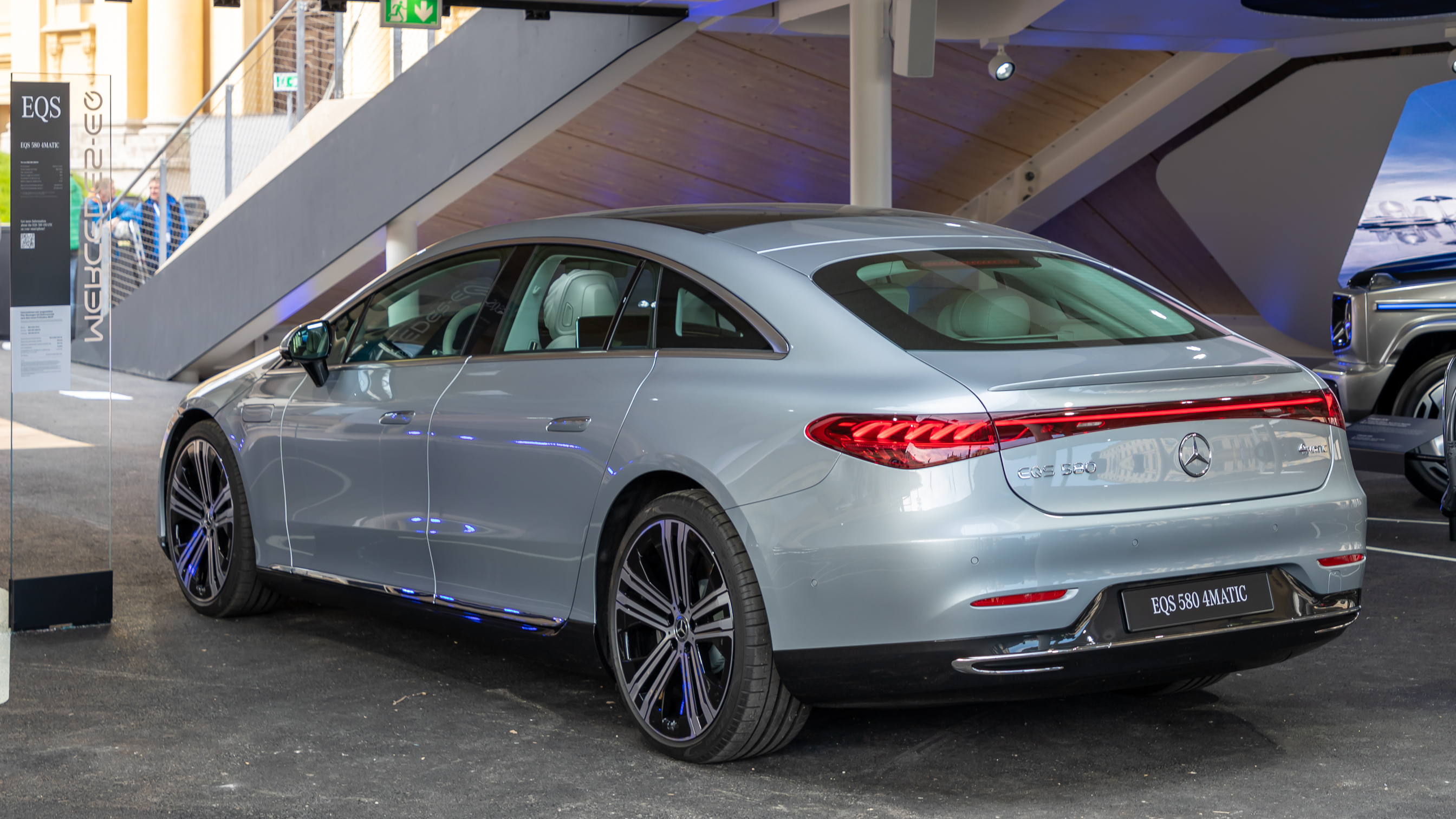
Mercedes EQS 450 plus
"I have a 2023 Mercedes EQS 450 plus electric SUV. And I'm looking for replacement tires."
This is Mercedes-Benz’s electric SUV, the EQS 450+. When you replace tires, you still need the right tire size and ratings, but the tire type can change how efficient the car is and how well it grips in snow.
The Mercedes-Benz EQS 450+ is an all-electric luxury SUV. Because it’s EV-powered, tire choice can affect efficiency (range) and winter performance, so the discussion focuses on what matters when replacing tires.
General RT-45
"we took a regular replacement car tire, a General RT-45, slapped it on that Model 3 and we lost a little range and it did everything else very, very well."
General RT-45 is a particular tire you can buy as a replacement. They used it to see how a normal tire compares to the tire that came on the car from the factory.
General is a tire brand, and the RT-45 is a specific replacement tire model. In the segment, it’s used as a baseline “regular replacement” tire to compare against the car’s original equipment (OE) tire.
tread wear
"You know, literally an old brand new tire on the car coming from the factory will have a little bit less tread than maybe a replacement one would. Then you run into you lose some tread wear there too."
Tread wear is how quickly a tire’s tread depth decreases with use. Since wet grip and hydroplaning resistance depend on tread depth, worn tires can reduce performance—especially on rain and snow where tread helps evacuate water and bite into the surface.
Request an Explanation
Heard something you'd like explained? We'll add it to this episode.
Sign in to request explanations for terms you heard.
Want to learn more?
Browse our glossary for plain-English explanations of automotive terms, jargon, and concepts.
Help improve this episode
See something that's not quite right? Our annotations are AI-generated and can sometimes miss the mark. Click the flag icon on any annotation to suggest a correction.