265: Finding Their There
About this episode
The hosts kick off with the “there there” problem: Sony’s Honda-backed Afeela EV never wowed, and the team questions the business rationale—was it meant as a hardware/software bridge, or just a proof of concept for Honda’s later (now-canceled) Zero lineup? They pivot to Toyota’s unexpected EV win with the improved BZ4X/RZ, then discuss Toyota/Subaru’s new three-row EV plans and Rivian R2 efficiency rumors. The debate turns political with vague talk of banning Chinese EVs, plus a study arguing franchise dealers add a “middleman tax.” They close with Tesla’s expanding Supercharger infrastructure and what it could mean long-term.
This week, we discuss a number of automotive brands finding their “there” in the EV world. For starters, Toyota’s bZ gains footing while Subaru gets into the three-row EV game and Rivian’s R2 ups its efficiency. Meanwhile, Afeela’s dead, plus some politicians say Chinese cars are not welcome on America’s shores (although that ship has certainly sailed).
Subscribe to the podcast on Apple Podcasts, Amazon Music, Audible, Spotify, PocketCasts, iHeartRadio, Podbean, and more! Or heck, use your favorite podcast application.
Perhaps you prefer to watch as well as listen. If so, we’ve got you covered.
SHOW NOTES
Sony and Honda discontinue Afeela: https://www.autoweek.com/news/a70847226/sony-honda-kill-afeela-ev/
Refreshed Toyota bZ turns out to be a hit: https://electrek.co/2026/04/02/toyota-sold-more-evs-in-the-us-than-ford-q1-one-suv/
2026 Toyota bZ doesn’t have built-in route planning in nav (suggested charging stops): https://insideevs.com/reviews/787629/2026-toyota-bz-review/
Subaru pulls sheet off 3-row Getaway: https://gizmodo.com/new-getaway-means-subaru-has-an-electric-suv-in-every-size-2000741132
Preliminary numbers show Rivian R2 could beat Tesla Model Y on efficiency: https://insideevs.com/news/792230/rivian-r2-epa-range-efficiency/
Chinese-made EVs won’t be allowed in the U.S., says American ambassador to Canada: https://www.autoblog.com/news/u-s-draws-the-line-at-the-border-chinese-evs-wont-enter-america
Senator Bernie Moreno wants to enact tougher restrictions on Chinese EVs: https://www.reuters.com/business/autos-transportation/republican-senator-proposes-widen-us-ban-chinese-autos-2026-03-31/
Study claims franchise dealership model adds nearly $5,000 to the price of a new car: https://www.thedrive.com/news/study-quantifies-how-much-the-dealership-model-costs-customers-and-it-aint-pretty
Tesla unveils “folding” superchargers for quicker deployment: https://www.teslarati.com/tesla-folding-supercharger-v4/
This week’s hosts: Phil Royle and Edward A. Sanchez
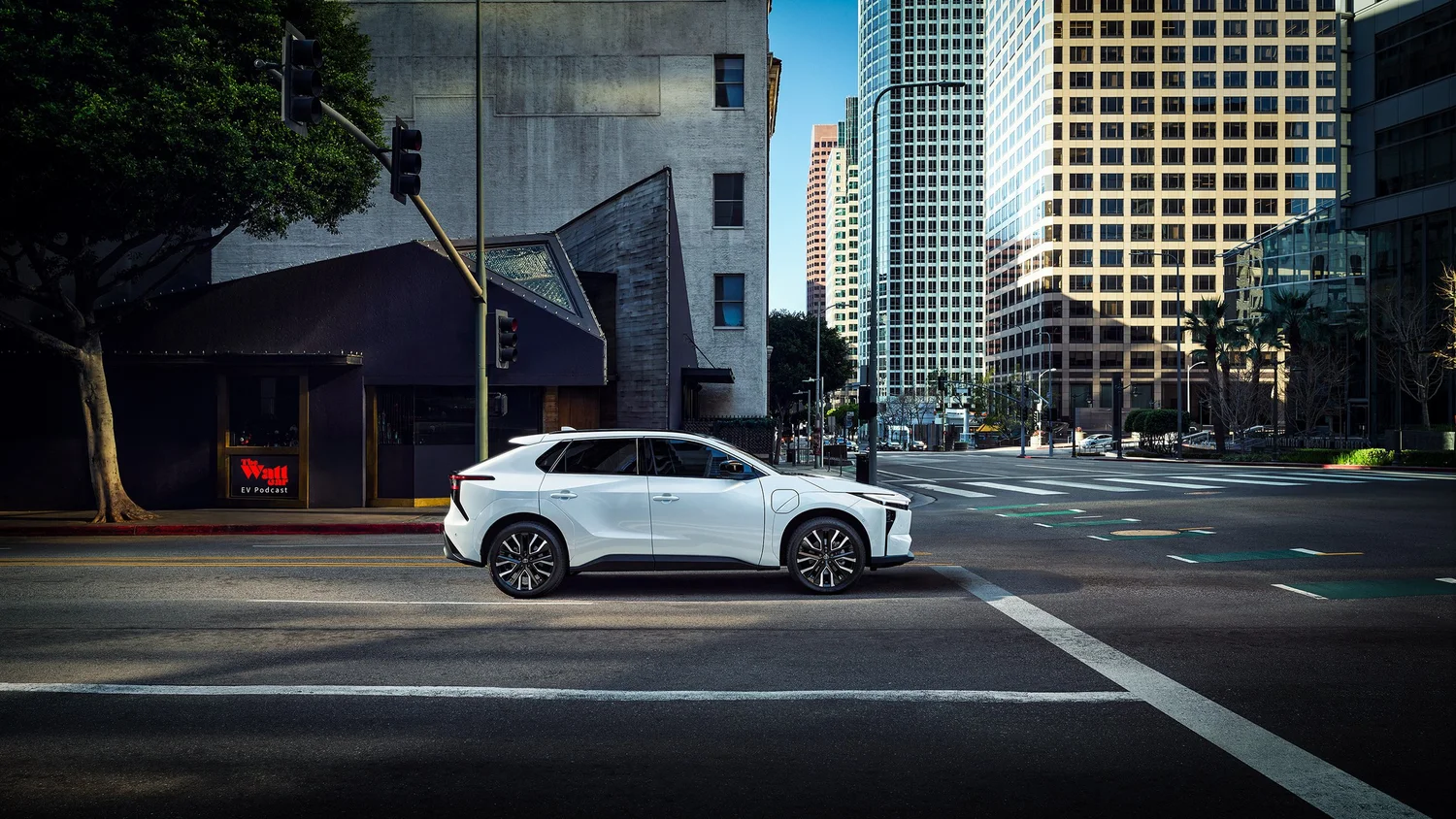
Episode art courtesy Toyota
Music courtesy Twisterium at Pixabay
Website: https://www.thewattcar.com
Buy merch: https://www.thewattcar.com/store
YouTube: https://www.youtube.com/@thewattcar
Hydrogen
"Guess what's dead? [17.2s] Hydrogen. [19.6s] No, hydrogen's the future. [21.1s] I thought we decided that last week, didn't we?"
Here, “hydrogen” means a fuel that can be turned into electricity to drive an electric motor. Some people think it could be a future EV option, but it depends a lot on how easy it is to make and deliver hydrogen.
In the EV world, “hydrogen” usually refers to hydrogen fuel-cell vehicles, where hydrogen is converted into electricity to power an electric motor. It’s often discussed as an alternative to battery-electric cars, especially for longer-range or faster-refuel use cases.
CES
"They brought it to CES, and then the next year, they brought it to CES again, and then the next year, they brought it to CES again, and it never really changed."
CES (Consumer Electronics Show) is a major annual tech trade show where automakers and suppliers often debut prototypes and software/AI concepts. Repeated CES appearances without visible change can suggest a concept that’s still evolving or not ready for production.
software development
"Like, I didn't understand it other than it gave maybe Honda a leg up in the software development, which we have since learned has been a major problem with Honda, at least"
In modern cars, software is what runs the screens, apps, and many of the “smart” features. The speaker is saying Honda’s software progress has been a challenge.
Software development in EVs and modern cars is often a major differentiator because it affects user experience, driver assistance, and how quickly features can be updated. The speaker frames it as a strategic hurdle for Honda when trying to compete in markets that demand strong in-car software.

Tesla Cybertruck
"...lled the zero lineup, which was the closest to a Cybertruck for good or for bad in design is going to get."
The Tesla Cybertruck is an electric pickup truck. It’s famous for its unusual, boxy-looking shape. People talk about it a lot because it looks very different from most trucks.
The Tesla Cybertruck is an all-electric, battery-powered pickup truck known for its angular, unconventional stainless-steel design. It often comes up in EV discussions because its styling and concept of a “truck-like” EV are polarizing—people debate whether it’s practical or just visually radical. That makes it a frequent reference point when comparing EVs’ design directions.

Toyota BZ4X
"So yeah, Toyota, the unexpected EV hero, it's turning out. [568.9s] So we've talked about this some the when it came out that what at the time was called [574.5s] the BZ4X, the awkwardly named kind of RAV4-ish EV crossover, BZ was beyond zero."
The Toyota BZ4X is Toyota’s electric SUV/crossover. When it launched, many people felt it wasn’t as impressive as the best EVs on the market at the time.
The Toyota BZ4X is Toyota’s first fully electric crossover built on a dedicated EV platform. It was positioned as a competitor to other EV crossovers, but early reviews often criticized its range and overall competitiveness.
EV crossover
"So we've talked about this some the when it came out that what at the time was called [574.5s] the BZ4X, the awkwardly named kind of RAV4-ish EV crossover, BZ was beyond zero. [584.2s] The 4X was, I guess, four wheel drive, even though I think some of them were front wheel [588.3s] drive."
An EV crossover is basically an electric SUV-style car. It’s meant to be practical for daily driving, not just fast acceleration.
An EV crossover is a car body style that blends the higher seating position and practicality of an SUV with the packaging and drivetrain of an electric vehicle. This category often targets buyers who want everyday usability rather than pure sports-car performance.
four wheel drive
"[584.2s] The 4X was, I guess, four wheel drive, even though I think some of them were front wheel [588.3s] drive. [588.9s] So, you know, I don't know."
Four wheel drive means the car can send power to all four wheels. That can help when roads are slippery, but not every version of a model is necessarily AWD.
Four wheel drive (4WD) means power can be sent to both the front and rear axles, improving traction in low-grip conditions. Many EVs offer AWD variants, but some models marketed with AWD cues may still have front-wheel-drive versions depending on trim.
Q1 sales
"And it looks like customers have noticed. So, Q1, so Q1 sales for this are up 79% from last year... They sold a little over 10,000 first quarter."
“Q1 sales” means first-quarter sales (January–March) and is commonly used to track short-term market momentum. The speaker uses Q1 comparisons to argue that the updated EV is gaining traction with buyers.
demand
"So also, I guess demand for the Lexus RZ... is like way up."
“Demand” means how much people want to buy the car. If the car gets better—like charging faster or going farther—more people tend to want it.
“Demand” refers to how strongly buyers want a product, often reflected in sales volume and order rates. In EV discussions, demand can rise when charging speed, range, and overall usability improve after early feedback.
built-in navigation system
"But if you just use the built-in navigation system, it doesn't, it doesn't have that, which to me, I think is a huge emission for an EV."
The built-in navigation system is the EV’s factory infotainment navigation. In this segment, the speaker emphasizes that the built-in system does not provide EV-specific functionality like charging-stop suggestions, which they consider a major drawback.
infotainment
"Because this kind of doesn't this kind of sit in as far as in car infotainment stuff. [798.0s] Do most people use the, I know in Tesla..."
Infotainment is the car’s entertainment and screen system—music, maps, and phone connections. It’s what you interact with while driving.
Infotainment is the in-car system that combines entertainment and information features—typically the touchscreen, media controls, navigation, and phone integration. The speaker notes that smartphone projection doesn’t “sit in” as deeply in some infotainment setups.
Android Auto
"Based on the information I've seen in vehicles equipped with what I call smartphone projection, [841.3s] If they have it, they typically use it quite a bit."
Android Auto lets you connect your Android phone to your car’s screen. You can then use things like maps, music, and calls through the car interface.
Android Auto is Google’s system for projecting a compatible Android phone onto a car’s infotainment screen. It typically provides navigation, music, calls, and voice control in a standardized interface.
CarPlay
"They said, oh, well, statistically, most owners are probably going to use [859.1s] Android Auto or CarPlay, which has this."
CarPlay lets you connect an iPhone to your car’s screen. It shows a simplified set of apps like maps, music, and phone controls.
CarPlay is Apple’s system for projecting an iPhone onto a compatible car’s infotainment display. Like Android Auto, it focuses on a simplified, app-based interface for navigation, calls, and media.
OTA updates
"Um, do you think some of this has to do with OTA updates as well? ... I think it has to do with the sophistication of the system on the vehicle in terms of what it can handle relative to OTA updates."
OTA updates are software updates your car can download wirelessly. Instead of going to a shop, the car gets improvements over the internet, which matters a lot when charging networks and software needs change.
OTA (over-the-air) updates let a vehicle receive software updates without a dealer visit, usually via cellular or Wi‑Fi. In EVs, OTA can be important for improving charging behavior, navigation, battery/thermal management logic, and infotainment features.
three-row SUVs
"And a while, even before then, like I've been saying, we need three row SUVs. That's someone who owns a three US, three row SUV, a family vehicle that only has two rows is not big enough."
A three-row SUV is designed to seat up to seven or eight people, with a third row for kids or extra passengers. In the EV market, three-row models have historically been less common, so their arrival is a big deal for families who need space and practicality.
share platforms
"So but but largely thanks Toyota. I mean, they were kind of co-developed and they share platforms."
Sharing platforms means different cars use the same basic design underneath. For EVs, that can make it easier and cheaper to build multiple models.
Sharing platforms means using the same structural design, engineering, and major components across multiple models or brands. For EVs, this can streamline battery integration, wiring, software, and manufacturing.
Rivian
"...High end granola is Rivian. So yeah, so this is still kind of not really definitive..."
Rivian is a company that makes electric vehicles, especially ones aimed at outdoor/adventure use. Here, they’re mentioned as a premium EV brand and as the maker of the R2 they’re discussing.
Rivian is an EV automaker known for adventure-focused electric vehicles like the R1T and R1S. In this discussion, Rivian is positioned as a “higher end” brand within the EV market, and it’s also the subject of the preliminary EPA-related R2 information.
how the sausage is made
"They're like, they just care about total range. As I've said before, they don't care about how the sausage is made. They just care if it tastes good."
“How the sausage is made” is a metaphor meaning the details of the process behind a product. In this context, it means buyers may not care about the engineering methods used to achieve range and efficiency.
coefficient of drag
"The coefficient of drag on the Model Y... is about 0.23... Coefficient of drag was about 0.3... So the Model Y is about 0.07 CD."
The coefficient of drag is a number that tells you how much the car fights the air. A lower number usually means the car uses less energy to move, which can help range.
The coefficient of drag (often written as Cd) measures how aerodynamically “slippery” a vehicle is. Lower Cd means less aerodynamic resistance, which can improve efficiency and range—especially at highway speeds.
aerodynamic design
"It's all angles, and angles are not what you want for aerodynamic design. The Rivian, it looks square, but everything's kind of rounded off."
Aerodynamic design is about shaping the car so air flows around it more easily. If the air resistance is lower, the car needs less energy to go the same speed.
Aerodynamic design is how a vehicle’s shape is engineered to manage airflow. It directly affects drag, which influences energy consumption, efficiency, and range for EVs.
Chinese EVs
"I think we've done like almost whole episodes on Chinese EVs. Yeah, so people are, I shouldn't say finally, sounding the alarm."
They’re talking about electric cars made in China. The big question is whether those cars will be allowed to sell in the US, and what rules might change.
The discussion is about electric vehicles manufactured in China and how they’re being received in other markets. This matters because EVs are tied to trade policy, tariffs, and domestic industry competitiveness.
Polestar
"So newsflash already here. Not to mention Polestar, I mean on top of that."
Polestar is an electric-car brand. They’re bringing it up to show that EVs made in China are already sold internationally, not just in China.
Polestar is an EV brand (and automaker) that has produced vehicles in China for the global market. Mentioning Polestar supports the point that Chinese manufacturing is already part of the EV supply chain.
Volvo
"...going back to 2010, Volvo has effectively been Chinese owned by Geely. Volvos, you know, they're still on sale."
Volvo is a car brand from Sweden. The speaker is saying that even though Volvo is still sold in the US, it’s owned by a Chinese company (Geely), so it shows how Chinese automakers are already part of the American market.
Volvo is a Swedish automaker. In the context of this discussion, the key point is ownership and market access—Volvo is described as effectively Chinese-owned through Geely, yet the cars are still sold in the US.
DJI
"...it's easy to follow the money in the drone conversation where they're trying to ban DJI. That's easy."
DJI is a major Chinese manufacturer of consumer and professional drones. The speaker uses DJI as an analogy for how governments may restrict Chinese-made tech while allowing domestic alternatives, framing it as a policy driven by incentives and supply-chain realities.
sensor
"And you know the, because I needed it for video, that the sensor is worse. And no matter what you do, like I could get around some of the flying features that it was missing."
The sensor is the part of the camera that actually records the picture. If the sensor is worse, your photos and video usually look less sharp or less clear.
A drone (or camera) sensor is the imaging component that captures light and turns it into an image. A “worse” sensor typically means lower image quality, especially in low light or fast-moving scenes.
OEMs
"But that alone will not keep the Chinese OEMs out of the U.S. market. They will find a work around. And they're already here."
OEMs are the main companies that build the original products—like the automakers themselves. Here, it means the Chinese car makers being discussed.
OEMs means Original Equipment Manufacturers—the companies that make the vehicles or major components used in vehicles. The speaker uses it to refer to Chinese automakers and argues they can still access the U.S. market despite restrictions.
direct-to-consumer
"Whereas, you know, like for instance, like Tesla or Rivian or whoever, you know, they don't get the sale until they get a delivery... it's on the company's books to deal with all the excess inventory... people making the case that franchise dealerships really don't have a lot of value"
Direct-to-consumer means the company sells the car straight to you, rather than through a dealership network. The tradeoff is the company has to handle more logistics like inventory and delivery.
Direct-to-consumer (DTC) is a sales model where an automaker sells cars to the end customer without relying on the traditional franchise dealership network. The segment contrasts DTC brands like Tesla and Rivian with franchise-based OEM sales, especially around inventory and delivery responsibilities.
Pet boys
"you hit a point where you need a mechanic. And yeah, you could go to pet boys. But are you really gonna like I've had shocks replaced at pet boys?"
Pet Boys is an auto parts store and repair shop chain. The speaker is saying they had shocks replaced there and it didn’t go well.
“Pet boys” refers to the retail/auto-service chain that offers maintenance and repairs. In the segment, the speaker is using it as an example of a non-dealership option for suspension work, and they’re describing a negative experience.
service center
"can you take delivery of a Tesla at a service center? ... And then there's a service station service center that is attached to that there's a network across the nation."
A service center is where the company brings your car for repairs and maintenance. The speaker is saying Tesla uses these locations as part of both delivery and service.
A service center is a dedicated facility for vehicle maintenance and repairs. In this segment, the speaker discusses Tesla service centers being used for delivery and for ongoing service, supported by a nationwide network.
infrastructure
"Yeah. So I think Tesla's got that ability to be the infrastructure. And if you're the infrastructure, what is it that Jeff Bezos said that was it Bezos?"
Here, “infrastructure” means the setup that makes EVs work in real life, like charging. Instead of only making money when you buy a car, the business can earn money every time someone charges.
In this context, “infrastructure” means the supporting systems that enable EV adoption—especially charging networks and the platforms around them. The key concept is recurring revenue from usage (charging sessions) rather than one-time revenue from selling hardware.
a little cut of every time you charge
"And they take a little cut of every time you charge. They're well on their way."
This is the specific EV charging version of the “transaction cut” idea. It implies charging networks can monetize usage through per-session fees, per-kWh pricing, or other charging-related margins.
Request an Explanation
Heard something you'd like explained? We'll add it to this episode.
Sign in to request explanations for terms you heard.
Want to learn more?
Browse our glossary for plain-English explanations of automotive terms, jargon, and concepts.
Help improve this episode
See something that's not quite right? Our annotations are AI-generated and can sometimes miss the mark. Click the flag icon on any annotation to suggest a correction.