
April 25, 2026 | Weekend Drive: Should Stellantis just cut brands?; Elon Musk’s FSD admission
About this episode
Stellantis’ brand debate centers on whether it should concentrate investment in a few core nameplates while leaving the rest on a lighter touch, with Dodge and Chrysler seen as especially important in North America. The conversation then broadens to why full-size electric pickups are struggling, from high prices to policy changes. Later, the hosts describe an industry hedging its electrification bets, a confidence reading that hit a new low, and Elon Musk’s acknowledgment that Tesla’s full self-driving will need hardware upgrades.
Reporters Larry P. Vellequette and Michael Martinez discuss Stellantis’ move to focus investments on Jeep, Ram, Peugeot and Fiat; GM shelving its electric pickup plans; rising pessimism in the Automotive News Auto Industry Confidence Index; and Elon Musk admitting Tesla vehicles will need hardware upgrades for Full Self-Driving.
digital retailing
"Consider RET1 Fusion for your dealership's digital retailing. Customers can build vehicle financing options online with estimated payments, trade-ins, and you can even showcase optional protection products."
Digital retailing means buying a car using online tools instead of doing everything in person. You can usually pick options, see payment estimates, and start the trade-in process from your phone or computer.
Digital retailing is the process of shopping for and configuring a vehicle online, including financing and trade-in estimates. It’s meant to shorten the sales cycle and reduce friction between the customer and dealership.
RET1
"Consider RET1 Fusion for your dealership's digital retailing. Customers can build vehicle financing options online with estimated payments, trade-ins, and you can even showcase optional protection products."
RET1 is software dealerships use to sell cars online. It lets shoppers see estimated monthly payments, handle trade-ins, and add optional protection products without waiting for a salesperson.
RET1 is a digital retailing platform aimed at dealerships. It helps customers build financing options online, estimate payments, and manage trade-ins while also offering add-on protection products.
placing its bets on four core brands
"This week, we're talking about Stellantis placing its bets on four core brands... Reuters reports that the automaker is focusing investments on just four brands, Jeep, Ram, Peugeot, and Fiat."
Stellantis is trying to focus money on fewer brands. Instead of trying to push every brand equally, they’re picking the ones they think will do best.
This refers to Stellantis concentrating investment on a smaller set of brands rather than supporting many at once. The goal is usually to reduce overlap, focus marketing and product development, and improve financial performance by backing brands with stronger prospects.
Tesla
"Elon Musk finally admitting Tesla cars will need hardware upgrades for self-driving and more."
Tesla is the company being discussed here. The point is that future self-driving features may not work the same on every Tesla without hardware changes.
Tesla is referenced in connection with Elon Musk’s admission that self-driving will require hardware upgrades. This matters because it affects how owners might experience future features—some may require paid upgrades or newer cars.
self-driving hardware upgrades
"Elon Musk finally admitting Tesla cars will need hardware upgrades for self-driving and more."
The hosts are saying self-driving won’t just be a simple software update for all cars. Some vehicles may need new parts—like sensors or computers—to handle the driving features safely.
The segment says Tesla will need hardware upgrades for self-driving, meaning the car’s sensors/compute aren’t sufficient for the promised capability. This is a key distinction between software-only updates and changes that require new components.

Jeep
"Reuters reports that the automaker is focusing investments on just four brands, Jeep, Ram, Peugeot, and Fiat. What's the strategy here?"
Jeep is a major car brand within Stellantis. The hosts are saying Stellantis wants to put more money behind a few brands like Jeep instead of spreading resources across too many.
Jeep is one of Stellantis’s core brands in the strategy discussed. The idea is to concentrate investment on brands with stronger demand and clearer identity while letting others operate with less support.

Ram
"Reuters reports that the automaker is focusing investments on just four brands, Jeep, Ram, Peugeot, and Fiat."
Ram is the truck brand within Stellantis. The discussion is about Stellantis focusing investment on a smaller set of brands rather than trying to push everything at once.
Ram is named as one of Stellantis’s four core brands. In this context, it represents the company’s bet on its most profitable or best-positioned segments, especially trucks.

Jeep Brands Jeep
"you get to start with your take on Stellantis's big news of the week. Reuters reports that the automaker is focusing investments on just four brands, Jeep, Ram, Peugeot, and Fiat. What's the strategy here? I feel like I should introduce myself."
The Jeep Grand Cherokee is a midsize SUV made by Jeep. It’s designed to be comfortable for daily driving but also capable on rough roads. It may be mentioned because it’s one of Jeep’s important vehicles in the company’s plans.
The Jeep Grand Cherokee is a midsize SUV known for combining everyday comfort with off-road capability. It’s frequently discussed because it represents a key Jeep model within Stellantis’s broader brand strategy and investment plans. In the podcast context, it likely comes up as part of the “big news” about which brands are getting prioritized.
Opel
"you're weakening those other ones, just like Lancia and Alfa Romeo and Citroën and Opel in Europe."
Opel is a European car brand. In this segment it’s used as an example of a brand that might not get enough support if the company spreads money across too many names.
Opel is included in the list of European Stellantis brands that the hosts suggest are being weakened by insufficient investment. It supports the segment’s theme: brand portfolio complexity can reduce overall effectiveness.
Lancia
"you're weakening those other ones, just like Lancia and Alfa Romeo and Citroën and Opel in Europe."
Lancia is an older European car brand. Here it’s mentioned as an example of a brand that could lose strength if the parent company doesn’t put enough money behind it.
Lancia is listed among the European brands the hosts say could be weakened by underinvestment. It’s part of the broader argument that Stellantis has too many brands and should concentrate resources on the ones that sell best.
Citroën
"you're weakening those other ones, just like Lancia and Alfa Romeo and Citroën and Opel in Europe."
Citroën is a European car brand. It’s mentioned here to illustrate the “too many brands” argument—spreading investment too thin can make smaller brands struggle.
Citroën is another European brand cited as being among the weaker or less-invested names in Stellantis’s portfolio. The hosts use it to support the idea that too many brands can dilute focus and resources.
Alfa Romeo
"you're weakening those other ones, just like Lancia and Alfa Romeo and Citroën and Opel in Europe."
Alfa Romeo is a European car brand. In this discussion it’s used as an example of a smaller brand that might suffer if the company doesn’t invest enough.
Alfa Romeo is an Italian brand mentioned as one of the smaller Stellantis portfolio names that could be weakened by spreading investment too thin. The hosts compare it to stronger performers like Jeep and Ram to argue why brand focus matters.
Dodge
"And here Dodge and Chrysler, to a lesser extent, Alfa Romeo and Fiat, both of which are rounding errors when you compare them to Jeep or Ram."
Dodge is a well-known American car brand. Even if it doesn’t make the most money, people still recognize it, so dropping it could hurt sales because customers associate it with what they want.
Dodge is a legacy U.S. brand within Stellantis, closely tied to the North American customer base. The hosts note that even if Dodge isn’t as profitable as Jeep or Ram, customers still recognize the Dodge name, which makes it hard to simply remove or replace without risking demand.
Chrysler
"Most of them still call it Chrysler. If you look at profitability, it's proven that you"
Chrysler is a long-established U.S. brand. The hosts’ point is that many buyers still think of these cars as “Chrysler,” so the name itself helps customers connect to the products.
Chrysler is another legacy U.S. brand under Stellantis, and the segment emphasizes its importance to brand awareness. The hosts argue that many customers still call the company “Chrysler,” so keeping the name may matter even if profitability isn’t the highest.

Dodge Ram
"... rounding errors when you compare them to Jeep or Ram. This is a similar strategy to what they tried i..."
Ram is a brand of pickup truck made by Stellantis. Pickup trucks are built for hauling and towing, and they’re popular with people who need a truck for work or big projects. The podcast may mention Ram because it’s one of the company’s main brands getting attention.
The Dodge Ram refers to Ram-branded pickup trucks, which are a major part of Stellantis’s lineup and often discussed in the context of investment and brand strategy. They’re significant because pickups are high-volume vehicles with strong demand, so changes in corporate focus can directly affect product planning, updates, and future powertrain decisions. In a podcast, it may come up as part of broader news about which brands a company is prioritizing.
Fiat
"And here Dodge and Chrysler, to a lesser extent, Alfa Romeo and Fiat, both of which are rounding errors when you compare them to Jeep or Ram."
Fiat is a well-known brand, but the hosts are saying it doesn’t sell as much (or matter as much) as the top brands like Jeep and Ram. That’s why they’re debating whether Stellantis should focus more money on the biggest sellers.
Fiat is mentioned as one of the smaller Stellantis brands that the hosts say is a “rounding error” compared with Jeep or Ram. The point is that some brands may not justify the investment they require.
brand portfolio focus
"This is a similar strategy to what they tried in 2014, where they were going to focus their investment on where their money is."
This is the idea of putting more money into the brands that are already doing well. The hosts also warn that cutting back on other brands can weaken the company’s overall lineup.
Brand portfolio focus is the strategy of concentrating investment on the brands that sell the most or have the strongest market position. The hosts compare this to a similar approach Stellantis tried in 2014, arguing it can make the overall lineup weaker even if it seems logical on paper.
Stellantis
"Now, Larry, despite this news, it does sound like CEO Antonio Filosa wants to stick with all 14 brands for now. But should Salantis just start dropping brands?"
Stellantis is the big company behind a bunch of car brands. The discussion here is about whether they should focus their money on the brands that sell the most instead of spreading it across too many names.
Stellantis is the large automaker formed by the merger of Fiat Chrysler Automobiles and PSA Group. In this segment, the hosts discuss whether it should streamline its brand portfolio by investing more heavily in its biggest sellers and potentially selling or de-emphasizing smaller brands.
franchised auto dealers
"Actually, it gets very hard to shut down brands when you have franchised auto dealers."
Franchised auto dealers are independent businesses that sell a specific brand under an agreement with the automaker. The hosts explain that shutting down brands is difficult when dealers are already locked into those franchise relationships, because it affects contracts, inventory, and local business operations.
re-badge
"Chinese automaker comes in and can buy Chrysler or Dodge just as a turnkey operation and re-badge their own vehicles is that."
Re-badging means taking an existing car and selling it under a different brand name. The idea here is that a new company could use the old brand name to market the cars faster.
Re-badging is when a manufacturer sells a vehicle that’s essentially the same platform/design under a different brand name. The segment suggests Chinese automakers could buy Chrysler or Dodge and then re-badge vehicles to quickly enter the market using familiar U.S. brand identities.
turnkey operation
"Chinese automaker comes in and can buy Chrysler or Dodge just as a turnkey operation and re-badge their own vehicles is that."
A turnkey operation is like buying a business that’s already up and running. In this case, it would mean buying the brand and setup so you can start selling quickly.
A “turnkey operation” means acquiring something that’s already set up and ready to run—like an existing brand, dealer network, and business structure. Here, the hosts imply Chinese automakers could buy Chrysler or Dodge and immediately use the established infrastructure rather than building everything from scratch.
Chinese automakers
"Now, that could all change if we start letting Chinese automakers come in, right?"
The hosts are talking about Chinese car companies potentially buying existing brands in other countries. The idea is they could keep the familiar brand names and sell cars faster instead of starting over.
Chinese automakers are discussed as potential entrants who could acquire existing Western brands. The hosts argue that because shutting down brands is expensive, it could be more attractive for a buyer to keep the brand names and re-badge vehicles for the U.S. market.
brand awareness vs profitability
"And I hope Antonio Falosa understands the importance of Dodge and Chrysler here in the States, maybe not from a profitability standpoint, but just from the standpoint of this is what our customers know."
This is about whether a brand’s money-making performance is the only thing that matters. The hosts say customer recognition can be just as important, because people buy what they already know and trust.
The segment contrasts profitability with brand awareness—how well customers recognize and associate with a name. The hosts argue that even if some brands aren’t the most profitable, keeping names like Dodge and Chrysler can matter because customers still identify with those brands.

Challenger Hellcat
"... just throw a bigger, louder engine in it, put a Hellcat in it, right? And you have this community of enth..."
The Challenger is a muscle car, meaning it’s built for strong acceleration and a sporty feel. People often talk about making it “bigger and louder” by choosing higher-performance engine versions. The podcast mentions it because it has a dedicated group of fans who care about those upgrades.
The Challenger is a performance-focused muscle car, best known for its strong engine options and enthusiast community. It’s often discussed in terms of how the model can be made more exciting—such as the idea of fitting a bigger, louder engine (including Hellcat variants) to boost performance and appeal. In the podcast, it likely comes up as part of a conversation about what drives interest in the car and its fan base.
addition by subtraction
"So yeah, some concerning parts, but it does come back a little bit to what we talked about last week with Nissan and addition by subtraction. Yeah, on the surface, if you have a whole bunch of stuff and people aren't buying everything on the list, maybe cut some of the low performers."
“Addition by subtraction” means doing better by removing things that aren’t working. Here, it’s about cutting the least profitable brands or models instead of trying to keep everything.
“Addition by subtraction” is a strategy where a company improves results by cutting or simplifying parts of the business rather than adding more products. In this context, the hosts compare it to trimming low-performing brands or models when sales don’t justify the complexity and investment.
GM electric pickup plans
"Well, let's shift to GM. Mike, the automaker is shelving its electric pickup plans, seems similar to what Ford has already done with the Lightning."
GM is talking about backing away from electric pickup trucks. The hosts think it’s because making these trucks is expensive and because electric trucks don’t always meet what buyers want for towing and hauling.
This segment discusses GM shelving its electric pickup plans, framing it as a strategic retreat from the full-size EV truck push. The hosts connect the decision to economics (high production costs) and to customer expectations for towing/hauling.
battery electric full size pickup
"Can we say at this point that the battery electric full size pickup thing is over, at least for now? Probably. And we've touched on it before. I think Larry's made the point that when it comes to full size EV pickups, these automakers were trying to offer people more expensive versions that didn't do as much as the gas variants, right?"
This is the idea of making a big electric truck like the ones people use for work. The problem is that towing and hauling can drain the battery faster, and the electric versions can be more expensive while not matching what buyers expect from gas trucks.
A battery-electric full-size pickup is an EV version of the traditional large American truck. The hosts argue the business case has been weak because EVs can lose range when you’re towing/hauling, and because the EV versions often cost more while delivering less capability than gas trucks.
tow or haul
"They can't tow or haul as much. The battery just drains when you have something in the bed."
“Tow or haul” means pulling something behind the truck or carrying heavy stuff. The point here is that when you do that, an electric truck’s battery can run down faster than people expect.
“Towing or hauling” refers to using a truck for pulling trailers or carrying heavy loads. The hosts connect it to EV limitations: under heavy use, battery range can drop faster, making EV pickups harder to sell to buyers who rely on real-world truck capability.
standalone platform
"Maybe GM's case is a little bit different because they took the strategy of waiting, letting Ford and others get to market first so they could develop that standalone platform."
A standalone platform is basically a “purpose-built” vehicle design. Instead of converting an existing gas-truck design to electric, you build the EV truck from the ground up, which can help with efficiency and costs.
A standalone platform means designing a vehicle architecture specifically for a certain powertrain (here, EVs) rather than adapting an existing gas-car truck platform. The hosts suggest GM waited so it could develop an EV-specific foundation, which can reduce risk and improve cost efficiency.
MSRP
"And whether it was the CEOs missing the mark on the segment or just the production costs or the MSRP costs, these were very expensive vehicles that people couldn't afford."
MSRP is basically the “official” price on the window sticker. If the MSRP is too high, fewer people can afford the car—especially when incentives change.
MSRP (Manufacturer’s Suggested Retail Price) is the sticker price automakers publish before discounts. In EV discussions, MSRP matters because it influences whether buyers qualify for incentives and whether the vehicle can compete on monthly payments.
federal tax credit
"And the nail in the coffin was the Trump administration getting rid of the federal tax credit. So really, you have a number of factors that have all collided at once to make these products not quite viable."
A federal tax credit is money the government gives you to help lower the cost of buying an EV. If that credit goes away, the same EV can suddenly feel too expensive for many buyers.
Federal EV tax credits can materially change the effective purchase price by reducing what buyers pay at the time of purchase (or via tax liability). Removing or reducing the credit can quickly make certain EVs uneconomical for consumers, especially higher-priced models.
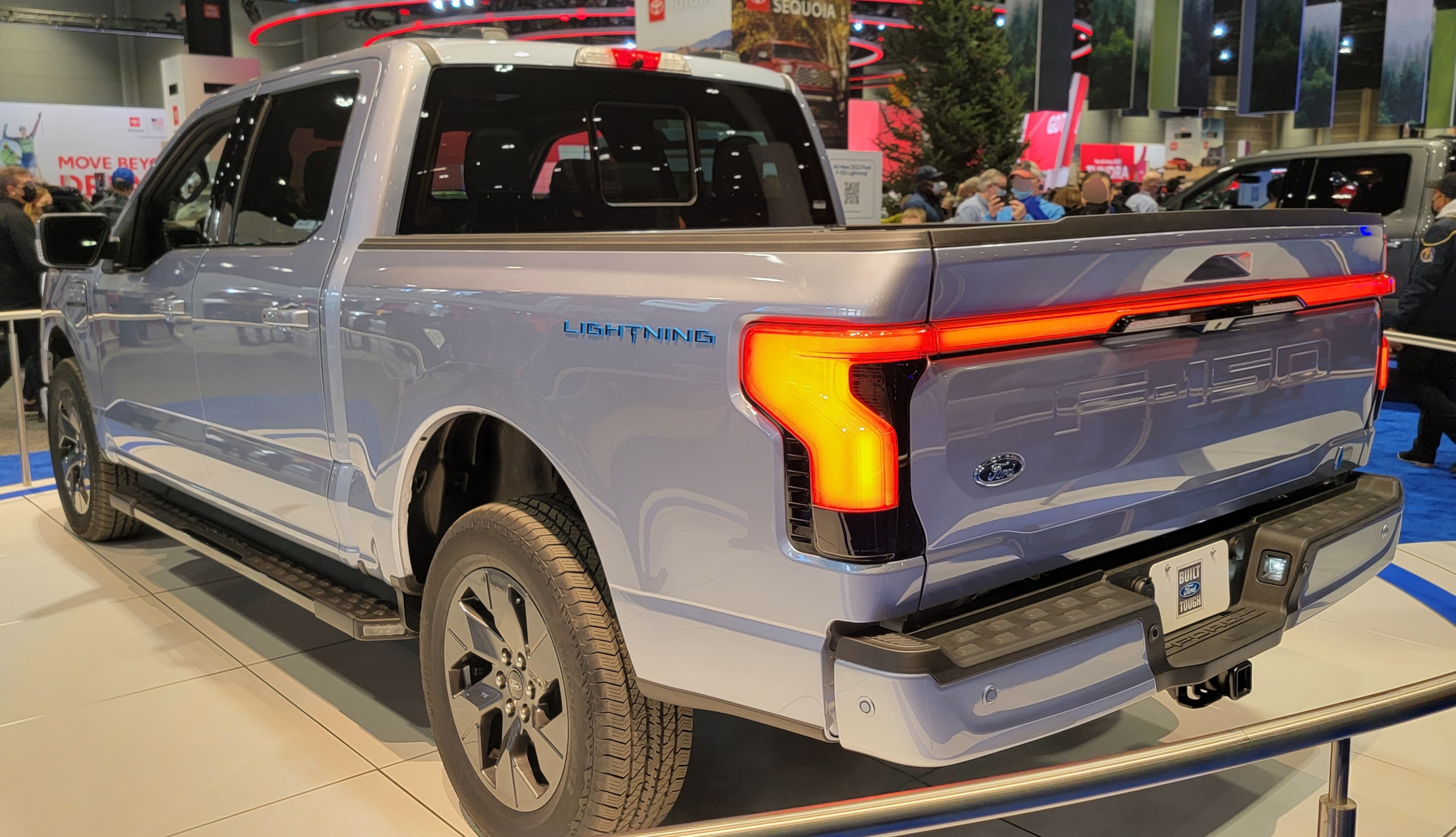
Ford Lightning
"That's why you're not seeing them discontinue the trucks as of today, like Ford did. The Lightning's gone. They're not making it anymore."
The Ford Lightning is Ford’s electric pickup truck. The point here is that Ford stopped making it, showing how hard it is to make EV trucks work when prices and incentives change.
The Ford F-150 Lightning is Ford’s electric version of the F-150 pickup, positioned as a mainstream EV truck. In this segment, it’s referenced as a product Ford stopped making, illustrating how EV truck demand and economics didn’t line up.

Tesla Cybertruck
"What about that volume king, the Cybertruck?"
The Tesla Cybertruck is Tesla’s electric pickup. Even if it’s popular, the conversation here is that its design didn’t appeal to everyone, which can limit sales.
Tesla’s Cybertruck is an electric pickup known for its angular design and unconventional styling. The hosts discuss it as a “volume king” but also critique its looks, highlighting how EV truck success depends on more than just technology—consumer taste and category fit matter.
lifestyle products
"Those were more lifestyle products. They weren't for real truck people. They weren't meant to do what trucks actually do. They're status symbols, they're lifestyle."
A “lifestyle product” is something you buy for how it fits your image and lifestyle, not because it’s built for heavy work. With EV trucks, that can be a problem if people want a truck that works like a normal truck.
“Lifestyle products” describes vehicles marketed more for identity, design, and status than for traditional utility. In the EV truck context, that can create a mismatch if buyers expect the vehicle to behave like a conventional truck for towing, hauling, and daily work.
consumer demand
"It's a good strategy. I mean, you're, you got out a little ahead of your skis with this product in terms of where you were with consumer demand and where they were with capability."
Consumer demand is just how many people actually want to buy something. If a company builds an EV truck before enough people are ready to pay for it, sales can fall short.
Consumer demand is how many buyers want a product at a given price and capability level. The hosts argue EV truck planning may have been ahead of demand and ahead of real-world capability, which can make even good technology financially unviable.
oil and gas industry impact on EV sales
"We're dependent on a, you know, on another industry, the oil and gas industry, that has a heavy impact on our sales. And if things go haywire there, it'll change our demands."
EV sales can depend on gas prices. If gasoline gets expensive, driving an EV can suddenly look like a better deal, and more people may want one.
The segment links EV sales to the broader oil-and-gas market because gasoline prices influence how attractive EVs feel to consumers. When gas prices rise, the cost gap between driving an EV and driving a gas car can shrink quickly, boosting EV demand.
mass market electric vehicles
"...a new study from Boston Consulting Group that while automakers probably rushed in too fast on mass market electric vehicles, the bigger risk might be doing a 180 too fast..."
“Mass market EVs” are electric cars meant for everyday people, not just expensive specialty models. The hosts are saying some companies may have bet too hard on EV demand before the market was truly ready.
The phrase refers to EVs aimed at mainstream buyers rather than niche performance or luxury segments. The discussion is about how automakers may have accelerated EV plans too quickly during a period when demand signals were distorted by earlier supply-chain and inventory conditions.
hybrid
"...the automakers that are taking these write downs are still investing in some form of electrification. Obviously, they're upping hybrid in EREV development..."
A hybrid uses both gas and electricity. It can use electric power sometimes, but it also has a gas engine for longer trips and flexibility.
Hybrid vehicles combine an internal-combustion engine with an electric motor and battery to improve efficiency and reduce fuel use. In this segment, hybrids are positioned as a continuing strategy even as automakers adjust their EV timelines.
EREV development
"...they're upping hybrid in EREV development. They're still coming out with electric vehicles."
An EREV is mostly an electric car, but it has a backup system that can make electricity to keep you going when the battery gets low. Think of it as “electric-first,” with a built-in way to recharge.
EREV stands for Extended-Range Electric Vehicle, a type of plug-in hybrid where the wheels are driven primarily by electric motors. A generator (often a gasoline engine) can recharge the battery when it runs low, extending range without the vehicle behaving like a traditional gas car.

Ford Mach-E
"...from that first wave with the Mach-E and the Lightning."
The Ford Mustang Mach-E is one of Ford’s early electric vehicles aimed at regular buyers. The hosts mention it to show what Ford launched first, before the newer EV strategy.
The Ford Mustang Mach-E is Ford’s mainstream battery-electric crossover, part of the company’s early EV push. In this segment, it’s used as a reference point for the “first wave” of EVs that Ford says its next platform will improve upon.
hedge its bets
"So I think what we're witnessing now is an industry that's trying to hedge its bets and is trying to be able to pivot more quickly if something changes..."
“Hedging its bets” means companies don’t want to bet everything on just one type of car technology. They’re trying to be ready for whatever happens with rules, incentives, and customer preferences.
“Hedging its bets” describes automakers spreading investments across multiple powertrain paths—EVs, hybrids, and sometimes EREVs—so they aren’t overly dependent on one technology winning. The hosts frame it as a response to regulatory uncertainty and shifting consumer demand.
wide swath of pure EV for certain use cases
"...and then offer that wide swath of pure EV for certain use cases because we know EVs are great for certain use cases..."
They’re saying electric cars are great in some situations, but not every situation. So automakers plan to offer EVs broadly, while still using gas hybrids or other setups when that fits better.
The segment argues that EVs are especially effective for certain driving patterns and needs, rather than being universally best for every buyer and scenario. This is part of the broader “pragmatic approach” theme: using EVs where they make the most sense and relying on other powertrains elsewhere.
Boston Consulting Group
"But there is also a danger of, as Boston Consulting says, going too far. We are in a spot because it's not just us in the United States or in North America."
They mention Boston Consulting Group, which is a big business consulting firm. The hosts are using it as a reference point for strategic advice—basically, don’t swing too hard in one direction. In this case, it’s about how automakers manage the EV transition.
The hosts reference Boston Consulting Group (BCG) as a source for the idea that companies can go “too far.” In automotive strategy discussions, BCG is often used to frame market and transition risks—like how aggressively automakers pivot to EVs or restructure portfolios. Here, it supports the argument for balancing speed with caution.
battery tech
"And China, if you looked at some of the innovation coming out of the Shanghai Auto Show this week, some of the battery tech announcements, they were mind blowing. If you haven't gone and looked, go read Hans' story about that."
They’re talking about how EV batteries are getting better. “Energy density” is basically how much energy fits in the battery, and “recharge rate” is how quickly you can charge. Even if charging stations aren’t perfect yet, better batteries can make EVs more competitive.
The hosts discuss “battery tech” in the context of EVs—specifically energy density and recharge rate improvements. Higher energy density generally means more usable energy for the same battery size/weight, while faster recharge rates improve real-world usability. The point is that EV performance progress could rival gasoline, even if charging infrastructure still lags.
Shanghai Auto Show
"And China, if you looked at some of the innovation coming out of the Shanghai Auto Show this week, some of the battery tech announcements, they were mind blowing."
They’re pointing to the Shanghai Auto Show as the event where new EV and battery updates were announced. It’s being used to explain why China’s progress is getting attention. Think of it like a major auto industry news event.
The hosts cite the Shanghai Auto Show as the place where they saw major EV and battery-related announcements. As a topic marker, it frames where the “mind blowing” battery tech news is coming from and why it matters to global automakers. It’s essentially the news source for the competitive EV narrative.
infrastructure issues
"Now, you still got the infrastructure issues, certainly in this country and the distances, et cetera. That's life changing stuff coming over there."
They’re saying EVs aren’t just about the car—they also depend on charging stations. If charging is hard to find, slow, or unreliable, people may not switch. Better batteries help, but charging infrastructure still matters a lot.
The hosts mention “infrastructure issues” as a major constraint on EV adoption, even when battery performance improves. Charging availability, reliability, and coverage strongly influence whether EVs work for long trips and everyday use. The takeaway is that technology progress alone doesn’t solve adoption barriers without charging networks catching up.
full self-driving
"We'll talk about the growing pessimism in all corners of the auto industry about the future. And we'll look at Elon Musk's admission that many drivers who want full self-driving are going to need a hardware upgrade. That's next on Weekend Drive."
They’re talking about “full self-driving” as in advanced driver-assist features. The key idea is that some cars may need extra hardware—like sensors or computer power—before the software can work as promised. So it’s not always just a simple update.
The segment tees up Elon Musk’s claim that many drivers who want “full self-driving” will need a hardware upgrade. This highlights an important reality of advanced driver-assistance/automation: software capability can be limited by the sensors, compute, and wiring already installed in the vehicle. It also implies that “FSD” isn’t purely a software unlock for everyone.
pivoting back too fast
"Now, a new report suggests that the bigger risk may be pivoting back too fast. If they guess right and index one way or the other and they get it right, they could be even more profitable, but they could also be bankrupt."
They’re talking about companies changing their plans too quickly. If automakers switch directions based on short-term market pressure, they might lose money or get stuck with the wrong investments. The point is that transitions need a careful pace.
“Pivoting back too fast” describes the risk of reversing course quickly—such as when automakers change EV plans due to market headwinds. The idea is that timing and execution matter: move too quickly and you can destroy profitability or strand investments. The hosts frame this as a transition-management problem rather than a simple pro/anti-EV debate.
digital retail solution
"Route 1 Fusion is an expanded digital retail solution built to enhance your dealership's customer engagement and improve the results of your online efforts. Many customers expect a fast online friendly experience and prefer clarity early in the process, especially if they have a vehicle to trade."
Digital retail means the dealership uses websites and apps to help you shop and buy without as much back-and-forth. It can estimate your trade-in value and help you plan payments before you ever show up.
“Digital retail” refers to using online tools to guide shoppers through the buying process—like estimating trade-in value, viewing inventory, scheduling appointments, and understanding financing. The goal is to make the online experience clearer and faster so customers can arrive at the dealership ready to make decisions.
Route 1 Fusion
"Route 1 Fusion is an expanded digital retail solution built to enhance your dealership's customer engagement and improve the results of your online efforts. With a subscription to Fusion, you can benefit from its trade and valuation feature..."
Route 1 Fusion is a software service dealerships pay for to make their online shopping better. It helps estimate your trade-in value and can help set up appointments and financing steps before you visit.
Route 1 Fusion is a dealership software subscription aimed at improving online sales performance. In this segment, it’s described as providing trade and valuation features, appointment scheduling, prequalification/payment options, and product presentations to move shoppers from online to in-store.
trade and valuation feature
"With a subscription to Fusion, you can benefit from its trade and valuation feature that empowers customers to estimate the value of their current vehicle early in the process. This helps customers arrive in store, better prepared..."
This is an online tool that estimates how much your current car might be worth as a trade-in. If you know that number early, it’s easier to understand what your payments could look like later.
A trade-in “valuation” feature estimates what a customer’s current vehicle is worth early in the shopping process. By giving a ballpark value sooner, it helps set realistic expectations for equity and payments, reducing friction when the customer arrives at the dealership.
appointment scheduling
"Fusion also supports other features that include appointment scheduling so customers can view your availability and book a time."
Appointment scheduling means the website lets you pick a time to come in. That way you don’t have to call around to find a slot.
Appointment scheduling in a digital retail platform lets customers choose a time to visit and see dealer availability online. This reduces the back-and-forth that can slow down conversion from browsing to an in-person test drive or sales meeting.
prequalification tools
"Prequalification tools with subscription provide quick credit-based payment options and production product presentations allow you to present products earlier..."
Prequalification is an early step that estimates what kind of financing you might qualify for. It helps you understand possible payments before you commit to a full application.
Prequalification tools estimate financing eligibility and potential payment options before a formal credit application. In the context of digital retail, they’re used to speed up the process and give customers more confidence about payments earlier.
Automotive News Confidence Index
"So Mike, the Automotive News Confidence Index dropped to 55.6 this quarter. That's the lowest since we started tracking it last summer. What's driving all this pessimism?"
This index is basically a “how confident are car-industry leaders” score. When it drops, it means executives expect things to be tougher soon.
The Automotive News Confidence Index is a sentiment metric tracking how optimistic or pessimistic industry executives are about the near-term outlook. A drop indicates weaker expectations—often tied to macro factors like fuel prices, interest rates, and economic uncertainty.
price hikes in terms of oil and gas
"Well, there's a lot. And as you can imagine, the Iran War has a lot to do with it and the resulting price hikes in terms of oil and gas."
When oil and gas prices jump, it can make everything more expensive—especially transportation and shipping. That can lead to higher costs across the car business and make people less willing to buy.
Rising oil and gas prices can ripple through the automotive market by increasing operating costs and influencing consumer demand. Higher energy costs can also affect manufacturing and logistics expenses, contributing to broader price pressure.
oil futures turning into the physical price of oil
"Think about this, right? We're just starting to see fuel prices rise because of how long it takes for oil futures to turn into the physical price of oil that gets delivered and gets refined."
Gas prices don’t change instantly when traders move oil prices. There’s a lag while the oil is delivered, refined, and priced for actual use—so the gas pump catches up later.
Oil futures are contracts traded in financial markets, and their prices don’t always immediately match what consumers pay for delivered crude and refined products. The “turning into physical price” idea is about how delays, logistics, and refining capacity translate market expectations into real-world gasoline and diesel costs.
fuel costs coming straight off the top for working people
"It's going to get really ugly. So fuel costs are money that just comes straight off the top for working people, right? If they're paying more at the gas pump, they have to pay less somewhere else."
Higher gas prices squeeze your budget right away. And because diesel affects shipping and food delivery, groceries can go up too—so people delay buying things like a new car.
When fuel rises, it hits household budgets immediately because people need to drive and transport goods. That reduces discretionary spending and can ripple into other categories like groceries (via diesel) and big-ticket purchases like cars.
delaying service and putting off large purchases like automobiles
"And when groceries go up because diesel goes up, when all your costs go up, something's got to give, and that means putting off large purchases like automobiles, delaying service, it's going to get bad."
Economic pressure often shows up as deferred maintenance and postponed big purchases. For automakers and the broader industry, that means weaker demand for new vehicles and more strain on service and parts ecosystems as owners stretch repairs longer.
ATP pricing and margins
"Well, they told us prices, and we mean prices from the standpoint of ATPs, that they recognize that vehicles cost too much and that's hurting their demand, but also the margins, the prices in terms of the margins they're getting on those vehicles, they're concerned about that as well."
“ATP” here refers to average transaction price—what customers pay on average for vehicles. Automakers worry not only about ATP being too high for demand, but also about the profit “margins” they can earn at those prices, especially if incentives rise or costs don’t fall.
financial distress for the supply community
"Another area they called out, interestingly, was financial distress for the supply community. There was, I think, nearly two-thirds of respondents mentioned they were either very or somewhat concerned about their supply chains..."
Car companies rely on a network of suppliers for parts. If those suppliers run into money problems, they may struggle to deliver parts on time, which can slow down vehicle production.
The “supply community” includes parts suppliers that feed automakers. If suppliers face financial distress, it can lead to shortages, production disruptions, or higher costs—so automakers’ concerns about supply chains can become self-reinforcing.
FSD
"He's been promising full self-driving to Tesla buyers. And now we get to the point... it's going to take hardware..."
FSD is Tesla’s name for its self-driving software. The big point here is that the system may need extra car hardware and more time than Tesla originally suggested.
FSD stands for Full Self-Driving, Tesla’s driver-assistance software package marketed as progressing toward full autonomy. In this segment, the hosts discuss how Tesla’s timeline and claims are being challenged by the need for more than just software—namely additional hardware and real-world capability.
software upgrade vs hardware
"we figured out it's not going to be software, it's going to be... it’s going to take hardware..."
Some people think self-driving features can be added just by updating the computer. But if the car doesn’t have the right sensors and processing, software alone can’t make it work.
The hosts are contrasting the idea that self-driving features could arrive purely through a software update versus the reality that autonomy often requires specific sensors/compute hardware. This matters because if the car wasn’t built with the right components, you can’t “patch” your way to higher autonomy levels.
Waymo
"...what the other automakers have done, what Waymo has done."
Waymo is one of the best-known companies working on self-driving cars. The point is that real autonomy takes a lot of work, not just a simple software promise.
Waymo is a leading autonomous-driving company known for operating and testing self-driving systems at scale. Mentioning Waymo here frames the discussion around what it actually takes to reach higher autonomy—more than marketing claims, including extensive testing and system integration.
self-driving tech
"what do you think legacy automakers are watching with Tesla's all in approach to self-driving tech?"
“Self-driving tech” is the whole system that tries to drive the car by itself. The hosts are saying other automakers are watching to see if Tesla’s approach actually works when it’s put into real cars.
“Self-driving tech” here refers to the stack of systems needed for autonomy—software, sensors, and compute—rather than a single feature. The segment emphasizes that legacy automakers are watching Tesla’s approach to see whether it “pans out” in real capability and timelines.
legacy automakers
"legacy automakers are watching with Tesla's all in approach to self-driving tech?"
“Legacy automakers” are the traditional big car companies that have been building cars for decades. The discussion is about how they’re approaching self-driving more step-by-step than Tesla.
“Legacy automakers” refers to traditional car manufacturers with established production and supplier ecosystems, as opposed to newer tech-first players. In this segment, they’re contrasted with Tesla’s “all in” approach, with legacy brands described as taking a more incremental path through autonomy levels.
level two, level three, level four
"they're taking a much more... pragmatic stair step approach in terms of having level two, level three, level four..."
These “levels” are a way to describe how self-driving a car is. Higher levels mean the car does more of the driving and the human has less to do—though Level 4 is still usually limited to certain conditions.
These are SAE autonomy levels describing how much driving is handled by the vehicle versus the human. Level 2 typically still requires active driver supervision, while Level 3 shifts more responsibility to the system under certain conditions, and Level 4 is much more capable within defined operating areas.
beta testing on their consumers
"...and not beta testing on their consumers."
This is basically saying some companies release self-driving features before they’re fully ready, and customers end up testing them in real life. The concern is that the results may not match the marketing or expectations.
The phrase “beta testing on their consumers” criticizes the practice of releasing advanced driver-assistance features before they’re fully validated. In autonomy discussions, this implies customers may experience incomplete or delayed functionality compared with what was promised at purchase.
Request an Explanation
Heard something you'd like explained? We'll add it to this episode.
Sign in to request explanations for terms you heard.
Want to learn more?
Browse our glossary for plain-English explanations of automotive terms, jargon, and concepts.
Help improve this episode
See something that's not quite right? Our annotations are AI-generated and can sometimes miss the mark. Click the flag icon on any annotation to suggest a correction.