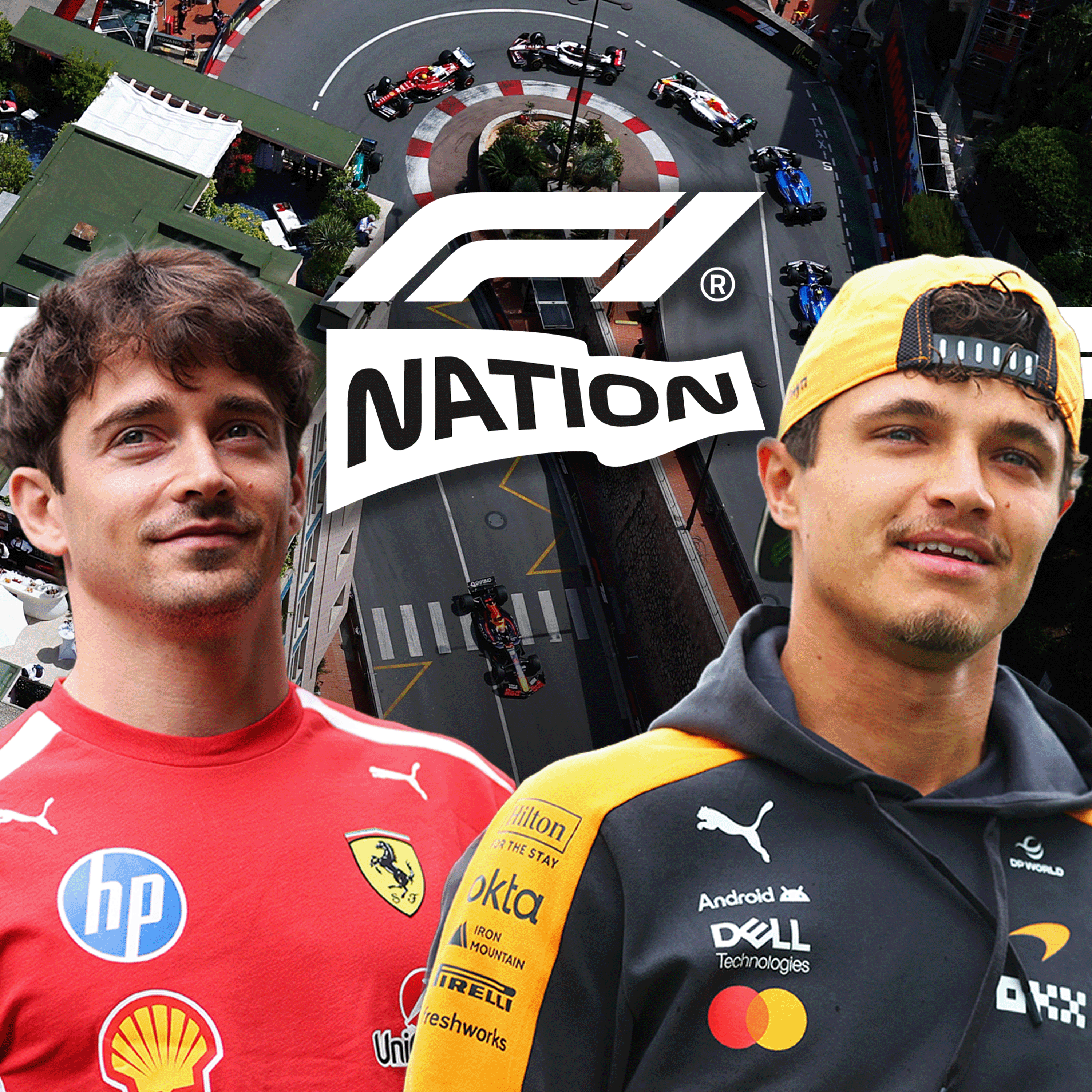
Are Ferrari favourites? – Monaco GP Preview with Palmer + Hinchcliffe
About this episode
Monaco’s quirks take center stage as F1 Nation weighs whether Ferrari can be the favourite. The hosts and guest compare Monaco to other street tracks—narrow, crash-prone, and impossible to “attack from the off”—and explain how shorter wheelbases, compliance, and even hybrid torque could shape grip and rotation, especially if Friday is wet. They debate Ferrari’s edge via ride quality and race-start consistency, then lean toward Leclerc and even a Ferrari 1-2, while also previewing Monaco’s competitive qualifying and broader team news like Alpine’s Gucci branding deal.
Tom Clarkson is joined by former F1 driver Jolyon Palmer and IndyCar race winner James Hinchcliffe to look ahead to this weekend’s Monaco Grand Prix.
After Canada, Lewis Hamilton said he thinks Ferrari will be strong in Monaco. So, could this be the first Grand Prix of 2026 that Mercedes don’t win? Are Ferrari the favourites in Monte Carlo?
Jolyon, Hinch and Tom discuss the Scuderia’s chances and what mindset Charles Leclerc is in before his home race, after describing Canada as the ‘most difficult weekend of my Formula 1 career’.
With Kimi Antonelli looking for a fifth win in a row to extend his 43-point championship lead, where has he made a step forward in 2026? And do we need to rethink how we view George Russell’s performances against his Mercedes teammate?
The guys also react to the announcement that Gucci will become Alpine’s title sponsor in 2027. And we look back in the archive to commemorate Jolyon’s first F1 race in Monaco 10 years ago.
THIS EPISODE IS SPONSORED BY...
Shopify: Sign up for your $1 per month trial today at shopify.com/nation
BetterHelp: Sign up and get 10% off at betterhelp.com/f1nation
street tracks
"Do you have to treat Monaco differently to other street tracks? You can't treat it any other way. Monaco just treats you differently."
A street track is a race course made from regular city roads. Because it’s tight and has walls close by, drivers have to be more careful than on a normal race track.
In F1, “street tracks” are circuits laid out on public roads, which typically have narrow lanes, concrete walls close to the racing line, and less run-off than purpose-built tracks. That environment changes how drivers brake, turn in, and manage risk compared with normal permanent circuits.
qualifying session
"This might be the closest, most competitive qualifying session that we have all season long. Alpine and Gucci are getting together from 2027."
A qualifying session in Formula 1 determines the starting grid for the race. When the hosts say it might be the closest and most competitive qualifying session of the season, they’re highlighting how tightly matched the cars and drivers are over one-lap pace.
paddock walk-in
"There's going to be some excited people on the old paddock walk-in on Thursdays, aren't there? When the Alpine drivers come in dripping in Gucci."
The “paddock walk-in” refers to a team’s public-facing appearance in the paddock area, often involving drivers and team members arriving or presenting themselves for media and fans. It’s a recognizable F1 social/PR moment rather than a track action.
Monaco Grand Prix
"Welcome everybody to F1 Nation's preview of the Monaco Grand Prix. I'm Tom Clarkson and I'm back with my regular teammates, Jolien Palmer and James Hinchcliffe."
The Monaco Grand Prix is an F1 race on city streets in Monaco. It’s famous for being very twisty and hard to overtake, so qualifying and strategy matter a lot.
The Monaco Grand Prix is a Formula 1 race held on the streets of Monaco, known for tight corners, limited overtaking, and a high premium on qualifying and race strategy. It’s one of the most distinctive races on the F1 calendar because the circuit layout changes how drivers can attack and defend.
500 miles
"Mind you, it didn't look much better in Indie Hinch, actually, where you were, right? It was now a little warmer but the same thread of rain throughout the weekend, but ultimately rain held off for the most part and managed to get in all 500 miles of what was,"
“500 miles” means the race is really long—about that distance. The hosts are using it to emphasize how big and demanding the event was.
“500 miles” refers to the race distance used in some motorsport events, indicating a long-duration contest rather than a short sprint. In this segment it’s used to describe the Canada race’s length and the scale of the challenge.
Max Verstappens
"That's what you see out of the Max Verstappens of the world. That's what you see out of champions."
Max Verstappen is a famous Formula 1 race driver. People associate him with taking big risks and driving right at the limit of what the car can do.
Max Verstappen is a top Formula 1 driver known for aggressive, high-commitment driving and pushing cars to their limits. In F1, that style often shows up as late braking, repeated pressure on rivals, and maximizing traction and grip even when it’s close to the edge.
Montreal
"And so it's a record breaking weekend in Montreal as well, right? First forever to win their first four in a row."
Montreal is where the Canadian Formula 1 race is held. The track there is demanding, so drivers have to be very precise and manage tires carefully.
Montreal is the Canadian host city for the Formula 1 race at Circuit Gilles Villeneuve. It’s known for high-speed corners and heavy braking zones, which make tire management and driver precision especially important.
engine failed
"Ultimately, George was ahead when his engine failed. But man, Kimmy was quicker."
“Engine failed” means the car suddenly couldn’t make power anymore. In an F1 race, that can force the driver to slow down or stop racing.
In F1, an engine failure means the power unit stops producing usable power, forcing the driver to slow down or retire. Because F1 engines are highly stressed and tightly regulated, failures can happen suddenly and dramatically affect race outcomes.
locking up
"Both drivers making mistakes when they were out in front. We saw them both locking up into 10 only when they were leading,"
“Locking up” means the tires stop turning while braking. That reduces grip and can make the car slower and harder to control.
Locking up refers to the wheels stopping rotation during braking, causing a loss of grip and often flat-spotting the tires. In F1, it’s a sign the driver is braking too hard for the available traction, and it can cost time and tire life.
pit stop
"And it's 10 years since Red Bull infamously cost Daniel Ricardo victory in Monaco when they weren't ready for his pit stop."
A pit stop is when the car comes into the pit lane during the race to change tires (and sometimes make quick adjustments). When you do it can make a big difference to your race result.
A pit stop is when an F1 car enters the pit lane to change tires and/or make setup adjustments during a race. Timing pit stops is a major strategic lever because it can determine track position and whether a team gains or loses time.
virtual safety cart
"The virtual safety cart will now bring this race to a halt. And down at Sandoval, Jolien Palmer crashes out of his first Monaco Grand Prix,"
It’s like a race “pause” that’s controlled by the officials, but without a real safety car driving out. Drivers have to slow down in a specific way, and it can change when teams decide to pit.
In Formula 1, a virtual safety car is an on-track control where the race is temporarily neutralized without deploying the physical safety car. Drivers must follow the prescribed speed/behavior rules until the situation is resolved, which can strongly affect pit-stop timing and strategy.
zebra crossing
"On the zebra crossing, it was a zebra crossing. Lit up the rear tyres, spat him straight into the barrier."
A zebra crossing is a painted road marking, but on Monaco it can interact with the car’s tires and suspension because the circuit is built on real streets. Hitting it at the wrong moment can upset traction and contribute to sudden loss of control, as described here.
rear tyres
"On the zebra crossing, it was a zebra crossing. Lit up the rear tyres, spat him straight into the barrier."
“Rear tyres” are the tires on the back axle, which heavily influence traction and stability under braking, acceleration, and cornering. If the rear loses grip, the car can rotate or slide into barriers—especially on a street circuit like Monaco.
GP2
"because you actually won at Monaco twice in GP2. The feature race, the most recent one in your championship year."
GP2 was a racing series that helped drivers move up toward Formula 1. It’s like a top-level “training ground” where you learn how to race fast cars under pressure. The guest is saying they did well there at Monaco before reaching F1.
GP2 (now known as Formula 2) was a feeder series that supported Formula 1, giving drivers experience with high-performance single-seaters. Winning in GP2—especially at a track like Monaco—signals strong racecraft and car control because the cars are fast and the circuit is unforgiving. The host uses it to frame the guest’s background before discussing Formula One at Monaco.
feature race
"The feature race, the most recent one in your championship year. Tell us about Monaco and what this legendary racetrack has in store for the drivers."
The “feature race” is the main, longer race of the GP2/Formula 2 weekend. It usually involves more strategy—like managing tires and timing pit stops—so it’s not just about raw speed. The host is using it to clarify which race the guest won.
In GP2/Formula 2, the “feature race” is the main race of the weekend (as opposed to the shorter sprint race). It typically has a longer distance and usually includes mandatory pit stops and tire strategy, so it rewards consistent pace and race management. The host mentions it to pinpoint which Monaco win the guest is referring to.
curbs
"You get locked in, you're in the zone, the bumps, the curbs, the walls. It all just becomes second nature."
Curbs are the raised edges at the side of the track. Drivers use them to help take corners faster, but on tight street tracks they can also make the car bounce or feel unstable. That’s why they matter a lot at places like Monaco.
Curbs are the raised edges along the sides of a racing circuit that drivers often ride over to maximize cornering line and reduce lap time. On street circuits like Monaco, curbs are particularly important because they’re paired with bumps and tight walls, so hitting them can unsettle the car. The guest lists curbs as part of what becomes “second nature” when you’re locked in.
Singapore
"Is it different to Baku? Is it different to Singapore? Yeah."
Singapore is another Formula 1 race held on a street circuit. It’s known for being tight with walls close to the track, and it’s also raced at night. The host is comparing it to Monaco to see if the strategy and driving style are different.
Singapore refers to the Marina Bay Street Circuit, home of the Singapore Grand Prix. It’s a night race on a street layout with tight corners and lots of barriers, making tire management and car control especially important. The host includes it alongside Monaco, Baku, and other street tracks to ask whether the driving approach changes between these circuits.
Baku
"Do you have to treat Monaco differently to other street tracks? Is it different to Baku?"
Baku refers to the Baku City Circuit used for the Azerbaijan Grand Prix, another street-track layout. Like Monaco, it’s characterized by tight sections and close barriers, so drivers often need a similar “street circuit” approach: careful car placement, strong qualifying, and high precision through slow corners. The host brings it up to compare how Monaco’s demands differ from other street races.
Sainte-de-Votte
"I mean, you leave the pits, you head up the hill out of Sainte-de-Votte and you're just staggered at how narrow it is, how easy it is to crash at any given moment."
Sainte-de-Votte is a specific turn on the Monaco track. It’s in a spot where the road is narrow and the walls are close, so mistakes can be very costly.
Sainte-de-Votte is a corner on the Monaco street circuit, located on the climb after leaving the pits. Because the circuit is narrow and the barriers are close, getting it wrong there can quickly lead to a crash.
cannot attack from the off
"And you just cannot attack from the off. You have to build into Monaco."
On Monaco, drivers often can’t push hard immediately because the circuit is so narrow and unforgiving. The hosts describe a need to build into the lap—finding grip and confidence—rather than going all-out from the first moment.
Mirabeau
"Even if you go off at Sainte-de-Votte or Mirabeau, you know, there are some runoffs there,"
Mirabeau is a part of the Monaco track where drivers have to be precise. Even if there’s some extra space nearby, it’s still easy to hit the barriers if you get it wrong.
Mirabeau is a section/corner on the Monaco circuit where drivers approach at speed before braking and turning. The transcript highlights that even though there are runoffs, they’re not something you want to rely on because the exit is tricky and the barriers are still a threat.
runoffs
"Even if you go off at Sainte-de-Votte or Mirabeau, you know, there are some runoffs there,"
Runoffs are areas beside the racing surface designed to slow a car down if it leaves the track. On Monaco, the hosts stress that even when runoffs exist, they’re not something drivers want to count on because the recovery can be tricky and barriers are still close.
chicane
"And then there's the whole second half of the lap after the chicane, which is probably the one where you will see loads of yellow flags in practice"
A chicane is a sequence of alternating turns that forces cars to slow down and change direction. The transcript mentions the second half of the lap after the chicane, linking it to where practice yellow flags are common.
yellow flags
"which is probably the one where you will see loads of yellow flags in practice because you can bail through there a bit quicker."
Yellow flags are a safety signal used in motorsport to warn drivers that there’s a hazard on track (like an accident or debris). Drivers must slow down and be prepared for reduced visibility or blocked sections, which affects practice pace and strategy.
Antony Nogues
"And then the Rascals and Antony Nogues right at the end as well. How many times have you seen someone just brush the barriers there?"
Antony Nogues is a specific spot on the Monaco track near the end. The point is that it’s tight and easy to hit the barriers if you’re not careful.
Antony Nogues is a named corner/section on the Monaco circuit near the end of the lap. The hosts mention it alongside Rascals to illustrate how often drivers can end up brushing the barriers in that area.
Rascals
"And then the Rascals and Antony Nogues right at the end as well. How many times have you seen someone just brush the barriers there?"
Rascals is a named part of the Monaco track near the end of the lap. It’s known for being tight enough that drivers can easily clip the barriers.
Rascals is a named section at the end of the Monaco lap, near the finish area. It’s referenced as a spot where drivers can brush the barriers, reinforcing how close and unforgiving the track is in the final stretch.
mid-corner
"[528.7s] The zero margin for error. [530.8s] How much are you willing to push through that mid-corner? [533.6s] How early are you willing to get on the power?"
“Mid-corner” is the middle part of a turn, around the tightest point. That’s where the car needs to stay balanced so it can grip the road and set up a good exit.
“Mid-corner” refers to the phase of a turn when the car is at or near its apex and the steering angle is still significant. It’s a key moment for traction and balance, because pushing too hard here can cause understeer or loss of grip before the exit.
on the power
"[533.6s] How early are you willing to get on the power? [535.5s] Is it going to stick on the exit? [537.8s] I always really love that challenge."
“On the power” means pressing the gas pedal to start accelerating. When you do it matters a lot because the car needs grip to avoid sliding or losing control.
“On the power” means applying throttle to accelerate out of a corner. In racing, the timing of when you go on the throttle affects traction and stability, especially on low-speed street circuits where grip can be inconsistent.
Haas
"[555.5s] Maybe not straight into an F1 car. [557.3s] But it'd be nice to go there like... [558.8s] You're debut with Haas. [560.5s] Yeah, we're going to take you to Monaco hinge."
Haas is a Formula 1 racing team. Saying it’s your debut with Haas means it’s your first race in F1 driving for that team.
Haas is an F1 team (Haas F1 Team) that competes on the Formula 1 grid. When the host says “your debut with Haas,” they’re referring to a driver’s first F1 outing with that team, which is a big career milestone.
electrical motor
"[567.4s] I mean, I have been excited about Monaco since before the start of the season. [571.3s] All the added torque that we have with the electrical motor now. [575.0s] It's kind of like these cars were made for Monaco is my feeling."
The “electrical motor” is the electric part of the hybrid system that adds extra push. In a race like Monaco, that extra torque can help the car accelerate out of corners sooner and more strongly.
In modern F1, the “electrical motor” refers to the hybrid electric unit that provides additional torque to help acceleration. The extra torque can change how early drivers can apply throttle and how effectively the car can pull out of Monaco’s slow, tight corners.
torque
"[571.3s] All the added torque that we have with the electrical motor now. [575.0s] It's kind of like these cars were made for Monaco is my feeling."
Torque is the “twisting force” that makes the car accelerate. More torque usually means the car can pull away faster, like when you’re exiting a slow corner.
Torque is the twisting force an engine or motor produces, and it strongly influences how quickly a car accelerates—especially at low speeds. In cornering, higher available torque can help the car get moving earlier on exit, but only if traction is sufficient.
Bahrain
"I think from the very moment I arrived in Bahrain and saw them moving around a lot more."
Bahrain is where one of the Formula 1 races is held. It’s an early reference point the host uses because that’s where they first noticed the cars behaving differently. It helps set up why they expect Monaco to be similar or even more dramatic.
Bahrain refers to the Bahrain Grand Prix venue, typically the Bahrain International Circuit. It’s used by F1 as an early-season test of how cars behave under different grip and aerodynamic setups. Here, the host uses Bahrain as the starting point for noticing the cars’ handling changes.
rear sliding
"The way that a lot of the drivers are just hustling with the rear sliding. Imagine you've got that now in Monaco."
Rear sliding happens when the back tires don’t grip as well, so the car’s rear starts to move sideways. Drivers often have to correct it to stay in control. The host is saying the new car behavior could make that more noticeable at Monaco.
Rear sliding refers to the rear tires losing grip so the back of the car rotates or drifts sideways. In wet or low-grip conditions, rear sliding becomes more common and can be part of how drivers manage traction and balance. The host connects this behavior to why Monaco could be exciting if it’s slippery.
Canada
"You could see it in Canada as well. The way that a lot of the drivers are just hustling with the rear sliding."
Canada is another Formula 1 race the host is using as a comparison. They’re saying the driving style and car behavior they saw there could show up again at Monaco. It’s basically a “we’ve seen this before” argument.
Canada refers to the Canadian Grand Prix, usually held at Circuit Gilles Villeneuve in Montreal. The host cites Canada as evidence of how the cars behave when they’re more prone to rotation and rear instability. That comparison is meant to forecast what could happen in Monaco.
wet
"Certainly on a race weekend in the wet to be at Monaco. We heard all the concerns about Montreal with the walls being close and all the rest of it."
“Wet” means the track has rain or is damp. Less grip makes it easier for the car to slide, so drivers have to be more careful and adjust their driving. The host is hoping to see how the new cars handle in those slippery conditions.
“Wet” refers to racing conditions on a rain-affected track where tire grip is reduced and braking/turn-in behavior changes. In F1, wet races often amplify car balance issues like rear instability and make driver skill and traction management more important. The host is specifically discussing how the cars will look in wet first laps at Monaco.
Ferrari
"Are they favorites?... but you can kind of guarantee the Ferrari starts... but it's their best chance by far."
Ferrari is a Formula 1 team. Here, they’re talking about how strong Ferrari looks—especially for race starts and Monaco.
Ferrari is one of Formula 1’s historic teams, and in this segment the hosts focus on Ferrari’s early-season competitiveness and race-start consistency. They argue Ferrari’s car characteristics could make it the best bet for Monaco.
slow speed and medium speed corners
"I think when you look at the performance in slow speed and medium speed corners over the start of the year, they've been the standout car."
Slow and medium corners are turns where you don’t go as fast. In those sections, tire grip and how the car is set up matter a lot.
Slow-speed and medium-speed corners are sections of a circuit where cars generate less aerodynamic downforce and rely more on mechanical grip and traction. F1 teams tune car balance differently for these corner types, so strong performance there is a useful indicator for races like Monaco.
compliance
"They've got really good ride quality, good compliance over the bumps and curbs."
Compliance is how well the car soaks up bumps instead of bouncing. If the car absorbs the track well, it can keep better grip and stay controllable.
In F1, compliance refers to how much the car can absorb small bumps and surface changes without upsetting the chassis. More compliance helps the car maintain grip over curbs and rough patches, especially in slow-speed corners.
ride quality
"They've got really good ride quality, good compliance over the bumps and curbs."
Ride quality is how smoothly an F1 car moves over bumps, curbs, and uneven track surfaces. Better ride quality usually means the car stays more stable and predictable, improving traction and driver confidence.
starts
"They never make bad starts. It looks like Mercedes have maybe started to figure out how to get better starts as well."
Starts are how well a car launches from the grid. A good start means the car gets moving quickly without losing traction.
In F1, “starts” refers to the launch off the grid—how quickly and cleanly the car gets up to speed without wheelspin or bogging down. The hosts discuss which team has improved its start performance and how that could affect race outcomes.
Mercedes
"It looks like Mercedes have maybe started to figure out how to get better starts as well, but you can kind of guarantee the Ferrari starts."
Mercedes is another Formula 1 team. They’re saying Mercedes might be getting better at launching from the grid.
Mercedes is a Formula 1 team the hosts mention as potentially improving its race starts. The point is comparative: Ferrari’s starts are treated as more reliable, while Mercedes is described as catching up.
Hamilton
"on the evidence of Canada, you probably have to say Hamilton, but which of the two Ferrari drivers do you think?"
Hamilton is a famous Formula 1 driver. In this segment, they’re saying his recent results suggest he could be the strongest option.
Lewis Hamilton is a top Formula 1 driver and a key reference point in this discussion about who has the best recent form. The hosts use Hamilton’s Canada performance as evidence for who might be strongest heading into Monaco.
Leclerc
"on the evidence of historical results at Monaco, you'd go Leclerc for me personally."
Leclerc is a Ferrari Formula 1 driver. They think he’s likely to do best at Monaco because of how he’s performed there before.
Charles Leclerc is a Ferrari driver, and the hosts argue he’s the better bet for Monaco based on past results at that track. They’re effectively contrasting his Monaco-specific track record against Hamilton’s more general recent form.
Monaco GP
"on the evidence of historical results at Monaco, you'd go Leclerc for me personally... there is something special about that place."
Monaco GP is a Formula 1 race on very tight city streets. It’s famous because it’s hard to overtake and small mistakes matter a lot.
The Monaco Grand Prix is one of Formula 1’s most famous races, run on a tight street circuit in Monte Carlo. Because it’s slow-speed and highly technical, small setup and driving differences can decide qualifying and the race.
sectors
"So when you look at the sectors from Canada, you get a bit of a tell as to who might have good Monaco performance from particularly the first sector in Montreal, a little bit the second sector as well."
F1 tracks are split into a few sections for timing. By looking at each section’s time, you can tell where a driver/car is fast or struggling.
In Formula 1, a lap is divided into multiple timed segments called sectors. Teams and commentators use sector times to diagnose where a car is gaining or losing time—like traction out of slow corners versus top speed on straights.
worst weekend in Formula One
"But what about Charles then? He's just had what he called his worst weekend in Formula One? He has actually just cancelled a whole load of commitments between Montreal and Monaco as well."
In F1, a “worst weekend” means things went badly across the whole race weekend, not just one moment. The discussion is about how tough it is to bounce back quickly for the next Grand Prix.
A “worst weekend” in Formula One usually means the driver and team struggled across multiple sessions—qualifying pace, race execution, and/or reliability—so the overall result is far below expectations. The key point here is that the host is discussing how hard it can be to mentally and operationally recover for the next race.
straight line performance
"They have the best straight line performance, but like Lewis has said, that's not worth a huge amount in Monaco."
It’s how fast the car is when it’s going mostly straight. Monaco has fewer long straights, so being great in a straight line doesn’t help as much as being good through corners.
Straight-line performance is how quickly a car can accelerate and maintain speed on straights, largely driven by engine power, aerodynamics, and traction. In Monaco, it matters less than cornering because the circuit is slow, tight, and dominated by turns and traction out of them.
Fp1
"Do you think he's going to be on the back foot going in or can you just put in a different chip in your brain and just get going from Fp1? Fp1 will be really important for him, just to have that reset."
Fp1 is the first practice session on Friday. It’s when teams and drivers start dialing in the car, so it can be a big reset after a bad weekend.
Fp1 means the first Free Practice session of a Grand Prix weekend. It’s the earliest on-track running where teams gather baseline setup data and drivers learn the car’s behavior, so a strong start can help a driver reset after a poor race weekend.
Maranello
"So when Schumi was spending more time with the test team back at Maranello, there were probably, I'd say, somewhere like 16, 18 races in the season. ... I think you bring up a great point, though, that because testing was open and Ferrari had a test track at the factory."
Maranello is where Ferrari is based in Italy. In this episode, it’s where Schumacher would go to work with the team’s testing and practice.
Maranello is Ferrari’s home base in Italy, where the team’s factory and development operations are centered. The hosts mention Schumacher spending time with Ferrari’s test team back at Maranello, tying the location to how the team prepared drivers.
Bridgestone Michelin tire wall
"I remember at the height of the Bridgestone Michelin tire wall, we used to have a day off in Monaco. So first practice, first and second practice used to be on the Thursday."
Bridgestone and Michelin were different companies making the F1 tires. The hosts are talking about that tire-supplier era and how it changed the weekend schedule and planning.
The phrase refers to the era when Bridgestone and Michelin were the competing tire suppliers in Formula 1, creating a “tire war” dynamic. The hosts connect it to a specific Monaco schedule detail (a day off) and to how tire-related testing and planning affected the weekend rhythm.
Fiorano
"And then you'd have final practice and qualifying on Saturday in the race on Sunday. [1394.7s] And Schumi used to go back to Maranello to Fiorano and practice his starts and just get out on the test track on the Friday..."
Fiorano is Ferrari’s own test track near their base in Italy. Schumacher would go there to practice race starts and work on what he learned during the weekend.
Fiorano is Ferrari’s private test circuit near Maranello, used for development work and driver practice. The segment specifically notes Schumacher going back to Maranello to Fiorano to practice race starts and apply what he learned during the earlier sessions.
testing was open
"I think you bring up a great point, though, that because testing was open and Ferrari had a test track at the factory. Yeah, Schumi was there all the time, right?"
“Testing was open” means teams had more opportunities to practice and develop cars outside the official race weekend. The hosts are saying that made it easier for a driver to stay sharp and keep working on skills.
“Testing was open” refers to periods in F1 history when teams had more freedom to run testing sessions beyond the race weekend. The hosts argue that with more testing available—and Ferrari having a test track—drivers like Schumacher could more easily keep improving and fill their time between races.
championship favourite
"But now I think he's got the confidence and with it all, the consistency that makes him, I would say, championship favourite as of now."
A “championship favourite” means the person most likely to win the season title. It’s about doing well over many races, not just one weekend.
A “championship favourite” is the driver or team considered most likely to win the overall F1 title. It’s based on current form, consistency, and points accumulation rather than just single-race pace.
Nouvelle Chacune
"And actually he crashed in Q1 in Monaco, didn't he, at the Nouvelle Chacune? So he started the race 15th in Monaco last year."
Nouvelle Chicane is a particular set of turns on the Monaco track. It’s a spot where braking and turning have to be really precise, and getting it wrong can ruin your lap or cause a crash.
Nouvelle Chicane is a specific chicane section on the Circuit de Monaco. It’s a key braking-and-turning point where mistakes can easily lead to crashes or poor qualifying laps.
Q1
"And actually he crashed in Q1 in Monaco, didn't he, at the Nouvelle Chacune? So he started the race 15th in Monaco last year."
During F1 qualifying, Q1 is the first part. If you don’t go fast enough in that first session, you’re knocked out and can’t race for the top starting spots.
In Formula 1 qualifying, Q1 is the first knockout segment. Drivers who don’t set fast enough times are eliminated before the later qualifying sessions (Q2 and Q3).
Antonelli
"So do you think Antonelli is actually the favourite? I've just raved about Ferrari and their chances. We've discussed that, but actually is Antonelli the man to beat?"
Antonelli is Andrea Antonelli, an F1 driver. They’re debating whether he’s the top threat at Monaco compared with other drivers like Leclerc.
Antonelli refers to Formula 1 driver Andrea Antonelli. The segment frames him as a potential “man to beat” at Monaco, contrasting his prospects with Ferrari’s Charles Leclerc and the advantages claimed for Mercedes.
Charles
"Yeah. There's still something, I still, I don't know if it's an emotional thing or what, but I still think Charles has the best odds, you know, because Monaco is super unique. And even with that increased confidence that Kimmy's got..."
“Charles” is Charles Leclerc, Ferrari’s driver. They’re saying he has the best chance at Monaco because the track is so unusual that it can favor the right driver and setup.
“Charles” here refers to Charles Leclerc, Ferrari’s driver. The hosts are discussing his odds for Monaco, emphasizing that Monaco’s unusual demands can change how team and car advantages translate into results.

McLaren
"What a great segue to talk about McLaren. Because after such a such a disappointing race in Montreal, right?"
McLaren here means the McLaren Formula 1 team. They’re talking about how McLaren’s car might do well at Monaco, especially after a front-wing change that struggled in a previous race.
McLaren is a Formula 1 team and constructor, known for building race cars that are often very competitive when their aerodynamic package is dialed in. In this segment, they’re discussed in the context of Monaco performance and a front-wing update that didn’t work as expected in Montreal.
inters
"When they start on on inters and it just goes from bad to worse from there. Are they in the picture for Monaco?"
“Inters” are intermediate tires used when the track is wet but not completely soaked. They’re designed to work in that in-between weather so the car can still grip.
“Inters” refers to the intermediate tire compound used in wet or damp conditions—when the track isn’t fully dry and not fully flooded. In F1, switching to inters can drastically change grip and how confidently drivers can push.
front wing
"OK, the front wing, the new front wing didn't work in Montreal. They've already said they're going to run it again in Monaco."
The front wing is the aerodynamic piece at the front of the F1 car. It helps push the car down onto the track so the tires can grip better, and a new version can change how the car feels in corners.
The front wing is a key aerodynamic component on an F1 car that shapes airflow to generate downforce and improve grip. If a new front wing “didn’t work” at a race like Montreal, it can mean the expected balance—how the car sticks in corners—wasn’t achieved.
compliant
"So is that's the key thing that you want where you want some downforce, but then you really do need it to be to be compliant and trying to find the balance between the two of those things"
“Compliant” here means the car can handle bumps and uneven track surfaces without losing its grip or balance. It’s about keeping the aero working smoothly rather than becoming twitchy or inconsistent.
In F1 aero talk, “compliant” describes how well the car’s aerodynamic platform and suspension behavior maintain performance over bumps and changing ride conditions. The idea is to balance downforce with stability/consistency so the car doesn’t lose grip or become unpredictable.
downforce
"So is that's the key thing that you want where you want some downforce, but then you really do need it to be to be compliant"
Downforce is what the car’s aero creates to press the tires harder onto the road. More downforce usually means better grip in corners, but it can also affect balance and how the car behaves.
Downforce is the aerodynamic force that pushes the car downward, increasing tire grip and allowing higher cornering speeds. The segment frames it as a tuning target—drivers/teams want enough downforce, but not so much that the car becomes unstable or hard to manage.
energy deployment
"I think Mercedes have a better understanding still on energy deployment, energy usage, that side of things."
Energy deployment is how the team decides when to use the car’s stored hybrid power. Use it well and you can be faster when it matters, without running out too early.
Energy deployment is how an F1 team meters and uses stored energy (from the hybrid system) during the race to maximize performance while staying within limits. The hosts suggest Mercedes has a better grasp of this, which can translate into stronger pace at key moments.
shorter wheelbase
"where it's the shorter wheelbase, the front end will help. [2096.0s] But also this is the sort of one where you want to crank on as much downforce as you can get."
Wheelbase is how long the car is between the front and back wheels. A shorter wheelbase can make the car feel quicker to turn in tight corners, which matters a lot on Monaco’s twisty layout.
Wheelbase is the distance between the front and rear axles. A shorter wheelbase generally makes a car easier to rotate and place through tight corners, which can help on circuits with lots of slow, changing-direction driving like Monaco.
differential of entry speeds
"So the biggest thing in the driving is having your differential of entry speeds [2117.0s] and some harvesting and deployment."
Entry speed is the speed when you start turning into a corner. If one car is faster at that moment than another, it can get a better line and usually has the advantage to set up the rest of the corner.
“Entry speed” is how fast a car is when it turns into a corner. The “differential” refers to how much faster one car is than another at that same point, which often determines who gains positions because Monaco’s lap time is heavily influenced by corner-by-corner traction and braking/turn-in performance.
harvesting and deployment
"having your differential of entry speeds [2117.0s] and some harvesting and deployment. [2119.1s] Whereas in Monaco, it's flat out."
This is about storing energy and then using it at the right time. The car recovers energy when slowing down, then “spends” it to get extra acceleration when it matters most.
In F1, harvesting is capturing energy (typically via regenerative braking) and deployment is using that stored energy to boost performance later. This energy-management strategy can strongly affect lap times and overtaking opportunities, especially on circuits where braking zones and traction vary a lot.
Red Bull Powertrains
"Max Verstappen, first podium of the year last time out in Montreal. [2136.5s] Red Bull Powertrains' first podium in its history."
Red Bull Powertrains is the part of Red Bull’s F1 operation that handles the engine and energy system. They’re pointing out that it’s had its first podium, which is a big milestone.
Red Bull Powertrains is the power-unit organization within Red Bull’s F1 program, responsible for the development and performance of the team’s engines/energy system. The hosts note it achieved its first podium in its history, highlighting how quickly the program has progressed.
DNF
"It took a Mercedes DNF and a double McLaren strategy blunder to even be in the conversation. [2163.3s] He was tracked down by, I mean, what was the gap that Hamilton closed up?"
DNF means the car didn’t finish the race. If a driver retires early, they usually score no points from that race.
DNF stands for “Did Not Finish.” In F1, it means a car retired from the race due to mechanical issues, crashes, or other problems, which typically results in zero points for that race (unless special scoring rules apply).
Ferrari 12
"I'm going to say Leclerc wins, but I think Hamilton is second. It's a Ferrari 1-2, and I'm going to say third is Lando. We've got no Mercedes on the podium."
The Ferrari 812 Superfast is a very powerful luxury sports car made for driving quickly on regular roads. It uses a big V12 engine and is designed to feel fast and exciting, especially at higher speeds. It’s mentioned because it represents Ferrari’s top level of performance in road cars.
The Ferrari 812 Superfast is a high-performance grand tourer built for fast, long-distance driving rather than racing. It’s powered by a naturally aspirated V12 engine and is known for delivering very strong straight-line performance, which is why it often comes up when people discuss Ferrari’s top-end road-car technology and power. In a motorsport-focused podcast, it may be referenced as a symbol of Ferrari’s engineering and performance image beyond Formula 1.
Kimmy
"Ferraris have beaten them, you've got Seb and Kimmy back in the day. They haven't been great in recent years either."
“Kimmy” refers to Kimi Räikkönen, another well-known Ferrari-era Formula 1 driver. They’re bringing him up to talk about Ferrari’s past success.
“Kimmy” is a shorthand reference to Kimi Räikkönen, a former Formula 1 driver who raced for Ferrari. The mention is used to recall Ferrari’s stronger results “back in the day.”
Seb
"Ferraris have beaten them, you've got Seb and Kimmy back in the day. They haven't been great in recent years either."
“Seb” here is Sebastian Vettel, a famous past Formula 1 driver. The hosts are mentioning him as part of Ferrari’s earlier success.
“Seb” is a shorthand reference to Sebastian Vettel, a former Formula 1 driver who raced for Ferrari. In this segment, the host uses his name to anchor a past era of Ferrari competitiveness.
1-2
"I'm going for a Ferrari 1-2. Their first 1-2 at Monaco since 2017. Shell, ahead of Lewis, with Kimmy Antonelli P3."
A “1-2” means the same team takes both first and second place. They’re saying Ferrari could lock out the top two at Monaco.
A “1-2” is when one team finishes first and second in the race. The host is predicting a Ferrari 1-2 at Monaco, meaning both Ferraris would take the top two spots.
Lewis
"Shell, ahead of Lewis, with Kimmy Antonelli P3. I have more faith in Mercedes at Monaco."
“Lewis” is Lewis Hamilton, one of the most successful Formula 1 drivers. They’re comparing who’s ahead of him in the projected running order.
“Lewis” refers to Lewis Hamilton, a top Formula 1 driver. Here he’s mentioned in the context of race position (“ahead of Lewis”) during the Monaco preview.
Nouvelle Chocaine
"If he can just keep building as the weekend goes on, and not clip the inside wall at the Nouvelle Chocaine, like he did in Q1 last year."
Nouvelle Chicane is a particular tight section of the Monaco track. It’s easy to hit the wall there if you’re not perfectly on the right line and speed.
Nouvelle Chicane is a specific chicane section of the Monaco circuit. It’s a well-known braking/turn-in point where drivers can clip the wall if they misjudge speed or steering angle.
Alpine
"First of all, Alpine. Let's not forget that they were last in the Constructors' Championship last year, and they've now gone and attracted one of the biggest global brands..."
Alpine is a Formula 1 team. They’re talking about Alpine getting a major sponsor deal, which suggests the team is becoming more attractive to big global brands.
Alpine is a Formula 1 team and brand competing in the Constructors' Championship. In this segment, the hosts discuss Alpine’s recent title-sponsor deal and how it signals the team’s growing commercial pull.
Constructors' Championship
"Let's not forget that they were last in the Constructors' Championship last year, and they've now gone and attracted one of the biggest global brands..."
In F1, the Constructors' Championship is a standings race for the teams. Teams earn points based on their cars’ results across the season.
The Constructors' Championship is the season-long points race for Formula 1 teams, based on how their cars perform in each Grand Prix. It’s separate from the Drivers' Championship, which ranks individual drivers.
Luca D'Ameo
"JP, that Luca D'Ameo, who was the boss of Alpine, is now the CEO of Carang, who is the parent company of Gucci."
Luca D'Ameo is a business executive. The hosts say he used his connections—having worked at Alpine and later leading Carang—to help make a big sponsorship deal happen.
Luca D'Ameo is described as the former boss of Alpine who later became CEO of Carang. In the segment, his move is presented as a key factor in helping connect Alpine with a major luxury sponsor.
Carang
"Luca D'Ameo, who was the boss of Alpine, is now the CEO of Carang, who is the parent company of Gucci."
Carang is a company that owns or controls Gucci. The hosts mention it to connect the people involved in the Alpine sponsorship deal.
Carang is referenced here as the parent company of Gucci, meaning it controls the brand. The segment uses this corporate link to explain how the sponsorship deal may have been facilitated.
Gucci
"Luca D'Ameo, who was the boss of Alpine, is now the CEO of Carang, who is the parent company of Gucci. I'm sure that helped put the deal together..."
Gucci is a luxury fashion brand. Here, they’re talking about Gucci sponsoring an Alpine Formula 1 team, which is a big deal because it brings a very high-end brand into F1.
Gucci is a luxury fashion brand, and in this segment it’s referenced as becoming the title sponsor for an Alpine-branded F1 team. The hosts frame it as a high-end, globally recognizable partnership that reflects F1’s mainstream appeal.
Flavio
"I'm sure that helped put the deal together, the friendship between Flavio and Luca. But still, they've got it across the line."
Flavio is mentioned as someone connected to the people behind the deal. The point is that relationships and connections helped make it happen.
Flavio is referenced as part of the relationship that helped get the sponsorship deal across the line. The segment implies personal connections played a role in securing the agreement.
Renault engines
"I think they've done a really good job dropping the Renault engines for Mercedes."
“Renault engines” refers to the power units supplied by Renault to an F1 team. In this segment, the host says Alpine is moving away from Renault engines, implying a change in the technical package that can affect performance and development direction.
customer team
"And just becoming a customer team."
A “customer team” is an F1 team that gets its engine from another company instead of building and running its own engine program. They still design their own car and race it, but the engine comes from a supplier.
In Formula 1, a “customer team” is a team that doesn’t run its own full works engine program and instead buys an engine from another manufacturer. The engine supplier provides the power unit, while the customer team handles its own chassis, aerodynamics, and race operations around that engine package.
Request an Explanation
Heard something you'd like explained? We'll add it to this episode.
Sign in to request explanations for terms you heard.
Want to learn more?
Browse our glossary for plain-English explanations of automotive terms, jargon, and concepts.
Help improve this episode
See something that's not quite right? Our annotations are AI-generated and can sometimes miss the mark. Click the flag icon on any annotation to suggest a correction.