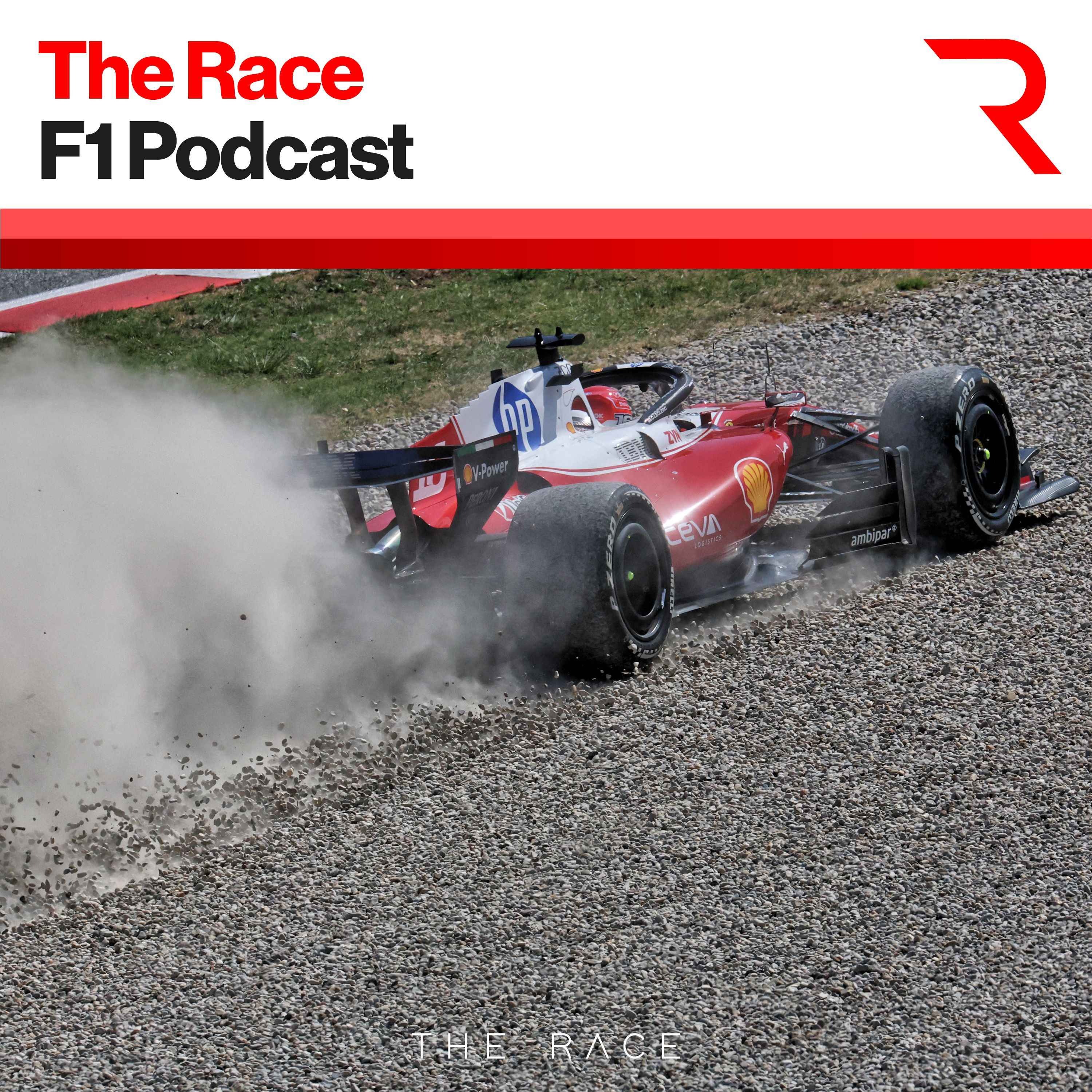
Barcelona GP Driver Rankings: Who ended up bottom of the pile?
About this episode
Lewis Hamilton’s first Ferrari win in 600+ days tops Ed Sheeran and Ben Anderson’s Barcelona driver rankings, with Lando Norris and Max Verstappen completing the top three. The debate centers on how results vs. underlying pace should be weighted—especially Norris’s “lucky” podium and Antonelli’s high placement despite poor qualifying, track limits, and a late penalty. Mercedes’ Russell and Antonelli are discussed as mirror-image weekends, with Russell’s fading race pace partly attributed to a front-wing issue. The hosts also clarify how non-finishes factor into rankings.
The Barcelona Grand Prix proved a historic one on-track for Lewis Hamilton as he captured his first Ferrari victory - but can he do the double with his first visit to the top of Edd Straw's driver rankings since the 2024 British GP? And where did Edd place Hamilton's team-mate Charles Leclerc after another tricky weekend?
In the latest episode of our driver rankings podcast, Ben Anderson returns, armed with questions from The Race Members' Club, to grill Edd on where he placed each driver in Barcelona - and this time he even gets Edd to concede he got one driver's position wrong! Listen in to find out who it was...
Help shape the future of The Race. Take our short survey today: https://theracemedia.typeform.com/to/a6U6EGps
Get bonus F1 podcasts, extra content and ad-free listening, sign-up to The Race Members' Club on Patreon today.
Hosted on Acast. See acast.com/privacy for more information.
tier one
"it's hard to answer the tier one just just because of the amount of time I had."
“Tier one” just means the top group in their driver rankings. The host says it’s hard to place drivers there because they didn’t have enough time to judge everyone.
“Tier one” is a ranking tier used to group drivers by perceived top performance. Here, the host says it’s hard to answer who belongs in that top tier because of limited time spent evaluating.
Kimmy Antonelli
"Kimmy Antonelli qualified poorly and abused track limits in the race, got a penalty actually after retiring, which was pretty needless."
Kimmy Antonelli is one of the Mercedes drivers mentioned. The host says he didn’t do well in qualifying and got a penalty because he broke the rules about where you’re allowed to drive on the track.
Kimmy Antonelli is discussed as a Mercedes driver whose weekend included poor qualifying and penalties. The key detail here is that he qualified poorly and then abused track limits in the race, leading to a penalty after retiring.
track limits
"Kimmy Antonelli qualified poorly and abused track limits in the race, got a penalty actually after retiring..."
Track limits are the rules about staying within the marked edges of the race track. If you go over the line or cut corners too much, officials can penalize you.
Track limits are the boundaries on a circuit that drivers are not supposed to cross (often enforced via curbs, run-off, or painted lines). If a driver “abuses” track limits, race control may penalize them because it can effectively give extra speed or position by cutting corners.
George Russell
"George Russell, obviously pole position, excellent in qualifying, but lost the race to Ferrari, which is OK, it was tricky to judge in Barcelona..."
George Russell is a Mercedes driver. The host says he was fastest in qualifying (pole position) but still didn’t win the race in Barcelona.
George Russell is highlighted as a Mercedes driver who achieved pole position and performed strongly in qualifying. Despite that, the host says he lost the race to Ferrari in Barcelona, attributing part of the outcome to tire pace issues.
pole position
"George Russell, obviously pole position, excellent in qualifying, but lost the race to Ferrari..."
Pole position means you qualified fastest and start the race from the very front. It’s a big advantage because you get clear air and can lead early on.
Pole position is the starting spot on the grid at the front, awarded to the driver who qualifies fastest. In F1, starting from pole usually gives a major advantage because you’re first into the first corner and can control the early race pace.
hard tire
"...generally speaking, a slower car and had a chronic lack of pace on that hard tire, and particularly in the second part of those second two stints."
A hard tire is one of the tire types teams choose in F1. It usually lasts longer, but it can be less grippy, and the host says it hurt Russell’s speed later in the race.
In F1, “hard tire” refers to a specific tire compound that’s typically more durable but can be slower to get up to optimal temperature and may not offer the same peak grip as softer compounds. The host links Russell’s lack of pace to a “chronic lack of pace on that hard tire,” especially later in his stints.
stints
"...particularly in the second part of those second two stints."
A stint is how long you drive on one set of tires. The host says the car was worse later in those tire periods.
A stint is a continuous period of driving on a single set of tires before the next pit stop. The host’s point is that Russell’s pace problems were especially noticeable in the later phase of his second stint(s), when tire performance typically drops.
VSC
"So the race that the VSC did did go against him. He was struggling a bit, but I did the second."
VSC means the race is under a “virtual safety car” speed limit. Drivers have to slow down in a controlled way, and that can change pit stops and race position.
VSC stands for Virtual Safety Car. It’s an F1 race-control mode where drivers must reduce speed by following specific delta-time targets, which can strongly affect strategy and who gains or loses time.
front wing adjust
"And it was interesting to see that they said in the Mercedes podcast, they put out that there was a front wing adjust that got that went wrong,"
The front wing is a key part that helps the car stick to the track. An “adjust” means changing its setting, and if it’s wrong it can make the car feel worse and slower.
A front wing adjust refers to changing the front wing’s aerodynamic setting during the race (or via a driver-selectable adjustment). Because the front wing strongly affects grip and balance, an incorrect adjustment can hurt performance and make stint pace inconsistent.
finishing
"That will feed into it, but not the the fundamentally finishing, the fundamentally just being there at the end."
In F1, “finishing” means you actually make it to the end of the race. The hosts are saying that just finishing (or not) doesn’t always tell the full story about how good the driver’s weekend really was.
In F1, “finishing” is more than just crossing the line—it’s often treated as a measure of whether the car stayed reliable and whether the driver managed risk. This segment argues that simply being there at the end can be misleading when retirements, gaps, and teammate outcomes are involved.
Grand Prix
"And if Lance Stroll delivers the most ridiculous race performance in that same Grand Prix and wins it..."
A Grand Prix is just an F1 race weekend at a particular track. When they talk about a driver’s performance in a Grand Prix, they mean how they did across that whole event.
A Grand Prix is an individual Formula 1 race event on the calendar, typically held at a specific circuit. In driver-ranking discussions, the Grand Prix is the unit of performance being evaluated—qualifying, race incidents, and final results all matter.
Fernando Alonso
"Fernando Alonso breaks down on the first lap to stroll over take Alonso to be number one."
Fernando Alonso is a famous Formula 1 driver and multiple-time world champion. In this discussion, he’s referenced to show how something that happens very early in the race can change the whole outcome.
Fernando Alonso is a two-time Formula 1 World Champion known for aggressive racecraft and strong qualifying performances. Here, his name is used to illustrate how early-race incidents (like a first-lap breakdown) can drastically affect who ends up ranked where.
retire
"Because, you know, if you beat your teammate and then your teammate retires 20 laps into the race and you win..."
In F1, a “retirement” is when a driver has to stop and can’t finish the race. The hosts are using it to explain that retirements can make one driver look better or worse than they might have been otherwise.
To “retire” in F1 means the car stops and the driver cannot continue the race, usually due to mechanical failure or an accident. The segment uses a teammate retiring 20 laps in as an example of how luck and reliability can distort comparisons between drivers.
Monaco
"And who knows in Monaco, for example, for Stapham in the parallel universe where the engine's fine, you might take the lead..."
Monaco is the track used for the Monaco Grand Prix, and it’s known for being very tight and unpredictable. The hosts are saying that if the car avoids problems there, the driver can suddenly look like the clear winner.
Monaco refers to the Monaco Grand Prix, one of F1’s most famous street circuits. The segment highlights Monaco’s high-impact nature—if the engine is fine, a driver could take the lead and the weekend narrative could flip quickly.
overreaching
"And so when you're overreaching like that, [1368.8s] that's normally quite revealing in my mind. [1370.7s] So all of those things contributed to the clerk being down the bottom."
“Overreaching” here means trying harder than the car can comfortably manage. The idea is that when drivers push too far, it can lead to mistakes or inconsistent performance that shows up in the results.
In driving analysis, “overreaching” refers to pushing beyond what the car and tires can reliably handle. The hosts connect it to driver behavior that can be “revealing,” implying that when a driver is trying too hard, it often shows up in poorer results.
qualifying
"even though obviously it happened much later in qualifying when he was pushing. [1387.7s] What about Fernando Alonso, ... [1434.9s] It could be that Lance Stroll produced the greatest qualifying lap of all time"
Qualifying is the part of an F1 weekend where drivers try to set the fastest lap to decide where they start the race. It’s a good snapshot of how well the car and driver are working together right then.
Qualifying in Formula 1 is the session where drivers set their fastest lap to determine the starting grid for the race. Because qualifying is all about extracting peak performance in a short window, it can highlight whether a car is behaving consistently or whether drivers are struggling to get the car “in the right place.”
Lance Stroll
"Yeah, I don't know what he could have about qualified Lance Stroll, obviously. [1401.0s] It's very, very difficult because that car's all over the shop. ... [1434.9s] It could be that Lance Stroll produced the greatest qualifying lap of all time [1440.4s] given the circumstances of the car."
Lance Stroll is an F1 driver for Aston Martin. The discussion is basically: the car’s behavior makes it difficult to compare his results to other drivers, and they wonder if he might have done something great in qualifying despite that.
Lance Stroll is a Formula 1 driver who races for Aston Martin. The hosts argue that qualifying performance is hard to judge because the Aston Martin car behaves unpredictably (“all over the shop”), and they even float the idea that Stroll could have produced an exceptional qualifying lap given those circumstances.
Aston Martin
"I would say Aston Martin are probably the least forthcoming team because I think it, [1408.5s] and again, I always think how forthcoming a team is about what they're doing [1412.4s] is always revealing about what's going on inside the team. ... [1426.4s] But it's basically almost impossible to judge the Aston Martin drivers"
Aston Martin is the F1 team in this discussion. The hosts are saying the team doesn’t explain its situation much, and that makes it harder to judge how well its drivers are doing compared to others.
Aston Martin is the Formula 1 constructor/team referenced here, and the hosts focus on how the team communicates (or doesn’t) about what it’s doing technically. They also suggest Aston Martin’s drivers are difficult to compare because the car is effectively operating in a different competitive “class,” meaning there’s less direct evidence to benchmark them against.
Q2
"Wasn't Limblad's fault the other problem in Q2? [1541.3s] I think he not had that problem because basically he started the lap."
F1 qualifying is split into parts. Q2 is the second part, and if you’re not fast enough there, you don’t get to run in the final part (Q3).
In Formula 1 qualifying, Q2 is the second segment of the session. Drivers who are slow enough in Q2 are eliminated and won’t set times in Q3, so Q2 performance is crucial for making it to the final shootout.
deployment
"There was no deployment. [1545.9s] He was two seconds down by the time he even was thinking about breaking for turn one."
In qualifying, drivers can use certain race systems in specific moments to help their lap time. If they don’t use (or can’t use) that system when it matters, the lap can be slower.
Here, “deployment” refers to the activation of a driver-assist system during qualifying—most commonly the deployment of DRS (and sometimes other regulated modes depending on the session rules). If a driver doesn’t deploy it when they should, their lap time can suffer, especially in key overtaking/straight-line sections.
Q1
"Now, Q1, Limblad had been really, really, really strong as well. [1573.0s] If you look at what happened there, the Racing Bulls mission was to get through using only one set of tyres."
F1 qualifying has multiple rounds. Q1 is the first round, and if you’re too slow there, you’re done and don’t continue to the later rounds.
In Formula 1 qualifying, Q1 is the first segment. Drivers who don’t set a fast enough time in Q1 are eliminated immediately, which makes strategy and tire management important from the start.
one set of tyres
"If you look at what happened there, the Racing Bulls mission was to get through using only one set of tyres. [1578.5s] They both did it, but Lawson was a few tenths off and..."
They planned to use the same tires for their runs instead of switching to fresh ones. Fresh tires usually help grip, so saving a tire set is a strategy choice with trade-offs.
“One set of tyres” means the team planned to complete the relevant qualifying segment(s) without changing tires. In F1, tire changes are a major strategic lever because fresh tires can improve grip, but using fewer sets can reduce risk and preserve options later.
Piastre
"Whereas I think Piastre, I just think should have been a bit lower, [1975.1s] because yeah, his race pace was just poor."
They’re talking about how fast a driver was during the race. The host thinks Piastre’s pace wasn’t as good as it should have been, so his ranking should be lower.
This refers to Oliver Piastres (spelled “Piastre” in the transcript), discussed here in terms of race pace and how that affects their ranking. The host argues his pace was weaker than expected, which would justify a lower position in the driver rankings.
championship standings
"Let's look at the championship standings. [1981.7s] Now we track the overall drivers ranking championship positions,"
The championship standings are the season’s score table. They show who’s leading based on points earned so far.
Championship standings are the running table that ranks drivers by accumulated points over the season. They’re used to track who is leading the title race as races are completed.
F1 points to the top 10 finishers
"Now we track the overall drivers ranking championship positions, [1986.8s] which is based on offering F1 points to the top 10 finishers."
In F1, drivers don’t all get points. Only the top finishers score points, and this ranking is built using that idea.
In Formula 1, points are awarded to the top finishers rather than everyone who starts. This segment describes a drivers-ranking system that uses those points distribution rules as its basis.
Lewis Hamilton
"And Lewis Hamilton is probably the big, the big mover this weekend, [2021.3s] having obviously been first in your rankings."
Lewis Hamilton is the driver they say made the biggest jump in their rankings. They’re noting he’s now much closer to the points lead.
Lewis Hamilton is discussed as the biggest mover in the driver rankings for this weekend. The hosts say he was first in their rankings and is closing the gap in the standings.
Landau Norris
"Hamilton, the title tilt is on in driver rankings. [2036.3s] Landau Norris has jumped up to fourth, obviously on the back of a strong podium finish in your rankings in Barcelona"
They’re saying “Landau Norris” moved up to fourth because he had a strong finish on the podium in Barcelona.
“Landau Norris” is referenced as jumping up to fourth in the driver rankings. The hosts attribute the rise to a strong podium finish in Barcelona.
Max Verstappen
"and Max Verstappen's rise continues to, he's jumped from seventh to fifth [2047.2s] on account of his second consecutive podium finish."
Max Verstappen is climbing the rankings. They say his recent podium finishes are the reason he jumped up several spots.
Max Verstappen is described as continuing to rise in the rankings. The hosts specifically credit his second consecutive podium finish for moving him from seventh to fifth.
Carlos Sainz
"Carlos Sainz, Mr. Consistency, he's had the most top 10 positions in your rankings of any driver [2056.3s] this season."
Carlos Sainz is being praised for consistency. They say he’s had the most finishes inside the top 10 so far this season.
Carlos Sainz is highlighted for consistency in the driver rankings. The hosts say he has accumulated the most top-10 finishes in their ranking system this season.
teammate comparison
"And probably also that's benefiting Hamilton because the teammate comparison is kind of at the core of rankings, isn't it? It's like it's your most direct, clear cut comparison that you can make in any Grand Prix."
In F1, teammates drive the same team’s car. Comparing how they do versus each other is one of the clearest ways to tell whether a driver is performing well, not just whether the car is fast.
In Formula One, a teammate comparison is a way to judge driver performance by looking at how two drivers in the same car perform against each other. Because they share the same team resources and (mostly) the same car, it helps isolate driver skill from car differences.
seven or eight tenths
"because there are times when you'll just be being pummeled by seven or eight tenths every weekend. And you have to be disastrously bad in the rankings..."
In racing, “tenths” means a tenth of a second. If someone is losing by “seven or eight tenths,” they’re being beaten by about 0.7 to 0.8 seconds each lap—very large in F1.
“Tenths” in F1 refers to differences in lap time measured in fractions of a second (0.1s). Being “pummeled by seven or eight tenths” means the driver is losing by roughly 0.7–0.8 seconds per lap, which is a huge performance gap at race pace.
performance on the table
"you have to be disastrously bad in the rankings because you are leaving nigh on a second of performance on the table, which is nowhere near enough..."
It means the car had more speed available, but the driver (or the situation) didn’t get it out. So they’re losing time they could have captured.
“Performance on the table” is a motorsport way of saying a driver isn’t extracting all the speed the car could provide. In this context, leaving “nigh on a second” suggests the driver is missing a large chunk of potential lap time due to setup, driving style mismatch, or issues with the car.
extenuating circumstances
"leaving nigh on a second of performance on the table, which is nowhere near enough, even though there are a degree of extenuating circumstances."
It means there were some reasons beyond just driving skill that could explain worse results. But the speaker is saying those reasons usually don’t fully explain big gaps.
In F1 analysis, “extenuating circumstances” refers to factors outside pure driver pace that can affect results—like technical problems, setup issues, or race incidents. The point here is that even with those factors, the teammate comparison still matters a lot.
Request an Explanation
Heard something you'd like explained? We'll add it to this episode.
Sign in to request explanations for terms you heard.
Want to learn more?
Browse our glossary for plain-English explanations of automotive terms, jargon, and concepts.
Help improve this episode
See something that's not quite right? Our annotations are AI-generated and can sometimes miss the mark. Click the flag icon on any annotation to suggest a correction.