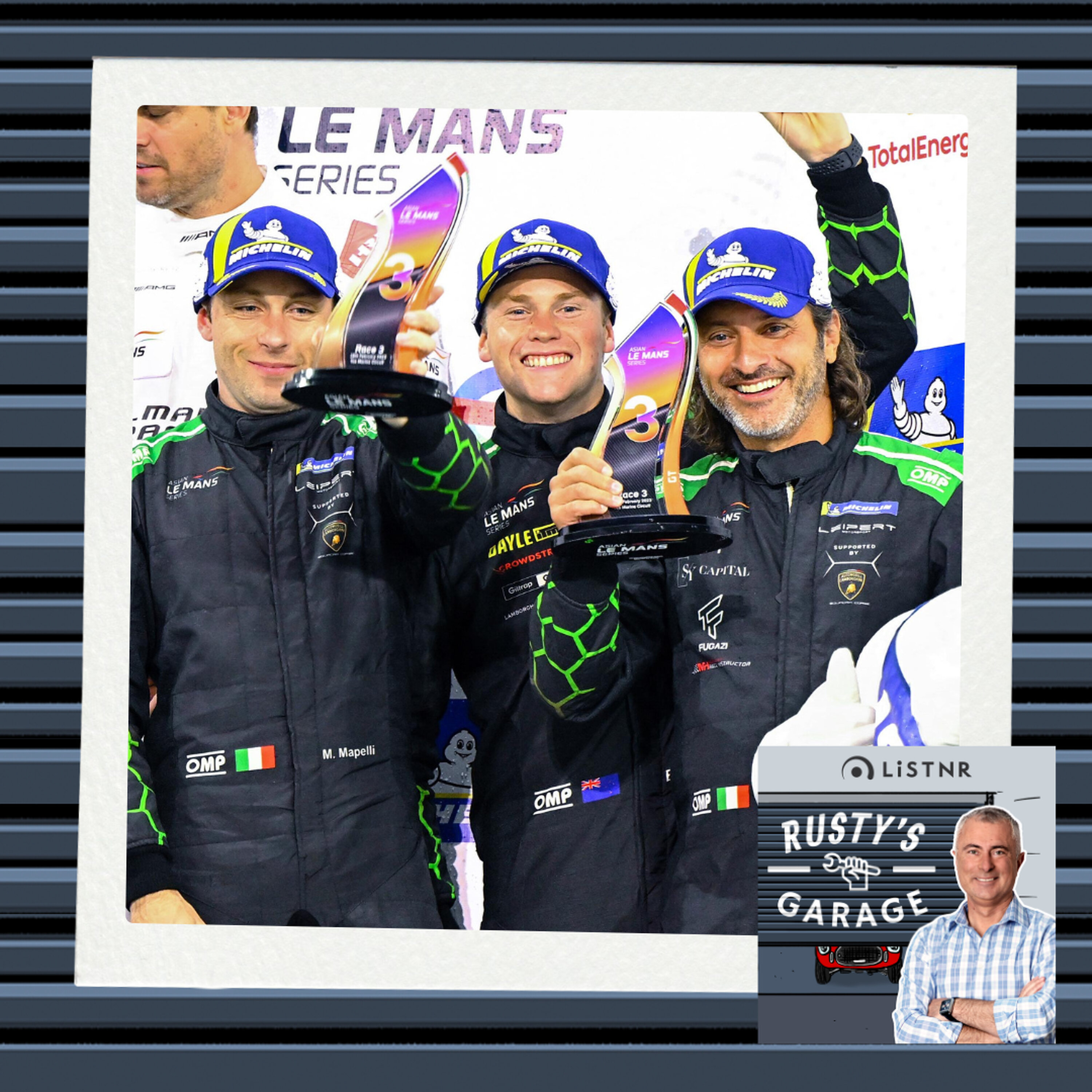
Brendon Leitch | Part 1 - workshop lessons & cold calls
About this episode
Recorded from a corporate box at Bend Motorsport Park, Brendon Leitch walks through his motorsport path—from early workshop lessons and family racing stories to the grind of sponsorship door-knocking and cold calls. He recalls learning engine rebuilding as a kid, racing go-karts and Formula Ford projects, and even a major triple-somersault crash in New Zealand. The conversation then tracks his persistence into GT opportunities, including GT3 testing in Europe, and how limited budgets shaped everything from tyres to race preparation.
Growing up at the bottom of the world and the strong Leitch racing genes.
Being round his Dad Barry’s internationally respected Motorsport restoration business and how that ‘hands on’ learning helps to this day.
Getting creative to find the budget to go racing and heading off with props in his backpack after school.
Working at Highlands Motorsport Park and for Scott O’Donnell (now part owner for Walkinshaw TWG Racing) in the early years.
The respect for his brother Damon’s talent and Brendon’s little known cooking skills.
What it was like to only race five weekends over the New Zealand summer (on a shoe string budget) but to beat some F1 stars of the future!
And the bollocking he received from a respected team manager that Brendon says helped shape his career.
Plus a funny rental car adventure in Japan.
This is one of those eps that will genuinely draw you in. Easy going, affable but hungry and determined. Brendon gets the podcast medium too and he converses here with ease.
Head to Rusty's Facebook, Twitter or Instagram and give us your feedback and let us know who you want to hear from on Rusty's Garage.
See omnystudio.com/listener for privacy information.
Bend Motorsport Park
"For this episode, I'm in a corporate box at the impressive Bend Motorsport Park [30.2s] about an hour out of Adelaide. Friday practice for the Shannon Speed Series"
Bend Motorsport Park is a race track where cars go to practice and compete. Here, it’s where the weekend’s racing activities are happening.
Bend Motorsport Park is a racing circuit used for motorsport events and practice sessions. In the context of this episode, it’s the venue where Friday practice for the Shannon Speed Series just wrapped up.
Shannon Speed Series
"about an hour out of Adelaide. Friday practice for the Shannon Speed Series [33.9s] has just wrapped up and my guest, Brendan Leach, has a rice smile on his face."
The Shannon Speed Series is a racing competition series. In this episode, it’s the event Brendan is taking part in over the weekend.
The Shannon Speed Series is a motorsport racing series, referenced here through its Friday practice session. The hosts use it to set the weekend context for Brendan Leach’s GT3 racing.

Mercedes-AMG GT3
"my guest, Brendan Leach, has a rice smile on his face. [39.0s] That's because the Mercedes-AMG GT3 that he races with Sergio Pires"
The Mercedes-AMG GT3 is a race version of a Mercedes-AMG sports car made for a popular worldwide racing class called GT3. It’s built to be fast and reliable over race weekends, not just for short sprints.
The Mercedes-AMG GT3 is a purpose-built race car for GT3-spec competition, meaning it’s designed to be competitive in customer racing series rather than as a one-off prototype. It’s based on Mercedes-AMG’s GT platform but heavily modified for endurance-style racing, including race-focused aerodynamics and a setup aimed at consistent lap times.
Sergio Pires
"That's because the Mercedes-AMG GT3 that he races with Sergio Pires [44.0s] and Tagani Motorsport is in very good shape."
Sergio Pires is another driver involved with Brendan Leach’s race car. In races like these, drivers often share the car and work together to get good results.
Sergio Pires is named as a co-driver or racing partner for the Mercedes-AMG GT3 that Brendan Leach races. In endurance-style GT racing, co-drivers share driving duties and help with overall race performance.
Tagani Motorsport
"That's because the Mercedes-AMG GT3 that he races with Sergio Pires [44.0s] and Tagani Motorsport is in very good shape."
Tagani Motorsport is the team that helps run the race car. They’re responsible for things like getting the car ready and supporting the driver during the race weekend.
Tagani Motorsport is the racing team/operation associated with the Mercedes-AMG GT3 that Brendan Leach races. In motorsport, teams like this handle day-to-day preparation, setup, and race execution alongside the driver.
hour-long races
"In fact, 24 hours after we recorded this, they took a very memorable win [52.8s] in the first of the weekend's hour-long races."
Hour-long races are endurance-style events where the key challenge is staying consistent for a long time, not just going fast for a few laps. Strategy often includes tire and fuel management, plus keeping the car in a condition that can survive the full race duration.
Leach Motorsport and Restoration
"being around some seriously cool cars in his Dad Barry's workshop, [87.0s] the internationally respected Leach Motorsport and Restoration."
Leach Motorsport and Restoration is the business tied to Brendan Leach’s family and workshop. It’s connected to racing work and also to restoring cars.
Leach Motorsport and Restoration is referenced as an internationally respected operation connected to Brendan Leach’s background. The “motorsport and restoration” framing suggests involvement in both racing preparation and preserving/restoring vehicles.
Tim Miles
"He also talks about his friendship with the late Tim Miles, racing with him [103.7s] and the things that Tim quietly helped him with."
Tim Miles was a person Brendan Leach knew well and raced with. The host says Tim helped Brendan in a behind-the-scenes way.
Tim Miles is described as the late person Brendan Leach was friends with and raced with. The episode frames Tim as someone who quietly helped Brendan with practical racing support.
DayLITM
"There's a long-standing commercial connection with the Day family and DayLITM, [111.5s] plus the craziness of flatting with a couple of motorsport journals"
DayLITM is a business name connected to Brendan Leach through a long-term relationship. The episode suggests it’s part of the support network behind his racing career.
DayLITM is mentioned as part of a long-standing commercial connection with the Day family. While the transcript doesn’t explain what DayLITM does, it’s clearly a business relationship relevant to Brendan Leach’s motorsport path.
diamond hones
"and I'm just measuring tolerances on the rings with diamond hones and wondering what they were and every little detail like that"
A diamond hone is a special tool used to lightly sand the inside of an engine cylinder. The goal is to make the surface smooth and “just right” so the piston rings can seal well.
Diamond hones are abrasive tools used to refine the surface finish inside engine cylinders. In rebuilding an engine, they help achieve the correct cylinder wall texture so piston rings can seat properly and seal combustion gases.
tolerances
"and I'm just measuring tolerances on the rings with diamond hones"
Tolerances are how precisely parts have to fit together. In an engine rebuild, checking tolerances helps make sure everything seals and moves correctly.
Tolerances are the allowable tightness/clearance between engine parts. When tolerances are measured during a rebuild, it helps ensure the rings, pistons, and cylinder surfaces work together without excessive wear or poor sealing.
rings
"and I'm just measuring tolerances on the rings with diamond hones"
In this context, “rings” refers to piston rings, which sit in grooves on the piston. They seal the gap between the piston and cylinder wall to control oil and combustion gases, and they need the right cylinder finish to seat correctly.
racing background
"“...your Dad's work that he does on cars... your mum's been a pretty handy steerer too... Yeah, mum used to race.”"
This part is about the guest’s family history with racing. It explains where their interest and skills came from before getting into the workshop and business side.
This segment focuses on the guest’s family racing background, including karting and early involvement in motorsport. It sets context for how racing knowledge gets passed down and how the workshop/cold-calls theme ties into real-world experience.
Go-Karts
"“Yeah, mum used to race. She was in Go-Karts.”"
Go-karts are small race cars you often start with when learning to race. They’re quick to respond, so you learn how to steer, brake, and corner effectively.
Go-karts are small, lightweight racing vehicles used as an entry point to motorsport. Because they’re simple and responsive, they’re great for learning racecraft like braking points, corner entry, and driving lines.

Ac Cobras
"Dad built these half-size replica AC Cobras. Cool."
The AC Cobra is a famous old-school sports car. Here, they’re talking about half-size toy replicas that look like a Cobra so kids could “drive” around the yard.
The AC Cobra is a classic British sports car known for its lightweight roadster body and big V8 power. In this story, Brendon’s dad built half-size replica versions, which is a fun way to mimic the Cobra’s look and driving feel at a kid scale.
Caterham Lotus 7 Bleach Super Sprint
"And also a Caterham Lotus 7 Bleach Super Sprint. So he would, you know, we had one of each for like,"
Caterham makes small, lightweight sports cars inspired by the Lotus 7. This “Bleach Super Sprint” is a specific version they had as a toy, and the person says it felt lighter and quicker than the other one.
Caterham is known for the Lotus 7–style lightweight, open-top roadster formula. The “Bleach Super Sprint” name points to a specific Caterham variant/trim, and the speaker says it was lighter and faster than the other toy car, matching the Lotus 7 idea of low weight for quicker response.
160cc motor
"and these things, they had a little Honda engine in them, like a little hundred, 160cc motor."
“160cc” tells you how big the engine is. In this case it’s a small engine size, which makes sense because these are toy cars for driving around the lawn.
“cc” (cubic centimeters) is engine displacement, a measure of the engine’s size. A 160cc engine is small, which fits the context: these are toy-scale cars with motorcycle-like engines rather than full-size sports cars.
CART Sport New Zealand
"CART Sport New Zealand gave me a dispensation to do my first race when I was like, you know, five and 360 days."
CART Sport New Zealand is the group that made an exception so the guest could race when he was still very young. It’s basically the authority that handles racing rules.
CART Sport New Zealand is referenced as the organization that granted Brendon Leitch a dispensation so he could race at a very young age. The mention is about motorsport governance—rules and exceptions that allow participation.
dispensation
"CART Sport New Zealand gave me a dispensation to do my first race when I was like, you know, five and 360 days."
A dispensation is an official exception to the rules. In this case, it let him race earlier than the usual age limit.
In motorsport, a dispensation is an official exception to the normal eligibility rules—here, allowing a child to compete earlier than the standard age requirement. It’s essentially a permission granted by the sanctioning body.
Ralts RZ4
"One that is sort of uppermost in my mind is that, that Ralts RZ4, the Formula Atlantic, right? The Jacques Lafitte car, Jautane livery."
The Ralts RZ4 is a dedicated race car used in Formula Atlantic. It’s the kind of car built for open-wheel racing, and the guest says he actually raced one.
The Ralts RZ4 is a Formula Atlantic race car built by Ralts, known for being a purpose-built open-wheel chassis used in Atlantic-series competition. In this episode, Brendon Leitch specifically connects it to historic racing and his own experience driving it.
Formula Atlantic
"One that is sort of uppermost in my mind is that, that Ralts RZ4, the Formula Atlantic, right? The Jacques Lafitte car, Jautane livery."
Formula Atlantic is a type of open-wheel race series. It’s often seen as a ladder for drivers, and specific race cars are built to match its rules.
Formula Atlantic is an open-wheel racing category that sits below top-tier Formula racing, historically serving as a stepping stone for drivers. Cars like the Ralts RZ4 are built to compete in this specific formula, with rules shaping chassis and performance characteristics.
Lady Wygrom Cup
"I was really lucky 2013 or 2014. I did the Lady Wygrom Cup in it, which was a historic race for Atlantic."
The Lady Wygrom Cup is a race event for historic cars. In this segment, the guest says he raced the Ralts RZ4 in it.
The Lady Wygrom Cup is a historic race event Brendon Leitch mentions as the competition where he drove the Ralts RZ4. The key detail here is that it’s framed as a historic race for Atlantic cars.
historic race
"I did the Lady Wygrom Cup in it, which was a historic race for Atlantic."
A historic race is an event where older cars are raced, typically to preserve and celebrate motorsport history rather than to crown current-spec champions. Here, it’s used to describe the Lady Wygrom Cup as a historic competition for Atlantic cars.
in-car robot adjustment
"[530.3s] It's pretty cool. [530.9s] It has an in-car robot adjustment. [533.9s] So, I mean, for me, growing up in junior formula,"
This sounds like a system that can automatically adjust something on the car while you’re driving. Instead of setting it once before you go out, it helps you change how the car grips so it feels better in different conditions.
“In-car robot adjustment” here refers to an electronically controlled system that can change a chassis or suspension setting while you’re driving. The goal is to let the driver tune grip balance on the fly, rather than relying on a fixed setup before the run.
front grip
"[541.6s] just to have the front-handy robot [543.5s] you can adjust how much front grip you had [545.1s] in the car while you're driving."
Front grip is basically how well the front tires can stick to the road. More front grip usually makes the car turn in more easily; less front grip can make it feel like it won’t turn and pushes outward.
“Front grip” is how much traction the front tires have, which strongly affects steering feel and how quickly the car turns in. If front grip is reduced, the car can understeer (push wide); if it’s increased, the car can rotate more readily into corners.
five-speed H-pat
"[546.3s] And I mean, you've got a five-speed H-pat and gearbox there [549.7s] and just trying not to over-ever the thing [551.6s] and just felt, I don't know,"
This is describing a manual transmission with five gears and a standard shift pattern. You move the gear lever into different positions to pick each gear.
“Five-speed H-pat” appears to mean a five-speed manual gearbox with an H-pattern shifter gate. An H-pattern manual uses a physical shift pattern (typically 1st/2nd on one side and 3rd/4th/5th on the other) that the driver selects with the lever.
over-ever
"[549.7s] and just trying not to over-ever the thing [551.6s] and just felt, I don't know, [553.3s] they feel very different to the cars of now."
This likely means “over-revving,” or spinning the engine too fast. Drivers avoid that because it can be hard on the engine.
“Over-ever” is likely a mis-transcription of “over-rev,” meaning pushing the engine beyond its safe RPM range. Over-revving can risk engine damage, so drivers try to keep RPM under control when shifting and accelerating.
visceral
"[556.8s] Chapo's a journal. [558.1s] He would say probably like visceral, [559.4s] like a real kind of driver's car magic sound."
“Visceral” here means the car feels really physical and exciting—like you can sense what it’s doing through the steering wheel and seat. It’s the opposite of feeling numb or disconnected.
“Visceral” in driving talk means the car communicates through physical feedback—sound, vibration, steering, and throttle response—so it feels immediate and emotionally engaging. It’s often used to describe cars that feel more “alive” than modern, more insulated designs.

Dodge Journey
"...-bent on going car racing? And what is the racing journey up until that point? I guess this is almost a cro..."
The Dodge Journey is a crossover SUV, meaning it’s built for everyday driving with more space than a small car. It’s typically chosen for practicality like passenger room and cargo space. If it’s mentioned in a personal story, it’s likely the person’s everyday vehicle before or alongside other interests.
The Dodge Journey is a mid-size crossover SUV designed for family-oriented use, with seating and cargo space aimed at everyday practicality. It can come up in conversations about “car journeys” because it’s a common choice for people who want an SUV without going to full-size. In the podcast context, it’s mentioned as part of a broader discussion about someone’s racing or driving path.

Chevrolet Corvette
"...Eastwood was there, and he's racing in WEC, now a Corvette driver. Into 2016 was the year of Landon Orris,"
The Chevrolet Corvette is a fast sports car made for performance driving. It’s also used in racing, so people may talk about it when discussing drivers and competition. If someone says they’re a “Corvette driver,” it means they race Corvettes.
The Chevrolet Corvette is a performance sports car known for its strong power and track-focused heritage. In a racing context, it’s often discussed because it has a long history of being adapted for competition and driving programs. Mentioning a “Corvette driver” ties the car to motorsport participation and performance credentials.

Mini Countryman
"...nd if you do, then you'll make it work. Brendan's countryman, Paul Radisic, came on the pod back in 2019"
The Mini Countryman is a small crossover SUV made by Mini. It’s designed to be practical for daily driving, with more space than a basic Mini hatchback. People bring it up because it’s a common, usable car rather than a race car.
The Mini Countryman is a compact crossover that blends Mini styling with more practicality than a typical small hatchback. It’s often brought up in everyday ownership discussions because it offers usable space while staying relatively easy to drive. In the podcast context, it’s referenced through a specific person’s car, which makes it a relatable, real-world example.

Mercedes SLS AMG
"It was my first time driving a touring car, racing the Mercedes SLS AMG. It was really cool."
The Mercedes SLS AMG is a high-performance Mercedes made by AMG. It’s known for being fun to drive and for its big V8 sound, so it shows up in racing when people want something exciting and controllable.
The Mercedes SLS AMG is a performance coupe built by Mercedes-AMG, known for its naturally aspirated V8 and dramatic gullwing-style design. In racing contexts, it’s often used as a “driver’s car” platform because it’s predictable and sounds great while you’re pushing it.

Porsche Gt Career
"...me to go to touring cars and to try and chase the GT career. So, yeah, 2019 raced in Super Trefao Asia"
The Porsche Carrera GT is a very high-end sports car designed for fast driving. It’s the kind of car that shows up in serious racing conversations because it’s built for performance. The name “Carrera GT” refers to that specific supercar model.
The Porsche Carrera GT (often referred to as the Carrera GT) is a high-performance supercar built for extreme driving and track capability. It’s significant because it’s a rare, purpose-built machine that often comes up when discussing serious motorsport careers and “GT” racing paths. In the podcast context, it’s mentioned alongside racing progression and touring/GT ambitions.
pit limiter
"I got on the gas off the pit limiter, full throttle, and then hit the brakes like I had ABS"
A pit limiter is a system that limits how fast the car can go in the pit lane. When you leave the pits, the limiter turns off, so the car can accelerate much more strongly.
A pit limiter is an engine/ECU function that caps engine output while you’re driving in the pit lane. It helps keep speeds safe and consistent, and it changes how the car responds when you re-apply throttle after leaving the pits.
ABS
"and then hit the brakes like I had ABS and just torched the front tyres,"
ABS is a safety feature that stops your wheels from locking during hard braking. It helps you keep control of the car while you slow down.
ABS (anti-lock braking system) prevents the wheels from locking up during hard braking. When ABS activates, it rapidly modulates brake pressure, helping maintain steering control while still braking effectively.
Suzuka
"We were racing at Suzuka, and I had a driver coach. His name is Richard Bradley. ...after the qualifying session, I had fired the car off at Degna, too, in the middle of Suzuka,"
Suzuka is a well-known race track in Japan. It has challenging corners, so getting braking and pit-lane exits right matters a lot.
Suzuka is a famous motorsport circuit in Japan known for its complex layout and high-speed corners. It’s often used for top-level racing, so braking zones and pit exits there can be especially demanding.
Degna
"and after the qualifying session, I had fired the car off at Degna, too, in the middle of Suzuka,"
Degner is a specific corner at Suzuka. If you get the braking or turn-in wrong there, it’s easy to run wide or go off the track.
Degner (spoken here as “Degna”) is a well-known corner complex at Suzuka. It’s a braking/turn-in area where mistakes can quickly lead to going off-line, especially right after a qualifying session.
Formula 3
"but he taught me so much [2114.6s] on that championship in Formula 3 [2117.1s] that it progressed my current racing so much."
Formula 3 is a racing series where up-and-coming drivers compete in open-wheel cars. It’s often used to learn the skills needed to move up to bigger, faster racing categories.
Formula 3 is a junior open-wheel racing series used as a stepping stone toward higher categories like Formula 2 and Formula 1. It’s a common place for young drivers to build racecraft, car setup feedback skills, and race strategy under professional coaching.
Mandelika
"We just finished in Mandelika in Indonesia, [2139.9s] which was a brand new circuit to me, [2142.4s] and never been there before,"
Mandalika is a race track in Indonesia. In this story, it was new to the driver, so they had to learn it fast before going out for real laps.
Mandalika refers to the Mandalika circuit in Indonesia, which hosts major motorsport events. The key point here is that it was a brand-new track for the driver, so they relied on preparation to learn braking points and racing lines quickly.
simulator
"can watch video, but nothing beats driving on it, [2146.8s] so I managed to find a good track model in my simulator [2149.8s] and jump on there and cut lots and lots of laps,"
A simulator is like a realistic racing video game used for practice. It helps drivers learn a track and plan things like when to brake before they drive the real car.
A simulator is a racing training tool that recreates a track and car behavior on a computer. Drivers use it to practice lap-by-lap details—like braking zones—before or between real sessions, especially when they’re visiting a circuit for the first time.
Ferrari
"and we were right at the top of the times, [2157.9s] like in the first run on the car, [2159.7s] I knew the Ferrari already from the first round,"
Ferrari is a famous racing car brand. In this segment, the driver says they already understood how the Ferrari felt, which helped them focus on learning the new track.
Ferrari is an Italian performance and racing brand known for competing in top-level motorsport. Here it’s mentioned because the driver already knew the Ferrari’s behavior from earlier sessions, even though the track itself was new.
brake
"didn't know the track, [2163.8s] but I knew exactly where I needed to brake,"
In racing, “brake” is about when you slow down before a corner. If you know the right braking point, you can carry the right speed into the turn instead of guessing.
In racing, “brake” usually refers to braking points—where and when you slow down to set up the corner entry. Knowing exactly where to brake is crucial on an unfamiliar track because it determines your speed, traction, and line through the turn.
mileage
"when you waste five laps, [2188.4s] that's, you know, it's a lot of mileage on the parts, [2191.3s] it's not necessary, you know, where you can do this."
Here, “mileage” just means how far the car has been driven. On a race weekend, extra laps wear out parts faster, so it can cost more money.
In this context, “mileage” means how much distance the car covers on track. More track distance means more wear on consumable parts, so wasting laps can increase maintenance costs and reduce reliability during a race weekend.
race weekend
"you're limited with your driving time [2198.6s] on a race weekend, you know, you have limited sessions, [2200.7s] one-hour sessions through both days,"
A “race weekend” is the whole event across a couple of days. Drivers only get limited practice time, so you can’t just drive as much as you want.
A “race weekend” is the multi-day event structure where drivers get limited practice and qualifying time before racing. The speaker emphasizes that because sessions are capped (including one-hour sessions across days), efficient practice matters.
Ben Motorsport Park
"like in the lead-up to where Taylor and Ben did, [2220.7s] the Ben Motorsport Park."
“Ben Motorsport Park” is a specific racing venue mentioned as the location tied to the lead-up content. In motorsport, track-specific learning (lines, braking points, and setup changes) is a big part of how drivers improve between sessions.

Toyota Hiace
"Who pulls up but, like, a typical Toyota Hiace van, like a Silver Hiace van with four Japanese builders in it?"
A Toyota Hiace is a common type of van in many countries. Here, it’s just the vehicle that pulls over to help them when they’re stuck.
The Toyota Hiace is a popular Japanese van used for people and cargo, often seen as a practical work vehicle. In this story, the hosts describe it as the van that stops to help after their car breaks down on the road.

Lamborghini GT3
"So, end of 2019, I got the opportunity to go to Europe and test the Lamborghini GT3 car for the first time. Current spec car"
This is a Lamborghini race car built for GT3 racing. It’s made to be fast and reliable for track events, and it has to follow a common set of racing rules so different brands can compete fairly.
A Lamborghini GT3 is a race-prepped version of a Lamborghini built to compete in GT3-style endurance and sprint series. GT3 cars are designed around a balance of speed, durability, and rules-based performance so private teams can race them.

Audi R8
"we put together a program [2589.0s] and an old Audi R8, LMS, [2591.5s] one of the first generation cars, [2592.9s] which was really cool looking back on,"
The Audi R8 is a supercar made by Audi, and it’s built with the engine in the middle of the car. That mid-engine design helps it handle well, and the early (first-generation) R8s are especially recognizable.
The Audi R8 is Audi’s mid-engine supercar, known for its V8/V10 powertrains and track-capable layout. In this episode, Brendon Leitch mentions an old Audi R8 from the first generation, which is a common enthusiast reference point because the early cars have a distinct look and racing pedigree.
South Island Insurance Championship
"And we did the [2599.3s] South Island Insurance Championship there [2601.6s] and then by the time we got into that"
This is the name of a racing series in New Zealand’s South Island. The host is mentioning it to explain when they got back into competition.
This refers to a regional motorsport series in New Zealand’s South Island. The episode uses it as a timeline marker for when the speaker was racing again after earlier uncertainty.
Request an Explanation
Heard something you'd like explained? We'll add it to this episode.
Sign in to request explanations for terms you heard.
Want to learn more?
Browse our glossary for plain-English explanations of automotive terms, jargon, and concepts.
Help improve this episode
See something that's not quite right? Our annotations are AI-generated and can sometimes miss the mark. Click the flag icon on any annotation to suggest a correction.