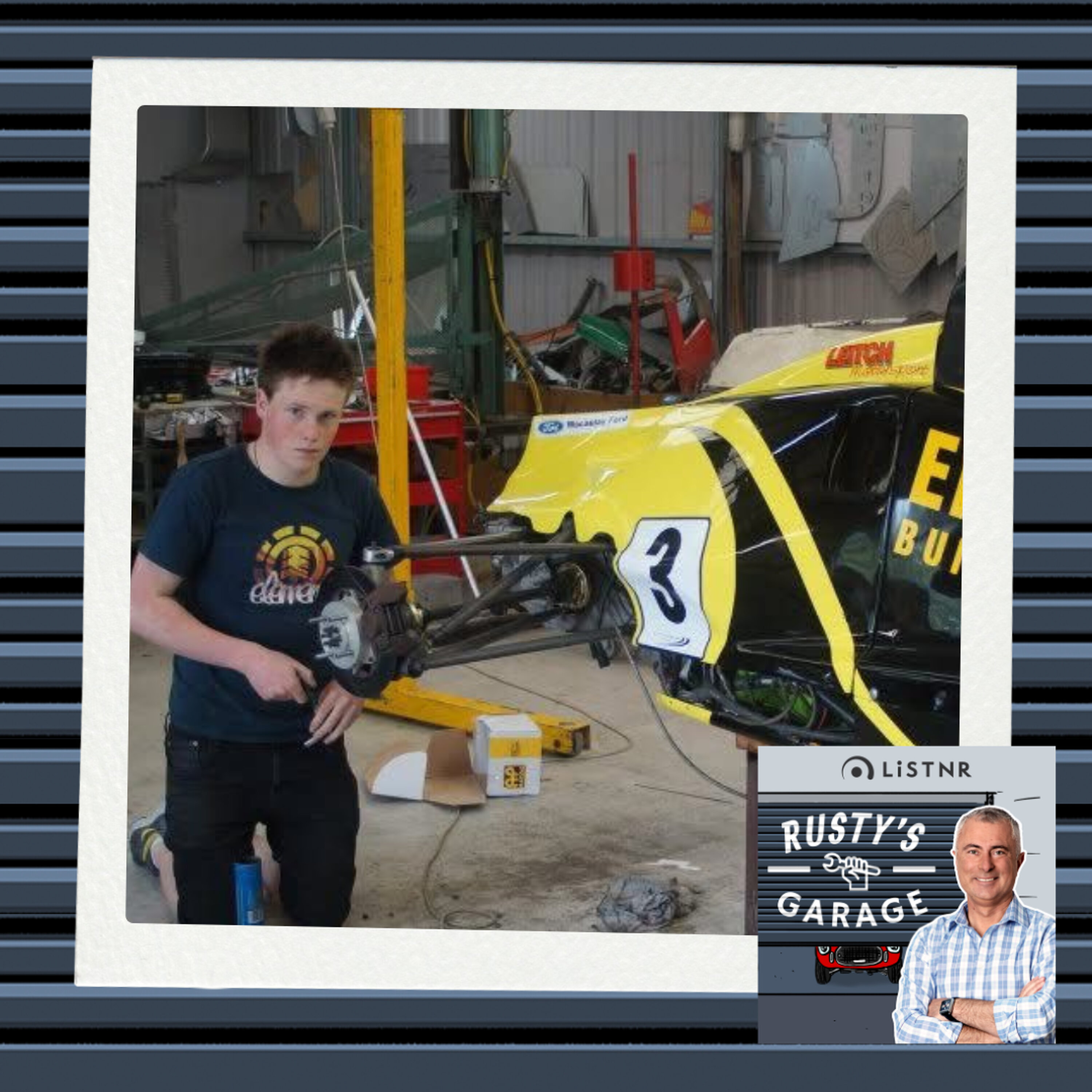
Brendon Leitch | Part 2 - GT Gun for Hire & Mentor Miles
About this episode
Shifting from sprint GT3 to endurance racing, Miles breaks down stint planning and the reality of “managing the traffic,” even after incidents like “taking out a TCR car at the Hockenheim race.” Brendon’s path weaves through GT World Challenge, Pro-Am mentoring, and learning by chasing faster drivers—then pivots after being denied a Lamborghini factory promotion. In Australia, opportunities come through relationships, co-driving, and sim racing coaching, with confidence boosted by factory-car experience and key championship momentum at Phillip Island.
When the going gets tough….the tough get going as they say!
Finding support from the Day Family in New Zealand and the secret to its longevity.
Spreading his wings to compete abroad and doing double duties between Formula 3 and racing a Lamborghini in Asia.
Stepping up to GT3’s and making it to the big stage against the likes of Valentino Rossi and more.
Why Pro-Am racing is about bringing so much more than just driving talent and how he’s enjoying the chance to share the knowledge now.
SIM racing with Shane van Gisbergen and some laughs while flatting with Motorsport journos James Pavey and Simon Chapman.
Memories of his late codriving mate Tim Miles and how ‘Milesy’ quietly helped make a Supercars test happen.
You get the feeling Brendon has unfinished business in Supercars but in the meantime he’s found a new home at Tigani Motorsport and the day after we recorded he and Sergio Pires won in the team’s Mercedes AMG GT3 at The Bend Motorsport Park.
If you’re an aspiring racer there are some ripper takeaways in this convo as well, from underrated skills in Motorsport and is finding an opportunity or keeping it harder?
Head to Rusty's Facebook, Twitter or Instagram and give us your feedback and let us know who you want to hear from on Rusty's Garage.
See omnystudio.com/listener for privacy information.
GT3 class
"There's lots of legends in the GT3 class. [76.4s] You are on the big stage, mate."
GT3 is a type of race category where car makers build race cars based on real production models. The rules are designed so different brands can race each other more fairly.
The GT3 class is a global endurance/sprint racing category for production-based sports cars. Cars are built to a common rule set (with balance-of-performance adjustments) so different brands can compete on relatively even terms.
endurance races
"In 2021, those endurance races, they did well. [92.4s] It was great for me to really understand how GT3 racing works on the other side of the planet. [99.0s] Endurance racing, how that works at, like, at a top level."
Endurance races are long races where you have to keep the car quick and controlled for a long time. It’s not only about speed—drivers also manage tires, fuel, and other cars on track.
Endurance races are long-duration events where the key challenge is staying fast and consistent for hours, not just for a short sprint. Strategy matters—stints, tire/fuel management, and dealing with traffic between faster and slower cars.
stint
"and just trying to squeeze every bit of lap time out [126.2s] and try and minimize, make your stint, you know, [128.8s] get as many laps as possible within that stint."
A stint is how long a driver keeps the car on track before the next planned change. In long races, it’s usually tied to tire wear and when you switch drivers.
A stint is the period a driver (or a car) stays on track before a planned change—commonly a driver swap in endurance racing. Managing stints is about balancing pace, tire wear, and how long you can run before the next stop.
TCR car
"So managing the traffic was something that I wasn't used to before. [134.9s] I ended up taking out a TCR car at the Hockenheim race,"
TCR is a racing series for production-based cars (usually front-wheel drive) with standardized rules. In mixed events, a TCR car can be slower traffic that faster GT cars have to navigate safely.
TCR is a touring-car racing formula built around front-wheel-drive production cars with standardized rules. A “TCR car” refers to cars competing in that category, which often runs alongside GT events—so GT drivers can encounter them as slower traffic.
Hockenheim race
"So managing the traffic was something that I wasn't used to before. [134.9s] I ended up taking out a TCR car at the Hockenheim race,"
Hockenheim is a famous race track in Germany. It has fast sections and big braking areas, so drivers have to deal with other cars and plan passes carefully.
Hockenheimring (often shortened to Hockenheim) is a major German circuit used for touring car and GT racing. It’s known for long straights and heavy braking zones, which makes traffic and overtaking especially important in endurance events.
GT World Challenge Europe
"[168.8s] But for me in 2021, it was, it was really important. [173.2s] And in 2022 was when I first raced in GT World Challenge Europe. [176.7s] And that was, that is the biggest GT3 championship in the world."
GT World Challenge Europe is a big racing series in Europe for GT3 race cars. Drivers and teams compete at multiple tracks, and it’s a common stepping stone for people aiming to race at the highest levels of GT racing.
GT World Challenge Europe is a major international sports-car racing series for GT3-spec cars, run across multiple rounds in Europe. It’s known for factory-backed teams and pro-am driver lineups, with races that test both pace and consistency.
Spa 24 hour
"[176.7s] And that was, that is the biggest GT3 championship in the world. [182.6s] It's Spa 24 hour. [184.5s] Back then it was the three hours of Imola, 24 hours of Spa,"
“Spa 24 hour” is a famous 24-hour endurance race held at Spa in Belgium. It’s a major event where teams have to manage speed, reliability, and changing conditions for an entire day.
“Spa 24 hour” refers to the 24-hour endurance race at Circuit de Spa-Francorchamps in Belgium. It’s one of the most prestigious endurance events in the world, famous for fast corners, elevation changes, and variable weather.
Imola
"[184.5s] Back then it was the three hours of Imola, 24 hours of Spa, [189.8s] Barcelona, Hockenheim and one other track. [192.6s] I can't remember right now, but it was something."
Imola is a well-known race track in Italy. Drivers often talk about it because it has a challenging layout that rewards good car control.
Imola refers to Autodromo Internazionale Enzo e Dino Ferrari, a circuit near Imola, Italy. It’s known for a mix of fast sections and technical corners, and it’s a common venue for GT and touring-car racing.
Barcelona
"[189.8s] Barcelona, Hockenheim and one other track. [192.6s] I can't remember right now, but it was something. [193.3s] I mean, this is a heck of a roll call of amazing places."
Barcelona is a race track in Spain used for motorsport events. It’s a mix of fast and twisty sections, so it tests both top speed and handling.
Barcelona here refers to the Circuit de Barcelona-Catalunya, a prominent European road course in Spain. It’s frequently used for GT and endurance racing because it combines long straights with technical corners.
qualifying
"[196.1s] That's right. And I did, I did the first race. [198.7s] I did an amazing job in qualifying. [200.4s] And I remember how good the lap was and I qualified 41st."
Qualifying is when drivers try to set their best lap time before the race. Your qualifying result helps decide where you start, which can make the race easier or harder.
Qualifying is the session where drivers set their fastest lap times to determine starting positions for the race. In GT racing, qualifying performance can be crucial because track position affects how easily you can avoid traffic and manage tire wear.
Daytona
"The only one I can think of right now is Daytona that I haven't competed on. I mean, I did Le Mans in 2023 in the Michelin-Lemon Cup."
Daytona is a famous race track in Florida. People really want to race there because endurance races are tough and you have to stay fast for a long time.
Daytona refers to the Daytona road course/oval racing complex in Florida, best known for endurance racing. It’s a major bucket-list track for drivers because the event format demands both speed and consistency over long stints.
Le Mans
"I mean, I did Le Mans in 2023 in the Michelin-Lemon Cup. I didn't do the 24-hour, but we had a really awesome weekend in Le Mans Cup that weekend"
Le Mans is one of the most famous endurance races in the world in France. It’s a 24-hour event, so the cars have to last and the drivers have to stay consistent.
Le Mans is the famous French endurance race (the 24 Hours of Le Mans) held at the Circuit de la Sarthe. It’s a defining event in sports-car racing where reliability, driver stints, and strategy matter as much as outright pace.
Michelin-Lemon Cup
"I mean, I did Le Mans in 2023 in the Michelin-Lemon Cup. I didn't do the 24-hour, but we had a really awesome weekend in Le Mans Cup that weekend"
Michelin-Lemon Cup sounds like a specific racing class or event name. The important part is that it wasn’t the full 24-hour Le Mans race, but a related competition at the same kind of weekend.
Michelin-Lemon Cup appears to be a branded racing class/cup associated with Michelin and a “lemon” theme. The key point here is that the speaker competed in a specific support/feeder competition rather than the full 24-hour Le Mans race.
factory car
"It was the first time I ever drove a factory car, like the car had been with the factory and prepared and, you know, we had all the engineers around us from the manufacturer"
A “factory car” is a race car backed by the car maker itself. Instead of just a private team, you often get help from the manufacturer’s engineers and better-prepared equipment.
A “factory car” means a race car prepared and supported by the vehicle manufacturer (or its official program), not a privateer team. It typically comes with manufacturer engineers, data support, and parts preparation that can materially affect performance and reliability.
Marco Mappalli
"and Gabriel and Don and Marco Mappalli. And Marco is like a world-class driver, anybody that knows motorsport knows Marco"
Marco Mappalli is another racing driver the speaker worked with as a teammate. The host is basically saying he’s very highly regarded in motorsport.
Marco Mappalli is a motorsport driver mentioned as one of the speaker’s teammates in the factory-car experience. The speaker frames him as a “world-class driver,” indicating his high standing in the racing community.

GT3 car
"And the first time that I've probably been in a situation [456.7s] in a GT3 car where I was in the same car, I was the chaser."
A GT3 car is a type of race car used in many pro-am series. It’s based on a regular sports car, but it’s modified for racing—so it has race-focused parts and grip.
A GT3 car refers to a race car built to the FIA GT3 rules, which are designed for customer teams rather than factory prototypes. These cars are typically based on production models but are heavily modified for racing, including aerodynamics and racing tires.
Abu Dhabi
"We ended up with two podiums in Abu Dhabi that year in Asian Le Mans. [489.5s] And we just missed out on top three in the Asian Le Mans series"
Abu Dhabi is a city in the United Arab Emirates that hosts race events. Here, it’s the location where the speaker says their team got podium finishes.
Abu Dhabi is a major motorsport venue in the Middle East, hosting endurance and GT racing events on purpose-built circuits. In this context, it’s where the speaker says they achieved podium results in the Asian Le Mans series.
Lamborghini factory driver
"[670.8s] I kept in touch with Tim, obviously, frequently, [673.1s] and after that, you know, [674.8s] he started talking about wanting to do some racing with me. [677.2s] And I was like, I didn't think, you know, so much of it. [679.7s] Then I was, you know, laser focused on becoming [682.7s] or trying to become a Lamborghini factory driver."
A “factory driver” is a driver hired or supported by the car maker itself. It usually means the manufacturer helps with the racing team and the cars.
A “Lamborghini factory driver” means being an official works driver for Lamborghini, typically supported directly by the manufacturer. In practice, it usually involves factory-backed racing programs and access to team resources, engineers, and current-spec race cars.
Lamborghini Super Traffa Europe
"[689.0s] That weekend was the weekend before the final round [691.7s] of Lamborghini Super Traffa Europe, [693.6s] where after the six hour race, [695.2s] I flew straight back there to compete in the last round, [698.0s] and we won the European Championship."
This sounds like a Lamborghini-sponsored racing series in Europe. Drivers compete in Lamborghini cars using the same general rules.
“Lamborghini Super Traffa Europe” is a Lamborghini-branded racing series in Europe. The name suggests a one-make or manufacturer-supported competition, where drivers race Lamborghini cars under a shared rule set.
six hour race
"[691.7s] of Lamborghini Super Traffa Europe, [693.6s] where after the six hour race, [695.2s] I flew straight back there to compete in the last round, [698.0s] and we won the European Championship."
A “six hour race” is a long event where the goal is to keep going for six hours. Teams usually have to stop for things like fuel and tires, so strategy is important.
A “six hour race” is an endurance format where cars run for a set duration rather than a fixed number of laps. These events typically involve pit stops for fuel and tires, and the strategy matters as much as outright speed.
infringement
"[728.0s] and we got another couple of trophies. [730.1s] We even won a race on the track, [731.5s] and got to take an office for an infringement. [734.8s] And then, yeah, then I went back to Europe,"
In racing, an “infringement” means you broke a rule. If that happens, officials can give penalties that can change how the race or championship standings turn out.
An “infringement” in racing is a rules violation that can lead to penalties. The speaker mentions taking an “office” for an infringement, which implies a formal penalty process (often involving stewards) that can affect results or points.
championship in Australia
"[770.2s] and we're getting told to leave, [772.1s] and I ended up with no drive. [774.0s] So I talked to him and said, hey, like, [776.0s] you still want a co-driver for this championship in Australia?"
They’re talking about a racing series that takes place in Australia. For this kind of racing, teams often need a co-driver, and if you don’t have one lined up, you can miss the whole season.
The “championship in Australia” is a named racing series the speaker is trying to secure a co-driver for. In endurance and GT racing, championships are typically multi-round events where co-driver availability can make or break a season.
co-driver
"[770.2s] and we're getting told to leave, [772.1s] and I ended up with no drive. [774.0s] So I talked to him and said, hey, like, [776.0s] you still want a co-driver for this championship in Australia?"
A co-driver is another driver who takes turns driving the same race car. In longer races, it helps keep the driver fresh and lets the team plan strategy better.
A co-driver is a second driver who shares driving duties with the primary driver, especially in endurance racing. Co-drivers help manage fatigue, maintain consistent lap times, and allow the team to run optimal pit-stop and strategy windows.
Highlands Motorsport Park
"[1045.7s] Brendan talked earlier about working at Highlands Motorsport Park [1049.3s] as he climbed the ladder. [1051.0s] That world-class venue is owned by Tony Quinn"
Highlands Motorsport Park is a race track in New Zealand. The host is saying Brendan worked there as part of building his career in motorsport.
Highlands Motorsport Park is a well-known racing circuit in New Zealand used for motorsport events and driver development. In this episode, it’s mentioned as the place Brendan worked while “climbing the ladder,” tying the venue to real-world racing career progression.
Tony Quinn
"[1051.0s] That world-class venue is owned by Tony Quinn [1053.3s] who joined Rusty on the Podium 2020"
Tony Quinn is the person the speaker says owns Highlands Motorsport Park, the race track mentioned in the episode. That makes him a key figure behind the venue where racing happens.
Tony Quinn is identified here as the owner of Highlands Motorsport Park. That ownership matters because it links a real motorsport facility to the local racing ecosystem and the “ladder” Brendan described earlier.
Phillip Island
"the second thing would have been [1269.7s] the first race at Phillip Island in 2024, I think. [1272.8s] I mean, there was many times in that championship [1293.1s] You know, Phillip Island was a track that I've watched"
Phillip Island is a famous race track in Australia. Wind and cornering make it tricky, so doing well early can really help a driver feel confident.
Phillip Island is a well-known road course in Australia, famous for its fast corners and coastal wind conditions that can strongly affect grip. In racing, it’s a track where momentum and confidence early in a season can matter a lot for results.

1973 Volkswagen combi
"Good. The final thing for me, you have a cool combi. Tell me about that, baby. Oh yeah, 1973 Volkswagen combi."
This is a 1973 Volkswagen “combi,” which is a classic VW bus. People love it because it’s roomy, has a simple mechanical setup, and it’s great for trips and tinkering.
A 1973 Volkswagen combi is the classic VW Type 2 “split-window” era microbus, known for its boxy shape and air-cooled flat-four engine layout. It became a cultural icon for road trips and community because it’s simple, spacious, and easy to personalize.
Request an Explanation
Heard something you'd like explained? We'll add it to this episode.
Sign in to request explanations for terms you heard.
Want to learn more?
Browse our glossary for plain-English explanations of automotive terms, jargon, and concepts.
Help improve this episode
See something that's not quite right? Our annotations are AI-generated and can sometimes miss the mark. Click the flag icon on any annotation to suggest a correction.