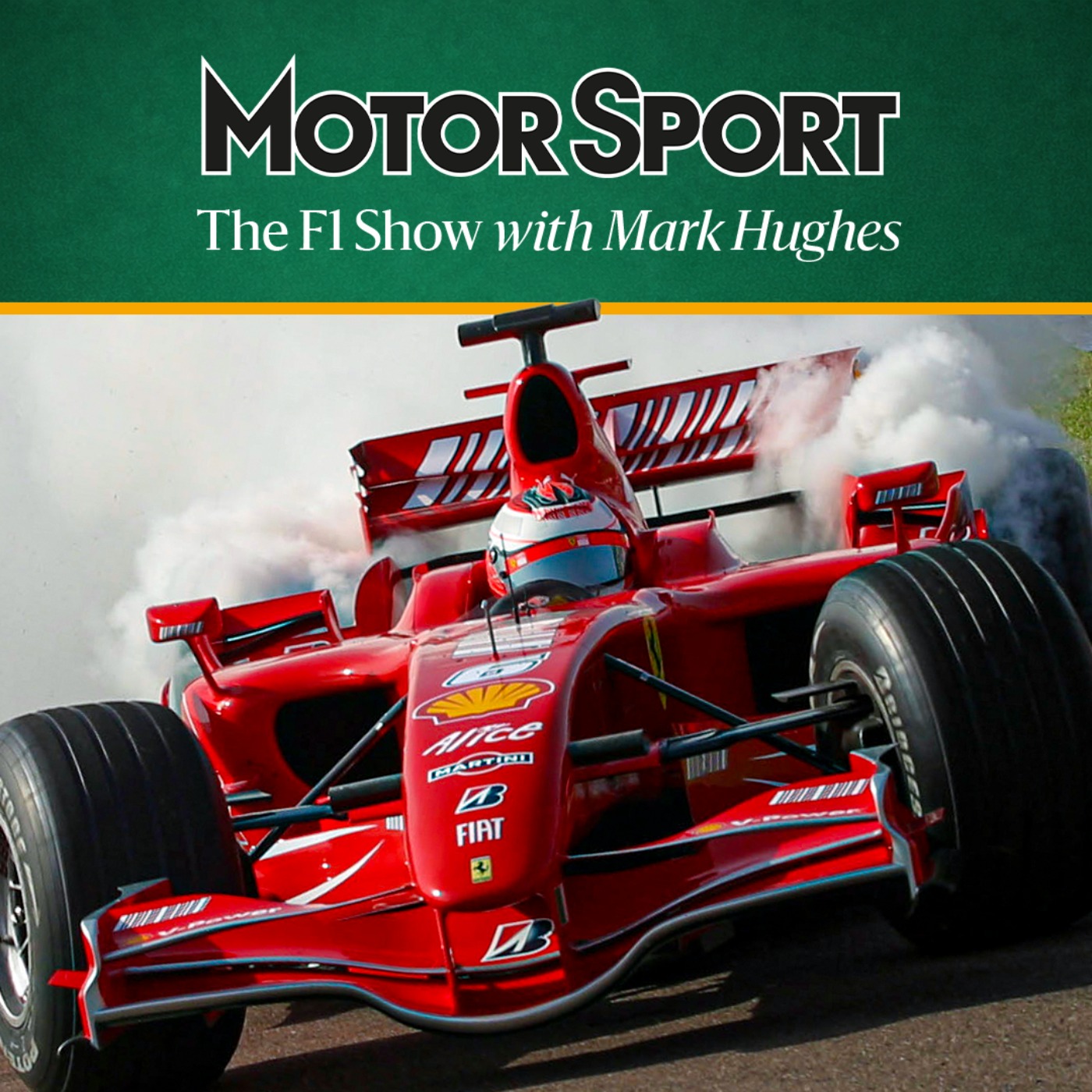
Can V8 engines save F1? Why they really are set for a comeback
About this episode
Mark Hughes and the hosts dig into why V8 engines could be on the way back to Formula One, arguing the current hybrid direction has not delivered as hoped. They connect that bigger regulation debate to Miami, where heat, rain, battery deployment and tire management shaped the race. The conversation also tracks the rise of Kimi Antonelli, Russell’s struggles, and how small gaps between closely matched cars can swing the championship picture quickly.
V8 engines are set to return to F1: the decision looks inevitable — it’s just a case of when.
Plus: George Russell has a big problem. After being outperformed by Kimi Antonelli, who took his third successive win in Miami, he's piled the pressure on himself to deliver at the upcoming Canadian Grand Prix. Is it crunch time for the championship already?
Has Mercedes lost its advantage? With teams bringing more upgrades to Montreal, we could see more drivers joining this year's title battle.
And your questions answered on why F1 doesn't simply ban aerodynamics, and the intricacies of energy deployment.
More from Mark Hughes and Bryn Lucas on the stories that really matter, in the latest episode of the Motor Sport F1 Show.
Subscribe now for every weekly episode and tell us what you want to know from Mark. Send us a message on social media or find this podcast at https://go.motorsportmagazine.com/4tepf25 and drop your questions in the comments. He'll answer a selection of the best every week.
Read Mark's column every Wednesday at https://go.motorsportmagazine.com/4tepf25
Hosted on Acast. See acast.com/privacy for more information.
V8 engines
"V8 engines are set to return to Formula One. The decision looks inevitable, it's just a case of when."
A V8 engine has eight cylinders arranged in a V shape. In racing, the engine type can change how the car feels and how it performs on track.
A V8 engine is an internal-combustion engine with eight cylinders arranged in a “V” shape. In F1 discussions, it matters because engine architecture affects power delivery, packaging, and how the car can manage energy and traction.
on-charge, off-charge
"You weren't seeing any outrageous on-charge, off-charge contrasts. There was a little bit of fatate around turning it in turn one..."
“On-charge” and “off-charge” are about when the car is using or building up energy from its hybrid system. That can affect how strong the car feels when it accelerates and how it manages speed through a lap.
“On-charge” and “off-charge” describe how an F1 car’s hybrid energy system is being used: on-charge is when the car is harvesting or deploying energy in a charging mode, while off-charge is when it’s not. These modes can change acceleration and how close cars run to each other.
battery
"It was a little bit like in Shanghai, where the battery just sort of kept the following cars in contention on the straight."
In modern F1, the “battery” stores electrical energy from the hybrid system so it can be deployed for acceleration and traction. How effectively teams manage battery energy can influence overtaking and defensive driving.
pit lane performance
"It was to do with the driver performance of Kimi Antonelli and the strategy performance, and then pit lane performance of Mercedes."
“Pit lane performance” is how well a team handles pit stops. If they’re faster or smarter than rivals, they can gain track position and change who wins.
“Pit lane performance” refers to how quickly and accurately a team executes pit stops and related procedures (like timing, driver release, and coordination). In F1, small differences in pit lane execution can swing track position and therefore race outcome.
strategy performance
"It was to do with the driver performance of Kimi Antonelli and the strategy performance, and then pit lane performance of Mercedes."
“Strategy performance” means how smart the team is about race decisions like when to pit. The right calls can help a driver gain position even if the cars are close.
“Strategy performance” is how well a team chooses when to pit, how to manage tires, and how to time energy deployment to match race conditions. Even with similar car speed, better strategy can determine who finishes ahead.
street circuit
"isn't being a street circuit in inverted commas. But before we do that, your article, your latest MPH column article, which as always is a really enjoyable read, this talks about the, the inter"
A street circuit is a race course made from regular city streets. Because it’s not built like a normal track, it’s usually tighter and has less room for mistakes.
A street circuit is a race track laid out using public roads rather than a purpose-built track. In Formula 1, that usually means tighter corners, less runoff, and more barriers, which can make cars harder to drive at the limit and can amplify weather and grip changes.
qualifying sessions
"where he was a long way off until his pace around four tenths off in each of the qualifying sessions and half a minute behind in the race."
Qualifying is when drivers set the fastest lap to decide where they start the race. If you’re a little quicker in qualifying, you usually start closer to the front.
Qualifying sessions in Formula 1 determine the starting order for the race. Drivers try to set their fastest lap in a limited time window, so small differences in car setup, tire choice, and track conditions can strongly affect grid position.
four tenths off
"where he was a long way off until his pace around four tenths off in each of the qualifying sessions and half a minute behind in the race."
“Four tenths off” means the driver was roughly 0.4 seconds slower than the reference. In racing, even a fraction of a second can be a big deal.
“Four tenths off” refers to being about 0.4 seconds slower than the benchmark lap time in qualifying. In F1, tenths of a second are huge because lap times are measured precisely and small gaps can translate into big differences in grid position and race pace.
three consecutive victories
"leading the championship by 20 points now, three consecutive victories, three consecutive polls. That is, I mean, less of a surprise, I mean, surprise there is that the stats have gone"
Consecutive victories means winning multiple races in a row. It usually shows the car is working really well, not just one lucky weekend.
In F1, consecutive victories are a strong indicator of a team and car that are consistently fast across multiple races. When a driver stacks wins early in the season, it often reflects both car performance and the ability to manage tires, strategy, and race pace repeatedly.
polls
"leading the championship by 20 points now, three consecutive victories, three consecutive polls. That is, I mean, less of a surprise. I mean, surprise there is that the stats have gone"
“Poles” means the driver qualified fastest and starts the race from the front. Starting first can make the race easier because you’re in clean air and have track position.
“Polls” here is almost certainly a transcription of “poles,” meaning the driver started from first position on the grid. Pole position is awarded to the fastest driver in qualifying and can be a major advantage in races, especially where overtaking is difficult.
glitch in Q3
"Russell should have probably been ahead in Suzuka. He just had a glitch in Q3, which put him behind and that was absolutely crucial to the outcome."
F1 qualifying is broken into parts called Q1, Q2, and Q3. If something goes wrong in Q3, the driver may not be able to set a fast lap, which can hurt where they start the race.
In Formula 1, qualifying is split into sessions (Q1, Q2, Q3). A “glitch in Q3” means a technical or operational problem during the final qualifying segment, which can prevent a driver from setting the best possible lap time and can strongly affect race starting position.
rookie season
"But he was never going to have an easier time from Antonelli in Antonelli's second season as he did in his rookie season. He came in the rookie season credibly lacking in experience."
A “rookie season” in F1 is a driver’s first year in the series. The transcript contrasts Antonelli’s early experience level with later development, implying that new drivers typically need time to adapt to car behavior, racecraft, and team processes.
F2
"He came in the rookie season credibly lacking in experience. You know, he'd done one season of F2, hadn't even done F3 before that."
F2 (Formula 2) is a lower-level racing series that many F1 drivers come through. Doing only one season there means the driver may not have had as much time to learn before stepping into F1.
F2 refers to Formula 2, the main feeder series to Formula 1. The transcript uses it to explain Antonelli’s limited background—having done one season of F2—before moving up, which affects how quickly a driver can adapt to F1.
F3
"You know, he'd done one season of F2, hadn't even done F3 before that. Very, very sort of sudden scent through the ranks."
F3 (Formula 3) is another step in the junior racing ladder. If a driver hasn’t done it, they may have had less time in that kind of car and less practice before reaching F1.
F3 refers to Formula 3, another junior single-seater series below F2. The transcript notes Antonelli hadn’t even done F3, framing it as less “ladder” experience before F1, which can slow development compared with drivers who progressed through more steps.
world championship
"I think he's absolutely in contention for this world championship. I wouldn't be surprised if there were one or few ragged edges still, you know, to become apparent as the season goes on."
The world championship is the main season goal in F1. Drivers earn points race by race, and the one with the most points at the end is the champion.
The “world championship” in F1 is the season-long points battle that determines the drivers’ champion. The transcript says Antonelli is “in contention,” meaning he’s performing at a level that could realistically win enough points over the season.
Miami circuit vs Montreal circuit (Russell's outlook)
"Russell saying he doesn't really like the Miami circuit, it's not really, you know, so actually [793.4s] it's kind of like it was a free hit for him maybe. When he goes to Canada to Montreal, [797.0s] that is a good circuit for him, you know, he will, he does like that place."
They’re talking about how Russell thinks about the Miami track and how that mindset carries into the next race in Montreal. The key point is that Montreal has been a strong track for him before.
The hosts discuss how George Russell’s feelings about the Miami circuit affect the psychological pressure heading into the next race at Montreal. They connect Russell’s past success at Montreal with the idea that Miami can be a “free hit” for him.
Antonelli vs Russell in Canada (Montreal) and championship pressure
"Does he have to now outperform Kimmy Antonelli in Canada to reclaim that [808.1s] number one driver position? I know that we're not talking number one, number two, [811.4s] but to reclaim that, that right to the number one title? ... [878.2s] also, it could be troubling for him if the narrative continues with Antonelli on top when [887.6s] we get to other circuits."
They’re basically saying Montreal could be a big test for Russell against Antonelli. If Antonelli keeps winning, it could create extra pressure on Russell, even though the season is still early.
This segment frames Montreal as a key head-to-head between Antonelli and Russell, with the implication that Russell may need to outperform Antonelli to regain the top driver position. It also discusses how early-season narratives can become pressure even when results are still forming.
learning curve
"We don't know [856.0s] how Kimmy's going to go there. He's learning a lot of these things, you know, very early in [862.6s] his learning curve."
“Learning curve” refers to how quickly a driver adapts to new cars, teams, and racecraft over time. In this context, it’s used to explain why Antonelli’s performance could vary as he gains experience early in his career.
Suzuka and Miami as Antonelli's standout races (and back-to-back narrative)
"The other thing, of course, these last two races, Suzuka and Miami, [894.9s] were the two races where Antonelli was really outstanding last year as well. ... [903.6s] calendar. So it tends to form a narrative, but it might not be a narrative, it might just be [908.0s] that's the sequence of those tracks."
They mention that Antonelli did really well at Suzuka and Miami last year. Because those tracks are near each other in the schedule, it can make it feel like there’s a pattern—even if it might just be timing.
The hosts point out that Suzuka and Miami were the two races where Antonelli was especially strong last year, and that those tracks are close together on the calendar. They discuss how that scheduling can create a storyline, whether or not it reflects a true underlying performance trend.
championship fight
"It's very early in early days in [932.1s] the championship fight, but 20 points behind is significant even at this early stage. And if"
They mean the overall race to win the season title. Even though it’s early, being 20 points behind can be hard to catch up from.
“Championship fight” describes the points battle across the season, where each race affects standings. The hosts emphasize that even early in the season, being 20 points behind is meaningful because the gap can widen quickly.
low grip surfaces
"but there are going to be tracks like low grip surfaces like we had in Miami, where the surface was basically too hot for the tires,"
Low grip means the track doesn’t “hold” the tires well. When that happens, you have to drive more gently so the tires can keep doing their job.
In Formula One, low grip surfaces mean the tires generate less traction, so the car can’t accelerate, brake, or turn as aggressively. Drivers often need smoother inputs and more careful car positioning to keep the tires working instead of sliding.
weight transfer
"where you're going to need a bit more finesse, weight transfer and skill rather than using the steering so much,"
Weight transfer is when the car’s weight shifts forward/back or side-to-side when you brake, accelerate, or corner. If the tires can’t grip well, controlling that shift helps the car stay stable.
Weight transfer is how a car’s load shifts between tires as it accelerates, brakes, or turns. In low-grip conditions, managing weight transfer is crucial because it affects how much grip each tire has and how stable the car feels.
micro detail
"I think you'll be looking very, very carefully at that, and the micro detail of that, and going behind the scenes with his engineers and his team around him"
They’re talking about very small adjustments that can make a big difference. Even tiny changes in how you brake or steer can help the tires last and keep the car fast.
“Micro detail” in F1 usually means small, measurable differences in driving and setup—like braking points, throttle application, steering angle, and how the car is balanced through a corner. Those tiny changes can strongly affect tire temperatures, wear, and ultimately lap time consistency.
behind the scenes
"and the micro detail of that, and going behind the scenes with his engineers and his team around him and trying to sort of say, right, next time when we get to X, Y, Z circuit,"
This is the team’s work away from the track—studying what happened and planning changes for the next race. It’s not just the driver; the engineers help figure out what to adjust.
“Behind the scenes” refers to the off-track engineering work in F1: analyzing data, reviewing video, and adjusting strategy and car setup for the next race. The key point here is that drivers and engineers use feedback to change how the car behaves at specific circuits.
tires stay in
"trying to sort of say, right, next time when we get to X, Y, Z circuit, what do I need to do, what can we do differently, and what is it that he was doing there, that was letting his tires stay in, and rear tires stay in shape better than I was doing,"
This is about not overheating or wearing the tires out too quickly. If you “keep the tires in,” you can keep grip longer and stay faster for more laps.
“Keeping the tires in shape” refers to preserving tire operating condition—temperature and wear—so they keep producing grip lap after lap. The discussion contrasts one driver’s ability to manage tire degradation with another driver “taking more from the tires,” which can lead to earlier loss of performance.
two tenths
"in the week before Miami, if their upgrade can get that two tenths that they were behind Mercedes [1404.5s] in Suzuki, it would be a very good upgrade"
“Two tenths” means 0.2 seconds. In racing, that’s a big deal because cars are often separated by very tiny time differences.
In F1, “two tenths” refers to a time gap of 0.2 seconds, typically per lap. Because cars are closely matched, even a two-tenths improvement from an upgrade can be the difference between qualifying positions and race pace.
temperature of the track
"and the [1415.1s] temperature of the track seems to juggle which of them was actually quicker than the other one"
Track temperature affects tire grip and how quickly tires heat up, which changes which car is quicker. The host says the “temperature of the track” can “juggle” which of two cars looks faster, even if over the whole weekend they end up equally matched.
keeping the entire temperature down
"The Ferrari did look very quick at certain times in the weekend, [1439.5s] but it had the problem keeping the entire temperature down"
This means the team has to stop the car and tires from getting too hot. If they overheat, the tires lose grip and the driver can’t keep the same pace for long.
“Keeping the entire temperature down” refers to managing heat in the car and tires so performance doesn’t degrade. In F1, overheating can reduce grip and consistency, so a car that can’t control temperatures may fade over laps.
stop
"and certainly Red Bull, yes, it required a very special lap from the stop, [1486.7s] it put it on the front row"
In F1, “the stop” usually means the pit stop for tires. The lap right after that stop can be crucial, because the tires and grip level can make or break your pace.
In F1, “the stop” is shorthand for the pit stop where the car changes tires and/or makes a strategy adjustment. The host says Ferrari needed a “very special lap from the stop” to reach the front row, highlighting how pit-stop timing and tire performance after the stop can swing results.
extreme rotation
"he seems as though there's, you know, I've got something to work with now, I now understand it, and sure enough, as soon as he [1506.7s] gets a car that he can work with, and he can get that really extreme rotation on the corner"
“Extreme rotation” means turning the car into the corner very sharply so it “pivots” more. The key point here is doing it without slowing down too much while you’re still in the turn.
“Extreme rotation” describes how aggressively the car pivots into a corner, usually via steering input and weight transfer. The host links it to maintaining speed through the corner, implying the driver can rotate the car without losing momentum.
scrub
"without then losing the speed, which seems the natural thing to happen with other drivers, [1517.5s] he then loses what you've gained with a quick rotation through the scrub on the second part [1522.5s] of the corner"
“Scrub” here means the tires are slipping a bit while they’re trying to grip. That can slow the car down, especially later in the turn.
“Scrub” in this context refers to the loss of speed that can happen when tires scrub for grip during the second part of a corner. The host says other drivers tend to lose the gain because they scrub speed after the initial rotation, while this driver avoids that.
steering, the throttle, the brakes
"he's got the sensitivity to not have that happen, just through what he does with [1526.7s] the steering, the throttle, the brakes"
This is about how the driver uses the steering wheel, the gas pedal, and the brakes together. The timing and smoothness of those inputs can help the car stay fast through the turn.
The host is describing coordinated driver inputs—steering, throttle, and brakes—to control balance and traction through a corner. In F1, small changes in how and when you apply these inputs can prevent speed loss and keep the car stable as grip changes.
dominant car
"when you have a dominant car, even when you have a rubbish weekend, you still finish second, you're only losing, what is it, seven points to the guy who's just trounced you"
A “dominant car” is a car that’s usually fast enough to finish near the front. If that’s the case, even a bad race doesn’t hurt as much in the championship because you still score strong results.
In Formula 1, a “dominant car” is one that can consistently qualify and finish near the front, even when conditions aren’t ideal. That changes how points are lost: if you’re usually second, a bad weekend still costs less than if you’re fighting for mid-pack finishes.
rubbish weekend
"whereas you saw in Miami, when you have merely a car that's competitive and not dominant, you have a rubbish weekend, you have P4, P5, and your teammates won"
A “rubbish weekend” is when the car just isn’t working well and you end up finishing much lower than you should. In the championship, that kind of weekend can cost a lot more when your car isn’t usually at the front.
A “rubbish weekend” in F1 means the car underperforms across qualifying and the race—often resulting in lower finishing positions than expected. The key point here is that when you’re not dominant, those low results create a bigger swing in championship points.
P4, P5
"you have a rubbish weekend, you have P4, P5, and your teammates won, and so there's suddenly a much bigger penalty for having a rubbish weekend"
“P4, P5” means 4th place and 5th place. In F1, where you finish affects how many points you get, so P4/P5 can be a big drop compared to winning or podiums.
“P4, P5” are shorthand for finishing positions 4th and 5th in an F1 race. Because F1 points are tied to finishing order, moving from podium contention to P4/P5 can drastically change championship momentum.
competitive picture
"there are all sorts of computations in terms of points for the championship that arise from this different competitive picture, and it is moving around a lot"
The “competitive picture” is basically who’s faster than everyone else at that moment. In F1, it can change race to race—especially early in a new ruleset—because teams keep improving their cars.
The “competitive picture” refers to how strong each team’s car is relative to the others over a stretch of races. In early seasons (or after major rule changes), that picture can shift quickly as teams learn and update their cars.

Buick Century
"...Victorian London, rumoured body snatchers in 19th century Edinburgh, and the women who helped shape our ind..."
The Buick Century is a mid-size car made by Buick. It was designed to be a practical everyday vehicle for families and commuting. It might come up in a podcast when talking about how ordinary cars show up in history and daily life.
The Buick Century is a mid-size car built by Buick, a brand known for producing family-oriented vehicles in the U.S. It’s often discussed in historical or cultural contexts because it represents a common, everyday American car type from its production era. In a podcast that’s referencing Victorian-era stories and social history, it may be mentioned as part of a broader theme about how cars and everyday transport fit into changing communities over time.
grip of the tyres
"and really getting the most from the grip of the tyres and really using the steering very aggressively that you get on higher grip circuits."
Tyre grip is how much traction the tires have on the track. If grip is high you can brake and turn harder; if it’s low you have to be gentler.
Tyre grip is the traction available at the tire-road contact patch, which determines how hard a car can brake, turn, and accelerate. In F1, drivers and engineers constantly manage grip because it changes with temperature, surface, and aerodynamic load.
V8s will be back in Formula One from 2030
"Mohammed Ben Salem has announced categorically, he says, that V8s will be back in Formula One from 2030, 2021, 2030."
They’re talking about changing F1’s engine rules so V8 engines come back around 2030. The idea is that the current hybrid setup may not fit how F1 cars need to use energy to stay quick and generate grip.
This refers to a proposed return of V8 engines to Formula One starting in 2030. The episode frames it as a response to regulation tradeoffs—especially around the balance between combustion power and energy recovery/electrification—because F1’s high-downforce, high-drag cars need lots of usable energy to stay fast.
energy split
"I think there's been a general recognition that these regulations were too ambitious in the energy split and that it's not such a high percentage of electrical power."
Energy split is the rule that decides how much of the car’s power comes from the electric part versus the fuel engine. If that balance doesn’t work well for F1 cars, it can make them harder to optimize for speed.
Energy split is how regulations divide the allowed contribution between electric power and combustion power. If the split is too restrictive or poorly matched to the car’s aerodynamic demands, it can limit how effectively teams can produce downforce-relevant performance.
combustion power
"If you're combining it with combustion power, it's not conducive to high downforce cars like Formula One..."
Combustion power is the “gas engine” part that makes power by burning fuel. In hybrid race cars, it has to work together with the electric part to meet the rules.
Combustion power is the energy produced by burning fuel in the engine (as opposed to electric motor power). In hybrid F1 power units, the relative amount of combustion power affects how the car can deliver thrust while also meeting efficiency and energy-management limits.
downforce
"If you're combining it with combustion power, it's not conducive to high downforce cars like Formula One, which use an awful lot of energy to get through the air."
Downforce is the “suction” from the wings and body that presses the car onto the track. More downforce usually means the tires can grip better when you’re cornering fast.
Downforce is the aerodynamic force that pushes the car’s tires into the road, increasing available grip. Formula One cars rely heavily on downforce, so any regulation that affects how much energy is available for power and efficiency can influence how well the car can generate and use it.
80, 20 split
"to be thinking about reducing that split to a longer term and maybe going more like an 80, 20 split. So, the teams have been sounded out..."
F1 rules decide how much of the engine teams can design themselves versus how much is shared or tightly controlled. An “80, 20 split” is a way of describing that balance, and the goal is usually to make costs and competition more even.
In Formula 1 engine regulations, an “80, 20 split” refers to how much of the power unit’s development is allocated to standardized (cost-controlled) parts versus team/manufacturer-specific (free) development. The idea is to reduce the gap (“split”) between teams and manufacturers by shifting more toward the controlled portion over time.
V8
"opposition to that idea anymore of going to V8. It may still be a turbo V8 and it may still have some electrical element to it..."
A V8 is an engine with eight cylinders arranged in a V shape. In this discussion, they’re talking about F1 possibly using a V8 layout again, which would change how the cars sound and how the engines are built.
A V8 is an internal-combustion engine with eight cylinders arranged in a “V” shape. In the F1 context discussed here, the key point is that switching from today’s power unit format to a V8 (possibly with turbocharging and some electrical assistance) would change the engine character and the regulation framework for manufacturers.
turbo V8
"It may still be a turbo V8 and it may still have some electrical element to it, but it would be nowhere near as much as at the moment."
A turbo V8 is a V8 engine with a turbocharger. The turbo helps the engine make more power by pushing extra air into the cylinders.
A “turbo V8” is a V8 engine that uses a turbocharger to force more air into the cylinders, allowing higher power from a smaller displacement. In F1 regulation debates, turbocharging is central because it affects efficiency, packaging, and how much power can be extracted under the rules.
electrical element
"It may still be a turbo V8 and it may still have some electrical element to it, but it would be nowhere near as much as at the moment."
The “electrical element” means the car uses electricity as part of its power system, not just fuel. In F1, that usually involves storing energy and using it to help the engine.
In modern F1 power units, an “electrical element” typically refers to hybrid energy systems that store and deploy electrical power (for example, via motor-generators and energy storage). The speaker is contrasting a future V8 plan with today’s level of hybrid involvement—suggesting it would be reduced.
Audi
"You know, Audi have come in, Ford have come back in, Honda have come back in."
Audi is one of the car brands mentioned in the discussion. They’re brought up to show that manufacturers might not strongly oppose a move toward V8 rules.
Audi is named as one of the manufacturers that has returned to the F1 conversation. In this segment, the point is whether major brands would resist a regulation shift toward a V8 format.
Ford
"Audi have come in, Ford have come back in, Honda have come back in."
Ford is one of the car brands mentioned. The speaker is basically saying Ford probably wouldn’t fight a rules change toward V8 engines.
Ford is mentioned as a manufacturer that has re-entered the F1 landscape. The speaker uses Ford as an example of a brand that likely wouldn’t oppose switching the engine direction toward a V8.
Honda
"Ford have come back in, Honda have come back in. Would there be pushback from the Marks, the manufacturers..."
Honda is mentioned as another major car brand involved in the F1 engine debate. The speaker is using it to argue manufacturers likely wouldn’t oppose a V8 direction.
Honda is cited as another manufacturer that has returned to the F1 discussion. In this segment, the question is whether big brands would push back if F1 rolled back toward a V8-based regulation.
accounting term is amelioration
"I think the accounting term is amelioration, where you do a big investment for a big project and you write it off over a certain period of years."
The speaker is talking about how companies handle big spending on long projects in their financial records. If the schedule changes partway through, the way they “spread out” that cost can change too, which affects their accounting.
“Amelioration” here is used in an accounting sense to describe spreading the cost of a major investment (like an engine development program) over multiple years. If the project’s timeline or expected write-off period changes midstream, it can create significant financial and reporting impacts for large organizations.
Cadillac
"But in terms of the principle of it, no, I don't think so. I think certainly Ford, Cadillac, they would certainly have no problem going V8..."
Cadillac is brought up as another brand that, according to the speaker, would be comfortable with a V8 engine direction. The point is that V8s are still important to their identity and engine culture.
Cadillac is mentioned alongside Ford as a manufacturer that would have “no problem going V8.” The underlying idea is that some brands’ engine heritage and market expectations make a V8-focused F1 direction more straightforward for them.
electrification
"as long as you can say we have the sustainable fuels, we have electrification, we've helped make more efficient, etc."
Electrification means using electricity more in the car’s power system. In this discussion, it’s about how much of F1’s future power should be electric versus traditional engine power.
Electrification in motorsport/regulation means increasing the role of electric power—typically via battery-electric components and energy recovery—within the race car’s powertrain. The speaker frames it as a major industry direction that F1/FIA over-emphasized before recalibrating toward a more balanced approach.
FIA and Formula One management
"So sort of the FIA and Formula One management saying, we got it wrong, but they're not saying we got it wrong."
The FIA and F1 management are the organizations that write and enforce the rules for Formula 1. The speaker is saying they’re adjusting their approach after the electrification plan didn’t play out as expected.
The FIA (Fédération Internationale de l’Automobile) and Formula One management are the rule-setting and governing bodies that shape F1’s technical regulations. Here, they’re described as acknowledging they “got it wrong” on the electrification timeline, while claiming they’re adapting (“agile and listening”).
energy density
"I think they did it in the expectation that the battery technology would have improved, you would have had greater density of battery, energy density in the batteries by this time"
Energy density means how much energy a battery can hold compared to its size and weight. If it doesn’t improve as expected, the electrified plan becomes harder to make work the way regulators hoped.
Energy density is how much usable energy a battery can store for its size or weight. The speaker argues F1’s electrification plan assumed battery energy density would improve faster, and that shortfall is what “caught it out.”
aerodynamics
"The absurd level of aerodynamics is ruining the racing... You can't uninvent aero... seek to move that air in the most advantageous way possible to lap time."
Aerodynamics is how the car’s shape interacts with the air as it moves. In F1, that air shaping is used to push the car down onto the track so the tires can grip harder. More grip means you can go faster, especially in corners, which is why aero is such a big deal.
In Formula One, aerodynamics is about how the car shapes airflow to create forces like downforce. More downforce increases tire grip, letting the car carry more speed through corners and ultimately improve lap time. Mark Hughes argues that even if rules restrict aero, teams will still find ways to generate downforce because it’s the biggest lap-time lever.
draft
"give the cars fat tires that trailing cars can really draft behind? The problem with that is that you can't uninvent aero."
Drafting is when the car behind gets a “slipstream” benefit from the car in front. That can make it easier to go faster or use less effort to maintain speed. Hughes is discussing drafting as an alternative to heavy aero, but says aero will still exist.
Drafting is when a trailing car benefits from reduced aerodynamic resistance by riding in the disturbed airflow created by the car ahead. Hughes references drafting as part of a hypothetical rule change (fat tires for trailing cars to draft behind). In F1, drafting effects can influence overtaking and race strategy, but he argues aero can’t be removed from the equation.
lap time
"seek to move that air in the most advantageous way possible to lap time... the biggest lap time gain will always be aerodynamics."
Lap time is how long it takes to drive one full lap of the track. In racing, teams try to make that number as small as possible. Hughes is saying aero is usually the biggest reason they can shave time off.
Lap time is the measured time it takes to complete one circuit, and it’s the core metric F1 teams optimize. Hughes frames aero development as the main route to reducing lap time, even when engine power and tire grip also matter. In other words, teams chase the smallest time improvements per lap.
mechanical grip
"there'll be a bit on engine power, and yes, there'll be some on mechanical grip and tires, but... you have a standardized tire."
Mechanical grip is how well the tires can “hold” the track surface. It depends on things like tire type and how the car is set up. Hughes is saying aero usually has the biggest impact on speed, especially when tires are the same for everyone.
Mechanical grip is the traction the tires generate through contact with the road surface, influenced by tire compound, tire temperature, suspension setup, and vehicle weight transfer. Hughes contrasts mechanical grip with aerodynamics, arguing that with standardized tires, aero tends to deliver the largest lap-time gains. Mechanical grip still matters, but it’s not the only performance driver.
standardized tire
"given... you have a standardized tire, the biggest lap time gain will always be aerodynamics."
A standardized tire means every team runs essentially the same tire. That reduces the advantage teams can get just by picking a better tire. Hughes is saying that makes aero the main place teams can still gain speed.
A standardized tire means all teams use the same tire specification, limiting how much performance can be gained through tire choice alone. Hughes uses this to argue that when tires are equalized, aerodynamics becomes the dominant area for lap-time improvement. That shifts the competitive focus toward aero development.
outwashing
"they try to mitigate outwashing, and by making the end plates on the front wings, they've got to be vertical, you can't have them turning the air out, it has to be inwashing"
Outwashing is when the front wing is shaped to push air sideways away from the car. Teams do it to keep the airflow behaving in a way that helps the car stick to the track.
In Formula 1 aerodynamics, outwashing is a strategy where the front wing and endplates push airflow outward to reduce how much air spills into the car’s critical underbody flow. The goal is to manage how air is directed so the car can generate more stable downforce and cleaner airflow to the rear.
inwashing
"they try to mitigate outwashing, and by making the end plates on the front wings, they've got to be vertical, you can't have them turning the air out, it has to be inwashing"
Inwashing means the wing is designed to pull air toward the middle of the car. That can help the car’s aero work better and make the handling more consistent.
Inwashing is the opposite of outwashing: the front wing endplates are designed to direct airflow inward toward the car’s centerline. In F1, that helps control the wake and improve the quality of airflow feeding the rest of the aerodynamic surfaces.
wake
"it seems to always find ways to flick the air off in turbulent ways to cause a wake behind. It's just part of the process, game."
A wake is the messy air left behind a moving car. If it’s turbulent, the car behind can lose grip from aerodynamics and struggle to get close enough to pass.
A wake is the disturbed airflow left behind a car after it passes through the air. In F1, wakes can be turbulent and reduce the aerodynamic efficiency of following cars, affecting both lap times and overtaking.
Mercedes
"Daniel Ricciardo Monaco win where he had lost power... Mercedes had the right combination in Miami. It's more of a statement though from Steve, do you want to respond to that?"
Mercedes is one of the F1 teams. In this discussion, they’re being judged on how well their car uses battery power during the race weekend.
Mercedes is an F1 team and constructor brand that competes with its own powertrain and race strategy. Here, the host compares Mercedes’s battery deployment approach in Miami to McLaren’s, highlighting how different teams can optimize energy use for conditions.
deployment strategy
"in terms of the Mercedes McLaren deployment, it was a moving goalpost... and that had big implications on what the best deployment strategy was for the battery"
Deployment strategy is the team’s plan for when to use the extra battery power. They adjust it based on the track and conditions so the car is strongest at the right moments.
Deployment strategy is the plan for when and how aggressively to use battery power across a lap and across sessions. In this segment, the host emphasizes that it depends on track layout and conditions, especially wind, because those change where the car can gain time and where it can attack.
McLaren
"in terms of the Mercedes McLaren deployment, it was a moving goalpost... and what McLaren were doing on Friday and Saturday was perfect for those conditions"
McLaren is an F1 team. The host is saying McLaren chose the right moments to use battery power for the conditions in Miami.
McLaren is an F1 team brand known for its engineering and race strategy. In this segment, the host says McLaren’s battery deployment work on Friday and Saturday matched the Miami conditions better than Mercedes’s, leading to stronger performance.
Grand Prix qualifying
"they both then tweaked for Grand Prix qualifying, which you then stuck with for the rest of the weekend"
Grand Prix qualifying is the main qualifying event for that race weekend. Teams adjust how they use the car’s extra power for the fastest single lap, then often stick with it afterward.
Grand Prix qualifying refers to the official qualifying session(s) for a Grand Prix weekend, where teams finalize their one-lap performance. The host describes teams tweaking battery deployment for qualifying, then carrying that approach into the rest of the weekend.
power is deployed
"a lot of the drivers were almost fearful of driving those cars in the rain, they were very concerned because of the way the power is deployed on these cars, so what happens Belgium, what happens further down the line when the heavens open"
This means how the car sends its power to the tires while you’re driving. In the rain, that timing matters a lot because the tires can lose grip more easily.
In Formula 1, “power is deployed” refers to how the car delivers engine and hybrid power to the wheels moment-by-moment. In wet conditions, the timing and smoothness of that delivery strongly affects traction and how easily the car can be controlled.
weather maps
"I think we'll probably find that they will be developing weather maps that are much more benign I would guess, that's probably something that's being worked on right now"
Teams use “weather maps” to predict how the track conditions will change, like when rain will start or get heavier. That helps them choose the right tires and strategy at the right time.
“Weather maps” are detailed forecasts used by F1 teams to anticipate changes in track conditions—especially rain onset and intensity. Teams use them to plan when to switch tires and how to adjust car setup and driving strategy for evolving grip levels.
Pierre Gasly
"I would guess, that's probably something that's being worked on right now, I think it was Pierre Gasly that tested at Silverstone on the wet and said it was the most terrifying thing he's ever done"
Pierre Gasly is a Formula 1 driver. In this segment, they’re using his experience testing in the rain to show how scary or difficult wet driving can be.
Pierre Gasly is an F1 driver who has tested and raced for multiple teams, and his comments here are used as evidence of how intense wet-weather driving can feel. His Silverstone wet test is cited to support the idea that the current power delivery makes rain especially challenging.
torque instantly
"yeah it's a very big challenge, a huge amount of torque instantly to live it from the battery"
Torque is the twisting force that makes the car accelerate. If it shows up too quickly in the rain, the tires can slip, and the car becomes much harder to drive smoothly.
“Torque instantly” describes how quickly the car can generate twisting force at the wheels, particularly from the hybrid system. When that torque arrives too abruptly—especially on low-grip wet surfaces—it can overwhelm traction and make the car harder to control.
too much power
"is you've got to you know sometimes you can have too much power and it actually better off in terms of competitiveness you actually better off with less"
Sometimes more engine power doesn’t make you faster if the tires can’t grip the road. In the rain, the limiting factor is traction, so teams may need to manage power delivery to stay in control.
The segment argues that in wet conditions, having “too much power” can hurt competitiveness because traction limits how effectively that power can be used. In other words, the fastest cars aren’t just the ones with the most output—they’re the ones that can deliver it in a controllable way.
Request an Explanation
Heard something you'd like explained? We'll add it to this episode.
Sign in to request explanations for terms you heard.
Want to learn more?
Browse our glossary for plain-English explanations of automotive terms, jargon, and concepts.
Help improve this episode
See something that's not quite right? Our annotations are AI-generated and can sometimes miss the mark. Click the flag icon on any annotation to suggest a correction.