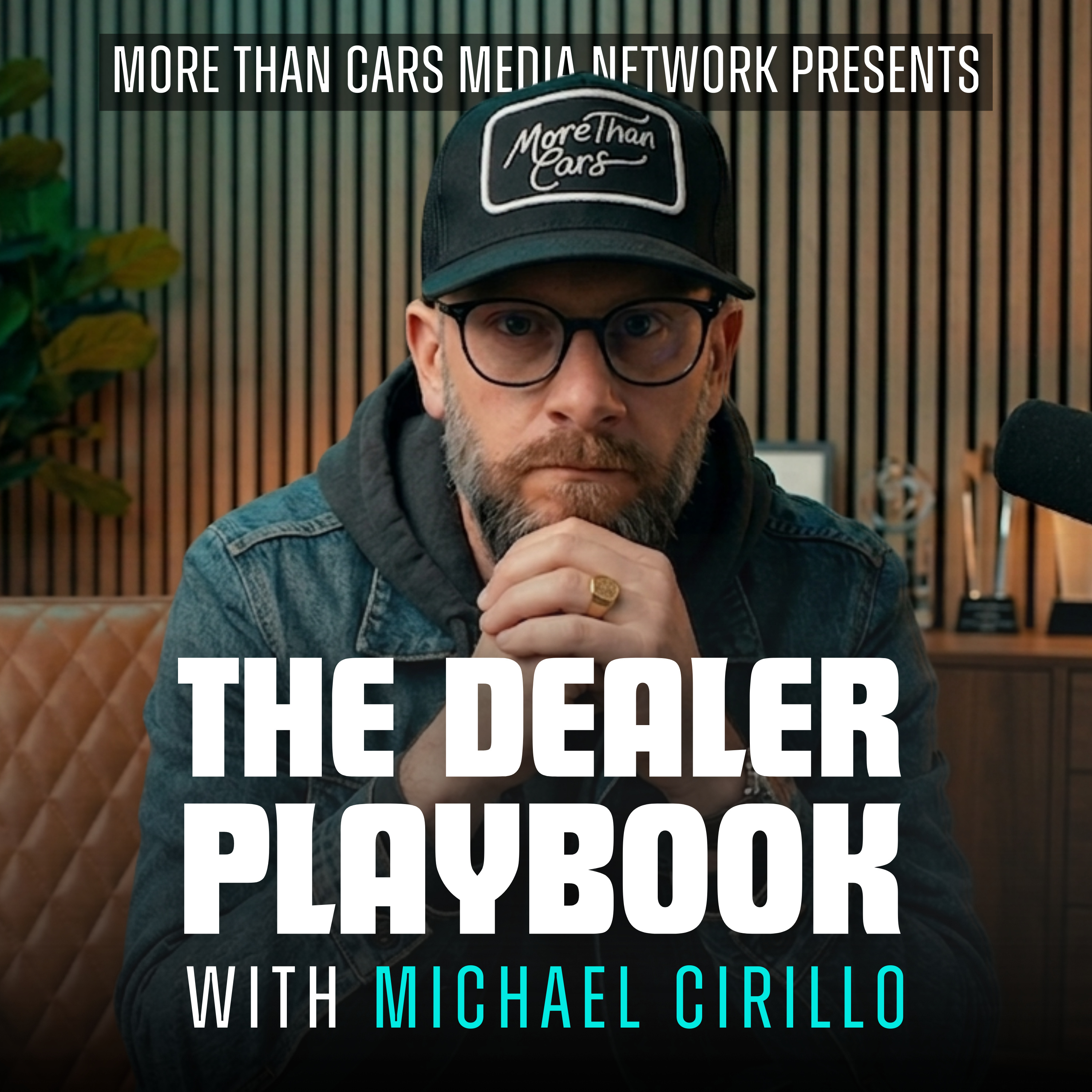
"Choose hard" — Finding Your Edge in Automotive Retail | David Spisak, Founder and CEO of DGS
About this episode
David Spisak makes a case for automotive retail as a people business, not a technology story. He reflects on mentoring, career growth, and why teaching others matters more than personal accolades. From dealership resilience and community representation to AI, transparency, and FTC pressure, he keeps returning to one theme: choose hard by building better paths for people, measuring progress, and leading with relationships and accountability.
Are you tired of hearing the same old talk about how "hard" automotive retail is? Everyone acknowledges the challenges, but few are willing to roll up their sleeves and actually do the hard work that creates real, sustainable dealer growth. This isn't about avoiding difficulty; it's about making deliberate choices that set your dealership apart.
Here's what you'll get from this episode:
- Reframe how you view challenges in automotive retail, understanding they are opportunities for real differentiation.
- Discover why investing in people and fostering internal talent development isn't just "nice to have," but essential for dealer growth.
- Learn why embracing "unreasonable hospitality" can elevate your car dealership above the competition.
- Identify immediate, actionable steps to transition your team from just "talking the talk" to "walking the walk" on internal development.
- Understand why the inevitable changes, like new regulations, are ultimately beneficial for high-integrity car dealers.
David Spisak, automotive consultant and keynote speaker, brings decades of experience leading top-performing dealerships and developing industry talent.
Timestamps
00:00 Keynote Skepticism Setup
02:08 ASOTUCON Keynote Preview
05:18 Circuit City to COO Story
09:03 Bill Walsh Coaching Tree
11:23 Dealers Resilience Through Change
21:14 Develop Talent Like Techs
26:17 Unreasonable Hospitality Standard
28:17 FTC Rules and Choosing Hard
38:44 Year of the Human Close
43:18 Final Thanks and Outro
Follow The Dealer Playbook so you never miss an episode.
DGS
"Your keynote at a SoduCon, which is coming up here shortly... I posted about this on LinkedIn... Somebody commented and said, to do what David did in his store..."
DGS is the company David Spisak leads. The episode is about how his business approach helps people succeed in car sales and dealership operations.
DGS is referenced as the organization tied to David Spisak’s role as founder and CEO. In this episode, it functions as the business identity behind the “Dealer Playbook” approach to automotive retail.
Dealer Playbook
"A couple of things, number one... One of the things that I enjoy most about producing the Dealer Playbook is hearing from you..."
“Dealer Playbook” is the show/brand they’re talking about. It’s centered on practical advice for running a dealership and building a successful career in car retail.
“Dealer Playbook” is the podcast/brand being discussed, focused on strategies for succeeding in automotive retail. The hosts talk about teaching dealership operators to replicate results and improve day-to-day workflows.
Flex Dealer
"And you know, one of the ways that we make doing this possible is through my agency Flex Dealer. And of course, in the spirit of providing value,"
Flex Dealer is an agency David mentions as part of how he’s able to keep the podcast going. It’s connected to helping people in the dealership business.
Flex Dealer is mentioned as David Spisak’s agency that helps make the “Dealer Playbook” possible. It’s positioned as a supporting business that likely provides services to dealerships or retail-auto operators.
Norm Reeves Honda
"Wow, as the chief operating officer of one of the best organizations, the car organization, Norm Reeves Honda. No offense to my friend, Brian Benstock, Paragon, number one."
Norm Reeves Honda is a car dealership (a Honda store). The host brings it up as an example of a really strong dealership operation.
Norm Reeves Honda is a Honda dealership group. In the episode, it’s referenced as an example of a top-performing “car organization” in retail operations.
Paragon
"No offense to my friend, Brian Benstock, Paragon, number one. Okay, and they are number one, let's be honest."
Paragon is another dealership business the host mentions as being among the best. They’re using it as a comparison point for dealership performance.
Paragon is referenced as a dealership organization that the speaker ranks highly (“number one”). The context suggests it’s being compared against other top automotive retailers.
Super Bowl coaches
"how many coaches, how many head coaches, how many Super Bowl coaches, came from the tree of Bill Walsh. When you think about Pete Carroll,"
They’re talking about football coaches and using that as an analogy. It’s not really about cars or car technology.
The speaker uses “Super Bowl coaches” as a metaphor for coaching lineage and influence, not as an automotive topic. It’s part of the story structure rather than a car-related concept.
AutoNation
"Big Publix, this is before AutoNation came along, we're gonna own a big chunk, and then the other massive chunk was gonna be the OEMs."
AutoNation is a big company that runs lots of car dealerships. The hosts mention it when talking about how the retail business changed and who ended up owning the stores.
AutoNation is a large U.S. automotive retailer that operates dealership groups. In this segment, it’s mentioned as part of the shift in who controls retail store ownership over time.
Publix
"Big Publix, this is before AutoNation came along... We're still here, the Publix did come along, and the Publix do some really good things..."
Publix is mentioned as a big example in the story about who would own retail stores. The point is about dealership/retail ownership changing over time, not about groceries.
Publix is referenced as a “big chunk” example in the prediction about store ownership, but it’s not an automotive OEM. In context, it’s being used as a stand-in for a major retail/dealer group that “came along” after the prediction.
OEMs
"Dealers were gonna own 15% of all the stores in the country... and then the other massive chunk was gonna be the OEMs. Huh, how'd that work out?"
OEMs are the automakers themselves—the companies that make the cars. The discussion uses OEMs to describe one of the big groups expected to control a large share of retail.
OEMs means “original equipment manufacturers”—the companies that build the vehicles in the first place. In dealer-industry talk, OEMs often influence pricing, marketing, and distribution through franchise agreements and programs.
Galpin
"It's still people like Liza Borges, right? People like Brian, people like the Bachmans over at Galpin, people like Stampak..."
Galpin is a well-known U.S. dealership group. Here it’s used as an example of long-running dealer families/organizations that have survived major industry shifts.
Black Monday, 1987
"Black Monday, 1987, that was gonna do it, [903.7s] Uber coming out, ooh, that's the end of new cars,"
“Black Monday” is a famous stock market crash in 1987. The host is using it as an example of how big economic events can impact car sales.
“Black Monday” refers to the major stock market crash on October 19, 1987. The episode uses it as a historical reference point to frame how shocks can ripple through the economy and consumer spending—factors that affect auto retail.
chips
"you know, I don't think we need a long-term contract for chips, we just wanna buy them three months at a time, [932.2s] only to find out that that set us back,"
“Chips” are small electronic parts inside the car. If there aren’t enough of them, car production slows down and dealers can’t get as many new cars.
In automotive retail and manufacturing, “chips” usually refers to semiconductor components used in modern vehicles’ electronics—engine control, infotainment, safety systems, and more. When chip supply tightens, it can cause production delays and reduce new-car availability for dealers.
long-term contract
"And maybe a poor decision by an OEM going, [926.6s] you know, I don't think we need a long-term contract for chips, we just wanna buy them three months at a time,"
A long-term contract is a deal to keep buying something for a long time. If you don’t lock in supply for the long run, shortages can happen and dealers end up with fewer cars.
A long-term contract is an agreement to buy goods (here, semiconductors) over an extended period, often with more stable pricing and supply commitments. In dealership terms, OEMs relying on short-term purchasing can increase the risk of shortages that reduce inventory.
polarization in a headline
"we both produce content, we know the power of polarization in a headline and, you know, how it stirs up commentary"
This means writing headlines that make people feel strongly—either for or against. It can get more clicks and comments, but it can also turn some shoppers away.
The hosts are talking about using polarizing messaging in headlines to deliberately provoke strong reactions. In automotive retail, this can increase attention and engagement, but it also risks alienating part of the audience.
contribution of people
"this idea of people and the contribution of people in a meaningful and strategic way"
They’re saying the results come from what people do—like how the team is organized and motivated. In a dealership, that can mean training and incentives that help salespeople perform better.
The speaker frames strategy around “the contribution of people,” emphasizing how individual effort and roles drive outcomes. In automotive retail, this is often about staffing, training, and incentives that directly affect sales performance and customer experience.
velocity
"I love the word velocity, because it implies to my mind speed with a focus, not just sporadic all over the place, chaotic speed"
They’re using “velocity” to mean speed with direction—staying focused instead of doing random things. In car sales, it can relate to how quickly you turn interest into actual deals.
Here, “velocity” is used in a business/marketing sense: moving quickly toward goals with sustained focus, not random activity. In retail contexts, it often maps to how fast leads move through the sales funnel and how quickly inventory and campaigns convert.
internal scholarships
"we talked about how you did things in an unorthodox way, that you created internal scholarships, and you got rid of marketing dollars"
This is a program where a company helps employees (or their families) pay for education. For dealerships, it can be a way to invest in training so the team grows stronger over time.
“Internal scholarships” are a dealership or company-sponsored education program aimed at developing talent. In automotive retail, this can be used to build long-term workforce capability (e.g., technician training pipelines) rather than relying only on outside hiring.
marketing dollars
"we talked about how you did things in an unorthodox way, that you created internal scholarships, and you got rid of marketing dollars"
This just means money spent on advertising and promotions. They’re saying they stopped spending that money and tried a different approach instead.
“Marketing dollars” refers to budget allocated to advertising and promotional activities. The speaker contrasts this with their approach, implying a shift away from paid marketing spend toward other strategies (like internal programs or operational changes).
Wokan
"of course, Kerry Wise with Wokan and Patricia and others that have put together these great organizations."
Wokan is mentioned as one of the automotive-related organizations/companies involved in the industry community. The episode uses it as an example of people building support networks.
Wokan is referenced as a company involved in automotive-related organizations. In this context, it’s part of a list of groups and people working to support and develop dealership and industry communities.
NAMAD
"We've had NAMAD around for years."
NAMAD is a group that supports minority-owned car dealerships. The host mentions it as something that’s been around and working for a long time.
NAMAD is an organization focused on supporting minority-owned automotive dealerships. In the episode, it’s referenced as an established group that has been active for years in the dealership community.
CPO
"...this feeling of why they were number one CPO on Hunt Acre store in the world year after year."
CPO means “Certified Pre-Owned.” It’s a used car that gets checked and backed by the dealer or brand, often with extra warranty coverage compared with a normal used car.
CPO stands for Certified Pre-Owned. It’s a manufacturer- or dealer-backed program that inspects a used car and typically adds warranties and eligibility rules, which can make CPO vehicles more attractive than regular used cars.
artificial intelligence
"So, as far as these subjects, here's the thing, [1256.1s] AI is not AH, it's not artificial humanity. [1262.0s] It's artificial intelligence, and by my measure, [1265.7s] I think sometimes it comes up kind of short on the eye."
Artificial intelligence (AI) is computer software that can learn from data and help make decisions. In car dealerships, it’s often used to help with things like finding the right customers and organizing sales and inventory.
The host is using “artificial intelligence” to refer to AI systems that can analyze information and make decisions or recommendations. In automotive retail, this often means using software to support tasks like lead scoring, pricing, inventory matching, or customer outreach.

Master Tech
"...vel two and a level three and a level four and a master tech. Why can't I do that with salespeople?"
“Master” here means a highly experienced mechanic or technician level, not a type of car. The podcast is talking about training and job levels—how service roles can have clear advancement, while sales roles may not. It’s about people and skills, not a particular vehicle.
The term “Master” in this context doesn’t refer to a specific car model; it’s describing a top-level technician role (a “master tech”) in an automotive service setting. It’s brought up to contrast how some people can be trained or certified to higher levels in service, while sales roles may not have the same structured path. The discussion is about roles and training, not vehicle features.
used cars
"...you don't understand it's so hard to find used cars. Yeah, it is for you, using the approach you're using today."
A “used car” is a car someone already owned and is now being sold again. Dealers make money by finding, pricing, and selling these cars efficiently.
“Used cars” are pre-owned vehicles sold after their original purchase, typically with varying mileage, condition, and service history. In dealer operations, used-car sourcing and inventory turnover are major drivers of profitability.
used to new (9 or 10 to one)
"...selling 400 cars at nine or 10 to one used to new. Buying 250 cars or more off the street."
They’re talking about how many used-car sales happen compared to new-car sales—like 9 or 10 used for every 1 new. That sales mix changes how a dealership runs and profits.
The phrase “nine or 10 to one used to new” refers to the ratio of used-car sales compared with new-car sales. That mix matters because used cars often have different margins, inventory requirements, and sales processes than new vehicles.
buying 250 cars or more off the street
"...Buying 250 cars or more off the street. You know, our friend Patrick..."
“Off the street” means the dealer buys cars directly from people in the area, not through a typical auction or brand channel. It’s a way to build inventory faster.
“Off the street” means acquiring vehicles directly from customers or local sellers rather than through auctions or manufacturer channels. For dealers, this affects sourcing costs, reconditioning workload, and how quickly inventory can be turned.
Beaver Toyota
"Okay, go and look at Beaver Toyota's website right now today, 450 used cars on it. You don't understand how hard it is to acquire people."
They mention Beaver Toyota as a real dealership example. They’re using it to show how many used cars are available online and what it takes to run a busy dealership.
Beaver Toyota is referenced as a specific Toyota dealership whose website inventory is being used as an example. The point is to illustrate how many used cars a dealer can list and how that ties into recruiting and staffing challenges.
Bozar Ford Lincoln
"But Bozar Ford Lincoln, they haven't looked for a technician in years. They've gone from 30 bays to 90 plus bays. And there's a two year waiting list to get an entry level job there."
Bozar Ford Lincoln is cited as a dealership that has rapidly expanded its capacity, going from about 30 service bays to 90+ bays. The discussion uses that growth to explain how difficult it is to recruit technicians and how long it can take to get staffed.
technician
"they haven't looked for a technician in years. They've gone from 30 bays to 90 plus bays."
A technician is the mechanic/repair specialist who works on cars in the shop. They’re saying there aren’t enough of them, which makes hiring slow.
In dealership staffing, a technician is the trained shop employee who performs vehicle diagnostics, maintenance, and repairs. The speaker highlights technician scarcity as a bottleneck when service capacity expands.
service bays
"They've gone from 30 bays to 90 plus bays. And there's a two year waiting list to get an entry level job there."
Service bays are the individual garage/work areas inside a dealership where vehicles are brought in for maintenance and repairs. Increasing the number of bays (like from ~30 to 90+) directly increases throughput, but it also requires more technicians to staff those stations.
entry level job
"And there's a two year waiting list to get an entry level job there. And when you do get a job there,"
An entry-level job is the first job someone gets when they’re starting out. They’re saying even those beginner roles can be hard to get when a dealership is growing quickly.
An entry level job is the first rung on a career ladder, typically for new or less-experienced candidates. The speaker’s point is that even entry-level technician roles can have long waiting lists when the dealership ecosystem is expanding faster than the labor supply.
recruiting people
"look at the website and look at the website where the recruiting people, university, the Bozar University Development Center, childcare on site."
In this context, “recruiting people” refers to actively sourcing and attracting dealership employees—especially technicians—through targeted outreach and programs. The speaker contrasts it with simply “looking” for candidates, emphasizing that hiring requires an intentional pipeline.
Bozar University Development Center
"I want everybody in my code to go to Bozar Ford Lincoln, look at the website and look at the website where the recruiting people, university, the Bozar University Development Center, childcare on site."
The Bozar University Development Center is mentioned as part of the dealership’s recruiting and training pipeline. It’s used to show that staffing growth requires structured development programs, not just advertising for candidates.
childcare on site
"Bozar University Development Center, childcare on site. You know what I mean?"
“Childcare on site” is referenced as an employee benefit used to attract and retain workers. In retail/service hiring, benefits like this can broaden the candidate pool and reduce barriers to taking entry-level roles.
development pipeline
"So we have to go from talking the talk to walk to walk when it comes to development. When it comes to making our, creating opportunities"
A development pipeline is a structured path for turning new hires or candidates into trained employees over time. The speaker uses it to argue that growth requires moving beyond marketing (“talk”) into real training and progression (“walk to walk”).
60% of our cars are purchased by women
"so that we do find, you know, 60, we talked for years, decades, 60% of our cars are purchased by women."
They’re sharing a statistic about who buys their cars—women make up 60% of purchases. The takeaway is that knowing your customer mix matters for how you run the business.
The speaker cites a customer-demographic statistic—women buying 60% of their cars—to support a business strategy. In automotive retail, understanding who the buyer is can shape marketing, recruiting, and sales process design.
autonomous EVs
"I'd like to see that it'd be amazing if we could, despite the fact that autonomous EVs and our AI dominate, you know, the conversations, I'd love us to get to the point..."
That phrase means electric cars that can drive themselves more than a normal car can. It’s a big deal for car businesses because it affects how the cars work, how they’re supported, and how companies sell them.
“Autonomous EVs” refers to electric vehicles (EVs) that use automation—typically driver-assistance systems and, in some marketing, fully self-driving claims—to handle driving tasks. In retail conversations, this matters because it changes how vehicles are marketed, serviced, and sold (e.g., software subscriptions, data, and new service workflows).
AI
"despite the fact that autonomous EVs and our AI dominate, you know, the conversations, I'd love us to get to the point to where you know..."
Here, “AI” means computer technology that can learn from information and help make decisions. In car retail, it can be used for things like targeting customers, pricing, and managing inventory.
In this context, “AI” means artificial intelligence used to power systems that can interpret data and make decisions—often for marketing, customer interaction, pricing, inventory management, or vehicle software. The speaker is framing AI as a dominant force in the industry’s conversations, which influences retail strategy.
FTC
"[1694.2s] but it's to your point, you've named it. [1696.7s] FTC. [1697.9s] Do you know, Michael, FTC regulations,"
FTC stands for the Federal Trade Commission. It’s a U.S. agency that makes sure businesses don’t use misleading advertising or pricing tricks.
The FTC (Federal Trade Commission) is a U.S. government agency that enforces consumer-protection and advertising rules. In car retail, it matters because dealer marketing and pricing claims can be regulated for being misleading or unfair.
out-the-door price
"[1728.8s] those hidden behind the fine print, [1731.8s] those who, oh, yeah, that price is only if you finance, [1736.1s] otherwise it's a grand more. [1737.5s] Oh, that's if you have a trade,"
The out-the-door price is the final total you’ll pay at the end of the deal. It includes the stuff that gets added on top of the advertised price.
The out-the-door price is the total amount you pay to drive the car home, including taxes, fees, and any dealer charges. It’s different from the advertised or base price, which may exclude financing conditions, trade-in assumptions, or add-ons.
fine print
"[1726.3s] I'm talking about, you know who I'm talking about, [1728.8s] those hidden behind the fine print, [1731.8s] those who, oh, yeah, that price is only if you finance,"
“Fine print” is the small text in an offer or contract that can include important conditions. In car buying, it can be where the deal’s price only applies if you meet certain requirements.
“Fine print” refers to the small, detailed terms in a contract or offer that can change what the quoted price or deal actually applies to. In car sales, it’s often where conditions like financing requirements or add-on exclusions are spelled out.
dealer add-ons
"[1738.7s] otherwise it's two grand more. [1740.3s] Oh, that price didn't include these add-ons, right? [1745.0s] I'm talking about you guys, okay?"
Dealer add-ons are extra add-on products or services a dealer may tack onto the deal. They can make the final price higher than the number you first saw.
Dealer add-ons are extra products or services added to a car sale—often after the base price is quoted. They can include items like protection packages, warranties, or service plans, and they can materially change the out-the-door cost.
commission breath
"I coined a phrase back in the 80s that I used all the time in teaching my salespeople. It was called commission breath."
“Commission breath” means a salesperson seems more focused on making money than on helping you. It’s basically the vibe that they’re pushing because they want their commission, not because it’s the right thing for you.
“Commission breath” is a sales-team nickname for the mindset (and behavior) where a salesperson is overly focused on earning their commission rather than helping the customer. The phrase implies the customer can feel that the interaction is driven by pay/metrics, not by the customer’s needs.
GMAC
"After the horrible tragedy of 9-11, GMAC, GM Financial came out with the first 0% interest of all time as a way of jumpstarting the industry."
GMAC was a company that helped finance car purchases. The host is saying that special financing deals from GMAC helped boost car sales during tough times.
GMAC (now known as Ally Financial) is a finance company tied to General Motors that provides auto lending and dealership financing. In the segment, it’s referenced as part of a financing push that helped stimulate new-car sales.
GM Financial
"After the horrible tragedy of 9-11, GMAC, GM Financial came out with the first 0% interest of all time as a way of jumpstarting the industry."
GM Financial helps people buy or lease cars through loans. The point here is that GM Financial offered very cheap financing to encourage more people to buy cars.
GM Financial is the General Motors–branded arm that offers auto loans and leases. The episode credits GM Financial’s promotional financing (0% interest) with helping jumpstart the auto industry after 9/11.
0% interest
"GMAC, GM Financial came out with the first 0% interest of all time as a way of jumpstarting the industry."
0% interest means the loan doesn’t add interest charges for the promo period. Dealers and lenders use it to make buying a car feel cheaper and easier.
“0% interest” refers to financing where the lender charges no interest on the loan balance for a promotional period. In auto retail, these deals are used to reduce monthly payment pressure and increase buyer demand.
jumpstarting the industry
"GMAC, GM Financial came out with the first 0% interest of all time as a way of jumpstarting the industry. And it did, it exploded."
Here, “jumpstarting the industry” means giving the market a boost when sales are slow. The host is describing how incentives can get people to buy again.
In this context, “jumpstarting the industry” means using external incentives—like promotional financing—to stimulate demand when the market is weak. It’s a retail strategy idea: change buyer behavior by changing the deal structure.
cash for clunkers
"You know, we had cash for clumpkers. [2113.1s] It exploded new cars."
“Cash for clunkers” was a government program that gave people money to trade in older cars for newer ones. It helped dealerships sell more new cars for a while.
“Cash for clunkers” refers to the U.S. Car Allowance Rebate System (CARS), a program that offered rebates for trading in older, less fuel-efficient vehicles for newer ones. It temporarily boosted demand for new cars and affected dealership sales patterns.
tariff
"And the word is tariff. [2156.1s] It's a password. [2157.2s] Yeah, password, right? [2159.2s] Yeah."
A tariff is a tax on imported products. If cars or parts cost more because of that tax, prices at the dealership can go up too.
A “tariff” is a tax a government places on imported goods. In automotive retail, tariffs can raise the cost of imported parts and vehicles, which can feed into higher prices and changes in demand.
Request an Explanation
Heard something you'd like explained? We'll add it to this episode.
Sign in to request explanations for terms you heard.
Want to learn more?
Browse our glossary for plain-English explanations of automotive terms, jargon, and concepts.
Help improve this episode
See something that's not quite right? Our annotations are AI-generated and can sometimes miss the mark. Click the flag icon on any annotation to suggest a correction.