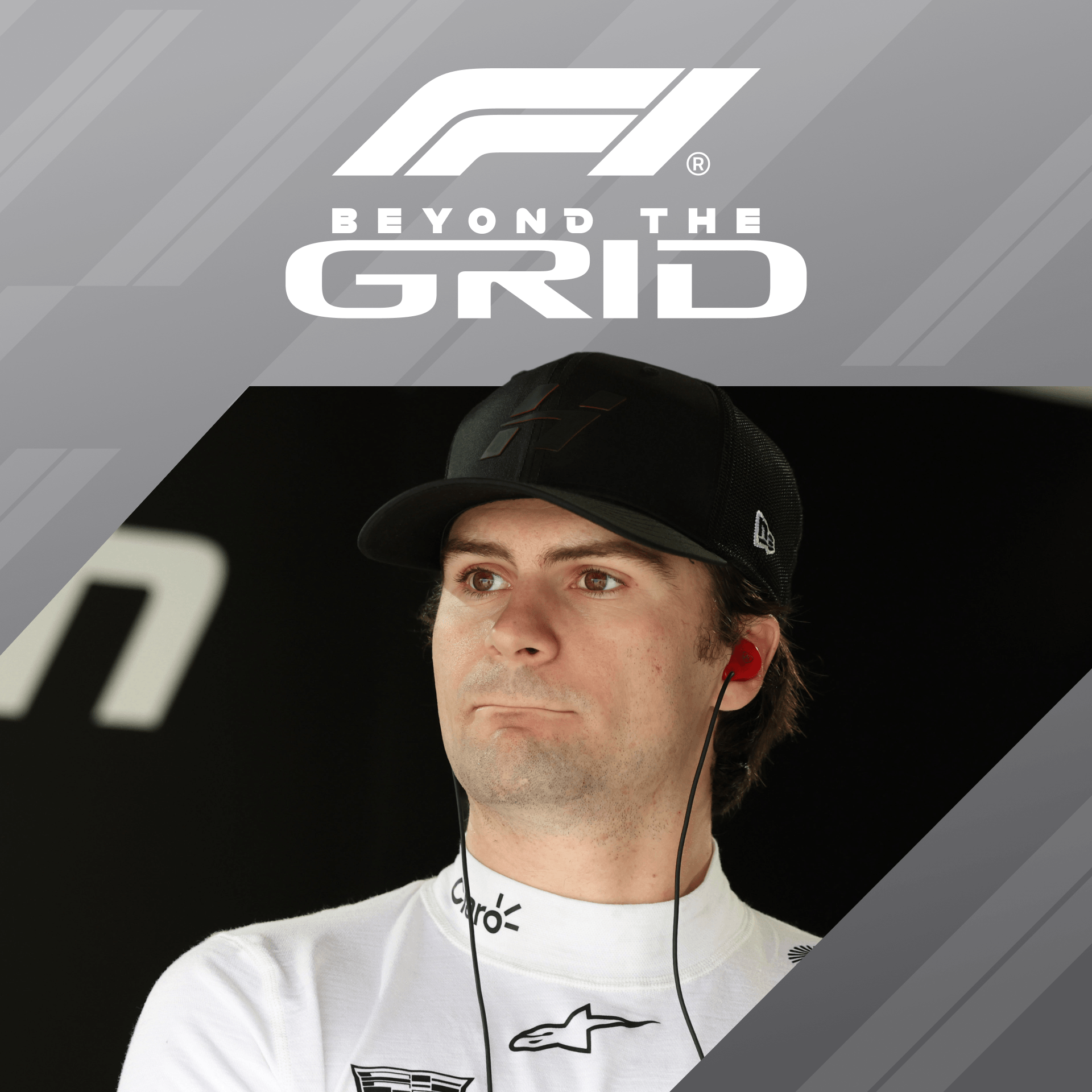
Colton Herta: doing the work
About this episode
Colton Herta talks through his unusual path from IndyCar success to climbing the ladder via F2 toward a Formula One seat with Cadillac. The conversation covers his F1 seat fit and driving-position quirks, what FP1 practice will mean for his learning, and why Barcelona feels familiar. He reflects on past near-misses (Sauber, then AlphaTauri) and the super-license drama, plus how he’s adapting to F2’s limited practice time and tire-driven learning. Along the way, he shares his motorsport upbringing, his McLaren test impressions, and what “success” looks like this year: progression, points, and eventually wins.
Speaking on the day he had a seat-fit for Cadillac’s F1 car, Colton Herta tells Tom Clarkson about growing up at racetracks with his father, IndyCar legend Bryan Herta, his love of motorsport and F1 deals that never happened with Sauber and Red Bull’s junior team.
Colton also remembers leaving the US as a teenager to race in Europe, where he was teammates with a young Lando Norris in junior categories, and he looks forward to making his F1 practice session debut for Cadillac later this season.
This episode is sponsored by:
Shopify: sign up for your one-dollar-per-month trial today at shopify.com/beyondthegrid
Vanta: get started at vanta.com/GRID.
Cadillac entering Formula One
"Cadillac has entered Formula One, deepening the racing pedigree behind every V-Series on the road. Discover a lineup that delivers pure adrenaline in the form of modern luxury... Find out more about Cadillac's performance story in Formula One and our race-tested V-Series lineup at Cadillac.com."
They’re talking about Cadillac getting involved in Formula One. Then they connect that racing involvement to Cadillac’s performance cars you can buy.
This segment is about Cadillac’s move into Formula One and how the hosts connect that to the brand’s performance image. It frames F1 as a credibility builder for Cadillac’s road-car “V-Series” lineup.
V-Series lineup
"Cadillac has entered Formula One, deepening the racing pedigree behind every V-Series on the road. Discover a lineup that delivers pure adrenaline in the form of modern luxury... Find out more about Cadillac's performance story in Formula One and our race-tested V-Series lineup at Cadillac.com."
Cadillac’s V-Series is their set of performance models. The point they’re making is that racing experience helps make these regular cars feel faster and more exciting.
Cadillac’s “V-Series” is the brand’s performance lineup, and the segment ties it to racing credibility by saying the cars are “race-tested.” The idea is that motorsport development influences tuning, chassis behavior, and powertrain calibration in road cars.
Cadillac CT5V Blackwing
"Experience the quickest Cadillac ever, the all-electric Lyric V, the peak performance of the CT5V Blackwing, the nimble agility of the OPTIQ V, and the legendary Roar of the Escalade V, all engineered to thrill."
The CT5V Blackwing is Cadillac’s performance-focused CT5. “Blackwing” is basically the badge for the most serious, track-inspired version of that model.
The Cadillac CT5V Blackwing is a high-performance version of the CT5, positioned as the brand’s “peak performance” offering in this lineup. The Blackwing name is Cadillac’s performance halo, typically associated with more aggressive tuning and performance-oriented engineering.

Cadillac Lyric
"Experience the quickest Cadillac ever, the all-electric Lyric V, the peak performance of the CT5V Blackwing, the nimble agility of the OPTIQ V, and the legendary Roar of the Escalade V, all engineered to thrill."
Cadillac is talking about a “V” version of its electric Lyriq. The “V” badge usually means it’s been tuned to feel more performance-focused than the regular car.
Cadillac’s “Lyriq V” is presented here as the brand’s all-electric performance model. In this context, the “V” naming is Cadillac’s performance sub-brand, meant to signal higher-output tuning and sportier hardware than a standard model.

Cadillac OPTIQ V
"Experience the quickest Cadillac ever, the all-electric Lyric V, the peak performance of the CT5V Blackwing, the nimble agility of the OPTIQ V, and the legendary Roar of the Escalade V, all engineered to thrill."
The OPTIQ V is a more performance-oriented version of the OPTIQ. The “V” badge usually means it’s been tuned to drive more sharply than the regular model.
The Cadillac OPTIQ V is described as “nimble agility” within Cadillac’s V-Series performance lineup. The “V” designation generally indicates a sportier setup—tuning and performance calibration—compared with the base OPTIQ.

Cadillac Escalade
"Experience the quickest Cadillac ever, the all-electric Lyric V, the peak performance of the CT5V Blackwing, the nimble agility of the OPTIQ V, and the legendary Roar of the Escalade V, all engineered to thrill."
The Escalade V is the performance version of the Cadillac Escalade. It’s meant to be the “more exciting” Escalade, not just a luxury family SUV.
The Cadillac Escalade V is the performance-flavored Escalade mentioned as having the “legendary Roar.” It’s part of Cadillac’s broader V-Series strategy, using the V badge to differentiate higher-performance versions across multiple body styles.
Formula One (F1)
"But if he's going to drive for them in F1, he's got to earn it. ...prepare myself to be a Formula One driver..."
Formula One (F1) is the highest level of open-wheel racing. It’s where teams race in Grand Prix events, and drivers usually have to prove themselves in lower series first.
Formula One (F1) is the top tier of open-wheel racing, run as a season of Grand Prix events. Drivers typically earn their place through results in feeder series and testing opportunities, rather than simply “getting” a seat.
Formula Two (F2)
"My goal of coming over here and doing F2 is to prepare myself to be a Formula One driver the best I can with Cadillac in mind. Having to learn a new way of driving."
Formula Two (F2) is like the step right before Formula One. Drivers use it to learn how to race at a higher level and show teams they’re ready for F1.
Formula Two (F2) is the main feeder series to Formula One, where drivers prove they can handle higher-speed cars and more complex racecraft. It’s often where drivers learn the skills needed to compete at the Grand Prix level, before earning an F1 seat.
IndyCar (IndyCar career)
"walking away from a successful IndyCar career to try and work his way up from Formula Two to Formula One. That's going to be tough."
IndyCar is the big open-wheel racing series in the U.S. Switching from IndyCar to F1 is tough because the cars and how you race them are different.
IndyCar is the top American open-wheel racing series, and moving from IndyCar to F1 is a major transition. The driving style, car behavior, and race formats differ enough that drivers often need time to adapt.
test driver
"As Cadillac's test driver, he'll get to drive their F1 car in practice sessions this year, but he wants to prove..."
A test driver helps a racing team by learning and evaluating the car. Sometimes they also drive during practice sessions so the team can see how well they perform.
A test driver in F1 is a driver who supports the team by developing the car and, in some cases, driving in practice sessions. It’s a way for teams to evaluate a driver’s pace and feedback without committing them to a full race seat immediately.
Grand Prix grid
"but he wants to prove that he belongs on a Grand Prix grid. We talk about Colton's love of motorsport..."
The “Grand Prix grid” is the list of drivers who are allowed to start an F1 race. Getting on the grid means you’ve earned a real race seat with an F1 team.
A “Grand Prix grid” refers to the starting lineup for an F1 race. Earning a spot on the grid means securing a race seat with a team, which is typically the result of strong performances in feeder series and team evaluations.
IndyCar legend Brian Herter
"watching his dad, Indy legend Brian Herter, racing when he was just a few weeks old,"
They mention Brian Herter as a well-known IndyCar figure. The point is that Colton grew up around racing, which can help shape how he learns to drive and compete.
The transcript references Brian Herter as an “IndyCar legend,” highlighting racing pedigree and early exposure to motorsport. In driver development, family involvement and early track exposure can strongly influence a driver’s path and confidence.
Cadillacs HQ
"We're speaking at Silverstone at Cadillacs HQ, where you're having a seat fit in the MAC26."
They’re talking about where the seat work is being done. Racing seats are custom-fit to the driver, and that kind of work usually happens at a specialized facility.
The hosts mention “Cadillacs HQ,” which appears to refer to a Cadillac-related facility in the context of the seat-fitting visit. In racing, seat fitment is often done at specialized facilities that build or refine driver seating and safety equipment.
two-part foam
"You either use some form of two-part foam or a bead seat, then you get it shipped off to go get it scanned and make it lighter, basically."
Two-part foam is used to create a custom driver seat insert or mold. The foam conforms to the driver’s body, improving comfort and reducing movement during high loads, then it’s typically processed further for weight and fit.
bead seat
"You either use some form of two-part foam or a bead seat, then you get it shipped off to go get it scanned and make it lighter, basically."
A “bead seat” is a seat insert filled with tiny beads that shift to match your body. The goal is the same as foam: keep the driver comfortable and held in place.
A bead seat uses small beads (often in a flexible container) to conform to the driver’s body shape. Compared with foam, it can provide fine positional support and is sometimes used for repeatable fitment workflows.
scanned
"then you get it shipped off to go get it scanned and make it lighter, basically. And I think that's pretty general across all the stuff that I've done so far."
After the initial seat-molding step, the insert is “scanned” to capture the exact driver contours. Scanning enables precise manufacturing of a lighter, final insert while preserving the fit achieved during the mold stage.
European open-wheel cars vs US open-wheel cars
"Is the driving position in Formula One different to what you've experienced before? Yes. Well, I think for the most part, the European open-wheel cars are different to the US open-wheel cars, apart from a few in the US."
He’s saying the cars built for Europe and the cars built for the US can feel different in the cockpit. That affects where your body sits and how you reach the controls.
The guest notes that European open-wheel cars and US open-wheel cars differ in driving position and overall ergonomics. This matters because seat fit, pedal layout, and cockpit packaging can change how drivers manage forces and reach controls.
back positioning
"So I would say the back positioning is similar, but your feet are a little bit higher. And the visibility is a little bit less because of that..."
“Back positioning” is basically how the driver sits—how reclined or upright the seat feels. Changing that angle can change how far you reach for the pedals and how the car feels when you drive. He’s saying the seat/back setup is similar, but the legs being higher changes the feel.
“Back positioning” refers to where the driver’s torso and hips sit relative to the steering wheel, pedals, and cockpit structure. Even small changes in seat angle and how the back rises can change pedal reach, comfort, and driving feel. Herta notes that the overall back position is similar between cars, but the higher leg/foot placement makes it feel different.
tub comes up on the front
"And the visibility is a little bit less because of that, because the tub comes up on the front a bit more."
In open-wheel race cars, the “tub” is the cockpit tub/structure around the driver’s seat. When it rises higher at the front, it can reduce forward visibility by blocking the driver’s line of sight. Herta connects this to the cockpit being set up with higher foot/leg placement, which changes both comfort and what the driver can see.
heel rest
"but the only thing that's weird about me is I don't like to run a heel rest. And that's because when I push the pedal, instead of going on like this, I actually push with my toes. And so my heel comes up."
In a race car, a heel rest is a little platform that supports your heel while you press the pedals. Some drivers like it because it helps them keep their foot position steady. Herta says he doesn’t like it because he presses the pedals with his toes, and the heel rest gets in the way of how his foot wants to move.
A heel rest is a small support in an open-wheel race car cockpit that lets drivers brace their heel while using the pedals. It helps keep the driver’s foot position stable during braking and throttle inputs. Herta says he doesn’t like using one because his natural pedal technique uses toe pressure, which makes the heel rest interfere with his preferred foot movement.
karting
"I think it's something that I picked up in karting and it's been like that ever since."
Karting is usually the first step for racing drivers. Drivers learn how to control the car with small, precise inputs before they move to faster race cars.
Karting is the traditional entry point for many professional drivers. It’s where drivers learn basic car control skills—like throttle/brake modulation and steering inputs—before moving up to single-seaters.
throttle travel
"Do you have a lot of throttle travel? No, everything else is pretty normal about how I set the car up."
Throttle travel is how far you have to move the gas pedal to go from “off” to “full.” Some setups make the car respond sooner or later, which can help you drive more smoothly.
Throttle travel is how much the throttle pedal moves from idle to full throttle. Drivers and engineers use it to fine-tune pedal feel and how quickly the car responds, which can matter for consistency in braking/acceleration transitions.
FP1
"Cadillac have just announced that you're going to be doing four FP ones for the team. Starting in Barcelona..."
FP1 is the first practice session on a race weekend. Teams use it to test the car and learn what setup works best before the competitive sessions.
FP1 refers to Formula 1’s first free practice session of a race weekend. Teams use it to gather baseline data, check setups, and evaluate upgrades before qualifying and the race.
winter testing in Formula One
"Basically, all of winter testing in Formula One for a long time has taken place in Spain or Portugal."
Teams use winter testing to try out upgrades and get ready for the season. It’s like practice with the actual race car so they can learn what changes work.
Formula One teams traditionally run winter testing sessions to evaluate car updates, tire behavior, and driver adaptation before the season starts. The timing and location matter because weather and track availability affect how much useful running teams can get done.
Barcelona
"And when it's in Spain, it's usually at Barcelona... basically all your testing happens in Barcelona, or about 80% of it through the winter."
Barcelona is a major European motorsport venue, and it’s commonly used for winter testing because it offers reliable conditions and a well-known circuit. In this segment, the speaker emphasizes how much of the off-season testing for multiple series happens there, making it familiar territory.
F4 and F3, even in F2
"But people don't tell you that when it's cheaper to run and race cars in F4 and F3, even in F2, basically all your testing happens in Barcelona..."
F4, F3, and F2 are lower-level racing series that help drivers work their way up toward F1. The speaker is saying those series also do a lot of testing in the same places.
F4, F3, and F2 are junior open-wheel feeder series that sit below F1, with drivers moving up the ladder as they improve. The key point here is that testing time and track choice are concentrated in certain places, which affects how familiar drivers become with specific circuits.
relearn two corners
"There's a lot of places that I haven't been to and I have to learn 20 corners. ... If I have to relearn two corners, I'll take that."
Even at familiar circuits, drivers may need to relearn specific corners due to layout tweaks, curb/surface changes, or evolving racing lines. In testing, that relearning affects how quickly a driver can reach consistent lap times and provide useful feedback to engineers.
curb profiling changes
"Some of the curb profiling changes and some of the abrasions on the tracks or bumps might change here there."
Curbs are the raised edges at the side of the track. If the curb shape changes, the car can bounce or grip differently when you run over it, so drivers may need to adjust their line.
Curb profiling refers to the shape/height/contour of the curbs at the edge of the track. Small changes can alter how the car behaves when you ride the curb—affecting grip, suspension loading, and how drivers set up braking and corner entry.
abrasions on the tracks or bumps
"Some of the curb profiling changes and some of the abrasions on the tracks or bumps might change here there."
The track surface can get rough or uneven over time. That can make the tires grip differently and can make the car feel bumpy, so drivers have to adapt.
Track abrasions and bumps are surface wear and irregularities that can develop over time. They can change tire wear, traction consistency, and ride quality, which matters during testing when teams are trying to compare data lap-to-lap.
IndyCar race winner
"You've done a lot of testing in your time. You're an IndyCar race winner."
IndyCar is a major American open-wheel racing series, and being an IndyCar race winner signals high-level experience with racecraft and car setup work. While this segment is about F1 testing, the mention frames the guest’s credibility as a top-tier driver.
practice session rhythm in Formula One
"Do you expect the rhythm of a practice session in Formula One to be different to what you've experienced before? Yeah. Well, I mean, it's always going to be different..."
They’re talking about how practice in Formula One feels different from other racing series. The big theme is how drivers manage tires and energy during practice.
This segment focuses on how the rhythm of an F1 practice session differs from other series, especially around tire management and hybrid energy usage. It’s essentially a comparison of what drivers feel and do lap-to-lap in practice.
run plans
"everything has its little nuances and differences and run plans and how the car is. And most of it's kind of dictated by the tire."
A run plan is basically the team’s schedule for practice. It tells the driver what to do—like how long to run and when to push—so the team can learn how the car behaves.
A “run plan” is the planned sequence of laps and activities a team schedules during practice—often including stint length, tire choices, and when the driver should push versus conserve. It’s a key part of how teams gather data and prepare for qualifying or the race.
tire
"everything has its little nuances and differences and run plans and how the car is. And most of it's kind of dictated by the tire."
Tires are what actually grip the road, so their condition matters a lot. If the tires are too hot, too cold, or wearing out, the car won’t feel as fast or predictable.
The speaker says practice pace and strategy are “dictated by the tire,” highlighting how tire temperature and wear directly affect grip. In open-wheel and prototype racing, teams constantly manage tire operating range to keep the car fast and consistent.
push-cool-push sequences
"Whereas in Formula One, you see a lot more push-cool-push kind of sequences rather than maybe an IndyCar, you might get two pushes in a row. So stuff like that might be a little bit different."
It’s a driving pattern where you go fast, then ease off to let the tires cool down, then go fast again. The goal is to keep the tires working in the best grip range.
In Formula One, “push-cool-push” describes a common practice rhythm where drivers push hard for a stint, then back off to let tires cool and stabilize, then push again. It’s a strategy to manage tire temperature and grip rather than staying at maximum pace continuously.
charge the battery
"You have to charge the battery a lot more when you're doing these push-cool-push sequences. There will be some differences and the car will feel different."
Some F1 cars use a hybrid system that can store energy in a battery. During practice, you learn how to build up that stored energy and when to use it for extra power.
“Charge the battery” refers to using the car’s hybrid energy system to store electrical energy during certain driving phases. In F1, energy management is tightly controlled, so practice sessions often involve learning when to harvest and when to deploy power.
Indy 500
"The Indy 500 hasn't happened yet, but I'm sure it would have done in time."
The Indy 500 is a huge one-day race in the U.S. It’s one of the biggest goals for IndyCar drivers.
The Indy 500 is the most famous race on the IndyCar calendar, held at Indianapolis Motor Speedway. It’s a major milestone for drivers in the U.S. and often a key goal alongside other series achievements.
IMSA
"you know, my second interest was IMSA, because my father was racing there in 2006, 2007, with the Acura."
IMSA is a big racing series in North America, especially known for longer races. Cars race for endurance, so strategy and reliability matter a lot.
IMSA (International Motor Sports Association) is a major North American sports-car racing organization known for endurance racing. It features classes of cars that race together, emphasizing strategy, reliability, and driver stints.
Acura
"my father was racing there in 2006, 2007, with the Acura."
Acura is a car brand from Honda. They’ve also raced in endurance events like IMSA, which is why it shows up in motorsports stories.
Acura is Honda’s luxury performance brand, and it has competed in IMSA with factory and team efforts. In endurance racing, manufacturer involvement often means dedicated engineering support and development work for race cars.
Formula E
"Like on my off weekend, I'm watching Formula E here. I'm watching Formula One if I'm not there, IndyCar, NASCAR, whatever it might be, WEC."
Formula E is a racing series where the cars are fully electric. It’s meant to show how fast and capable electric cars can be, while teams manage battery energy during races.
Formula E is an all-electric open-wheel racing series focused on showcasing electric vehicle technology in competition. It uses standardized or tightly regulated components to keep the racing close while emphasizing energy management.
WEC
"I'm watching Formula One if I'm not there, IndyCar, NASCAR, whatever it might be, WEC."
WEC is endurance racing—think longer races where teams have to manage the car over time. It’s not just about being fastest for a few laps; it’s about lasting and executing strategy.
WEC usually refers to the FIA World Endurance Championship, which features long-duration races and multi-class competition. Endurance racing emphasizes reliability, driver stints, and pit strategy as much as outright speed.
NASCAR
"I'm watching Formula One if I'm not there, IndyCar, NASCAR, whatever it might be, WEC."
NASCAR is a popular U.S. racing series with cars that are based on production models. The racing style and track types are different from open-wheel racing.
NASCAR is a stock-car racing series primarily raced in North America, typically on oval tracks. It’s known for close, physical racing and different car setups compared with open-wheel series like IndyCar and Formula One.
Long Beach
"I mean, I'm speaking to you now when IndyCar is in Long Beach, one of the iconic races."
Long Beach is a famous race held on a street circuit. Because it’s on city streets, it’s tighter and more unforgiving than many purpose-built tracks.
Long Beach refers to the Long Beach Grand Prix, a well-known street-circuit event on the IndyCar calendar. Street circuits add challenges like tight corners, limited runoff, and higher risk of damage from contact.
IndyCar races
"But, you know, I will say it is weird to kind of watch IndyCar races for, still for a little bit. But no, it's been cool. It's been cool to be a fan of it."
IndyCar is a major racing series in the U.S. It’s different from Formula 1, but it’s still open-wheel racing, so it’s a common place for drivers to follow while they’re thinking about F1.
IndyCar is the top open-wheel racing series in the United States, separate from Formula One. Herta watching IndyCar races while transitioning highlights how drivers can move between major open-wheel ecosystems.
Sauber
"You know, five years ago, almost got across the line with Sauber, then there was interest from Alpha Tower as well and then there was the super licensed drama."
Sauber is a Formula 1 racing team. The host is saying Herta was close to getting a spot with that team, which is a big deal because F1 seats are limited.
Sauber is a Swiss Formula One team that has competed in F1 for decades and has also been involved in driver development. In the transcript, Colton Herta says he almost joined Sauber, which highlights how close he came to an F1 seat.
Alpha Tower
"almost got across the line with Sauber, then there was interest from Alpha Tower as well and then there was the super licensed drama."
This sounds like another Formula 1 team interest. The name in the transcript likely refers to AlphaTauri, which is connected to Red Bull’s F1 setup.
“Alpha Tower” appears to be a transcription error for “AlphaTauri,” which is an F1 team brand associated with the Red Bull Racing organization. The mention indicates there was additional interest from another F1 program after the Sauber talks.
super licensed drama
"then there was interest from Alpha Tower as well and then there was the super licensed drama. Has all of those disappointments fueled the desire to get into Formula One even more?"
To race in Formula 1, drivers need special permission called a Super Licence. If you don’t meet the rules or points in time, it can become a big obstacle to getting into F1.
In F1, a driver typically needs a Super Licence to race. The “drama” here points to the process and requirements—such as points earned through junior categories and timing of eligibility—that can block or delay a driver from getting an F1 seat.
count my lucky stars
"...And then this came around and I was like, geez, count my lucky stars. This is an amazing opportunity..."
It’s an expression meaning “I’m really glad things worked out for me.” In racing, opportunities can depend on timing and team decisions, so it fits the context.
“Count my lucky stars” is an idiom meaning the speaker feels fortunate that circumstances aligned. In motorsport terms, it often reflects how timing, contracts, and team decisions can create (or remove) opportunities.
IndyCar side
"...I know them for a while now from the IndyCar side and even walking around here..."
IndyCar is a major racing series in the U.S. Saying “IndyCar side” means he’s talking about the people and experience he built while racing in that series.
IndyCar is the top open-wheel racing series in the U.S., and “IndyCar side” implies the driver’s prior experience and relationships there. Those connections often matter when teams recruit drivers or when engineers and mechanics move between series.
F2 career
"...that's the fully focused on trying to get here and dealing with my F2 career at the moment and trying to go through that side of things and learning as much as I can. So that's kind of where we're at."
“F2” is a racing series that helps drivers get ready for Formula 1. It’s where young drivers prove they can race well and improve their skills before moving up.
“F2” refers to Formula 2, a feeder series that sits just below Formula 1 in the FIA ladder. Drivers use F2 to develop racecraft, car setup feedback, and consistency while competing for promotion opportunities.
long-form interviews
"...I'd want someone who understands pace in long-form interviews and can work fast under pressure."
They’re talking about how editing works for longer interview episodes. The goal is to keep the conversation flowing and interesting over a longer time.
The hosts discuss editing and production skills for long-form interview content. In podcast terms, “long-form” usually means longer segments that require pacing, structure, and careful editing to keep listeners engaged.
simulator pace
"First of all, I think it was Mario Andretti who let the cat out of the bag when he said, on the Sauber simulator, you'd been faster than Reichenan and Givenazzi. Is that true?"
Simulator pace is how fast someone seems to be in the simulator. It can be a good clue, but real races can feel different, so it doesn’t always match perfectly.
“Simulator pace” refers to how quickly a driver appears to be in virtual testing compared to others. It’s useful for spotting trends and potential, but it can differ from real-world pace due to tire behavior, track evolution, and setup limitations.
Hungary
"That was at Hungary. Oh, is it? It was at Hungary. We did a few tracks, I think. No, we didn't on that one."
Hungary here means the Hungaroring race track. The speaker is clarifying which track the earlier comment was about.
Hungary refers to the Hungaroring, a well-known F1 circuit used for races and testing. The speaker clarifies that the relevant session/location was Hungary rather than Barcelona, and notes they didn’t run on that specific one.
Mercedes
"This is the first time I met Valtteri, because he was coming over from Mercedes to there, so he was doing a seat fit."
Mercedes is one of the biggest Formula 1 teams. Here it’s mentioned because the driver was associated with Mercedes before coming to do cockpit setup work.
Mercedes is an F1 constructor/team and a major engine and technical partner in the sport. The transcript references Valtteri coming over from Mercedes, framing it as a driver/seat-fitting context tied to team operations.
seat fit
"because he was coming over from Mercedes to there, so he was doing a seat fit. And yeah, that's... Fortunately, nothing came of it, but yeah, it was a cool time to have a little bit of an insight into it."
A seat fit is the process of adjusting a driver’s cockpit position—seat position, steering wheel reach, pedal spacing, and often the seat insert—to match the driver’s body. In F1, this affects comfort, control, and how effectively the driver can apply steering and braking forces.
Alfa Towery deal
"And the Alfa Towery deal."
This sounds like a business or sponsorship deal involving Alfa Romeo. The transcript wording is a bit unclear, but it’s being mentioned as an off-track development rather than a car tech detail.
This appears to reference an Alfa Romeo–related arrangement (likely a sponsorship or partnership deal) involving “Alfa” and “Towery.” Because the name is unclear in the transcript, it’s best treated as a specific business/branding topic rather than a technical term.
F1 paddock
"There was a period of time in the F1 paddock where we were all led to believe that the deal was on. Is that how it felt for you?"
In Formula 1, the paddock is like the teams’ backstage area at the race. It’s where people meet, plan, and handle day-to-day team business—not where the cars race.
The F1 paddock is the working area at a Formula 1 race where teams manage logistics, engineering discussions, and driver/team coordination. It’s distinct from the track and garages, and it’s where contract and team dynamics often play out.
contract
"You know, I had a contract from them, just unable to sign because I didn't have the super license. ... I signed with them, which ended up being the right thing because I didn't get allowed."
In racing, a contract is the official agreement to drive for a team. But you still have to meet certain rules and paperwork requirements, so sometimes drivers have to sign elsewhere if they can’t get cleared in time.
In motorsport, a contract isn’t just a promise to drive—it’s tied to eligibility, timing, and formal sign-off requirements (like licensing). This segment highlights how contract timing can be constrained by FIA rules, forcing a driver to secure a seat elsewhere.
IndyCar seat
"I would have had no formal onesie and no IndyCar seat [1207.8s] and don't know what I would have done then."
An IndyCar “seat” means being hired to drive for a team in IndyCar. Getting one is a big deal because it’s what lets you race in the series.
An “IndyCar seat” refers to a spot on an IndyCar team’s driver lineup. In American open-wheel racing, securing a seat is a major career milestone because it determines your car, team support, and race schedule.
Red Bull Sim
"of being able to go into the Red Bull Sim, [1236.5s] you know, being able to talk to Dr. Marco"
A “sim” is a racing simulator. It helps drivers practice and learn how the car behaves, and it gives the team useful feedback.
The “Red Bull Sim” is shorthand for simulator work within Red Bull’s driver development ecosystem. Simulators let drivers practice racecraft, learn car behavior, and provide engineers with feedback without waiting for track time.
Red Bull Young Driver Program
"Had you ever had the opportunity to join the Red Bull Young Driver Program? [1252.8s] No, I didn't."
This is Red Bull’s program for finding and training young race drivers. It helps them get experience, coaching, and chances to progress toward Formula One.
The Red Bull Young Driver Program is a talent pipeline run by Red Bull to identify and develop promising young racers. Drivers often get coaching, simulator time, and opportunities to move up the junior formula ladder toward Formula One.
Formula 3
"British F4 and Euro Formula Open, Formula 3. [1262.8s] I don't think I was over here long enough."
Formula 3 is a more advanced step in junior open-wheel racing. It’s where drivers move up from the earlier series and start racing with more demanding cars.
Formula 3 is a higher-level junior single-seater category that typically comes after F4 and other feeder series. It’s an important proving ground because car performance is closer to what drivers will face in more advanced series.
Euro Formula Open
"I did two seasons, British F4 and Euro Formula Open, Formula 3."
Euro Formula Open is another junior racing series in Europe. Drivers use it to gain experience and show they’re ready for the next step.
Euro Formula Open is a European junior open-wheel series that helps drivers progress toward higher tiers like Formula 3 and beyond. It’s part of the typical “ladder” system where performance and consistency matter for getting noticed by bigger teams.
British F4
"you know, I did two seasons, British F4 and Euro Formula Open, Formula 3."
British F4 is a stepping-stone racing series for young drivers. It’s where drivers learn and prove themselves before moving to bigger, faster categories.
British F4 is a junior single-seater racing series that sits early in the open-wheel development ladder. It’s commonly used by young drivers to build race experience, car control skills, and results before moving up to higher formula categories.
living with my mechanic
"Thing was, I was living with my mechanic. So there really wasn't a lot who was like 20 or 21."
A mechanic helps keep the race car working and helps adjust it for performance. Living with the mechanic suggests Colton was around the car and the people who set it up all the time, which can speed up learning.
In racing, a mechanic is central to day-to-day car preparation—maintenance, setup changes, and troubleshooting. Living with the mechanic implies a highly immersive development environment where the driver is constantly exposed to how the car is prepared and tuned.
30 races and 25 test days in one year
"I did 30 races and 25 test days in one year. I was in the car two times a week, at least."
Races are the actual competitions. Test days are practice sessions where the team tries different settings and the driver learns how the car behaves. Doing a lot of both in a year means you improve fast, but it’s also a huge grind.
In motorsport, “races” are competitive events, while “test days” are dedicated sessions to evaluate setup, tires, and driver feedback. Doing that many races and tests in a single year is an intense workload that accelerates learning and adaptation.
driving through fast corners
"Lando saying, Colton's quick, Colton's really quick, very quick through fast corners as well."
Fast corners are the high-speed turns where you can’t just slow down a lot—you have to keep the car moving well. If someone is quick through them, it usually means they’re smooth and confident at keeping speed without losing control.
“Fast corners” are high-speed sections where the car stays loaded with aerodynamic grip and the driver manages steering input, throttle, and braking timing to maintain momentum. Being “really quick through fast corners” usually points to strong car control and confidence at higher lateral g-forces.
learning at that age / refining everything
"When you're learning at that age, I think there's maybe a little bit more disparity between drivers... and then you have to refine everything and that's where kind of your weaknesses are smaller..."
In junior single-seater racing, early success often comes from raw talent, but progression depends on refining technique—like braking consistency, corner entry/exit discipline, and adapting to different cars. The idea here is that as drivers move up the ladder, the remaining weaknesses tend to shrink because everyone is already highly skilled.
racing culture in the UK compared to the US
"How different is the racing culture in the UK compared to the US? I mean, is the language the same?"
They’re talking about how racing feels different depending on where you are—like the UK versus the US. Even if the driving terms and techniques are similar, the way fans and teams show passion can change.
The discussion contrasts how motorsport culture and fan engagement can differ by region, even when the core driving concepts remain the same. In practice, this can affect how teams recruit, train, and motivate drivers and staff.
oversteer
"Is oversteer still oversteer and understeer still understeer?"
Oversteer is when the back of the car starts to slide out more than you want in a turn. It can feel like the car is “turning itself” too much, and it can get you into trouble if you can’t control it.
Oversteer is when a car rotates more than you expect during cornering, often causing the rear to step out. Drivers may use throttle and steering inputs to manage it, but too much oversteer can spin the car.
understeer
"Is oversteer still oversteer and understeer still understeer?"
Understeer is when the car won’t “turn in” enough, so it keeps going straight and drifts toward the outside of the turn. It usually means the front tires aren’t gripping as well as the driver expects.
Understeer is when a car doesn’t turn as much as you expect, so it tends to push wide toward the outside of the corner. It’s commonly linked to front tire grip and how the car is balanced under braking, turn-in, or throttle.
racing intensity differences in Europe
"is because the racing intensity is slightly different. Or is that a myth? I've always thought it doesn't matter where you go."
They’re debating whether racing feels more intense in Europe than elsewhere. The point is to explain why drivers might choose to move there to face tougher competition.
The hosts discuss whether racing intensity is meaningfully different in Europe compared with other regions. This is a “why people come to Europe” segment, tying geography to competitiveness and the availability of high-level track specialists.
go-kart track
"there will be some kid that all he does is drive around that go-kart track and will give you a really hard time at beating him."
A go-kart track is where kids and beginners race small, simple cars. Racing karts early helps people learn the basics of driving and racing really well.
Go-karting is a common entry point for young drivers because it’s relatively accessible and teaches fundamental driving skills like throttle control, braking timing, and racing lines. The transcript uses it as an example of how early, focused seat time can produce very competitive drivers.
specialists at any sort of racing or any sort of track
"I think you'll find quick people anywhere in the world and specialists at any sort of racing or any sort of track."
They’re saying that really good racers can be found anywhere. If someone spends a lot of time on a particular track or type of racing, they can become an expert.
This idea suggests that high-level talent and track-specific expertise exist everywhere, not just in one region. It’s about how competitive environments and repeated practice create “specialists” regardless of geography.
junior formula
"I think because the engineers in junior formula are really way more focused on driver development than I would say in the US."
“Junior formula” is the ladder of racing series for young drivers. It’s where drivers learn skills and get coached so they’re ready for bigger, faster racing later.
“Junior formula” refers to the feeder series that develop young drivers before they reach top-tier categories like F1. The key idea is that these programs focus heavily on driver development—coaching, seat time, and learning how to adapt to different cars and tracks.
driver development
"I think because the engineers in junior formula are really way more focused on driver development than I would say in the US."
Driver development is the structured process of improving a racer’s skills—car control, racecraft, feedback to engineers, and adapting to different setups. In junior categories, teams often emphasize this more than pure results, because the goal is to graduate drivers who can learn quickly at higher levels.
track time
"I think it's that ability to learn is probably a little bit greater here in the track time that you get. It's probably a little bit greater here than anywhere else in the world."
Track time is how long you get to drive on the race track. The more time you spend there, the more you learn what works—like where to brake and how to take turns.
“Track time” is the amount of time a driver spends on a circuit practicing or racing. More track time generally means more laps, more feedback, and faster learning of braking points, lines, and car setup preferences.
Champcar
"Brian Hertha, Indy, Indy Cole Champcar, an IRL winner and things."
ChampCar was a major type of open-wheel racing in the U.S. It was an important stepping stone for drivers aiming at top-level American racing.
ChampCar (often written as CART/Champ Car) was a prominent American open-wheel racing series. It helped define the modern IndyCar-style talent pipeline before later series mergers.
IRL
"Brian Hertha, Indy, Indy Cole Champcar, an IRL winner and things."
IRL was a top-level open-wheel racing league in the U.S. It later became part of what we now call IndyCar.
IRL stands for Indy Racing League, which was the predecessor to today’s IndyCar series. Winning in IRL/IndyCar is a major achievement in American open-wheel motorsport.
Dario Franckini
"And it's probably came from Dario Franckini,"
Dario Franckini is someone being credited with influencing Colton’s early path. In racing, having the right people around you can help you get started and keep progressing.
Dario Franckini is mentioned as a source of influence, likely tied to early karting or racing connections. In motorsport, mentors and local racing figures can strongly shape how drivers get seat time and opportunities.
track day
"And so he said, okay, rented one, went out and did a track day. And I was hooked immediately."
A track day is when people go to a race track to drive and practice. It’s a way to learn how the track feels and how to drive better without the full pressure of a race.
A track day is an organized event where drivers take vehicles onto a race circuit for practice and fun, usually with coaching and open sessions. In motorsport development, early track time helps drivers learn car control and track etiquette in a lower-pressure environment than formal racing.
Minardi TC
"He drove a Minardi TC to Donnington, I remember. And Donnington, yeah. Justin Wilson was also testing that day, I think, in the Jag."
Minardi was a racing team in Formula One. The “TC” is the name of one of their race cars from that time. They’re talking about it because it shows how close the family was to high-level open-wheel racing.
Minardi was an Italian Formula One constructor, and the Minardi TC refers to a specific Minardi open-wheel car used in that era. In the transcript, it’s mentioned as the car Colton Herta’s dad drove to Donington, tying it to the grassroots path toward top-level racing.
Donnington
"He drove a Minardi TC to Donnington, I remember. And Donnington, yeah. Justin Wilson was also testing that day, I think, in the Jag."
Donnington refers to Donington Park in the UK, a well-known motorsport circuit used for testing and racing. In the segment, it’s where the Minardi TC was driven, and it’s also where Justin Wilson was testing, showing the setting for open-wheel activity.
F1 races
"And so you would watch the F1 races with dad at some silly hour of the night? Yeah, I think that kind of came later, a little bit older, probably around nine or 10."
Formula 1 (F1) is the top level of open-wheel racing, with highly engineered cars and strict technical rules. Watching F1 is often a way fans and aspiring drivers learn how race strategy, tire management, and car setup work together.
F2
"So let's talk about F2 now. Is it what you're expecting?"
F2 is like a stepping-stone series for young race drivers. It’s where drivers learn how to race in cars that are closer to Formula 1, but not quite as fast or high-profile.
F2 refers to Formula 2, a junior open-wheel racing series that sits below Formula 1. Drivers use it to develop racecraft and prove they can handle faster cars and more complex race weekends before moving up.

IndyCar
"Roman Grosjean said to me, when he made the switch over to IndyCar, he said, it's like an F2 car, just different tires."
IndyCar is a major U.S. open-wheel racing series. Even though it’s still a race car, the driving feel changes because the tires, power delivery, and cockpit setup are different than other open-wheel categories.
IndyCar is the top open-wheel racing series in the United States, with purpose-built race cars that differ from Formula cars in several key areas. Drivers often talk about differences in power delivery, gearing, seating position, and tire characteristics—so the same driving “feel” doesn’t automatically transfer.
gears shift
"I think just like the feel of the car and how the power is put down and how the gears shift and obviously the tire deck that you have over here is greater."
When you accelerate in a race car, the transmission changes gears. How fast and how smoothly it does that can change how much grip you have when you’re trying to go faster.
“How the gears shift” refers to the transmission’s shift characteristics—timing, smoothness, and how quickly it changes ratios under acceleration and deceleration. In race cars, shift behavior strongly affects traction because it changes engine speed and torque delivery right when you’re trying to accelerate out of corners.
halo
"Just a quick question on the arrow screen that you have in IndyCar versus the halo has the halo taken a bit of getting used to or?"
The halo is a safety device used in modern open-wheel racing: a curved titanium structure that sits in front of the driver’s head to help protect against debris and impacts. Drivers often describe getting used to it visually and physically, and it can also change how they perceive wind and airflow.
arrow screen
"Just a quick question on the arrow screen that you have in IndyCar versus the halo has the halo taken a bit of getting used to or?"
The “arrow screen” sounds like IndyCar’s extra protective screen in front of the driver. The host is comparing it to the halo to explain how both protect the driver, but in slightly different ways.
“Arrow screen” here appears to refer to IndyCar’s cockpit protection/visor-style screen used alongside the front bar. It’s discussed as analogous to the halo—providing additional protection while still allowing the driver to feel some airflow.
Fahrenheit
"But it was, we had a race at Indy, it was 150 degrees in the cockpit Fahrenheit. I'm going to guess that's probably around 45, maybe more 50 Celsius."
Fahrenheit is just a different way to measure temperature. In racing, knowing the Celsius equivalent helps you picture how hot it really is.
Fahrenheit is a temperature scale commonly used in the U.S. Converting between Fahrenheit and Celsius helps listeners understand how extreme cockpit temperatures can be during a race.
Celsius
"I'm going to guess that's probably around 45, maybe more 50 Celsius. But so it's incredibly hot."
Celsius is another temperature scale. Converting to Celsius helps you understand how hot the cockpit is in everyday terms.
Celsius is the temperature scale used in most of the world. Converting the cockpit temperature from Fahrenheit to Celsius gives a clearer sense of heat stress levels for drivers and teams.
SOC2
"So whether you're preparing for a SOC2 or managing a larger enterprise GRC program, Vanta helps keep everything organized and moving in the right direction."
SOC 2 is a checklist-style standard companies follow to prove they handle security and customer data responsibly. If a business is “SOC 2 ready,” it usually means they’ve set up controls and processes to protect information.
SOC 2 is a widely used security and compliance framework created by the American Institute of CPAs (AICPA). Companies use it to demonstrate they manage customer data securely, which can be important for vendors and enterprise customers.
GRC program
"So whether you're preparing for a SOC2 or managing a larger enterprise GRC program, Vanta helps keep everything organized and moving in the right direction."
GRC is a way companies organize how they handle rules, risks, and oversight. It’s basically “how we make sure we’re compliant and managing risk the right way.”
GRC stands for Governance, Risk, and Compliance. It refers to the systems and processes an organization uses to manage risks, meet regulatory requirements, and ensure decision-making is aligned with company governance.
Formula 2 (F2)
"You're now in F2. What is it? It's the one practice session and straight into court... And that's kind of the name of the game in Formula 2 is if you can kind of get on the weekend with your best foot forward..."
Formula 2 is a stepping-stone racing series that helps drivers get ready for Formula 1. The key idea here is that the weekend doesn’t give you much time to practice, so you have to get up to speed fast.
Formula 2 (F2) is the FIA’s main feeder series to Formula 1, using standardized cars and a tight weekend schedule. In this segment, the hosts emphasize that F2 has limited practice time and limited tire sets, so drivers must learn quickly and extract performance immediately.
Melbourne
"Especially if you throw the car in the wall in practice like in Melbourne. Practice time is so, so important."
They mention Melbourne as an example of a track where it’s easy to get it wrong during practice. The point is that mistakes can be especially costly when you don’t have much time to recover.
Melbourne is referenced as a circuit where a driver can make mistakes in practice, including throwing the car into the wall. It’s a useful contextual example of how unforgiving certain F2/FE-style weekends can be when practice is limited.
get up to speed quick / learn fast
"So it's definitely like you've got to get up to speed quick. Need to learn fast. And that's kind of the name of the game in Formula 2..."
They’re saying you have to improve quickly over the weekend. Since there isn’t much time to practice, you can’t afford to be slow to understand the car and the track.
This segment frames “learning fast” as a competitive requirement in F2 because there’s little time to catch up or recover after early sessions. It’s essentially about rapid driver adaptation to car balance, track grip, and setup changes within a constrained schedule.

Daewoo Statesman
"... process of what it is. You're kind of the elder statesman as well. I am, yeah."
The Daewoo Statesman is a regular passenger car made by Daewoo. It’s meant for everyday driving and comfort, like a typical family sedan. People might mention it when talking about older Daewoo models and what they were like.
The Daewoo Statesman is a passenger car model produced by Daewoo, typically discussed as an example of the brand’s older, more “mainstream” lineup. It may come up in a conversation as a reference point for how the company’s vehicles were positioned and perceived during earlier eras. The name “Statesman” also makes it an easy shorthand for the car’s intended role as a comfortable, everyday family sedan.
one lap pace
"...qualifying pace, like one lap pace behind the wheel."
One-lap pace is basically your best-lap speed. It depends on getting the tires working and driving each corner at the right moment.
One-lap pace refers to how quickly a driver can complete a single lap at the limit. In open-wheel racing, it’s heavily influenced by setup balance, tire temperature, and how well the driver hits braking points and corner entry/exit.
qualifying pace
"...you're pretty close to what your maximum mobility is going to be as far as like qualifying pace, like one lap pace behind the wheel."
Qualifying pace means how fast you can go on your best lap during qualifying. It’s not the same as race pace because qualifying is all about getting the car to perform at its peak for a short time.
Qualifying pace is the speed you can consistently produce over a single timed lap (or short stint) during qualifying. It’s different from race pace because qualifying is usually about maximizing grip and performance for one push rather than managing tires and fuel for many laps.
race management
"The maturity like inside the car and the race management grows a lot."
Race management is the set of decisions and execution that keep a driver fast over an entire race, not just a single lap. It includes managing tires, fuel strategy, traffic, and when to push versus when to protect the car and position.
Lewis Hamilton
"...about what's been Lewis Hamilton's best season in Formula One."
Lewis Hamilton is one of the top Formula One drivers ever. Debating his best season usually means looking at how many races he won and how consistently he performed.
Lewis Hamilton is a multi-time Formula One world champion and one of the most successful drivers in modern F1 history. When the hosts debate his best season, they’re usually comparing factors like race wins, consistency, and how well he maximized car performance across different tracks.
Request an Explanation
Heard something you'd like explained? We'll add it to this episode.
Sign in to request explanations for terms you heard.
Want to learn more?
Browse our glossary for plain-English explanations of automotive terms, jargon, and concepts.
Help improve this episode
See something that's not quite right? Our annotations are AI-generated and can sometimes miss the mark. Click the flag icon on any annotation to suggest a correction.