John Saccameno and Luke Chennell join the Driven Radio Show to discuss the challenges of running a restoration shop and the importance of skilled labor in the automotive restoration industry. They share insights on the need for a certification system for restoration skills, the difficulties in finding qualified employees, and the shifting market dynamics in vehicle restoration. The conversation touches on the value of education, the impact of COVID-19 on the industry, and the potential for creating a guild to standardize skills and practices. Listeners will gain a deeper understanding of the restoration community and its future.
Brett and Mark welcome John Saccameno of Sport and Specialty and Luke Chennell of the McPherson College Auto Restoration Program for a roundtable discussion of the difficulties of running a restoration business, the lack of qualified help, the need for restoration standards, and the preservation of automotive historical knowledge. This and more on Driven Radio Show!
"So I talked to the guy who has the car, whose brother died, and it was part of an estate that he's just getting rid of stuff."
An estate sale is when a person's belongings are sold, usually after they pass away. This can include furniture, cars, and other personal items.
An estate sale is a sale of goods from a person's estate, often conducted after their death. It typically includes personal belongings, antiques, and sometimes vehicles.
"...when I bought that 1964 Dodge custom 880. I liked it. I wouldn't really in love with it..."
The Dodge Custom 880 is a large car made by Dodge in 1964. It was designed for people who wanted a comfortable ride with plenty of space inside.
The Dodge Custom 880 is a full-size car produced by Dodge in the early 1960s. It was known for its spacious interior and classic styling, appealing to buyers looking for comfort and performance.
The 361 engine is a type of V8 engine that was used in some older cars. It has a size of 361 cubic inches, which is a way to measure how big the engine is. These engines were popular in the 1960s and were known for being reliable.
The 361 engine refers to a specific V8 engine displacement of 361 cubic inches, commonly found in certain classic American cars, particularly from the 1960s. It was known for its decent power output and was used in various models, often associated with Chrysler products.
"Well, can we find you a 73 charger or something?"
The Dodge Charger is a famous car, especially known for its speed and sporty look. The 1973 version is one of the older models that collectors often seek.
The Dodge Charger is a classic American muscle car known for its powerful performance and distinctive styling. The 1973 model is part of the second generation of Chargers, which were produced from 1971 to 1974.
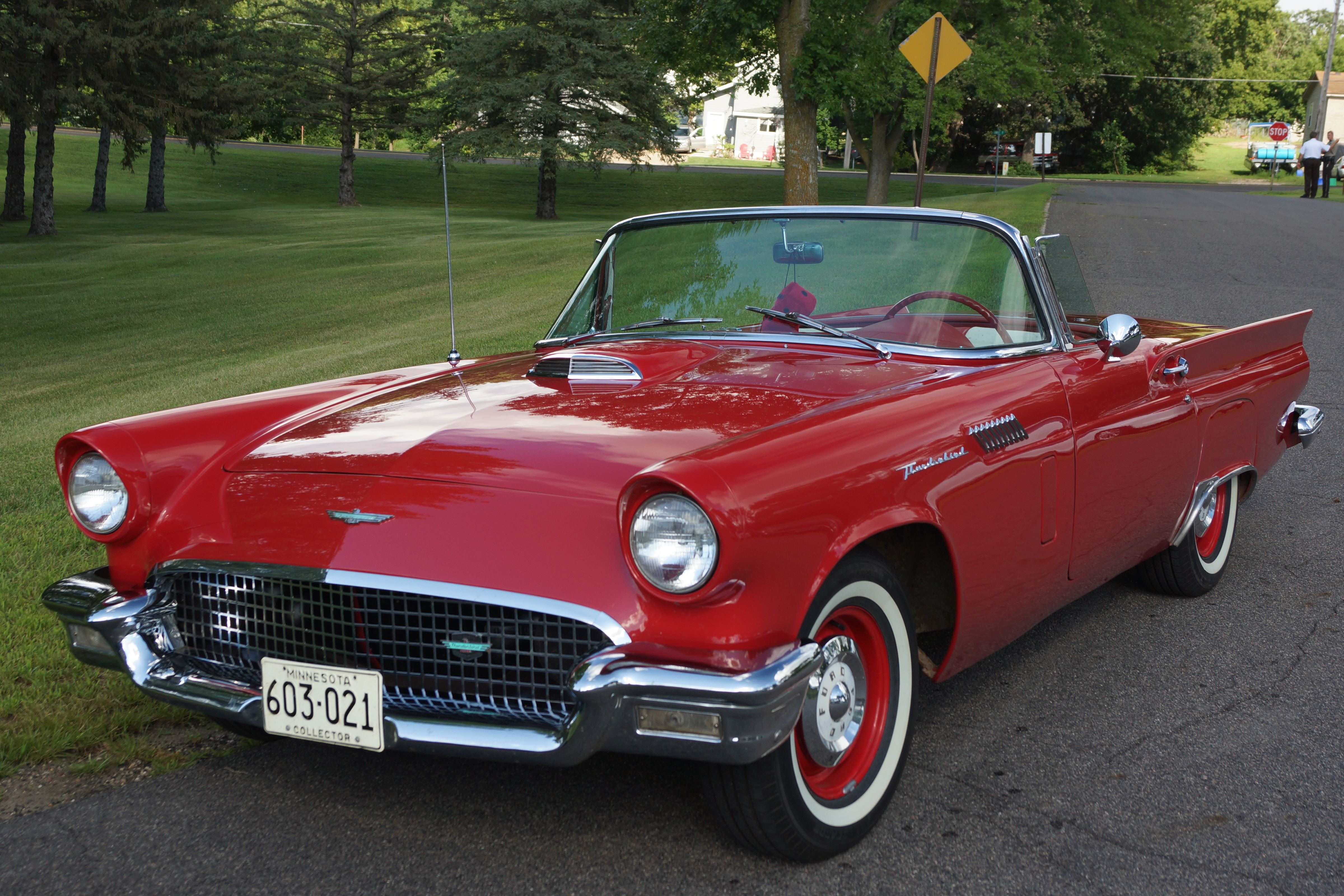
"Go looking for that. So the Thunderbirds 58 to 6, roughly 66. I'm really kind of getting g..."
The Ford Thunderbird is a classic car that was made to be a comfortable and stylish ride. The versions from 1958 to 1966 are especially popular because they look unique and were built to be enjoyable to drive.
The Ford Thunderbird is a classic American car that was first introduced in 1955 as a personal luxury vehicle. The models produced from 1958 to 1966 are particularly notable for their distinctive styling and features, representing a significant era in automotive history where comfort and performance were highly valued.
"When I got that Corvette home and it flattened on a cam tap."
The Corvette is a famous sports car made by Chevrolet. It's known for being fast and stylish, and many people love to drive it.
The Chevrolet Corvette is a high-performance sports car known for its powerful engines and sleek design. It has a long history in American automotive culture, often celebrated for its performance and styling.
"...the normal and the plug right now. But nobody can see this except you guys. So you have to go. Oh, and I'm shit. But you know, here."
Jaguar is a well-known British car brand that makes luxury cars. They are famous for their stylish designs and fast performance.
Jaguar is a British luxury vehicle brand known for its performance-oriented cars and elegant design. Models like the F-Type and XJ are iconic in the automotive world.
"...the normal and the plug right now. But nobody can see this except you guys. So you have to go. Oh, and I'm shit. But you know, here."
Alfa Romeo is a famous Italian car brand that makes stylish and sporty cars. They are known for their unique designs and performance.
Alfa Romeo is an Italian luxury car manufacturer known for its sporty vehicles and distinctive design. The brand has a rich motorsport heritage and is celebrated for models like the Giulia and Stelvio.
"...the normal and the plug right now. But nobody can see this except you guys. So you have to go. Oh, and I'm shit. But you know, here."
Austin Healey is a classic British car brand that made sports cars, especially popular in the 1950s and 60s. They are known for their fun driving experience and stylish looks.
Austin Healey was a British sports car manufacturer known for its classic roadsters, particularly the 3000 model. These cars are celebrated for their performance and design from the 1950s and 1960s.
The Alfa Romeo Giulia is a newer car that is known for being stylish and fun to drive. It's a compact car that feels sporty and has a lot of character.
The Alfa Romeo Giulia is a modern compact executive car that combines performance with Italian styling. It has received praise for its handling and design, making it a popular choice among enthusiasts.
"...Healy, which is a limited production car 640 units."
A limited production car is made in small numbers, which makes it rare and often more valuable. People like these cars because they are unique and not many are available.
A limited production car is a vehicle that is manufactured in a restricted quantity, often making it more exclusive and desirable among collectors and enthusiasts. These cars can be special editions or high-performance models.
The Porsche 356 is an early sports car made by Porsche, famous for being lightweight and fun to drive. It's a popular choice for collectors today.
The Porsche 356 is a classic sports car produced by Porsche from 1948 to 1965. It is known for its lightweight design and agile handling, making it a favorite among car enthusiasts and collectors.
"...I teach primarily drive train chassis restoration. So I do transmissions axles, steering suspension brakes."
Drive train chassis restoration is about fixing the parts of a car that help it move, like the frame and the parts that connect the engine to the wheels. It's important for making sure the car runs well and is safe to drive.
Drive train chassis restoration involves the repair and refurbishment of the components that transfer power from the engine to the wheels, including the chassis, axles, and related systems. This process is crucial for ensuring the vehicle operates safely and efficiently.
"...So I do transmissions axles, steering suspension brakes."
Axles are the parts of the car that connect the wheels to the body of the car. They help the wheels turn and support the weight of the car.
Axles are the shafts that connect the wheels to the vehicle and allow them to rotate. They play a crucial role in supporting the weight of the vehicle and enabling movement.
"...So I do transmissions axles, steering suspension brakes."
Steering suspension is the system that helps you steer the car and makes the ride smooth. It includes the parts that connect the steering wheel to the wheels and help cushion bumps in the road.
Steering suspension refers to the system that allows the driver to control the direction of the vehicle while providing a comfortable ride. It includes components like the steering wheel, linkages, and suspension parts that absorb shocks from the road.
"...So I do transmissions axles, steering suspension brakes."
Brakes are the parts of the car that help it stop. They work by pressing against the wheels to slow them down when you push the brake pedal.
Brakes are a vital safety component of a vehicle, allowing it to slow down or stop. They work by applying friction to the wheels, which slows their rotation and brings the car to a halt.
"...So I do transmissions axles, steering suspension brakes."
The transmission is a part of the car that helps it change speeds. It connects the engine to the wheels and makes it possible for the car to go faster or slower.
A transmission is a critical component of a vehicle that transmits power from the engine to the wheels, allowing the car to change speeds. It can be manual or automatic and is essential for vehicle operation.
"You know, you just said something about coil. You know, you rebuild coils. Most people don't know how a coil works like the end-old coil."
An ignition coil is a part of the car's engine that helps create the spark needed to start the engine. It takes the battery's power and makes it strong enough to ignite the fuel in the engine.
A coil, specifically an ignition coil, is a crucial component in an internal combustion engine that transforms the battery's low voltage into the high voltage needed to create a spark in the spark plugs. This spark ignites the air-fuel mixture in the engine's cylinders, enabling combustion and power generation.
"They just don't know how carburetors work. You know, it's like, they just look at me like, I have no idea what you're talking about."
A carburetor helps engines get the right mix of air and fuel to run properly. It's an important part that helps the engine work efficiently.
A carburetor is a device in an internal combustion engine that mixes air with a fine spray of liquid fuel. It plays a crucial role in the engine's performance by ensuring the right fuel-air mixture for combustion.

"...he's got a guy who's a Porsche specialty guy. He just does air cooled 9.11 stuff."
The Porsche 911 is a famous sports car known for its unique shape and powerful performance. It's been around for many years and has many different versions, especially ones that use air-cooled engines, which are popular among car fans.
The Porsche 911 is a high-performance sports car that has been in production since 1964, renowned for its distinctive design and rear-engine layout. It has multiple variants and generations, with the air-cooled versions being particularly celebrated among enthusiasts.
"...drive train, you know, and part of that might be carburetion and another one might be ignition..."
Carburetion is how fuel and air are mixed together in a car engine to help it run. It's important for the engine to work properly.
Carburetion is the process of mixing air with a fine spray of liquid fuel in an engine. It is a crucial step in ensuring that the engine runs efficiently and effectively.
"...another one might be ignition, the other might be transmissions and..."
Ignition is what starts the engine by lighting the fuel and air mixture inside it. This is done using parts like spark plugs.
Ignition refers to the process of igniting the air-fuel mixture in an engine's cylinders to produce power. It involves components like spark plugs and ignition coils.
"...you've got to have left and right side because they meet at the differential. Okay. And so, yeah, I need the left side."
A differential is a part of a car that helps the wheels turn at different speeds, which is important when going around corners. It keeps the car stable and helps it grip the road.
A differential is a mechanical device that allows the wheels to rotate at different speeds, especially when turning. It is crucial for maintaining traction and stability in vehicles.
"...or you want to turn it into a high-performance, meat-eating, flamethrowering street monster..."
High-performance means a car is built to go really fast and handle well. These cars often have special parts that make them quicker and more fun to drive.
High-performance refers to vehicles that are engineered for superior speed, handling, and overall driving experience. This often includes modifications to the engine, suspension, and other components to enhance performance.
"Call Rick Hunter at Hot Rod Express, 816-224-95-97 or just stop by at 510-5-US-40 in Blue Springs, Missouri."
Hot Rod Express is a place where you can take your car to get it fixed up or made to look cooler. They work on classic cars and can help make them faster or more stylish.
Hot Rod Express is a custom automotive shop that specializes in modifying and restoring vehicles, particularly classic cars and hot rods. They offer services that can enhance both the appearance and performance of cars.
"...Daryl's work on Mercury Mountaineer, classic Corvette's Nissan Xtera, unusual Mercedes Yards..."
The Mercury Mountaineer is a type of SUV made by the Mercury brand, which is part of Ford. It's designed to carry people and cargo, and it can handle rough roads well.
The Mercury Mountaineer is a mid-size SUV that was produced by Mercury, a division of Ford. It shares its platform with the Ford Explorer and is known for its spacious interior and off-road capabilities.
The Nissan Xterra is a type of SUV made by Nissan. It's built for off-road driving and is great for adventures.
The Nissan Xterra is an SUV that was designed for off-road use, featuring a rugged build and practical interior. It was popular among outdoor enthusiasts during its production years.
"...ra, unusual Mercedes Yards, and a 64-gauge custom A80, neither of ours anymore, but you know why it ran..."
The Toyota Supra is a fast and stylish sports car that many people love for its speed and looks. The version called A80 is famous for being really powerful and is often modified by fans to make it even faster.
The Toyota Supra is a high-performance sports car that has gained a legendary status among car enthusiasts, particularly for its tuning potential and powerful turbocharged engines. The A80 generation, produced from 1993 to 2002, is especially revered for its robust performance and iconic design, making it a popular choice for both racing and modification.
Select text to request an explanation
Welcome to Driven Radio Show, your home for Car Talk covering the latest news to the greatest views on the biggest names in performance, sports, and just playing cool driving machines. Let's rev up the conversation. Time for Driven Radio Show.
I'm coming to you from Driven Radio Studios, where we took a knee-last week, because I was a little bit buried. It was a busy week, and I was just getting back from a company getaway, though. I came back a train wreck, so. I hate you people. God, I was so tired. The people are great. I'm just old. I get that. I've been feeling that 20 years ago, 15 years ago. I used to build houses.
We'd have 10 or 12 houses going into time. We were finishing more than 100 houses a year, and I got used to just having tools in the back of my truck and always being busy, and I had a laptop in the truck, too, so I could keep track of all the subs and where everything was going. I was pretty good at it. All it's taken to kick my ass the past few months is one little tiny villa, and it isn't a new construction. It's just a remodel.
It ain't much of one. Terra up the floors, move some doors around. I had just had the crap kicked out of me the last few weeks, and last week was part of it. I'll tell you what, if there's one job I hate doing in the house, it's jacking with insulation.
I got to do some of that coming up before we really hit winter strong downstairs around the mother-in-law suite. Let me know if you need help. I'm getting good at it, so that you can tell me hell no, and feel good about it. I got a couple of brand new hell handheld little staple guns. I know how to use them.
And you'll let me borrow them. Did you not see them sitting on the top of the stairs when you came in? Very nice. I can feel the hate.
It's just radiate and all of the other thing that I had forgotten about being a builder is three t-shirt days.
You know, in the summertime, we're leading into fall, but it's still 90 here. Just having extra t-shirts in your truck, you shake all the crap off of you. Change to the next t-shirt, you suck that sucker.
Yep, man. I always enjoyed building houses, but I've forgotten some of the ins and outs. And as it happens in a minute, we're going to talk about ins and outs in the restoration world.
Hey, how goes the car search? Well, I've made two phone calls, and one you're going to laugh at me about, because I did call the guy about the 1960 tee bird that looked really good.
The one with the craggers already on at the bridge. And it turns out, you know, that was kind of a small description. And it's that was the nephew.
So I talked to the guy who has the car, whose brother died, and it was part of an estate that he's just getting rid of stuff.
Which, I'll buy it. You know, they, they seem pretty, they seem pretty straight up on the phone. Okay.
However, it would have to be trailered. It's going to need a car built. It might, it needs breaks checked and this and that.
And it, it can run, but it will, it'll die on acceleration sometimes and die when you start it and then you put it into gear.
And I'm like, you know what? It's really pretty, but not for that kind of money.
Yep. And it's not a bad price compared to all the other 1960s that I've been looking at and comparing it to.
But for one that's not running, got to be trailered and has kind of a suspicious pedigree.
See, and here's the list.
Less is hard. Super nice guy. But the, and the other thing is you're in a position now because of, you know, the house sale and selling another car.
You got a little bit more latitude and the car should looking at this time.
Don't buy another, buy something done.
Which leads me into the second car.
Okay.
You know, I was, it was funny when I bought civil when I bought that 1964 Dodge custom 880.
I liked it.
Mm hmm.
I wouldn't really in love with it, but I was like, this hits my price range. It's my price points.
It's running that I got at home and it barely ran trying to get it off the damn trailer.
And then there was a whole bunch of other stuff that had to be done with it.
So it was an experience of a couple of years.
But over the year and change that I owned it, I really started to really like that car.
Yeah.
I liked how it looked.
And, you know, I make jokes about craggers and I make my little redneck jokes about myself.
But I really liked how they looked on it.
And even without the raised white, white walls, it just when you shine it up and you put a little spit and sweat on it.
Yeah.
It wasn't a bad looking car and it was, it had a highly original interior and it was in good shape.
And when it ran decently, it really ran decently.
And it was just, you know, the car was the issue on it and I was just too lazy and didn't get it wrong.
And it had a kind of an oddball engine, a 361.
Yeah.
I'd never even heard of those.
Not neither did I.
So.
So all that going on, I kind of fell in love with the car.
So what, lo and behold, as I was selling it, you know, I did some price checking and you couldn't find any of them.
Until, until not long before I sold it.
And there's a 1964 Dodge custom 880 out there.
This one has a 3D3.
I talked to the guy who owns it today.
It's way down there in price.
But he got it from a collector.
Who owned it for about 15, 20 years and then he's had it for about 10.
And it's always been covered, et cetera, but it hasn't been driven much.
So it's sad for a long time.
He's got it.
You can run it off of fuel down the car.
But and he has that brand new trunk or brand new guest tank in the trunk, which I immediately asked him.
I asked him, okay, that brand new thing.
Have you tried the fuel nozzle down into it to see if it's too small?
It was mine.
I had to have a cut out from the original tank of blah, blah, blah.
I haven't tried that.
I'm like, oh, shit.
So it's got that.
And then I thought of one of our guests because I looked at it.
It's got, you know, that that you can care about.
You can say his brain system.
He is listening.
Okay.
Luke was kind enough to figure out my brakes.
And this has that same Bendix brake system.
Yeah.
Now he knows how it works.
And I asked the guy, you know, did the brakes work?
He's like, wow, don't really know all Jesus.
And guess where he is?
He's down in Arkansas right around where the preacher was at.
So I'm never getting over the fact that a preacher lied to you.
Never going to get over that one.
That just goes to show you that the suckers reborn every minute.
Yeah.
I'd like to see which church he is running.
It was somewhere down in Texas and I'm sure the cooling is so cold.
But be that as it may.
This one has a 383 on it, the outside of the body course pictures lie.
But it looks really good.
He said there's no rust on it, which the other guy said it from the one I bought.
And he was pretty accurate overall.
Okay.
So I'm putting it in my back pocket because he also told me going to Arkansas.
Well, he's already lowered the price a little.
And when I was talking about the phone, he's like, tell you what?
You know, down in Arkansas, I'm going to tell you what?
Tell you what, you know, I got some bills coming up.
So once you just come on down, bring some cash in your pocket, make me an offer and take it.
Yeah.
And I'm like, I think my life would just choke me to death.
He's dangling that awful heart.
And can we please review?
You've said it so many damn times now.
I have it memorized.
205 inches by God.
It would be a daily.
It would be a daily driver.
Oh, my God.
You daily this hell.
Yeah.
Why would you get rid of the extra?
Because this car is much cooler.
And all it be all.
Okay.
Okay.
So that's where I'm at right now.
I can't really knock you for that.
It's unlikely.
It's very unlikely.
But I'm keeping it in my back pocket because I am keeping my eye.
There's a several other cars.
I have kind of gotten my focus because at one time a long time ago, I was looking at so many different cars.
You're like, Jesus, Mark.
It's cool that you're looking for cars finally to get one.
Well, can we find you a 73 charger or something?
But what you told me was you need to kind of narrow it down.
Pick one.
Yeah.
Go looking for that.
So the Thunderbirds 58 to 6, roughly 66.
I'm really kind of getting getting a real.
I was going to see something rude.
I am rather excited about that.
Yes, I know what you're going to say.
So dirty, dirty.
So we'll see where it goes with that.
Well, and that's where I'm at.
With Likes car search this week.
Yeah.
In a minute, you're going to show me that when we're done with the show, you're going to show me that car.
Oh, hell yeah.
And then I'm probably going to encourage you to do something stupid.
Yeah.
I want you smack in your forehead going on.
Oh, my God.
No, no.
No.
You've seen me do stupid with zeros on the end.
So I can't really knock you there.
Yeah.
But at least yours, you could drive across the country.
I couldn't even drive mine off the GD trailer.
When I got that Corvette home and it flattened on a cam tap.
Yeah.
It was a boo-boo.
Yeah.
There was some issues.
Yeah.
Okay.
My end of the car rule this week.
And we were talking to our guests just a little bit before we started the show.
Apparently in the ongoing saga of the drum brakes.
On the 60 Corvette, we've come to the.
We've come to the idea that one half or that the driver's side axle is bent.
It's bent.
And here's the first thing.
I can't even begin to figure out how that happened because I don't drive that car hard.
Yeah.
I don't take it out and run the hell out of it.
I drive it very infrequently period.
And usually it's like to go get ice cream or something like that.
So not real sure how it happened, but that's in material.
I need an axle, you know, the driver's side half of the axle and half an axle.
Well, the axle for the left side.
And I just, I'm kind of at a loss.
We're to start looking because none of the catalogs are going to have anything like that.
Maybe one of our guests knows.
So let's jump into that.
Our special guest this week, repeat offenders.
John Sakimino of Sport and Specialty and Luke Channel of McPherson College Auto Restoration Program.
Gentlemen, welcome back to Driven Radio.
Hey, Brad.
How are you?
No, I've missed you so.
Two whole weeks.
I don't know.
Come on back.
Wait a minute.
Wait a minute.
I'm not ready yet.
I didn't want to leave you hanging.
I know you had a awesome time.
Well, also at the end of the show when we had you on a couple of weeks ago,
we started talking about what we're going to discuss tonight.
And I'd been talking to Luke about something similar at the same time.
Luke, how you doing?
I'm good.
I'm good.
I'm glad to be here.
And I just have some new friends for you to introduce you to.
Okay.
You can con gear an axle and then make your shaft.
They do.
So.
They do.
So I don't know what you want to do with your shaft when you purchase it.
That's where you're going to get.
It's only half a shaft.
I mean, could I go brag?
Well, first I want to make sure that you con guys are from here and not some part of Asia.
Guys, to speed things along real quick, can you give us a thumbnail of your qualifications
and current occupations?
John, I'll let you go first.
Okay.
I own a restoration business, automotive restoration business in Northern Illinois by 90 miles north west of Chicago.
Go ahead and plug it.
What's that?
Go ahead and plug it.
I listen.
I have no pride.
That's why I'm here.
Otherwise, we just talk on the phone.
You heard the show.
Anyway, no, we do 50s, 60s and basically 50s, 60s, 70s, European sports cars.
There's certain models we tend to stick to and the normal and the plug right now.
But nobody can see this except you guys.
So you have to go.
Oh, and I'm shit.
But you know, here.
Here's the.
Ooh.
Ah.
Here.
Okay.
Just took goal at the Alpha Romeo owners club meeting the National Convention in.
In Chicago two weeks or no, last week.
It was pretty cool.
Oh, cool.
This is mine and we did it at the shop.
So it's.
It's a beauty.
It's a beauty.
Okay.
Tell us what it is and what size engine and what do you've done to it?
It is a bone stack car.
It is truly a.
A.
A.
A.
A.
A.
A.
A.
A.
A.
A.
A.
A.
A.
A.
A.
A.
A.
A.
A.
It's like 958 points.
Mostly the points I didn't get were because I put leather in instead of vinyl.
I did so.
I did a few things that.
You know, the purist didn't like.
Was it a Johnson B210 or what?
No, it's a.
It's.
I think that's an alpha.
Oh, it's a male.
It's a 19.
It's just spider, isn't it?
Julia G.
I.
U.
L.
I.
A.
Velocie.
And then I was one of 1100.
They only made like a thousand eighty three.
I think that year.
So it's a pretty rare.
It was worth putting some money into.
But yeah, we'd I put it out and said here judge it.
And it came back gold.
So that was.
It was.
That's terrific.
I'm for the day thought.
But, you know, that's the kind of stuff we do.
So I.
I think I posted in social media this week.
We hit a hat trick.
We've done a gold.
Healy.
100 am.
Healy, which is a limited production car 640 units.
We did a gold.
Jaguar series one that was the best in the country in 2019.
And now we've got a gold Alfaro male Julia.
Velocie.
So.
I'm like, OK.
And when people say, Hey.
Do you know how to work on these?
I can say, I think we do.
No?
Yeah.
I'm pretty happy with that and we were we've got a 356.
A 52.
356 be super 90.
I'm working on trying to get judged yet this year and see if I don't know if they have gold or whatever, you know, super high standard they have.
So I can go to have Patrick plus one with most of the major marks of that era.
Very cool.
Thanks.
Luke, give us a rundown of qualifications, current occupation.
Great question.
I'm an associate professor at Macerson College teaching the automotive restoration department.
And I teach primarily drive train chassis restoration.
So I do transmissions axles, steering suspension brakes.
Basically, if it's on the underside of a car and it's oily or greasy, I'm into that.
I'm currently in my 19th year here at the college.
I started teaching directly after I was a student in 2003 and basically I've never left.
I've never had in my life a non automotive job.
I've worked in basically every part from down in the pit at a quick loop to hear at the top of the college.
I worked in art stores and shops and ran my own mobile service business for a while.
I worked on modern cars, vintage cars, really vintage cars.
And then cars that basically don't even classify as vintage they classify as antique.
Well, of antique tractors.
I've engineered on a steamboat.
I ran a steam locomotive for a while.
So I've been in every field of transportation with maybe the exception of aircraft.
And I just love machines, machine parts, fix and things, seeing how they work.
So it's been my life's calling.
And on top of all that courtesy of the rather abrupt departure of our good friend, Professor Yon.
Now you're also teaching some history.
Yeah, so I got my undergraduate degree in not only auto restoration but also in history.
I went on to get a master's degree in local and community history.
And then I like to say I got the better part of my PhD which was all the coursework but no dissertation.
Again, in American history and railroad history.
So I've been teaching history courses.
I've sat in a lot of seminar rooms and argued with a lot of people about history.
I'm pretty good at that.
You don't want to get in an argument with me on the internet because like I win every time.
Keep going.
Oh, I have a fantastic joke about that.
But I can't tell it here because we want to be able to still do the show.
Well, and furthermore, my first in college will disavow my existence.
I never get to see anything about this school.
Again, good or bad?
So Luke, what do you do with your spare time though?
I want an ignition coil rebuilding business called midnight coil repair.
Oh, because that's the only time he has to do it.
Yeah, from 10 to midnight is midnight coil repair.
So you've finished magnetos and buzz coils and all kinds of stuff.
He's also really good at painting shop floors.
I've watched him do that.
That's he's fantastic.
It was going to have a hobby.
Yeah, well Luke's idea was just throw the paint down.
Damn it, I'll get to it.
He did a great job before.
Alrighty, John outside the show we have discussed.
And this is really the thrust of the show tonight.
The difficulties and the challenges of running a quality restoration shop.
And what are, I'm curious, what are the primary concerns in running your shop?
And how do you find skilled employees?
And like we were talking before the show,
you had one skate on you today.
Would you like to jump into that?
I guess I, one of the things that's kind of amazed me when I got into this industry,
if you will, into the hobby that everybody calls it, the hobby.
No, I've started calling it at the community because I think that's all right.
Yeah, well, the community, yeah, it's much of the same thing.
With everybody in the restoration side of the coin,
we all do the same stuff.
But we also all share the same troubles and problems.
Finding help, finding customers, how do you market properly?
How do you get paid?
Is it easy to get paid?
How do you structure your finances?
And the other thing I found it was kind of interesting about it was that
I came at it as Luke said, he's a car guy.
There's a lot of guys in my business who own shops like I do,
who came at it from that side.
That's all they've ever done is worked on cars.
They didn't have the benefit of going to McPherson and rounding out their education.
As they got bigger and bigger and bigger, whatever they were doing at the beginning,
when they were a young pup fixing one car at a time,
and now they've got two employees and they're doing four cars.
A lot of them just kind of, the business end of their business, if you will,
never got very sophisticated.
Every month was always a surprise.
I know that because that's the business I owned or that I bought from my friend Mark,
who basically needs some money, I better do some building.
That's how he did it.
It's a business guy.
At one point, I ran a $75 million operational business.
With operations around the globe.
You can't do that.
You have to know where you are.
My brain doesn't function that way.
One of the things I did was I came up with a financial way to track finances
and what is our cash and what are we doing.
I talked to other people and I actually helped two or three other shop owners
understand that part of the business, how you make money.
Particularly how you make money, but how money is made if you will.
That's a big piece of how I started thinking about this.
There's probably, I don't know, let's call it a dozen.
When I say good shops, when I say good shops, I don't mean that there's a lot of bad shops.
I'm just saying there's a, let's call it the top tier.
The man's restorations and the Levine restorations.
I'm not even throwing myself in that piece.
Some of these restoration shops are just filled with talented people
and talented management and talented owners that I think we would all benefit
from the same ideas across the board.
Again, one of them is hiring people.
What's the best way to hire people?
I've been having an RPM foundation.
It's been a big piece of that for a long time.
I talked to Nick.
Just kind of get my brain around what's going on with that.
There is no ASC industry certification for
there is no ASC industry certification or restoration businesses.
We're competing for those heads that get hired by Ford.
If you stay a year and a half, you can keep your tools.
That's what they do.
That's a big deal.
It's a big deal.
They get signing bonuses out of their technical schools.
I've been dragged into tech force.
It has asked me to come in to a couple of presentations.
I'm giving a presentation of a bunch of young guys
telling how excited the restoration business is.
The Ford guy comes in and goes,
you might like that stuff.
It might be fun.
We're going to give you cash and tools.
How can I say no to that?
Just because I love it doesn't mean everyone else does.
I just want them to.
When you ask that question,
I think that's what it comes down to.
Those are some of the difficulties we have.
What are the best practices?
What are the best practices to running a business in this industry?
In your conversations with other restores and preservationists,
aside from what you mentioned, talking to Nick,
what have you learned?
Can you speak to their concerns and their shops?
What are their largest hurdles?
Aside from, hey, I'm broke.
I better do some billing.
I think they have a hard time keeping good help
or bringing people on.
I talk to, you know,
it's always be hiring mentality.
I'm always trying to talk to people.
And I'm being a racer.
I'm always at a track.
At some point, talking to people,
hey, I see a young kid.
I go, hey, what do you do for a living?
Hey, do you know anybody?
Do you have a cousin and nephew?
A niece that wants to come to work?
I mean, I'm always hiring.
And so are they.
And I always look, I always hear,
oh, have you called me a person?
And I go, yeah, yeah, I have.
I go, I go, yeah.
I go, you know, me.
My first son isn't graduating 1500 candidates a year.
People have this idea that Jay Leno says,
money to me first.
And they're just, you guys are just spewing out candidates
on a regular basis.
And I go, it's not how that works.
And I listen, I love what you guys do there.
Don't give me wrong.
But the public has no idea.
You know, and I think it's just kind of funny sometimes,
you know, as to, as to how do we.
And I got to tell you a lot of collectors think,
oh, that's, hey, the world is good.
Jay Leno and, you know, the Walden family
are making sure that the person is on top of it.
You guys got nothing to worry about.
You'll be stiff forever.
I'm just, I get it, I get kind of a chuckle out of it.
And you're chuckled into it.
I can see it.
Absolutely.
I mean, believe me, we've been so lucky to have such people,
benefactors like the Walden's,
and particularly Jay Leno, who, you know,
elevated us to this height.
And the problem we have now is,
it's like, how many can you really take in,
given the amount of resources that we have available to us right now?
And how can we responsibly grow our program to graduate?
I mean, we're typically graduating about 40 students a year right now.
And even move the mark to 60,
the education is such an intensive thing
that it takes a giant commitment of resources.
And particularly, you know, real estate, cars, faculty time,
that it's hard to just scale easily.
And so I really appreciate your comments.
Believe me, we're doing everything we can to, you know,
save the world and save the car.
But we're only in school, right?
So yeah, I appreciate your comments that way.
There are other schools in the country
that teach something akin to what McPherson does,
although I don't think anybody else does it on the same caliber.
Lou, help me out here.
Now, why O Tech comes to mind,
but are they teaching restoration?
Not strictly restoration.
They have their hot rod, you, which graduates,
and it's not a degree program, it's a certificate program.
And they graduate, have graduated some really impressive people
who are doing a lot of really cool stuff out in the industry.
The other schools in our space really are the Pennsylvania College of Technology,
which is close to Hershey and the AACA.
They're affiliated there, also with Swagger Museum.
And then in San Francisco, the Academy of Art has a degree program
in restoration as well.
And I don't care a lot.
I don't see a lot of grads there,
but certainly Pennsylvania College of Technology is out there.
So just taking a stab at it,
I'm not saying you know off the top of your head,
but if you added Pennsylvania and you added San Francisco in,
along with the 40 or so graduates coming out of McPherson,
how many do you think there are?
60.
How many are actually stay in the community?
But that's the other thing that goes along with this.
You know, you talk about 60 or 40 grads coming out of McPherson,
not all of us wind up in a restoration shop.
A lot of them wind up managing collections or managing museums
or you know, you get weenies like me who wind up writing articles for people.
There's even with the 40 or so grads coming out of McPherson,
not all of us wind up in shops.
So there's a giant dirt, a giant chasm,
between how many jobs there are to be filled
and how many really decently qualified individuals
you could get to fill them.
Absolutely.
Yeah, I mean, and then you know some people go off
and they decide that they don't want to work on cars
or do anything car related at all.
Several alums who are in finance now and really love it.
And they didn't do it just for the money,
but learn while in college taking business courses
that they love to count any finance.
So they went into that.
So yeah, you can't guarantee that just because we educate somebody
that they're going to go start a shop and save the world
such as it is.
They're in finance.
I'm sacrilegious.
Well, I don't have it forbid anybody say anything.
Well, it's a big person.
So we have to, you know, we're not critical at all.
And I'm not trying to be critical.
I'm just trying to, I'm trying to put it in perspective,
I think Luke is, you know.
And mostly it's people that don't know anything about our,
you know, it's like, hey, I'm looking for someone
because I'll ask anybody.
You know, hey, I'm looking for someone.
Hey, have you called them?
Oh, yeah.
Yeah, I have.
You know, I'm an idiot.
I've never heard of them before.
Yeah.
Well, John, I mean, it's, it's got to be the point
where there's so much demand for our graduates,
that I tell prospective employers,
it's really a two to three year process
to get a graduate,
because you need to build a relationship
with internships, you know,
be reaching out to them constantly,
give them the kind of benefits and such,
give them a home housing,
kind of whatever you can do to facilitate it,
because the reality is that there's so much competition
in the marketplace that they can fundamentally
write their own ticket.
And just as an aside, like, it's,
to me, it's absolutely bonkers.
Because when I graduated, it was like,
well, this guy down over at the body shop,
he's got a couple of little cars in the back
that need worked on.
I think he might pay eight or 10 bucks an hour
if you go ask.
And, you know, now it's like,
well, which coast do you want to live on?
And how much free housing do you need?
And it's just, it's crazy the way things have exploded.
I'm going back to school.
No, I'm good.
No crap.
I'll be an apprentice source.
Great job.
You know, it is.
And a lot, you know, a lot of people go into collections.
They go into museums.
They, you know, they, and listen,
God love them.
You know, they're leveraging their education.
That's what they should do.
Yeah.
And, you know, the problem is what I'm looking for
is a guy that I can teach how to sand.
Okay?
All day long.
You know, one of the least ugliest jobs on the planet.
And that's what I just lost this guy.
And I would tell you, a lot of it had to do with the fact
that, you know, at the end of his day,
he didn't be clacked out and then took an air,
you know, an air gun and was cleaned himself off.
You know, he blew all the dust off himself
so he could get in his car and go home.
Or he had his, you know, one of us do it.
You know, that's, it's, and it's not, it's, you know,
and it's not to start in this industry
or to start in this business is not very attractive.
You know, I would tell you, though,
if you, if you can, you know,
and I think that also comes,
I'm not going to go down the this generation thing
because that was just crushed.
No, but I'm gonna.
You know, all of this, I mean, I guess,
I want to say many of us, many of us,
you know, did crappy jobs for two, three, four, five years
to learn?
I did a crappy job today.
I'm still doing a crappy job.
Yeah, what are you talking about?
Well, that's, that's one of the thing.
And the, the restores, the perspective restores now
because they're in such high demand.
They're, they're getting all of this free stuff, like Luke said.
You know, they're getting free housing in which coast
you want to live on and all that stuff.
Hey, guess what, kids?
Most jobs aren't sexy.
Most of them, the vast majority of them,
the very, there's a very, very small percentage of jobs
that are actually sexy.
And typically the ones that are, that sound sexy,
don't pay anything.
You know, way they call it work?
Yeah.
Stinking work.
You got to go do stuff.
I often joke if all these reality shows involving cars
and restoration work and sort of this kind of stuff.
And I think if I were to make a real restoration reality show,
like season three would be problems with the blast cabinet.
And seasons four, five, and six, and I mean,
that's, that's what the job is.
It's, it's a lot of hard-dirty work.
And that's not to say it's not rewarding because it is.
I mean, but you have to persevere through some stuff
that's really not fun for a long time.
Correct.
Correct.
And you know, I think that's one of the struggles I think
all of us have is trying to keep somebody interested in it.
And I would tell you, I, you know, I use the,
I use the, you know, the carrot, the carrot and the stick.
You know, the fact is, everybody's retiring.
I mean, guys, my age, I'm 69.
I'm still going to edit, but I'm not that skilled.
Okay.
And I think I said that if the last me, at the last show,
I'm not that skilled.
I'm not.
I can, I build engines.
I can do stuff, you know.
You know how to keep a business running and profitable.
Right, but I'm not skilled.
You know, my guys have the talent and the skills to do that.
I mean, like I said, I think I said my last time,
I said my, my corporate superpower was building teams.
I'm good at that.
And I, I try not to do their job.
You know, here, let me show you.
No, no, no, no, no.
I just become real critical and that doesn't look good,
because I know what it looked, what should look good.
But it's, it's, what I try to tell them though is,
look, you know, to your point, Luke,
there's going to be three or four years here where it's
really going to suck.
And it's going to be, you know, really frustrating work.
And you're going to go home with, you know,
lots of, lots of solvent in your, in your clothes,
and you're going to smell funny and your wife's not going to,
you know, let you walk into, walk into the house with your,
with your boots on.
But in five years, you might be one of five people
in Northern Illinois and Southern Wisconsin
and notice how to, you know, notice how to rebuild.
And I'm a sink, a three SU Jag engine.
We do that here.
You know, there, there's, there's, that's,
that's the stuff that we do.
You know, that maybe you could do.
But, you know, you're not graduating people that can do that.
I'm, I'm, hopefully, I'm training people that can go out in there.
They, they, they, they say, well, what's that going to be worth in five or ten years?
That could be worth a hundred bucks an hour.
Yeah.
That could be worth a lot of money because you're going to be a very,
a very small, you know, cadre of people that have that skill.
If you're willing to put up with it, you know,
the shenanigans in the nonsense of doing a lot of stupid stuff to get there, you know.
Well, I mean, and, and for me, I mean, in a school setting,
it's like, guys, you need to hit the books because to figure out how you're going to do that properly.
A lot of this stuff has been monkey to it so much and messed up and altered and modified
that you have to have the fundamental grasp.
And you have to basically have x-ray vision when it comes to looking inside that engine or transmission
and be able to fix from the outside while it's still running
and see what you're going to have to do to get inside it
and make whatever repair it is you need or synchronize the carburetor.
So whatever it is, but that takes time, skill, and experience.
And it's really hard at the beginning because you feel like you have no idea what you're doing.
But it's through that, you know, consistent, kind of constant study of things
that keep you game that skill that is really valuable.
You know, like, why did this take so long?
It's like, OPW is what's that?
Other people's work before you got into, we got into it.
Yeah, I'm not kidding.
You know, that's why it was a seven-hour job.
You know, you just said something about coil.
You know, you rebuild coils.
Most people don't know how a coil works like the end-old coil.
You know, they don't know that all the distributors do, you know,
it's not the distributor providing the power.
All it is is a circuit.
It's a switch.
It's turning the coil out and off.
And people look at me like, what are you talking about?
I'm like, I took two years of automotive shop in high school.
And I'm still telling some of the guys in our shop.
They just don't know how carburetors work.
You know, it's like, they just look at me like,
I have no idea what you're talking about.
I go, vacuum, this, that, you know, combustion.
They don't, it's part of the schooling piece that they just don't understand.
Like you said, you got to hit the books.
And you know, I asked the guys, I go, explain to me how this all works.
And they look at me like, what?
You know, A, A goes into B and C is here.
And I go, no, no, no, no, no, no.
They're start to finish.
You know, show me how this works.
Where do you put it on?
And what you're talking about, John, kind of dovetails into one of the other questions
I had for both of you.
One of the things that, and Luke's, Luke's right about diving into the books
and studying all the history and everything else.
But one of the things that we're running into, especially now,
is a lot of the guys who have been working on this stuff for decades.
They're, they're dying.
They're aging out.
And all of the knowledge that's accumulated with those people
is just going away.
We don't have it documented anywhere.
And we don't have any kind of, we need to find a way to be able to preserve all that knowledge.
And I think we've, we're losing an awful lot of it.
A lot, awful lot of it.
When we talked to John Facara about this, he said that he's got a guy who's a Porsche specialty guy.
He just does air cooled 9.11 stuff.
And the guy's in his 80s.
Yeah.
And he just, he's got such a vast knowledge of all this air cooled stuff.
But he doesn't have anybody, young working for him.
He doesn't have anybody who can pass the knowledge on to.
And when he goes, all that knowledge goes to.
How, how do we find a way to preserve all of this knowledge?
Go ahead, Luke.
Well, I wanted to say a couple things.
I think.
Sometimes I think people think they have knowledge that isn't as rare as it really is.
Because certainly there are kind of field tips and tricks and things that guys know.
But in all honesty, a lot of that stuff is in the service manuals, or it's been written down in some format over the years.
That's not to say that your concern is a legitimate.
But the more I hang around, you know, the old heads and such.
I certainly learn things from them.
I always do.
I'm always a sponge and I'm always willing to listen.
But at the same time, a lot of times they're pretty reluctant to use techniques now.
Or equipment or tools that we have available to us that honestly are better and easier.
In terms of machine tools and this kind of stuff.
Not necessarily fuel injection.
That's kind of another story.
But in a lot of times we just have better practices now.
Then the old ways and we have just better ways to go on about things that the old guys didn't want to do.
Which is not to say that you're not right and that we need to preserve some of those things.
But I think the issue comes about.
And not only preserving it, but also figuring out how to make it useful and available.
To the community and to the people who really need it.
And I think for me, that's the bigger challenge because we can record.
I mean, we live in a world of recordings today.
It's not that hard to get some of these, you know, take and walk them through an engine rebuild.
But then finding and connecting the people to that is the real challenge for me.
So John, I want to hear what we have to say though.
I've got the next reality show I want to do is I'm going to take two young kids in the Google and YouTube.
And I'm going to have a car problem.
And then I'm going to have two like master mechanics from the 60s.
And I'm going to put the four of them in a row.
One guy is going to have a laptop.
The two kids are going to have a laptop.
And the master mechanics is going to have his knowledge and his tools.
And I'm going to go go and we'll see who wins.
I mean, it's kind of funny.
But that's the good news is like you said, Luke, everybody's a Google star these days.
You know, guys with terrible pronunciation and diction and that shaky cameras and all that shit.
But I got to tell you, there's a lot of a lot of stuff out there.
You know, you can go find.
You know, it's like, it's like, I used to hoard parts, right?
And, you know, we used to hoard parts.
I don't hoard parts anymore.
Other people hoard parts.
They put them on, they put them on eBay and I find them there.
And I don't, I don't want to, I don't want to own the world's largest stash of crappy parts that nobody, nobody really, really wants.
So if I would need something, people call me and go, hey, I got all these extra parts for all these healies and jags.
You want them?
I go, nope.
Well, I don't, I don't, it's a bad business thing.
Why would you tie up your capital in old crappy parts?
Well, your capital, your real estate, your shelf space, everything else.
Did I, did I, I don't know if I told you this, I gave a presentation last week, kind of like this to the Alpha Romeo Club.
And about, you know, the restoration business ends and outs and it was interesting.
But there's a, there's a guy that owns North Shore Sports cars.
His name is Norm Breeze.
And Norm, Norm's been doing this a long time.
Good guy, friend of mine.
And he, and he was trying to sell his business.
So he had a, he had a business consultant come in to take a look at his business.
So he, he sits down and he takes the guy through the shop.
It's just big operation.
He sells Morgan cars too.
But he's got, he looks up and, and this business consultant, you know, looks around.
And he goes, all these old parts, he goes holy cow.
He goes, he's looking at, he goes, old parts, new parts.
And he goes, you know, he goes, he goes, how much of this is excess and obsolete?
And Norm says, all of it.
It's basically all of it.
Everything was excess and obsolete.
It was all just old parts.
And, and this thing is like, it's stupid to keep that stuff around.
People, people actually sell this stuff.
You can find it.
Even, even Corvette Axelhaps, you know.
And then, and then you buy, you buy one from somebody and you find out,
oh, that was a drag car for a while.
And, you know, all the splines are twisted and everything goes up on it.
But, you know, if you can buy new stuff, just buy new stuff.
And, and, you know, I think, I think that's,
I think you're going to find the same thing, though, on that knowledge piece.
Look, I think a lot of this stuff is just going to get converted to Google.
You know, and, and YouTube videos and, and, and people are going to be able to look a lot of it up.
Um, what I don't want it to do as an aside is, is turn, go to the forums.
The forums are, are a place where good people go to like, shun them.
You know, this is where everybody, it's like, everybody, you read in a forum and you're like,
what are you people smoking it that you have no idea what you're talking about.
Oh, they all do that. And, you know, here's how I do it.
And, that's where, and look, this is where all the old guys come up.
He goes, yeah, I would never use one of those, you know, new, fangled pieces.
You know, I'm going to use this, this piece.
And, what you do is you take the chisel and you wing the shit out of it, you know.
Yeah.
Are you kidding me?
That's the forums.
You know, he's like, no.
I, I think that's the technical term.
The wing of the shadow.
That's going to look vocabulary.
Wow.
My favorite, my favorite always is, well, these cars had run better if we just had good gasoline.
Oh, God.
Gasoline is the whole problem.
Higher complicated mechanical piece.
No, no, it's just gas.
It's just, you know, it's, it's a problem. It's not me.
I don't, I don't know.
I, I think part of, part of what, what I've been trying to do, what I've been trying to do is
I'm trying to get my head around how, you know, look, you had mentioned certification.
You know, for like AFC and some of these other things.
And I like to envision, I like to envision, and I guess I hit Brett with this last week
a little bit.
You know, for lack of a better term, let's call it a passport.
You know, and I think if you took the disciplines that, you know, you teach,
and that I need, you know, and come in and say, listen, you know,
if a guy comes in and can do, can do a poultry, can you whittle that down
so that it's not a, you know, it's not a two semester course, you know,
that it's, he guy works in a shop with another guy.
And at the end of the day, you can quote unquote, certify him, you know,
that he, he or she, you know, knows how to work a sewing machine
and knows how to properly, you know, stuff and, and foam something
and can make a pattern and work a pattern.
And, you know, run a proper seam and beading and, you know,
so that and, and and, and, and, and shut and quantify that and qualify that
so that, you know, that page in their passport, if you will,
they can take it and they want to go do the West Coast.
And they want to work at a shop out there, they take it out and go, hey,
you know, I worked at, I worked for Sacramento at Sporting Specialty and they call me,
you know, based on this passport or the certification and go, hey,
what do you think of sewing so?
So, you know, I think they did a great job where I wouldn't assigned it and I kind of
foresee this thing where maybe, you know, we come up with a very, and I listen, I'm not
trying to build an organization.
The last thing I want to do is get involved in something like that, but kind of like a
guild, okay, where, you know, there's maybe a half a dozen disciplines, you know, like
you said, you know, drive, drive train, you know, and part of that might be carburetion
and another one might be ignition, the other might be transmissions and, you know, those
pieces, suspension, you know, do you understand that and is there a likelihood and because
I talk to, when I talk to Nick Ellis today, I said, you know, the problem is nobody has
anything in their hand.
I talked to these guys and there is no ASC certification.
There is nothing that they can take after working for me for six years that they can
go and say, hey, I want to work at these coast.
I want to go to Florida, you know, and can you help me do that?
Yeah, I can't, you know, yeah, I can and, you know, take the skills that you learned
with me or that you learned with Travis or Jason Mann's or that the man, you know, at
the man play business and maybe come up and work for me.
I've got a job that would be, you know, a promotion for you and I think that would fill
some of that, some of that void I'm done.
Well, John, what you're going to do is you make a list of titles, do your Google sheet
and make a list of titles and, you know, there is, you've got your base mechanic, your
second degree mechanic, your kung fu mechanic, you know, and give them all names and set
down those charts that grow ever bigger with each step.
And then show the monetary things and they can walk out with a title that you have created
from your shop.
It adds value to all your positions because you're actually giving them a ranking and one
that they can claim.
And of course, you know, you put it out on the inner webs about how your shop works and
your different mechanic levels and boom, you've got to, you've got a way to market that.
And also to draw in people and show that younger people, we run in this a lot at the place
that I work now, is we've got a whole lot of young people and they are, you know, chomping
at the bit rare and to go, they want to grow and grow their career.
But there's got to be a place for their career to say, oh, well, I went from being a junior
web copywriter to a web copywriter to a senior web copywriter to a master copywriter.
So there's a, there's all of these levels and sometimes it's up to the workplace to literally
create that.
But then they, when they leave with this, they've got position rank and verifiable position
rank.
And it didn't really cost you anything you, you, you, you've set up now these goals and
as the people get better under and I'm, forgive me for the love of God because I'm preaching
to the choir here, but it just, it, we're actually working on this where I work, creating
these rankings and creating verifiable places for people to go, especially young people
because getting them to stay in one place for a while, they want to go around, man, they,
they want to fire off the rockets and, and go do shit and do it everywhere and, you know,
you get up into the more mature people where the ones are like, you know, I need to have
a place that where I can lay my head for more than five years.
And I probably have a family to go along with it and they'll be more up to stay.
So now what we've got is the restoration free mason's.
I'm a 16th degree interior mason.
Oh, greasy sensei.
Tell me you're, I'm a 33rd degree bodywork mason.
So do we get to the secret ceremony party?
Oh, and we've all got our aprons too.
As long as we don't have shop stewards, I'm okay.
Got a sense with a big deal.
I'm pulling, I'm pulling the plug and again, this was just something we were kind of, you know,
bread and I were kind of,
joying about and talking and Luke, he suggested we pull you in.
And I just think it's an interesting concept.
I like to, I'm trying to figure out a way to, and that's just on people.
But, you know, I mean, people is a huge piece of this problem.
And, but to make that work, you'd have to have cooperation amongst, you know,
let's say a half a dozen or a dozen shops, you know, and the owners in those shops,
but the problem is, you know, so we are coming up with a guild.
Well, what kind of, I mean, that's what I said, but the problem, no, I'm not, I'm not
giving you a crap.
I'm saying this, that's what this is starting to sound like.
And I think you're on the right track.
Yeah, I don't know.
I, I, um, so, let me interrupt here.
So I pulled up a document that I put together in March of 2011.
There you go.
Oh, no, called the Society of Automotive Artisans.
And so here is my plan.
Basically, we need to get together a director's or advisory board council of,
basically, all the prominent people we can get on board.
So people like you, Paul Russell, Fay Butler, whoever's the, Travis Levine,
all the people that are big in the industry right now.
So we get them all together.
We come to some agreement on what this kind of subsets of skills are needed.
And then we do exactly what you suggest, which is to offer a tested experience certificate
that's available to anybody, whether that's a McPherson grad, grad from the local
high school, wherever it is.
And then we've got, you know, basically your independent certification
tethered to a work experience requirement, also, just like an ASC certification
so that not only do you get the testing certification, but you also get the experience.
And then at that point, you know, somebody can take that card and show up on your doorstep
and say, Hey, I know how to do transmissions.
Hey, I know, know how to do a poll street, whatever the case might be.
I think, I mean, I think people would buy in, I really do.
I think, you know, from my standpoint, I would love to have something independent
to certify my graduates because at this point at the college, we're just saying,
I mean, we have some weight to it, but basically the weight of a degree here is because we say it's a good degree.
We don't have an external reviewer other than accreditation agencies and a whole bunch of
higher nonsense.
So we have to do, and then we do quite successfully backing that up.
But yeah, an independent agency, some third party, I think it'd be incredible.
And I think you could do major stuff for this industry.
You know, it's SEMA, they founded ARMO some years ago, 15, 20 years ago, probably 20 years ago now.
And I think my impression, initial impression was that ARMO was going to do some of this kind of stuff
and it just never really took on.
So I think there's quite a bit of space available.
So how do we get it off the ground?
Well, I started something like this, Luke.
I called Adam Hammer, right?
Oh, yeah.
Yeah.
You know, Adam's a guy that reached out to me years ago and says, Hey, talk to me, teach me stuff.
I mean, he's a great guy.
I mean, I just love Adam.
And you know, he was back when he first started out.
And he goes, you know, people say, Hey, you're a pretty smart guy.
Can we talk?
I mean, he searched me out at an event in Milwaukee and I had a great time when we both like beer.
So now we've found the driving factor.
Yeah, there it is.
Imagine that, you know, imagine that.
But, you know, and I, you know, David Phillips, you know, Sean Robinson was no longer in the guild anymore.
He's just, he married, he married up and now he doesn't really do much, which is kind of,
I had such great plans for that kid, you know, I mean, he was good.
He was, he was a TV show unto himself.
But now he's, I don't even know what he's doing anymore.
He's just hanging out and floored up.
But, you know, there's, there's, but I think, I think, I had about five or six shops.
So I was, I had rented a room and, um, at a high, at a high at no, at a hair.
And I said, I don't want this to be 20 shops.
I don't want 20 shops in here.
And maybe Paul Russell doesn't get included because Paul Russell's got his own, like, little powerhouse, you know,
there's, there's Paul Russell's in there's the rest of us to a certain degree.
You know what I mean, I'm, you know, this is, you know, this is the independent, you know,
the independent guys are like scratch every day.
Um, but I, but I put it together and what happened in fellow parts because of COVID.
And nobody, you know, the whole thing started coming apart.
And I had it scheduled that November where like five or six of us were going to get together.
All I wanted to do was like, I was going to facilitate because I've done that before.
And facilitate like five guys, five shops with just one person from each shop.
And, and let's, let's put up the first, the top 10 problems that we have as, as shop owners in this industry.
Okay. And then you work from 10 and you go, okay, let's rank those 10 to, and, and come up with the top five.
Okay. And, and not 20, not 30, you know, and that's what people try to do.
They try to change the world with 30 things and nothing ever happens because it's just too, it's too aggressive.
And this is a part time thing.
This is not a full time job.
And then you take the top five things and you back off the bottom two.
And you go, look, these are the three things that are the most important to us.
And, and within each of, and this is how you would facilitate it in my mind.
In each of your businesses, how do you address those three issues individually?
And see if you can come up with, as you said, at best practices, right?
How do you do it?
John, what do you do?
Oh, I do a lot of social media.
I do a lot of this.
I, I go to a lot of cars and coffees, you know, I guess a lot of babies, you know, that kind of stuff.
And is it effective?
You know, maybe, maybe not, but indeed, you know, I've, I've grown the business to a certain degree.
And frankly, I could have grown it even more if I could get more people better, better people, better people that were qualified and skilled.
Because we've basically, basically been training our own.
We're bringing people in with very, very small skill sets.
And, and I just look at every hour that they build and go, yeah, that was a six hour drive.
I can only charge four hours for it.
That's my training program.
You know, and we look over their shoulders and give them small things and hope they, you know, they pick it up.
I think we could do better this way.
So what I'm thinking is, you know, I've, I've talked to Travis, I've, Travis, I've talked to Jason, man's.
I've talked to two or three other people that I, who, who I think, you know, are kind of leaders in this thing.
And frankly, they're way younger than me, you know, Travis is younger, Jason's younger, Adam's younger.
I don't want this, you know, I don't want this to be run by a bunch of old guys, but I, but I would, I would love to help kick this off.
Okay.
And, and try to get some younger guys involved because they're the, they're the future.
They're going to be doing this for another 10, 15, 20 years.
You know, how getting them organized, I think, would be really beneficial to the industry.
You know, when you, when you've spoken to people, John, what has the reception been as a fairly receptive to it?
Very much so.
Very much so.
The problem is, nobody wants to get off their dead ass and do it because I understand I'm not sure I do.
Either, you know, because it requires a lot of organization, you know, no, we're, you know, we're, we're, we're, you know, winding our butts and scratching our watches all the time.
You know, there's always so many things going on that to say, you know, hey, I'll, I'll, I'll carve out two or three days out of my schedule just to help organize something like this, let alone, attend it.
And I think that's, that's part of the issue.
And most of us are so busy executing and we're so busy doing, you know, practicing our tactics that strategy tends to fall behind and I'm guilty of, I'm as guilty of that as anybody, you know.
So do you have somebody else organize it and start it, get it moving, try to get everybody involved.
Well, I think what I need to do is see if, see if I can get enough buy in for people to, I will probably have to start getting out of the phone and call people.
Okay, I've talked to people one on one and kind of queried them as to, you know, whether or not they think this is a good idea that everyone has said yes.
Okay.
And because a lot of us are just at the end of our ropes in terms of in terms of trying to find people and try to figure out where the industry is going to.
I mean, I don't know, in my, in my world, you said it earlier, when you, when you and Mark were talking, hey, why don't you have some money now, why don't you just buy one that's done.
And like, see, that's what I'm telling people, you know, it's like, look, I'm very expensive these days, it's, you know, not that I don't want the business, but I'm an ethical guy.
I'm like, no, no, no, no, no, no, if you, but people are also seeing, listen, I don't want to spend 250k restoring a Jaguar.
Okay, I can go buy one for a buck 75.
It's not exactly what I wanted.
And Mark, you were the first to say that, well, you know, it fit, it fit my budget, it fit what I was looking for it fit, it's 50s five, the five criteria that I was looking at.
So I bought it, and I've grown to love it, you know, okay, okay, that's great.
But I think there's a lot of that going on right now.
So, yeah, I see increasingly, I see the market for full restoration shops kind of dwindling away a little bit, you know, the concept where you take it, some beater card, bring it in and then you wind up with a finished jewel on the other end, it's not exactly dead, but it's certainly become a very small part of the industry and a lot more, it's come to where we're talking about cards like Marcus looking at where somebody's got a card that was nice 15 years ago, but it's sad.
You know, mechanically, it needs a bunch of work, it needs some spurs and up here and there and really shops are pretty successful.
Now in that market, where they're taking a card that was done and bringing it back to some better standard than what is currently this.
So, yeah, we're finishing jobs right now for people, you know, I mean, we've always been, you know, I call them basket jobs.
You know, they bring them in and laundry baskets and boxes and all that stuff, you know, and they go, hey, I started this 25 years ago, you want to finish it.
And, and, you know, as you said, even the, even the, to me, even the definition of restoration has changed, Luke, you know, it used to be you take a fairly nice car and make it into a really nice car.
Okay. Well, nobody's doing that anymore, not because they don't want to, but all those fairly nice cars are going.
You know, they're just that they aren't there. And if they're not there, well, it's a driver car, we can restore it.
Well, you're not going to, you're still going to spend the same amount of money to finish as I tell people like, where do you stop?
You know, where do you stop in this process of restoration?
Because nobody, nobody wants it. Nobody wants to, you know, if I stop here, I think when I was on a couple of weeks ago, we talked about it, people said, hey, we want to paint you out.
But I go, what's 35, 40,000 bucks? There's impossible. I go, okay, I said, well, you know, it's, you know, there's rust under there.
You know, there's, you start taking the car apart and you start touching all the things that need to be refinished, redone, replaced, swapped out.
And you start adding all that up and then you tell me that 40 grand on a paint jobs impossible.
Oh, it's hard because, well, that's, that's my favorite is, it doesn't have to be a kind of core paint job. But I go, okay, well, why would I do a shitty one?
Well, I said, I said, so if it's got dirty, the paint is okay. Well, no, then if it's got a nice run or a sag, you know, coming down the side, is that okay?
Well, no, that's terrible. How about just a, you know, modicum, but you know, fair amount of orange peel.
Oh, I don't want that at all. Then it's a kind of more paint job.
Look, girl, shy.
Well, I mean, it really is. And like, how do you, how do you do a bad one? I said, listen, one, you know, give me one shitty paint job.
Oh, coming up, coming right up.
And, and furthermore, your reputation's tied to that crappy paint job.
I go, I mean, I go, well, that would have been a nice paint job if they did it. Right? Who did that?
All Sacramento did it. No, no, no, no, no.
I cut it, I cut it 300 D. more satis in the shop right now.
And somebody put a terrible paint job on it and did a bunch of half-ass mechanical work on it.
And then they had the audacity to put a sticker on it, restored by something,
in restorations, New Jersey, this or that.
And so now every time the students work on that car,
they're like, boy, this car was restored
at the finest restoration you've ever bought.
You know, we've been doing it at the time.
But my cousin, the worst possible thing you could do,
because he's been here forever.
Yeah, we have little, we have little plaques
that we do, like, restored by sporting specialists.
They're little brass plaques.
And typically we put them someplace, you know,
off to the side, but, you know, people like,
some of them come in and I go, do not put a plaque
on that car.
I don't know what I mean.
Anywhere near there, anywhere near there.
No, no, no, no, no.
You know what I'm looking for is somebody
to come into the studio and paint,
wang the shit out of it, like, like a little laugh
love on one of the walls.
100% shit wang.
Yeah, and then we'll put a little sporting specialty plaque
under it.
Well, I think, you know, I think too, Luke,
would you be interested in, you know,
I've been talking to Nick Alice, I'm also trying
to get some people, you know, let's go.
And I don't want to say periphery,
but some, you know, in the periphery
or in the support that the community
and that, you know, are part of the community,
actually, that make it grow.
Would you be interested in, you know, helping with this?
I'll tell you a brief, huh?
I'll tell you, John, I am, I'm very interested.
The one reason I've always been cautious about this
is that I really think it's important
that it not come as an initiative from a person.
Because I feel like we're,
I've come to such a place of dominance
that it really needs to be industry coming together.
And we're certainly happy to help out.
And I would be happy to help out myself.
But I don't want it to appear like we're making this up,
you know, that this is just the certification arm
of the college.
You know, but I think it would also lend some credence,
okay, and a certain amount of weight and gravity
to the endeavor.
You know, if there was, you know,
even some oversight to a certain degree, you know,
and if there's a certification process
that if someone on that certificate,
someone who was part of that certification process
came from McPherson.
Yeah, and I would encourage you also
to approach the other schools as well.
Yeah, no, no, no, no, people there.
Absolutely.
Well, and that could be,
it could be part of the testing standard
at the end of the degree.
All right.
Well, I'd also like to see your proposal
or at least, you know, if you could,
you could, you could,
you could add it out and black out the pieces.
You don't like redact anything that, you know,
you wouldn't want to get out into the,
out into the open.
But, you know, your original proposal look
sounds like it would be another place that, you know,
to add in that come up with a skeleton for this thing.
I'm, the problem is being an ex-executive,
I am not an administrative guy.
I mean, not, that is,
the last thing I want to do is sit in a meeting.
I mean, I'm doing what I'm doing now
because I didn't want to sit in a meeting anymore.
You're doing what you're doing now
because we told you you could drink
while you were doing it.
Well, I could, I could, and I could, you know,
I can build my own, I can build my own cars for a living.
That's cool.
Exactly.
I don't know.
The cruel irony of the restoration industries,
you get into this stuff because you love working on cars.
And the deeper the rungs you get into,
it means the less you actually work on cars.
True.
And it's just like the, yeah,
it's the most frustrating thing sometimes.
Okay, guys, well, what have we learned,
what have we established, what are we gonna do going forward?
Well, I think I, I'm going to continue my, you know,
I'm going to continue my conversations with a bunch of people.
And, you know, I, I named some of them.
Brett, I may come back to you and say, hey, you know,
who else did I talk to?
I think Jonathan Klinger's another guy
that we should probably talk to.
Absolutely.
You know, you know, I mean, again, I, I don't want to,
I don't want to turn it into a McPherson initiative.
I want it, you know, I want it to be owned by the,
and that's a good one, Brett, Brett, the community, if you will.
Yeah.
You know, the Abby, the group and, you know, again,
maybe come up with, come up, come up,
have it come up as a guild, you know,
I like to put it, put it together and maybe start, you know,
pushing it off, but I don't want to run it, you know,
but I think, I think there's also some,
I think there's also some, you know,
grant money out there that might be able to go into it
if we could attach it to somebody that wants to, you know,
help administer that.
I don't, you know, but I think, you know,
somebody could, somebody could put that together
from an association standpoint and, and see, you know,
see where we could go.
I'm going to start making some calls.
I think Luke, you and I are like Facebook friends.
Um, yep, we are.
I just sent you that proposal also.
So, okay, thank you.
You're the magic of the internet.
Suddenly it's yours.
I love that.
Thank you.
No, no, no.
And as I said, I, I make, I make quant, try not to, you know,
take advantage of your, your hospitality or, or large S,
but you know, quantum gets some ideas.
I, I don't know.
Yeah.
I only have 17 jobs.
I'll run the Restoration Masons.
Hell yeah.
Yeah.
I don't know, I don't know.
Like I said, I, I tried to do this.
Um, um, and then after COVID, there was just so much stuff.
I've been, you know, chasing, I've just been chasing, chasing, chasing.
And, but I think it's, it's time to maybe re, you know, revisit this.
Um, I think the industry's a little slow right now.
Um, I, I, I, I'm slower.
I'm slowing down.
I don't have that, that frantic post-COVID stuff going on right now.
But I think that would be a good time to maybe try to try to initiate some of this.
COVID really did turn the whole world into a natcha sketch and gave it a good shake.
And now we're starting, I'm starting over on a lot of things that were motoring along
beforehand.
And I don't, I don't think you're wrong is using that as the point of demarcation, uh,
as far as establishing this, it sounds like you both have had the same idea at different
times.
And if that's the case, then it's something that needs to be addressed.
Well, I think so.
I think so.
I, you know, I'd like to, um, you know, if anybody's listening to this and has any ideas
or anything they can send it to me at John, it's port and specialty.com, send me your notes
or thoughts or whatever, um, you know, I'd be more than happy to, you know, take some,
take some, take some ideas.
If it's criticism, I just don't want to hear it because I'm not going to read it anyway,
but, um, yeah, that's your second, you know, I can get better, I don't need to go into
workplace and hear this stuff.
You know, I mean, I, I own my own business now, so I don't have to put up a big crowd.
Dear John, screw you.
Love, you know, who do you think you are?
You know, okay, I know.
Yeah.
You know, but I think, you know, I love to, I love to do that.
I, you know, me, you know, I was a little nervous.
I called Nick because I didn't want him to, you know, again, I didn't want Nick to think
I'm trying to usurp the RPM foundation or do anything weird.
It's not, but I think it's going to take a lot of resources, a lot, even a little
bit of resources from a bunch of different places to kind of make this happen.
Um, and then when, you know, what I know about associations and guilds and all that, you
could, you could put in a, a symbol, but I think, you know, I've, I've seen where this
could be, I think I've, I've seen where this has worked in other organizations or organizations
have been helpful, you know, in, in putting, like, and if nothing else brackets around
what we're trying to do.
Yeah, I've got 16 credit hours, of course, is to teach.
So you can email me and I probably will just delete it.
Yeah, she's just, you know, you use, use, use emojis, you know, the rainbow emojis find.
You know, I, I, it's fine with that.
It's, you can contact me without being offended.
You can contact him at Luke at I'm to DM Busy.
I'm calm and I'm done that.
No, do I give you a, well, it's funny.
It, you know, everybody, nobody wants to talk out of fall, but they're going to send me
like four hours worth of texting.
I'm like, no, don't just get out of phone, get it out and get it over.
Don't be I'm wrong and be done with it.
I mean, I'm, I, you know, oh, you get a four page email.
I'm like, who's got time to type four pages of email?
I tell you what, guys, I'll, I'll help in this regard.
If you have anybody listening, if you have ideas, suggestions, concerns, or a master plan
send it to Brett, B-R-E-T-T at drivenradioshow.com, I'm sure I'll give it the concern and, and time
that it's due.
And I will be happy to pass any suggestions on to the two individuals.
And I will filter out all the mean crap.
We've been speaking with John Sakimino of Sport and Specialty and Luke Channel Associate
Professor in the auto restoration program at McPherson College, gentlemen, thank you both
for doing this.
And please tell everyone where they can find you online and on social media.
I'm on Facebook, it's at Luke Channel, L-U-K-E-C-A-G-N-N-E-L-L.
You can email me at Channel C-A-G-N-N-E-L-L at McPherson.edu.
Also encourage you to visit www. McPherson.edu slash auto restoration to see about the program.
I'm the only John Sakimino on Facebook because Sakimino is an Ellis Island F-Up, okay?
And I was supposed to be Sakimino.
And I'm the only one.
I'm the only one.
I tell you, you put my name in a database that pops right up.
There's no John Smiths.
You got to go through 850 million of them, come straight up, but I'm on John Sakimino.
I've got Sport and Specialty on Facebook also, John, it'sportandspecialty.com or just
Sakimino at AOL.com, old school.
AOL is shuddering.
I read an article today.
This is the last month AOL is going to exist as a provider.
They're shuddering their service after 35 years.
And John's like a ticker.
He's the only one.
That's fine.
It's fine.
No, they're not.
I mean, you can still use their email service.
They're just not going to have all that other stupid stuff that they thought they were
going to make money.
Yeah.
Yeah.
All of that's going away.
Gentlemen, thank you both for being with us.
We really appreciate the conversation.
I think this is a great idea.
I hope we find a way to make it live and jump.
Me too.
Thanks.
Okay.
First things first.
I'm so stinkin' proud of you.
That's the most I've ever heard on you shit say on the show at one time.
And they haven't make any damn sense at all.
Jesus.
He had jumped in.
I'm like, what do I have another kill switch?
Well, they were talking about something that I am, that actually excites me.
The whole idea of creating this group who can help to set these levels, especially for
young people.
Yeah.
I'm the team lead for this group of writers at this company that I work for.
And they are, I'm, you know, I'm frickin' old.
And I'm working with all these kids that are, we just hired somebody's 22.
You can still smell the college on them.
You see the blue flame?
Oh my god, yes.
And all the way up until like 28, 29 year old, I think it's the oldest I have on my team.
And 29 year old and then you.
Yeah.
And then you hit a 61 year old.
So there's a little disparity, but I'm so damn charming.
However, these young people they are, you are, you are amazingly charming and you give
great humble.
Absolutely.
I'm the most humble giver that I know.
These young people, they're kind of, I was the same way, you know?
You want to set your ass on fire and the rest of the world.
You want to go places, you will do things, but you do need Gandalf to lead you.
Yeah, you need, you need something, you need some structure.
If they're going to stay in a place, you want to show a pathway where they can, they,
their trajectory is still moving forward.
Even if they're going to be with you, you know, three to five years.
But if you're looking at a young person who's strong and able to get into underneath cars
and twist around and do all this stuff and you want them to stick around, your money,
money's great.
Money talks, but other people have more money.
So what is it about the structure of your company and their ability to grow with it that,
that will make them want to stay and, you know, I don't know, I'm really fascinated at
the idea.
Oh, my God.
And the, this whole, the, when they started talking about, you know, creating an actual
build amongst a bunch of different places, expanding that idea out, I was like, whole, I
just started sparking.
Yeah.
But finding set standards and having a pathway forward and I think all of that is a really
great idea.
Yeah.
And there doesn't seem to be any hard fast rules about how to apply it.
And again, you know, you, you, like with McPherson, you go through the whole program and you
learn a good bit of a lot of different things.
But along the way, most students find one thing or two things that they excel at or they,
you know, they're better at than the other things and they tend to gravitate.
Wouldn't it be fantastic to have at the, at the end of the program something that says,
Oh, this person's a specialist in X and they have met this level of learning or accomplishment.
And they can take that and go out, you know, right now, again, how many, how many jobs
are out there?
Yeah.
Probably thousands.
Yeah.
There's, there's a lot at the going to fill with our friends, a Sparkburn hot rods.
I shared that, yeah, that Facebook post because they posted one saying, Hey, we need, we
need a body person.
Yeah.
And finding a frickin body person and they pay, well, they pay decent and it's in a small
town.
So you're, you know, your cost of living is going to be really low.
And it's a, it's a small shop that does incredible work.
Well, it is same thing with Rick and the guys over at Hot Rod Express.
And they're hiring people out of McPherson because they need body and, and Rick is one
of those examples, you know, Hot Rod Express, one of those examples of the shop they were
talking about that they're not lots of them anymore.
Hot Rod Express, they do the interior work and they do the engine work and they do the transmission
work and they do the body work and they do everything soup to nuts.
And they need lots of people.
And what Luke say, maybe 60, yeah, you're 40 out of McPherson and that's across them, you
know, nation line, yeah, you've got 60 people coming out with specific skill sets and
but not all of them are wrenches kind of like you were talking about it, I think you
alluded to it.
There are people walking, walking out there with a, you know, a mechanic history degrees.
Yeah.
Basically car history.
They are incredible historians and can really dive deep into what the, the background
of a vehicle, but they're not wrenching.
So how many of that 60 are, and I think you said 40 and 60 would be a high number of
tops.
So even if it's 40, well, 60 of them are actually other schools, but again, not everybody
is doing restoration, yeah.
I know I'm rare because not lots of guys wind up doing what I'm doing, but I write about
it.
Yeah.
I write about the history.
I'm not, you know, I'm still getting the help to work on my stuff and yeah, I'm the next
best thing to a billet, you know, friggin' wrench here.
It's like, can I glue it on?
Okay.
And nailed it.
I put in new floor mats.
I are an engineering person.
Yeah.
Well, you and I aren't horribly different.
Yeah.
Harder.
It is what it is.
Of course.
We're both still screaming for help.
Hey, speaking of screaming for help before we wrap this up, I need a Corvette, Axel.
I need a left Axel for a 60 Corvette, folks, so I didn't know that the Axels came in
halves.
Well, they got to meet at the pumpkin.
Oh, oh.
So are you, you're talking like the guts of it, not actually half of the, no, it's okay.
It's a solid housing, but, you know, you've got to have left and right side because they
meet at the differential.
Okay.
And so, yeah, I need the left side.
I don't know if there's any difference left or right.
Maybe it's just the same, but the side I need is the left side on my car, 60 Corvette, Axel,
if anybody knows where I can find one of those critters, even used in good shape, a fantastic
team.
Yeah.
Team him.
Team him.
That's after I look through Mercari and eBay and check out Amazon, you know, for a shot
in the dark.
And there's that Craigslist.
Oh, God, no.
You could find an Axel and a prostitute Facebook marketplace.
I thought that was backdoor.
Wouldn't that backgate or backdoor or whatever?
Backarts.
I think it's backarts.
Well, it's, it's the back half of the car about that.
Yeah.
Oh, good God.
Let's close this out before it gets too far too, too much further off track.
Hey, thank you for spending time with Driven Radio.
We love what we do and we wouldn't be able to do it without the support of our listeners.
You can find us online at DrivenRadioShow.com, follow us on Facebook, Twitter and Instagram
at Driven Radio Show and on LinkedIn as Driven Radio Show podcast.
If you have a story you would like to tell or someone you would like us to interview or
some car parts you'd like to get rid of or some idea for forming a restoration guild,
contact me at Brett, B-R-E-T-T at DrivenRadioShow.com.
I am Brett Hatfield for Mark L. Groves.
No.
This name we'll see you next time here on Driven Radio.
Wait, are they done?
I thought those two dorks would never shut up.
I love commercials.
Especially when they're about cool hangouts and great mechanics for car people.
Bring me the commercials now!
You were just so manly.
Look, I think I grew a new chest hair.
Welcome to the House of Hell, yes.
Casa Migos at 159th of Merlin serves up some of the best Mexican food this side of Mexico.
It's a Driven Radio show favorite for after the show.
We've been there.
And before.
Yeah.
And something during if we didn't get away with it.
Not wrong.
Jose Villasignor, the owner, makes food the old fashioned way.
You know.
Delicious.
Oh yeah.
Remember that?
Plus he has a little red corvette, so we already like him.
I saw that in your garage.
I have a little brown corvette.
Yeah.
I'm helping.
I'm helping.
You're still kind.
I'm taking out and trade for chips and salsa.
It's my man.
Did I mention the food?
Oh, yeah.
That huge menu and margaritas that are pleased to meet ya.
Order takeout, dine in, eat on the patio.
It's all good.
It is.
Service is awesome.
Seriously.
It's the only restaurant I've been to where the owner comes out and gives me a hug.
Make the drive to Casa Amigos at 159th in Merlin and Olathe, Kansas.
Check them out online at CasaAmigoskc.com, living La Vida local.
Yeah.
Casa Amigos, where flavor is your friend?
See.
See.
Car guys have dreams.
Totally.
The dream might be sitting in the garage waiting to be perfected.
It might be sitting on an auction site with a guy working the highest bid.
Oh lord, I got one of those right now.
What makes it a dream?
The potential.
The goal.
A perfected ride that makes you look back at it every time before you close your garage door.
Just one more shot.
I know.
You found the right car, you can't park it in a parking lot without shooting a look back
over your shoulder.
As you walk away.
Amen.
And at Hot Rod Express, dreams come true.
Call Hot Rod Express in Blue Springs, Missouri at 816-224-95-97.
Ask for Rick Hunter, the nicest guy at this side of a kick-ass burnout.
He did wonders for my 65 Corvette, and he can do it for your car too.
Whether you want your dream ride to look more original than when it rolled off the showroom
floor or you want to turn it into a high-performance, meat-eating, flamethrowering street monster, Rick
and his expert crew could make that happen.
Stop dreaming, start driving.
Call Rick Hunter at Hot Rod Express, 816-224-95-97 or just stop by at 510-5-US-40 in Blue Springs,
Missouri.
816-224-95-97.
At Hot Rod Express, they make friends fast.
You know, Daryl Ossipic might just be the most interesting man on Earth.
If you look at his collection of vehicles, you'll realize this is a Renaissance man from
weird old beaters to serious performance hot rods.
All in one place.
Owner of Ossipic Automotive, Daryl is the car whisperer practicing voodoo that brings vehicles
back from the dead.
For us, here on this show, Daryl's work on Mercury Mountaineer, classic Corvette's Nissan
Xtera, unusual Mercedes Yards, and a 64-gauge custom A80, neither of ours anymore, but you
know why it ran, Daryl Ossipic.
That's right.
In other words, we come to him with our whining issues and he comes back to us with shiny,
fixed automobiles.
It is like magic.
Daryl has ASC certified mechanics and happily gives binding estimates.
You might not know he's happy, but that might be because he sees us come in and it erases
all of us.
Join us.
You'll watch that face drop.
Daryl will explain what he finds, what he plans on doing, and lets you make your decisions.
Nothing hidden, no mechanic bait and switch.
He straight up and even guarantees all work for at least one month or 1,000 miles.
Ossipic Automotive, that's OSI, PIK, Automotive, 5920, Merriam Drive, and Merriam Kansas, called
Daryl at 913-831-3613.
What was that number?
913-831-3613.
Oh.
Don't even have to read it.
It's been in my head for a while now.
It's been a while now.
Back on my skull.
Ask for the big D and tell him Brett sends you.
After he sighs heavily.
He will.
Get you taken care of 913-831-3613, Ossipic Automotive.
Request an explanation for:
10 cars
Scroll for more
10 cars featured
Request an Explanation
Heard something you'd like explained? We'll add it to this episode.
Sign in to request explanations for terms you heard.
Want to learn more?
Browse our glossary for plain-English explanations of automotive terms, jargon, and concepts.
See something that's not quite right? Our annotations are AI-generated and can sometimes miss the mark.
Click the flag icon on any annotation to suggest a correction.