
Episode 448: 2026 Jeep Grand Wagoneer, 2026 Subaru Crosstrek Hybrid
About this episode
Hosts kick off with quick banter and a Jeep stall, then pivot into a long look at the 2026 Jeep Grand Wagoneer—its confusing Wagoneer naming, luxury strategy versus Trail Rated credibility, and how drivetrain, traction, and third-row comfort stack up. They also tackle hands-free driving tech, hybrid/electrified powertrains, and pricing comparisons against rivals. The second half shifts to the 2026 Subaru Crosstrek Hybrid, covering its two-motor setup, real-world efficiency, and rough cold-start behavior.
What's the deal with the Jeep Grand Wagoneer? The Unnamed Automotive Podcast thoroughly explores the 2026 model which has a new design, revised lineup, reduced powertrain options and a million screens. Sami's review is all encompassing though he brings up a lot of competitors in the space.
Then Benjamin shares his thoughts on the 2026 Subaru Crosstrek Hybrid. It's the most powerful Crosstrek yet, and is barely the most efficient, but theres more to the story than that. Hear the full review to learn more! Thanks for listening!

Jeep Grand Wagoneer
"Jeep introduced the Wagoneer and Grand Wagoneer and the reception was, let's say lukewarm at that... there's the Grand Wagoneer"
The Jeep Grand Wagoneer is the bigger, more upscale version of the Wagoneer. The hosts are pointing out that Jeep created several similar-sounding versions, which made it harder to keep track.
The Jeep Grand Wagoneer is the larger/more premium version of the Wagoneer nameplate, still built around a three-row SUV formula. Here, the hosts explain how Jeep layered multiple “Wagoneer” variants (including longer-wheelbase versions), contributing to customer confusion.

Jeep Wagoneer
"Jeep introduced the Wagoneer and Grand Wagoneer and the reception was, let's say lukewarm at that."
The Jeep Wagoneer is a big SUV with room for three rows of passengers. The episode is talking about how Jeep made several versions of it, which is why the names can sound confusing.
The Jeep Wagoneer is a full-size, three-row SUV that Jeep positioned as a more upscale alternative to typical Jeep models. In this segment, the hosts discuss how Jeep expanded the Wagoneer lineup into multiple length/trim variants, which can make the naming feel confusing.
create a luxury brand
"And it was an attempt to create a luxury brand. [295.5s] Now, the whole idea behind this was Cadillac [300.2s] makes a lot of money selling Escalades."
They’re talking about Jeep trying to market certain SUVs as a luxury brand, not just regular Jeeps. The hosts think Jeep may have tried to do it too quickly or in a way that didn’t match what buyers wanted.
This segment discusses “creating a luxury brand” strategy—trying to reposition a vehicle line to compete with higher-end rivals and justify higher pricing. The hosts argue Jeep’s approach with Wagoneer may have been too aggressive (“jumped the gun”) for the market.

Cadillac Escalade
"Now, the whole idea behind this was Cadillac [300.2s] makes a lot of money selling Escalades."
The Cadillac Escalade is a very upscale, high-status SUV. The hosts are using it as an example of a luxury SUV that makes a lot of money, which Jeep wanted to compete with.
The Cadillac Escalade is a flagship luxury full-size SUV known for high-end features and strong brand positioning. In this segment, it’s used as the benchmark for why Jeep thought it could capture “a piece” of that luxury-SUV money.
four wheel drive
"But that's because all of them in Canada come with four wheel drive. They're four by four. That's the one reason."
Four-wheel drive means the car can send power to all four wheels. That helps it grip better on slippery roads, and in this segment they say it’s one reason the price is higher in Canada.
Four-wheel drive (4WD) is a drivetrain setup that can send power to all four wheels, improving traction on slippery surfaces like snow, mud, or loose gravel. The hosts connect it to pricing, saying Canadian models include it and that it accounts for a significant part of the price difference.
all wheel drive system
"That's the $20,000 difference. Yeah. That's that better. That's a heck of an all wheel drive system."
An all-wheel drive system helps the car use traction from all four wheels. The hosts are saying the AWD setup is a big selling point for the SUV.
An all-wheel drive (AWD) system is designed to distribute power to all four wheels to improve traction and stability. The hosts call it a “heck of an all wheel drive system,” implying it’s a notable feature that helps justify the vehicle’s cost.

Jeep Grand Cherokee
"It looks a little bit more modern kind of high tech than the outgoing model did... I think it looks closer to a grand Cherokee now."
The Jeep Grand Cherokee is another popular Jeep SUV. They’re mainly mentioning it to compare the new Grand Wagoneer’s styling to a familiar Jeep look.
The Jeep Grand Cherokee is a mid-size Jeep SUV known for offering off-road capability in certain trims. In this segment, the hosts use it as a visual comparison point, saying the Grand Wagoneer now looks closer to the Grand Cherokee.
trail rated
"I wanna ask Sammy, is the Grand Wagoneer the only Jeep that is not trail rated? ... Is Wagoneer S, well, trail rated?"
“Trail Rated” is Jeep’s label for SUVs that are designed and tested to handle off-road trails. It’s basically Jeep saying, “this one can do real trail driving,” not just look rugged.
“Trail Rated” is Jeep’s branding for vehicles that meet specific off-road performance criteria. It’s meant to indicate the SUV can handle common trail conditions like uneven terrain, traction demands, and ground clearance challenges.
brand identity shift toward luxury
"It's a really tough thing to ask when you're like, oh, Jeep also means luxury. [...] That's a new thing that they've just decided and they've hiked up the price point for that."
They’re talking about how Jeep is trying to sell some models as more upscale and comfortable, not just as off-road vehicles. The debate is which Jeeps should be luxury and which should stay rugged.
This segment discusses how Jeep’s traditional off-road identity is being broadened to include luxury positioning. The hosts connect that shift to pricing and to which models are allowed to feel “luxury” versus which remain purely rugged.

Jeep Wrangler
"Yeah, you don't really see like a luxurious entry level Jeep and the Wrangler has never offered a luxury version."
The Jeep Wrangler is the Jeep most people associate with serious off-roading. The hosts are saying it hasn’t really been sold as a luxury model the way some other Jeeps have.
The Jeep Wrangler is Jeep’s iconic off-road-focused SUV, known for its rugged design and trail-oriented reputation. The hosts note that it “has never offered a luxury version,” contrasting it with newer luxury-leaning Jeeps like the Grand Wagoneer.

Tesla My Model
"...e off-road gimmicks in the form of like it has on my model in particular had air suspension."
The Model Y is an electric SUV, meaning it runs on electricity instead of gasoline. The podcast mentions air suspension, which is a system that can help smooth out the ride and change how the car sits. It’s being discussed as part of how the car handles different driving conditions.
The Tesla Model Y is a compact electric SUV known for its battery-electric powertrain and modern tech features. The podcast specifically references air suspension on the Model Y “in particular,” which points to comfort and ride-height adjustability on certain configurations. It’s discussed in the context of off-road-style features and suspension behavior.
air suspension
"[585.1s] in particular had air suspension. [586.6s] It could raise the ride height [588.5s] so that you would have just around 10 inches,"
Air suspension is a suspension system that can change the car’s height using air pressure. For off-roading, it can lift the vehicle so you have more clearance under it.
Air suspension uses air-filled springs instead of steel coils, letting the vehicle automatically adjust ride height. On off-road setups, raising the suspension increases ground clearance to help the tires clear rocks and ruts.
ground clearance
"[586.6s] It could raise the ride height [588.5s] so that you would have just around 10 inches, [591.1s] just a little over 10 inches of ground clearance."
Ground clearance is the distance between the lowest part of the vehicle and the road surface. More ground clearance generally helps prevent scraping the underbody when driving over obstacles.
locking diffs
"Anyways, in addition to that it's got locking diffs, [624.0s] it's got for a low-range four-wheel-drive mode."
Locking diffs are a traction feature that makes both wheels on the same axle turn together. That helps when one wheel is slipping, so the vehicle can keep moving.
Locking differentials force both wheels on an axle to rotate at the same speed. This helps maintain traction when one wheel loses grip, which is common on uneven off-road surfaces.
friction coefficient
"And you just realize how much of your safety is riding on the friction coefficient of your tires and the rock."
The friction coefficient is basically a measure of how grippy the tire is on that surface. Higher grip means you’re less likely to slip when climbing or coming down a steep rock face.
The friction coefficient is a number that describes how much grip two surfaces have relative to each other. On steep rock, the tires’ friction coefficient against the rock largely determines whether you can hold traction without sliding or spinning.
Quadra Drive 2
"So Quadra Drive 2 with the four by four and the rear electronic limited slip diff and the low range gear ratio is optional."
Quadra Drive 2 is Jeep’s specific 4x4 setup on some models. It’s meant to help the vehicle stay in control and keep traction when the terrain is tough.
Quadra Drive 2 is Jeep’s branded full-time four-wheel-drive system used on certain Grand Cherokee trims. It combines electronic traction management with a low-range transfer case option, and it’s designed to improve grip and control on challenging surfaces.
rear electronic limited slip diff
"So Quadra Drive 2 with the four by four and the rear electronic limited slip diff and the low range gear ratio is optional."
This is a traction device for the rear wheels. If one rear wheel starts slipping, it helps transfer power to the other rear wheel that still has grip.
A rear electronic limited-slip differential (often shortened to electronic LSD) helps manage how torque is split between the left and right rear wheels. When one wheel loses traction, the system can reduce wheelspin and send more drive to the wheel with grip—crucial for climbing or descending uneven rock.
low range gear ratio
"So Quadra Drive 2 with the four by four and the rear electronic limited slip diff and the low range gear ratio is optional. Okay."
Low range is a gearing mode that makes the vehicle move slower but with more pulling power. It’s used for tough off-road driving where you need precise control.
Low-range gearing is a transfer-case setting that multiplies torque at the wheels for slow-speed, high-traction-demand driving. It’s especially useful for rock crawling because it provides more control and less wheel speed while climbing or descending steep obstacles.
rear-wheel-drive
"But in the US, there's a rear-wheel-drive version. And there's no locking front diff."
Rear-wheel drive means the back wheels get the power. On dry roads it can feel fun, but in snow or rain it may grip less than all-wheel drive.
Rear-wheel drive (RWD) sends engine power primarily to the rear wheels. Compared with AWD, it can feel more lively for driving dynamics, but it generally has less traction advantage in slippery conditions.
locking front diff
"And there's no locking front diff. You mentioned one before, but you're not mentioning one now."
A locking front diff helps the front wheels work together when traction is uneven. Without it, if one front wheel slips, the car may struggle to move forward.
A locking front differential forces the left and right front wheels to rotate at the same speed. That helps when one wheel loses traction, because the locked diff prevents power from just spinning the slipping wheel.
Tesh
"Did you pick yours up from Tesh? Yeah. Yeah, that's probably it."
Tesh is the person they bought the car from (or got it through). The hosts are talking about the car’s past, not a specific car feature.
Tesh is referenced as the person the speaker picked the vehicle up from, implying a specific ownership/source story rather than a factory trim or part. In this context, it functions like a named individual connected to the car’s history.
Canadian specs
"Let me make sure, I'm gonna make sure I have everything because I was using my Canadian specs. And of course, the Canadian in the US"
“Canadian specs” means the version of the car sold in Canada. It can have different features or options than the US version.
“Canadian specs” refers to the factory configuration sold in Canada, which can differ from US versions due to regulations and equipment packages. Those differences can include drivetrain availability, trim content, and standard features.
Hurricane engine
"I think this is the first year they've cut down to only the three liter, the 420 horsepower version. Of the hurricane engine. Before they used to offer a 540 horsepower version of it..."
“Hurricane engine” is the name Jeep uses for a particular engine design. They’re saying the Grand Wagoneer is now using one main version of that engine, instead of several different power levels.
“Hurricane engine” is the name used for a specific engine family in the Jeep lineup. In this segment, the hosts describe it by displacement (“three liter”) and power output, and they compare different horsepower versions offered in earlier years.
horsepower version
"I think this is the first year they've cut down to only the three liter, the 420 horsepower version. ... Before they used to offer a 540 horsepower version of it..."
When they say “horsepower version,” they mean the engine is rated to make a certain amount of power. They’re comparing a lower-power version (420 hp) to a higher-power version that used to be offered (540 hp).
A “horsepower version” refers to a specific tune or variant of an engine that produces a particular peak power rating. The segment contrasts a 420 horsepower version with an earlier 540 horsepower version, which implies different performance calibration and/or hardware configuration.

Ram
"I've driven it in both the Grand Wagoneer and the Ram. And I've driven the 420 horsepower model before this"
Ram is the truck brand. They’re comparing driving feel between a Ram and the Jeep Grand Wagoneer, mainly talking about horsepower and what’s being offered.
Ram is the truck brand within Stellantis, and in this context the host is comparing how the same kind of powertrain feels in a Ram versus the Jeep Grand Wagoneer. The mention is mainly about driving impressions and horsepower availability rather than a deep dive into a specific Ram model.
420 horsepower
"And I've driven the 420 horsepower model before this and I'm driving this 420 horsepower now."
Horsepower is a number that roughly describes how strong the engine is. Here, “420 horsepower” is used to compare different versions of the truck/SUV they’ve driven.
“Horsepower” is a measure of engine power output, and “420 horsepower” indicates a relatively high-performance tune for the vehicle being discussed. In this segment, the hosts use the number to compare different versions and to talk about what power levels are being offered or removed.
Pentastar
"Remember the Pentastar? Yeah, the V6."
Pentastar is the name Jeep/Chrysler uses for a V6 engine. They’re saying that V6 is returning, which matters because it changes what kind of powertrain the vehicle will use.
Pentastar is Chrysler/Jeep’s family name for a V6 engine used across multiple models. The host says it’s “coming back,” implying a return to a conventional gasoline V6 instead of (or alongside) newer electrified powertrains.
EREV
"You know, an extended range electric vehicle format. Where the car will make something like 650 horsepower and will go, I guess, I don't know, like 500 miles. So people... who aren't familiar with the EREV, which is the abbreviation of what Sammy just described."
EREV means an electric car with an extra system to help it go farther. It still drives like an electric vehicle, but it can use a generator to recharge the battery for longer trips.
EREV stands for “extended-range electric vehicle.” It’s an electrified setup where the car primarily runs on an electric drivetrain, but it also uses a generator (often an engine) to recharge the battery and extend range when needed.
hybrid system
"This is a hybrid system where the V6 engine that is under the hood is not connected to the wheels. That's right. All it does is provide, work as a generator to provide an electric motor or a series of electric motors with the power to accelerate the vehicle."
A hybrid car uses both a gas engine and an electric motor. In some designs, the gas engine doesn’t directly push the wheels—it can instead make electricity for the electric motor to drive the car.
A hybrid system uses more than one power source—typically an internal-combustion engine and one or more electric motors. In this setup, the V6 can act mainly as a generator rather than directly driving the wheels, while the electric motor(s) provide the acceleration torque.
generator
"All it does is provide, work as a generator to provide an electric motor or a series of electric motors with the power to accelerate the vehicle."
Here, the engine is used like a power plant. It spins a device that makes electricity, and that electricity runs the electric motor that moves the car.
In this context, a generator is the electrical machine that converts mechanical energy from the engine into electricity. The electricity then powers the electric motor(s) that actually propel the vehicle.
series hybrid
"All it does is provide, work as a generator to provide an electric motor or a series of electric motors with the power to accelerate the vehicle."
In a series hybrid, the gas engine mainly makes electricity. The electric motor is what actually turns the wheels.
A series hybrid is a hybrid design where the engine primarily generates electricity, and the wheels are driven by electric motors. The engine may never be mechanically connected to the wheels, so propulsion comes from the electric motor(s).
electric motor
"to provide an electric motor or a series of electric motors with the power to accelerate the vehicle. Now, if you think it's strange to have not just a battery and not just electric motors, but also a full V6 drive train in a vehicle..."
An electric motor is the part that turns electricity into movement. In a hybrid, it’s often the main thing doing the driving most of the time.
An electric motor converts electrical energy into motion. In hybrid drivetrains, the motor can provide propulsion directly and can also work with the engine/generator to manage power smoothly across different speeds and loads.
V6 drive train
"but also a full V6 drive train in a vehicle to achieve some kind of questionable goal and not share what's going on."
A V6 is a gas engine with six cylinders. The “drive train” is the set of parts that normally send engine power to the wheels, but here they’re saying the V6 isn’t doing that job directly.
A V6 drive train refers to the vehicle’s powertrain hardware built around a V6 engine layout (six cylinders arranged in a V). In this discussion, the oddity is that the V6 is present as part of the system even though it isn’t directly connected to the wheels.
Honda
"If you look at Honda's hybrid system, I believe that it only connects to the wheels in like very limited situations. Most of the time it's the electric motor that's doing all of the work."
Honda is mentioned as an example of a different hybrid design. The idea is that Honda’s system usually relies on the electric motor, and only sometimes uses the gas engine to directly help the wheels.
Honda is referenced here because the speaker compares its hybrid strategy to the system being discussed. The key point is that Honda’s approach is described as connecting to the wheels only in limited situations, with the electric motor doing most of the work.
early 2010s hybrid debate
"This is all bringing us back to the days of the vault when it came out in the early 2010s. Like a four cylinder engine. And there were all those arguments about whether it was actually a hybrid"
The hosts reference an earlier period (early 2010s) when hybrid powertrains—often involving smaller engines like a four-cylinder—were debated about whether they truly qualified as “hybrids” in the way people expected. This highlights how hybrid architectures can vary, even if they share the same basic label.
extended range electric vehicle
"or whether it was an extended range electric vehicle. The vault is probably the most famous example of this."
This is an electric car that can go farther than a typical EV by using an extra system to keep the battery charged. Instead of only depending on charging from a plug, it can generate electricity when needed.
An extended range electric vehicle is an EV that uses an additional energy source to increase how far it can go. Commonly, that means a generator or engine helps recharge the battery when the main battery is low, rather than relying only on charging at a station.

BMW i3
"The vault is probably the most famous example of this. The BMW i3 is another one where you could get a... Range extended trunk, like trunk shortener. Yeah, and not only that, but when you added this gas powered range extension engine to the i3, it lowered the range of the vehicle because it added weight."
The BMW i3 is an electric car that, in some versions, can include a small gas engine to help recharge the battery. That extra engine and equipment add weight, which can hurt how far you can go on electricity alone.
The BMW i3 is a small electric car that’s known for offering a range-extending setup in some versions. When you add the gas-powered range extender (an engine that charges the battery), the extra hardware increases weight, which can reduce the vehicle’s overall electric range.
range extension engine
"but when you added this gas powered range extension engine to the i3, it lowered the range of the vehicle because it added weight."
A range extension engine is a small gas engine used to make electricity for the battery when it’s running low. It helps the car go farther, but it also adds weight, which can reduce efficiency.
A range extension engine is a small internal-combustion engine used to generate electricity for the battery in an EV. It doesn’t directly drive the wheels like a traditional engine; instead, it helps extend driving range, but adds weight and complexity.

Ford F150 Lightning
"Okay, but the weight of the F-150 lightning is also 6,000 pounds. So how much heavier can it be?"
The Ford F-150 Lightning is the electric version of the Ford F-150 pickup. Here it’s mentioned mainly because its weight is similar, so the hosts are questioning whether the new system would be dramatically heavier.
The Ford F-150 Lightning is an electric version of the popular F-150 pickup. In this discussion, it’s used as a weight comparison point to evaluate how much heavier the Grand Wagoneer’s system might be.
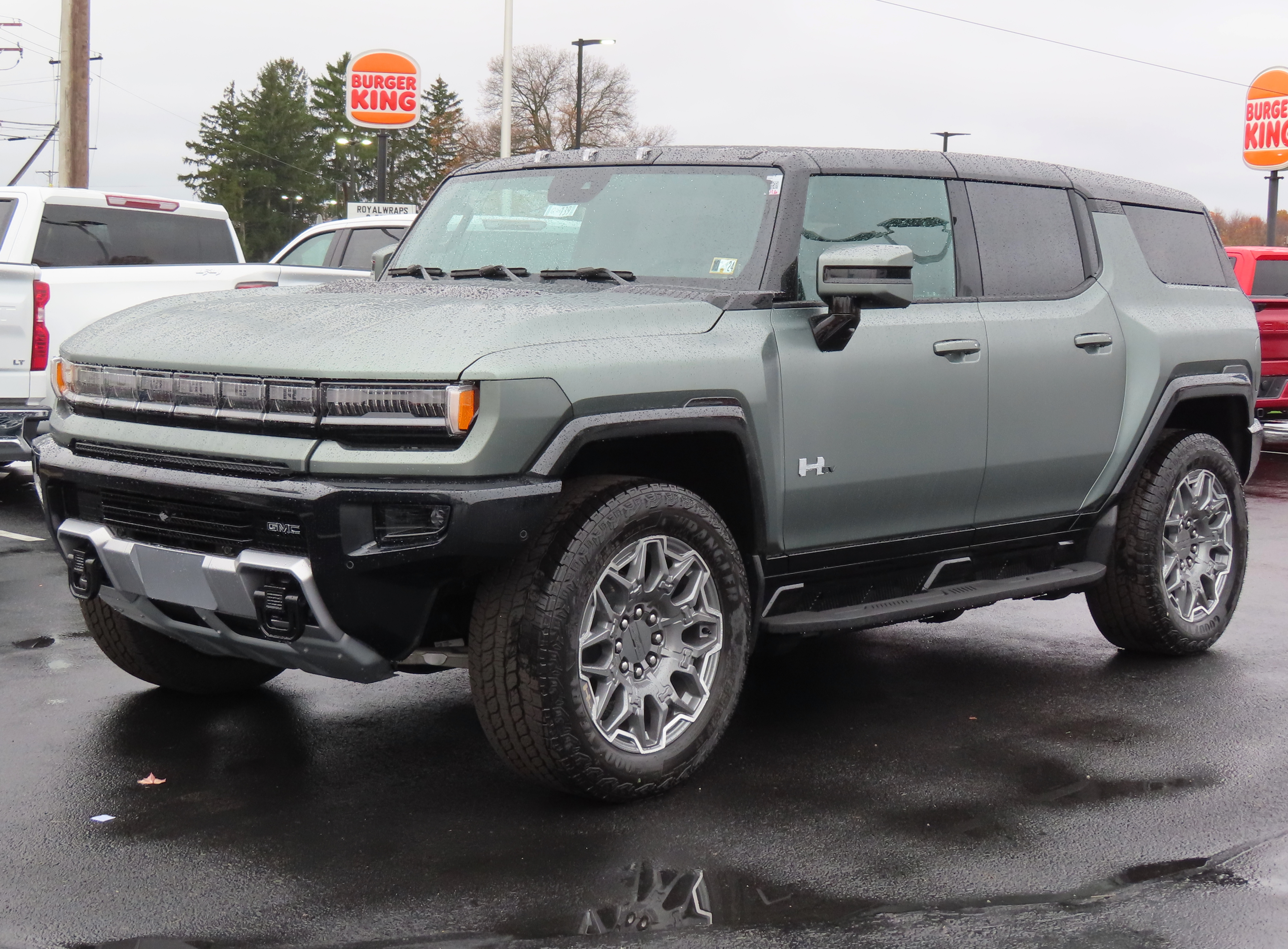
Hummer Ev
"Yeah. I mean, the Hummer EV and the Silverado EV are... But those are full EV..."
The Hummer EV SUV is a big SUV that runs on electricity. The podcast is pointing out that it’s a full electric vehicle, not a gas hybrid. It’s mentioned alongside other electric vehicles in the same general category.
The Hummer EV SUV is an all-electric version of the Hummer lineup, built as a large, off-road-capable electric vehicle. The podcast groups it with the Silverado EV and emphasizes that these are full EVs, highlighting the shift from traditional powertrains. It’s discussed as part of the broader conversation about electric trucks and SUVs.

Chevrolet Silverado EV
"I mean, the Hummer EV and the Silverado EV are... But those are full EVs. But they're 9,000 pounds."
The Chevrolet Silverado EV is an electric pickup. They mention it to make the point that fully electric trucks can be extremely heavy compared with other vehicles.
The Chevrolet Silverado EV is GM’s electric take on the Silverado pickup. In this segment it’s referenced alongside the Hummer EV to illustrate that full EVs can reach very high weights (around 9,000 pounds, per the hosts).

Lincoln Navigator
"“You mentioned the Cadillac Escalade [1093.2s] and of course, the Lincoln Navigator there. [1095.2s] That's where the highest end of the Grand Wagoneer kind of fits around in terms of price point.”"
The Lincoln Navigator is a big luxury SUV. The hosts use it as another example of the premium competitors the Grand Wagoneer is trying to match.
The Lincoln Navigator is a full-size luxury SUV known for comfort and high-end appointments. Here, it’s named alongside the Escalade as a top-tier competitor for the Grand Wagoneer’s price positioning.
kilowatt hour battery pack
"Yeah, 647 horsepower. A 92 kilowatt hour battery pack. Two electric motors."
A kilowatt-hour (kWh) is a unit of electrical energy storage, and the battery pack’s kWh rating is a key indicator of how much energy the vehicle can use. A 92 kWh pack is considered large for a plug-in hybrid, which typically translates to more electric-only capability (though real-world results depend on driving conditions and how the hybrid system is calibrated).
driving range
"They're claiming 500 miles of driving range, but like, what does that even mean when you're, don't want to get into it."
Driving range is how far the car says it can go before you have to recharge or refuel. The real distance can be different depending on how you drive and conditions like weather.
Driving range is the estimated distance a vehicle can travel before it needs to be recharged or refueled. The hosts question the meaning of a stated 500-mile range, because real-world range can vary a lot based on speed, temperature, battery state, and how often the vehicle uses its gasoline engine versus electricity.
PHEV strategy
"This is an automaker that has kind of flubbed its entire PHEV strategy or plug or electrified strategy."
PHEV means plug-in hybrid. It’s a car that can drive using electricity for a while, but it also has a gas engine if you need more range.
PHEV stands for plug-in hybrid electric vehicle. It means the car can run on electricity for some distance, but it also has a gasoline engine for longer trips.
plug-in hybrid electric vehicle
"This is an automaker that has kind of flubbed its entire PHEV strategy or plug or electrified strategy."
A plug-in hybrid is a car you can charge from a plug, but it also has a gas engine. The idea is to get electric driving when it’s convenient, and gas power when you need extra range.
A plug-in hybrid electric vehicle (PHEV) can be charged from an external power source and also uses a conventional engine. This setup is intended to give electric driving for shorter trips while retaining gas power for longer journeys.
max tow rating
"one of the cool things about this truck though is that it has a max tow rating of 10,000 pounds, which is pretty good."
Max tow rating is the highest weight the manufacturer says the vehicle can tow safely. It’s there to prevent overheating, brake fade, and other towing problems.
Max tow rating is the manufacturer’s maximum allowable weight a vehicle is designed to tow safely. It’s typically limited by the engine, transmission, cooling system, brakes, and the vehicle’s overall towing setup.

GMC Yukon Denali
"...row, you'll get more space than what you get in a Yukon Denali, which I think is like the perfect competition fo..."
The Yukon is a large SUV, and the Denali is a higher-end trim. The podcast mentions it while comparing how much space you get versus other large SUVs. The point is about interior room and how it stacks up.
The GMC Yukon is a full-size SUV offered in trims like the Yukon Denali, aimed at buyers who want a lot of interior space and a more upscale experience. The podcast compares space and positioning, noting that you can get more space than a Yukon Denali. It’s used as a reference point for competition in the large-SUV market.

Ford Expedition
"... the other full size SUVs like the Sequoia or the Expedition or the Armada and their luxury counter parts."
The Expedition is a large SUV with three rows of seats, meant for carrying more people. It’s often compared to other big SUVs because they’re similar in size and purpose. The podcast brings it up as part of that comparison group.
The Ford Expedition is a full-size three-row SUV designed for families and long-distance comfort. It’s mentioned alongside other big SUVs because it competes in the same “large, spacious” segment, including luxury versions. The podcast is using it as a benchmark for size and positioning.

Nissan Armada
"...ze SUVs like the Sequoia or the Expedition or the Armada and their luxury counter parts."
The Armada is a large SUV with three rows of seats, meant for carrying more people. It’s brought up because it competes with other big SUVs in the same general category. The podcast is grouping it with similar full-size options.
The Nissan Armada is a full-size three-row SUV built for space and family hauling. It’s mentioned in the same breath as other large SUVs like the Expedition and Sequoia, which suggests the podcast is comparing the big-SUV segment and their luxury counterparts. The Armada is part of that “large SUV” discussion.
Super Cruise
"I will admit though, and I say this every time we have a chance to talk about GM, but Super Cruise is a really wicked feature and Ford has gotten a little bit closer..."
Super Cruise is a GM system that can help drive the car hands-free in certain situations. The host brings it up as a major selling point for GM compared with competitors.
Super Cruise is GM’s hands-free driver-assistance system that can steer the vehicle under certain conditions while the driver monitors the road. It’s positioned here as a standout tech feature that other brands are trying to match.
Blue Cruise
"...and Ford has gotten a little bit closer to Super Cruise with its Blue Cruise hands-free system..."
Blue Cruise is Ford’s hands-free driving assist feature that can steer the car by itself in certain situations. The host uses it to show Ford is catching up to GM’s Super Cruise.
Blue Cruise is Ford’s hands-free driver-assistance system, designed to allow the car to steer itself in supported conditions while the driver remains responsible for monitoring. In this segment, it’s mentioned as Ford’s closer alternative to GM’s Super Cruise.
hands-free system
"...with its Blue Cruise hands-free system and Jeep does not have anything like that right now. And if it did, it's not available in the 2026 Grand Wagoneer."
A hands-free system is tech that can help steer the car without you gripping the wheel all the time. It only works when the car is in the right kind of driving situation, and the host says Jeep doesn’t have that in the 2026 Grand Wagoneer.
A hands-free system refers to advanced driver-assistance technology that can control steering (and sometimes other functions) without the driver holding the wheel, but only within specific operating limits. The host is using this idea to compare which automakers offer it and whether the 2026 Grand Wagoneer includes it.
engine replacement
"you can just go on Instagram and find GM service texts and mechanics making videos of customer vehicles coming in that require, excuse me, require engine replacement."
Engine replacement is when a shop swaps the whole engine instead of just fixing one part. The hosts are saying this is happening often enough to be a noticeable reliability problem.
Engine replacement means the entire engine is removed and swapped for a new or remanufactured unit. In the segment, it’s used to describe a pattern of failures severe enough that repairs escalate beyond normal fixes.
power recline
"The third row seats also have like a power recline function, which is really cool because usually third row passengers are treated completely like out of mind really."
Power recline means the seat can move to different angles using a button or switch. It helps third-row passengers get comfortable more easily.
Power recline means the seat back angle can be adjusted electronically, usually with a switch or button. On a third row, it’s a convenience feature that makes it easier to dial in comfort without manually adjusting the seat.
USB-C
"But there's also USB ports back there, both USB-C and USB-A style ports."
USB-C is a type of charging port that you can plug in either way. It’s common on phones and other devices, so rear passengers can charge more easily.
USB-C is a modern, reversible USB connector commonly used for charging and data. Having USB-C in the third row indicates the vehicle supports charging for rear passengers without needing adapters.
USB-A
"But there's also USB ports back there, both USB-C and USB-A style ports."
USB-A is the common older USB plug shape. It’s included so more different devices can charge without needing the exact same cable.
USB-A is the older, rectangular USB connector shape still used by many devices and accessories. Including USB-A alongside USB-C improves compatibility for different charging cables.
sunroof
"There's also a dedicated sunroof to those passengers, which is always a weird thing to see. It does not have a powered sunshade though."
A sunroof is a glass or panel opening in the roof that lets in light and sometimes fresh air. The host notes a dedicated sunroof for the third-row passengers, which is unusual because many SUVs only provide roof openings for the front or second row.
powered sunshade
"It does not have a powered sunshade though. You have to manual sunshade back there."
A powered sunshade is a cover that you can move automatically to block the sun. In this case, it doesn’t move by itself, so you have to adjust it manually.
A powered sunshade is an electronically operated cover that blocks sunlight over a sunroof. The host says this vehicle lacks that feature, meaning the shade must be adjusted manually for third-row comfort.
rear-seat entertainment system
"In the second row, there are in because I have the rear-seat entertainment system. There are three screens... Most of the time, when we talk about rear-seat entertainment systems..."
A rear-seat entertainment system is the screen-and-audio setup meant for passengers in the back seats. The goal is to keep kids or passengers entertained without taking over the main screen up front.
A rear-seat entertainment system is a set of screens and media controls designed to keep passengers in the back seats entertained. It often includes dedicated displays, audio/video inputs, and sometimes streaming or device mirroring—so the front-seat occupants aren’t sharing the same screen.
four-zone climate control
"There are three screens. That's two entertainment systems and a HVAC setup because this also features a four-zone climate control."
Four-zone climate control means the car can heat or cool different parts of the cabin separately. So people in different seats can each pick a temperature they like.
Four-zone climate control divides the cabin into up to four independently controlled temperature areas. That lets different passengers (for example, front left/right and rear left/right) set their own comfort levels instead of sharing one temperature setting.
HVAC setup
"That's two entertainment systems and a HVAC setup because this also features a four-zone climate control."
HVAC is the car’s heating and air-conditioning system. It controls how air moves through the cabin and what temperature it’s set to.
HVAC stands for heating, ventilation, and air conditioning—the system that manages cabin airflow and temperature. In this context, the hosts are linking the rear-seat screens to the car’s climate system controls.
head-up display
"There is an information display, [1668.9s] you know, a 12-inch information like digital dash. [1671.3s] There's a head-up display, which has the biggest fonts [1673.8s] I have ever seen on a head-up display. [1676.6s] It feels like it's set to old man mode."
A head-up display shows important driving info on the windshield. That way you don’t have to take your eyes off the road to check gauges.
A head-up display (HUD) projects key driving information onto the windshield so you can see it without looking down at the instrument cluster. In this segment, the host notes the HUD’s unusually large fonts and how it affects readability.
massage seat functions
"Yeah. And I called that my creature comfort control panel [1682.0s] because it features the massage seat functions there. [1686.6s] So that's seven screens we're up to so far."
Massage seat functions are built-in seat features that use motors and air bladders or rollers to provide vibration or kneading sensations. Here, the host points out that the massage controls are integrated into the vehicle’s screen-based “creature comfort” panel.
motorized hinge
"You can press a button that motorizes. [1697.1s] It has a motorized hinge. It flies away. [1698.9s] Is there a screen..."
A motorized hinge is a hinge that moves automatically using a motor. Here, it’s part of a feature that opens or swings away when you press a button.
A motorized hinge is a hinge mechanism that uses an electric motor to move a door, panel, or cover. In this context, it’s describing an opening/closing feature that “flies away” when activated.
wireless phone charger
"There's a wireless phone charger there. [1701.0s] Is there a screen on the inside of the gas cap?"
A wireless phone charger tops up your phone without plugging in a cable. You just set the phone in the charging spot.
A wireless phone charger charges a compatible phone without plugging in a cable, typically using inductive charging. It’s usually integrated into a console or storage area for convenience.
haptic buttons
"Some of them are kind of like those haptic buttons, [1729.6s] but they have like ridges around them so you can like... [1733.5s] You don't have to aim too much."
Haptic buttons give you a physical “feel” (like a vibration) when you press something. That way you can use the controls without constantly looking at the screen.
Haptic buttons use vibration or tactile feedback to confirm an input, even though the button may not physically “move” much. In practice, that can help drivers avoid looking down while operating climate, media, or convenience functions.
Stellantis
"So I will give credit to Stellantis or Jeep [1741.4s] for figuring out some pretty good interior ergonomics."
Stellantis is the company that owns Jeep and other car brands. The host is basically saying the company did a good job designing how the controls and layout feel inside the vehicle.
Stellantis is the automaker group behind multiple brands, including Jeep. When the host credits Stellantis (or Jeep) for interior ergonomics, they’re attributing the design/packaging work to the parent company that develops and coordinates these vehicles.
3-row SUV
"in that it is a Jeep branded 3-row SUV. And it should be..."
A 3-row SUV has three rows of seats, usually for bigger families. The speaker is saying this kind of design often prioritizes carrying people over serious off-road driving.
A 3-row SUV is designed with seating for three rows of passengers, typically targeting families that need more seats than a two-row crossover. In this context, the speaker argues that the Grand Wagoneer’s family-focused packaging comes at the expense of off-road priorities.

Land Rover Defender 130
"there's one other car maker or automaker that has I think the same off-road credibility and has a competing product in Land Rover and the Defender 130, I think is a more capable off-road vehicle."
The Land Rover Defender 130 is a rugged off-road SUV with extra length for more space. The speaker’s comparing it to the Jeep to argue the Defender is made first for off-roading, not just looking luxurious.
The Land Rover Defender 130 is a long-wheelbase Defender variant built around serious off-road use. Here, it’s used as a benchmark for “off-road credibility,” with the speaker saying it’s more capable for activities like dune bashing even if it’s less luxury-focused.
dune bashing
"but that is a vehicle I would see myself go dune bashing in. Well, I think the difference is that's a vehicle designed to go off-road from the start."
Dune bashing means driving aggressively over sand dunes off-road. It’s a tough test for how well a vehicle can handle loose terrain and bumps.
Dune bashing is an off-road driving activity where you traverse sand dunes at speed, using traction and suspension travel to keep the vehicle moving. It’s a good real-world test of off-road capability because it stresses tires, drivetrain, and suspension repeatedly.
tow a trailer
"Whereas the Grand Wagoneer is designed to carry your kids around and tow a trailer."
To tow a trailer means pulling something behind the SUV, like a boat or camper. The speaker is saying the Grand Wagoneer is built more for that everyday utility than for hardcore off-roading.
To tow a trailer means pulling another vehicle or load behind the SUV, which requires adequate towing capacity and the right drivetrain and cooling setup. The speaker uses it to characterize the Grand Wagoneer’s intended role as more of a family-and-hauling vehicle than a dedicated off-roader.
three-row SUV
"I think that you only buy this class of vehicle if you have a specific need for something this big. And usually that's towing or hauling. And off-roading is just not... It's just not a part of the three row SUV."
A three-row SUV is a big family SUV with extra seats in the back. The point they’re making is that these vehicles are usually bought for carrying people and gear, not for serious off-roading.
A three-row SUV is a large family vehicle with seating for up to seven or eight people, typically prioritizing space and practicality. In this segment, the hosts argue that off-roading isn’t usually the point of a three-row SUV, and that buyers of vehicles “this big” are more often motivated by towing or hauling.
towing or hauling
"And I think that you only buy this class of vehicle if you have a specific need for something this big. And usually that's towing or hauling."
Towing is when you pull something behind your car, like a trailer or boat. Hauling is when you carry heavy or bulky stuff, and they’re saying that’s usually why people choose a big SUV.
Towing means pulling a trailer behind the vehicle, while hauling generally means transporting bulky cargo or heavy loads in/around the vehicle. The hosts use these as the “specific need” that justifies buying a very large SUV like the Grand Wagoneer.

Toyota Sequoia
"You're comparing this to a Sequoia? 1875.7s] Isn't that what the three row SUV alternative is at Toyota? [1879.4s] Yeah, but it's considerably cheaper and not luxurious whatsoever."
The Toyota Sequoia is Toyota’s full-size, three-row SUV that competes directly with other large family haulers. Here it’s used as the benchmark “three-row SUV alternative” to the Grand Wagoneer, with the key comparison being that the Sequoia is more expensive and less luxurious in the speaker’s view.
TRD
"There's also a TRD version of the Sequoia, which is also $102,000."
TRD is Toyota’s performance/off-road brand. A TRD Sequoia usually has extra features or styling meant to make it more capable or more “sporty” than a regular trim.
TRD is Toyota Racing Development, Toyota’s in-house performance and off-road branding. When a Sequoia is offered as a TRD version, it typically means more aggressive styling and equipment aimed at driving enthusiasts or light off-road use.
Land Rover Defender
"If you want to say maybe it goes up against Land Rover, I don't know if it's a Defender... Land Rover, Defender. I want to find the pricing of the 130."
The Defender is a large SUV built to handle rough roads and off-road trails. People talk about it when comparing expensive, capable SUVs and when checking the price of bigger versions. The podcast is referencing it while trying to match it to other vehicles.
The Land Rover Defender is a rugged, off-road-focused SUV known for its boxy design and strong capability. It often comes up in discussions when people compare “go-anywhere” SUVs and look at pricing for specific variants like the Defender 130. The podcast mentions it in the context of figuring out how it stacks up against other large SUVs.

Land Rover Discovery
"Did they still make the discovery, the seven passenger discovery? I think, you know, like Land Rover is kind of splitting the difference there for their three rows."
The Land Rover Discovery is a three-row SUV known for blending family-friendly practicality with a more upscale, capable character. In this segment, the hosts compare it to the Defender 130 and describe it as being “closer to crossover territory,” meaning it’s positioned more like a mainstream family SUV than a rugged off-road-only vehicle.
Jeep Grand Cherokee L
"[2011.8s] Or a Grand Cherokee L. [2013.0s] It is bigger. [2014.1s] Yeah, maybe the Grand Cherokee L."
The Grand Cherokee L is a longer version of Jeep’s Grand Cherokee. The hosts are basically saying the Wagoneer looks similar in size and shape to this longer Jeep.
The Jeep Grand Cherokee L is the longer-wheelbase version of the Grand Cherokee line. In this segment, the hosts compare the 2026 Jeep Grand Wagoneer’s proportions and styling to the Grand Cherokee L to explain why it may look “bigger” and less distinctive.

Dodge Hornet
"two vehicles for sale right now. Is the Hornet still on your list? And no, Hornet's gone."
The Hornet is a small crossover SUV. In the podcast, they say it’s no longer on the list because it’s “gone,” meaning it’s not currently being sold or considered. The mention is about availability rather than driving details.
The Dodge Hornet is a compact crossover that the podcast discusses as being “on your list,” but then notes it’s “gone,” implying it’s no longer available or no longer part of the current lineup. The mention is brief and focused on whether it’s still being considered. It’s essentially a status update within the host’s vehicle shortlist.

Mazda 3
"... I mean, we talked about this thing back with the Mazda 3. Sometimes an old design is still okay if it does..."
The RX-3 is an older Mazda sports car. The podcast is using it to make the point that an older design can still be a good choice. It’s mentioned as part of a discussion about whether “old” automatically means “bad.”
The Mazda RX-3 is a classic Mazda sports coupe that’s known for its rotary-engine heritage. The podcast references it in a broader point about older designs still being acceptable if they meet the needs of buyers. It’s mentioned as an example of how a design can remain relevant over time.
Magne ride
"A really good suspension. Magne, Magne ride? And Magne ride."
MagneRide is a suspension system that can automatically adjust how soft or firm the ride feels. It helps the car stay comfortable on rough roads while still handling well.
“Magne ride” refers to GM’s MagneRide adaptive suspension system, which uses electronically controlled dampers to change ride stiffness in real time. It’s designed to improve both comfort and handling by reacting quickly to road conditions.

Subaru Cross Trek
"No, I drove the 2026 Subaru Cross Trek Hybrid. ... This is a new thing where it's two electric motors"
The 2026 Subaru Crosstrek Hybrid is a Crosstrek that uses both a gas engine and electric power. The hosts are saying the newer hybrid system is different from older attempts, and they’re focusing on how it affects power and weight.
The 2026 Subaru Crosstrek Hybrid is notable because it adds an electrified powertrain to the Crosstrek crossover formula, changing how it delivers power and efficiency. In this segment, the hosts discuss how earlier hybrid attempts felt weak, and how the newest setup uses two electric motors.
hybrid vs plug-in hybrid (power delivery and charging)
"Is it the PHEV or the hybrid? ... It was a problem in the sense that it did not have enough power ... It added some weight. ... They made a plug-in version"
They’re comparing two kinds of hybrid cars: one you mostly charge through driving, and one you can plug in. The difference matters because it changes how much electric power you get and how the car feels to drive.
The segment contrasts a regular hybrid with a plug-in hybrid, focusing on how the powertrain affects real-world performance. The hosts argue that the earlier hybrid setup felt weak and added weight, while later they mention a plug-in version as a different approach.
four cylinder engine
"and the two and a half liter four cylinder engine."
A four-cylinder engine is an engine with four working cylinders. They mention the size (two and a half liters) to explain why the power and torque numbers make sense.
A four-cylinder engine has four combustion chambers in a single engine block, and it’s a common layout for efficient everyday vehicles. Here, the hosts specify a “two and a half liter four cylinder engine” to frame the discussion of power and torque output.
torque
"And together it makes 196 horsepower [2317.7s] and 199 pound-feet of torque. ... [2357.4s] But more importantly, it's 20 more pound-feet of torque [2360.1s] and those pound-feet of torque arrive like nearly instantly"
Torque is the force that helps the car accelerate and feel strong. Higher or earlier torque usually means the car feels responsive right away.
Torque is the twisting force the engine produces, and it strongly affects how quickly a vehicle feels like it’s pulling. In this segment, they emphasize that the Crosstrek’s torque comes in nearly instantly versus peaking at higher RPM.
RPM
"and those pound-feet of torque arrive like nearly instantly [2363.7s] versus I think it's 3,700 RPM for max torque [2367.3s] on the two and a half liter."
RPM (revolutions per minute) is how fast the engine’s crankshaft spins. They’re comparing where maximum torque happens—nearly instant versus around 3,700 RPM—so you can understand the difference in “low-end” versus “high-RPM” pull.
spare tire
"Anyway, Cross Trek was capable of doing that. You don't get a spare tire either. That's the other difference."
A spare tire is the backup tire you can use if you get a flat. The host is saying this version doesn’t come with one, so a flat could be more of a hassle.
A spare tire is an extra wheel/tire carried so you can replace a flat without waiting for roadside help. The host notes that the Crosstrek Hybrid they’re discussing doesn’t include a spare tire, which affects how you handle punctures on the road.
hybrid trim availability by country
"In Canada, there's only one hybrid trim. It's the limited hybrid, the top tier. In the U.S., you get limited hybrid and you get sport hybrid. So the cheapest hybrid in the States is 34 grand."
Car buyers don’t always get the exact same hybrid options in every country. This segment explains that Canada and the U.S. have different hybrid trim choices, so the starting price ends up different too.
Automakers often sell different trim lineups by market, so the “same” hybrid model can come in different configurations depending on the country. Here, the host says Canada has only one hybrid trim while the U.S. offers multiple hybrid trims, which changes what the cheapest hybrid costs.
turbocharged engine
"But until we get a turbocharged engine under the hood, it's as close as we're going to get, I think. And it does well."
A turbocharged engine uses a device that pushes extra air into the engine. That usually helps the car feel stronger and quicker, especially when you accelerate.
A turbocharged engine uses a turbocharger to force more air into the cylinders, which can increase power without needing a larger engine. The host is using this as a benchmark for when the Crosstrek would feel “fast,” implying the current setup lacks that boost.
CVT
"The main difference between the drivetrains is it's less buzzy, because you're not necessarily pegging a four-cylinder engine with a CVT. And that CVT and that buzzeness is actually a really... It really does get to you after a while."
CVT means the transmission can adjust its “gear ratio” smoothly. The host is saying that on the gas Crosstrek, the engine can end up sounding buzzy because the CVT keeps it in a certain rev range.
CVT stands for continuously variable transmission, a gearbox that can smoothly change gear ratios instead of using fixed “gears.” The host describes “buzzeness” from a four-cylinder engine being held near higher revs by the CVT, which can become tiring over time.
transitions between the gas engine and the electric system
"with the hybrid version is transitions between the gas engine and the electric system are not very smooth, especially if the engine's cold. It can actually shake the dashboard on initial startup."
In a hybrid, the car constantly switches between gas power and electric power. If that switch happens abruptly—like right after a cold start—it can feel rough or shake the car.
In a hybrid, “transitions” are the moments when control switches between the gas engine and the electric system. If the calibration isn’t seamless—especially when the engine is cold—it can feel jerky or cause vibration because torque delivery changes quickly.
EV driving mode
"there's a button on the dashboard to give you EV driving mode, and it never works ever, ever, ever... It would just say EV mode not available."
EV mode is the setting that tries to make the car run on electricity instead of the gas engine. If the battery or conditions aren’t right, the car won’t let EV mode turn on and will warn you.
EV driving mode is a setting that tries to run the vehicle on electric power alone (or as much as possible) instead of using the gas engine. If the system can’t meet the power demand or battery conditions, the car may refuse to engage EV mode and display messages like “EV mode not available.”
mild hybrid
"So that's kind of... That makes it sound more like a mild hybrid"
A mild hybrid is a hybrid where the electric system mainly helps the gas engine, not fully replace it. So the car may only be able to run on electricity in limited moments, like when you’re coasting or stopped.
A mild hybrid uses an electric motor to assist the gas engine, but it typically can’t propel the car for long distances on electricity alone. That’s why EV mode may be limited or only available in certain situations, such as coasting or at a complete stop.
fuel economy
"but I'm going to pull up the fuel economy of the Crosstrek hybrid. In the US, I believe it's rated at 36 miles per gallon highway, city, and combined."
Fuel economy is a measure of how far a car can go on a gallon of gas. The hosts mention the usual U.S. categories: city driving, highway driving, and an overall combined number.
Fuel economy is how efficiently a vehicle uses fuel, commonly expressed as miles per gallon (MPG) in the U.S. The segment references the standard breakdown of highway, city, and combined ratings used for comparisons.
hybrid synergy drive
"Wikipedia says this is a version of hybrid synergy drive from Toyota. I don't know how successful Toyota is at that."
Hybrid Synergy Drive is Toyota’s name for how it combines a gas engine and an electric motor in one hybrid system. The goal is to make the car use electricity and gas together efficiently.
Hybrid Synergy Drive (HSD) is Toyota’s hybrid system architecture, best known from models like the Prius. It coordinates the gasoline engine and electric motor(s) so the car can blend power smoothly and recover energy during braking.
EV power
"Because I can cruise around at EV power. Oh, wait, I can't because it doesn't work with the cross track."
EV power means the car is running on electricity from its battery. The hosts are saying you can’t always rely on it—sometimes the car switches away from electric-only driving.
EV power means the vehicle is being driven using electricity from its battery and electric motor, rather than burning fuel. The segment highlights that the Crosstrek Hybrid can’t always stay in EV mode depending on conditions, so real-world driving may use more gas than expected.
Crosstrek Cross Track
"...h, wait, I can't because it doesn't work with the cross track. I got 7.3."
The Crosstrek is a small crossover SUV meant for everyday driving. In the podcast, they say they can’t use a certain feature or setup because it doesn’t work with the car’s “cross track” setup. The mention is about compatibility, not performance specs.
The Crosstrek (likely referring to the Subaru Crosstrek/Crosstrek) is a compact crossover known for practical versatility. In the snippet, the host says they can’t do something because it “doesn’t work with the cross track,” suggesting a compatibility or feature limitation related to the car’s systems. The mention is tied to whether a particular function or setup applies to this model.

Toyota Corolla Cross
"Like if you look at, you're talking about Toyota technology, right? The only other all wheel drive crossover in its class that is a hybrid is the Corolla Cross, which gets 5.6 liters combined."
The Toyota Corolla Cross is another small crossover. Here it’s used as a comparison point for hybrid fuel economy and all-wheel-drive availability.
The Toyota Corolla Cross is a compact crossover, and in this segment it’s brought up as the Corolla Cross hybrid option that’s also all-wheel drive in its class. The hosts compare its combined fuel economy figure to the Subaru Crosstrek Hybrid to show how close (or far) the real-world results may be.
combined
"which gets 5.6 liters combined. Yeah, that's much nicer."
“Combined” is a single fuel-economy rating that averages different kinds of driving. It’s used so you can compare two cars on the same basis.
A combined fuel-economy number blends multiple driving conditions (typically city and highway) into one figure. The hosts use the “combined” value to compare vehicles fairly, rather than relying on a single type of driving.
Request an Explanation
Heard something you'd like explained? We'll add it to this episode.
Sign in to request explanations for terms you heard.
Want to learn more?
Browse our glossary for plain-English explanations of automotive terms, jargon, and concepts.
Help improve this episode
See something that's not quite right? Our annotations are AI-generated and can sometimes miss the mark. Click the flag icon on any annotation to suggest a correction.