Episode 458: 2026 Lotus Eletre, 2026 Ford Bronco Sport
About this episode
Wildfire smoke and poor air quality in Canada kick things off, followed by a detour into an AI “face training” lawsuit. The conversation then zeroes in on the 2026 Lotus Eletre: its naming, “Energon cubes,” Lotus’s first SUV claim, and how EV weight, battery limits, and launch-control/traction logic shape the drive. They also cover charging, HUDs, autonomy talk, and U.S. tariff pricing. The second half shifts to the 2026 Ford Bronco Sport—heritage styling, Black Diamond off-road packaging, and real-world practicality.
The Unnamed Automotive Podcast gets its first taste of Lotus this week as Benjamin test drives the new Eletre. This large electric SUV might not be the most Lotus thing you could think of, but it represents a new chapter of the automaker, one that has left Benjamin with many thoughts and impressions that he is keen to share.
Then Sami reviews the 2026 Ford Bronco Sport, a car he had trouble understanding in the past, but now totally gets, especially in light of all these other fake off-road trims that have come out. With a bunch of upgrades and features, the Bronco Sport stands out, but is a bit expensive. Sami details more Pros and Cons in his full take of this cute-ute. Thanks for listening!

Lotus Eletre
"And now we're talking about the Lotus Elytra or Eletre, [404.8s] as they call it here in Quebec. [406.7s] This is the first SUV that Lotus has ever made."
The Lotus Eletre is the first SUV that Lotus has ever made. It’s a big change for Lotus, because they’re usually known for smaller, lighter sports cars.
The Lotus Eletre is Lotus’s first SUV, marking a major shift from the brand’s traditional lightweight sports-car focus. It’s notable because it brings Lotus’s performance identity into a large, family-oriented crossover format.

Lotus 7
"You've never driven a Lotus 7 before? [417.8s] Have you? [418.5s] Or a Caterham 7? [419.9s] Have you?"
The Lotus 7 is a very lightweight, simple sports car that Lotus is known for. The hosts mention it to explain what kind of Lotus cars they’re talking about—small, driver-focused ones.
The Lotus 7 is a lightweight, minimalist sports car concept that Lotus is famous for. It’s often associated with Caterham’s modern interpretation, and the hosts use it to set context for what Lotus driving experience means.

Caterham 7
"You've never driven a Lotus 7 before? [417.8s] Have you? [418.5s] Or a Caterham 7? [419.9s] Have you?"
The Caterham 7 is a modern take on the classic Lotus 7 idea. It’s a small, lightweight sports car, and they’re using it as another example of the kind of Lotus-adjacent car they’re talking about.
The Caterham 7 is Caterham’s version of the classic Lotus 7 formula: a lightweight, open-top, driver-focused car. The hosts mention it alongside the Lotus 7 to compare the kind of “Seven” experience they have (or haven’t) had.

Genesis G90
"...k it up, it has broken. This is like your Genesis G90 white whale that has it. It's like multiple Maser..."
The Genesis G90 is a large luxury car designed for comfort and a premium feel. People may talk about it as a “white whale” when a specific version or example is hard to find. The podcast is using it as a point of comparison for luxury cars.
The Genesis G90 is a full-size luxury sedan focused on comfort, quietness, and high-end features. The podcast reference to a “white whale” and something that “has it” suggests it’s being discussed as a rare or hard-to-find configuration or example. It’s also mentioned in the context of other luxury cars, implying a comparison of desirability and ownership stories.
Maserati
"I have gone on launch programs with Maserati. Can you believe that? ... I hear that's the most effective form of Maserati ownership."
Maserati is a famous Italian car brand that makes sporty luxury cars. Here it’s mentioned because the speaker has worked with them on new-car development and testing.
Maserati is an Italian luxury and performance car brand known for sporty engines and grand-touring models. In this segment, it’s used as an example of a brand the host has been involved with on “launch programs,” implying pre-production or new-model development activity.
Alfa Romeo
"I think you're confusing Maserati for Alfa Romeo. ... I don't think so. ... I guess, Maserati and Alfa Romeo."
Alfa Romeo is another Italian car brand, also known for sporty cars. In this conversation, it’s mentioned because the speakers are comparing it to Maserati and talking about how the brands relate.
Alfa Romeo is an Italian automaker best known for stylish designs and historically sporty, driver-focused cars. The hosts bring it up because they’re discussing brand confusion and corporate relationships between Maserati and Alfa Romeo.
Stalantis
"I think it's the I don't think the apple falls far from that tree or Stalantis in general, which is, I guess, Maserati and Alfa Romeo."
This sounds like “Stellantis,” which is a big company that owns multiple car brands. The hosts are saying Maserati and Alfa Romeo are part of the same larger group.
“Stalantis” appears to refer to Stellantis, a major global automaker formed from a merger of Fiat Chrysler Automobiles and PSA. The hosts are using it to connect Maserati and Alfa Romeo under the same corporate umbrella.
Geely
"And now I think owned by a Chinese car company. Yeah, it's owned by Geely. And most people will know Geely as making electric cars."
Geely is a Chinese car company. The speakers say Geely owns Lotus, and that helps explain why Lotus is building more electric cars.
Geely is a Chinese automaker that owns Lotus. The hosts link Geely’s reputation for electric vehicles to Lotus’s electric direction, framing ownership as a driver of product strategy.
EV
"Yeah, it's owned by Geely. And most people will know Geely as making electric cars. And that's kind of why the electric exists..."
Electric cars run on electricity stored in a battery instead of burning gasoline. The hosts are saying Geely makes lots of electric cars, which influences Lotus’s electric lineup.
Electric cars are vehicles powered primarily by electric motors and a battery (rather than a gasoline engine). In this segment, the phrase is used to explain why Lotus’s “electric” exists after Geely ownership.
Colin Chapman
"[542.5s] In fact, Colin Chapman, who was the founder of Lotus, [545.9s] had that famous saying of simplify and add lightness, basically,"
Colin Chapman was the founder of Lotus. He’s known for the idea that making cars lighter and simpler helps them perform better.
Colin Chapman was the founder of Lotus and is strongly associated with the brand’s engineering philosophy. His famous idea was to “simplify and add lightness,” meaning reduce complexity and weight to improve performance.
simplify and add lightness
"[545.9s] had that famous saying of simplify and add lightness, basically, [549.5s] which was did not translate to anything Geely understood."
This is a Lotus motto meaning “make it simpler and lighter.” The idea is that lighter, simpler cars tend to drive better and feel more responsive.
“Simplify and add lightness” is Lotus’s classic engineering motto: reduce unnecessary complexity and keep vehicle weight down. The segment uses it to contrast Lotus’s traditional approach with the heavier weight of the discussed SUV.
carbon
"[582.8s] is the version that I drove, the carbon that has 900 horsepower. [588.2s] And I mean, if you're going to make something heavy,"
Here, “carbon” likely means a higher-end version of the car that uses carbon-fiber materials. The host is connecting that version to more power.
In this context, “carbon” refers to a specific Eletre variant/trim associated with carbon-fiber content. The host links it to the higher-output version they drove.
900 horsepower
"[582.8s] is the version that I drove, the carbon that has 900 horsepower. [588.2s] And I mean, if you're going to make something heavy,"
Horsepower is a measure of how strong the engine is. Higher horsepower can help a heavy car still accelerate well.
Horsepower is a measure of engine output (how much work the powertrain can do). The segment uses the 900 hp figure to argue that the heavier Eletre can still feel quick thanks to high power.
weight to power to weight ratio
"[588.2s] And I mean, if you're going to make something heavy, [591.4s] at least get the power to make it a nice weight to power to weight ratio."
This is a simple idea: how much power the car has compared to how heavy it is. More power for the weight usually makes the car feel faster.
The “power-to-weight ratio” is how much power an engine makes relative to the vehicle’s mass. A higher ratio generally means quicker acceleration and better performance feel, even if the car is heavy.
600 horsepower
"[603.0s] There is the base model. [605.2s] And then there's something I think it's called the touring or the sport. [608.0s] I can't remember. [609.3s] And that has 600 horsepower."
They’re talking about horsepower differences between versions of the same car. A 600 hp version is less powerful than the 900 hp one mentioned earlier.
The host is comparing different Eletre power levels by mentioning a 600 hp variant. This helps frame how the lineup’s performance changes depending on market/trim.
R or sport
"[611.3s] And then there's a version called the R or sport are again, depends where you live. [616.3s] And that has the 900"
This is a name for a more performance-focused version of the car. The host is saying the naming can vary by country, but it’s one of the stronger variants.
“R” (or “sport,” depending on market naming) is being used as a higher-output trim designation within the Eletre lineup. The segment’s point is that different regions get different model names and power levels.
100 percent tariff
"And if you live in the U.S., you will be paying a 100 percent tariff on the Lotus because it's built in China."
A tariff is a tax on things brought into the country from elsewhere. If it’s “100 percent,” that means the tax is so high it can roughly double the cost of the car.
A tariff is a tax the government charges on imported goods. A “100 percent tariff” means the tax rate is effectively equal to the item’s value, so it can double the cost before dealer pricing and other fees.
transport and destination
"And going up to the carbon price was just 232 including including transport and destination and all that stuff."
“Transport and destination” is the cost to ship the car and deliver it to where it’s sold. When someone quotes a price including this, it’s closer to what you’ll actually pay than just the sticker price.
“Transport and destination” refers to the logistics and delivery charges to get a vehicle from where it’s built to the buyer’s region or dealer. Hosts often include it when quoting an approximate “all-in” price, since it can add a noticeable amount beyond the base vehicle price.

Lamborghini Urus
"I think that has 700 and fifty horsepower from a twelve cylinder engine. And then I think the Urus is like just under 700 or something."
The Lamborghini Urus is a very powerful luxury SUV. The host brings it up to compare how much power it makes against the Lotus Eletre.
The Lamborghini Urus is a high-performance luxury SUV known for delivering supercar-like acceleration and power. Here it’s used as a comparison point for horsepower versus the Lotus Eletre’s claimed output.

Porsche Cayenne S
"and then it gets down to like Cayenne S and that kind of thing, Bentayga speed and all that stuff."
The Porsche Cayenne S is a sportier version of Porsche’s Cayenne SUV. The host mentions it as one of the SUVs people compare when talking about power.
The Porsche Cayenne S is a performance-oriented trim of the Cayenne SUV line. The host uses it as another reference point in the “super SUV” horsepower comparison, implying the Lotus Eletre’s output is higher than these mainstream performance variants.

Bentley Bentayga
"Cayenne S and that kind of thing, Bentayga speed and all that stuff."
The Bentayga Speed is Bentley’s faster, sportier SUV. The host mentions it as another example of a powerful luxury SUV.
The Bentayga Speed is the performance-focused version of the Bentley Bentayga SUV. It’s included in the host’s list of high-output luxury SUVs to contrast against the Lotus Eletre’s claimed horsepower advantage.
internal combustion engine
"So they knew that they were going into a situation where I think going with [724.4s] an internal combustion engine might have been the wrong call. [728.2s] So instead, and this is how I've been thinking about it, I drove it last week."
An internal combustion engine is the traditional gas or diesel engine that burns fuel to make power. The hosts are saying Lotus may have been better off choosing an electric setup instead.
An internal combustion engine (ICE) is a gasoline or diesel engine that burns fuel inside the engine to create motion. The hosts contrast ICE with an EV approach, arguing that going ICE might have been the “wrong call” for this particular Lotus product.
combustion power trains
"as it is now, like a Geely company with a combustion powertrain SUV,"
A combustion powertrain means the car makes power by burning fuel, like a normal gas or diesel engine. The discussion is contrasting that with an electric approach.
A combustion powertrain is a drivetrain built around burning fuel (gasoline or diesel) to make power. The hosts use it to contrast with an EV powertrain, arguing that an ICE-based Lotus SUV would be compared directly against many established brands.
Max Trentini
"when I spoke to the CEO, [775.2s] Max Trentini, about CEO of Lotus Americas, [779.2s] about why they decided to do this."
Max Trentini is a top executive at Lotus Americas. In this episode, he’s quoted explaining why Lotus went with an electric SUV and how battery weight matters.
Max Trentini is identified here as the CEO of Lotus Americas. The segment uses his comments to explain why Lotus chose an EV approach and how vehicle weight factors into the decision.
battery powered vehicles
"And he's like, look, we can't get around the weight of this vehicle. [784.4s] You know, battery powered vehicles."
Battery powered vehicles run mainly on electricity stored in a battery. The point here is that batteries are heavy, and that weight has to be accounted for when designing the car.
“Battery powered vehicles” refers to cars that use an electric battery as their primary energy source, typically as EVs or plug-in hybrids. The segment highlights a key EV engineering constraint: battery packs add weight, which can affect performance, packaging, and overall vehicle design.
energy density
"They have a hard cap because of energy density is all we can do."
Energy density is basically how much “power” a battery can store compared to its size and weight. If it’s limited, the car can’t carry enough energy to do everything you might want.
Energy density is how much energy a battery can store for a given weight or volume. The “hard cap” idea means EV range and performance are constrained by how much energy the battery can physically fit and still keep the vehicle’s weight reasonable.
EV aspect
"So it could be evaluated on its own merits rather than comparing it to a two seat sports car. I think the EV aspect helps them do that."
“EV aspect” refers to how electric powertrains change evaluation criteria—like instant torque, packaging, and battery constraints—compared with traditional internal-combustion cars. Here, the hosts argue the EV nature helps justify judging the vehicle on its own merits rather than against a two-seat sports car.
Lotus DNA
"And they tried to make Lotus DNA a part of the package... it was lightweight car, right?... but also it was the feeling behind the wheel."
“Lotus DNA” is a brand concept describing the driving characteristics Lotus is known for—especially lightweight construction and the resulting steering/handling feel. In this segment, they define it as lightweight benefits plus “the feeling behind the wheel,” rather than engine brute force.
twin turbo V8
"So I think that if you had had an ICE, like a twin turbo V8 or something... because again, Lotus doesn't really make their own engines either."
A twin-turbo V8 is a V8 engine with two turbochargers, designed to produce strong power and torque. The hosts mention it as an example of the kind of “brute force” approach they think Lotus is avoiding in favor of a different driving experience.
ICEs
"So I think that if you had had an ICE, like a twin turbo V8 or something..."
ICE stands for internal combustion engine—typically gasoline or diesel engines that burn fuel to make power. The segment contrasts an ICE approach (like a twin-turbo V8) with an EV approach to how the vehicle should be evaluated and experienced.
Toyota
"because again, Lotus doesn't really make their own engines either... Usually they get them from Toyota."
Toyota is mentioned as the typical source of engines for Lotus, implying Lotus often uses partner-supplied powertrains rather than building its own. That matters because it shapes how Lotus can pursue its “Lotus feel” without relying on a bespoke engine lineup.
V12
"And I also think that by avoiding a twin turbo V8 or a V12 or whatever, you also avoid the idea of a vehicle that is going to brute force its way..."
A V12 is an engine with twelve cylinders arranged in a “V” shape, commonly associated with smoothness and high power potential. The hosts use it as another example of a traditional, high-displacement “power-first” approach they’re arguing against.
electric SUV
"And in a way, they're right because they're kind of the only electric SUV at this level. I asked them how they felt about companies like Lucid with the gravity."
An electric SUV is an SUV that runs on electricity. Instead of a gas engine, it uses electric motors, and you typically charge it like a phone—at home or at a charging station.
An electric SUV is a sport-utility vehicle powered by electric motors instead of a gasoline engine. This matters because EV SUVs have different packaging, weight distribution, and charging considerations than gas SUVs.
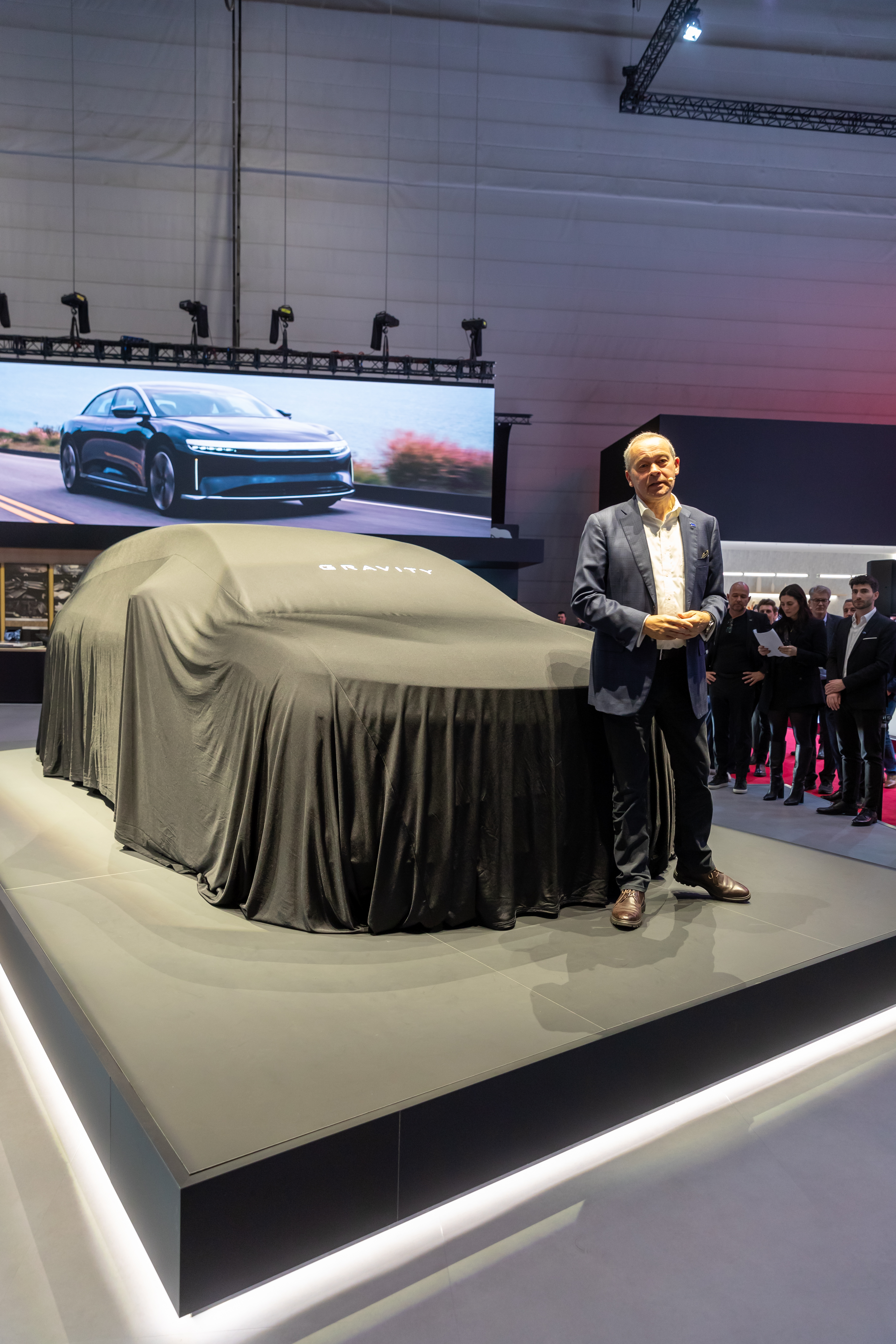
Lucid Gravity
"I asked them how they felt about companies like Lucid with the gravity. Yeah, I was going to say maybe that. But the gravity is kind of big."
The Lucid Gravity is Lucid’s electric SUV. They’re talking about how big it is and whether it’s expensive compared with the Lotus option.
The Lucid Gravity is Lucid’s electric SUV, positioned as a large, family-oriented EV. The hosts discuss its size and how it compares to the Lotus’s approach, including the idea that Gravity is “big” and likely priced higher.
SUV coupe
"I'm looking at pictures of the Electra and it doesn't look it looks more like SUV coupe in terms of it's as big or bigger than it was."
An SUV coupe is an SUV with a more slanted, sporty-looking roof. It’s still an SUV, but the shape is designed to look more like a coupe.
An SUV coupe is a style of SUV with a more sloped, coupe-like roofline rather than a boxier shape. It’s usually aimed at improving aerodynamics and giving a sportier look, even though it’s still an SUV in size and practicality.
pricing
"And I think if you look at the pricing, that makes sense. OK. Why they're not even close."
Here, “pricing” just means how expensive the cars are. The idea is that if one EV costs a lot more, it won’t attract the same buyers as the cheaper option.
In this context, “pricing” refers to how the cost of competing EVs affects who buys them. The hosts connect pricing to why Lotus doesn’t see Lucid as a direct threat.
launch control system
"So in any case, I came to the vehicle with with an open mind. [966.2s] Look, very rare for you. [968.4s] No, I'm joking. [969.3s] These SUVs are are a fact of life now [971.6s] because companies are looking for volume so they can stay alive. [975.6s] And there's rumors that Lotus is actually planning to build a sports car [980.3s] and a sedan that are based on the same platform that the electric is using. [984.5s] So this is kind of their best foot forward in building a family of vehicles, [988.7s] electric vehicles around this particular model. [992.0s] I can tell you that it is outrageously fast. [996.1s] I could not get the launch control system to work."
Launch control is a “max acceleration” mode. It tries to get the car moving as fast as possible from a stop while preventing the wheels from spinning.
A launch control system is an EV or performance-car feature that manages throttle, traction control, and sometimes transmission behavior to produce the hardest possible standing start. It’s designed to keep wheelspin under control while still maximizing acceleration.
tire sensors for inflation
"[992.0s] I can tell you that it is outrageously fast. [996.1s] I could not get the launch control system to work. [998.5s] I think it's because I had there was a problem with the the only problem [1001.9s] I experienced with the vehicle was the tire sensors for inflation [1006.2s] on one side of the vehicle were showing as not working."
This is the system that monitors your tire pressure. If it thinks something is wrong with the tire-pressure readings, the car may disable certain performance features.
“Tire sensors for inflation” refers to the car’s tire-pressure monitoring system (TPMS), which uses sensors to measure tire pressure. If the system thinks a sensor is faulty or pressure data is unavailable, it can limit other functions for safety.
traction control
"But I was assured that they were. [1011.2s] It was just a problem with with the configuration. [1013.4s] So I think that that's why it would not let me turn off traction control [1017.6s] completely to do the launch control."
Traction control helps keep the tires from spinning when you accelerate. If the car detects a problem, it may not let you fully turn it off for launch mode.
Traction control is an electronic stability feature that reduces wheelspin by modulating engine power and/or braking when the tires lose grip. Many performance cars won’t allow full disablement (or will restrict launch control) if traction-related safety logic detects a fault.

Chevrolet Corvette
"...s than three seconds, but it does the whole Chevy Corvette thing where it says 2.95. Oh, really? Where it's ..."
The Chevrolet Corvette is a sports car made by Chevrolet. It’s built to go fast and feel exciting to drive. People talk about it a lot because it can accelerate very quickly.
The Chevrolet Corvette is a performance sports car known for its strong acceleration and long-running reputation as a flagship American sports car. It often comes up in podcasts when people discuss lap times, horsepower claims, and how the car delivers speed in real-world driving. The mention of a sub-three-second number highlights the kind of performance marketing and bragging rights the Corvette is known for.
Chevy Corvette
"[1025.2s] It does 60 in less than three seconds, [1027.8s] but it does the whole Chevy Corvette thing where it says 2.95. [1031.7s] Oh, really? Where it's like skin of its teeth kind of thing."
The Chevrolet Corvette is a well-known fast sports car. The host is using it as a comparison for how the car’s acceleration numbers feel like they’re right on the edge of what you can actually achieve.
The Chevrolet Corvette is a performance sports car known for aggressive acceleration claims and track-focused tuning. Here, the host compares the Lotus Eletre’s displayed 0–60 figure to the Corvette’s reputation for “skin of its teeth” numbers—suggesting the spec is close to the limit of what’s repeatable.
twisty roads
"It's so powerful that on twisty roads, [1062.5s] I was able to break the rear wheels free..."
Twisty roads are winding roads with lots of turns. They make it harder to keep the car stable and gripping the road while you’re driving fast.
“Twisty roads” refers to winding, curvy routes where steering inputs and grip changes happen constantly. They’re a tougher test for traction control and stability because the car is asked to accelerate, turn, and maintain balance at the same time.
break the rear wheels free
"It's so powerful that on twisty roads, [1062.5s] I was able to break the rear wheels free in an all wheel drive electric vehicle."
It means the back tires lose grip and start spinning. Usually that happens when you accelerate too hard for the available traction.
“Breaking the rear wheels free” means the rear tires lose traction and start to spin faster than the car can grip. That’s a sign of traction limits being exceeded, often caused by high torque at launch or aggressive throttle input.
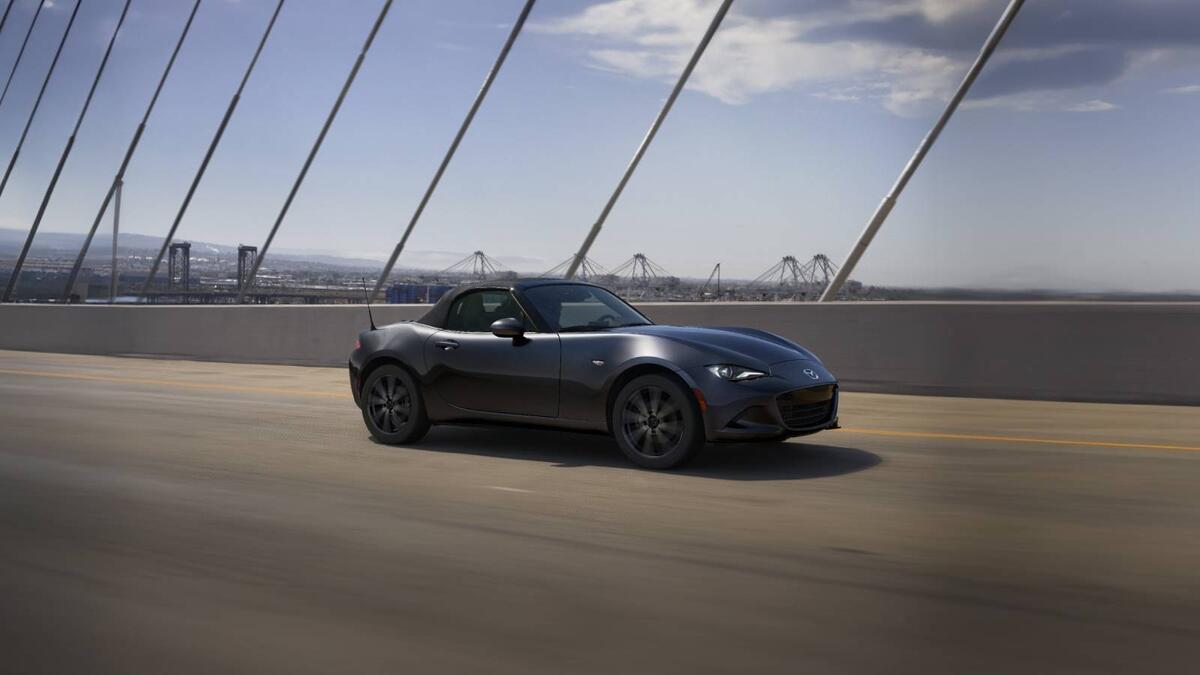
Mazda MX-5 / Miata
"...oad that a friend of mine used to use to tune his Miata for the track and we would go up there every once..."
The Mazda MX-5 (Miata) is a small two-seat car made for driving enjoyment. It’s light and handles well, which is why some people take it to track days. It’s also a common car to modify for better performance.
The Mazda MX-5, commonly called the Miata, is a lightweight two-seat roadster designed for fun handling and driver-focused driving. It’s frequently discussed in enthusiast circles because it’s popular for track days and easy to modify. The podcast context about tuning it for the track fits that reputation.

Aston Martin DBX
"it does feel rougher and more raw and more visceral in terms of experience. And I think that that's the internal combustion engine is playing a big part there."
The Aston Martin DBX is a luxury performance SUV. The host says it feels more rough and dramatic because it’s powered by a traditional gas engine, unlike the EV they’re discussing.
The Aston Martin DBX is a performance SUV that uses a conventional internal-combustion engine, which the speaker says tends to feel rougher, rawer, and more visceral. They’re contrasting that “engine feel” with the Lotus Eletre’s different personality.

Land Rover Defender
"...horsepower, 600 horsepower. Let's like that's the Defender Octa and Range Over Sport as V and like BMW X5M. ..."
The Land Rover Defender is a large SUV designed to handle rough roads and off-road driving. Some versions are built to be much faster than the standard model. The podcast is likely comparing that high-performance Defender to other powerful SUVs.
The Land Rover Defender is a rugged, off-road-capable SUV that’s known for its boxy design and durability. In performance discussions, the “Defender Octa” reference points to a high-output version built for much stronger acceleration than typical off-road models. It’s mentioned alongside other high-performance SUVs to compare power and positioning.

BMW X5M
"Let's like that's the Defender Octa and Range Over Sport as V and like BMW X5M."
The BMW X5 M is the performance version of the BMW X5 SUV. The hosts bring it up as another very fast SUV, but one they’re implying might be less extreme than the vehicle they’re talking about.
The BMW X5 M is BMW’s high-performance version of the X5, designed for strong acceleration and sharper handling than a standard X5. Here it’s mentioned alongside other “super SUV” contenders to frame a comparison of performance tiers.

Challenger Hellcat
"...ore work for me here. Well, have you driven a the Hellcat Demon? No, not the demon."
The Challenger is a muscle car designed to be very powerful. It’s known for strong acceleration and a sporty, classic look. The podcast is mentioning it while talking about an especially extreme high-performance version.
The Dodge Challenger is a muscle car known for powerful engines and a long-running lineup focused on straight-line performance and classic styling. In the podcast context, it’s brought up in relation to the Hellcat Demon, which is a high-performance Challenger variant. That suggests the discussion is about how extreme performance versions compare or what they’re like to drive.
electric power
"except since you have all wheel drive and electric power, you don't have all the drama that goes with like a perfect launch"
Electric power means the car’s electric motors push you forward right away. The point they’re making is that it can make fast acceleration easier to repeat without needing perfect launch technique.
Electric power here means the torque delivery from an electric motor(s), which can provide immediate thrust. The host contrasts it with traditional gas launch behavior, arguing it reduces the “drama” needed to get a perfect launch.
all wheel drive
"except since you have all wheel drive and electric power, you don't have all the drama that goes with like a perfect launch"
All-wheel drive means power goes to more than just the rear or front wheels. That helps the tires grip better, so hard acceleration is more consistent and less dependent on perfect technique.
All-wheel drive (AWD) sends power to more than one axle, improving traction—especially when accelerating hard. In this segment, AWD is part of why the host claims the acceleration is easier to achieve repeatedly.
perfect launch
"you don't have all the drama that goes with like a perfect launch on a dribble drive drag car."
A “perfect launch” is when a car starts so well that it grips the road and accelerates hard right away. The host is saying that with AWD and electric power, you don’t have to nail that launch as precisely to get strong results.
A “perfect launch” is the ideal start in a drag-style acceleration run—where the car hooks up and transfers power to the ground without excessive wheelspin. The host argues that electric power plus AWD can reduce the effort and skill needed to achieve that kind of repeatable launch.
drag car
"you don't have all the drama that goes with like a perfect launch on a dribble drive drag car."
A drag car is a car set up mainly for racing in a straight line. The host is using it as an example of how hard it can be to get a great start every time.
A drag car is built and tuned primarily for straight-line acceleration over a short distance, where traction and launch control matter a lot. The host uses it to contrast traditional gas launch “drama” with the easier, repeatable acceleration they’re describing.
dual clutch transmissions
"of skill in other super SUVs, because they're all like dual clutch transmissions. [1269.3s] No, but what I'm saying is like in a in an internal combustion engine,"
A dual-clutch transmission is a gearbox with two clutches that helps the car shift gears quickly. It can line up the next gear ahead of time, so the shift feels almost instant.
A dual-clutch transmission (DCT) uses two separate clutches—one for odd gears and one for even gears. That lets it pre-select the next gear so shifts can be very fast, which is why many performance cars use them.
performance envelopes
"So you did mention that it shrink wraps a little bit. [1313.2s] The performance can the that that performance envelope [1317.9s] seems to be able to smooth over a little bit of the weight."
A performance envelope is basically the set of situations where the car feels at its best. If the host says it smooths over weight, they mean the car still drives well even though it’s heavy.
A performance envelope is the range of conditions where a vehicle can deliver its best behavior—like acceleration, grip, and stability—without falling off. When the host says the envelope can “smooth over” weight, they mean the car’s dynamics can stay composed despite being heavy.
280 miles of range
"Realistically, this vehicle is very comfortable on a daily basis. [1343.8s] You're going to enjoy it. [1344.4s] It has about 280 miles of range, which is decent."
Range is how far a vehicle can travel on a full charge (for an EV) under a defined test cycle. “280 miles” is a key real-world shopping metric because it affects whether the car fits daily driving and typical road trips.
charging 12 minutes 10 to 80 percent
"It has about 280 miles of range, which is decent. [1347.5s] It charges in 20 minutes from 10 to 80 percent."
This describes EV fast-charging performance: how quickly the battery fills between two state-of-charge levels (10% to 80%). Charging is usually slower near full capacity, so the 10–80% window is commonly used because it’s more representative of typical fast-charge stops.
kilowatts
"It has 350 kilowatt, although Lotus says it'll really do 400 kilowatt at a charging station if you can find it."
Kilowatts (kW) measure how much power is flowing. On an EV, higher kW usually means the car can charge faster at a fast charger.
Kilowatt (kW) is a unit of power, not energy. For EVs, the charging power in kilowatts indicates how quickly the car can accept electricity from a fast charger.
charging stations
"Lotus says it'll really do 400 kilowatt at a charging station if you can find it."
A charging station is where you plug in to charge an EV. The car can only charge as fast as the charger can provide power.
A charging station is the external charger that supplies electricity to an EV. The speaker’s point is that the car’s top charging power (400 kW) depends on using a station capable of delivering that level.
infotainment system
"I was really surprised to see for the first time an exotic car company that had good graphics on its infotainment system."
The infotainment system is the car’s screen and controls for things like music, maps, and phone features. The host is saying Lotus’s screen is easier to use than usual.
An infotainment system is the car’s in-cabin interface that combines functions like navigation, media, phone connectivity, and vehicle settings. The speaker is praising Lotus for having a more usable, better-designed interface than they typically see from exotic brands.
horizontal readout
"it has like a horizontal readout in front of you that stretches a little bit. Instead of being rectangular, it's like a ribbon..."
This is a wide digital display on the dashboard. Instead of a normal boxy speedometer layout, it’s more like a long strip showing information.
A horizontal readout refers to a wide, continuous digital display used to present driving information across the instrument area. In this case, the speaker describes it as a ribbon-like screen rather than a traditional rectangular cluster.
HUD
"And then most of the information you need is on the HUD. So instead of doing what Toyota does and pushing the gauge cluster all the way to the windshield..."
HUD means the car shows important info on the windshield area. That way you don’t have to look down as much to see speed, navigation, or warnings.
HUD (heads-up display) projects key driving information onto the windshield area so you can read it without looking down at the instrument cluster. The speaker prefers this setup because it keeps important data in the driver’s direct line of sight.
regen
"The brakes are a bit touchy at low speeds when you're crawling through traffic. I think they need to work on tuning the difference between regen and actual breaking."
“Regen” is how an electric car slows down while also recharging its battery. The car can slow you down using the motor, and if that switch isn’t smooth, braking in stop-and-go traffic can feel a little weird.
“Regen” is short for regenerative braking, where an electric motor slows the car while turning some of that motion back into electricity. Because regen can feel different from friction brakes, the transition between the two can make low-speed braking feel “touchy” if it isn’t well calibrated.
24 sensors
"It doesn't have weird mirrors, but it has these cameras on the side fenders. You'll probably see it. They there's like 24 sensors."
A “24 sensors” setup indicates a dense suite of hardware used for perception—detecting lane markings, vehicles, pedestrians, and obstacles. More sensors can improve coverage and redundancy, which matters for advanced driver-assistance and semi-autonomous driving.
advanced driving
"There's a whole sensory package that comes with it for its advanced driving, like its whole like limited self driving. Lotus says they want it."
“Advanced driving” means the car has more sophisticated help features than just cruise control. It uses cameras and sensors to assist with steering and speed, and sometimes can drive more of the way for you.
“Advanced driving” here refers to driver-assistance systems that go beyond basic cruise control—using sensors and cameras to support functions like lane keeping, adaptive speed control, and automated driving behaviors. The host frames it as part of a “limited self driving” package.
level four autonomy
"Lotus says they want it. It could technically it could technically qualify for level four autonomy if that were legal. No one wants that, I don't want that, but it's baked into this car."
“Level four autonomy” means the car can drive itself in certain situations without you having to take over. The host is saying it might meet that standard, but laws may not allow it yet.
“Level four autonomy” refers to SAE autonomy levels where the car can handle driving tasks without human intervention in defined conditions. The host notes it “could technically qualify” if it were legal, but also says they personally don’t want that kind of system.
frunk
"I'm saying this because I remember like Ian Callum was like showing me the the I type one time with the with the the frunk like that open. And he was like, you can put some wine bottles in there."
A “frunk” is a trunk in the front of the car. People use it for small stuff like groceries, a gym bag, or bottles—basically anything you don’t want in the back.
A “frunk” is a front trunk: a storage compartment in the front of the car, usually made possible by packaging that leaves space where the engine bay would be on a conventional layout. It’s commonly used for small items because it’s not as large or accessible as the rear trunk.
air suspension
"And I'm like, oh, no, the the vehicle suspension to it's an air suspension. It's got to be for for something this big, right?"
Air suspension is a suspension system that uses air instead of metal springs. It can raise the car up or lower it down to help with comfort, efficiency, or rough roads.
Air suspension uses an air compressor and air springs (instead of steel coil springs) to adjust ride height. That lets the car raise or lower itself for comfort, aerodynamics, or off-road clearance.
Multiple drive modes
"So it has it has multiple drive modes. It's like a track mode that like a wing pops up in the back."
Multiple drive modes are different settings the car offers. They change how the car behaves, like making it feel more aggressive for driving hard or more forgiving for rough terrain.
Multiple drive modes are preset software/behavior profiles that change how the car responds—often including throttle mapping, steering feel, traction control behavior, and sometimes suspension settings. They’re used to tailor the car for different conditions like sport driving or off-road use.
track mode
"It's like a track mode that like a wing pops up in the back. It has little louvers at the front grill."
Track mode is a driving profile tuned for performance driving. It typically sharpens throttle/steering response and may adjust stability control and suspension behavior for faster, more consistent cornering.
front grill louvers
"It has little louvers at the front grill. So like you can open for cooling or close for efficiency."
Front grill louvers are adjustable openings in the front of the car. They can open for cooling or close to help the car move more efficiently through the air.
Front grill louvers are adjustable vents that can open or close to manage airflow. Opening them helps cooling when you need it, while closing them can reduce drag for better efficiency.
trail mode
"And then when you select trail mode, it it it rises up slowly in the front and it creaks a little bit, kind of like you're in an old, old wooden sailing."
Trail mode is the car’s off-road setting. It often raises the suspension to give you more clearance over bumps and ruts.
Trail mode is an off-road-oriented drive profile. In this context, it’s paired with suspension height changes to increase ground clearance and improve approach/departure angles on uneven terrain.
ride height
"And then when you select trail mode, it it it rises up slowly in the front and it creaks a little bit..."
Ride height is just how high the car is off the ground. Air suspension can change it so the car can be lower for efficiency or higher for rough roads.
Ride height is how high the car sits relative to the ground. With air suspension, the vehicle can change ride height depending on the selected mode—lower for efficiency, higher for clearance.

Land Rover Range Rover
"...yeah, it's pretty funny. The suspension is like a Range Rover. Every time you get out of a Range Rover, it does..."
The Land Rover Range Rover is a luxury SUV meant to feel comfortable on the road. Its suspension is tuned for a smooth ride. The podcast is referencing that distinctive ride feel when getting in and out.
The Land Rover Range Rover is a luxury SUV focused on comfort, refinement, and advanced suspension for a smooth ride. The podcast comment about the suspension “like a Range Rover” points to how it can feel different when you get in and out, thanks to its ride height and suspension behavior. It’s often used as a benchmark for how these luxury SUVs ride.
suspension tune
"So the suspension, though, the tune is on the harsher side in regular driving, [1662.1s] not in the sense that it jostles you, but it will be a bit louder than maybe"
A suspension tune is the way the car’s suspension is set up to ride. It affects how smooth it feels on rough roads and how “firm” or “busy” it feels over bumps.
A suspension tune is how the vehicle’s suspension is calibrated—things like spring/valving behavior and damping characteristics. It determines how the car feels over bumps and how much noise and harshness you notice in everyday driving.
kilowatt hour battery
"They all technically have the same drivetrain. [1691.3s] I think it's a hundred and twelve kilowatt hour battery."
A kilowatt-hour battery is a way to describe how much energy the battery can hold. More kWh usually means the car can go farther before it needs charging.
A kilowatt-hour (kWh) battery is the measure of how much electrical energy the battery pack can store. A “112 kilowatt hour battery” indicates a very large capacity, which typically translates to longer driving range potential (depending on efficiency and driving conditions).
rear motor
"But the the carbon and the sport are have a larger [1696.5s] rear motor that gives it the extra power."
A rear motor is the electric engine that drives the back wheels. If it’s bigger, it can help the car feel faster and put more power to the rear.
A rear motor means the electric drive unit is mounted at the back axle, typically used in dual-motor all-wheel-drive setups. Adding a larger rear motor can increase total power and improve how the car delivers torque to the rear wheels.
brushless motors
"And also, I mean, if you look at BMW, they're starting to go with like brushless [1718.1s] motors versus brush and what not, different designs"
Brushless motors are electric motors that don’t use worn-out brushes. They’re controlled electronically, which helps the car manage power more precisely.
Brushless motors are electric motors that use electronic control instead of physical brushes to transfer current. In EVs, brushless designs can improve efficiency and allow more flexible control of torque delivery, including disengaging or “declutching” behavior in some systems.
declutch
"because they're able to declutch them more easily, I think. [1724.8s] OK. Take them out of the equation when you're just cruising."
Declutch here means the car can “disconnect” the motor’s drive when you’re just cruising. That helps reduce wasted energy because the motor doesn’t have to work as hard.
To declutch (in this context) means temporarily disengaging the drive unit so it isn’t actively providing torque while cruising. That can reduce drag and improve efficiency when full power isn’t needed.
power-on-demand
"So it's kind of like the we're back to the power on demand days [1732.5s] of all wheel drive systems where you didn't really need the traction."
Power on demand is when the car only sends extra power to the wheels when it actually needs it. That can make the car feel more efficient and less “busy” during normal driving.
Power on demand describes an AWD strategy where the car doesn’t constantly send equal torque to all wheels. Instead, it waits until it senses a need—like low traction—then delivers extra drive power to improve grip.

Hummer
"A lot of trucks like Hummer. Isn't there a Hummer with a bajillion horse? Absolutely no comparison. Yeah, the Hummer weighs 3000 pounds more than this does."
Hummer is a truck brand that’s usually big and heavy. Here, they’re comparing it to another SUV by pointing out the Hummer weighs about 3,000 pounds more.
Hummer is a brand known for large, heavy, high-power trucks—often associated with extreme performance claims. In this segment, the host contrasts Hummer’s mass (about 3,000 pounds more) with the lighter vehicle they’re discussing.

Ferrari
"I will say, you know, at 200 and 32000 it's almost it's almost half the price of a Ferrari. Perosongi. Yeah, like that's wild."
Ferrari is a famous supercar brand. They’re using it as a reference point to talk about how expensive (or not) the Lotus feels compared with a Ferrari.
Ferrari is an Italian supercar brand used here as a pricing and status benchmark. The host compares the Lotus’s price level to Ferrari, arguing the Lotus feels like it’s in a similar “presence” conversation.

Lotus Elise
"Especially when it comes to things like the Elise and the what's the other one I really like. The E..."
The Lotus Elise is a small sports car built to be fun and responsive. It’s designed to handle well and feel sporty when you drive it. People talk about it because it’s lightweight and performance-oriented.
The Lotus Elise is a lightweight, mid-engine sports car designed for sharp handling and an engaging driving experience. It’s frequently discussed among enthusiasts because its simple, performance-focused design makes it feel very connected to the road. The podcast’s mention suggests the Elise is part of a conversation about favorite lightweight sports cars.

Lotus Exige
"The Exige. Exige. And then there's that other one."
The Lotus Exige is a small, sporty Lotus that’s designed to feel sharp and fun to drive. In this conversation it’s brought up as one of the classic Lotus cars people admire.
The Lotus Exige is a lightweight, track-focused sports car built around Lotus’s handling-first philosophy. The hosts mention it alongside the Elise as a model they like, contrasting it with the newer, more policy-impacted direction of the brand.

Lotus Evora
"...f the Elises that I've always, you know, admired. Evora was the one that I was thinking of. I've never dr..."
The Lotus Evora is a sports car made by Lotus. It’s designed to be fun to drive and has an engine placed in the middle of the car. The podcast is mentioning it because the speaker really likes it compared with other Lotus models.
The Lotus Evora is a mid-engine sports car from Lotus, positioned as a more usable alternative to the Elise while still delivering a driver-focused feel. The podcast context shows it being compared as a favorite or admired Lotus model, with the speaker saying the Evora was the one they were thinking of. It’s often discussed as a blend of performance and everyday practicality within Lotus’s lineup.
go electric
"And that's what happens when you go electric, though. [1970.0s] Wait, wait is added."
“Go electric” means the car uses an electric motor instead of a gas engine. That changes how you charge it and how it drives.
“Go electric” refers to switching a vehicle’s propulsion from a gasoline engine to an electric powertrain. This change affects everything from packaging (battery placement) to driving feel and how the vehicle is used day-to-day (charging vs fueling).
trade off
"Like it's it's it's a tradeoff that seems to be inevitable right now. [1976.9s] So what did you drive?"
A “tradeoff” means you get something good, but you also give up something else. The host is saying that when you switch to electric cars, you usually have to accept compromises.
In the context of electrification, a “tradeoff” means you gain some benefits (like instant torque or lower emissions) but you also accept compromises (like charging time, battery weight, or range limitations). The host frames going electric as a situation where these compromises are hard to avoid.

2026 Ford Bronco Sport
"So what did you drive? [1978.8s] I drove a 2026 Ford Bronco Sport. [1982.6s] Listeners of this podcast will probably remember ... [2015.9s] And then when I saw that the Bronco Sport was just basically [2019.8s] a boxy version of an escape ... [2035.2s] I think you're really, really gliding over what this vehicle actually is."
The Ford Bronco Sport is a small SUV from Ford that’s meant to look and feel more adventurous than a typical crossover. Here, the host is saying the 2026 model isn’t just a simple copy of another Ford SUV—it’s its own thing.
The Ford Bronco Sport is a compact SUV built around Ford’s crossover platform strategy, but with Bronco-style off-road branding and styling. In this segment, the host discusses how the 2026 model differs from the earlier impression that it was merely a “boxy” version of the Ford Escape.

Ford Escape
"I used to think ... that Ford was filling up its portfolio with cars it didn't need to [2005.2s] because I found the Ford Escape to have a reputation that was really positive. [2009.2s] It offered a lot of different drive trains."
The Ford Escape is another Ford compact SUV/crossover. In this conversation, it’s used as the comparison car to explain why the host questioned the Bronco Sport’s existence at first.
The Ford Escape is Ford’s compact crossover that the host uses as a reference point for how the brand’s lineup is structured. The discussion contrasts the Escape’s perceived strengths (including multiple drive-train options) with the host’s earlier skepticism about the Bronco Sport’s purpose.
drivetrain
"It offered a lot of different drive trains. [2012.7s] It was efficient."
“Drive train” is basically how the car sends power from the engine to the wheels. Different versions can feel different because they use different setups for power and traction.
“Drive trains” refers to the car’s power delivery layout—how the engine’s power is transmitted to the wheels. In modern lineups, different drive trains can mean different combinations of engines and transmissions, and sometimes different drivetrain types (like front-wheel drive vs all-wheel drive).
retro themed
"Even from the start, this was a retro themed. I'm at affordable. I think like tech, like the platform and the engine,"
“Retro themed” means the car is styled to feel like an older, classic era. The host is saying that theme helps it feel more unique than typical modern crossovers.
“Retro themed” refers to designing a modern vehicle to evoke the look and vibe of older vehicles or eras. In this segment, it’s used to explain how the package and positioning create a distinct identity versus more generic compact crossovers.
platform
"I think like tech, like the platform and the engine, which make up a lot of the characteristics of some of these cars."
A “platform” is the car’s underlying foundation—its main structure and engineering layout. Cars that share a platform often feel similar because many key parts are designed around the same base.
In automotive terms, a “platform” is the shared underlying structure (hardpoints, mounting points, and major engineering architecture) that multiple cars use. The host is saying the platform and engine contribute heavily to the car’s overall character.
Badlands version
"the ultimate soft rotor, plus they made the Badlands version, which had 240 horsepower and, you know, the H.O.S.S. suspension upgrade and all that stuff."
“Badlands” is a special trim level that’s meant to make a vehicle feel more off-road capable. The host is saying this version adds upgrades compared to the base model.
“Badlands” is a trim level/package name used on certain Ford models to signal more off-road capability and tougher styling. In this segment, the host ties it to specific upgrades and output (like horsepower) and suspension changes.
soft rotor
"the package itself, it was intended to be, you know, the ultimate soft rotor, plus they made the Badlands version,"
“Soft rotor” sounds like the host’s way of describing a car that feels smoother and more relaxed to drive. In this context, it’s about the overall driving character they were aiming for.
“Soft rotor” here appears to be the host’s shorthand for a retro-styled, comfort-oriented driving character rather than a specific, widely standardized engineering term. It’s being used to describe the intended feel/behavior of the platform and package.
H.O.S.S. suspension upgrade
"which had 240 horsepower and, you know, the H.O.S.S. suspension upgrade and all that stuff."
H.O.S.S. is the name of a suspension upgrade package. The point is that it changes how the car rides and handles, especially for rougher roads.
H.O.S.S. is an acronym for a suspension system/upgrade package associated with the Badlands trim. The host is using it to highlight that the vehicle isn’t just a cosmetic retro theme—it has hardware changes to improve ride and off-road behavior.
heritage play
"But I think most importantly, this was a big heritage play. This is a big retro play."
A “heritage play” means a company uses its past—its recognizable identity and history—to make a new vehicle feel special. The host is saying the retro theme is a big part of why the car stands out.
A “heritage play” is a marketing and product strategy where a brand leans on its history and recognizable themes to create an emotional connection. Here, the host argues the retro-themed approach is a major reason the Bronco Sport feels distinct.
off road package
"All of these other compact crossovers come with these really dopey off road packages that don't really like they don't do anything to the person to the car."
An off-road package is a set of add-ons that’s supposed to make a normal SUV feel more suited for dirt roads or trails. Sometimes it’s mostly cosmetic, and that’s what the host is criticizing here.
An off-road package is a bundled set of exterior and interior upgrades—like styling elements, wheels/tires, and sometimes skid plates or driving aids—intended to make a crossover more capable and more “trail-ready.” The host’s point is that some compact crossovers get these packages mostly for appearance, without changing how the car actually feels or performs.

Plymouth Fury
"...ilable in three actual colors. Yeah, it's orange, fury, velocity, blue and ruby red. So in particular, I..."
The Plymouth Fury is an older American car model. It was known for its big, classic look and for being available in different colors. The podcast is talking about the Fury in terms of its specific options and appearance.
The Plymouth Fury is a classic American full-size car associated with the muscle-car era, known for bold styling and a range of engine options depending on the year. The podcast context about available colors suggests the conversation is focused on the car’s period-correct details and presentation. It’s mentioned as a specific model with recognizable identity.
extra cost paint finish
"It looked great to me, which is an extra cost paint finish, which I think is kind of silly because you're spending more money on a on a white on a non color."
An extra cost paint finish is a premium exterior color or coating option that costs more than the base paint. Automakers often charge for metallic, pearl, or multi-coat finishes, and the host argues that paying more for a white metallic finish is “silly” because it’s still a non-custom color choice.
Badlands model
"It was not the top end Badlands model. Instead, I had a big bend trim, which was loaded with all kinds of that's the base. Packages."
Badlands is a higher, more off-road-focused version of the Bronco Sport. The host is saying the car they drove wasn’t the most rugged Badlands trim.
“Badlands” is a named off-road-oriented trim level on the Ford Bronco Sport line, positioned as a more rugged, trail-focused option compared with lower trims. In this segment, the host notes the test car was not the top Badlands model, implying it had less of the most off-road-specific equipment.
trim
"It was not the top end Badlands model. Instead, I had a big bend trim, which was loaded with all kinds of that's the base. Packages."
Trim is basically the “version” of the car—what features and options it includes from the factory. Different trims can change the look and what equipment you get.
Trim refers to a specific equipment level for a model—how the car is packaged with features, styling, and sometimes drivetrain-related options. Here, the host says the car wasn’t the top-end Badlands model, but instead a Big Bend trim that came loaded with multiple packages.
Request an Explanation
Heard something you'd like explained? We'll add it to this episode.
Sign in to request explanations for terms you heard.
Want to learn more?
Browse our glossary for plain-English explanations of automotive terms, jargon, and concepts.
Help improve this episode
See something that's not quite right? Our annotations are AI-generated and can sometimes miss the mark. Click the flag icon on any annotation to suggest a correction.