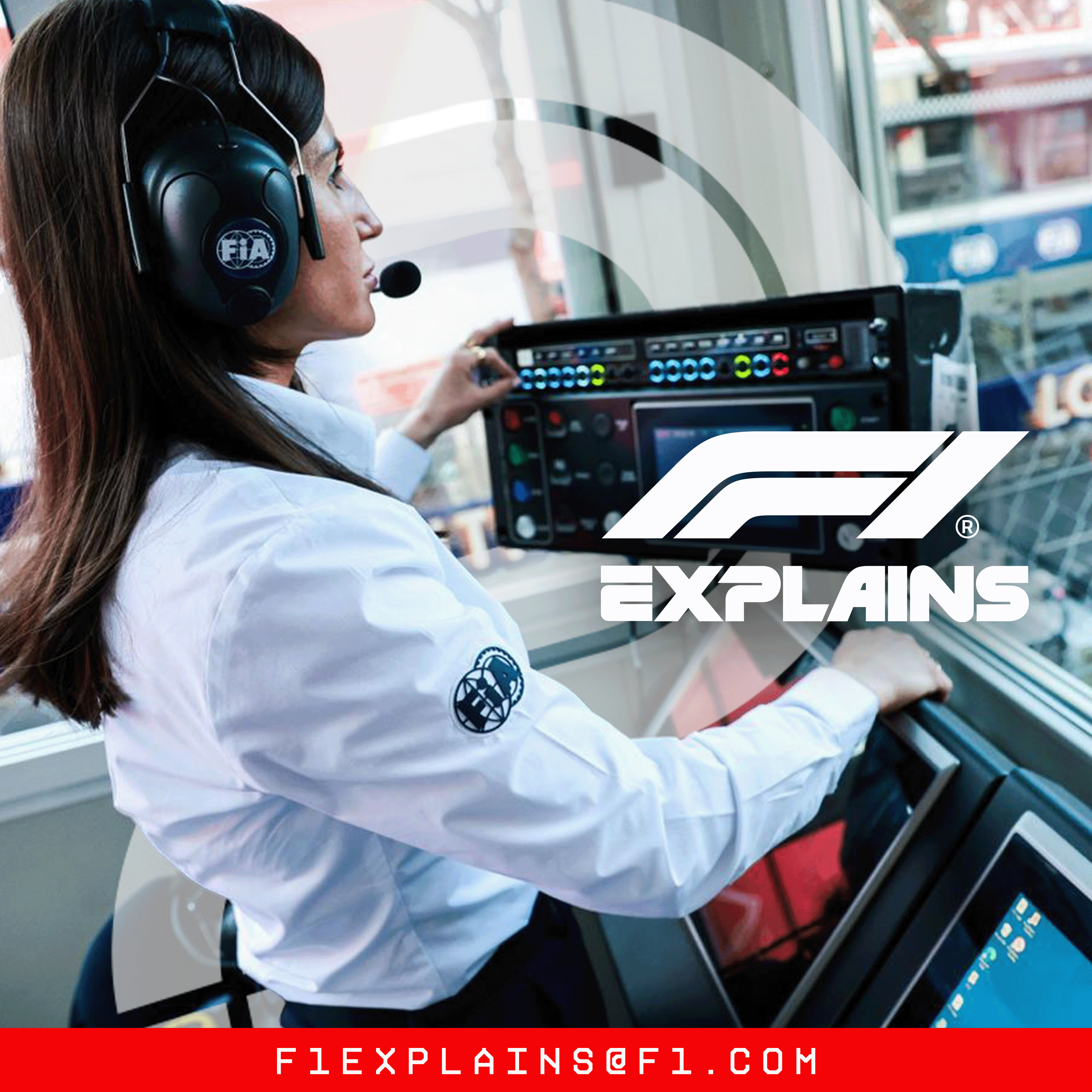
F1 Explains: how a Grand Prix gets started
About this episode
From the tension of “red lights” to the formation lap’s purpose, the episode walks through how an F1 Grand Prix start is prepared and verified. Rebecca Lee, F1’s permanent race starter, explains final checks, who can trigger an abort, and how the race director oversees safety. The hosts then cover grid compliance, transponders and cameras for false-start detection, and the fixed lights-out timing—plus what changes under 2026 procedures and in wet conditions.
Five red lights go out and the race is on! The start of a Formula 1 Grand Prix is a high-pressure moment - not just for the drivers, but for the woman who controls the start.
Rebecca Lee is the Head of Single-Seater Operations at the FIA and the F1 Permanent Starter. She joins Christian Hewgill to answer your questions about the race start procedure. What are the rules at the start of a race? How does she keep everyone safe? Most excitingly, how does she decide when to push the button which turns the lights off, and send 22 Formula 1 cars into battle?
Send us your F1 questions - we'll find the best person to answer them
Emails and voice notes welcome - [email protected]
Listen to more official F1 podcasts
F1 Nation's preview and review of the Barcelona-Catalunya Grand Prix is on this feed
Alex Albon talks making Williams history on F1 Beyond The Grid
Keep up with the Formula 1 Barcelona-Catalunya Grand Prix
Follow @F1 on social media
Download the F1 app or visit F1.com
Grand Prix start (red lights / launch)
"Everyone holds their breath as the red lights appear and heartbeats start a third. And then... Who's got the launch? It's Charles Leclerc and it's a spin for Max Stappen."
F1 races start when the red lights go out. Drivers have to accelerate fast and smoothly right away, and if they get it wrong, they can lose positions or even spin.
In Formula One, the Grand Prix start is triggered by the red lights going out, and the drivers must launch immediately and cleanly. Because the start can decide track position, it’s a high-pressure moment where a good getaway can win the race and a mistake can cause spins or collisions.
Max Stappen
"It's Charles Leclerc and it's a spin for Max Stappen. Can the pack avoid him?"
Max Stappen is an F1 driver. Here, he spins during the start, showing how chaotic the first moments can be.
Max Stappen (spelled this way in the transcript) is referenced as spinning at the start. The moment is used to illustrate how quickly things can go wrong in the opening seconds of an F1 race.
Charles Leclerc
"Who's got the launch? It's Charles Leclerc and it's a spin for Max Stappen... Charles Leclerc takes the lead of the Grand Prix."
Charles Leclerc is an F1 driver. In this story, he gets away well at the start and ends up taking the lead.
Charles Leclerc is a Ferrari driver, and in this segment he’s described as getting the launch at the start. The host credits him with taking the lead after the opening chaos.
Barcelona-Catalunya Grand Prix
"And this is the circuit to Catalonia and we are at the 2026 Barcelona-Catalunya Grand Prix."
This is the F1 race in Barcelona, held at the Circuit de Barcelona-Catalunya. It’s a regular stop on the F1 calendar, and where the race happens matters for how the cars behave.
The Barcelona-Catalunya Grand Prix is the Formula One race held at the Circuit de Barcelona-Catalunya in Spain. It’s a staple on the F1 calendar, and its layout makes starts and early positioning especially important.
Aston Martin
"And opposite Roman, we can see Aston Martin. There is a man in a drawer with a piece of paper and a notebook checking some things."
Aston Martin is one of the racing teams/brands in Formula One. The host is just noting that their people are nearby at media day.
Aston Martin is an F1 constructor/brand associated with the team present at the FIA media area. In F1 coverage, the brand name typically identifies the team’s personnel and operations at the event.
RB team
"And then next to them is the RB team who are all donned with VCarb FC for the World Cup, which of course is underway by the time you're listening to this."
“RB team” is the name used for a Red Bull-related F1 team. The host is mentioning them as part of the media-day scene.
“RB team” refers to the Red Bull–branded team identity used in F1. The host is describing who’s present at the FIA hospitality area during media day.
formation lap
"So the formation lap is basically the final check and the final test. So the drivers can make sure that the cars are operating as they should be. They can warm the brakes. They can warm the tyres..."
The formation lap is the warm-up lap before the race officially starts. Cars drive around in a controlled way so drivers and officials can check everything is working and the tires and brakes are ready.
A formation lap is the warm-up lap(s) before the Grand Prix start where cars circulate in formation rather than racing. It lets drivers confirm the car is working correctly, brings brakes and tires up to operating temperature, and gives officials a final look at track and car readiness before the field goes into Turn 1.
abort the start
"...observing the cars going round to make sure that we don't need to abort the start or do any intervention... So yeah, obviously when I'm in the start country, if I physically see something, then of course I'll abort."
“Abort the start” means the race start gets stopped because something went wrong or isn’t safe. Officials may cancel the start or sometimes ask for another warm-up lap while they fix the problem.
“Abort the start” means stopping the start procedure because of an incident or unsafe condition before the race begins. Depending on what happens and what officials can see, the race director may either abort entirely or call for an additional formation lap while the situation is recovered.
race director
"And is the race director... is the race director sort of the boss in overall charge? Yeah. So obviously he'll make all of the final decisions and he's also the safety delegate as well."
The race director is the main official who makes the final decisions during the race. They also oversee safety decisions and coordinate with track staff if there’s an incident.
The race director is the senior official who makes the final calls on race-start and safety-critical decisions. They also act as the safety delegate, coordinating with other officials (like marshals and local track staff) to manage incidents and recovery timing.
grid cameras
"Yeah. So the tyres need to be within the white lines on the grid. We have grid cameras, so we can check the positioning."
Grid cameras are cameras aimed at the starting grid. They let officials double-check that cars are lined up correctly.
Grid cameras are trackside cameras focused on the starting grid. They provide officials with visual evidence to confirm cars are correctly positioned within the grid markings before the start.
Monaco
"And then we've got race control, checking the cameras just to make sure that everyone's in position. Monaco, for example, that start finish straight is not actually straight. It goes round on a bend, so it can be optical illusion sometimes."
Monaco is the famous F1 track in Monaco. The start area can look straight but it isn’t, so it can trick your eyes about car position.
Monaco refers to the Circuit de Monaco, where the start area can be visually misleading. The start/finish straight follows a bend, so drivers and cameras can create an optical illusion about where the cars should be positioned.
grid box
"George Russell was investigated for a potential start line breach. His wheels were within the white lines of the grid box. In those situations, you don't get a penalty. But Sergio Perez, unfortunately for Sergio, lost out on Cadillac's first point in Formula One. Why was that, Rebecca? He pulled up into the wrong grid box."
A grid box is the exact marked spot on the starting grid for each car. If you stop in the wrong box, you can get penalized after the start.
A grid box is the marked rectangular spot on the starting grid assigned to each car. Drivers must stop with their car within the box (including the tyres within the white lines) to avoid a start-line breach.
George Russell
"So of course, for those that missed it in Monaco last weekend, George Russell was investigated for a potential start line breach. His wheels were within the white lines of the grid box."
George Russell is an F1 driver. In this segment, they talk about an investigation related to whether his car was lined up correctly at the start.
George Russell is a Formula 1 driver whose start procedure compliance was discussed here. He was investigated for a potential start line breach, but his wheels were still within the grid box markings.
Sergio Perez
"But Sergio Perez, unfortunately for Sergio, lost out on Cadillac's first point in Formula One. Why was that, Rebecca? He pulled up into the wrong grid box."
Sergio Perez is an F1 driver. They’re saying he lined up in the wrong spot on the grid, which led to losing out on points.
Sergio Perez is an F1 driver mentioned for a start procedure mistake. The segment says he pulled into the wrong grid box, which cost him points tied to Cadillac’s first point in Formula One.
Cadillac
"But Sergio Perez, unfortunately for Sergio, lost out on Cadillac's first point in Formula One. Why was that, Rebecca?"
Cadillac is a car brand mentioned in connection with an F1 points milestone. In this story, a start-line mistake affected whether that milestone happened.
Cadillac is referenced here as the brand associated with a team’s first point in Formula One. The key point in the segment is that Perez’s grid-box error affected whether that first point would be scored.
deploy
"So it's relief once everyone gets deployed and everyone's completed lap 1. I do get a feeling of relief and I just always want to wrench you without everyone's deployed in a safe manner."
In this context, “deploy” means the race start is officially carried out and the cars are allowed to go. The official feels relief once the start is done and the cars have safely finished the first lap.
Here, “deploy” refers to the start sequence being carried out so the race can begin safely—specifically, the cars being released to start and the officials completing the start procedure. The speaker describes relief once everyone is deployed and has completed lap 1.
marshal
"Again, like, everything goes down to safety if I need to wait a couple of extra seconds because, you know, we think that there's a gate not closed or we might see a marshal or we might see something on track"
A marshal is a safety worker on the track who watches for problems and helps coordinate what happens during a race. If they’re dealing with something, the start might be delayed for safety.
A marshal is an on-track official stationed around the circuit who monitors incidents and communicates with race control. If a marshal is visible or a track situation is developing, the start procedure may be delayed to keep drivers safe.
extinguish the lights
"We've always got a couple of seconds or I'd always wait and then obviously extinguish the lights. At the same time, you don't want to unnecessarily make the guys sit there sweating."
F1 races start with a row of red lights. When the official turns them off, that’s the signal for the cars to launch and start the race.
In Formula 1, the start is signaled by a set of five red lights on the starting gantry. The official extinguishes (turns off) the lights to begin the race, after which the cars are allowed to launch and complete lap 1.
Canada
"And you guys must have to have your eyes and ears to the ground at all points because the situations like in Canada where poor Arvid Limblads was struggling, he couldn't get off the line."
They’re talking about a Grand Prix in Canada and using it as an example of a start issue. The point is that the start official has to watch carefully because problems can happen right at launch.
The speaker references an incident that happened at a Canadian Grand Prix, using it as an example of why the start official must watch the grid and the cars closely. It highlights how start problems can occur even when everything is set up correctly.
transponders
"So we've got transponders. If there's a move detected, the report will automatically come through and then we can review that with the stewards."
Transponders are electronic trackers on the cars. They send signals that let race officials know exactly what each car is doing, including if someone starts moving before the lights go out.
In Formula 1, transponders are electronic devices (on the cars) that broadcast an identifying signal so race control can track car positions and timing precisely. If a driver moves early, the system can detect that movement and generate a report for officials to review.
telemetry
"So with our grid cameras, any onboard cameras, the telemetry, and then obviously it'll be a combination of the report from the transponders..."
Telemetry is data the car sends to officials during a race. It can include things like speed and other signals, helping confirm what happened at the start.
Telemetry is the stream of performance and status data sent from the car to race control. For start-line incidents, telemetry can help confirm what the car was doing (and when) alongside camera and transponder evidence.
pit lane
"And what about the cars starting the race from the pit lane? How is it different for them?"
The pit lane is the service road alongside the track where teams work on cars and where some race procedures begin. Starting from the pit lane changes how a car rejoins the field: it still follows the formation lap, but the release timing is managed so it merges safely and in the correct order.
red flag
"So yeah, otherwise, you know, if there's something more sinister than, you know, just a driver's got an issue, we just abort the start and then we'd have to redo the starting procedure. ... And with you, and with you, but the difference between what I was getting mixed up with is the red flag when the race has stopped, that's when they go into the pit."
A red flag is the signal that the race has to stop right away because something unsafe happened. After that, officials decide what to do next and the race can be restarted under controlled rules.
In Formula 1, a red flag means the race is stopped immediately for safety reasons. When that happens, teams and cars follow specific procedures (like returning to the pit lane) and the race officials then decide whether and how to restart.
race aborted
"But if it's a race aborted, it's a more simple case of stay where you are, guys. Everybody comes here. If it starts being aborted."
An aborted start means the race officials decide not to start the race as planned. Instead of fully stopping everything like a red flag, the cars usually stay put and they try the start again later.
An aborted race start is when officials cancel the start sequence before the race properly gets underway. The procedure is simpler than a full red-flag stoppage: cars typically remain where they are, and the start can be re-run with a new official start time.
Race Control channel
"So I'm listening into the Race Control channel. And of course, I'm watching the race."
Race Control is the command center for the event, and the Race Control channel is how they talk to the teams. It carries the important safety and race instructions that affect what happens on track.
The Race Control channel is the official communications link between race officials and the teams. It’s where key safety and race-management instructions are issued, including decisions like red flags, restarts, and start procedures.
safety car
"When a race is starting under the safety car, how's that different in terms of what you do? ... if it's wet conditions, sometimes we want the drivers to go around and do multiple laps behind the safety car"
The safety car comes out when there’s danger on the track. Cars drive behind it at reduced speed, and then the race can restart once the track is safe.
The safety car is deployed to control the pace of the race when there’s a hazard on track, such as debris or an incident. If the race starts under the safety car, drivers follow it for one or more laps before the race can resume at racing speed.
rolling start
"And then obviously, if we're going to do a rolling start, if the starting grid's"
A rolling start means the cars don’t all launch from a standstill. They start moving and then build up speed as they go, usually when conditions call for extra care.
A rolling start is a start where the cars are already moving as they line up and accelerate, rather than launching from a stationary grid. In F1, rolling starts are often used when conditions require extra caution, such as wet weather.
five red lights
"George in the Netherlands has emailed and said, watching on TV, we hear the heartbeat noise when the five red lights come on at the start. ... The current system of five red lights coming out one by one, then all going out was first used in 1996."
At the start of an F1 race, a set of five red lights turns on in a specific order. When they go out, that’s the signal for everyone to launch at the same time.
In Formula 1, the start is signaled by a set of five red lights that illuminate one by one and then go out to indicate the race start. The sequence is standardized so drivers can react consistently across the grid.
race start procedure
"And the start procedure's moved on quite heavily, hasn't it? Back in the 1950s, when the F1 World Championship began, the race was started by just a bloke waving a flag. ... So sometimes there can be accidental movements, but ultimately, you know, like all of our systems are pretty much linked and speaking"
The race start procedure is the standardized sequence of signals and driver actions used to launch the race as fairly and safely as possible. The transcript highlights how it evolved from flag starts to light-based systems, and how modern systems coordinate signals, driver preparation, and detection of early movement.
start lights
"I think the main aspect of that is safety. We've got repeater lights as well. So for the drivers that are further back on the grid. Yes, there's a second set. Exactly."
The start lights are the official signals that tell drivers when the race is about to begin. Because cars are spread out on the grid, F1 uses extra light locations so everyone can see the signal.
F1 uses multiple sets of start lights (including repeater lights) positioned so drivers across the grid can see the signal clearly. This helps ensure the start is consistent and reduces the chance of drivers reacting late or differently due to visibility.
false starts
"I spoke earlier about the transponders of the cars, you know, to detect any false starts and movements."
A false start is when a driver goes early—before the official start signal. F1 uses timing data to spot early movement.
A false start in F1 is when a car moves or launches before the official start signal. The transponder data and start-light timing allow race control to determine whether a driver crept forward during the sequence.
FIA
"So I started with the FIA in 2022. Prior to that, I was a supplier to the FIA."
The FIA is the main organization that runs and regulates big auto racing. For F1, it helps set the rules and oversees how race procedures are handled.
The FIA (Fédération Internationale de l’Automobile) is the governing body that sets the rules and oversees major motorsport events, including Formula 1. In this context, the speaker joined the FIA and later supported race-start operations.
grid lights
"You know, I spoke about the grid lights earlier on the side of the pit wall, and we've got like the information panel on the start and gantry."
F1 uses a set of lights to tell everyone when the race is about to start. When the lights change in a specific order, it signals the exact moment drivers are allowed to launch.
In Formula 1, the grid lights are the multi-lamp signal system on the pit wall and/or start gantry that counts down to the race start. They’re used to communicate the exact moment the start procedure transitions from “ready” to “go.”
pit wall
"You know, I spoke about the grid lights earlier on the side of the pit wall, and we've got like the information panel on the start and gantry."
The pit wall is the barrier area alongside the pit lane where team personnel and race officials manage communications and signals. In F1, it’s also referenced as a location for parts of the start signaling system like the grid lights.
start and gantry
"and we've got like the information panel on the start and gantry."
In F1, the start gantry is the overhead structure spanning the track that carries race-start equipment and displays. It works alongside other signaling locations (like the pit wall) to present the official information used during the countdown and release.
F2 and F3
"So I was doing the race starts for Porsche, W series at the time, F2 and F3."
F2 and F3 are FIA-sanctioned junior single-seater racing series that sit below Formula 1 in the motorsport ladder. The speaker says they supported race starts in these categories before stepping up to F1.
Porsche
"So I was doing the race starts for Porsche, W series at the time, F2 and F3."
Porsche is a major motorsport brand that fields cars and supports racing programs across multiple series. In this segment, it’s mentioned as one of the categories the speaker did race-start support for.
Request an Explanation
Heard something you'd like explained? We'll add it to this episode.
Sign in to request explanations for terms you heard.
Want to learn more?
Browse our glossary for plain-English explanations of automotive terms, jargon, and concepts.
Help improve this episode
See something that's not quite right? Our annotations are AI-generated and can sometimes miss the mark. Click the flag icon on any annotation to suggest a correction.