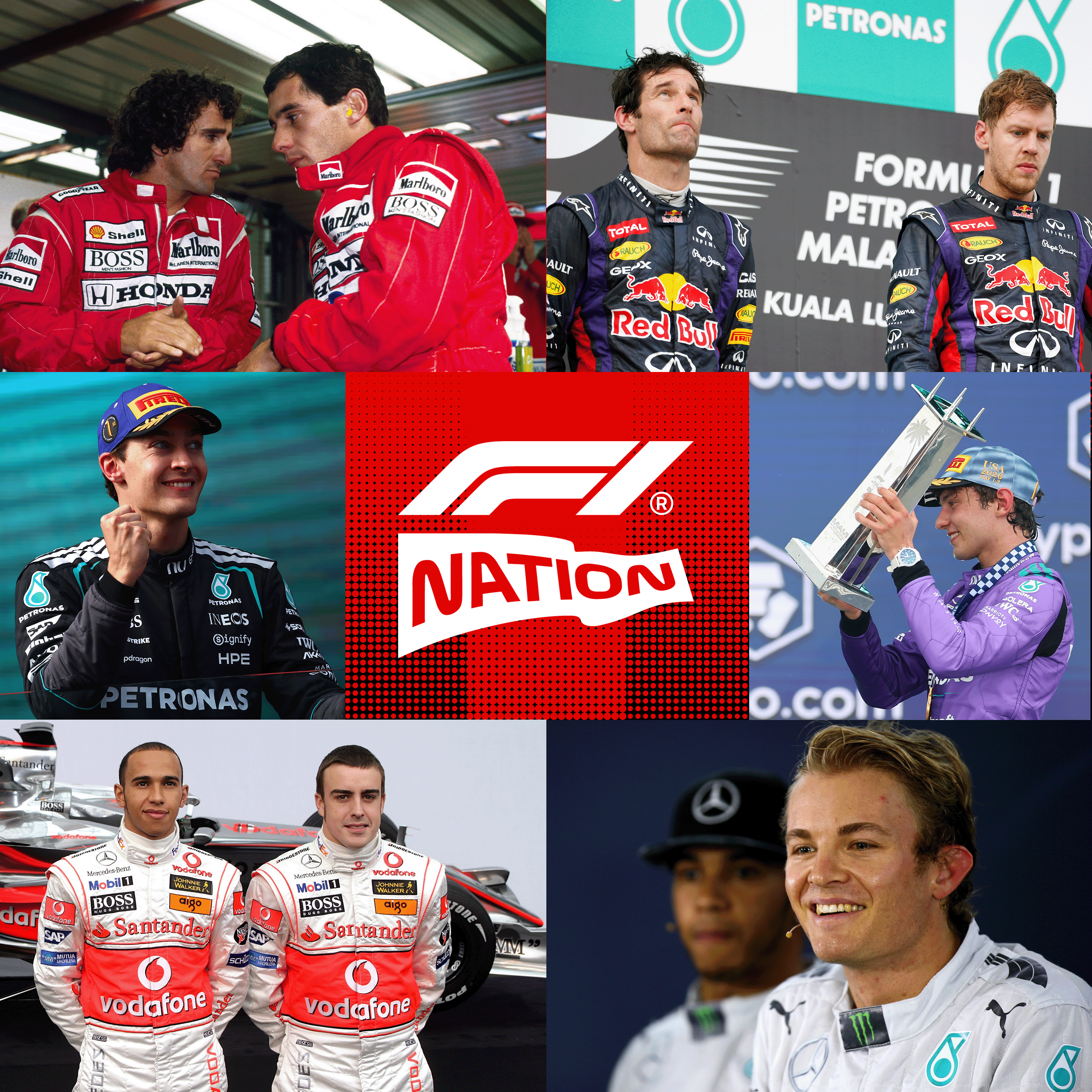
F1’s greatest teammate rivalries – with Palmer + Hinchcliffe
About this episode
Teammate rivalries get sharper when championship pressure, team orders, and imperfect simulator-to-track correlation collide. Palmer and Hinchcliffe trace how rivalries can “tee off” with qualifying incidents, then escalate through tactics, perceived favoritism, and even rule/engine-mode controversies. They also dig into why teams try to keep things “even” but can “exacerbate the problem,” and how leadership decisions from the pit wall shape what drivers feel on track. The conversation connects classic rivalries to modern scenarios like Mercedes’ intra-team title battle.
With an intra-team title battle brewing between Kimi Antonelli and George Russell at Mercedes in 2026, Tom Clarkson is joined by Jolyon Palmer and James Hinchcliffe to chat about some of the greatest teammate rivalries in F1 history.
The guys discuss Lewis Hamilton’s battles with Nico Rosberg at Mercedes and Fernando Alonso at McLaren, the major flashpoints during Sebastian Vettel and Mark Webber’s time at Red Bull, and the politics between Ayrton Senna and Alain Prost at McLaren.
Why were those rivalries so fierce? What are the key ingredients for an intense fight between teammates? How much involvement should the team have? And of the current grid, which driver pairing do Tom, Jolyon and Hinch think would have the most heated rivalry if they were competing for a title?
LAS VEGAS. FORMULA 1. LIKE NOTHING BEFORE.
The Las Vegas Grand Prix returns November 19th – 21st, 2026.
Get your tickets for the fastest weekend of the year at f1lasvegasgp.com/tickets.
Grand Prix in Montreal
"Obviously, back in Indianapolis now and it is well and truly the month of May and we've got the Grand Prix coming up, we're on the road course here this weekend, but events have already started..."
They’re discussing the F1 race weekend in Montreal. It’s a specific track on the F1 calendar, and the track’s layout affects how cars need to brake and grip the road.
They’re talking about the Formula 1 Grand Prix at Montreal, which is run on the Circuit Gilles Villeneuve. It’s known for high-speed corners and a layout that rewards traction and braking stability.
McLarens
"The other headline is, though, how good everyone else was as well, the McLarens, the Ferraris and pretty much everyone that brought upgrades found the right amount of pace..."
McLaren is one of the F1 teams. “McLarens” means the cars from that team and how well they did in the race.
McLaren is a Formula 1 constructor (team) that competes with its own car design and race strategy. When the hosts mention “McLarens,” they mean the McLaren cars and how they performed relative to the rest of the field.
Ferraris
"The other headline is, though, how good everyone else was as well, the McLarens, the Ferraris and pretty much everyone that brought upgrades found the right amount of pace..."
Ferrari is another F1 team. The hosts are saying Ferrari had a lot of new parts on its car, but the results in Miami weren’t what they wanted.
Ferrari is a Formula 1 constructor (team) with its own car development and upgrade program. The hosts are contrasting Ferrari’s performance in Miami with other teams, noting that Ferrari brought more upgrades than anyone else.
upgrades
"...and pretty much everyone that brought upgrades found the right amount of pace or more than I think we expected, but like a really good amount. There wasn't anyone really scratching their heads with the new parts on the cars..."
In F1, “upgrades” are updates to the car—like new parts meant to make it faster. If upgrades work well, the team’s car can gain speed and confidence right away.
In Formula 1, “upgrades” are new or revised parts added to the car—often to improve aerodynamic efficiency, cooling, or mechanical grip. The hosts are saying many teams found the performance they expected from their new parts, which makes the weekend more competitive.
downforce
"Hamilton's race was compromised lap one from the Colopinto contact and losing a significant amount of downforce and damage to the car."
Downforce is the “squish” effect from the car’s shape that presses it onto the track. If the car loses downforce after damage, it has less grip and tends to be slower—especially in corners.
Downforce is the aerodynamic force that pushes the car toward the track. In F1, it’s crucial for grip in corners, and losing it (for example after contact or damage) usually makes the car slower and harder to drive.
upgrade package
"Was the upgrade package the instant, second faster they wanted it to be? No, probably not, but in a sprint weekend, it's so hard to maximize and optimize everything."
An upgrade package is a set of new parts the team brings to a race to make the car faster. The debate is whether those parts actually work as well as the team hoped, right away.
An upgrade package in F1 is a bundle of new parts (often aerodynamic and/or cooling-related) brought to a race to improve performance. The key question is whether the upgrades deliver the expected lap-time gain quickly enough to matter in qualifying and the race.
sprint weekend
"No, probably not, but in a sprint weekend, it's so hard to maximize and optimize everything."
A sprint weekend is when F1 runs an extra, shorter race on Saturday. It changes the starting order for Sunday, and the tight schedule can make it harder to get everything perfectly dialed in.
A sprint weekend is an F1 format where a shorter race (the sprint) happens on Saturday, affecting grid positions for Sunday’s Grand Prix. Because the schedule is compressed, it can be harder to test, optimize, and extract maximum performance from upgrades and setups.
chassis
"we mentioned it before Miami, they already have a bit of the best chassis. Upgrades for the best car are not going to be as effective as upgrades for everyone else, basically."
The chassis is the car’s main structure. If a team already has the best chassis, it means the base “platform” is working really well, so extra upgrades might not help as much as they would on a less competitive car.
In F1, the chassis is the car’s structural platform that supports the suspension, aerodynamics, and driver controls. When the speaker says they already have “the best chassis,” they mean the underlying platform is strong, so further upgrades may have diminishing returns compared to teams starting from a weaker baseline.
power unit upgrade
"So what they need is a power unit upgrade, and then I think we'll see how good their car really is."
A power unit upgrade means the team is improving the car’s engine-and-energy system. In F1, that can boost speed and overall pace, not just cornering grip.
A power unit upgrade targets the F1 power unit, which includes the engine plus associated energy-recovery and control systems. In F1, improving the power unit can change straight-line speed and overall race pace, especially when aerodynamic upgrades have limited impact.
simulator
"There was one interesting comment Hamilton made on Sunday night, which was that he said he's being misled by the simulator back in Maranello."
The simulator is a computer system teams use to model how the car will drive. If a driver thinks it’s misleading, they’re saying the real car isn’t matching what the simulator predicted.
In F1, the simulator is the team’s high-fidelity driving and engineering model used to predict car behavior and help drivers and engineers refine setups. If a driver says they’re being “misled” by the simulator, it implies the real car is behaving differently than the model predicts.
simulation
"…ultimately, a simulation is just that. It's a it's a simulation. It's not the real thing."
In racing, a “simulation” is a computer model that tries to recreate how a car behaves using physics and data. The goal is not just to look realistic, but to match real-world behavior through model accuracy and correlation to track results. The hosts emphasize that sims can’t fully reproduce the cockpit’s visceral feedback.
tire model
"…get the tire model, the arrow model, the engine model, the track model, all the different elements that you have to get right in the simulator…"
A “tire model” is the simulator’s mathematical representation of how tires generate grip and respond to load, slip, and temperature. Because tire behavior strongly affects braking, cornering, and acceleration, an accurate tire model is one of the hardest parts of making a sim match real-world lap times and feel. If the tire model is wrong, the car can understeer/oversteer differently than it does on track.
correlate
"…get the tire model, the arrow model, the engine model, the track model, all the different elements that you have to get right in the simulator to try and get it to correlate while to the racetrack."
Here, “correlate” means making the simulator match the real race car and track. If the sim is correlated, it predicts how the car will behave more like it does in real life. If it’s not correlated, the sim can be misleading even if it seems realistic.
In racing simulation, “correlate” means tuning the simulator so its outputs match what happens on the real track. That typically requires getting multiple models to agree—like tires, aerodynamics, engine behavior, and the track surface. When correlation is off, the sim can feel “right” in some ways but still predict the wrong car behavior.
arrow model
"…get the tire model, the arrow model, the engine model, the track model, all the different elements that you have to get right in the simulator…"
In this context, the “arrow model” is almost certainly the simulator’s aerodynamic model—how wings and body shape create downforce and drag. Aerodynamics determine how much grip the car has at speed and how it behaves in fast corners. Getting the aero model right is essential for matching real race-car balance and lap-time trends.
engine model
"…get the tire model, the arrow model, the engine model, the track model, all the different elements that you have to get right in the simulator…"
An “engine model” in a racing sim represents how the power unit delivers torque and responds to throttle, revs, and drivetrain effects. It affects acceleration, traction, and how the car behaves when exiting corners. If the engine model is inaccurate, the sim can mis-predict gear choice, shift timing, and overall speed.
track model
"…get the tire model, the arrow model, the engine model, the track model, all the different elements that you have to get right in the simulator…"
A “track model” is the simulator’s representation of the circuit geometry and surface characteristics. That includes things like corner radii, elevation changes, banking, and how the track affects tire grip over a lap. Even with perfect car physics, a poor track model can lead to mismatched braking points and cornering behavior.
G
"You can have it move around the room and simulate a fraction of the G that you actually feel in the car."
“G” is a measure of acceleration relative to gravity (1G is the acceleration due to gravity). In a race car, drivers experience high G-forces during braking, cornering, and acceleration, which strongly affects how the car feels and how the driver’s body responds. Simulators can approximate motion and cues, but they can’t fully replicate the physical G-load and cockpit sensations.
grip
"they're feeling grip and how they're feeling balance through their core, their hands, their feet, all the parts."
Grip is basically how much the tires can “hold” the road. If the tires have more grip, the car can turn and accelerate harder without sliding.
In racing, grip is how much traction the tires can generate between the car and the track. More grip lets the driver brake later, turn in harder, and accelerate sooner without losing control.
balance
"they're feeling grip and how they're feeling balance through their core, their hands, their feet, all the parts."
Balance refers to how the car behaves across the front and rear axles during braking, turning, and acceleration. Drivers describe it as whether the car feels neutral, too loose, or too tight, and it strongly affects lap time consistency.
teammate rivalries
"All right, we're going to talk teammate rivalries. Kimmy Antonelli leads George Russell at the top of the World Championship standings by 20 points after the opening four rounds."
The hosts are focusing on rivalries between teammates in the same F1 team. They’ll explain why those battles can become famous and how they differ from today.
This is the episode’s main discussion theme: how teammate matchups become iconic in F1. It frames rivalries as internal battles for performance, development direction, and points within the same team.
World Championship standings
"Kimmy Antonelli leads George Russell at the top of the World Championship standings by 20 points after the opening four rounds."
The World Championship standings are the season points rankings for drivers. Whoever has the most points by the end of the year wins the championship.
This refers to the points table that ranks drivers across the season. It’s the basis for the F1 Drivers’ Championship, where every race’s points add up over time.
Mercedes
"they could yet join the fight with Mercedes as the season progresses. But at the very least, it looks like we've got an intra team title battle on our hands at Mercedes Antonelli versus Russell."
Mercedes is one of the F1 teams. In this segment, they’re talking about rivalry between teammates inside the Mercedes team.
Mercedes is the F1 constructor team referenced here, and it’s central to the discussion of an intra-team title battle. The rivalry is framed as teammate competition within the Mercedes squad.
V8s
"I seem to remember it was, you know, the last year of the V8s and Hamilton was betting in at the team."
“V8s” means the F1 cars were using V8 engines at the time. It’s an older engine era, and the cars drove differently than today’s turbo-hybrid cars.
“V8s” refers to the engine configuration used in Formula 1 before the turbo-hybrid era—an era where the cars used naturally aspirated V8 engines. That context matters because engine character and sound/response influence how drivers adapt and how teams develop cars.
engine modes
"And then it emerged that I think Rosberg had been using some sort of frowned upon engine modes in the race to attack Hamilton."
An F1 engine can run in different “modes” depending on what the team wants—like more power or better efficiency. If a driver is accused of using the wrong mode, it usually means they may have been bending the rules to gain an advantage.
In F1, “engine modes” are different software/operating settings that change how the power unit delivers power and energy. Teams can use them to manage performance, heat, and fuel/energy usage during specific phases of a race. When someone is accused of using “frowned upon” engine modes, it implies they may have been exploiting rules in a way that affects fairness.
skullduggery
"And that, for me, set the tone between them because it was the one they were hugs afterwards, brilliant fight. And then it emerged that I think Rosberg had been using some sort of frowned upon engine modes in the race to attack Hamilton. And it was the start of things, a little bit of skullduggery going on between teammates that before you have one of these like Eureka moments of like, hang on, that's not ethical in the battle that we're doing."
They’re using “skullduggery” to mean sneaky or questionable behavior. In this context, it’s about teammates doing things that feel unfair or not in the spirit of racing, which makes the rivalry get tense.
“Skullduggery” here is used to describe underhand or questionable behavior between teammates during a race. In F1 context, it suggests actions that may be outside the spirit of fair competition—like exploiting technical loopholes or making moves that are intended to provoke rather than race cleanly. The speaker frames it as the start of rivalry turning from competitive to personal.
Monaco situation
"could be risking a crash, could be the Monaco situation with with Rosberg, where he sort of looked like he went off potentially deliberately there."
They’re referencing a famous Monaco race moment where Rosberg’s actions looked like they might have been intentional. The point is that it made the rivalry feel more hostile—like it wasn’t just racing, but trying to send a message.
The “Monaco situation” refers to a well-known incident in the Monaco Grand Prix where Nico Rosberg appeared to go off-line in a way that looked deliberate. In teammate rivalries, such moments raise suspicion that on-track actions are being used as retaliation or intimidation rather than pure racing. That’s why it’s brought up as an example of tension escalating into something more than normal competition.
pit wall
"Imagine you're you're on the McLaren pit wall and you're thinking, [773.4s] Oh, do we swap these guys back? Do we not?"
The pit wall is the team’s control center at the track. It’s where people watch the race and send instructions to the drivers over the radio.
The pit wall is the command area at an F1 circuit where team leadership, engineers, and strategists monitor the race and communicate instructions to the drivers. Decisions like timing, track position, and whether to prioritize one car over another are typically coordinated from there.
team orders
"[773.4s] Oh, do we swap these guys back? Do we not? [775.7s] You've got probably Zach and Andrea Stella in communication with the race engineers. [786.6s] The start in Singapore, you've got Norris sort of barging his way past Piazzari."
Team orders are when the team tells one driver to change how they’re racing relative to their teammate. It’s usually to help the team get the best result.
Team orders are instructions from the team to manage how teammates race—often to protect track position, maximize points, or avoid internal conflict. In this segment, the “swap these guys back” idea is essentially about whether one car should be held back or allowed through.
race engineers
"[775.7s] You've got probably Zach and Andrea Stella in communication with the race engineers. [780.3s] How much communication?"
Race engineers are the engineers who work directly with the drivers during the race. They use live data to tell the driver what to do next—like how hard to push and how to handle the tires.
Race engineers are the engineers assigned to a driver (or car) who translate real-time data into driving and strategy guidance. They manage things like tire behavior, fuel/energy targets, and how to respond to traffic and rivals during a stint.
track position
"[793.5s] looking through their own teammates, a little bit of contact. [797.6s] And they gave themselves a massive headache. [800.1s] But in the end, because they got away with it, I feel like it's probably a case study"
Track position is basically who is ahead on the track. In F1, being in front or behind can change your strategy and how easy it is to pass others.
Track position is where a car sits relative to others on the circuit, which strongly affects overtaking chances and strategy. In F1, losing or gaining track position—especially via contact or swapping priorities between teammates—can create major strategic problems.
contact
"[793.5s] looking through their own teammates, a little bit of contact. [797.6s] And they gave themselves a massive headache. [800.1s] But in the end, because they got away with it, I feel like it's probably a case study"
“Contact” means the cars touch during the race. That can cause damage and make the rest of the strategy harder for the team.
In racing, “contact” means the cars physically touch or scrape during a maneuver. Even minor contact can damage aero or suspension, trigger penalties, and force strategy changes—hence the “massive headache” described here.
championship battle
"[800.1s] But in the end, because they got away with it, I feel like it's probably a case study [805.2s] of how it was quite well handled, ultimately, because we're into the next year [808.9s] and the drivers are still harmonious, although they're not yet in the championship battle."
A championship battle means the season fight for the top ranking. When it’s close to the title, teams usually get stricter about how teammates race each other.
A championship battle is the fight for the season’s top standings (drivers’ and/or constructors’). When teammates aren’t yet in that battle, teams may tolerate more internal racing; once the title is on the line, they typically tighten control and prioritize points.
outside the box
"[853.7s] If I ever want to beat this guy, I have to start. [858.1s] I have to start thinking outside the box and doing some of the other stuff."
Here, “outside the box” means trying a different, less typical way to beat the other driver—usually by taking more creative risks.
In racing context, “thinking outside the box” usually means trying unconventional approaches—like different lines, timing, or risk levels—to break a stalemate. It’s not a technical F1 term, but it’s used here to describe a more aggressive competitive strategy.
grid
"well, my win today is an eighth and then that hopefully gives me the opportunity to move up the grid and eventually be in a car that can fight for a win."
The grid is where cars line up to start the race. If you move up the grid, you start nearer the front, which usually makes it easier to compete for the win.
In F1, the “grid” is the starting order/positions on the grid for a race, determined by qualifying. Moving up the grid generally means starting closer to the front, which improves your odds because overtaking is difficult and track position matters.
getting under Lewis' skin
"Rossburg chipping away any possible time he could, he was getting under Lewis' skin. And bearing mind, he was kind of the inferior driver in terms of talent."
It means one driver is trying to mess with the other driver’s focus. If you throw their timing off or make them more tense, they’re more likely to lose a little speed or make a mistake.
In racing, “getting under” an opponent’s focus is about psychological pressure—forcing mistakes, disrupting rhythm, or raising stress so lap-to-lap performance drops. In F1, where qualifying and race pace are extremely fine margins, even small concentration disruptions can change outcomes.
out of his sort of steady state
"Anytime you can get your opponent's concentration or get him out of his sort of steady state, that's going to be a good thing."
It means the driver is no longer driving in their comfortable, repeatable rhythm. Once that happens, they can start reacting a bit slower and driving less smoothly, which costs time.
“Steady state” in motorsport refers to a driver’s consistent operating mode—stable focus, predictable car behavior, and repeatable lap-by-lap inputs. If a rival can push you out of that rhythm, you often see slower reaction times, less precise braking/turn-in, and reduced tire and traction management consistency.
straight up fight
"99.9% of Formula 1 drivers can't beat Lewis Hamilton in a straight up fight at that time in his career."
They mean a direct head-to-head battle on track. No special tricks—just racing each other as normal and seeing who’s faster.
“Straight up fight” here means a direct, on-track contest where the outcome depends mainly on pure driving performance and racecraft rather than outside help like strategy calls, luck, or major interference. It emphasizes how hard it is to beat Hamilton when both cars are racing normally.
toolbox
"And he managed to do it by utilizing all of these tools, everything in the toolbox, even some tools that other people wouldn't have been willing to do."
“Toolbox” means all the different tactics a driver can use. The idea is that Rosberg didn’t rely on just one thing—he used many approaches to try to beat Hamilton.
In racing talk, “the toolbox” refers to the full set of tactics and techniques a driver can use—car setup feedback, driving style adjustments, defensive/offensive maneuvers, and race strategy execution. The segment claims Rosberg used every available option to create an opening against Hamilton.
rattle Lewis and slow him down
"but there was also an element of how can I rattle Lewis and slow him down? He's just a"
They’re talking about trying to throw off another driver’s flow. If you make their driving less smooth or consistent, they can lose time without you necessarily being faster every moment.
This describes a common racing objective: disrupt an opponent’s rhythm (“rattle”) and force them into less efficient driving, which can reduce their pace. In F1, even small changes in how consistently a driver can hit braking points and traction zones can translate into lap-time loss.
Hamilton Rosberg
"Imagine being on the other side of the garage of that guy who holds everyone to account. You can't get away with a soft answer... That's Hamilton Rosberg."
They’re talking about a rivalry between two teammates in F1. Since they drive for the same team, it’s a close comparison of driver skill.
This refers to the teammate rivalry between Lewis Hamilton and Nico Rosberg. In F1, teammate rivalries are especially intense because both drivers share the same car package and team resources.
Hamilton Alonso
"Give us another rivalry. The one that I just remember the clearest... was Hamilton Alonso. That one for me, it's just such a good story."
They’re describing a big rivalry between two top drivers. The idea is that when teammates clash, it can affect the whole team’s ability to win.
This is the host’s framing of a rivalry involving Lewis Hamilton and Fernando Alonso. The key point is how teammate dynamics and competing ambitions can escalate into conflict that hurts championship outcomes.
driver team history
"Fernando Alonso's face is going to be in the dictionary next to Tenacious. And the level of Skull Duggery and Tom Fulery that followed was unbelievable to the point where it was the most spectacular divorce in driver team history at the end of the season."
They’re talking about how the driver and team relationship fell apart. In F1, that kind of breakup can directly affect how well the car and strategy work together.
In Formula 1, a “driver team history” is the relationship between a driver and their team—especially when it turns sour. When the hosts say the rivalry led to the “most spectacular divorce,” they’re describing a breakdown in the driver–team partnership that affected results.
Ron Dennis
"imagine on the receiving end of that, you've got Ron Dennis at McLaren, one of the hardest taskmasters that Formula One team principal's seen..."
Ron Dennis is presented as the tough leader running the team. The story is that even he couldn’t control how the drivers’ relationship played out.
Ron Dennis is discussed as McLaren’s team principal/manager figure—an executive with strong control over team operations. The hosts’ point is that even a hard-driving team boss couldn’t fully manage the driver lineup politics and rivalry that followed.
Toto
"But again, it shows you've got Toto, you've got Ron, two old-timers... But you can't stop things blowing up like this."
“Toto” is a top team leader in Formula 1. They’re saying that even strong team management can’t stop big rivalries from escalating.
“Toto” refers to Toto Wolff, a major F1 team executive figure. In this segment, he’s grouped with Ron Dennis as an “old-timers” leadership presence, emphasizing that team leadership can’t always prevent on-track conflict when drivers want different outcomes.
pit lane
"Who can forget qualifying in Hungary when Alonso just sat in the pit lane so that his teammate couldn't get a final lap in?"
The pit lane is the lane next to the track where teams work on the cars. If someone is stuck there at the wrong time, it can stop another driver from getting a crucial fast lap.
The pit lane is the area beside the track where teams service cars during a race weekend. In qualifying, blocking or delaying a teammate in the pit lane can prevent them from completing a final flying lap, directly impacting grid position.
qualifying in Hungary
"Who can forget qualifying in Hungary when Alonso just sat in the pit lane so that his teammate couldn't get a final lap in?"
Qualifying decides where each car starts for the race. The Hungary reference is about a memorable qualifying incident that affected who could set a fast lap.
Qualifying is the session in F1 that sets the starting grid for the race. The Hungarian Grand Prix is known for dramatic qualifying moments, and this segment references a specific incident involving a teammate not getting a final lap.
Spygate $100 million fine
"Who can forget qualifying in Hungary when Alonso just sat in the pit lane so that his teammate couldn't get a final lap in? And then from there, the Spygate $100 million fine."
“Spygate” was an F1 cheating scandal involving teams getting access to secret technical information. The big fine shows the sport treats it as a major rules violation.
“Spygate” refers to an F1 spying scandal where one team was accused of illegally obtaining technical information from another team. The mention of a “$100 million fine” highlights how serious the sport’s rules are about technical advantage and competitive integrity.

Dodge Challenger
"...where the established guy just sees off the young challenger, who we all think is that good? It's quite diffic..."
The Dodge Challenger is a car built for strong acceleration and a sporty, loud driving feel. It’s known for having big engines, especially V8s, and it’s often talked about as a “challenger” because it’s meant to compete on performance.
The Dodge Challenger is a classic American muscle car known for its powerful V8 engines and long-running popularity. It often comes up in discussions about “challengers” because it represents a big, performance-focused alternative to more modern or more restrained sports cars. In a podcast, it may be mentioned to illustrate the idea of a newer contender trying to prove itself against an established performer.
Red Bull
"Obviously you've got the whole run of red bull drivers since Verstappen. So Gasly, maybe people thought was going to be a bit of a challenge."
Red Bull is a major Formula 1 team. When the show talks about Red Bull drivers, it’s referring to the team’s lineup and the tough teammate competition inside a top car.
Red Bull is a Formula 1 team brand that has been a dominant force in recent years, especially through its driver lineups. The segment references “the whole run of red bull drivers since Verstappen,” highlighting how teammates at a top Red Bull seat often face intense internal rivalry.
F3 champ / F2 champ ladder to Formula 1
"The other one is Norison Piastri. So you've got Piastri, F3 champ, F2 champ, gets to Formula 1..."
F3 and F2 are lower-tier racing series that help young drivers prove themselves. If someone wins those championships, it usually means they’re ready for Formula 1.
F1’s feeder system uses junior single-seater series like Formula 2 (F2) and Formula 3 (F3) to identify and develop young talent. Winning championships there is treated as strong evidence a driver can handle higher-speed cars and tougher competition before stepping into Formula 1.
title shot
"Piastri, F3 champ, F2 champ, gets to Formula 1, has the title shot and actually Norris dug in so deep, but held him back last year..."
A “title shot” means you have a real chance to win the championship. It’s more than just racing—it’s being in the mix at the front.
A “title shot” means being in a position to realistically contend for the championship, not just participate. In F1, it usually depends on having a top car and a team that believes the driver can fight for points consistently across the season.
teammate rivalry
"Obviously one of them is a champion now and in their teammate rivalry as well. The fact that Norris stopped the charge of Piastri."
Teammate rivalry means two drivers on the same team competing hard against each other. Since they’re in the same team, it’s a very direct comparison of who’s performing better.
Teammate rivalry in F1 is competition between drivers who share the same team and (largely) the same car platform. Because both drivers are working under the same technical constraints and team goals, the rivalry often becomes a direct test of driver talent under identical machinery.
gearbox failed
"Hamilton was literally in the gravel in Shanghai and then his gearbox failed in Brazil."
The gearbox is what helps the car use the engine’s power efficiently. If it “fails,” the car can’t shift properly or deliver power, so the race is usually over.
A gearbox failure means the transmission system that delivers power to the wheels stopped working correctly. In F1, gearbox issues can end a driver’s race quickly because the car can’t reliably change gears or transmit torque.
gravel
"Hamilton was literally in the gravel in Shanghai and then his gearbox failed in Brazil."
Gravel is loose material near the track that slows you down if you go off course. In racing, hitting it usually means you lose control and can damage the car.
Gravel is a track surface used in run-off areas to slow cars when they leave the racing line. In F1, going into gravel often causes immediate loss of control and can damage the car or force retirement.
TC
"And as you say, TC, Hamilton then went to go and be a seven-time world champion, but the next year a champion."
TC stands for traction control. It helps stop the wheels from spinning when the tires don’t have enough grip, so the car can accelerate more smoothly.
TC here refers to traction control, an electronic system that helps prevent wheelspin by reducing engine power or adjusting torque when grip is limited. In F1 discussions, it’s often mentioned in the context of how drivers manage acceleration and stability under changing conditions.
teammates
"But it's such a well-famed story. And because I was looking into this in anticipation for this pod, I've just looked through their time as teammates. Two years, 1988, 1989."
In F1, teammates are the two drivers who share the same car model and team resources within a constructor. Because they have similar equipment, teammate matchups (like qualifying head-to-heads) are often used to judge driver performance more fairly than comparing across different teams.
out qualifying
"I've just looked through their time as teammates. Two years, 1988, 1989. And TC, you probably know better than me this era. But I was looking through the stats and I can't believe that this was even a rivalry because you've got Etten Center out qualifying Alan Prost 14-2 in 1988 and he wins the championship."
“Out-qualifying” just means one driver got a faster lap time than the other during qualifying. It’s a direct head-to-head pace comparison.
“Out-qualifying” means one driver sets a faster qualifying time than another driver. In this segment, the hosts use it to compare Ayrton Prost’s teammate performances against Alain Prost’s own qualifying results.
qualifying deficit
"Johnny Dumfries and Satoru Nakajima, do you know what their average qualifying deficit was to center? I've had a lot of fun doing this, right? Yeah. [2166.3s] It's somewhere between three and four seconds per lap."
Qualifying deficit means how far behind one driver is compared to another in the qualifying session. If it’s “three to four seconds,” that’s a big gap in one-lap speed.
In Formula 1, a qualifying deficit is how much slower a driver is compared with a specific reference—often their teammate—over a qualifying lap. When the hosts say “three to four seconds per lap,” they’re describing a consistent gap in single-lap pace during qualifying.
collision at Suzuka
"And in 1989, of course, he gets that championship after the collision at Suzuka. It's a great point, JP, because the real sort of shenanigans kind of didn't start till Center had that first championship."
The “collision at Suzuka” refers to a decisive on-track incident at the Japanese Grand Prix venue, Suzuka Circuit. In F1, collisions between title contenders can swing the championship by changing points outcomes and triggering investigations or rule interpretations.
mind games
"You've got sort of mind games in this as well, haven't you? So it's in the interest of the guy that's fundamentally not as quick to do things differently, to try and make, you know, force the rivalry, try and close the field."
“Mind games” in Formula One are psychological tactics used to unsettle a rival—through comments, strategic positioning, or influencing how aggressively they push. Because championships are decided over many races, these tactics can be as important as outright lap time.
pressure cooker situation
"Or do you think when you're in that pressure cooker situation, championship on the line, refusing to lose, that's when it just sort of comes out?"
In motorsport, a “pressure cooker situation” refers to the intense, high-stakes period when championship points are on the line. That kind of environment often changes driver behavior—risk tolerance rises, and rivalries can escalate into more aggressive tactics.
FIA
"And this is almost where Prost was kind of using the FIA relationship, right? Because that was a big part of the mind game part of it with them. Precisely."
The FIA (Fédération Internationale de l’Automobile) is the governing body that oversees Formula One rules, stewarding, and disciplinary processes. The transcript suggests Prost used the FIA relationship as part of the rivalry, implying how official decisions and procedures can become part of the competitive chess match.
opening lap
"Prost had proposed that whoever was leading into turn one should stay in front for the opening lap of the race."
The opening lap is the very first lap of the race. It’s when drivers are most likely to gain or lose positions, so rivalries can flare up quickly.
The “opening lap” is the first lap after the start, when positions are most volatile due to traffic, braking zones, and limited grip while tires come up to temperature. In rivalries, disputes often start here because a single overtake—or failure to defend—can set the tone for the entire race.
turn one
"Prost had proposed that whoever was leading into turn one should stay in front for the opening lap of the race."
Turn one is the first corner on the track. Since it’s right after the start, it’s where a lot of early battles happen.
“Turn one” is the first corner at a Grand Prix circuit, and it’s often the most important braking and overtaking zone of the race start. Because it’s the first place drivers can pass or defend, it frequently becomes the focal point of rivalries and controversial incidents.
race restart
"There was, of course, that big accident of Gerhard Berger's. So there was a restart. And Prost got to the first corner first."
A restart is when the race stops and then begins again after an interruption. When it restarts, the order and momentum can shift, especially at the first corner.
A “restart” in F1 happens after a race is interrupted (for example, due to a major accident) and the field is re-launched under controlled conditions. Restarts can dramatically change the competitive order because drivers get another chance to attack the first corners and manage tire and brake temperatures.
team principal
"I think an interesting point as well is that when you talk about team managers, team principals having to manage these situations, one of the most difficult things to manage is a driver in the heat of the moment."
In F1, the team principal is basically the team’s top boss. They help manage what the drivers do and how the team handles tense situations during a race weekend.
In Formula 1, a team principal is the senior manager responsible for running the team day-to-day and making high-level decisions. They’re often the person trying to balance team orders, driver behavior, and competitive strategy when rivalries or on-track incidents happen.
team first, repercussions for hitting each other
"Yes, there's the golden rule, you can't hit each other, there should be repercussions for that, team first, all that stuff."
F1 has strict rules about not crashing into other cars. If drivers do something unsafe, there can be penalties, and the team also tries to handle it.
The “golden rule” in F1 is that drivers can’t physically hit each other, and the sport has penalties and enforcement to discourage dangerous behavior. The transcript also points out that teams manage these situations internally (“team first”) before or alongside official repercussions.
protest against Prost's win in Suzuka
"there was already, you know, the perception that Ron was favoring Senna, right? There's, of course, the whole protest against Prost's win in Suzuka because of what happened at the chicane in the Marshalls and all the rest of it."
After an F1 race, teams can complain to the officials if they think something broke the rules. If the officials agree, the race result can change.
In Formula 1, teams can file a formal protest after a race if they believe the result was affected by a rules violation. The Suzuka reference points to a specific incident where the outcome was challenged via the sport’s official review process.
chicane
"the whole protest against Prost's win in Suzuka because of what happened at the chicane in the Marshalls and all the rest of it."
A chicane is a part of the track where the cars have to zig-zag through a tight section. It’s used to slow cars and make the driving more complicated there.
A chicane is a sequence of alternating turns designed to slow cars down and create a technical passing area. Because it forces cars to change direction quickly, incidents at chicanes often become controversial and can lead to protests or penalties.
Marshalls
"the whole protest against Prost's win in Suzuka because of what happened at the chicane in the Marshalls and all the rest of it."
Marshals are officials on the track who handle accidents and safety. What they do can influence what happens to the cars during the race.
In F1, marshals are track officials positioned around the circuit to manage safety and respond to incidents. Their actions—like controlling access to a section of track—can affect what drivers are allowed to do during a race.
front wing
"you had Vettel had a, was it an incident in practice or just a faulty, the new front wing that failed, and they only had one other. And they took it from Mark Webber's car and put it on Sebastian Vettel's car."
The front wing is the big wing on the front of an F1 car. It helps the car stick to the track by pushing air in a way that increases grip. If it breaks or gets moved to another car, the handling can change right away.
In Formula 1, the front wing is the primary aerodynamic device at the nose that shapes airflow to generate downforce and stability. If a front wing fails or is swapped, it can immediately change grip and balance, which is why it becomes a big deal during a race weekend.
title contention
"But you know, that's difficult for a teammate in title contention to have. And I think they said it was worth about half a tenth..."
“Title contention” means a driver is realistically in the fight for the championship, not just racing for individual race results. When two teammates are both in title contention, any perceived unfairness—like a key part being swapped—can feel like it directly affects the championship outcome.
pole
"they said it was worth about half a tenth, Vettel put it on pole, Webber won the race, not bad for a number two driver..."
“Pole” means the driver starts the race from the very front because they were fastest in qualifying. It’s a big deal in F1, so when the team situation turns messy, it can make rivalries feel even sharper.
Pole position (often shortened to “pole”) is awarded to the driver who qualifies fastest and starts the race from the front of the grid. In F1, starting from pole is a major advantage, so losing parts or team support while also fighting for pole and wins can intensify teammate tension.
half a tenth
"they said it was worth about half a tenth, Vettel put it on pole, Webber won the race..."
In F1 timing, “a tenth” refers to 0.1 seconds, so “half a tenth” is 0.05 seconds. Because qualifying and race pace can be separated by only small fractions of a second, even a tiny aerodynamic gain from a part like a front wing can be decisive.
Silverstone
"but you would feel like a number two driver. You literally are a number two driver at that point when you're at Silverstone, it's neither driver's home race..."
Silverstone is a historic Formula 1 circuit in the UK, known for high-speed corners and heavy emphasis on aerodynamic efficiency and braking stability. Teammate rivalries can feel especially intense at major venues because both drivers may have strong personal motivation and fan attention.
cool down room
"multi-21 sep in the, in the cool down room. There's no, like we'll talk about it afterwards, it was just a hammer blow."
The cool-down room is a post-session area in F1 where drivers and team members decompress and discuss what happened after qualifying or a race. It’s part of the team’s workflow, so arguments or accusations raised there can quickly become part of the rivalry narrative.
Bahrain
"So whether it's Bahrain, a bit of engine tweaking from Rosberg, the holding positions in Monaco"
Bahrain is where one of the Formula 1 races is held. In this story, it’s used as a reference point for a specific rivalry moment.
Bahrain refers to the Bahrain Grand Prix, a Formula 1 race held at the Bahrain International Circuit. It’s mentioned here as part of a sequence of teammate-rivalry moments tied to race incidents and team dynamics.
Imola
"the Senna, Prost, Imola moment, all of these ones, it's, it's a team order rather than a sort of natural fight where they figure it out."
Imola is a track in Italy where Formula 1 races are held. Here it’s referenced as the location of a memorable rivalry incident.
Imola refers to the Emilia Romagna Grand Prix at the Autodromo Enzo e Dino Ferrari. The segment uses “Imola moment” as shorthand for a well-known teammate-rivalry incident in that era.
safety car
"Seb's first full season in Formula One, Fuji, they're behind the safety car, it's a wet race. And Seb crashes into the back of Mark taking both cars out of the race."
A safety car comes out when the track is unsafe. Everyone slows down and follows it until the race can restart safely.
The safety car is deployed in Formula 1 when there’s danger on track, and it controls the pace of the race behind it. Drivers must follow the safety car’s speed and spacing rules, which can dramatically change race outcomes and restart timing.
out of contract
"[3385.7s] out of character. He's young, he's out of contract at the end of the year currently, [3390.7s] which seems amazing right now."
“Out of contract” means the driver’s current deal is ending soon. When that happens, it can change how the driver behaves because their next step is uncertain.
“Out of contract” means a driver’s current employment agreement is ending, so their future with the team is uncertain. In F1, contract timing can affect how aggressively a driver pushes, negotiates, or reacts to teammate dynamics.
driver briefings
"...and seeing some of the tension in the driver's briefings and all of it around."
A driver briefing is a meeting before a session where the team explains the plan for the race or qualifying. It can also show how the team is thinking about each driver’s role.
“Driver briefings” are pre-session meetings where the team reviews plans and performance expectations for upcoming runs. In F1, they can reveal how the team is managing strategy, car setup direction, and—sometimes—how it expects drivers to behave.
Spygate scandal
"...I think my memories of that season are also slightly muddied by the Spygate scandal and the $100 million fine that McLaren were given"
“Spygate” was a major F1 controversy involving stolen or misused confidential information. McLaren was punished, and it changed how people viewed that season.
“Spygate” refers to the F1 “spy scandal,” where McLaren was accused of using confidential information from a rival team. It led to penalties including a major fine, and it became a defining off-track controversy of that era.
Request an Explanation
Heard something you'd like explained? We'll add it to this episode.
Sign in to request explanations for terms you heard.
Want to learn more?
Browse our glossary for plain-English explanations of automotive terms, jargon, and concepts.
Help improve this episode
See something that's not quite right? Our annotations are AI-generated and can sometimes miss the mark. Click the flag icon on any annotation to suggest a correction.