
How not to drive a 300SL Gullwing, 'Manthey' MX-5 & the next Nissan GT-R | Episode 48
About this episode
Evo Podcast Episode 48 kicks off with “Evo eras” for 2026, revisiting the idea without repeating the same picks. The hosts then zoom in on Manthey’s track-focused Porsche GT3 aero and suspension philosophy—homologated, warranty-backed, and tuned for repeatable braking and real-world drivability. After that, the show pivots to MX-5 culture and engine swaps via Rocketeer, before classic-car driving lessons in the 1954 Mercedes 300SL Gullwing’s throttle-sensitive swing-axle feel and non-synchromesh gearbox technique.
In this week's episode, Stuart Gallagher is joined by James Taylor, Richard Meaden and John Barker to discuss our upcoming supercar eras series, a £100,000 Mazda MX-5, the latest Manthey Porsche 911 GT3 and what could be the heart of the next Nissan GT-R.
Mantai
"Yeah, I've been driving the latest Mantai kit. So this is the 992.2 Gen GT3, so the current GT3 that's out now."
Manthey is a company that makes performance upgrade kits for Porsche models. Here, they’re fitting a kit to a Porsche 911 GT3 to make it better for track driving. The big idea is improving grip and aerodynamics, not changing the main engine parts.
Manthey is a motorsport-focused Porsche tuning brand known for developing track-oriented upgrades. In this episode, “Mantai kit” refers to their package of changes for the Porsche 911 GT3. The host emphasizes that Manthey’s approach here is to improve handling and aero rather than reworking the core engine/gearbox.
powertrain
"It's like other Mantai kits, they don't touch the powertrain. So no changes to the engine or the gearbox."
Powertrain is the car’s main “go” system—engine and gearbox working together. If the kit doesn’t touch it, they’re not changing the engine or transmission. Instead, the upgrades focus on how the car handles and how it behaves at speed.
Powertrain is the car’s main mechanical drive system—typically the engine plus transmission and related components that send power to the wheels. When the host says the kit “doesn’t touch the powertrain,” they mean it avoids changing the engine/gearbox calibration or hardware. That makes the kit’s impact mainly about how the car grips and how it stays stable at speed.
aero
"It's all about the suspension and the aero. And this one also had a few extra bits as well,"
Aero is how the car’s body and wings interact with the air. On a track car, aero is used to push the car down so the tires can grip better at high speed. This kit is mainly about aero improvements too.
Aero (aerodynamics) refers to how the car’s shape and add-on parts manage airflow. On track cars, aero is often used to generate downforce, which increases grip at speed without relying on more engine power. The host’s point is that this Manthey kit focuses on aerodynamic changes alongside suspension.
suspension
"It's all about the suspension and the aero. And this one also had a few extra bits as well,"
Suspension is what helps the wheels stay in contact with the road. It affects how the car feels over bumps and how steady it is when turning hard. In this kit, suspension is one of the main areas being upgraded.
Suspension is the system that connects the wheels to the car and controls how the car moves over bumps and during cornering. Track-focused suspension changes can improve tire contact, reduce body movement, and make the car more predictable under braking and cornering. Here, the host says the kit is “all about the suspension and the aero,” meaning these are the main performance levers.
lightweight wheels
"So they also do their own lightweight wheels, which they make in their own factory, their own brake pads,"
Lightweight wheels mean the rims are made lighter than stock. That can help the suspension react more quickly, so the tires can keep better contact with the road. It’s one of the ways performance kits improve handling.
Lightweight wheels reduce unsprung mass (weight not supported by the suspension springs). Lower unsprung mass helps the suspension respond faster to road and track surface changes, improving grip and ride control. In performance kits, wheel weight is a common target because it affects how quickly the tires can stay working effectively.
carbon trim
"their own brake pads, their own, they now do carbon trim and things like that."
Carbon trim means parts made from carbon fiber. Carbon fiber is a lightweight, strong material often used on performance cars. They’re listing it as one of the extra add-ons in the kit.
Carbon trim refers to interior or exterior pieces made from carbon fiber composite. Carbon fiber is valued in performance applications for its high stiffness-to-weight ratio, allowing parts to be lighter and sometimes more rigid than conventional materials. In this segment, it’s mentioned as part of Manthey’s “rolling catalog of parts.”
four-way adjustable dampers
"but it's got adjustable coilover suspensions, a four-way adjustable dampers, hand adjustable. And then this really sophisticated aero package."
Dampers are what keep the car from bouncing too much. “Four-way adjustable” means you can adjust the shock settings in more than one direction so the car feels right on track.
Dampers (shock absorbers) control how quickly the suspension compresses and rebounds. “Four-way adjustable” typically means you can set multiple damping parameters (often compression and rebound, sometimes in separate ranges), letting you dial in grip and stability as conditions change.
turning vanes
"and turning vanes all the way underneath the car, made out of plastic rather than carbons, the diffusers carbon, but these are plastic,"
Turning vanes are small aerodynamic fins that steer airflow. Under the car, they help the air move in the right way to improve grip.
Turning vanes are shaped aerodynamic surfaces that “direct” airflow, often used to manage how air moves under the car. In underbody aero, they help feed the diffuser and keep the flow organized so the car can generate downforce efficiently.
diffusers
"made out of plastic rather than carbons, the diffusers carbon, but these are plastic, because the idea is that you take it on track"
A diffuser is a part under the car that helps create suction. More suction under the car means more downforce, which helps the car feel planted at speed.
A diffuser is an underbody aerodynamic device that expands airflow as it exits the car’s underside. That expansion creates lower pressure under the car, which increases downforce and improves high-speed stability.
run over curbs
"because the idea is that you take it on track and run over curbs and you're down. So does that become a badge of honor of how many"
On a track, you often ride over curbs to get better line and speed. But curbs can scrape or break parts underneath the car, so the materials matter.
Running over curbs is a track-driving reality that can damage low-slung underbody aero parts. This segment implies the materials (plastic vs carbon) are chosen to tolerate curb strikes and track-day abuse.
downforce
"So yeah, well, I think roughly half the downforce comes from under the body, so to be a fair bit. And at top speed, if I'm remembering rightly, it's 575 kilos of downforce"
Downforce is the “suction” effect from the car’s shape that presses it harder onto the road. That helps the tires grip better when you’re going fast, especially when turning.
Downforce is the downward aerodynamic force that pushes a car toward the road at speed. More downforce generally improves grip and stability, especially in corners, but it can also increase drag depending on how it’s generated.
drag
"And yet the same drag, so a bit like the RS that you guys tested to have it all homologated."
Drag is the air resistance that fights against the car’s motion. If you can add grip (downforce) without adding drag, the car can stay fast without needing more power.
Drag is the aerodynamic resistance that slows a car down as it moves through air. The hosts are saying the car gained downforce without increasing drag, which is a key efficiency goal in aero development.
homologated
"And yet the same drag, so a bit like the RS that you guys tested to have it all homologated. Yeah, it has to stay within all the homologation."
Homologation is official approval that a specific car setup meets the rules. It’s what makes certain parts and configurations legal for the road or for a racing class.
Homologation is the process of certifying a car configuration so it’s legally allowed for road use or for a specific racing category. In this context, they’re talking about keeping the aero/parts within the approved rules so the car can be used as intended.
Manto
"Yeah, which is the people at Manto describe it as eating more food, but still weighing the same, which is quite a good trick if you can do it."
Manthey is a Porsche specialist that works on performance upgrades, especially for aero and track setups. They’re being praised for making the car stick more without making it heavier.
Manthey (spoken here as “Manto”) is a Porsche-focused motorsport and tuning outfit known for developing track-oriented Porsche packages. The hosts credit Manthey’s approach to improving aerodynamic performance without adding weight.
Porsche
"So yeah, it's all the parts that got Porsche, part numbers, it's all full factory warranty. You can take it to any Porsche dealer to get it serviced"
Porsche is the carmaker whose dealer network and parts numbering system are referenced here. The hosts are saying the car uses Porsche-approved parts and can be serviced through Porsche dealers under warranty.
factory warranty
"it's all full factory warranty. You can take it to any Porsche dealer to get it serviced, all that stuff."
Factory warranty means the carmaker will pay for certain repairs if something goes wrong, as long as it’s within the warranty rules. They’re saying this setup is covered like a normal Porsche, not a sketchy aftermarket conversion.
A factory warranty is coverage provided by the manufacturer for repairs within a defined period and terms. Here, the hosts emphasize that the car’s parts are official and supported, so dealer service should be straightforward.
two-part test
"It was a two-part test. Yeah, and you had it, so road and track."
They’re testing the car in two ways: on normal roads and on a track. That shows how it behaves day-to-day versus when you push it hard.
A “two-part test” here means they evaluate the car in two different environments—road and track—to understand how aero and drivability behave under real-world and high-load conditions. This helps separate everyday comfort/behavior from performance limits.
track oriented
"But yeah, it's very much track oriented. So I was a bit worried about taking it on the road."
“Track-oriented” means the car is set up to drive well on a race track. That usually involves tuning things for grip and control, not just smoothness on normal roads.
“Track-oriented” describes a car setup or model focus tuned for circuit driving—typically prioritizing grip, braking stability, and suspension/aero behavior over everyday comfort. In this context, it explains why the hosts were initially worried about road drivability.
Thruxton circuit
"And then a few days later, we drove it at Thruxton circuit, so it was a couple of clicks different on the dampers,"
Thruxton is a real race track. The hosts drove there to see how the car behaved with different suspension settings compared to the road.
Thruxton Circuit is a UK race track used to evaluate how changes to suspension and aero settings affect real driving behavior. Here, it’s the reference point for comparing damper settings between road use and circuit use.
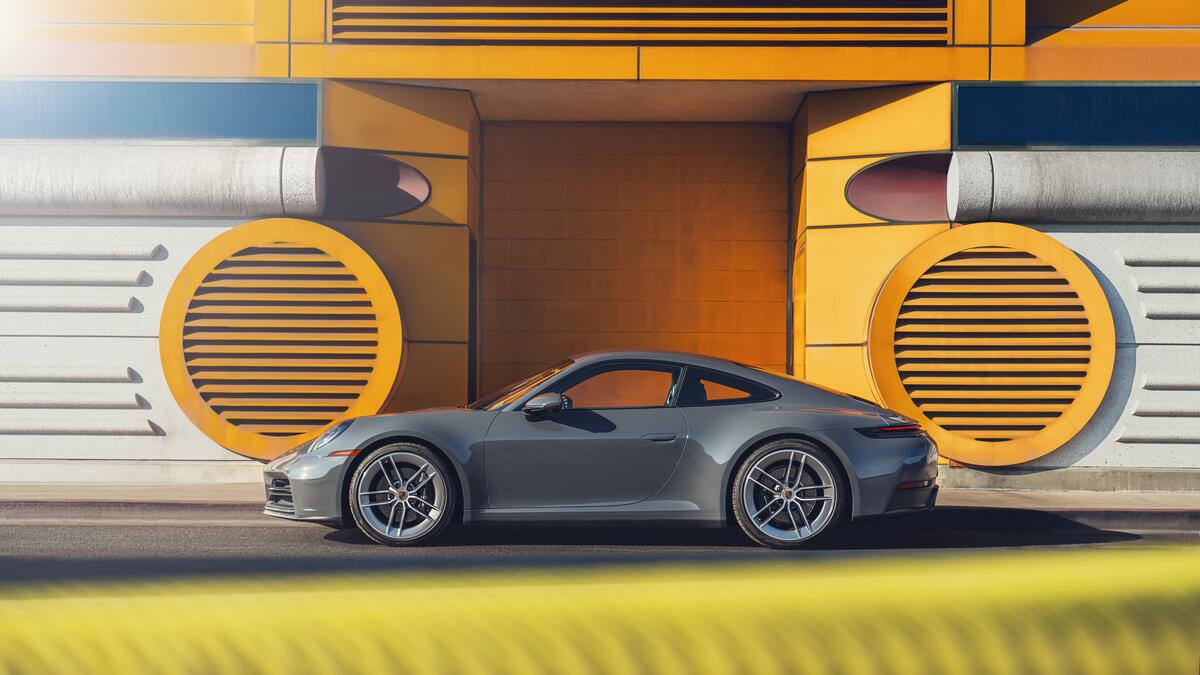
Porsche 911 GT3 RS
"Did it feel like when we first drove the GT3 RS on the road,"
The Porsche 911 GT3 RS is a super track-ready 911. Even though it’s meant for circuits, the hosts are saying it can still feel comfortable and controllable when you drive it on normal roads.
The Porsche 911 GT3 RS is a track-focused version of the 911, built around delivering high grip and predictable handling with a more aggressive aero package. In this segment, the hosts compare how it feels on the road versus a track-oriented setup, highlighting that it can still be usable outside the circuit.
rear wing
"and it's quite wild looking rear wing. [340.6s] But now it felt very similar to a normal GT3"
A rear wing is a spoiler that uses airflow to push the back of the car down. More downforce usually means better grip when you’re cornering fast.
A rear wing is an aerodynamic device mounted at the back that generates downforce by redirecting airflow. On track-oriented cars, it’s often larger and more adjustable, helping keep the car stable and planted through corners.
rear dampers
"You can hear the rear dampers working when you're going over speed bumps and things like that, but it's still got Apple CarPlay"
The rear dampers are the shock absorbers that help the car settle after bumps. If you can hear them working over speed bumps, it means the suspension is actively controlling the rear of the car.
Dampers (shock absorbers) control how quickly the suspension moves after hitting bumps. When the host says you can hear the rear dampers working over speed bumps, they’re describing suspension damping action—how the car manages vertical motion at the rear.
Apple CarPlay
"but it's still got Apple CarPlay, it's still got stereo, it's still, you can have a conversation"
Apple CarPlay lets you connect your iPhone to the car and use apps on the car’s screen. It’s mentioned here to show the car isn’t just track-only.
Apple CarPlay is a smartphone integration system that mirrors compatible iPhone apps onto the car’s infotainment screen. The host mentions it to highlight that even a track-oriented car can still have modern daily-driver tech.
fifth gear
"because I mean, there aren't any slow corners at Thruxton, you're in fifth gear everywhere, pretty much."
Saying you’re in fifth gear a lot means the car is staying in a higher gear because the track is fast. It usually means fewer big gear changes and more steady driving.
“Fifth gear everywhere” is a shorthand for how the track’s speed profile keeps the car in a relatively high gear for most corners. That usually means less frequent downshifting and a stronger emphasis on maintaining speed through the turns.
braided lines
"So they still changed that, they put braided lines and make a few little tweaks, don't they?"
Braided brake lines are brake hoses with extra reinforcement. They help the brake pedal feel more immediate and consistent when you’re braking hard on track. Less “flex” in the line usually means better control.
Braided brake lines are hoses reinforced with a braided material to reduce brake-fluid “sponginess.” That makes pedal feel firmer and can improve consistency under hard track braking. The hosts connect this change to better braking performance and stability during turning.
front dampers
"Yeah, so they're stiffened the front dampers by 20% so it doesn't sort of fall over the front wheel"
Front dampers are the shocks that help the car stay settled over bumps. If they’re stiffer, the front end moves less when you turn in. That can make the car feel more stable on track.
Front dampers are the shock absorbers that control how the front of the car moves over bumps and during steering. Stiffening them can reduce unwanted front-end “fall over” as the car turns in, improving stability and grip consistency. Here, the speaker says the front dampers were stiffened by 20% to help turn-in behavior.
brake pads
"there's an extra option you can have, which is their own brake pads as well, which only work with the ceramic discs,"
Brake pads are the parts that squeeze against the brake rotors to slow the car down. Different pad materials can be better for track use and can be designed to work with certain types of rotors. In this case, the pads are matched to ceramic discs.
Brake pads are the friction material that clamps onto the brake disc to create stopping force. On track cars, pad compounds are often tailored for specific rotor types (like ceramic discs) and for heat range. The hosts mention an “extra option” for their own brake pads that only work with ceramic discs, emphasizing that pad choice is part of the overall braking system design.
ceramic discs
"which only work with the ceramic discs, but they're working on some that work with the regular discs as well for the future."
Ceramic brake discs are special rotors made from ceramic material. They’re designed to handle lots of hard braking without losing effectiveness as quickly. The key point here is that the brake pads have to be matched to the ceramic rotors.
Ceramic brake discs (ceramic rotors) are high-performance rotors made from ceramic materials rather than traditional cast iron. They can offer strong fade resistance for repeated hard braking, which matters on track. The hosts note that certain brake pads only work with ceramic discs, highlighting how brake pad/rotor compatibility affects performance.
brakes still
"But the same on the road, but used to go on the road, those brakes still. And they didn't squeak as well."
Brake fade is when your brakes get less effective after lots of hard stops. They’re saying these brakes stayed strong and didn’t lose stopping power.
“Brake fade” is when braking performance drops after repeated hard use, usually because the brake system overheats. The hosts are saying these brakes didn’t fade, meaning they stayed consistent lap after lap and in demanding conditions.
high performance pads
"You drive some cars with high performance pads and they're horrible and squeaky, this was fine. And you had such a good feel,"
Brake pads are friction materials that clamp to the brake rotor to slow the car. “High performance pads” are designed for stronger bite and better heat tolerance, but they can be noisy (squeal) and may behave differently in wet or stop-and-go driving.
cup two tires
"driving it in torrential rain, really want to have, especially as it was on cup two tires. I can say, so it comes on a cup two,"
“Cup 2” is a type of performance tire made for track use. It’s designed to grip hard, especially when the tire is warmed up, which can make braking and handling feel more consistent.
“Cup 2” refers to Michelin’s Pilot Sport Cup 2 track-focused tire line, known for high grip and strong performance when hot. The hosts are linking the tire choice to braking feel and wet traction, implying the tire compound and construction help the car stay consistent.
cup two R
"I can say, so it comes on a cup two, I guess, that you can have a cup two R. Exactly, yeah."
“Cup 2 R” is a more aggressive version of the Cup 2 tire. It’s meant to give stronger grip for track-style driving, which can improve how the car feels when you’re pushing it.
“Cup 2 R” is a more track-oriented variant within Michelin’s Cup 2 family, typically aimed at even higher grip and faster warm-up for motorsport-style driving. The discussion suggests this tire option (or an equivalent) is part of what makes the car’s braking and wet-road feel impressive.
Bridgestone
"Or the equivalent from Dunlop or Bridgestone or Pirelli, if you want. But yeah, a really impressive bit of kit."
Bridgestone makes tires. They’re saying you can pick a similar type of performance tire from Bridgestone too.
Bridgestone is a tire brand referenced as an alternative source for equivalent track-focused tires. The point is that the performance characteristics they’re praising can be achieved with different brands, not just one specific model.
Pirelli
"Or the equivalent from Dunlop or Bridgestone or Pirelli, if you want. But yeah, a really impressive bit of kit."
Pirelli is a tire brand. They’re saying you can choose similar performance tires from Pirelli as well.
Pirelli is a tire brand mentioned as another option for equivalent track-oriented tires. The hosts are framing tire choice as a key part of the car’s consistent feel, regardless of which brand you choose.
Dunlop
"Or the equivalent from Dunlop or Bridgestone or Pirelli, if you want. But yeah, a really impressive bit of kit."
Dunlop is a tire brand. They’re saying you can get similar “track-style” tires from brands other than Michelin.
Dunlop is a tire brand mentioned as an alternative to Michelin’s Cup 2/R lineup. The hosts are saying you can choose comparable track-oriented tires from other manufacturers depending on availability and preference.
214,000 pounds
"If you just bought a car with no options and put the kit on it, it would be 214,000 pounds, plus fitting, the kit's 56,000."
They’re estimating the total money you’d spend: buy the car without extras, then add the kit and pay to have it installed.
This is the all-in cost estimate for buying a base car with no options and then adding the discussed kit. It’s a “total cost of ownership” style calculation, but specifically about the purchase price plus the kit and fitting.
roll cage
"so things like the Visak pack and the roll cage in the back and sound system, things like that."
A roll cage is a metal safety frame inside the car. It helps protect you in a crash and can also make the car feel more solid when driving hard.
A roll cage is a reinforced metal frame installed inside the cabin to protect occupants in a crash. It also stiffens the chassis, which can improve handling response—especially when a car is being used for track driving.
Manthey
"You only need to either go to one of the Mantar days at the Nürburgring or... I know Mantars are an extension of factories, isn't it?"
Manthey is a well-known motorsport/track-prep name. The hosts are basically saying you’d go to their track events if you want to use the car the “right” way.
Manthey (often associated with Porsche motorsport and track preparation) is referenced here as a track-oriented program/event. In this segment, “Manthey” is tied to using specific cars at the Nürburgring, implying a higher level of preparation and performance focus than casual driving.
carbon fiber discs
"The most outlandish bit of this kit has got the discs on the rear wheels, carbon fiber discs, but like a Porsche 935 or something, they're really eye-catching, but yeah, first one."
Carbon fiber discs are lightweight parts made from carbon fiber that get used on the wheels or around the wheel area. They’re mainly there to make the car look very dramatic, like something from racing.
Carbon fiber discs here refers to wheel-mounted or wheel-cover style pieces made from carbon fiber, used to create a distinctive motorsport look. In the context of the segment, they’re described as especially eye-catching and reminiscent of race-car styling.

Porsche 935
"...ar wheels, carbon fiber discs, but like a Porsche 935 or something, they're really eye-catching, but ye..."
The Porsche 935 is a Porsche race car based on the 911. It was made to compete in motorsport, so it has a very distinctive, attention-grabbing look. People mention it when they want to describe a car that stands out visually.
The Porsche 935 is a race-bred evolution of the 911, built for endurance and competition. It’s known for its aggressive styling and motorsport hardware, which is why it’s described as “eye-catching.” In your excerpt, it’s used as a comparison for how certain cars look and stand out.
engine swaps
"Yeah, Rucketeer, I've engine, back to old engine swaps. Yeah, I loved it, actually."
An engine swap means replacing the car’s original engine with a different one. People do it to change how the car drives—often to make it faster or more fun.
An engine swap is when you remove one engine from a car and install a different engine from another vehicle (or a different model/variant). It’s a common modification approach because it can dramatically change power, feel, and how the car behaves.

Mazda MX-5
"or whether it does just feel like an MX-5 [753.6s] with a big engine in it, but it's such a clever, [760.1s] just a really well-considered package."
The Mazda MX-5 is a small, light sports car that’s fun to drive because it’s not heavy. Here, they’re talking about an MX-5 that’s been modified with a bigger engine, and whether it still feels like an MX-5.
The Mazda MX-5 is a lightweight, front-engine, rear-wheel-drive roadster known for its simple, balanced driving feel. In this segment, the hosts compare an MX-5-based build to a “big engine in it,” which is the key idea behind how Manthey-style tuning can change the car’s character while keeping the proportions.
stage two and a half
"This was a second-gen tone, NB, with a stage two and a half [775.1s] engine, so it's got a few kind of in the middle tweaks"
“Stage” is a way tuners describe how big the upgrade is. “Stage two and a half” means it’s not the smallest upgrade, but also not the most extreme one—more like a middle step.
“Stage” levels are aftermarket tuning tiers that typically correspond to how much hardware and calibration work has been done (for example, intake/exhaust upgrades and engine management changes). “Stage two and a half” implies a build between common stage-two and stage-three levels, aiming for a specific balance rather than the maximum possible setup.
second-gen
"This was a second-gen tone, NB, with a stage two and a half [775.1s] engine, so it's got a few kind of in the middle tweaks"
“Second-gen” just means the second version of that car model. Cars often get redesigned over time, so generation helps you know which one they mean.
“Second-gen” means the second generation of a model line, where the car’s design and engineering are updated compared to the first generation. Here, it’s used to identify which MX-5 generation the speaker is talking about before discussing its specific tuning package.
3.0-litre V6
"but so it's 340 horsepower, for which engine? [788.9s] Little V6, isn't it? [790.8s] Yeah, so it's a wholly overlooked engine, really,"
A “3.0-litre V6” is an engine with six cylinders, shaped like a V, and it’s 3.0 liters total. They’re saying this specific engine is the one that makes the power in the build they’re discussing.
A “3.0-litre V6” is an engine with six cylinders arranged in a V shape, with a total displacement of 3.0 liters. In this segment, the hosts connect that engine choice to the car’s power output and explain why it’s notable despite being used in other brands.
Jaguar
"Yeah, so it's a wholly overlooked engine, really, [793.1s] because it just lived in the front [794.7s] of various stodgy-looking Jags, seemingly."
Jaguar is the car brand they mention as the place this engine was used before. They’re saying the engine didn’t get attention because it was fitted to cars people didn’t associate with performance.
Jaguar is referenced as the brand that used this V6 engine in “stodgy-looking” cars, which is why the engine is described as overlooked. The point is that the same engine can have different reputations depending on which brand and model it’s installed in.
Durotep-based engine
"So it's the 3.0-litre V6, sort of Durotep-based engine, [806.4s] but was originally a Porsche design"
They’re referring to the engine’s original design “family,” like where the basic engineering came from. That helps explain why the same core engine can show up in different cars.
“Durotep-based” refers to the engine’s underlying design family or architecture that the speaker says the 3.0-litre V6 is derived from. This matters because it frames the engine as a known platform that later got adapted across different manufacturers and applications.
Ford
"and then Porsche ran out of money and sold it, [816.5s] and then Ford took the engine on,"
Ford is named as one of the companies that later used the engine design. It’s basically a story about how engine technology can move between brands.
Ford is mentioned as the next company to take the engine after Porsche sold it. This highlights how major manufacturers sometimes share or license engine designs, leading to the same core powerplant appearing in different marque applications.
cylinder head work
"and then Ford took the engine on, [818.4s] and Cosworth did some cylinder head work,"
“Cylinder head work” means changing parts of the top of the engine where valves and combustion happen. Improving it can help the engine breathe better and make more power.
Cylinder head work refers to modifications to the cylinder head, such as porting, valve changes, or combustion-chamber refinements. Because the cylinder head governs airflow and how efficiently fuel burns, it’s a key area for performance tuning.
Cosworth
"and then Ford took the engine on, [818.4s] and Cosworth did some cylinder head work,"
Cosworth is mentioned as the company that modified the engine’s cylinder head. The cylinder head is where the air and fuel enter and where combustion happens, so changes there can boost performance.
Cosworth is described as doing cylinder head work on the engine after Ford took it on. Cylinder head work is a common performance path because it affects airflow and combustion efficiency, which can improve power and drivability.
flat six
"it's got elements of flat six as well, isn't it? But yeah, with some induction noise,"
A flat-six is an engine shape where the cylinders are laid out flat, like two rows facing each other. It can make the engine run smoothly and sound unique.
A flat-six is an engine layout where six cylinders sit horizontally in two banks of three, opposed to each other. This design can help balance vibration and often gives a distinctive sound and smoothness compared with other layouts.
induction noise
"But yeah, with some induction noise, so it sounds a bit like a Snorty 911,"
Induction noise is the sound of air being pulled into the engine. Some cars make that sound louder or more noticeable, which can make the driving feel more exciting.
Induction noise is the sound produced as air is drawn into the engine—often amplified by intake design, throttle response, and sometimes aftermarket intake/exhaust setups. It’s a big part of why some engines feel “alive” even when you’re not pushing hard.
cylinder shorter
"It fits beautifully, because the engine is actually a cylinder shorter. Yeah, of course."
They mean the engine is physically shorter than before. A shorter engine can help fit the car better and can also affect how the car balances and drives.
Saying the engine is “a cylinder shorter” points to a physically shorter engine package—typically achieved by changing engine design so the overall length is reduced. A shorter engine can improve packaging, weight distribution, and how the car fits in the chassis.
carbon cam covers
"It's presented really, really nicely with some proper carbon cam covers, and it's just such a nice thing."
Cam covers are the covers on top of the engine that help keep oil in and protect the engine area. Carbon-fiber versions are lighter and look more special than stock covers.
Cam covers (valve cover/cylinder head covers) protect the top of the engine and help seal oil inside. Using carbon-fiber cam covers is mostly about weight reduction and a distinctive look, and it’s a common “show-and-go” style modification on enthusiast cars.
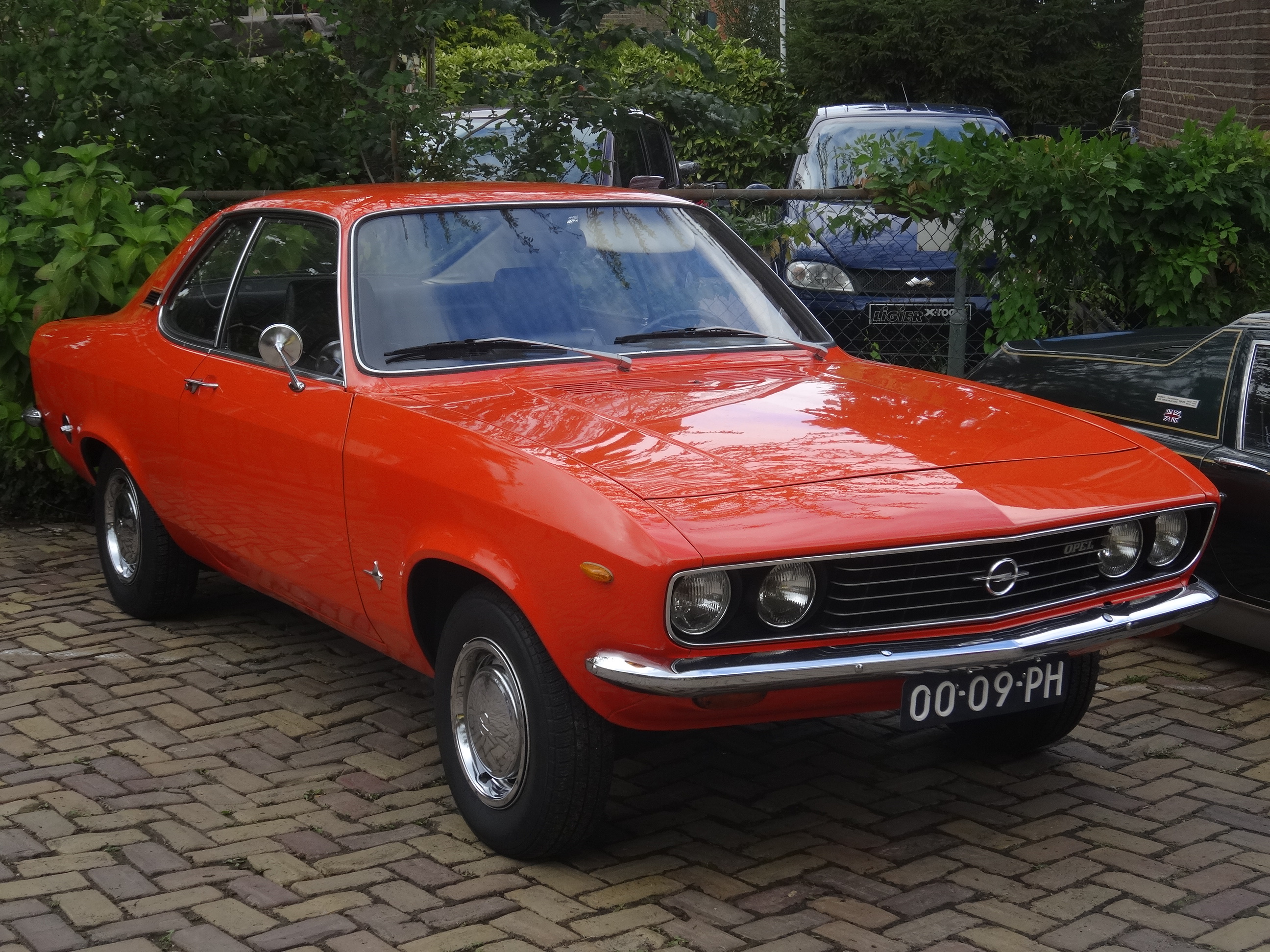
Opel Manta
"...is one didn't have, it was the opposite of James' Manta car, in that they just picked a really freakishly..."
The Opel Manta is a sporty coupe made by Opel. People often remember it for its distinctive styling. In the podcast, it’s being used as a comparison for how one car’s setup or look differs from another.
The Opel Manta is a sporty coupe from Opel that’s often remembered for its bold styling and enthusiast following. In your excerpt, it’s used as a comparison point—specifically noting a “freakishly” chosen characteristic—suggesting the conversation is about how one car’s look or setup contrasts with another. That makes it relevant as a reference for distinctive appearance or personality.
unrestored, unrusty
"in that they just picked a really freakishly original, very, very low miles, unrestored, unrusty MX-5, and then they'd got their own seats..."
They’re saying the car hasn’t been restored and it doesn’t have much rust. That’s a good sign because rust repairs can be costly and sometimes indicate deeper problems.
“Unrestored, unrusty” describes a car that hasn’t been cosmetically rebuilt and doesn’t have significant corrosion. For older enthusiast cars, that matters because rust repair is expensive and can hide underlying structural issues.
Meister R
"So we had some different rims, different dampers, Meister R, I think, which I've never heard of, but I think what Rocker did benefit from..."
Meister R is a suspension brand best known for aftermarket coilovers and dampers used by enthusiasts to tune ride height and handling. In this segment, it’s mentioned as part of the MX-5’s suspension setup.
aftermarket tuning
"but then he also uses probably the best aftermarket kind of resource of tuning parts. I can't think of a car that's had more aftermarket tuning than an MX-5 over the years"
Aftermarket tuning is when you modify a car using parts that aren’t made by the original manufacturer. People do it to make the car feel faster, handle better, or sound different.
Aftermarket tuning means replacing or adding non-factory parts (like intake, exhaust, ECU software, suspension, and brakes) to change how a car performs. It’s often used to increase power, sharpen throttle response, and improve handling beyond what the stock car delivers.
five-speed
"This has five-speed in this one, didn't it? Yeah, it's the same drivetrain, but yeah."
A five-speed refers to a manual transmission with five forward gears. Gear count affects how the engine stays in its power band during acceleration and how relaxed the engine feels at cruising speeds.
drivetrain
"Yeah, it's the same drivetrain, but yeah. And it can take the extra grunt."
The drivetrain is everything that sends power from the engine to the wheels. If the tuner keeps the same drivetrain, it means they think it can survive the extra power.
Drivetrain is the set of components that deliver power from the engine to the wheels, including the transmission and driveshafts. When tuners keep the same drivetrain, they’re betting it can handle the added engine output.
torque
"it's not massively torquey. I mean, it's like 250 foot-pounds or something, so it's not completely overwhelmed"
Torque is the force that makes the car pull. Higher torque usually helps with acceleration, especially from lower speeds.
Torque is the engine’s twisting force that strongly influences how hard the car accelerates, especially at lower RPMs. The speaker contrasts the car’s torque level with how it feels, noting it isn’t “massively torquey,” so it isn’t overwhelmed.
RPM
"so it gives its performance when you rev. It revs to 8,000 RPM, so it just feels right."
RPM tells you how fast the engine is spinning. If it can rev to around 8,000 RPM, it usually means it’s happy working at higher engine speeds.
RPM (revolutions per minute) measures how fast the engine spins. Revving to around 8,000 RPM indicates the engine is designed to make power higher in the rev range, which can create a more “eager” sports-car feel.
Rocketeer
"So do you buy finished cars from Rocketeer [1013.5s] or can you take your own and have it? [1015.6s] You can do both, so I think they've done,"
Rocketeer is a company that helps you build a car. They can either sell you a kit to convert your own car, or they can build a complete car for you.
Rocketeer is mentioned as a company that supplies finished cars and also sells conversion kits. In this segment, they’re described as doing engine conversions and potentially offering turnkey builds where they source and restore a base car.
engine-converted cars
"well, there are about 180 Rocketeer engine-converted cars, [1031.2s] but they've sold quite a few as conversion kits,"
An engine-converted car is one where the engine has been changed from the original. It can be done as a full completed build or as a kit you install yourself.
Engine-converted cars are vehicles that have been modified so they use a different engine than they originally came with. The segment frames Rocketeer’s experience as having supplied many of these conversions, either as completed cars or as kits.
conversion kits
"well, there are about 180 Rocketeer engine-converted cars, [1031.2s] but they've sold quite a few as conversion kits,"
A conversion kit is a set of parts meant to modify a car in a specific way. In this case, it’s for converting the car to use a different engine.
Conversion kits are packaged parts and components intended to change a car’s configuration—here, to install a different engine. They typically include the hardware needed for mounting and integration, and may be sold alongside guidance for the conversion process.
engine transplant
"so you basically get a great engine [1037.0s] with all the kind of bracketry and subframe changes [1041.4s] and the things to give it that engine transplant,"
An engine transplant means putting a different engine into a car. It’s not just swapping parts—there’s usually extra work needed to make everything fit and work together.
An engine transplant is the process of removing one engine from a car and installing a different engine. It usually requires custom fabrication and engineering work so the new engine fits, mounts correctly, and can be integrated with the car’s systems.
subframe changes
"with all the kind of bracketry and subframe changes [1041.4s] and the things to give it that engine transplant,"
Subframe changes mean adjusting the car’s metal structure that supports key components. When you swap an engine, the mounting points may not match, so the subframe may need modification.
Subframe changes refer to modifying the car’s structural mounting framework that the engine and drivetrain components attach to. For an engine conversion, the subframe often needs alterations so the new engine’s mounting points line up and the car’s geometry and strength remain correct.
turnkey cars
"but they are looking at doing more turnkey cars, [1050.3s] so you can ask them to source a base car fully, [1056.6s] like just blast the shell, completely restore the shell,"
A turnkey car is a fully completed vehicle you can buy ready to use, rather than a project where you do the work yourself. Here, it includes sourcing a base car, restoring the shell, painting, trimming, and then combining it with the chosen engine tune.
blast the shell
"so you can ask them to source a base car fully, [1056.6s] like just blast the shell, completely restore the shell, [1059.8s] paint it to your color, trim it to your trim,"
“Blast the shell” means cleaning the car body down to bare metal by blasting off old paint and coatings. It’s a common step before repainting and restoration.
“Blast the shell” refers to abrasive blasting of the car’s bare body shell to strip old paint and coatings. It’s commonly used before restoration and repainting so the new paint can adhere properly and rust/imperfections can be addressed.

Ford Capri
"...n MX-5, but if you, I mean, John will know with a capri, but at any kind of paint job or, you know."
The Ford Capri is a sporty-looking Ford coupe. It was made in different versions over the years. In your podcast context, it’s being mentioned because of how it can look with different paint or styling.
The Ford Capri is a sporty coupe that was produced in multiple generations, often associated with affordable performance and styling. In the context you shared, it’s brought up in relation to paint jobs and appearance details. That makes it a useful reference when discussing how certain cars look after customization.
project
"so the minimum price they now charge [1234.1s] for a project is £430,000. [1237.4s] Does that include a car?"
A “project” is a bigger custom job than normal repairs—usually a build or restoration. They’re talking about what it costs and what kind of starting cars the shop prefers.
In enthusiast circles, a “project” usually means a custom or restoration build where the shop does significant work beyond routine maintenance. Here, the speaker discusses the minimum price for a project and how the shop chooses what kind of base cars to work on.
donor car
"Does that include a car? [1238.5s] It does not include the donor car. [1239.6s] Does that include the house and the garage to park in?"
A donor car is the “starting” car that gets taken apart or used as the base for a project. The point here is that the project cost doesn’t include buying that starting car.
A donor car is the original vehicle you buy and then use as the parts/source platform for a build. In this case, the speaker clarifies that the quoted project price doesn’t include the donor car, and you either provide it or the shop sources one for you.
tired cars
"They try and choose, sort of, tired cars to work on, [1252.8s] rather than the pristine ones. [1254.5s] Well, I did wonder if there's any original ones there."
“Tired cars” means cars that are worn out or not very fresh—more used and less perfect. The idea is that the shop prefers those as starting points because they’re usually cheaper than pristine cars.
“Tired cars” is enthusiast shorthand for vehicles that are worn out or not in great condition—often with higher mileage, age-related wear, or mechanical issues. The speaker says the business tries to choose these tired cars to work on instead of pristine ones, likely because they’re cheaper and still workable as donor bases.
Porsche 964 Carrera II
"and you can convert your singer back to an elephant-eared 964 Carrera II with that design, 90 wheels. I mean, it was a lovely thing,"
This is a Porsche 911 from the 964 generation. “Carrera II” means it drives the rear wheels, not all four.
The Porsche 964 Carrera II is the 911 generation from the late 1980s/early 1990s, and “Carrera II” specifically denotes rear-wheel drive. It’s a popular enthusiast baseline because it sits in the classic 911 shape while introducing more modern 964-era refinements.
man-hours
"and you get 6,000 man-hours of work and so on, but yeah, it's not a small amount of money. Yeah, and that's 100,000 power, MX-5 look reasonable."
“Man-hours” means labor time. It’s basically how many hours of human work the job takes, and that strongly affects the price.
“Man-hours” is a measure of labor time—how many hours of work it takes one person (or the equivalent total across multiple people). In restoration and custom builds, man-hours are a major driver of cost because skilled work is expensive.

Bentley Continental GTS
"So, that's the Martin DB12S and Bentley Continental GTS. So, the Bentley... Kind of rivals, aren't they? Kind of rivals. The Bentley's is the lower..."
This is a Bentley grand tourer meant for fast, long-distance driving. In the episode, they’re comparing it to a quicker Bentley version and saying it uses similar underpinnings (the car’s setup) but with a different performance level.
The Bentley Continental GTS is a grand tourer focused on high-speed comfort and performance, and in this discussion it’s specifically framed as a “performance hybrid.” The host contrasts its power output and positioning versus the faster Continental Speed, while also noting it shares chassis technology with that higher-spec model.
performance hybrid
"So, it's the performance hybrid, not the ultra performance at 630, 40 horsepower,"
A “performance hybrid” is a hybrid car where the battery and electric motor are set up to help the car feel quicker. It’s not only about saving fuel—it’s about adding power when you need it.
A “performance hybrid” is a hybrid powertrain tuned to deliver stronger acceleration and higher power output than a typical efficiency-focused hybrid. In this discussion, it’s used to describe how the Bentley Continental GTS’s hybrid system is calibrated for driving feel and speed rather than just fuel economy.
chassis tech
"but it's got all of the chassis tech from the Speed, which, as you know from that group test you did with the DB12 and the Maserati last year."
“Chassis tech” refers to the engineering in the car’s structure and running gear—things like suspension design, geometry, and how the car is tuned to behave. Here, the host says the Continental GTS has “all of the chassis tech” from the higher-spec Speed, implying shared handling hardware and calibration.
geometry
"But they've kind of gone through the car back to front on the whole geometry and chassis setup."
In suspension tuning, “geometry” describes the angles and relationships of suspension components (like camber, toe, and steering/suspension linkage behavior). The host says the DB12S has been reworked “back to front” on geometry and chassis setup, meaning the handling characteristics were revised rather than just the engine tune.

Aston Martin Vantage S
"It looks quite different, doesn't it? Versus the Vantage S. Yes, so they look different."
The Aston Martin Vantage S is a sportier version of the Vantage. Here, they’re basically saying its steering feel and responsiveness are tuned differently than other Aston models.
The Aston Martin Vantage S is a performance-focused version of the Vantage, aimed at delivering sharper steering and more driver feedback than a more grand-touring setup. In this segment, the hosts compare its feel to other Aston models, highlighting how steering weight and response can differ between trims.
Aston Martin DBX707S
"So, Vantage S and DBX707S, they were already at quite the top of what they can do with them, whereas DB12, they had a much broader sort of envelope to play with."
The Aston Martin DBX707S is a more powerful, sport-tuned version of the DBX SUV. They’re saying it’s already pushed pretty far, so there’s less room left for further tuning than on the DB12.
The Aston Martin DBX707S is a high-output, sport-tuned variant of the DBX SUV line. The segment frames it as already near the limit of what Aston can extract from that platform, compared with the newer DB12’s wider range for chassis and software changes.
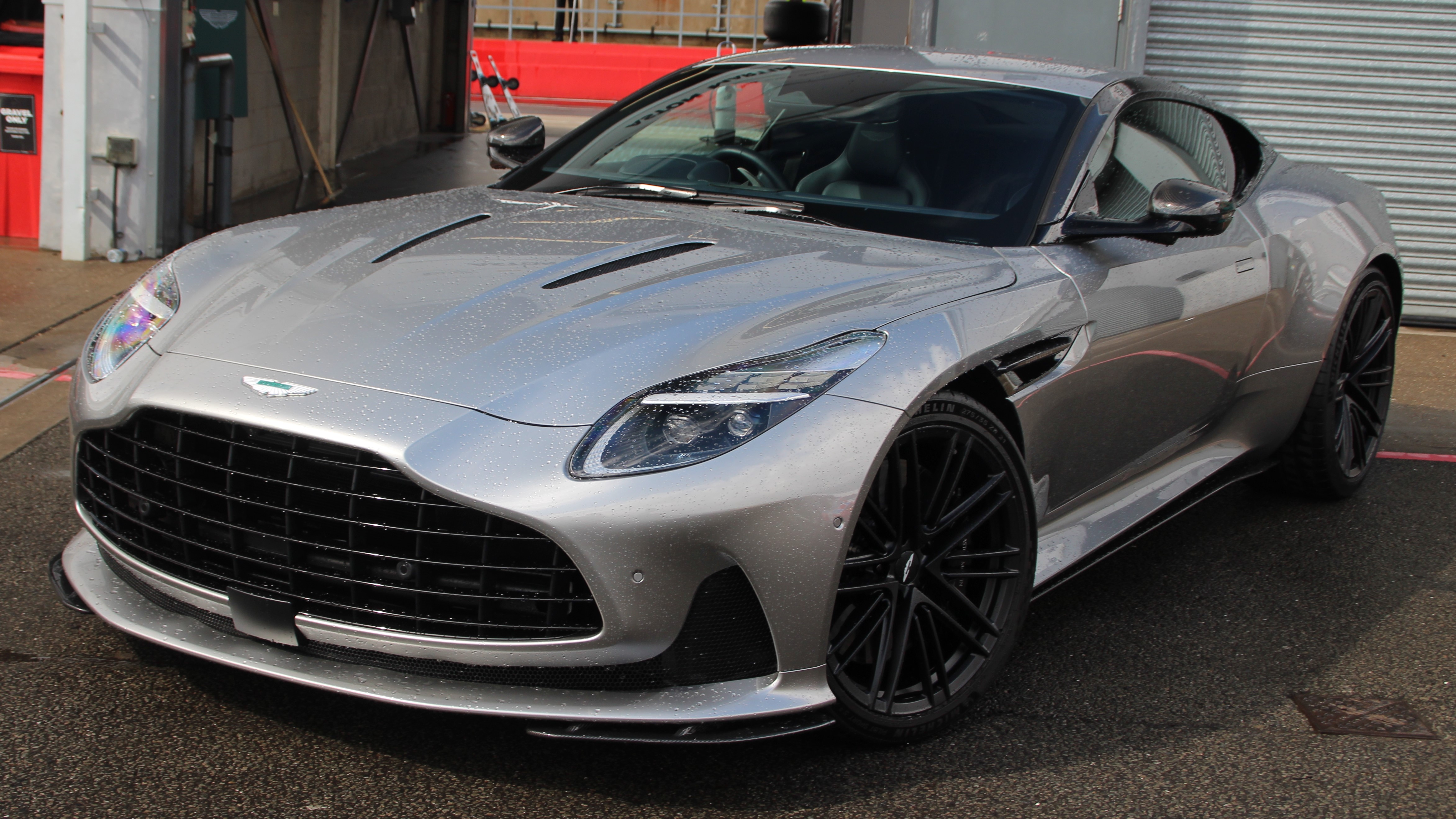
Aston Martin DB12
"whereas DB12, they had a much broader sort of envelope to play with. So, they've gone through the car, as I say, nose to toe of a lot of chassis tweaks... Because I had this damper in there to try and get the self-centering effect. So, they've just taken it out."
The Aston Martin DB12 is a luxury performance car. In this part, they’re talking about how the steering and handling were adjusted with both hardware and software, including removing a component meant to make the steering wheel return to center more naturally.
The Aston Martin DB12 is a grand tourer (GT) that’s being discussed here in terms of chassis tuning and steering feel. The hosts describe how Aston made “nose to toe” chassis tweaks and used software changes—then removed a damper-related setup that was intended to create a self-centering steering effect.
e-pass
"A lot of it is software from changing the e-pass and taking out the..."
“E-pass” sounds like an electronic system that helps the steering feel lighter or heavier. If you change it, the steering can respond differently and feel more or less precise.
“E-pass” here refers to an electronic power-assist system used to control steering effort. Changing it can alter steering weight and the way the car reacts to driver inputs, which is why it’s mentioned alongside steering feel and software updates.
self-centering effect
"Because I had this damper in there to try and get the self-centering effect. So, they've just taken it out."
The self-centering effect is how the steering wheel wants to straighten itself after you turn. If it’s tuned well, the car feels easier to drive and more predictable.
The self-centering effect is the tendency of a steering system to return the wheel toward center after you turn. It’s influenced by suspension geometry, steering assist, and damping components, and it strongly affects how “natural” steering feels at speed and during corner exit.
steering
"which gives them much clearer sort of lines [1490.8s] of communication for the steering and it is fantastic."
Steering communication is how clearly the car tells you what the tires are doing. When it’s good, you can feel changes in grip and cornering more easily.
In performance driving, steering “communication” refers to how clearly the car relays information about grip and load through the steering wheel. Better communication usually comes from chassis setup and tire behavior working together, so the driver can predict what the car will do next.
tyres are doing more work
"There's more... [1524.3s] The tyres are doing more work. [1526.4s] There's more of a footprint on the road [1528.0s] for the tyres on this car."
They’re saying the tires are doing a bigger share of the job of keeping the car stable and turning. With better setup, the car can feel more connected and controlled instead of just feeling like it’s grabbing.
When the hosts say the tires are “doing more work,” they mean the tires are being used more effectively to generate grip and manage the car’s forces. That often comes from better suspension tuning and tire contact, so the car feels more communicative rather than just “grip, grip, grip.”
footprint on the road
"The tyres are doing more work. [1526.4s] There's more of a footprint on the road [1528.0s] for the tyres on this car."
The footprint is where the tire actually touches the road. If the car setup helps the tire sit more evenly, you get better grip and the steering feels more accurate.
A tire’s “footprint” is the portion of the tread that contacts the road. More effective contact (often from suspension geometry and compliance) can improve grip consistency and steering feel because the tire can work over a larger, more stable contact patch.
body control
"so that they're working much better with the body control. [1535.9s] It's just really, really good."
Body control is how well the car keeps itself composed when you’re driving hard—less leaning and bouncing. When it’s good, the tires stay planted and the car feels more predictable.
Body control is how effectively a car manages its body motions—like roll, pitch, and squat—especially during braking, acceleration, and cornering. Better body control usually means the suspension keeps the tires working consistently, improving grip and steering feel.

Aston Martin DBX S
"It's just all these incremental changes which what they did were done with Vantage S and the DBX S but you just notice it more because it is the first of that new current family of Aston Martins"
The Aston Martin DBX S is a sportier, more powerful version of Aston Martin’s DBX SUV. They bring it up to show the same “incremental improvements” were happening across the brand.
The Aston Martin DBX S is a higher-performance version of Aston Martin’s DBX luxury SUV. Here, it’s referenced alongside the Vantage S to illustrate that Aston Martin’s improvements came through step-by-step updates across multiple models.
GT mode
"but I actually think it's a better GT car because when it's in just GT mode, it's much calmer, more fluid, more sort of smooth."
GT mode is a “grand touring” driving setting. It’s meant to make the car feel calmer and smoother for longer, relaxed driving.
GT mode is a driving setting that prioritizes smoothness and composure over maximum sharpness. In practice, it typically changes how the car responds (throttle mapping, shift behavior, and steering feel) to make it easier to drive at steady speeds.
Sport Plus
"and then when it's in Sport or Sport Plus, it's more precise, less hyperactive, but more enjoyable."
Sport Plus is a driving mode that makes the car respond more aggressively. In this case, the host says it feels sharper but also more controlled, not jumpy.
“Sport Plus” is a drive-mode setting that typically sharpens throttle response, steering feel, and transmission behavior to make the car react more quickly. The speaker says it becomes “more precise” and “less hyperactive,” meaning the mode changes the car’s control calibration to feel calmer while still being more engaging.
GT
"So does it get it closer to the Bentley in terms of as a GT... It's a much stronger GT car..."
GT means “grand touring.” It’s about a car that’s comfortable and confident for long, fast drives—not just a car that’s exciting at the limit.
“GT” stands for grand touring, a style of car focused on comfortable, composed high-speed driving over long distances. The speaker uses it to describe how close the car’s behavior is to Bentley’s GT character—more refined and controlled than a purely sporty setup.

Conti GT
"it just seems to bring more out of that Conti GT with the rear wheel steering, the diff."
“Conti GT” refers to Bentley’s Continental GT. It’s a luxury grand tourer, and the host is saying the changes they’re talking about make it feel even better and more capable.
“Conti GT” is shorthand for the Bentley Continental GT, a grand touring model known for combining comfort with strong performance. Here, the speaker says the discussed car setup “brings more out of” the Continental GT by improving steering/traction behavior and suspension/damper effectiveness.
air springs
"the suspension set up, the damper set up on the air springs, it just works much better..."
Air springs are suspension supports that use air pressure. Because they can be tuned, they can help the car ride smoothly and stay composed when you drive harder.
Air springs use compressed air instead of steel coils to support the vehicle, allowing ride height and spring stiffness to be adjusted. The speaker says the damper setup on the air springs is part of why the car “works much better,” improving control and ride behavior.
damper set up
"the suspension set up, the damper set up on the air springs, it just works much better..."
Dampers are the shock absorbers that control how the car moves over bumps. Tuning them changes how steady and controlled the car feels.
A “damper set up” refers to how the shock absorbers are tuned to control body motion—how quickly the suspension compresses and rebounds. The speaker links damper tuning (especially with air springs) to better grip and more predictable road feel.
dynamics
"It is all in what they've done with the dynamics [1729.1s] and for such huge cars in the Bentley 2,400."
Dynamics is how the car acts when you’re driving—turning, stopping, and responding to your inputs. It’s more about the “feel” and control than just engine power.
Dynamics refers to how a car behaves in motion—how it accelerates, brakes, turns, and responds to steering. It’s often used to summarize tuning choices like suspension setup, steering feel, and traction behavior rather than just raw power.
lag
"Yeah, there's a bit of lag, isn't it? [1735.4s] Yeah, crazy. [1736.1s] But it just makes it..."
Lag means there’s a short delay before the car really responds when you put your foot down. It can make acceleration feel less immediate.
Lag is the delay between pressing the accelerator and getting the expected response from the engine or turbo system. It often comes up with turbocharged setups, where boost builds after a brief wait, affecting how quickly the car feels like it’s accelerating.
Isle of Man driving
"So we drove it on the Isle of Man, [1745.6s] where it's very tight and twisty [1748.3s] and off the mounting course"
They’re talking about how the car feels on the Isle of Man, where the roads are narrow and curvy. That kind of route makes it easier to judge how precise and easy the car is to drive.
The hosts discuss driving the car on the Isle of Man, emphasizing tight, twisty roads and how that kind of route tests precision and control. This is a driving-context segment rather than a technical deep dive.
tight and twisty
"where it's very tight and twisty [1748.3s] and off the mounting course"
“Tight and twisty” means lots of close turns with not much straight driving. Cars that feel accurate and stable in corners tend to do well there.
“Tight and twisty” describes roads with frequent, closely spaced corners and limited straight-line distance. That environment highlights steering response, braking consistency, and traction management more than top speed.
software tuning
"Well, there's a lot of the software tuning on the Conti GTS isn't just taken from the speed. There's also learnings from SuperSport,"
Software tuning means changing how the car’s computer controls things like power delivery and driving modes. The hosts are saying the tuning here was developed using track experience from more than one source.
Software tuning is adjusting a car’s control systems—like throttle response, shift logic, traction/drive modes, and other calibration parameters—to change how the car behaves. In this segment, the hosts emphasize that tuning can be informed by multiple track programs, not just one set of performance data.
Request an Explanation
Heard something you'd like explained? We'll add it to this episode.
Sign in to request explanations for terms you heard.
Want to learn more?
Browse our glossary for plain-English explanations of automotive terms, jargon, and concepts.
Help improve this episode
See something that's not quite right? Our annotations are AI-generated and can sometimes miss the mark. Click the flag icon on any annotation to suggest a correction.